talk: Improving Password Security and Usability with Data-Driven Approaches, 3/11

Improving Password Security and Usability with Data-Driven Approaches
Blase Ur, CMU
12:30pm Friday, 11 March 2016, ITE325b
Users often must make security and privacy decisions, yet are rarely equipped to do so. In my research, I aim to understand both computer systems and the humans who use them. Armed with this understanding, I design and build tools that help users protect their security and privacy.
In this talk, I will describe how I applied this research approach to password security and usability. As understanding what makes a password good or bad is crucial to this process, I will first discuss our work on metrics for password strength. These metrics commonly involve modeling password cracking, which we found often vastly underestimates passwords’ vulnerability to cracking in the real world. We instead propose combining a series of carefully configured approaches, which we found to conservatively model real-world experts. We used these insights to implement a Password Guessability Service, which is already used by nearly two dozen research groups. I will then discuss our work on another key step to helping users create better passwords: understanding why humans create the passwords they do. I will focus on the impact of password-strength meters and users’ perceptions of password security. By combining better metrics with an understanding of users, I show how we can design tools that guide users toward better passwords.
Blase Ur is a Ph.D. candidate at Carnegie Mellon University’s School of Computer Science, where he is advised by Lorrie Cranor. His research interests lie at the intersection of security, privacy, and human-computer interaction (HCI). In addition to his work on password security, he has studied numerous aspects of online privacy and the Internet of Things (IoT). Previously, he obtained his A.B. in Computer Science from Harvard University. He is the recipient of an NDSEG fellowship, a Fulbright scholarship, a Yahoo Key Scientific Challenges Award, the best paper award at UbiComp 2014, and honorable mentions for best paper at both CHI 2012 and CHI 2016.
]]>
Improving Password Security and Usability with Data-Driven Approaches Blase Ur, CMU 12:30pm Friday, 11 March 2016, ITE325b Users often must make security and privacy decisions, yet are...
http://www.csee.umbc.edu/2016/03/talk-improving-password-security-and-usability-with-data-driven-approaches/
https://my3.my.umbc.edu/api/v0/pixel/news/58492/guest@my.umbc.edu/8662ae6a6344d590e9ec66ddf763b095/api/pixel
computer-science
cybersecurity
news
talks
Computer Science and Electrical Engineering
https://my3.my.umbc.edu/groups/csee
https://assets3-my.umbc.edu/system/shared/avatars/groups/000/000/099/d117dca133c64bf78a4b7696dd007189/xsmall.png?1314043393
https://assets1-my.umbc.edu/system/shared/avatars/groups/000/000/099/d117dca133c64bf78a4b7696dd007189/original.png?1314043393
https://assets1-my.umbc.edu/system/shared/avatars/groups/000/000/099/d117dca133c64bf78a4b7696dd007189/xxlarge.png?1314043393
https://assets4-my.umbc.edu/system/shared/avatars/groups/000/000/099/d117dca133c64bf78a4b7696dd007189/xlarge.png?1314043393
https://assets3-my.umbc.edu/system/shared/avatars/groups/000/000/099/d117dca133c64bf78a4b7696dd007189/large.png?1314043393
https://assets1-my.umbc.edu/system/shared/avatars/groups/000/000/099/d117dca133c64bf78a4b7696dd007189/medium.png?1314043393
https://assets2-my.umbc.edu/system/shared/avatars/groups/000/000/099/d117dca133c64bf78a4b7696dd007189/small.png?1314043393
https://assets3-my.umbc.edu/system/shared/avatars/groups/000/000/099/d117dca133c64bf78a4b7696dd007189/xsmall.png?1314043393
https://assets3-my.umbc.edu/system/shared/avatars/groups/000/000/099/d117dca133c64bf78a4b7696dd007189/xxsmall.png?1314043393
Computer Science and Electrical Engineering
0
0
true
Tue, 08 Mar 2016 19:00:41 -0500
Tue, 08 Mar 2016 19:00:41 -0500
talk: To Measure or not to Measure Terabyte-Sized Images? 3pm 3/9
CHMPR Seminar
To Measure or not to Measure Terabyte-Sized Images?
Peter Bajcsy, PhD
Information Technology Laboratory
National Institute for Standards and Technology
3:00pm Wednesday, 9 March 2016, ITE325b, UMBC
This talk will elaborate on a basic question “To Measure or Not To Measure Terabyte-Sized Images?” posed by William Shakespeare if he were a bench scientist at NIST. This basic question is a dilemma for many traditional scientists that operate imaging instruments capable of acquiring very large quantities of images. However, manual analyses of terabyte-sized images and insufficient software and computational hardware resources prevent scientists from making new discoveries, increasing statistical confidence of data-driven conclusions, and improving reproducibility of reported results.
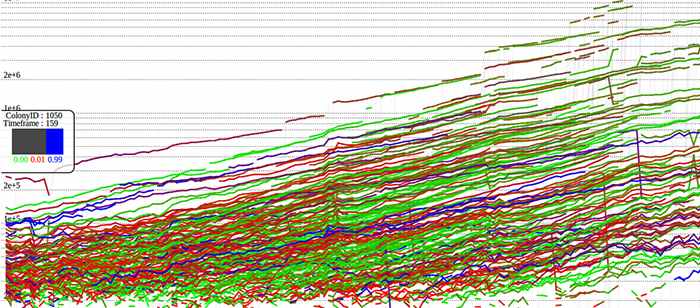
The motivation for our work comes from experimental systems for imaging and analyzing human pluripotent stem cell cultures at the spatial and temporal coverages that lead to terabyte-sized image data. The objective of such an unprecedented cell study is to characterize specimens at high statistical significance in order to guide a repeatable growth of high quality stem cell colonies. To pursue this objective, multiple computer and computational science problems have to be overcome including image correction (flat-field, dark current and background), stitching, segmentation, tracking, re-projection, feature extraction, data-driven modeling and then representation of large images for interactive visualization and measurements in a web browser.
I will outline and demonstrate web-based solutions deployed at NIST that have enabled new insights in cell biology using TB-sized images. Interactive access to about 3TB of image and image feature data is available at https://isg.nist.gov/deepzoomweb/.
Peter Bajcsy received his Ph.D. in Electrical and Computer Engineering in 1997 from the University of Illinois at Urbana-Champaign and a M.S. in Electrical and Computer Engineering in 1994 from the University of Pennsylvania. He worked for machine vision, government contracting, and research and educational institutions before joining the National Institute of Standards and Technology in 2011. At NIST, he has been leading a project focusing on the application of computational science in biological metrology, and specifically stem cell characterization at very large scales. Peter’s area of research is large-scale image-based analyses and syntheses using mathematical, statistical and computational models while leveraging computer science fields such as image processing, machine learning, computer vision, and pattern recognition. He has co-authored more than more than 27 journal papers and eight books or book chapters, and close to 100 conference papers.
]]>
CHMPR Seminar To Measure or not to Measure Terabyte-Sized Images? Peter Bajcsy, PhD Information Technology Laboratory National Institute for Standards and Technology 3:00pm Wednesday, 9...
http://www.csee.umbc.edu/2016/03/measure-terabyte-images-bajcsy/
https://my3.my.umbc.edu/api/v0/pixel/news/58396/guest@my.umbc.edu/3e4f7bd3497343c91210822033ecaafe/api/pixel
computer-science
data-science
news
research
talks
Computer Science and Electrical Engineering
https://my3.my.umbc.edu/groups/csee
https://assets3-my.umbc.edu/system/shared/avatars/groups/000/000/099/d117dca133c64bf78a4b7696dd007189/xsmall.png?1314043393
https://assets1-my.umbc.edu/system/shared/avatars/groups/000/000/099/d117dca133c64bf78a4b7696dd007189/original.png?1314043393
https://assets1-my.umbc.edu/system/shared/avatars/groups/000/000/099/d117dca133c64bf78a4b7696dd007189/xxlarge.png?1314043393
https://assets4-my.umbc.edu/system/shared/avatars/groups/000/000/099/d117dca133c64bf78a4b7696dd007189/xlarge.png?1314043393
https://assets3-my.umbc.edu/system/shared/avatars/groups/000/000/099/d117dca133c64bf78a4b7696dd007189/large.png?1314043393
https://assets1-my.umbc.edu/system/shared/avatars/groups/000/000/099/d117dca133c64bf78a4b7696dd007189/medium.png?1314043393
https://assets2-my.umbc.edu/system/shared/avatars/groups/000/000/099/d117dca133c64bf78a4b7696dd007189/small.png?1314043393
https://assets3-my.umbc.edu/system/shared/avatars/groups/000/000/099/d117dca133c64bf78a4b7696dd007189/xsmall.png?1314043393
https://assets3-my.umbc.edu/system/shared/avatars/groups/000/000/099/d117dca133c64bf78a4b7696dd007189/xxsmall.png?1314043393
Computer Science and Electrical Engineering
0
0
true
Sun, 06 Mar 2016 16:18:21 -0500
Sun, 06 Mar 2016 16:18:21 -0500
UMBC Grand Challenges Scholars Program, apply by 3/25
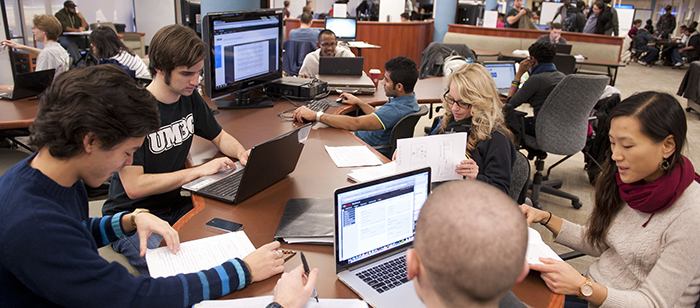
The UMBC Grand Challenges Scholars Program engages students from all majors who want to help solve important problems facing society. It is organized around a fourteen Grand Challenges identified by the National Academy of Engineering with a focus on sustainability, health, security and knowledge. Their solutions will require interdisciplinary teams and years of sustained effort. The national program combines curricular and extra-curricular program with five components that are designed to prepare students to be the generation that solves the grand challenges facing society in this century.
A UMBC Grand Challenge Scholar will design a personalized program to explore a selected Grand Challenge. The program areas include research, interdisciplinary study, entrepreneurship, global perspectives, and service. UMBC Grand Challenge Scholars will receive formal designation at graduation for their accomplishments. The program is designed for students completing their sophomore year, but all students may apply. Get more information here and apply online to become a UMBC Grand Challenge Scholar by March 25.
Find out more about the UMBC Grand Challenges Scholars Program from Prof. Marie desJardins this Tuesday, March 8, from 12-1pm (pizza provided!) or Thursday, March 10, from 4-5pm (snacks provided!), in ITE 325b.
]]>
The UMBC Grand Challenges Scholars Program engages students from all majors who want to help solve important problems facing society. It is organized around a fourteen Grand Challenges identified...
http://www.csee.umbc.edu/2016/03/umbc-grand-challenges-scholars-program-apply-by-325/
https://my3.my.umbc.edu/api/v0/pixel/news/58387/guest@my.umbc.edu/3660a67ae4e07e94fd3da665edfb1803/api/pixel
computer-engineering
computer-science
cybersecurity
data-science
news
research
students
undergraduate
Computer Science and Electrical Engineering
https://my3.my.umbc.edu/groups/csee
https://assets3-my.umbc.edu/system/shared/avatars/groups/000/000/099/d117dca133c64bf78a4b7696dd007189/xsmall.png?1314043393
https://assets1-my.umbc.edu/system/shared/avatars/groups/000/000/099/d117dca133c64bf78a4b7696dd007189/original.png?1314043393
https://assets1-my.umbc.edu/system/shared/avatars/groups/000/000/099/d117dca133c64bf78a4b7696dd007189/xxlarge.png?1314043393
https://assets4-my.umbc.edu/system/shared/avatars/groups/000/000/099/d117dca133c64bf78a4b7696dd007189/xlarge.png?1314043393
https://assets3-my.umbc.edu/system/shared/avatars/groups/000/000/099/d117dca133c64bf78a4b7696dd007189/large.png?1314043393
https://assets1-my.umbc.edu/system/shared/avatars/groups/000/000/099/d117dca133c64bf78a4b7696dd007189/medium.png?1314043393
https://assets2-my.umbc.edu/system/shared/avatars/groups/000/000/099/d117dca133c64bf78a4b7696dd007189/small.png?1314043393
https://assets3-my.umbc.edu/system/shared/avatars/groups/000/000/099/d117dca133c64bf78a4b7696dd007189/xsmall.png?1314043393
https://assets3-my.umbc.edu/system/shared/avatars/groups/000/000/099/d117dca133c64bf78a4b7696dd007189/xxsmall.png?1314043393
Computer Science and Electrical Engineering
4
1
true
Sun, 06 Mar 2016 10:09:32 -0500
Sun, 06 Mar 2016 10:09:32 -0500
talk: Automated Privacy Policy Compliance, 11:30 Mon 3/7

Automated Privacy Policy Compliance
Dr. Omar Chowdhury, Purdue University
11:30am Monday, 7 March 2016, ITE325b, UMBC
Privacy regulations often govern data sharing and data use practices of organizations that collect personally identifiable information from their clients. For instance, in the US, healthcare organizations must comply with the federally mandated Health Insurance Portability and Accountability Act (HIPAA). Monetary penalties for non-compliance are high. The current practice of manual auditing for privacy violation is error-prone, cumbersome, and it does not scale well. It is thus crucial for the research community to develop automated tools and techniques to aid organizations in checking privacy policy compliance.
Within this context, I will first present encryption schemes that enable an organization to outsource the storage of audit logs and the computation of compliance checking to an untrusted cloud without completely giving up on privacy. Next, I will present an efficient compliance checker called précis, which leverages techniques from runtime verification and logic programming. Finally, I will conclude with a discussion of some remaining obstacles to practical deployment.
Omar Chowdhury is a Post-Doctoral Research Associate in the Department of Computer Science at Purdue University. Before joining Purdue, he was a Post-Doctoral Research Associate in Cylab at Carnegie Mellon University. He received his Ph.D. in Computer Science from the University of Texas at San Antonio. His research interest broadly lies in investigating practically relevant problems of Computer Security and Privacy. His current research focuses on leveraging formal verification and program analysis techniques to check compliance of a system implementation, against well-defined policies and properties. He won the best paper award at the ACM SACMAT’2012. He has also served as a program committee member of ACM SACMAT and ACM CCS.
host: Tim Finin, Sorry, you need javascript to view this email address.
]]>
Automated Privacy Policy Compliance Dr. Omar Chowdhury, Purdue University 11:30am Monday, 7 March 2016, ITE325b, UMBC Privacy regulations often govern data sharing and data use practices of...
http://www.csee.umbc.edu/2016/03/automated-privacy-policy-compliance/
https://my3.my.umbc.edu/api/v0/pixel/news/58310/guest@my.umbc.edu/8a993139466ed57714e4caba9bcdae67/api/pixel
computer-science
cybersecurity
news
talks
Computer Science and Electrical Engineering
https://my3.my.umbc.edu/groups/csee
https://assets3-my.umbc.edu/system/shared/avatars/groups/000/000/099/d117dca133c64bf78a4b7696dd007189/xsmall.png?1314043393
https://assets1-my.umbc.edu/system/shared/avatars/groups/000/000/099/d117dca133c64bf78a4b7696dd007189/original.png?1314043393
https://assets1-my.umbc.edu/system/shared/avatars/groups/000/000/099/d117dca133c64bf78a4b7696dd007189/xxlarge.png?1314043393
https://assets4-my.umbc.edu/system/shared/avatars/groups/000/000/099/d117dca133c64bf78a4b7696dd007189/xlarge.png?1314043393
https://assets3-my.umbc.edu/system/shared/avatars/groups/000/000/099/d117dca133c64bf78a4b7696dd007189/large.png?1314043393
https://assets1-my.umbc.edu/system/shared/avatars/groups/000/000/099/d117dca133c64bf78a4b7696dd007189/medium.png?1314043393
https://assets2-my.umbc.edu/system/shared/avatars/groups/000/000/099/d117dca133c64bf78a4b7696dd007189/small.png?1314043393
https://assets3-my.umbc.edu/system/shared/avatars/groups/000/000/099/d117dca133c64bf78a4b7696dd007189/xsmall.png?1314043393
https://assets3-my.umbc.edu/system/shared/avatars/groups/000/000/099/d117dca133c64bf78a4b7696dd007189/xxsmall.png?1314043393
Computer Science and Electrical Engineering
0
0
true
Thu, 03 Mar 2016 08:55:37 -0500
Thu, 03 Mar 2016 08:55:37 -0500
talk: Efficient Energy Delivery for Low Power IoT Devices, 11am 3/4
Efficient Energy Delivery for Low Power IoT Devices
Khondker Zakir Ahmed, Georgia Institute of Technology
11:00-12:00 Friday, 4 March 2016, ITE325b
Low power IoT Devices are growing in numbers and by 2020 there will be more than 25 Billion of those in areas such as wearables, smart homes, remote surveillance, transportation and industrial systems, including many others. Many IoT electronics either will operate from stand-alone energy supply (e.g., battery) or be self-powered by harvesting from ambient energy sources or have both options. Harvesting sustainable energy from ambient environment plays significant role in extending the operation lifetime of these devices and hence, lower the maintenance cost of the system, which in turn help make them integral to simpler systems. Both for battery-powered and harvesting capable systems, efficient power delivery unit remains an essential component for maximizing energy efficiency.
In this talk, I will discuss some of the most pressing challenges of energy delivery for low power electronics considering both energy harvesting as well as battery-powered conditions. Design techniques for very high conversion ratio, bias current reduction with autonomous bias gating, battery-less cold start, component and power stage multiplexing for reconfigurable and multi-domain regulators will be discussed. I will also present a highly integrated autonomous imaging system featuring a dual-purpose CMOS image sensor that is capable of both imaging and harvesting. This talk will focus only on the energy harvesting and power delivery aspect of this imaging system; presenting ‘a single inductor, single input, four output’power delivery unit with maximum power point tracking and prioritized output voltages. I will also present some silicon results from prototype chips developed in 130nm CMOS.
I will conclude the talk by discussing my vision of research on how low power analog electronics will play significant roles in realizing tomorrow’s ultra-low power, yet highly complex and smart electronic systems.
Khondker Zakir Ahmed is a PhD candidate in the School of Electrical and Computer Engineering at Georgia Institute of Technology, Atlanta, GA, where he works with the supervision of Professor Saibal Mukhopadhyay. He has received his MS in ECE from Georgia Tech in 2015 and BSc in EEE from Bangladesh University of Engineering and Technology in 2004. His primary research focus is power delivery circuit and systems design, specifically focused on low power electronics. His research accomplishments include innovative bias current reduction mechanism (Best in Session award, SRC TECHCON 2014), On-chip controller design for TEG/TEC for joint energy harvesting and hot-spot cooling (Best paper award, ISLPED 2014) and high conversion ratio hybrid down-converting regulator (Best in Session award, SRC TECHCON 2015). Khondker enjoys teaching; he has been a guest lecturer in several courses at Georgia Tech, and was a lecturer in the Department of Electrical and Electronic Engineering at East West University in Dhaka, Bangladesh for over a year before coming to Georgia Tech. Earlier, Khondker has worked as Analog IC Designer from 2005 to 2010 developing commercial power management ICs. He was a graduate intern at Intel Labs in the summers of 2013 and 2014, where he worked on adaptive voltage regulation for guardband reduction and cross-coupled voltage regulators with dynamic load sharing for microprocessors.
]]>
Efficient Energy Delivery for Low Power IoT Devices Khondker Zakir Ahmed, Georgia Institute of Technology 11:00-12:00 Friday, 4 March 2016, ITE325b Low power IoT Devices are growing in...
http://www.csee.umbc.edu/2016/03/talk-efficient-energy-delivery-for-low-power-iot-devices-11am-34/
https://my3.my.umbc.edu/api/v0/pixel/news/58283/guest@my.umbc.edu/369f1ead30f9b6347510a3474a197bf1/api/pixel
computer-engineering
news
talks
Computer Science and Electrical Engineering
https://my3.my.umbc.edu/groups/csee
https://assets3-my.umbc.edu/system/shared/avatars/groups/000/000/099/d117dca133c64bf78a4b7696dd007189/xsmall.png?1314043393
https://assets1-my.umbc.edu/system/shared/avatars/groups/000/000/099/d117dca133c64bf78a4b7696dd007189/original.png?1314043393
https://assets1-my.umbc.edu/system/shared/avatars/groups/000/000/099/d117dca133c64bf78a4b7696dd007189/xxlarge.png?1314043393
https://assets4-my.umbc.edu/system/shared/avatars/groups/000/000/099/d117dca133c64bf78a4b7696dd007189/xlarge.png?1314043393
https://assets3-my.umbc.edu/system/shared/avatars/groups/000/000/099/d117dca133c64bf78a4b7696dd007189/large.png?1314043393
https://assets1-my.umbc.edu/system/shared/avatars/groups/000/000/099/d117dca133c64bf78a4b7696dd007189/medium.png?1314043393
https://assets2-my.umbc.edu/system/shared/avatars/groups/000/000/099/d117dca133c64bf78a4b7696dd007189/small.png?1314043393
https://assets3-my.umbc.edu/system/shared/avatars/groups/000/000/099/d117dca133c64bf78a4b7696dd007189/xsmall.png?1314043393
https://assets3-my.umbc.edu/system/shared/avatars/groups/000/000/099/d117dca133c64bf78a4b7696dd007189/xxsmall.png?1314043393
Computer Science and Electrical Engineering
0
0
true
Wed, 02 Mar 2016 09:35:00 -0500
Wed, 02 Mar 2016 09:35:00 -0500
CSEE Prof. Penny Rheingans elected to CRA Board of Directors
CSEE professor Penny Rheingans has been elected to the Computing Research Association (CRA) Board of Directors. She will serve a three year term.

Dr. Rheingans is a Professor of Computer Science and Electrical Engineering and Director of the Center for Women in Technology (CWIT). As CWIT Director, she oversees a scholarship program for undergraduates committed to increasing gender diversity in the technology fields and develops programs to increase the interest and retention of women in technology programs. She received a Ph.D in Computer Science from the University of North Carolina, Chapel Hill and an AB in Computer Science from Harvard University. Her current research interests include the visualization of predictive models, visualization of data with associated uncertainty, volume rendering, information visualization, perceptual and illustration issues in visualization, non-photorealistic rendering, dynamic and interactive representations and interfaces, and the experimental validation of visualization techniques.

The CRA was founded in 1972 as an association of more than 220 North American academic departments of computer science, computer engineering, and related fields; laboratories and centers in industry, government, and academia engaging in basic computing research; and affiliated professional societies. Its mission is to enhance innovation by joining with industry, government and academia to strengthen research and advanced education in computing. CRA executes this mission by leading the computing research community, informing policymakers and the public, and facilitating the development of strong, diverse talent in the field.
CRA’s Board of Directors is a distinguished group of leaders in computing research drawn from academia and industry. Its members serve on CRA’s standing committees and lead the organization’s responses as new issues affecting computing research arise and evolve.
]]>
CSEE professor Penny Rheingans has been elected to the Computing Research Association (CRA) Board of Directors. She will serve a three year term. Dr. Rheingans is a Professor of Computer...
http://www.csee.umbc.edu/2016/03/csee-prof-penny-rheingans-elected-to-cra-board-of-directors/
https://my3.my.umbc.edu/api/v0/pixel/news/58274/guest@my.umbc.edu/31a1929d7d6aaa4d10b7fa2792c02dc3/api/pixel
csee
faculty-and-staff
news
Computer Science and Electrical Engineering
https://my3.my.umbc.edu/groups/csee
https://assets3-my.umbc.edu/system/shared/avatars/groups/000/000/099/d117dca133c64bf78a4b7696dd007189/xsmall.png?1314043393
https://assets1-my.umbc.edu/system/shared/avatars/groups/000/000/099/d117dca133c64bf78a4b7696dd007189/original.png?1314043393
https://assets1-my.umbc.edu/system/shared/avatars/groups/000/000/099/d117dca133c64bf78a4b7696dd007189/xxlarge.png?1314043393
https://assets4-my.umbc.edu/system/shared/avatars/groups/000/000/099/d117dca133c64bf78a4b7696dd007189/xlarge.png?1314043393
https://assets3-my.umbc.edu/system/shared/avatars/groups/000/000/099/d117dca133c64bf78a4b7696dd007189/large.png?1314043393
https://assets1-my.umbc.edu/system/shared/avatars/groups/000/000/099/d117dca133c64bf78a4b7696dd007189/medium.png?1314043393
https://assets2-my.umbc.edu/system/shared/avatars/groups/000/000/099/d117dca133c64bf78a4b7696dd007189/small.png?1314043393
https://assets3-my.umbc.edu/system/shared/avatars/groups/000/000/099/d117dca133c64bf78a4b7696dd007189/xsmall.png?1314043393
https://assets3-my.umbc.edu/system/shared/avatars/groups/000/000/099/d117dca133c64bf78a4b7696dd007189/xxsmall.png?1314043393
Computer Science and Electrical Engineering
1
0
true
Tue, 01 Mar 2016 16:59:26 -0500
Tue, 01 Mar 2016 16:59:26 -0500
talk: Spatiotemporal Data Mining and Analytics, 3/3

Spatiotemporal Data Mining and Analytics:
Issues, Methods, and Applications
Shen-Shyang Ho, Nanyang Technological University
12:00pm Thursday, 3 March 2016, ITE325b, UMBC
The extensive and ubiquitous uses of sensors (e.g., satellites, in-situ sensors) and smartphones have resulted in the collection of huge amount of time-stamped data with location information. These large-scale dynamic datasets present many research challenges and application opportunities. In this talk, I describe my research work on spatiotemporal tasks related to (1) application-specific pattern mining, (2) prediction methods, (3) similarity search, and (4) privacy issue. Moreover, I highlight my new research direction in array-based distributed database for spatiotemporal domains.
Shen-Shyang Ho is a tenure-track assistant professor in the School of Computer Engineering at the Nanyang Technological University in Singapore since January 2012. Before this, he was a researcher at the University of Maryland, College Park from 2010 to 2011. He was a postdoctoral scholar at the California Institute of Technology from 2009 to 2010 and a NASA postdoctoral fellow at the Jet Propulsion Laboratory (JPL) from 2007 to 2009. Shen-Shyang received his Ph.D. in Computer Science from George Mason University in 2007 and his Bachelor (Honors) in Science (Mathematics and Computational Science) from the National University of Singapore in 1999. His research was supported by NASA, JPL, and GSFC between 2007 and 2012. His current research is supported by the Ministry of Education (Singapore), National Research Foundation (Singapore), Rolls Royce (UK), and BMW (Germany). He has two US patents and one pending Germany patent. He has given technical tutorials at AAAI (2011), IJCNN (2011), and ECML (2014).
Host: Cynthia Matuszek
]]>
Spatiotemporal Data Mining and Analytics: Issues, Methods, and Applications Shen-Shyang Ho, Nanyang Technological University 12:00pm Thursday, 3 March 2016, ITE325b, UMBC The extensive and...
http://www.csee.umbc.edu/2016/02/talk-spatiotemporal-data-mining-and-analytics-33/
https://my3.my.umbc.edu/api/v0/pixel/news/58245/guest@my.umbc.edu/916741acfe6f3442c092224691428b20/api/pixel
computer-science
data-science
news
research
talks
Computer Science and Electrical Engineering
https://my3.my.umbc.edu/groups/csee
https://assets3-my.umbc.edu/system/shared/avatars/groups/000/000/099/d117dca133c64bf78a4b7696dd007189/xsmall.png?1314043393
https://assets1-my.umbc.edu/system/shared/avatars/groups/000/000/099/d117dca133c64bf78a4b7696dd007189/original.png?1314043393
https://assets1-my.umbc.edu/system/shared/avatars/groups/000/000/099/d117dca133c64bf78a4b7696dd007189/xxlarge.png?1314043393
https://assets4-my.umbc.edu/system/shared/avatars/groups/000/000/099/d117dca133c64bf78a4b7696dd007189/xlarge.png?1314043393
https://assets3-my.umbc.edu/system/shared/avatars/groups/000/000/099/d117dca133c64bf78a4b7696dd007189/large.png?1314043393
https://assets1-my.umbc.edu/system/shared/avatars/groups/000/000/099/d117dca133c64bf78a4b7696dd007189/medium.png?1314043393
https://assets2-my.umbc.edu/system/shared/avatars/groups/000/000/099/d117dca133c64bf78a4b7696dd007189/small.png?1314043393
https://assets3-my.umbc.edu/system/shared/avatars/groups/000/000/099/d117dca133c64bf78a4b7696dd007189/xsmall.png?1314043393
https://assets3-my.umbc.edu/system/shared/avatars/groups/000/000/099/d117dca133c64bf78a4b7696dd007189/xxsmall.png?1314043393
Computer Science and Electrical Engineering
0
0
true
Mon, 29 Feb 2016 23:48:33 -0500
talk: Learning models of language, action and perception for human-robot collaboration
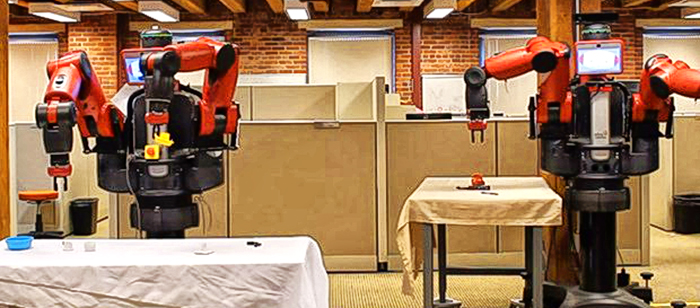
Learning models of language, action and perception
for human-robot collaboration
Dr. Stefanie Tellex
Department of Computer Science, Brown University
4:00pm Monday, 7 March 2016, ITE325b
Robots can act as a force multiplier for people, whether a robot assisting an astronaut with a repair on the International Space station, a UAV taking flight over our cities, or an autonomous vehicle driving through our streets. To achieve complex tasks, it is essential for robots to move beyond merely interacting with people and toward collaboration, so that one person can easily and flexibly work with many autonomous robots. The aim of my research program is to create autonomous robots that collaborate with people to meet their needs by learning decision-theoretic models for communication, action, and perception. Communication for collaboration requires models of language that map between sentences and aspects of the external world. My work enables a robot to learn compositional models for word meanings that allow a robot to explicitly reason and communicate about its own uncertainty, increasing the speed and accuracy of human-robot communication. Action for collaboration requires models that match how people think and talk, because people communicate about all aspects of a robot’s behavior, from low-level motion preferences (e.g., “Please fly up a few feet”) to high-level requests (e.g., “Please inspect the building”). I am creating new methods for learning how to plan in very large, uncertain state-action spaces by using hierarchical abstraction. Perception for collaboration requires the robot to detect, localize, and manipulate the objects in its environment that are most important to its human collaborator. I am creating new methods for autonomously acquiring perceptual models in situ so the robot can perceive the objects most relevant to the human’s goals. My unified decision-theoretic framework supports data-driven training and robust, feedback-driven human-robot collaboration.
Stefanie Tellex is an Assistant Professor of Computer Science and Assistant Professor of Engineering at Brown University. Her group, the Humans To Robots Lab, creates robots that seamlessly collaborate with people to meet their needs using language, gesture, and probabilistic inference, aiming to empower every person with a collaborative robot. She completed her Ph.D. at the MIT Media Lab in 2010, where she developed models for the meanings of spatial prepositions and motion verbs. Her postdoctoral work at MIT CSAIL focused on creating robots that understand natural language. She has published at SIGIR, HRI, RSS, AAAI, IROS, ICAPs and ICMI, winning Best Student Paper at SIGIR and ICMI, Best Paper at RSS, and an award from the CCC Blue Sky Ideas Initiative. Her awards include being named one of IEEE Spectrum’s AI’s 10 to Watch in 2013, the Richard B. Salomon Faculty Research Award at Brown University, a DARPA Young Faculty Award in 2015, and a 2016 Sloan Research Fellowship. Her work has been featured in the press on National Public Radio and MIT Technology Review; she was named one of Wired UK’s Women Who Changed Science In 2015 and listed as one of MIT Technology Review’s Ten Breakthrough Technologies in 2016.
]]>
Learning models of language, action and perception for human-robot collaboration Dr. Stefanie Tellex Department of Computer Science, Brown University 4:00pm Monday, 7 March 2016, ITE325b...
http://www.csee.umbc.edu/2016/02/talk-learning-models-of-language-action-and-perception-for-human-robot-collaboration/
https://my3.my.umbc.edu/api/v0/pixel/news/58228/guest@my.umbc.edu/e13b5d8839aed188b07a103a12bdd2a9/api/pixel
ai
news
research
robotics
talks
Computer Science and Electrical Engineering
https://my3.my.umbc.edu/groups/csee
https://assets3-my.umbc.edu/system/shared/avatars/groups/000/000/099/d117dca133c64bf78a4b7696dd007189/xsmall.png?1314043393
https://assets1-my.umbc.edu/system/shared/avatars/groups/000/000/099/d117dca133c64bf78a4b7696dd007189/original.png?1314043393
https://assets1-my.umbc.edu/system/shared/avatars/groups/000/000/099/d117dca133c64bf78a4b7696dd007189/xxlarge.png?1314043393
https://assets4-my.umbc.edu/system/shared/avatars/groups/000/000/099/d117dca133c64bf78a4b7696dd007189/xlarge.png?1314043393
https://assets3-my.umbc.edu/system/shared/avatars/groups/000/000/099/d117dca133c64bf78a4b7696dd007189/large.png?1314043393
https://assets1-my.umbc.edu/system/shared/avatars/groups/000/000/099/d117dca133c64bf78a4b7696dd007189/medium.png?1314043393
https://assets2-my.umbc.edu/system/shared/avatars/groups/000/000/099/d117dca133c64bf78a4b7696dd007189/small.png?1314043393
https://assets3-my.umbc.edu/system/shared/avatars/groups/000/000/099/d117dca133c64bf78a4b7696dd007189/xsmall.png?1314043393
https://assets3-my.umbc.edu/system/shared/avatars/groups/000/000/099/d117dca133c64bf78a4b7696dd007189/xxsmall.png?1314043393
Computer Science and Electrical Engineering
0
0
true
Mon, 29 Feb 2016 20:33:44 -0500
talk: Why applications are still draining our batteries, and how we can help, 3/1

Why applications are still draining our batteries, and how we can help
Aaron Schulman, Stanford University
12:00pm Tuesday, 01 March 2016, ITE325b
Application developers lack tools to profile and compare the energy consumption of different software designs. This energy-optimization task is challenging because of unpredictable interactions between the application and increasingly complex power management logic. Yet, having accurate power information would allow application developers to both avoid inefficient designs and discover opportunities for new optimizations.
In this talk, I will show that it is possible to accurately measure system-level power and attribute it to application activities. I will present BattOr, a portable, easy-to-use power monitor that provides developers with a profile of the energy consumption of their designs—without modifications to hardware or software. I will show how Google developers are using BattOr to improve Chrome’s energy efficiency. I will also show how fine-grained understanding of cellular power at different signal strengths enables novel energy optimizations. Finally, I will describe my future plans to attribute system-level power to individual hardware components and to investigate opportunities presented by instrumenting every server in a data center with fine-grained power monitoring.
Aaron Schulman is a Postdoctoral Scholar at Stanford working with Sachin Katti; he earned his Ph.D. in Computer Science from the University of Maryland, where he was advised by Neil Spring. His research interests are in low-power embedded systems, wireless communication, and network measurement. Aaron’s research on the BattOr power monitor has been funded by Google, is being commercialized by his startup Mellow Research, and is becoming Google’s de facto standard tool for measuring the energy consumption of the Chrome web browser. For his dissertation, Aaron provided the first observations of fundamental factors that limit the reliability of the Internet’s critical last-mile infrastructure. His dissertation was selected to receive the the 2013 ACM SIGCOMM Doctoral Dissertation Award.
]]>
Why applications are still draining our batteries, and how we can help Aaron Schulman, Stanford University 12:00pm Tuesday, 01 March 2016, ITE325b Application developers lack tools to...
http://www.csee.umbc.edu/2016/02/talk-why-applications-are-still-draining-our-batteries-and-how-we-can-help-31/
https://my3.my.umbc.edu/api/v0/pixel/news/58132/guest@my.umbc.edu/cfce431456b91ca294c4736534cb25bb/api/pixel
computer-engineering
computer-science
news
research
talks
Computer Science and Electrical Engineering
https://my3.my.umbc.edu/groups/csee
https://assets3-my.umbc.edu/system/shared/avatars/groups/000/000/099/d117dca133c64bf78a4b7696dd007189/xsmall.png?1314043393
https://assets1-my.umbc.edu/system/shared/avatars/groups/000/000/099/d117dca133c64bf78a4b7696dd007189/original.png?1314043393
https://assets1-my.umbc.edu/system/shared/avatars/groups/000/000/099/d117dca133c64bf78a4b7696dd007189/xxlarge.png?1314043393
https://assets4-my.umbc.edu/system/shared/avatars/groups/000/000/099/d117dca133c64bf78a4b7696dd007189/xlarge.png?1314043393
https://assets3-my.umbc.edu/system/shared/avatars/groups/000/000/099/d117dca133c64bf78a4b7696dd007189/large.png?1314043393
https://assets1-my.umbc.edu/system/shared/avatars/groups/000/000/099/d117dca133c64bf78a4b7696dd007189/medium.png?1314043393
https://assets2-my.umbc.edu/system/shared/avatars/groups/000/000/099/d117dca133c64bf78a4b7696dd007189/small.png?1314043393
https://assets3-my.umbc.edu/system/shared/avatars/groups/000/000/099/d117dca133c64bf78a4b7696dd007189/xsmall.png?1314043393
https://assets3-my.umbc.edu/system/shared/avatars/groups/000/000/099/d117dca133c64bf78a4b7696dd007189/xxsmall.png?1314043393
Computer Science and Electrical Engineering
2
0
true
Thu, 25 Feb 2016 09:19:31 -0500
Sat, 20 Feb 2016 09:19:31 -0500
Prof. Marie desJardins: one of ten AI researchers to follow on Twitter
TechRepublic identified CSEE professor Marie desJardins as one of “10 artificial intelligence researchers to follow on Twitter”. Check out her feed at @mariedj17.
“Want to know what’s happening at the epicenter of artificial intelligence? Follow these 10 AI researchers who make the most of their 140 characters on Twitter.”
]]>
TechRepublic identified CSEE professor Marie desJardins as one of “10 artificial intelligence researchers to follow on Twitter”. Check out her feed at @mariedj17. “Want to know what’s happening...
http://www.csee.umbc.edu/2016/02/prof-marie-desjardins-one-of-ten-ai-researchers-to-follow-on-twitter/
https://my3.my.umbc.edu/api/v0/pixel/news/58123/guest@my.umbc.edu/5e612b4dd5045311a81a8ca4b2ae15a8/api/pixel
ai
computer-science
faculty-and-staff
news
Computer Science and Electrical Engineering
https://my3.my.umbc.edu/groups/csee
https://assets3-my.umbc.edu/system/shared/avatars/groups/000/000/099/d117dca133c64bf78a4b7696dd007189/xsmall.png?1314043393
https://assets1-my.umbc.edu/system/shared/avatars/groups/000/000/099/d117dca133c64bf78a4b7696dd007189/original.png?1314043393
https://assets1-my.umbc.edu/system/shared/avatars/groups/000/000/099/d117dca133c64bf78a4b7696dd007189/xxlarge.png?1314043393
https://assets4-my.umbc.edu/system/shared/avatars/groups/000/000/099/d117dca133c64bf78a4b7696dd007189/xlarge.png?1314043393
https://assets3-my.umbc.edu/system/shared/avatars/groups/000/000/099/d117dca133c64bf78a4b7696dd007189/large.png?1314043393
https://assets1-my.umbc.edu/system/shared/avatars/groups/000/000/099/d117dca133c64bf78a4b7696dd007189/medium.png?1314043393
https://assets2-my.umbc.edu/system/shared/avatars/groups/000/000/099/d117dca133c64bf78a4b7696dd007189/small.png?1314043393
https://assets3-my.umbc.edu/system/shared/avatars/groups/000/000/099/d117dca133c64bf78a4b7696dd007189/xsmall.png?1314043393
https://assets3-my.umbc.edu/system/shared/avatars/groups/000/000/099/d117dca133c64bf78a4b7696dd007189/xxsmall.png?1314043393
Computer Science and Electrical Engineering
0
0
true
Wed, 24 Feb 2016 18:24:08 -0500