2016 Maryland Computing Education Summit, April 12, UMBC

On Tuesday, April 12, 2016, the CS Matters in Maryland project and the Maryland State Department of Education will jointly host a CE21-Maryland Summit for Computing Education at the University of Maryland, Baltimore County (UMBC) campus in Baltimore, Maryland. This event invites the attendance of teachers, administrators, legislators, industry leaders, and others who have an interest in expanding computer science in Maryland schools. UMBC President Freeman Hrabowski will be the summit’s keynote speaker.
Register here for the Maryland computing education summit. The early registration deadline for this event is February 29. Participants who register by the early deadline will receive a confirmation email no later than March 12 indicating whether your registration is confirmed. Late registrations will be accepted and confirmed on a rolling basis. Walk-in registration will be available if capacity or cancellations permit. All registrations are subject to available capacity at the meeting venue.
More information including the schedule is available here.
]]>
On Tuesday, April 12, 2016, the CS Matters in Maryland project and the Maryland State Department of Education will jointly host a CE21-Maryland Summit for Computing Education at the University of...
https://www.csee.umbc.edu/2016/02/2016-maryland-computing-education-summit-april-12-umbc/
https://my3.my.umbc.edu/api/v0/pixel/news/57854/guest@my.umbc.edu/b8c51f6b6e45deda77ad0b353d969321/api/pixel
computer-engineering
computer-science
education
news
Computer Science and Electrical Engineering
https://my3.my.umbc.edu/groups/csee
https://assets3-my.umbc.edu/system/shared/avatars/groups/000/000/099/d117dca133c64bf78a4b7696dd007189/xsmall.png?1314043393
https://assets1-my.umbc.edu/system/shared/avatars/groups/000/000/099/d117dca133c64bf78a4b7696dd007189/original.png?1314043393
https://assets1-my.umbc.edu/system/shared/avatars/groups/000/000/099/d117dca133c64bf78a4b7696dd007189/xxlarge.png?1314043393
https://assets4-my.umbc.edu/system/shared/avatars/groups/000/000/099/d117dca133c64bf78a4b7696dd007189/xlarge.png?1314043393
https://assets3-my.umbc.edu/system/shared/avatars/groups/000/000/099/d117dca133c64bf78a4b7696dd007189/large.png?1314043393
https://assets1-my.umbc.edu/system/shared/avatars/groups/000/000/099/d117dca133c64bf78a4b7696dd007189/medium.png?1314043393
https://assets2-my.umbc.edu/system/shared/avatars/groups/000/000/099/d117dca133c64bf78a4b7696dd007189/small.png?1314043393
https://assets3-my.umbc.edu/system/shared/avatars/groups/000/000/099/d117dca133c64bf78a4b7696dd007189/xsmall.png?1314043393
https://assets3-my.umbc.edu/system/shared/avatars/groups/000/000/099/d117dca133c64bf78a4b7696dd007189/xxsmall.png?1314043393
Computer Science and Electrical Engineering
0
0
true
Tue, 09 Feb 2016 21:56:32 -0500
talk, Chaitan Baru: NSF Big Data/Data Science Programs 10am 2/12
Big Data/Data Science Programs at NSF
Chaitan Baru
Senior Advisor for Data Science, NSF CISE Directorate
10-11:00am Friday 12 February 2016, ITE 459, UMBC
This talk will provide an overview of current programs and activities related to Big Data and Data Science at NSF, and also highlight NSF’s inter-agency engagements in this topic area. The talk will also discuss future directions for Data Science research, education, and infrastructure. Considering that Data Science is a rapidly emerging, evolving field and discipline, ample time will be provided for Q&A and discussions about where the field ought to be going, given what we know today.
Dr. Chaitan Baru is currently a senior advisor for data science in the Computer and Information Science and Engineering Directorate at the National Science Foundation. He is a Distinguished Scientist and Associate Director of Data Initiatives at the San Diego Supercomputer Center (SDSC), UC San Diego where he works on applied and applications-oriented research problems related to data management and data analytics.
Dr. Baru has participated in a number of “data cyberinfrastructure” initiatives, including as Principal Investigator of the OpenTopography project; Cyberinfrastructure Lead, Tropical Ecology, Assessment and Monitoring network; Co-Investigator of the Cyberinfrastructure for Comparative Effectiveness Research project; Member of the founding Senior Management Team of the National Ecologial Observatory Network and Co-PI of the NEON Cyberinfrastructure Testbed; Co-PI of the CUAHSI Hydrologic Information Systems; Director, NEES Cyberinfrastructure Center; PI/Project Director, Geosciences Network; and member of the How Much Information? project.
Baru leads the Advanced Cyberinfrastructure Development Group at SDSC and is also Director of the Center for Large-scale Data Systems research. Prior to joining SDSC in 1996, Baru was at IBM, where he led one of the development teams for DB2 Parallel Edition Version 1 and at the University of Michigan, where he served on the faculty of the EECS Department. He received his B.Tech in Electronics Engineering from the Indian Institute of Technology, Madras, and M.E. and Ph.D. in Electrical Engineering from the University of Florida, Gainesville.
]]>
Big Data/Data Science Programs at NSF Chaitan Baru Senior Advisor for Data Science, NSF CISE Directorate 10-11:00am Friday 12 February 2016, ITE 459, UMBC This talk will provide an...
http://www.csee.umbc.edu/2016/02/talk-chaitan-baru-nsf-big-datadata-science-programs-10am-212/
https://my3.my.umbc.edu/api/v0/pixel/news/57538/guest@my.umbc.edu/48122edaf5132083ec7198f8add34316/api/pixel
computer-engineering
computer-science
data-science
news
talks
Computer Science and Electrical Engineering
https://my3.my.umbc.edu/groups/csee
https://assets3-my.umbc.edu/system/shared/avatars/groups/000/000/099/d117dca133c64bf78a4b7696dd007189/xsmall.png?1314043393
https://assets1-my.umbc.edu/system/shared/avatars/groups/000/000/099/d117dca133c64bf78a4b7696dd007189/original.png?1314043393
https://assets1-my.umbc.edu/system/shared/avatars/groups/000/000/099/d117dca133c64bf78a4b7696dd007189/xxlarge.png?1314043393
https://assets4-my.umbc.edu/system/shared/avatars/groups/000/000/099/d117dca133c64bf78a4b7696dd007189/xlarge.png?1314043393
https://assets3-my.umbc.edu/system/shared/avatars/groups/000/000/099/d117dca133c64bf78a4b7696dd007189/large.png?1314043393
https://assets1-my.umbc.edu/system/shared/avatars/groups/000/000/099/d117dca133c64bf78a4b7696dd007189/medium.png?1314043393
https://assets2-my.umbc.edu/system/shared/avatars/groups/000/000/099/d117dca133c64bf78a4b7696dd007189/small.png?1314043393
https://assets3-my.umbc.edu/system/shared/avatars/groups/000/000/099/d117dca133c64bf78a4b7696dd007189/xsmall.png?1314043393
https://assets3-my.umbc.edu/system/shared/avatars/groups/000/000/099/d117dca133c64bf78a4b7696dd007189/xxsmall.png?1314043393
Computer Science and Electrical Engineering
0
0
true
Sat, 06 Feb 2016 22:52:00 -0500
Sat, 06 Feb 2016 22:52:00 -0500
talk, Chaitan Baru: NSF Big Data/Data Science Programs 10am 2/12
Big Data/Data Science Programs at NSF
Chaitan Baru
Senior Advisor for Data Science, NSF CISE Directorate
10-11:00am Friday 12 February 2016, ITE 459, UMBC
This talk will provide an overview of current programs and activities related to Big Data and Data Science at NSF, and also highlight NSF’s inter-agency engagements in this topic area. The talk will also discuss future directions for Data Science research, education, and infrastructure. Considering that Data Science is a rapidly emerging, evolving field and discipline, ample time will be provided for Q&A and discussions about where the field ought to be going, given what we know today.
Dr. Chaitan Baru is currently a senior advisor for data science in the Computer and Information Science and Engineering Directorate at the National Science Foundation. He is a Distinguished Scientist and Associate Director of Data Initiatives at the San Diego Supercomputer Center (SDSC), UC San Diego where he works on applied and applications-oriented research problems related to data management and data analytics.
Dr. Baru has participated in a number of “data cyberinfrastructure” initiatives, including as Principal Investigator of the OpenTopography project; Cyberinfrastructure Lead, Tropical Ecology, Assessment and Monitoring network; Co-Investigator of the Cyberinfrastructure for Comparative Effectiveness Research project; Member of the founding Senior Management Team of the National Ecologial Observatory Network and Co-PI of the NEON Cyberinfrastructure Testbed; Co-PI of the CUAHSI Hydrologic Information Systems; Director, NEES Cyberinfrastructure Center; PI/Project Director, Geosciences Network; and member of the How Much Information? project.
Baru leads the Advanced Cyberinfrastructure Development Group at SDSC and is also Director of the Center for Large-scale Data Systems research. Prior to joining SDSC in 1996, Baru was at IBM, where he led one of the development teams for DB2 Parallel Edition Version 1 and at the University of Michigan, where he served on the faculty of the EECS Department. He received his B.Tech in Electronics Engineering from the Indian Institute of Technology, Madras, and M.E. and Ph.D. in Electrical Engineering from the University of Florida, Gainesville.
]]>
Big Data/Data Science Programs at NSF Chaitan Baru Senior Advisor for Data Science, NSF CISE Directorate 10-11:00am Friday 12 February 2016, ITE 459, UMBC This talk will provide an...
https://www.csee.umbc.edu/2016/02/talk-chaitan-baru-nsf-big-datadata-science-programs-10am-212/
https://my3.my.umbc.edu/api/v0/pixel/news/57855/guest@my.umbc.edu/c056dbfab49dd8cf16ada95947b8b183/api/pixel
computer-engineering
computer-science
data-science
news
talks
Computer Science and Electrical Engineering
https://my3.my.umbc.edu/groups/csee
https://assets3-my.umbc.edu/system/shared/avatars/groups/000/000/099/d117dca133c64bf78a4b7696dd007189/xsmall.png?1314043393
https://assets1-my.umbc.edu/system/shared/avatars/groups/000/000/099/d117dca133c64bf78a4b7696dd007189/original.png?1314043393
https://assets1-my.umbc.edu/system/shared/avatars/groups/000/000/099/d117dca133c64bf78a4b7696dd007189/xxlarge.png?1314043393
https://assets4-my.umbc.edu/system/shared/avatars/groups/000/000/099/d117dca133c64bf78a4b7696dd007189/xlarge.png?1314043393
https://assets3-my.umbc.edu/system/shared/avatars/groups/000/000/099/d117dca133c64bf78a4b7696dd007189/large.png?1314043393
https://assets1-my.umbc.edu/system/shared/avatars/groups/000/000/099/d117dca133c64bf78a4b7696dd007189/medium.png?1314043393
https://assets2-my.umbc.edu/system/shared/avatars/groups/000/000/099/d117dca133c64bf78a4b7696dd007189/small.png?1314043393
https://assets3-my.umbc.edu/system/shared/avatars/groups/000/000/099/d117dca133c64bf78a4b7696dd007189/xsmall.png?1314043393
https://assets3-my.umbc.edu/system/shared/avatars/groups/000/000/099/d117dca133c64bf78a4b7696dd007189/xxsmall.png?1314043393
Computer Science and Electrical Engineering
0
0
true
Sat, 06 Feb 2016 22:52:00 -0500
HackUMBC 24 -hour student hackathon, 5-6 March 2016 at UMBC

HackUMBC is a 24 hour student hackathon that will take place on Saturday and Sunday, March 5-6, 2016 at UMBC. It’s an opportunity to learn new skills, make friends, create your wildest idea, and share it with the world. Build an app, a website, a robotic arm, a game, anything. It’s free and food, beverages, swag, workspaces, and sleeping areas will be provided. All undergraduate, graduate, and high school students are welcome, but pre-registration is required. Get more information and apply at
https://hackumbc.org/.
]]>
HackUMBC is a 24 hour student hackathon that will take place on Saturday and Sunday, March 5-6, 2016 at UMBC. It’s an opportunity to learn new skills, make friends, create your wildest idea, and...
http://www.csee.umbc.edu/2016/02/hackumbc-24-hour-student-hackathon-5-6-march-2016-at-umbc/
https://my3.my.umbc.edu/api/v0/pixel/news/57483/guest@my.umbc.edu/4a6edf68c956023ce16156c5387af956/api/pixel
computer-engineering
computer-science
cybersecurity
data-science
electrical-engineering
events
game-track
graduate
news
robotics
students
undergraduate
Computer Science and Electrical Engineering
https://my3.my.umbc.edu/groups/csee
https://assets3-my.umbc.edu/system/shared/avatars/groups/000/000/099/d117dca133c64bf78a4b7696dd007189/xsmall.png?1314043393
https://assets1-my.umbc.edu/system/shared/avatars/groups/000/000/099/d117dca133c64bf78a4b7696dd007189/original.png?1314043393
https://assets1-my.umbc.edu/system/shared/avatars/groups/000/000/099/d117dca133c64bf78a4b7696dd007189/xxlarge.png?1314043393
https://assets4-my.umbc.edu/system/shared/avatars/groups/000/000/099/d117dca133c64bf78a4b7696dd007189/xlarge.png?1314043393
https://assets3-my.umbc.edu/system/shared/avatars/groups/000/000/099/d117dca133c64bf78a4b7696dd007189/large.png?1314043393
https://assets1-my.umbc.edu/system/shared/avatars/groups/000/000/099/d117dca133c64bf78a4b7696dd007189/medium.png?1314043393
https://assets2-my.umbc.edu/system/shared/avatars/groups/000/000/099/d117dca133c64bf78a4b7696dd007189/small.png?1314043393
https://assets3-my.umbc.edu/system/shared/avatars/groups/000/000/099/d117dca133c64bf78a4b7696dd007189/xsmall.png?1314043393
https://assets3-my.umbc.edu/system/shared/avatars/groups/000/000/099/d117dca133c64bf78a4b7696dd007189/xxsmall.png?1314043393
Computer Science and Electrical Engineering
8
0
true
Thu, 04 Feb 2016 22:44:48 -0500
HackUMBC 24 -hour student hackathon, 5-6 March 2016 at UMBC
HackUMBC is a 24 hour student hackathon that will take place on Saturday and Sunday, March 5-6, 2016 at UMBC. It’s an opportunity to learn new skills, make friends, create your wildest idea, and share it with the world. Build an app, a website, a robotic arm, a game, anything. It’s free and food, beverages, swag, workspaces, and sleeping areas will be provided. All undergraduate, graduate, and high school students are welcome, but pre-registration is required. Get more information and apply at
https://hackumbc.org/.
]]>
HackUMBC is a 24 hour student hackathon that will take place on Saturday and Sunday, March 5-6, 2016 at UMBC. It’s an opportunity to learn new skills, make friends, create your wildest idea, and...
https://www.csee.umbc.edu/2016/02/hackumbc-24-hour-student-hackathon-5-6-march-2016-at-umbc/
https://my3.my.umbc.edu/api/v0/pixel/news/57856/guest@my.umbc.edu/a26c5468296d5acfa152e4062536e98a/api/pixel
computer-engineering
computer-science
cybersecurity
data-science
electrical-engineering
events
game-track
graduate
news
robotics
students
undergraduate
Computer Science and Electrical Engineering
https://my3.my.umbc.edu/groups/csee
https://assets3-my.umbc.edu/system/shared/avatars/groups/000/000/099/d117dca133c64bf78a4b7696dd007189/xsmall.png?1314043393
https://assets1-my.umbc.edu/system/shared/avatars/groups/000/000/099/d117dca133c64bf78a4b7696dd007189/original.png?1314043393
https://assets1-my.umbc.edu/system/shared/avatars/groups/000/000/099/d117dca133c64bf78a4b7696dd007189/xxlarge.png?1314043393
https://assets4-my.umbc.edu/system/shared/avatars/groups/000/000/099/d117dca133c64bf78a4b7696dd007189/xlarge.png?1314043393
https://assets3-my.umbc.edu/system/shared/avatars/groups/000/000/099/d117dca133c64bf78a4b7696dd007189/large.png?1314043393
https://assets1-my.umbc.edu/system/shared/avatars/groups/000/000/099/d117dca133c64bf78a4b7696dd007189/medium.png?1314043393
https://assets2-my.umbc.edu/system/shared/avatars/groups/000/000/099/d117dca133c64bf78a4b7696dd007189/small.png?1314043393
https://assets3-my.umbc.edu/system/shared/avatars/groups/000/000/099/d117dca133c64bf78a4b7696dd007189/xsmall.png?1314043393
https://assets3-my.umbc.edu/system/shared/avatars/groups/000/000/099/d117dca133c64bf78a4b7696dd007189/xxsmall.png?1314043393
Computer Science and Electrical Engineering
0
0
true
Thu, 04 Feb 2016 22:44:48 -0500
Gymama Slaughter on self-powered, life-saving medical devices at TEDxBaltimore
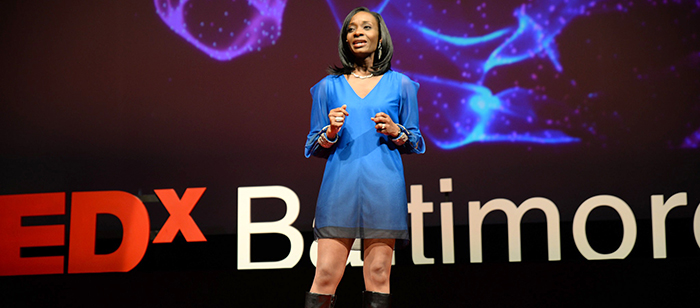
CSEE professor Gymama Slaughter talked about her research to develop an implantable glucose sensor powered by chemical reactions in the human body at TEDxBaltimore in January. In her work in the UMBC Bioelectronics Laboratory, Slaughter concentrates on how chemical processes occurring naturally in the human body can power medical devices and eliminate the need for batteries in devices like blood glucose monitors. “If we could only remove batteries from the equation,” said Slaughter, “all of a sudden, we would have truly wearable and implantable sensors.”
Read more about her TEDxBaltimore talk here and see is starting at 25:50 in this video.
]]>
CSEE professor Gymama Slaughter talked about her research to develop an implantable glucose sensor powered by chemical reactions in the human body at TEDxBaltimore in January. In her work in the...
http://www.csee.umbc.edu/2016/01/gymama-slaughter-on-self-powered-life-saving-medical-devices-at-tedxbaltimore/
https://my3.my.umbc.edu/api/v0/pixel/news/57313/guest@my.umbc.edu/ffff9592a5ee0826c29e82f4f7c4b253/api/pixel
computer-engineering
faculty-and-staff
news
research
Computer Science and Electrical Engineering
https://my3.my.umbc.edu/groups/csee
https://assets3-my.umbc.edu/system/shared/avatars/groups/000/000/099/d117dca133c64bf78a4b7696dd007189/xsmall.png?1314043393
https://assets1-my.umbc.edu/system/shared/avatars/groups/000/000/099/d117dca133c64bf78a4b7696dd007189/original.png?1314043393
https://assets1-my.umbc.edu/system/shared/avatars/groups/000/000/099/d117dca133c64bf78a4b7696dd007189/xxlarge.png?1314043393
https://assets4-my.umbc.edu/system/shared/avatars/groups/000/000/099/d117dca133c64bf78a4b7696dd007189/xlarge.png?1314043393
https://assets3-my.umbc.edu/system/shared/avatars/groups/000/000/099/d117dca133c64bf78a4b7696dd007189/large.png?1314043393
https://assets1-my.umbc.edu/system/shared/avatars/groups/000/000/099/d117dca133c64bf78a4b7696dd007189/medium.png?1314043393
https://assets2-my.umbc.edu/system/shared/avatars/groups/000/000/099/d117dca133c64bf78a4b7696dd007189/small.png?1314043393
https://assets3-my.umbc.edu/system/shared/avatars/groups/000/000/099/d117dca133c64bf78a4b7696dd007189/xsmall.png?1314043393
https://assets3-my.umbc.edu/system/shared/avatars/groups/000/000/099/d117dca133c64bf78a4b7696dd007189/xxsmall.png?1314043393
Computer Science and Electrical Engineering
3
0
true
Sun, 31 Jan 2016 12:29:39 -0500
Gymama Slaughter on self-powered, life-saving medical devices at TEDxBaltimore
CSEE professor Gymama Slaughter talked about her research to develop an implantable glucose sensor powered by chemical reactions in the human body at TEDxBaltimore in January. In her work in the UMBC Bioelectronics Laboratory, Slaughter concentrates on how chemical processes occurring naturally in the human body can power medical devices and eliminate the need for batteries in devices like blood glucose monitors. “If we could only remove batteries from the equation,” said Slaughter, “all of a sudden, we would have truly wearable and implantable sensors.”
Read more about her TEDxBaltimore talk here and see is starting at 25:50 in this video.
]]>
CSEE professor Gymama Slaughter talked about her research to develop an implantable glucose sensor powered by chemical reactions in the human body at TEDxBaltimore in January. In her work in the...
https://www.csee.umbc.edu/2016/01/gymama-slaughter-on-self-powered-life-saving-medical-devices-at-tedxbaltimore/
https://my3.my.umbc.edu/api/v0/pixel/news/57857/guest@my.umbc.edu/e7661ae5d48e6f62bb2aec90e289fb34/api/pixel
computer-engineering
faculty-and-staff
news
research
Computer Science and Electrical Engineering
https://my3.my.umbc.edu/groups/csee
https://assets3-my.umbc.edu/system/shared/avatars/groups/000/000/099/d117dca133c64bf78a4b7696dd007189/xsmall.png?1314043393
https://assets1-my.umbc.edu/system/shared/avatars/groups/000/000/099/d117dca133c64bf78a4b7696dd007189/original.png?1314043393
https://assets1-my.umbc.edu/system/shared/avatars/groups/000/000/099/d117dca133c64bf78a4b7696dd007189/xxlarge.png?1314043393
https://assets4-my.umbc.edu/system/shared/avatars/groups/000/000/099/d117dca133c64bf78a4b7696dd007189/xlarge.png?1314043393
https://assets3-my.umbc.edu/system/shared/avatars/groups/000/000/099/d117dca133c64bf78a4b7696dd007189/large.png?1314043393
https://assets1-my.umbc.edu/system/shared/avatars/groups/000/000/099/d117dca133c64bf78a4b7696dd007189/medium.png?1314043393
https://assets2-my.umbc.edu/system/shared/avatars/groups/000/000/099/d117dca133c64bf78a4b7696dd007189/small.png?1314043393
https://assets3-my.umbc.edu/system/shared/avatars/groups/000/000/099/d117dca133c64bf78a4b7696dd007189/xsmall.png?1314043393
https://assets3-my.umbc.edu/system/shared/avatars/groups/000/000/099/d117dca133c64bf78a4b7696dd007189/xxsmall.png?1314043393
Computer Science and Electrical Engineering
0
0
true
Sun, 31 Jan 2016 12:29:39 -0500
talk: Neural circuit deconvolution approach to study motivated behavior
UMBC CSEE Seminar
A Neural Circuit Deconvolution Approach to Study Motivated Behavior
Dr. Joseph Cheer
Associate Professor, Deptartment of Anatomy and Neurobiology
and Department of Psychiatry
School of Medicine, University of Maryland Baltimore
11:001am-12:00pm, Wednesday, 3 February 2016, ITE 325b
In order to examine relationships between subsecond dopamine signaling and nucleus accumbens (NAc) cell firing during reward-directed behaviors, the ideal experimental approach is to record postsynaptic neuronal firing from the same electrode used to measure dopamine release. We have demonstrated that these measurements are feasible using cylindrical carbon fiber electrodes that can voltammetrically detect the oxidation potential of dopamine and also measure single-units extracellularly or local field potentials (LFPs). Moreover, we have added iontophoresis barrels to the carbon-fiber microelectrode to allow localized, rapid drug delivery to examine the signal transduction utilized by postsynaptic neurons when dopamine release is detected. The drugs to be ejected out of the iontophoresis barrels are selected on the basis of effects of prior microinjections (such as dopamine receptor antagonists). Once a significant behavioral effect is observed following the microinjection, iontophoresis pipettes with the same compounds are loaded for ejection in other animals. Under these conditions ongoing behavior is unaltered allowing for a detailed neurobiological dissection of the particular microanatomical domain during specific times of the behavioral sequence. Finally we can now provide causality between the two simultaneously recorded measures, by applying the above mentioned to animals amenable to optogenetic interrogation of dopaminergic pathways. We will show that dopamine sculpts cue-related patterned neuronal activity as well as the power of the NAc LFP during reward seeking.
Dr. Joseph Cheer graduated from Universidad de los Andes (Bogota, Colombia) with a B.S in Biology and Mathematics in 1996. He joined the Laboratory of Neurobiology and Experimental Microsurgery at the Colombian Neurology Foundation where he worked for 1 year investigating CNS regeneration using oncogene-tranfected cells and sciatic nerve co-grafts in motor cortex-lesioned animals. Joe received his Ph.D from The University of Nottingham (Neuroscience Section of the School of Biomedical Sciences) under the direction of Profs Charles Marsden and Dave Kendall and Dr Rob Mason. Dr. Cheer’s graduate research focused on the behavioral and electrophysiological effects of cannabinoids.
Dr. Cheer’s first postdoc (2000-2002) was spent in Sam Deadwyler’s laboratory (Wake Forest University School of Medicine) where he conducted research on multiple single-unit electrophysiology in freely moving organisms. Joe joined Mark Wightman’s lab as a post doc in fall 2002 at the University of North Carolina (Chapel Hill). There, he established the use of a microelectrode that allows for the simultaneous measurement of single-unit activity and dopamine release via fast-scan cyclic voltammetry.
Dr. Cheer is currently a tenured associate professor at the University of Maryland School of Medicine, where he directs several NIH and private foundation-funded graduate and undergraduate projects related to several neurophysiological and neurochemical aspects of endogenous cannabinoid signaling in intact systems.
Hosts: Professors Fow-Sen Choa (Sorry, you need javascript to view this email address. ) and Alan T. Sherman (Sorry, you need javascript to view this email address. )
]]>
UMBC CSEE Seminar A Neural Circuit Deconvolution Approach to Study Motivated Behavior Dr. Joseph Cheer Associate Professor, Deptartment of Anatomy and Neurobiology and Department of...
http://www.csee.umbc.edu/2016/01/20085/
https://my3.my.umbc.edu/api/v0/pixel/news/57304/guest@my.umbc.edu/adc162940f8b63fb2381262d7f5bb8f5/api/pixel
news
talks
Computer Science and Electrical Engineering
https://my3.my.umbc.edu/groups/csee
https://assets3-my.umbc.edu/system/shared/avatars/groups/000/000/099/d117dca133c64bf78a4b7696dd007189/xsmall.png?1314043393
https://assets1-my.umbc.edu/system/shared/avatars/groups/000/000/099/d117dca133c64bf78a4b7696dd007189/original.png?1314043393
https://assets1-my.umbc.edu/system/shared/avatars/groups/000/000/099/d117dca133c64bf78a4b7696dd007189/xxlarge.png?1314043393
https://assets4-my.umbc.edu/system/shared/avatars/groups/000/000/099/d117dca133c64bf78a4b7696dd007189/xlarge.png?1314043393
https://assets3-my.umbc.edu/system/shared/avatars/groups/000/000/099/d117dca133c64bf78a4b7696dd007189/large.png?1314043393
https://assets1-my.umbc.edu/system/shared/avatars/groups/000/000/099/d117dca133c64bf78a4b7696dd007189/medium.png?1314043393
https://assets2-my.umbc.edu/system/shared/avatars/groups/000/000/099/d117dca133c64bf78a4b7696dd007189/small.png?1314043393
https://assets3-my.umbc.edu/system/shared/avatars/groups/000/000/099/d117dca133c64bf78a4b7696dd007189/xsmall.png?1314043393
https://assets3-my.umbc.edu/system/shared/avatars/groups/000/000/099/d117dca133c64bf78a4b7696dd007189/xxsmall.png?1314043393
Computer Science and Electrical Engineering
1
0
true
Sat, 30 Jan 2016 19:03:50 -0500
Sat, 30 Jan 2016 19:03:50 -0500
talk: Neural circuit deconvolution approach to study motivated behavior
UMBC CSEE Seminar
A Neural Circuit Deconvolution Approach to Study Motivated Behavior
Dr. Joseph Cheer
Associate Professor, Deptartment of Anatomy and Neurobiology
and Department of Psychiatry
School of Medicine, University of Maryland Baltimore
11:001am-12:00pm, Wednesday, 3 February 2016, ITE 325b
In order to examine relationships between subsecond dopamine signaling and nucleus accumbens (NAc) cell firing during reward-directed behaviors, the ideal experimental approach is to record postsynaptic neuronal firing from the same electrode used to measure dopamine release. We have demonstrated that these measurements are feasible using cylindrical carbon fiber electrodes that can voltammetrically detect the oxidation potential of dopamine and also measure single-units extracellularly or local field potentials (LFPs). Moreover, we have added iontophoresis barrels to the carbon-fiber microelectrode to allow localized, rapid drug delivery to examine the signal transduction utilized by postsynaptic neurons when dopamine release is detected. The drugs to be ejected out of the iontophoresis barrels are selected on the basis of effects of prior microinjections (such as dopamine receptor antagonists). Once a significant behavioral effect is observed following the microinjection, iontophoresis pipettes with the same compounds are loaded for ejection in other animals. Under these conditions ongoing behavior is unaltered allowing for a detailed neurobiological dissection of the particular microanatomical domain during specific times of the behavioral sequence. Finally we can now provide causality between the two simultaneously recorded measures, by applying the above mentioned to animals amenable to optogenetic interrogation of dopaminergic pathways. We will show that dopamine sculpts cue-related patterned neuronal activity as well as the power of the NAc LFP during reward seeking.
Dr. Joseph Cheer graduated from Universidad de los Andes (Bogota, Colombia) with a B.S in Biology and Mathematics in 1996. He joined the Laboratory of Neurobiology and Experimental Microsurgery at the Colombian Neurology Foundation where he worked for 1 year investigating CNS regeneration using oncogene-tranfected cells and sciatic nerve co-grafts in motor cortex-lesioned animals. Joe received his Ph.D from The University of Nottingham (Neuroscience Section of the School of Biomedical Sciences) under the direction of Profs Charles Marsden and Dave Kendall and Dr Rob Mason. Dr. Cheer’s graduate research focused on the behavioral and electrophysiological effects of cannabinoids.
Dr. Cheer’s first postdoc (2000-2002) was spent in Sam Deadwyler’s laboratory (Wake Forest University School of Medicine) where he conducted research on multiple single-unit electrophysiology in freely moving organisms. Joe joined Mark Wightman’s lab as a post doc in fall 2002 at the University of North Carolina (Chapel Hill). There, he established the use of a microelectrode that allows for the simultaneous measurement of single-unit activity and dopamine release via fast-scan cyclic voltammetry.
Dr. Cheer is currently a tenured associate professor at the University of Maryland School of Medicine, where he directs several NIH and private foundation-funded graduate and undergraduate projects related to several neurophysiological and neurochemical aspects of endogenous cannabinoid signaling in intact systems.
Hosts: Professors Fow-Sen Choa (Sorry, you need javascript to view this email address. ) and Alan T. Sherman (Sorry, you need javascript to view this email address. )
]]>
UMBC CSEE Seminar A Neural Circuit Deconvolution Approach to Study Motivated Behavior Dr. Joseph Cheer Associate Professor, Deptartment of Anatomy and Neurobiology and Department of...
https://www.csee.umbc.edu/2016/01/20085/
https://my3.my.umbc.edu/api/v0/pixel/news/57858/guest@my.umbc.edu/7d882d86176f10631e021f4baca2c8d5/api/pixel
news
talks
Computer Science and Electrical Engineering
https://my3.my.umbc.edu/groups/csee
https://assets3-my.umbc.edu/system/shared/avatars/groups/000/000/099/d117dca133c64bf78a4b7696dd007189/xsmall.png?1314043393
https://assets1-my.umbc.edu/system/shared/avatars/groups/000/000/099/d117dca133c64bf78a4b7696dd007189/original.png?1314043393
https://assets1-my.umbc.edu/system/shared/avatars/groups/000/000/099/d117dca133c64bf78a4b7696dd007189/xxlarge.png?1314043393
https://assets4-my.umbc.edu/system/shared/avatars/groups/000/000/099/d117dca133c64bf78a4b7696dd007189/xlarge.png?1314043393
https://assets3-my.umbc.edu/system/shared/avatars/groups/000/000/099/d117dca133c64bf78a4b7696dd007189/large.png?1314043393
https://assets1-my.umbc.edu/system/shared/avatars/groups/000/000/099/d117dca133c64bf78a4b7696dd007189/medium.png?1314043393
https://assets2-my.umbc.edu/system/shared/avatars/groups/000/000/099/d117dca133c64bf78a4b7696dd007189/small.png?1314043393
https://assets3-my.umbc.edu/system/shared/avatars/groups/000/000/099/d117dca133c64bf78a4b7696dd007189/xsmall.png?1314043393
https://assets3-my.umbc.edu/system/shared/avatars/groups/000/000/099/d117dca133c64bf78a4b7696dd007189/xxsmall.png?1314043393
Computer Science and Electrical Engineering
0
0
true
Sat, 30 Jan 2016 19:03:50 -0500
talk postponed: NSF Big Data/Data Science Programs
Big Data/Data Science Programs at NSF
Chaitan Baru
Senior Advisor for Data Science, NSF CISE Directorate
10-11:00am Thursday 28 January 2016, ITE 459, UMBC
postponed
This talk will provide an overview of current programs and activities related to Big Data and Data Science at NSF, and also highlight NSF’s inter-agency engagements in this topic area. The talk will also discuss future directions for Data Science research, education, and infrastructure. Considering that Data Science is a rapidly emerging, evolving field and discipline, ample time will be provided for Q&A and discussions about where the field ought to be going, given what we know today.
Dr. Chaitan Baru is currently a senior advisor for data science in the Computer and Information Science and Engineering Directorate at the National Science Foundation. He is a Distinguished Scientist and Associate Director of Data Initiatives at the San Diego Supercomputer Center (SDSC), UC San Diego where he works on applied and applications-oriented research problems related to data management and data analytics.
Dr. Baru has participated in a number of “data cyberinfrastructure” initiatives, including as Principal Investigator of the OpenTopography project; Cyberinfrastructure Lead, Tropical Ecology, Assessment and Monitoring network; Co-Investigator of the Cyberinfrastructure for Comparative Effectiveness Research project; Member of the founding Senior Management Team of the National Ecologial Observatory Network and Co-PI of the NEON Cyberinfrastructure Testbed; Co-PI of the CUAHSI Hydrologic Information Systems; Director, NEES Cyberinfrastructure Center; PI/Project Director, Geosciences Network; and member of the How Much Information? project.
Baru leads the Advanced Cyberinfrastructure Development Group at SDSC and is also Director of the Center for Large-scale Data Systems research. Prior to joining SDSC in 1996, Baru was at IBM, where he led one of the development teams for DB2 Parallel Edition Version 1 and at the University of Michigan, where he served on the faculty of the EECS Department. He received his B.Tech in Electronics Engineering from the Indian Institute of Technology, Madras, and M.E. and Ph.D. in Electrical Engineering from the University of Florida, Gainesville.
]]>
Big Data/Data Science Programs at NSF Chaitan Baru Senior Advisor for Data Science, NSF CISE Directorate 10-11:00am Thursday 28 January 2016, ITE 459, UMBC postponed This talk will provide...
https://www.csee.umbc.edu/2016/01/talk-nsf-big-datadata-science-programs/
https://my3.my.umbc.edu/api/v0/pixel/news/57859/guest@my.umbc.edu/8cfb6bdd4670a0fb389de0be36df1149/api/pixel
data-science
news
research
talks
Computer Science and Electrical Engineering
https://my3.my.umbc.edu/groups/csee
https://assets3-my.umbc.edu/system/shared/avatars/groups/000/000/099/d117dca133c64bf78a4b7696dd007189/xsmall.png?1314043393
https://assets1-my.umbc.edu/system/shared/avatars/groups/000/000/099/d117dca133c64bf78a4b7696dd007189/original.png?1314043393
https://assets1-my.umbc.edu/system/shared/avatars/groups/000/000/099/d117dca133c64bf78a4b7696dd007189/xxlarge.png?1314043393
https://assets4-my.umbc.edu/system/shared/avatars/groups/000/000/099/d117dca133c64bf78a4b7696dd007189/xlarge.png?1314043393
https://assets3-my.umbc.edu/system/shared/avatars/groups/000/000/099/d117dca133c64bf78a4b7696dd007189/large.png?1314043393
https://assets1-my.umbc.edu/system/shared/avatars/groups/000/000/099/d117dca133c64bf78a4b7696dd007189/medium.png?1314043393
https://assets2-my.umbc.edu/system/shared/avatars/groups/000/000/099/d117dca133c64bf78a4b7696dd007189/small.png?1314043393
https://assets3-my.umbc.edu/system/shared/avatars/groups/000/000/099/d117dca133c64bf78a4b7696dd007189/xsmall.png?1314043393
https://assets3-my.umbc.edu/system/shared/avatars/groups/000/000/099/d117dca133c64bf78a4b7696dd007189/xxsmall.png?1314043393
Computer Science and Electrical Engineering
0
0
true
Wed, 27 Jan 2016 09:13:21 -0500
