PhD defense: Infrastructure-less Group Data Sharing using Smart Devices
Ph.D. Dissertation Defense
Infrastructure-less Group Data
Sharing using Smart Devices
Ahmed Shahin
2:30 Tuesday, 8 December 2015, ITE-346
Advances in pervasive communication technology have enabled many unconventional applications that facilitate and improve the safety and quality of life in modern society. Among emerging applications is situational awareness where individuals and first-responders receive timely alerts about serious events that could have caused the interruption of the services provided by the communication infrastructure such as cellular networks, Wi-Fi hotspots, etc. Another example is when exchanging road conditions between peer-to-peer networked vehicles without the involvement of roadside units. The popularity of smart portable devices such as iPhone and Android powered phones and tablets has made them an attractive choice that can play a role in the realization of these emerging applications. These devices support multiple communication standards and thus enable Device-to-Device (D2D) data exchange at an increased level of convenience. By using technologies such as Bluetooth, Wi-Fi ad-hoc mode and Wi-Fi Direct, these devices are able to communicate without the need for any communication infrastructures. In addition, many of these devices are equipped with sensors that can provide a wealth of information about the surroundings once their readings are aggregated.
However, most existing protocols for data sharing among devices either require an internet connection, which may not be available and may incur extra costs in some cases, or suffer from the device’s operating system limitations. Actually there is no existing solution that allows a set of devices to start sharing data dynamically without forcing the users to apply an elaborate procedure for setting up a group. These shortcomings render existing solutions unsuitable for emergency cases. In this dissertation proposal, we tackle such a problem by developing a framework for enabling data exchange in a cost-effective and timely manner through the establishment of peer-to-peer links among smart devices. In addition, our framework opts to minimize the user required interaction for setting up a connection and overcome the limitations of the operating system.
Our framework consists of a set of protocols for group data exchange using Wi-Fi Direct on Android devices. First we present an Efficient and Lightweight protocol for peer-to-peer Networking of Android smart devices over Wi-Fi Direct (ELN). ELN main goal is to overcome the Wi-Fi Direct support limitations in Android, thus allowing the devices in one Wi-Fi Direct group to communicate together. The ELN protocol is validated by implementing a group chatting application. In addition, we present a protocol for Alert Dissemination using Service discovery (ADS) in Wi-Fi Direct. ADS uses the service discovery feature of Wi-Fi Direct for distributing alerts to nearby devices without requiring any prior connections and thus avoids the setup delay in creating Wi-Fi Direct groups and the limitations of multi-group connectivity in Android. ADS is validated by implementing a hazard propagation application for Android. Finally, we present an Efficient Multi-group formation and Communication (EMC) protocol for Wi-Fi Direct. EMC exploits the battery specifications of the devices to qualify potential group owners and enable dynamic formation of efficient groups. Moreover, EMC allows data exchange between different Wi-Fi direct groups. Part of our implementation of EMC in Android involves the modification of the Android source code to allow multi-group support. A chat application is developed to validate EMC.
To complete the dissertation, we plan to extend EMC by replacing the static assignment of devices’ addresses in our current implementation with an IP address negotiation protocol that runs before creating groups. Such an extension would give greater flexibility in adapting EMC. In addition, we plan to define some criteria for selecting proxy members in order to allow maximum coverage and allow the D2D communication to span a larger geographical area. In addition, we will develop a simulator to do large scale testing for the proposed framework. Finally, we would like to explore the use of dual transceivers in order to increase the robustness of D2D connections when the wireless channels are subject to varying level of interference; particularly we like to investigate the integration of Bluetooth Low Energy within our framework to enable group membership of nodes that do not have Wi-Fi Direct or suffer interference that makes the Wi-Fi Direct links unstable.
Committee: Drs. Mohamed Younis (Chair), Charles Nicholas, Chintan Patel, Tinoosh Mohsenin
]]>
Ph.D. Dissertation Defense Infrastructure-less Group Data Sharing using Smart Devices Ahmed Shahin 2:30 Tuesday, 8 December 2015, ITE-346 Advances in pervasive communication technology...
https://www.csee.umbc.edu/2015/12/phd-defense-infrastructure-less-group-data-sharing-using-smart-devices/
https://my3.my.umbc.edu/api/v0/pixel/news/57868/guest@my.umbc.edu/d3e316b253b8390de7af4c058b8c428d/api/pixel
computer-engineering
computer-science
defense
graduate
news
research
Computer Science and Electrical Engineering
https://my3.my.umbc.edu/groups/csee
https://assets3-my.umbc.edu/system/shared/avatars/groups/000/000/099/d117dca133c64bf78a4b7696dd007189/xsmall.png?1314043393
https://assets1-my.umbc.edu/system/shared/avatars/groups/000/000/099/d117dca133c64bf78a4b7696dd007189/original.png?1314043393
https://assets1-my.umbc.edu/system/shared/avatars/groups/000/000/099/d117dca133c64bf78a4b7696dd007189/xxlarge.png?1314043393
https://assets4-my.umbc.edu/system/shared/avatars/groups/000/000/099/d117dca133c64bf78a4b7696dd007189/xlarge.png?1314043393
https://assets3-my.umbc.edu/system/shared/avatars/groups/000/000/099/d117dca133c64bf78a4b7696dd007189/large.png?1314043393
https://assets1-my.umbc.edu/system/shared/avatars/groups/000/000/099/d117dca133c64bf78a4b7696dd007189/medium.png?1314043393
https://assets2-my.umbc.edu/system/shared/avatars/groups/000/000/099/d117dca133c64bf78a4b7696dd007189/small.png?1314043393
https://assets3-my.umbc.edu/system/shared/avatars/groups/000/000/099/d117dca133c64bf78a4b7696dd007189/xsmall.png?1314043393
https://assets3-my.umbc.edu/system/shared/avatars/groups/000/000/099/d117dca133c64bf78a4b7696dd007189/xxsmall.png?1314043393
Computer Science and Electrical Engineering
0
0
true
Thu, 03 Dec 2015 09:07:09 -0500
MS defense, Budhraja: Neuroevolution-Based Inverse Reinforcement Learning
M.S. Thesis Defense
Neuroevolution-Based Inverse Reinforcement Learning
Karan K. Budhraja
9:00am Wednesday, 2 December 2015, ITE 346
Motivated by such learning in nature, the problem of Learning from Demonstration is targeted at learning to perform tasks based on observed examples. One of the approaches to Learning from Demonstration is Inverse Reinforcement Learning, in which actions are observed to infer rewards. This work combines a feature based state evaluation approach to Inverse Reinforcement Learning with neuroevolution, a paradigm for modifying neural networks based on their performance on a given task. Neural networks are used to learn from a demonstrated expert policy and are evolved to generate a policy similar to the demonstration. The algorithm is discussed and evaluated against competitive feature-based Inverse Reinforcement Learning approaches. At the cost of execution time, neural networks allow for non-linear combinations of features in state evaluations. These valuations may correspond to state value or state reward. This results in better correspondence to observed examples as opposed to using linear combinations.
This work also extends existing work on Bayesian Non-Parametric Feature construction for Inverse Reinforcement Learning by using non-linear combinations of intermediate data to improve performance. The algorithm is observed to be specifically suitable for a linearly solvable non-deterministic Markov Decision Processes in which multiple rewards are sparsely scattered in state space. Performance of the algorithm is shown to be limited by parameters used, implying adjustable capability. A conclusive performance hierarchy between evaluated algorithms is constructed.
Committee: Drs. Tim Oates, Cynthia Matuszek and Tim Finin
]]>
M.S. Thesis Defense Neuroevolution-Based Inverse Reinforcement Learning Karan K. Budhraja 9:00am Wednesday, 2 December 2015, ITE 346 Motivated by such learning in nature, the problem of...
http://www.csee.umbc.edu/2015/12/ms-defense-budhraja-neuroevolution-based-inverse-reinforcement-learning/
https://my3.my.umbc.edu/api/v0/pixel/news/56383/guest@my.umbc.edu/a3baac40117364cc0e0836a7d8a741c6/api/pixel
computer-science
defense
graduate
news
research
talks
Computer Science and Electrical Engineering
https://my3.my.umbc.edu/groups/csee
https://assets3-my.umbc.edu/system/shared/avatars/groups/000/000/099/d117dca133c64bf78a4b7696dd007189/xsmall.png?1314043393
https://assets1-my.umbc.edu/system/shared/avatars/groups/000/000/099/d117dca133c64bf78a4b7696dd007189/original.png?1314043393
https://assets1-my.umbc.edu/system/shared/avatars/groups/000/000/099/d117dca133c64bf78a4b7696dd007189/xxlarge.png?1314043393
https://assets4-my.umbc.edu/system/shared/avatars/groups/000/000/099/d117dca133c64bf78a4b7696dd007189/xlarge.png?1314043393
https://assets3-my.umbc.edu/system/shared/avatars/groups/000/000/099/d117dca133c64bf78a4b7696dd007189/large.png?1314043393
https://assets1-my.umbc.edu/system/shared/avatars/groups/000/000/099/d117dca133c64bf78a4b7696dd007189/medium.png?1314043393
https://assets2-my.umbc.edu/system/shared/avatars/groups/000/000/099/d117dca133c64bf78a4b7696dd007189/small.png?1314043393
https://assets3-my.umbc.edu/system/shared/avatars/groups/000/000/099/d117dca133c64bf78a4b7696dd007189/xsmall.png?1314043393
https://assets3-my.umbc.edu/system/shared/avatars/groups/000/000/099/d117dca133c64bf78a4b7696dd007189/xxsmall.png?1314043393
Computer Science and Electrical Engineering
2
0
true
Tue, 01 Dec 2015 23:06:25 -0500
Tue, 01 Dec 2015 23:06:25 -0500
MS defense, Budhraja: Neuroevolution-Based Inverse Reinforcement Learning
M.S. Thesis Defense
Neuroevolution-Based Inverse Reinforcement Learning
Karan K. Budhraja
9:00am Wednesday, 2 December 2015, ITE 346
Motivated by such learning in nature, the problem of Learning from Demonstration is targeted at learning to perform tasks based on observed examples. One of the approaches to Learning from Demonstration is Inverse Reinforcement Learning, in which actions are observed to infer rewards. This work combines a feature based state evaluation approach to Inverse Reinforcement Learning with neuroevolution, a paradigm for modifying neural networks based on their performance on a given task. Neural networks are used to learn from a demonstrated expert policy and are evolved to generate a policy similar to the demonstration. The algorithm is discussed and evaluated against competitive feature-based Inverse Reinforcement Learning approaches. At the cost of execution time, neural networks allow for non-linear combinations of features in state evaluations. These valuations may correspond to state value or state reward. This results in better correspondence to observed examples as opposed to using linear combinations.
This work also extends existing work on Bayesian Non-Parametric Feature construction for Inverse Reinforcement Learning by using non-linear combinations of intermediate data to improve performance. The algorithm is observed to be specifically suitable for a linearly solvable non-deterministic Markov Decision Processes in which multiple rewards are sparsely scattered in state space. Performance of the algorithm is shown to be limited by parameters used, implying adjustable capability. A conclusive performance hierarchy between evaluated algorithms is constructed.
Committee: Drs. Tim Oates, Cynthia Matuszek and Tim Finin
]]>
M.S. Thesis Defense Neuroevolution-Based Inverse Reinforcement Learning Karan K. Budhraja 9:00am Wednesday, 2 December 2015, ITE 346 Motivated by such learning in nature, the problem of...
https://www.csee.umbc.edu/2015/12/ms-defense-budhraja-neuroevolution-based-inverse-reinforcement-learning/
https://my3.my.umbc.edu/api/v0/pixel/news/57869/guest@my.umbc.edu/269e31dee805d8a289f6c3baf616c114/api/pixel
computer-science
defense
graduate
news
research
talks
Computer Science and Electrical Engineering
https://my3.my.umbc.edu/groups/csee
https://assets3-my.umbc.edu/system/shared/avatars/groups/000/000/099/d117dca133c64bf78a4b7696dd007189/xsmall.png?1314043393
https://assets1-my.umbc.edu/system/shared/avatars/groups/000/000/099/d117dca133c64bf78a4b7696dd007189/original.png?1314043393
https://assets1-my.umbc.edu/system/shared/avatars/groups/000/000/099/d117dca133c64bf78a4b7696dd007189/xxlarge.png?1314043393
https://assets4-my.umbc.edu/system/shared/avatars/groups/000/000/099/d117dca133c64bf78a4b7696dd007189/xlarge.png?1314043393
https://assets3-my.umbc.edu/system/shared/avatars/groups/000/000/099/d117dca133c64bf78a4b7696dd007189/large.png?1314043393
https://assets1-my.umbc.edu/system/shared/avatars/groups/000/000/099/d117dca133c64bf78a4b7696dd007189/medium.png?1314043393
https://assets2-my.umbc.edu/system/shared/avatars/groups/000/000/099/d117dca133c64bf78a4b7696dd007189/small.png?1314043393
https://assets3-my.umbc.edu/system/shared/avatars/groups/000/000/099/d117dca133c64bf78a4b7696dd007189/xsmall.png?1314043393
https://assets3-my.umbc.edu/system/shared/avatars/groups/000/000/099/d117dca133c64bf78a4b7696dd007189/xxsmall.png?1314043393
Computer Science and Electrical Engineering
0
0
true
Tue, 01 Dec 2015 23:06:25 -0500
IS Security Research Opportunity - Earn $10 for 1 hour
Participate in IS security research and earn $10
The
Human
Centered Computing program of the Information Systems Department at
UMBC is running a study investigating the usability
of traditional and non-traditional authentication mechanisms. We are
looking for participants for this study with IT security experience, especially
research or professional. Your
participation will be a key contribution to the success of the research
project.
The
study (IRB Protocol: Y15RK12082) will take approximately one hour. You will be interviewed about your
opinions and experiences with common authentication methods and mobile
technology security issues.
All
participants must be aged over 18, and use a mobile device (e.g. smartphone).
If
you are interested and meet the requirements, please contact the researcher (flynn.wolf@umbc.edu).
Your participation is very important for our research and will be highly
appreciated.
]]>
The Human Centered Computing program of the Information Systems Department at UMBC is running a study investigating the usability of traditional and non-traditional authentication mechanisms. We...
https://my3.my.umbc.edu/api/v0/pixel/news/56339/guest@my.umbc.edu/3e3bf03a370a88d555244e37c3d32bc0/api/pixel
Information Systems Security Association, UMBC Chapter
https://my3.my.umbc.edu/groups/issa
https://assets4-my.umbc.edu/system/shared/avatars/groups/000/000/514/0bdfb1231eca53e69ca24c2de2eb6912/xsmall.png?1772925484
https://assets4-my.umbc.edu/system/shared/avatars/groups/000/000/514/0bdfb1231eca53e69ca24c2de2eb6912/original.jpg?1772925484
https://assets3-my.umbc.edu/system/shared/avatars/groups/000/000/514/0bdfb1231eca53e69ca24c2de2eb6912/xxlarge.png?1772925484
https://assets3-my.umbc.edu/system/shared/avatars/groups/000/000/514/0bdfb1231eca53e69ca24c2de2eb6912/xlarge.png?1772925484
https://assets4-my.umbc.edu/system/shared/avatars/groups/000/000/514/0bdfb1231eca53e69ca24c2de2eb6912/large.png?1772925484
https://assets2-my.umbc.edu/system/shared/avatars/groups/000/000/514/0bdfb1231eca53e69ca24c2de2eb6912/medium.png?1772925484
https://assets1-my.umbc.edu/system/shared/avatars/groups/000/000/514/0bdfb1231eca53e69ca24c2de2eb6912/small.png?1772925484
https://assets4-my.umbc.edu/system/shared/avatars/groups/000/000/514/0bdfb1231eca53e69ca24c2de2eb6912/xsmall.png?1772925484
https://assets4-my.umbc.edu/system/shared/avatars/groups/000/000/514/0bdfb1231eca53e69ca24c2de2eb6912/xxsmall.png?1772925484
Information Systems Security Association, UMBC Chapter
https://assets4-my.umbc.edu/system/shared/thumbnails/news/000/056/339/e5ee16ec09671af24141c35df4fb9991/xxlarge.jpg?1448918250
https://assets3-my.umbc.edu/system/shared/thumbnails/news/000/056/339/e5ee16ec09671af24141c35df4fb9991/xlarge.jpg?1448918250
https://assets2-my.umbc.edu/system/shared/thumbnails/news/000/056/339/e5ee16ec09671af24141c35df4fb9991/large.jpg?1448918250
https://assets2-my.umbc.edu/system/shared/thumbnails/news/000/056/339/e5ee16ec09671af24141c35df4fb9991/medium.jpg?1448918250
https://assets1-my.umbc.edu/system/shared/thumbnails/news/000/056/339/e5ee16ec09671af24141c35df4fb9991/small.jpg?1448918250
https://assets3-my.umbc.edu/system/shared/thumbnails/news/000/056/339/e5ee16ec09671af24141c35df4fb9991/xsmall.jpg?1448918250
https://assets1-my.umbc.edu/system/shared/thumbnails/news/000/056/339/e5ee16ec09671af24141c35df4fb9991/xxsmall.jpg?1448918250
0
0
true
Mon, 30 Nov 2015 16:18:09 -0500
PhD defense: R. Holder, Plan Adaptation Through Offline Analysis of Potential Plan Disruptors

Ph.D. Dissertation Defense
Computer Science and Electrical Engineering
University of Maryland, Baltimore County
Rapid Plan Adaptation Through Offline
Analysis of Potential Plan Disruptors
Robert H. Holder, III
9:00am Wednesday, 9 December 2015, ITE 325b
Computing solutions to intractable planning problems is particularly problematic in dynamic, real-time domains. For example, visitation planning problems, such as a delivery truck that must deliver packages to various locations, can be mapped to a Traveling Salesman Problem (TSP). The TSP is an NP-complete problem, requiring planners to use heuristics to find solutions to any significantly large problem instance, and can require a lengthy amount of time. Planners that solve the dynamic variant, the Dynamic Traveling Salesman Problem (DTSP), calculate an efficient route to visit a set of potentially changing locations. When a new location becomes known, DTSP planners typically use heuristics to add the new locations to the previously computed route. Depending on the placement and quantity of these new locations, the efficiency of this adapted, approximated solution can vary significantly. Solving a DTSP in real time thus requires choosing between a TSP planner, which produces a relatively good but slowly generated solution, and a DTSP planner, which produces a less optimal solution relatively quickly.
Instead of quickly generating approximate solutions or slowly generating better solutions at runtime, this dissertation introduces an alternate approach of precomputing a library of high-quality solutions prior to runtime. One could imagine a library containing a high-quality solution for every potential problem instance consisting of potential new locations, but this approach obviously does not scale with increasing problem complexity. Because complex domains preclude creating a comprehensive library, I instead choose a subset of all possible plans to include. Strategic plan selection will ensure that the library contains appropriate plans for future scenarios.
Committee: Drs. Marie desJardins (co-chair), Tim Finin (co-chair), Tim Oates, Donald Miner, R. Scott Cost
]]>
Ph.D. Dissertation Defense Computer Science and Electrical Engineering University of Maryland, Baltimore County Rapid Plan Adaptation Through Offline Analysis of Potential Plan Disruptors...
http://www.csee.umbc.edu/2015/11/plan-adaptation-offline-analysis-potential-disruptors/
https://my3.my.umbc.edu/api/v0/pixel/news/56277/guest@my.umbc.edu/4fd4717b172771ae8e0d04aa620dc0d9/api/pixel
computer-science
defense
graduate
news
research
students
talks
Computer Science and Electrical Engineering
https://my3.my.umbc.edu/groups/csee
https://assets3-my.umbc.edu/system/shared/avatars/groups/000/000/099/d117dca133c64bf78a4b7696dd007189/xsmall.png?1314043393
https://assets1-my.umbc.edu/system/shared/avatars/groups/000/000/099/d117dca133c64bf78a4b7696dd007189/original.png?1314043393
https://assets1-my.umbc.edu/system/shared/avatars/groups/000/000/099/d117dca133c64bf78a4b7696dd007189/xxlarge.png?1314043393
https://assets4-my.umbc.edu/system/shared/avatars/groups/000/000/099/d117dca133c64bf78a4b7696dd007189/xlarge.png?1314043393
https://assets3-my.umbc.edu/system/shared/avatars/groups/000/000/099/d117dca133c64bf78a4b7696dd007189/large.png?1314043393
https://assets1-my.umbc.edu/system/shared/avatars/groups/000/000/099/d117dca133c64bf78a4b7696dd007189/medium.png?1314043393
https://assets2-my.umbc.edu/system/shared/avatars/groups/000/000/099/d117dca133c64bf78a4b7696dd007189/small.png?1314043393
https://assets3-my.umbc.edu/system/shared/avatars/groups/000/000/099/d117dca133c64bf78a4b7696dd007189/xsmall.png?1314043393
https://assets3-my.umbc.edu/system/shared/avatars/groups/000/000/099/d117dca133c64bf78a4b7696dd007189/xxsmall.png?1314043393
Computer Science and Electrical Engineering
1
0
true
Sat, 28 Nov 2015 18:52:10 -0500
Sat, 28 Nov 2015 18:52:10 -0500
PhD defense: R. Holder, Plan Adaptation Through Offline Analysis of Potential Plan Disruptors
Ph.D. Dissertation Defense
Computer Science and Electrical Engineering
University of Maryland, Baltimore County
Rapid Plan Adaptation Through Offline
Analysis of Potential Plan Disruptors
Robert H. Holder, III
9:00am Wednesday, 9 December 2015, ITE 325b
Computing solutions to intractable planning problems is particularly problematic in dynamic, real-time domains. For example, visitation planning problems, such as a delivery truck that must deliver packages to various locations, can be mapped to a Traveling Salesman Problem (TSP). The TSP is an NP-complete problem, requiring planners to use heuristics to find solutions to any significantly large problem instance, and can require a lengthy amount of time. Planners that solve the dynamic variant, the Dynamic Traveling Salesman Problem (DTSP), calculate an efficient route to visit a set of potentially changing locations. When a new location becomes known, DTSP planners typically use heuristics to add the new locations to the previously computed route. Depending on the placement and quantity of these new locations, the efficiency of this adapted, approximated solution can vary significantly. Solving a DTSP in real time thus requires choosing between a TSP planner, which produces a relatively good but slowly generated solution, and a DTSP planner, which produces a less optimal solution relatively quickly.
Instead of quickly generating approximate solutions or slowly generating better solutions at runtime, this dissertation introduces an alternate approach of precomputing a library of high-quality solutions prior to runtime. One could imagine a library containing a high-quality solution for every potential problem instance consisting of potential new locations, but this approach obviously does not scale with increasing problem complexity. Because complex domains preclude creating a comprehensive library, I instead choose a subset of all possible plans to include. Strategic plan selection will ensure that the library contains appropriate plans for future scenarios.
Committee: Drs. Marie desJardins (co-chair), Tim Finin (co-chair), Tim Oates, Donald Miner, R. Scott Cost
]]>
Ph.D. Dissertation Defense Computer Science and Electrical Engineering University of Maryland, Baltimore County Rapid Plan Adaptation Through Offline Analysis of Potential Plan Disruptors...
https://www.csee.umbc.edu/2015/11/plan-adaptation-offline-analysis-potential-disruptors/
https://my3.my.umbc.edu/api/v0/pixel/news/57870/guest@my.umbc.edu/efea1aaee8e5fba664fa2e37f71296a9/api/pixel
computer-science
defense
graduate
news
research
students
talks
Computer Science and Electrical Engineering
https://my3.my.umbc.edu/groups/csee
https://assets3-my.umbc.edu/system/shared/avatars/groups/000/000/099/d117dca133c64bf78a4b7696dd007189/xsmall.png?1314043393
https://assets1-my.umbc.edu/system/shared/avatars/groups/000/000/099/d117dca133c64bf78a4b7696dd007189/original.png?1314043393
https://assets1-my.umbc.edu/system/shared/avatars/groups/000/000/099/d117dca133c64bf78a4b7696dd007189/xxlarge.png?1314043393
https://assets4-my.umbc.edu/system/shared/avatars/groups/000/000/099/d117dca133c64bf78a4b7696dd007189/xlarge.png?1314043393
https://assets3-my.umbc.edu/system/shared/avatars/groups/000/000/099/d117dca133c64bf78a4b7696dd007189/large.png?1314043393
https://assets1-my.umbc.edu/system/shared/avatars/groups/000/000/099/d117dca133c64bf78a4b7696dd007189/medium.png?1314043393
https://assets2-my.umbc.edu/system/shared/avatars/groups/000/000/099/d117dca133c64bf78a4b7696dd007189/small.png?1314043393
https://assets3-my.umbc.edu/system/shared/avatars/groups/000/000/099/d117dca133c64bf78a4b7696dd007189/xsmall.png?1314043393
https://assets3-my.umbc.edu/system/shared/avatars/groups/000/000/099/d117dca133c64bf78a4b7696dd007189/xxsmall.png?1314043393
Computer Science and Electrical Engineering
0
0
true
Sat, 28 Nov 2015 18:52:10 -0500
New spring course: Principles of Human-Robot Interaction
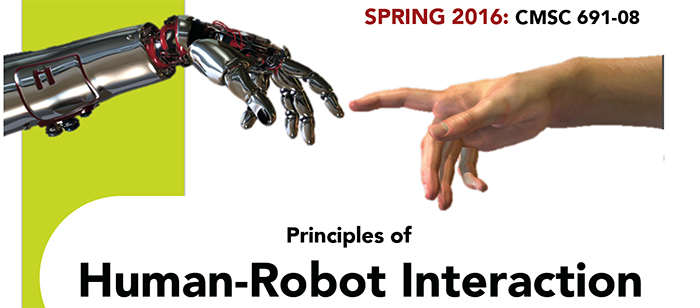
CSEE professor Cynthia Matuszek will teach a new special topics course this spring on Principles of Human-Robot Interaction. The graduate level course (CMSC 691-08) will meet on Tuesday and Thursdays from 4:00 to 5:30pm in 013 Sherman Hall.
Principles of Human-Robot Interaction
An introduction to robots in our daily lives
CMSC691-08, 4:00-5:15pm Tue/Thr, starting 26 January 2016, UMBC
Robots are becoming ubiquitous. From Roombas in our homes, to surgical robots in hospitals, to giant manipulators that assemble cars, robots are everywhere. In the past, robots have only ever interacted with highly trained experts. Now, as they are being deployed more widely, we must address new questions about how our robots can interact day-to-day with end users — non-experts — safely, usefully, and pleasantly. This new area of research is called Human-Robot Interaction, or HRI.
This 3-credit special topics course aims to introduce students to current research in HRI and provide hands-on experience with HRI research. Students will explore the diverse range of research topics in this area, learn to identify HRI problems in their own research, and carry out a collaborative project involving human-robot interactions. Topics to be covered include:
- Social robots: how can robots be social beings? When do we want them to?
- Human-robot collaboration: humans and robots working together on tasks
- Natural-language interactions with robots and human-robot dialog
- Telerobotics: the uses of remote presence and teleoperation
- Expressive robots: how can robots express emotion – and should they?
Students may benefit from having some previous coursework or experience in AI, machine learning, or robotics, but none are necessary. Undergraduate students can enroll with the instructor’s permission. For more information, contact Dr. Matuszek at cmat at umbc.edu.
]]>
CSEE professor Cynthia Matuszek will teach a new special topics course this spring on Principles of Human-Robot Interaction. The graduate level course (CMSC 691-08) will meet on Tuesday and...
http://www.csee.umbc.edu/2015/11/new-spring-course-principles-of-human-robot-interaction/
https://my3.my.umbc.edu/api/v0/pixel/news/56230/guest@my.umbc.edu/94b0578024b2d65cd8f50ca6b42c9f27/api/pixel
computer-science
graduate
news
robotics
Computer Science and Electrical Engineering
https://my3.my.umbc.edu/groups/csee
https://assets3-my.umbc.edu/system/shared/avatars/groups/000/000/099/d117dca133c64bf78a4b7696dd007189/xsmall.png?1314043393
https://assets1-my.umbc.edu/system/shared/avatars/groups/000/000/099/d117dca133c64bf78a4b7696dd007189/original.png?1314043393
https://assets1-my.umbc.edu/system/shared/avatars/groups/000/000/099/d117dca133c64bf78a4b7696dd007189/xxlarge.png?1314043393
https://assets4-my.umbc.edu/system/shared/avatars/groups/000/000/099/d117dca133c64bf78a4b7696dd007189/xlarge.png?1314043393
https://assets3-my.umbc.edu/system/shared/avatars/groups/000/000/099/d117dca133c64bf78a4b7696dd007189/large.png?1314043393
https://assets1-my.umbc.edu/system/shared/avatars/groups/000/000/099/d117dca133c64bf78a4b7696dd007189/medium.png?1314043393
https://assets2-my.umbc.edu/system/shared/avatars/groups/000/000/099/d117dca133c64bf78a4b7696dd007189/small.png?1314043393
https://assets3-my.umbc.edu/system/shared/avatars/groups/000/000/099/d117dca133c64bf78a4b7696dd007189/xsmall.png?1314043393
https://assets3-my.umbc.edu/system/shared/avatars/groups/000/000/099/d117dca133c64bf78a4b7696dd007189/xxsmall.png?1314043393
Computer Science and Electrical Engineering
1
0
true
Tue, 24 Nov 2015 14:23:17 -0500
Tue, 24 Nov 2015 14:23:17 -0500
New spring course: Principles of Human-Robot Interaction
CSEE professor Cynthia Matuszek will teach a new special topics course this spring on Principles of Human-Robot Interaction. The graduate level course (CMSC 691-08) will meet on Tuesday and Thursdays from 4:00 to 5:30pm in 013 Sherman Hall.
Principles of Human-Robot Interaction
An introduction to robots in our daily lives
CMSC691-08, 4:00-5:15pm Tue/Thr, starting 26 January 2016, UMBC
Robots are becoming ubiquitous. From Roombas in our homes, to surgical robots in hospitals, to giant manipulators that assemble cars, robots are everywhere. In the past, robots have only ever interacted with highly trained experts. Now, as they are being deployed more widely, we must address new questions about how our robots can interact day-to-day with end users — non-experts — safely, usefully, and pleasantly. This new area of research is called Human-Robot Interaction, or HRI.
This 3-credit special topics course aims to introduce students to current research in HRI and provide hands-on experience with HRI research. Students will explore the diverse range of research topics in this area, learn to identify HRI problems in their own research, and carry out a collaborative project involving human-robot interactions. Topics to be covered include:
- Social robots: how can robots be social beings? When do we want them to?
- Human-robot collaboration: humans and robots working together on tasks
- Natural-language interactions with robots and human-robot dialog
- Telerobotics: the uses of remote presence and teleoperation
- Expressive robots: how can robots express emotion – and should they?
Students may benefit from having some previous coursework or experience in AI, machine learning, or robotics, but none are necessary. Undergraduate students can enroll with the instructor’s permission. For more information, contact Dr. Matuszek at cmat at umbc.edu.
]]>
CSEE professor Cynthia Matuszek will teach a new special topics course this spring on Principles of Human-Robot Interaction. The graduate level course (CMSC 691-08) will meet on Tuesday and...
https://www.csee.umbc.edu/2015/11/new-spring-course-principles-of-human-robot-interaction/
https://my3.my.umbc.edu/api/v0/pixel/news/57871/guest@my.umbc.edu/eba2288b016419603bb92820c069bacb/api/pixel
computer-science
graduate
news
robotics
Computer Science and Electrical Engineering
https://my3.my.umbc.edu/groups/csee
https://assets3-my.umbc.edu/system/shared/avatars/groups/000/000/099/d117dca133c64bf78a4b7696dd007189/xsmall.png?1314043393
https://assets1-my.umbc.edu/system/shared/avatars/groups/000/000/099/d117dca133c64bf78a4b7696dd007189/original.png?1314043393
https://assets1-my.umbc.edu/system/shared/avatars/groups/000/000/099/d117dca133c64bf78a4b7696dd007189/xxlarge.png?1314043393
https://assets4-my.umbc.edu/system/shared/avatars/groups/000/000/099/d117dca133c64bf78a4b7696dd007189/xlarge.png?1314043393
https://assets3-my.umbc.edu/system/shared/avatars/groups/000/000/099/d117dca133c64bf78a4b7696dd007189/large.png?1314043393
https://assets1-my.umbc.edu/system/shared/avatars/groups/000/000/099/d117dca133c64bf78a4b7696dd007189/medium.png?1314043393
https://assets2-my.umbc.edu/system/shared/avatars/groups/000/000/099/d117dca133c64bf78a4b7696dd007189/small.png?1314043393
https://assets3-my.umbc.edu/system/shared/avatars/groups/000/000/099/d117dca133c64bf78a4b7696dd007189/xsmall.png?1314043393
https://assets3-my.umbc.edu/system/shared/avatars/groups/000/000/099/d117dca133c64bf78a4b7696dd007189/xxsmall.png?1314043393
Computer Science and Electrical Engineering
0
0
true
Tue, 24 Nov 2015 14:23:17 -0500
User Generated Passwords 3×3 vs 4×4 Grid Sizes for Android
Is Bigger Better?
Is Bigger Better? Comparing User Generated Passwords on
3×3 vs. 4×4 Grid Sizes for Android’s Pattern Unlock
Adam Aviv, USNA
1:00-2:00pm Tuesday, 1 December 2015, ITE 459
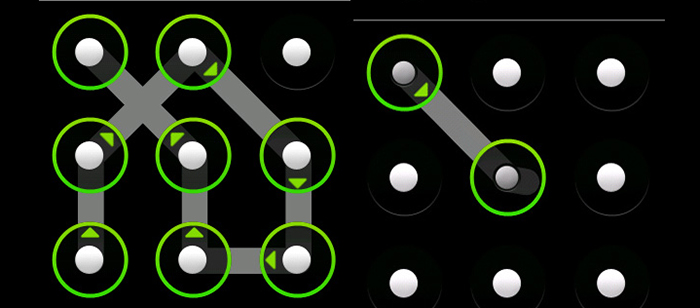
Android’s graphical authentication mechanism requires users to unlock their devices by “drawing” a pattern that connects a sequence of contact points arranged in a 3×3 grid. Prior studies have shown that human-generated patterns are far less complex than one would desire; large portions can be trivially guessed with sufficient training. Custom modifications to Android, such as CyanogenMod, offer ways to increase the grid size beyond 3×3, and in this paper we ask the question: Does increasing the grid size increase the security of human-generated patterns?
To answer this question, we conducted two large studies, one in-lab and one online, collecting 934 total 3×3 patterns and 504 4×4 patterns. Analysis shows that for both 3×3 and 4×4 patterns, there is a high incidence of repeated patterns and symmetric pairs (patterns that derive from others based on a sequence of flips and rotations). Further, many of the 4×4 patterns are similar versions of 3×3 patterns distributed over the larger grid space. Leveraging this information, we developed the most advanced guessing algorithm in this space, and we find that guessing the first 20% (0.2) of patterns for both 3×3 and 4×4 can be done as efficiently as guessing a random 2-digit PIN. Guessing larger portions of 4×4 patterns (0.5), however, requires 2-bits more entropy than guessing the same ratio of 3×3 patterns, but the entropy is still on the order of cracking random 3-digit PINs. These results suggest that while there may be some benefit to expanding the grid size to 4×4, the majority of patterns will remain trivially guessable and insecure against broad guessing attacks.
Adam J. Aviv is an Assistant Professor of Computer Science at the United States Naval Academy, receiving his Ph.D. from the University of Pennsylvania under the advisement of Jonathan Smith and Matt Blaze. He has varied research interests including in system and network security, applied cryptography, smartphone security, and more recently in the area of usable security with a focus on mobile devices.
]]>
Is Bigger Better? Comparing User Generated Passwords on 3×3 vs. 4×4 Grid Sizes for Android’s Pattern Unlock Adam Aviv, USNA 1:00-2:00pm Tuesday, 1 December 2015, ITE 459 Android’s graphical...
http://www.csee.umbc.edu/2015/11/talk-user-generated-passwords-on-3x3-vs-4x4-grid-sizes-for-android/?utm_campaign=19942&utm_medium=twitter&utm_source=twitter
https://my3.my.umbc.edu/api/v0/pixel/news/56224/guest@my.umbc.edu/98494a41dd216ba5de1761cf72be87d6/api/pixel
android
infosec
passwords
privacy
security
Information Systems Security Association, UMBC Chapter
https://my3.my.umbc.edu/groups/issa
https://assets4-my.umbc.edu/system/shared/avatars/groups/000/000/514/0bdfb1231eca53e69ca24c2de2eb6912/xsmall.png?1772925484
https://assets4-my.umbc.edu/system/shared/avatars/groups/000/000/514/0bdfb1231eca53e69ca24c2de2eb6912/original.jpg?1772925484
https://assets3-my.umbc.edu/system/shared/avatars/groups/000/000/514/0bdfb1231eca53e69ca24c2de2eb6912/xxlarge.png?1772925484
https://assets3-my.umbc.edu/system/shared/avatars/groups/000/000/514/0bdfb1231eca53e69ca24c2de2eb6912/xlarge.png?1772925484
https://assets4-my.umbc.edu/system/shared/avatars/groups/000/000/514/0bdfb1231eca53e69ca24c2de2eb6912/large.png?1772925484
https://assets2-my.umbc.edu/system/shared/avatars/groups/000/000/514/0bdfb1231eca53e69ca24c2de2eb6912/medium.png?1772925484
https://assets1-my.umbc.edu/system/shared/avatars/groups/000/000/514/0bdfb1231eca53e69ca24c2de2eb6912/small.png?1772925484
https://assets4-my.umbc.edu/system/shared/avatars/groups/000/000/514/0bdfb1231eca53e69ca24c2de2eb6912/xsmall.png?1772925484
https://assets4-my.umbc.edu/system/shared/avatars/groups/000/000/514/0bdfb1231eca53e69ca24c2de2eb6912/xxsmall.png?1772925484
IS Dept
0
0
true
Tue, 24 Nov 2015 11:40:53 -0500
talk: User Generated Passwords on 3×3 vs. 4×4 Grid Sizes for Android
UMBC Department of Information Systems
Is Bigger Better? Comparing User Generated Passwords on
3×3 vs. 4×4 Grid Sizes for Android’s Pattern Unlock
Adam Aviv, USNA
1:00-2:00pm Tuesday, 1 December 2015, ITE 459
Android’s graphical authentication mechanism requires users to unlock their devices by “drawing” a pattern that connects a sequence of contact points arranged in a 3×3 grid. Prior studies have shown that human-generated patterns are far less complex than one would desire; large portions can be trivially guessed with sufficient training. Custom modifications to Android, such as CyanogenMod, offer ways to increase the grid size beyond 3×3, and in this paper we ask the question: Does increasing the grid size increase the security of human-generated patterns?
To answer this question, we conducted two large studies, one in-lab and one online, collecting 934 total 3×3 patterns and 504 4×4 patterns. Analysis shows that for both 3×3 and 4×4 patterns, there is a high incidence of repeated patterns and symmetric pairs (patterns that derive from others based on a sequence of flips and rotations). Further, many of the 4×4 patterns are similar versions of 3×3 patterns distributed over the larger grid space. Leveraging this information, we developed the most advanced guessing algorithm in this space, and we find that guessing the first 20% (0.2) of patterns for both 3×3 and 4×4 can be done as efficiently as guessing a random 2-digit PIN. Guessing larger portions of 4×4 patterns (0.5), however, requires 2-bits more entropy than guessing the same ratio of 3×3 patterns, but the entropy is still on the order of cracking random 3-digit PINs. These results suggest that while there may be some benefit to expanding the grid size to 4×4, the majority of patterns will remain trivially guessable and insecure against broad guessing attacks.
Adam J. Aviv is an Assistant Professor of Computer Science at the United States Naval Academy, receiving his Ph.D. from the University of Pennsylvania under the advisement of Jonathan Smith and Matt Blaze. He has varied research interests including in system and network security, applied cryptography, smartphone security, and more recently in the area of usable security with a focus on mobile devices.
]]>
UMBC Department of Information Systems Is Bigger Better? Comparing User Generated Passwords on 3×3 vs. 4×4 Grid Sizes for Android’s Pattern Unlock Adam Aviv, USNA 1:00-2:00pm Tuesday, 1...
http://www.csee.umbc.edu/2015/11/talk-user-generated-passwords-on-3x3-vs-4x4-grid-sizes-for-android/
https://my3.my.umbc.edu/api/v0/pixel/news/56219/guest@my.umbc.edu/b4e0e6ef67f6dff8f8b0de8a148e98e2/api/pixel
cybersecurity
news
talks
Computer Science and Electrical Engineering
https://my3.my.umbc.edu/groups/csee
https://assets3-my.umbc.edu/system/shared/avatars/groups/000/000/099/d117dca133c64bf78a4b7696dd007189/xsmall.png?1314043393
https://assets1-my.umbc.edu/system/shared/avatars/groups/000/000/099/d117dca133c64bf78a4b7696dd007189/original.png?1314043393
https://assets1-my.umbc.edu/system/shared/avatars/groups/000/000/099/d117dca133c64bf78a4b7696dd007189/xxlarge.png?1314043393
https://assets4-my.umbc.edu/system/shared/avatars/groups/000/000/099/d117dca133c64bf78a4b7696dd007189/xlarge.png?1314043393
https://assets3-my.umbc.edu/system/shared/avatars/groups/000/000/099/d117dca133c64bf78a4b7696dd007189/large.png?1314043393
https://assets1-my.umbc.edu/system/shared/avatars/groups/000/000/099/d117dca133c64bf78a4b7696dd007189/medium.png?1314043393
https://assets2-my.umbc.edu/system/shared/avatars/groups/000/000/099/d117dca133c64bf78a4b7696dd007189/small.png?1314043393
https://assets3-my.umbc.edu/system/shared/avatars/groups/000/000/099/d117dca133c64bf78a4b7696dd007189/xsmall.png?1314043393
https://assets3-my.umbc.edu/system/shared/avatars/groups/000/000/099/d117dca133c64bf78a4b7696dd007189/xxsmall.png?1314043393
Computer Science and Electrical Engineering
0
0
true
Tue, 24 Nov 2015 09:10:40 -0500
Tue, 24 Nov 2015 09:10:40 -0500