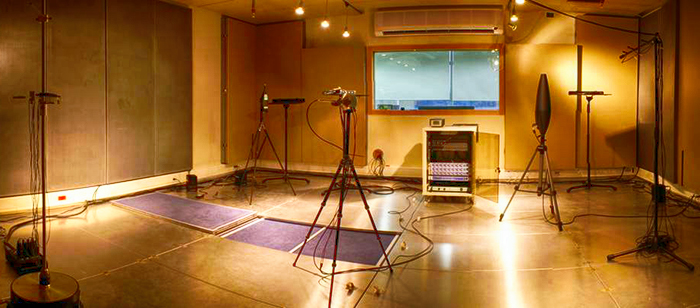
Microphone array algorithms emerged in the early 1990s as viable solutions to speech processing problems. However, the adaptation of beamforming methods to speech processing is still an open issue. There are many difficulties which arise from the characteristics of the speech signal and the acoustic environment. The speech signal is a wide-band and non-stationary signal. Very long room impulse responses (RIRs), which are several thousands of taps long, may be attributed to multiple reflections of the sound source on objects in the enclosure. Moreover, due to the inevitable movements of both sources (speakers) and receivers (microphones), the room impulse responses become time-varying.
In this talk, we will focus on spatial processors, a.k.a, beamformers, based on the linearly constrained minimum variance (LCMV) criterion, and its special case, the minimum variance distortionless (MVDR) beamformer. We show that classical beamformers that merely take into account angular information (as reflected by the so-called beam-pattern), are too simplistic to fully address the intricate propagation regime of the sound source in reverberant environment. We will therefore reformulate the LCMV beamformer in the shorttime Fourier transform (STFT) domain and substitute the free-field steering vector by the entire acoustic transfer function (ATF). The corresponding relative transfer function (RTF) will be then introduced, and its applicability to the design of beamformers in reverberant environments will be discussed. We will then elaborate on several blind RTF estimation techniques, e.g. based on subspace analysis, that enable the implementation of all necessary beamformer’s blocks. Several applications of the powerful LCMV beamformer, e.g. speech enhancement, extraction of desired speakers in multiple competing speaker environment, and binaural processing, will then be presented.
We will conclude the talk with an overview of the emerging field of distributed algorithms for ad hoc microphone arrays, and discuss the advantages and challenges they raise. The presentation will be accompanied by audio clips demonstrating the capabilities of the introduced schemes.
Sharon Gannot received his B.Sc. degree (summa cum laude) from the Technion-Israel Institute of Technology, Haifa, Israel in 1986 and the M.Sc. (cum laude) and Ph.D. degrees from Tel-Aviv University, Israel in 1995 and 2000 respectively, all in Electrical Engineering. In 2001 he held a post-doctoral position at the department of Electrical Engineering (ESAT-SISTA) at K.U.Leuven, Belgium. In 2002-2003 he held a research and teaching position at the Faculty of Electrical Engineering, Technion-Israel Institute of Technology, Haifa, Israel. Currently, he is a Full Professor at the Faculty of Engineering, Bar-Ilan University, Israel, where he is heading the Speech and Signal Processing laboratory and the Signal Processing Track. Prof. Gannot is the recipient of Bar-Ilan University outstanding lecturer award for 2010 and 2014. Prof. Gannot has served as an Associate Editor of the EURASIP Journal of Advances in Signal Processing in 2003-2012, and as an Editor of several special issues on Multi-microphone Speech Processing of the same journal. He has also served as a Guest Editor of ELSEVIER Speech Communication and Signal Processing journals. Prof. Gannot has served as an Associate Editor of IEEE Transactions on Speech, Audio and Language Processing in 2009-2013. Currently, he is a Senior Area Chair of the same journal. He also serves as a reviewer of many IEEE journals and conferences. Prof. Gannot is a member of the Audio and Acoustic Signal Processing (AASP) technical committee of the IEEE since Jan., 2010. He is also a member of the Technical and Steering committee of the International Workshop on Acoustic Signal Enhancement (IWAENC) since 2005. He was the general co-chair of IWAENC held at Tel-Aviv, Israel in August 2010. Prof. Gannot has served as the general co-chair of the IEEE Workshop on Applications of Signal Processing to Audio and Acoustics (WASPAA), New-Paltz, NY, USA in October 2013. Prof. Gannot was selected (with colleagues) to present a tutorial sessions in ICASSP 2012, EUSIPCO 2012, ICASSP 2013 and EUSIPCO 2013. His research interests include multi-microphone speech processing and specifically distributed algorithms for ad hoc microphone arrays for noise reduction and speaker separation; machine learning methods in speech processing; dereverberation; single microphone speech enhancement and speaker localization and tracking.
]]>
Multi-Microphone Speech Enhancement Sharon Gannot Bar-Ilan University, Israel 1:30pm Wednesday, 14 October 2015, ITE 325B, UMBC Microphone array algorithms emerged in the early 1990s as...http://www.csee.umbc.edu/2015/09/talk-sharon-gannot-multi-microphone-speech-enhancement-1014/https://my3.my.umbc.edu/api/v0/pixel/news/54463/guest@my.umbc.edu/35fd3f067993917b6a27898982d394ff/api/pixelcomputer-engineeringelectrical-engineeringnewsresearchtalksComputer Science and Electrical Engineeringhttps://my3.my.umbc.edu/groups/cseehttps://assets3-my.umbc.edu/system/shared/avatars/groups/000/000/099/d117dca133c64bf78a4b7696dd007189/xsmall.png?1314043393https://assets1-my.umbc.edu/system/shared/avatars/groups/000/000/099/d117dca133c64bf78a4b7696dd007189/original.png?1314043393https://assets1-my.umbc.edu/system/shared/avatars/groups/000/000/099/d117dca133c64bf78a4b7696dd007189/xxlarge.png?1314043393https://assets4-my.umbc.edu/system/shared/avatars/groups/000/000/099/d117dca133c64bf78a4b7696dd007189/xlarge.png?1314043393https://assets3-my.umbc.edu/system/shared/avatars/groups/000/000/099/d117dca133c64bf78a4b7696dd007189/large.png?1314043393https://assets1-my.umbc.edu/system/shared/avatars/groups/000/000/099/d117dca133c64bf78a4b7696dd007189/medium.png?1314043393https://assets2-my.umbc.edu/system/shared/avatars/groups/000/000/099/d117dca133c64bf78a4b7696dd007189/small.png?1314043393https://assets3-my.umbc.edu/system/shared/avatars/groups/000/000/099/d117dca133c64bf78a4b7696dd007189/xsmall.png?1314043393https://assets3-my.umbc.edu/system/shared/avatars/groups/000/000/099/d117dca133c64bf78a4b7696dd007189/xxsmall.png?1314043393Computer Science and Electrical Engineering00trueThu, 24 Sep 2015 23:17:08 -0400PhD Defense: Tanvir Mahmood, 2pm 9/24
Polarization-insensitive all-optical dual pump-phase trans-multiplexing from 2 × 10-GBd OOKs to 10-GBd RZ-QPSK using cross-phase modulation in a passive nonlinear birefringent photonic crystal fiber
Tanvir Mahmood
2:00pm Thursday, 24 September 2015, ITE325b
Considering the network size, bit rate, spectral and channel capacity limitations, different modulation formats may be selectively used in future optical networks. Although the traditional metropolitan area networks (MANs) still use the non-return-to-zero on-off keying (NRZ-OOK) modulation format due to its technical simplicity and therefore low cost, QPSK format is more advantageous in spectrally efficient long-haul fiber optic transmission systems because of its constant power envelope, and robustness to various transmission impairments. Consequently, an important problem may arise, in particular how to route the OOK-data streams from MANs to long-haul backbone networks when the state of polarization (SOP) of the remotely generated OOK is unpredictable. Hence, the focus of this dissertation was to investigate a polarization-insensitive (PI) all-optical nonlinear optical signal processing (NOSP) method that can be implemented at the network cross-connect (X-connect) to transfer data from a remotely and a locally generated OOK data simultaneously to more effectual QPSK format for long-haul transmission. By utilizing cross-phase modulation (XPM) and inherent birefringence of the device, the work demonstrated, for the first time, PI all-optical data transfer utilizing dual pump-phase transmultiplexing (DPTM) from 2 × 10-GBd OOKs to 10-GBd RZ-QPSK in a passive nonlinear birefringent photonic crystal fiber (PCF). Polarization insensitivity was achieved by scrambling the SOP of the remotely generated OOK pump and launching the locally generated OOK pump and the probe off-axis. To mitigate polarization induced power fluctuations and detrimental effects due to nearby partially degenerate and non-degenerate four wave mixings, an optimum pump-probe detuning was also utilized. The PI DPTM RZ-QPSK demonstrated a pre-amplified receiver sensitivity penalty < 5.5 dB at 10−9 bit-error-rate (BER), relative to the FPGA-precoded RZ-DQPSK baseline in ASE-limited transmission system. The effect of the remotely generated OOK pump OSNR degradation on the PI DPTM RZ-QPSK was also investigated and it was established that 10−9 BER metric was attainable till the remotely generated OOK pump reached the threshold OSNR limit of 34 dB/0.1nm. Finally, DWDM transmission performance of the PI DPTM RZ-QPSK signal was evaluated using a 138-km long recirculating loop and it was demonstrated that the PI DPTM RZ-QPSK can be transmitted over 1,500 km before it reached ITU-T G.709 7% HD-FEC overhead limit. This propagation distance was well beyond the transmission requisites of any typical metro network (≈ 600 km). Furthermore, it was demonstrated that, within the threshold limit, OSNR degradation of the remotely generated OOK pump had minimal impact on the transmission distance of the PI DPTM RZ-QPSK before it reached 7% HD-FEC overhead limit.
Committee: Drs. Gary M. Carter (Chair), Anthony M. Johnson, Fow-Sen Choa, Tinoosh Mohsenin, Thomas E. Murphy (ECE,UMCP), William Astar
]]>
PhD Dissertation Defense Announcement Electrical Engineering Polarization-insensitive all-optical dual pump-phase trans-multiplexing from 2 × 10-GBd OOKs to 10-GBd RZ-QPSK using cross-phase...http://www.csee.umbc.edu/2015/09/phd-defense-tanvir-mahmood-2pm-924/https://my3.my.umbc.edu/api/v0/pixel/news/54374/guest@my.umbc.edu/581750de64defe8a947953f1424fd919/api/pixeldefenseelectrical-engineeringgraduatenewsresearchComputer Science and Electrical Engineeringhttps://my3.my.umbc.edu/groups/cseehttps://assets3-my.umbc.edu/system/shared/avatars/groups/000/000/099/d117dca133c64bf78a4b7696dd007189/xsmall.png?1314043393https://assets1-my.umbc.edu/system/shared/avatars/groups/000/000/099/d117dca133c64bf78a4b7696dd007189/original.png?1314043393https://assets1-my.umbc.edu/system/shared/avatars/groups/000/000/099/d117dca133c64bf78a4b7696dd007189/xxlarge.png?1314043393https://assets4-my.umbc.edu/system/shared/avatars/groups/000/000/099/d117dca133c64bf78a4b7696dd007189/xlarge.png?1314043393https://assets3-my.umbc.edu/system/shared/avatars/groups/000/000/099/d117dca133c64bf78a4b7696dd007189/large.png?1314043393https://assets1-my.umbc.edu/system/shared/avatars/groups/000/000/099/d117dca133c64bf78a4b7696dd007189/medium.png?1314043393https://assets2-my.umbc.edu/system/shared/avatars/groups/000/000/099/d117dca133c64bf78a4b7696dd007189/small.png?1314043393https://assets3-my.umbc.edu/system/shared/avatars/groups/000/000/099/d117dca133c64bf78a4b7696dd007189/xsmall.png?1314043393https://assets3-my.umbc.edu/system/shared/avatars/groups/000/000/099/d117dca133c64bf78a4b7696dd007189/xxsmall.png?1314043393Computer Science and Electrical Engineering40trueMon, 21 Sep 2015 23:10:07 -0400Proposal: Vatcher, Verifiable Randomness and its Applications, 10:30 9/24
Ph.D. Dissertation Proposal
Verifiable Randomness and its Applications
Christopher Vatcher
10:30am Thursday, 24 September 2015, ITE 325b
We propose to create a public verifiable randomness beacon, to integrate with the Random-Sample Voting system, constructed to be secure against adversaries who have even almost complete control over the system’s source of public randomness including the entropy source.
By verifiable randomness, we do not mean we can prove a sequence of bits to be random. Instead, verifiability means it is possible to prove: (a) a consumer used uniform bits originating from a specific entropy source and therefore cannot lie about the bits used; and (b) the bits used were unpredictable prior to their generation and, with overwhelming probability, were free of adversarial influence. This is in contrast to ordinary public randomness where parties must agree to trust some randomness provider, who becomes a target of corruption. Verifiable randomness is an enhancement of public randomness used to perform random selection in voting, conduct random audits, preserve privacy, generate random challenges for secure multi-party computation, and public lottery draws. Random-Sample Voting specifically requires verifiable randomness for random voter selection and random audits.
Our work extends the work of Eastlake and Clark and Hengartner by considering (a) adversaries who have fine control over the entropy source and (b) physical entropy sources, which we can make verifiable.
Our specific aims include (a) creating adversary models for three entropy source abstractions based on trusted providers, sensor networks, and distributed proof-of-work systems; (b) create a verifiable random beacon that integrates each model; (c) integrate our work with the Random-Sample Voting system; and (d) integrate with NIST’s beacon and propose a verifiable randomness standard based on our work.
Our method is to weaken the trust assumption on the entropy source by introducing verifiable entropy sources, which have mechanisms for limiting adversarial influence and accumulating evidence that their outputs obey a known distribution. Combined with an appropriate randomness extractor, we can generate verifiable random bits. Using sources like weather, we will construct a verifiable randomness beacon: a public randomness provider unencumbered by generous and often unfounded trust assumptions. Such a beacon can serve as a singular gateway for accessing and aggregating multiple entropy sources without compromising the randomness provided to consumers.
Committee: Drs. Alan T. Sherman (Chair), Konstantinos Kalpakis, Weining Kang (Math/Stat), David Chaum (Random-Sample Voting), Aggelos Kiayias (University of Athens)
]]>
Ph.D. Dissertation Proposal Verifiable Randomness and its Applications Christopher Vatcher 10:30am Thursday, 24 September 2015, ITE 325b We propose to create a public verifiable randomness...http://www.csee.umbc.edu/2015/09/proposal-vatcher-verifiable-randomness-and-its-applications-1030-924/https://my3.my.umbc.edu/api/v0/pixel/news/54373/guest@my.umbc.edu/001d44f1c767a22080f20c47b6f79b47/api/pixelcomputer-sciencecybersecuritygraduatenewsresearchtalksComputer Science and Electrical Engineeringhttps://my3.my.umbc.edu/groups/cseehttps://assets3-my.umbc.edu/system/shared/avatars/groups/000/000/099/d117dca133c64bf78a4b7696dd007189/xsmall.png?1314043393https://assets1-my.umbc.edu/system/shared/avatars/groups/000/000/099/d117dca133c64bf78a4b7696dd007189/original.png?1314043393https://assets1-my.umbc.edu/system/shared/avatars/groups/000/000/099/d117dca133c64bf78a4b7696dd007189/xxlarge.png?1314043393https://assets4-my.umbc.edu/system/shared/avatars/groups/000/000/099/d117dca133c64bf78a4b7696dd007189/xlarge.png?1314043393https://assets3-my.umbc.edu/system/shared/avatars/groups/000/000/099/d117dca133c64bf78a4b7696dd007189/large.png?1314043393https://assets1-my.umbc.edu/system/shared/avatars/groups/000/000/099/d117dca133c64bf78a4b7696dd007189/medium.png?1314043393https://assets2-my.umbc.edu/system/shared/avatars/groups/000/000/099/d117dca133c64bf78a4b7696dd007189/small.png?1314043393https://assets3-my.umbc.edu/system/shared/avatars/groups/000/000/099/d117dca133c64bf78a4b7696dd007189/xsmall.png?1314043393https://assets3-my.umbc.edu/system/shared/avatars/groups/000/000/099/d117dca133c64bf78a4b7696dd007189/xxsmall.png?1314043393Computer Science and Electrical Engineering00trueMon, 21 Sep 2015 22:41:38 -0400talk: Challenges & opportunities in studying the brain’s network activity, 12p 9/25
The UMBC CSEE Seminar Series Presents
Technical challenges and opportunities
in studying the brain’s network activity
Dr. Hanbing Lu
National Institute of Drug Abuse, NIH
12:00-1:00pm, Friday 25 September 2015, ITE 325b
Brain structures do not work in isolation; they work in concert to produce sensory perception, motivation and behavior. Recent advances in fMRI technology offer the opportunity to investigate brain’s network activity. Data are accumulated suggesting that dysregulations within and between network activity are implicated in a number of neurodegenerative and neuropsychiatric disorders, including Alzheimer’s disease and drug addiction. Despite wide application of this approach in systems neuroscience, the fundamentals of brain network activity remain poorly understood. Animal models permit invasive manipulations and are uniquely advantageous in this regard. In this talk, Dr. Lu will discuss technical challenges and opportunities in studying brain networks by integrating multiple modalities, including MRI, electrophysiological recording, optical and electromagnetic neural modulation.
Dr. Hanbing Lu received his doctorate training in Biophysics at the Medical College of Wisconsin, during which he developed hardware and imaging sequence for functional magnetic resonance imaging (fMRI) in rodents. He is currently a staff scientist in the Neuroimaging Research Branch, National Institute on Drug Abuse, NIH. Dr. Lu pioneered animal models to investigate brain’s large scale networks. Current efforts include integrating multiple modalities to better understand the neurobiology of brain’s network activity
Hosts: Professors Fow-Sen Choa (Sorry, you need javascript to view this email address. ) and Alan T. Sherman (Sorry, you need javascript to view this email address. )
]]>
The UMBC CSEE Seminar Series Presents Technical challenges and opportunities in studying the brain’s network activity Dr. Hanbing Lu National Institute of Drug Abuse, NIH 12:00-1:00pm,...http://www.csee.umbc.edu/2015/09/talk-challenges-opportunities-in-studying-the-brains-network-activity-12p-925/https://my3.my.umbc.edu/api/v0/pixel/news/54327/guest@my.umbc.edu/841a8b5b4d15443c9708628621308021/api/pixelnewsresearchtalksComputer Science and Electrical Engineeringhttps://my3.my.umbc.edu/groups/cseehttps://assets3-my.umbc.edu/system/shared/avatars/groups/000/000/099/d117dca133c64bf78a4b7696dd007189/xsmall.png?1314043393https://assets1-my.umbc.edu/system/shared/avatars/groups/000/000/099/d117dca133c64bf78a4b7696dd007189/original.png?1314043393https://assets1-my.umbc.edu/system/shared/avatars/groups/000/000/099/d117dca133c64bf78a4b7696dd007189/xxlarge.png?1314043393https://assets4-my.umbc.edu/system/shared/avatars/groups/000/000/099/d117dca133c64bf78a4b7696dd007189/xlarge.png?1314043393https://assets3-my.umbc.edu/system/shared/avatars/groups/000/000/099/d117dca133c64bf78a4b7696dd007189/large.png?1314043393https://assets1-my.umbc.edu/system/shared/avatars/groups/000/000/099/d117dca133c64bf78a4b7696dd007189/medium.png?1314043393https://assets2-my.umbc.edu/system/shared/avatars/groups/000/000/099/d117dca133c64bf78a4b7696dd007189/small.png?1314043393https://assets3-my.umbc.edu/system/shared/avatars/groups/000/000/099/d117dca133c64bf78a4b7696dd007189/xsmall.png?1314043393https://assets3-my.umbc.edu/system/shared/avatars/groups/000/000/099/d117dca133c64bf78a4b7696dd007189/xxsmall.png?1314043393Computer Science and Electrical Engineering00trueSat, 19 Sep 2015 17:11:42 -0400Sat, 19 Sep 2015 17:11:42 -0400PhD proposal: Kulkarni, Secured Embedded Many-Core Accelerator for Big Data Processing
PhD Dissertation Proposal
Secured Embedded Many-Core Accelerator for Big Data Processing
Amey Kulkarni
2:00-4:00pm Friday, 18 September 2015, ITE 325b
I/O bandwidth and stringent delay constraints on processing time, limits the use of streaming Big Data for a large variety of real world problems. On the other hand, examining Big Data in applications such as intelligence, surveillance and reconnaissance unveils sensitive information in terms of hidden patterns or unknown correlations, thus demanding secured processing environment. In this PhD research, we propose a scalable and secured framework for a many-core accelerator architecture for efficient big data parallel processing. We propose to merge a compressive sensing-based framework to reduce IO Bandwidth and a machine learning-based framework to secure many-core communications. Four different reduced complexity architectures and two different modifications to Orthogonal Matching Pursuit (OMP) compressive sensing reconstruction algorithm are proposed. We implement the proposed OMP architectures on FPGA, ASIC, CPU/GPU and Many-Core to investigate hardware overhead cost. To secure communications within many-core, we propose two different machine learning-based Trojan detection framework which have minimal hardware overhead. To conclude this work, we aim to implement and evaluate the proposed scalable and secured many-core accelerator hardware for image and multi-channel biomedical signal processing on quad-core and sixteen-core architectures.
Committee: Drs. Tinoosh Mohsenin, (Chair), Mohamed Younis, Seung-Jun Kim, Farinaz Koushanfar (Rice University) and Houman Homayoun (George Mason University)
]]>
PhD Dissertation Proposal Secured Embedded Many-Core Accelerator for Big Data Processing Amey Kulkarni 2:00-4:00pm Friday, 18 September 2015, ITE 325b I/O bandwidth and stringent delay...http://www.csee.umbc.edu/2015/09/phd-proposal-kulkarni-secured-embedded-many-core-accelerator-for-big-data-processing/https://my3.my.umbc.edu/api/v0/pixel/news/54277/guest@my.umbc.edu/4b123e9077faca201411ab83d8a178e5/api/pixelcomputer-engineeringgraduatenewsresearchtalksComputer Science and Electrical Engineeringhttps://my3.my.umbc.edu/groups/cseehttps://assets3-my.umbc.edu/system/shared/avatars/groups/000/000/099/d117dca133c64bf78a4b7696dd007189/xsmall.png?1314043393https://assets1-my.umbc.edu/system/shared/avatars/groups/000/000/099/d117dca133c64bf78a4b7696dd007189/original.png?1314043393https://assets1-my.umbc.edu/system/shared/avatars/groups/000/000/099/d117dca133c64bf78a4b7696dd007189/xxlarge.png?1314043393https://assets4-my.umbc.edu/system/shared/avatars/groups/000/000/099/d117dca133c64bf78a4b7696dd007189/xlarge.png?1314043393https://assets3-my.umbc.edu/system/shared/avatars/groups/000/000/099/d117dca133c64bf78a4b7696dd007189/large.png?1314043393https://assets1-my.umbc.edu/system/shared/avatars/groups/000/000/099/d117dca133c64bf78a4b7696dd007189/medium.png?1314043393https://assets2-my.umbc.edu/system/shared/avatars/groups/000/000/099/d117dca133c64bf78a4b7696dd007189/small.png?1314043393https://assets3-my.umbc.edu/system/shared/avatars/groups/000/000/099/d117dca133c64bf78a4b7696dd007189/xsmall.png?1314043393https://assets3-my.umbc.edu/system/shared/avatars/groups/000/000/099/d117dca133c64bf78a4b7696dd007189/xxsmall.png?1314043393Computer Science and Electrical Engineering10trueThu, 17 Sep 2015 22:05:14 -0400Not Yet Official: Cybersecurity Undergraduate CertificateStudents ask for more cybersecurity; IS is poised to deliver
Next semester IS plans to offer two courses, "Security Analytics" with Dr. Janeja (prerequisite probably IS 410), and "Software Security" with Dr. Seaman (prerequisite probably IS 247). In addition to being part of the (hopefully) upcoming cybersecurity certificate, IS will accept either course as a third programming course in the BS program. Ask your advisors as we approach registration late next month.
]]>
Next semester IS plans to offer two courses, "Security Analytics" with Dr. Janeja (prerequisite probably IS 410), and "Software Security" with Dr. Seaman (prerequisite probably IS 247). In...https://my3.my.umbc.edu/api/v0/pixel/news/54166/guest@my.umbc.edu/e2722623ea9f1ae1ce0a7b340f13cc3c/api/pixelInformation Systems Security Association, UMBC Chapterhttps://my3.my.umbc.edu/groups/issahttps://assets4-my.umbc.edu/system/shared/avatars/groups/000/000/514/0bdfb1231eca53e69ca24c2de2eb6912/xsmall.png?1772925484https://assets4-my.umbc.edu/system/shared/avatars/groups/000/000/514/0bdfb1231eca53e69ca24c2de2eb6912/original.jpg?1772925484https://assets3-my.umbc.edu/system/shared/avatars/groups/000/000/514/0bdfb1231eca53e69ca24c2de2eb6912/xxlarge.png?1772925484https://assets3-my.umbc.edu/system/shared/avatars/groups/000/000/514/0bdfb1231eca53e69ca24c2de2eb6912/xlarge.png?1772925484https://assets4-my.umbc.edu/system/shared/avatars/groups/000/000/514/0bdfb1231eca53e69ca24c2de2eb6912/large.png?1772925484https://assets2-my.umbc.edu/system/shared/avatars/groups/000/000/514/0bdfb1231eca53e69ca24c2de2eb6912/medium.png?1772925484https://assets1-my.umbc.edu/system/shared/avatars/groups/000/000/514/0bdfb1231eca53e69ca24c2de2eb6912/small.png?1772925484https://assets4-my.umbc.edu/system/shared/avatars/groups/000/000/514/0bdfb1231eca53e69ca24c2de2eb6912/xsmall.png?1772925484https://assets4-my.umbc.edu/system/shared/avatars/groups/000/000/514/0bdfb1231eca53e69ca24c2de2eb6912/xxsmall.png?1772925484Information Systems Security Association, UMBC Chapter71trueTue, 15 Sep 2015 16:15:55 -0400talk: Optical Measurements and Devices for Biotechnology and Biomedicine, 12pm 9/18
The UMBC CSEE Seminar Series Presents
Optical Measurements and Devices for Biotechnology and Biomedicine
Dr. Yordan Kostov
Assistant Director, Center for Advanced Sensor Technology, UMBC
12-1pm Friday, 18 September 2015
ITE 102 (Lecture Hall VIII)
A variety of approaches for measurement of bioprocess and biomedical variables are presented. Classical optical measurements (fluorescence, absorption, decay time, etc.) are employed together with miniaturized versions of benchtop spectroscopy equipment to measure a number of bioprocess variables (pH, DO, protein concentration, etc.). Similar approach allows for measurement of biomedical parameters (transcutaneous O2 and CO2, glucose). The sensing is made possible by the developed miniaturized versions of lab equipment, use of microfluidics and actuation, as well as the use of proper data processing coupled with customizable user interface. A number of examples will be given.
Dr. Yordan Kostov holds an M.Sc. in Electrical engineering from Odessa Polytechnical Institute (Ukraine) and a combined Ph.D. Degree in ChemE./EE from Bulgarian Academy of Sciences. He has industry experience as electronic technology engineer. In his doctoral studies, he focused on optical sensing of biomedical parameters, and pursues this line of research ever since. Currently, he is Assistant Director of the Center for Advanced Sensor Technology at UMBC and Adjunct Professor at CSEE. His main interests are in the area of Biomedical measurements and devices.
Hosts: Professors Fow-Sen Choa (Sorry, you need javascript to view this email address. ) and Alan T. Sherman (Sorry, you need javascript to view this email address. )
]]>
The UMBC CSEE Seminar Series Presents Optical Measurements and Devices for Biotechnology and Biomedicine Dr. Yordan Kostov Assistant Director, Center for Advanced Sensor Technology, UMBC...http://www.csee.umbc.edu/2015/09/19483/https://my3.my.umbc.edu/api/v0/pixel/news/54149/guest@my.umbc.edu/11dab9a498c7fb826b43ddc2cbefb9f4/api/pixelnewstalksComputer Science and Electrical Engineeringhttps://my3.my.umbc.edu/groups/cseehttps://assets3-my.umbc.edu/system/shared/avatars/groups/000/000/099/d117dca133c64bf78a4b7696dd007189/xsmall.png?1314043393https://assets1-my.umbc.edu/system/shared/avatars/groups/000/000/099/d117dca133c64bf78a4b7696dd007189/original.png?1314043393https://assets1-my.umbc.edu/system/shared/avatars/groups/000/000/099/d117dca133c64bf78a4b7696dd007189/xxlarge.png?1314043393https://assets4-my.umbc.edu/system/shared/avatars/groups/000/000/099/d117dca133c64bf78a4b7696dd007189/xlarge.png?1314043393https://assets3-my.umbc.edu/system/shared/avatars/groups/000/000/099/d117dca133c64bf78a4b7696dd007189/large.png?1314043393https://assets1-my.umbc.edu/system/shared/avatars/groups/000/000/099/d117dca133c64bf78a4b7696dd007189/medium.png?1314043393https://assets2-my.umbc.edu/system/shared/avatars/groups/000/000/099/d117dca133c64bf78a4b7696dd007189/small.png?1314043393https://assets3-my.umbc.edu/system/shared/avatars/groups/000/000/099/d117dca133c64bf78a4b7696dd007189/xsmall.png?1314043393https://assets3-my.umbc.edu/system/shared/avatars/groups/000/000/099/d117dca133c64bf78a4b7696dd007189/xxsmall.png?1314043393Computer Science and Electrical Engineering00trueTue, 15 Sep 2015 09:12:30 -0400Tue, 15 Sep 2015 09:12:30 -0400HueBots game created by UMBC students now on Steam
Huebotics developers Jasmin Martin, Erika Shumacher, Tad Cordle and Michael Leung
Technical.ly Baltimore reports that the HueBots robot-building game made by a four UMBC students has been added to the PC game platform Steam.
“HueBots is a deceptively challenging top-down puzzle game. You control a team of colorful robots that will only interact with objects that match their color; they will also keep moving in one direction until they collide with something that matches their color.”
You can try a demo version of Huebots at http://huebots.com/ and also download the demo version for use on a Mac or PC. The release trailer will give you an idea of what it’s like.
The UMBC Entrepreneurs group reports that the student team that developed the game includes lead Michael Leung ’16, computer science; Tad Cordle ’16, computer engineering; and Erika Schumacher ’17; and Jasmine Martin ’15, both visual arts students with interactive media concentrations. This summer Graham Dolle ’18, computer science, contributed special visual effects.
CSEE Professor Marc Olano notes that it is the first game to go for sale to the larger public from UMBC’s Game Developer’s Club.
“The Steam greenlight process requires the game to get strong community feedback before it is approved, which it could only have gotten with wider interest than just UMBC,” Olando said in an email to Technical.ly.
The group has already sold about 100 copies of the game and has a mobile version that is waiting for approval from iOS and Android in the coming weeks.
]]>
Huebotics developers Jasmin Martin, Erika Shumacher, Tad Cordle and Michael Leung Technical.ly Baltimore reports that the HueBots robot-building game made by a four UMBC students has been added...http://www.csee.umbc.edu/2015/09/huebots-game-created-by-umbc-students-now-on-steam/https://my3.my.umbc.edu/api/v0/pixel/news/54060/guest@my.umbc.edu/096db87cad035f74b16bd36562b4d3e1/api/pixelcomputer-engineeringcomputer-sciencegame-tracknewsstudentsundergraduateComputer Science and Electrical Engineeringhttps://my3.my.umbc.edu/groups/cseehttps://assets3-my.umbc.edu/system/shared/avatars/groups/000/000/099/d117dca133c64bf78a4b7696dd007189/xsmall.png?1314043393https://assets1-my.umbc.edu/system/shared/avatars/groups/000/000/099/d117dca133c64bf78a4b7696dd007189/original.png?1314043393https://assets1-my.umbc.edu/system/shared/avatars/groups/000/000/099/d117dca133c64bf78a4b7696dd007189/xxlarge.png?1314043393https://assets4-my.umbc.edu/system/shared/avatars/groups/000/000/099/d117dca133c64bf78a4b7696dd007189/xlarge.png?1314043393https://assets3-my.umbc.edu/system/shared/avatars/groups/000/000/099/d117dca133c64bf78a4b7696dd007189/large.png?1314043393https://assets1-my.umbc.edu/system/shared/avatars/groups/000/000/099/d117dca133c64bf78a4b7696dd007189/medium.png?1314043393https://assets2-my.umbc.edu/system/shared/avatars/groups/000/000/099/d117dca133c64bf78a4b7696dd007189/small.png?1314043393https://assets3-my.umbc.edu/system/shared/avatars/groups/000/000/099/d117dca133c64bf78a4b7696dd007189/xsmall.png?1314043393https://assets3-my.umbc.edu/system/shared/avatars/groups/000/000/099/d117dca133c64bf78a4b7696dd007189/xxsmall.png?1314043393Computer Science and Electrical Engineering80trueFri, 11 Sep 2015 17:03:55 -0400Center of Academic Excellence Community online events, 1-3 Thr 9/17
If you are interested in cybersecurity, consider joining the CAE community.
UMBC is designated as a Center of Academic Excellence in Information Assurance/Cyber Defense Education and Research by the NSA and DHS. The CAE Community site is a good place for information, ideas and events for students, faculty and staff who are interested in information assurance and cybersecurity.
For example, a recent news post has information on an online event on Thursday 17 September 2015 that will include two talks: one from 1-2pm on Digital Investigation and the Trojan Defense and another from 2:15-3:15 on the NSA Codebreaker Challenge.
See the post for more information on the talks and how to particiate online.
]]>
If you are interested in cybersecurity, consider joining the CAE community. UMBC is designated as a Center of Academic Excellence in Information Assurance/Cyber Defense Education and Research by...http://www.csee.umbc.edu/2015/09/center-of-academic-excellence-community-online-events-1-3-thr-917/https://my3.my.umbc.edu/api/v0/pixel/news/53950/guest@my.umbc.edu/e392d71fbe9a8294ffda6365d29b9428/api/pixelcybersecurityeventsnewstalksComputer Science and Electrical Engineeringhttps://my3.my.umbc.edu/groups/cseehttps://assets3-my.umbc.edu/system/shared/avatars/groups/000/000/099/d117dca133c64bf78a4b7696dd007189/xsmall.png?1314043393https://assets1-my.umbc.edu/system/shared/avatars/groups/000/000/099/d117dca133c64bf78a4b7696dd007189/original.png?1314043393https://assets1-my.umbc.edu/system/shared/avatars/groups/000/000/099/d117dca133c64bf78a4b7696dd007189/xxlarge.png?1314043393https://assets4-my.umbc.edu/system/shared/avatars/groups/000/000/099/d117dca133c64bf78a4b7696dd007189/xlarge.png?1314043393https://assets3-my.umbc.edu/system/shared/avatars/groups/000/000/099/d117dca133c64bf78a4b7696dd007189/large.png?1314043393https://assets1-my.umbc.edu/system/shared/avatars/groups/000/000/099/d117dca133c64bf78a4b7696dd007189/medium.png?1314043393https://assets2-my.umbc.edu/system/shared/avatars/groups/000/000/099/d117dca133c64bf78a4b7696dd007189/small.png?1314043393https://assets3-my.umbc.edu/system/shared/avatars/groups/000/000/099/d117dca133c64bf78a4b7696dd007189/xsmall.png?1314043393https://assets3-my.umbc.edu/system/shared/avatars/groups/000/000/099/d117dca133c64bf78a4b7696dd007189/xxsmall.png?1314043393Computer Science and Electrical Engineering10trueWed, 09 Sep 2015 09:26:22 -0400talk: Mark Cather, Enterprise and Higher Education Security, 11:15 Fri 9/11 UMBC
UMBC Cyber Defense Laboratory
University of Maryland, Baltimore County
Enterprise and Higher Education Security
Mark Cather
Chief Information Security Officer
University of Maryland, Baltimore County
11:15am-12:30pm Friday 11 September 2015, ITE 231
Mark Cather will speak about the priorities and current challenges in securing a higher education environment and enterprises in general. Mr. Cather has been working for UMBC’s Department of Information Technology since he received his BS in computer science from UMBC in 1997. He assumed his current role as UMBC’s Chief Information Security Officer in 2014.
For more information, contact Prof. Alan Sherman, sherman at umbc.edu .
]]>
UMBC Cyber Defense Laboratory University of Maryland, Baltimore County Enterprise and Higher Education Security Mark Cather Chief Information Security Officer University of Maryland,...http://www.csee.umbc.edu/2015/09/mark-cather-on-enterprise-and-higher-education-security-1115-fri-911-umbc/https://my3.my.umbc.edu/api/v0/pixel/news/53941/guest@my.umbc.edu/348b01f332a80dc06d8bb0a0cb0ad946/api/pixelcybersecuritynewstalksComputer Science and Electrical Engineeringhttps://my3.my.umbc.edu/groups/cseehttps://assets3-my.umbc.edu/system/shared/avatars/groups/000/000/099/d117dca133c64bf78a4b7696dd007189/xsmall.png?1314043393https://assets1-my.umbc.edu/system/shared/avatars/groups/000/000/099/d117dca133c64bf78a4b7696dd007189/original.png?1314043393https://assets1-my.umbc.edu/system/shared/avatars/groups/000/000/099/d117dca133c64bf78a4b7696dd007189/xxlarge.png?1314043393https://assets4-my.umbc.edu/system/shared/avatars/groups/000/000/099/d117dca133c64bf78a4b7696dd007189/xlarge.png?1314043393https://assets3-my.umbc.edu/system/shared/avatars/groups/000/000/099/d117dca133c64bf78a4b7696dd007189/large.png?1314043393https://assets1-my.umbc.edu/system/shared/avatars/groups/000/000/099/d117dca133c64bf78a4b7696dd007189/medium.png?1314043393https://assets2-my.umbc.edu/system/shared/avatars/groups/000/000/099/d117dca133c64bf78a4b7696dd007189/small.png?1314043393https://assets3-my.umbc.edu/system/shared/avatars/groups/000/000/099/d117dca133c64bf78a4b7696dd007189/xsmall.png?1314043393https://assets3-my.umbc.edu/system/shared/avatars/groups/000/000/099/d117dca133c64bf78a4b7696dd007189/xxsmall.png?1314043393Computer Science and Electrical Engineering00trueTue, 08 Sep 2015 20:59:53 -0400Tue, 08 Sep 2015 20:59:53 -0400