Room for rent for $500 (utilities included)
Hi,
A single room is available immediately for rent in a 2BHK located on Edmondson avenue near UMBC campus. However, the room is available only for a short term basis (until 10/30/17). The rent for the room is $500, which include utilities.The common areas (bathroom/kitchen) will be shared with another person.
The apartment is located in Edmondson (10 min drive to UMBC) and is on route of Catonsville shuttle.The locality is very quiet and safe, with lots of UMBC students calling it home.

UMBC’s Gymama Slaughter will develop a bioreactor to extend the viability of lifesaving human organs as they await transplant through a major new grant from the U.S. Army Medical Research and Material Command. Funding for the project totals nearly $1.5 million for a period of three years. Slaughter, associate professor of computer science and electrical engineering, will collaborate closely with Warren Grayson and Gerald Brandacher, both associate professors at Johns Hopkins.
The team will create a bioreactor integrating in-line sensors, mechanical stimulator, and blood perfusion system to more accurately and continuously monitor organs as they are transported for transplantation. They will also “develop a system that closely mimic the organ’s natural environment,” explains Slaughter.
Currently, organ and tissue donors typically need to be in close proximity to transplant recipients due to limitations in organ transport. Some organs are only viable for about six hours, and they must be kept at very cool temperatures to remain viable, so the transport process can be a race against time. With technological improvements, Slaughter says, the viability of the organs could be increased to about 36 hours, greatly expanding the distance an organ could travel from donor to recipient, and the likelihood of a successful transplant.
 Gymama Slaughter, right, with Joel Tyson ’17, chemical engineering, and Zahra Ghassemi M.S. ’17, chemical engineering, in her lab.
Slaughter will focus on developing the metabolic sensors to continuously monitor the organ’s nitric oxide and oxygen levels. Grayson will create a mechanical stimulator to keep the organ moving during the transportation process, so the organ tissue does not become rigid and die. Brandacher will develop technology to continuously supply the organ or tissue with blood, to maintain viability, and will focus on the clinical aspects of the grant.
“This interdisciplinary research will enable us to tackle complex organ transplant viability problems to create the next big breakthrough platform technology for extending and monitoring the viability of organs to improve patient care,” says Slaughter. Together, the researchers hope their work will lead to a new era of successful human organ transplantation, saving the lives of wounded soldiers and others in need of transplants in hard-to-reach locations around the world.
Slaughter’s work was highlighted in the Baltimore Business Journal, The Baltimore Sun, and The Baltimore Times.
Banner image: Gymama Slaughter. Photo by Marlayna Demond ’11 for UMBC.
]]>
UMBC’s Gymama Slaughter will develop a bioreactor to extend the viability of lifesaving human organs as they await transplant through a major new grant from the U.S. Army Medical Research and...
https://umbc.edu/stories/umbcs-gymama-slaughter-receives-nearly-1-5-million-from-u-s-army-to-develop-bioreactors-that-could-pause-the-clock-for-life-saving-organ-transplants/
https://my3.my.umbc.edu/api/v0/pixel/news/120691/guest@my.umbc.edu/65bcd093b370b8214d5927a6e7f26ee4/api/pixel
coeit
csee
research
science-and-technology
UMBC News & Magazine
https://my3.my.umbc.edu/groups/umbc-news-magazine
https://assets1-my.umbc.edu/system/shared/avatars/groups/000/001/943/24435aa6207c452e7bc15cc74b42c7bb/xsmall.png?1748556657
https://assets1-my.umbc.edu/system/shared/avatars/groups/000/001/943/24435aa6207c452e7bc15cc74b42c7bb/original.png?1748556657
https://assets2-my.umbc.edu/system/shared/avatars/groups/000/001/943/24435aa6207c452e7bc15cc74b42c7bb/xxlarge.png?1748556657
https://assets2-my.umbc.edu/system/shared/avatars/groups/000/001/943/24435aa6207c452e7bc15cc74b42c7bb/xlarge.png?1748556657
https://assets3-my.umbc.edu/system/shared/avatars/groups/000/001/943/24435aa6207c452e7bc15cc74b42c7bb/large.png?1748556657
https://assets1-my.umbc.edu/system/shared/avatars/groups/000/001/943/24435aa6207c452e7bc15cc74b42c7bb/medium.png?1748556657
https://assets2-my.umbc.edu/system/shared/avatars/groups/000/001/943/24435aa6207c452e7bc15cc74b42c7bb/small.png?1748556657
https://assets1-my.umbc.edu/system/shared/avatars/groups/000/001/943/24435aa6207c452e7bc15cc74b42c7bb/xsmall.png?1748556657
https://assets2-my.umbc.edu/system/shared/avatars/groups/000/001/943/24435aa6207c452e7bc15cc74b42c7bb/xxsmall.png?1748556657
UMBC News & Magazine
0
0
false
Mon, 28 Aug 2017 16:42:33 -0400
Free Financial course, win book store vouchers!
Check this out - you can take a free online course on money management through UMBC's Financial Smarts program and you can enter to win book store vouchers for up to $500!
https://my.umbc.edu/groups/financialsmarts/posts/69610
]]>
Check this out - you can take a free online course on money management through UMBC's Financial Smarts program and you can enter to win book store vouchers for up to $500! ...
https://my3.my.umbc.edu/api/v0/pixel/news/69655/guest@my.umbc.edu/599b1bd6e1d0b77036b1db62f9787129/api/pixel
International Student and Scholar Services (ISSS)
https://my3.my.umbc.edu/groups/ies
https://assets4-my.umbc.edu/system/shared/avatars/groups/000/000/431/46ad84ea8ba0baeed7c3faf29d1fd4ef/xsmall.png?1693323874
https://assets3-my.umbc.edu/system/shared/avatars/groups/000/000/431/46ad84ea8ba0baeed7c3faf29d1fd4ef/original.jpeg?1693323874
https://assets1-my.umbc.edu/system/shared/avatars/groups/000/000/431/46ad84ea8ba0baeed7c3faf29d1fd4ef/xxlarge.png?1693323874
https://assets1-my.umbc.edu/system/shared/avatars/groups/000/000/431/46ad84ea8ba0baeed7c3faf29d1fd4ef/xlarge.png?1693323874
https://assets4-my.umbc.edu/system/shared/avatars/groups/000/000/431/46ad84ea8ba0baeed7c3faf29d1fd4ef/large.png?1693323874
https://assets3-my.umbc.edu/system/shared/avatars/groups/000/000/431/46ad84ea8ba0baeed7c3faf29d1fd4ef/medium.png?1693323874
https://assets1-my.umbc.edu/system/shared/avatars/groups/000/000/431/46ad84ea8ba0baeed7c3faf29d1fd4ef/small.png?1693323874
https://assets4-my.umbc.edu/system/shared/avatars/groups/000/000/431/46ad84ea8ba0baeed7c3faf29d1fd4ef/xsmall.png?1693323874
https://assets3-my.umbc.edu/system/shared/avatars/groups/000/000/431/46ad84ea8ba0baeed7c3faf29d1fd4ef/xxsmall.png?1693323874
IES Marketplace
1
0
true
Fri, 25 Aug 2017 13:02:15 -0400
UMBC’s Tom Cronin explains how some animals “see without eyes”

In the last few decades, the scientific community has produced mounting evidence that many animals can “see” with cells all over their bodies. What purposes do these cells serve and how do they work? Earlier this month, Tom Cronin, professor of biological sciences, described this phenomenon—where animals’ cells detect light (“photoreception”) for purposes other than image-forming vision—in an article for The Conversation, which has since appeared in outlets such as Scientific American, Salon, Inverse, and Flipboard and received more than 36,000 views.
“Many animals—including human beings—do have specialized light-detecting molecules in unexpected places,” Cronin writes, explaining that they’re most often found in cells in the central nervous system and skin, but also in blood and internal organs.
In humans, light-detecting cells are highly concentrated in the retina at the back of the eye. Scientists used to think that only the classic “rod” and “cone” cells involved in conscious vision detected light there. Cronin writes that in the early 2000s, “the discovery…of other cells in a mouse retina that respond to light came as a shock.”
All light-detecting cells contain proteins called opsins, and the newly discovered mouse eye cells contained a new type of opsin protein the researchers named melanopsin. The quest to find more opsins in other animals and in other body locations was on, and new technology made it much easier. Cronin explains, “The advent of inexpensive and efficient molecular genetic technologies has made the search for opsins a cottage industry in laboratories worldwide.”
Previously unknown light-detecting cells have now been found in animals from cuttlefish to birds, as well as in plants. “Now that we know that these photoreceptors can be found throughout animals’ bodies, what in the world are they actually doing?” asks Cronin.
Cuttlefish, octopus, and squid (cephalopods) have light-detecting cells called chromatophores all over their skin, he explains. Scientists understand these cells serve to “actively control their color or pattern for several reasons, most often for camouflage (to match the color and pattern of the background) or to produce bright, prominent signals for aggression or attracting a mate.”
The cells that detect light in plants are aptly named “cryptochromes,” reflecting the lingering mystery of how they work. Although scientists still have many questions about cryptochromes, they agree that they play a role in plant growth and annual reproductive cycles. Cryptochromes also appear able to assist some birds in navigation using Earth’s magnetic field.
In humans, photoreceptor cells that aren’t involved in conscious vision are known to regulate subconscious functions like pupil size, body temperature, and sleep-wake cycles. This helps explain why some blind people still have typical circadian rhythms.
Recent research has also indicated a possible role for non-image-forming vision in learning ability, mood, and the sensitivity of conscious vision, Cronin explains. Plus, melanopsin has been spotted in mouse blood. “Since humans are likely to have the same system,” he writes, “this could partially explain the increase in heart attacks in the morning, which are perhaps associated with blood pressure changes occurring at that time.”
Scientists have made notable progress toward understanding unconscious vision in the last few decades, but there is much left to learn. “We know nonvisual light detection is ubiquitous and significant in the lives of animals,” Cronin writes, and “future research will continue to untangle its effects on human health and well-being.”
Read Tom Cronin’s complete article, “Seeing without eyes—the unexpected world of nonvisual photoreception” at The Conversation.
Image: Two cuttlefish, which are known to have light-sensing cells throughout their skin. Photo by Joi Ito via Flickr, shared under CC BY 2.0.
]]>
In the last few decades, the scientific community has produced mounting evidence that many animals can “see” with cells all over their bodies. What purposes do these cells serve and how do they...
https://umbc.edu/stories/umbcs-tom-cronin-explains-how-some-animals-see-without-eyes/
https://my3.my.umbc.edu/api/v0/pixel/news/120692/guest@my.umbc.edu/6f4028bfa81ede0d7c3fb662bb32c104/api/pixel
biology
cnms
research
science-and-technology
UMBC News & Magazine
https://my3.my.umbc.edu/groups/umbc-news-magazine
https://assets1-my.umbc.edu/system/shared/avatars/groups/000/001/943/24435aa6207c452e7bc15cc74b42c7bb/xsmall.png?1748556657
https://assets1-my.umbc.edu/system/shared/avatars/groups/000/001/943/24435aa6207c452e7bc15cc74b42c7bb/original.png?1748556657
https://assets2-my.umbc.edu/system/shared/avatars/groups/000/001/943/24435aa6207c452e7bc15cc74b42c7bb/xxlarge.png?1748556657
https://assets2-my.umbc.edu/system/shared/avatars/groups/000/001/943/24435aa6207c452e7bc15cc74b42c7bb/xlarge.png?1748556657
https://assets3-my.umbc.edu/system/shared/avatars/groups/000/001/943/24435aa6207c452e7bc15cc74b42c7bb/large.png?1748556657
https://assets1-my.umbc.edu/system/shared/avatars/groups/000/001/943/24435aa6207c452e7bc15cc74b42c7bb/medium.png?1748556657
https://assets2-my.umbc.edu/system/shared/avatars/groups/000/001/943/24435aa6207c452e7bc15cc74b42c7bb/small.png?1748556657
https://assets1-my.umbc.edu/system/shared/avatars/groups/000/001/943/24435aa6207c452e7bc15cc74b42c7bb/xsmall.png?1748556657
https://assets2-my.umbc.edu/system/shared/avatars/groups/000/001/943/24435aa6207c452e7bc15cc74b42c7bb/xxsmall.png?1748556657
UMBC News & Magazine
0
0
false
Thu, 24 Aug 2017 18:47:26 -0400
One room will be avaialable, Walking distance 8 min fromUMBC
roommate wanted, single family home
I am searching for one tenant to live in a
clean, quiet and nice neighborhood. The rent is $380 per month plus
utility and wifi, the room will be
available in September, one year lease need, the roommates are all University
of Maryland students. If interesting in, Please contact me for more information at pinghao531@gmail.com
and happy house hunting!
]]>
I am searching for one tenant to live in a clean, quiet and nice neighborhood. The rent is $380 per month plus utility and wifi, the room will be available in September, one year lease need, the...
https://my3.my.umbc.edu/api/v0/pixel/news/69598/guest@my.umbc.edu/9a8a5b0209e064b44fa349df85e22272/api/pixel
International Student and Scholar Services (ISSS)
https://my3.my.umbc.edu/groups/ies
https://assets4-my.umbc.edu/system/shared/avatars/groups/000/000/431/46ad84ea8ba0baeed7c3faf29d1fd4ef/xsmall.png?1693323874
https://assets3-my.umbc.edu/system/shared/avatars/groups/000/000/431/46ad84ea8ba0baeed7c3faf29d1fd4ef/original.jpeg?1693323874
https://assets1-my.umbc.edu/system/shared/avatars/groups/000/000/431/46ad84ea8ba0baeed7c3faf29d1fd4ef/xxlarge.png?1693323874
https://assets1-my.umbc.edu/system/shared/avatars/groups/000/000/431/46ad84ea8ba0baeed7c3faf29d1fd4ef/xlarge.png?1693323874
https://assets4-my.umbc.edu/system/shared/avatars/groups/000/000/431/46ad84ea8ba0baeed7c3faf29d1fd4ef/large.png?1693323874
https://assets3-my.umbc.edu/system/shared/avatars/groups/000/000/431/46ad84ea8ba0baeed7c3faf29d1fd4ef/medium.png?1693323874
https://assets1-my.umbc.edu/system/shared/avatars/groups/000/000/431/46ad84ea8ba0baeed7c3faf29d1fd4ef/small.png?1693323874
https://assets4-my.umbc.edu/system/shared/avatars/groups/000/000/431/46ad84ea8ba0baeed7c3faf29d1fd4ef/xsmall.png?1693323874
https://assets3-my.umbc.edu/system/shared/avatars/groups/000/000/431/46ad84ea8ba0baeed7c3faf29d1fd4ef/xxsmall.png?1693323874
IES Marketplace
0
1
true
Tue, 22 Aug 2017 16:49:05 -0400
UMBC’s Gloria Chuku receives international award for influential scholarship in Africana studies

Gloria Chuku, chair and professor of Africana studies, and affiliate professor of both gender and women’s studies and language, literacy, and culture, has received the 2017 Ali Mazrui Award for Scholarship and Research Excellence from the board of the Toyin Falola Annual Conference on African Diaspora (TOFAC).
The award honors the legacy of Kenyan-born professor Ali Mazrui, known for his research on African history and critical analysis of western influence in Africa. It acknowledges scholars whose academic work is substantial, rigorous, and original, and has a far-reaching impact on one or more disciplines within African(a) studies.
Chuku was honored as the first woman to receive the award at a special event during this year’s TOFAC gathering, held in July at the Adeyemi College of Education, in Ondo, Nigeria. Previous recipients include Nimi Wariboko, professor of social ethics at Boston University School of Theology, and Sabelo Ndlovu-Gatsheni, founder of the Africa Decolonial Research Network at the University of South Africa.
 Chuku’s 2017 Ali Mazrui Award. Photo courtesy of Chuku.
Chuku’s research spans continents and explores, in-depth, complex issues related to gender, cultural, ethnic, and religious differences and their intersections. Her first book, Igbo Women and Economic Transformation in Southeastern Nigeria 1900-1960 (Routledge, 2005), remains the most comprehensive study on Igbo women, covering all Igbo subculture zones.
“Through my undergraduate and graduate studies I realized that not much had been written on Igbo women,” says Chuku. “I remembered my grandmother, my mother, and of course all the powerful women of Igbo descent who accomplished a great deal, and whom I see as heroes and heroines. Their histories and experiences had not been captured and recorded. I thought, that is an area I should focus on when I have the opportunity to do my doctorate degree.”
In addition to honoring influential scholarship, the award also celebrates transformative leadership in higher education, and serves as a recognition of Chuku’s commitment to mentorship and student success.
“My goal is to help students advance their knowledge, their writing skills, and their analytical interpretation of historical evidence, as well as to graduate on time, be able to appreciate cultural diversity, and become better prepared to achieve their goals in life,” Chuku shares. “If I can help in a little way to help them accomplish their goals, I’ve done something.”
Chuku also presented a paper during the TOFAC conference. Using data from Belgian, English, French, German, and Portuguese colonial and mission education policies, she discussed formal education and women’s agency in colonial Africa. In addition to presenting, Chuku chaired a panel on indigenous education and knowledge systems in Africa, exploring values, crafts, trade, skills, and knowledge acquisition before Islam, Christianity, and Western education were introduced.
Connecting all of these projects is Chuku’s underlying passion for helping scholars, students, and broader communities better understand the past, present, and future of Africa.
Toyin Falola, the namesake of the TOFAC conference, will present UMBC’s annual W.E.B. Du Bois Distinguished Lecture (part of the Social Sciences Forum series) this fall. Falola is professor of history and Jacob and Frances Sanger Mossiker Chair in the Humanities at the University of Texas, Austin. The lecture will discuss contemporary African immigrant communities in the U.S. It will be held on November 8, 7 – 8 p.m., in the UC Ballroom.
Banner image: Gloria Chuku, chair of Africana studies. Photo by Marlayna Demond ’11 for UMBC.
]]>
Gloria Chuku, chair and professor of Africana studies, and affiliate professor of both gender and women’s studies and language, literacy, and culture, has received the 2017 Ali Mazrui Award for...
https://umbc.edu/stories/umbcs-gloria-chuku-receives-international-award-for-influential-scholarship-in-africana-studies/
https://my3.my.umbc.edu/api/v0/pixel/news/120693/guest@my.umbc.edu/4e3b1572d86e23b2d4c890e019173940/api/pixel
africanastudies
arts-and-culture
cahss
diversityandinclusion
UMBC News & Magazine
https://my3.my.umbc.edu/groups/umbc-news-magazine
https://assets1-my.umbc.edu/system/shared/avatars/groups/000/001/943/24435aa6207c452e7bc15cc74b42c7bb/xsmall.png?1748556657
https://assets1-my.umbc.edu/system/shared/avatars/groups/000/001/943/24435aa6207c452e7bc15cc74b42c7bb/original.png?1748556657
https://assets2-my.umbc.edu/system/shared/avatars/groups/000/001/943/24435aa6207c452e7bc15cc74b42c7bb/xxlarge.png?1748556657
https://assets2-my.umbc.edu/system/shared/avatars/groups/000/001/943/24435aa6207c452e7bc15cc74b42c7bb/xlarge.png?1748556657
https://assets3-my.umbc.edu/system/shared/avatars/groups/000/001/943/24435aa6207c452e7bc15cc74b42c7bb/large.png?1748556657
https://assets1-my.umbc.edu/system/shared/avatars/groups/000/001/943/24435aa6207c452e7bc15cc74b42c7bb/medium.png?1748556657
https://assets2-my.umbc.edu/system/shared/avatars/groups/000/001/943/24435aa6207c452e7bc15cc74b42c7bb/small.png?1748556657
https://assets1-my.umbc.edu/system/shared/avatars/groups/000/001/943/24435aa6207c452e7bc15cc74b42c7bb/xsmall.png?1748556657
https://assets2-my.umbc.edu/system/shared/avatars/groups/000/001/943/24435aa6207c452e7bc15cc74b42c7bb/xxsmall.png?1748556657
UMBC News & Magazine
0
0
false
Mon, 21 Aug 2017 16:50:29 -0400
UMBC selected for national initiative to prepare the next generation of social justice leaders
The Association of American Colleges and Universities (AAC&U) has selected UMBC as one of 10 institutions nationwide to participate in a bold, new initiative designed to “educate, prepare, and inspire the next generation of leaders to advance justice and build equitable communities.”
Participating colleges and universities will establish Truth, Racial Healing and Transformation (TRHT) Campus Centers to engage campus and community stakeholders around issues impacting racial equity, such as conscious and unconscious bias. AAC&U President Lynn Pasquerella shares that this is the first piece of a broader vision “to ensure that higher education is playing a leadership role in promoting racial and social justice” through a future national network of 150 such centers.
Frank Anderson, assistant director of The Choice Program at UMBC, coordinated UMBC’s TRHT proposal, with support from Zeevelle Nottingham-Lemon, associate director. The Choice Program has served more than 25,000 youth from Maryland’s most underserved communities for nearly 30 years, providing 24/7 wrap-around support. The program is based in UMBC’s Shriver Center, which works to realize the vision of Eunice Kennedy Shriver and Sargent Shriver to mobilize higher education to confront and solve major challenges facing urban America today.
“The Shriver Center’s Choice Program at UMBC recognizes that now, more than ever, there exists a need to create platforms for Baltimore City youth, UMBC service-learners, and our communities to voice their truth about systemic racism, and to seek opportunities for transformation,” says Anderson.
UMBC’s proposal focuses on the Shriver Center’s service-learning and community engagement work with youth, artists, advocates and community-serving organizations in and around Baltimore. It also incorporates plans for youth-led community conversations, at UMBC and in Baltimore, around racial equality and transformation. The $30,000 AAC&U grant will support The Choice Program’s Youth in Action group, which unites students and service-learners at UMBC with youth in Baltimore through art and social justice, and college night programming for Baltimore City school students, among other activities.
“Youth are often the most affected by social justice issues, but the least represented when solutions are sought,” says Anderson. He suggests that UMBC is in a strong position to elevate their perspectives, experiences, and ideas given the university’s history of youth mentoring and organizing through The Choice Program, as well as robust partnerships in Baltimore City Public Schools and other youth-serving organizations.
Across the country, 125 institutions applied to participate in this first cohort of TRHT Campus Centers. UMBC is joined by Brown University, Duke University, Spelman College, Rutgers University, and other innovative institutions on the list of 10 sites selected to launch the program’s first stage.
The UMBC TRHT Campus Center team includes Eric Ford, associate director of the Choice Program; Beverly Bickel, clinical associate professor of language literacy and culture; Keisha Allen, assistant professor of education; Charlotte Keniston, associate director of the Peaceworker Program; and Eloise Grose, program coordinator for service-learning in the Shriver Center, in addition to Anderson and Nottingham-Lemon.
“We are honored that UMBC has been selected to help launch this new national program. Our university is dedicated to open inquiry and understands that the diversity of our community is one of our greatest strengths,” says President Freeman Hrabowski. “Preparing today’s young people to serve as the next generation of leaders in creating a more equitable society is core to our mission as a civically-engaged public research university.”
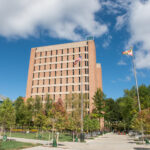
Featured image: Administration Building and flags at the main entrance to UMBC. Photo by Marlayna Demond ’11 for UMBC.
]]>
The Association of American Colleges and Universities (AAC&U) has selected UMBC as one of 10 institutions nationwide to participate in a bold, new initiative designed to “educate, prepare, and...
https://umbc.edu/stories/umbc-selected-for-national-initiative-to-prepare-the-next-generation-of-social-justice-leaders/
https://my3.my.umbc.edu/api/v0/pixel/news/120694/guest@my.umbc.edu/1d573957ad6b4ceab25bdc354fbc7a1a/api/pixel
choiceprogram
community
majoraward
policy-and-society
shrivercenter
UMBC News & Magazine
https://my3.my.umbc.edu/groups/umbc-news-magazine
https://assets1-my.umbc.edu/system/shared/avatars/groups/000/001/943/24435aa6207c452e7bc15cc74b42c7bb/xsmall.png?1748556657
https://assets1-my.umbc.edu/system/shared/avatars/groups/000/001/943/24435aa6207c452e7bc15cc74b42c7bb/original.png?1748556657
https://assets2-my.umbc.edu/system/shared/avatars/groups/000/001/943/24435aa6207c452e7bc15cc74b42c7bb/xxlarge.png?1748556657
https://assets2-my.umbc.edu/system/shared/avatars/groups/000/001/943/24435aa6207c452e7bc15cc74b42c7bb/xlarge.png?1748556657
https://assets3-my.umbc.edu/system/shared/avatars/groups/000/001/943/24435aa6207c452e7bc15cc74b42c7bb/large.png?1748556657
https://assets1-my.umbc.edu/system/shared/avatars/groups/000/001/943/24435aa6207c452e7bc15cc74b42c7bb/medium.png?1748556657
https://assets2-my.umbc.edu/system/shared/avatars/groups/000/001/943/24435aa6207c452e7bc15cc74b42c7bb/small.png?1748556657
https://assets1-my.umbc.edu/system/shared/avatars/groups/000/001/943/24435aa6207c452e7bc15cc74b42c7bb/xsmall.png?1748556657
https://assets2-my.umbc.edu/system/shared/avatars/groups/000/001/943/24435aa6207c452e7bc15cc74b42c7bb/xxsmall.png?1748556657
UMBC News & Magazine
0
0
false
Thu, 17 Aug 2017 20:41:11 -0400
Susan Sterett and Anne Brodsky begin new social science leadership roles at UMBC

UMBC’s College of Arts, Humanities, and Social Sciences is starting fall 2017 by welcoming new leaders for both the School of Public Policy and Maryland Institute of Policy Analysis and Research (MIPAR).
Susan Sterett, the new director of the School of Public Policy, comes to UMBC after serving three years as a professor in the Center for Public Administration and Policy and director of the Metropolitan Institute at Virginia Tech. Prior to that, Sterett was the program director for law and social sciences at the National Science Foundation (NSF) and an associate dean for the University of Denver’s Arts, Humanities, and Social Sciences academic unit. She is also currently co-chair of the Committee on the Status of Women in Political Science of the Western Political Science Association.
Sterett views higher education as having an essential role in American society today, and voices from the School of Public Policy as having great potential to impact national conversations on major issues.
“Universities can broaden our horizons and invite us to bring our inquiry to our communities,” she says, emphasizing, “UMBC’s proud tradition of excellence and public service are evident in the problems faculty and students in the School of Public Policy study, and the connection to communities that they bring.”
Sterett received her Ph.D. in jurisprudence and social policy from the University of California, Berkeley. Her research, teaching and writing focus on what people and institutions do with law and policy, particularly around social welfare issues. Her publications include the books Public Pensions: Gender and Civic Service in the States, 1850-1937 (Cornell University Press, 2003) and Creating Constitutionalism?: Professional Politics and Administrative Law in England and Wales (University of Michigan Press, 1997).
As director, Sterett says, “I plan to foster the success of current and incoming faculty, work to partner well across the social sciences, and deepen outreach to potential students, while supporting the School’s continued excellence in the policy areas of public management, health equity, environmental justice, and education equity.”
UMBC also celebrates Anne Brodsky‘s new appointment as interim director of MIPAR and special assistant to the dean for social sciences.
 Anne Brodsky. Photo by Marlayna Demond ’11 for UMBC.
“I’m excited to join the wonderful MIPAR staff, help MIPAR continue its critical role in supporting public policy and the social sciences at UMBC, and explore next steps MIPAR can take to advance the cutting edge scholarship and community engagement being done in this area by our faculty, staff, and students,” she shares.
Brodsky received her Ph.D. from the University of Maryland, College Park in clinical and community psychology, and joined UMBC’s faculty in 1997. She is a professor of psychology and served as associate dean in UMBC’s College of Arts, Humanities, and Social Sciences from 2012–2016.
In 2016-17 Brodsky participated in the prestigious American Council on Education (ACE) fellows program. She was one of just 29 fellows from across the nation to participate that year, selected for their tremendous potential as leaders in higher education. Upon the announcement of her ACE fellowship, she shared, “I am particularly interested in issues of access, inclusion, participation, and retention at all levels of the university, as well as initiatives to promote the co-equal synergy of STEM, the social sciences, and all the liberal arts – a synergy that is necessary to contribute to changes in the real world that serve to enhance the university’s value to the community.”
Brodsky is a community/clinical psychologist whose teaching, research, and practice focus on individual and community resilience in relation to violence, poverty, racism, sexism, and other forms of oppression. She has worked with both immigrant and nonimmigrant communities in the Baltimore-Washington D.C. area, particularly with single, low-income mothers. She has also traveled extensively throughout Pakistan and Afghanistan for research, and works in the U.S. to raise awareness of the experiences of Afghan women. She is the author of With All Our Strength: The Revolutionary Association of the Women of Afghanistan (Routledge, 2004).
Don Norris, who served as director of MIPAR for 28 years and as director of public policy for ten years, including the transition of UMBC’s public policy programs from a department to a school, will now transition to an emeritus role. He notes that he looks forward to the vision and skill sets Sterett and Brodsky will bring to their new positions, reflecting, “After my 28 years at UMBC, I leave with excitement about the new directions and contributions that Susan Sterrett and Anne Brodsky bring to the School and MIPAR.”
Dean Scott Casper of UMBC’s College of Arts, Humanities, and Social Sciences shares in this excitement, commenting, “Susan Sterett brings to the School of Public Policy an impressive range of academic and administrative experience, including her important work at the NSF. Anne Brodsky’s contributions to UMBC and to community psychology are legion, and her ACE fellowship has deepened her already national field of vision. I look forward to their leadership in thinking expansively about and across the social sciences at UMBC.”
Banner image: Susan Sterett, the new director of the School of Public Policy. Photo by Marlayna Demond ’11 for UMBC.
]]>
UMBC’s College of Arts, Humanities, and Social Sciences is starting fall 2017 by welcoming new leaders for both the School of Public Policy and Maryland Institute of Policy Analysis and Research...
https://umbc.edu/stories/susan-sterett-and-anne-brodsky-begin-new-social-science-leadership-roles-at-umbc/
https://my3.my.umbc.edu/api/v0/pixel/news/120695/guest@my.umbc.edu/75f81267310ff80990af03b0fe95ea97/api/pixel
cahss
mipar
policy-and-society
publicpolicy
UMBC News & Magazine
https://my3.my.umbc.edu/groups/umbc-news-magazine
https://assets1-my.umbc.edu/system/shared/avatars/groups/000/001/943/24435aa6207c452e7bc15cc74b42c7bb/xsmall.png?1748556657
https://assets1-my.umbc.edu/system/shared/avatars/groups/000/001/943/24435aa6207c452e7bc15cc74b42c7bb/original.png?1748556657
https://assets2-my.umbc.edu/system/shared/avatars/groups/000/001/943/24435aa6207c452e7bc15cc74b42c7bb/xxlarge.png?1748556657
https://assets2-my.umbc.edu/system/shared/avatars/groups/000/001/943/24435aa6207c452e7bc15cc74b42c7bb/xlarge.png?1748556657
https://assets3-my.umbc.edu/system/shared/avatars/groups/000/001/943/24435aa6207c452e7bc15cc74b42c7bb/large.png?1748556657
https://assets1-my.umbc.edu/system/shared/avatars/groups/000/001/943/24435aa6207c452e7bc15cc74b42c7bb/medium.png?1748556657
https://assets2-my.umbc.edu/system/shared/avatars/groups/000/001/943/24435aa6207c452e7bc15cc74b42c7bb/small.png?1748556657
https://assets1-my.umbc.edu/system/shared/avatars/groups/000/001/943/24435aa6207c452e7bc15cc74b42c7bb/xsmall.png?1748556657
https://assets2-my.umbc.edu/system/shared/avatars/groups/000/001/943/24435aa6207c452e7bc15cc74b42c7bb/xxsmall.png?1748556657
UMBC News & Magazine
0
0
false
Wed, 16 Aug 2017 17:51:47 -0400
Keith J Bowman named new dean of UMBC’s College of Engineering and Information Technology

Keith J Bowman has begun his tenure as the new dean of UMBC’s College of Engineering and Information Technology (COEIT). He joined UMBC on August 1, 2017, from San Francisco State University in California, where he served as dean of the College of Science and Engineering since 2015.
“Having lived in the San Francisco Bay area for a couple of years, I am looking forward to connecting with UMBC, Baltimore, and people on a completely different bay,” Bowman shared.
Bowman holds a Ph.D. in materials science from the University of Michigan, and B.S. and M.S. degrees in materials science from Case Western Reserve University. Prior to his role at SFSU, he held various positions at the Illinois Institute of Technology and Purdue University. At the Illinois Institute of Technology, he was the Duchossois Leadership Professor and chair of mechanical, materials, and aerospace engineering. In Purdue University’s School of Materials Engineering, he served as a professor and head of the school. He also held visiting professorships at the Technical University of Darmstadt in Germany and at the University of New South Wales in Australia.
Over the span of his career, Bowman has received nearly $20 million in research funding and awards. He is a fellow of the American Ceramic Society, a professional association dedicated to advancing the study, understanding, and use of ceramic and glass materials for the benefit of society.
As an education leader, Bowman is particularly interested in advancing diversity and inclusion across engineering disciplines. While at Purdue University, he was recognized for his commitment to teaching and mentoring, receiving the Charles B. Murphy Undergraduate Teaching Award and College of Engineering’s Mentoring Award.
“COEIT has embraced two compelling strategic directions—to advance research that benefits society and to elevate student success through innovative education experiences—and I’m very committed to both,” Bowman says. He explains, “My first year goal is to know and understand how we can best create synergy among all of our stakeholders and supporters to further propel us forward toward these goals.”
As dean, Bowman will work to advance COEIT’s mission by building on its strengths in research and teaching. He will support and continue to build a diverse faculty within the College, and will oversee their recruitment and development, promotion and tenure, and the appointment of department chairs and center directors. He will also identify innovative strategies to strengthen research activity and infrastructure, technology transfer, venture creation and other economic development initiatives.
Bowman’s appointment concludes a successful national search that began during the spring semester, led by Mark Marten, professor and chair of chemical, biochemical and environmental engineering. In welcoming Bowman as the new dean, Marten also recognizes previous dean Julie Ross, now engineering dean at Virginia Tech, for her significant contributions to the UMBC community over many years.
“Julie Ross and I both started in the CBEE department within about a year of each other, and developed a great friendship while establishing our respective careers. While I’m sad she is leaving UMBC, I’m excited for the impact I know she will have at Virginia Tech,” said Marten. “As the chair of the search committee, I am delighted we were able to bring in Keith Bowman as our new dean. He brings a wealth of experience and wisdom that I know will have a strong, positive impact both on the college and at UMBC.”
Banner image: Dean Keith J. Bowman. Photo by Marlayna Demond ’11 for UMBC.
]]>
Keith J Bowman has begun his tenure as the new dean of UMBC’s College of Engineering and Information Technology (COEIT). He joined UMBC on August 1, 2017, from San Francisco State University in...
https://umbc.edu/stories/keith-j-bowman-named-new-dean-of-umbcs-college-of-engineering-and-information-technology/
https://my3.my.umbc.edu/api/v0/pixel/news/120696/guest@my.umbc.edu/4bb56c3a5dc25a615ae532957e449880/api/pixel
coeit
community
science-and-technology
UMBC News & Magazine
https://my3.my.umbc.edu/groups/umbc-news-magazine
https://assets1-my.umbc.edu/system/shared/avatars/groups/000/001/943/24435aa6207c452e7bc15cc74b42c7bb/xsmall.png?1748556657
https://assets1-my.umbc.edu/system/shared/avatars/groups/000/001/943/24435aa6207c452e7bc15cc74b42c7bb/original.png?1748556657
https://assets2-my.umbc.edu/system/shared/avatars/groups/000/001/943/24435aa6207c452e7bc15cc74b42c7bb/xxlarge.png?1748556657
https://assets2-my.umbc.edu/system/shared/avatars/groups/000/001/943/24435aa6207c452e7bc15cc74b42c7bb/xlarge.png?1748556657
https://assets3-my.umbc.edu/system/shared/avatars/groups/000/001/943/24435aa6207c452e7bc15cc74b42c7bb/large.png?1748556657
https://assets1-my.umbc.edu/system/shared/avatars/groups/000/001/943/24435aa6207c452e7bc15cc74b42c7bb/medium.png?1748556657
https://assets2-my.umbc.edu/system/shared/avatars/groups/000/001/943/24435aa6207c452e7bc15cc74b42c7bb/small.png?1748556657
https://assets1-my.umbc.edu/system/shared/avatars/groups/000/001/943/24435aa6207c452e7bc15cc74b42c7bb/xsmall.png?1748556657
https://assets2-my.umbc.edu/system/shared/avatars/groups/000/001/943/24435aa6207c452e7bc15cc74b42c7bb/xxsmall.png?1748556657
UMBC News & Magazine
0
0
false
Mon, 14 Aug 2017 20:16:15 -0400
UMBC’s Jason Link leads development of cosmic ray detector headed for International Space Station

A white box the size of a refrigerator, called Cosmic Ray Energetics and Mass (CREAM), will head to the International Space Station (ISS) this month, thanks to the work of UMBC astrophysicist Jason Link and colleagues. Inside, four scientific detectors will work together to detect cosmic rays coming from far flung regions of the universe. The instruments will transmit the data from the ISS to Earth, to scientists reckoning with the tantalizing question, “What is the universe made of?”
Link, an astrophysicist with UMBC’s Center for Space Science and Technology, part of the recently-renewed CRESST consortium, is a co-investigator on the project and the technical lead for one of the detectors. Cosmic rays, particles from beyond the solar system, arrive with hundreds of times more energy than the Large Hadron Collider particle accelerator can produce, Link explains. Some of these particles will pass through the detector and interact inside, where they break up into a “shower of subatomic particles.” CREAM’s goal is to measure the composition and energy of individual particles, which will help scientists deduce where the rays came from and what phenomena caused them to accelerate so much.
Are the particles produced by supernovae or perhaps merging binary stars? “If we get into what accelerates the cosmic rays, we’re getting into one of the murky mysteries of science,” Link says.
Link has been working for more than 15 years on hardware to detect cosmic rays, including a version of CREAM that has taken seven balloon flights above Antarctica. Sending instruments to space poses new challenges, and also creates new opportunities.
 CREAM in preparation for launch. Photo provided by Jason Link.
“Balloons have a relatively short mission life,” Link shares, usually only a few dozen days. “But going up on the space station, you’re now talking about years.” Also, “When particles enter Earth’s atmosphere, they start to interact,” Link says. That means data analyses must incorporate a correction factor to account for these interactions, which introduces error. That’s much less of a problem in space.
Research instruments traveling to the ISS must reckon with constraints on size and mass, and be able to withstand extreme vibration. Link’s balloon-based instruments didn’t fit these constraints, so he and colleagues from NASA Goddard Space Flight Center, Penn State, and Northern Kentucky University undertook the challenge of building a new detector, based on the balloon detectors, that could safely survive the rigors of a rocket launch and deploy on the International Space Station.
The new detector can also collect additional scientific measurements. It can distinguish between negatively charged electrons and positively charged protons, based on the way they interact inside the detector.
“Designing a new detector from scratch on the limited budget for building balloon hardware required creativity, innovation and a bit of luck,” Link notes. “We did it and it successfully passed all of the environmental and safety requirements for deployment on the ISS.”
Colleagues from Kyungpook National University in South Korea built a detector that serves the same purpose, but with a different approach. Together, Link says, the two detectors provide a powerful way to distinguish between electrons and protons, and quickly verify findings, specifically because they use different techniques.
Link looks forward to diving into the data the instruments send from outer space. “If we see an excess of electrons,” he says, “that suggests that there is a local source of cosmic rays. That’s not something we expect.” That discovery would spur further research into what and where the source might be.
Instruments on CREAM will also help physicists better understand the “cosmic energy spectrum,” Link says. The energy of detected rays falls along a spectrum, with many more rays coming in with lower energies, and very few at the highest energies. The number of rays at each energy level falls off in a smooth curve, but, Link says, “There’s a kink in the cosmic energy spectrum,” where there’s an unexpected bump up in the number of rays with a specific energy. Scientists are very interested in what might be causing that kink, and CREAM is intended to help explain it.
Beyond the potential for groundbreaking scientific discovery about the fundamental makeup of the universe, the CREAM launch is special for Link. “This is the first time that I’ve actually built something that’s going to go into space,” he says.
Scientists are often heavily involved in designing instruments and analyzing the resulting data, but most of the time the actual construction of space instrumentation is handed over to engineers and technicians with specialized expertise. Not this time. “Yes, I actually tightened bolts and wired sensors on the detector,” Link is proud to report, “and it’s going to fly in space.”
Image: Sunrise from the International Space Station. Photo provided by NASA, captured by a member of the Expedition 52 crew.
The CREAM mission is headed by Dr. Eun-Suk Seo at the University of Maryland, College Park. NASA’s Wallops Flight Facility in Virginia provided overall management of CREAM and integration for space station deployment, led by Linda Thompson. The full project team includes scientists from the United States, France, Mexico, and South Korea.
]]>
A white box the size of a refrigerator, called Cosmic Ray Energetics and Mass (CREAM), will head to the International Space Station (ISS) this month, thanks to the work of UMBC astrophysicist...
https://umbc.edu/stories/umbcs-jason-link-leads-development-of-cosmic-ray-detector-headed-for-international-space-station/
https://my3.my.umbc.edu/api/v0/pixel/news/120697/guest@my.umbc.edu/2670dd8788b8d6afa2af1ab4b86d6a74/api/pixel
cnms
csst
research
science-and-technology
UMBC News & Magazine
https://my3.my.umbc.edu/groups/umbc-news-magazine
https://assets1-my.umbc.edu/system/shared/avatars/groups/000/001/943/24435aa6207c452e7bc15cc74b42c7bb/xsmall.png?1748556657
https://assets1-my.umbc.edu/system/shared/avatars/groups/000/001/943/24435aa6207c452e7bc15cc74b42c7bb/original.png?1748556657
https://assets2-my.umbc.edu/system/shared/avatars/groups/000/001/943/24435aa6207c452e7bc15cc74b42c7bb/xxlarge.png?1748556657
https://assets2-my.umbc.edu/system/shared/avatars/groups/000/001/943/24435aa6207c452e7bc15cc74b42c7bb/xlarge.png?1748556657
https://assets3-my.umbc.edu/system/shared/avatars/groups/000/001/943/24435aa6207c452e7bc15cc74b42c7bb/large.png?1748556657
https://assets1-my.umbc.edu/system/shared/avatars/groups/000/001/943/24435aa6207c452e7bc15cc74b42c7bb/medium.png?1748556657
https://assets2-my.umbc.edu/system/shared/avatars/groups/000/001/943/24435aa6207c452e7bc15cc74b42c7bb/small.png?1748556657
https://assets1-my.umbc.edu/system/shared/avatars/groups/000/001/943/24435aa6207c452e7bc15cc74b42c7bb/xsmall.png?1748556657
https://assets2-my.umbc.edu/system/shared/avatars/groups/000/001/943/24435aa6207c452e7bc15cc74b42c7bb/xxsmall.png?1748556657
UMBC News & Magazine
0
0
false
Fri, 11 Aug 2017 19:14:28 -0400

