From bagging sugar to modeling floods, Retriever interns deploy their technical chops to make modern life smoother in Maryland and beyond
 Pelumni Enilolobo outside the Domino factory. (Photo courtesy of Enilolobo)
On a typical day this summer, you may have started the morning stirring sugar into your coffee. After checking the weather forecast or making a few calls on your cell phone, you may have then logged into secure networks to access work data or conduct financial transactions.
And this summer, four UMBC students learned how they could contribute to the complex choreography that lies behind such seemingly simple actions in the modern world.
Pelumni Enilolobo, a rising senior in mechanical engineering, worked at the historic Domino Sugar facility in Baltimore, optimizing packaging operations; Yash Diggikar, a Ph.D. student in computer science, worked for NASA Goddard in Greenbelt on AI-assisted weather and earth-system modeling; Kaleem Butt, a rising senior in computer engineering, worked at Catonsville-based company RF Safety Laboratory, LLC, helping to test if the radio frequency emissions for new wireless consumer devices stay within safe limits; and Joycelyn Chow, a rising junior in computer engineering, worked for the Johns Hopkins Applied Physics Laboratory (APL) in Laurel, Maryland, on cybersecurity research.
Building and strengthening connections
The companies and organizations that employed these four Retrievers are all part of the vibrant economic ecosystem in Maryland. UMBC has built relationships with many of these local employers and facilitates student connections.
Butt first learned about RF Safety Laboratory, which has offices at the bwtech@UMBC Research and Technology Park, through a LinkedIn post. He later connected with the CEO of the company at a UMBC Career Fair. “At first, they were looking for people who could work during the school year. I couldn’t do that, but we stayed in touch and I later found out about the summer opportunity and applied,” he says.
Enilolobo found out about career opportunities at Domino Sugar during a Career Center-sponsored event that brought company representatives to the UMBC campus. And Diggikar connected to the NASA project through his advisor, UMBC research professor Milt Halem, a retired NASA employee who maintains strong connections to the agency.
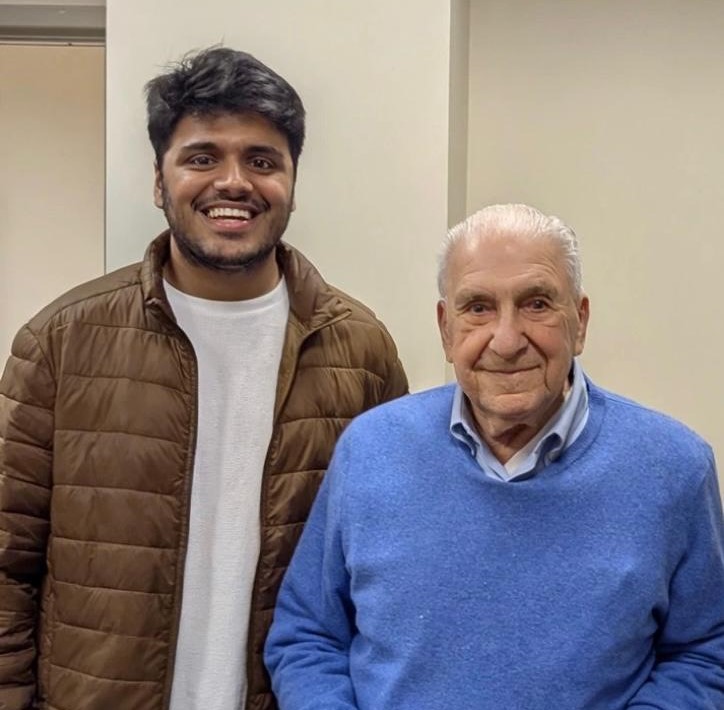
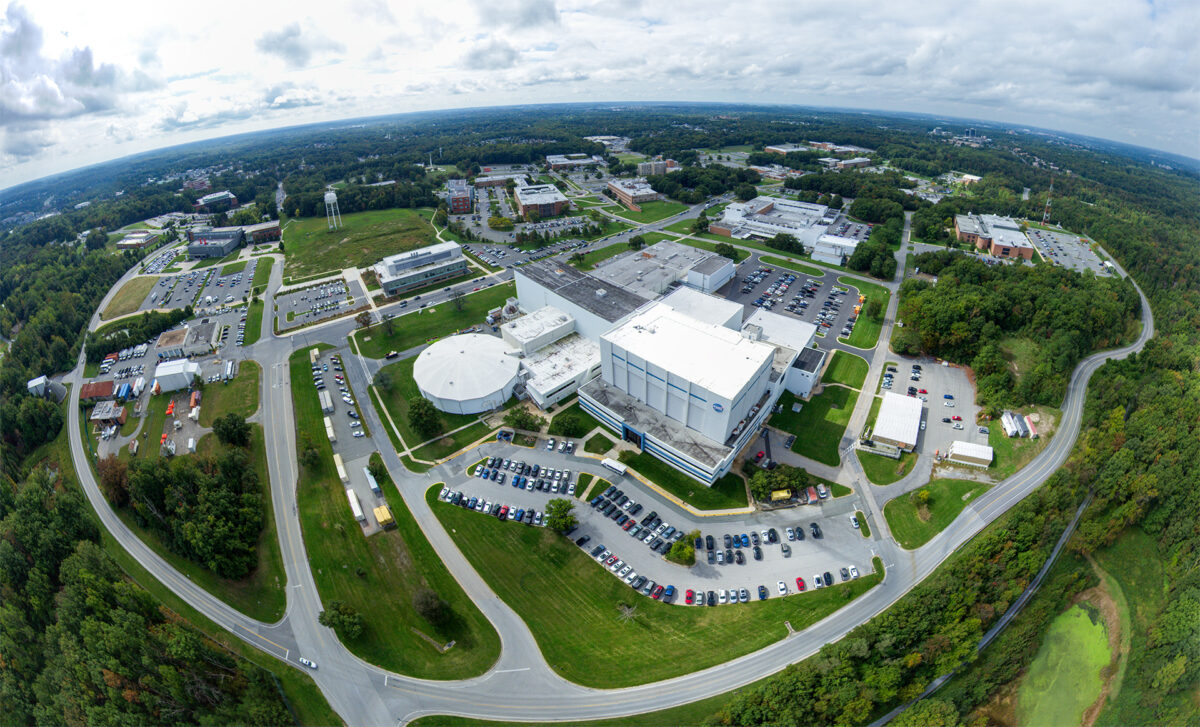
Yash Diggikar (left) with UMBC advisor and retired NASA employee Milt Halem. (Photo courtesy of Diggikar). On right, the NASA Goddard campus. (NASA/Francis Reddy)
While Chow was already familiar with APL from her years attending their ASPIRE high school internship program, she connected with colleagues and mentors at the lab who also attended UMBC. “One of my mentors, Jackie Schultz [’20, information systems], was in the same scholars program—Cyber Scholars—that I’m in right now at UMBC,” Chow says.
A summer of insights
For all four students, the summer offered the chance to contribute, connect, develop their skills, and discover insights that will shape their future careers.
Chow says she really values the strong team culture at APL and could easily see herself working at the lab full time after graduation. “The lab works on so many interesting problems, such as addressing the cybersecurity risks for satellites and other technology that wasn’t necessarily built with these concerns in mind,” she says.
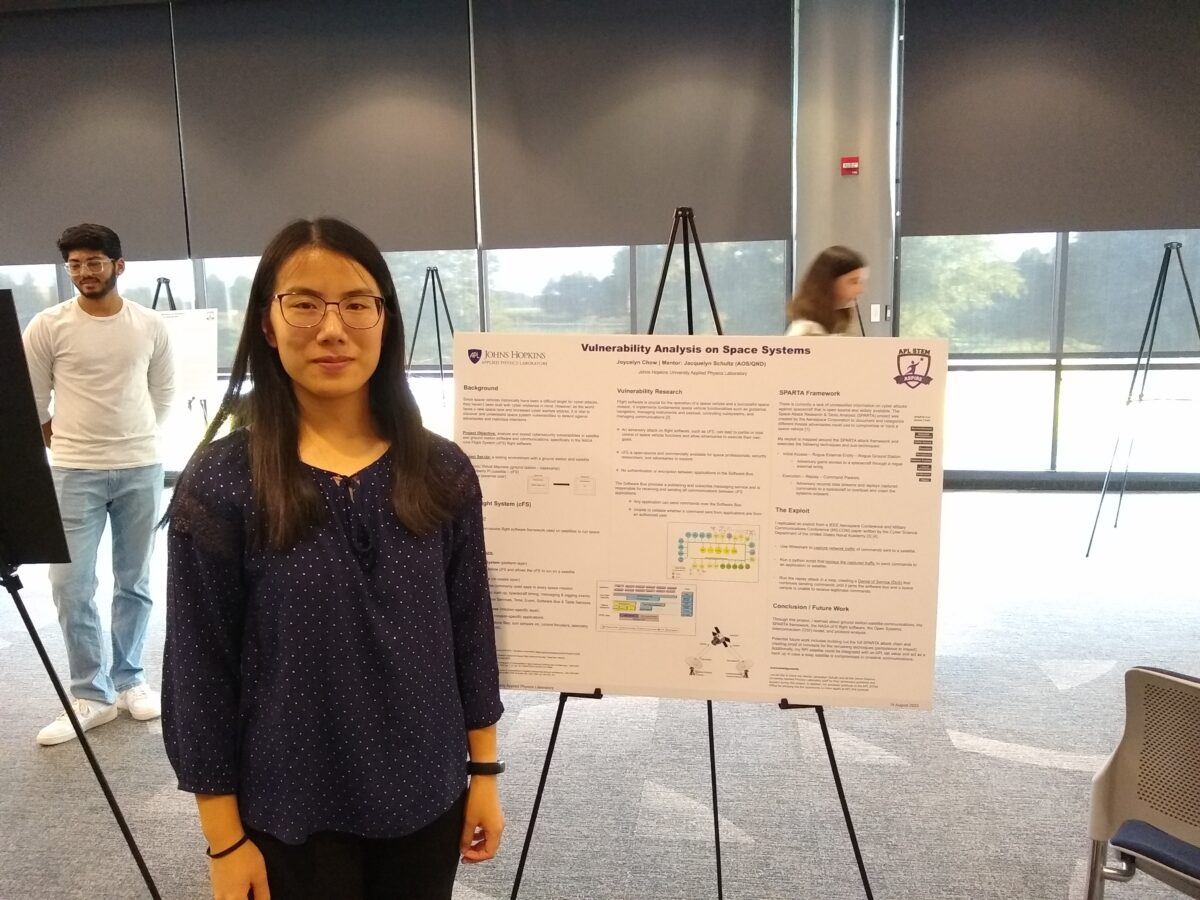

Joycelyn Chow stands with a poster about her summer internship work in 2023 at the ASPIRE Showcase (left) and with fellows APL interns in summer 2025 (right). Fellow Retriever Anugrah Zachary is on the far right. (Photos courtesy of Chow)
Diggikar says his summer work at NASA has clarified the direction of his Ph.D. research, which will look into how machine learning can speed up predictions of the Earth’s weather systems. “I have started to actually see a path, and how people can start a research project and end up at the end goal,” he says.
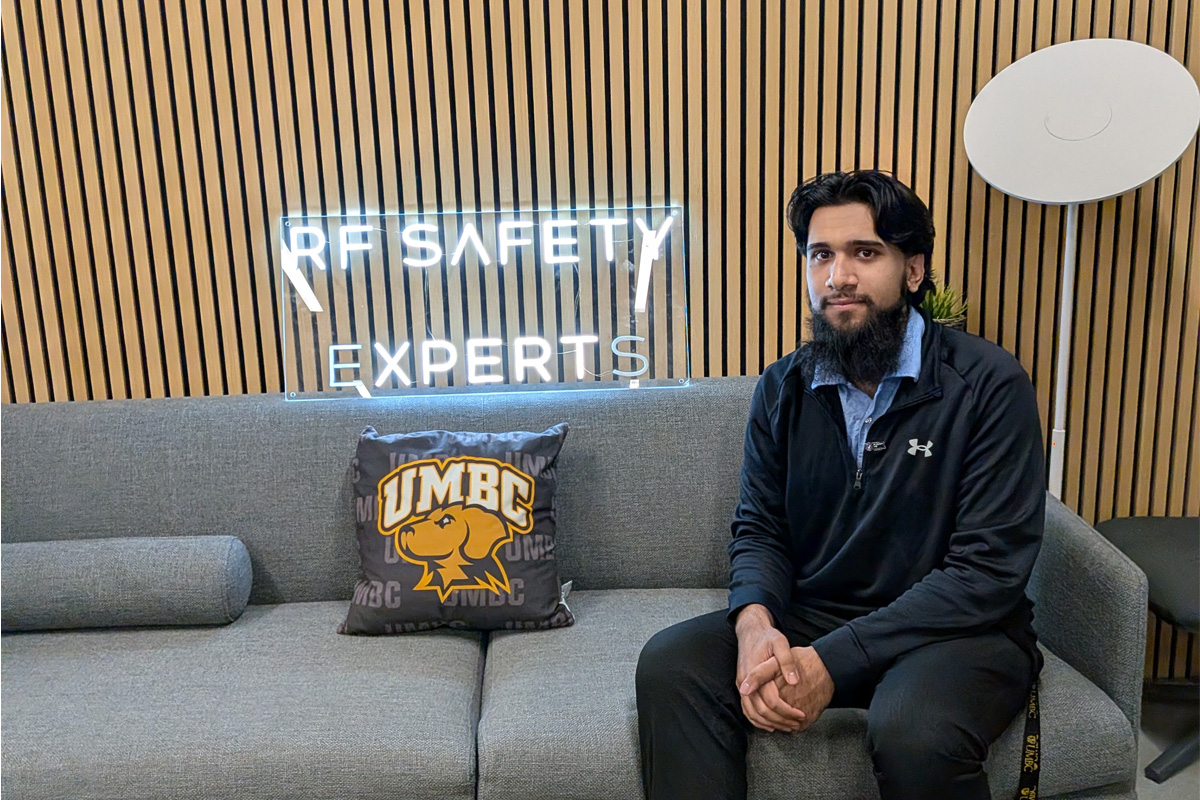 Kaleem Butt in the RF Safety Lab common room. (UMBC)
Enilolobo says he realized the sweet spot of taking ownership of his work and proactively reaching out to colleagues and mentors at Domino. “At work, you pretty much have to go find people who can help you,” he says. “You have to be assertive, and get your stuff done. I feel like that’s a very good way for somebody to grow, and it’s helped me a lot so far.”
Both Enilolobo and Butt remarked on how much they enjoyed the hands-on nature of their summer work. Enilolobo says he spent about 60 percent of his time on the factory floor, observing how machines pack sugar into 50-lb bags. In the bwtech office, Butt worked in a testing lab filled with electrical equipment and fellow engineers. “If I ever had a question, they would immediately jump up and help me,” he says.
And sometimes an insight came from an unexpected place. Butt says he hadn’t thought much about company size when considering jobs. But when he had to take time off for ACL surgery during the summer, all his office mates threw him a surprise party, with plenty of cake and well wishes. The moment really stuck in his mind. “Working for a small company, it feels like family,” Butt says. “It’s been amazing.”
]]>
Pelumni Enilolobo outside the Domino factory. (Photo courtesy of Enilolobo) On a typical day this summer, you may have started the morning stirring sugar into your coffee. After checking the...
https://umbc.edu/stories/internships-coeit-summer-2026/
https://my3.my.umbc.edu/api/v0/pixel/news/161699/guest@my.umbc.edu/224ebf4ef0d59aaa87dceae304255ffe/api/pixel
career-center
coeit
community
csee
internships
meche
science-and-tech
stories
story
UMBC News & Magazine
https://my3.my.umbc.edu/groups/umbc-news-magazine
https://assets1-my.umbc.edu/system/shared/avatars/groups/000/001/943/24435aa6207c452e7bc15cc74b42c7bb/xsmall.png?1748556657
https://assets1-my.umbc.edu/system/shared/avatars/groups/000/001/943/24435aa6207c452e7bc15cc74b42c7bb/original.png?1748556657
https://assets2-my.umbc.edu/system/shared/avatars/groups/000/001/943/24435aa6207c452e7bc15cc74b42c7bb/xxlarge.png?1748556657
https://assets2-my.umbc.edu/system/shared/avatars/groups/000/001/943/24435aa6207c452e7bc15cc74b42c7bb/xlarge.png?1748556657
https://assets3-my.umbc.edu/system/shared/avatars/groups/000/001/943/24435aa6207c452e7bc15cc74b42c7bb/large.png?1748556657
https://assets1-my.umbc.edu/system/shared/avatars/groups/000/001/943/24435aa6207c452e7bc15cc74b42c7bb/medium.png?1748556657
https://assets2-my.umbc.edu/system/shared/avatars/groups/000/001/943/24435aa6207c452e7bc15cc74b42c7bb/small.png?1748556657
https://assets1-my.umbc.edu/system/shared/avatars/groups/000/001/943/24435aa6207c452e7bc15cc74b42c7bb/xsmall.png?1748556657
https://assets2-my.umbc.edu/system/shared/avatars/groups/000/001/943/24435aa6207c452e7bc15cc74b42c7bb/xxsmall.png?1748556657
UMBC News & Magazine
0
0
false
Mon, 17 Aug 2026 16:03:23 -0400
Career readiness starts here: UMBC expands work-integrated learning opportunities
Earlier this summer, a month before the start of fall classes, newly-minted Retrievers were on campus and ready to start working. Part of UMBC’s initiative to scale up work-integrated learning (WIL), more than 100 incoming high school and transfer students spent a night on campus, connected with an instructor and teaching assistant, and spent a day participating in service on site at five different community partner locations: Art with a Heart, Friends of Patterson Park, Paul’s Place, Filbert Street Garden, and Retriever Essentials. WIL is an educational approach that prepares students for a rewarding career after college by pairing what they are learning in the classroom with hands-on, authentic work experiences.
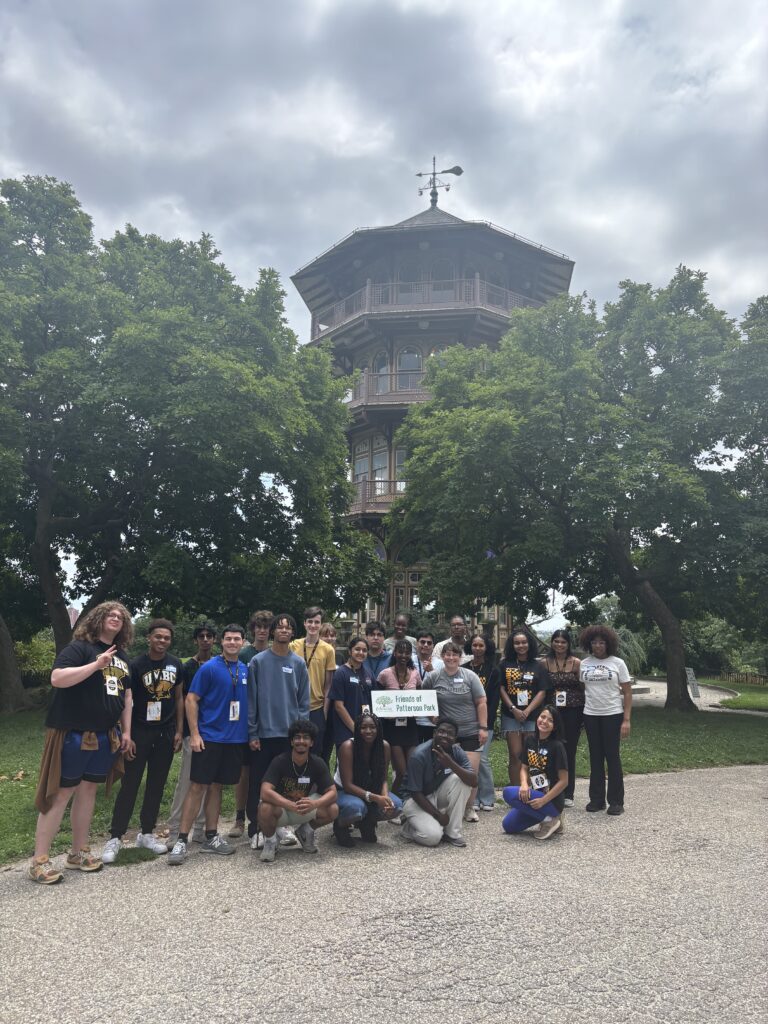 Emily Passera led 21 incoming students along with teaching assistant Nafi Gueye to Patterson Park. Here, they’re gathered in front of the observatory. (Photo courtesy of Passera)
Emily Passera, the senior program coordinator for community-engaged learning through The Shriver Center at UMBC, led a group of students to Patterson Park in east Baltimore. The bus ride to the participation site gave the students a chance to hear an overview of important cultural, historic, and environmental structures in between UMBC and Patterson Park, she says.
Once there, “They jumped into the hard physical work, and they deeply connected with each other,” observed Passera. “Students observed a pathway that was covered with mud and weeds, and shared that cleaning mud with shovels made them connect to the importance of fully accessible pathways for strollers, wheelchairs, and bicycles. The park should be usable for many different functions in many different ways.”
WIL students will participate in service with the same sites throughout their full first year at UMBC, deepening engagement and strengthening connection to their peers and faculty as well as to the campus and community.
“I believe a program like this is an excellent cohort building model. I was able to have individual conversations with all of them, learning what they cared about going into their unique UMBC journeys,” says Passera, who will teach the same students in a first-year experience course called UNIV 101. “These few hours will make my job as the UNIV 101 instructor a little easier, as we now have a shared experience together. We are really looking forward to the music and community events that happen in the park throughout the fall when they return.”
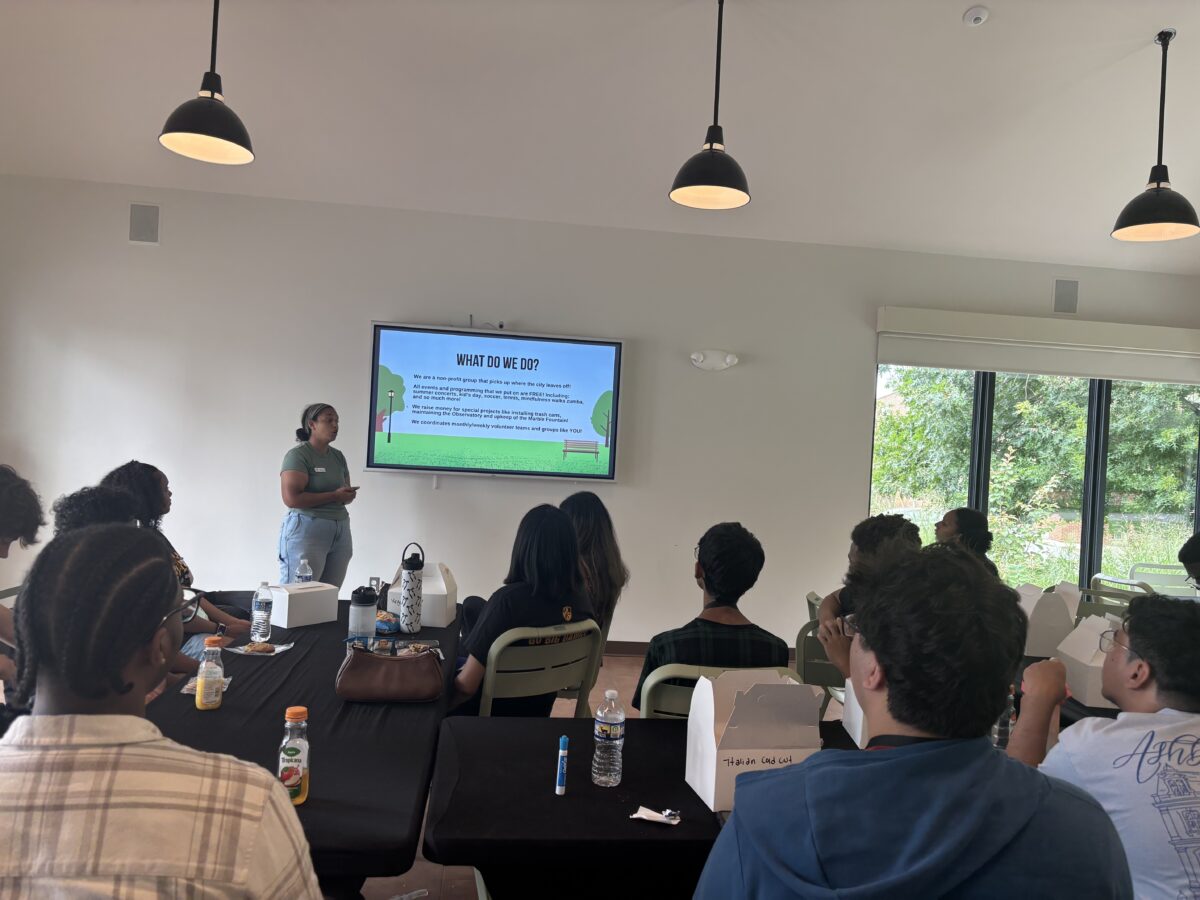 Peaceworker Fellow Katie Nagib with the cohort inside Friends of Patterson Park’s Cedar House, highlighting the importance of their work to the community and the principles of “leave no trace.” (Photo courtesy of Passera)
James DeVita, assistant vice president for academic partnerships and high impact experiences in the Division of Student Affairs, has been responsible for growing UMBC’s WIL opportunities across campus to ensure every student is exposed to the work world throughout their college years.
“WIL experiences are essential learning opportunities for students, not only because they help develop transferable and durable skills that ensure graduates are ready for the workforce, but also because they provide opportunities for real-world application that deepens learning in ways recognizable by external and industry partners,” says DeVita. “These experiences need to be embedded from day one for all of our students.”
]]>
Earlier this summer, a month before the start of fall classes, newly-minted Retrievers were on campus and ready to start working. Part of UMBC’s initiative to scale up work-integrated learning...
https://umbc.edu/stories/umbc-work-integrated-learning-opportunities/
https://my3.my.umbc.edu/api/v0/pixel/news/161492/guest@my.umbc.edu/02f3d30929cbc5ad375cde28ce51f8b7/api/pixel
baltimore-city
campus-life
community
retriever-essentials
shriver-center
stories
story
UMBC News & Magazine
https://my3.my.umbc.edu/groups/umbc-news-magazine
https://assets1-my.umbc.edu/system/shared/avatars/groups/000/001/943/24435aa6207c452e7bc15cc74b42c7bb/xsmall.png?1748556657
https://assets1-my.umbc.edu/system/shared/avatars/groups/000/001/943/24435aa6207c452e7bc15cc74b42c7bb/original.png?1748556657
https://assets2-my.umbc.edu/system/shared/avatars/groups/000/001/943/24435aa6207c452e7bc15cc74b42c7bb/xxlarge.png?1748556657
https://assets2-my.umbc.edu/system/shared/avatars/groups/000/001/943/24435aa6207c452e7bc15cc74b42c7bb/xlarge.png?1748556657
https://assets3-my.umbc.edu/system/shared/avatars/groups/000/001/943/24435aa6207c452e7bc15cc74b42c7bb/large.png?1748556657
https://assets1-my.umbc.edu/system/shared/avatars/groups/000/001/943/24435aa6207c452e7bc15cc74b42c7bb/medium.png?1748556657
https://assets2-my.umbc.edu/system/shared/avatars/groups/000/001/943/24435aa6207c452e7bc15cc74b42c7bb/small.png?1748556657
https://assets1-my.umbc.edu/system/shared/avatars/groups/000/001/943/24435aa6207c452e7bc15cc74b42c7bb/xsmall.png?1748556657
https://assets2-my.umbc.edu/system/shared/avatars/groups/000/001/943/24435aa6207c452e7bc15cc74b42c7bb/xxsmall.png?1748556657
UMBC News & Magazine
0
0
false
Fri, 07 Aug 2026 11:02:58 -0400
Baja team speeds into racing season with strong early showings
As the spring semester wound down at UMBC, a group of dedicated students was gearing up for their latest adventure. The week before finals, 12 students from the Society of Automotive Engineering’s (SAE’s) Baja racing team traveled almost 3,000 miles to Washougal, Washington, just across the border from Oregon, to compete with their custom-built, single-seat, off-road vehicle in a grueling set of challenges over four days.
Baja SAE draws more than 100 college teams from around the world, who spend a whole year designing, building, and racing their cars. The competitions, which happen three times a year, present a series of tests, from static events such as safety inspections and budgeting and sales presentations, to dynamic events that test the vehicles’ acceleration, traction, maneuverability, and suspension. To cap it all off, cars then compete in a grueling, four-hour endurance race, taking as many laps as possible around a punishing track that often includes steep, dirt hills, mud pits, high-speed straights, hairpin turns, and rocky, rutted, obstacles-strewn sections. Vehicles regularly flip over. On-the-spot repairs are a must.


The UMBC car, driven by Daniel Hessler, competing at the 2026 Baja SAE Oregon endurance event (left) and hill climb event (right). (Photos by Hasan Aslam)
“I’ll remember endurance day the most, same as every competition,” says Matt Crum, a sophomore majoring in financial economics, who traveled with the team to Washington and played a key role in the design presentation. In endurance, the UMBC car completed 40 laps, earning an 11th-place spot out of 76 teams. Considering all events, UMBC finished 12th overall, and took first place in the cost event.
From June 11—14, the team took the car to the second competition of the year, held in Palmyra, New York, and finished 11th overall, again taking first place in the cost event. The final competition of the year will be held September 24—27 in Nashport, Ohio.
“We hold our own against much bigger, better-funded schools,” says Shawn Pourifarsi, a junior computer engineering major and co-vice president of the club. “I’m proud of that.”
Getting their hands dirty
Students on the Baja racing team, which this year includes around 20 team members pursuing a variety of majors, gain valuable experience with a wide range of engineering and business tasks. They work on design refinements using specialized software, get their hands dirty in the shop, and hone skills such as teamwork, budgeting, sales pitching, and working with suppliers.


Team members Matt Crum (left, changing a tire), Daniel Hessler, and Oscar Coreas Otero (right) work on the car in the machine shop. (Brad Ziegler/UMBC)
The team connects with numerous local businesses, many of whom offer support by donating parts and providing expert advice. One local sponsor, Robnet, a Baltimore-based supplier of bolts and screws, has supported the team for more than 20 years.
“We love UMBC racing,” says Eric Edelstein, head of sales at Robnet, as he helped students get an important bolt before they headed across the country for the first race of the season.
Racing club members put in varying hours, depending on their responsibilities and their availability. Collectively, they spend more than 1,000 hours each year working on the car. For the students who become deeply involved in the team, the experience is deeply rewarding.
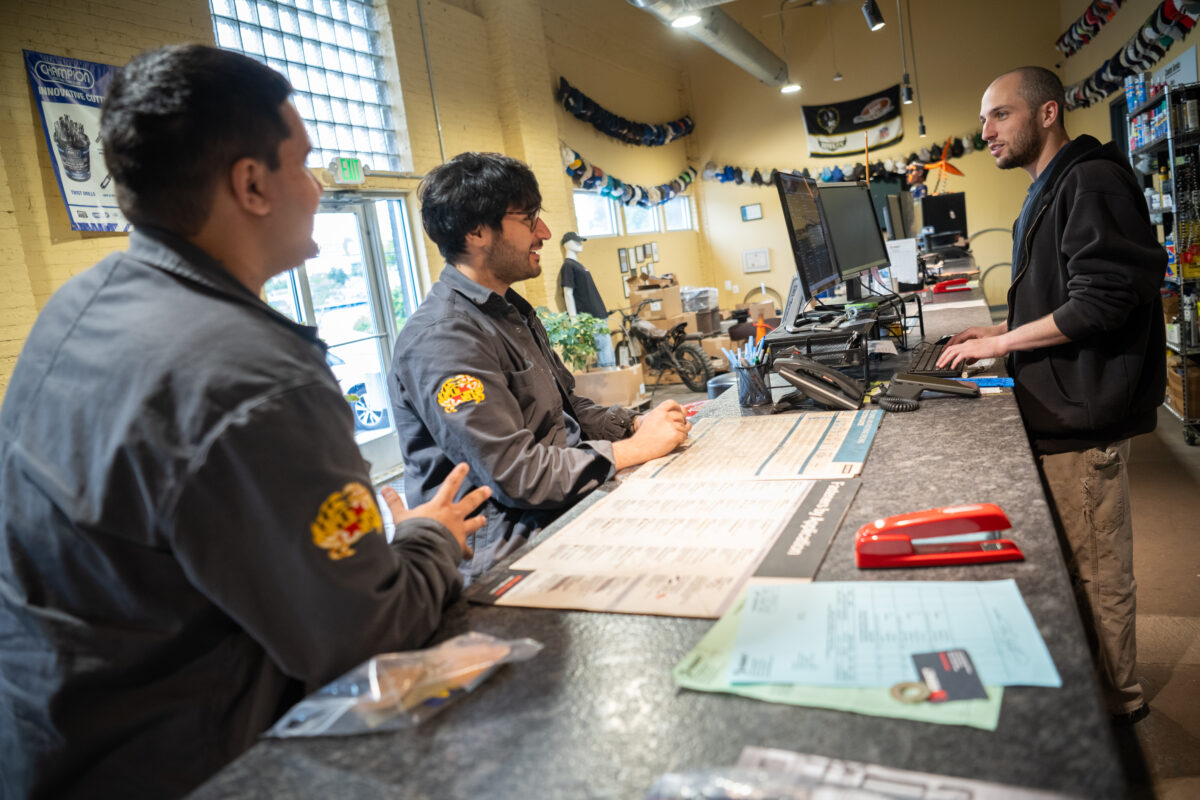 William Busch (left) and Shawn Pourifarsi (center) speak with Eric Edelstein, head of sales at Robnet. (Brad Ziegler/UMBC)
William Busch, a senior majoring in information technology, was one of the drivers of the car at the Washington/Oregon event. He says entering the competition site on the first morning of the event was especially memorable. “It was the second time I had been to the event site with our team, once in 2023 as a freshman and again now as a senior. So it felt like a real full circle moment,” he says.
“I joined the Baja team because I really liked cars,” says Crum. “I stayed because the culture is undeniably the best. I learn things every day that I wouldn’t be able to learn anywhere else.”
Club president Aiden Dement, a senior majoring in mechanical engineering, offers an even simpler reason for staying involved: ”It gets me out of my dorm room,” he says. Several thousand miles of road-tripping later, you could conclude the experience is certainly living up to that goal.
 The team visited Badlands National Park in South Dakota on their road trip west, stopping to photograph the car against the backdrop of the park’s distinct geological formations. (Photo by Hasan Aslam)
Learn more about UMBC’s Baja racing team.
]]>
As the spring semester wound down at UMBC, a group of dedicated students was gearing up for their latest adventure. The week before finals, 12 students from the Society of Automotive Engineering’s...
https://umbc.edu/stories/sae-baja-racing-summer-2026/
https://my3.my.umbc.edu/api/v0/pixel/news/161136/guest@my.umbc.edu/55b923e85852406b7a911b0e564d858d/api/pixel
cahss
coeit
community
csee
financial-economics
is
meche
science-and-tech
stories
story
UMBC News & Magazine
https://my3.my.umbc.edu/groups/umbc-news-magazine
https://assets1-my.umbc.edu/system/shared/avatars/groups/000/001/943/24435aa6207c452e7bc15cc74b42c7bb/xsmall.png?1748556657
https://assets1-my.umbc.edu/system/shared/avatars/groups/000/001/943/24435aa6207c452e7bc15cc74b42c7bb/original.png?1748556657
https://assets2-my.umbc.edu/system/shared/avatars/groups/000/001/943/24435aa6207c452e7bc15cc74b42c7bb/xxlarge.png?1748556657
https://assets2-my.umbc.edu/system/shared/avatars/groups/000/001/943/24435aa6207c452e7bc15cc74b42c7bb/xlarge.png?1748556657
https://assets3-my.umbc.edu/system/shared/avatars/groups/000/001/943/24435aa6207c452e7bc15cc74b42c7bb/large.png?1748556657
https://assets1-my.umbc.edu/system/shared/avatars/groups/000/001/943/24435aa6207c452e7bc15cc74b42c7bb/medium.png?1748556657
https://assets2-my.umbc.edu/system/shared/avatars/groups/000/001/943/24435aa6207c452e7bc15cc74b42c7bb/small.png?1748556657
https://assets1-my.umbc.edu/system/shared/avatars/groups/000/001/943/24435aa6207c452e7bc15cc74b42c7bb/xsmall.png?1748556657
https://assets2-my.umbc.edu/system/shared/avatars/groups/000/001/943/24435aa6207c452e7bc15cc74b42c7bb/xxsmall.png?1748556657
UMBC News & Magazine
0
0
false
Thu, 16 Jul 2026 13:36:16 -0400
Music, murals, and manifestos: Bringing history to life in the classroom
Anyone passing by Room 208 of the Sondheim Building this spring might have thought the class was a Latin American music appreciation course. Projected on the screen was a video of the Mexican band Los Ángeles Azules (“The Blue Angels”), featuring Natalia Lafourcade singing “Nunca Es Suficiente” (“It’s Never Enough”).
In Silvia Escanilla Huerta’s history classroom, music is not background noise but a historical text carrying centuries of migration, colonialism, resistance, and cultural exchange. “Nunca Es Suficiente” is a modern Mexican interpretation of Colombian cumbia, a 200-year-old genre of music created with African, Indigenous, and European acoustic instruments. Escanilla Huerta uses material culture—songs, videos, poems, documentaries, art, and student-created work—to awaken students’ senses and engage their interest in the complex history of Latin America.
Escanilla Huerta has found that using material culture helps students connect abstract historical ideas with concrete experiences, inviting students to think critically about how these practices evolved and impact the world today. She guides students as they analyze and compare primary and secondary sources from the past and the present to critique what is missing from historical records. Critical research analysis skills she honed while she was conducting archival research in Spain, Argentina, Bolivia, and Peru on the role indigenous peoples played in the process of independence in what today are Peru and Bolivia.
“I try to entertain and make it fun, not just for them but for me too, because I’ve worked with this material for decades. I want it to come alive for them as it did for me,” says Escanilla Huerta, the first tenure-track faculty member and the first Latina in UMBC’s history department to teach Latin American history. “I dance, I speak in Spanish, and translate Spanish-language texts for the class. We watch videos, listen to music, and connect this media to specific points in history,” Escanilla explains while the students continue to listen to the song, “like today’s topic, the Guatemalan and Cuban revolutions in post-WWII Latin America.”
The art of revolution
As the song “Nunca Es Suficiente” came to an end, Escanilla Huerta lowered the volume and projected “Gloriosa Victoria,” a painting by Mexican muralist Diego Rivera depicting the coup of 1954 as a segue into the Guatemalan revolution of 1944 to 1954 against Jorge Ubico’s dictatorship. The students scan the mural in anticipation of their next point of analysis.
“What do you see?” asks Escanilla Huerta. Students describe the crowded painting filled with Guatemalan and U.S. politicians, military and business leaders, in a tense negotiation while a bishop blesses them. “On the top right-hand corner, I can’t tell whether it’s people at a window with bars or jail,” says one student. Escanilla Huerta confirms that it’s a jail and then draws their attention to specific elements like a man holding a bomb with the face of the U.S. President Eisenhower, surrounded by people who were murdered during the coup.
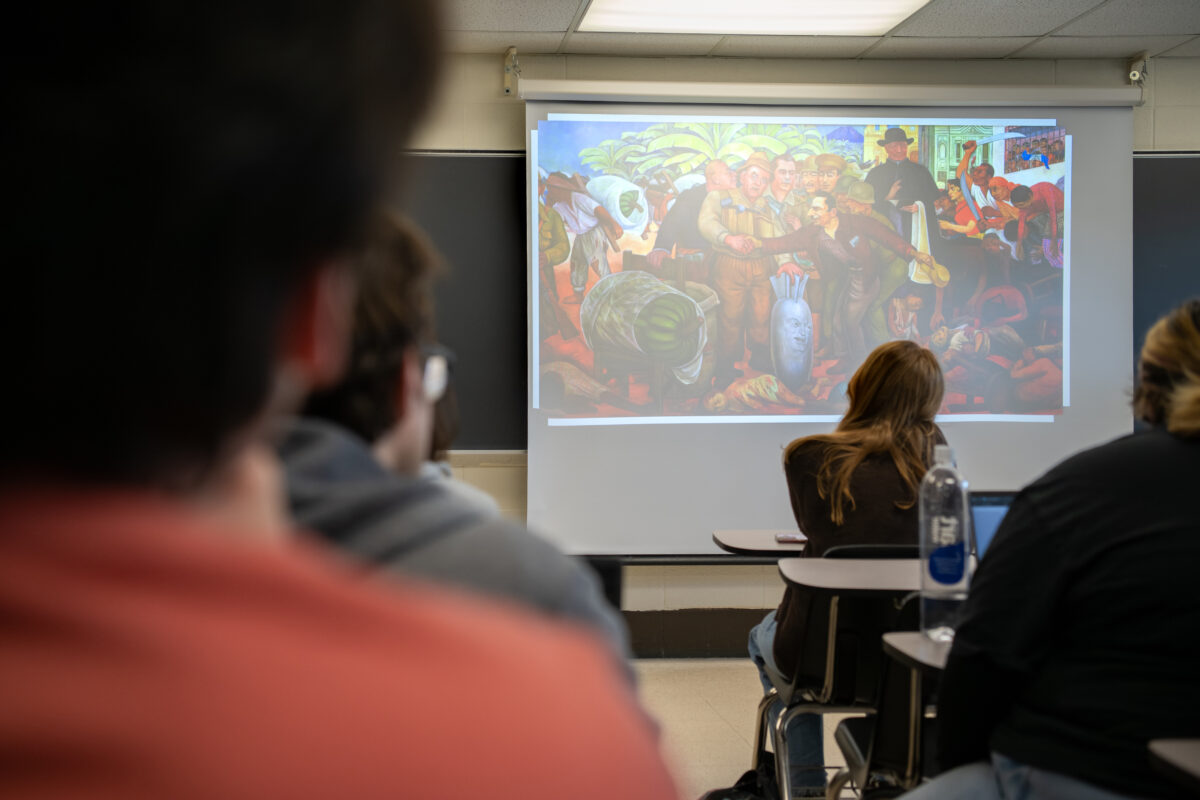
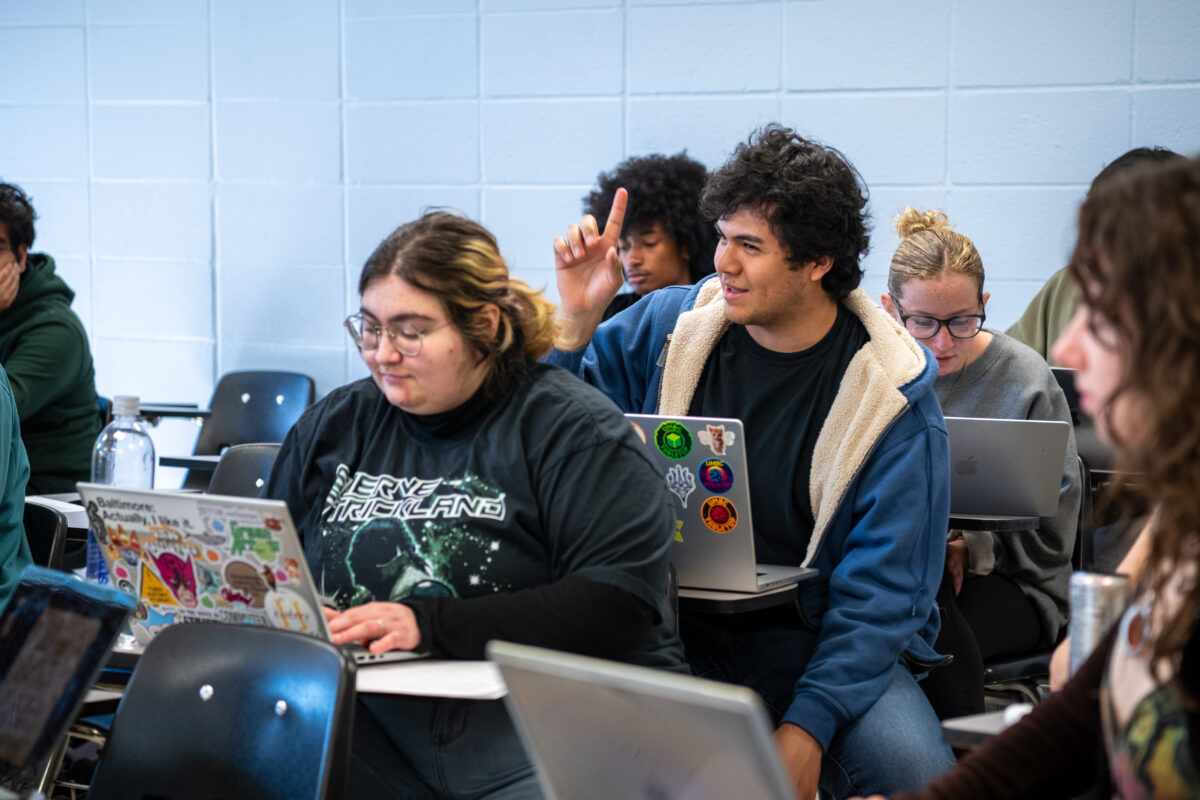 Students view and discuss “Gloriosa Victoria,” a painting by Mexican muralist Diego Rivera.
To further contextualize what Rivera was reacting to, she explains the political tensions of the time. “The revolution succeeded, bringing an elected democratic government for 10 years,” said Escanilla Huerta. “Until opposition from other political parties and U.S.-based corporate interests led the U.S. Central Intelligence Agency (CIA) to topple the government in 1954.” Back and forth, Escanilla Huerta and the students unpack the mural scene, connecting each scene to their readings and to today’s geopolitical wars.
She also urges students to think beyond identifying the iconic representations of abuses of power and to critique the artists themselves, their motives, and their lives. “The painting is a clear denunciation of corruption, but the artist himself has a complex history that, while he defends the people, he is also sexist and abusive. History is complex, and we need to consider all aspects.”
So you want a revolution
Shifting from fine art to pop art, Escanilla Huerta displays a poster of a man’s face wearing a black beret marked with a gold star and military fatigues, set against a vivid red backdrop. “Does anyone know who this is?” Some students nodded, but few knew the history behind the image.
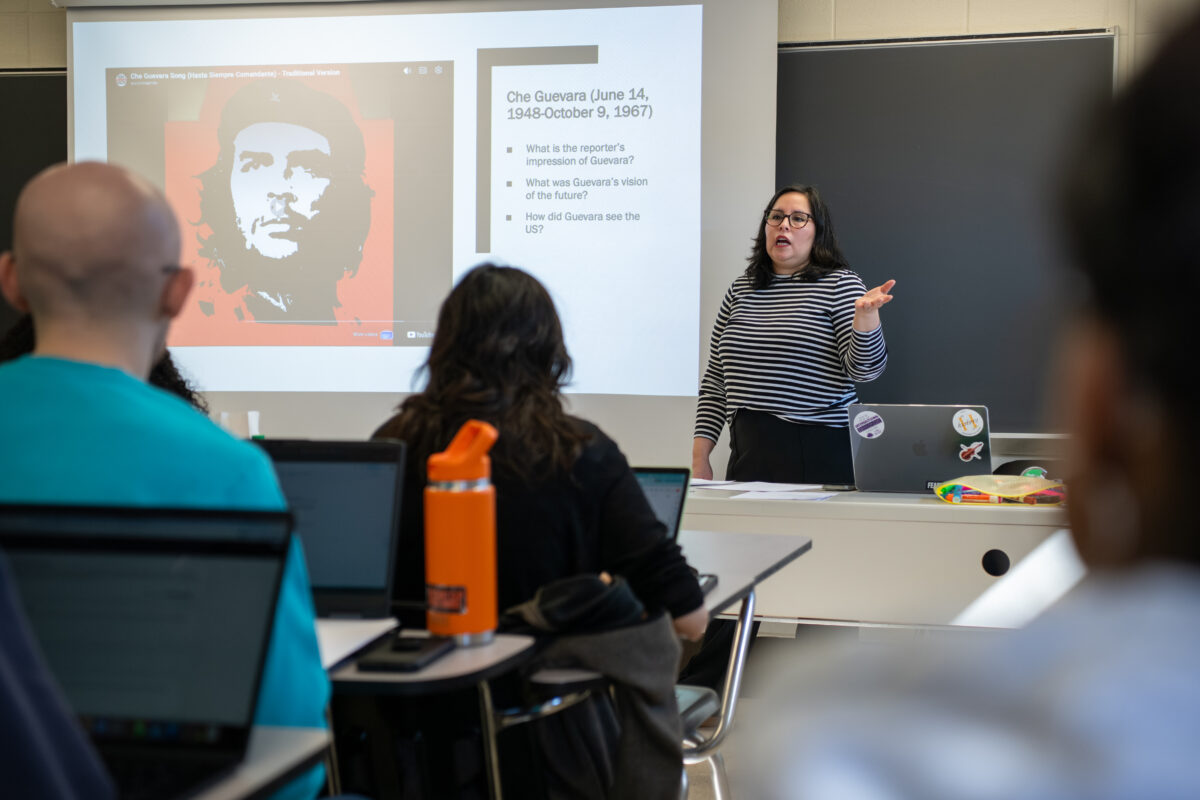 Escanilla Huerta discusses the life of Ché Guevara.
“Like many revered historical figures, Ernesto Guevara de la Serna, better known as Ché, is loved by people all over the world, but he is also controversial,” explains Escanilla Huerta. Nearly 60 years after his CIA-assisted execution, Guevara’s likeness remains one of the most recognizable symbols of Latin American revolution, reproduced on T-shirts, hats, and posters worldwide.
Students look at their own t-shirts as Escanilla Huerta encourages the class to connect two points: How merchandising is used to make personal political statements and how popular culture can keep the memory of a movement or a person long after they’re gone through merchandising, literature, and music. “Ché was a Marxist revolutionary who believed armed revolution was the only path to liberation from oppressive local governments and U.S. interventionism,” she says, clicking through historic black-and-white photos of Ché in Cuba.
“He developed his political ideology while he was a medical student during a motorcycle trip across Latin America where he witnessed the oppression of Indigenous and rural communities,” says Escanilla Huerta, emphasizing how college students can create change in a variety of ways while passing out copies of poems, songs, political cartoons, and a 1959 television interview, for students to read, compare, and discuss in groups.
Expanding on the idea of revolution, Escanilla Huerta introduces “Revolution” by the Beatles, released in 1968, 10 months after Ché was executed. “If you haven’t heard of the Beatles before, I’m very glad I’m the one introducing them to you,” she says, smiling and nodding to the beat. “I want you to listen to the lyrics, and then we can contrast Ché’s idea of revolution with the Beatles’ idea of revolution.” The song opens with the lines: You say you want a revolution / Well, you know / We all want to change the world. Hands quickly shoot up as students begin connecting Ché’s call for armed resistance with the Beatles’ more skeptical view of revolution and whether radical change truly transforms who holds power.
What are you willing to fight for
She ends the discussion by asking students to place themselves as active agents in history. “Now, what do you think it takes to become a revolutionary? What do you care about that you would like to change?” asks Escanilla Huerta as she passes out sheets featuring Guevara’s iconic red-and-black image. Faces lower, pencils race across the page, and within minutes, students tape their responses to the back wall for the class to see. Together, they move to the opposite side of the classroom to take in the full wall of ideas.

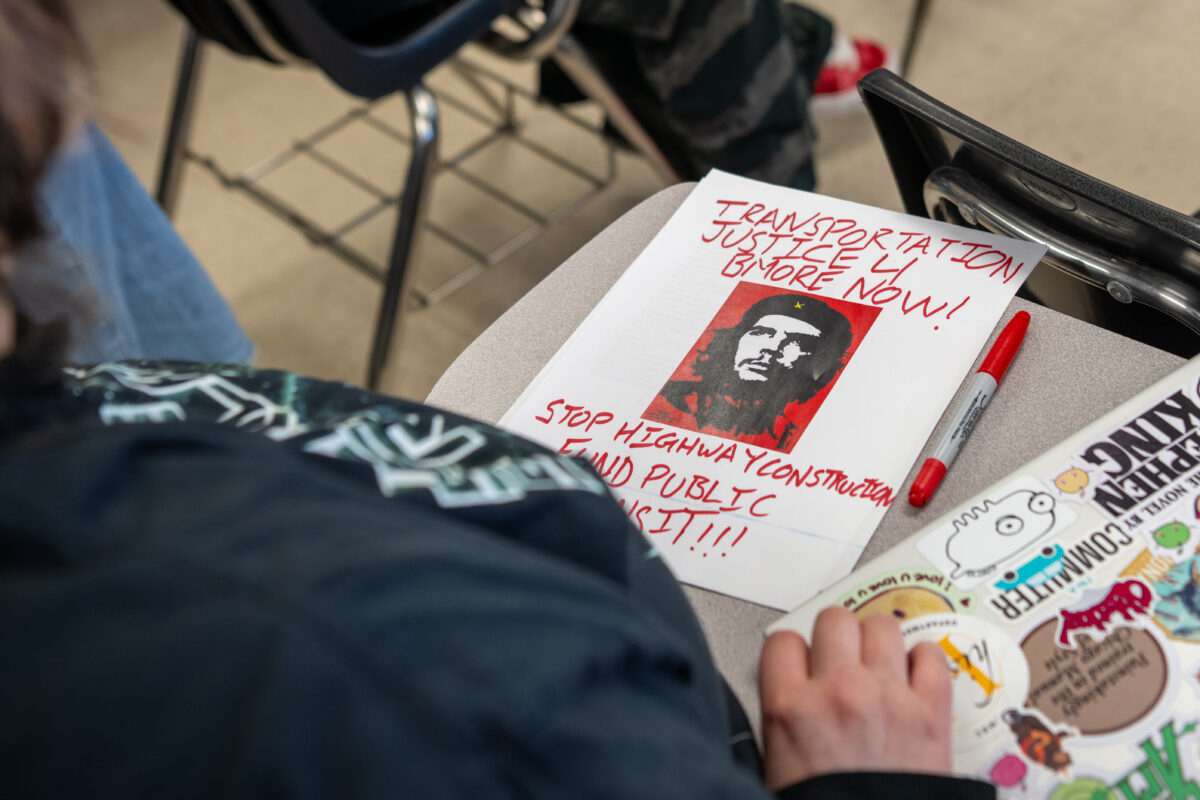 Students review a poem about Ché Guevara and write their ideas for social change.
“Who wants to share what they want to change in the world? What is worth fighting for?” asks Escanilla Huerta. One student’s hand flies up: “I want independence for Wales,” they say, explaining how Wales is a country conquered by England that remains under British rule. Another wants an end to the war between Israel and Palestine and the corporations profiting from it. Others bring the discussion closer to home, raising concerns about transportation equity in Baltimore, where public transit remains inaccessible in many areas. Standing at the front of the classroom and looking at their collective wall of ideas, students begin to recognize that history is shaped by people who choose to follow ideals—for better or worse, depending on who is telling the story.
We’re still here
“I don’t want the class to become a long list of injustices that have happened on Latin American soil,” says Escanilla Huerta, who was born and raised in Argentina. Just like she uses material culture of decades past, she also brings the present into the classroom to show that Latin American history doesn’t end with massacres—it’s so much more. “Despite all that pain, we have always carried joy, pride, and a fighting spirit. That’s why we also analyze examples of joy like Bad Bunny.”
The Puerto Rican singer-songwriter’s 2026 Super Bowl LX halftime performance was the kind of stadium-scale material culture Escanilla Huerta would love to bring into the classroom. Across the stadium floor were vivid representations of Puerto Rican history: workers in sugar cane fields, people trading gold, and the Puerto Rican independence flag flying high, connecting a painful colonial past with a joyful present through a lively house party scene celebrating Puerto Rican dance traditions, vendors selling local treats, and the flags of every Latin American country flanking both sides of the field.
While it may not be the Super Bowl, this spring in room 208 Sondheim, Escanilla Huerta similarly brought modern Latin American history and contemporary culture into the classroom to remind students, as Bad Bunny said in the final line of his Super Bowl performance, “Seguimos aquí!/We’re still here!”
Learn more about UMBC’s history department.
]]>
Anyone passing by Room 208 of the Sondheim Building this spring might have thought the class was a Latin American music appreciation course. Projected on the screen was a video of the Mexican band...
https://umbc.edu/stories/bringing-history-to-life-in-the-classroom/
Video Preview
https://assets3-my.umbc.edu/system/shared/attachments/7691d3dcfe316828a31b37d3e0e9bf2f/6a956532/news/000/161/106/94665a50005ce9dd9915475449bbef79/k76BgIb89-s.jpg?1784061308
https://my3.my.umbc.edu/api/v0/pixel/news/161106/guest@my.umbc.edu/dcb9accf4b4f4b01d967e5aa87ad18aa/api/pixel
cahss
discovery
history
policy-and-society
research
stories
story
UMBC News & Magazine
https://my3.my.umbc.edu/groups/umbc-news-magazine
https://assets1-my.umbc.edu/system/shared/avatars/groups/000/001/943/24435aa6207c452e7bc15cc74b42c7bb/xsmall.png?1748556657
https://assets1-my.umbc.edu/system/shared/avatars/groups/000/001/943/24435aa6207c452e7bc15cc74b42c7bb/original.png?1748556657
https://assets2-my.umbc.edu/system/shared/avatars/groups/000/001/943/24435aa6207c452e7bc15cc74b42c7bb/xxlarge.png?1748556657
https://assets2-my.umbc.edu/system/shared/avatars/groups/000/001/943/24435aa6207c452e7bc15cc74b42c7bb/xlarge.png?1748556657
https://assets3-my.umbc.edu/system/shared/avatars/groups/000/001/943/24435aa6207c452e7bc15cc74b42c7bb/large.png?1748556657
https://assets1-my.umbc.edu/system/shared/avatars/groups/000/001/943/24435aa6207c452e7bc15cc74b42c7bb/medium.png?1748556657
https://assets2-my.umbc.edu/system/shared/avatars/groups/000/001/943/24435aa6207c452e7bc15cc74b42c7bb/small.png?1748556657
https://assets1-my.umbc.edu/system/shared/avatars/groups/000/001/943/24435aa6207c452e7bc15cc74b42c7bb/xsmall.png?1748556657
https://assets2-my.umbc.edu/system/shared/avatars/groups/000/001/943/24435aa6207c452e7bc15cc74b42c7bb/xxsmall.png?1748556657
UMBC News & Magazine
0
0
false
Tue, 14 Jul 2026 16:01:40 -0400
Meet a Retriever—Manikanta Sirumalla, international data science graduate student and entrepreneur
If you want help meeting a big new fitness goal, Manikanta Sirumalla may have the app for you. Manikanta came to UMBC from India as a graduate student pursuing a master’s degree in data science. Since arriving, he’s tapped into the wealth of support for aspiring Retriever entrepreneurs. Several UMBC-affiliated programs and people helped Manikanta as he developed and launched his AI-powered fitness and nutrition app, RepTrack Pro. He tells us what it took to be a student and a solo founder of a brand new venture. Take it away, Manikanta!
Q: Tell us about yourself.
A: I’m Manikanta, an M.S. in data science student at UMBC. I’m also the solo founder of RepTrack Pro, an AI-powered fitness and nutrition iOS app that’s live on the App Store. I’m currently building it out through UMBC’s Launchpad accelerator, and most of my energy these days goes into turning it into a real venture. Three years of iOS development before grad school got me here, but the founder path is what I’m all in on now.
Q: Who are some of the people at UMBC who have most supported you?
A: Masoud Soroush, the director of my graduate program at UMBC, has been a steady source of support throughout my time here. Balancing a demanding course load with building RepTrack Pro full-time hasn’t been easy, and Dr. Soroush has been understanding and encouraging of the path I’m on. Having a program leader who recognizes the value of building something real alongside academic work, and who supports rather than discourages that, has made a meaningful difference in how I’ve been able to pursue both.
Since joining UMBC, the support I’ve found has also gone far beyond the classroom. My growth as a founder has been shaped most by the mentors around me. Chris White, the entrepreneur-in-residence at bwtech [UMBC’s Research and Technology Park], has pushed me to think like a founder rather than just an engineer. Mike Adelstein [’96, biochemistry and molecular biology], with his background in fitness tech, has brought perspective directly relevant to what I’m building with RepTrack Pro.
Beyond individual mentors, the broader community has backed my work in tangible ways. Winning UMBC’s Cangialosi Business Innovation Competition gave RepTrack Pro real funding and validation, and the Launchpad accelerator has given me the structure and accountability a solo founder rarely has access to. What makes the difference isn’t just the resources—it’s that people here take my work seriously and invest in it.
Q: Tell us more about the Launchpad accelerator program.
A: The Launchpad accelerator is the part of my UMBC experience I value most. It’s given me structure and accountability I wouldn’t have on my own—a real framework for validating my business rather than just building features. Working through the business modeling tool Lean Canvas has forced me to question assumptions and to focus on the problems my customers actually have.
What stands out most about the program is the access to experienced mentors and a community that takes early-stage founders seriously. Being a student and a founder at the same time can feel isolating, and Launchpad has been the place where that work gets recognized, challenged, and supported. It’s turned a side project into something I’m pursuing as a genuine venture.
Q: What brought you to UMBC in the first place?
A: I came to UMBC because I wanted to deepen my technical foundation and grow beyond where three years of iOS development had taken me. I’d been building software for others, and I was ready to build something of my own with the data science skills to back it. UMBC’s program offered the rigor I was looking for, but what I didn’t expect was the entrepreneurial support that came with it. What started as a path to a stronger career has turned into the launch point for my own venture.
Q: What would you tell other international students interested in entrepreneurship?
A: As an international student, coming to UMBC meant building a life and a career far from home, often while navigating things such as visas, paperwork, and a new system that domestic students don’t have to think about. What made the difference for me was finding a community that didn’t treat that as a limitation. Through the Launchpad accelerator and the bwtech ecosystem, I’ve been able to build my own venture and be taken seriously as a founder despite being new to the country.
To others in my shoes: Don’t assume the entrepreneurial and professional opportunities here are out of reach because you’re international. UMBC has the people and programs to support you if you’re willing to seek them out. Being an international student shaped my path here, but it never closed doors. If anything, the support I found opened them.

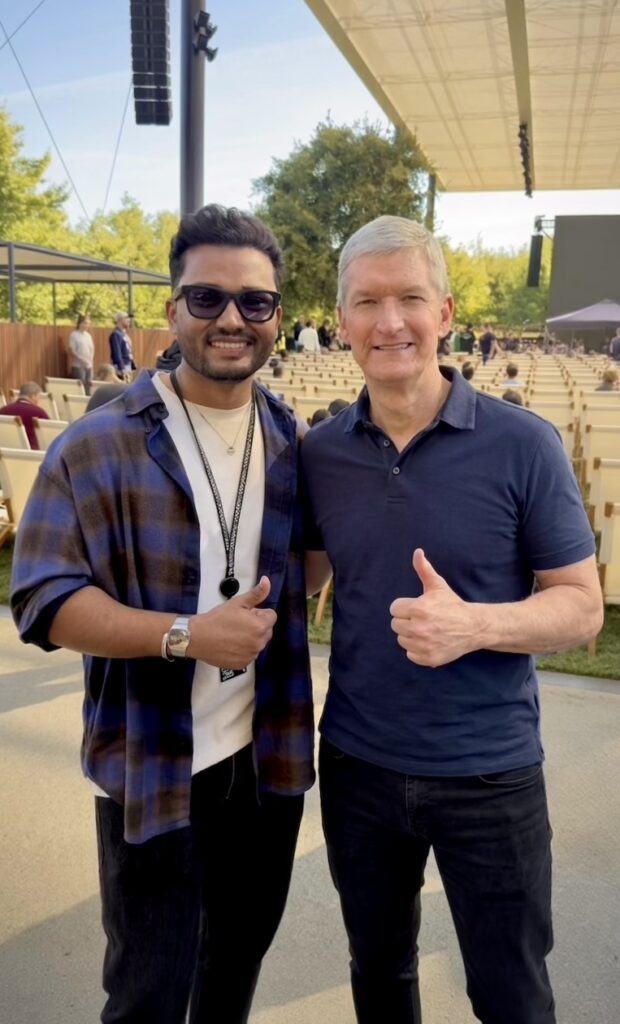
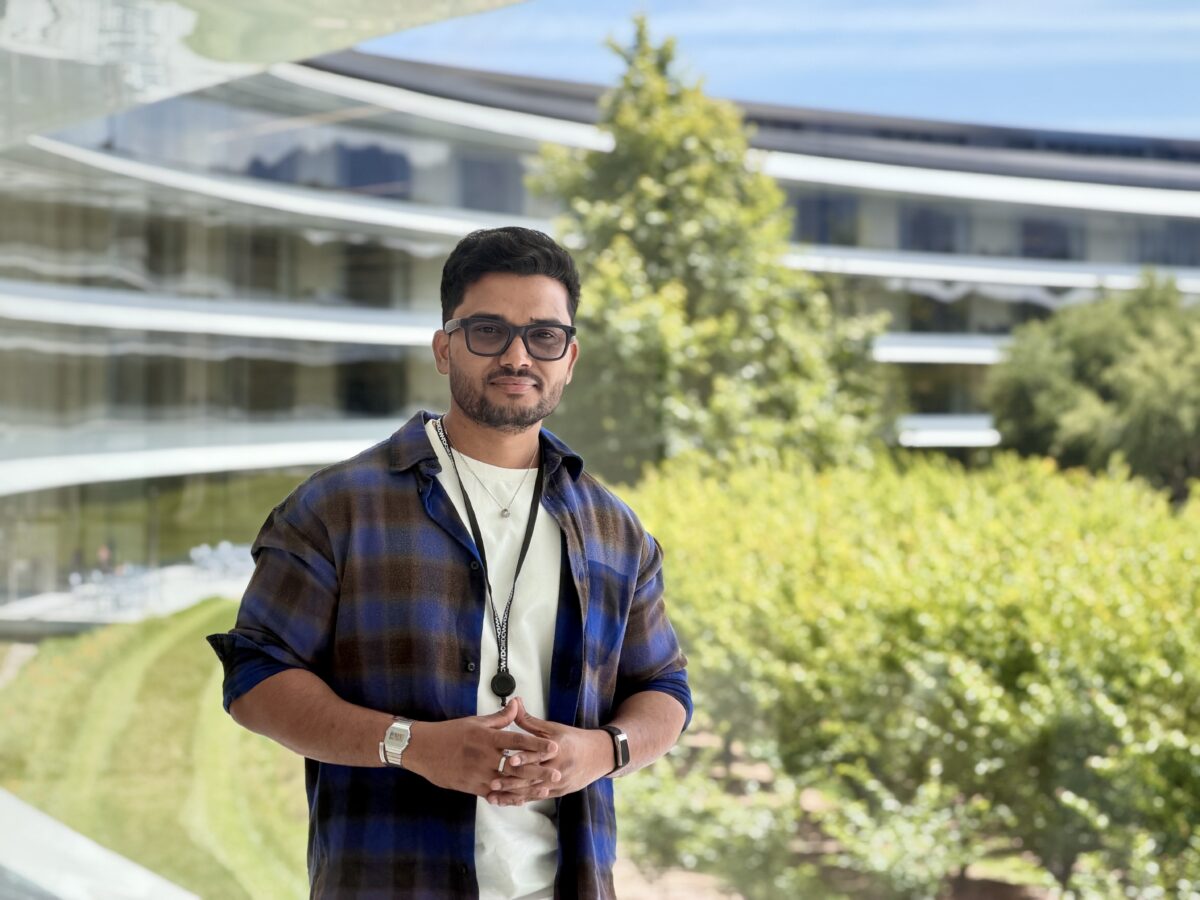
Manikanta Sirumalla at Apple’s Worldwide Developers Conference (left), with Apple CEO Tim Cook (center) and at Apple’s campus in Cupertino, California (right).
Q: What are your plans for after graduation?
A: After I graduate this December, my plan is to take RepTrack Pro full-time. What started as a project at UMBC has become a real venture, and post-graduation is when I commit to it completely growing the user base, launching the Pro tier, and building it into a sustainable business. UMBC’s entrepreneurship ecosystem gave me the foundation to make that leap, and my goal is to turn the momentum I’ve built here into a company that lasts.
Q: How has UMBC helped you get ready for life after graduation?
A: UMBC prepared me for life after graduation in a way I didn’t expect when I enrolled. I came for the technical foundation, but what I’m leaving with is the start of a real company. By the time I graduate, I won’t be starting from zero, I’ll be continuing something UMBC helped me build. That’s the best preparation I could have asked for.
Q: What’s the one thing you’d want someone who hasn’t joined the UMBC community to know about the support you find here?
A: The support here is real and hands-on, not just a brochure promise. As a solo founder, I expected to figure most things out alone. Instead I found mentors who take my work seriously, a competition that backed RepTrack Pro with real funding, and an accelerator that gave me structure and people to lean on. UMBC didn’t just let me build something on the side, it invested in it. That kind of support turns an individual effort into something bigger than what you could do on your own.
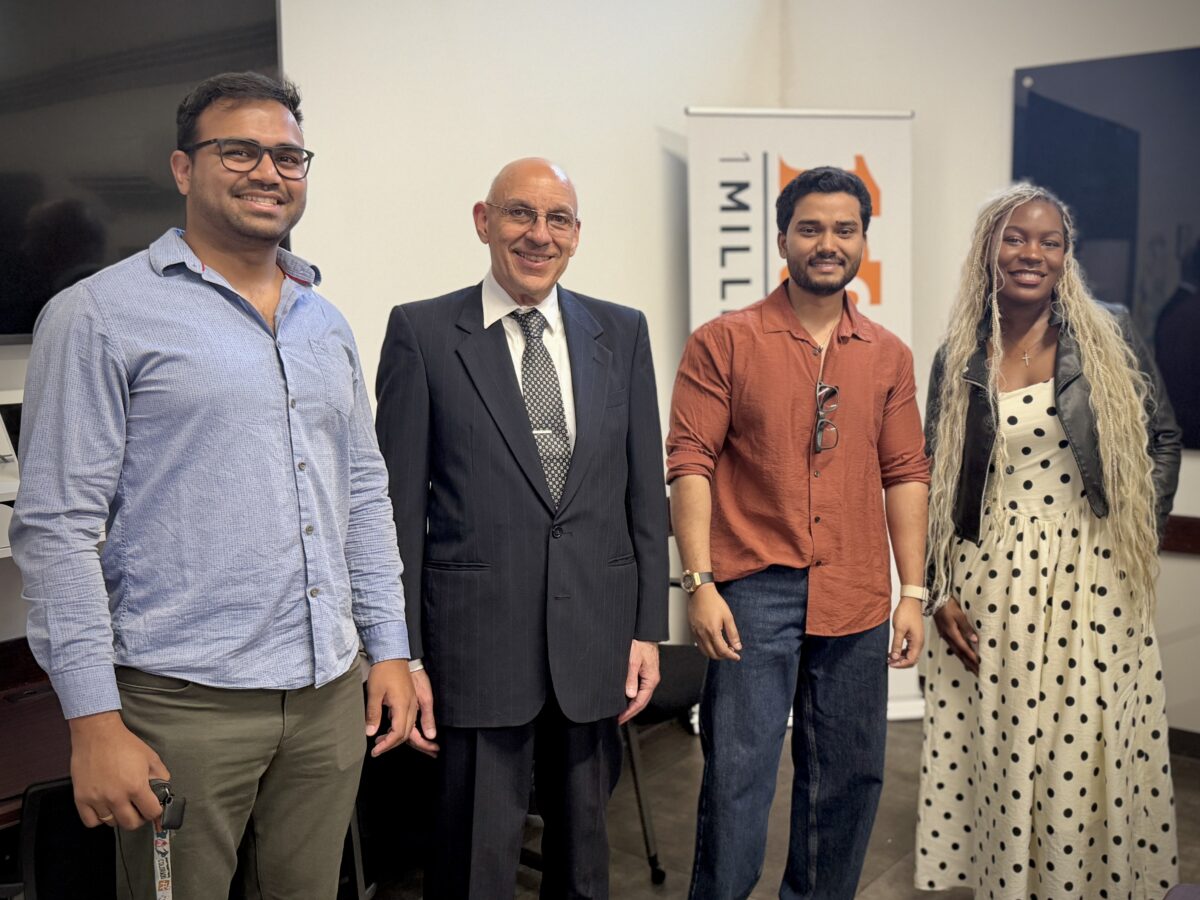 Manikanta Sirumalla (second from right) at a 1 Million Cups Baltimore event, part of a grassroots networking and educational program designed to connect local entrepreneurs with their communities.
* * * * *
UMBC’s greatest strength is its people. When people meet Retrievers and hear about the passion they bring, the relationships they create, the ways they support each other, and the commitment they have to inclusive excellence, they truly get a sense of our community. That’s what “Meet a Retriever” is all about.
Learn more about how UMBC can help you achieve your goals.
]]>
If you want help meeting a big new fitness goal, Manikanta Sirumalla may have the app for you. Manikanta came to UMBC from India as a graduate student pursuing a master’s degree in data science....
https://umbc.edu/stories/meet-a-retriever-manikanta-sirumalla-entrepreneur/
https://my3.my.umbc.edu/api/v0/pixel/news/160851/guest@my.umbc.edu/6c2a3ae8b4258bcedc4e7fb2693aa2ce/api/pixel
campus-life
coeit
data-science
graduate-school
international
meet-a-retriever
perspectives
science-and-tech
story
UMBC News & Magazine
https://my3.my.umbc.edu/groups/umbc-news-magazine
https://assets1-my.umbc.edu/system/shared/avatars/groups/000/001/943/24435aa6207c452e7bc15cc74b42c7bb/xsmall.png?1748556657
https://assets1-my.umbc.edu/system/shared/avatars/groups/000/001/943/24435aa6207c452e7bc15cc74b42c7bb/original.png?1748556657
https://assets2-my.umbc.edu/system/shared/avatars/groups/000/001/943/24435aa6207c452e7bc15cc74b42c7bb/xxlarge.png?1748556657
https://assets2-my.umbc.edu/system/shared/avatars/groups/000/001/943/24435aa6207c452e7bc15cc74b42c7bb/xlarge.png?1748556657
https://assets3-my.umbc.edu/system/shared/avatars/groups/000/001/943/24435aa6207c452e7bc15cc74b42c7bb/large.png?1748556657
https://assets1-my.umbc.edu/system/shared/avatars/groups/000/001/943/24435aa6207c452e7bc15cc74b42c7bb/medium.png?1748556657
https://assets2-my.umbc.edu/system/shared/avatars/groups/000/001/943/24435aa6207c452e7bc15cc74b42c7bb/small.png?1748556657
https://assets1-my.umbc.edu/system/shared/avatars/groups/000/001/943/24435aa6207c452e7bc15cc74b42c7bb/xsmall.png?1748556657
https://assets2-my.umbc.edu/system/shared/avatars/groups/000/001/943/24435aa6207c452e7bc15cc74b42c7bb/xxsmall.png?1748556657
UMBC News & Magazine
0
0
false
Fri, 26 Jun 2026 10:00:00 -0400
The Bernard L. Berkowitz Memorial Award for public service gives students the financial freedom to invest in themselves and their education
Rather than taking her usual route to UMBC at the Universities at Shady Grove for her spring public health class, Magaly Lizama Hernandez ’26, psychology, boarded a plane to Geneva, Switzerland, as part of a 2026 study abroad program. The experience was made possible by the Bernard L. Berkowitz Memorial Award for students dedicated to public service. Lizama Hernandez was the inaugural recipient in 2025.
“The Berkowitz Award helped make my study abroad experience in Switzerland possible. I had the opportunity to explore health and well-being from a global perspective while immersing myself in a new culture,” says Lizama Hernandez, who split her week abroad between Geneva and Zurich. “It was an amazing experience that broadened my understanding of community health and deepened my commitment to helping others through public service.”
Erika Bucciantini, a doctoral student of public policy and the 2026 recipient of the Bernard L. Berkowitz Memorial Award, is also grateful for the award. As a full-time mom and full-time student, time is scarce, and the cost of child care and basic needs adds up quickly.
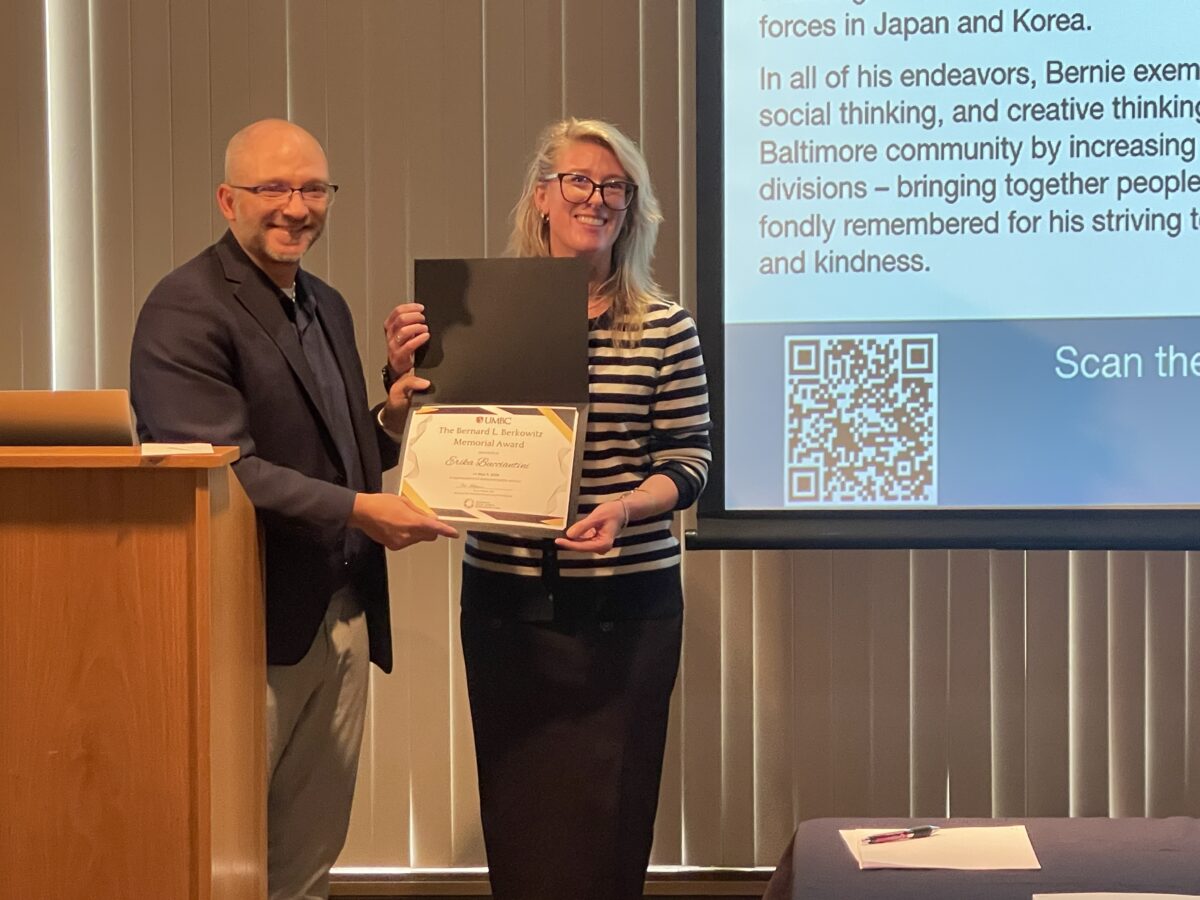 Stokan presents Bucciantini with the Bernard L. Berkowitz Memorial Award certificate at the 2026 award ceremony. (Amy Wolf/UMBC)
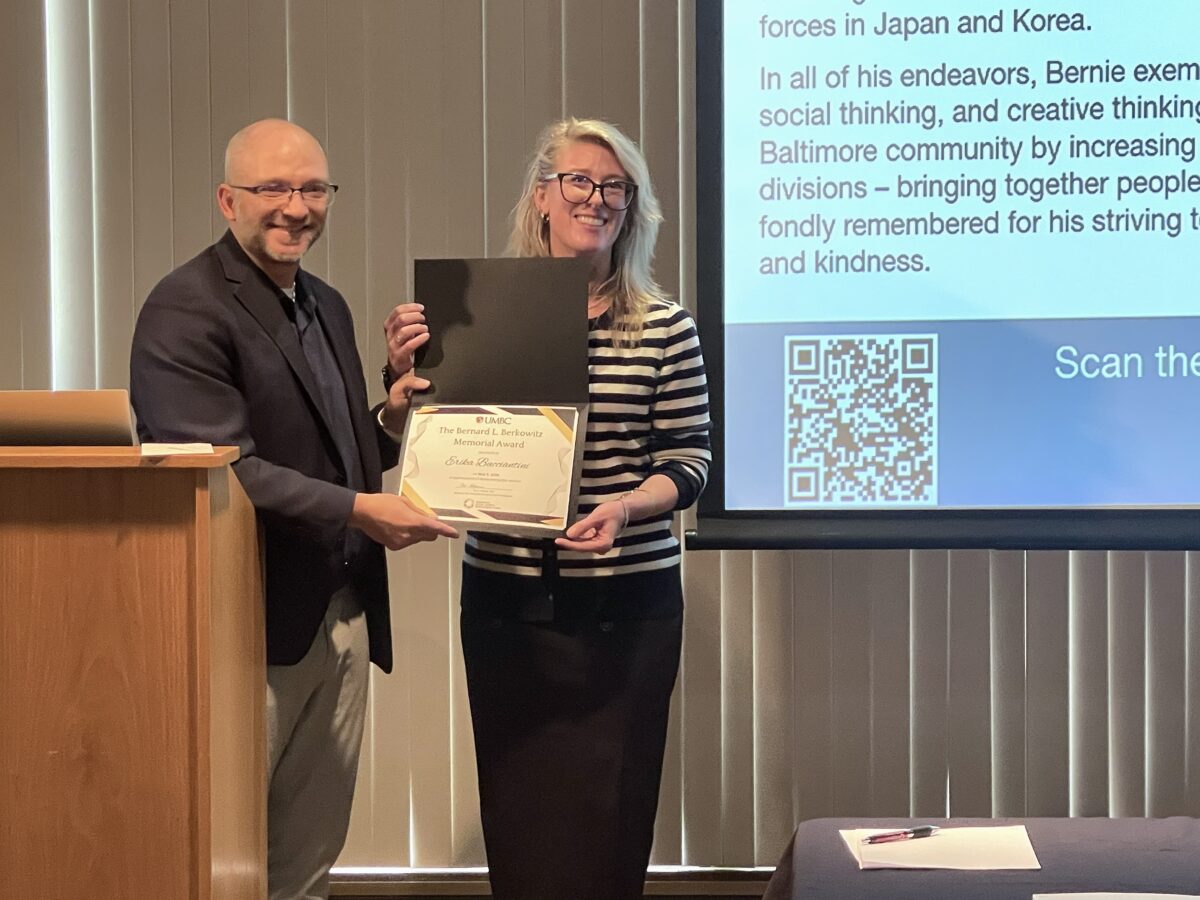

“As a parenting student with swiftly growing children, the first thing I did was buy new shoes for my kids. I also treated myself to two books for my research by Alan Mallach—The Divided City: Poverty and Prosperity in Urban America and Smaller Cities in a Shrinking World: Learning to Thrive Without Growth,” says Bucciantini.
Eric Stokan, associate professor of political science and director of UMBC’s Center for Social Science Scholarship (CS3), praised the CS3 advisory board for an outstanding selection of two exceptional students — Magaly and Erika — who, as he noted, “are poised to make a significant and positive impact on the Baltimore community, as envisioned by the founders of the Berkowitz Award.”
“The real gift of this award for me is the opportunity to afford childcare for my youngest over the summer so that I can take an internship to further my skill building,” says Bucciantini, who assists Loren Henderson, director and professor of the School of Public Policy, with data analysis coding, manuscript development, and teaching support for Henderson’s research about the plight of Black farmers in the United States.

 (left) Bucciantini (center) with fellow public policy graduate assistants. (right) Bucciantini (first on the left) at the American Sociological Association’s Policy Outreach Program with Loren Henderson (first on the left). (Image courtesy of Bucciantini)
Whether it’s supporting fellow doctoral Retrievers on campus or serving as vice chair for Montgomery County’s Dickerson Area Facilities Implementation Group to help residents stay informed about facility operations, county initiatives, and state services, Bucciantini notes that public service is one of her core values. In her work, which also includes writing for the Food Bank of the Rockies in Colorado and Wyoming, she hopes to bring her commitment to public service and interests in planning policy and racial discrimination together for the greater good.
The real gift of this award for me is the opportunity to afford childcare for my youngest over the summer so that I can take an internship to further my skill building.
Erika Bucciantini
Doctoral student of public policy
Learn more about the Bernard L. Berkowitz Memorial Award.
]]>
Rather than taking her usual route to UMBC at the Universities at Shady Grove for her spring public health class, Magaly Lizama Hernandez ’26, psychology, boarded a plane to Geneva, Switzerland,...
https://umbc.edu/stories/the-2026-bernard-l-berkowitz-memorial-award/
https://my3.my.umbc.edu/api/v0/pixel/news/160753/guest@my.umbc.edu/94d8cbe9ac88276d93f91ae4035b1454/api/pixel
cahss
graduateschool
policy-and-society
psychology
public-policy
story
UMBC News & Magazine
https://my3.my.umbc.edu/groups/umbc-news-magazine
https://assets1-my.umbc.edu/system/shared/avatars/groups/000/001/943/24435aa6207c452e7bc15cc74b42c7bb/xsmall.png?1748556657
https://assets1-my.umbc.edu/system/shared/avatars/groups/000/001/943/24435aa6207c452e7bc15cc74b42c7bb/original.png?1748556657
https://assets2-my.umbc.edu/system/shared/avatars/groups/000/001/943/24435aa6207c452e7bc15cc74b42c7bb/xxlarge.png?1748556657
https://assets2-my.umbc.edu/system/shared/avatars/groups/000/001/943/24435aa6207c452e7bc15cc74b42c7bb/xlarge.png?1748556657
https://assets3-my.umbc.edu/system/shared/avatars/groups/000/001/943/24435aa6207c452e7bc15cc74b42c7bb/large.png?1748556657
https://assets1-my.umbc.edu/system/shared/avatars/groups/000/001/943/24435aa6207c452e7bc15cc74b42c7bb/medium.png?1748556657
https://assets2-my.umbc.edu/system/shared/avatars/groups/000/001/943/24435aa6207c452e7bc15cc74b42c7bb/small.png?1748556657
https://assets1-my.umbc.edu/system/shared/avatars/groups/000/001/943/24435aa6207c452e7bc15cc74b42c7bb/xsmall.png?1748556657
https://assets2-my.umbc.edu/system/shared/avatars/groups/000/001/943/24435aa6207c452e7bc15cc74b42c7bb/xxsmall.png?1748556657
UMBC News & Magazine
0
0
false
Wed, 17 Jun 2026 15:45:48 -0400
Wed, 17 Jun 2026 15:45:48 -0400
The Charm Pack solves the case
Originally approached with a quilting mystery that began in 1846, a summer CoLab pulled a group of Retrievers together to examine the evidence. The detective pack expanded their search into robust research and, along the way, discovered how the communal process of sewing storytelling quilts lets these works of art transcend time.
Those in the quilting community know that the charm pack is a pre-cut bundle of fabric squares that can be used to create the patchwork for the top layer of a quilt. This story begins with a team that can be considered a sort of Charm Pack: expert quilters Mimi Dietrich, Monique Crabb, and Christa Gilliam and researchers Sarah Fouts, Kat Gill, Ben Kays, and Alyssa Thomas.
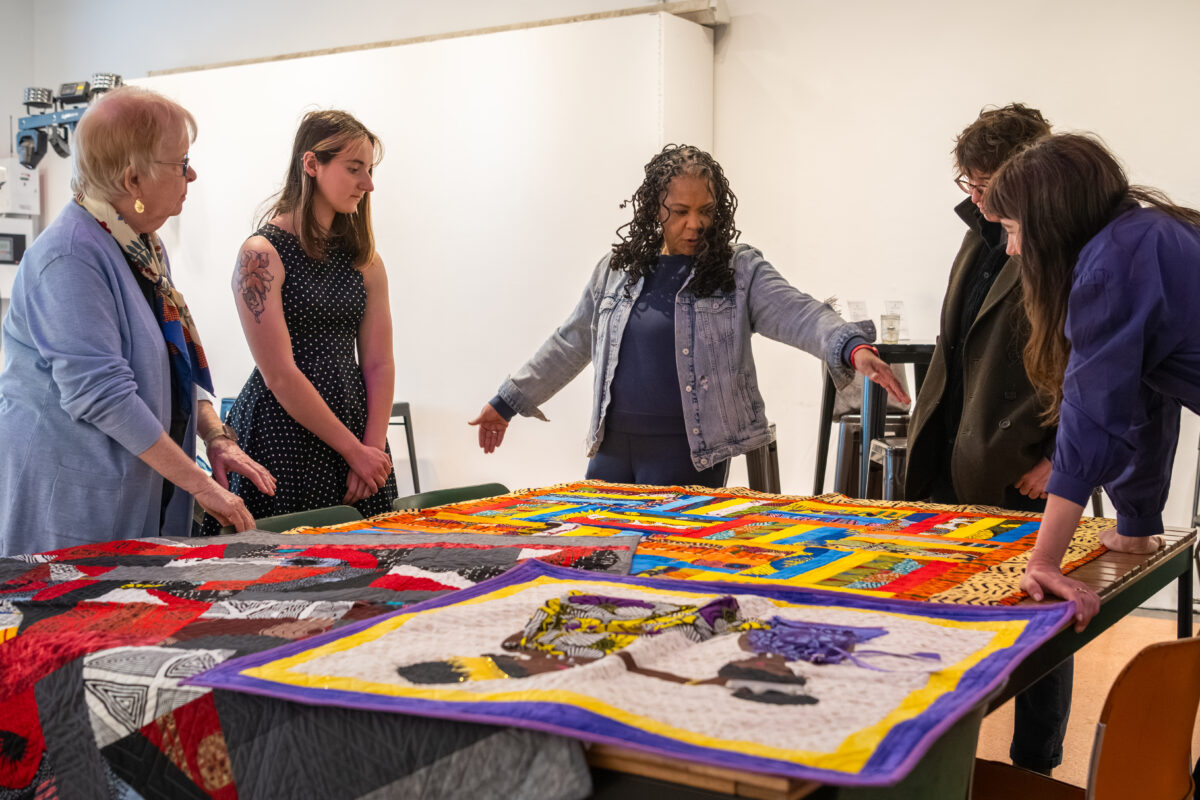 Gilliam (center) discusses the measurements of different quilts. Left to right: Dietrich, Gill, Fouts, and Crabb.
The pack first came together to solve a mystery for art collector Henry Stansbury, who bought a quilt at an auction 35 years ago with the words “Elizabeth Stansbury 1846” stitched into it. Last year, Stansbury showed this quilt to Dietrich, along with a second one he bought, stitched with the names Elizabeth and Mary Stansbury. Dietrich ’70, American studies, a member of UMBC’s Founding Four, has written 17 quilting books and has been an active part of the Baltimore quilting community since the 1980s. One look at the quilts and Dietrich could identify the type of fabric, the stitches used, and the style of quilt—a Baltimore Album Quilt. But these details didn’t give any clues about the Stansburys.


 Looking closely at the Stansbury Baltimore Album Quilt.
The pair turned to Sarah Fouts, associate professor of American studies and co-director of UMBC’s Public Humanities Program, for help. Fouts saw this as a great opportunity for a summer CoLab—where students and faculty conduct humanities research with a community partner and create public-facing projects. Enter the Storytelling through Baltimore Album Quilts 2025 CoLab.
Are the Stansbury quilts lost family heirlooms? Who are Elizabeth and Mary Stansbury? Are these two quilts telling the story of unrelated families with only the buyer to tie them together? The quick answer is no. “We never doubted they were related,” says Fouts. “There were just too many Elizabeths and Mary Stansburys that we couldn’t link it to a direct family line.” The longer, more complex answer is that all the threads led to a basement full of treasures and $10,000.
The sandwich
A quilt has three layers: the quilt top, the batting or insulating layer, and the backing or the bottom layer of fabric, formally known as the quilt sandwich. These pieces create the whole, and Fouts needed to find all the pieces of the sandwich, so she sent out a call for student interns to join the quilt-mystery-turned-humanities-research CoLab. Then she gathered a team of quilting experts: Dietrich, Crabb, M.F.A. ’22, and Gilliam, an associate professor of social work at Morgan State University who uses African-print fabrics to create quilts about her lived experience.
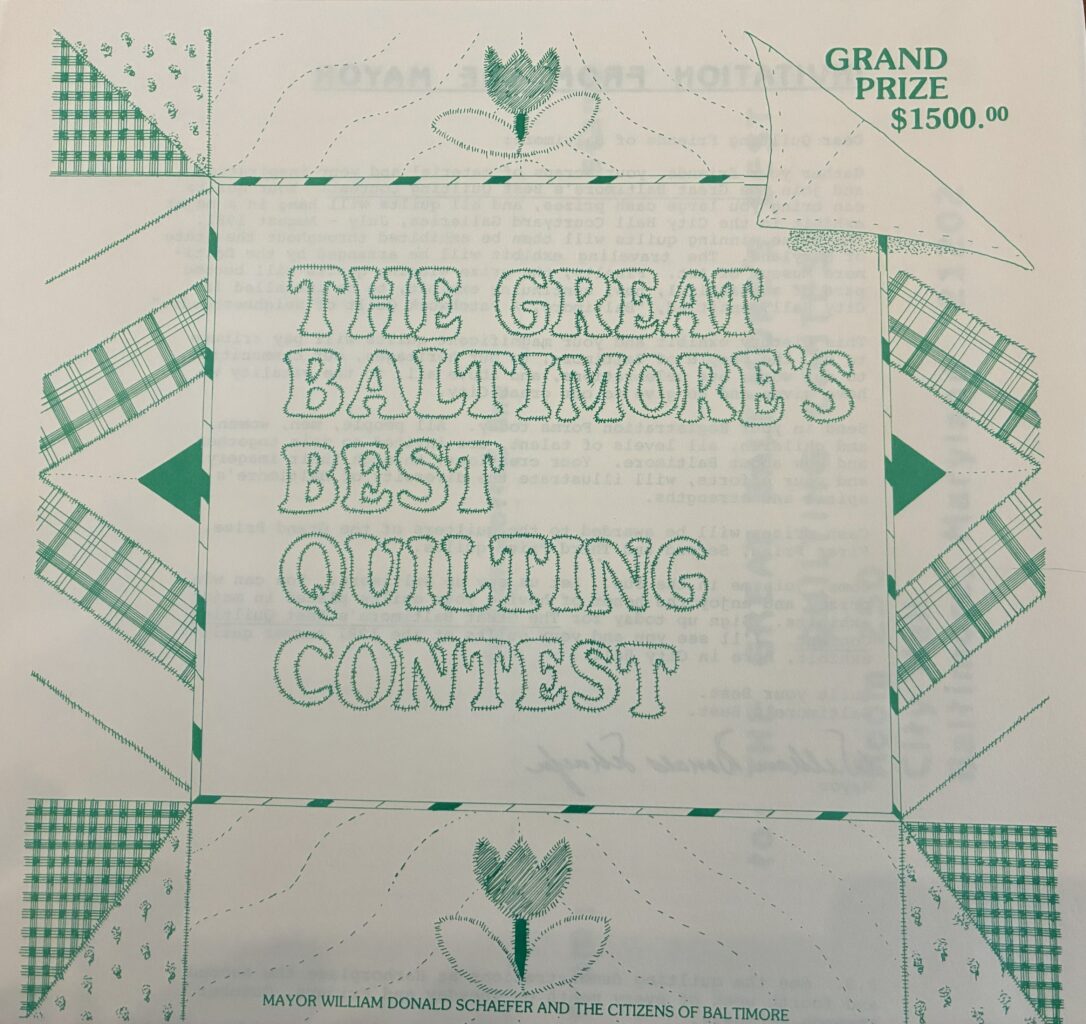 The original call for quilt makers in 1981. Quilted by Dietrich. (Image courtesy of Dietrich)
The first to join was Crabb, a Mexican American artist, who began quilting in 2014 and uses plant dyes, photography, thrift fabrics, and various quilting techniques to create quilts that reflect personal histories and feminism. As an adjunct professor at MICA, Crabb teaches 16 fiber-related processes in her Intro to Fiber class. But before the project even began, it took a turn. Crabb liked the idea, but encouraged Fouts and Deitrich to go to the basement of City Hall. Crabb knew that if they thought the Stansbury quilt was a find, the bowels of City Hall would dazzle them. She was right. Hanging in front of them was not one, but several different types of quilts from the Great Baltimore’s Best Quilting Contest of 1981, and they realized one of the participants was standing among them.
The inaugural citywide quilt competition, which Dietrich entered, celebrated Baltimore’s transportation, architecture, industry, people, and plants and animals. “I was surprised to see that the quilts were in the basement,” says Dietrich. Hers is stored at the Maryland Center for Culture and History (MCHC). “I entered the contest because I’ve always lived in Baltimore County.”
 Dietrich’s entry for the Great Baltimore’s Best Quilting Contest of 1981. (Image courtesy of the Maryland Center for History and Culture)
This treasure added multiple layers to the Charm Pack’s work. Now, it wasn’t about one quilt story, but many. Quilts made by residents from across Baltimore who, in 1981, chose to bring forth their vision of Baltimore through needle and thread. Who were these craftspeople? What was the history of the contest? And why did the Great Baltimore’s Best Quilting Contest have to live in the past?
“It’s good to learn something else from what you’re trying to find out,” said Dietrich, and with that, students across the College of Arts, Humanities, and Social Sciences took up the mantle of citizen investigators. Gill, an American studies and English senior; Kays, a theatre design and production junior; and Thomas ’25, Asian studies, made the cut. They analyzed historical records, photographs, and documents from the Library of Congress, Maryland State Archives, Maryland Historical Society, and the Maryland Quilt Heritage Project, and quickly solved the first mystery. No records tied Henry Stansbury directly to the quilts. However, the trail did connect the deep red that bordered the quilt and was used throughout the blocks, as well as the indigo used to color bluebirds in mid-flight to Maryland and beyond.
“Wonderful natural dyes have dyed the fabric on this quilt. The red throughout is made from turkey red… matter root that is grown here in America,” said Gills, in a video the lab co-produced with the Baltimore Heritage organization. “We also have this wonderful indigo blue that is very vibrant on the bird, which is from the indigo plant and is also made here in America, but is also imported from Latin and South America as well.”
The quilts the students researched were examples of how one person’s quilt tells more than one story. From the thread and needle chosen to the types of dyes on a cloth, each piece can stand as its own narrative, but once stitched together, a more complex one can emerge. “Quilts became powerful analytical tools, allowing students to interrogate intersections of class, race, gender, and globalization and demonstrating how even the most familiar objects are embedded in complex and often unequal systems,” says Fouts.
The blocks
Blocks are individual units of fabric sewn together with other identical or different blocks to form the main pattern of a quilt top. With the Stansbury mystery partially solved, everyone turned their efforts to studying the technical, communal, and historic aspects of Baltimore Album Quilts, which were named after a book where each page commemorated a friendship, like the adjacent blocks of a quilt.
To learn from the masters behind the craft, Dietrich introduced the students to 20 Baltimore quilt-makers. Kayes interviewed Crabb about the natural dyes and contemporary quilting practices. Thomas interviewed Gilliam about embellishments and Black quilting traditions in Baltimore. Gilliam is a fiber artist and member of the African American Quilters of Baltimore, and a former Maryland Folklife Apprentice of Vera Hall, a prominent Maryland African American master quilter.

 Gilliam with the “Golden Time of Day” quilt she quilted, left, and “She Who Wears the Crown,” applique, machine quilted, by Gilliam, right.
With nearly a decade of experience in quilt making, Gilliam once created a quilt titled “She Who Wears A Crown,” to help her students understand the 2019 Crown Act that protects against discrimination based on race-based hairstyles by extending statutory protection to hair texture and protective styles such as braids, locs, twists, and knots in the workplace and public schools.
“What excites me most about my work is the ability to work in community and meet so many young people who are interested in learning about the history of quilting,” says Gilliam. “Quilting allows us to learn and teach the stories that connect us to the past.”
The binding
When all the measuring, cutting, dying, and stitching have told the story, the quilter binds it together by sewing a strip of fabric around the edges to cover the raw edges of the quilt sandwich. It acts as a protective border to prevent fraying and provides a polished look.
After four weeks and 130 hours of research, the CoLab, in partnership with Baltimore Heritage, co-produced five oral histories on Dietrich, Crabb, Gilliam, Stansbury, and Catherine Rogers Arthur, vice president of collections and chief curator of MCHC.
But there was still one more loose thread. Crabb didn’t think the Baltimore Album Quilt story should have ended in 1981. The 1981 competition was hosted by Baltimore City Hall, with a grand prize of $1,500. In 2025, Fouts reached out to City Hall for support to resurrect the competition. The positive response was not only immediate but backed with a $10,000 prize for the contest. Maryland State Art Council had already committed $7,000 to operations.
Mayor’s Instagram message
Day of exhibit IG post
With the support of Baltimore City’s Mayor’s Office of Arts, Culture, and Entertainment and Maryland State Art Council’s Maryland Folklife Network, the CoLab has renewed the competition, titled “Homage to Baltimore Quilting Competition.” By April 1, 2026, 52 people submitted quilts. After Gilliam, Crabb, and Dietrich judged the final round of quilts, a $5,000 grand prize was presented at the opening exhibition on June 6, 2026, at Current Space.
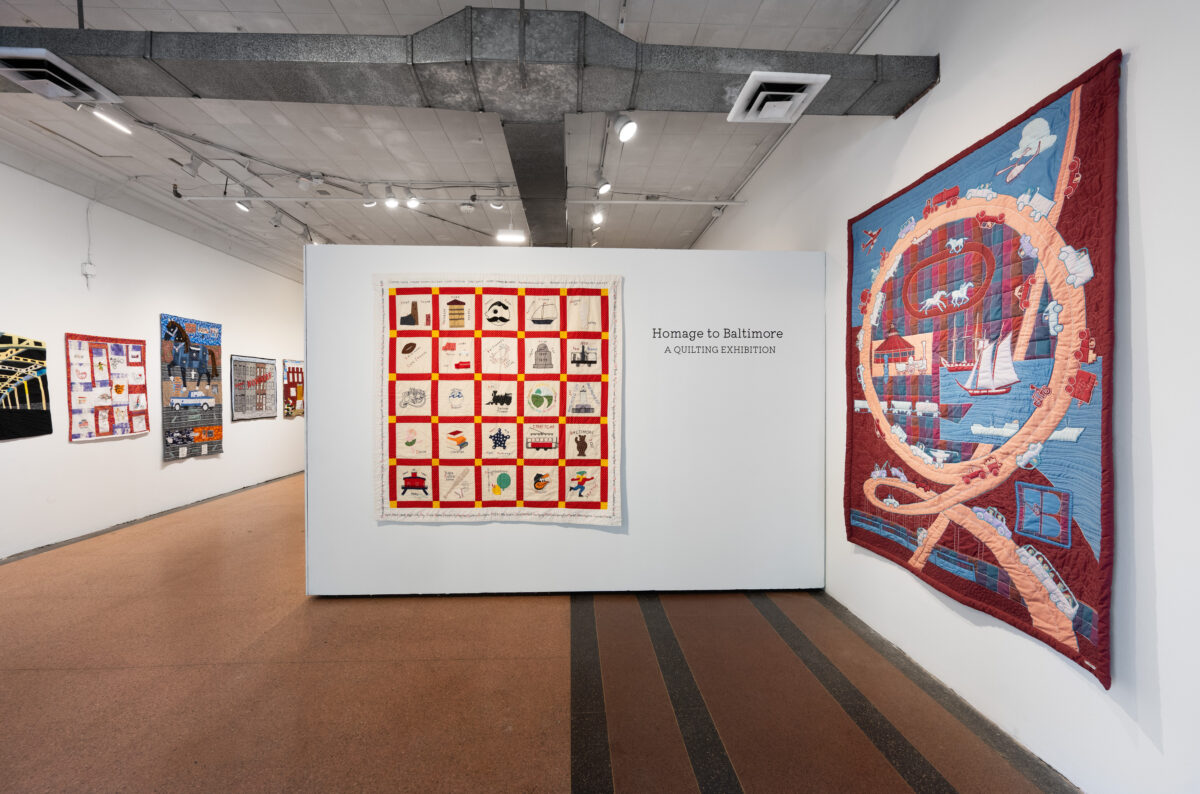 “Homage to Baltimore Quilting Competition” exhibit at Current Space on June 6, 2026. (Image courtesy of Fouts)
The winning quilt does it all: each of the 18 blocks of the hand- and machine-stitched quilt tells the story of Baltimore’s history using a lens from the present. Created by Piecing with Purpose Quilt Collective, “Baltimore Citizens, from Past to Present, on a Zoom Call” unites the city’s legendary movers and shakers in conversation with each other.
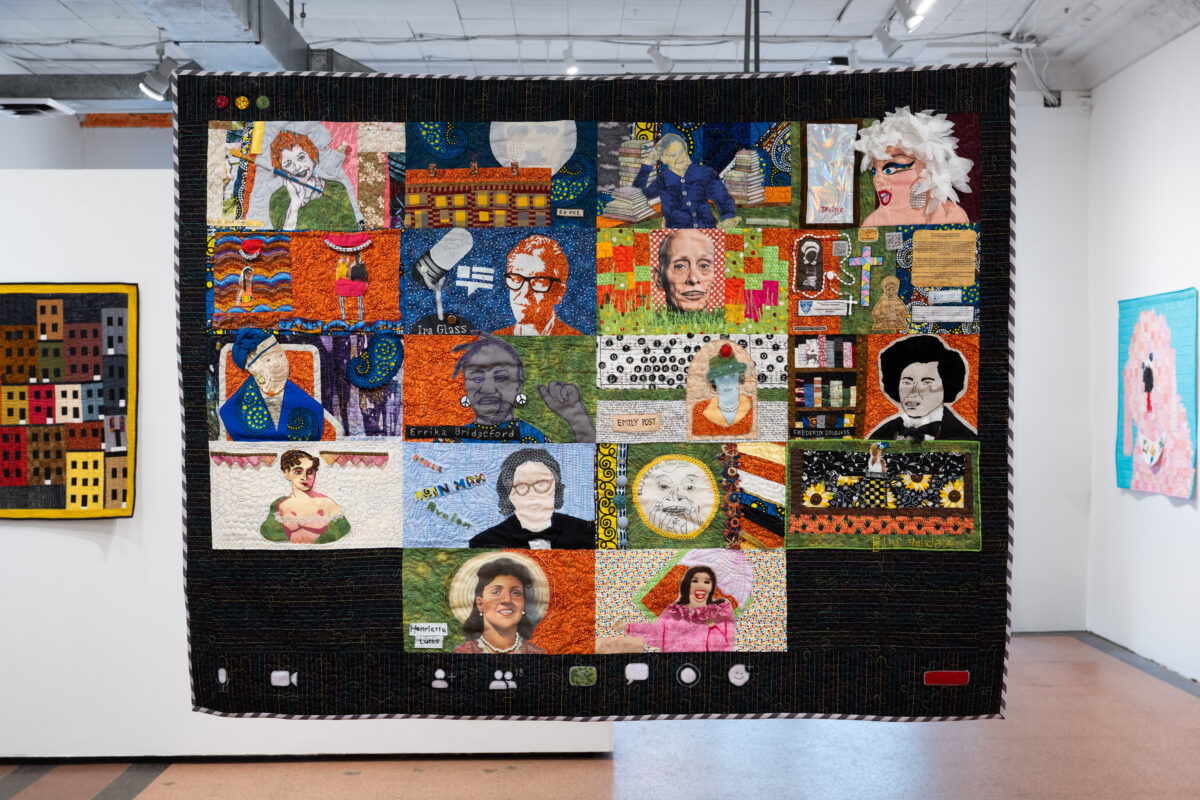 First place: “Baltimore Citizens, from Past to Present, on a Zoom Call,” by Piecing with Purpose Quilt Collective. (Image courtesy of Fouts)

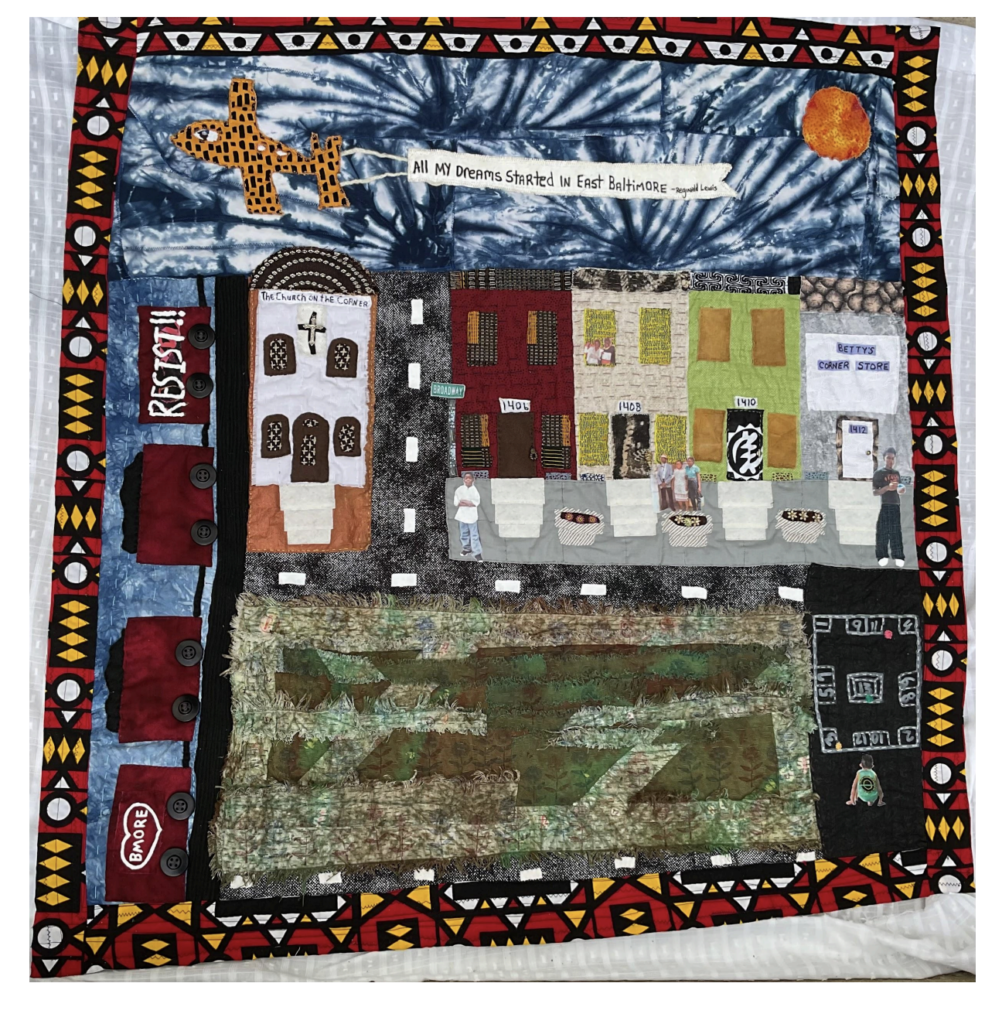 Left to right: Second place, “The Doorway of a Rowhome at Dawn’s Early Light,” by Sharon Coffman. Third place, “All My Dreams Started in East Baltimore,” by Kianga Jinaki. (Images courtesy of Fouts)
Two of the 1981 quilts were also on display at the Current Space exhibition, along with a zine by Abby Wheatley, a junior graphic design major, illustrating the history of the 1981 competition. “It’ll be exciting to see the continuity of themes over the 45 years of the competition,” Fouts says, “and, through the historical side, we can bring to life some of the co-lab’s archival work.” The top three winning quilts in the competition will be displayed in public schools. The Mayor’s Office has committed to continuing the competition in the future.
What began as a 19th-century quilting mystery evolved into a colorful and accessible competition—celebrating a wide range of voices and inviting people to wrap themselves up in Baltimore.
“I was fascinated with the CoLab experience and how the students shared their progress,” says Dietrich. “I love seeing how UMBC has grown. It’s amazing to see it through the eyes of someone who was here when it opened. There are so many different choices for engaged learning.”
Learn more about UMBC’s CoLab experience.
]]>
Originally approached with a quilting mystery that began in 1846, a summer CoLab pulled a group of Retrievers together to examine the evidence. The detective pack expanded their search into robust...
https://umbc.edu/stories/the-charm-pack-solves-the-quilting-case/
Video Preview
https://assets4-my.umbc.edu/system/shared/attachments/e57f813987dc97b32b13477ba388827a/6a956532/news/000/160/727/1f3994eeef613665217c07db797b64d0/eDUQj0rgBGE.jpg?1781650214
https://my3.my.umbc.edu/api/v0/pixel/news/160727/guest@my.umbc.edu/d236276ac477de37194457d75530c451/api/pixel
alumni
american-studies
asianstudies
baltimore-city
cahss
discovery
english
feature
magazine
mfa
public-humanities
spring-2026
story
UMBC News & Magazine
https://my3.my.umbc.edu/groups/umbc-news-magazine
https://assets1-my.umbc.edu/system/shared/avatars/groups/000/001/943/24435aa6207c452e7bc15cc74b42c7bb/xsmall.png?1748556657
https://assets1-my.umbc.edu/system/shared/avatars/groups/000/001/943/24435aa6207c452e7bc15cc74b42c7bb/original.png?1748556657
https://assets2-my.umbc.edu/system/shared/avatars/groups/000/001/943/24435aa6207c452e7bc15cc74b42c7bb/xxlarge.png?1748556657
https://assets2-my.umbc.edu/system/shared/avatars/groups/000/001/943/24435aa6207c452e7bc15cc74b42c7bb/xlarge.png?1748556657
https://assets3-my.umbc.edu/system/shared/avatars/groups/000/001/943/24435aa6207c452e7bc15cc74b42c7bb/large.png?1748556657
https://assets1-my.umbc.edu/system/shared/avatars/groups/000/001/943/24435aa6207c452e7bc15cc74b42c7bb/medium.png?1748556657
https://assets2-my.umbc.edu/system/shared/avatars/groups/000/001/943/24435aa6207c452e7bc15cc74b42c7bb/small.png?1748556657
https://assets1-my.umbc.edu/system/shared/avatars/groups/000/001/943/24435aa6207c452e7bc15cc74b42c7bb/xsmall.png?1748556657
https://assets2-my.umbc.edu/system/shared/avatars/groups/000/001/943/24435aa6207c452e7bc15cc74b42c7bb/xxsmall.png?1748556657
UMBC News & Magazine
0
0
false
Tue, 16 Jun 2026 17:02:13 -0400
Six April arts events not to be missed at UMBC
This academic year, UMBC launched a bold new initiative, Arts+, designed to celebrate our academic excellence in the arts, to elevate the visibility of our arts public programs, and to deepen audience engagement. We marked the 30th anniversary of the Linehan Artist Scholars Program, invited internationally known artists to campus, and have seen a robust increase in audience growth.
As the school year comes to a close, a flurry of events across the disciplines—including dance, music, theatre, and the visual arts—offers delightful opportunities to enjoy the work of guest artists and UMBC students and faculty. We’ve picked out just a few of the many happenings, for you to consider attending.
1. Mary Ellen Mark: Ward 81
Explore an exhibition of photography that’s at once beautiful and disturbing. Mary Ellen Mark: Ward 81, on display at the Albin O. Kuhn Library Gallery through May 22, showcases work by American photographer Mary Ellen Mark and sociologist Karen Folger Jacobs, who spent thirty-six days living in the Oregon State Hospital, where they photographed the residents of Ward 81, the hospital’s all-female, high-security psychiatric unit. Their unprecedented access allowed them to create a deeply nuanced portrayal of women navigating psychiatric care in the mid-1970s. Ward 81 brings together Mark’s photographs, Jacobs’s newly uncovered audio recordings, and rare archival materials, offering an intimate and expanded view of this landmark documentary project.
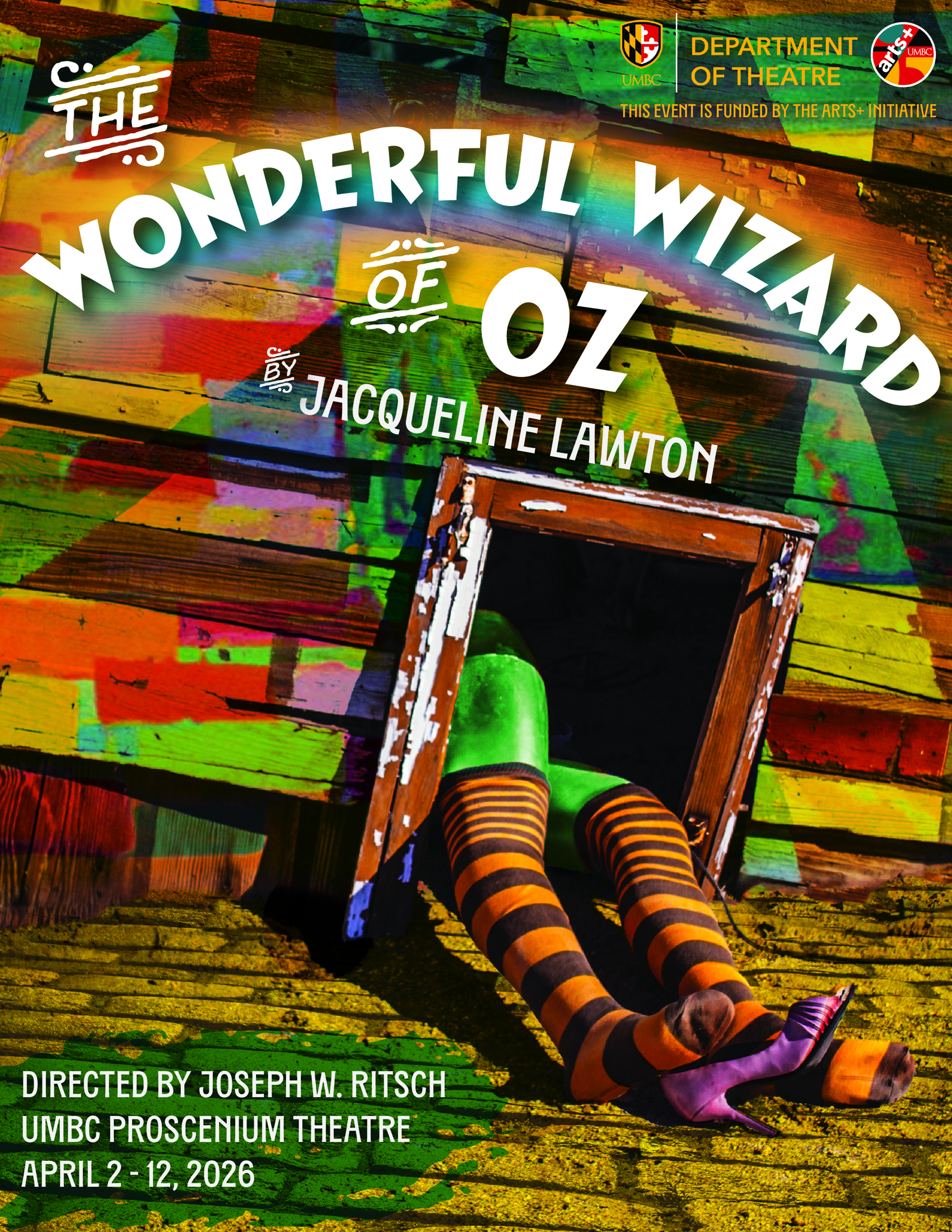
2. The Wonderful Wizard of Oz
Get ready to head down the yellow brick road as UMBC Theatre presents The Wonderful Wizard of Oz, adapted by Jacqueline Lawton and directed by Joseph W. Ritsch. This family friendly production, featuring the work of both students and faculty, will grace the Proscenium Theatre stage from April 2 through 12. And the plot will sound familiar! Life in modern day Baltimore has been a bit boring for Dorothy and her little dog Toto. Until one day, when a cyclone swoops in and takes them “over the rainbow” to the wonderful and magical land of Oz. With the Scarecrow, the Tin Man, and the Cowardly Lion, Dorothy sets off on the adventure of a lifetime down the yellow brick road to the Emerald City. These new friends brave witches, flying monkeys, and a Haunted Forest, all to meet the Wizard of Oz, who promises to make their dreams come true.
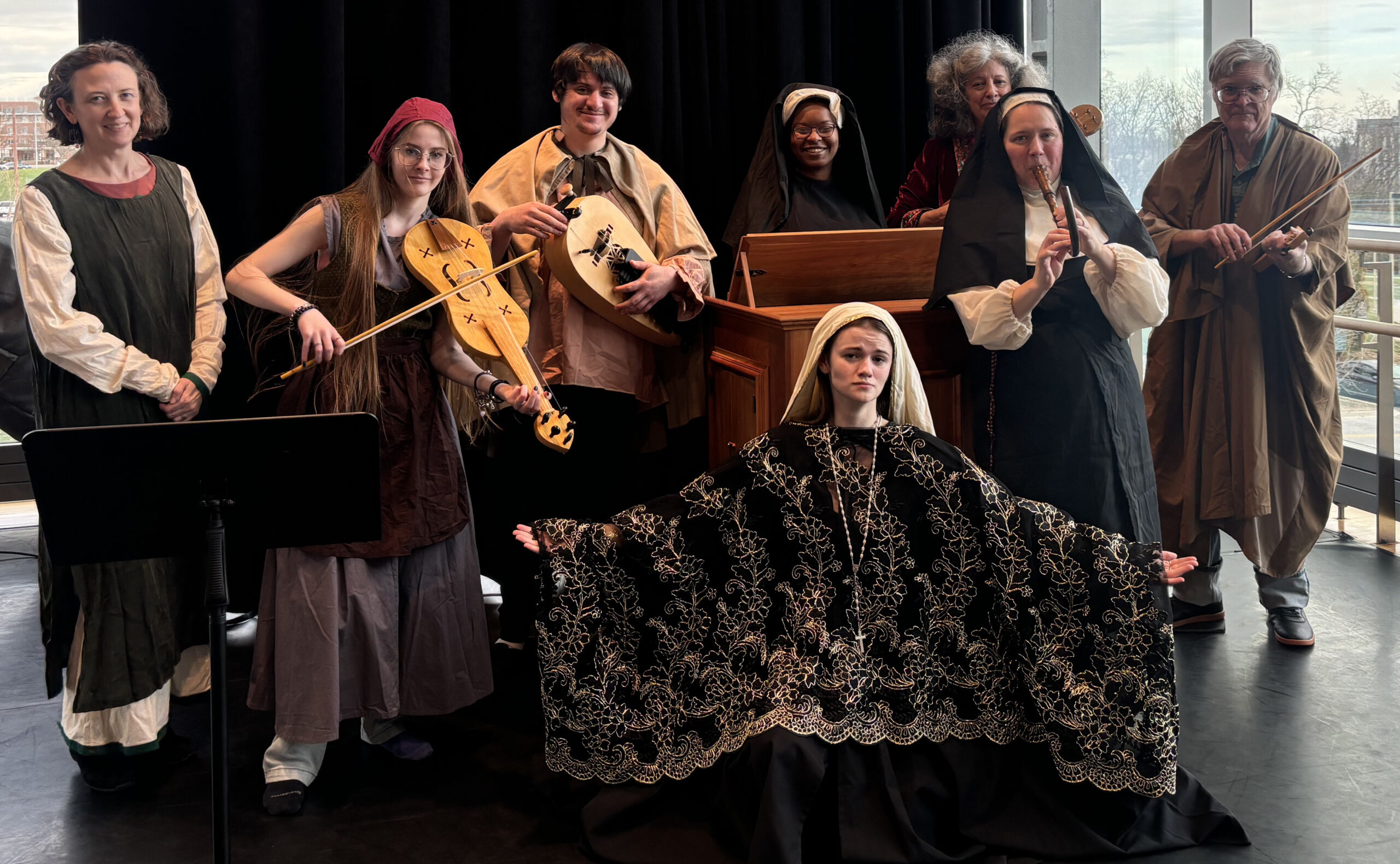
3. Step Back in Time: An Immersive Medieval Banquet
On Saturday, April 11, step back in time—the year 1161, to be precise—to a 12th century banquet that features the best in medieval food (yes, it’s really a banquet), music, and dance. Transport yourself to the Klopp Castle in the Rhine Valley, where you will dine (a three course feast!) in the presence of visionary nun, composer, and artist Hildegard of Bingen and the newly appointed Archbishop of Mainz, Conrad of Wittelsbach. This isn’t just a dinner, though—it’s a living art installation meticulously crafted by the students of an interdisciplinary arts course created just for this event.
4. Inscape Chamber Orchestra
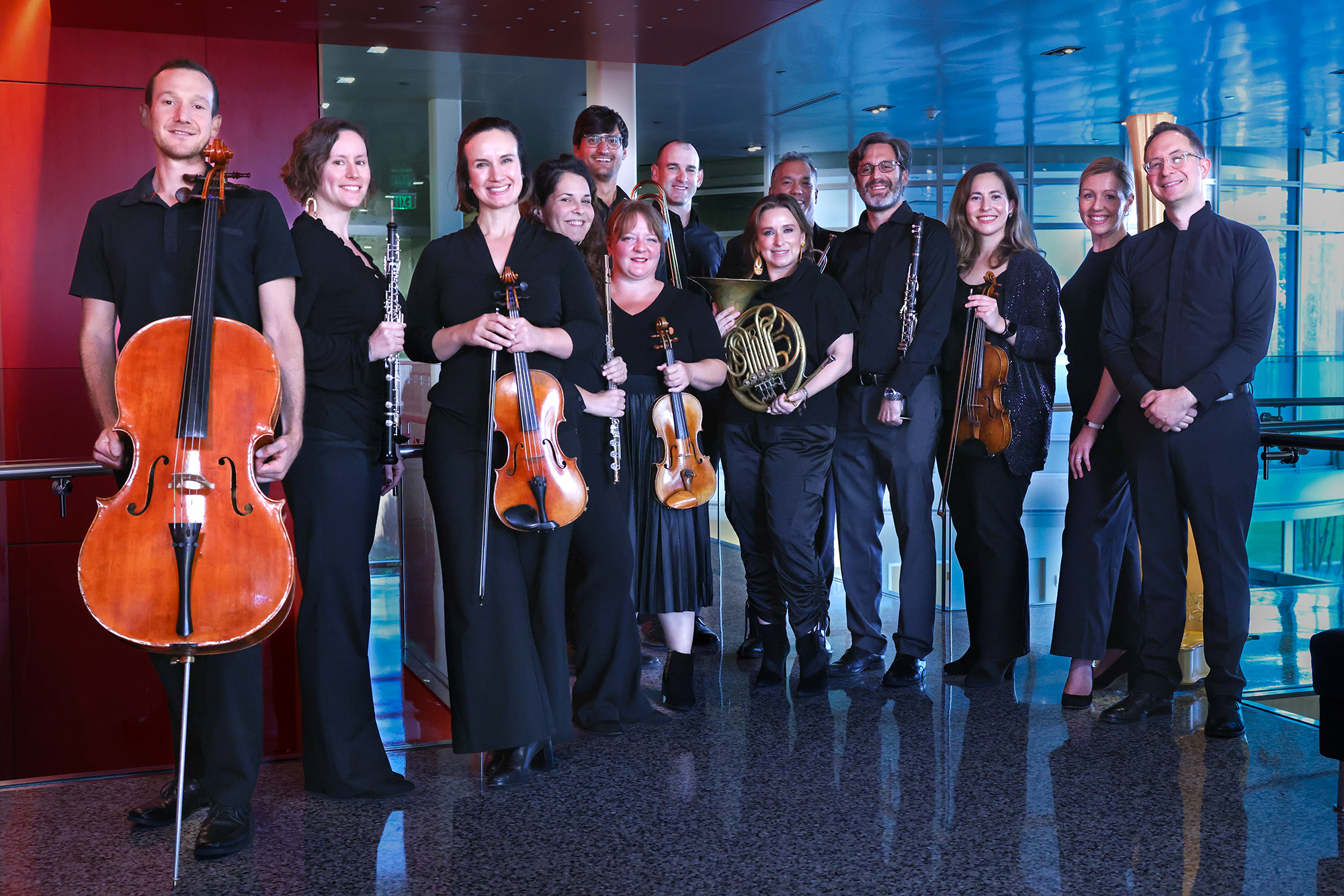
Journey with the acclaimed Inscape Chamber Orchestra on Sunday, April 19, as they explore Aaron Copland’s beloved Appalachian Spring, a masterwork of American music that captures the spare beauty of the frontier spirit and the warmth of community gathering. The program also features Richard Strauss’s Suite from Der Rosenkavalier, and Béla Bártok’s Violin Concerto No. 1, featuring soloist Airi Yoshioka, UMBC professor of music. The Strauss and Bartók are presented in rare chamber orchestra arrangements inspired by Arnold Schoenberg’s visionary Society for Private Musical Performance. In early 20th-century Vienna, Schoenberg’s Society brought monumental orchestral scores into salon-sized venues, revealing intricate details often lost in larger halls and making essential works accessible to new audiences.
5. The Polar Ice Museum
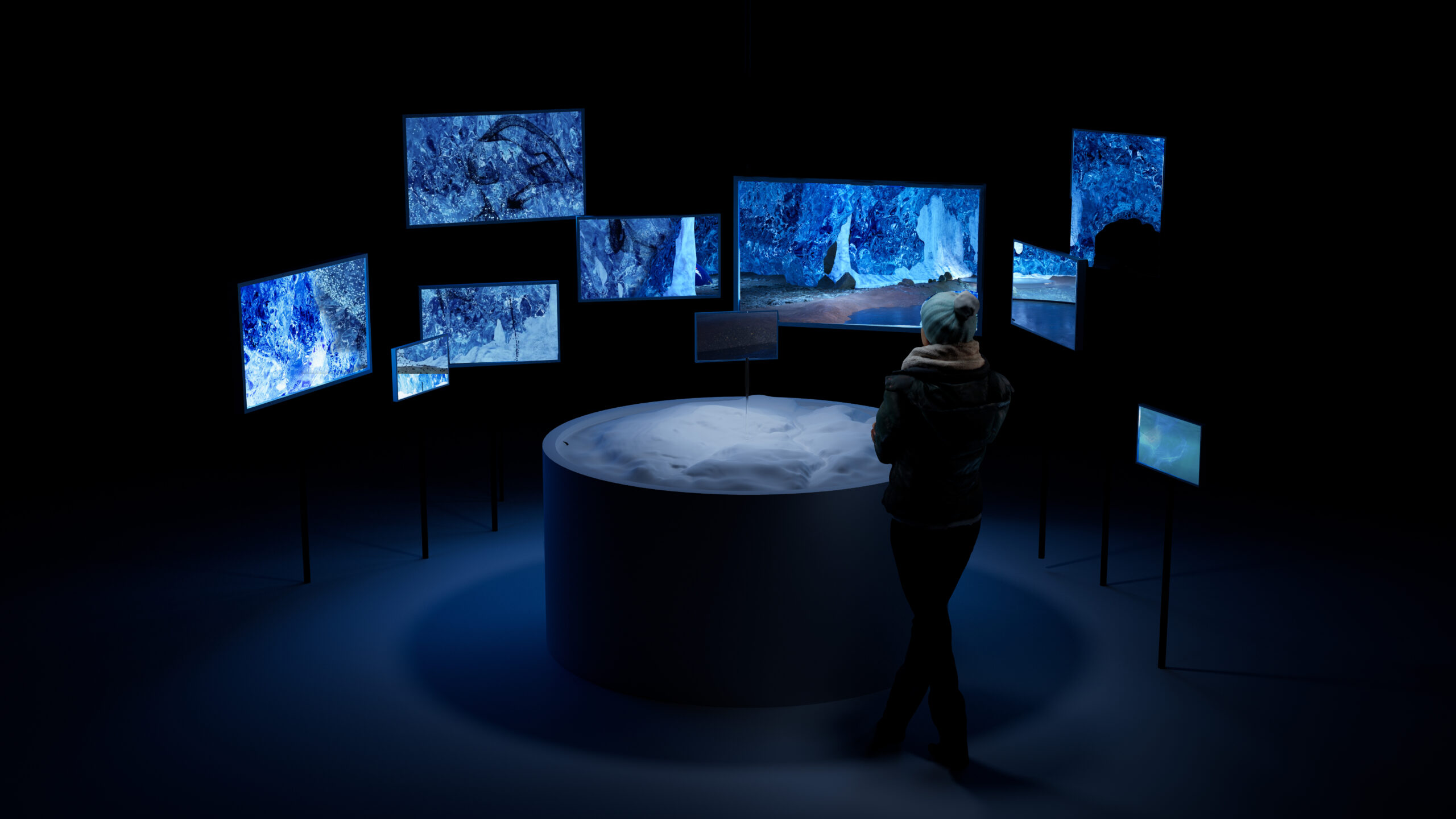
Tucked away in the ITE Building, UMBC’s Imaging Research Center is a hidden gem—but you get a chance to take a deep dive into the IRC on April 30, when the doors open for The Polar Ice Museum, a series of eye-popping artworks and immersive, data-driven installations that transform polar data into meaningful public engagement experiences on sea level, climate, and related environmental issues. With support from the National Science Foundation, the project draws on climate data from NASA and research conducted in Greenland. Visitors encounter a wall of videos depicting an ice cave and are invited to participate by altering visualizations of glaciers and sea-level change, both within the polar ice cave and at a South Baltimore landmark affected by flooding. Water-filled relief sculptures, interactive sound objects, VR climate games, and relevant information will all be on display.
6. Orange Grove Dance: Site / Unseen
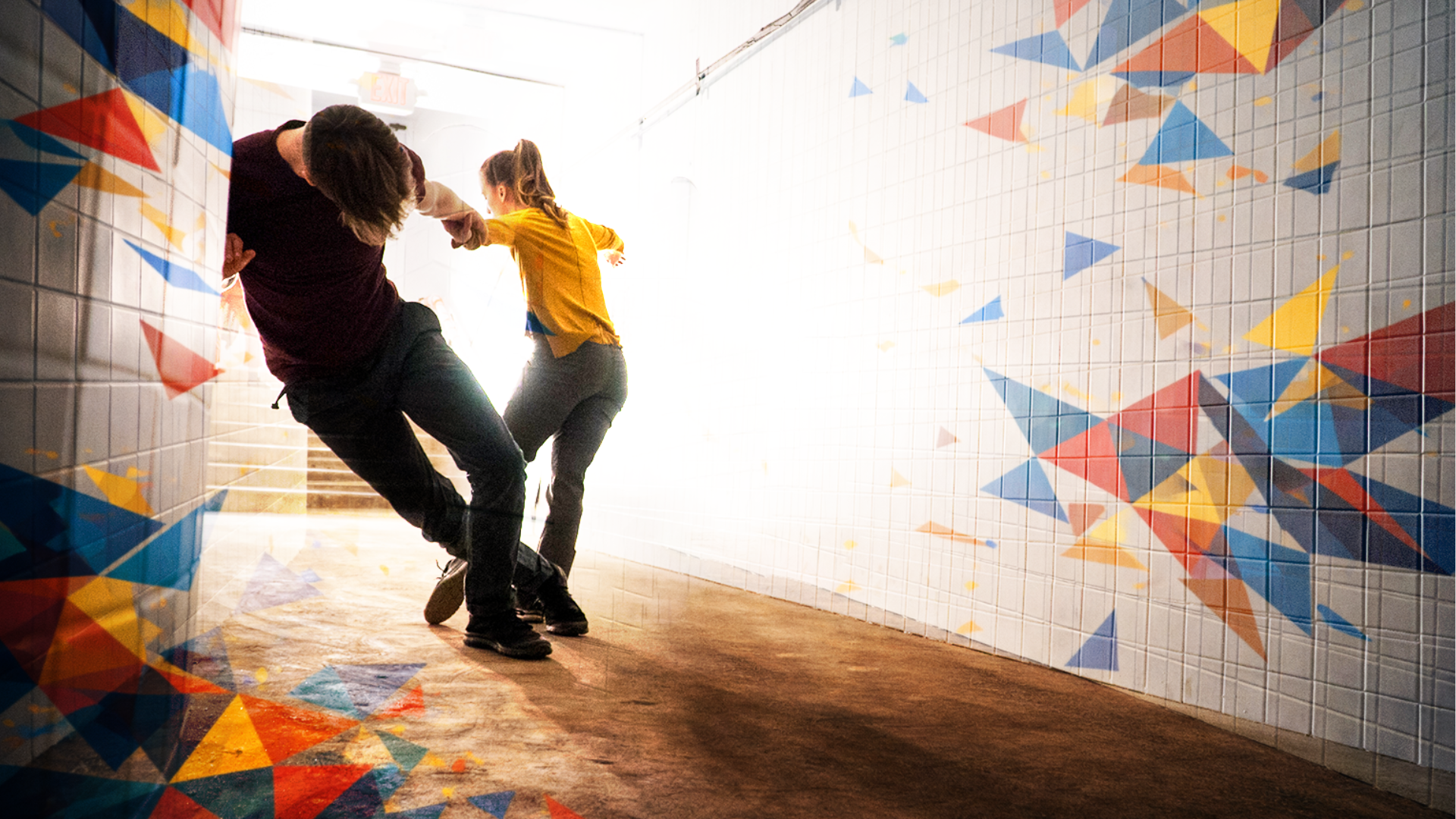
As the weather warms, it’s the perfect time for an outdoor performance. Gather on April 30 – May 2 as guest artists Orange Grove Dance bring 10 performers into dynamic partnership with sidewalks, stairways, and the UMBC amphitheatre. Through shared weight, timing, and physical negotiation, bodies and architecture collide and collaborate, revealing the unseen choreography woven into the spaces we pass through every day. The immersive performance, entitled Site / Unseen, will travel a short distance across campus, beginning at the Performing Arts and Humanities Building and concluding at the Fine Arts Building Amphitheatre.
Even more awaits …
This short list of six events only scratches the surface. Join us for lots of other happenings, ranging from an MFA art exhibition, to the Andrist-Daglar-Falkner chamber music trio, to an exhibition that celebrates the 50th anniversary of Bartleby, UMBC’s undergraduate literary arts publication. All these and more are on UMBC’s Arts and Culture Calendar, where you can also sign up to receive a weekly email that highlights upcoming events.
Top image: Mary Ellen Mark, Laurie in the Bathtub, Ward 81, Oregon State Hospital, Salem, Oregon, USA, 1976. © Mary Ellen Mark, courtesy of The Mary Ellen Mark Foundation.
]]>
This academic year, UMBC launched a bold new initiative, Arts+, designed to celebrate our academic excellence in the arts, to elevate the visibility of our arts public programs, and to deepen...
https://umbc.edu/stories/six-april-arts-events-not-to-be-missed-at-umbc/
https://my3.my.umbc.edu/api/v0/pixel/news/158167/guest@my.umbc.edu/b1b1ba5420afb3afd57cd41226c31586/api/pixel
aok-library-gallery
arts
arts-and-culture
arts-plus
cahss
campus-life
dance
irc
music
story
theatre
visual-arts
UMBC News & Magazine
https://my3.my.umbc.edu/groups/umbc-news-magazine
https://assets1-my.umbc.edu/system/shared/avatars/groups/000/001/943/24435aa6207c452e7bc15cc74b42c7bb/xsmall.png?1748556657
https://assets1-my.umbc.edu/system/shared/avatars/groups/000/001/943/24435aa6207c452e7bc15cc74b42c7bb/original.png?1748556657
https://assets2-my.umbc.edu/system/shared/avatars/groups/000/001/943/24435aa6207c452e7bc15cc74b42c7bb/xxlarge.png?1748556657
https://assets2-my.umbc.edu/system/shared/avatars/groups/000/001/943/24435aa6207c452e7bc15cc74b42c7bb/xlarge.png?1748556657
https://assets3-my.umbc.edu/system/shared/avatars/groups/000/001/943/24435aa6207c452e7bc15cc74b42c7bb/large.png?1748556657
https://assets1-my.umbc.edu/system/shared/avatars/groups/000/001/943/24435aa6207c452e7bc15cc74b42c7bb/medium.png?1748556657
https://assets2-my.umbc.edu/system/shared/avatars/groups/000/001/943/24435aa6207c452e7bc15cc74b42c7bb/small.png?1748556657
https://assets1-my.umbc.edu/system/shared/avatars/groups/000/001/943/24435aa6207c452e7bc15cc74b42c7bb/xsmall.png?1748556657
https://assets2-my.umbc.edu/system/shared/avatars/groups/000/001/943/24435aa6207c452e7bc15cc74b42c7bb/xxsmall.png?1748556657
UMBC News & Magazine
0
0
false
Thu, 02 Apr 2026 12:19:24 -0400
Thu, 02 Apr 2026 12:19:24 -0400