Conserve and Protect – Lekelia “Kiki” Jenkins ’97, BioSci

As a child, Lekelia “Kiki” Jenkins ’97, biological sciences, could often be found on a fishing pier on the Chesapeake Bay, dangling a line for fish or chicken-necking for blue crabs with her family.
Today, you’re more apt to find her on a commercial fishing boat in Ecuador as she researches how fishermen can keep from catching protected species such as sea turtles.
It’s a race against time as Jenkins works with fishermen and government regulators to adopt new technologies out on the water. It can take 15 years or longer to come up with a new device to keep sea turtles from being snared by hooks or to prevent dolphins from getting tangled in nets.
“When you’re looking at some of the forecasts of when animals are going to go extinct – like leatherback turtles, which could be a decade before they’re extinct in the Pacific Ocean – then 15 years is too long of a time frame,” said Jenkins, who is now an assistant professor at the University of Washington in Seattle.
Jenkins focuses not only on the mechanics of the devices she’s helping to streamline – called bycatch reduction devices – but also the factors that lead commercial fishermen to adopt them or reject them. In particular, she’s been evaluating barriers that might prevent fishermen in other countries from using the devices that American regulators are pushing.
She blends a touch of the social sciences into biology, understanding not just how the animals behave with the devices, but how the people who use them behave, too.
“It’s really about the people, and the people are having an impact on the environment,” Jenkins said. “What’s going to effect change really starts with humans and why they do what they do, and where there are opportunities to improve that.”
Jenkins also studies how commercial fishermen might switch their fishing gear to different types that are less lethal to protected species – from nets, say, to baited fishing lines. She is also working on recounting historic fishing harvests to better understand how humans have influenced marine life.
Jenkins’ research often takes her out on the water, working alongside commercial fishermen.
“Fishermen are wonderful. They like me, so I’m lucky,” Jenkins says with a laugh. “They are really sweet, very open. They take their time to share.”
Jenkins’ career path was shaped by her mentors at UMBC. A former junior zookeeper at what is now the Maryland Zoo in Baltimore, Jenkins initially considered studying veterinary medicine and endocrinology, so she could work in captive breeding.
But it was in the late UMBC professor of biological sciences Carl Weber’s ecology class that she found her calling.
“I was reading through the textbook, a chapter we weren’t assigned on conservation ecology, and I thought, ‘This is it! This is what I want to do,’” Jenkins recalls.
In addition to Weber, Jenkins credits other UMBC faculty, including associate professor of geography and environmental systems Sandy Parker, senior lecturer in chemistry Mark Perks, and former associate vice provost Teresa Viancour (who let Jenkins into the lab at night to observe electric fish) with helping her understand where her biology training at UMBC could take her.
Jenkins also found a “wonderful oasis” in UMBC’s dance department, where she earned a minor and found a creative outlet in an interest she continues today. In fact, after Jenkins earned her Ph.D. in marine conservation at Duke University in 2006, she choreographed a dance about her dissertation on sea turtles. It won second place in a dance competition sponsored by the American Association for the Advancement of Science.
Jenkins says the arts and science can mesh better than many might think. In fact, art can be used to communicate science to non-scientists.
“What I tell people all the time is that, especially when it comes to the environment, people’s interest in environmental issues are triggered by all sorts of things,” she said. That could be experiences in nature, photography, poetry or literature. It makes sense, she said, to communicate science through those same channels.
“If we as scientists want to deliver information back to stakeholders and people who care about the environment, doing scientific papers is insufficient,” she said.
Jenkins practices what she preaches, writing general-interest articles alongside each of her academic papers. In 2011, for example, she blogged about a research trip to Ecuador for the New York Times.
Jenkins hopes her work – whether with regulators, fishermen or regular folks – can help save vulnerable species.
“I want to make a difference. I want to have a lasting conservation impact,” Jenkins said. “When I did my dissertation, I said to my advisor: ‘I want to do work that someone’s going to use. It’s not going to sit on a shelf.’”
— Pamela Wood
]]>
As a child, Lekelia “Kiki” Jenkins ’97, biological sciences, could often be found on a fishing pier on the Chesapeake Bay, dangling a line for fish or chicken-necking for blue crabs with her...
https://umbc.edu/stories/conserve-and-protect-lekelia-kiki-jenkins-97-biosci/
https://my3.my.umbc.edu/api/v0/pixel/news/123730/guest@my.umbc.edu/cc0c993dad75aee302576feb80de62dd/api/pixel
alumni
fall-2012
UMBC News & Magazine
https://my3.my.umbc.edu/groups/umbc-news-magazine
https://assets1-my.umbc.edu/system/shared/avatars/groups/000/001/943/24435aa6207c452e7bc15cc74b42c7bb/xsmall.png?1748556657
https://assets1-my.umbc.edu/system/shared/avatars/groups/000/001/943/24435aa6207c452e7bc15cc74b42c7bb/original.png?1748556657
https://assets2-my.umbc.edu/system/shared/avatars/groups/000/001/943/24435aa6207c452e7bc15cc74b42c7bb/xxlarge.png?1748556657
https://assets2-my.umbc.edu/system/shared/avatars/groups/000/001/943/24435aa6207c452e7bc15cc74b42c7bb/xlarge.png?1748556657
https://assets3-my.umbc.edu/system/shared/avatars/groups/000/001/943/24435aa6207c452e7bc15cc74b42c7bb/large.png?1748556657
https://assets1-my.umbc.edu/system/shared/avatars/groups/000/001/943/24435aa6207c452e7bc15cc74b42c7bb/medium.png?1748556657
https://assets2-my.umbc.edu/system/shared/avatars/groups/000/001/943/24435aa6207c452e7bc15cc74b42c7bb/small.png?1748556657
https://assets1-my.umbc.edu/system/shared/avatars/groups/000/001/943/24435aa6207c452e7bc15cc74b42c7bb/xsmall.png?1748556657
https://assets2-my.umbc.edu/system/shared/avatars/groups/000/001/943/24435aa6207c452e7bc15cc74b42c7bb/xxsmall.png?1748556657
UMBC News & Magazine
0
0
false
Sat, 06 Oct 2012 21:16:15 -0400
At Play – Fall 2012

PUZZLE POWER
Marie desJardins, a professor of computer science at UMBC, specializes in research on artificial intelligence. But at the 2012 American Crossword Puzzle Tournament in March, her research became downright competitive when desJardins crossed pencils with a crossword-solving computer program.
The progam, dubbed “Dr. Fill,” was going up against one of the best crossword puzzle solvers in the country. DesJardins is the top-ranked female solver in the Mid-Atlantic region and she is the 44th best solver in the country. (Dr. Fill finished the same tournament in 141st place.)
“I didn’t realize I could be this good at crossword puzzles,” says desJardins. She adds that her development as a crossword competitor also highlights the hurdles to bringing more women into the sciences.
“A lot of girls think that they must not be intrinsically good at ‘that stuff,’” argues desJardins, who adds that the biggest impediments are “the psychological blocks we put up for ourselves.”
DesJardins has been closely involved in programs at UMBC to remove those blocks, including the Center for Women and Information Technology (CWIT). She also works with the Multi-Agent Planning and Learning Lab (MAPLE), which she founded in 2003 to facilitate student research in artificial intelligence.
DesJardins has her eye on next year’s tournament – if she can reconcile it with an academic conference scheduled for the same weekend. “I might go to that conference,” she says. “But I’ll have to leave early to go to the tournament.”
— Andrew Holter ’12
NOT CAMERA SHY

Even on a campus as welcoming as UMBC, some incoming freshmen and transfer students find that orientation makes them nervous. There’s the stress of course selection and presentations on campus life, but also the question that comes with joining any new community: Will I make new friends?
This year’s contingent of UMBC Orientation Peer Advisors (OPA) decided to break the ice with a bit of video comedy, powered with the Mika song “Love Today” as a soundtrack. This year’s advisors are caught in a range of fun and goofy activities: playing video games, dancing, tossing a football, chasing ducks, bumping into things, and that perennial undergraduate favorite: sleeping.
Christina Animashaun ’13, who studies media communications and photography, teamed up with Jason Palumbo ’13, a graphic design major, to make the video in a single day. Palumbo was behind the camera, and Animashaun coordinated the sequences. Spontaneity was a key to the feel of the video: “It was very much talking out the storyboards,” says Animashaun, “as opposed to having it all set and ready to go.”
An introductory video made by the Orientation Peer Advisors has become a staple through the years, but the 2012 video duo wanted to get this year’s orientation started with a jolt of humor and movement.
“On the morning [of orientation], people are rolling up at 8 or 8:30 a.m,” says Animashaun. “They’re hyped up on coffee, and then you [show the video]. It’s like, ‘Hey, we’re real people. We’re real students…” Palumbo finishes the thought: “…and we also like to dance.”
Watch the video here.
— Nathan Glover ’12
SPURS OF THE MOMENT

North London’s Tottenham Hotspur Football Club (often called “Spurs” for short) is one of the world’s great soccer teams, having recently played in the UEFA Champions League and finishing fourth in the English Premier League last season. Clad in iconic white and dark blue uniforms adorned with a cockerel, Spurs are known for playing an attractive, free-flowing and attacking football.
For one sweltering day in late July, however, Spurs found a home on UMBC’s campus, which they used as a training facility before a July 28 friendly match at Baltimore’s M&T Stadium against Liverpool Football Club –another one of England’s biggest and most iconic teams.
Tottenham stars including Gareth Bale, Aaron Lennon, and longtime U.S. men’s national team goalkeeper Brad Friedel got in a morning training session on UMBC’s soccer field under the watchful eye of new Spurs coach Andres Villas Boas. Spurs players then adjourned for lunch at the True Grits dining hall.
Later that day, young Maryland soccer players sampled how Tottenham coaches players in its own football academy at an afternoon clinic led by Spurs’ head of football development Mark Jones.
“We plan for everyone to get 2,000 or so touches of the ball this afternoon,” Jones told the players and their parents before putting them through an afternoon of coaching and drills.
It is the second time in four years that world soccer powers have used UMBC’s state-of-the-art facilities on visits to the region. In 2009, English and Italian soccer powers Chelsea and AC Milan trained at UMBC before a friendly match.
— Richard Byrne ’86
THE RINGS THING

Every four years, the Olympic Games give athletes a chance to chase their dreams and compete at the highest level.
For UMBC swimmers Mohamed Hussein ’13 (Egypt), Patrick Husson ’14 (USA) and Pierre De Waal ’13 (South Africa), those dreams almost became reality. Husson and De Waal competed in the Olympic Trials of their respective home countries but fell short of earning a trip to London.
Hussein did his teammates one better – qualifying for Egypt’s team in the 100-meter freestyle and the 200-meter individual medley. But his trip to London was cut short by FINA, the international governing body of swimming, which abruptly changed the qualifying times required to make the Olympics. Hussein’s times fell just short.
“[In] all the past Olympic games, FINA allowed more than 1,200 swimmers to participate in the competition,” Hussein observes.
Despite the disappointment, Hussein remains one of the best swimmers in his native Egypt as well as at UMBC, and calls 2012 “the best year in my swimming career.”
De Waal had to return to South Africa to compete in the Olympic Trials during the spring semester. After a day and a half of travel from Baltimore to Durban, De Waal took to the pool for his best event, the 200-meter butterfly, where he fell to fellow countryman Chad le Clos, who went on to win gold in the Olympics over U.S. Olympic swimming star Michael Phelps.
Former walk-on Patrick Husson also swam in the Olympic Trials in his best event, the 200-meter breaststroke, finishing 99th out of 132 competitors.
“The three of them have all raised the level of our competition and our team,” UMBC swim coach Chad Cradock ’97 says.
— Dan Levin ’13
]]>
PUZZLE POWER Marie desJardins, a professor of computer science at UMBC, specializes in research on artificial intelligence. But at the 2012 American Crossword Puzzle Tournament in March, her...
https://umbc.edu/stories/at-play-fall-2012/
https://my3.my.umbc.edu/api/v0/pixel/news/123731/guest@my.umbc.edu/ccbf2223861605ba4fae3cadcccad43c/api/pixel
campus-life
fall-2012
UMBC News & Magazine
https://my3.my.umbc.edu/groups/umbc-news-magazine
https://assets1-my.umbc.edu/system/shared/avatars/groups/000/001/943/24435aa6207c452e7bc15cc74b42c7bb/xsmall.png?1748556657
https://assets1-my.umbc.edu/system/shared/avatars/groups/000/001/943/24435aa6207c452e7bc15cc74b42c7bb/original.png?1748556657
https://assets2-my.umbc.edu/system/shared/avatars/groups/000/001/943/24435aa6207c452e7bc15cc74b42c7bb/xxlarge.png?1748556657
https://assets2-my.umbc.edu/system/shared/avatars/groups/000/001/943/24435aa6207c452e7bc15cc74b42c7bb/xlarge.png?1748556657
https://assets3-my.umbc.edu/system/shared/avatars/groups/000/001/943/24435aa6207c452e7bc15cc74b42c7bb/large.png?1748556657
https://assets1-my.umbc.edu/system/shared/avatars/groups/000/001/943/24435aa6207c452e7bc15cc74b42c7bb/medium.png?1748556657
https://assets2-my.umbc.edu/system/shared/avatars/groups/000/001/943/24435aa6207c452e7bc15cc74b42c7bb/small.png?1748556657
https://assets1-my.umbc.edu/system/shared/avatars/groups/000/001/943/24435aa6207c452e7bc15cc74b42c7bb/xsmall.png?1748556657
https://assets2-my.umbc.edu/system/shared/avatars/groups/000/001/943/24435aa6207c452e7bc15cc74b42c7bb/xxsmall.png?1748556657
UMBC News & Magazine
0
0
false
Sat, 06 Oct 2012 21:14:11 -0400
UMBC Brings Entrepreneurship to the Classroom
UMBC is known for innovation in education. Now, a couple of faculty members are taking that one step further and are teaching students to become entrepreneurs.
Baltimore Business Journal reporter, Sarah Gantz wrote about the class in the October 5, issue.
Gantz writes, “Two faculty members are developing a course for the school that would establish partnerships with businesses and nonprofit organizations to bring real-life problems to the classroom for students to solve by developing a product or service. William LaCourse, dean of UMBC’s College of Natural and Mathematical Sciences; and Gib Mason, co-founder of wraparound-earmuff company 180s Inc.”
She writes that, “The faculty members say the course is meant to offer students a hands-on experience with business implications beyond their grade point average, provide students who lack internship experience an opportunity to interact with businesses and establish a relationship with the business community that could lead to future jobs or internships.”
This course is still under development but she writes,
“The course would be modeled after a current class Mason teaches. In that class, students each come up with a product or service — some ideas from this semester include a knife with a safety sheaf, a mobile application that helps students navigate campus and a service to help find lost cellphones. They whittle down those ideas to one and spend the remainder of the semester working together to bring the product to market.”
Students love the course and Gantz reports that, Josh Massey, a 32 year old junior in the class says that, “Gib has a way of teaching you how to think, not what to think.”
So how does it end? “Mason said the course, which is not offered every semester, has developed a waiting list. Businesses may also be lining up to get in the future class.”
]]>
UMBC is known for innovation in education. Now, a couple of faculty members are taking that one step further and are teaching students to become entrepreneurs. Baltimore Business Journal...
https://umbc.edu/stories/umbc-brings-entrepreneurship-to-the-classroom/
https://my3.my.umbc.edu/api/v0/pixel/news/123732/guest@my.umbc.edu/f399053d21adc7afb3d78e1b281cb5f5/api/pixel
cnms
science-and-technology
UMBC News & Magazine
https://my3.my.umbc.edu/groups/umbc-news-magazine
https://assets1-my.umbc.edu/system/shared/avatars/groups/000/001/943/24435aa6207c452e7bc15cc74b42c7bb/xsmall.png?1748556657
https://assets1-my.umbc.edu/system/shared/avatars/groups/000/001/943/24435aa6207c452e7bc15cc74b42c7bb/original.png?1748556657
https://assets2-my.umbc.edu/system/shared/avatars/groups/000/001/943/24435aa6207c452e7bc15cc74b42c7bb/xxlarge.png?1748556657
https://assets2-my.umbc.edu/system/shared/avatars/groups/000/001/943/24435aa6207c452e7bc15cc74b42c7bb/xlarge.png?1748556657
https://assets3-my.umbc.edu/system/shared/avatars/groups/000/001/943/24435aa6207c452e7bc15cc74b42c7bb/large.png?1748556657
https://assets1-my.umbc.edu/system/shared/avatars/groups/000/001/943/24435aa6207c452e7bc15cc74b42c7bb/medium.png?1748556657
https://assets2-my.umbc.edu/system/shared/avatars/groups/000/001/943/24435aa6207c452e7bc15cc74b42c7bb/small.png?1748556657
https://assets1-my.umbc.edu/system/shared/avatars/groups/000/001/943/24435aa6207c452e7bc15cc74b42c7bb/xsmall.png?1748556657
https://assets2-my.umbc.edu/system/shared/avatars/groups/000/001/943/24435aa6207c452e7bc15cc74b42c7bb/xxsmall.png?1748556657
UMBC News & Magazine
0
0
false
Fri, 05 Oct 2012 19:59:25 -0400
Alumni Essay – Battles Can Build Bridges
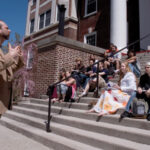
Proposition: The natural sciences will forever be at odds with the humanities and social sciences. Steven Gimbel ’90, philosophy and physics, argues in the negative. As chair of the philosophy department at Gettysburg College and the author of works such as Einstein’s Jewish Science: Physics at the Intersection of Politics and Religion, Gimbel has made his career finding useful and provocative intersections between the sciences and the humanities and social sciences.
* * * * *
There are days in college that leave an indelible trace on your mind. I will never forget sitting in professor (and now professor emeritus of physics) Robert L. Rasera’s solid state physics class about two weeks from the end of the semester, when Jon Lau ’90, physics (who busted every curve), asked for clarification about the topic being discussed.
I recall that Rasera paused, and then said three little words: “We don’t know.” Not “I don’t know,” but “We don’t know.” And as he sketched out competing views, everything changed for me.
As a double major in physics and philosophy, I was used to discussing disagreements between philosophers – that’s just what philosophers do. But science had always been beautifully clean. Every problem had an elegant solution. All equations had seamless derivations. Problems were solved exactly.
That moment in Rasera’s class showed me that science was also a process involving people arguing with each other. It was the real physics, the messy physics, the human physics. I had found the philosophy in the science – and I have stayed there ever since.
As a philosopher of science, students often tell me: “This philosophy stuff is interesting, but I believe in science.” Their mistaken view is something one could easily infer from the way we do things. We create departments of physics, chemistry, and biology, and then locate them in buildings away from history, sociology, and political science. Much of what we do at universities can entrench the idea that these divisions are absolute. Natural sciences go in one box, pack the humanities in a different one, and leave the arts and social sciences to their own.
But it just isn’t so. There’s no competition here, and no need to choose sides. Indeed, these seemingly disparate disciplines are complementary, working together to create multifaceted minds that appreciate the full breadth of the world and derive insight and wisdom from it.
Sociologists like Robert K. Merton, historians like I.B. Cohen, and philosophers like Thomas Kuhn looked at scientific communities and the reasoning of individual scientists in order to embed discoveries in historical and cultural contexts. If we want to understand not only how the science works, but where it came from and why it appeared when it did, then we need to blend our disciplines across borders.
This is what I do in my latest book Einstein’s Jewish Science. The title comes from a phrase used by the Nazis to denigrate the theory of relativity. Like so much that came from Hitler and his minions, we now dismiss it as absurd propaganda. But look closely at the history of our sciences, and you’ll realize how inextricably intertwined they are with the politics, ideas, and religious beliefs of their day.
But interdisciplinarity isn’t merely a retrospective exercise. It is essential to developing the minds of scientists who will move us forward. During the last week of my first semester of quantum mechanics at UMBC, I remember professor of physics Ivan Kramer discussing the interpretation of the equations we had been studying. The theory itself, Kramer argued, was “a bunch of squiggles.” But then he asked what those squiggles meant.
Again, I found philosophy in my physics class. Because looking for meaning, after all, is what a philosopher does. Some of the squiggles represented mass or length – things that can be measured. Others were mathematical symbols, like an equal sign, that form the grammar of mathematical language. And there were more squiggles standing for potential field values, curvature tensors, and other weird things that we can’t see. If the theory is true, how do we make sense of these? What does the theory mean? What does the universe really look like if this theory describes how it works? The equation doesn’t answer these questions. Philosophy does.
This meditation leads us to two important elements of interdisciplinarity. First, what theory tells us about the world may compel us to completely change how we understand ourselves and our universe. Moving from a geocentric to a heliocentric view of the solar system did not change an inconsequential technical parameter. The earth was removed from the center of Creation. There were other planets just like ours, and other suns just like ours. This required a full reworking of our relation to the universe.
Scientific advancement and new technologies lead to yet another place where the sciences and humanities collide and collaborate. New discoveries force increasingly complex ethical issues onto the cultural stage. Technology gives us new tools and science gives us the know-how to use them in unforeseen ways. But the questions of meaning are urgent: Should we use them in those ways, or indeed at all?
Again, consider Einstein, who saw the horrors of the two world wars in which science and technology helped create mass death. Knowing that the great German physicist Werner Heisenberg had been enlisted by the Nazis to create an atomic weapon, Einstein and fellow physicist Leo Szillard wrote to warn President Franklin Delano Roosevelt. That letter helped create the Manhattan Project, which also led to the nuclear arsenals that shaped the Cold War and now stoke our greatest fears concerning terrorist organizations. Einstein later said: “I could burn my fingers that I wrote that letter.” Science yields knowledge, but that knowledge also forces weighty and complex moral decisions upon us.
We are faced with new and daunting ethical challenges each day because of the progress of science and the technology derived from it. That will not – and should not – change. But it does require us to shed the old way of thinking of knowledge in boxes. We must cross boundaries, weaving together the natural sciences, the social sciences and the humanities. This is what education for a new age needs. It is what I received – and what students still receive – at UMBC.
]]>
Proposition: The natural sciences will forever be at odds with the humanities and social sciences. Steven Gimbel ’90, philosophy and physics, argues in the negative. As chair of the philosophy...
https://umbc.edu/stories/alumni-essay-battles-can-build-bridges/
https://my3.my.umbc.edu/api/v0/pixel/news/123733/guest@my.umbc.edu/6347261d62db3a2beb29991ce47fe96b/api/pixel
fall-2012
perspectives
UMBC News & Magazine
https://my3.my.umbc.edu/groups/umbc-news-magazine
https://assets1-my.umbc.edu/system/shared/avatars/groups/000/001/943/24435aa6207c452e7bc15cc74b42c7bb/xsmall.png?1748556657
https://assets1-my.umbc.edu/system/shared/avatars/groups/000/001/943/24435aa6207c452e7bc15cc74b42c7bb/original.png?1748556657
https://assets2-my.umbc.edu/system/shared/avatars/groups/000/001/943/24435aa6207c452e7bc15cc74b42c7bb/xxlarge.png?1748556657
https://assets2-my.umbc.edu/system/shared/avatars/groups/000/001/943/24435aa6207c452e7bc15cc74b42c7bb/xlarge.png?1748556657
https://assets3-my.umbc.edu/system/shared/avatars/groups/000/001/943/24435aa6207c452e7bc15cc74b42c7bb/large.png?1748556657
https://assets1-my.umbc.edu/system/shared/avatars/groups/000/001/943/24435aa6207c452e7bc15cc74b42c7bb/medium.png?1748556657
https://assets2-my.umbc.edu/system/shared/avatars/groups/000/001/943/24435aa6207c452e7bc15cc74b42c7bb/small.png?1748556657
https://assets1-my.umbc.edu/system/shared/avatars/groups/000/001/943/24435aa6207c452e7bc15cc74b42c7bb/xsmall.png?1748556657
https://assets2-my.umbc.edu/system/shared/avatars/groups/000/001/943/24435aa6207c452e7bc15cc74b42c7bb/xxsmall.png?1748556657
UMBC News & Magazine
0
0
false
Fri, 05 Oct 2012 19:38:36 -0400
Gray New World

Students in the Erickson School’s Project 2061 class have high expectations for technology and its power to meet human needs. Working across disciplines, they’ve created new possibilities for the future of senior care.
By Dinah Winnick
Photos: Marlayna Demond ’11. CAD images: Michael Mower ’12

Ashley Johnson ’12, MAgS (left), helped her team imagine the needs of “Ashley,” a 111-year-old former psychologist who loves to garden but struggles with dementia, diabetes and hearing loss. Abdulla Aljneibi ’12, mechanical engineering (right), inspired his classmates to design for “Abdulla,” an imagined 90-year-old man determined to live independently despite impairments from a stroke.
It’s hard to imagine ourselves five years into the future, let alone 50. But one group of UMBC students has confronted this challenge head-on in search of inspiration for new designs to improve the lives of older adults.
Their course, “Project 2061” was spearheaded by the Erickson School, UMBC’s newest college. Founded in 2004, the school offers undergraduate and graduate curricula that combine the studies of aging, public policy and management.
The Erickson School created Project 2061 after being invited to showcase UMBC student research at a conference on the future of aging. The project quickly attracted faculty and students from engineering, information systems, design, management of aging services (MAgS) and interdisciplinary studies (INDS) to collaboratively develop new technologies for older adults living in the year 2061.
As it turns out, the endeavor’s success hinged on something simple and personal: students’ reflections on their own imagined future needs and desires. The class created three avatars based on students’ life experiences – “Abdulla,” “Ashley,” and “Spencer” – to help them explore both the problems aging can bring and how design can meet those challenges.
“Abdulla,” for instance, was based on Project 2061 participant Abdulla Aljneibi ’12, mechanical engineering. His avatar is 90 years old and recovering from a stroke that has left him struggling with memory, speech and motor impairments. Yet he is determined to live independently and enjoy activities such as cooking, daily prayer and going to the theater.
For Judah Ronch, dean of the Erickson School, creating personas like “Abdulla” proved the key to making Project 2061 click.
“This is always the challenge in teaching about aging,” says Ronch, “Until you make it about us it’s very removed. If it’s always about them, it’s highly abstract, it’s not very real, and there is not a sense of urgency about it because [typical students] are 25 or 20 and we’re talking about 60 years down the road.”
Everything changes, Ronch observes, “once you start talking about yourself and [asking], ‘How will this affect me?’”
BUILDING A TEAM

Assistant professors Amy Hurst and Catherine Neylan explore data visualization with Meyerhoff Scholar Jasmine Jones ’12, computer science and interdisciplinary studies (left to right).
In May 2011, LeadingAge — a research and advocacy group focused on the lives of older adults — asked the Erickson School to create an exhibit on the future of aging.
LeadingAge planned a celebration of its 50th anniversary in October 2011 with a conference that would bring 8,000 participants to Washington, D.C. The group wanted to highlight dramatic changes in senior living from 1961 to the present, and also articulate a bold vision for the next 50 years.
Ronch says the exhibit “was an opportunity we couldn’t pass up.” So he recruited faculty and students from across UMBC to create the school’s presentation as part of a new, boundary-breaking course in the Erickson School.
To teach the class, Ronch enlisted Tim Topoleski, a professor of mechanical engineering who studies mobility and the mechanics of joint replacements. Catherine Neylan, assistant professor of design, and Amy Hurst, assistant professor of information systems, followed, attracted to the course by their shared interest in design for people with disabilities.
These faculty recruited students from a range of majors. Neylan observes that technology and social problems are now so complex that “we need collective intelligence to build the things that we build.”
Eventually, 19 UMBC students joined the effort. Early in the process, MAgS major Joe Yoon proposed that the class should create specific design personas based on students in the course and then craft flexible technologies to meet those avatars’ specific needs. His idea was a game-changer.
“In all of our scenarios of how this would be used,” recalls Hurst, “we never said, ‘How would grandma use this?’ We said, ‘How would I use it in 50 years.’ I think that fundamentally changed a lot of the designs [and] helped the students be more creative and engaged.”
Yoon’s proposal also forced students to ponder uncomfortable possibilities. As Steven Hall, a junior majoring in graphic design, observes: “I don’t think anybody’s going to want to think, ‘What’s my life going to be like in 50 years? I’m going to have cataracts and be overweight. I’m going to have my foot amputated from diabetes.’”
The students had to deal with uncertainties about their lives and the world in 50 years. “You can’t take the current older adult population and simply throw them 50 years into the future,” argues Colleen Bennett, a gerontology Ph.D. student and Project 2061 teaching assistant. The project depended on young people confronting their own fears and desires for later life.
“Every generation is different, and then they age,” says Hurst. “Traditionally, people are very bad at abstracting and predicting what they would want in the future, but they can tell you what they want now and how they feel about things.”
REALIZING A VISION
The three personas gave Project 2061 students a concrete foundation to build on.
“Once we had a starting point,” says Aljneibi, “the ideas started flowing.”
The class worked quickly to conceptualize, research, and render designs for technologies to meet functional needs: eating, sleeping, hygiene, and entertainment/social engagement. Living environments in the future might be quite different, they reasoned, but basic human needs will remain the same.
Occasionally, there were hiccups. The blurred lines of interdisciplinary work and the indefinite nature of the problems that the project aimed to address frustrated some of the students, especially early in the process.
“You would think design and engineering would be closer, but they both want to have a product and their process is so different,” observes Meyerhoff Scholar Jasmine Jones ’12, computer science and INDS. At times, she adds, students misinterpreted their failure to communicate across a disciplinary “language barrier” as actual disagreement over ideas.
“They are beginning to learn that the real world is not as clear-cut as their well-designed classes,” says Hurst.
In four weeks, however, a dozen designs took shape, all of them informed by contemporary technologies and targeted to meet users’ specific needs.
One group devised a “Smart Closet” that reminds users with memory and other cognitive impairments when and how garments need to be cleaned. It also lets users know when they last wore a favorite dress or tie, and even what clothing is appropriate for particular activities or occasions.
Another design team emerged with a “Lavish Lavatory”—which auto-adjusts toilet and rail height to account for changes in strength and balance over time. The design’s flexibility means it can help communal facilities better meet the needs of diverse individuals. It also discreetly and unobtrusively monitors waste and automatically sends relevant health data to each user’s physician.
Eating properly is important at any age, so another group designed a “FoodPro,” that monitors the refrigerator and pantry, keeping track of grocery inventory, expiration dates and nutritional content. It also helps users prepare meals that meet their particular dietary needs, taking into account health conditions, lifestyle choices and food preferences.
These projects formed the core of the Erickson School’s LeadingAge exhibit— “My Surroundings, My Well-Being”— which centered on personal experiences with technology.
The student designers took the exhibit opportunity as a chance to demonstrate how individuals would use their products in home environments. They acted as docents to the conference exhibit, explaining to visitors how each invention would serve “Ashley,” “Abdulla” and “Spencer” in their future lives.
Helping people connect with the exhibit in a personal way was a priority for Aljneibi—and not simply because he lent his identity to the design process. He also belongs to a close-knit multigenerational family with a grandmother facing mobility problems.
“When she goes into the shower,” he says, “it’s always in our heads: ‘What if she slips? What if she falls?’” For his family, respecting her boundaries means resisting the impulse to help her in the shower. In what ways could his team’s designs enable her, and people like her, to more safely bathe by themselves?
Though he approached the course from a neuroscience background, Talmo Pereira, an INDS major and Meyerhoff Scholar, took the tenets of user-centered design to heart.
“Considering that the environment should adapt to the user,” he suggests, “the mutability of the environment is one of the things that will most compensate for differences in culture and preferences, and certainly limitations.”
The exhibit received an enthusiastic response from vendors, senior care professionals, and LeadingAge organizers, who immediately invited the students back for 2012.
FULL SPEED AHEAD
Creating an exhibit with an October deadline left everyone involved in Project 2061 with the question of how to best make use of the rest of the semester. Focus on prototyping the exhibit designs or generate new concepts? Continue team projects or pursue independent research? The answer was different for each participant.
Aljneibi chose to continue his team project on bath designs. “When I came to the States I wasn’t fine with communal bathing, especially in the gym,” he reflects. “I used the handicapped one because I needed my privacy.” For him, this experience— uncomfortable though it felt—was an inspiration. After all, if the United States continues to grow increasingly diverse, certainly consumers would appreciate flexible bathing technologies.
Steven Hall ’11 and Pavlo Yankovetz ’11, both in graphic design, explored how visualizing health data in particular ways may offer older adults a sense of self-awareness and empowerment. They argue that information can motivate or stifle health-seeking behaviors, depending on how it is conveyed. “If you’re just giving someone numbers, that’s not helpful or useful. We want those numbers to mean something,” says Hall.
Meyerhoff Scholar Deanna Easley ’12, mechanical engineering, worked to develop safer flooring for older adults, who are often injured in falls. Having broken her own wrist in a fall, Easley understood the mental and physical traumas of injury and lengthy recovery.
“People told me, ‘At least you didn’t break the hand you write with,’” recalls Easley. “But I’m a pianist. I need both hands.” With a deep understanding of how injury can wreak havoc on one’s sense of self, plus input from MAgS students, Easley designed flooring that would not only enhance safety, but also offer aesthetic appeal and emotional comfort to potential consumers.
INNOVATION STARTS AT HOME
Academic leaders at UMBC applaud the new class, arguing that it breaks new ground at a university already known for its commitment to promoting undergraduate success through active learning.
“Project 2061 represents a striking example of UMBC’s ability to create innovative and multi-disciplinary approaches to teaching and learning that address significant future challenges,” says Provost Philip Rous.
“In the process of researching real problems, our students not only gain knowledge, they also co-create knowledge and contribute to the field,” says Diane Lee, Vice Provost and Dean of Undergraduate Education.
Connecting research to reality and realizing its potential for lasting impact isn’t simply a hypothetical draw to students. For Meyerhoff Scholar Jasmine Jones, Project 2061 is about “actually making a difference right now” rather than just “writing up a piece of code and turning it in.”
Ashley Johnson ’12, MAgS, who helped her classmates understand the needs of “Ashley,” a 111-year-old former psychologist who loves to garden and meditate in the year 2061 but struggles with dementia, diabetes and hearing loss, agrees: “I’m never asking, ‘Will I use this in the future?’ I know I will.”
Students aren’t the only beneficiaries of this work. As Don Engel, Assistant Vice President for Research, articulates: “Universities support research both to expand human knowledge and to engage students in the forefront of their disciplines. Project 2061 demonstrates how interdisciplinarity and a focus on real-world challenges produce compelling results and provide a valuable education to students and faculty alike.”
Part of Project 2061’s success, it turns out, was also rooted in participants’ refusal to play it safe. Not only did they take risks with ideas, but students and the faculty broke out of their intellectual comfort zones when they crossed disciplinary boundaries.
When you predict the future, says Ronch, “you have to be prepared to be wrong.” This kind of risk-taking requires what he calls “a special kind of iconoclasm: looking at a blank space and seeing what could fill it.”
]]>
Students in the Erickson School’s Project 2061 class have high expectations for technology and its power to meet human needs. Working across disciplines, they’ve created new possibilities for the...
https://umbc.edu/stories/gray-new-world-2/
https://my3.my.umbc.edu/api/v0/pixel/news/123734/guest@my.umbc.edu/58b5d9c7a1c8b6ecbebb69d9d56dd1d5/api/pixel
discovery
fall-2012
UMBC News & Magazine
https://my3.my.umbc.edu/groups/umbc-news-magazine
https://assets1-my.umbc.edu/system/shared/avatars/groups/000/001/943/24435aa6207c452e7bc15cc74b42c7bb/xsmall.png?1748556657
https://assets1-my.umbc.edu/system/shared/avatars/groups/000/001/943/24435aa6207c452e7bc15cc74b42c7bb/original.png?1748556657
https://assets2-my.umbc.edu/system/shared/avatars/groups/000/001/943/24435aa6207c452e7bc15cc74b42c7bb/xxlarge.png?1748556657
https://assets2-my.umbc.edu/system/shared/avatars/groups/000/001/943/24435aa6207c452e7bc15cc74b42c7bb/xlarge.png?1748556657
https://assets3-my.umbc.edu/system/shared/avatars/groups/000/001/943/24435aa6207c452e7bc15cc74b42c7bb/large.png?1748556657
https://assets1-my.umbc.edu/system/shared/avatars/groups/000/001/943/24435aa6207c452e7bc15cc74b42c7bb/medium.png?1748556657
https://assets2-my.umbc.edu/system/shared/avatars/groups/000/001/943/24435aa6207c452e7bc15cc74b42c7bb/small.png?1748556657
https://assets1-my.umbc.edu/system/shared/avatars/groups/000/001/943/24435aa6207c452e7bc15cc74b42c7bb/xsmall.png?1748556657
https://assets2-my.umbc.edu/system/shared/avatars/groups/000/001/943/24435aa6207c452e7bc15cc74b42c7bb/xxsmall.png?1748556657
UMBC News & Magazine
0
0
false
Fri, 05 Oct 2012 19:29:02 -0400
Ryan Bloom, English, in the American Prospect
“For major league baseball fans in Washington, it’s been 79 years of waiting for another postseason appearance. The last time they made it to the playoffs, Herbert Hoover was just leaving the first air-conditioned Oval Office. This Sunday, the wait ends,” writes Ryan Bloom, English lecturer, in The American Prospect.
Bloom gives an account of the complicated history of baseball in the nation’s capital, concluding that “Whatever may come, the excitement in Washington is palpable… it seems D.C. fans of all stripes know what the rest of baseball is just figuring out: This time, the Washington Nationals are here to stay.”
The piece, “Nationals Pride,” appeared online on October 5.
]]>
“For major league baseball fans in Washington, it’s been 79 years of waiting for another postseason appearance. The last time they made it to the playoffs, Herbert Hoover was just leaving the...
https://umbc.edu/stories/ryan-bloom-english-in-the-american-prospect/
https://my3.my.umbc.edu/api/v0/pixel/news/123735/guest@my.umbc.edu/51ea6f70e6d5d3b18f68fc851d875b9c/api/pixel
cahss
english
policy-and-society
UMBC News & Magazine
https://my3.my.umbc.edu/groups/umbc-news-magazine
https://assets1-my.umbc.edu/system/shared/avatars/groups/000/001/943/24435aa6207c452e7bc15cc74b42c7bb/xsmall.png?1748556657
https://assets1-my.umbc.edu/system/shared/avatars/groups/000/001/943/24435aa6207c452e7bc15cc74b42c7bb/original.png?1748556657
https://assets2-my.umbc.edu/system/shared/avatars/groups/000/001/943/24435aa6207c452e7bc15cc74b42c7bb/xxlarge.png?1748556657
https://assets2-my.umbc.edu/system/shared/avatars/groups/000/001/943/24435aa6207c452e7bc15cc74b42c7bb/xlarge.png?1748556657
https://assets3-my.umbc.edu/system/shared/avatars/groups/000/001/943/24435aa6207c452e7bc15cc74b42c7bb/large.png?1748556657
https://assets1-my.umbc.edu/system/shared/avatars/groups/000/001/943/24435aa6207c452e7bc15cc74b42c7bb/medium.png?1748556657
https://assets2-my.umbc.edu/system/shared/avatars/groups/000/001/943/24435aa6207c452e7bc15cc74b42c7bb/small.png?1748556657
https://assets1-my.umbc.edu/system/shared/avatars/groups/000/001/943/24435aa6207c452e7bc15cc74b42c7bb/xsmall.png?1748556657
https://assets2-my.umbc.edu/system/shared/avatars/groups/000/001/943/24435aa6207c452e7bc15cc74b42c7bb/xxsmall.png?1748556657
UMBC News & Magazine
0
0
false
Fri, 05 Oct 2012 19:26:28 -0400
Former Retrievers Kimener, Poillon Part of U.S. Lacrosse National Team for Capital Lacrosse Classic
Former Retriever midfielders Terry Kimener and Peet Poillon will be part of the United States national lacrosse team which will conduct an intrasquad scrimmage Sunday at 3 p.m. at the Capital Lacrosse Classic at Landon School in Bethesda. This is the latest step for the U.S. team as it prepares for tryouts next summer before the 2014 Federation of International Lacrosse World Championships in Commerce City, Colo.
The scrimmage is also a preview of the Champion Challenge from Jan. 25-27 in Orlando, Fla., when the defending gold medalists will scrimmage at least one NCAA team.
This will be Kimener’s first competition in the red, white and blue. In his sixth MLL season, the three-time All-American (2006-08) and 2008 America East Player of the Year had a break-out season with the Denver Outlaws in 2012, scoring 17 goals and adding 18 assists.
His Outlaw teammate Poillon tied for ninth in scoring in 2012 with 40 points (24-13-40) and surpassed the 100-point plateau (75-32-113) in his fifth MLL season. Poillon was a Second Team All-American for UMBC in 2009.
]]>
Former Retriever midfielders Terry Kimener and Peet Poillon will be part of the United States national lacrosse team which will conduct an intrasquad scrimmage Sunday at 3 p.m. at the Capital...
https://umbc.edu/stories/former-retrievers-kimener-poillon-part-of-u-s-lacrosse-national-team-for-capital-lacrosse-classic/
https://my3.my.umbc.edu/api/v0/pixel/news/123736/guest@my.umbc.edu/8b17b36a2c1989a3497b90dce6984f5b/api/pixel
athletics
policy-and-society
UMBC News & Magazine
https://my3.my.umbc.edu/groups/umbc-news-magazine
https://assets1-my.umbc.edu/system/shared/avatars/groups/000/001/943/24435aa6207c452e7bc15cc74b42c7bb/xsmall.png?1748556657
https://assets1-my.umbc.edu/system/shared/avatars/groups/000/001/943/24435aa6207c452e7bc15cc74b42c7bb/original.png?1748556657
https://assets2-my.umbc.edu/system/shared/avatars/groups/000/001/943/24435aa6207c452e7bc15cc74b42c7bb/xxlarge.png?1748556657
https://assets2-my.umbc.edu/system/shared/avatars/groups/000/001/943/24435aa6207c452e7bc15cc74b42c7bb/xlarge.png?1748556657
https://assets3-my.umbc.edu/system/shared/avatars/groups/000/001/943/24435aa6207c452e7bc15cc74b42c7bb/large.png?1748556657
https://assets1-my.umbc.edu/system/shared/avatars/groups/000/001/943/24435aa6207c452e7bc15cc74b42c7bb/medium.png?1748556657
https://assets2-my.umbc.edu/system/shared/avatars/groups/000/001/943/24435aa6207c452e7bc15cc74b42c7bb/small.png?1748556657
https://assets1-my.umbc.edu/system/shared/avatars/groups/000/001/943/24435aa6207c452e7bc15cc74b42c7bb/xsmall.png?1748556657
https://assets2-my.umbc.edu/system/shared/avatars/groups/000/001/943/24435aa6207c452e7bc15cc74b42c7bb/xxsmall.png?1748556657
UMBC News & Magazine
0
0
false
Thu, 04 Oct 2012 15:31:04 -0400
Thomas Schaller, Political Science, in the Baltimore Sun
 In his latest Baltimore Sun column, UMBC political science professor Thomas F. Schaller critiques conservative pundits’ concerns about “redistributive welfare” in the U.S. today. Schaller argues, “the threat of socialism swallowing America is as imaginary as a Martian invasion.” He writes:
In fact, on almost any measure — from the growing share of income earned or wealth controlled by either the top 1 percent or 10 percent; the geometric rise in CEO-to-worker pay ratio; the declining rates of intergenerational mobility that reinforce and exacerbate these disparities — America is not becoming more socialist, nor is the country’s wealth being redistributed. (At least not from rich to poor.)
Read the full commentary at the Baltimore Sun.
]]>
In his latest Baltimore Sun column, UMBC political science professor Thomas F. Schaller critiques conservative pundits’ concerns about “redistributive welfare” in the U.S. today. Schaller argues,...
https://umbc.edu/stories/thomas-schaller-political-science-in-the-baltimore-sun-15/
https://my3.my.umbc.edu/api/v0/pixel/news/123737/guest@my.umbc.edu/6330c4150e58ccf26aa9fd54e4684090/api/pixel
cahss
policy-and-society
politicalscience
UMBC News & Magazine
https://my3.my.umbc.edu/groups/umbc-news-magazine
https://assets1-my.umbc.edu/system/shared/avatars/groups/000/001/943/24435aa6207c452e7bc15cc74b42c7bb/xsmall.png?1748556657
https://assets1-my.umbc.edu/system/shared/avatars/groups/000/001/943/24435aa6207c452e7bc15cc74b42c7bb/original.png?1748556657
https://assets2-my.umbc.edu/system/shared/avatars/groups/000/001/943/24435aa6207c452e7bc15cc74b42c7bb/xxlarge.png?1748556657
https://assets2-my.umbc.edu/system/shared/avatars/groups/000/001/943/24435aa6207c452e7bc15cc74b42c7bb/xlarge.png?1748556657
https://assets3-my.umbc.edu/system/shared/avatars/groups/000/001/943/24435aa6207c452e7bc15cc74b42c7bb/large.png?1748556657
https://assets1-my.umbc.edu/system/shared/avatars/groups/000/001/943/24435aa6207c452e7bc15cc74b42c7bb/medium.png?1748556657
https://assets2-my.umbc.edu/system/shared/avatars/groups/000/001/943/24435aa6207c452e7bc15cc74b42c7bb/small.png?1748556657
https://assets1-my.umbc.edu/system/shared/avatars/groups/000/001/943/24435aa6207c452e7bc15cc74b42c7bb/xsmall.png?1748556657
https://assets2-my.umbc.edu/system/shared/avatars/groups/000/001/943/24435aa6207c452e7bc15cc74b42c7bb/xxsmall.png?1748556657
UMBC News & Magazine
0
0
false
Wed, 03 Oct 2012 17:05:06 -0400
Jamie Harrison, DoIT, Inducted into Cricket Hall of Fame
The Cricket Hall of Fame in Hartford, Connecticut will hold its annual induction ceremony Saturday in Hartford, Connecticut. The Class of 2012 includes Jamie Harrison, president of the United States Youth Cricket Association (http://usyca.org), as well as West Indian fast bowler Courney Walsh and former USACA Exceutive Secretary John Aaron.
Harrison is a member of the UMBC Class of 2010 and a staffer with the Department of Information Technology.
http://www.crickethalloffame.org
http://en.wikipedia.org/wiki/United_States_Youth_Cricket_Association
]]>
The Cricket Hall of Fame in Hartford, Connecticut will hold its annual induction ceremony Saturday in Hartford, Connecticut. The Class of 2012 includes Jamie Harrison, president of the United...
https://umbc.edu/stories/jamie-harrison-doit-inducted-into-cricket-hall-of-fame/
https://my3.my.umbc.edu/api/v0/pixel/news/123738/guest@my.umbc.edu/53693e8d3f75e58d0ecf089613d5126a/api/pixel
admin
policy-and-society
UMBC News & Magazine
https://my3.my.umbc.edu/groups/umbc-news-magazine
https://assets1-my.umbc.edu/system/shared/avatars/groups/000/001/943/24435aa6207c452e7bc15cc74b42c7bb/xsmall.png?1748556657
https://assets1-my.umbc.edu/system/shared/avatars/groups/000/001/943/24435aa6207c452e7bc15cc74b42c7bb/original.png?1748556657
https://assets2-my.umbc.edu/system/shared/avatars/groups/000/001/943/24435aa6207c452e7bc15cc74b42c7bb/xxlarge.png?1748556657
https://assets2-my.umbc.edu/system/shared/avatars/groups/000/001/943/24435aa6207c452e7bc15cc74b42c7bb/xlarge.png?1748556657
https://assets3-my.umbc.edu/system/shared/avatars/groups/000/001/943/24435aa6207c452e7bc15cc74b42c7bb/large.png?1748556657
https://assets1-my.umbc.edu/system/shared/avatars/groups/000/001/943/24435aa6207c452e7bc15cc74b42c7bb/medium.png?1748556657
https://assets2-my.umbc.edu/system/shared/avatars/groups/000/001/943/24435aa6207c452e7bc15cc74b42c7bb/small.png?1748556657
https://assets1-my.umbc.edu/system/shared/avatars/groups/000/001/943/24435aa6207c452e7bc15cc74b42c7bb/xsmall.png?1748556657
https://assets2-my.umbc.edu/system/shared/avatars/groups/000/001/943/24435aa6207c452e7bc15cc74b42c7bb/xxsmall.png?1748556657
UMBC News & Magazine
0
0
false
Wed, 03 Oct 2012 16:39:04 -0400
PhD Candidate Amy Pucino ’15, Language, Literacy, and Culture, in Diverse
Language, Literacy, and Culture PhD candidate Amy Pucino ’15 was profiled by Diverse on September 18th for her volunteer work with UMBC’s Refugee Youth Project (RYP).
Pucino spoke with the magazine about her personal experience with aiding a family of Iraqis who fled their country during the Iraq War and relocated to Baltimore. She helped the family on issues ranging from English tutoring to navigating the city’s institutions in order to help them obtain housing and health care. The experience inspired Pucino to base her dissertation on “the relationships between Iraqi refugees and those who play an educational role in their lives.”
“Through working with the family, I’ve picked up that the Iraqi population is an increasing population across the U.S. It’s our social responsibility to figure out ways to better serve the increasing population here. It taught me the importance of the need to work better with diverse communities. I wanted to do research that had some sort of practical application,” she said.
]]>
Language, Literacy, and Culture PhD candidate Amy Pucino ’15 was profiled by Diverse on September 18th for her volunteer work with UMBC’s Refugee Youth Project (RYP). Pucino spoke with the...
https://umbc.edu/stories/phd-candidate-amy-pucino-15-language-literacy-and-culture-in-diverse/
https://my3.my.umbc.edu/api/v0/pixel/news/123739/guest@my.umbc.edu/bc3869d7de56ae5510aa55177d7fff39/api/pixel
llc
policy-and-society
UMBC News & Magazine
https://my3.my.umbc.edu/groups/umbc-news-magazine
https://assets1-my.umbc.edu/system/shared/avatars/groups/000/001/943/24435aa6207c452e7bc15cc74b42c7bb/xsmall.png?1748556657
https://assets1-my.umbc.edu/system/shared/avatars/groups/000/001/943/24435aa6207c452e7bc15cc74b42c7bb/original.png?1748556657
https://assets2-my.umbc.edu/system/shared/avatars/groups/000/001/943/24435aa6207c452e7bc15cc74b42c7bb/xxlarge.png?1748556657
https://assets2-my.umbc.edu/system/shared/avatars/groups/000/001/943/24435aa6207c452e7bc15cc74b42c7bb/xlarge.png?1748556657
https://assets3-my.umbc.edu/system/shared/avatars/groups/000/001/943/24435aa6207c452e7bc15cc74b42c7bb/large.png?1748556657
https://assets1-my.umbc.edu/system/shared/avatars/groups/000/001/943/24435aa6207c452e7bc15cc74b42c7bb/medium.png?1748556657
https://assets2-my.umbc.edu/system/shared/avatars/groups/000/001/943/24435aa6207c452e7bc15cc74b42c7bb/small.png?1748556657
https://assets1-my.umbc.edu/system/shared/avatars/groups/000/001/943/24435aa6207c452e7bc15cc74b42c7bb/xsmall.png?1748556657
https://assets2-my.umbc.edu/system/shared/avatars/groups/000/001/943/24435aa6207c452e7bc15cc74b42c7bb/xxsmall.png?1748556657
UMBC News & Magazine
0
0
false
Wed, 03 Oct 2012 15:23:13 -0400

