<?xml version="1.0"?>
<News hasArchived="false" page="1" pageCount="2" pageSize="10" timestamp="Mon, 03 Aug 2026 01:18:00 -0400" url="https://my3.my.umbc.edu/groups/sustainability/posts.xml?tag=umbc">
<NewsItem contentIssues="true" id="48865" important="false" status="posted" url="https://my3.my.umbc.edu/groups/sustainability/posts/48865">
<Title>Reflections of a Green Intern</Title>
<Tagline>i'm not good at introductions but its about sustainability</Tagline>
<Body>
<![CDATA[
    <div class="html-content">
    <p>I can't properly articulate my job description as a UMBC France-Merrick Foundation intern. The position certainly has sustainability and environmental consciousness at its core, but the responsibilities and privileges that come with it are so varied that its difficult to place them into boxes. I've been able to spearhead initiatives that are transforming the way UMBC students commute. I've been part of diverse teams that are evolving the way UMBC handles its waste. I've seen students transform ground-breaking ideas into projects that have earned funding and are going to become realities in the upcoming semester. The common denominator of the experience thus far, however, has been working with a community.</p>
    <p>Working with the Sustainability Matters initiative has allowed me to become part of a community that seeks to make UMBC beautiful. We've been able to divert more waste from landfills to compost. We've created a new community for cyclists at UMBC by introducing new public facilities and more opportunities for students to get access to bikes through the Retriever Fleet. The Green Office Program has established a fantastic way for entire departments on campus to commit to energy conservation. We've organized festivals, classes and student groups committed to sustainability at UMBC. Fall 2014 was certainly a successful semester. </p>
    <p>I'm grateful to be a part of such an amazing program. I'm grateful to be able to lead and create. I'm grateful to be able to work with an amazing student body to create and crush innovative goals. 2015 is going to introduce new opportunities for commuters to have better parking access. The already upgraded cycling program is going to grow and evolve to suit the needs of more students. Healthier food options are going to continue to be introduced on campus and waste reduction programs are going to continue to grow until we've all but eliminated our landfill contributions. Simply put: we won't stop crushing it because we had a good year. </p>
    <p><span>Halfway through my inaugural year interning I'm reminded of a quote by</span><span> one of my favorite authors,</span><span> Albert Camus:</span></p>"Thinking is learning all over again how to see, directing one's consciousness, making of every image a privileged place." <br><p>I'd like to invite you to make UMBC a privileged place. Join the Garden to grow and share organic, healthy produce right here on campus. Work with the Eco-Ambassadors to spread the word about sustainability and provide outreach for student orgs large and small. Sign up for projects led by Students for Environmental Awareness to get outside and keep our environment clean. Join the growing Sustainability community in 2015 if you haven't already, and become a part of a beautiful community. </p>
    <p>Happy New Year to you and other people around you,</p>
    <p>DeVaughn Jerome Jones, France Merrick Sustainability Intern </p>
    </div>
]]>
</Body>
<Summary>I can't properly articulate my job description as a UMBC France-Merrick Foundation intern. The position certainly has sustainability and environmental consciousness at its core, but the...</Summary>
<Website>http://sustainability.umbc.edu</Website>
<TrackingUrl>https://my3.my.umbc.edu/api/v0/pixel/news/48865/guest@my.umbc.edu/bd8ed64dd22721458c42932b27614965/api/pixel</TrackingUrl>
<Tag>clean</Tag>
<Tag>devaughn</Tag>
<Tag>environment</Tag>
<Tag>france-merrick</Tag>
<Tag>garden</Tag>
<Tag>jones</Tag>
<Tag>sea</Tag>
<Tag>sustainability</Tag>
<Tag>umbc</Tag>
<Group token="sustainability">Sustainability Matters at UMBC</Group>
<GroupUrl>https://my3.my.umbc.edu/groups/sustainability</GroupUrl>
<AvatarUrl>https://assets1-my.umbc.edu/system/shared/avatars/groups/000/000/086/91091ac32f525d88daa6d6b721420ac1/xsmall.png?1586269437</AvatarUrl>
<AvatarUrl size="original">https://assets3-my.umbc.edu/system/shared/avatars/groups/000/000/086/91091ac32f525d88daa6d6b721420ac1/original.png?1586269437</AvatarUrl>
<AvatarUrl size="xxlarge">https://assets4-my.umbc.edu/system/shared/avatars/groups/000/000/086/91091ac32f525d88daa6d6b721420ac1/xxlarge.png?1586269437</AvatarUrl>
<AvatarUrl size="xlarge">https://assets2-my.umbc.edu/system/shared/avatars/groups/000/000/086/91091ac32f525d88daa6d6b721420ac1/xlarge.png?1586269437</AvatarUrl>
<AvatarUrl size="large">https://assets2-my.umbc.edu/system/shared/avatars/groups/000/000/086/91091ac32f525d88daa6d6b721420ac1/large.png?1586269437</AvatarUrl>
<AvatarUrl size="medium">https://assets4-my.umbc.edu/system/shared/avatars/groups/000/000/086/91091ac32f525d88daa6d6b721420ac1/medium.png?1586269437</AvatarUrl>
<AvatarUrl size="small">https://assets4-my.umbc.edu/system/shared/avatars/groups/000/000/086/91091ac32f525d88daa6d6b721420ac1/small.png?1586269437</AvatarUrl>
<AvatarUrl size="xsmall">https://assets1-my.umbc.edu/system/shared/avatars/groups/000/000/086/91091ac32f525d88daa6d6b721420ac1/xsmall.png?1586269437</AvatarUrl>
<AvatarUrl size="xxsmall">https://assets3-my.umbc.edu/system/shared/avatars/groups/000/000/086/91091ac32f525d88daa6d6b721420ac1/xxsmall.png?1586269437</AvatarUrl>
<Sponsor>Sustainability Matters at UMBC</Sponsor>
<ThumbnailUrl size="xxlarge">https://assets2-my.umbc.edu/system/shared/thumbnails/news/000/048/865/5e3f3dd744162ab53cece6063ebf4d29/xxlarge.jpg?1420144076</ThumbnailUrl>
<ThumbnailUrl size="xlarge">https://assets3-my.umbc.edu/system/shared/thumbnails/news/000/048/865/5e3f3dd744162ab53cece6063ebf4d29/xlarge.jpg?1420144076</ThumbnailUrl>
<ThumbnailUrl size="large">https://assets2-my.umbc.edu/system/shared/thumbnails/news/000/048/865/5e3f3dd744162ab53cece6063ebf4d29/large.jpg?1420144076</ThumbnailUrl>
<ThumbnailUrl size="medium">https://assets4-my.umbc.edu/system/shared/thumbnails/news/000/048/865/5e3f3dd744162ab53cece6063ebf4d29/medium.jpg?1420144076</ThumbnailUrl>
<ThumbnailUrl size="small">https://assets1-my.umbc.edu/system/shared/thumbnails/news/000/048/865/5e3f3dd744162ab53cece6063ebf4d29/small.jpg?1420144076</ThumbnailUrl>
<ThumbnailUrl size="xsmall">https://assets2-my.umbc.edu/system/shared/thumbnails/news/000/048/865/5e3f3dd744162ab53cece6063ebf4d29/xsmall.jpg?1420144076</ThumbnailUrl>
<ThumbnailUrl size="xxsmall">https://assets2-my.umbc.edu/system/shared/thumbnails/news/000/048/865/5e3f3dd744162ab53cece6063ebf4d29/xxsmall.jpg?1420144076</ThumbnailUrl>
<PawCount>9</PawCount>
<CommentCount>0</CommentCount>
<CommentsAllowed>true</CommentsAllowed>
<PostedAt>Thu, 01 Jan 2015 15:34:22 -0500</PostedAt>
<EditAt>Sat, 03 Jan 2015 00:37:31 -0500</EditAt>
</NewsItem>

<NewsItem contentIssues="true" id="43987" important="false" status="posted" url="https://my3.my.umbc.edu/groups/sustainability/posts/43987">
<Title>May: Clean Commute Month &amp; Bike to Work Day</Title>
<Tagline>Take part and get a t-shirt, guide, food, and prizes!</Tagline>
<Body>
<![CDATA[
    <div class="html-content">
    <h5>
    <strong>When:</strong> <br>
    </h5>
    <p>Fri May 16, 2014 6AM to 9AM<br></p>
    <p></p>
    <h5><span><strong>Where:</strong> <br></span></h5>
    <p><span>Santa's House (@ Catonsville Fire Station)</span><strong></strong><span><span>754 Frederick Rd, </span></span><span><span>Catonsville</span>, 
                  <span>MD</span> 21228</span></p>
    <p></p>
    <p></p>
    <p></p>
    <h2></h2>
    <h5><strong>What: <br></strong></h5>
    <p>Participants in Bike to Work Day who stop by the event location will receive a free t-shirt, commuting guide, and a chance to win prizes. Coffee &amp; refreshments provided. Simply bike to work, and stop by 754 Frederick Rd. Register <a href="https://www.eventbrite.com/e/bike-to-work-day-catonsville-md-tickets-10841879353" rel="nofollow external" class="bo">here</a>.</p>
    <h5>
    <strong>Why: </strong><br>
    </h5>
    <p>Bike to Work Day is a national event to encourage and celebrate bicycling to work and promote public awareness of bicycling and bicycle safety. Locally, it's a part of Maryland's Clean Commute Month in May. Register <a href="https://www.eventbrite.com/e/bike-to-work-day-catonsville-md-tickets-10841879353" rel="nofollow external" class="bo">here</a>.</p>
    <p>Late Spring is the start of the ground-level ozone season, when we hear about Code Red and Orange Ozone Action Days. On these warm smoggy days, the air is dangerous to breathe – especially for the young and for the elderly. Emissions from single occupancy vehicles(driving alone) contribute approximately 20% of our region's dangerous ozone levels. Driving alone also results in increasingly congested roadways and parking issues. We can save money, protect the environment, stay in shape and have fun while biking.</p>
    <p>Transportation accounts for 38% of UMBC's carbon footprint. In 2007, President Hrabowski committed to campus carbon neutrality.</p>
    <h5>
    <strong>How: </strong><br>
    </h5>
    <p>Resources on<span>UMBC's sustainable transportation alternatives are listed at:</span><a href="http://sustainability.umbc.edu/transportation/" rel="nofollow external" class="bo"><span> http://sustainability.umbc.edu/transportation/<br></span></a></p>
    <ul>
    <li><a href="http://sustainability.umbc.edu/transportation/" rel="nofollow external" class="bo">Ride Transit </a></li>
    <li><a href="http://sustainability.umbc.edu/transportation/" rel="nofollow external" class="bo">Carpool Together</a></li>
    <li><a href="http://sustainability.umbc.edu/transportation/" rel="nofollow external" class="bo">Bike to Campus    </a></li>
    <li><a href="http://sustainability.umbc.edu/transportation/" rel="nofollow external" class="bo">Borrow a Free Bicycle</a></li>
    <li><a href="http://sustainability.umbc.edu/transportation/" rel="nofollow external" class="bo">Charge an Electric Vehicle</a></li>
    <li><a href="http://sustainability.umbc.edu/transportation/" rel="nofollow external" class="bo">Borrow a Zip Car</a></li>
    </ul>
    <h5>
    <strong>Who: </strong><br>
    </h5>
    <p>These sustainable transportation options have been developed and promoted by the following groups. If this topic is of interest to you, consider getting involved:<br></p>
    <ul>
    <li><a href="http://sustainability.umbc.edu/energy-climate/" rel="nofollow external" class="bo">UMBC Transportation Work Group (part of the Climate Change Task Force)</a></li>
    <li><a href="https://www.facebook.com/#%21/groups/BikeUMBC/" rel="nofollow external" class="bo"><span>UMBC Cycling Community</span></a></li>
    <li><a href="http://my.umbc.edu/groups/ocss" rel="nofollow external" class="bo">UMBC Off Campus Student Services, Sustainable Transportation Outreach Intern</a></li>
    <li><a href="http://sustainability.umbc.edu/contact/" rel="nofollow external" class="bo">UMBC Sustainability</a></li>
    </ul>
    </div>
]]>
</Body>
<Summary>When:    Fri May 16, 2014 6AM to 9AM    Where:    Santa's House (@ Catonsville Fire Station)754 Frederick Rd, Catonsville,                MD 21228      What:    Participants in Bike to Work Day...</Summary>
<Website>http://sustainability.umbc.edu/transportation/</Website>
<TrackingUrl>https://my3.my.umbc.edu/api/v0/pixel/news/43987/guest@my.umbc.edu/3c695d6063c0b399015d6b77730884a8/api/pixel</TrackingUrl>
<Tag>air</Tag>
<Tag>bicycle</Tag>
<Tag>bike</Tag>
<Tag>bus</Tag>
<Tag>carbon</Tag>
<Tag>carpool</Tag>
<Tag>clean</Tag>
<Tag>commute</Tag>
<Tag>drive</Tag>
<Tag>eco</Tag>
<Tag>environmental</Tag>
<Tag>gas</Tag>
<Tag>green</Tag>
<Tag>quality</Tag>
<Tag>save</Tag>
<Tag>sustainability</Tag>
<Tag>train</Tag>
<Tag>transit</Tag>
<Tag>transportation</Tag>
<Tag>umbc</Tag>
<Group token="sustainability">Sustainability Matters at UMBC</Group>
<GroupUrl>https://my3.my.umbc.edu/groups/sustainability</GroupUrl>
<AvatarUrl>https://assets1-my.umbc.edu/system/shared/avatars/groups/000/000/086/91091ac32f525d88daa6d6b721420ac1/xsmall.png?1586269437</AvatarUrl>
<AvatarUrl size="original">https://assets3-my.umbc.edu/system/shared/avatars/groups/000/000/086/91091ac32f525d88daa6d6b721420ac1/original.png?1586269437</AvatarUrl>
<AvatarUrl size="xxlarge">https://assets4-my.umbc.edu/system/shared/avatars/groups/000/000/086/91091ac32f525d88daa6d6b721420ac1/xxlarge.png?1586269437</AvatarUrl>
<AvatarUrl size="xlarge">https://assets2-my.umbc.edu/system/shared/avatars/groups/000/000/086/91091ac32f525d88daa6d6b721420ac1/xlarge.png?1586269437</AvatarUrl>
<AvatarUrl size="large">https://assets2-my.umbc.edu/system/shared/avatars/groups/000/000/086/91091ac32f525d88daa6d6b721420ac1/large.png?1586269437</AvatarUrl>
<AvatarUrl size="medium">https://assets4-my.umbc.edu/system/shared/avatars/groups/000/000/086/91091ac32f525d88daa6d6b721420ac1/medium.png?1586269437</AvatarUrl>
<AvatarUrl size="small">https://assets4-my.umbc.edu/system/shared/avatars/groups/000/000/086/91091ac32f525d88daa6d6b721420ac1/small.png?1586269437</AvatarUrl>
<AvatarUrl size="xsmall">https://assets1-my.umbc.edu/system/shared/avatars/groups/000/000/086/91091ac32f525d88daa6d6b721420ac1/xsmall.png?1586269437</AvatarUrl>
<AvatarUrl size="xxsmall">https://assets3-my.umbc.edu/system/shared/avatars/groups/000/000/086/91091ac32f525d88daa6d6b721420ac1/xxsmall.png?1586269437</AvatarUrl>
<Sponsor>Sustainability Matters at UMBC</Sponsor>
<ThumbnailUrl size="xxlarge">https://assets4-my.umbc.edu/system/shared/thumbnails/news/000/043/987/5993cd2be496dde4c1ae87dcffa6469f/xxlarge.jpg?1398788847</ThumbnailUrl>
<ThumbnailUrl size="xlarge">https://assets3-my.umbc.edu/system/shared/thumbnails/news/000/043/987/5993cd2be496dde4c1ae87dcffa6469f/xlarge.jpg?1398788847</ThumbnailUrl>
<ThumbnailUrl size="large">https://assets3-my.umbc.edu/system/shared/thumbnails/news/000/043/987/5993cd2be496dde4c1ae87dcffa6469f/large.jpg?1398788847</ThumbnailUrl>
<ThumbnailUrl size="medium">https://assets1-my.umbc.edu/system/shared/thumbnails/news/000/043/987/5993cd2be496dde4c1ae87dcffa6469f/medium.jpg?1398788847</ThumbnailUrl>
<ThumbnailUrl size="small">https://assets1-my.umbc.edu/system/shared/thumbnails/news/000/043/987/5993cd2be496dde4c1ae87dcffa6469f/small.jpg?1398788847</ThumbnailUrl>
<ThumbnailUrl size="xsmall">https://assets3-my.umbc.edu/system/shared/thumbnails/news/000/043/987/5993cd2be496dde4c1ae87dcffa6469f/xsmall.jpg?1398788847</ThumbnailUrl>
<ThumbnailUrl size="xxsmall">https://assets3-my.umbc.edu/system/shared/thumbnails/news/000/043/987/5993cd2be496dde4c1ae87dcffa6469f/xxsmall.jpg?1398788847</ThumbnailUrl>
<PawCount>7</PawCount>
<CommentCount>0</CommentCount>
<CommentsAllowed>true</CommentsAllowed>
<PostedAt>Tue, 29 Apr 2014 12:27:58 -0400</PostedAt>
<EditAt>Tue, 29 Apr 2014 14:01:45 -0400</EditAt>
</NewsItem>

<NewsItem contentIssues="true" id="40899" important="false" status="posted" url="https://my3.my.umbc.edu/groups/sustainability/posts/40899">
<Title>First meeting of the semester Mon 02/03 at NOON, Common 332!</Title>
<Tagline>Be an ELEMENT of Change this semester and join The Force!</Tagline>
<Body>
<![CDATA[
    <div class="html-content">
    <p>Hello Everyone!</p>
    <p>Looking forward to seeing each of you at our first meeting tomorrow,<strong> Monday Feb 3rd at NOON in the Commons</strong>,<strong> room 332</strong>!
     It will be an exciting and interesting one with free pizza and drinks. 
    Please make sure to come on time and be prepared to learn about our 
    upcoming service projects, leadership opportunities and group 
    discussions for this semester!</p>
    <p>If looking for something to do this Spring Break, make sure to 
    checkout this myUMBC post on ASB’s Environmental Trip (which spurred the
     creation of ETF) at <a href="http://my.umbc.edu/groups/serve/news/40811">http://my.umbc.edu/groups/serve/news/40811</a></p>
    <p>Also, we will be using our website (<a href="http://umbceforce.wordpress.com/">http://umbceforce.wordpress.com/</a>) as the main method of communication this semester, so make sure to follow us and stay updated!<br></p>
    </div>
]]>
</Body>
<Summary>Hello Everyone!   Looking forward to seeing each of you at our first meeting tomorrow, Monday Feb 3rd at NOON in the Commons, room 332!  It will be an exciting and interesting one with free pizza...</Summary>
<Website>http://umbceforce.wordpress.com/</Website>
<TrackingUrl>https://my3.my.umbc.edu/api/v0/pixel/news/40899/guest@my.umbc.edu/9194ff1543b688b26e4cf16b618ede1d/api/pixel</TrackingUrl>
<Tag>environmental</Tag>
<Tag>force</Tag>
<Tag>service</Tag>
<Tag>task</Tag>
<Tag>umbc</Tag>
<Group token="etf">Environmental Task Force</Group>
<GroupUrl>https://my3.my.umbc.edu/groups/etf</GroupUrl>
<AvatarUrl>https://assets1-my.umbc.edu/system/shared/avatars/groups/000/000/658/a4376b1e16378bd96b9ca18a1efb03a8/xsmall.png?1413050627</AvatarUrl>
<AvatarUrl size="original">https://assets2-my.umbc.edu/system/shared/avatars/groups/000/000/658/a4376b1e16378bd96b9ca18a1efb03a8/original.jpeg?1413050627</AvatarUrl>
<AvatarUrl size="xxlarge">https://assets3-my.umbc.edu/system/shared/avatars/groups/000/000/658/a4376b1e16378bd96b9ca18a1efb03a8/xxlarge.png?1413050627</AvatarUrl>
<AvatarUrl size="xlarge">https://assets1-my.umbc.edu/system/shared/avatars/groups/000/000/658/a4376b1e16378bd96b9ca18a1efb03a8/xlarge.png?1413050627</AvatarUrl>
<AvatarUrl size="large">https://assets1-my.umbc.edu/system/shared/avatars/groups/000/000/658/a4376b1e16378bd96b9ca18a1efb03a8/large.png?1413050627</AvatarUrl>
<AvatarUrl size="medium">https://assets1-my.umbc.edu/system/shared/avatars/groups/000/000/658/a4376b1e16378bd96b9ca18a1efb03a8/medium.png?1413050627</AvatarUrl>
<AvatarUrl size="small">https://assets4-my.umbc.edu/system/shared/avatars/groups/000/000/658/a4376b1e16378bd96b9ca18a1efb03a8/small.png?1413050627</AvatarUrl>
<AvatarUrl size="xsmall">https://assets1-my.umbc.edu/system/shared/avatars/groups/000/000/658/a4376b1e16378bd96b9ca18a1efb03a8/xsmall.png?1413050627</AvatarUrl>
<AvatarUrl size="xxsmall">https://assets3-my.umbc.edu/system/shared/avatars/groups/000/000/658/a4376b1e16378bd96b9ca18a1efb03a8/xxsmall.png?1413050627</AvatarUrl>
<Sponsor>UMBC's Environmental Task Force</Sponsor>
<ThumbnailUrl size="xxlarge">https://assets1-my.umbc.edu/system/shared/thumbnails/news/000/040/899/faeddbfcef4331221e71ed4186e0c65b/xxlarge.jpg?1391381684</ThumbnailUrl>
<ThumbnailUrl size="xlarge">https://assets2-my.umbc.edu/system/shared/thumbnails/news/000/040/899/faeddbfcef4331221e71ed4186e0c65b/xlarge.jpg?1391381684</ThumbnailUrl>
<ThumbnailUrl size="large">https://assets4-my.umbc.edu/system/shared/thumbnails/news/000/040/899/faeddbfcef4331221e71ed4186e0c65b/large.jpg?1391381684</ThumbnailUrl>
<ThumbnailUrl size="medium">https://assets1-my.umbc.edu/system/shared/thumbnails/news/000/040/899/faeddbfcef4331221e71ed4186e0c65b/medium.jpg?1391381684</ThumbnailUrl>
<ThumbnailUrl size="small">https://assets2-my.umbc.edu/system/shared/thumbnails/news/000/040/899/faeddbfcef4331221e71ed4186e0c65b/small.jpg?1391381684</ThumbnailUrl>
<ThumbnailUrl size="xsmall">https://assets1-my.umbc.edu/system/shared/thumbnails/news/000/040/899/faeddbfcef4331221e71ed4186e0c65b/xsmall.jpg?1391381684</ThumbnailUrl>
<ThumbnailUrl size="xxsmall">https://assets4-my.umbc.edu/system/shared/thumbnails/news/000/040/899/faeddbfcef4331221e71ed4186e0c65b/xxsmall.jpg?1391381684</ThumbnailUrl>
<PawCount>4</PawCount>
<CommentCount>0</CommentCount>
<CommentsAllowed>true</CommentsAllowed>
<PostedAt>Sun, 02 Feb 2014 17:55:04 -0500</PostedAt>
</NewsItem>

<NewsItem contentIssues="true" id="35410" important="false" status="posted" url="https://my3.my.umbc.edu/groups/sustainability/posts/35410">
<Title>Commons' New Waste Bins: Learn about Composting on Campus!</Title>
<Tagline>All About Compost: Learn How, Who, Why &amp; Where @UMBC!</Tagline>
<Body>
<![CDATA[
    <div class="html-content">
    <blockquote>
    <p>As you returned or arrived to campus in the fall, you may have seen the new waste bins (including compost!) in the Commons. In case you were wondering, here's how they came to be, and how you can use them! Help us spread the word by sharing this post with your networks: <a href="http://sustainability.umbc.edu/waste" rel="nofollow external" class="bo"><span>http://sustainability.umbc.edu/<span>waste</span></span></a></p>
    <p><a href="http://sustainability.umbc.edu/waste/thumbnail/" rel="nofollow external" class="bo">Check out this illustrated guide from OCSS for sorting recycling, composting and waste (printable PDF)</a></p>
    <img src="http://sustainability.umbc.edu/files/2013/08/thumbnail.png" height="586" width="463" style="max-width: 100%; height: auto;"><p><a href="http://sustainability.umbc.edu/waste/281011_10151281993946539_1487753444_o/" rel="nofollow external" class="bo"><img alt="281011_10151281993946539_1487753444_o" src="http://sustainability.umbc.edu/files/2013/08/281011_10151281993946539_1487753444_o.jpg" height="200" width="258" style="max-width: 100%; height: auto;"></a><br></p>
    <p>UMBC's new bins have 3 or 4 slots:</p>
    <ol>
    <li>Paper</li>
    <li>Landfill</li>
    <li>Compostable <em>(Commons &amp; UC only)</em>
    </li>
    <li>Glass, Cans, Plastic</li>
    </ol>
    <p>The
     labels are available as stickers as well, to show and explain how waste
     should be sorted. The new bins are located in the Commons, and at 
    lecture halls, and will be phased in across campus as a new indoor standard. Outdoor recycling 
    bins (the black, metal, circular bins) accept all recyclables: paper, glass,
     cans and plastic.</p>
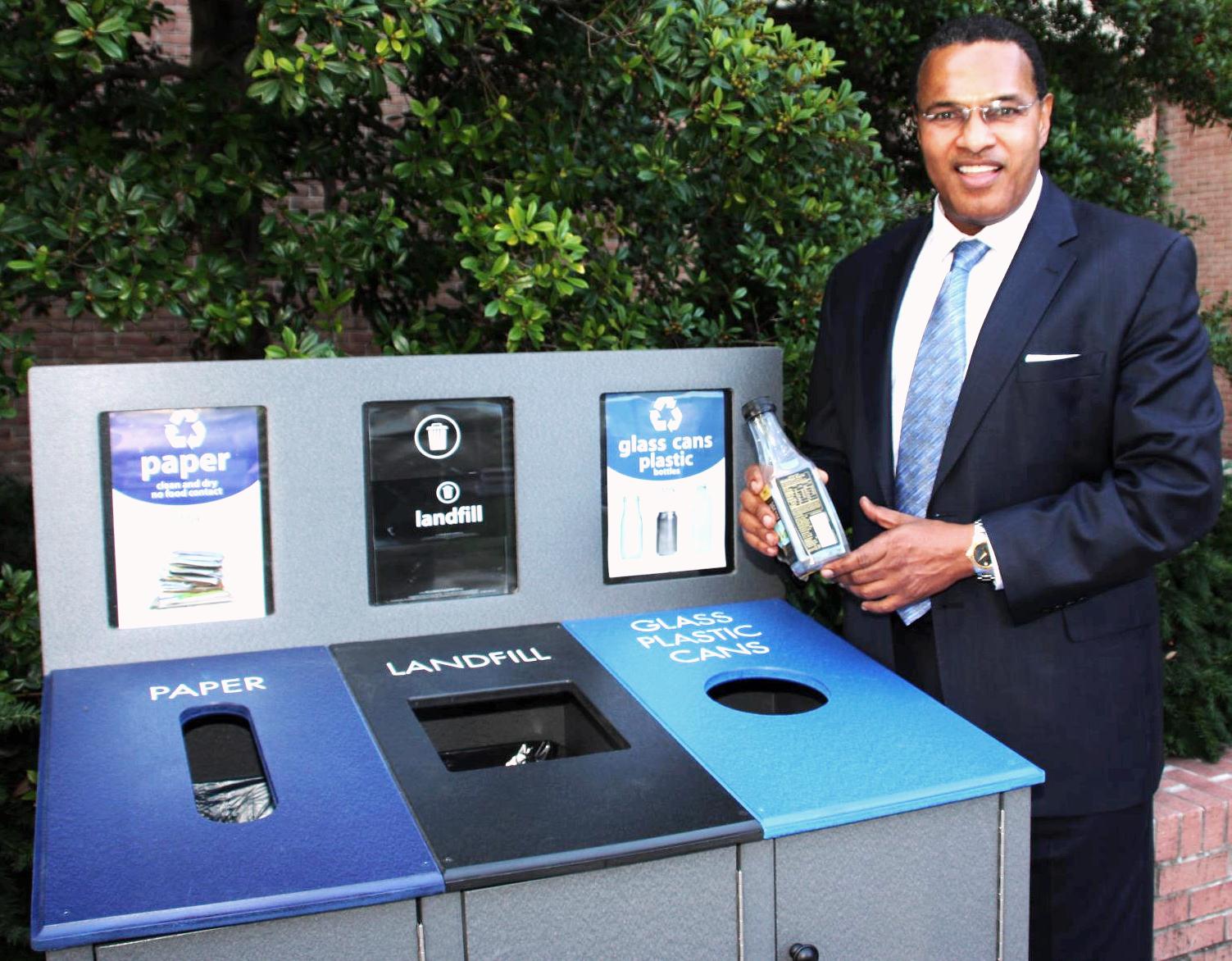
    <p>Above: President Freeman Hrabowski demonstrating new 3 hole bins.</p>
    </blockquote>
    <h3>Compost</h3>
    <p>Learn about compostable packaging: </p>
    <h3><strong>What can we compost?</strong></h3>
    <ul>
    <li>All Food Waste</li>
    <li>Soiled Paper Products (such as used napkins, pizza boxes, etc. If you notice a plastic or wax coating, toss into the landfill slot for general trash)</li>
    <li>Plant-based Packaging (just check the labels and images below)</li>
    </ul>
    <h3>
    <a href="http://sustainability.umbc.edu/waste/compost/" rel="nofollow external" class="bo"><img alt="compost" src="http://sustainability.umbc.edu/files/2013/08/compost-300x194.jpg" height="191" width="296" style="max-width: 100%; height: auto;"></a><br>
    </h3>
    <h3>
    <a href="http://sustainability.umbc.edu/waste/pepsico-eco-friendly-cups-300x300/" rel="nofollow external" class="bo"><img alt="PepsiCo-Eco-Friendly-Cups-300x300" src="http://sustainability.umbc.edu/files/2013/08/PepsiCo-Eco-Friendly-Cups-300x300-150x150.jpg" height="150" width="150" style="max-width: 100%; height: auto;"></a><br>
    </h3>
    <h3><a href="http://sustainability.umbc.edu/waste/gpinklemonade-223x350/" rel="nofollow external" class="bo"><img alt="GPinkLemonade-223x350" src="http://sustainability.umbc.edu/files/2013/08/GPinkLemonade-223x350-150x150.jpg" height="150" width="150" style="max-width: 100%; height: auto;"></a></h3>
    <h3></h3>
    <strong>Where can we compost?</strong><ul>
    <li>True Grits Dining Hall (all food waste is composted in the kitchen, including food on used dishes)</li>
    <li>
    <a href="http://www.umbc.edu/commons/" rel="nofollow external" class="bo">The Commons (labeled green slots in waste bins)</a><br>
    </li>
    <li>University Center (ground floor by dining options)</li>
    </ul>
    <p><strong>Why Compost?</strong></p>
    <p>Composting
     allows food to decompose naturally into valuable fertile soil. Otherwise, food 
    waste decomposing in a landfill without oxygen would create methane, a 
    problematic greenhouse gas contributing to climate change. <a href="http://www.epa.gov/compost/basic.htm" rel="nofollow external" class="bo">Learn more at epa.gov</a>!</p>
    <blockquote>
    <p><strong>History: Collaboration and Coordination</strong></p>
    <p>We were able to start composting our food waste in 2012 thanks to the efforts of <a href="http://sga.umbc.edu/" rel="nofollow external" class="bo">SGA</a> Sustainability Intern Madeline Hall (featured in the composting video below), and a coordinating committee including student leaders, our dining provider <a href="http://www.dineoncampus.com/umbc/show.cfm?cmd=sustainability" rel="nofollow external" class="bo">Chartwells</a>, contract coordinators <a href="http://campuscard.umbc.edu/" rel="nofollow external" class="bo">Campus Card</a>, our <a href="http://www.abm.com/why-abm/white-papers/pages/green-cleaning-programs.aspx" rel="nofollow external" class="bo">green housekeeping group</a>, and the company who picks up our compost and returns the decomposed food as fertile soil, <a href="http://www.wasteneutral.com" rel="nofollow external" class="bo">Waste Neutral</a>, as well as <a href="http://www.umbc.edu/fm/energy/recycling.html" rel="nofollow external" class="bo">Facilities Management</a> and UMBC's <a href="http://sustainability.umbc.edu" rel="nofollow external" class="bo">Sustainability Coordinator</a>! <br></p>
    <p>Composting has been phased into food services since 2012, starting with
     the Dining hall, then the Commons- to allow time to collaboratively 
    select, purchase, and install new user friendly bins, to become a 
    standard across campus.</p>
    <strong>Awareness: Events, Promotions and Education</strong><p>Our student partners
     such as Students for Environmental Awareness, SGA Department of 
    Environmental Affairs and SGA Sustainability interns have taken the lead in the 2012-2013 school year and designed educational outreach programs to raise awareness on why and how
     to compost on campus since composting was first introduced on campus! <br></p>
    <p>We are excited to work with anyone interested in helping spread the word! Just email <a href="mailto:sustainability@umbc.edu">sustainability@umbc.edu</a> to get involved!<br></p>
    <p><a href="http://youtu.be/Jlf80VmIvpQ" rel="nofollow external" class="bo">Check out the student video about composting in the dining hall</a>: <a href="http://youtu.be/Jlf80VmIvpQ" rel="nofollow external" class="bo">http://youtu.be/Jlf80VmIvpQ</a></p>Some popular past published updates on composting:<br><ul>
    <li><a href="http://my.umbc.edu/groups/sustainability/news/21992" rel="nofollow external" class="bo">Taking time to compost in The Commons, by Zoe Gensheimer; An article from the Retriever Weekly describing composting!</a></li>
    <li><a href="http://my.umbc.edu/groups/sustainability/news/22880" rel="nofollow external" class="bo">Check out the inside scoop: News on composting &amp; recycling! Stay up to date on how you can pitch in!</a></li>
    <li><a href="http://my.umbc.edu/groups/sustainability/news/21992" rel="nofollow external" class="bo">SUSTAINABLE FOOD AT UMBC! Chartwells has been doing tons of great things to go "green!</a></li>
    </ul>
    <p><strong>Zero Waste Events</strong></p>
    <p>Consider
     plant-based compostable dishware and flatware rather than plastic or 
    Styrofoam for your next campus event with food and be sure to request a 
    portable compost bin and pick up service through <a href="http://sustainability.umbc.edu/wp-admin/www.umbc.edu/thecommons/epcs/%E2%80%8E" rel="nofollow external" class="bo">events services</a>!  The new SGA Green Paws fund allows student organizations to acquire plant based compostable materials at no additional cost.</p>
    <p>Do you have any questions or ideas about composting on campus?<br></p>
    </blockquote>
    </div>
]]>
</Body>
<Summary>As you returned or arrived to campus in the fall, you may have seen the new waste bins (including compost!) in the Commons. In case you were wondering, here's how they came to be, and how you can...</Summary>
<Website>http://sustainability.umbc.edu/waste</Website>
<AttachmentKind>Flyer</AttachmentKind>
<AttachmentUrl>https://assets4-my.umbc.edu/system/shared/attachments/2c8e1456ebfdd6953386c1ca9804fc1f/6a702488/news/000/035/410/a0a40b610afc7e41298f3ebd55c60ded/thumbnail.png?1378823624</AttachmentUrl>
<Attachments>
<Attachment kind="Flyer" url="https://my3.my.umbc.edu/groups/sustainability/posts/35410/attachments/10935"></Attachment>
<Attachment kind="Document" url="https://my3.my.umbc.edu/groups/sustainability/posts/35410/attachments/10936"></Attachment>
</Attachments>
<TrackingUrl>https://my3.my.umbc.edu/api/v0/pixel/news/35410/guest@my.umbc.edu/98bf72e772c96e67ba85bfe82524fadf/api/pixel</TrackingUrl>
<Tag>commons</Tag>
<Tag>compost</Tag>
<Tag>composting</Tag>
<Tag>decompose</Tag>
<Tag>dining</Tag>
<Tag>grits</Tag>
<Tag>hall</Tag>
<Tag>loop</Tag>
<Tag>recycle</Tag>
<Tag>recycling</Tag>
<Tag>soil</Tag>
<Tag>true</Tag>
<Tag>umbc</Tag>
<Tag>waste</Tag>
<Group token="sustainability">Sustainability Matters at UMBC</Group>
<GroupUrl>https://my3.my.umbc.edu/groups/sustainability</GroupUrl>
<AvatarUrl>https://assets1-my.umbc.edu/system/shared/avatars/groups/000/000/086/91091ac32f525d88daa6d6b721420ac1/xsmall.png?1586269437</AvatarUrl>
<AvatarUrl size="original">https://assets3-my.umbc.edu/system/shared/avatars/groups/000/000/086/91091ac32f525d88daa6d6b721420ac1/original.png?1586269437</AvatarUrl>
<AvatarUrl size="xxlarge">https://assets4-my.umbc.edu/system/shared/avatars/groups/000/000/086/91091ac32f525d88daa6d6b721420ac1/xxlarge.png?1586269437</AvatarUrl>
<AvatarUrl size="xlarge">https://assets2-my.umbc.edu/system/shared/avatars/groups/000/000/086/91091ac32f525d88daa6d6b721420ac1/xlarge.png?1586269437</AvatarUrl>
<AvatarUrl size="large">https://assets2-my.umbc.edu/system/shared/avatars/groups/000/000/086/91091ac32f525d88daa6d6b721420ac1/large.png?1586269437</AvatarUrl>
<AvatarUrl size="medium">https://assets4-my.umbc.edu/system/shared/avatars/groups/000/000/086/91091ac32f525d88daa6d6b721420ac1/medium.png?1586269437</AvatarUrl>
<AvatarUrl size="small">https://assets4-my.umbc.edu/system/shared/avatars/groups/000/000/086/91091ac32f525d88daa6d6b721420ac1/small.png?1586269437</AvatarUrl>
<AvatarUrl size="xsmall">https://assets1-my.umbc.edu/system/shared/avatars/groups/000/000/086/91091ac32f525d88daa6d6b721420ac1/xsmall.png?1586269437</AvatarUrl>
<AvatarUrl size="xxsmall">https://assets3-my.umbc.edu/system/shared/avatars/groups/000/000/086/91091ac32f525d88daa6d6b721420ac1/xxsmall.png?1586269437</AvatarUrl>
<Sponsor>UMBC Sustainability</Sponsor>
<ThumbnailUrl size="xxlarge">https://assets2-my.umbc.edu/system/shared/thumbnails/news/000/035/410/a849796db8f46701f8e41b0586a09fae/xxlarge.jpg?1378823812</ThumbnailUrl>
<ThumbnailUrl size="xlarge">https://assets1-my.umbc.edu/system/shared/thumbnails/news/000/035/410/a849796db8f46701f8e41b0586a09fae/xlarge.jpg?1378823812</ThumbnailUrl>
<ThumbnailUrl size="large">https://assets4-my.umbc.edu/system/shared/thumbnails/news/000/035/410/a849796db8f46701f8e41b0586a09fae/large.jpg?1378823812</ThumbnailUrl>
<ThumbnailUrl size="medium">https://assets2-my.umbc.edu/system/shared/thumbnails/news/000/035/410/a849796db8f46701f8e41b0586a09fae/medium.jpg?1378823812</ThumbnailUrl>
<ThumbnailUrl size="small">https://assets4-my.umbc.edu/system/shared/thumbnails/news/000/035/410/a849796db8f46701f8e41b0586a09fae/small.jpg?1378823812</ThumbnailUrl>
<ThumbnailUrl size="xsmall">https://assets2-my.umbc.edu/system/shared/thumbnails/news/000/035/410/a849796db8f46701f8e41b0586a09fae/xsmall.jpg?1378823812</ThumbnailUrl>
<ThumbnailUrl size="xxsmall">https://assets1-my.umbc.edu/system/shared/thumbnails/news/000/035/410/a849796db8f46701f8e41b0586a09fae/xxsmall.jpg?1378823812</ThumbnailUrl>
<PawCount>39</PawCount>
<CommentCount>8</CommentCount>
<CommentsAllowed>true</CommentsAllowed>
<PostedAt>Tue, 10 Sep 2013 10:37:49 -0400</PostedAt>
<EditAt>Tue, 29 Apr 2014 11:22:34 -0400</EditAt>
</NewsItem>

<NewsItem contentIssues="true" id="30247" important="false" status="posted" url="https://my3.my.umbc.edu/groups/sustainability/posts/30247">
<Title>Green Commute Options: Save Gas, Save Cash, &amp; cut emissions</Title>
<Tagline>Try transit shuttles, a bus, a bike, a zip car, or carpool!</Tagline>
<Body>
<![CDATA[
    <div class="html-content">
    <p><img src="https://my3.my.umbc.edu/system/shared/attachments/news/000/030/247/0f83556a305d789b1d71815e8ea4f4b0/Green%20Ride%20Options.png" style="max-width: 100%; height: auto;"><img alt="" style="max-width: 100%; height: auto;"></p>
    <p></p>
    <h1><span>Transportation</span></h1>
    <p></p>
    <h1><span>Guide</span></h1>
    <p></p>
    <p><span>Know your options:</span></p>
    <p> </p>
    <p><strong><span>6 Transit Shuttle
    Buses </span></strong></p>
    <p><strong><span><a href="http://umbc.edu/transit" rel="nofollow external" class="bo"><span><u>http://umbc.edu/transit</u></span></a></span></strong></p>
    <p><strong><span></span></strong> </p>
    <p><strong><span>UMBC’s Carpooling Program</span></strong></p>
    <p><strong><span>Connect with UMBC
    carpoolers</span></strong></p>
    <p><u><strong><span><span>  </span>http://</span></strong><strong><span><a href="https://apps-my.umbc.edu/apps/alternetrides/" rel="nofollow external" class="bo"><span>umbc.edu/go/alternetrides/</span></a></span></strong><strong><span></span></strong></u></p>
    <p></p>
    <p><strong><span>MTA – MD Public
    Transportation </span></strong></p>
    <p><strong><span>Routes #35, 77, and 99 serve UMBC</span></strong></p>
    <p><strong><span><u><a href="http://my.umbc.edu/groups/sustainability/news/%20http:/mta.maryland.gov/" rel="nofollow external" class="bo"><span>http://mta.maryland.gov/</span></a></u></span></strong></p>
    <p><strong><span> </span></strong></p>
    <p><strong><span>Zipcar – Car Share</span></strong></p>
    <p><strong><span><u><a href="http://zipcar.com/umbc" rel="nofollow external" class="bo">http://zipcar.com/umbc</a></u></span></strong><span><span>                                 </span></span></p>
    <p><span><span>                                              </span></span></p>
    <p></p>
    <p><span> </span></p>
    <p></p>
    <p><span> </span></p>
    <p></p>
    <p><span> </span></p>
    <p></p>
    <p><span>


     </span></p>
    </div>
]]>
</Body>
<Summary>Transportation   Guide   Know your options:     6 Transit Shuttle Buses   http://umbc.edu/transit     UMBC’s Carpooling Program  Connect with UMBC carpoolers    http://umbc.edu/go/alternetrides/...</Summary>
<Website>http://umbc.edu/tag</Website>
<AttachmentKind>Document</AttachmentKind>
<AttachmentUrl>https://assets3-my.umbc.edu/system/shared/attachments/e52bb7ea7f911d86e2d8b86b18d549da/6a702488/news/000/030/247/0f83556a305d789b1d71815e8ea4f4b0/Green Ride Options.png?1369338805</AttachmentUrl>
<Attachments>
<Attachment kind="Document" url="https://my3.my.umbc.edu/groups/sustainability/posts/30247/attachments/10209"></Attachment>
</Attachments>
<TrackingUrl>https://my3.my.umbc.edu/api/v0/pixel/news/30247/guest@my.umbc.edu/cc6b9d84b566370216dc39a538d04aa9/api/pixel</TrackingUrl>
<Tag>buses</Tag>
<Tag>carpool</Tag>
<Tag>green</Tag>
<Tag>guide</Tag>
<Tag>mta</Tag>
<Tag>public</Tag>
<Tag>routes</Tag>
<Tag>shuttle</Tag>
<Tag>sustainability</Tag>
<Tag>transit</Tag>
<Tag>transportation</Tag>
<Tag>umbc</Tag>
<Group token="sustainability">Sustainability Matters at UMBC</Group>
<GroupUrl>https://my3.my.umbc.edu/groups/sustainability</GroupUrl>
<AvatarUrl>https://assets1-my.umbc.edu/system/shared/avatars/groups/000/000/086/91091ac32f525d88daa6d6b721420ac1/xsmall.png?1586269437</AvatarUrl>
<AvatarUrl size="original">https://assets3-my.umbc.edu/system/shared/avatars/groups/000/000/086/91091ac32f525d88daa6d6b721420ac1/original.png?1586269437</AvatarUrl>
<AvatarUrl size="xxlarge">https://assets4-my.umbc.edu/system/shared/avatars/groups/000/000/086/91091ac32f525d88daa6d6b721420ac1/xxlarge.png?1586269437</AvatarUrl>
<AvatarUrl size="xlarge">https://assets2-my.umbc.edu/system/shared/avatars/groups/000/000/086/91091ac32f525d88daa6d6b721420ac1/xlarge.png?1586269437</AvatarUrl>
<AvatarUrl size="large">https://assets2-my.umbc.edu/system/shared/avatars/groups/000/000/086/91091ac32f525d88daa6d6b721420ac1/large.png?1586269437</AvatarUrl>
<AvatarUrl size="medium">https://assets4-my.umbc.edu/system/shared/avatars/groups/000/000/086/91091ac32f525d88daa6d6b721420ac1/medium.png?1586269437</AvatarUrl>
<AvatarUrl size="small">https://assets4-my.umbc.edu/system/shared/avatars/groups/000/000/086/91091ac32f525d88daa6d6b721420ac1/small.png?1586269437</AvatarUrl>
<AvatarUrl size="xsmall">https://assets1-my.umbc.edu/system/shared/avatars/groups/000/000/086/91091ac32f525d88daa6d6b721420ac1/xsmall.png?1586269437</AvatarUrl>
<AvatarUrl size="xxsmall">https://assets3-my.umbc.edu/system/shared/avatars/groups/000/000/086/91091ac32f525d88daa6d6b721420ac1/xxsmall.png?1586269437</AvatarUrl>
<Sponsor>UMBC SUSTAINABILITY</Sponsor>
<ThumbnailUrl size="xxlarge">https://assets4-my.umbc.edu/system/shared/thumbnails/news/000/030/247/92cdc3666b7883ebeed2973e70725bb1/xxlarge.jpg?1369338922</ThumbnailUrl>
<ThumbnailUrl size="xlarge">https://assets4-my.umbc.edu/system/shared/thumbnails/news/000/030/247/92cdc3666b7883ebeed2973e70725bb1/xlarge.jpg?1369338922</ThumbnailUrl>
<ThumbnailUrl size="large">https://assets3-my.umbc.edu/system/shared/thumbnails/news/000/030/247/92cdc3666b7883ebeed2973e70725bb1/large.jpg?1369338922</ThumbnailUrl>
<ThumbnailUrl size="medium">https://assets2-my.umbc.edu/system/shared/thumbnails/news/000/030/247/92cdc3666b7883ebeed2973e70725bb1/medium.jpg?1369338922</ThumbnailUrl>
<ThumbnailUrl size="small">https://assets1-my.umbc.edu/system/shared/thumbnails/news/000/030/247/92cdc3666b7883ebeed2973e70725bb1/small.jpg?1369338922</ThumbnailUrl>
<ThumbnailUrl size="xsmall">https://assets3-my.umbc.edu/system/shared/thumbnails/news/000/030/247/92cdc3666b7883ebeed2973e70725bb1/xsmall.jpg?1369338922</ThumbnailUrl>
<ThumbnailUrl size="xxsmall">https://assets1-my.umbc.edu/system/shared/thumbnails/news/000/030/247/92cdc3666b7883ebeed2973e70725bb1/xxsmall.jpg?1369338922</ThumbnailUrl>
<PawCount>7</PawCount>
<CommentCount>3</CommentCount>
<CommentsAllowed>true</CommentsAllowed>
<PostedAt>Thu, 23 May 2013 15:55:57 -0400</PostedAt>
<EditAt>Thu, 23 May 2013 15:56:21 -0400</EditAt>
</NewsItem>

<NewsItem contentIssues="false" id="26287" important="false" status="posted" url="https://my3.my.umbc.edu/groups/sustainability/posts/26287">
<Title>Dr. Turner's course on Sustainability: eco-literacy @ UMBC</Title>
<Body>
<![CDATA[
    <div class="html-content">
    <h2>Eco-Education</h2>
    <p>A first-year seminar class offered this semester is giving students the 
    chance to explore environmental issues from a humanities perspective. The class, 
    Sustainability in American Culture, focuses on eco-literacy; that is, an 
    awareness of how cultural influences can affect our relationship with the 
    environment. 
    </p>
    <p>“In a humanities course, it’s possible to think about thing like culture, 
    discourse and language and how those things shape our thinking and how our 
    thinking shapes our interaction with the environment and the natural world,” 
    said <strong>Rita Turner</strong>, ’11 Ph.D., language, literacy and culture, 
    who is teaching the class. Turner’s dissertation is based on developing 
    curriculum to cultivate environmental awareness in high school and college 
    students, so when she heard that the university was testing the idea of having 
    graduate students teach first-year seminars she jumped at the chance to use her 
    materials.</p>
    <p>The class allows students to approach environmental issues from multiple 
    perspectives, rather than just learning the science of the environment. For 
    example, students read about how everyday items are produced, wrote creative 
    pieces from the perspective of nonhuman beings in the environment and created 
    digital stories about places.</p>
    <p>“We look critically about what’s said in the media, how our attitudes are 
    shaped, what metaphors we use to talk about the natural world and what rights we 
    have,” said Turner. By discussing popular discourse on the environment, Turner 
    hopes to empower her students—many of whom are science majors who plan to work 
    on environmental issues —to understand and critique the range of factors that 
    contribute to our attitudes about the environment.</p>
    <p>“I like the fact that we can step into the gray areas instead of being in the 
    black-and-white place that we normally are when it comes to classes and 
    answers,” said <strong>Heather Harshbarger</strong> ’14, chemical 
    engineering.</p>
    <p> “I was surprised at how much information the class covered,” said 
    <strong>Jennie Williams</strong> ’14, social work. “Not only did the curriculum 
    focus on conservation, but it also explored consumerism, corporate power, 
    political influence and even art and creative reflection in nature.”</p>
    <p>Williams, an avid recycler and vegetarian, said that she was aware of 
    environmental issues before taking the class but that it has expanded her view 
    of these issues. “I have definitely become more aware of consumerism in the 
    American culture and it has motivated me to stay active in education and 
    projects of environmental protection,” she said.</p>
    <p>Turner said that teaching the class has helped her to hone the curriculum 
    that she will present with her dissertation, and she looks forward to being able 
    to share what she learned in a real classroom with her dissertation committee. 
    Teaching the class has reinforced her belief that students should learn to think 
    critically about the environment. “This sort of humanities piece of the puzzle 
    is missing, and I feel like there’s a real need for that,” she said.</p>
    <p>(12/6/10)</p>
    </div>
]]>
</Body>
<Summary>Eco-Education   A first-year seminar class offered this semester is giving students the  chance to explore environmental issues from a humanities perspective. The class,  Sustainability in...</Summary>
<TrackingUrl>https://my3.my.umbc.edu/api/v0/pixel/news/26287/guest@my.umbc.edu/57197e1e47492e70ebf521b78aa99661/api/pixel</TrackingUrl>
<Tag>sustainability</Tag>
<Tag>umbc</Tag>
<Group token="sustainability">Sustainability Matters at UMBC</Group>
<GroupUrl>https://my3.my.umbc.edu/groups/sustainability</GroupUrl>
<AvatarUrl>https://assets1-my.umbc.edu/system/shared/avatars/groups/000/000/086/91091ac32f525d88daa6d6b721420ac1/xsmall.png?1586269437</AvatarUrl>
<AvatarUrl size="original">https://assets3-my.umbc.edu/system/shared/avatars/groups/000/000/086/91091ac32f525d88daa6d6b721420ac1/original.png?1586269437</AvatarUrl>
<AvatarUrl size="xxlarge">https://assets4-my.umbc.edu/system/shared/avatars/groups/000/000/086/91091ac32f525d88daa6d6b721420ac1/xxlarge.png?1586269437</AvatarUrl>
<AvatarUrl size="xlarge">https://assets2-my.umbc.edu/system/shared/avatars/groups/000/000/086/91091ac32f525d88daa6d6b721420ac1/xlarge.png?1586269437</AvatarUrl>
<AvatarUrl size="large">https://assets2-my.umbc.edu/system/shared/avatars/groups/000/000/086/91091ac32f525d88daa6d6b721420ac1/large.png?1586269437</AvatarUrl>
<AvatarUrl size="medium">https://assets4-my.umbc.edu/system/shared/avatars/groups/000/000/086/91091ac32f525d88daa6d6b721420ac1/medium.png?1586269437</AvatarUrl>
<AvatarUrl size="small">https://assets4-my.umbc.edu/system/shared/avatars/groups/000/000/086/91091ac32f525d88daa6d6b721420ac1/small.png?1586269437</AvatarUrl>
<AvatarUrl size="xsmall">https://assets1-my.umbc.edu/system/shared/avatars/groups/000/000/086/91091ac32f525d88daa6d6b721420ac1/xsmall.png?1586269437</AvatarUrl>
<AvatarUrl size="xxsmall">https://assets3-my.umbc.edu/system/shared/avatars/groups/000/000/086/91091ac32f525d88daa6d6b721420ac1/xxsmall.png?1586269437</AvatarUrl>
<Sponsor>UMBC SUSTAINABILITY</Sponsor>
<PawCount>3</PawCount>
<CommentCount>1</CommentCount>
<CommentsAllowed>true</CommentsAllowed>
<PostedAt>Thu, 21 Mar 2013 13:51:10 -0400</PostedAt>
</NewsItem>

<NewsItem contentIssues="true" id="25589" important="false" status="posted" url="https://my3.my.umbc.edu/groups/sustainability/posts/25589">
<Title>UMBC President summarizes our advances in sustainability</Title>
<Tagline>Dr Hrabowski on UMBC's progress &amp; efforts in sustainability</Tagline>
<Body>
<![CDATA[
    <div class="html-content">
    <p>From the 2013 Legislative Testimony, Dr Freeman Hrabowski, III, UMBC President</p>
    <h5><strong><em>SUSTAINABILITY</em></strong></h5>
    <p>Our campus community is working to address global warming every day. Through our research and academic programs, we are producing knowledge and a new generation of informed citizens and leaders to move Maryland and the nation toward dramatically reduced emissions of greenhouse gases.  We are part of the American College &amp; University Presidents’ Climate Commitment.  Our Climate Change Task Force has developed an action plan and is actively implementing projects to reduce our carbon footprint on campus and beyond. Through climate change initiatives, the campus has reduced its net emissions by 13.3% over the past five years, a major reduction considering the 15% increase in enrollment and 2% increase in campus square footage during this time period. The additional square footage includes a LEED Gold Certified addition to Patapsco Residence Hall, complete with our campus’s first green roof, as well as Phase 1 of our new Performing Arts and Humanities Building built to LEED Silver standards.</p>
    <p>As of 2012, 20% of UMBC’s electricity comes from renewable resources, utilizing our long-term contract with the University System of Maryland.  A Chilled Water Optimization project significantly improves the efficiency of the Central Plant and cooling for most of the campus, reducing annual energy usage by 5,700,000 kWh and reducing annual Greenhouse Gas emissions by 3,100 metric tons eCO2.  Relative to a baseline year of 2007, this represents a 7% reduction in electricity and 3.5% reduction in carbon footprint.</p>
    <p>UMBC hired its first full-time Environmental Sustainability Coordinator in 2012, and the Student Government Association is funding five sustainability interns this year. Student participation in a new composting program and in Recyclemania, a 10-week national competition involving 400 colleges and universities, has boosted the campus’s recycling rate to 28%.  The university has also made significant advances in green transportation initiatives, including optimizing UMBC transit service routes and schedules,  a new carpooling policy, improved vanpooling and public transit options, and improvements to make the campus more bike- and pedestrian-friendly.</p>
    </div>
]]>
</Body>
<Summary>From the 2013 Legislative Testimony, Dr Freeman Hrabowski, III, UMBC President  SUSTAINABILITY  Our campus community is working to address global warming every day. Through our research and...</Summary>
<Website>http://president.umbc.edu/legislative-testimony-2013/</Website>
<TrackingUrl>https://my3.my.umbc.edu/api/v0/pixel/news/25589/guest@my.umbc.edu/a5a873fda6f1ffada690a51ca4f02686/api/pixel</TrackingUrl>
<Tag>environment</Tag>
<Tag>environmental</Tag>
<Tag>green</Tag>
<Tag>hrabowski</Tag>
<Tag>renewable</Tag>
<Tag>science</Tag>
<Tag>sustainability</Tag>
<Tag>technology</Tag>
<Tag>umbc</Tag>
<Group token="sustainability">Sustainability Matters at UMBC</Group>
<GroupUrl>https://my3.my.umbc.edu/groups/sustainability</GroupUrl>
<AvatarUrl>https://assets1-my.umbc.edu/system/shared/avatars/groups/000/000/086/91091ac32f525d88daa6d6b721420ac1/xsmall.png?1586269437</AvatarUrl>
<AvatarUrl size="original">https://assets3-my.umbc.edu/system/shared/avatars/groups/000/000/086/91091ac32f525d88daa6d6b721420ac1/original.png?1586269437</AvatarUrl>
<AvatarUrl size="xxlarge">https://assets4-my.umbc.edu/system/shared/avatars/groups/000/000/086/91091ac32f525d88daa6d6b721420ac1/xxlarge.png?1586269437</AvatarUrl>
<AvatarUrl size="xlarge">https://assets2-my.umbc.edu/system/shared/avatars/groups/000/000/086/91091ac32f525d88daa6d6b721420ac1/xlarge.png?1586269437</AvatarUrl>
<AvatarUrl size="large">https://assets2-my.umbc.edu/system/shared/avatars/groups/000/000/086/91091ac32f525d88daa6d6b721420ac1/large.png?1586269437</AvatarUrl>
<AvatarUrl size="medium">https://assets4-my.umbc.edu/system/shared/avatars/groups/000/000/086/91091ac32f525d88daa6d6b721420ac1/medium.png?1586269437</AvatarUrl>
<AvatarUrl size="small">https://assets4-my.umbc.edu/system/shared/avatars/groups/000/000/086/91091ac32f525d88daa6d6b721420ac1/small.png?1586269437</AvatarUrl>
<AvatarUrl size="xsmall">https://assets1-my.umbc.edu/system/shared/avatars/groups/000/000/086/91091ac32f525d88daa6d6b721420ac1/xsmall.png?1586269437</AvatarUrl>
<AvatarUrl size="xxsmall">https://assets3-my.umbc.edu/system/shared/avatars/groups/000/000/086/91091ac32f525d88daa6d6b721420ac1/xxsmall.png?1586269437</AvatarUrl>
<Sponsor>UMBC SUSTAINABILITY</Sponsor>
<ThumbnailUrl size="xxlarge">https://assets1-my.umbc.edu/system/shared/thumbnails/news/000/025/589/35e70893fec54c27bc46a147e73aa552/xxlarge.jpg?1363010499</ThumbnailUrl>
<ThumbnailUrl size="xlarge">https://assets1-my.umbc.edu/system/shared/thumbnails/news/000/025/589/35e70893fec54c27bc46a147e73aa552/xlarge.jpg?1363010499</ThumbnailUrl>
<ThumbnailUrl size="large">https://assets3-my.umbc.edu/system/shared/thumbnails/news/000/025/589/35e70893fec54c27bc46a147e73aa552/large.jpg?1363010499</ThumbnailUrl>
<ThumbnailUrl size="medium">https://assets3-my.umbc.edu/system/shared/thumbnails/news/000/025/589/35e70893fec54c27bc46a147e73aa552/medium.jpg?1363010499</ThumbnailUrl>
<ThumbnailUrl size="small">https://assets3-my.umbc.edu/system/shared/thumbnails/news/000/025/589/35e70893fec54c27bc46a147e73aa552/small.jpg?1363010499</ThumbnailUrl>
<ThumbnailUrl size="xsmall">https://assets2-my.umbc.edu/system/shared/thumbnails/news/000/025/589/35e70893fec54c27bc46a147e73aa552/xsmall.jpg?1363010499</ThumbnailUrl>
<ThumbnailUrl size="xxsmall">https://assets2-my.umbc.edu/system/shared/thumbnails/news/000/025/589/35e70893fec54c27bc46a147e73aa552/xxsmall.jpg?1363010499</ThumbnailUrl>
<PawCount>3</PawCount>
<CommentCount>0</CommentCount>
<CommentsAllowed>true</CommentsAllowed>
<PostedAt>Mon, 11 Mar 2013 10:03:10 -0400</PostedAt>
</NewsItem>

<NewsItem contentIssues="false" id="25588" important="false" status="posted" url="https://my3.my.umbc.edu/groups/sustainability/posts/25588">
<Title>UMBC leads in environmental science &amp; tech. research</Title>
<Tagline>Dr Hrabowski extols UMBC's advances &amp; in earth sciences</Tagline>
<Body>
<![CDATA[
    <div class="html-content">
    <p>From the 2013 Legislative Testimony, Dr Freeman Hrabowski, III, UMBC President</p>
    <p> </p>
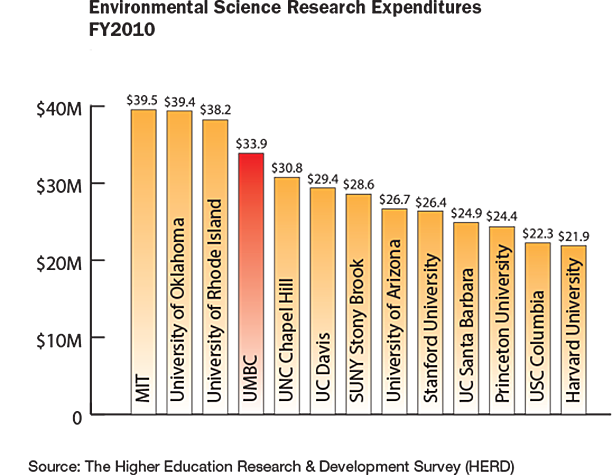
    <p>According to the Higher Education Research &amp; Development Survey, the campus ranks 18<sup>th</sup> nationally in <strong>environmental</strong> <strong>science</strong> research and development expenditures.   We recently launched the Goddard Planetary Heliophysics Institute (GPHI) through a Cooperative Agreement with the NASA Goddard Space Flight Center (GSFC) in Greenbelt, Maryland.  Based at GSFC, GPHI is a center for collaborative research in solar-planetary sciences linking researchers from UMBC, the University of Maryland, College Park, and American University. The Institute focuses on phenomena ranging from solar wind to sunspots, including the effects that weather on the Sun can have on Earth and our orbiting satellites.</p>
    <p><a href="http://president.umbc.edu/legislative-testimony-2013/fig8/" rel="nofollow external" class="bo"><img alt="Environmental Science Research Expenditures" src="http://president.umbc.edu/files/2013/02/fig8.png" width="428" height="333" style="max-width: 100%; height: auto;"></a></p>
    <p>The recent realignment of the former University of Maryland Biotechnology Institute faculty has brought many new scientific and technology-development assets to UMBC.  <strong>Maryland</strong> <strong>Sustainable</strong> <strong>Mariculture</strong> (<strong>MSM</strong>), a spin-off company founded by UMBC marine biotechnology faculty, is currently negotiating with a group of international investors who plan to lease space at the Columbus Center in downtown Baltimore to model marine aquaculture in a public display.  Plasmonix, a biotechnology start-up based on technologies licensed from the Institute of Fluorescence, recently received venture capital from the Governor’s “<strong>Invest</strong> <strong>Maryland</strong> <strong>Challenge</strong>” and is now located at <em>bwtech@</em>UMBC<em>, </em>our research and technology park.  In addition, our core facilities in mass spectrometry, imaging, and high-performance computing support both faculty research and companies. We work aggressively to create multi-level partnerships that connect faculty and students with companies, agencies, foundations, and school systems – and these partnerships enable us to leverage State funds.  For example, we have developed major research centers and other partnerships with support from NASA and from IBM, Lockheed Martin, Northrop Grumman, SAIC, Wyeth Pharmaceuticals, the Department of Defense, the National Security Agency (NSA), and other organizations.  Other partnerships with Federal and State agencies have allowed us to leverage State funds and contribute to the policy arena in gerontology (through the Erickson School for Aging, Management, and Policy and the Center for Aging Studies), the environment (through our <strong>Center</strong> <strong>for</strong> <strong>Urban</strong> <strong>Environmental</strong> <strong>Research</strong> <strong>&amp; Education</strong> – <strong>CUERE</strong>), health care (through our Hilltop Institute), and teacher education (through the Center for History Education, the Center for Excellence in STEM Education, and the <strong>Maryland</strong> <strong>Geographic</strong> <strong>Alliance</strong>).</p>
    </div>
]]>
</Body>
<Summary>From the 2013 Legislative Testimony, Dr Freeman Hrabowski, III, UMBC President     According to the Higher Education Research &amp; Development Survey, the campus ranks 18th nationally in...</Summary>
<Website>http://president.umbc.edu/legislative-testimony-2013/</Website>
<TrackingUrl>https://my3.my.umbc.edu/api/v0/pixel/news/25588/guest@my.umbc.edu/cf88928a903087ee0c10149d47f3bbc2/api/pixel</TrackingUrl>
<Tag>environment</Tag>
<Tag>environmental</Tag>
<Tag>green</Tag>
<Tag>hrabowski</Tag>
<Tag>renewable</Tag>
<Tag>science</Tag>
<Tag>sustainability</Tag>
<Tag>technology</Tag>
<Tag>umbc</Tag>
<Group token="sustainability">Sustainability Matters at UMBC</Group>
<GroupUrl>https://my3.my.umbc.edu/groups/sustainability</GroupUrl>
<AvatarUrl>https://assets1-my.umbc.edu/system/shared/avatars/groups/000/000/086/91091ac32f525d88daa6d6b721420ac1/xsmall.png?1586269437</AvatarUrl>
<AvatarUrl size="original">https://assets3-my.umbc.edu/system/shared/avatars/groups/000/000/086/91091ac32f525d88daa6d6b721420ac1/original.png?1586269437</AvatarUrl>
<AvatarUrl size="xxlarge">https://assets4-my.umbc.edu/system/shared/avatars/groups/000/000/086/91091ac32f525d88daa6d6b721420ac1/xxlarge.png?1586269437</AvatarUrl>
<AvatarUrl size="xlarge">https://assets2-my.umbc.edu/system/shared/avatars/groups/000/000/086/91091ac32f525d88daa6d6b721420ac1/xlarge.png?1586269437</AvatarUrl>
<AvatarUrl size="large">https://assets2-my.umbc.edu/system/shared/avatars/groups/000/000/086/91091ac32f525d88daa6d6b721420ac1/large.png?1586269437</AvatarUrl>
<AvatarUrl size="medium">https://assets4-my.umbc.edu/system/shared/avatars/groups/000/000/086/91091ac32f525d88daa6d6b721420ac1/medium.png?1586269437</AvatarUrl>
<AvatarUrl size="small">https://assets4-my.umbc.edu/system/shared/avatars/groups/000/000/086/91091ac32f525d88daa6d6b721420ac1/small.png?1586269437</AvatarUrl>
<AvatarUrl size="xsmall">https://assets1-my.umbc.edu/system/shared/avatars/groups/000/000/086/91091ac32f525d88daa6d6b721420ac1/xsmall.png?1586269437</AvatarUrl>
<AvatarUrl size="xxsmall">https://assets3-my.umbc.edu/system/shared/avatars/groups/000/000/086/91091ac32f525d88daa6d6b721420ac1/xxsmall.png?1586269437</AvatarUrl>
<Sponsor>UMBC SUSTAINABILITY</Sponsor>
<PawCount>1</PawCount>
<CommentCount>0</CommentCount>
<CommentsAllowed>true</CommentsAllowed>
<PostedAt>Mon, 11 Mar 2013 09:56:09 -0400</PostedAt>
</NewsItem>

<NewsItem contentIssues="false" id="23662" important="false" status="posted" url="https://my3.my.umbc.edu/groups/sustainability/posts/23662">
<Title>Recirculating aquaculture to farm fish more sustainably</Title>
<Tagline>UMBC&#8217;s Dept. of Marine Biotech. is taking on the challenge</Tagline>
<Body>
<![CDATA[
    <div class="html-content">
    <h1>Fishing Without a Net</h1>
    <div>
    <p><img alt="Fishing Without a Net" src="http://www.umbc.edu/magazine/winter11/images/fishing_topimage.jpg" style="max-width: 100%; height: auto;"></p>
    <p><strong><em>In UMBC’s Department of Marine Biotechnology, Yonathan Zohar and his colleagues are creating sustainable fish farms that may revolutionize our notions of fishing and seafood. </em></strong></p>
    <p>Source: UMBC Magazine</p>
    <p><em>- By Anthony Lane </em></p>
    <p>A well-known proverb appears on a wall near the entrance to the Columbus Center on Baltimore’s Inner Harbor: <em>Give a man a fish, he eats for a day. Teach a man to fish and he eats for a lifetime.</em></p>
    <p>A worthy sentiment, yes. But what happens if we use up the bounty of the world’s oceans and seas? Talk for a few minutes with aquaculture pioneer Yonathan Zohar and you might be moved to coin a new proverb:</p>
    <p><em>Teach too many people to fish, and there might one day be nothing left to catch.</em></p>
    <p>Zohar is chair of UMBC’s new Department of Marine Biotechnology. At the Columbus Center, he and his colleagues develop new techniques and technologies to protect the world’s oceans and seas and preserve the life inside them.</p>
    <p><img alt="Fish image" src="http://www.umbc.edu/magazine/winter11/images/fishing_subimage1.jpg" style="max-width: 100%; height: auto;"></p>
    <p>Pollution, climate change and gushing oil wells are all threats to aquatic systems. But even the act of fishing itself has advanced to a point of deadly efficiency: high-tech fishing fleets use spotters in airplanes and other techniques to maximize their catch and meet a growing global demand for seafood.</p>
    <p>“If we don’t do anything about it,” Zohar observes, “the oceans could be out of 90 percent-plus of the major fishery stocks by the year 2050.” Many fisheries are already in serious trouble in 2011, he adds: “Cod used to be one of the most abundant fish out there. Now the cod fishery is almost gone. The giant bluefin tuna has been fished almost beyond repair.”</p>
    <p>One answer to overfishing of natural waters is fish farms. But much of the news there is also troubling. Marine fish such as salmon and sea bass are typically raised in offshore floating net pens, where they cause pollution, absorb toxins, and exchange diseases with their wild cousins. Selectively bred farmed fish sometimes escape from their pens, displacing the natives or getting cozy with them.</p>
    <p>So where will seafood come from in the future?</p>
    <p>Zohar and his colleagues think they have an answer: a sustainable aquaculture system that they have developed in the Columbus Center’s basement. It uses a system of filters and pumps to clean and recirculate artificial seawater, providing ideal conditions for marine fish to grow and breed in safety. The fish can’t escape, and the design eliminates the risk of transmitting diseases or polluting coastal waters. Even the fish wastes are put to productive use: they are converted to methane, which can be used to help power the whole aquaculture system.</p>
    <p>Humans have domesticated an array of animals and plants over the course of centuries to meet most of our food needs, Zohar observes. That still hasn’t happened with seafood.</p>
    <p>“You don’t go to the wild to catch poultry or bovines,” he says. “Seafood is the only hunt-and-gather crop.”</p>
    <p>Zohar believes that the aquaculture system at the Columbus Center – which could be used in landlocked Iowa just as easily as it can be used near the Inner Harbor – could be a green, clean and efficient way to raise fish anywhere.</p>
    <p><strong>A Tricky Business</strong></p>
    <p>Zohar grew up in Jerusalem, and he developed an early fascination with oceans and marine life studying magazines such as <em>National Geographic</em>. Though he was close to the Mediterranean Sea all his life, it was not until he was teenager that he first visited the water during a school trip to the beach. “I loved it from first sight,” he says.</p>
    <p>This passion for the sea eventually brought Zohar to Baltimore. In 1990, he joined the Center of Marine Biotechnology at the University System of Maryland to conduct aquaculture research. He later became the director of that center, remaining in that position until July 2010, when the center became the Institute of Marine and Environmental Technology (IMET), a partnership between UMBC, the University of Maryland Center for Environmental Science and the University of Maryland, Baltimore. Zohar continued on as IMET’s interim director, and he is chair of the new Department of Marine Biotechnology at UMBC.</p>
    <p>Aquaculture was in its early stages when Zohar studied biology as an undergraduate at the Hebrew University of Jerusalem. Completing his master’s degree in oceanography in the mid-1970s, the young researcher started working at a national lab in Israel dedicated to developing techniques for raising marine fish such as European sea bass and sea bream. But progress in aquaculture in that era was stalled by a roadblock: The fish would not reproduce in captivity.</p>
    <p>“We had to go collect juvenile fish in the wild,” Zohar recalls. “It was very clear this was not practical or reliable.”</p>
    <p>Zohar eventually became an expert in reproduction, completing his Ph.D. in comparative endocrinology at the University of Pierre and Marie Curie in Paris in 1982. Reproduction is a tricky business with marine fish. In the wild, they will migrate hundreds or even thousands of miles to reach the spawning grounds where their offspring are most likely to survive. During these migrations, changes in temperature, water depth, salinity and other environmental factors essentially serve as an elemental sort of foreplay. The fish spawn only when these conditions are just right.</p>
    <p>One way around the reproduction roadblock would be to mimic these environmental conditions in captivity. This approach wasn’t working, so Zohar decided to try something different, examining instead how the fishes’ hormonal systems respond to the environmental changes that lead to reproduction.</p>
    <p>In an effort to understand why fish held in confinement fail to reproduce, Zohar’s research team collected spawning fish from the wild to compare them with their captive, reproductively challenged cousins. It became clear that a surge of a particular hormone resulted in spawning. His group traced the failure of captive fish to release this hormone to a malfunction in a related hormone system in the brain that produces what are known as gonadotropin-releasing hormones (GnRHs). They eventually found completely new forms of GnRH, a breakthrough that spurred reproductive research in animals and humans.</p>
    <p>Zohar and his colleagues learned to synthesize a specific type of GnRH, and they discovered that injecting it into captive fish would trigger the reproductive response. Or the start of it, at least. After the injection, it turned out that enzymes in the fish would naturally break the hormone apart. So Zohar’s team spent a period of years developing a novel form of the hormone resistant to that process. They also engineered a “sustained delivery system” so that the hormone could be released at just the right pace to induce spawning.</p>
    <p>That approach effectively cleared a path for the field of aquaculture to develop. In the recent <em>New York Times</em> bestseller <em>Four Fish</em>, Paul Greenberg details Zohar’s aquaculture research, characterizing his impact in bold terms. “Over the years he has gained a reputation as one of the world’s best at cracking the reproductive codes of the marine world.”</p>
    <p><strong>A Sustainable System</strong></p>
    <p><img alt="Zohar" src="http://www.umbc.edu/magazine/winter11/images/fishing_subimage2.jpg" width="265" height="195" style="max-width: 100%; height: auto;"></p>
    <p>Challenges in marine aquaculture are not limited to reproduction. For a system to be sustainable, it must be engineered to reproduce in miniature the microbial processes that support life in the oceans.</p>
    <p>The system Zohar and his colleagues have developed over the last 15 years now sprawls across 18,000 square feet in the Columbus Center’s basement. Zohar beams proudly as he leads tours through the facility, explaining how it defines a new level of sophistication in aquaculture systems.</p>
    <p>“Ours is the first system in the world to be fully and completely self-contained,” Zohar says.</p>
    <p>The Columbus Center is only two blocks from the National Aquarium in downtown Baltimore, and its aquaculture facility feels in many ways like an industrial version of its tourist-oriented neighbor. Massive round tanks brim with European sea bass, sea bream, cobia and other fish species. The fish circle intently, abruptly striking with open mouths when Zohar throws in a handful of food pellets.</p>
    <p>Next to each tank, water churns through towering filtration units filled with what appear to be wagon-wheel pasta pieces. A labyrinth of pipes and tubes connects with a web of filters and sensors to keep the water within healthy limits for the fish.</p>
    <p>The “seawater” in the tanks is actually manufactured; the system starts with dechlorinated tap water, which is mixed with salt and other trace elements to simulate what is found in the oceans. In this water, the fish go about their daily business, leaving behind wasted food and producing ammonia and feces that would soon turn the water into inhospitable sludge.</p>
    <p>A network of filtration systems keeps the water in pristine condition. The first separates out the food and feces, producing a viscous, salty sludge. In freshwater systems, the sludge can be used as fertilizer. This can cause pollution, however, and it’s not an option given the leftover salt in marine systems.</p>
    <p>Enter <strong>Kevin Sowers</strong>, a professor in the Department of Marine Biotechnology who is an expert on methane-producing bacteria. Over the years, he has helped find a blend of organisms that can effectively devour the sludge created in the Columbus Center aquaculture system and convert it into methane.</p>
    <p>“It’s very critical that all these organisms stay in balance,” Sowers observes. And when they do, 90 percent of the waste can be converted to methane.</p>
    <p>The aquaculture system developed by Zohar and the marine biotechnology team has already been licensed to a private company for commercial production. When that system is up and running, Sowers says, it should be able to meet at least five to 10 percent of its electricity needs by burning this methane.</p>
    <p>The other major waste product created by the system is ammonia. It’s relatively simple to convert ammonia into less toxic nitrogen compounds: Those filters filled with wagon-wheel-shaped pieces are designed specifically for this purpose. The plastic pieces are coated with a film of bacteria that thrive on ammonia, converting it into the nitrogen compounds nitrite and nitrate.</p>
    <p>That’s only part of the process, however. The nitrogen compounds build up in the system over time. The nitrate, in particular, renders the water toxic. To get rid of it, aquarium owners and the operators of other land-based aquaculture systems are accustomed to frequently changing their water, but doing that in a commercial marine aquaculture system would be both costly and unsustainable.</p>
    <p>Marine biotechnology faculty members <strong>Hal Schreier</strong> and <strong>Keiko Saito</strong>, along with other colleagues at the Columbus Center, developed a parallel filtration system that keeps the nitrate in check.</p>
    <p>This system amounts to something of a high-wire act. Sulfate is a compound that occurs naturally in aquaculture systems, but aquaculture engineers have shied away from trying to use it productively due to an undesirable side reaction that produces toxic hydrogen sulfide, which could turn the water into an acidic broth.</p>
    <p>The Columbus Center aquaculture system harnesses that reaction. Hydrogen sulfide is produced in one step by the bacteria residing in one waste chamber, and the compound is then channeled to another chamber where it is available to a special crop of finicky bacteria. Some of these bacteria consume a cocktail of hydrogen sulfide and nitrate, and churn out sulfate, hydrogen and harmless nitrogen gas in the process.</p>
    <p>“We used the process that everyone wanted to avoid,” Schreier explains, “and we turned it to our advantage.”</p>
    <p><strong>Fishing for the Future</strong></p>
    <p>So where does the aquaculture system developed by Zohar and his colleagues go from here?</p>
    <p>Adapting it to a commercial scale is one challenge. It could happen soon: A start-up company called Maryland Sustainable Mariculture has licensed the technology and is now looking for warehouse space that can accommodate an expanded operation. Zohar and his team will help with that effort.</p>
    <p>Schreier says there are still parts of the innovative set-up that could be fine-tuned. Though the present aquaculture system minimizes pollution, it still produces a minimal amount of phosphate. The compound shows up as white flakes that must be collected and removed.</p>
    <p>Schreier imagines that researchers will one day find a chemical or biological pathway to eliminate this waste product.</p>
    <p>Marine biotechnology members are also continuing research on other fronts, including the use of bacteria to break down contaminants in the ocean, the development of algae that can be used in the production of biofuels and the exploration of the seas as a source of new pharmaceuticals.</p>
    <p>Zohar envisions a future where aquaculture and marine biotechnology both contribute to the health of the world’s oceans.</p>
    <p>“We have too many fishermen,” Zohar says, “and too many fishing boats.”</p>
    <p>For now, anyway. Zohar predicts a more sustainable future: “Fishermen, I think, can readily become aquaculturists.”</p>
    </div>
    </div>
]]>
</Body>
<Summary>Fishing Without a Net     In UMBC’s Department of Marine Biotechnology, Yonathan Zohar and his colleagues are creating sustainable fish farms that may revolutionize our notions of fishing and...</Summary>
<Website>http://umbcmagazine.wordpress.com/umbc-magazine-winter-2011/fishing-without-a-net/</Website>
<TrackingUrl>https://my3.my.umbc.edu/api/v0/pixel/news/23662/guest@my.umbc.edu/802a0a97f455a2c6a4eecde501c7c75c/api/pixel</TrackingUrl>
<Tag>aquaculture</Tag>
<Tag>green</Tag>
<Tag>research</Tag>
<Tag>sustainability</Tag>
<Tag>umbc</Tag>
<Group token="sustainability">Sustainability Matters at UMBC</Group>
<GroupUrl>https://my3.my.umbc.edu/groups/sustainability</GroupUrl>
<AvatarUrl>https://assets1-my.umbc.edu/system/shared/avatars/groups/000/000/086/91091ac32f525d88daa6d6b721420ac1/xsmall.png?1586269437</AvatarUrl>
<AvatarUrl size="original">https://assets3-my.umbc.edu/system/shared/avatars/groups/000/000/086/91091ac32f525d88daa6d6b721420ac1/original.png?1586269437</AvatarUrl>
<AvatarUrl size="xxlarge">https://assets4-my.umbc.edu/system/shared/avatars/groups/000/000/086/91091ac32f525d88daa6d6b721420ac1/xxlarge.png?1586269437</AvatarUrl>
<AvatarUrl size="xlarge">https://assets2-my.umbc.edu/system/shared/avatars/groups/000/000/086/91091ac32f525d88daa6d6b721420ac1/xlarge.png?1586269437</AvatarUrl>
<AvatarUrl size="large">https://assets2-my.umbc.edu/system/shared/avatars/groups/000/000/086/91091ac32f525d88daa6d6b721420ac1/large.png?1586269437</AvatarUrl>
<AvatarUrl size="medium">https://assets4-my.umbc.edu/system/shared/avatars/groups/000/000/086/91091ac32f525d88daa6d6b721420ac1/medium.png?1586269437</AvatarUrl>
<AvatarUrl size="small">https://assets4-my.umbc.edu/system/shared/avatars/groups/000/000/086/91091ac32f525d88daa6d6b721420ac1/small.png?1586269437</AvatarUrl>
<AvatarUrl size="xsmall">https://assets1-my.umbc.edu/system/shared/avatars/groups/000/000/086/91091ac32f525d88daa6d6b721420ac1/xsmall.png?1586269437</AvatarUrl>
<AvatarUrl size="xxsmall">https://assets3-my.umbc.edu/system/shared/avatars/groups/000/000/086/91091ac32f525d88daa6d6b721420ac1/xxsmall.png?1586269437</AvatarUrl>
<Sponsor>UMBC SUSTAINABILITY</Sponsor>
<PawCount>4</PawCount>
<CommentCount>0</CommentCount>
<CommentsAllowed>true</CommentsAllowed>
<PostedAt>Mon, 11 Feb 2013 12:42:30 -0500</PostedAt>
</NewsItem>

<NewsItem contentIssues="false" id="23661" important="false" status="posted" url="https://my3.my.umbc.edu/groups/sustainability/posts/23661">
<Title>Research Scientist reduces runoff protecting Chesapeake Bay</Title>
<Tagline>Schwartz reduces compaction of soil, increasing infiltration</Tagline>
<Body>
<![CDATA[
    <div class="html-content">
    <h3>GREEN AND CLEAN</h3>
    <p>Can Maryland’s green spaces help keep the Chesapeake Bay cleaner?</p>
    <p><a href="http://umbcmagazine.files.wordpress.com/2013/02/discovery_soil_win13.jpg" rel="nofollow external" class="bo"><img alt="discovery_soil_win13" src="http://umbcmagazine.files.wordpress.com/2013/02/discovery_soil_win13.jpg?w=940&amp;h=562" width="470" height="281" style="max-width: 100%; height: auto;"></a></p>
    <p>Source: UMBC Magazine</p>
    <p><strong>Stuart S. Schwartz</strong>, a senior research scientist at UMBC’s Center for Urban Environmental Research and Education (CUERE) is developing new methods that may help minimize potentially harmful runoff from green spaces into the Chesapeake Bay.</p>
    <p>“What we find when you look around at construction sites is the way that we develop the landscape deeply disturbs [the soil],” says Schwartz.</p>
    <p>One particular culprit is soil compaction, which allows runoff to flow more readily into the Chesapeake Bay or other bodies of water. So Schwartz and his team have devised a plan to loosen urban soils and mix them with vegetative compost to create a thicker, deeper soil that also allows more rainfall to infiltrate it and be retained in the soil, thus producing less runoff.</p>
    <p>Schwartz’s plan adapts “subsoiling” – a technique commonly used in agriculture to break up the shallow compaction of soil that develops when farm vehicles go back and forth across fields. The researchers at CUERE are using deep ripping with heavy steel blades ripping (18 to 24 inches down) to pulverize the soil then they till organic material compost back into the ground.</p>
    <p>The technique likely won’t have immediate applications in small residential yards where deep ripping would also tear up water, gas, and electrical utilities, though Schwartz says that in the right conditions (utilities on one side of houses, for instance), a collection of 25 to 50 homeowners on the same street who agreed to have it done might provide the proper economy of scale.</p>
    <p>So in the meantime, Schwartz and his colleagues have secured a grant to test their method on vacant lots in Baltimore City where access is easier to obtain – and the researchers can also test other sustainable methods aimed at reducing pollutants even further.</p>
    <p>Schwartz says that the tests on vacant lots are “also incorporating biochar, a very specialized form of black carbon, which has a high affinity for binding certain pollutants.”</p>
    <p>Indeed, biochar might turn such sample lots (and any other space in which it is employed) into high-performance pollutant filters that will retain hydrocarbons, heavy metals and nutrients above and beyond what a normal soil can hold.</p>
    <p>To accelerate the adoption of the deep ripping technique, the CUERE researchers hope to convince developers to use subsoiling at the time of building construction. Though challenges such as demolition debris that might pose constraints to deep ripping do remain, such collaborations would achieve the goal of reducing runoff and also minimize costs, since the technique requires just a little bit of extra time, an inexpensive commodity (compost) and a piece of equipment typically onsite already.</p>
    <p><em>— Nicole Ruediger</em></p>
    </div>
]]>
</Body>
<Summary>GREEN AND CLEAN  Can Maryland’s green spaces help keep the Chesapeake Bay cleaner?    Source: UMBC Magazine  Stuart S. Schwartz, a senior research scientist at UMBC’s Center for Urban...</Summary>
<Website>http://umbcmagazine.wordpress.com/umbc-magazine-winter-2013/discovery-winter-2013/</Website>
<TrackingUrl>https://my3.my.umbc.edu/api/v0/pixel/news/23661/guest@my.umbc.edu/2a3a27f968290c9547c847ddf0fba7b4/api/pixel</TrackingUrl>
<Tag>chesapeake</Tag>
<Tag>green</Tag>
<Tag>sustainability</Tag>
<Tag>umbc</Tag>
<Group token="sustainability">Sustainability Matters at UMBC</Group>
<GroupUrl>https://my3.my.umbc.edu/groups/sustainability</GroupUrl>
<AvatarUrl>https://assets1-my.umbc.edu/system/shared/avatars/groups/000/000/086/91091ac32f525d88daa6d6b721420ac1/xsmall.png?1586269437</AvatarUrl>
<AvatarUrl size="original">https://assets3-my.umbc.edu/system/shared/avatars/groups/000/000/086/91091ac32f525d88daa6d6b721420ac1/original.png?1586269437</AvatarUrl>
<AvatarUrl size="xxlarge">https://assets4-my.umbc.edu/system/shared/avatars/groups/000/000/086/91091ac32f525d88daa6d6b721420ac1/xxlarge.png?1586269437</AvatarUrl>
<AvatarUrl size="xlarge">https://assets2-my.umbc.edu/system/shared/avatars/groups/000/000/086/91091ac32f525d88daa6d6b721420ac1/xlarge.png?1586269437</AvatarUrl>
<AvatarUrl size="large">https://assets2-my.umbc.edu/system/shared/avatars/groups/000/000/086/91091ac32f525d88daa6d6b721420ac1/large.png?1586269437</AvatarUrl>
<AvatarUrl size="medium">https://assets4-my.umbc.edu/system/shared/avatars/groups/000/000/086/91091ac32f525d88daa6d6b721420ac1/medium.png?1586269437</AvatarUrl>
<AvatarUrl size="small">https://assets4-my.umbc.edu/system/shared/avatars/groups/000/000/086/91091ac32f525d88daa6d6b721420ac1/small.png?1586269437</AvatarUrl>
<AvatarUrl size="xsmall">https://assets1-my.umbc.edu/system/shared/avatars/groups/000/000/086/91091ac32f525d88daa6d6b721420ac1/xsmall.png?1586269437</AvatarUrl>
<AvatarUrl size="xxsmall">https://assets3-my.umbc.edu/system/shared/avatars/groups/000/000/086/91091ac32f525d88daa6d6b721420ac1/xxsmall.png?1586269437</AvatarUrl>
<Sponsor>UMBC SUSTAINABILITY</Sponsor>
<PawCount>1</PawCount>
<CommentCount>0</CommentCount>
<CommentsAllowed>true</CommentsAllowed>
<PostedAt>Mon, 11 Feb 2013 12:35:38 -0500</PostedAt>
<EditAt>Mon, 11 Feb 2013 12:36:24 -0500</EditAt>
</NewsItem>

</News>