<?xml version="1.0"?>
<News hasArchived="false" page="25" pageCount="40" pageSize="10" timestamp="Thu, 03 Sep 2026 06:34:44 -0400" url="https://my3.my.umbc.edu/groups/umbc-ai/posts.xml?mode=activity&amp;page=25">
<NewsItem contentIssues="false" id="147169" important="false" status="posted" url="https://my3.my.umbc.edu/groups/umbc-ai/posts/147169">
<Title>Academic Integrity in the Era of AI, 12-1pm ET, Tue, Feb. 18 online</Title>
<Body>
<![CDATA[
    <div class="html-content">
    <h3>Encouraging Academic Integrity in the Era of AI Rescheduled to 2/18</h3>
    <h4>Best practices in course design and clear AI policies</h4>
    <h4>Tuesday, February 18, 12-1pm ET, online</h4>
    <div><br></div>
    <div>While fostering and maintaining academic integrity has always been an important goal of instruction at UMBC, advances in “the other AI” – artificial intelligence – have complicated this effort. Students are not always aware of what constitutes plagiarism where generative AI tools are concerned. Meanwhile, faculty often feel pressure to ensure that students meet course learning objectives and also to help them learn how to use AI tools ethically and responsibly. Further complicating the academic integrity landscape, currently no single tool exists that is able to distinguish reliably between student writing and AI writing.</div>
    <div><br></div>
    <div>This session sponsored by the <a href="https://calt.umbc.edu/" rel="nofollow external" class="bo"><strong>UMBC Faculty Development Center</strong></a> will revisit best practices in course, syllabus, and assignment design in light of the opportunities and temptations that generative AI tools present. Faculty will also learn how to make their policies around AI use clear to students and will gain strategies for dissuading students from inappropriate use of these tools.</div>
    <div><br></div>
    <div>
    <a href="https://doit.umbc.edu/about/directory/person/md50842/" rel="nofollow external" class="bo"><strong>John Fritz</strong></a>, Associate Vice President,  Instructional Technology, will share an approach using version control features in word processing that could aid faculty in assessing students’ use/misuse of generative AI in course papers and other text-based assignments.</div>
    <div><br></div>
    <div>
    <strong><a href="https://my3.my.umbc.edu/groups/calt/events/136842" rel="nofollow external" class="bo">Register here</a></strong> to receive a link and participate online via WebEx one hour before the session. Please email <a href="mailto:fdc@umbc.edu">fdc@umbc.edu</a> if you have any questions.</div>
    <div><br></div>
    <hr>
    <a href="https://ai.umbc.edu/" rel="nofollow external" class="bo"><strong>UMBC Center for AI</strong></a>
    </div>
]]>
</Body>
<Summary>Encouraging Academic Integrity in the Era of AI Rescheduled to 2/18  Best practices in course design and clear AI policies  Tuesday, February 18, 12-1pm ET, online     While fostering and...</Summary>
<Website>https://my3.my.umbc.edu/groups/calt/events/136842</Website>
<TrackingUrl>https://my3.my.umbc.edu/api/v0/pixel/news/147169/guest@my.umbc.edu/7fb9cd5bf4608ff713073aae31007191/api/pixel</TrackingUrl>
<Tag>academic-integrity</Tag>
<Tag>ai</Tag>
<Tag>policy</Tag>
<Tag>teaching</Tag>
<Group token="umbc-ai">UMBC AI</Group>
<GroupUrl>https://my3.my.umbc.edu/groups/umbc-ai</GroupUrl>
<AvatarUrl>https://assets4-my.umbc.edu/system/shared/avatars/groups/000/002/081/cfb27ebe008c2636486089a759ea5c36/xsmall.png?1691095779</AvatarUrl>
<AvatarUrl size="original">https://assets2-my.umbc.edu/system/shared/avatars/groups/000/002/081/cfb27ebe008c2636486089a759ea5c36/original.png?1691095779</AvatarUrl>
<AvatarUrl size="xxlarge">https://assets1-my.umbc.edu/system/shared/avatars/groups/000/002/081/cfb27ebe008c2636486089a759ea5c36/xxlarge.png?1691095779</AvatarUrl>
<AvatarUrl size="xlarge">https://assets1-my.umbc.edu/system/shared/avatars/groups/000/002/081/cfb27ebe008c2636486089a759ea5c36/xlarge.png?1691095779</AvatarUrl>
<AvatarUrl size="large">https://assets1-my.umbc.edu/system/shared/avatars/groups/000/002/081/cfb27ebe008c2636486089a759ea5c36/large.png?1691095779</AvatarUrl>
<AvatarUrl size="medium">https://assets3-my.umbc.edu/system/shared/avatars/groups/000/002/081/cfb27ebe008c2636486089a759ea5c36/medium.png?1691095779</AvatarUrl>
<AvatarUrl size="small">https://assets3-my.umbc.edu/system/shared/avatars/groups/000/002/081/cfb27ebe008c2636486089a759ea5c36/small.png?1691095779</AvatarUrl>
<AvatarUrl size="xsmall">https://assets4-my.umbc.edu/system/shared/avatars/groups/000/002/081/cfb27ebe008c2636486089a759ea5c36/xsmall.png?1691095779</AvatarUrl>
<AvatarUrl size="xxsmall">https://assets1-my.umbc.edu/system/shared/avatars/groups/000/002/081/cfb27ebe008c2636486089a759ea5c36/xxsmall.png?1691095779</AvatarUrl>
<Sponsor>UMBC Faculty Development Center</Sponsor>
<PawCount>0</PawCount>
<CommentCount>0</CommentCount>
<CommentsAllowed>true</CommentsAllowed>
<PostedAt>Sun, 09 Feb 2025 12:53:17 -0500</PostedAt>
<EditAt>Tue, 11 Feb 2025 09:57:57 -0500</EditAt>
</NewsItem>

<NewsItem contentIssues="false" id="147158" important="false" status="posted" url="https://my3.my.umbc.edu/groups/umbc-ai/posts/147158">
<Title>UMBC's Faculty Senate Seeks Input on AI in the Classroom; 2/17</Title>
<Tagline>12-1pm Monday, February 17, 2025 Online</Tagline>
<Body>
<![CDATA[
    <div class="html-content">
    <div><div>
    <div>The UMBC Faculty Senate's Ad Hoc Committee on the Integration of AI has the two goals of:<br><ul>
    <li>Formulating evidence-based policy recommendations to guide the ethical and responsible integration of AI technologies in teaching and learning environments.</li>
    <li>Proposing guidelines, procedures, and safeguards to ensure the appropriate use of AI tools while mitigating potential risks and safeguarding academic integrity, student privacy, and equity.  </li>
    </ul>
    </div>
    <div>The fall 2024 faculty survey on AI use in the classroom highlighted the complexities of the topic and the high level of interest in exploring AI among the faculty.  The purpose of this listening session is to give faculty the opportunity to address this topic in a collaborative and in-depth manner.</div>
    <div><br></div>
    <div>The listening session will be recorded to preserve data and no identifying information will be associated with collected data.  The outcomes of the listening sessions will be reflected in our report shared with the faculty senate.</div>
    <div><br></div>
    <div>
    <div>Join the meeting 12-1pm on Monday, February 17, 2015 via <a href="https://umbc.webex.com/umbc/j.php?MTID=mc6877ba3126dfb157cd82776e8b3be52" rel="nofollow external" class="bo">WebEx</a> or by phone  +1-202-860-2110, Toll Access code: 28625710881.</div>
    <div><br></div>
    </div>
    </div></div> <hr>
    <a href="https://ai.umbc.edu/" rel="nofollow external" class="bo"><strong>UMBC Center for AI</strong></a>
    </div>
]]>
</Body>
<Summary>The UMBC Faculty Senate's Ad Hoc Committee on the Integration of AI has the two goals of:   Formulating evidence-based policy recommendations to guide the ethical and responsible integration of AI...</Summary>
<Website>https://my3.my.umbc.edu/groups/fs/events/139598</Website>
<TrackingUrl>https://my3.my.umbc.edu/api/v0/pixel/news/147158/guest@my.umbc.edu/67f3470b9adfb5ea8b0dcd184fedbe81/api/pixel</TrackingUrl>
<Tag>ai</Tag>
<Tag>teaching</Tag>
<Group token="umbc-ai">UMBC AI</Group>
<GroupUrl>https://my3.my.umbc.edu/groups/umbc-ai</GroupUrl>
<AvatarUrl>https://assets4-my.umbc.edu/system/shared/avatars/groups/000/002/081/cfb27ebe008c2636486089a759ea5c36/xsmall.png?1691095779</AvatarUrl>
<AvatarUrl size="original">https://assets2-my.umbc.edu/system/shared/avatars/groups/000/002/081/cfb27ebe008c2636486089a759ea5c36/original.png?1691095779</AvatarUrl>
<AvatarUrl size="xxlarge">https://assets1-my.umbc.edu/system/shared/avatars/groups/000/002/081/cfb27ebe008c2636486089a759ea5c36/xxlarge.png?1691095779</AvatarUrl>
<AvatarUrl size="xlarge">https://assets1-my.umbc.edu/system/shared/avatars/groups/000/002/081/cfb27ebe008c2636486089a759ea5c36/xlarge.png?1691095779</AvatarUrl>
<AvatarUrl size="large">https://assets1-my.umbc.edu/system/shared/avatars/groups/000/002/081/cfb27ebe008c2636486089a759ea5c36/large.png?1691095779</AvatarUrl>
<AvatarUrl size="medium">https://assets3-my.umbc.edu/system/shared/avatars/groups/000/002/081/cfb27ebe008c2636486089a759ea5c36/medium.png?1691095779</AvatarUrl>
<AvatarUrl size="small">https://assets3-my.umbc.edu/system/shared/avatars/groups/000/002/081/cfb27ebe008c2636486089a759ea5c36/small.png?1691095779</AvatarUrl>
<AvatarUrl size="xsmall">https://assets4-my.umbc.edu/system/shared/avatars/groups/000/002/081/cfb27ebe008c2636486089a759ea5c36/xsmall.png?1691095779</AvatarUrl>
<AvatarUrl size="xxsmall">https://assets1-my.umbc.edu/system/shared/avatars/groups/000/002/081/cfb27ebe008c2636486089a759ea5c36/xxsmall.png?1691095779</AvatarUrl>
<Sponsor>UMBC Faculty Senate</Sponsor>
<PawCount>0</PawCount>
<CommentCount>0</CommentCount>
<CommentsAllowed>true</CommentsAllowed>
<PostedAt>Fri, 07 Feb 2025 15:21:36 -0500</PostedAt>
</NewsItem>

<NewsItem contentIssues="false" id="146981" important="false" status="posted" url="https://my3.my.umbc.edu/groups/umbc-ai/posts/146981">
<Title>Talk: From Social Media Mining to Generative AI: Asking and Solving Challenging Problems</Title>
<Tagline>Huan Liu, ASU, 12-1pm ET Wed. Feb 5, ITE 459 &amp; online</Tagline>
<Body>
<![CDATA[
    <div class="html-content">
    <span><p><span><strong>UMBC Distinguished Speaker</strong></span></p>
    <h3><span>From Social Media Mining to Generative AI: Asking and Solving Challenging Problems</span></h3>
    <h4><span><a href="https://search.asu.edu/profile/255975" rel="nofollow external" class="bo">Huan Liu</a>, Arizona State University</span></h4>
    <h4><strong><span>Wednesday, Feb. 5, 12-1pm EST, ITE 459, UMBC &amp; </span><a href="https://umbc.webex.com/umbc/j.php?MTID=m2abb662d101bfbd99fe2592ff1709b92" rel="nofollow external" class="bo"><span>online</span></a></strong></h4>
    <p><span>In this talk, we will present emerging opportunities in AI and Big Data, through the lens of social media. Generative AI, in particular, Large Language Models (LLMs), has added new challenges. We use examples to illustrate (1) fundamental problems associated with multi-modal data like social media, challenging common practice and existential understanding in machine learning and data mining, (2) how we embrace the power of LLMs to solve perplexing problems, and (3) developing novel algorithms for responsible LLMs. Seeking interdisciplinary collaborations, we contemplate the promising future of data science and data mining in the rapid development of AI.</span></p>
    <p><span><a href="https://search.asu.edu/profile/255975" rel="nofollow external" class="bo"><strong>Dr. Huan Liu</strong></a> is a Regents Professor and Ira A. Fulton professor of Computer Science and Engineering at Arizona State University. He is the recipient of the ACM SIGKDD 2022 Innovation Award for his outstanding contributions to the foundation, principles, and applications of social media mining and feature selection for data Mining. He co-authored the textbook, Social Media Mining: An Introduction, by Cambridge University Press. He is Editor in Chief of ACM TIST, Founding Field Chief Editor of Frontiers in Big Data, its Specialty Chief Editor of Data Mining and Management, and a founding organizer of the International Conference Series on Social Computing, Behavioral-Cultural Modeling, and Prediction. He is a Fellow of ACM, AAAI, AAAS, and IEEE.</span></p></span>
    <hr>
    <strong><a href="http://ai.umbc.edu/" rel="nofollow external" class="bo">UMBC Center for AI</a></strong>
    </div>
]]>
</Body>
<Summary>UMBC Distinguished Speaker  From Social Media Mining to Generative AI: Asking and Solving Challenging Problems  Huan Liu, Arizona State University  Wednesday, Feb. 5, 12-1pm EST, ITE 459, UMBC...</Summary>
<Website>https://informationsystems.umbc.edu/home/calendar/events/</Website>
<TrackingUrl>https://my3.my.umbc.edu/api/v0/pixel/news/146981/guest@my.umbc.edu/9ec839ddb357706b493328d2406bf9ac/api/pixel</TrackingUrl>
<Tag>ai</Tag>
<Tag>llm</Tag>
<Tag>talk</Tag>
<Group token="umbc-ai">UMBC AI</Group>
<GroupUrl>https://my3.my.umbc.edu/groups/umbc-ai</GroupUrl>
<AvatarUrl>https://assets4-my.umbc.edu/system/shared/avatars/groups/000/002/081/cfb27ebe008c2636486089a759ea5c36/xsmall.png?1691095779</AvatarUrl>
<AvatarUrl size="original">https://assets2-my.umbc.edu/system/shared/avatars/groups/000/002/081/cfb27ebe008c2636486089a759ea5c36/original.png?1691095779</AvatarUrl>
<AvatarUrl size="xxlarge">https://assets1-my.umbc.edu/system/shared/avatars/groups/000/002/081/cfb27ebe008c2636486089a759ea5c36/xxlarge.png?1691095779</AvatarUrl>
<AvatarUrl size="xlarge">https://assets1-my.umbc.edu/system/shared/avatars/groups/000/002/081/cfb27ebe008c2636486089a759ea5c36/xlarge.png?1691095779</AvatarUrl>
<AvatarUrl size="large">https://assets1-my.umbc.edu/system/shared/avatars/groups/000/002/081/cfb27ebe008c2636486089a759ea5c36/large.png?1691095779</AvatarUrl>
<AvatarUrl size="medium">https://assets3-my.umbc.edu/system/shared/avatars/groups/000/002/081/cfb27ebe008c2636486089a759ea5c36/medium.png?1691095779</AvatarUrl>
<AvatarUrl size="small">https://assets3-my.umbc.edu/system/shared/avatars/groups/000/002/081/cfb27ebe008c2636486089a759ea5c36/small.png?1691095779</AvatarUrl>
<AvatarUrl size="xsmall">https://assets4-my.umbc.edu/system/shared/avatars/groups/000/002/081/cfb27ebe008c2636486089a759ea5c36/xsmall.png?1691095779</AvatarUrl>
<AvatarUrl size="xxsmall">https://assets1-my.umbc.edu/system/shared/avatars/groups/000/002/081/cfb27ebe008c2636486089a759ea5c36/xxsmall.png?1691095779</AvatarUrl>
<Sponsor>UMBC Department of Information Systems</Sponsor>
<PawCount>0</PawCount>
<CommentCount>0</CommentCount>
<CommentsAllowed>true</CommentsAllowed>
<PostedAt>Mon, 03 Feb 2025 13:18:40 -0500</PostedAt>
<EditAt>Mon, 03 Feb 2025 13:24:29 -0500</EditAt>
</NewsItem>

<NewsItem contentIssues="true" id="146965" important="false" status="posted" url="https://my3.my.umbc.edu/groups/umbc-ai/posts/146965">
<Title>Talk: AI and the Metabolism of Knowledge, 2/12</Title>
<Tagline>12-1pm ET Wednesday, February 12, 2025, online</Tagline>
<Body>
<![CDATA[
    <div class="html-content">
    <span><a href="https://blink.ucsd.edu/technology/about/structure-governance/groups/cio.html" rel="nofollow external" class="bo"><strong>Vince Kellen</strong></a> (chief information officer for the University of California, San Diego), will apply a metaphor taken from microbiology, namely metabolism, and examine how knowledge management and AI are combining in new ways. He will discuss the practical implications for managing knowledge in this new world, including managing intellectual property protection, privacy, safety, quality control, agents, regulation, and most importantly, linkages to measurable outcomes and productivity gains. </span><div><span><br></span></div>
    <div>
    <span><strong><a href="https://www.youtube.com/watch?v=K7aFB3uKQcw" rel="nofollow external" class="bo">Video of the talk</a></strong><br></span><div><span><br></span></div>
    <div><span>This talk is part of the AI in Practice webinar series, a collaboration between the University of Baltimore, Johns Hopkins, and UMBC. Discover how generative AI is transforming higher education and workforce preparation in this engaging three-part series, scheduled for Feb. 12, March 12, and April 9. Each session explores innovative ways to enhance teaching and learning, equips students with essential AI skills, and provides opportunities for interactive discussions with leading AI experts.</span></div>
    <div><span><br></span></div>
    <div>
    <p>Register</p>
    <div><ul>
    <li>
    <a href="https://ubalt.zoom.us/webinar/register/WN_D37ibiISTlGXZT3hKfrClA#/registration" rel="nofollow external" class="bo"><strong>HERE</strong></a> for an online Zoom link</li>
    <li>
    <a href="https://my3.my.umbc.edu/groups/instructional-technology/events/137594" rel="nofollow external" class="bo"><strong>HERE</strong></a> for to join an on-campus viewing with lunch in Engineering 102 at UMBC</li>
    </ul></div>
    </div>
    <div><br></div>
    <hr>
    <a href="https://ai.umbc.edu/" rel="nofollow external" class="bo"><strong>UMBC Center for AI</strong></a>
    </div>
    </div>
]]>
</Body>
<Summary>Vince Kellen (chief information officer for the University of California, San Diego), will apply a metaphor taken from microbiology, namely metabolism, and examine how knowledge management and AI...</Summary>
<Website>https://my3.my.umbc.edu/groups/instructional-technology/events/137594</Website>
<TrackingUrl>https://my3.my.umbc.edu/api/v0/pixel/news/146965/guest@my.umbc.edu/7e27948be14be533ba3f6217669175b1/api/pixel</TrackingUrl>
<Tag>ai</Tag>
<Tag>seminar</Tag>
<Group token="umbc-ai">UMBC AI</Group>
<GroupUrl>https://my3.my.umbc.edu/groups/umbc-ai</GroupUrl>
<AvatarUrl>https://assets4-my.umbc.edu/system/shared/avatars/groups/000/002/081/cfb27ebe008c2636486089a759ea5c36/xsmall.png?1691095779</AvatarUrl>
<AvatarUrl size="original">https://assets2-my.umbc.edu/system/shared/avatars/groups/000/002/081/cfb27ebe008c2636486089a759ea5c36/original.png?1691095779</AvatarUrl>
<AvatarUrl size="xxlarge">https://assets1-my.umbc.edu/system/shared/avatars/groups/000/002/081/cfb27ebe008c2636486089a759ea5c36/xxlarge.png?1691095779</AvatarUrl>
<AvatarUrl size="xlarge">https://assets1-my.umbc.edu/system/shared/avatars/groups/000/002/081/cfb27ebe008c2636486089a759ea5c36/xlarge.png?1691095779</AvatarUrl>
<AvatarUrl size="large">https://assets1-my.umbc.edu/system/shared/avatars/groups/000/002/081/cfb27ebe008c2636486089a759ea5c36/large.png?1691095779</AvatarUrl>
<AvatarUrl size="medium">https://assets3-my.umbc.edu/system/shared/avatars/groups/000/002/081/cfb27ebe008c2636486089a759ea5c36/medium.png?1691095779</AvatarUrl>
<AvatarUrl size="small">https://assets3-my.umbc.edu/system/shared/avatars/groups/000/002/081/cfb27ebe008c2636486089a759ea5c36/small.png?1691095779</AvatarUrl>
<AvatarUrl size="xsmall">https://assets4-my.umbc.edu/system/shared/avatars/groups/000/002/081/cfb27ebe008c2636486089a759ea5c36/xsmall.png?1691095779</AvatarUrl>
<AvatarUrl size="xxsmall">https://assets1-my.umbc.edu/system/shared/avatars/groups/000/002/081/cfb27ebe008c2636486089a759ea5c36/xxsmall.png?1691095779</AvatarUrl>
<Sponsor>UMBC AI</Sponsor>
<ThumbnailUrl size="xxlarge">https://assets2-my.umbc.edu/system/shared/thumbnails/news/000/146/965/73809292a63da700ee70a84095c0b0f6/xxlarge.jpg?1738552092</ThumbnailUrl>
<ThumbnailUrl size="xlarge">https://assets4-my.umbc.edu/system/shared/thumbnails/news/000/146/965/73809292a63da700ee70a84095c0b0f6/xlarge.jpg?1738552092</ThumbnailUrl>
<ThumbnailUrl size="large">https://assets4-my.umbc.edu/system/shared/thumbnails/news/000/146/965/73809292a63da700ee70a84095c0b0f6/large.jpg?1738552092</ThumbnailUrl>
<ThumbnailUrl size="medium">https://assets3-my.umbc.edu/system/shared/thumbnails/news/000/146/965/73809292a63da700ee70a84095c0b0f6/medium.jpg?1738552092</ThumbnailUrl>
<ThumbnailUrl size="small">https://assets1-my.umbc.edu/system/shared/thumbnails/news/000/146/965/73809292a63da700ee70a84095c0b0f6/small.jpg?1738552092</ThumbnailUrl>
<ThumbnailUrl size="xsmall">https://assets4-my.umbc.edu/system/shared/thumbnails/news/000/146/965/73809292a63da700ee70a84095c0b0f6/xsmall.jpg?1738552092</ThumbnailUrl>
<ThumbnailUrl size="xxsmall">https://assets1-my.umbc.edu/system/shared/thumbnails/news/000/146/965/73809292a63da700ee70a84095c0b0f6/xxsmall.jpg?1738552092</ThumbnailUrl>
<PawCount>0</PawCount>
<CommentCount>0</CommentCount>
<CommentsAllowed>true</CommentsAllowed>
<PostedAt>Mon, 03 Feb 2025 09:18:04 -0500</PostedAt>
<EditAt>Thu, 13 Feb 2025 17:54:22 -0500</EditAt>
</NewsItem>

<NewsItem contentIssues="false" id="146922" important="false" status="posted" url="https://my3.my.umbc.edu/groups/umbc-ai/posts/146922">
<Title>Talk: Machine learning for scientific computing, Felix Ye, 2/3</Title>
<Tagline>12-1pm EST Mon., Feb. 3, 2025, 409 Sondheim Hall, UMBC</Tagline>
<Body>
<![CDATA[
    <div class="html-content">
    <div><strong>UMBC Joint Statistics and Applied Mathematics Colloquium</strong></div>
    <div><strong><br></strong></div> <div>
    <h4><strong>Machine Learning for Scientific Computing </strong></h4>
    <h4><strong><a href="https://yexf308.github.io/" rel="nofollow external" class="bo">Felix Ye</a>, SUNY Albany</strong></h4>
    </div>
    <div>
    <h4><strong>12-1pm EST Monday, Feb. 3, 2025<br>409 Sondheim Hall, UMBC</strong></h4>
    <div>The emerging use of data-driven and machine learning methods is revolutionizing problem-solving in science and engineering, addressing complex and high-dimensional challenges that traditional methods often struggle to tackle. Scientific machine learning is rapidly evolving into a major field within scientific computing. In this talk, I will present two examples where machine learning methods have been extensively developed as numerical tools to solve real-world problems.</div>
    <div><br></div>
    <p> In the first part, I will introduce a nonlinear stochastic model reduction technique for high-dimensional stochastic dynamical systems that have a low-dimensional invariant effective manifold with slow dynamics and high-dimensional, large fast modes. Given only access to a black-box simulator from which short bursts of simulation can be obtained, we design an algorithm that outputs an estimate of the invariant manifold, a process of the effective stochastic dynamics on it, which has averaged out the fast modes, and a simulator thereof. This simulator is efficient in that it exploits of the low dimension of the invariant manifold, and takes time-steps of size dependent on the regularity of the effective process, and therefore typically much larger than that of the original simulator, which had to resolve the fast modes. The algorithm and the estimation can be performed on the fly, leading to efficient exploration of the effective state space, without losing consistency with the underlying dynamics. </p>
    <p>The second part focuses on optimal transport (OT), a powerful framework for comparing probability distributions. Applications such as shuffled regression can be approached by optimizing regularized optimal transport (OT) distances, such as the entropic OT and Sinkhorn distances. A common approach for this optimization is to use a first-order optimizer, which requires the gradient of the OT distance. For faster convergence, one might also resort to a second-order optimizer, which additionally requires the Hessian. The computations of these derivatives are crucial for efficient and accurate optimization. However, they present significant challenges in terms of memory consumption and numerical instability, especially for large datasets and small regularization strengths. We circumvent these issues by analytically computing the gradients for OT distances and the Hessian for the entropic OT distance, which was not previously used due to intricate tensor-wise calculations and the complex dependency on parameters within the bi-level loss function. Through analytical derivation and spectral analysis, we identify and resolve the numerical instability caused by the singularity and ill-posedness of a key linear system. Consequently, we achieve scalable and stable computation of the Hessian, enabling the implementation of the stochastic gradient descent (SGD)-Newton methods. </p>
    <p><span><a href="https://yexf308.github.io/" rel="nofollow external" class="bo"><strong>Felix Ye</strong></a> is a Assistant Professor in the Department of Mathematics and Statistics at SUNY Albany. His research interest is the intersection of machine learning and dynamical systems and is directed toward data-driven model reduction methods in the context of stochastic dynamical systems. He was a Postdoctoral Fellow at Johns Hopkins University and received a PhD in applied math from the University of Washington, advised by Hong Qian.</span></p>
    </div> 
    <hr>
    <a href="https://ai.umbc.edu/" rel="nofollow external" class="bo"><strong>UMBC Center for AI</strong></a>
    </div>
]]>
</Body>
<Summary>UMBC Joint Statistics and Applied Mathematics Colloquium       Machine Learning for Scientific Computing   Felix Ye, SUNY Albany    12-1pm EST Monday, Feb. 3, 2025 409 Sondheim Hall, UMBC  The...</Summary>
<Website>https://my3.my.umbc.edu/groups/mathweb/events/137447</Website>
<TrackingUrl>https://my3.my.umbc.edu/api/v0/pixel/news/146922/guest@my.umbc.edu/5847b1faa79cb58fb20d205ea5a73b29/api/pixel</TrackingUrl>
<Tag>ai</Tag>
<Tag>machine-learning</Tag>
<Tag>ml</Tag>
<Tag>talk</Tag>
<Group token="umbc-ai">UMBC AI</Group>
<GroupUrl>https://my3.my.umbc.edu/groups/umbc-ai</GroupUrl>
<AvatarUrl>https://assets4-my.umbc.edu/system/shared/avatars/groups/000/002/081/cfb27ebe008c2636486089a759ea5c36/xsmall.png?1691095779</AvatarUrl>
<AvatarUrl size="original">https://assets2-my.umbc.edu/system/shared/avatars/groups/000/002/081/cfb27ebe008c2636486089a759ea5c36/original.png?1691095779</AvatarUrl>
<AvatarUrl size="xxlarge">https://assets1-my.umbc.edu/system/shared/avatars/groups/000/002/081/cfb27ebe008c2636486089a759ea5c36/xxlarge.png?1691095779</AvatarUrl>
<AvatarUrl size="xlarge">https://assets1-my.umbc.edu/system/shared/avatars/groups/000/002/081/cfb27ebe008c2636486089a759ea5c36/xlarge.png?1691095779</AvatarUrl>
<AvatarUrl size="large">https://assets1-my.umbc.edu/system/shared/avatars/groups/000/002/081/cfb27ebe008c2636486089a759ea5c36/large.png?1691095779</AvatarUrl>
<AvatarUrl size="medium">https://assets3-my.umbc.edu/system/shared/avatars/groups/000/002/081/cfb27ebe008c2636486089a759ea5c36/medium.png?1691095779</AvatarUrl>
<AvatarUrl size="small">https://assets3-my.umbc.edu/system/shared/avatars/groups/000/002/081/cfb27ebe008c2636486089a759ea5c36/small.png?1691095779</AvatarUrl>
<AvatarUrl size="xsmall">https://assets4-my.umbc.edu/system/shared/avatars/groups/000/002/081/cfb27ebe008c2636486089a759ea5c36/xsmall.png?1691095779</AvatarUrl>
<AvatarUrl size="xxsmall">https://assets1-my.umbc.edu/system/shared/avatars/groups/000/002/081/cfb27ebe008c2636486089a759ea5c36/xxsmall.png?1691095779</AvatarUrl>
<Sponsor>UMBC Department of Mathematics and Statistics</Sponsor>
<PawCount>0</PawCount>
<CommentCount>0</CommentCount>
<CommentsAllowed>true</CommentsAllowed>
<PostedAt>Thu, 30 Jan 2025 17:50:19 -0500</PostedAt>
<EditAt>Thu, 30 Jan 2025 18:12:41 -0500</EditAt>
</NewsItem>

<NewsItem contentIssues="true" id="146793" important="false" status="posted" url="https://my3.my.umbc.edu/groups/umbc-ai/posts/146793">
<Title>Talk: Do LLMs Exhibit Cybersecurity Misconceptions? 1/31 online</Title>
<Tagline>Evaluation of LLMs on Cybersecurity Concept Inventories</Tagline>
<Body>
<![CDATA[
    <div class="html-content">
    <h4>Do LLMs Show Cybersecurity Misconceptions?<br>
    </h4>
    <h5>Evaluation of LLMs Performance on Cybersecurity Concept Inventories</h5>
    <h5>Shan Huang, UIUC</h5>
    <div><strong>Joint work with Jeffrey Herman and Alan Sherman, et al.</strong></div>
    <div>
    <strong>12:00–1pm ET Friday, Jan. 31, 2025, <a href="https://umbc.webex.com/meet/sherman" rel="nofollow external" class="bo">online</a></strong> </div>
    <div><br></div>
    <div>We evaluated the performance of five LLMs (Llama a, GPT-3.5-turbo, GPT-4, GPT-4O, and GPT-O1) on two cybersecurity concept inventories: <a href="https://dl.acm.org/doi/fullHtml/10.1145/3451346" rel="nofollow external" class="bo"><strong>Cybersecurity Concept Inventory</strong></a> (CCI) and <strong><a href="https://dl.acm.org/doi/10.1145/3545945.3569762" rel="nofollow external" class="bo">Cybersecurity Curriculum Assessment</a> </strong>(CCA). Using a zero-shot setting to minimize external influencing factors, we compared the performance of these LLMs with that of students previously studied, and we conducted a qualitative analysis of GPT-O1's output to examine if it exhibits misconceptions. Quantitative analysis reveals that, for the CCI and CCA, GPT-O1 significantly outperformed other models and students, correctly answering 92% of CCI and 72% of CCA test items. These results indicate GPT-O1’s strong proficiency in foundational topics (CCI) but reveal its limitations in addressing these concepts in more technically advanced scenarios (CCA). Qualitative analysis of GPT-O1’s reasoning patterns uncovered instances of insightful reasoning but also highlighted ways in which GPT-O1's answers reflect persistent student mistakes, such as biases, overgeneralizations, and logical inconsistencies. This work highlights the significant potential of GPT-O1 as a tool for introductory cybersecurity education in its ability to provide detailed explanations and structured reasoning for novice learners.</div>
    <div><br></div>
    <div>
    <strong><a href="https://www.linkedin.com/in/shan-huang-262041193/" rel="nofollow external" class="bo">Shan Huang</a> </strong>is a Ph.D. candidate in Computer Science at the University of Illinois Urbana-Champaign. She is broadly interested in how educational games can improve student learning. Current work includes improving student learning in cybersecurity with educational games and accessing student knowledge of cybersecurity concepts. Shan is also involved in various educational data mining projects.</div>
    <div><br></div>
    <hr>
    <a href="https://ai.umbc.edu/" rel="nofollow external" class="bo"><strong>UMBC Center for AI</strong></a>
    </div>
]]>
</Body>
<Summary>Do LLMs Show Cybersecurity Misconceptions?   Evaluation of LLMs Performance on Cybersecurity Concept Inventories  Shan Huang, UIUC  Joint work with Jeffrey Herman and Alan Sherman, et al....</Summary>
<TrackingUrl>https://my3.my.umbc.edu/api/v0/pixel/news/146793/guest@my.umbc.edu/1ca42e886baeb4a9edbebb1da8e736fc/api/pixel</TrackingUrl>
<Tag>ai</Tag>
<Tag>cca</Tag>
<Tag>cci</Tag>
<Tag>cybersecurity</Tag>
<Tag>llm</Tag>
<Group token="umbc-ai">UMBC AI</Group>
<GroupUrl>https://my3.my.umbc.edu/groups/umbc-ai</GroupUrl>
<AvatarUrl>https://assets4-my.umbc.edu/system/shared/avatars/groups/000/002/081/cfb27ebe008c2636486089a759ea5c36/xsmall.png?1691095779</AvatarUrl>
<AvatarUrl size="original">https://assets2-my.umbc.edu/system/shared/avatars/groups/000/002/081/cfb27ebe008c2636486089a759ea5c36/original.png?1691095779</AvatarUrl>
<AvatarUrl size="xxlarge">https://assets1-my.umbc.edu/system/shared/avatars/groups/000/002/081/cfb27ebe008c2636486089a759ea5c36/xxlarge.png?1691095779</AvatarUrl>
<AvatarUrl size="xlarge">https://assets1-my.umbc.edu/system/shared/avatars/groups/000/002/081/cfb27ebe008c2636486089a759ea5c36/xlarge.png?1691095779</AvatarUrl>
<AvatarUrl size="large">https://assets1-my.umbc.edu/system/shared/avatars/groups/000/002/081/cfb27ebe008c2636486089a759ea5c36/large.png?1691095779</AvatarUrl>
<AvatarUrl size="medium">https://assets3-my.umbc.edu/system/shared/avatars/groups/000/002/081/cfb27ebe008c2636486089a759ea5c36/medium.png?1691095779</AvatarUrl>
<AvatarUrl size="small">https://assets3-my.umbc.edu/system/shared/avatars/groups/000/002/081/cfb27ebe008c2636486089a759ea5c36/small.png?1691095779</AvatarUrl>
<AvatarUrl size="xsmall">https://assets4-my.umbc.edu/system/shared/avatars/groups/000/002/081/cfb27ebe008c2636486089a759ea5c36/xsmall.png?1691095779</AvatarUrl>
<AvatarUrl size="xxsmall">https://assets1-my.umbc.edu/system/shared/avatars/groups/000/002/081/cfb27ebe008c2636486089a759ea5c36/xxsmall.png?1691095779</AvatarUrl>
<Sponsor>UMBC Cyber Defense Lab</Sponsor>
<ThumbnailUrl size="xxlarge">https://assets1-my.umbc.edu/system/shared/thumbnails/news/000/146/793/f8af6870dd1080f5b47500ad019d548b/xxlarge.jpg?1738081136</ThumbnailUrl>
<ThumbnailUrl size="xlarge">https://assets2-my.umbc.edu/system/shared/thumbnails/news/000/146/793/f8af6870dd1080f5b47500ad019d548b/xlarge.jpg?1738081136</ThumbnailUrl>
<ThumbnailUrl size="large">https://assets2-my.umbc.edu/system/shared/thumbnails/news/000/146/793/f8af6870dd1080f5b47500ad019d548b/large.jpg?1738081136</ThumbnailUrl>
<ThumbnailUrl size="medium">https://assets4-my.umbc.edu/system/shared/thumbnails/news/000/146/793/f8af6870dd1080f5b47500ad019d548b/medium.jpg?1738081136</ThumbnailUrl>
<ThumbnailUrl size="small">https://assets4-my.umbc.edu/system/shared/thumbnails/news/000/146/793/f8af6870dd1080f5b47500ad019d548b/small.jpg?1738081136</ThumbnailUrl>
<ThumbnailUrl size="xsmall">https://assets4-my.umbc.edu/system/shared/thumbnails/news/000/146/793/f8af6870dd1080f5b47500ad019d548b/xsmall.jpg?1738081136</ThumbnailUrl>
<ThumbnailUrl size="xxsmall">https://assets2-my.umbc.edu/system/shared/thumbnails/news/000/146/793/f8af6870dd1080f5b47500ad019d548b/xxsmall.jpg?1738081136</ThumbnailUrl>
<PawCount>0</PawCount>
<CommentCount>0</CommentCount>
<CommentsAllowed>true</CommentsAllowed>
<PostedAt>Tue, 28 Jan 2025 11:53:43 -0500</PostedAt>
</NewsItem>

<NewsItem contentIssues="false" id="146738" important="false" status="posted" url="https://my3.my.umbc.edu/groups/umbc-ai/posts/146738">
<Title>Naghmeh Karimi funded to study computing-in-memory AI accelerators</Title>
<Body>
<![CDATA[
    <div class="html-content">
    <p><a href="https://userpages.cs.umbc.edu/nkarimi/" rel="nofollow external" class="bo"><strong><span>Naghmeh Karimi</span>,</strong></a> an associate professor in the Department of Computer Science and Electrical Engineering, was recently granted more than $300,000 in funding from the <a href="https://www.src.org/" rel="nofollow external" class="bo"><strong>Semiconductor Research Corporation</strong></a> (SRC) to study the security of promising hardware components that speed up the computing process. </p>
    <p>SRC brings together technology companies, academics, and government agencies to tackle large scientific and technical challenges, and Karimi’s research will be funded by three leading technology companies: IBM-Research, AMD, and Siemens. </p>
    <p>Karimi and her team, including graduate students and a collaborator from Arizona State University, will study computer chips whose design and structure allows <strong>computing-in-memory (CiM)</strong>, where data processing happens directly within the computer’s memory. CiM architectures are promising for speeding up the use of machine learning algorithms because they consume less energy.</p>
    <p>Different types of CiM devices (such as RRAM, MRAM, and SRAM) each have their own strengths and weaknesses in terms of performance, power use, and size, and to get the best results, engineers need to combine different CiM devices into one system. Building these systems in 3D layers can further improve their efficiency and performance. However, the security of these 3D architectures has received little attention to date. </p>
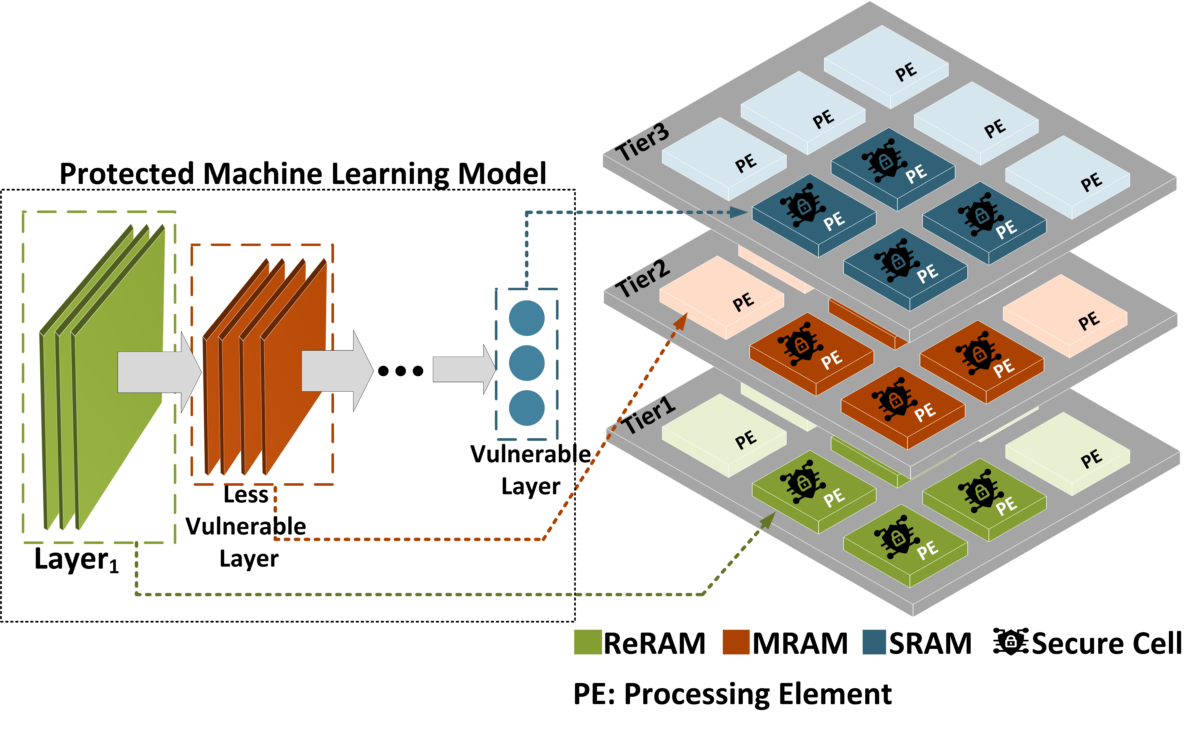
    <img width="1200" height="730" src="https://umbc.edu/wp-content/uploads/2025/01/Karimi-figure-1200x730.png" alt="Schematic shows layers of computing elements." style="max-width: 100%; height: auto;">Karimi and her team will study the security of computing-in-memory architectures, as shown in this project overview. (Image courtesy of Karimi)<p><br></p>
    <p>Karimi’s team will study the security of 3D CiM technologies used in AI applications. In particular, the research will focus on evaluating the security vulnerabilities of the technologies and developing mitigation strategies. </p>
    <p>“I’m excited about this project because the topic is very timely,” says Karimi. “The support from three leading companies in the AI field shows the importance of the problem and the promise of the solutions we are working on.”</p>
    <p>The team aims to enhance the security of CiM-based AI accelerators against physical attacks that adversaries might launch to leak sensitive data or induce malfunctions. The researchers will work closely with the funding companies over the next three years in this area.</p>
    <p>This post was written by <a href="https://umbc.edu/author/cmeyers2/" rel="nofollow external" class="bo">Catherine Meyers</a> and originally published online <a href="https://umbc.edu/quick-posts/naghmeh-karimi-ai-accelerators/" rel="nofollow external" class="bo">here</a>.</p>
    <hr>
    <a href="https://ai.umbc.edu/" rel="nofollow external" class="bo"><strong>UMBC Center for AI</strong></a>
    </div>
]]>
</Body>
<Summary>Naghmeh Karimi, an associate professor in the Department of Computer Science and Electrical Engineering, was recently granted more than $300,000 in funding from the Semiconductor Research...</Summary>
<Website>https://umbc.edu/quick-posts/naghmeh-karimi-ai-accelerators/</Website>
<TrackingUrl>https://my3.my.umbc.edu/api/v0/pixel/news/146738/guest@my.umbc.edu/97c10bda2cac5558508bba82692d4854/api/pixel</TrackingUrl>
<Tag>ai</Tag>
<Tag>cim</Tag>
<Tag>computing-in-memory</Tag>
<Tag>funding</Tag>
<Tag>research</Tag>
<Group token="umbc-ai">UMBC AI</Group>
<GroupUrl>https://my3.my.umbc.edu/groups/umbc-ai</GroupUrl>
<AvatarUrl>https://assets4-my.umbc.edu/system/shared/avatars/groups/000/002/081/cfb27ebe008c2636486089a759ea5c36/xsmall.png?1691095779</AvatarUrl>
<AvatarUrl size="original">https://assets2-my.umbc.edu/system/shared/avatars/groups/000/002/081/cfb27ebe008c2636486089a759ea5c36/original.png?1691095779</AvatarUrl>
<AvatarUrl size="xxlarge">https://assets1-my.umbc.edu/system/shared/avatars/groups/000/002/081/cfb27ebe008c2636486089a759ea5c36/xxlarge.png?1691095779</AvatarUrl>
<AvatarUrl size="xlarge">https://assets1-my.umbc.edu/system/shared/avatars/groups/000/002/081/cfb27ebe008c2636486089a759ea5c36/xlarge.png?1691095779</AvatarUrl>
<AvatarUrl size="large">https://assets1-my.umbc.edu/system/shared/avatars/groups/000/002/081/cfb27ebe008c2636486089a759ea5c36/large.png?1691095779</AvatarUrl>
<AvatarUrl size="medium">https://assets3-my.umbc.edu/system/shared/avatars/groups/000/002/081/cfb27ebe008c2636486089a759ea5c36/medium.png?1691095779</AvatarUrl>
<AvatarUrl size="small">https://assets3-my.umbc.edu/system/shared/avatars/groups/000/002/081/cfb27ebe008c2636486089a759ea5c36/small.png?1691095779</AvatarUrl>
<AvatarUrl size="xsmall">https://assets4-my.umbc.edu/system/shared/avatars/groups/000/002/081/cfb27ebe008c2636486089a759ea5c36/xsmall.png?1691095779</AvatarUrl>
<AvatarUrl size="xxsmall">https://assets1-my.umbc.edu/system/shared/avatars/groups/000/002/081/cfb27ebe008c2636486089a759ea5c36/xxsmall.png?1691095779</AvatarUrl>
<Sponsor>UMBC AI</Sponsor>
<PawCount>0</PawCount>
<CommentCount>0</CommentCount>
<CommentsAllowed>true</CommentsAllowed>
<PostedAt>Sun, 26 Jan 2025 18:33:37 -0500</PostedAt>
</NewsItem>

<NewsItem contentIssues="false" id="146680" important="false" status="posted" url="https://my3.my.umbc.edu/groups/umbc-ai/posts/146680">
<Title>Talk: Securing Networks with Reinforcement Learning &amp; Game Theory</Title>
<Tagline>10-11am Thursday, Jan. 30, 2025; ITE459 and online</Tagline>
<Body>
<![CDATA[
    <div class="html-content">
    <span><h4><span>Securing Distributed Networks: Leveraging Reinforcement Learning and Game Theory for Attack Detection and Mitigation</span></h4>
    <h4>
    <a href="https://ischool.syracuse.edu/md-tariqul-islam-pavel/#Biography" rel="nofollow external" class="bo"><span><strong>Dr. Md Tariqul Islam</strong></span></a><span>, Syracuse University</span>
    </h4>
    <h4>
    <span>10-11am January 30, 2025;  ITE 459, UMBC and </span><a href="https://umbc.webex.com/umbc/j.php?MTID=m47153e19db08254c1e0d30e43cad1b24" rel="nofollow external" class="bo"><span>online</span></a>
    </h4>
    <p><br></p>
    <p><span><a href="https://en.wikipedia.org/wiki/Reinforcement_learning" rel="nofollow external" class="bo"><strong>Reinforcement learning</strong></a> (RL) has demonstrated remarkable success across diverse domains, from mastering complex games to optimizing real-time feedback systems in robotics and industrial control. However, its potential in cybersecurity, particularly for autonomous attack detection and mitigation in distributed systems, remains largely underexplored. Traditional single-agent RL approaches struggle in decentralized environments where multiple entities make independent decisions, necessitating <a href="https://en.wikipedia.org/wiki/Multi-agent_reinforcement_learning" rel="nofollow external" class="bo"><strong>multi-agent reinforcement learning</strong></a> (MARL). Our research explores blockchain networks as an ideal test case due to their decentralized architecture and trustless consensus mechanisms. We developed a novel MARL-based consensus mechanism for Proof-of-Stake blockchains, enabling nodes to collaboratively identify and penalize malicious behavior while preserving decentralization. This approach </span><span>effectively mitigated six major blockchain attack types with minimal computational overhead. Building on these results, we propose integrating game-theoretic principles into the MARL framework to model adversarial strategies and enhance system resilience. The synergy between reinforcement learning and game theory establishes a robust foundation for dynamic and adaptive security in distributed systems, effectively addressing current vulnerabilities while anticipating and countering future threats. This integrated approach enables the design of resilient, scalable defense mechanisms tailored to the complex dynamics of decentralized architectures.</span></p>
    <p><span><br></span></p>
    <a href="https://ischool.syracuse.edu/md-tariqul-islam-pavel/#Biography" rel="nofollow external" class="bo"><span><strong>Dr. Md Tariqul Islam</strong></span></a><span> is an Assistant Professor of Trustworthy Cyberspace in the School of Information Studies (iSchool) at Syracuse University. His research focuses on advancing the security, efficiency, and fault tolerance of networks and distributed systems, particularly in the domains of cloud and blockchain technologies.</span></span><div>
    <span><br></span><hr>
    <a href="https://ai.umbc.edu/" rel="nofollow external" class="bo"><strong>UMBC Center for AI</strong></a> </div>
    </div>
]]>
</Body>
<Summary>Securing Distributed Networks: Leveraging Reinforcement Learning and Game Theory for Attack Detection and Mitigation  Dr. Md Tariqul Islam, Syracuse University  10-11am January 30, 2025;  ITE 459,...</Summary>
<Website>https://informationsystems.umbc.edu/home/calendar/events/</Website>
<TrackingUrl>https://my3.my.umbc.edu/api/v0/pixel/news/146680/guest@my.umbc.edu/bf62a2f97b078a9fbd21ce8220294317/api/pixel</TrackingUrl>
<Tag>agent</Tag>
<Tag>ai</Tag>
<Tag>cybersecurity</Tag>
<Tag>game-theory</Tag>
<Tag>machine-learning</Tag>
<Tag>multiagent</Tag>
<Tag>reinforcement-learning</Tag>
<Group token="umbc-ai">UMBC AI</Group>
<GroupUrl>https://my3.my.umbc.edu/groups/umbc-ai</GroupUrl>
<AvatarUrl>https://assets4-my.umbc.edu/system/shared/avatars/groups/000/002/081/cfb27ebe008c2636486089a759ea5c36/xsmall.png?1691095779</AvatarUrl>
<AvatarUrl size="original">https://assets2-my.umbc.edu/system/shared/avatars/groups/000/002/081/cfb27ebe008c2636486089a759ea5c36/original.png?1691095779</AvatarUrl>
<AvatarUrl size="xxlarge">https://assets1-my.umbc.edu/system/shared/avatars/groups/000/002/081/cfb27ebe008c2636486089a759ea5c36/xxlarge.png?1691095779</AvatarUrl>
<AvatarUrl size="xlarge">https://assets1-my.umbc.edu/system/shared/avatars/groups/000/002/081/cfb27ebe008c2636486089a759ea5c36/xlarge.png?1691095779</AvatarUrl>
<AvatarUrl size="large">https://assets1-my.umbc.edu/system/shared/avatars/groups/000/002/081/cfb27ebe008c2636486089a759ea5c36/large.png?1691095779</AvatarUrl>
<AvatarUrl size="medium">https://assets3-my.umbc.edu/system/shared/avatars/groups/000/002/081/cfb27ebe008c2636486089a759ea5c36/medium.png?1691095779</AvatarUrl>
<AvatarUrl size="small">https://assets3-my.umbc.edu/system/shared/avatars/groups/000/002/081/cfb27ebe008c2636486089a759ea5c36/small.png?1691095779</AvatarUrl>
<AvatarUrl size="xsmall">https://assets4-my.umbc.edu/system/shared/avatars/groups/000/002/081/cfb27ebe008c2636486089a759ea5c36/xsmall.png?1691095779</AvatarUrl>
<AvatarUrl size="xxsmall">https://assets1-my.umbc.edu/system/shared/avatars/groups/000/002/081/cfb27ebe008c2636486089a759ea5c36/xxsmall.png?1691095779</AvatarUrl>
<Sponsor>UMBC AI</Sponsor>
<PawCount>0</PawCount>
<CommentCount>0</CommentCount>
<CommentsAllowed>true</CommentsAllowed>
<PostedAt>Thu, 23 Jan 2025 10:32:43 -0500</PostedAt>
</NewsItem>

<NewsItem contentIssues="true" id="146565" important="false" status="posted" url="https://my3.my.umbc.edu/groups/umbc-ai/posts/146565">
<Title>2024 Gartner Hype Cycle for AI</Title>
<Body>
<![CDATA[
    <div class="html-content">
    <div><a href="https://emt.gartnerweb.com/ngw/globalassets/en/articles/infographics/hype-cycle-for-artificial-intelligence-2024.jpg" rel="nofollow external" class="bo"><img src="https://ai.umbc.edu/wp-content/uploads/sites/734/2025/01/AI_hype-cycle.jpg" style="max-width: 100%; height: auto;"></a></div>
    <div><br></div>
    <div>
    <span>In November 2024, the </span><a href="https://en.wikipedia.org/wiki/Gartner" rel="nofollow external" class="bo"><span>Gartner</span></a><span> company published instances of its popular </span><a href="https://en.wikipedia.org/wiki/Gartner_hype_cycle" rel="nofollow external" class="bo"><span>hype cycles</span></a><span> on AI in general and the narrower topic of generative AI. While generative AI is still a dominating technology, Gartner identifies </span><a href="https://en.wikipedia.org/wiki/Artificial_intelligence_engineering" rel="nofollow external" class="bo"><span>AI engineering</span></a><span> and </span><a href="https://en.wikipedia.org/wiki/Knowledge_graph" rel="nofollow external" class="bo"><span>knowledge graphs</span></a><span> as the two biggest movers in their </span><a href="https://www.gartner.com/en/articles/hype-cycle-for-artificial-intelligence" rel="nofollow external" class="bo"><span><strong>2024 AI Hype Cycle</strong></span></a><span>. </span><span>AI Engineering was placed at the “peak of inflated expectations”, and knowledge graphs on the cycle’s “slope of enlightenment”. </span>
    </div>
    <div>Gartner defines AI engineering as</div>
    <blockquote>
    <div><span><br></span></div>
    <div><span>"AI engineering unites various disciplines from across the organization to tame the AI hype while providing a clearer path to value when operationalizing the combination of multiple AI techniques (including GenAI models). It also includes responsible AI, dealing with risk, trust, transparency, ethics, fairness, and accountability." </span></div>
    <div><span><br></span></div>
    </blockquote>
    <span>and knowledge graphs as</span><div>
    <span><br></span><blockquote>
    <div><span>"Knowledge graphs are machine-readable representations of the physical and digital worlds. They capture information in a visually intuitive format, yet are still able to represent complex relationships. More importantly, they provide dependable logic and explainable reasoning (as opposed to GenAI’s fallible but powerful predictive capabilities)."</span></div>
    <div><span><br></span></div>
    </blockquote>
    </div>
    <hr>
    <a href="https://ai.umbc.edu/" rel="nofollow external" class="bo"><strong>UMBC Center for AI</strong></a>
    </div>
]]>
</Body>
<Summary>In November 2024, the Gartner company published instances of its popular hype cycles on AI in general and the narrower topic of generative AI. While generative AI is still a dominating technology,...</Summary>
<Website>https://www.gartner.com/en/articles/hype-cycle-for-artificial-intelligence</Website>
<TrackingUrl>https://my3.my.umbc.edu/api/v0/pixel/news/146565/guest@my.umbc.edu/54937961f9343d0717ecf7e816a15f99/api/pixel</TrackingUrl>
<Tag>ai</Tag>
<Tag>ai-engineering</Tag>
<Tag>hype-cycle</Tag>
<Tag>knowledge-graph</Tag>
<Group token="umbc-ai">UMBC AI</Group>
<GroupUrl>https://my3.my.umbc.edu/groups/umbc-ai</GroupUrl>
<AvatarUrl>https://assets4-my.umbc.edu/system/shared/avatars/groups/000/002/081/cfb27ebe008c2636486089a759ea5c36/xsmall.png?1691095779</AvatarUrl>
<AvatarUrl size="original">https://assets2-my.umbc.edu/system/shared/avatars/groups/000/002/081/cfb27ebe008c2636486089a759ea5c36/original.png?1691095779</AvatarUrl>
<AvatarUrl size="xxlarge">https://assets1-my.umbc.edu/system/shared/avatars/groups/000/002/081/cfb27ebe008c2636486089a759ea5c36/xxlarge.png?1691095779</AvatarUrl>
<AvatarUrl size="xlarge">https://assets1-my.umbc.edu/system/shared/avatars/groups/000/002/081/cfb27ebe008c2636486089a759ea5c36/xlarge.png?1691095779</AvatarUrl>
<AvatarUrl size="large">https://assets1-my.umbc.edu/system/shared/avatars/groups/000/002/081/cfb27ebe008c2636486089a759ea5c36/large.png?1691095779</AvatarUrl>
<AvatarUrl size="medium">https://assets3-my.umbc.edu/system/shared/avatars/groups/000/002/081/cfb27ebe008c2636486089a759ea5c36/medium.png?1691095779</AvatarUrl>
<AvatarUrl size="small">https://assets3-my.umbc.edu/system/shared/avatars/groups/000/002/081/cfb27ebe008c2636486089a759ea5c36/small.png?1691095779</AvatarUrl>
<AvatarUrl size="xsmall">https://assets4-my.umbc.edu/system/shared/avatars/groups/000/002/081/cfb27ebe008c2636486089a759ea5c36/xsmall.png?1691095779</AvatarUrl>
<AvatarUrl size="xxsmall">https://assets1-my.umbc.edu/system/shared/avatars/groups/000/002/081/cfb27ebe008c2636486089a759ea5c36/xxsmall.png?1691095779</AvatarUrl>
<Sponsor>UMBC AI</Sponsor>
<PawCount>0</PawCount>
<CommentCount>0</CommentCount>
<CommentsAllowed>true</CommentsAllowed>
<PostedAt>Tue, 14 Jan 2025 18:59:40 -0500</PostedAt>
<EditAt>Wed, 15 Jan 2025 06:21:22 -0500</EditAt>
</NewsItem>

<NewsItem contentIssues="true" id="146529" important="false" status="posted" url="https://my3.my.umbc.edu/groups/umbc-ai/posts/146529">
<Title>Ramana Vinjamuri co-authors book on embedded systems and robotics</Title>
<Tagline>A practical guide for undergraduate and graduate students</Tagline>
<Body>
<![CDATA[
    <div class="html-content">
    <span><h3>
    <span>Introduction to Embedded Systems and Robotics, A Practical Guide</span><br>
    </h3>
    <h4><span>Nayan Kakoty, Rupam Goswami and Ramana Vinjamuri</span></h4>
    <p><span><br></span></p>
    <p><span>UMBC CSEE professor </span><a href="https://www.csee.umbc.edu/ramana-vinjamuri/" rel="nofollow external" class="bo"><span><strong>Ramana Vinjamuri</strong></span></a><span> is one of the authors of a new book, </span><a href="https://link.springer.com/book/10.1007/978-3-031-73098-6" rel="nofollow external" class="bo"><span><strong>Introduction to Embedded Systems and Robotics</strong></span></a><span><strong>,</strong> published by Springer in December 2024. It is a technical guide to the fundamentals of embedded systems and robotics and their application to practical problems.</span></p>
    <p><span>The book is designed to be appropriate for both undergraduate and graduate students and serve as a practical guide for doing robotics projects in their final semesters. </span><span>It is written to cover the “ABC of embedded systems and robotics: A for acquiring the concepts, B for building robotic systems, and C for creating solutions.” It:</span></p>
    <ul>
    <li><span>Includes solved problems at the end of each chapter</span></li>
    <li><span>Features projects, such as developing a robotic hand and developing a biomimetic prosthetic finger</span></li>
    <li><span>Introduces robotics to undergraduate and graduate scholars using plain language and with the aid of practical problems</span></li>
    </ul></span>
    <hr>
    <a href="https://ai.umbc.edu/" rel="nofollow external" class="bo"><strong>UMBC Center for AI</strong></a>
    </div>
]]>
</Body>
<Summary>Introduction to Embedded Systems and Robotics, A Practical Guide   Nayan Kakoty, Rupam Goswami and Ramana Vinjamuri     UMBC CSEE professor Ramana Vinjamuri is one of the authors of a new book,...</Summary>
<Website>https://link.springer.com/book/10.1007/978-3-031-73098-6</Website>
<TrackingUrl>https://my3.my.umbc.edu/api/v0/pixel/news/146529/guest@my.umbc.edu/10e557a09afdfe7ed78aa5a16db38887/api/pixel</TrackingUrl>
<Tag>ai</Tag>
<Tag>book</Tag>
<Tag>robotics</Tag>
<Group token="umbc-ai">UMBC AI</Group>
<GroupUrl>https://my3.my.umbc.edu/groups/umbc-ai</GroupUrl>
<AvatarUrl>https://assets4-my.umbc.edu/system/shared/avatars/groups/000/002/081/cfb27ebe008c2636486089a759ea5c36/xsmall.png?1691095779</AvatarUrl>
<AvatarUrl size="original">https://assets2-my.umbc.edu/system/shared/avatars/groups/000/002/081/cfb27ebe008c2636486089a759ea5c36/original.png?1691095779</AvatarUrl>
<AvatarUrl size="xxlarge">https://assets1-my.umbc.edu/system/shared/avatars/groups/000/002/081/cfb27ebe008c2636486089a759ea5c36/xxlarge.png?1691095779</AvatarUrl>
<AvatarUrl size="xlarge">https://assets1-my.umbc.edu/system/shared/avatars/groups/000/002/081/cfb27ebe008c2636486089a759ea5c36/xlarge.png?1691095779</AvatarUrl>
<AvatarUrl size="large">https://assets1-my.umbc.edu/system/shared/avatars/groups/000/002/081/cfb27ebe008c2636486089a759ea5c36/large.png?1691095779</AvatarUrl>
<AvatarUrl size="medium">https://assets3-my.umbc.edu/system/shared/avatars/groups/000/002/081/cfb27ebe008c2636486089a759ea5c36/medium.png?1691095779</AvatarUrl>
<AvatarUrl size="small">https://assets3-my.umbc.edu/system/shared/avatars/groups/000/002/081/cfb27ebe008c2636486089a759ea5c36/small.png?1691095779</AvatarUrl>
<AvatarUrl size="xsmall">https://assets4-my.umbc.edu/system/shared/avatars/groups/000/002/081/cfb27ebe008c2636486089a759ea5c36/xsmall.png?1691095779</AvatarUrl>
<AvatarUrl size="xxsmall">https://assets1-my.umbc.edu/system/shared/avatars/groups/000/002/081/cfb27ebe008c2636486089a759ea5c36/xxsmall.png?1691095779</AvatarUrl>
<Sponsor>UMBC AI</Sponsor>
<ThumbnailUrl size="xxlarge">https://assets4-my.umbc.edu/system/shared/thumbnails/news/000/146/529/a21fd7ab3caad45d0d3f30841bbb757a/xxlarge.jpg?1736722004</ThumbnailUrl>
<ThumbnailUrl size="xlarge">https://assets3-my.umbc.edu/system/shared/thumbnails/news/000/146/529/a21fd7ab3caad45d0d3f30841bbb757a/xlarge.jpg?1736722004</ThumbnailUrl>
<ThumbnailUrl size="large">https://assets2-my.umbc.edu/system/shared/thumbnails/news/000/146/529/a21fd7ab3caad45d0d3f30841bbb757a/large.jpg?1736722004</ThumbnailUrl>
<ThumbnailUrl size="medium">https://assets3-my.umbc.edu/system/shared/thumbnails/news/000/146/529/a21fd7ab3caad45d0d3f30841bbb757a/medium.jpg?1736722004</ThumbnailUrl>
<ThumbnailUrl size="small">https://assets2-my.umbc.edu/system/shared/thumbnails/news/000/146/529/a21fd7ab3caad45d0d3f30841bbb757a/small.jpg?1736722004</ThumbnailUrl>
<ThumbnailUrl size="xsmall">https://assets3-my.umbc.edu/system/shared/thumbnails/news/000/146/529/a21fd7ab3caad45d0d3f30841bbb757a/xsmall.jpg?1736722004</ThumbnailUrl>
<ThumbnailUrl size="xxsmall">https://assets3-my.umbc.edu/system/shared/thumbnails/news/000/146/529/a21fd7ab3caad45d0d3f30841bbb757a/xxsmall.jpg?1736722004</ThumbnailUrl>
<PawCount>0</PawCount>
<CommentCount>0</CommentCount>
<CommentsAllowed>true</CommentsAllowed>
<PostedAt>Sun, 12 Jan 2025 18:09:52 -0500</PostedAt>
</NewsItem>

</News>
