<?xml version="1.0"?>
<News hasArchived="false" page="27" pageCount="40" pageSize="10" timestamp="Thu, 03 Sep 2026 06:53:02 -0400" url="https://my3.my.umbc.edu/groups/umbc-ai/posts.xml?mode=activity&amp;page=27">
<NewsItem contentIssues="true" id="145919" important="false" status="posted" url="https://my3.my.umbc.edu/groups/umbc-ai/posts/145919">
<Title>Teaching with AI: two workshops for UMBC faculty and staff, January 23</Title>
<Tagline>In person in PAHB 337 on Thursday, January 23, 2024</Tagline>
<Body>
<![CDATA[
    <div class="html-content">
    <span><p><span>Dr. <a href="https://josebowen.com/" rel="nofollow external" class="bo"><strong>José Antonio Bowen</strong></a> will visit UMBC on </span><span>Thursday, January 23,</span><span> to lead two in-person workshops for UMBC faculty and staff based on his book </span><a href="https://www.press.jhu.edu/books/title/53869/teaching-ai" rel="nofollow external" class="bo"><span><strong>Teaching with AI</strong></span></a><span>, co-authored with C. Edward Watson, JHU Press, 2024.</span></p>
    <p><span>Get more information on the workshops and register in the links below to ensure seating, workshop materials, and lunch or coffee and snacks. </span></p>
    <p><span>Registration closes on Thursday, January 16. </span></p>
    <ul>
    <li>
    <a href="https://my3.my.umbc.edu/groups/calt/events/136407" rel="nofollow external" class="bo"></a><a href="https://my3.my.umbc.edu/groups/calt/events/136407" rel="nofollow external" class="bo"><span><strong>AI Literacy &amp; Prompt Engineering</strong></span></a><span>, (with lunch): 12:00-1:45pm;  </span><a href="https://my3.my.umbc.edu/groups/calt/events/136407" rel="nofollow external" class="bo"><span><strong>REGISTER HERE</strong></span></a>
    
    </li>
    <li>
    <a href="https://my3.my.umbc.edu/groups/calt/events/136408" rel="nofollow external" class="bo"><span><strong>AI Assignments &amp; Assessments</strong></span></a><span> (coffee &amp; snacks): 2:00-3:15pm. - </span><a href="https://my3.my.umbc.edu/groups/calt/events/136408" rel="nofollow external" class="bo"><span><strong>REGISTER HERE</strong></span></a>
    </li>
    </ul></span><div><span><p><span>These will be in-person only workshops in PAHB 337 (The Dance Cube). You may register for one or both workshops. This topics are especially relevant as we navigate new possibilities and challenges arising for teaching and learning in the era of generative AI. </span>Please bring a device to the workshops.</p>
    <p><span>The workshops are only open to UMBC faculty and staff.</span></p>
    <div><br></div></span></div>
    <hr>
    <a href="https://ai.umbc.edu/" rel="nofollow external" class="bo"><strong>UMBC Center for AI</strong></a>
    </div>
]]>
</Body>
<Summary>Dr. José Antonio Bowen will visit UMBC on Thursday, January 23, to lead two in-person workshops for UMBC faculty and staff based on his book Teaching with AI, co-authored with C. Edward Watson,...</Summary>
<Website>https://my3.my.umbc.edu/groups/calt/events/136406</Website>
<TrackingUrl>https://my3.my.umbc.edu/api/v0/pixel/news/145919/guest@my.umbc.edu/252fa6a2479528105e54329f30a051f0/api/pixel</TrackingUrl>
<Tag>ai</Tag>
<Tag>education</Tag>
<Tag>teaching</Tag>
<Group token="umbc-ai">UMBC AI</Group>
<GroupUrl>https://my3.my.umbc.edu/groups/umbc-ai</GroupUrl>
<AvatarUrl>https://assets4-my.umbc.edu/system/shared/avatars/groups/000/002/081/cfb27ebe008c2636486089a759ea5c36/xsmall.png?1691095779</AvatarUrl>
<AvatarUrl size="original">https://assets2-my.umbc.edu/system/shared/avatars/groups/000/002/081/cfb27ebe008c2636486089a759ea5c36/original.png?1691095779</AvatarUrl>
<AvatarUrl size="xxlarge">https://assets1-my.umbc.edu/system/shared/avatars/groups/000/002/081/cfb27ebe008c2636486089a759ea5c36/xxlarge.png?1691095779</AvatarUrl>
<AvatarUrl size="xlarge">https://assets1-my.umbc.edu/system/shared/avatars/groups/000/002/081/cfb27ebe008c2636486089a759ea5c36/xlarge.png?1691095779</AvatarUrl>
<AvatarUrl size="large">https://assets1-my.umbc.edu/system/shared/avatars/groups/000/002/081/cfb27ebe008c2636486089a759ea5c36/large.png?1691095779</AvatarUrl>
<AvatarUrl size="medium">https://assets3-my.umbc.edu/system/shared/avatars/groups/000/002/081/cfb27ebe008c2636486089a759ea5c36/medium.png?1691095779</AvatarUrl>
<AvatarUrl size="small">https://assets3-my.umbc.edu/system/shared/avatars/groups/000/002/081/cfb27ebe008c2636486089a759ea5c36/small.png?1691095779</AvatarUrl>
<AvatarUrl size="xsmall">https://assets4-my.umbc.edu/system/shared/avatars/groups/000/002/081/cfb27ebe008c2636486089a759ea5c36/xsmall.png?1691095779</AvatarUrl>
<AvatarUrl size="xxsmall">https://assets1-my.umbc.edu/system/shared/avatars/groups/000/002/081/cfb27ebe008c2636486089a759ea5c36/xxsmall.png?1691095779</AvatarUrl>
<Sponsor>Faculty Development Center and Instructional Technology</Sponsor>
<ThumbnailUrl size="xxlarge">https://assets1-my.umbc.edu/system/shared/thumbnails/news/000/145/919/6341b3ec1e76cef1e6e15ec34a3b6c51/xxlarge.jpg?1732635577</ThumbnailUrl>
<ThumbnailUrl size="xlarge">https://assets2-my.umbc.edu/system/shared/thumbnails/news/000/145/919/6341b3ec1e76cef1e6e15ec34a3b6c51/xlarge.jpg?1732635577</ThumbnailUrl>
<ThumbnailUrl size="large">https://assets3-my.umbc.edu/system/shared/thumbnails/news/000/145/919/6341b3ec1e76cef1e6e15ec34a3b6c51/large.jpg?1732635577</ThumbnailUrl>
<ThumbnailUrl size="medium">https://assets2-my.umbc.edu/system/shared/thumbnails/news/000/145/919/6341b3ec1e76cef1e6e15ec34a3b6c51/medium.jpg?1732635577</ThumbnailUrl>
<ThumbnailUrl size="small">https://assets3-my.umbc.edu/system/shared/thumbnails/news/000/145/919/6341b3ec1e76cef1e6e15ec34a3b6c51/small.jpg?1732635577</ThumbnailUrl>
<ThumbnailUrl size="xsmall">https://assets3-my.umbc.edu/system/shared/thumbnails/news/000/145/919/6341b3ec1e76cef1e6e15ec34a3b6c51/xsmall.jpg?1732635577</ThumbnailUrl>
<ThumbnailUrl size="xxsmall">https://assets3-my.umbc.edu/system/shared/thumbnails/news/000/145/919/6341b3ec1e76cef1e6e15ec34a3b6c51/xxsmall.jpg?1732635577</ThumbnailUrl>
<PawCount>2</PawCount>
<CommentCount>0</CommentCount>
<CommentsAllowed>true</CommentsAllowed>
<PostedAt>Tue, 26 Nov 2024 11:19:58 -0500</PostedAt>
<EditAt>Tue, 26 Nov 2024 11:26:52 -0500</EditAt>
</NewsItem>

<NewsItem contentIssues="true" id="145869" important="false" status="posted" url="https://my3.my.umbc.edu/groups/umbc-ai/posts/145869">
<Title>Talk: Advancing machine learning methodology for applications in gerontology</Title>
<Tagline>11-12pm EST Mon, Dec. 11, 2024, U. MD, Baltimore &amp; online</Tagline>
<Body>
<![CDATA[
    <div class="html-content">
    <span><h4><span>Advancing machine learning methodology for applications in gerontology</span></h4>
    <h5><span><strong>Dr. Jaime Lynn Speiser, Wake Forest University School of Medicine</strong></span></h5>
    <h5><span>11-12pm EST Mon, Dec. 11, 2024
    U. of Maryland, Baltimore &amp; online</span></h5>
    <p><span> </span></p>
    <p><span>Prediction models aim to help medical providers, individuals, and caretakers make informed, data-driven decisions about the risk of developing poor health outcomes, such as fall injury or mobility limitation in older adults. Most models for outcomes in older adults use cross-sectional data, although leveraging repeated measurements of predictors and outcomes over time may result in higher prediction accuracy. This seminar talk will focus on a novel methodology for longitudinal, repeated measures prediction models called </span><a href="https://pmc.ncbi.nlm.nih.gov/articles/PMC7202553/" rel="nofollow external" class="bo"><span><strong>Binary Mixed Model</strong></span></a><span>(BiMM) forest. I will give an overview of longitudinal data analysis and introduce the BiMM forest method with variable selection. I will then apply a <a href="https://my3.my.umbc.edu/groups/umbc-ai/posts/145869/a6c/f588885d3b4504deabc0a0dbb602ca78/web/link?link=https%3A%2F%2Fpmc.ncbi.nlm.nih.gov%2Farticles%2FPMC7508310%2F" rel="nofollow external" class="bo"><strong>BiMM forest</strong></a> for predicting mobility limitation in older adults using the Health, Aging, and Body Composition dataset.</span></p>
    <p><a href="https://school.wakehealth.edu/faculty/s/jaime-lynn-speiser" rel="nofollow external" class="bo"><span><strong>Dr. Speiser</strong></span></a><span> received her B.S. in mathematics at Elon University and M.S. in statistics at the Ohio State University. She completed her Ph.D. in biostatistics at the Medical University of South Carolina, where she was awarded the Distinguished Graduate Student Award at the top of her class. Dr. Speiser received the Lester R Curtin Award from the American Statistical Association and several conference travel awards. She serves on the executive committees of the American Statistical Association’s Statistical Learning and Data Science Section and Statistics and Data Science in Aging Interest Group. Dr. Speiser is currently funded by an NIH K25 award and is the Leadership Fellow for Wake Forest’s Pepper Center and Clinical and Translational Research Institute. Her paper comparing </span><a href="https://pmc.ncbi.nlm.nih.gov/articles/PMC7508310/" rel="nofollow external" class="bo"><span><strong>random forest variable selection methods</strong></span></a><span> is a top-cited paper in the journal Expert Systems with Applications with over 1000 citations.</span></p>
    <p><strong><a href="https://umaryland.zoom.us/meeting/register/tJIvdOmorj0oGNOCDwqZyuuL0WYoeVAPshsM" rel="nofollow external" class="bo"><span>Register here to get a Zoom link.</span></a><span> </span></strong></p></span>
    <hr>
    <a href="https://ai.umbc.edu/" rel="nofollow external" class="bo"><strong>UMBC Center for AI</strong></a>
    </div>
]]>
</Body>
<Summary>Advancing machine learning methodology for applications in gerontology  Dr. Jaime Lynn Speiser, Wake Forest University School of Medicine  11-12pm EST Mon, Dec. 11, 2024 U. of Maryland, Baltimore...</Summary>
<TrackingUrl>https://my3.my.umbc.edu/api/v0/pixel/news/145869/guest@my.umbc.edu/61cca87e90ed043807336ba719378e6a/api/pixel</TrackingUrl>
<Tag>ai</Tag>
<Tag>bimm</Tag>
<Tag>gerontology</Tag>
<Tag>machine-learning</Tag>
<Group token="umbc-ai">UMBC AI</Group>
<GroupUrl>https://my3.my.umbc.edu/groups/umbc-ai</GroupUrl>
<AvatarUrl>https://assets4-my.umbc.edu/system/shared/avatars/groups/000/002/081/cfb27ebe008c2636486089a759ea5c36/xsmall.png?1691095779</AvatarUrl>
<AvatarUrl size="original">https://assets2-my.umbc.edu/system/shared/avatars/groups/000/002/081/cfb27ebe008c2636486089a759ea5c36/original.png?1691095779</AvatarUrl>
<AvatarUrl size="xxlarge">https://assets1-my.umbc.edu/system/shared/avatars/groups/000/002/081/cfb27ebe008c2636486089a759ea5c36/xxlarge.png?1691095779</AvatarUrl>
<AvatarUrl size="xlarge">https://assets1-my.umbc.edu/system/shared/avatars/groups/000/002/081/cfb27ebe008c2636486089a759ea5c36/xlarge.png?1691095779</AvatarUrl>
<AvatarUrl size="large">https://assets1-my.umbc.edu/system/shared/avatars/groups/000/002/081/cfb27ebe008c2636486089a759ea5c36/large.png?1691095779</AvatarUrl>
<AvatarUrl size="medium">https://assets3-my.umbc.edu/system/shared/avatars/groups/000/002/081/cfb27ebe008c2636486089a759ea5c36/medium.png?1691095779</AvatarUrl>
<AvatarUrl size="small">https://assets3-my.umbc.edu/system/shared/avatars/groups/000/002/081/cfb27ebe008c2636486089a759ea5c36/small.png?1691095779</AvatarUrl>
<AvatarUrl size="xsmall">https://assets4-my.umbc.edu/system/shared/avatars/groups/000/002/081/cfb27ebe008c2636486089a759ea5c36/xsmall.png?1691095779</AvatarUrl>
<AvatarUrl size="xxsmall">https://assets1-my.umbc.edu/system/shared/avatars/groups/000/002/081/cfb27ebe008c2636486089a759ea5c36/xxsmall.png?1691095779</AvatarUrl>
<Sponsor>UMB Division of Biostatistics and Bioinformatics</Sponsor>
<ThumbnailUrl size="xxlarge">https://assets3-my.umbc.edu/system/shared/thumbnails/news/000/145/869/b50d069a3dc392b5cc6bd27e5895b7da/xxlarge.jpg?1732399676</ThumbnailUrl>
<ThumbnailUrl size="xlarge">https://assets2-my.umbc.edu/system/shared/thumbnails/news/000/145/869/b50d069a3dc392b5cc6bd27e5895b7da/xlarge.jpg?1732399676</ThumbnailUrl>
<ThumbnailUrl size="large">https://assets2-my.umbc.edu/system/shared/thumbnails/news/000/145/869/b50d069a3dc392b5cc6bd27e5895b7da/large.jpg?1732399676</ThumbnailUrl>
<ThumbnailUrl size="medium">https://assets2-my.umbc.edu/system/shared/thumbnails/news/000/145/869/b50d069a3dc392b5cc6bd27e5895b7da/medium.jpg?1732399676</ThumbnailUrl>
<ThumbnailUrl size="small">https://assets1-my.umbc.edu/system/shared/thumbnails/news/000/145/869/b50d069a3dc392b5cc6bd27e5895b7da/small.jpg?1732399676</ThumbnailUrl>
<ThumbnailUrl size="xsmall">https://assets4-my.umbc.edu/system/shared/thumbnails/news/000/145/869/b50d069a3dc392b5cc6bd27e5895b7da/xsmall.jpg?1732399676</ThumbnailUrl>
<ThumbnailUrl size="xxsmall">https://assets3-my.umbc.edu/system/shared/thumbnails/news/000/145/869/b50d069a3dc392b5cc6bd27e5895b7da/xxsmall.jpg?1732399676</ThumbnailUrl>
<PawCount>0</PawCount>
<CommentCount>0</CommentCount>
<CommentsAllowed>true</CommentsAllowed>
<PostedAt>Sat, 23 Nov 2024 17:29:15 -0500</PostedAt>
<EditAt>Sat, 23 Nov 2024 17:42:48 -0500</EditAt>
</NewsItem>

<NewsItem contentIssues="true" id="145840" important="false" status="posted" url="https://my3.my.umbc.edu/groups/umbc-ai/posts/145840">
<Title>AI4ALL Ignite free AI program for 2025</Title>
<Body>
<![CDATA[
    <div class="html-content">
    <div>
    <a href="https://bit.ly/3AQcpC2" rel="nofollow external" class="bo"><span><strong>AI4ALL Ignite</strong></span></a><span> is a no-cost virtual career accelerator program for undergraduate students that is designed to boost your internship <span>and</span> other AI work opportunities.</span>
    </div>
    <div>
    <ul>
    <li>
    <span>Develop a real-world AI technical portfolio project using data alongside </span><span><strong>AI industry mentors and peers</strong></span><span>.</span>
    </li>
    <li>Master responsible AI concepts through <span><strong>hands-on workshops and invigorating discussions.</strong></span>
    </li>
    <li>Get tailored AI career readiness &amp; face-time with industry recruiters from companies like <span><strong>NVIDIA, Microsoft, and Amazon.</strong></span>
    </li>
    </ul>
    <p><span><strong>Why Participate?</strong></span></p>
    <ul>
    <li>
    <span><strong>AI Career Readiness Training &amp; Virtual Symposium:</strong></span><span> Technical interview prep to answer problem-solving questions, mock interviews with industry professionals, resume and job search prep,  and a virtual student symposium.</span>
    </li>
    <li>
    <strong>Exclusive Networking Opportunities: </strong><span>Mentorship from AI industry mentors, company opportunity chats.</span>
    </li>
    <li>
    <strong>Gain a Responsible AI Lens:</strong><span> Participate in AI  discussions on  topics like responsible AI, data sourcing + visualization, machine learning methods, bias mitigation, project management, Github <span>and</span> more.</span>
    </li>
    <li><strong>Achieve an AI4ALL Certificate of Completion</strong></li>
    </ul>
    <p><span><strong>To Le</strong></span><span><strong>arn More</strong></span></p>
    <ul>
    <li><span><a href="https://drive.google.com/file/d/1yfYBpQT5kYyC8vf1ZL1Ksq0ZJyDbXycA/view?usp=drive_link" rel="nofollow external" class="bo">See this flyer</a></span></li>
    <li><a href="https://bit.ly/3AQcpC2" rel="nofollow external" class="bo">Submit <span>an </span>Interest Form</a></li>
    <li>
    <a href="https://bit.ly/40VEqTE" rel="nofollow external" class="bo"><span>SignUp</span></a><span> f</span><span>or</span><span> AI Networks of Opportunity Newsletter</span>
    </li>
    <li>
    <a href="https://bit.ly/40UleWj" rel="nofollow external" class="bo"><span>RSVP</span></a><span> to AI4ALL<span> for a</span> live <span>online</span> info session</span>
    </li>
    </ul>
    <br><p><span>While all undergraduate students are welcome to apply and will be considered,  <span>AI4ALL</span> especially encourages applications from individuals whose race, gender, or ethnicity have been historically underrepresented in AI. This includes students identifying as women, non-binary individuals, Black, Hispanic/Latinx, and Indigenous people.</span></p>
    <p><span><br></span></p>
    </div> <hr>
    <a href="https://ai.umbc.edu/" rel="nofollow external" class="bo"><strong>UMBC Center for AI</strong></a>
    </div>
]]>
</Body>
<Summary>AI4ALL Ignite is a no-cost virtual career accelerator program for undergraduate students that is designed to boost your internship and other AI work opportunities.    Develop a real-world AI...</Summary>
<Website>https://ai-4-all.org/ai4all-ignite/</Website>
<TrackingUrl>https://my3.my.umbc.edu/api/v0/pixel/news/145840/guest@my.umbc.edu/d8e380e5aec23e90e45fb32f63cb70de/api/pixel</TrackingUrl>
<Tag>ai</Tag>
<Tag>ai4all</Tag>
<Tag>au4all-ignite</Tag>
<Group token="umbc-ai">UMBC AI</Group>
<GroupUrl>https://my3.my.umbc.edu/groups/umbc-ai</GroupUrl>
<AvatarUrl>https://assets4-my.umbc.edu/system/shared/avatars/groups/000/002/081/cfb27ebe008c2636486089a759ea5c36/xsmall.png?1691095779</AvatarUrl>
<AvatarUrl size="original">https://assets2-my.umbc.edu/system/shared/avatars/groups/000/002/081/cfb27ebe008c2636486089a759ea5c36/original.png?1691095779</AvatarUrl>
<AvatarUrl size="xxlarge">https://assets1-my.umbc.edu/system/shared/avatars/groups/000/002/081/cfb27ebe008c2636486089a759ea5c36/xxlarge.png?1691095779</AvatarUrl>
<AvatarUrl size="xlarge">https://assets1-my.umbc.edu/system/shared/avatars/groups/000/002/081/cfb27ebe008c2636486089a759ea5c36/xlarge.png?1691095779</AvatarUrl>
<AvatarUrl size="large">https://assets1-my.umbc.edu/system/shared/avatars/groups/000/002/081/cfb27ebe008c2636486089a759ea5c36/large.png?1691095779</AvatarUrl>
<AvatarUrl size="medium">https://assets3-my.umbc.edu/system/shared/avatars/groups/000/002/081/cfb27ebe008c2636486089a759ea5c36/medium.png?1691095779</AvatarUrl>
<AvatarUrl size="small">https://assets3-my.umbc.edu/system/shared/avatars/groups/000/002/081/cfb27ebe008c2636486089a759ea5c36/small.png?1691095779</AvatarUrl>
<AvatarUrl size="xsmall">https://assets4-my.umbc.edu/system/shared/avatars/groups/000/002/081/cfb27ebe008c2636486089a759ea5c36/xsmall.png?1691095779</AvatarUrl>
<AvatarUrl size="xxsmall">https://assets1-my.umbc.edu/system/shared/avatars/groups/000/002/081/cfb27ebe008c2636486089a759ea5c36/xxsmall.png?1691095779</AvatarUrl>
<Sponsor>UMBC AI</Sponsor>
<ThumbnailUrl size="xxlarge">https://assets4-my.umbc.edu/system/shared/thumbnails/news/000/145/840/ec8ae621b47d1c049ded3ad446fe609a/xxlarge.jpg?1732293994</ThumbnailUrl>
<ThumbnailUrl size="xlarge">https://assets2-my.umbc.edu/system/shared/thumbnails/news/000/145/840/ec8ae621b47d1c049ded3ad446fe609a/xlarge.jpg?1732293994</ThumbnailUrl>
<ThumbnailUrl size="large">https://assets1-my.umbc.edu/system/shared/thumbnails/news/000/145/840/ec8ae621b47d1c049ded3ad446fe609a/large.jpg?1732293994</ThumbnailUrl>
<ThumbnailUrl size="medium">https://assets2-my.umbc.edu/system/shared/thumbnails/news/000/145/840/ec8ae621b47d1c049ded3ad446fe609a/medium.jpg?1732293994</ThumbnailUrl>
<ThumbnailUrl size="small">https://assets4-my.umbc.edu/system/shared/thumbnails/news/000/145/840/ec8ae621b47d1c049ded3ad446fe609a/small.jpg?1732293994</ThumbnailUrl>
<ThumbnailUrl size="xsmall">https://assets1-my.umbc.edu/system/shared/thumbnails/news/000/145/840/ec8ae621b47d1c049ded3ad446fe609a/xsmall.jpg?1732293994</ThumbnailUrl>
<ThumbnailUrl size="xxsmall">https://assets4-my.umbc.edu/system/shared/thumbnails/news/000/145/840/ec8ae621b47d1c049ded3ad446fe609a/xxsmall.jpg?1732293994</ThumbnailUrl>
<PawCount>0</PawCount>
<CommentCount>0</CommentCount>
<CommentsAllowed>true</CommentsAllowed>
<PostedAt>Fri, 22 Nov 2024 12:01:31 -0500</PostedAt>
<EditAt>Fri, 22 Nov 2024 12:02:42 -0500</EditAt>
</NewsItem>

<NewsItem contentIssues="true" id="145742" important="false" status="posted" url="https://my3.my.umbc.edu/groups/umbc-ai/posts/145742">
<Title>Strengthening Image Generative AI: Integrating Fingerprinting and Revision Methods for Enhanced Safety and Control</Title>
<Tagline>4-5:15pm EST, Monday Nov 25, Math&amp;Psych 106 and online</Tagline>
<Body>
<![CDATA[
    <div class="html-content">
    <h4>Strengthening Image Generative AI: Integrating Fingerprinting and Revision Methods for Enhanced Safety and Control</h4>
    <h4>4-5:15pm EST, Monday Nov 25, Math&amp;Psych 106 &amp; <a href="https://umbc.webex.com/meet/gokhale" rel="nofollow external" class="bo">online </a>
    </h4>
    <div><br></div>
    <div><br></div>
    <div>In the rapidly evolving field of <a href="https://en.wikipedia.org/wiki/Generative_artificial_intelligence" rel="nofollow external" class="bo"><strong>Generative Artificial Intelligence</strong></a> (Gen-AI) for imaging, models such as DALL·E3 and Stable Diffusion have transitioned from theoretical concepts to practical tools with significant impact across various sectors including entertainment, art, journalism, and education. These advancements represent a substantial technological evolution, enhancing creative and professional practices. However, the widespread accessibility of Gen-AI also facilitates misuse by malicious actors who create deepfakes and spread misinformation, posing serious risks to societal well-being and privacy. This talk will address these critical challenges by focusing on enhancing the reliability of Image Gen-AI models through the identification and mitigation of inherent vulnerabilities and the development of computational tools and frameworks for enabling better community oversight. The talk will describe the development of innovative fingerprinting techniques that trace malicious Gen-AI outputs back to their sources, and the implementation of strategies to prevent the generation of unauthorized content. These efforts collectively strengthen the robustness and accountability of Gen-AI technologies, particularly in sensitive applications.</div>
    <div> </div>
    <div>
    <a href="https://www.changhoonkim.com/" rel="nofollow external" class="bo"><strong>Dr. Changhoon Kim</strong></a> is a Postdoctoral Scientist in the Bedrock Team at Amazon. He completed his Ph.D. in Computer Engineering at Arizona State University. His primary research focuses on the creation of secure machine learning systems. He has dedicated his efforts to developing user-attribution methods for generative models, a critical area of research in the age of AI-generated hyper-realistic content for tracing malicious usage, and machine unlearning for removing private or harmful content from AI models. Kim’s research has been recognized at prestigious conferences such as ICLR, ICML, ECCV, and CVPR, and a U.S. patent for user-attribution in generative models. To further contribute to the community, he has organized tutorials and workshops at leading conferences to emphasize the importance of secure generative AI.</div>
    <div><br></div>
    <hr>
    <a href="https://ai.umbc.edu/" rel="nofollow external" class="bo"><strong>UMBC Center for AI</strong></a>
    </div>
]]>
</Body>
<Summary>Strengthening Image Generative AI: Integrating Fingerprinting and Revision Methods for Enhanced Safety and Control  4-5:15pm EST, Monday Nov 25, Math&amp;Psych 106 &amp; online         In the...</Summary>
<Website>https://www.tejasgokhale.com/seminar.html</Website>
<TrackingUrl>https://my3.my.umbc.edu/api/v0/pixel/news/145742/guest@my.umbc.edu/c947837388de3f0bcf0c622cbdacb59a/api/pixel</TrackingUrl>
<Tag>ai</Tag>
<Tag>gen-ai</Tag>
<Tag>images</Tag>
<Tag>vision</Tag>
<Group token="umbc-ai">UMBC AI</Group>
<GroupUrl>https://my3.my.umbc.edu/groups/umbc-ai</GroupUrl>
<AvatarUrl>https://assets4-my.umbc.edu/system/shared/avatars/groups/000/002/081/cfb27ebe008c2636486089a759ea5c36/xsmall.png?1691095779</AvatarUrl>
<AvatarUrl size="original">https://assets2-my.umbc.edu/system/shared/avatars/groups/000/002/081/cfb27ebe008c2636486089a759ea5c36/original.png?1691095779</AvatarUrl>
<AvatarUrl size="xxlarge">https://assets1-my.umbc.edu/system/shared/avatars/groups/000/002/081/cfb27ebe008c2636486089a759ea5c36/xxlarge.png?1691095779</AvatarUrl>
<AvatarUrl size="xlarge">https://assets1-my.umbc.edu/system/shared/avatars/groups/000/002/081/cfb27ebe008c2636486089a759ea5c36/xlarge.png?1691095779</AvatarUrl>
<AvatarUrl size="large">https://assets1-my.umbc.edu/system/shared/avatars/groups/000/002/081/cfb27ebe008c2636486089a759ea5c36/large.png?1691095779</AvatarUrl>
<AvatarUrl size="medium">https://assets3-my.umbc.edu/system/shared/avatars/groups/000/002/081/cfb27ebe008c2636486089a759ea5c36/medium.png?1691095779</AvatarUrl>
<AvatarUrl size="small">https://assets3-my.umbc.edu/system/shared/avatars/groups/000/002/081/cfb27ebe008c2636486089a759ea5c36/small.png?1691095779</AvatarUrl>
<AvatarUrl size="xsmall">https://assets4-my.umbc.edu/system/shared/avatars/groups/000/002/081/cfb27ebe008c2636486089a759ea5c36/xsmall.png?1691095779</AvatarUrl>
<AvatarUrl size="xxsmall">https://assets1-my.umbc.edu/system/shared/avatars/groups/000/002/081/cfb27ebe008c2636486089a759ea5c36/xxsmall.png?1691095779</AvatarUrl>
<Sponsor>UMBC Cognitive Vision Group</Sponsor>
<ThumbnailUrl size="xxlarge">https://assets3-my.umbc.edu/system/shared/thumbnails/news/000/145/742/90f95032fef2709fdedd4fabc6e2e03e/xxlarge.jpg?1732047123</ThumbnailUrl>
<ThumbnailUrl size="xlarge">https://assets1-my.umbc.edu/system/shared/thumbnails/news/000/145/742/90f95032fef2709fdedd4fabc6e2e03e/xlarge.jpg?1732047123</ThumbnailUrl>
<ThumbnailUrl size="large">https://assets3-my.umbc.edu/system/shared/thumbnails/news/000/145/742/90f95032fef2709fdedd4fabc6e2e03e/large.jpg?1732047123</ThumbnailUrl>
<ThumbnailUrl size="medium">https://assets3-my.umbc.edu/system/shared/thumbnails/news/000/145/742/90f95032fef2709fdedd4fabc6e2e03e/medium.jpg?1732047123</ThumbnailUrl>
<ThumbnailUrl size="small">https://assets3-my.umbc.edu/system/shared/thumbnails/news/000/145/742/90f95032fef2709fdedd4fabc6e2e03e/small.jpg?1732047123</ThumbnailUrl>
<ThumbnailUrl size="xsmall">https://assets1-my.umbc.edu/system/shared/thumbnails/news/000/145/742/90f95032fef2709fdedd4fabc6e2e03e/xsmall.jpg?1732047123</ThumbnailUrl>
<ThumbnailUrl size="xxsmall">https://assets2-my.umbc.edu/system/shared/thumbnails/news/000/145/742/90f95032fef2709fdedd4fabc6e2e03e/xxsmall.jpg?1732047123</ThumbnailUrl>
<PawCount>1</PawCount>
<CommentCount>0</CommentCount>
<CommentsAllowed>true</CommentsAllowed>
<PostedAt>Tue, 19 Nov 2024 15:30:06 -0500</PostedAt>
</NewsItem>

<NewsItem contentIssues="true" id="145736" important="false" status="posted" url="https://my3.my.umbc.edu/groups/umbc-ai/posts/145736">
<Title>Talk: Real-Life Challenges and Opportunities in AI and Health, 11/25</Title>
<Tagline>12-1 pm Monday, November 25, 2024 in ITE 406 and online</Tagline>
<Body>
<![CDATA[
    <div class="html-content">
    <span><h4><span>Real-Life Challenges and Opportunities in AI and Health</span></h4>
    <h4><span>Catherine Ordun, VP at Booz Allen Hamilton</span></h4>
    <h4>
    <span>12-1 pm Mon. Nov. 25, 2024 in ITE 406 &amp; </span><a href="https://umbc.webex.com/umbc/j.php?MTID=m641f20fc14baae636624d5ee4f7535a7" rel="nofollow external" class="bo"><span>online</span></a>
    </h4>
    <p><strong><span>Lunch provided for those attending in-person, please RSVP with this</span><a href="https://forms.gle/bQSNQkKnr4WdnA4S7" rel="nofollow external" class="bo"><span> form</span></a><span>. </span></strong><strong>Additional Q&amp;A session 1-2pm in ITE 406.</strong></p>
    <p><span>In academic research, we often find ourselves constrained to focus on algorithms and training data to develop novel architectures and frameworks. However, in real-life applications for customers, there are significantly more challenges that we should consider. When it comes to AI and Health in the Federal Government, it goes beyond algorithms and toward understanding the limitations of data and the complexities of AI integration into different platforms and systems. In this talk, Catherine Ordun will provide an overview of insights from her work leading AI development at Booz Allen Hamilton. We will walk through different real-life vignettes to help illustrate how to evaluate varying levels of complexity in AI development, from algorithms to deployment.</span></p>
    <p><a href="https://www.boozallen.com/menu/media-center/q3-2024/exploring-ais-many-facets-with-catherine-ordun.html" rel="nofollow external" class="bo"><span><strong>Dr. Catherine Ordun</strong></span></a><span> received her Ph.D in Information Systems from the University of Maryland, Baltimore County, with her dissertation on Multimodal Deep Generative Models for Cross Spectral Image Analysis. She has published papers at top AI conferences including NeurIPS, ICML, AAAI, MICAII, KDD, and a variety of IEEE conferences in image processing and biometrics. She is a Vice President at Booz Allen Hamilton, leading the AI Rapid Prototyping team, having led client delivery in the firm for thirteen years across health, defense, and intelligence accounts for data science, natural language processing, computer vision, and now, multimodal/multitask systems. Before Booz Allen, she worked in the U.S. Intelligence Community. She has a B.S. in Applied Biology from Georgia Tech, a Masters in Public Health from Emory University, and an MBA from George Washington University.</span></p>
    <div><span><br></span></div></span>
    <hr>
    <a href="https://ai.umbc.edu/" rel="nofollow external" class="bo"><strong>UMBC Center for AI</strong></a>
    </div>
]]>
</Body>
<Summary>Real-Life Challenges and Opportunities in AI and Health  Catherine Ordun, VP at Booz Allen Hamilton  12-1 pm Mon. Nov. 25, 2024 in ITE 406 &amp; online  Lunch provided for those attending...</Summary>
<Website>https://informationsystems.umbc.edu/home/calendar/events/</Website>
<TrackingUrl>https://my3.my.umbc.edu/api/v0/pixel/news/145736/guest@my.umbc.edu/552c74663c04c33727f25ff4764e8efe/api/pixel</TrackingUrl>
<Tag>ai</Tag>
<Tag>healthcare</Tag>
<Group token="umbc-ai">UMBC AI</Group>
<GroupUrl>https://my3.my.umbc.edu/groups/umbc-ai</GroupUrl>
<AvatarUrl>https://assets4-my.umbc.edu/system/shared/avatars/groups/000/002/081/cfb27ebe008c2636486089a759ea5c36/xsmall.png?1691095779</AvatarUrl>
<AvatarUrl size="original">https://assets2-my.umbc.edu/system/shared/avatars/groups/000/002/081/cfb27ebe008c2636486089a759ea5c36/original.png?1691095779</AvatarUrl>
<AvatarUrl size="xxlarge">https://assets1-my.umbc.edu/system/shared/avatars/groups/000/002/081/cfb27ebe008c2636486089a759ea5c36/xxlarge.png?1691095779</AvatarUrl>
<AvatarUrl size="xlarge">https://assets1-my.umbc.edu/system/shared/avatars/groups/000/002/081/cfb27ebe008c2636486089a759ea5c36/xlarge.png?1691095779</AvatarUrl>
<AvatarUrl size="large">https://assets1-my.umbc.edu/system/shared/avatars/groups/000/002/081/cfb27ebe008c2636486089a759ea5c36/large.png?1691095779</AvatarUrl>
<AvatarUrl size="medium">https://assets3-my.umbc.edu/system/shared/avatars/groups/000/002/081/cfb27ebe008c2636486089a759ea5c36/medium.png?1691095779</AvatarUrl>
<AvatarUrl size="small">https://assets3-my.umbc.edu/system/shared/avatars/groups/000/002/081/cfb27ebe008c2636486089a759ea5c36/small.png?1691095779</AvatarUrl>
<AvatarUrl size="xsmall">https://assets4-my.umbc.edu/system/shared/avatars/groups/000/002/081/cfb27ebe008c2636486089a759ea5c36/xsmall.png?1691095779</AvatarUrl>
<AvatarUrl size="xxsmall">https://assets1-my.umbc.edu/system/shared/avatars/groups/000/002/081/cfb27ebe008c2636486089a759ea5c36/xxsmall.png?1691095779</AvatarUrl>
<Sponsor>UMBC Department of Information Systems</Sponsor>
<ThumbnailUrl size="xxlarge">https://assets1-my.umbc.edu/system/shared/thumbnails/news/000/145/736/1bcca93e3e8b6dda4560501d403a2b10/xxlarge.jpg?1732035783</ThumbnailUrl>
<ThumbnailUrl size="xlarge">https://assets3-my.umbc.edu/system/shared/thumbnails/news/000/145/736/1bcca93e3e8b6dda4560501d403a2b10/xlarge.jpg?1732035783</ThumbnailUrl>
<ThumbnailUrl size="large">https://assets2-my.umbc.edu/system/shared/thumbnails/news/000/145/736/1bcca93e3e8b6dda4560501d403a2b10/large.jpg?1732035783</ThumbnailUrl>
<ThumbnailUrl size="medium">https://assets4-my.umbc.edu/system/shared/thumbnails/news/000/145/736/1bcca93e3e8b6dda4560501d403a2b10/medium.jpg?1732035783</ThumbnailUrl>
<ThumbnailUrl size="small">https://assets3-my.umbc.edu/system/shared/thumbnails/news/000/145/736/1bcca93e3e8b6dda4560501d403a2b10/small.jpg?1732035783</ThumbnailUrl>
<ThumbnailUrl size="xsmall">https://assets3-my.umbc.edu/system/shared/thumbnails/news/000/145/736/1bcca93e3e8b6dda4560501d403a2b10/xsmall.jpg?1732035783</ThumbnailUrl>
<ThumbnailUrl size="xxsmall">https://assets4-my.umbc.edu/system/shared/thumbnails/news/000/145/736/1bcca93e3e8b6dda4560501d403a2b10/xxsmall.jpg?1732035783</ThumbnailUrl>
<PawCount>0</PawCount>
<CommentCount>0</CommentCount>
<CommentsAllowed>true</CommentsAllowed>
<PostedAt>Tue, 19 Nov 2024 12:15:46 -0500</PostedAt>
</NewsItem>

<NewsItem contentIssues="true" id="145733" important="false" status="posted" url="https://my3.my.umbc.edu/groups/umbc-ai/posts/145733">
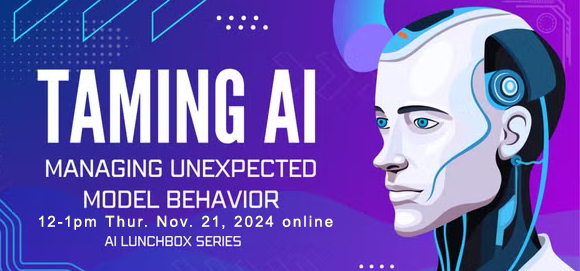
<Title>Talk: Taming AI: Managing Unexpected Model Behavior</Title>
<Tagline>12-1 pm EST, Thursday November 21, 2024 online</Tagline>
<Body>
<![CDATA[
    <div class="html-content">
    <div><img src="https://ai.umbc.edu/wp-content/uploads/sites/734/2024/11/taiming_ai.jpg" style="max-width: 100%; height: auto;"></div>
    <div><span><br></span></div>
    <div>
    <span>J</span><span>oin </span><strong><a href="https://www.linkedin.com/in/shane-emmons/" rel="nofollow external" class="bo">Shane Emmons</a> </strong><span>of</span><strong> </strong><span>Swept AI as he does a dive deep into AI model drift, where unexpected behavior is guaranteed in the UMBC Training Centers Center for Appllied AI lunchbox series.</span>
    </div>
    <div><span><br></span></div>
    <div>
    <span><a href="https://en.wikipedia.org/wiki/Concept_drift" rel="nofollow external" class="bo"><strong>Drift</strong></a> in machine learning models is a change in the data generating process that can cause a model's predictions to become less accurate or irrelevant over time. </span><span>Inspired by the ranger service’s prevention and preparedness mentality, Shane will discuss the challenges of maintaining robust AI systems. Attend this session to learn to scrutinize models effectively, preventing them from spiraling out of control and enhancing their long-term success.</span>
    </div>
    <div><span><br></span></div>
    <div><span>Get more information and <strong><a href="https://www.meetup.com/c4a-ai/events/303614993" rel="nofollow external" class="bo">register here</a></strong> for the link.</span></div>
    <div><span><br></span></div>
    <hr>
    <a href="https://ai.umbc.edu/" rel="nofollow external" class="bo"><strong>UMBC Center for AI</strong></a>
    </div>
]]>
</Body>
<Summary>Join Shane Emmons of Swept AI as he does a dive deep into AI model drift, where unexpected behavior is guaranteed in the UMBC Training Centers Center for Appllied AI lunchbox series.     Drift in...</Summary>
<Website>https://c4ai.umbctraining.com/event/taming-ai-managing-unexpected-model-behavior/</Website>
<TrackingUrl>https://my3.my.umbc.edu/api/v0/pixel/news/145733/guest@my.umbc.edu/5d71888abc55764deb0a0362f13971ab/api/pixel</TrackingUrl>
<Tag>ai</Tag>
<Tag>drift</Tag>
<Tag>machine-learning</Tag>
<Tag>model-drift</Tag>
<Group token="umbc-ai">UMBC AI</Group>
<GroupUrl>https://my3.my.umbc.edu/groups/umbc-ai</GroupUrl>
<AvatarUrl>https://assets4-my.umbc.edu/system/shared/avatars/groups/000/002/081/cfb27ebe008c2636486089a759ea5c36/xsmall.png?1691095779</AvatarUrl>
<AvatarUrl size="original">https://assets2-my.umbc.edu/system/shared/avatars/groups/000/002/081/cfb27ebe008c2636486089a759ea5c36/original.png?1691095779</AvatarUrl>
<AvatarUrl size="xxlarge">https://assets1-my.umbc.edu/system/shared/avatars/groups/000/002/081/cfb27ebe008c2636486089a759ea5c36/xxlarge.png?1691095779</AvatarUrl>
<AvatarUrl size="xlarge">https://assets1-my.umbc.edu/system/shared/avatars/groups/000/002/081/cfb27ebe008c2636486089a759ea5c36/xlarge.png?1691095779</AvatarUrl>
<AvatarUrl size="large">https://assets1-my.umbc.edu/system/shared/avatars/groups/000/002/081/cfb27ebe008c2636486089a759ea5c36/large.png?1691095779</AvatarUrl>
<AvatarUrl size="medium">https://assets3-my.umbc.edu/system/shared/avatars/groups/000/002/081/cfb27ebe008c2636486089a759ea5c36/medium.png?1691095779</AvatarUrl>
<AvatarUrl size="small">https://assets3-my.umbc.edu/system/shared/avatars/groups/000/002/081/cfb27ebe008c2636486089a759ea5c36/small.png?1691095779</AvatarUrl>
<AvatarUrl size="xsmall">https://assets4-my.umbc.edu/system/shared/avatars/groups/000/002/081/cfb27ebe008c2636486089a759ea5c36/xsmall.png?1691095779</AvatarUrl>
<AvatarUrl size="xxsmall">https://assets1-my.umbc.edu/system/shared/avatars/groups/000/002/081/cfb27ebe008c2636486089a759ea5c36/xxsmall.png?1691095779</AvatarUrl>
<Sponsor>UMBC Training Centers Center for Appllied AI</Sponsor>
<PawCount>0</PawCount>
<CommentCount>0</CommentCount>
<CommentsAllowed>true</CommentsAllowed>
<PostedAt>Tue, 19 Nov 2024 11:08:43 -0500</PostedAt>
</NewsItem>

<NewsItem contentIssues="true" id="145721" important="false" status="posted" url="https://my3.my.umbc.edu/groups/umbc-ai/posts/145721">
<Title>Talk: Enhancing Computational Thinking Skills while Addressing ChatGPT Challenges in Introductory Programming Courses</Title>
<Tagline>12-1 EST, Wednesday, November 20, in ITE 459 and online</Tagline>
<Body>
<![CDATA[
    <div class="html-content">
    <span><h4><span>Enhancing Computational Thinking Skills while Addressing ChatGPT Challenges in Introductory Programming Courses</span></h4>
    <h4>
    <span>12-1pm EST, </span><span>Wednesday, Nov. 20, in ITE 459 and <a href="https://umbc.webex.com/umbc/j.php?MTID=m562838d60e0c17f6655faaf919459017" rel="nofollow external" class="bo">online</a></span>
    </h4>
    <p><span>Effective practices for teaching computing majors to become proficient programmers have been a key research focus for some time. Programming is a fundamental skill that computing students must develop, yet research shows that a notable percentage of students encounter difficulties or become discouraged, sometimes deterring them from the field altogether. The rise of AI tools has introduced new challenges for educators striving to equip students with the essential skills needed for professional practice. In computing, AI and its vast potential are actively studied, yet generative AI tools like ChatGPT—which are open-source and widely accessible—present unique hurdles. These tools, while valuable, may impede students’ ability to develop core computational skills, especially when emphasis is placed on programming pedagogy. This talk will explore these challenges in depth, addressing strategies and practices to mitigate the influence of ChatGPT in early programming courses. Additionally, it will highlight ongoing efforts in IS 147 to examine the impact of these practices on student learning and skill development.</span></p>
    <p><a href="https://www.edwarddillonjrphd.com/" rel="nofollow external" class="bo"><span>Edward Dillon</span></a><span> is an Associate Professor in the Department of Information Systems at UMBC. His research focuses on human-centered computing with emphasis on computer science education and broadening participation in computing. Dr. Dillon has received ~$3.7 million in research funding and awards from external agencies and non-profit organizations, including the National Science Foundation, the Maryland Pre-Service Computer Science Teacher Education Program, and the Collaborative Research Experience for Undergraduates. He also conducted a Faculty in Residency at Google during the summer of 2018 to learn more about this company’s culture, practices, and to understand the expectations for candidates (e.g., aspiring CS majors) who pursue career opportunities at this company and related prominent companies in tech.</span></p></span>
    <hr>
    <a href="https://ai.umbc.edu/" rel="nofollow external" class="bo"><strong>UMBC Center for AI</strong></a>
    </div>
]]>
</Body>
<Summary>Enhancing Computational Thinking Skills while Addressing ChatGPT Challenges in Introductory Programming Courses  12-1pm EST, Wednesday, Nov. 20, in ITE 459 and online  Effective practices for...</Summary>
<Website>https://informationsystems.umbc.edu/home/calendar/events/</Website>
<TrackingUrl>https://my3.my.umbc.edu/api/v0/pixel/news/145721/guest@my.umbc.edu/7b85b4dfc47454777106e173027c6663/api/pixel</TrackingUrl>
<Tag>ai</Tag>
<Tag>chatgpt</Tag>
<Tag>education</Tag>
<Tag>programming</Tag>
<Group token="umbc-ai">UMBC AI</Group>
<GroupUrl>https://my3.my.umbc.edu/groups/umbc-ai</GroupUrl>
<AvatarUrl>https://assets4-my.umbc.edu/system/shared/avatars/groups/000/002/081/cfb27ebe008c2636486089a759ea5c36/xsmall.png?1691095779</AvatarUrl>
<AvatarUrl size="original">https://assets2-my.umbc.edu/system/shared/avatars/groups/000/002/081/cfb27ebe008c2636486089a759ea5c36/original.png?1691095779</AvatarUrl>
<AvatarUrl size="xxlarge">https://assets1-my.umbc.edu/system/shared/avatars/groups/000/002/081/cfb27ebe008c2636486089a759ea5c36/xxlarge.png?1691095779</AvatarUrl>
<AvatarUrl size="xlarge">https://assets1-my.umbc.edu/system/shared/avatars/groups/000/002/081/cfb27ebe008c2636486089a759ea5c36/xlarge.png?1691095779</AvatarUrl>
<AvatarUrl size="large">https://assets1-my.umbc.edu/system/shared/avatars/groups/000/002/081/cfb27ebe008c2636486089a759ea5c36/large.png?1691095779</AvatarUrl>
<AvatarUrl size="medium">https://assets3-my.umbc.edu/system/shared/avatars/groups/000/002/081/cfb27ebe008c2636486089a759ea5c36/medium.png?1691095779</AvatarUrl>
<AvatarUrl size="small">https://assets3-my.umbc.edu/system/shared/avatars/groups/000/002/081/cfb27ebe008c2636486089a759ea5c36/small.png?1691095779</AvatarUrl>
<AvatarUrl size="xsmall">https://assets4-my.umbc.edu/system/shared/avatars/groups/000/002/081/cfb27ebe008c2636486089a759ea5c36/xsmall.png?1691095779</AvatarUrl>
<AvatarUrl size="xxsmall">https://assets1-my.umbc.edu/system/shared/avatars/groups/000/002/081/cfb27ebe008c2636486089a759ea5c36/xxsmall.png?1691095779</AvatarUrl>
<Sponsor>UMBC Information Systems WISS</Sponsor>
<ThumbnailUrl size="xxlarge">https://assets3-my.umbc.edu/system/shared/thumbnails/news/000/145/721/c0370f7da64175e882a0016338eff606/xxlarge.jpg?1731969942</ThumbnailUrl>
<ThumbnailUrl size="xlarge">https://assets4-my.umbc.edu/system/shared/thumbnails/news/000/145/721/c0370f7da64175e882a0016338eff606/xlarge.jpg?1731969942</ThumbnailUrl>
<ThumbnailUrl size="large">https://assets2-my.umbc.edu/system/shared/thumbnails/news/000/145/721/c0370f7da64175e882a0016338eff606/large.jpg?1731969942</ThumbnailUrl>
<ThumbnailUrl size="medium">https://assets3-my.umbc.edu/system/shared/thumbnails/news/000/145/721/c0370f7da64175e882a0016338eff606/medium.jpg?1731969942</ThumbnailUrl>
<ThumbnailUrl size="small">https://assets4-my.umbc.edu/system/shared/thumbnails/news/000/145/721/c0370f7da64175e882a0016338eff606/small.jpg?1731969942</ThumbnailUrl>
<ThumbnailUrl size="xsmall">https://assets4-my.umbc.edu/system/shared/thumbnails/news/000/145/721/c0370f7da64175e882a0016338eff606/xsmall.jpg?1731969942</ThumbnailUrl>
<ThumbnailUrl size="xxsmall">https://assets2-my.umbc.edu/system/shared/thumbnails/news/000/145/721/c0370f7da64175e882a0016338eff606/xxsmall.jpg?1731969942</ThumbnailUrl>
<PawCount>0</PawCount>
<CommentCount>0</CommentCount>
<CommentsAllowed>true</CommentsAllowed>
<PostedAt>Mon, 18 Nov 2024 17:55:59 -0500</PostedAt>
<EditAt>Mon, 18 Nov 2024 18:04:37 -0500</EditAt>
</NewsItem>

<NewsItem contentIssues="true" id="145697" important="false" status="posted" url="https://my3.my.umbc.edu/groups/umbc-ai/posts/145697">
<Title>Rebecca Williams receives Learning Analytics Fellowship for work on data visualization</Title>
<Tagline>Addressing persistent misconceptions in data visualization</Tagline>
<Body>
<![CDATA[
    <div class="html-content">
    <span><p><span>CSEE Assistant Professor </span><a href="https://my3.my.umbc.edu/groups/instructional-technology/posts/145632/a6c/22edeac7ec99acb292115baa54b84823/web/link?link=https%3A%2F%2Fwww.csee.umbc.edu%2Fpeople%2Ffaculty%2Frebecca-williams%2F" rel="nofollow external" class="bo"><span>Rebecca WIlliams</span></a><span> was selected to receive a </span><a href="https://my3.my.umbc.edu/groups/instructional-technology/posts/145632/a6c/045d91a14f612e8269282679528eb06e/email/link?link=https%3A%2F%2Fdoit.umbc.edu%2Fanalytics%2Fcommunity%2Fmini-grants%2F" rel="nofollow external" class="bo"><span> Learning Analytics Fellowship </span></a><span>for the 2024-25 academic year funded by the UMBC Provost’s office. The program supports faculty and staff for research on and development of effective data-informed teaching and learning practices.</span></p>
    <span>Her project builds on her </span><a href="https://my3.my.umbc.edu/groups/instructional-technology/posts/145632/a6c/d04321d27cfaff73a344ee7a45289ded/web/link?link=https%3A%2F%2Fdoit.umbc.edu%2Fanalytics%2Fnews%2Fpost%2F135851%2F" rel="nofollow external" class="bo"><span>previous work</span></a><span> on course interventions to address persistent student misconceptions in data visualization. These misconceptions include the belief that simple, easy-to-read charts are always effective and the assumption that data visualizations are entirely objective. Williams’ continued interventions involve having students search for, annotate, and critique a broader array of visualization examples, supplementing those provided by the instructor. Additionally, the project will incorporate more rigorous qualitative analysis using the Taguette data analysis tool, collect richer demographic data, and analyze the temporal progression of student-created graphs. By expanding these efforts, students are more likely to deepen their critical analysis skills, improve their visual literacy, and retain these competencies in the long term.</span></span><div>
    <span><br></span>
    <hr>
    <a href="https://ai.umbc.edu/" rel="nofollow external" class="bo"><strong>UMBC Center for AI</strong></a> </div>
    </div>
]]>
</Body>
<Summary>CSEE Assistant Professor Rebecca WIlliams was selected to receive a  Learning Analytics Fellowship for the 2024-25 academic year funded by the UMBC Provost’s office. The program supports faculty...</Summary>
<Website>https://my3.my.umbc.edu/groups/instructional-technology/posts/145632</Website>
<TrackingUrl>https://my3.my.umbc.edu/api/v0/pixel/news/145697/guest@my.umbc.edu/4dd3939cf6377c4a250252029cb1f0bb/api/pixel</TrackingUrl>
<Tag>ai</Tag>
<Tag>charts</Tag>
<Tag>data</Tag>
<Tag>misunderstanding</Tag>
<Group token="umbc-ai">UMBC AI</Group>
<GroupUrl>https://my3.my.umbc.edu/groups/umbc-ai</GroupUrl>
<AvatarUrl>https://assets4-my.umbc.edu/system/shared/avatars/groups/000/002/081/cfb27ebe008c2636486089a759ea5c36/xsmall.png?1691095779</AvatarUrl>
<AvatarUrl size="original">https://assets2-my.umbc.edu/system/shared/avatars/groups/000/002/081/cfb27ebe008c2636486089a759ea5c36/original.png?1691095779</AvatarUrl>
<AvatarUrl size="xxlarge">https://assets1-my.umbc.edu/system/shared/avatars/groups/000/002/081/cfb27ebe008c2636486089a759ea5c36/xxlarge.png?1691095779</AvatarUrl>
<AvatarUrl size="xlarge">https://assets1-my.umbc.edu/system/shared/avatars/groups/000/002/081/cfb27ebe008c2636486089a759ea5c36/xlarge.png?1691095779</AvatarUrl>
<AvatarUrl size="large">https://assets1-my.umbc.edu/system/shared/avatars/groups/000/002/081/cfb27ebe008c2636486089a759ea5c36/large.png?1691095779</AvatarUrl>
<AvatarUrl size="medium">https://assets3-my.umbc.edu/system/shared/avatars/groups/000/002/081/cfb27ebe008c2636486089a759ea5c36/medium.png?1691095779</AvatarUrl>
<AvatarUrl size="small">https://assets3-my.umbc.edu/system/shared/avatars/groups/000/002/081/cfb27ebe008c2636486089a759ea5c36/small.png?1691095779</AvatarUrl>
<AvatarUrl size="xsmall">https://assets4-my.umbc.edu/system/shared/avatars/groups/000/002/081/cfb27ebe008c2636486089a759ea5c36/xsmall.png?1691095779</AvatarUrl>
<AvatarUrl size="xxsmall">https://assets1-my.umbc.edu/system/shared/avatars/groups/000/002/081/cfb27ebe008c2636486089a759ea5c36/xxsmall.png?1691095779</AvatarUrl>
<Sponsor>UMBC AI</Sponsor>
<ThumbnailUrl size="xxlarge">https://assets2-my.umbc.edu/system/shared/thumbnails/news/000/145/697/c6acdb7dc62ff174465525b1c1250d49/xxlarge.jpg?1731943697</ThumbnailUrl>
<ThumbnailUrl size="xlarge">https://assets2-my.umbc.edu/system/shared/thumbnails/news/000/145/697/c6acdb7dc62ff174465525b1c1250d49/xlarge.jpg?1731943697</ThumbnailUrl>
<ThumbnailUrl size="large">https://assets2-my.umbc.edu/system/shared/thumbnails/news/000/145/697/c6acdb7dc62ff174465525b1c1250d49/large.jpg?1731943697</ThumbnailUrl>
<ThumbnailUrl size="medium">https://assets2-my.umbc.edu/system/shared/thumbnails/news/000/145/697/c6acdb7dc62ff174465525b1c1250d49/medium.jpg?1731943697</ThumbnailUrl>
<ThumbnailUrl size="small">https://assets4-my.umbc.edu/system/shared/thumbnails/news/000/145/697/c6acdb7dc62ff174465525b1c1250d49/small.jpg?1731943697</ThumbnailUrl>
<ThumbnailUrl size="xsmall">https://assets1-my.umbc.edu/system/shared/thumbnails/news/000/145/697/c6acdb7dc62ff174465525b1c1250d49/xsmall.jpg?1731943697</ThumbnailUrl>
<ThumbnailUrl size="xxsmall">https://assets4-my.umbc.edu/system/shared/thumbnails/news/000/145/697/c6acdb7dc62ff174465525b1c1250d49/xxsmall.jpg?1731943697</ThumbnailUrl>
<PawCount>0</PawCount>
<CommentCount>0</CommentCount>
<CommentsAllowed>true</CommentsAllowed>
<PostedAt>Mon, 18 Nov 2024 10:34:13 -0500</PostedAt>
</NewsItem>

<NewsItem contentIssues="true" id="145682" important="false" status="posted" url="https://my3.my.umbc.edu/groups/umbc-ai/posts/145682">
<Title>Microsoft Webinar: Copilot Studio for Education, 11/21</Title>
<Tagline>Build a generative AI chatbot in minutes, 11/21, 11-12 EST</Tagline>
<Body>
<![CDATA[
    <div class="html-content">
    <span><p><span><a href="https://www.microsoft.com/en-us/microsoft-copilot/microsoft-copilot-studio" rel="nofollow external" class="bo">Microsoft’s Copilot Studio</a></span><span> is a conversational AI platform that lets you create agents using natural language or a graphical interface that are based on </span><span>the </span><a href="https://en.wikipedia.org/wiki/GPT-4" rel="nofollow external" class="bo"><span>GPT-4</span></a><span> series of </span><a href="https://en.wikipedia.org/wiki/Large_language_model" rel="nofollow external" class="bo"><span>large language models</span></a><span>. </span><span>Using </span><span>Copilot Studio</span><span>, you can more easily design, test, and publish agents that suit your needs for internal or external scenarios across your university, department, or role. </span><span>This one-hour webinar is focused on using it for education by faculty, staff, and students: 11-12pm EST, Thursday, November 21, 2024, online. </span><a href="https://msit.events.teams.microsoft.com/event/ff807c02-73cc-4cd4-8862-383d64e7c20c@72f988bf-86f1-41af-91ab-2d7cd011db47/registration" rel="nofollow external" class="bo"><span><strong>Register here</strong></span></a><span>. </span></p>
    <div><span><br></span></div></span> <hr>
    <a href="https://ai.umbc.edu/" rel="nofollow external" class="bo"><strong>UMBC Center for AI</strong></a>
    </div>
]]>
</Body>
<Summary>Microsoft’s Copilot Studio is a conversational AI platform that lets you create agents using natural language or a graphical interface that are based on the GPT-4 series of large language models....</Summary>
<Website>https://my3.my.umbc.edu/groups/meec/posts/145617</Website>
<TrackingUrl>https://my3.my.umbc.edu/api/v0/pixel/news/145682/guest@my.umbc.edu/ca6f3746a2f3b5ce178b4a2dc0df457b/api/pixel</TrackingUrl>
<Tag>agents</Tag>
<Tag>chatgpt</Tag>
<Tag>copilot</Tag>
<Tag>education</Tag>
<Tag>genai</Tag>
<Tag>llm</Tag>
<Tag>microsoft</Tag>
<Tag>studio</Tag>
<Group token="umbc-ai">UMBC AI</Group>
<GroupUrl>https://my3.my.umbc.edu/groups/umbc-ai</GroupUrl>
<AvatarUrl>https://assets4-my.umbc.edu/system/shared/avatars/groups/000/002/081/cfb27ebe008c2636486089a759ea5c36/xsmall.png?1691095779</AvatarUrl>
<AvatarUrl size="original">https://assets2-my.umbc.edu/system/shared/avatars/groups/000/002/081/cfb27ebe008c2636486089a759ea5c36/original.png?1691095779</AvatarUrl>
<AvatarUrl size="xxlarge">https://assets1-my.umbc.edu/system/shared/avatars/groups/000/002/081/cfb27ebe008c2636486089a759ea5c36/xxlarge.png?1691095779</AvatarUrl>
<AvatarUrl size="xlarge">https://assets1-my.umbc.edu/system/shared/avatars/groups/000/002/081/cfb27ebe008c2636486089a759ea5c36/xlarge.png?1691095779</AvatarUrl>
<AvatarUrl size="large">https://assets1-my.umbc.edu/system/shared/avatars/groups/000/002/081/cfb27ebe008c2636486089a759ea5c36/large.png?1691095779</AvatarUrl>
<AvatarUrl size="medium">https://assets3-my.umbc.edu/system/shared/avatars/groups/000/002/081/cfb27ebe008c2636486089a759ea5c36/medium.png?1691095779</AvatarUrl>
<AvatarUrl size="small">https://assets3-my.umbc.edu/system/shared/avatars/groups/000/002/081/cfb27ebe008c2636486089a759ea5c36/small.png?1691095779</AvatarUrl>
<AvatarUrl size="xsmall">https://assets4-my.umbc.edu/system/shared/avatars/groups/000/002/081/cfb27ebe008c2636486089a759ea5c36/xsmall.png?1691095779</AvatarUrl>
<AvatarUrl size="xxsmall">https://assets1-my.umbc.edu/system/shared/avatars/groups/000/002/081/cfb27ebe008c2636486089a759ea5c36/xxsmall.png?1691095779</AvatarUrl>
<Sponsor>UMBC AI</Sponsor>
<ThumbnailUrl size="xxlarge">https://assets4-my.umbc.edu/system/shared/thumbnails/news/000/145/682/162e97af3429e0d41bf14fe7cfc6591f/xxlarge.jpg?1731801136</ThumbnailUrl>
<ThumbnailUrl size="xlarge">https://assets1-my.umbc.edu/system/shared/thumbnails/news/000/145/682/162e97af3429e0d41bf14fe7cfc6591f/xlarge.jpg?1731801136</ThumbnailUrl>
<ThumbnailUrl size="large">https://assets3-my.umbc.edu/system/shared/thumbnails/news/000/145/682/162e97af3429e0d41bf14fe7cfc6591f/large.jpg?1731801136</ThumbnailUrl>
<ThumbnailUrl size="medium">https://assets2-my.umbc.edu/system/shared/thumbnails/news/000/145/682/162e97af3429e0d41bf14fe7cfc6591f/medium.jpg?1731801136</ThumbnailUrl>
<ThumbnailUrl size="small">https://assets1-my.umbc.edu/system/shared/thumbnails/news/000/145/682/162e97af3429e0d41bf14fe7cfc6591f/small.jpg?1731801136</ThumbnailUrl>
<ThumbnailUrl size="xsmall">https://assets2-my.umbc.edu/system/shared/thumbnails/news/000/145/682/162e97af3429e0d41bf14fe7cfc6591f/xsmall.jpg?1731801136</ThumbnailUrl>
<ThumbnailUrl size="xxsmall">https://assets3-my.umbc.edu/system/shared/thumbnails/news/000/145/682/162e97af3429e0d41bf14fe7cfc6591f/xxsmall.jpg?1731801136</ThumbnailUrl>
<PawCount>0</PawCount>
<CommentCount>0</CommentCount>
<CommentsAllowed>true</CommentsAllowed>
<PostedAt>Sat, 16 Nov 2024 18:58:40 -0500</PostedAt>
<EditAt>Sat, 16 Nov 2024 21:45:56 -0500</EditAt>
</NewsItem>

<NewsItem contentIssues="false" id="145624" important="false" status="posted" url="https://my3.my.umbc.edu/groups/umbc-ai/posts/145624">
<Title>Talk: Using Participatory Design and AI to Create Agency-increasing Augmentative and Alternative Communication Systems</Title>
<Tagline>3-4pm ET Mon., Nov. 18, 2024 in ITE 406 &amp; online</Tagline>
<Body>
<![CDATA[
    <div class="html-content">
    <h4><strong>Talk: Using Participatory Design and AI to Create Agency-increasing Augmentative and Alternative Communication Systems</strong></h4>
    <div><br></div>
    <h4>
    <strong><a href="https://stephanie-valencia.com/" rel="nofollow external" class="bo">Dr. Stephanie Valencia</a>, Univ. of Maryland<br></strong><strong>3-4pm ET Monday, November 18, 2024<br></strong><strong>ITE 406, UMBC and <a href="https://umbc.webex.com/wbxmjs/joinservice/sites/umbc/meeting/download/6ffaf986d45fc74b41db09df7c78a7d9" rel="nofollow external" class="bo">online</a></strong>
    </h4>
    <div><br></div>
    <div>Agency and communication are integral to personal development, enabling us to pursue and express our goals. However, agency in communication is not fixed–Many individuals who use speech-generating devices to communicate encounter social constraints and technical limitations that can restrict what they can say, how they can say it, and when they can contribute to a discussion. In this talk, I will delve into how an agency-centered design approach can foster more accessible communication experiences and help us uncover opportunities for design. Drawing from empirical research and collaborative co-design with people with disabilities, I will highlight how various technological tools—such as automated transcription, physical interaction artifacts, and AI-driven language generation—can impact conversational agency. Additionally, I will share practical design strategies and discuss existing challenges for co-designing communication technologies that enhance user agency and participation.</div>
    <div><br></div>
    <div>
    <a href="https://stephanie-valencia.com/" rel="nofollow external" class="bo"><strong>Dr. Valencia</strong></a> is dedicated to promoting equitable access to assistive technologies (AT), advocating for open-source hardware, and championing the inclusion of underrepresented groups in technology design and development. Dr. Valencia²’s research endeavors are centered on elevating user agency, accessibility, and enjoyment. Employing participatory design methodologies, she has explored the integration of diverse design elements such as artificial intelligence and embodied expressive objects to empower augmentative and alternative communication users. Dr. Valencia² works on conceptualizing these innovations but also in building and deploying them to make a real-world impact. Rigorous empirical studies are an integral part of her work, ensuring that the efficacy and significance of design contributions are thoroughly assessed. She earned her Ph.D. at the Human-computer Interaction Institute at Carnegie Mellon University.</div>
    <div><br></div>
    <hr>
    <a href="https://ai.umbc.edu/" rel="nofollow external" class="bo"><strong>UMBC Center for AI</strong></a>
    </div>
]]>
</Body>
<Summary>Talk: Using Participatory Design and AI to Create Agency-increasing Augmentative and Alternative Communication Systems     Dr. Stephanie Valencia, Univ. of Maryland 3-4pm ET Monday, November 18,...</Summary>
<Website>https://my3.my.umbc.edu/groups/langtech/events/136186</Website>
<TrackingUrl>https://my3.my.umbc.edu/api/v0/pixel/news/145624/guest@my.umbc.edu/da246d6551d44cb689cad7374ec3aaf5/api/pixel</TrackingUrl>
<Tag>agency</Tag>
<Tag>ai</Tag>
<Tag>nlp</Tag>
<Group token="umbc-ai">UMBC AI</Group>
<GroupUrl>https://my3.my.umbc.edu/groups/umbc-ai</GroupUrl>
<AvatarUrl>https://assets4-my.umbc.edu/system/shared/avatars/groups/000/002/081/cfb27ebe008c2636486089a759ea5c36/xsmall.png?1691095779</AvatarUrl>
<AvatarUrl size="original">https://assets2-my.umbc.edu/system/shared/avatars/groups/000/002/081/cfb27ebe008c2636486089a759ea5c36/original.png?1691095779</AvatarUrl>
<AvatarUrl size="xxlarge">https://assets1-my.umbc.edu/system/shared/avatars/groups/000/002/081/cfb27ebe008c2636486089a759ea5c36/xxlarge.png?1691095779</AvatarUrl>
<AvatarUrl size="xlarge">https://assets1-my.umbc.edu/system/shared/avatars/groups/000/002/081/cfb27ebe008c2636486089a759ea5c36/xlarge.png?1691095779</AvatarUrl>
<AvatarUrl size="large">https://assets1-my.umbc.edu/system/shared/avatars/groups/000/002/081/cfb27ebe008c2636486089a759ea5c36/large.png?1691095779</AvatarUrl>
<AvatarUrl size="medium">https://assets3-my.umbc.edu/system/shared/avatars/groups/000/002/081/cfb27ebe008c2636486089a759ea5c36/medium.png?1691095779</AvatarUrl>
<AvatarUrl size="small">https://assets3-my.umbc.edu/system/shared/avatars/groups/000/002/081/cfb27ebe008c2636486089a759ea5c36/small.png?1691095779</AvatarUrl>
<AvatarUrl size="xsmall">https://assets4-my.umbc.edu/system/shared/avatars/groups/000/002/081/cfb27ebe008c2636486089a759ea5c36/xsmall.png?1691095779</AvatarUrl>
<AvatarUrl size="xxsmall">https://assets1-my.umbc.edu/system/shared/avatars/groups/000/002/081/cfb27ebe008c2636486089a759ea5c36/xxsmall.png?1691095779</AvatarUrl>
<Sponsor>LARA Lab and Interactive Systems Research Center</Sponsor>
<PawCount>0</PawCount>
<CommentCount>0</CommentCount>
<CommentsAllowed>true</CommentsAllowed>
<PostedAt>Wed, 13 Nov 2024 21:48:26 -0500</PostedAt>
<EditAt>Wed, 13 Nov 2024 21:55:47 -0500</EditAt>
</NewsItem>

</News>