<?xml version="1.0"?>
<News hasArchived="false" page="33" pageCount="40" pageSize="10" timestamp="Wed, 02 Sep 2026 21:32:03 -0400" url="https://my3.my.umbc.edu/groups/umbc-ai/posts.xml?mode=activity&amp;page=33">
<NewsItem contentIssues="true" id="142062" important="false" status="posted" url="https://my3.my.umbc.edu/groups/umbc-ai/posts/142062">
<Title>Talk: Machine Learning for Voltage Monitoring, 10:30 ET 5/23</Title>
<Tagline>estimating voltage over the entire distribution feeder</Tagline>
<Body>
<![CDATA[
    <div class="html-content">
    <div><img src="https://ai.umbc.edu/wp-content/uploads/sites/734/2024/05/Screenshot-2024-05-17-at-1.56.22%E2%80%AFPM.webp" style="max-width: 100%; height: auto;"></div>
    <div><br></div>
    <div>
    <strong>Machine Learning based Voltage Monitoring in  </strong><strong>Real-time Unobservable Distribution Systems</strong>
    </div>
    <div><strong><br></strong></div>
    <div><strong>Prof. <a href="https://search.asu.edu/profile/3023947" rel="nofollow external" class="bo">Anamitra Pal</a>, Arizona State University</strong></div>
    <div><strong><br></strong></div>
    <div><strong>10:30-11:30am ET, Thursday, May 23, 2024</strong></div>
    <div><strong>UMBC, 325b ITE and online via <a href="https://umbc.webex.com/meet/rajangul" rel="nofollow external" class="bo">WebEx</a></strong></div>
    <div><br></div>
    <div>Due to increasing penetration of solar photovoltaic generation and electric vehicle charging loads, there is a genuine need to closely monitor the voltage over the entire length of the distribution feeder. Smart meters, present only at the terminal nodes of the feeder, cannot fulfill this need; they also have high reporting delays.  Distribution phasor measurement units have the necessary speed, but it is cost- prohibitive to place them in bulk. Thus, monitoring voltages in real-time unobservable distribution systems is challenging. This talk will describe how the use of machine learning can help overcome this challenge by performing high-speed voltage estimation while accounting for the physical attributes and operational characteristics of modern distribution systems. To ensure trust in the machine learning-based approach, formal guarantees of performance will also be provided.</div>
    <div><br></div>
    <div>
    <strong><a href="https://search.asu.edu/profile/3023947" rel="nofollow external" class="bo">Anamitra Pal</a> </strong>is an Associate Professor in the School of Electrical, Computer, and Energy Engineering at Arizona State University (ASU). His research interests include data analytics with a special emphasis on time-synchronized measurements, artificial intelligence applications in power systems, renewable generation integration studies, and critical infrastructure resilience. Dr. Pal has received the 2018 Young CRITIS Award for his contributions to the field of critical infrastructure protection, the 2019 Outstanding Young Professional Award from the IEEE Phoenix Section, the National Science Foundation CAREER Award in 2022, and the 2023 Centennial Professorship Award from ASU.</div>
    <div><br></div>
    <div>Host:<strong> <a href="https://rajanguluri.github.io/" rel="nofollow external" class="bo">Rajasekhar Anguluri</a></strong>
    </div>
    <div><br></div>  <hr>
    <a href="https://ai.umbc.edu/" rel="nofollow external" class="bo"><strong>UMBC Center for AI</strong></a>
    </div>
]]>
</Body>
<Summary>Machine Learning based Voltage Monitoring in  Real-time Unobservable Distribution Systems     Prof. Anamitra Pal, Arizona State University     10:30-11:30am ET, Thursday, May 23, 2024  UMBC, 325b...</Summary>
<TrackingUrl>https://my3.my.umbc.edu/api/v0/pixel/news/142062/guest@my.umbc.edu/ffe9d5d4580f66c94f3f929d89bb45e9/api/pixel</TrackingUrl>
<Tag>ai</Tag>
<Tag>computer-engineering</Tag>
<Tag>machine-learning</Tag>
<Tag>ml</Tag>
<Group token="umbc-ai">UMBC AI</Group>
<GroupUrl>https://my3.my.umbc.edu/groups/umbc-ai</GroupUrl>
<AvatarUrl>https://assets4-my.umbc.edu/system/shared/avatars/groups/000/002/081/cfb27ebe008c2636486089a759ea5c36/xsmall.png?1691095779</AvatarUrl>
<AvatarUrl size="original">https://assets2-my.umbc.edu/system/shared/avatars/groups/000/002/081/cfb27ebe008c2636486089a759ea5c36/original.png?1691095779</AvatarUrl>
<AvatarUrl size="xxlarge">https://assets1-my.umbc.edu/system/shared/avatars/groups/000/002/081/cfb27ebe008c2636486089a759ea5c36/xxlarge.png?1691095779</AvatarUrl>
<AvatarUrl size="xlarge">https://assets1-my.umbc.edu/system/shared/avatars/groups/000/002/081/cfb27ebe008c2636486089a759ea5c36/xlarge.png?1691095779</AvatarUrl>
<AvatarUrl size="large">https://assets1-my.umbc.edu/system/shared/avatars/groups/000/002/081/cfb27ebe008c2636486089a759ea5c36/large.png?1691095779</AvatarUrl>
<AvatarUrl size="medium">https://assets3-my.umbc.edu/system/shared/avatars/groups/000/002/081/cfb27ebe008c2636486089a759ea5c36/medium.png?1691095779</AvatarUrl>
<AvatarUrl size="small">https://assets3-my.umbc.edu/system/shared/avatars/groups/000/002/081/cfb27ebe008c2636486089a759ea5c36/small.png?1691095779</AvatarUrl>
<AvatarUrl size="xsmall">https://assets4-my.umbc.edu/system/shared/avatars/groups/000/002/081/cfb27ebe008c2636486089a759ea5c36/xsmall.png?1691095779</AvatarUrl>
<AvatarUrl size="xxsmall">https://assets1-my.umbc.edu/system/shared/avatars/groups/000/002/081/cfb27ebe008c2636486089a759ea5c36/xxsmall.png?1691095779</AvatarUrl>
<Sponsor>UMBC AI</Sponsor>
<PawCount>0</PawCount>
<CommentCount>0</CommentCount>
<CommentsAllowed>true</CommentsAllowed>
<PostedAt>Fri, 17 May 2024 14:04:29 -0400</PostedAt>
<EditAt>Fri, 17 May 2024 14:07:16 -0400</EditAt>
</NewsItem>

<NewsItem contentIssues="true" id="141999" important="false" status="posted" url="https://my3.my.umbc.edu/groups/umbc-ai/posts/141999">
<Title>AI Lunchbox: AI, misinformation &amp; disinformation, 12-1 5/16</Title>
<Body>
<![CDATA[
    <div class="html-content">
    <p><span><img src="https://ai.umbc.edu/wp-content/uploads/sites/734/2024/05/AI_disinfo.webp" style="max-width: 100%; height: auto;"></span></p>
    <p><span>This week's </span>UMBC Training Centers <span>AI Lunchbox session is on how new AI systems spread both misinformation and  disinformation. </span><strong><a href="https://en.wikipedia.org/wiki/Misinformation" rel="nofollow external" class="bo"><span>Misinformation</span></a><span> </span></strong><span>is incorrect or misleading information that can include inaccurate, incomplete, </span><span>misleading</span><span>, or false information and selective or half-truths but </span><span>is distributed</span><span> without the intention to mislead.  </span><strong><a href="https://en.wikipedia.org/wiki/Disinformation" rel="nofollow external" class="bo">Disinformation</a></strong><span> is false information deliberately spread to deceive people.</span></p>
    <p><span>AI systems have evolved dramatically to the point where anyone can emulate another person's speech, language, and image at little to no cost. A significant downside is the explosion of content meant to deceive others. </span></p>
    <p><span>Join the UMBC Training Centers for this free</span><span> lunchtime session as <strong><a href="https://www.linkedin.com/in/ed-melick-7a683/" rel="nofollow external" class="bo">Ed Melick</a></strong></span> examines AI disinformation/misinformation and what you can do to inform and protect yourself.</p>
    <p><span>Register <a href="https://www.meetup.com/c4a-ai/events/300438326/" rel="nofollow external" class="bo"><strong>here</strong></a> for this session, 12-</span><span>1pm</span><span> ET Thursday, May 16, 2024.<br></span></p> <hr>
    <a href="https://ai.umbc.edu/" rel="nofollow external" class="bo"><strong>UMBC Center for AI</strong></a>
    </div>
]]>
</Body>
<Summary>This week's UMBC Training Centers AI Lunchbox session is on how new AI systems spread both misinformation and  disinformation. Misinformation is incorrect or misleading information that can...</Summary>
<Website>https://www.meetup.com/c4a-ai/events/300438326/</Website>
<TrackingUrl>https://my3.my.umbc.edu/api/v0/pixel/news/141999/guest@my.umbc.edu/a6e15a9625bb4ce488763526c97413db/api/pixel</TrackingUrl>
<Tag>ai</Tag>
<Tag>disinformation</Tag>
<Tag>misinformation</Tag>
<Group token="umbc-ai">UMBC AI</Group>
<GroupUrl>https://my3.my.umbc.edu/groups/umbc-ai</GroupUrl>
<AvatarUrl>https://assets4-my.umbc.edu/system/shared/avatars/groups/000/002/081/cfb27ebe008c2636486089a759ea5c36/xsmall.png?1691095779</AvatarUrl>
<AvatarUrl size="original">https://assets2-my.umbc.edu/system/shared/avatars/groups/000/002/081/cfb27ebe008c2636486089a759ea5c36/original.png?1691095779</AvatarUrl>
<AvatarUrl size="xxlarge">https://assets1-my.umbc.edu/system/shared/avatars/groups/000/002/081/cfb27ebe008c2636486089a759ea5c36/xxlarge.png?1691095779</AvatarUrl>
<AvatarUrl size="xlarge">https://assets1-my.umbc.edu/system/shared/avatars/groups/000/002/081/cfb27ebe008c2636486089a759ea5c36/xlarge.png?1691095779</AvatarUrl>
<AvatarUrl size="large">https://assets1-my.umbc.edu/system/shared/avatars/groups/000/002/081/cfb27ebe008c2636486089a759ea5c36/large.png?1691095779</AvatarUrl>
<AvatarUrl size="medium">https://assets3-my.umbc.edu/system/shared/avatars/groups/000/002/081/cfb27ebe008c2636486089a759ea5c36/medium.png?1691095779</AvatarUrl>
<AvatarUrl size="small">https://assets3-my.umbc.edu/system/shared/avatars/groups/000/002/081/cfb27ebe008c2636486089a759ea5c36/small.png?1691095779</AvatarUrl>
<AvatarUrl size="xsmall">https://assets4-my.umbc.edu/system/shared/avatars/groups/000/002/081/cfb27ebe008c2636486089a759ea5c36/xsmall.png?1691095779</AvatarUrl>
<AvatarUrl size="xxsmall">https://assets1-my.umbc.edu/system/shared/avatars/groups/000/002/081/cfb27ebe008c2636486089a759ea5c36/xxsmall.png?1691095779</AvatarUrl>
<Sponsor>UMBC AI</Sponsor>
<PawCount>0</PawCount>
<CommentCount>0</CommentCount>
<CommentsAllowed>true</CommentsAllowed>
<PostedAt>Wed, 15 May 2024 10:36:33 -0400</PostedAt>
</NewsItem>

<NewsItem contentIssues="true" id="141989" important="false" status="posted" url="https://my3.my.umbc.edu/groups/umbc-ai/posts/141989">
<Title>Prof. Adali honored as UMBC Presidential Research Professor</Title>
<Tagline>Leads Machine Learning for Signal Processing Laboratory</Tagline>
<Body>
<![CDATA[
    <div class="html-content">
    <div><img src="https://ai.umbc.edu/wp-content/uploads/sites/734/2024/05/UMBC_PRP_2024_2.jpg" style="max-width: 100%; height: auto;"></div>
    <div>
    <p><span><br></span></p>
    <p><span>Every year, UMBC honors a faculty member with the Presidential Research Professor Award. CSEE professor <a href="https://www.csee.umbc.edu/people/faculty/tulay-adali/" rel="nofollow external" class="bo"><strong>Tülay Adali</strong></a> was selected this year as UMBC's Presidential Research Professor for 2024-2027.</span></p>
    <p><span>Professor Adali received the Ph.D. in electrical engineering from North Carolina State University, Raleigh, NC, in 1992 and joined the UMBC’s faculty the same year.  In 2015, she was named a Distinguished University Professor in recognition of her </span><span>outstanding contributions to statistical signal processing and machine learning and excellence in teaching and mentoring the next generation of engineers and scholars who continue to advance the field of signal processing and machine learning.</span></p>
    <p><span>Dr. Adali's commitment to her professional community is evident in her diverse roles and responsibilities. She currently serves as Editor-in-Chief of the prestigious IEEE Signal Processing Magazine and has held significant positions such as the Chair of the IEEE Brain Technical Community and the IEEE Signal Processing Society Vice President for Technical Directions from 2019 to 2022. Her professional involvement includes the organization of many conferences and workshops, including the IEEE International Conference on Acoustics, Speech, and Signal Processing, where she has served in various capacities.</span></p>
    <p><span>Professor Adali is a Fellow of the IEEE, AIMBE, and AAIA, a Fulbright Scholar, and an IEEE SPS Distinguished Lecturer. She has received the SPS Meritorious Service Award, Humboldt Research Award, IEEE SPS Best Paper Award, the SPIE Unsupervised Learning and ICA Pioneer Award, the University System of Maryland Regents' Award for Research, and the NSF CAREER Award.</span></p>
    <p><span>Her current research interests are in the areas of statistical signal processing, machine learning, and applications in medical image analysis and fusion.</span></p>
    <p><span>Dr. Adali leads the <strong><a href="https://mlsp.umbc.edu/" rel="nofollow external" class="bo">Machine Learning for Signal Processing laboratory</a></strong>, and primarily with support from the NSF and the NIH, she and her research associates, research students, and network of collaborators develop theory and tools for processing signals that arise in today's growing array of applications and pose challenges for traditional signal processing techniques with a focus on medical image analysis and fusion.</span></p>
    </div>
    <hr>
    <a href="https://ai.umbc.edu/" rel="nofollow external" class="bo"><strong>UMBC Center for AI</strong></a>
    </div>
]]>
</Body>
<Summary>Every year, UMBC honors a faculty member with the Presidential Research Professor Award. CSEE professor Tülay Adali was selected this year as UMBC's Presidential Research Professor for 2024-2027....</Summary>
<Website>https://mlsp.umbc.edu/</Website>
<TrackingUrl>https://my3.my.umbc.edu/api/v0/pixel/news/141989/guest@my.umbc.edu/74910898347fa6baca4ce606f9eba7d9/api/pixel</TrackingUrl>
<Tag>adali</Tag>
<Tag>ai</Tag>
<Tag>award</Tag>
<Tag>machine-learning</Tag>
<Tag>research</Tag>
<Tag>signal-processing</Tag>
<Group token="umbc-ai">UMBC AI</Group>
<GroupUrl>https://my3.my.umbc.edu/groups/umbc-ai</GroupUrl>
<AvatarUrl>https://assets4-my.umbc.edu/system/shared/avatars/groups/000/002/081/cfb27ebe008c2636486089a759ea5c36/xsmall.png?1691095779</AvatarUrl>
<AvatarUrl size="original">https://assets2-my.umbc.edu/system/shared/avatars/groups/000/002/081/cfb27ebe008c2636486089a759ea5c36/original.png?1691095779</AvatarUrl>
<AvatarUrl size="xxlarge">https://assets1-my.umbc.edu/system/shared/avatars/groups/000/002/081/cfb27ebe008c2636486089a759ea5c36/xxlarge.png?1691095779</AvatarUrl>
<AvatarUrl size="xlarge">https://assets1-my.umbc.edu/system/shared/avatars/groups/000/002/081/cfb27ebe008c2636486089a759ea5c36/xlarge.png?1691095779</AvatarUrl>
<AvatarUrl size="large">https://assets1-my.umbc.edu/system/shared/avatars/groups/000/002/081/cfb27ebe008c2636486089a759ea5c36/large.png?1691095779</AvatarUrl>
<AvatarUrl size="medium">https://assets3-my.umbc.edu/system/shared/avatars/groups/000/002/081/cfb27ebe008c2636486089a759ea5c36/medium.png?1691095779</AvatarUrl>
<AvatarUrl size="small">https://assets3-my.umbc.edu/system/shared/avatars/groups/000/002/081/cfb27ebe008c2636486089a759ea5c36/small.png?1691095779</AvatarUrl>
<AvatarUrl size="xsmall">https://assets4-my.umbc.edu/system/shared/avatars/groups/000/002/081/cfb27ebe008c2636486089a759ea5c36/xsmall.png?1691095779</AvatarUrl>
<AvatarUrl size="xxsmall">https://assets1-my.umbc.edu/system/shared/avatars/groups/000/002/081/cfb27ebe008c2636486089a759ea5c36/xxsmall.png?1691095779</AvatarUrl>
<Sponsor>UMBC AI</Sponsor>
<PawCount>0</PawCount>
<CommentCount>0</CommentCount>
<CommentsAllowed>true</CommentsAllowed>
<PostedAt>Tue, 14 May 2024 20:45:57 -0400</PostedAt>
</NewsItem>

<NewsItem contentIssues="true" id="141836" important="false" status="posted" url="https://my3.my.umbc.edu/groups/umbc-ai/posts/141836">
<Title>Maximizing Productivity with Microsoft Copilot, 12-1pm May 9</Title>
<Tagline>AI Lunchbox series, UMBC Training Centers</Tagline>
<Body>
<![CDATA[
    <div class="html-content">
    <div><img src="https://ai.umbc.edu/wp-content/uploads/sites/734/2024/05/600_520824035.webp" style="max-width: 100%; height: auto;"></div>
    <span><div><span><br></span></div>Join the UMBC Training Centers on Thursday, May 9 from 12:00 to 1:00pm ET for another free session of the AI Lunchbox Series with <a href="https://www.linkedin.com/in/dratra/" rel="nofollow external" class="bo"><strong>Dhruv Ratra</strong></a>. He will revisit Microsoft's <a href="https://en.wikipedia.org/wiki/Microsoft_Copilot" rel="nofollow external" class="bo"><strong>Copilot</strong></a> from a different angle with </span><span>Maximizing Productivity with Copilot for Microsoft 365: A Business-Focused Introduction. </span><div><span><br></span></div>
    <div>
    <span>His</span><span> demonstration will cover key features that differentiate the business version from <a href="https://www.microsoft.com/en-us/store/b/copilotpro" rel="nofollow external" class="bo"><strong>Copilot Pro</strong></a>, focusing on use cases</span><span> in business and enterprise environments to integrate with the Microsoft 365 suite. Dhruv will share some tips to enhance productivity, streamline workflows, and foster collaboration across teams.</span>
    </div>
    <div><span><br></span></div>
    <div><span>Register for the Lunchbox Series <span><a href="https://info.umbctraining.com/e3t/Ctc/LT+113/c3xy404/VWcmGg3fDY3rW427QZ25BK_QzW39GxQ75dQ7bzN99fz8g3qgyTW5BW0B06lZ3m1W488SkV1Gb-D2N4Vhrfx85lB9W4FHvPz8J_pnVW7w5lDR653CZqW5b_7G249vvBvVDYR59573PyLN1QVdfNV30_yW75MN212lR25FW3Bp1Ny4VrBnvVKcrBl7WfR73W5hGGNb7WpGJ0W5mhX2T28z6Z6V5YP0k2gqw5_W64167w1gcG58W9bXLZ26bCdbcW7dMNNH7H2j5CW74Pghs2YVTPDW7NTQts2zcPyMf4HzF0M04" rel="nofollow external" class="bo"><span><span>on the C4A site</span></span></a> <span>or through</span> <a href="https://info.umbctraining.com/e3t/Ctc/LT+113/c3xy404/VWcmGg3fDY3rW427QZ25BK_QzW39GxQ75dQ7bzN99fz8z3qgyTW69sMD-6lZ3ljN2t-BQSRBbc3W1lCYrl3LYWw_W52Ntgn5wR12qW79X__v4NQ--pW5jb-w49j38D9W6_t2Vl996g_-W3Jp3Xy4hVDqYW7K5y6G71SqgRN4b1z3jbNR31W3mgqWc8d-2sqN59BktR--0FxVWbVxk3KtNXFN7wXGkLLRglZW1JdfjY1H6DjBW6GjWLZ4P76-FW94-knc1HJLhpW8cYzS-86HC57W1FPmYb8MzBXLVfBk1d2n_kmDW6WBPR88r--GDf51Fwtg04" rel="nofollow external" class="bo">Meetup!</a></span></span></div> <div><br></div>
    <hr>
    <a href="https://ai.umbc.edu/" rel="nofollow external" class="bo"><strong>UMBC Center for AI</strong></a>
    </div>
]]>
</Body>
<Summary>Join the UMBC Training Centers on Thursday, May 9 from 12:00 to 1:00pm ET for another free session of the AI Lunchbox Series with Dhruv Ratra. He will revisit Microsoft's Copilot from a different...</Summary>
<Website>https://info.umbctraining.com/e3t/Ctc/LT+113/c3xy404/VWcmGg3fDY3rW427QZ25BK_QzW39GxQ75dQ7bzN99fz8g3qgyTW5BW0B06lZ3m1W488SkV1Gb-D2N4Vhrfx85lB9W4FHvPz8J_pnVW7w5lDR653CZqW5b_7G249vvBvVDYR59573PyLN1QVdfNV30_yW75MN212lR25FW3Bp1Ny4VrBnvVKcrBl7WfR73W5hGGNb7WpGJ0W5mhX2T28z6Z6V5YP0k2gqw5_W64167w1gcG58W9bXLZ26bCdbcW7dMNNH7H2j5CW74Pghs2YVTPDW7NTQts2zcPyMf4HzF0M04</Website>
<TrackingUrl>https://my3.my.umbc.edu/api/v0/pixel/news/141836/guest@my.umbc.edu/f302cfd548d0926baa428707cf7bd476/api/pixel</TrackingUrl>
<Tag>ai</Tag>
<Tag>copilot</Tag>
<Tag>genai</Tag>
<Tag>llm</Tag>
<Group token="umbc-ai">UMBC AI</Group>
<GroupUrl>https://my3.my.umbc.edu/groups/umbc-ai</GroupUrl>
<AvatarUrl>https://assets4-my.umbc.edu/system/shared/avatars/groups/000/002/081/cfb27ebe008c2636486089a759ea5c36/xsmall.png?1691095779</AvatarUrl>
<AvatarUrl size="original">https://assets2-my.umbc.edu/system/shared/avatars/groups/000/002/081/cfb27ebe008c2636486089a759ea5c36/original.png?1691095779</AvatarUrl>
<AvatarUrl size="xxlarge">https://assets1-my.umbc.edu/system/shared/avatars/groups/000/002/081/cfb27ebe008c2636486089a759ea5c36/xxlarge.png?1691095779</AvatarUrl>
<AvatarUrl size="xlarge">https://assets1-my.umbc.edu/system/shared/avatars/groups/000/002/081/cfb27ebe008c2636486089a759ea5c36/xlarge.png?1691095779</AvatarUrl>
<AvatarUrl size="large">https://assets1-my.umbc.edu/system/shared/avatars/groups/000/002/081/cfb27ebe008c2636486089a759ea5c36/large.png?1691095779</AvatarUrl>
<AvatarUrl size="medium">https://assets3-my.umbc.edu/system/shared/avatars/groups/000/002/081/cfb27ebe008c2636486089a759ea5c36/medium.png?1691095779</AvatarUrl>
<AvatarUrl size="small">https://assets3-my.umbc.edu/system/shared/avatars/groups/000/002/081/cfb27ebe008c2636486089a759ea5c36/small.png?1691095779</AvatarUrl>
<AvatarUrl size="xsmall">https://assets4-my.umbc.edu/system/shared/avatars/groups/000/002/081/cfb27ebe008c2636486089a759ea5c36/xsmall.png?1691095779</AvatarUrl>
<AvatarUrl size="xxsmall">https://assets1-my.umbc.edu/system/shared/avatars/groups/000/002/081/cfb27ebe008c2636486089a759ea5c36/xxsmall.png?1691095779</AvatarUrl>
<Sponsor>UMBC Training Centers</Sponsor>
<PawCount>0</PawCount>
<CommentCount>0</CommentCount>
<CommentsAllowed>true</CommentsAllowed>
<PostedAt>Wed, 08 May 2024 18:01:48 -0400</PostedAt>
<EditAt>Wed, 08 May 2024 18:03:38 -0400</EditAt>
</NewsItem>

<NewsItem contentIssues="true" id="141708" important="false" status="posted" url="https://my3.my.umbc.edu/groups/umbc-ai/posts/141708">
<Title>Talk: AI for causal understanding of Earth processes, 5/10</Title>
<Tagline>Machine Learning seminar, 2:30-3:30pm ET, Friday May 10</Tagline>
<Body>
<![CDATA[
    <div class="html-content">
    <div><strong>Machine Learning Seminar, Math and Statistics</strong></div>
    <div><br></div>
    <div><strong>Artificial Intelligence for Earth: Exploring AI techniques for causal understanding of Earth processes and multi-satellite Earth remote sensing</strong></div>
    <div><br></div>
    <div><strong><a href="https://bdal.umbc.edu/people/jianwu/" rel="nofollow external" class="bo">Dr. Jianwu Wang</a>, UMBC Information Systems</strong></div>
    <div><br></div>
    <div><strong>2:30-3:30pm ET, Friday, May 10, 2024</strong></div>
    <div><strong>Mathematics/Psychology 412 and <a href="https://my3.my.umbc.edu/groups/mathweb/events/126147/join_meeting" rel="nofollow external" class="bo">online</a></strong></div>
    <div>
    <strong>Host: </strong><span><a href="https://sph.umd.edu/people/thu-nguyen" rel="nofollow external" class="bo"><strong>Thu Nguyen</strong></a></span>
    </div>
    <div><br></div>
    <div>Earth artificial intelligence (AI) has become a research frontier by leveraging AI techniques to understand the complex Earth system and help various Earth applications. Challenges for Earth AI include a large volume of available data, spatial-temporal high-dimensionality, incompatible data from multiple sources, data-driven causal understanding of the Earth system. This talk will present two related Earth AI studies. The first study proposes a <strong>Time-Series Causal Neural Network</strong> (TS-CausalNN) - a deep learning technique to discover contemporaneous and lagged causal relations simultaneously from non-stationary and non-linear Earth observation time series data. The second one studies how to leverage deep domain adaptation techniques and multiple satellite data to improve cloud remote sensing retrieval. Both studies use real-world Earth data to evaluate their advantages over state-of-art approaches.</div>
    <div><br></div>
    <div>
    <strong><a href="https://bdal.umbc.edu/people/jianwu/" rel="nofollow external" class="bo">Dr. Jianwu Wang</a> </strong>is an Associate Professor in UMBC's Department of Information Systems. He leads the Big Data Analytics Lab (<a href="https://bdal.umbc.edu/" rel="nofollow external" class="bo"><strong>BDAL</strong></a>) and co-leads the NSF HDR Institute for Harnessing Data and Model Revolution in the Polar Regions (<a href="https://iharp.umbc.edu/" rel="nofollow external" class="bo"><strong>iHARP</strong></a>). He is also an affiliate faculty in CSEE and the Joint Center for Earth Systems Technology (<strong><a href="https://jcet.umbc.edu/" rel="nofollow external" class="bo">JCET</a></strong>). </div>
    <div><br></div>
    <hr>
    <a href="https://ai.umbc.edu/" rel="nofollow external" class="bo"><strong>UMBC Center for AI</strong></a>
    </div>
]]>
</Body>
<Summary>Machine Learning Seminar, Math and Statistics     Artificial Intelligence for Earth: Exploring AI techniques for causal understanding of Earth processes and multi-satellite Earth remote sensing...</Summary>
<Website>https://my3.my.umbc.edu/groups/mathweb/events/126147</Website>
<TrackingUrl>https://my3.my.umbc.edu/api/v0/pixel/news/141708/guest@my.umbc.edu/ccf4b808bed34d8ba25a07d783459e22/api/pixel</TrackingUrl>
<Tag>ai</Tag>
<Tag>causal</Tag>
<Tag>earth-data</Tag>
<Tag>remote-sensing</Tag>
<Group token="umbc-ai">UMBC AI</Group>
<GroupUrl>https://my3.my.umbc.edu/groups/umbc-ai</GroupUrl>
<AvatarUrl>https://assets4-my.umbc.edu/system/shared/avatars/groups/000/002/081/cfb27ebe008c2636486089a759ea5c36/xsmall.png?1691095779</AvatarUrl>
<AvatarUrl size="original">https://assets2-my.umbc.edu/system/shared/avatars/groups/000/002/081/cfb27ebe008c2636486089a759ea5c36/original.png?1691095779</AvatarUrl>
<AvatarUrl size="xxlarge">https://assets1-my.umbc.edu/system/shared/avatars/groups/000/002/081/cfb27ebe008c2636486089a759ea5c36/xxlarge.png?1691095779</AvatarUrl>
<AvatarUrl size="xlarge">https://assets1-my.umbc.edu/system/shared/avatars/groups/000/002/081/cfb27ebe008c2636486089a759ea5c36/xlarge.png?1691095779</AvatarUrl>
<AvatarUrl size="large">https://assets1-my.umbc.edu/system/shared/avatars/groups/000/002/081/cfb27ebe008c2636486089a759ea5c36/large.png?1691095779</AvatarUrl>
<AvatarUrl size="medium">https://assets3-my.umbc.edu/system/shared/avatars/groups/000/002/081/cfb27ebe008c2636486089a759ea5c36/medium.png?1691095779</AvatarUrl>
<AvatarUrl size="small">https://assets3-my.umbc.edu/system/shared/avatars/groups/000/002/081/cfb27ebe008c2636486089a759ea5c36/small.png?1691095779</AvatarUrl>
<AvatarUrl size="xsmall">https://assets4-my.umbc.edu/system/shared/avatars/groups/000/002/081/cfb27ebe008c2636486089a759ea5c36/xsmall.png?1691095779</AvatarUrl>
<AvatarUrl size="xxsmall">https://assets1-my.umbc.edu/system/shared/avatars/groups/000/002/081/cfb27ebe008c2636486089a759ea5c36/xxsmall.png?1691095779</AvatarUrl>
<Sponsor>UMBC Department of Mathematics and Statistics</Sponsor>
<ThumbnailUrl size="xxlarge">https://assets3-my.umbc.edu/system/shared/thumbnails/news/000/141/708/a6d21103854fd08e499de5c8ce798620/xxlarge.jpg?1714946420</ThumbnailUrl>
<ThumbnailUrl size="xlarge">https://assets4-my.umbc.edu/system/shared/thumbnails/news/000/141/708/a6d21103854fd08e499de5c8ce798620/xlarge.jpg?1714946420</ThumbnailUrl>
<ThumbnailUrl size="large">https://assets1-my.umbc.edu/system/shared/thumbnails/news/000/141/708/a6d21103854fd08e499de5c8ce798620/large.jpg?1714946420</ThumbnailUrl>
<ThumbnailUrl size="medium">https://assets1-my.umbc.edu/system/shared/thumbnails/news/000/141/708/a6d21103854fd08e499de5c8ce798620/medium.jpg?1714946420</ThumbnailUrl>
<ThumbnailUrl size="small">https://assets2-my.umbc.edu/system/shared/thumbnails/news/000/141/708/a6d21103854fd08e499de5c8ce798620/small.jpg?1714946420</ThumbnailUrl>
<ThumbnailUrl size="xsmall">https://assets3-my.umbc.edu/system/shared/thumbnails/news/000/141/708/a6d21103854fd08e499de5c8ce798620/xsmall.jpg?1714946420</ThumbnailUrl>
<ThumbnailUrl size="xxsmall">https://assets3-my.umbc.edu/system/shared/thumbnails/news/000/141/708/a6d21103854fd08e499de5c8ce798620/xxsmall.jpg?1714946420</ThumbnailUrl>
<PawCount>0</PawCount>
<CommentCount>0</CommentCount>
<CommentsAllowed>true</CommentsAllowed>
<PostedAt>Sun, 05 May 2024 18:13:19 -0400</PostedAt>
<EditAt>Sun, 05 May 2024 18:17:52 -0400</EditAt>
</NewsItem>

<NewsItem contentIssues="true" id="141573" important="false" status="posted" url="https://my3.my.umbc.edu/groups/umbc-ai/posts/141573">
<Title>Free AI4ALL Ignite program for undergrads interested in AI</Title>
<Tagline>Starts in September 2024, apply by June 17</Tagline>
<Body>
<![CDATA[
    <div class="html-content">
    <div><br></div>
    <div>
    <a href="https://ai-4-all.org/ai4all-ignite/" rel="nofollow external" class="bo"><strong>AI4ALL Ignite</strong></a><span> is a free virtual AI career accelerator that offers opportunities for Black, Hispanic/Latinx, Indigenous and/or women or non-binary undergraduate students to cultivate long-term AI industry connections and mentorship by working with AI professionals on a hands-on AI technical portfolio project. Students will present their work at a virtual student symposium, understand the technology through a responsible AI lens, and participate in career readiness training. The goal is to empower participating students with the in-demand skills needed to interview for AI technical internships. Apply by </span><strong>June 17</strong><span> for early consideration. The year-long program begins in September 2024 and continues into the spring semester. For more information, visit the </span><strong><a href="https://ai-4-all.org/ai4all-ignite/" rel="nofollow external" class="bo">AI4ALL Ignite</a> website</strong><span>.</span>
    </div> <br><hr>
    <a href="https://ai.umbc.edu/" rel="nofollow external" class="bo">UMBC Center for AI</a>
    </div>
]]>
</Body>
<Summary>AI4ALL Ignite is a free virtual AI career accelerator that offers opportunities for Black, Hispanic/Latinx, Indigenous and/or women or non-binary undergraduate students to cultivate long-term AI...</Summary>
<Website>https://ai-4-all.org/ai4all-ignite/</Website>
<TrackingUrl>https://my3.my.umbc.edu/api/v0/pixel/news/141573/guest@my.umbc.edu/c2fd3c09d4a0f40720216184f3babc90/api/pixel</TrackingUrl>
<Tag>ai</Tag>
<Tag>ai4all</Tag>
<Tag>career</Tag>
<Group token="umbc-ai">UMBC AI</Group>
<GroupUrl>https://my3.my.umbc.edu/groups/umbc-ai</GroupUrl>
<AvatarUrl>https://assets4-my.umbc.edu/system/shared/avatars/groups/000/002/081/cfb27ebe008c2636486089a759ea5c36/xsmall.png?1691095779</AvatarUrl>
<AvatarUrl size="original">https://assets2-my.umbc.edu/system/shared/avatars/groups/000/002/081/cfb27ebe008c2636486089a759ea5c36/original.png?1691095779</AvatarUrl>
<AvatarUrl size="xxlarge">https://assets1-my.umbc.edu/system/shared/avatars/groups/000/002/081/cfb27ebe008c2636486089a759ea5c36/xxlarge.png?1691095779</AvatarUrl>
<AvatarUrl size="xlarge">https://assets1-my.umbc.edu/system/shared/avatars/groups/000/002/081/cfb27ebe008c2636486089a759ea5c36/xlarge.png?1691095779</AvatarUrl>
<AvatarUrl size="large">https://assets1-my.umbc.edu/system/shared/avatars/groups/000/002/081/cfb27ebe008c2636486089a759ea5c36/large.png?1691095779</AvatarUrl>
<AvatarUrl size="medium">https://assets3-my.umbc.edu/system/shared/avatars/groups/000/002/081/cfb27ebe008c2636486089a759ea5c36/medium.png?1691095779</AvatarUrl>
<AvatarUrl size="small">https://assets3-my.umbc.edu/system/shared/avatars/groups/000/002/081/cfb27ebe008c2636486089a759ea5c36/small.png?1691095779</AvatarUrl>
<AvatarUrl size="xsmall">https://assets4-my.umbc.edu/system/shared/avatars/groups/000/002/081/cfb27ebe008c2636486089a759ea5c36/xsmall.png?1691095779</AvatarUrl>
<AvatarUrl size="xxsmall">https://assets1-my.umbc.edu/system/shared/avatars/groups/000/002/081/cfb27ebe008c2636486089a759ea5c36/xxsmall.png?1691095779</AvatarUrl>
<Sponsor>UMBC AI</Sponsor>
<ThumbnailUrl size="xxlarge">https://assets4-my.umbc.edu/system/shared/thumbnails/news/000/141/573/219b3be84770c0d3d80b1f670556fd66/xxlarge.jpg?1714573365</ThumbnailUrl>
<ThumbnailUrl size="xlarge">https://assets4-my.umbc.edu/system/shared/thumbnails/news/000/141/573/219b3be84770c0d3d80b1f670556fd66/xlarge.jpg?1714573365</ThumbnailUrl>
<ThumbnailUrl size="large">https://assets2-my.umbc.edu/system/shared/thumbnails/news/000/141/573/219b3be84770c0d3d80b1f670556fd66/large.jpg?1714573365</ThumbnailUrl>
<ThumbnailUrl size="medium">https://assets3-my.umbc.edu/system/shared/thumbnails/news/000/141/573/219b3be84770c0d3d80b1f670556fd66/medium.jpg?1714573365</ThumbnailUrl>
<ThumbnailUrl size="small">https://assets4-my.umbc.edu/system/shared/thumbnails/news/000/141/573/219b3be84770c0d3d80b1f670556fd66/small.jpg?1714573365</ThumbnailUrl>
<ThumbnailUrl size="xsmall">https://assets2-my.umbc.edu/system/shared/thumbnails/news/000/141/573/219b3be84770c0d3d80b1f670556fd66/xsmall.jpg?1714573365</ThumbnailUrl>
<ThumbnailUrl size="xxsmall">https://assets4-my.umbc.edu/system/shared/thumbnails/news/000/141/573/219b3be84770c0d3d80b1f670556fd66/xxsmall.jpg?1714573365</ThumbnailUrl>
<PawCount>0</PawCount>
<CommentCount>0</CommentCount>
<CommentsAllowed>true</CommentsAllowed>
<PostedAt>Wed, 01 May 2024 10:26:48 -0400</PostedAt>
</NewsItem>

<NewsItem contentIssues="true" id="141513" important="false" status="posted" url="https://my3.my.umbc.edu/groups/umbc-ai/posts/141513">
<Title>Talk: Building Human-AI Alignment, 4-5:30 Wed. May 1</Title>
<Tagline>Specifying, Inspecting, and Modeling AI Behaviors</Tagline>
<Body>
<![CDATA[
    <div class="html-content">
    <div><img src="https://www.csee.umbc.edu/wp-content/uploads/sites/659/2024/04/ppr_5.1.24.png" style="max-width: 100%; height: auto;"></div>
    <div><br></div>
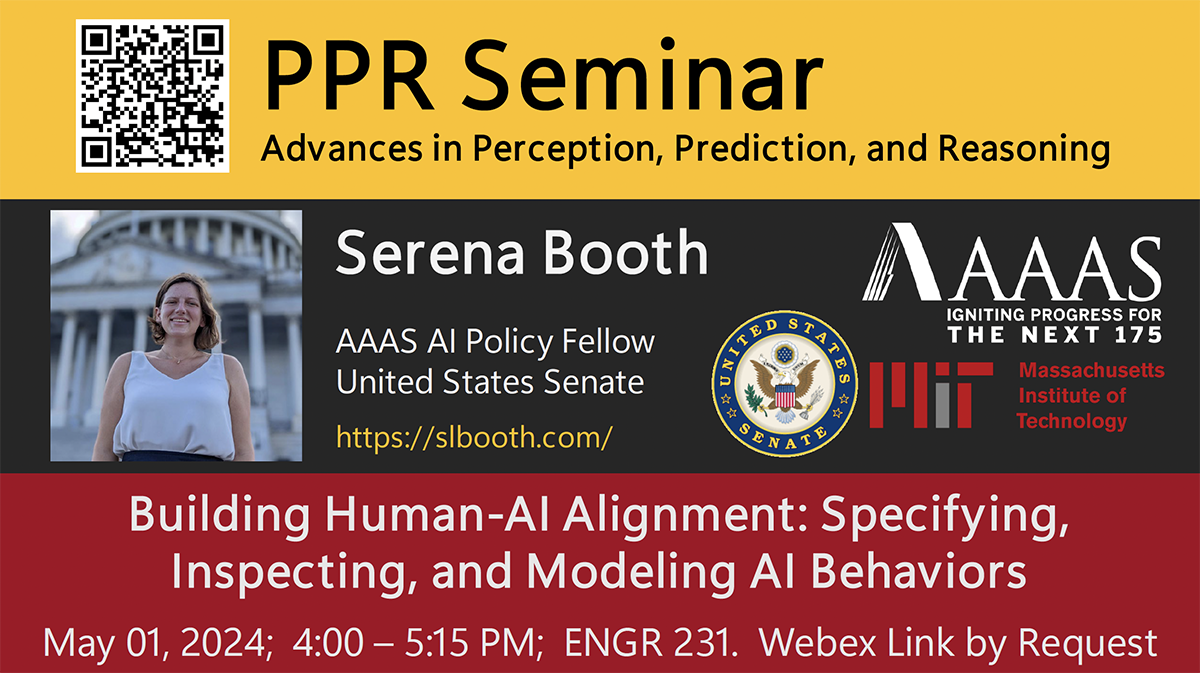
    <div><strong>Building Human-AI Alignment: Specifying, Inspecting, and Modeling AI Behaviors</strong></div>
    <div><br></div>
    <div><strong><a href="https://slbooth.com" rel="nofollow external" class="bo">Serena Booth</a><br>AAAS AI Policy Fellow, United States Senate</strong></div>
    <div><br></div>
    <div><strong>4-5:30pm ET Wednesday, 1 May, 2024</strong></div>
    <div><strong>UMBC ENGR 231, Webex Link by Request</strong></div>
    <div><br></div>
    <div>The learned behaviors of AI and robot agents should align with the intentions of their human designers. Toward this goal, people must be able to easily specify, inspect, and model agent behaviors. For specifications, we will consider expert-written reward functions for reinforcement learning (<a href="https://en.wikipedia.org/wiki/Reinforcement_learning" rel="nofollow external" class="bo"><strong>RL</strong></a>) and non-expert preferences for reinforcement learning from human feedback (<strong><a href="https://en.wikipedia.org/wiki/Reinforcement_learning_from_human_feedback" rel="nofollow external" class="bo">RLHF</a></strong>). I will show evidence that experts are bad at writing reward functions: even in a trivial setting, experts write specifications that are overfit to a particular RL algorithm, and they often write erroneous specifications for agents that fail to encode their true intent. Next, I will show that the common approach to learning a reward function from non-experts in RLHF uses an inductive bias that fails to encode how humans express preferences, and that our proposed bias better encodes human preferences both theoretically and empirically. For inspection, humans must be able to assess the behaviors an agent learns from a given specification. I will discuss a method to find settings that exhibit particular behaviors, like out-of-distribution failures. Lastly, cognitive science theories attempt to show how people build conceptual models that explain agent behaviors. I will show evidence that some of these theories are used in research to support humans, but that we can still build better curricula for modeling. Collectively, my research provides evidence that—even with the best of intentions— current human-AI systems often fail to induce alignment; my research proposes promising directions for how to build better aligned human-AI systems.</div>
    <div><br></div>
    <div>
    <a href="https://slbooth.com/" rel="nofollow external" class="bo"><strong>Serena Booth </strong></a>received her PhD at <strong><a href="https://en.wikipedia.org/wiki/MIT_Computer_Science_and_Artificial_Intelligence_Laboratory" rel="nofollow external" class="bo">MIT CSAIL</a></strong> in 2023. Serena studies how people write specifications for AI systems and how people assess whether AI systems are successful in learning from specifications. While at MIT, Serena served as an inaugural Social and Ethical Responsible Computing Scholar, teaching AI Ethics and developing MIT’s AI ethics curriculum that is also released on MIT OpenCourseWare. Serena is a graduate of Harvard College (2016), after which she worked as an Associate Product Manager at Google to help scale Google’s ARCore augmented reality product to 100 million devices. Serena currently works in the U.S. Senate as a AAAS AI Policy Fellow, where she is working on AI policy questions for the Senate Banking, Housing, and Urban Affairs Committee. Her research has been supported by an MIT Presidential Fellowship and by an NSF GRFP. She is a Rising Star in EECS and an HRI Pioneer.</div> <div>
    <br><hr>
    <a href="https://ai.umbc.edu/" rel="nofollow external" class="bo">UMBC Center for AI</a>
    </div>
    </div>
]]>
</Body>
<Summary>Building Human-AI Alignment: Specifying, Inspecting, and Modeling AI Behaviors     Serena Booth AAAS AI Policy Fellow, United States Senate     4-5:30pm ET Wednesday, 1 May, 2024  UMBC ENGR 231,...</Summary>
<Website>https://www.tejasgokhale.com/seminar.html</Website>
<TrackingUrl>https://my3.my.umbc.edu/api/v0/pixel/news/141513/guest@my.umbc.edu/ddb95eb735b5822cb2f0ba45ce7e4cd0/api/pixel</TrackingUrl>
<Tag>ai</Tag>
<Tag>alignment</Tag>
<Tag>llm</Tag>
<Group token="umbc-ai">UMBC AI</Group>
<GroupUrl>https://my3.my.umbc.edu/groups/umbc-ai</GroupUrl>
<AvatarUrl>https://assets4-my.umbc.edu/system/shared/avatars/groups/000/002/081/cfb27ebe008c2636486089a759ea5c36/xsmall.png?1691095779</AvatarUrl>
<AvatarUrl size="original">https://assets2-my.umbc.edu/system/shared/avatars/groups/000/002/081/cfb27ebe008c2636486089a759ea5c36/original.png?1691095779</AvatarUrl>
<AvatarUrl size="xxlarge">https://assets1-my.umbc.edu/system/shared/avatars/groups/000/002/081/cfb27ebe008c2636486089a759ea5c36/xxlarge.png?1691095779</AvatarUrl>
<AvatarUrl size="xlarge">https://assets1-my.umbc.edu/system/shared/avatars/groups/000/002/081/cfb27ebe008c2636486089a759ea5c36/xlarge.png?1691095779</AvatarUrl>
<AvatarUrl size="large">https://assets1-my.umbc.edu/system/shared/avatars/groups/000/002/081/cfb27ebe008c2636486089a759ea5c36/large.png?1691095779</AvatarUrl>
<AvatarUrl size="medium">https://assets3-my.umbc.edu/system/shared/avatars/groups/000/002/081/cfb27ebe008c2636486089a759ea5c36/medium.png?1691095779</AvatarUrl>
<AvatarUrl size="small">https://assets3-my.umbc.edu/system/shared/avatars/groups/000/002/081/cfb27ebe008c2636486089a759ea5c36/small.png?1691095779</AvatarUrl>
<AvatarUrl size="xsmall">https://assets4-my.umbc.edu/system/shared/avatars/groups/000/002/081/cfb27ebe008c2636486089a759ea5c36/xsmall.png?1691095779</AvatarUrl>
<AvatarUrl size="xxsmall">https://assets1-my.umbc.edu/system/shared/avatars/groups/000/002/081/cfb27ebe008c2636486089a759ea5c36/xxsmall.png?1691095779</AvatarUrl>
<Sponsor>UMBC AI</Sponsor>
<PawCount>0</PawCount>
<CommentCount>0</CommentCount>
<CommentsAllowed>true</CommentsAllowed>
<PostedAt>Tue, 30 Apr 2024 12:27:12 -0400</PostedAt>
</NewsItem>

<NewsItem contentIssues="false" id="141437" important="false" status="posted" url="https://my3.my.umbc.edu/groups/umbc-ai/posts/141437">
<Title>Generative AI for Assignments, Projects and Assessments 4/29</Title>
<Tagline>A two-hour workshop on practical skills and takeaways</Tagline>
<Body>
<![CDATA[
    <div class="html-content">
    <p><strong><br></strong></p>
    <p><strong>Generative AI for Assignments, Projects, and Assessments</strong></p>
    <div><span><strong><a href="https://www.linkedin.com/in/pdmilleredd/" rel="nofollow external" class="bo">Paul D. Miller, Ed.D.</a></strong></span></div>
    <div><strong>6:30-8:30pm ET Monday, 29 April 2024 via <a href="https://my3.my.umbc.edu/groups/dps/events/129119/join_meeting" rel="nofollow external" class="bo">WebEx</a></strong></div>
    <div><br></div>
    <div>In an era where <a href="https://en.wikipedia.org/wiki/Generative_artificial_intelligence" rel="nofollow external" class="bo"><strong>Generative Artificial Intelligence</strong></a> (GAI) is increasingly becoming a part of our daily professional and personal lives, understanding how to effectively interact with these systems is crucial. This workshop is designed to equip participants with practical skills and insights for engaging with GAI interfaces, specifically focusing on optimizing the quality of results, integrating GAI outputs into user responses, and adhering to ethical citation practices.  This workshop is being hosted by the <strong><a href="https://professionalprograms.umbc.edu/geographic-information-systems/" rel="nofollow external" class="bo">Graduate Program in Geographic Information Systems</a></strong>. Friends of the program are welcome to join virtually.</div>
    <div><br></div>
    <div><span><span><a href="https://www.linkedin.com/in/pdmilleredd/" rel="nofollow external" class="bo"><strong>Paul D. Miller </strong></a>will lead the session. He has extensive experience in STEM instruction; K-16 curriculum development; instructional design and teaching methodologies; project evaluation; inclusive professional learning/development; instructional technology integration; instructional systems development; program implementation fidelity and evaluation; and over $34 million in federal and state grant facilitation and management. </span></span></div>
    <div>
    <br><hr>
    <a href="https://ai.umbc.edu/" rel="nofollow external" class="bo">UMBC Center for AI</a>
    </div>
    </div>
]]>
</Body>
<Summary>Generative AI for Assignments, Projects, and Assessments  Paul D. Miller, Ed.D.  6:30-8:30pm ET Monday, 29 April 2024 via WebEx     In an era where Generative Artificial Intelligence (GAI) is...</Summary>
<Website>https://my3.my.umbc.edu/groups/dps/events/129119</Website>
<TrackingUrl>https://my3.my.umbc.edu/api/v0/pixel/news/141437/guest@my.umbc.edu/e15ee29882ab681894ea36867efd2818/api/pixel</TrackingUrl>
<Tag>ai</Tag>
<Tag>geographic-information-systems</Tag>
<Tag>gis</Tag>
<Tag>llm</Tag>
<Group token="umbc-ai">UMBC AI</Group>
<GroupUrl>https://my3.my.umbc.edu/groups/umbc-ai</GroupUrl>
<AvatarUrl>https://assets4-my.umbc.edu/system/shared/avatars/groups/000/002/081/cfb27ebe008c2636486089a759ea5c36/xsmall.png?1691095779</AvatarUrl>
<AvatarUrl size="original">https://assets2-my.umbc.edu/system/shared/avatars/groups/000/002/081/cfb27ebe008c2636486089a759ea5c36/original.png?1691095779</AvatarUrl>
<AvatarUrl size="xxlarge">https://assets1-my.umbc.edu/system/shared/avatars/groups/000/002/081/cfb27ebe008c2636486089a759ea5c36/xxlarge.png?1691095779</AvatarUrl>
<AvatarUrl size="xlarge">https://assets1-my.umbc.edu/system/shared/avatars/groups/000/002/081/cfb27ebe008c2636486089a759ea5c36/xlarge.png?1691095779</AvatarUrl>
<AvatarUrl size="large">https://assets1-my.umbc.edu/system/shared/avatars/groups/000/002/081/cfb27ebe008c2636486089a759ea5c36/large.png?1691095779</AvatarUrl>
<AvatarUrl size="medium">https://assets3-my.umbc.edu/system/shared/avatars/groups/000/002/081/cfb27ebe008c2636486089a759ea5c36/medium.png?1691095779</AvatarUrl>
<AvatarUrl size="small">https://assets3-my.umbc.edu/system/shared/avatars/groups/000/002/081/cfb27ebe008c2636486089a759ea5c36/small.png?1691095779</AvatarUrl>
<AvatarUrl size="xsmall">https://assets4-my.umbc.edu/system/shared/avatars/groups/000/002/081/cfb27ebe008c2636486089a759ea5c36/xsmall.png?1691095779</AvatarUrl>
<AvatarUrl size="xxsmall">https://assets1-my.umbc.edu/system/shared/avatars/groups/000/002/081/cfb27ebe008c2636486089a759ea5c36/xxsmall.png?1691095779</AvatarUrl>
<Sponsor>UMBC AI</Sponsor>
<PawCount>0</PawCount>
<CommentCount>0</CommentCount>
<CommentsAllowed>true</CommentsAllowed>
<PostedAt>Mon, 29 Apr 2024 09:25:58 -0400</PostedAt>
</NewsItem>

<NewsItem contentIssues="false" id="141433" important="false" status="posted" url="https://my3.my.umbc.edu/groups/umbc-ai/posts/141433">
<Title>Talk: ChatGPT &amp; AI in Research, Education &amp; Classrooms, 4/29</Title>
<Tagline>12-1 pm ET Monday, April 29, 2024</Tagline>
<Body>
<![CDATA[
    <div class="html-content">
    <div><strong>UMBC AI, Privacy, and Ethics Symposium</strong></div>
    <div><strong><br></strong></div>
    <div><strong>ChatGPT and AI in Research, Education, and the Classroom</strong></div>
    <div><strong>Rachael Kang, UMBC Information Systems</strong></div>
    <div><strong><br></strong></div>
    <div><strong>12-1pm ET Monday, April 29, 2024, via <a href="https://my3.my.umbc.edu/groups/library/events/127076/join_meeting" rel="nofollow external" class="bo">WebEx</a></strong></div>
    <div><br></div>
    <div>Join UMBC Information Systems PhD student <a href="https://www.linkedin.com/in/rachael-kang-761513131/" rel="nofollow external" class="bo"><strong>Rachael Kang</strong></a> as she shares her research journey of how she came to study AI, starting from her master's thesis on the utility of machine learning in predicting suicide risk to her current research interests of integrating a large language model into patient portals to increase patient health literacy. Rachael will also discuss how she has introduced ChatGPT as a learning tool for the students she TAs in Information Systems 303, the activities she has conducted with the students to demonstrate the strengths and weaknesses of ChatGPT, and the types of conversations she has with students about what is proper and improper use of ChatGPT.</div>
    <div><br></div>
    <div>Get more information and join the event <a href="https://my3.my.umbc.edu/groups/library/events/127076" rel="nofollow external" class="bo">here</a>.</div>
    <div>Here is a <strong><a href="https://umbc.webex.com/recordingservice/sites/umbc/recording/39f99f38e870103cbfd796d1806433cd/playback" rel="nofollow external" class="bo">video of the session</a>.</strong>
    </div>
    <div>
    <hr>
    <a href="https://ai.umbc.edu/" rel="nofollow external" class="bo">UMBC Center for AI</a>
    </div>
    </div>
]]>
</Body>
<Summary>UMBC AI, Privacy, and Ethics Symposium     ChatGPT and AI in Research, Education, and the Classroom  Rachael Kang, UMBC Information Systems     12-1pm ET Monday, April 29, 2024, via WebEx     Join...</Summary>
<Website>https://my3.my.umbc.edu/groups/library/events/127076</Website>
<TrackingUrl>https://my3.my.umbc.edu/api/v0/pixel/news/141433/guest@my.umbc.edu/c79f1210a7c7f48c897c131e4fb92ef0/api/pixel</TrackingUrl>
<Tag>ai</Tag>
<Tag>chatgpt</Tag>
<Tag>classroom</Tag>
<Tag>llm</Tag>
<Tag>teaching</Tag>
<Group token="umbc-ai">UMBC AI</Group>
<GroupUrl>https://my3.my.umbc.edu/groups/umbc-ai</GroupUrl>
<AvatarUrl>https://assets4-my.umbc.edu/system/shared/avatars/groups/000/002/081/cfb27ebe008c2636486089a759ea5c36/xsmall.png?1691095779</AvatarUrl>
<AvatarUrl size="original">https://assets2-my.umbc.edu/system/shared/avatars/groups/000/002/081/cfb27ebe008c2636486089a759ea5c36/original.png?1691095779</AvatarUrl>
<AvatarUrl size="xxlarge">https://assets1-my.umbc.edu/system/shared/avatars/groups/000/002/081/cfb27ebe008c2636486089a759ea5c36/xxlarge.png?1691095779</AvatarUrl>
<AvatarUrl size="xlarge">https://assets1-my.umbc.edu/system/shared/avatars/groups/000/002/081/cfb27ebe008c2636486089a759ea5c36/xlarge.png?1691095779</AvatarUrl>
<AvatarUrl size="large">https://assets1-my.umbc.edu/system/shared/avatars/groups/000/002/081/cfb27ebe008c2636486089a759ea5c36/large.png?1691095779</AvatarUrl>
<AvatarUrl size="medium">https://assets3-my.umbc.edu/system/shared/avatars/groups/000/002/081/cfb27ebe008c2636486089a759ea5c36/medium.png?1691095779</AvatarUrl>
<AvatarUrl size="small">https://assets3-my.umbc.edu/system/shared/avatars/groups/000/002/081/cfb27ebe008c2636486089a759ea5c36/small.png?1691095779</AvatarUrl>
<AvatarUrl size="xsmall">https://assets4-my.umbc.edu/system/shared/avatars/groups/000/002/081/cfb27ebe008c2636486089a759ea5c36/xsmall.png?1691095779</AvatarUrl>
<AvatarUrl size="xxsmall">https://assets1-my.umbc.edu/system/shared/avatars/groups/000/002/081/cfb27ebe008c2636486089a759ea5c36/xxsmall.png?1691095779</AvatarUrl>
<Sponsor>UMBC AI</Sponsor>
<PawCount>0</PawCount>
<CommentCount>0</CommentCount>
<CommentsAllowed>true</CommentsAllowed>
<PostedAt>Sun, 28 Apr 2024 18:02:38 -0400</PostedAt>
<EditAt>Wed, 01 May 2024 08:24:42 -0400</EditAt>
</NewsItem>

<NewsItem contentIssues="true" id="141413" important="false" status="posted" url="https://my3.my.umbc.edu/groups/umbc-ai/posts/141413">
<Title>Talk: Rigorous measurement in text-to-image systems, 4/29</Title>
<Tagline>4-5pm ET Monday, April 29 in ENGR 231 and Webex</Tagline>
<Body>
<![CDATA[
    <div class="html-content">
    <div>
    <h4><strong><br></strong></h4>
    <h4><strong>Rigorous measurement in text-to-image systems (and AI more broadly?)</strong></h4>
    <div><br></div>
    <div><a href="https://saxon.me/" rel="nofollow external" class="bo"><strong>Michael Saxon</strong></a></div>
    <div><strong>University of California, Santa Barbara</strong></div>
    <div><strong><br></strong></div>
    <div><strong>April 29, 2024 4:00 – 5:15 PM ET</strong></div>
    <div><strong>ENGR 231 and <a href="https://umbc.webex.com/meet/gokhale" rel="nofollow external" class="bo">Webex</a></strong></div>
    <div><br></div>
    <div>As large pretrained models underlying generative AI systems have grown larger, inscrutable, and widely-deployed, interest in understanding their nature as emergent rather than engineered systems has grown. I believe to move this "ersatz natural science" of AI forward, we need to focus on building rigorous observational tools for these systems, which can characterize capabilities unambiguously. At their best, benchmarks and metrics could meet this need, but at present they are often treated as mere leaderboards to chase and only very indirectly measure capabilities of interest. This talk covers three works on this topic: first, a work laying out the high-level case for building a subfield of "model metrology" which focuses on building better benchmarks and metrics. Then, it covers two works on metrology in the generative image domain: first, a work which assesses multilingual conceptual knowledge in <a href="https://en.wikipedia.org/wiki/Text-to-image_model" rel="nofollow external" class="bo"><strong>text-to-image</strong></a> (T2I) systems, and second, a meta-benchmark that demonstrates how many T2I prompt faithfulness benchmarks actually fail to capture the compositionality characteristics of T2I systems which they purport to measure. This line of inquiry is intended to help move benchmarking toward the ideal of rigorous tools of scientific observation.</div>
    <div><br></div>
    <div>
    <strong><a href="Michael%20Saxon" rel="nofollow external" class="bo">Michael Saxon</a></strong> is a PhD candidate and NSF Fellow in the NLP Group at the University of California, Santa Barbara. His research sits on the intersection of generative model benchmarking, multimodality, and AI ethics. He’s particularly interested in making meaningful evaluations of hard-to-measure new capabilities in these artifacts. Michael earned his BS in Electrical Engineering and MS in Computer Engineering at Arizona State University, advised by Visar Berish and Sethuraman Panchanathan in 2018 and 2020 respectively.</div>
    </div>
    <div>
    <br><hr>
    <a href="https://ai.umbc.edu/" rel="nofollow external" class="bo">UMBC Center for AI</a>
    </div>
    </div>
]]>
</Body>
<Summary>Rigorous measurement in text-to-image systems (and AI more broadly?)     Michael Saxon  University of California, Santa Barbara     April 29, 2024 4:00 – 5:15 PM ET  ENGR 231 and Webex     As...</Summary>
<Website>https://www.tejasgokhale.com/seminar.html</Website>
<TrackingUrl>https://my3.my.umbc.edu/api/v0/pixel/news/141413/guest@my.umbc.edu/a635851ae646611f8b11c1745ec96965/api/pixel</TrackingUrl>
<Tag>ai</Tag>
<Tag>image</Tag>
<Tag>llm</Tag>
<Tag>text</Tag>
<Tag>text-to-image</Tag>
<Group token="umbc-ai">UMBC AI</Group>
<GroupUrl>https://my3.my.umbc.edu/groups/umbc-ai</GroupUrl>
<AvatarUrl>https://assets4-my.umbc.edu/system/shared/avatars/groups/000/002/081/cfb27ebe008c2636486089a759ea5c36/xsmall.png?1691095779</AvatarUrl>
<AvatarUrl size="original">https://assets2-my.umbc.edu/system/shared/avatars/groups/000/002/081/cfb27ebe008c2636486089a759ea5c36/original.png?1691095779</AvatarUrl>
<AvatarUrl size="xxlarge">https://assets1-my.umbc.edu/system/shared/avatars/groups/000/002/081/cfb27ebe008c2636486089a759ea5c36/xxlarge.png?1691095779</AvatarUrl>
<AvatarUrl size="xlarge">https://assets1-my.umbc.edu/system/shared/avatars/groups/000/002/081/cfb27ebe008c2636486089a759ea5c36/xlarge.png?1691095779</AvatarUrl>
<AvatarUrl size="large">https://assets1-my.umbc.edu/system/shared/avatars/groups/000/002/081/cfb27ebe008c2636486089a759ea5c36/large.png?1691095779</AvatarUrl>
<AvatarUrl size="medium">https://assets3-my.umbc.edu/system/shared/avatars/groups/000/002/081/cfb27ebe008c2636486089a759ea5c36/medium.png?1691095779</AvatarUrl>
<AvatarUrl size="small">https://assets3-my.umbc.edu/system/shared/avatars/groups/000/002/081/cfb27ebe008c2636486089a759ea5c36/small.png?1691095779</AvatarUrl>
<AvatarUrl size="xsmall">https://assets4-my.umbc.edu/system/shared/avatars/groups/000/002/081/cfb27ebe008c2636486089a759ea5c36/xsmall.png?1691095779</AvatarUrl>
<AvatarUrl size="xxsmall">https://assets1-my.umbc.edu/system/shared/avatars/groups/000/002/081/cfb27ebe008c2636486089a759ea5c36/xxsmall.png?1691095779</AvatarUrl>
<Sponsor>UMBC AI</Sponsor>
<ThumbnailUrl size="xxlarge">https://assets2-my.umbc.edu/system/shared/thumbnails/news/000/141/413/3843538aec7e5167ea4f3e2c5a95c3eb/xxlarge.jpg?1714224563</ThumbnailUrl>
<ThumbnailUrl size="xlarge">https://assets1-my.umbc.edu/system/shared/thumbnails/news/000/141/413/3843538aec7e5167ea4f3e2c5a95c3eb/xlarge.jpg?1714224563</ThumbnailUrl>
<ThumbnailUrl size="large">https://assets3-my.umbc.edu/system/shared/thumbnails/news/000/141/413/3843538aec7e5167ea4f3e2c5a95c3eb/large.jpg?1714224563</ThumbnailUrl>
<ThumbnailUrl size="medium">https://assets2-my.umbc.edu/system/shared/thumbnails/news/000/141/413/3843538aec7e5167ea4f3e2c5a95c3eb/medium.jpg?1714224563</ThumbnailUrl>
<ThumbnailUrl size="small">https://assets2-my.umbc.edu/system/shared/thumbnails/news/000/141/413/3843538aec7e5167ea4f3e2c5a95c3eb/small.jpg?1714224563</ThumbnailUrl>
<ThumbnailUrl size="xsmall">https://assets1-my.umbc.edu/system/shared/thumbnails/news/000/141/413/3843538aec7e5167ea4f3e2c5a95c3eb/xsmall.jpg?1714224563</ThumbnailUrl>
<ThumbnailUrl size="xxsmall">https://assets2-my.umbc.edu/system/shared/thumbnails/news/000/141/413/3843538aec7e5167ea4f3e2c5a95c3eb/xxsmall.jpg?1714224563</ThumbnailUrl>
<PawCount>0</PawCount>
<CommentCount>0</CommentCount>
<CommentsAllowed>true</CommentsAllowed>
<PostedAt>Sat, 27 Apr 2024 09:34:44 -0400</PostedAt>
<EditAt>Sat, 27 Apr 2024 10:07:37 -0400</EditAt>
</NewsItem>

</News>