<?xml version="1.0"?>
<News hasArchived="false" page="29" pageCount="40" pageSize="10" timestamp="Sun, 30 Aug 2026 21:10:42 -0400" url="https://my3.my.umbc.edu/groups/umbc-ai/posts.xml?mode=pawpularity&amp;page=29">
<NewsItem contentIssues="true" id="144995" important="false" status="posted" url="https://my3.my.umbc.edu/groups/umbc-ai/posts/144995">
<Title>Talk: ML Reproducibility: Sources of Algorithmic, Implementation &amp; Observational Variability, 10/29</Title>
<Tagline>4-5pm EDT Tuesday, October 29, 2024, online</Tagline>
<Body>
<![CDATA[
    <div class="html-content">
    <h3>ML Reproducibility: Sources of Algorithmic, Implementation, and Observational Variability</h3>
    <h4>Kevin Coakley, UC San Diego</h4>
    <h4>4-5pm EDT Tue., 29 Oct. 2024, <a href="https://my3.my.umbc.edu/groups/iharp/events/134052/join_meeting" rel="nofollow external" class="bo">online</a> </h4>
    <div><br></div>
    <div>Reproducibility is fundamental to scientific research, as it underpins trust, progress, and credibility. In machine learning (ML), achieving reproducibility is difficult due to variability in algorithms, implementations, and observational factors. This presentation explores key contributors to irreproducibility in ML, including algorithmic factors like <a href="https://en.wikipedia.org/wiki/Hyperparameter_optimization" rel="nofollow external" class="bo">hyperparameter tuning</a> and random weight initialization, implementation differences in software and hardware, and observational factors such as dataset bias and data preprocessing. It emphasizes the need to view ML model performance as a distribution, not a single metric or average of results, and clarifies the difference between reproducibility and portability. The goal is to guide researchers on improving ML reproducibility and identifying the critical information necessary for replicating experimental outcomes.</div>
    <div><br></div>
    <div>
    <a href="https://www.linkedin.com/in/kevcoakley/" rel="nofollow external" class="bo">Kevin Coakley</a> is a Computational and Data Science Research Specialist at the San Diego Supercomputer Center and UC San Diego focusing on AI reproducibility. Kevin holds a MAS in Architecture-based Enterprise Systems Engineering and Leadership from UC San Diego and is pursuing a PhD in Computer Science at the Norwegian University of Science and Technology. Kevin specializes in training and evaluating machine learning models for accuracy and reproducibility in applications like image recognition, time series prediction, and natural language processing.</div>
    <div><br></div>
    <div>Sponsored by <a href="https://iharp.umbc.edu/" rel="nofollow external" class="bo">iHARP, the NSF HDR Institute for Harnessing Data &amp; Model Revolution in the Polar Regions</a>
    </div>
    <div><br></div> <hr>
    <a href="https://ai.umbc.edu/" rel="nofollow external" class="bo"><strong>UMBC Center for AI</strong></a>
    </div>
]]>
</Body>
<Summary>ML Reproducibility: Sources of Algorithmic, Implementation, and Observational Variability  Kevin Coakley, UC San Diego  4-5pm EDT Tue., 29 Oct. 2024, online      Reproducibility is fundamental to...</Summary>
<Website>https://my3.my.umbc.edu/groups/iharp/events/134052</Website>
<TrackingUrl>https://my3.my.umbc.edu/api/v0/pixel/news/144995/guest@my.umbc.edu/1a5b95931bab93d48e19778962cf1124/api/pixel</TrackingUrl>
<Tag>ai</Tag>
<Tag>iharp</Tag>
<Tag>machine-learning</Tag>
<Group token="umbc-ai">UMBC AI</Group>
<GroupUrl>https://my3.my.umbc.edu/groups/umbc-ai</GroupUrl>
<AvatarUrl>https://assets4-my.umbc.edu/system/shared/avatars/groups/000/002/081/cfb27ebe008c2636486089a759ea5c36/xsmall.png?1691095779</AvatarUrl>
<AvatarUrl size="original">https://assets2-my.umbc.edu/system/shared/avatars/groups/000/002/081/cfb27ebe008c2636486089a759ea5c36/original.png?1691095779</AvatarUrl>
<AvatarUrl size="xxlarge">https://assets1-my.umbc.edu/system/shared/avatars/groups/000/002/081/cfb27ebe008c2636486089a759ea5c36/xxlarge.png?1691095779</AvatarUrl>
<AvatarUrl size="xlarge">https://assets1-my.umbc.edu/system/shared/avatars/groups/000/002/081/cfb27ebe008c2636486089a759ea5c36/xlarge.png?1691095779</AvatarUrl>
<AvatarUrl size="large">https://assets1-my.umbc.edu/system/shared/avatars/groups/000/002/081/cfb27ebe008c2636486089a759ea5c36/large.png?1691095779</AvatarUrl>
<AvatarUrl size="medium">https://assets3-my.umbc.edu/system/shared/avatars/groups/000/002/081/cfb27ebe008c2636486089a759ea5c36/medium.png?1691095779</AvatarUrl>
<AvatarUrl size="small">https://assets3-my.umbc.edu/system/shared/avatars/groups/000/002/081/cfb27ebe008c2636486089a759ea5c36/small.png?1691095779</AvatarUrl>
<AvatarUrl size="xsmall">https://assets4-my.umbc.edu/system/shared/avatars/groups/000/002/081/cfb27ebe008c2636486089a759ea5c36/xsmall.png?1691095779</AvatarUrl>
<AvatarUrl size="xxsmall">https://assets1-my.umbc.edu/system/shared/avatars/groups/000/002/081/cfb27ebe008c2636486089a759ea5c36/xxsmall.png?1691095779</AvatarUrl>
<Sponsor>IHARP Institute</Sponsor>
<ThumbnailUrl size="xxlarge">https://assets4-my.umbc.edu/system/shared/thumbnails/news/000/144/995/422e03e13c76f394bca2bbede792688a/xxlarge.jpg?1729689826</ThumbnailUrl>
<ThumbnailUrl size="xlarge">https://assets2-my.umbc.edu/system/shared/thumbnails/news/000/144/995/422e03e13c76f394bca2bbede792688a/xlarge.jpg?1729689826</ThumbnailUrl>
<ThumbnailUrl size="large">https://assets4-my.umbc.edu/system/shared/thumbnails/news/000/144/995/422e03e13c76f394bca2bbede792688a/large.jpg?1729689826</ThumbnailUrl>
<ThumbnailUrl size="medium">https://assets2-my.umbc.edu/system/shared/thumbnails/news/000/144/995/422e03e13c76f394bca2bbede792688a/medium.jpg?1729689826</ThumbnailUrl>
<ThumbnailUrl size="small">https://assets2-my.umbc.edu/system/shared/thumbnails/news/000/144/995/422e03e13c76f394bca2bbede792688a/small.jpg?1729689826</ThumbnailUrl>
<ThumbnailUrl size="xsmall">https://assets1-my.umbc.edu/system/shared/thumbnails/news/000/144/995/422e03e13c76f394bca2bbede792688a/xsmall.jpg?1729689826</ThumbnailUrl>
<ThumbnailUrl size="xxsmall">https://assets1-my.umbc.edu/system/shared/thumbnails/news/000/144/995/422e03e13c76f394bca2bbede792688a/xxsmall.jpg?1729689826</ThumbnailUrl>
<PawCount>0</PawCount>
<CommentCount>0</CommentCount>
<CommentsAllowed>true</CommentsAllowed>
<PostedAt>Wed, 23 Oct 2024 09:40:01 -0400</PostedAt>
</NewsItem>

<NewsItem contentIssues="true" id="144926" important="false" status="posted" url="https://my3.my.umbc.edu/groups/umbc-ai/posts/144926">
<Title>Talk: Cyborg Meets AI: Technologized Disabled People in the Context of Corporatized Technological Development and Health Management</Title>
<Tagline>4-5:30 pm EDT, Tuesday, October 22, 2024, online</Tagline>
<Body>
<![CDATA[
    <div class="html-content">
    <h4>Cyborg Meets AI: Technologized Disabled People in the Context of Corporatized Technological Development and Health Management</h4>
    <div><br></div>
    <h4>
    <a href="https://liberalarts.vt.edu/departments-and-schools/department-of-science-technology-and-society/faculty/ashley-shew.html" rel="nofollow external" class="bo">Ashley Shew</a>, Virginia Tech<br>4-5:30 pm EDT, Tue., Oct. 22, 2024, <a href="https://umbc.webex.com/umbc/j.php?MTID=m658420aeff278fa969cb378cf0747448" rel="nofollow external" class="bo">online</a>
    </h4>
    <div><br></div>
    <div>There are many dangers of having parts of your body owned, managed, or maintained by companies and/or managed care -- to be cyborg is to be tracked and surveilled as a regular feature of being a disabled person. I'll speak about state programs that use electronic visit verification for personal attendant care, about a bionic eye company that went belly up (and left people without sight), about a company that shifted away from a product for lower income folks and left people with unusable cochlear implants in their heads (and no support for repair or replacement), about social media surveillance in denying people disability benefits, about where increased use of AI will overlook some disabled people and look extra hard at others (with implications for education, jobs, and public life). Some of these cases are to help us think about future AI (and don't constitute AI themselves), but I think are important to understanding the context of being disabled in our society, and regularly living with and relying on technologies. We need historical and lived context for considering, evaluating, and setting prudent policies forth for AI development.</div>
    <div><br></div>
    <div>Ashley Shew is an associate professor of Science, Technology, and Society at Virginia Tech. Her current research sits at the intersection of technology studies, biotech ethics, and disability studies.</div>
    <div><br></div>
    <div>Organized by the <a href="https://hcst.umbc.edu/" rel="nofollow external" class="bo">Human Context of Science and Technology</a> program and the <a href="https://cahss.umbc.edu/news/post/141647/" rel="nofollow external" class="bo">Critical Disability Studies Minor.</a>  Cosponsored by Accessibility and Disabilities Services, the Designing Participatory Futures Lab, the Department of English, the Department of Media and Communication Studies, the Department of Philosophy, the Department of Sociology, Anthropology, and Public Health, and the Global Studies Program. </div>
    <div><br></div> <hr>
    <a href="https://ai.umbc.edu/" rel="nofollow external" class="bo"><strong>UMBC Center for AI</strong></a>
    </div>
]]>
</Body>
<Summary>Cyborg Meets AI: Technologized Disabled People in the Context of Corporatized Technological Development and Health Management     Ashley Shew, Virginia Tech 4-5:30 pm EDT, Tue., Oct. 22, 2024,...</Summary>
<TrackingUrl>https://my3.my.umbc.edu/api/v0/pixel/news/144926/guest@my.umbc.edu/e79dc5309c0d322693bd2aed1f817adc/api/pixel</TrackingUrl>
<Tag>ai</Tag>
<Tag>disability</Tag>
<Group token="umbc-ai">UMBC AI</Group>
<GroupUrl>https://my3.my.umbc.edu/groups/umbc-ai</GroupUrl>
<AvatarUrl>https://assets4-my.umbc.edu/system/shared/avatars/groups/000/002/081/cfb27ebe008c2636486089a759ea5c36/xsmall.png?1691095779</AvatarUrl>
<AvatarUrl size="original">https://assets2-my.umbc.edu/system/shared/avatars/groups/000/002/081/cfb27ebe008c2636486089a759ea5c36/original.png?1691095779</AvatarUrl>
<AvatarUrl size="xxlarge">https://assets1-my.umbc.edu/system/shared/avatars/groups/000/002/081/cfb27ebe008c2636486089a759ea5c36/xxlarge.png?1691095779</AvatarUrl>
<AvatarUrl size="xlarge">https://assets1-my.umbc.edu/system/shared/avatars/groups/000/002/081/cfb27ebe008c2636486089a759ea5c36/xlarge.png?1691095779</AvatarUrl>
<AvatarUrl size="large">https://assets1-my.umbc.edu/system/shared/avatars/groups/000/002/081/cfb27ebe008c2636486089a759ea5c36/large.png?1691095779</AvatarUrl>
<AvatarUrl size="medium">https://assets3-my.umbc.edu/system/shared/avatars/groups/000/002/081/cfb27ebe008c2636486089a759ea5c36/medium.png?1691095779</AvatarUrl>
<AvatarUrl size="small">https://assets3-my.umbc.edu/system/shared/avatars/groups/000/002/081/cfb27ebe008c2636486089a759ea5c36/small.png?1691095779</AvatarUrl>
<AvatarUrl size="xsmall">https://assets4-my.umbc.edu/system/shared/avatars/groups/000/002/081/cfb27ebe008c2636486089a759ea5c36/xsmall.png?1691095779</AvatarUrl>
<AvatarUrl size="xxsmall">https://assets1-my.umbc.edu/system/shared/avatars/groups/000/002/081/cfb27ebe008c2636486089a759ea5c36/xxsmall.png?1691095779</AvatarUrl>
<Sponsor>UMBC AI</Sponsor>
<ThumbnailUrl size="xxlarge">https://assets4-my.umbc.edu/system/shared/thumbnails/news/000/144/926/e0a885f1e01321ea585586aef586d082/xxlarge.jpg?1729436597</ThumbnailUrl>
<ThumbnailUrl size="xlarge">https://assets4-my.umbc.edu/system/shared/thumbnails/news/000/144/926/e0a885f1e01321ea585586aef586d082/xlarge.jpg?1729436597</ThumbnailUrl>
<ThumbnailUrl size="large">https://assets1-my.umbc.edu/system/shared/thumbnails/news/000/144/926/e0a885f1e01321ea585586aef586d082/large.jpg?1729436597</ThumbnailUrl>
<ThumbnailUrl size="medium">https://assets3-my.umbc.edu/system/shared/thumbnails/news/000/144/926/e0a885f1e01321ea585586aef586d082/medium.jpg?1729436597</ThumbnailUrl>
<ThumbnailUrl size="small">https://assets4-my.umbc.edu/system/shared/thumbnails/news/000/144/926/e0a885f1e01321ea585586aef586d082/small.jpg?1729436597</ThumbnailUrl>
<ThumbnailUrl size="xsmall">https://assets3-my.umbc.edu/system/shared/thumbnails/news/000/144/926/e0a885f1e01321ea585586aef586d082/xsmall.jpg?1729436597</ThumbnailUrl>
<ThumbnailUrl size="xxsmall">https://assets4-my.umbc.edu/system/shared/thumbnails/news/000/144/926/e0a885f1e01321ea585586aef586d082/xxsmall.jpg?1729436597</ThumbnailUrl>
<PawCount>2</PawCount>
<CommentCount>0</CommentCount>
<CommentsAllowed>true</CommentsAllowed>
<PostedAt>Sun, 20 Oct 2024 11:08:42 -0400</PostedAt>
<EditAt>Sun, 20 Oct 2024 11:13:58 -0400</EditAt>
</NewsItem>

<NewsItem contentIssues="true" id="144922" important="false" status="posted" url="https://my3.my.umbc.edu/groups/umbc-ai/posts/144922">
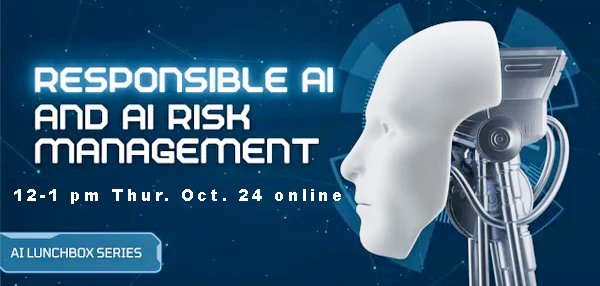
<Title>Talk: Responsible AI and AI Risk Management Frameworks, 12pm 10/24</Title>
<Tagline>AI Lunchbox, 12-1 pm EDT on October 24, 2024</Tagline>
<Body>
<![CDATA[
    <div class="html-content">
    <div><img src="https://ai.umbc.edu/wp-content/uploads/sites/734/2024/10/600_523938704.jpg" style="max-width: 100%; height: auto;"></div>
    <div><br></div>
    <div>
    <span>In the next <a href="https://www.umbctraining.com/" rel="nofollow external" class="bo"><strong>UMBC Training Centers</strong></a> </span><span>AI Lunchbox session,</span><span> <a href="https://www.linkedin.com/in/ed-melick-7a683/" rel="nofollow external" class="bo"><strong>Ed Melick</strong></a> will discuss Responsible AI and AI Risk Management Frameworks, 12-1 pm EDT on October 24, 2024. </span>
    </div>
    <div><span><br></span></div>
    <div><span>Many Responsible AI (RAI) and AI risk management frameworks have been developed, and the number is growing rapidly. Variations among these frameworks can be significant. This has led to some confusion and hesitance among organizations wanting to implement RAI programs to ensure the safe and ethical development, deployment, and use of AI systems. </span></div>
    <div><span><br></span></div>
    <div><span>Join Ed as he discusses C4AI’s effort to build a definitive database of publicly available frameworks, risk repositories, incident databases, and related resources. </span></div>
    <div><span><br></span></div>
    <div><span><a href="https://www.meetup.com/c4a-ai/events/303883918/" rel="nofollow external" class="bo"><strong>Register here</strong></a> for this free online meeting to get the link.</span></div>
    <div><span><br></span></div> <hr>
    <a href="https://ai.umbc.edu/" rel="nofollow external" class="bo"><strong>UMBC Center for AI</strong></a>
    </div>
]]>
</Body>
<Summary>In the next UMBC Training Centers AI Lunchbox session, Ed Melick will discuss Responsible AI and AI Risk Management Frameworks, 12-1 pm EDT on October 24, 2024.      Many Responsible AI (RAI) and...</Summary>
<Website>https://www.meetup.com/c4a-ai/events/303883918/</Website>
<TrackingUrl>https://my3.my.umbc.edu/api/v0/pixel/news/144922/guest@my.umbc.edu/3129f7419313b46cd0a66dd16ee27243/api/pixel</TrackingUrl>
<Tag>ai</Tag>
<Tag>risk</Tag>
<Group token="umbc-ai">UMBC AI</Group>
<GroupUrl>https://my3.my.umbc.edu/groups/umbc-ai</GroupUrl>
<AvatarUrl>https://assets4-my.umbc.edu/system/shared/avatars/groups/000/002/081/cfb27ebe008c2636486089a759ea5c36/xsmall.png?1691095779</AvatarUrl>
<AvatarUrl size="original">https://assets2-my.umbc.edu/system/shared/avatars/groups/000/002/081/cfb27ebe008c2636486089a759ea5c36/original.png?1691095779</AvatarUrl>
<AvatarUrl size="xxlarge">https://assets1-my.umbc.edu/system/shared/avatars/groups/000/002/081/cfb27ebe008c2636486089a759ea5c36/xxlarge.png?1691095779</AvatarUrl>
<AvatarUrl size="xlarge">https://assets1-my.umbc.edu/system/shared/avatars/groups/000/002/081/cfb27ebe008c2636486089a759ea5c36/xlarge.png?1691095779</AvatarUrl>
<AvatarUrl size="large">https://assets1-my.umbc.edu/system/shared/avatars/groups/000/002/081/cfb27ebe008c2636486089a759ea5c36/large.png?1691095779</AvatarUrl>
<AvatarUrl size="medium">https://assets3-my.umbc.edu/system/shared/avatars/groups/000/002/081/cfb27ebe008c2636486089a759ea5c36/medium.png?1691095779</AvatarUrl>
<AvatarUrl size="small">https://assets3-my.umbc.edu/system/shared/avatars/groups/000/002/081/cfb27ebe008c2636486089a759ea5c36/small.png?1691095779</AvatarUrl>
<AvatarUrl size="xsmall">https://assets4-my.umbc.edu/system/shared/avatars/groups/000/002/081/cfb27ebe008c2636486089a759ea5c36/xsmall.png?1691095779</AvatarUrl>
<AvatarUrl size="xxsmall">https://assets1-my.umbc.edu/system/shared/avatars/groups/000/002/081/cfb27ebe008c2636486089a759ea5c36/xxsmall.png?1691095779</AvatarUrl>
<Sponsor>UMBC Training Centers</Sponsor>
<PawCount>0</PawCount>
<CommentCount>0</CommentCount>
<CommentsAllowed>true</CommentsAllowed>
<PostedAt>Sat, 19 Oct 2024 18:58:25 -0400</PostedAt>
<EditAt>Sat, 19 Oct 2024 19:00:09 -0400</EditAt>
</NewsItem>

<NewsItem contentIssues="true" id="144920" important="false" status="posted" url="https://my3.my.umbc.edu/groups/umbc-ai/posts/144920">
<Title>UMBC faculty receive NSF award for digitial twins to study neurodegenerative diseases</Title>
<Body>
<![CDATA[
    <div class="html-content">
    <div><img src="https://ai.umbc.edu/wp-content/uploads/sites/734/2024/10/nsf_dt.webp" style="max-width: 100%; height: auto;"></div>
    <span><div><span><br></span></div>
    <div><span>UMBC Professors <a href="http://ansuchatterjee.com/" rel="nofollow external" class="bo">Ansu Chatterjee,</a> <a href="https://karuna.informationsystems.umbc.edu/" rel="nofollow external" class="bo">Karuna Joshi,</a> and <a href="https://userpages.umbc.edu/~abiswas/" rel="nofollow external" class="bo">Animikh Biswas</a> received an NSF award to study the use of digital twins to diagnose, treat, and increase the understanding of neurodegenerative diseases such as Alzheimer's disease, Parkinson's disease, and multiple sclerosis. </span></div>
    <div><span><br></span></div>
    <div><span><a href="https://en.wikipedia.org/wiki/Digital_twin" rel="nofollow external" class="bo">Digital twin </a>models can leverage the exponential growth of biomedical data and AI and data science techniques and provide new insights into these diseases and their treatment and prevention. The three-year award, Aspects of Digital Twin Studies for Neuroimages, will provide almost $900k in funding. </span></div>
    <div><span><br></span></div>
    <div><span>Read more about this award on <a rel="nofollow external" class="bo">NSF </a>and <a href="https://umbc.edu/stories/digital-twinning-nsf-study/" rel="nofollow external" class="bo">UMBC News</a>.</span></div></span><div><div><span></span></div></div> <hr>
    <a href="https://ai.umbc.edu/" rel="nofollow external" class="bo"><strong>UMBC Center for AI</strong></a>
    </div>
]]>
</Body>
<Summary>UMBC Professors Ansu Chatterjee, Karuna Joshi, and Animikh Biswas received an NSF award to study the use of digital twins to diagnose, treat, and increase the understanding of neurodegenerative...</Summary>
<Website>https://umbc.edu/stories/digital-twinning-nsf-study/</Website>
<TrackingUrl>https://my3.my.umbc.edu/api/v0/pixel/news/144920/guest@my.umbc.edu/4a9f62ee3d5e676f317c858b4b25dd79/api/pixel</TrackingUrl>
<Tag>ai</Tag>
<Tag>data-science</Tag>
<Tag>digital-twin</Tag>
<Tag>nsf</Tag>
<Group token="umbc-ai">UMBC AI</Group>
<GroupUrl>https://my3.my.umbc.edu/groups/umbc-ai</GroupUrl>
<AvatarUrl>https://assets4-my.umbc.edu/system/shared/avatars/groups/000/002/081/cfb27ebe008c2636486089a759ea5c36/xsmall.png?1691095779</AvatarUrl>
<AvatarUrl size="original">https://assets2-my.umbc.edu/system/shared/avatars/groups/000/002/081/cfb27ebe008c2636486089a759ea5c36/original.png?1691095779</AvatarUrl>
<AvatarUrl size="xxlarge">https://assets1-my.umbc.edu/system/shared/avatars/groups/000/002/081/cfb27ebe008c2636486089a759ea5c36/xxlarge.png?1691095779</AvatarUrl>
<AvatarUrl size="xlarge">https://assets1-my.umbc.edu/system/shared/avatars/groups/000/002/081/cfb27ebe008c2636486089a759ea5c36/xlarge.png?1691095779</AvatarUrl>
<AvatarUrl size="large">https://assets1-my.umbc.edu/system/shared/avatars/groups/000/002/081/cfb27ebe008c2636486089a759ea5c36/large.png?1691095779</AvatarUrl>
<AvatarUrl size="medium">https://assets3-my.umbc.edu/system/shared/avatars/groups/000/002/081/cfb27ebe008c2636486089a759ea5c36/medium.png?1691095779</AvatarUrl>
<AvatarUrl size="small">https://assets3-my.umbc.edu/system/shared/avatars/groups/000/002/081/cfb27ebe008c2636486089a759ea5c36/small.png?1691095779</AvatarUrl>
<AvatarUrl size="xsmall">https://assets4-my.umbc.edu/system/shared/avatars/groups/000/002/081/cfb27ebe008c2636486089a759ea5c36/xsmall.png?1691095779</AvatarUrl>
<AvatarUrl size="xxsmall">https://assets1-my.umbc.edu/system/shared/avatars/groups/000/002/081/cfb27ebe008c2636486089a759ea5c36/xxsmall.png?1691095779</AvatarUrl>
<Sponsor>UMBC AI</Sponsor>
<PawCount>0</PawCount>
<CommentCount>0</CommentCount>
<CommentsAllowed>true</CommentsAllowed>
<PostedAt>Sat, 19 Oct 2024 12:03:22 -0400</PostedAt>
<EditAt>Tue, 22 Oct 2024 09:18:39 -0400</EditAt>
</NewsItem>

<NewsItem contentIssues="true" id="144799" important="false" status="posted" url="https://my3.my.umbc.edu/groups/umbc-ai/posts/144799">
<Title>Talk: Transdisciplinarity in Audio Deepfake Discernment with Expert-in-the-Loop AI Models</Title>
<Tagline>12-1 pm EDT, Friday, 18 October 2024, online</Tagline>
<Body>
<![CDATA[
    <div class="html-content">
    <div><strong>The <a href="https://cisa.umbc.edu/" rel="nofollow external" class="bo">UMBC Cyber Defense Lab </a>presents</strong></div>
    <div><br></div>
    <h3>Transdisciplinarity in Audio Deepfake Discernment with Expert-in-the-Loop AI Models</h3>
    <div><br></div>
    <h4>Prof. Vandana Janeja, UMBC</h4>
    <h4>12-1 pm EDT, Friday, 18 October 2024, <strong><a href="https://umbc.webex.com/meet/sherman" rel="nofollow external" class="bo">online</a> </strong>
    </h4>
    <div><br></div>
    <div>Opportunities for audio-related misinformation, fraud, and social disruption are now a clear and imminent threat to individuals and society.  <strong><a href="https://en.wikipedia.org/wiki/Audio_deepfake" rel="nofollow external" class="bo">Deepfake audio</a></strong> of human speech can be generated with easy access to several readily available AI voice generation tools—even with a very small original sample. Advancements in generative AI far exceed the advancements in the detection of the AI-generated content. Similarly, advancements in detecting text and video deepfakes exceed advancements in audio deepfake detection. Particularly hindering the continuous robust detection of audio deepfakes is that current AI-based detection models lack a full understanding of the inherent variability of language, and the complexities and uniqueness of human speech. This talk will share challenges and the promising potential in recent transdisciplinary work that incorporates linguistic knowledge into AI-based approaches to provide pathways for expert-in-the-loop detection, and to move beyond expert agnostic AI-based methods for more robust and comprehensive audio deepfake detection.</div>
    <div><br></div>
    <div>
    <a href="https://userpages.umbc.edu/~vjaneja/" rel="nofollow external" class="bo"><strong>Dr. Vandana Janeja</strong></a> is associate dean for research and faculty development in the College of Engineering and Information Technology and Professor in the Information Systems (IS) department at UMBC. She served as chair of the IS department at UMBC (2019-2023). She is the author of the book Data Analytics for Cybersecurity published by Cambridge press. She heads the <a href="https://mdata.umbc.edu/" rel="nofollow external" class="bo"><strong>Multi Data Lab</strong></a> at UMBC, which brings together projects addressing important societal aspects such as climate change, ethics in data science, misinformation detection, developing research ecosystems, and advancing data science pedagogy, through the lens of her research in data science.  She is the recipient of the 2024 University System of Maryland, Board of Regents Faculty Award for excellence in scholarship or research. She is a member of the UMBC ADVANCE Executive Committee focusing on diversity in STEM and is a member of the ADVANCE leadership cohort (2022-2024), and an ELATES at Drexel leadership fellow (2021-2022). She is a UMBC innovation fellow (2020-2022) advancing the ideas of including ethics in data science. She served as an expert at NSF supporting data science activities in the CISE directorate (CNS: 2018-2021) and as AAAS S&amp;TP fellow in the Office of the Assistant Director in the CISE directorate (2017-2018). During the fellowship, she helped with visioning and coordination of cross directorate activities for Harnessing the Data Revolution Big Idea at NSF, Data Science Corps, Open Knowledge Network, and Cloud Access.</div>
    <div><br></div>
    <div>Support for this event is provided in part by the NSF under SFS grant DGE-1753681.  The UMBC Cyber Defense Lab meets biweekly Fridays 12-1pm. All meetings are open to the public.</div> <hr>
    <a href="https://ai.umbc.edu/" rel="nofollow external" class="bo"><strong>UMBC Center for AI</strong></a>
    </div>
]]>
</Body>
<Summary>The UMBC Cyber Defense Lab presents     Transdisciplinarity in Audio Deepfake Discernment with Expert-in-the-Loop AI Models     Prof. Vandana Janeja, UMBC  12-1 pm EDT, Friday, 18 October...</Summary>
<Website>https://cisa.umbc.edu/transdisciplinarity-in-audio-deepfake-discernment-with-expert-in-the-loop-ai-models/</Website>
<TrackingUrl>https://my3.my.umbc.edu/api/v0/pixel/news/144799/guest@my.umbc.edu/122fde517aad305e4c0aeee74cbd5512/api/pixel</TrackingUrl>
<Tag>ai</Tag>
<Tag>audio</Tag>
<Tag>deepfake</Tag>
<Group token="umbc-ai">UMBC AI</Group>
<GroupUrl>https://my3.my.umbc.edu/groups/umbc-ai</GroupUrl>
<AvatarUrl>https://assets4-my.umbc.edu/system/shared/avatars/groups/000/002/081/cfb27ebe008c2636486089a759ea5c36/xsmall.png?1691095779</AvatarUrl>
<AvatarUrl size="original">https://assets2-my.umbc.edu/system/shared/avatars/groups/000/002/081/cfb27ebe008c2636486089a759ea5c36/original.png?1691095779</AvatarUrl>
<AvatarUrl size="xxlarge">https://assets1-my.umbc.edu/system/shared/avatars/groups/000/002/081/cfb27ebe008c2636486089a759ea5c36/xxlarge.png?1691095779</AvatarUrl>
<AvatarUrl size="xlarge">https://assets1-my.umbc.edu/system/shared/avatars/groups/000/002/081/cfb27ebe008c2636486089a759ea5c36/xlarge.png?1691095779</AvatarUrl>
<AvatarUrl size="large">https://assets1-my.umbc.edu/system/shared/avatars/groups/000/002/081/cfb27ebe008c2636486089a759ea5c36/large.png?1691095779</AvatarUrl>
<AvatarUrl size="medium">https://assets3-my.umbc.edu/system/shared/avatars/groups/000/002/081/cfb27ebe008c2636486089a759ea5c36/medium.png?1691095779</AvatarUrl>
<AvatarUrl size="small">https://assets3-my.umbc.edu/system/shared/avatars/groups/000/002/081/cfb27ebe008c2636486089a759ea5c36/small.png?1691095779</AvatarUrl>
<AvatarUrl size="xsmall">https://assets4-my.umbc.edu/system/shared/avatars/groups/000/002/081/cfb27ebe008c2636486089a759ea5c36/xsmall.png?1691095779</AvatarUrl>
<AvatarUrl size="xxsmall">https://assets1-my.umbc.edu/system/shared/avatars/groups/000/002/081/cfb27ebe008c2636486089a759ea5c36/xxsmall.png?1691095779</AvatarUrl>
<Sponsor>The UMBC Cyber Defense Lab</Sponsor>
<ThumbnailUrl size="xxlarge">https://assets1-my.umbc.edu/system/shared/thumbnails/news/000/144/799/ce1a5c2173311b2c2746f8ca279c152a/xxlarge.jpg?1729037252</ThumbnailUrl>
<ThumbnailUrl size="xlarge">https://assets2-my.umbc.edu/system/shared/thumbnails/news/000/144/799/ce1a5c2173311b2c2746f8ca279c152a/xlarge.jpg?1729037252</ThumbnailUrl>
<ThumbnailUrl size="large">https://assets3-my.umbc.edu/system/shared/thumbnails/news/000/144/799/ce1a5c2173311b2c2746f8ca279c152a/large.jpg?1729037252</ThumbnailUrl>
<ThumbnailUrl size="medium">https://assets1-my.umbc.edu/system/shared/thumbnails/news/000/144/799/ce1a5c2173311b2c2746f8ca279c152a/medium.jpg?1729037252</ThumbnailUrl>
<ThumbnailUrl size="small">https://assets1-my.umbc.edu/system/shared/thumbnails/news/000/144/799/ce1a5c2173311b2c2746f8ca279c152a/small.jpg?1729037252</ThumbnailUrl>
<ThumbnailUrl size="xsmall">https://assets3-my.umbc.edu/system/shared/thumbnails/news/000/144/799/ce1a5c2173311b2c2746f8ca279c152a/xsmall.jpg?1729037252</ThumbnailUrl>
<ThumbnailUrl size="xxsmall">https://assets3-my.umbc.edu/system/shared/thumbnails/news/000/144/799/ce1a5c2173311b2c2746f8ca279c152a/xxsmall.jpg?1729037252</ThumbnailUrl>
<PawCount>0</PawCount>
<CommentCount>0</CommentCount>
<CommentsAllowed>true</CommentsAllowed>
<PostedAt>Tue, 15 Oct 2024 20:29:36 -0400</PostedAt>
<EditAt>Tue, 15 Oct 2024 21:01:06 -0400</EditAt>
</NewsItem>

<NewsItem contentIssues="true" id="144637" important="false" status="posted" url="https://my3.my.umbc.edu/groups/umbc-ai/posts/144637">
<Title>Talk: Trust but verify, building production ready Gen AI applications</Title>
<Tagline>1-2pm EDT, Thur 10 Oct 2024, UMBC ITE 325b &amp; online</Tagline>
<Body>
<![CDATA[
    <div class="html-content">
    <div>
    <h3><strong><span>Trust but verify, building production ready Gen AI applications</span></strong></h3>
    <h4><strong><a href="https://my3.my.umbc.edu/groups/umbc-ai/posts/144637/2668/d61b3558aa5a22f13d6bce4888b8b1ff/web/link?link=https%3A%2F%2Fwww.linkedin.com%2Fin%2Fanupamdatta%2F" rel="nofollow external" class="bo">Dr. Anupam Datta,</a> Co-Head of Snowflake AI Research</strong></h4>
    <h4>
    <strong><br></strong><strong><span>1-2pm EDT, Thur. 10 Oct. 2024, ITE 325b, <a href="https://umbc.webex.com/umbc/j.php?MTID=m2292130a5fac70c2541905be14a7ae18" rel="nofollow external" class="bo">online via WebEx</a></span></strong>
    </h4>
    <div>We have seen a tremendous surge of interest in enterprises for generative AI applications – from chatbots and summarization to agents and multi-modal apps. Yet most of these apps remain in the prototype and experimentational stage. To move apps into production and keep them there, it is critical to make them efficient and to address common failure modes  – hallucinations, retrieval failures, safety issues such as toxicity and bias and more, all while providing robust governance.</div>
    <div>
    <br>In this talk, we will share learnings from building and maintaining production-grade apps. Using two concrete examples – <strong><a href="https://docs.snowflake.com/en/user-guide/snowflake-cortex/cortex-search/cortex-search-overview" rel="nofollow external" class="bo">Cortex Search</a></strong> (which incorporates hybrid search to power question-answering over unstructured data) and <strong><a href="https://docs.snowflake.com/en/user-guide/snowflake-cortex/cortex-analyst" rel="nofollow external" class="bo">Cortex Analyst</a></strong> (which enables business users to talk to their structured data with SOTA accuracy) – we will examine key design patterns to build efficient and trusted generative AI apps. Building on <strong><a href="https://www.trulens.org/" rel="nofollow external" class="bo">TruLens</a></strong>, our open source project, we will also present a methodology for evaluating, experimenting, and monitoring generative AI apps that enables developers to measure app quality, identify and debug failure modes, and build the trust that’s needed to move apps into production and keep them there. Specifically, we will discuss evaluation methodologies based on the RAG Triad -- context relevance, groundedness, and answer relevance -- that can surface flaws in LLM apps and guide iteration to improve them. We will also show how this can be done practically using our open source framework, TruLens, leveraging both LLMs-as-a-judge and smaller, custom models that scale better to production monitoring workloads.</div>
    <div><strong><br></strong></div>
    <div>
    <strong><a href="https://www.linkedin.com/in/anupamdatta/" rel="nofollow external" class="bo">Anupam Datta</a> </strong>is Co-Head of <strong><a href="https://www.snowflake.com/en/data-cloud/workloads/ai-ml/ai-research/" rel="nofollow external" class="bo">Snowflake AI Research</a></strong>. He joined Snowflake as part of the acquisition of TruEra where he served as Co-Founder, President, and Chief Scientist from 2019-2024. Datta was on the faculty at Carnegie Mellon University from 2007-2022, most recently as a tenured Professor of Electrical &amp; Computer Engineering and Computer Science. Datta's current research focuses on Trustworthy AI and includes pioneering work on evaluation, explainability, fairness, and adversarial robustness of ML models and GenAI applications. His research has also had significant product impact at TruEra and Snowflake. Datta served as Chair of the National Academies Workshop on Assessing and Improving AI Trustworthiness, on the Steering Committee of of the ACM Conference on Fairness, Accountability, and Transparency, and the IEEE Computer Security Foundations Symposium, and as an Editor-in-Chief of Foundations and Trends in Privacy and Security. He obtained a B.Tech. from IIT Kharagpur, and Ph.D. and M.S. degrees from Stanford University, all in Computer Science. </div>
    </div>
    <div><br></div>
    <div>
    <strong>Host:</strong> Dr. Richard Forno (<a href="mailto:rforno@umbc.edu" rel="nofollow external" class="bo">rforno@umbc.edu</a>)</div> <hr>
    <a href="https://ai.umbc.edu/" rel="nofollow external" class="bo"><strong>UMBC Center for AI</strong></a>
    </div>
]]>
</Body>
<Summary>Trust but verify, building production ready Gen AI applications  Dr. Anupam Datta, Co-Head of Snowflake AI Research   1-2pm EDT, Thur. 10 Oct. 2024, ITE 325b, online via WebEx  We have seen a...</Summary>
<TrackingUrl>https://my3.my.umbc.edu/api/v0/pixel/news/144637/guest@my.umbc.edu/350bd2257a1b7ccbcfff2cf906dd55ed/api/pixel</TrackingUrl>
<Tag>ai</Tag>
<Tag>genai</Tag>
<Tag>llm</Tag>
<Tag>security</Tag>
<Tag>trust</Tag>
<Group token="umbc-ai">UMBC AI</Group>
<GroupUrl>https://my3.my.umbc.edu/groups/umbc-ai</GroupUrl>
<AvatarUrl>https://assets4-my.umbc.edu/system/shared/avatars/groups/000/002/081/cfb27ebe008c2636486089a759ea5c36/xsmall.png?1691095779</AvatarUrl>
<AvatarUrl size="original">https://assets2-my.umbc.edu/system/shared/avatars/groups/000/002/081/cfb27ebe008c2636486089a759ea5c36/original.png?1691095779</AvatarUrl>
<AvatarUrl size="xxlarge">https://assets1-my.umbc.edu/system/shared/avatars/groups/000/002/081/cfb27ebe008c2636486089a759ea5c36/xxlarge.png?1691095779</AvatarUrl>
<AvatarUrl size="xlarge">https://assets1-my.umbc.edu/system/shared/avatars/groups/000/002/081/cfb27ebe008c2636486089a759ea5c36/xlarge.png?1691095779</AvatarUrl>
<AvatarUrl size="large">https://assets1-my.umbc.edu/system/shared/avatars/groups/000/002/081/cfb27ebe008c2636486089a759ea5c36/large.png?1691095779</AvatarUrl>
<AvatarUrl size="medium">https://assets3-my.umbc.edu/system/shared/avatars/groups/000/002/081/cfb27ebe008c2636486089a759ea5c36/medium.png?1691095779</AvatarUrl>
<AvatarUrl size="small">https://assets3-my.umbc.edu/system/shared/avatars/groups/000/002/081/cfb27ebe008c2636486089a759ea5c36/small.png?1691095779</AvatarUrl>
<AvatarUrl size="xsmall">https://assets4-my.umbc.edu/system/shared/avatars/groups/000/002/081/cfb27ebe008c2636486089a759ea5c36/xsmall.png?1691095779</AvatarUrl>
<AvatarUrl size="xxsmall">https://assets1-my.umbc.edu/system/shared/avatars/groups/000/002/081/cfb27ebe008c2636486089a759ea5c36/xxsmall.png?1691095779</AvatarUrl>
<Sponsor>UMBC AI</Sponsor>
<ThumbnailUrl size="xxlarge">https://assets2-my.umbc.edu/system/shared/thumbnails/news/000/144/637/7e39dacb738dc58571ffdbe007f3c5df/xxlarge.jpg?1728489026</ThumbnailUrl>
<ThumbnailUrl size="xlarge">https://assets2-my.umbc.edu/system/shared/thumbnails/news/000/144/637/7e39dacb738dc58571ffdbe007f3c5df/xlarge.jpg?1728489026</ThumbnailUrl>
<ThumbnailUrl size="large">https://assets3-my.umbc.edu/system/shared/thumbnails/news/000/144/637/7e39dacb738dc58571ffdbe007f3c5df/large.jpg?1728489026</ThumbnailUrl>
<ThumbnailUrl size="medium">https://assets2-my.umbc.edu/system/shared/thumbnails/news/000/144/637/7e39dacb738dc58571ffdbe007f3c5df/medium.jpg?1728489026</ThumbnailUrl>
<ThumbnailUrl size="small">https://assets3-my.umbc.edu/system/shared/thumbnails/news/000/144/637/7e39dacb738dc58571ffdbe007f3c5df/small.jpg?1728489026</ThumbnailUrl>
<ThumbnailUrl size="xsmall">https://assets4-my.umbc.edu/system/shared/thumbnails/news/000/144/637/7e39dacb738dc58571ffdbe007f3c5df/xsmall.jpg?1728489026</ThumbnailUrl>
<ThumbnailUrl size="xxsmall">https://assets4-my.umbc.edu/system/shared/thumbnails/news/000/144/637/7e39dacb738dc58571ffdbe007f3c5df/xxsmall.jpg?1728489026</ThumbnailUrl>
<PawCount>0</PawCount>
<CommentCount>0</CommentCount>
<CommentsAllowed>true</CommentsAllowed>
<PostedAt>Wed, 09 Oct 2024 11:51:26 -0400</PostedAt>
<EditAt>Thu, 10 Oct 2024 09:23:23 -0400</EditAt>
</NewsItem>

<NewsItem contentIssues="false" id="144588" important="false" status="posted" url="https://my3.my.umbc.edu/groups/umbc-ai/posts/144588">
<Title>Talk today on AI for Event-Centric Video Retrieval, 1:30pm in ITE 325b</Title>
<Body>
<![CDATA[
    <div class="html-content"><span><span>If you are interested in a challenging AI problem involving integrated spoken language and video understanding, Reno Kriz from JHU will discuss the results of a large summer project focused on finding videos about specific current events. His presentation will be at 1:30 p.m. today (Tuesday, 10/8) in ITE 325b and also online. Register and get more information </span><a href="https://my3.my.umbc.edu/groups/langtech/events/134555" rel="nofollow external" class="bo"><span>here</span></a><span>.</span></span></div>
]]>
</Body>
<Summary>If you are interested in a challenging AI problem involving integrated spoken language and video understanding, Reno Kriz from JHU will discuss the results of a large summer project focused on...</Summary>
<Website>https://my3.my.umbc.edu/groups/langtech/events/134555</Website>
<TrackingUrl>https://my3.my.umbc.edu/api/v0/pixel/news/144588/guest@my.umbc.edu/dfbc935fe3eaaed0ea7269f34ad72685/api/pixel</TrackingUrl>
<Tag>ai</Tag>
<Tag>audio</Tag>
<Tag>nlp</Tag>
<Tag>text</Tag>
<Tag>video</Tag>
<Tag>vision</Tag>
<Group token="umbc-ai">UMBC AI</Group>
<GroupUrl>https://my3.my.umbc.edu/groups/umbc-ai</GroupUrl>
<AvatarUrl>https://assets4-my.umbc.edu/system/shared/avatars/groups/000/002/081/cfb27ebe008c2636486089a759ea5c36/xsmall.png?1691095779</AvatarUrl>
<AvatarUrl size="original">https://assets2-my.umbc.edu/system/shared/avatars/groups/000/002/081/cfb27ebe008c2636486089a759ea5c36/original.png?1691095779</AvatarUrl>
<AvatarUrl size="xxlarge">https://assets1-my.umbc.edu/system/shared/avatars/groups/000/002/081/cfb27ebe008c2636486089a759ea5c36/xxlarge.png?1691095779</AvatarUrl>
<AvatarUrl size="xlarge">https://assets1-my.umbc.edu/system/shared/avatars/groups/000/002/081/cfb27ebe008c2636486089a759ea5c36/xlarge.png?1691095779</AvatarUrl>
<AvatarUrl size="large">https://assets1-my.umbc.edu/system/shared/avatars/groups/000/002/081/cfb27ebe008c2636486089a759ea5c36/large.png?1691095779</AvatarUrl>
<AvatarUrl size="medium">https://assets3-my.umbc.edu/system/shared/avatars/groups/000/002/081/cfb27ebe008c2636486089a759ea5c36/medium.png?1691095779</AvatarUrl>
<AvatarUrl size="small">https://assets3-my.umbc.edu/system/shared/avatars/groups/000/002/081/cfb27ebe008c2636486089a759ea5c36/small.png?1691095779</AvatarUrl>
<AvatarUrl size="xsmall">https://assets4-my.umbc.edu/system/shared/avatars/groups/000/002/081/cfb27ebe008c2636486089a759ea5c36/xsmall.png?1691095779</AvatarUrl>
<AvatarUrl size="xxsmall">https://assets1-my.umbc.edu/system/shared/avatars/groups/000/002/081/cfb27ebe008c2636486089a759ea5c36/xxsmall.png?1691095779</AvatarUrl>
<Sponsor>Language Technology Seminar Series</Sponsor>
<PawCount>0</PawCount>
<CommentCount>0</CommentCount>
<CommentsAllowed>true</CommentsAllowed>
<PostedAt>Tue, 08 Oct 2024 10:10:00 -0400</PostedAt>
</NewsItem>

<NewsItem contentIssues="true" id="144387" important="false" status="posted" url="https://my3.my.umbc.edu/groups/umbc-ai/posts/144387">
<Title>Talk: AI in Practice: Humanities-Based Approach to Safe and Effective Use, 10/9</Title>
<Tagline>12-1 pm EDT Wednesday, October 9, 2024, online via Zoom</Tagline>
<Body>
<![CDATA[
    <div class="html-content">
    <h3>AI Literacy for Adults:  Humanities-Based Approach to Safe and  Effective Use</h3>
    <h4>12-1 pm EDT October 9, 2024, online</h4>
    <div><br></div>
    <div>In this second event of the AI in Practice series, <a href="https://www.linkedin.com/in/mike-kentz-04b35b1a/" rel="nofollow external" class="bo"><strong>Mike Kentz</strong></a> discusses a new way of using AI, one that leverages your existing skills and removes the fog and mystery from a process we already know and understand. Discover what safe and effective use of AI looks like, thereby bringing you one step closer to incorporating in your classroom in a way that is understandable, effective, and helpful to your students. </div>
    <div><br></div>
    <div><strong><a href="https://ubalt.zoom.us/webinar/register/WN_bg3dv7XlQE6-fYfBWEH9gQ#/registration" rel="nofollow external" class="bo">Register here</a>. </strong></div>
    <div><br></div>
    <div>Mike Kentz is an award-winning educator with over 14 years of experience across journalism and teaching. He is a TEDx Speaker and his work in AI in Education has been featured in EdSurge, Edutopia, the Wall Street Journal, Canadian National Radio, and more. His workshops have been formulated as a product of direct classroom experience in 2023-24, when he developed a ground-breaking approach to teaching with AI in the classroom that has since been accepted for presentation at multiple national and regional education conferences. These experiences now inform his unique, humanities-based approach to developing AI literacy among adults and students and helping schools to adapt to the advancement of artificial intelligence.</div>
    <div><br></div>
    <hr>
    <a href="https://ai.umbc.edu/" rel="nofollow external" class="bo"><strong>UMBC Center for AI</strong></a>
    </div>
]]>
</Body>
<Summary>AI Literacy for Adults:  Humanities-Based Approach to Safe and  Effective Use  12-1 pm EDT October 9, 2024, online     In this second event of the AI in Practice series, Mike Kentz discusses a new...</Summary>
<Website>https://my3.my.umbc.edu/groups/dreshercenter/events/134780</Website>
<TrackingUrl>https://my3.my.umbc.edu/api/v0/pixel/news/144387/guest@my.umbc.edu/1ae651f4e440b882cd41a71e11cf2bd7/api/pixel</TrackingUrl>
<Tag>ai</Tag>
<Tag>education</Tag>
<Tag>teaching</Tag>
<Group token="umbc-ai">UMBC AI</Group>
<GroupUrl>https://my3.my.umbc.edu/groups/umbc-ai</GroupUrl>
<AvatarUrl>https://assets4-my.umbc.edu/system/shared/avatars/groups/000/002/081/cfb27ebe008c2636486089a759ea5c36/xsmall.png?1691095779</AvatarUrl>
<AvatarUrl size="original">https://assets2-my.umbc.edu/system/shared/avatars/groups/000/002/081/cfb27ebe008c2636486089a759ea5c36/original.png?1691095779</AvatarUrl>
<AvatarUrl size="xxlarge">https://assets1-my.umbc.edu/system/shared/avatars/groups/000/002/081/cfb27ebe008c2636486089a759ea5c36/xxlarge.png?1691095779</AvatarUrl>
<AvatarUrl size="xlarge">https://assets1-my.umbc.edu/system/shared/avatars/groups/000/002/081/cfb27ebe008c2636486089a759ea5c36/xlarge.png?1691095779</AvatarUrl>
<AvatarUrl size="large">https://assets1-my.umbc.edu/system/shared/avatars/groups/000/002/081/cfb27ebe008c2636486089a759ea5c36/large.png?1691095779</AvatarUrl>
<AvatarUrl size="medium">https://assets3-my.umbc.edu/system/shared/avatars/groups/000/002/081/cfb27ebe008c2636486089a759ea5c36/medium.png?1691095779</AvatarUrl>
<AvatarUrl size="small">https://assets3-my.umbc.edu/system/shared/avatars/groups/000/002/081/cfb27ebe008c2636486089a759ea5c36/small.png?1691095779</AvatarUrl>
<AvatarUrl size="xsmall">https://assets4-my.umbc.edu/system/shared/avatars/groups/000/002/081/cfb27ebe008c2636486089a759ea5c36/xsmall.png?1691095779</AvatarUrl>
<AvatarUrl size="xxsmall">https://assets1-my.umbc.edu/system/shared/avatars/groups/000/002/081/cfb27ebe008c2636486089a759ea5c36/xxsmall.png?1691095779</AvatarUrl>
<Sponsor>University of Baltimore, JHU and UMBC.</Sponsor>
<ThumbnailUrl size="xxlarge">https://assets4-my.umbc.edu/system/shared/thumbnails/news/000/144/387/bf5aad5315eb093bea330173696f13ed/xxlarge.jpg?1727825675</ThumbnailUrl>
<ThumbnailUrl size="xlarge">https://assets2-my.umbc.edu/system/shared/thumbnails/news/000/144/387/bf5aad5315eb093bea330173696f13ed/xlarge.jpg?1727825675</ThumbnailUrl>
<ThumbnailUrl size="large">https://assets4-my.umbc.edu/system/shared/thumbnails/news/000/144/387/bf5aad5315eb093bea330173696f13ed/large.jpg?1727825675</ThumbnailUrl>
<ThumbnailUrl size="medium">https://assets3-my.umbc.edu/system/shared/thumbnails/news/000/144/387/bf5aad5315eb093bea330173696f13ed/medium.jpg?1727825675</ThumbnailUrl>
<ThumbnailUrl size="small">https://assets1-my.umbc.edu/system/shared/thumbnails/news/000/144/387/bf5aad5315eb093bea330173696f13ed/small.jpg?1727825675</ThumbnailUrl>
<ThumbnailUrl size="xsmall">https://assets4-my.umbc.edu/system/shared/thumbnails/news/000/144/387/bf5aad5315eb093bea330173696f13ed/xsmall.jpg?1727825675</ThumbnailUrl>
<ThumbnailUrl size="xxsmall">https://assets1-my.umbc.edu/system/shared/thumbnails/news/000/144/387/bf5aad5315eb093bea330173696f13ed/xxsmall.jpg?1727825675</ThumbnailUrl>
<PawCount>0</PawCount>
<CommentCount>0</CommentCount>
<CommentsAllowed>true</CommentsAllowed>
<PostedAt>Tue, 01 Oct 2024 19:45:18 -0400</PostedAt>
<EditAt>Wed, 02 Oct 2024 09:28:41 -0400</EditAt>
</NewsItem>

<NewsItem contentIssues="true" id="144280" important="false" status="posted" url="https://my3.my.umbc.edu/groups/umbc-ai/posts/144280">
<Title>4th Brain-Computer Interfaces Workshop for Multimodal Imaging, 9/27</Title>
<Tagline>Friday Sep 27, 9:30am-4pm, ITE 325b at UMBC</Tagline>
<Body>
<![CDATA[
    <div class="html-content">
    <span><p><span><img src="https://www.csee.umbc.edu/wp-content/uploads/sites/659/2024/09/brain.png" style="max-width: 100%; height: auto;"></span></p>
    <p><span><br></span></p>
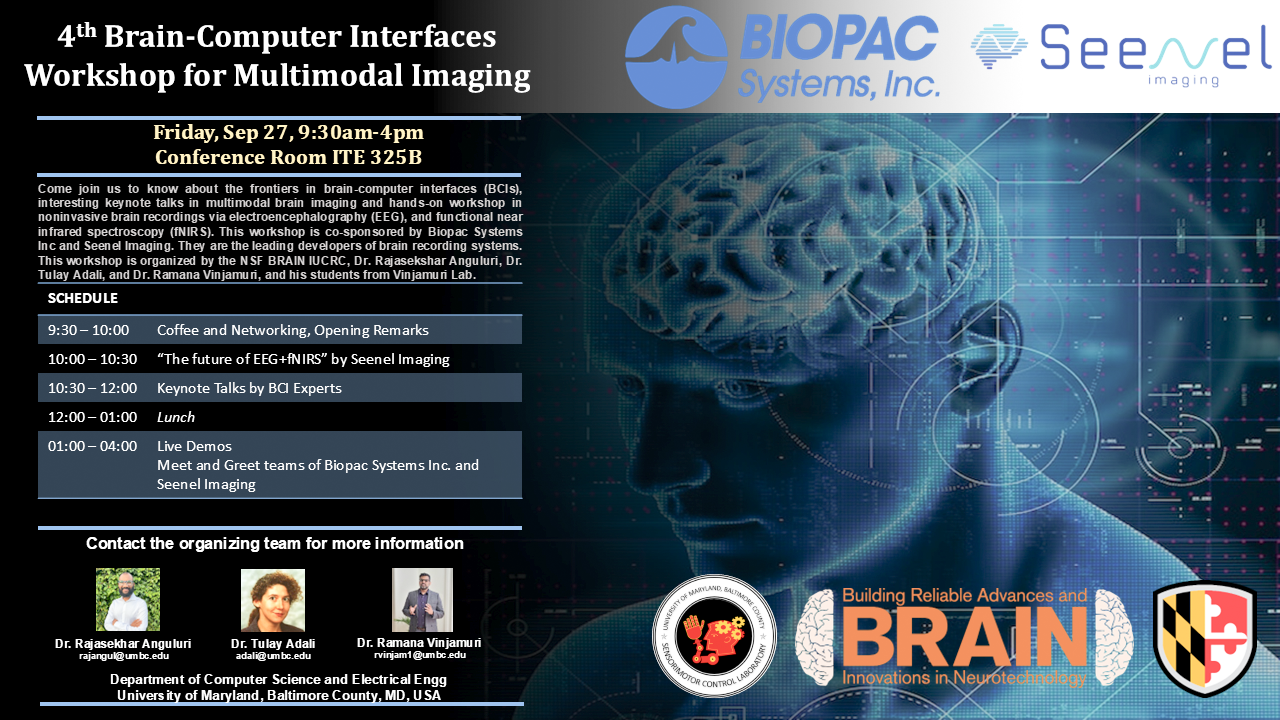
    <h4><span><strong>4th Brain-Computer Interfaces Workshop for Multimodal Imaging</strong></span></h4>
    <h4><span><strong>Friday Sep 27, 9:30am-4pm, ITE 325b, UMBC</strong></span></h4>
    <p><span>Attend the meeting to learn about the frontiers in brain-computer interfaces, interesting keynote talks in multimodal brain imaging and hands-on workshop in noninvasive brain recordings via electroencephalography, and functional near-infrared spectroscopy. This workshop is co-sponsored by Biopac Systems Inc. and Seenel Imaging. They are the leading developers of brain recording systems.</span></p>
    <p><span>This workshop is organized by the <a href="https://nsfbrain.org/" rel="nofollow external" class="bo">NSF BRAIN IUCRC</a>, Dr. <a href="https://rajanguluri.github.io/" rel="nofollow external" class="bo">Rajasekshar Anguluri</a>, Dr. <a href="https://userpages.cs.umbc.edu/adali/" rel="nofollow external" class="bo">Tulay Adali</a>, and Dr. <a href="https://www.csee.umbc.edu/ramana-vinjamuri/" rel="nofollow external" class="bo">Ramana Vinjamuri</a>, and his students from <a href="https://vinjamurilab.cs.umbc.edu/" rel="nofollow external" class="bo">Vinjamuri Lab</a>.</span></p>
    <p><span><a href="https://www.biopac.com/events/ws-umbc-brain-comp/" rel="nofollow external" class="bo"><strong>Register here.</strong></a></span></p></span><hr>
    <a href="https://ai.umbc.edu/" rel="nofollow external" class="bo"><strong>UMBC Center for AI</strong></a>
    </div>
]]>
</Body>
<Summary>4th Brain-Computer Interfaces Workshop for Multimodal Imaging  Friday Sep 27, 9:30am-4pm, ITE 325b, UMBC  Attend the meeting to learn about the frontiers in brain-computer interfaces, interesting...</Summary>
<Website>https://www.biopac.com/events/ws-umbc-brain-comp/</Website>
<TrackingUrl>https://my3.my.umbc.edu/api/v0/pixel/news/144280/guest@my.umbc.edu/67feba5ade9f32598bd7d634b961d81c/api/pixel</TrackingUrl>
<Tag>ai</Tag>
<Tag>brain</Tag>
<Tag>computer</Tag>
<Group token="umbc-ai">UMBC AI</Group>
<GroupUrl>https://my3.my.umbc.edu/groups/umbc-ai</GroupUrl>
<AvatarUrl>https://assets4-my.umbc.edu/system/shared/avatars/groups/000/002/081/cfb27ebe008c2636486089a759ea5c36/xsmall.png?1691095779</AvatarUrl>
<AvatarUrl size="original">https://assets2-my.umbc.edu/system/shared/avatars/groups/000/002/081/cfb27ebe008c2636486089a759ea5c36/original.png?1691095779</AvatarUrl>
<AvatarUrl size="xxlarge">https://assets1-my.umbc.edu/system/shared/avatars/groups/000/002/081/cfb27ebe008c2636486089a759ea5c36/xxlarge.png?1691095779</AvatarUrl>
<AvatarUrl size="xlarge">https://assets1-my.umbc.edu/system/shared/avatars/groups/000/002/081/cfb27ebe008c2636486089a759ea5c36/xlarge.png?1691095779</AvatarUrl>
<AvatarUrl size="large">https://assets1-my.umbc.edu/system/shared/avatars/groups/000/002/081/cfb27ebe008c2636486089a759ea5c36/large.png?1691095779</AvatarUrl>
<AvatarUrl size="medium">https://assets3-my.umbc.edu/system/shared/avatars/groups/000/002/081/cfb27ebe008c2636486089a759ea5c36/medium.png?1691095779</AvatarUrl>
<AvatarUrl size="small">https://assets3-my.umbc.edu/system/shared/avatars/groups/000/002/081/cfb27ebe008c2636486089a759ea5c36/small.png?1691095779</AvatarUrl>
<AvatarUrl size="xsmall">https://assets4-my.umbc.edu/system/shared/avatars/groups/000/002/081/cfb27ebe008c2636486089a759ea5c36/xsmall.png?1691095779</AvatarUrl>
<AvatarUrl size="xxsmall">https://assets1-my.umbc.edu/system/shared/avatars/groups/000/002/081/cfb27ebe008c2636486089a759ea5c36/xxsmall.png?1691095779</AvatarUrl>
<Sponsor>NSF BRAIN IUCRC</Sponsor>
<PawCount>0</PawCount>
<CommentCount>0</CommentCount>
<CommentsAllowed>true</CommentsAllowed>
<PostedAt>Thu, 26 Sep 2024 19:49:08 -0400</PostedAt>
<EditAt>Thu, 26 Sep 2024 19:50:10 -0400</EditAt>
</NewsItem>

<NewsItem contentIssues="false" id="144205" important="false" status="posted" url="https://my3.my.umbc.edu/groups/umbc-ai/posts/144205">
<Title>Talk: Takeaways from the Workshop on Event-Centric Video Retrieval, Oct 8</Title>
<Tagline>Reno Kriz, JHU HLTCOE, 1:30-2:30pm EDT, Tue. Oct. 8</Tagline>
<Body>
<![CDATA[
    <div class="html-content">
    <span><h4><span>Takeaways from the SCALE 2024 Workshop on Event-Centric Video Retrieval</span></h4>
    <h5><span><strong>Reno Kriz, JHU HLTCOE</strong></span></h5>
    <h5>
    <span><strong>1:30-2:30 pm EDT Tuesday, October 8, 2024<br></strong></span><strong><span>ITE 325b, UMBC and </span><a href="https://my3.my.umbc.edu/groups/langtech/events/134555/join_meeting" rel="nofollow external" class="bo"><span>online</span></a></strong>
    </h5>
    <p><span>Information dissemination for current events has traditionally consisted of professionally collected and produced materials, leading to large collections of well-written news articles and high-quality videos. As a result, most prior work in event analysis and retrieval has focused on leveraging this traditional news content, particularly in English. However, much of the event-centric content today is generated by non-professionals, such as on-the-scene witnesses to events who hastily capture videos and upload them to the internet without further editing; these are challenging to find due to quality variance, as well as a lack of text or speech overlays providing clear descriptions of what is occurring. To address this gap, SCALE 2024, a 10-week research workshop hosted at the Human Language Technology Center of Excellence (HLTCOE), focused on multilingual event-centric video retrieval, or the task of finding videos about specific current events. Around 50 researchers and students participated in this workshop and were split up into five sub-teams. The Infrastructure team focused on developing MultiVENT 2.0, a challenging new video retrieval dataset consisting of 20x more videos than prior work and targeted queries about specific world events across six languages. The other teams worked on improving models from specific modalities, specifically Vision, Optical Character Recognition (OCR), Audio, and Text. Overall, we came away with three primary findings: extracting specific text from a video allows us to take better advantage of powerful methods from the text information retrieval community; LLM summarization of initial text outputs from videos is helpful, especially for noisy text coming from OCR; and no one modality is sufficient, with fusing outputs from all modalities resulting in significantly higher performance.</span></p>
    <p><a href="https://hltcoe.jhu.edu/researcher/reno-kriz/" rel="nofollow external" class="bo"><span>Reno Kriz</span></a><span> is a research scientist at the Johns Hopkins University </span><a href="https://hltcoe.jhu.edu/" rel="nofollow external" class="bo"><span>Human Language Technology Center of Excellence</span></a><span> (</span><a href="https://hltcoe.jhu.edu/" rel="nofollow external" class="bo"><span>HLTCOE</span></a><span>). His primary research interests involve leveraging large pre-trained models for a variety of natural language understanding tasks, including those crossing into other modalities, e.g., vision and speech understanding. These multimodal interests have recently involved the 2024 Summer Camp for Language Exploration (SCALE) on event-centric video retrieval and understanding. He received his PhD from the University of Pennsylvania, where he worked with Chris Callison-Burch and Marianna Apidianaki on text simplification and natural language generation. Prior to that, he received BA degrees in Computer Science, Mathematics, and Economics from Vassar College.</span></p>
    <p><span>Part of the<strong> <a href="https://laramartin.net/LaTeSS.html" rel="nofollow external" class="bo">UMBC Language Technology Seminar Series</a></strong></span></p></span>
    <hr>
    <a href="https://ai.umbc.edu/" rel="nofollow external" class="bo"><strong>UMBC Center for AI</strong></a>
    </div>
]]>
</Body>
<Summary>Takeaways from the SCALE 2024 Workshop on Event-Centric Video Retrieval  Reno Kriz, JHU HLTCOE  1:30-2:30 pm EDT Tuesday, October 8, 2024 ITE 325b, UMBC and online  Information dissemination for...</Summary>
<Website>https://my3.my.umbc.edu/groups/langtech/events/134555</Website>
<TrackingUrl>https://my3.my.umbc.edu/api/v0/pixel/news/144205/guest@my.umbc.edu/76480d509d15b5184c20f45141e37422/api/pixel</TrackingUrl>
<Tag>ai</Tag>
<Tag>events</Tag>
<Tag>language</Tag>
<Tag>nlp</Tag>
<Tag>video</Tag>
<Group token="umbc-ai">UMBC AI</Group>
<GroupUrl>https://my3.my.umbc.edu/groups/umbc-ai</GroupUrl>
<AvatarUrl>https://assets4-my.umbc.edu/system/shared/avatars/groups/000/002/081/cfb27ebe008c2636486089a759ea5c36/xsmall.png?1691095779</AvatarUrl>
<AvatarUrl size="original">https://assets2-my.umbc.edu/system/shared/avatars/groups/000/002/081/cfb27ebe008c2636486089a759ea5c36/original.png?1691095779</AvatarUrl>
<AvatarUrl size="xxlarge">https://assets1-my.umbc.edu/system/shared/avatars/groups/000/002/081/cfb27ebe008c2636486089a759ea5c36/xxlarge.png?1691095779</AvatarUrl>
<AvatarUrl size="xlarge">https://assets1-my.umbc.edu/system/shared/avatars/groups/000/002/081/cfb27ebe008c2636486089a759ea5c36/xlarge.png?1691095779</AvatarUrl>
<AvatarUrl size="large">https://assets1-my.umbc.edu/system/shared/avatars/groups/000/002/081/cfb27ebe008c2636486089a759ea5c36/large.png?1691095779</AvatarUrl>
<AvatarUrl size="medium">https://assets3-my.umbc.edu/system/shared/avatars/groups/000/002/081/cfb27ebe008c2636486089a759ea5c36/medium.png?1691095779</AvatarUrl>
<AvatarUrl size="small">https://assets3-my.umbc.edu/system/shared/avatars/groups/000/002/081/cfb27ebe008c2636486089a759ea5c36/small.png?1691095779</AvatarUrl>
<AvatarUrl size="xsmall">https://assets4-my.umbc.edu/system/shared/avatars/groups/000/002/081/cfb27ebe008c2636486089a759ea5c36/xsmall.png?1691095779</AvatarUrl>
<AvatarUrl size="xxsmall">https://assets1-my.umbc.edu/system/shared/avatars/groups/000/002/081/cfb27ebe008c2636486089a759ea5c36/xxsmall.png?1691095779</AvatarUrl>
<Sponsor>Language Technology Seminar Series</Sponsor>
<PawCount>0</PawCount>
<CommentCount>0</CommentCount>
<CommentsAllowed>true</CommentsAllowed>
<PostedAt>Tue, 24 Sep 2024 18:37:45 -0400</PostedAt>
<EditAt>Tue, 24 Sep 2024 19:33:24 -0400</EditAt>
</NewsItem>

</News>