Maximizing Productivity with Microsoft Copilot, 12-1pm May 9
AI Lunchbox series, UMBC Training Centers
Join the UMBC Training Centers on Thursday, May 9 from 12:00 to 1:00pm ET for another free session of the AI Lunchbox Series with Dhruv Ratra. He will revisit Microsoft's Copilot from a different angle with Maximizing Productivity with Copilot for Microsoft 365: A Business-Focused Introduction.
His demonstration will cover key features that differentiate the business version from Copilot Pro, focusing on use cases in business and enterprise environments to integrate with the Microsoft 365 suite. Dhruv will share some tips to enhance productivity, streamline workflows, and foster collaboration across teams.
UMBC Center for AI
]]>
Join the UMBC Training Centers on Thursday, May 9 from 12:00 to 1:00pm ET for another free session of the AI Lunchbox Series with Dhruv Ratra. He will revisit Microsoft's Copilot from a different...
https://info.umbctraining.com/e3t/Ctc/LT+113/c3xy404/VWcmGg3fDY3rW427QZ25BK_QzW39GxQ75dQ7bzN99fz8g3qgyTW5BW0B06lZ3m1W488SkV1Gb-D2N4Vhrfx85lB9W4FHvPz8J_pnVW7w5lDR653CZqW5b_7G249vvBvVDYR59573PyLN1QVdfNV30_yW75MN212lR25FW3Bp1Ny4VrBnvVKcrBl7WfR73W5hGGNb7WpGJ0W5mhX2T28z6Z6V5YP0k2gqw5_W64167w1gcG58W9bXLZ26bCdbcW7dMNNH7H2j5CW74Pghs2YVTPDW7NTQts2zcPyMf4HzF0M04
https://my3.my.umbc.edu/api/v0/pixel/news/141836/guest@my.umbc.edu/f302cfd548d0926baa428707cf7bd476/api/pixel
ai
copilot
genai
llm
UMBC AI
https://my3.my.umbc.edu/groups/umbc-ai
https://assets4-my.umbc.edu/system/shared/avatars/groups/000/002/081/cfb27ebe008c2636486089a759ea5c36/xsmall.png?1691095779
https://assets2-my.umbc.edu/system/shared/avatars/groups/000/002/081/cfb27ebe008c2636486089a759ea5c36/original.png?1691095779
https://assets1-my.umbc.edu/system/shared/avatars/groups/000/002/081/cfb27ebe008c2636486089a759ea5c36/xxlarge.png?1691095779
https://assets1-my.umbc.edu/system/shared/avatars/groups/000/002/081/cfb27ebe008c2636486089a759ea5c36/xlarge.png?1691095779
https://assets1-my.umbc.edu/system/shared/avatars/groups/000/002/081/cfb27ebe008c2636486089a759ea5c36/large.png?1691095779
https://assets3-my.umbc.edu/system/shared/avatars/groups/000/002/081/cfb27ebe008c2636486089a759ea5c36/medium.png?1691095779
https://assets3-my.umbc.edu/system/shared/avatars/groups/000/002/081/cfb27ebe008c2636486089a759ea5c36/small.png?1691095779
https://assets4-my.umbc.edu/system/shared/avatars/groups/000/002/081/cfb27ebe008c2636486089a759ea5c36/xsmall.png?1691095779
https://assets1-my.umbc.edu/system/shared/avatars/groups/000/002/081/cfb27ebe008c2636486089a759ea5c36/xxsmall.png?1691095779
UMBC Training Centers
0
0
true
Wed, 08 May 2024 18:01:48 -0400
Wed, 08 May 2024 18:03:38 -0400
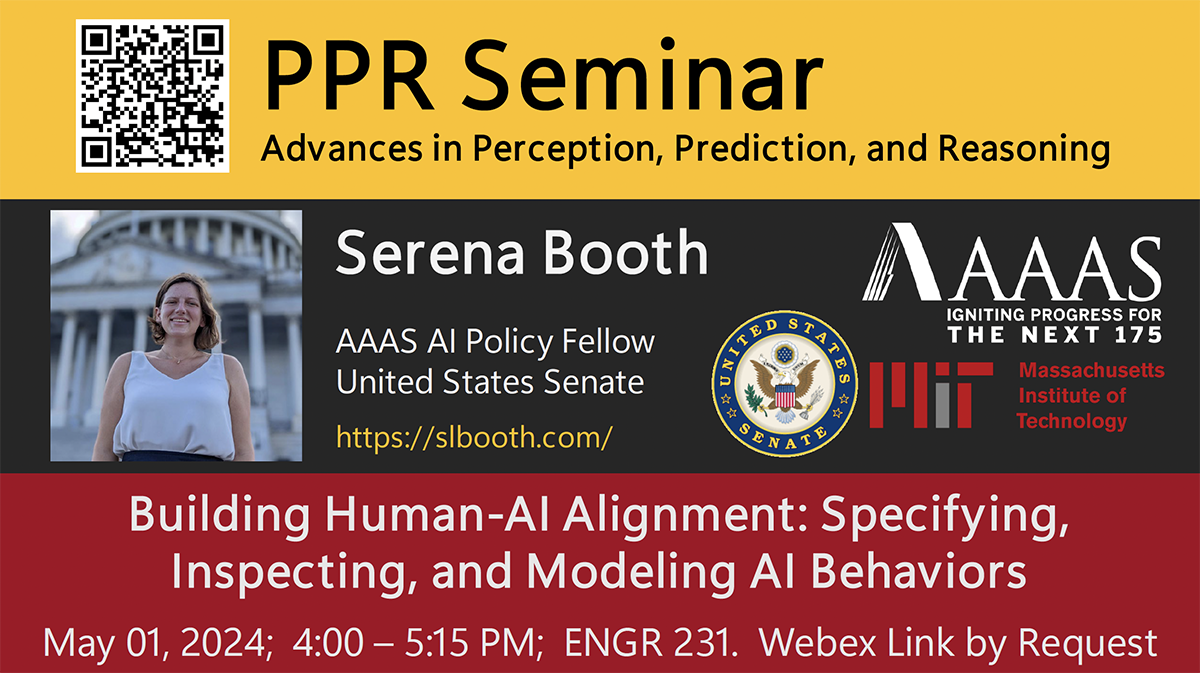
Talk: Building Human-AI Alignment, 4-5:30 Wed. May 1
Specifying, Inspecting, and Modeling AI Behaviors
Building Human-AI Alignment: Specifying, Inspecting, and Modeling AI Behaviors
4-5:30pm ET Wednesday, 1 May, 2024
UMBC ENGR 231, Webex Link by Request
The learned behaviors of AI and robot agents should align with the intentions of their human designers. Toward this goal, people must be able to easily specify, inspect, and model agent behaviors. For specifications, we will consider expert-written reward functions for reinforcement learning (
RL) and non-expert preferences for reinforcement learning from human feedback (
RLHF). I will show evidence that experts are bad at writing reward functions: even in a trivial setting, experts write specifications that are overfit to a particular RL algorithm, and they often write erroneous specifications for agents that fail to encode their true intent. Next, I will show that the common approach to learning a reward function from non-experts in RLHF uses an inductive bias that fails to encode how humans express preferences, and that our proposed bias better encodes human preferences both theoretically and empirically. For inspection, humans must be able to assess the behaviors an agent learns from a given specification. I will discuss a method to find settings that exhibit particular behaviors, like out-of-distribution failures. Lastly, cognitive science theories attempt to show how people build conceptual models that explain agent behaviors. I will show evidence that some of these theories are used in research to support humans, but that we can still build better curricula for modeling. Collectively, my research provides evidence that—even with the best of intentions— current human-AI systems often fail to induce alignment; my research proposes promising directions for how to build better aligned human-AI systems.
Serena Booth received her PhD at
MIT CSAIL in 2023. Serena studies how people write specifications for AI systems and how people assess whether AI systems are successful in learning from specifications. While at MIT, Serena served as an inaugural Social and Ethical Responsible Computing Scholar, teaching AI Ethics and developing MIT’s AI ethics curriculum that is also released on MIT OpenCourseWare. Serena is a graduate of Harvard College (2016), after which she worked as an Associate Product Manager at Google to help scale Google’s ARCore augmented reality product to 100 million devices. Serena currently works in the U.S. Senate as a AAAS AI Policy Fellow, where she is working on AI policy questions for the Senate Banking, Housing, and Urban Affairs Committee. Her research has been supported by an MIT Presidential Fellowship and by an NSF GRFP. She is a Rising Star in EECS and an HRI Pioneer.
]]>
Building Human-AI Alignment: Specifying, Inspecting, and Modeling AI Behaviors Serena Booth AAAS AI Policy Fellow, United States Senate 4-5:30pm ET Wednesday, 1 May, 2024 UMBC ENGR 231,...
https://www.tejasgokhale.com/seminar.html
https://my3.my.umbc.edu/api/v0/pixel/news/141513/guest@my.umbc.edu/ddb95eb735b5822cb2f0ba45ce7e4cd0/api/pixel
ai
alignment
llm
UMBC AI
https://my3.my.umbc.edu/groups/umbc-ai
https://assets4-my.umbc.edu/system/shared/avatars/groups/000/002/081/cfb27ebe008c2636486089a759ea5c36/xsmall.png?1691095779
https://assets2-my.umbc.edu/system/shared/avatars/groups/000/002/081/cfb27ebe008c2636486089a759ea5c36/original.png?1691095779
https://assets1-my.umbc.edu/system/shared/avatars/groups/000/002/081/cfb27ebe008c2636486089a759ea5c36/xxlarge.png?1691095779
https://assets1-my.umbc.edu/system/shared/avatars/groups/000/002/081/cfb27ebe008c2636486089a759ea5c36/xlarge.png?1691095779
https://assets1-my.umbc.edu/system/shared/avatars/groups/000/002/081/cfb27ebe008c2636486089a759ea5c36/large.png?1691095779
https://assets3-my.umbc.edu/system/shared/avatars/groups/000/002/081/cfb27ebe008c2636486089a759ea5c36/medium.png?1691095779
https://assets3-my.umbc.edu/system/shared/avatars/groups/000/002/081/cfb27ebe008c2636486089a759ea5c36/small.png?1691095779
https://assets4-my.umbc.edu/system/shared/avatars/groups/000/002/081/cfb27ebe008c2636486089a759ea5c36/xsmall.png?1691095779
https://assets1-my.umbc.edu/system/shared/avatars/groups/000/002/081/cfb27ebe008c2636486089a759ea5c36/xxsmall.png?1691095779
UMBC AI
0
0
true
Tue, 30 Apr 2024 12:27:12 -0400
Generative AI for Assignments, Projects and Assessments 4/29
A two-hour workshop on practical skills and takeaways
Generative AI for Assignments, Projects, and Assessments
6:30-8:30pm ET Monday, 29 April 2024 via WebEx
In an era where
Generative Artificial Intelligence (GAI) is increasingly becoming a part of our daily professional and personal lives, understanding how to effectively interact with these systems is crucial. This workshop is designed to equip participants with practical skills and insights for engaging with GAI interfaces, specifically focusing on optimizing the quality of results, integrating GAI outputs into user responses, and adhering to ethical citation practices. This workshop is being hosted by the
Graduate Program in Geographic Information Systems. Friends of the program are welcome to join virtually.
Paul D. Miller will lead the session. He has extensive experience in STEM instruction; K-16 curriculum development; instructional design and teaching methodologies; project evaluation; inclusive professional learning/development; instructional technology integration; instructional systems development; program implementation fidelity and evaluation; and over $34 million in federal and state grant facilitation and management.
]]>
Generative AI for Assignments, Projects, and Assessments Paul D. Miller, Ed.D. 6:30-8:30pm ET Monday, 29 April 2024 via WebEx In an era where Generative Artificial Intelligence (GAI) is...
https://my3.my.umbc.edu/groups/dps/events/129119
https://my3.my.umbc.edu/api/v0/pixel/news/141437/guest@my.umbc.edu/e15ee29882ab681894ea36867efd2818/api/pixel
ai
geographic-information-systems
gis
llm
UMBC AI
https://my3.my.umbc.edu/groups/umbc-ai
https://assets4-my.umbc.edu/system/shared/avatars/groups/000/002/081/cfb27ebe008c2636486089a759ea5c36/xsmall.png?1691095779
https://assets2-my.umbc.edu/system/shared/avatars/groups/000/002/081/cfb27ebe008c2636486089a759ea5c36/original.png?1691095779
https://assets1-my.umbc.edu/system/shared/avatars/groups/000/002/081/cfb27ebe008c2636486089a759ea5c36/xxlarge.png?1691095779
https://assets1-my.umbc.edu/system/shared/avatars/groups/000/002/081/cfb27ebe008c2636486089a759ea5c36/xlarge.png?1691095779
https://assets1-my.umbc.edu/system/shared/avatars/groups/000/002/081/cfb27ebe008c2636486089a759ea5c36/large.png?1691095779
https://assets3-my.umbc.edu/system/shared/avatars/groups/000/002/081/cfb27ebe008c2636486089a759ea5c36/medium.png?1691095779
https://assets3-my.umbc.edu/system/shared/avatars/groups/000/002/081/cfb27ebe008c2636486089a759ea5c36/small.png?1691095779
https://assets4-my.umbc.edu/system/shared/avatars/groups/000/002/081/cfb27ebe008c2636486089a759ea5c36/xsmall.png?1691095779
https://assets1-my.umbc.edu/system/shared/avatars/groups/000/002/081/cfb27ebe008c2636486089a759ea5c36/xxsmall.png?1691095779
UMBC AI
0
0
true
Mon, 29 Apr 2024 09:25:58 -0400
Talk: ChatGPT & AI in Research, Education & Classrooms, 4/29
12-1 pm ET Monday, April 29, 2024
UMBC AI, Privacy, and Ethics Symposium
ChatGPT and AI in Research, Education, and the Classroom
Rachael Kang, UMBC Information Systems
12-1pm ET Monday, April 29, 2024, via WebEx
Join UMBC Information Systems PhD student
Rachael Kang as she shares her research journey of how she came to study AI, starting from her master's thesis on the utility of machine learning in predicting suicide risk to her current research interests of integrating a large language model into patient portals to increase patient health literacy. Rachael will also discuss how she has introduced ChatGPT as a learning tool for the students she TAs in Information Systems 303, the activities she has conducted with the students to demonstrate the strengths and weaknesses of ChatGPT, and the types of conversations she has with students about what is proper and improper use of ChatGPT.
Get more information and join the event
here.
Rigorous measurement in text-to-image systems (and AI more broadly?)
University of California, Santa Barbara
April 29, 2024 4:00 – 5:15 PM ET
As large pretrained models underlying generative AI systems have grown larger, inscrutable, and widely-deployed, interest in understanding their nature as emergent rather than engineered systems has grown. I believe to move this "ersatz natural science" of AI forward, we need to focus on building rigorous observational tools for these systems, which can characterize capabilities unambiguously. At their best, benchmarks and metrics could meet this need, but at present they are often treated as mere leaderboards to chase and only very indirectly measure capabilities of interest. This talk covers three works on this topic: first, a work laying out the high-level case for building a subfield of "model metrology" which focuses on building better benchmarks and metrics. Then, it covers two works on metrology in the generative image domain: first, a work which assesses multilingual conceptual knowledge in
text-to-image (T2I) systems, and second, a meta-benchmark that demonstrates how many T2I prompt faithfulness benchmarks actually fail to capture the compositionality characteristics of T2I systems which they purport to measure. This line of inquiry is intended to help move benchmarking toward the ideal of rigorous tools of scientific observation.
Michael Saxon is a PhD candidate and NSF Fellow in the NLP Group at the University of California, Santa Barbara. His research sits on the intersection of generative model benchmarking, multimodality, and AI ethics. He’s particularly interested in making meaningful evaluations of hard-to-measure new capabilities in these artifacts. Michael earned his BS in Electrical Engineering and MS in Computer Engineering at Arizona State University, advised by Visar Berish and Sethuraman Panchanathan in 2018 and 2020 respectively.
]]>
Rigorous measurement in text-to-image systems (and AI more broadly?) Michael Saxon University of California, Santa Barbara April 29, 2024 4:00 – 5:15 PM ET ENGR 231 and Webex As...
https://www.tejasgokhale.com/seminar.html
https://my3.my.umbc.edu/api/v0/pixel/news/141413/guest@my.umbc.edu/a635851ae646611f8b11c1745ec96965/api/pixel
ai
image
llm
text
text-to-image
UMBC AI
https://my3.my.umbc.edu/groups/umbc-ai
https://assets4-my.umbc.edu/system/shared/avatars/groups/000/002/081/cfb27ebe008c2636486089a759ea5c36/xsmall.png?1691095779
https://assets2-my.umbc.edu/system/shared/avatars/groups/000/002/081/cfb27ebe008c2636486089a759ea5c36/original.png?1691095779
https://assets1-my.umbc.edu/system/shared/avatars/groups/000/002/081/cfb27ebe008c2636486089a759ea5c36/xxlarge.png?1691095779
https://assets1-my.umbc.edu/system/shared/avatars/groups/000/002/081/cfb27ebe008c2636486089a759ea5c36/xlarge.png?1691095779
https://assets1-my.umbc.edu/system/shared/avatars/groups/000/002/081/cfb27ebe008c2636486089a759ea5c36/large.png?1691095779
https://assets3-my.umbc.edu/system/shared/avatars/groups/000/002/081/cfb27ebe008c2636486089a759ea5c36/medium.png?1691095779
https://assets3-my.umbc.edu/system/shared/avatars/groups/000/002/081/cfb27ebe008c2636486089a759ea5c36/small.png?1691095779
https://assets4-my.umbc.edu/system/shared/avatars/groups/000/002/081/cfb27ebe008c2636486089a759ea5c36/xsmall.png?1691095779
https://assets1-my.umbc.edu/system/shared/avatars/groups/000/002/081/cfb27ebe008c2636486089a759ea5c36/xxsmall.png?1691095779
UMBC AI
https://assets2-my.umbc.edu/system/shared/thumbnails/news/000/141/413/3843538aec7e5167ea4f3e2c5a95c3eb/xxlarge.jpg?1714224563
https://assets1-my.umbc.edu/system/shared/thumbnails/news/000/141/413/3843538aec7e5167ea4f3e2c5a95c3eb/xlarge.jpg?1714224563
https://assets3-my.umbc.edu/system/shared/thumbnails/news/000/141/413/3843538aec7e5167ea4f3e2c5a95c3eb/large.jpg?1714224563
https://assets2-my.umbc.edu/system/shared/thumbnails/news/000/141/413/3843538aec7e5167ea4f3e2c5a95c3eb/medium.jpg?1714224563
https://assets2-my.umbc.edu/system/shared/thumbnails/news/000/141/413/3843538aec7e5167ea4f3e2c5a95c3eb/small.jpg?1714224563
https://assets1-my.umbc.edu/system/shared/thumbnails/news/000/141/413/3843538aec7e5167ea4f3e2c5a95c3eb/xsmall.jpg?1714224563
https://assets2-my.umbc.edu/system/shared/thumbnails/news/000/141/413/3843538aec7e5167ea4f3e2c5a95c3eb/xxsmall.jpg?1714224563
0
0
true
Sat, 27 Apr 2024 09:34:44 -0400
Sat, 27 Apr 2024 10:07:37 -0400
AI Lunchbox: AI integration Full Circle Data Analysis, 4/25
Integrating ChatGPT, Colab, and Python for Business Insights
This week’s AI Lunchbox Series, held online 12-1 pm ET on Thurs. April 25, is on AI integrations in Full Circle Data Analysis: Integrating ChatGPT and Google Colab with Python for Business Insights.
Dhruv Ratra shows how ChatGPT can generate Python code tailored to your data analysis needs, enabling you to interpret, cleanse, model, and validate your data with precision. You will see how the Python code executed in Google Colab produces results that are then analyzed and enhanced by ChatGPT, creating a feedback loop for continuous improvement and deeper insights.
Register for the free Lunchbox Series on the
C4A site or through
Meetup.
In the next AI Lunchbox session from the UMBC Training Centers,
Dhruv Ratra will cover
Microsoft Copilot and its use with familiar Microsoft products like Word, PowerPoint, Excel, Outlook, and Teams. Copilot is built on OpenAI's latest LLM system with additional fine-tuning to better support familiar Microsoft tools.
Discover how Microsoft Copilot integrates seamlessly into
Microsoft 365 to improve your productivity and creativity. The session will explore the innovative features of Microsoft Copilot, showing how it transforms the way you work with documents, email, and presentations. Join Dhruv to learn how to harness the power of AI to streamline your tasks, boost efficiency, and unleash your creative potential with Microsoft 365.
Whether you're a student, educator, or professional, this session will provide you with practical insights and tips to get the most out of the Microsoft 365 suite.
Register here for this free session, 12-1pm ET on Thursday, April 18, 2024.
]]>
In the next AI Lunchbox session from the UMBC Training Centers, Dhruv Ratra will cover Microsoft Copilot and its use with familiar Microsoft products like Word, PowerPoint, Excel, Outlook, and...
https://c4a.ai/#lb01
https://my3.my.umbc.edu/api/v0/pixel/news/140891/guest@my.umbc.edu/9c58cc727e0a780b6056b439eb295c5e/api/pixel
ai
chatgpt
copilot
llm
microsoft-365
UMBC AI
https://my3.my.umbc.edu/groups/umbc-ai
https://assets4-my.umbc.edu/system/shared/avatars/groups/000/002/081/cfb27ebe008c2636486089a759ea5c36/xsmall.png?1691095779
https://assets2-my.umbc.edu/system/shared/avatars/groups/000/002/081/cfb27ebe008c2636486089a759ea5c36/original.png?1691095779
https://assets1-my.umbc.edu/system/shared/avatars/groups/000/002/081/cfb27ebe008c2636486089a759ea5c36/xxlarge.png?1691095779
https://assets1-my.umbc.edu/system/shared/avatars/groups/000/002/081/cfb27ebe008c2636486089a759ea5c36/xlarge.png?1691095779
https://assets1-my.umbc.edu/system/shared/avatars/groups/000/002/081/cfb27ebe008c2636486089a759ea5c36/large.png?1691095779
https://assets3-my.umbc.edu/system/shared/avatars/groups/000/002/081/cfb27ebe008c2636486089a759ea5c36/medium.png?1691095779
https://assets3-my.umbc.edu/system/shared/avatars/groups/000/002/081/cfb27ebe008c2636486089a759ea5c36/small.png?1691095779
https://assets4-my.umbc.edu/system/shared/avatars/groups/000/002/081/cfb27ebe008c2636486089a759ea5c36/xsmall.png?1691095779
https://assets1-my.umbc.edu/system/shared/avatars/groups/000/002/081/cfb27ebe008c2636486089a759ea5c36/xxsmall.png?1691095779
UMBC AI
https://assets4-my.umbc.edu/system/shared/thumbnails/news/000/140/891/3a7e3251e8285102079d4561ae7ec771/xxlarge.jpg?1713032017
https://assets1-my.umbc.edu/system/shared/thumbnails/news/000/140/891/3a7e3251e8285102079d4561ae7ec771/xlarge.jpg?1713032017
https://assets3-my.umbc.edu/system/shared/thumbnails/news/000/140/891/3a7e3251e8285102079d4561ae7ec771/large.jpg?1713032017
https://assets1-my.umbc.edu/system/shared/thumbnails/news/000/140/891/3a7e3251e8285102079d4561ae7ec771/medium.jpg?1713032017
https://assets2-my.umbc.edu/system/shared/thumbnails/news/000/140/891/3a7e3251e8285102079d4561ae7ec771/small.jpg?1713032017
https://assets1-my.umbc.edu/system/shared/thumbnails/news/000/140/891/3a7e3251e8285102079d4561ae7ec771/xsmall.jpg?1713032017
https://assets1-my.umbc.edu/system/shared/thumbnails/news/000/140/891/3a7e3251e8285102079d4561ae7ec771/xxsmall.jpg?1713032017
0
0
true
Tue, 16 Apr 2024 15:43:28 -0400
Sat, 20 Apr 2024 10:39:01 -0400
GPT Dilemma: Pros, Cons & Impacts on Learning, 12-1 Mon 4/15
The GPT Dilemma: Navigating the
Pros, Cons, and Impacts on Learning
Department of Information systems
UMBC
12-1:00pm ET, Monday April 15, 2024, online
Picture this: You are in a classroom where you are free to use GPT - but should you? This session invites you to explore this dilemma. We will discuss the pros and cons of GPT in education, considering its impact on your learning, future career, and life in an AI-driven era, using examples from Dr. Chen's experience teaching two Data Science courses (one undergraduate and one graduate level) at UMBC in Fall 2023, where students were allowed to freely use GPT. Dr. Chen will share insights gained from identifying GPT-generated work, and discuss strategies for responsibly and productively engaging GPT as your personal AI assistant.
Lujie Karen Chen is an Assistant Professor in the Department of Information Systems at UMBC, where she leads the
Laboratory for Informatics for Human Flourishing. She has almost 20 years of academic and real-world experience in applied machine learning, statistics, data mining, analytics, and visualization. Before joining UMBC, she spent about 15 years at the
Auton Lab at Carnegie Mellon University, where she received her Ph.D. in Information Systems and was a fellow in the Program of Interdisciplinary Educational Research.
]]>
UMBC AI, Privacy, and Ethics Symposium The GPT Dilemma: Navigating the Pros, Cons, and Impacts on Learning Professor Lujie Karen Chen Department of Information systems UMBC 12-1:00pm...
https://my3.my.umbc.edu/groups/library/events/127070
https://my3.my.umbc.edu/api/v0/pixel/news/140894/guest@my.umbc.edu/0f05570a7cfdfcb598e4c36b6228b167/api/pixel
ai
chatgpt
education
gpt
llm
teaching
UMBC AI
https://my3.my.umbc.edu/groups/umbc-ai
https://assets4-my.umbc.edu/system/shared/avatars/groups/000/002/081/cfb27ebe008c2636486089a759ea5c36/xsmall.png?1691095779
https://assets2-my.umbc.edu/system/shared/avatars/groups/000/002/081/cfb27ebe008c2636486089a759ea5c36/original.png?1691095779
https://assets1-my.umbc.edu/system/shared/avatars/groups/000/002/081/cfb27ebe008c2636486089a759ea5c36/xxlarge.png?1691095779
https://assets1-my.umbc.edu/system/shared/avatars/groups/000/002/081/cfb27ebe008c2636486089a759ea5c36/xlarge.png?1691095779
https://assets1-my.umbc.edu/system/shared/avatars/groups/000/002/081/cfb27ebe008c2636486089a759ea5c36/large.png?1691095779
https://assets3-my.umbc.edu/system/shared/avatars/groups/000/002/081/cfb27ebe008c2636486089a759ea5c36/medium.png?1691095779
https://assets3-my.umbc.edu/system/shared/avatars/groups/000/002/081/cfb27ebe008c2636486089a759ea5c36/small.png?1691095779
https://assets4-my.umbc.edu/system/shared/avatars/groups/000/002/081/cfb27ebe008c2636486089a759ea5c36/xsmall.png?1691095779
https://assets1-my.umbc.edu/system/shared/avatars/groups/000/002/081/cfb27ebe008c2636486089a759ea5c36/xxsmall.png?1691095779
UMBC AI
https://assets1-my.umbc.edu/system/shared/thumbnails/news/000/140/894/a1cce5586dc4d5a22844a16af9518eb1/xxlarge.jpg?1713046228
https://assets2-my.umbc.edu/system/shared/thumbnails/news/000/140/894/a1cce5586dc4d5a22844a16af9518eb1/xlarge.jpg?1713046228
https://assets3-my.umbc.edu/system/shared/thumbnails/news/000/140/894/a1cce5586dc4d5a22844a16af9518eb1/large.jpg?1713046228
https://assets2-my.umbc.edu/system/shared/thumbnails/news/000/140/894/a1cce5586dc4d5a22844a16af9518eb1/medium.jpg?1713046228
https://assets1-my.umbc.edu/system/shared/thumbnails/news/000/140/894/a1cce5586dc4d5a22844a16af9518eb1/small.jpg?1713046228
https://assets1-my.umbc.edu/system/shared/thumbnails/news/000/140/894/a1cce5586dc4d5a22844a16af9518eb1/xsmall.jpg?1713046228
https://assets1-my.umbc.edu/system/shared/thumbnails/news/000/140/894/a1cce5586dc4d5a22844a16af9518eb1/xxsmall.jpg?1713046228
0
0
true
Sat, 13 Apr 2024 18:33:23 -0400
Tue, 16 Apr 2024 22:06:45 -0400
UMBC Prof. Lara Martin video on Neurosymbolic AI and LLMs
How I Learned to Stop Worrying & Love Large Language Models
UMBC professor Lara Martin gave a presentation recently at the JHU Center for Language & Speech Processing (CLSP). Her talk, Neurosymbolic AI or: How I Learned to Stop Worrying and Love the Large Language Model, covered some of her recent research on natural language processing, human-centered AI, and story generation. Here is the abstract of her talk.
Large language models like ChatGPT have shown extraordinary abilities for writing. While impressive at first glance, large language models aren't perfect and often make mistakes humans would not make. The main architecture behind ChatGPT mostly doesn't differ from early neural networks and, as a consequence, carries some of the same limitations. My work revolves around the use of neural networks like ChatGPT mixed with symbolic methods from early AI and how these two families of methods can combine to create more robust AI. I talk about some of the neurosymbolic methods I used for applications in story generation and understanding -- with the goal of eventually creating AI that can play Dungeons & Dragons. I also discuss pain points that I found for improving accessible communication and show how large language models can supplement such communication.
Dr. Martin will teach a special topics class at UMBC in Fall 2024 on
Interactive Fiction and Text Generation (CMSC 491/691) based on a
similar course she developed and co-taught at the University of Pennsylvania in 2022.
]]>
UMBC professor Lara Martin gave a presentation recently at the JHU Center for Language & Speech Processing (CLSP). Her talk, Neurosymbolic AI or: How I Learned to Stop Worrying and Love the...
https://www.youtube.com/watch?v=Kyopo5y91Bk
https://my3.my.umbc.edu/api/v0/pixel/news/140860/guest@my.umbc.edu/b3026273bcc20896257c6b2b5319cf6f/api/pixel
ai
language-generation
llm
nlp
story-generation
UMBC AI
https://my3.my.umbc.edu/groups/umbc-ai
https://assets4-my.umbc.edu/system/shared/avatars/groups/000/002/081/cfb27ebe008c2636486089a759ea5c36/xsmall.png?1691095779
https://assets2-my.umbc.edu/system/shared/avatars/groups/000/002/081/cfb27ebe008c2636486089a759ea5c36/original.png?1691095779
https://assets1-my.umbc.edu/system/shared/avatars/groups/000/002/081/cfb27ebe008c2636486089a759ea5c36/xxlarge.png?1691095779
https://assets1-my.umbc.edu/system/shared/avatars/groups/000/002/081/cfb27ebe008c2636486089a759ea5c36/xlarge.png?1691095779
https://assets1-my.umbc.edu/system/shared/avatars/groups/000/002/081/cfb27ebe008c2636486089a759ea5c36/large.png?1691095779
https://assets3-my.umbc.edu/system/shared/avatars/groups/000/002/081/cfb27ebe008c2636486089a759ea5c36/medium.png?1691095779
https://assets3-my.umbc.edu/system/shared/avatars/groups/000/002/081/cfb27ebe008c2636486089a759ea5c36/small.png?1691095779
https://assets4-my.umbc.edu/system/shared/avatars/groups/000/002/081/cfb27ebe008c2636486089a759ea5c36/xsmall.png?1691095779
https://assets1-my.umbc.edu/system/shared/avatars/groups/000/002/081/cfb27ebe008c2636486089a759ea5c36/xxsmall.png?1691095779
UMBC AI
0
0
true
Fri, 12 Apr 2024 11:52:46 -0400
Talk: Influencing Societies via Narrative Construction, 4/12
Dr. Anupam Joshi on misinformation, disinformation & LLMs
The UMBC Cyber Defense Lab presents
Shaping Opinion and Influencing Societies through Narrative Construction
CSEE Professor and Acting CoEIT Dean
12–1pm, Friday, April 12, 2024 via WebEx
There has been a significant body of work that explores “
misinformation” or “
disinformation” in the media. Research has explored how to identify misinformation, and how it spreads or goes viral. When detected, individual pieces of misinformation can be debunked. However, there is evidence that state actors (and others) are starting to launch more sophisticated information operations that try to craft a narrative that will shape public opinion. This involves combining factual information/hard news with opinions and potentially small elements of disinformation to persuade people, particularly in open societies typically found in democracies. While such influence building operations have been a tradition in statecraft, the ability to spread information fast provided by social media, and the removal of gatekeepers from the more traditional media sources, have provided a new potency to this approach. In this talk, we'll talk about disinformation, how easy it is to generate plausible “facts” in the era of
Large Language Models, and narrative constructions. We'll also describe our recent work (with PhD student
Priyanka Ranade) in creating computational approaches that might detect when a narrative is being constructed.
Anupam Joshi is the Oros Family Professor and Acting Dean of the College of Engineering and Information Technology at the University of Maryland, Baltimore County (UMBC). He also serves as the Director of UMBC’s Center for Cybersecurity. He was previously the Chair of Computer Science and Electrical Engineering Department, and is an Adjunct Professor at IIT Delhi's School of IT. He is a Fellow of IEEE and of the InCSCoE. He has published over 300 technical papers with an h-index of 91 and over 32,000 citations (per Google scholar), been granted nine patents, and has obtained research support over $22M from National Science Foundation (NSF), NASA, Defense Advanced Research Projects Agency (DARPA), US Dept of Defense (DoD), NIST, IBM, Microsoft, Qualcomm, Northrop Grumman, and Lockheed Martin amongst others.
Dr. Joshi obtained a B.Tech degree from IIT Delhi in 1989, and a Masters and Ph.D. from Purdue University in 1991 and 1993 respectively. His research interests are at the intersection of AI and Systems. He did some of the earliest work in data management and security for mobile and ad-hoc networks using AI approaches. Over the last decade, he has been exploring this intersection to improve Cybersecurity—using Distributed AI approaches for attack detection and resilience in CPS/IoT systems, and policy driven approaches to security and privacy. This work has led not just to papers but technology transfer to small Maryland companies.
Host: Alan T. Sherman,
sherman@umbc.edu. Support for this event was provided in part by the NSF under SFS grant DGE-1753681.
]]>
The UMBC Cyber Defense Lab presents Shaping Opinion and Influencing Societies through Narrative Construction Anupam Joshi CSEE Professor and Acting CoEIT Dean 12–1pm, Friday, April...
https://my3.my.umbc.edu/api/v0/pixel/news/140638/guest@my.umbc.edu/a4a284c335dd9fa66d2dd0ec9dd59961/api/pixel
ai
disinformation
llm
misinformation
UMBC AI
https://my3.my.umbc.edu/groups/umbc-ai
https://assets4-my.umbc.edu/system/shared/avatars/groups/000/002/081/cfb27ebe008c2636486089a759ea5c36/xsmall.png?1691095779
https://assets2-my.umbc.edu/system/shared/avatars/groups/000/002/081/cfb27ebe008c2636486089a759ea5c36/original.png?1691095779
https://assets1-my.umbc.edu/system/shared/avatars/groups/000/002/081/cfb27ebe008c2636486089a759ea5c36/xxlarge.png?1691095779
https://assets1-my.umbc.edu/system/shared/avatars/groups/000/002/081/cfb27ebe008c2636486089a759ea5c36/xlarge.png?1691095779
https://assets1-my.umbc.edu/system/shared/avatars/groups/000/002/081/cfb27ebe008c2636486089a759ea5c36/large.png?1691095779
https://assets3-my.umbc.edu/system/shared/avatars/groups/000/002/081/cfb27ebe008c2636486089a759ea5c36/medium.png?1691095779
https://assets3-my.umbc.edu/system/shared/avatars/groups/000/002/081/cfb27ebe008c2636486089a759ea5c36/small.png?1691095779
https://assets4-my.umbc.edu/system/shared/avatars/groups/000/002/081/cfb27ebe008c2636486089a759ea5c36/xsmall.png?1691095779
https://assets1-my.umbc.edu/system/shared/avatars/groups/000/002/081/cfb27ebe008c2636486089a759ea5c36/xxsmall.png?1691095779
UMBC AI
0
0
true
Sun, 07 Apr 2024 15:18:27 -0400
Sun, 07 Apr 2024 15:35:14 -0400