The Senior Class
Retrievers for life, that’s UMBC’s promise, and a group of residents at Charlestown’s senior living community are keeping their end of the bargain. Located two miles away from UMBC’s Catonsville campus, 60 or so retired and current faculty, staff, alumni, and friends at Charlestown are enjoying the ongoing cultural and educational perks of the two institutions. Several of these “Friends of UMBC” are laying the groundwork for continued exchange and connection—jazz concerts, classes about gender and sexuality, high-profile speakers—leaving a legacy for future generations to follow.

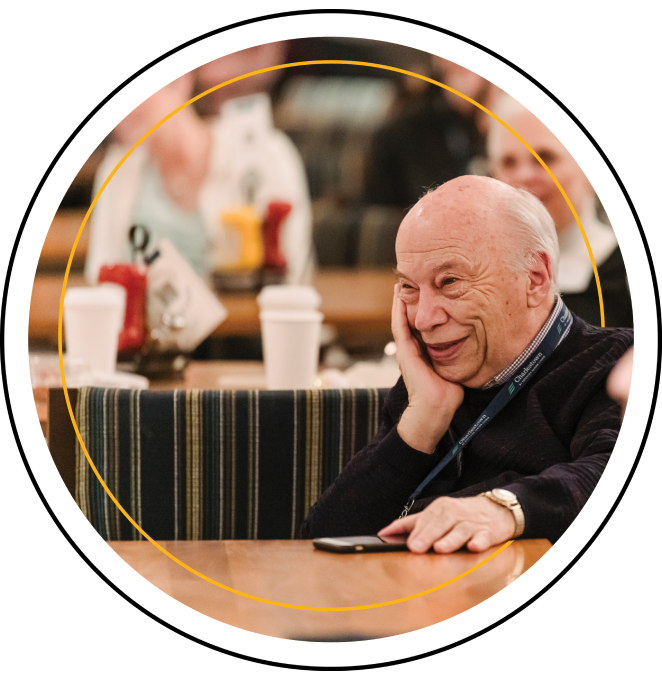 Art Johnson, professor emeritus, enjoys a jazz concert at Charlestown.
Around the café tables, heads are bobbing in rhythm tonight.
A duo of UMBC jazz students—Henry Smith ’24, on alto saxophone, and Leo Hickman ’27, on electric mandolin—are deep into their own takes on jazz standards. “Caravan,” “Misty,” and “There is No Greater Love” pour jauntily from their instruments.
The seniors here at Charlestown Senior Living know those tunes. Every song the UMBC jazz duo played was composed long before the student musicians were born, but just in the sweet spot for the audience. In the café where many have just eaten their crab soup and burgers for dinner, more than 100 Charlestown residents, including at least six who have tight connections to UMBC, clapped for the efforts of the young jazz players.
After the two finished playing “All of Me,” the crowd erupted in applause.
“That was ‘All of Me,’” Smith said into the microphone. “I feel like lots of you know that one. We’re having a great time playing for you. This is super fun!”
By 8 p.m. the crowd was stuffing dollar bills and fivers into the musicians’ tip jar by the mic and in paper bags held by volunteers at each exit. Then the seniors headed back to their apartments at the end of long corridors and in different buildings, very much like college dorms for older folks.
Strengthening Connections
A dedicated group of nearly 60 retired and current faculty and staff, alumni, or relatives have formed to promote connections between UMBC and Charlestown, a sprawling senior community with 2,000 residents. Thanks to their efforts, UMBC professors are teaching classes at the senior living community, Charlestown residents are traveling to UMBC for events, and helping the senior community’s restaurant staff with scholarship applications, funded by Charlestown residents, to UMBC and other Maryland colleges.
“That’s what I’m trying to do here, make connections,” said Art Johnson, provost emeritus who retired in 2019 from his position as political science professor and director of the Sondheim Scholars program. He moved to Charlestown in 2022 and since then, like a first-year student in search of college social groups, he has been indefatigably recruiting residents to join the Friends of UMBC at Charlestown.
“It helps maintain my connection to UMBC and lets me brag a little bit about UMBC,” Johnson said, laughing. “I meet people I wouldn’t have met otherwise. As provost, I used to promote UMBC all over. This is just an extension of that.”
Johnson met Lucy McKean on the bocce court, learned one of her kids went to UMBC, and reeled her into the group.
“Any connection will do,” Johnson said. “That’s how you build a long mailing list.”
Sitting at a dinner table on the Charlestown campus, McKean and Johnson laughed together. Thanks to the Friends of UMBC group, she’s now attending jazz concerts, which she never thought she would do.
The idea for a formal-ish group sprang from a walk that Johnson and Sam Lomonaco, computer science and electrical engineering professor, took around Charlestown in the fall of 2022. They wanted to create a web of connections between UMBC and Charlestown.
Lomonaco, who has lived at Charlestown for three years, still teaches at UMBC. His commute is nicely short, he said, and having a partnership between UMBC and Charlestown offers “a good chance to do things together. I meet a lot of interesting people I would not have met otherwise. And,” he said with a grin, “I’ve gotten interested in jazz.”
Johnson and Lomonaco started small, with a social for UMBC-connected folks at Charlestown. They’ve grown to arrange trips to programs by UMBC’s arts and culture departments, as well as the Wisdom Institute (the association for retired UMBC faculty and staff), and those monthly jazz concerts. As well, Johnson and others publish a newsletter and are recruiting UMBC faculty to teach courses at Charlestown through ELLIC (Elderhostel’s Lifelong Learning Institute at Charlestown), including classes on galaxies, genes, and gender.
“Art has been a binder, keeping us together,” said Bernice De Bels ’76, English, the first Black honors graduate at UMBC, who later worked in the foreign language department and now lives at Charlestown. “With UMBC we should explore what we have to offer them and what they have to offer us.”
Keeping Memory Alive
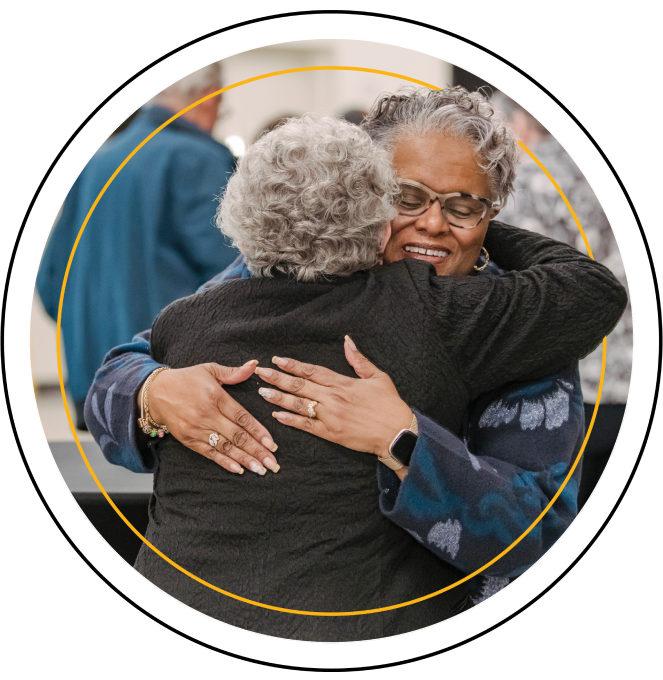 Diane Lee hugs Pamela Morgan, the former director of the Office of Field Experiences and Clinical Practice in UMBC’s education department and a Wisdom Institute Board Member.
Of the many courses offered at Charlestown’s ELLIC program, nine are taught by UMBC faculty. That’s not a coincidence. Though the connections between Charlestown and UMBC have been sporadic, the institutions do have history.
John Erickson, who founded Erickson Living, which owns Charlestown, has long worked with UMBC to promote the study of getting older. Through joint efforts of Erickson and then-president Freeman Hrabowski, in 2004 the state funded the Erickson School of Aging Studies at UMBC, and Erickson Living donated $5 million for the school’s development.
Jeff Watson, who is on the faculty for the Erickson School of Aging Studies and serves as Erickson’s director of operations, also researches geriatric cognition.
“The literature and growing academic consensus is that whatever is good for the heart is good for the lungs is good for the brain,” Watson said. “Thus a healthy lifestyle, reducing inflammation and injury, while increasing physical and cognitive strength, and engaging in life, builds better brain health.”
Erickson researchers have published a study in the American Journal of Geriatric Psychiatry testing UCLA Longevity Center researchers’ findings about memory fitness on two of Erickson’s campuses, Riderwood and Oak Crest. Watson said they found that “eating wisely, exercising daily, learning consistently, relaxing meaningfully, and connecting socially” is optimal for a healthy lifestyle for seniors.
The Friends of UMBC are all about learning and socializing while they’re matchmaking between UMBC and Charlestown. For years, Johnson said, UMBC talked about collaborating with Charlestown, but it never really manifested to the extent they envisioned.
“One of our long-term goals is to try to bring the two institutions closer together,” Johnson said. “We could cooperate on issues: sustainability, local transportation, good health care…. We talked about it years ago when I was at UMBC, but it never happened.”
Same Goals, From Different Directions
UMBC’s Wisdom Institute is trying to accomplish the same community-building as the UMBC group at the senior village. But now, they’re working together.
Johnson, who serves on the Wisdom Institute’s board, is the hub, said Diane Lee, director of the UMBC organization for retirees.
“He brilliantly brought people together,” Lee said. “What a wonderful way to reconnect with these folks.”
The Wisdom Institute is printing extra copies of its newsletters for distribution at Charlestown, and for a recent event, the institute rented out the Charlestown bus to bring UMBC-curious residents to a lunch and keynote by WJZ-TV anchor Denise Koch. The institute plans to invite Charlestown residents to other events, including observatory tours in UMBC’s Physics Building, monthly lunches, discussions, and concerts.
“We really want to forge this tie,” Lee said. “We like the idea of reciprocity.”
For 30 years, Lee taught at UMBC in the education department and worked in the administration. “I came as a visiting assistant professor with no intention of staying. But it was an exciting place and an exciting time to be there.”
She, like many of the longtime UMBC staff and faculty who now live at Charlestown, helped build UMBC from the ground up into the institution it is today.
“It’s a wonderful place to be,” Lee said. The work was demanding but energizing, she said. “And people cared. We’re trying to capture the spirit, to continue that sense of self and community and the kind of work we did together. UMBC was not just a campus. We talked about one another as family.”
Dream Students
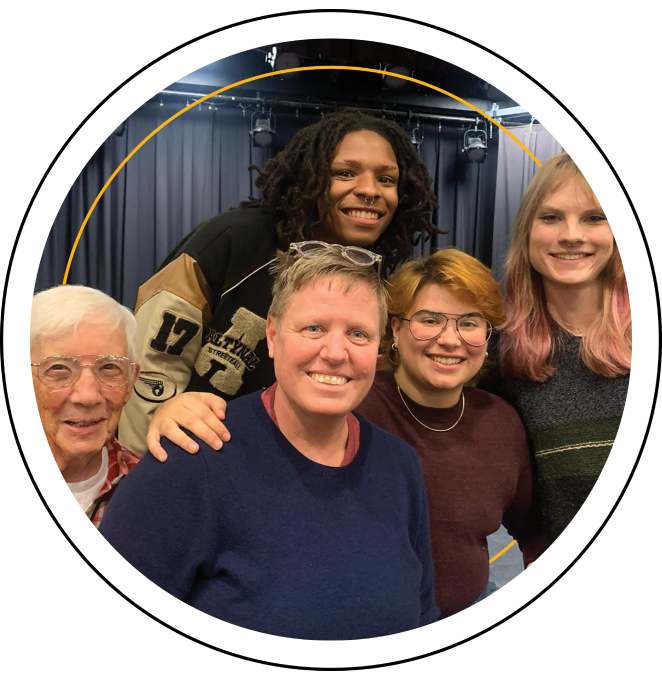 Donna Martin, Kate Drabinski, and students Marcus Ross, Sage Zoz, and August Wichman pose together after a class about gender and sexuality through the Enjoy Lifelong Learning in Charlestown program. Photo courtesy of Drabinski.
Kate Drabinski, principal lecturer in gender and women’s and sexuality studies, has visited Charlestown eight times to teach over three years. She jokes that if she teaches two more classes, she’ll earn a punch card for a free meal at Charlestown’s restaurant.
“It’s been some of the most valuable teaching I’ve done,” Drabinski said of the senior students learning through the ELLIC program, Enjoy Lifelong Learning in Charlestown. “They are rapt, they take notes, they ask questions. It’s a dream setup.”
On a spring Tuesday, Drabinski brought UMBC students who identify as gay, transgender, and nonbinary to the senior living community to tell their coming out stories, along with their struggles and joys around gender and sexuality.
“It’s been really moving for us, and also for the residents, to make these connections,” Drabinski said.
One student, who performs in drag shows, grew up on the same block as one of the residents, Drabinski said. The resident stood up and said she was proud of the student, Drabinski said, “for being brave and sharing her story.”
At least one of the Charlestown residents has a nonbinary grandchild, Drabinski said. “They probably feel uncomfortable asking their grandchild these questions,” she continued, but were curious and asked many questions of the students without the fear of rejection from a family member.
And she asked the students a question in front of the residents: “What do you wish your grandparents had said to you when you told them your coming out story? They said, ‘I want you to be part of my life—I trust you and this is a gift I’m giving.’”
They also discussed the generational misunderstandings, Drabinski said, “hot-button issues.” One resident asked why drag queens were reading stories at libraries. Students were worried about the question, but Drabinski said she maneuvered the fear in the room and, ultimately, they had a “fantastic discussion, the kind of discussion you only have when you have dedicated intergenerational space.”
Drabinski said her students came away from the interaction enriched. “Just because people are old doesn’t mean they are hostile. It was a huge benefit to students to get to practice telling their stories, to build confidence, and to learn from the questions the seniors are asking. It was a really positive experience.”
Familiar Tunes in a New Way
Now that he’s retired, Johnson has time to fulfill the goal of bringing UMBC and Charlestown closer.
One evening before the jazz concert, Johnson pulled together members of his group of UMBC folks to chat in the atrium of one of Charlestown’s buildings.
Pat Bettridge, who came to UMBC in 1966 and did graduate work in English, was married to English professor William Bettridge, and remembers UMBC in the 1960s as “a hole in the ground.” Bettridge, who has lived at Charlestown for 11 years, helped bring UMBC artists, dancers and theater productions to the senior living community over the years.
“It’s a good idea to get us together, to continue what we started 10 years ago,” Bettridge said.
Sebastian Petix, organizer of Charlestown’s jazz club and a friend of the Friends of UMBC, has worked with Matt Belzer, senior lecturer in jazz studies at UMBC, to bring the jazz groups to Charlestown. Petix, who played piano and trumpet and organized concert series before retirement, formed the Charlestown Jazz Club, and quickly signed onto the idea of bringing Retriever musicians onto Charlestown’s campus.
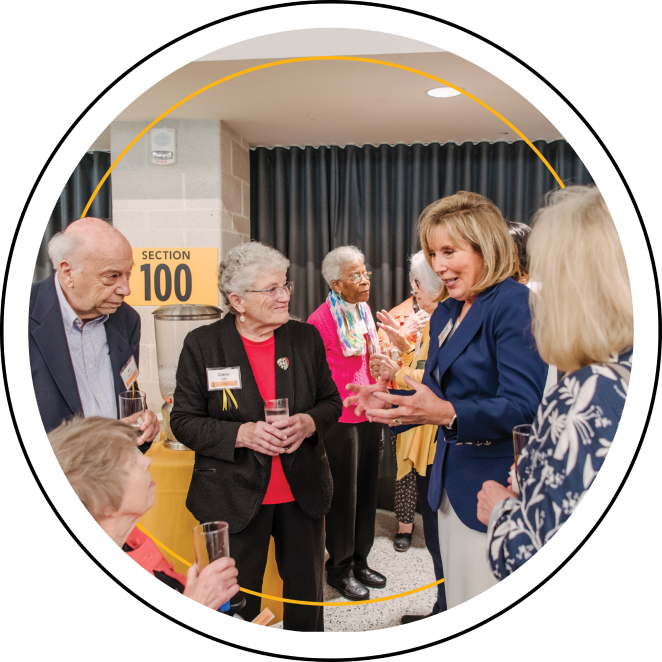 Art Johnson, Diane Lee, and Denise Koch chat with community members at the Wisdom Institute’s Signature Event in April 2024
“The audiences have really loved them,” Petix said. His jazz club, including some UMBC members, are planning a trip to see the UMBC semester’s final jazz recitals.
Valerie Woolston, whose husband Charles started as UMBC’s admissions director in 1968, helps edit the Friends of UMBC newsletter. She’s attended every jazz concert.
“They’re terrific,” Woolston said, nodding at the duo warming up in front of the crowd. “It’s really great to see how young people develop. They write their own music,” she said, almost as proud as a grandparent.
“I’m really pulled to UMBC,” said Woolston. “I’m really proud of it.”
Then she settled down with friends to watch the students play old, familiar tunes in a new way.
“I’m really pulled to UMBC,” said Woolston. “I’m really proud of it.”
Then she settled down with friends to watch the students play old, familiar tunes in a new way.
]]>
Retrievers for life, that’s UMBC’s promise, and a group of residents at Charlestown’s senior living community are keeping their end of the bargain. Located two miles away from UMBC’s Catonsville...
https://umbc.edu/stories/the-senior-class-charlestown-cultural-exchange/
https://my3.my.umbc.edu/api/v0/pixel/news/142344/guest@my.umbc.edu/355422fcb02e43ca3b6d40c2be3c039e/api/pixel
aging-studies
campus-life
erickson
feature
gwss
magazine
music
spring-2024
story
wisdom-institute
UMBC News & Magazine
https://my3.my.umbc.edu/groups/umbc-news-magazine
https://assets1-my.umbc.edu/system/shared/avatars/groups/000/001/943/24435aa6207c452e7bc15cc74b42c7bb/xsmall.png?1748556657
https://assets1-my.umbc.edu/system/shared/avatars/groups/000/001/943/24435aa6207c452e7bc15cc74b42c7bb/original.png?1748556657
https://assets2-my.umbc.edu/system/shared/avatars/groups/000/001/943/24435aa6207c452e7bc15cc74b42c7bb/xxlarge.png?1748556657
https://assets2-my.umbc.edu/system/shared/avatars/groups/000/001/943/24435aa6207c452e7bc15cc74b42c7bb/xlarge.png?1748556657
https://assets3-my.umbc.edu/system/shared/avatars/groups/000/001/943/24435aa6207c452e7bc15cc74b42c7bb/large.png?1748556657
https://assets1-my.umbc.edu/system/shared/avatars/groups/000/001/943/24435aa6207c452e7bc15cc74b42c7bb/medium.png?1748556657
https://assets2-my.umbc.edu/system/shared/avatars/groups/000/001/943/24435aa6207c452e7bc15cc74b42c7bb/small.png?1748556657
https://assets1-my.umbc.edu/system/shared/avatars/groups/000/001/943/24435aa6207c452e7bc15cc74b42c7bb/xsmall.png?1748556657
https://assets2-my.umbc.edu/system/shared/avatars/groups/000/001/943/24435aa6207c452e7bc15cc74b42c7bb/xxsmall.png?1748556657
UMBC News & Magazine
0
0
false
Wed, 29 May 2024 16:34:41 -0400
Wed, 29 May 2024 16:34:41 -0400
A Journey of Growth
International travel offers ample opportunities to stretch yourself—one minute you may be the expert and the next, completely clueless about how something works. Retrievers currently in the Fulbright U.S. Student Program—teaching English or researching around the globe—find themselves oscillating between their teaching and student roles on a daily or hourly basis. By engaging their host communities through openness and cultural humility (and many shared cups of tea or coffee), these Fulbrighters are finding their balance along the way.
All eyes are on Milan Richardson ’23 as she helps her co-teacher keep score in a Jeopardy-like game her students are playing. Richardson teaches English to several classes of first through sixth-grade students at Jinsha Elementary School in Kinmen County, Taiwan. As she completes the Mandarin character for the numeral 5, a wave of giggles and chatter flows through the room.
Similar to a U.S. tally—four strokes and a strike though, the Mandarin character has 5 strokes total and needs to be written a certain way to represent 1, 2, 3, 4, or 5. “The students were so confused because I wrote the character strokes in the wrong order,” says Richardson, who is used to solving complex math as a Meyerhoff Scholar having earned a bachelor’s degree in bioinformatics and computational biology and minors in computer science and modern, languages, linguistics, and intercultural communication.
“I wanted to write the character correctly. I asked, and they showed me the proper order to write the strokes,” says Richardson, a Fulbright English Teaching Assistant (ETA). “They started clapping once I got it right. This was one of the many cool moments where my students were able to teach me.”
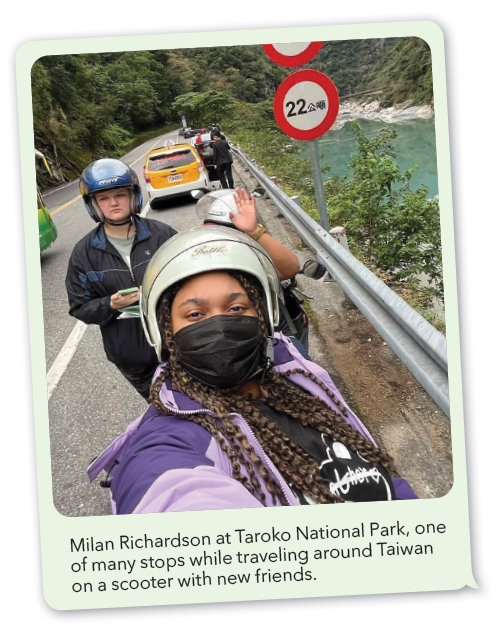
While she may be new to teaching in Taiwan, Richardson brings with her four years as an English and math tutor and a minor in Mandarin. “Taiwan was so different from any place I’ve ever been to. I was overwhelmed at first,” says Richardson. “I like it a lot, now. In my second month, I applied for a scooter license. Now I ride around the island and have taken my scooter other places on trips.”
Diplomas earned. Visas in hand. Vaccines completed. Luggage packed. Destination confirmed. Last summer, UMBC’s eight participants in the 2023 – 2024 Fulbright U.S. Student Program checked off all the important items on their to-do lists. The only thing left was to get to their placements on islands and in landlocked countries, cities, and countrysides across East Asia and Eastern Europe. It’s easier written than done. To adapt well to a new community, job, language, and culture, they must practice the art of humility and flexibility as their roles shift regularly from teacher to student.
Leading the Fulbright charge
All technicalities aside, the Fulbright experience is the beginning of building an international network of teachers and researchers who share the diversity and possibility of the U.S. with the world. In return, across the globe, communities welcome the next generation of leaders into their cities, neighborhoods, schools, and homes to share their country’s history, innovations, and culture. Since Fulbright’s inception in 1946, these reciprocal acts of kindness have created multiple paths forward to lifelong worldwide collaboration and understanding based on the simple act of giving someone different than yourself a chance.
“The Fulbright Program truly demonstrates public diplomacy in action,” says Brian Souders, M.A.’19, TESOL, and Ph.D. ’09, language, literacy, and culture, the associate director of global learning at UMBC’s Center for Global Engagement. In this role, Souders, who received a 2023 Fulbright International Education Administrator award to Germany, has led hundreds of Retrievers through the Fulbright application process as UMBC’s Fulbright Program advisor. “Whether in the classroom as teachers, students, or researchers, recipients learn about the world as much as they share what it means to be from the U.S. and UMBC alumni,” says Souders.
Thanks to Souders’ guidance, UMBC is one of 57 doctoral universities nationwide and three in Maryland to receive a Fulbright Top Producing Institution designation for 2023 – 2024, for the third time in the last five years. In the last decade, more than 80 UMBC alumni have received Fulbright awards. Out of the 10 Retrievers who received a 2023 – 2024 Fulbright, eight are currently placed internationally, seven are ETAs and one is on a research grant.
The hard work of play
There are U.S. Fulbright student scholars in more than 100 countries worldwide. Three Retrievers were placed in Taiwan—they keep in touch regularly, see each other at ETA trainings, and are planning to travel together during their Fulbright year. But they all arrived in Taiwan separately and faced different challenges settling in.
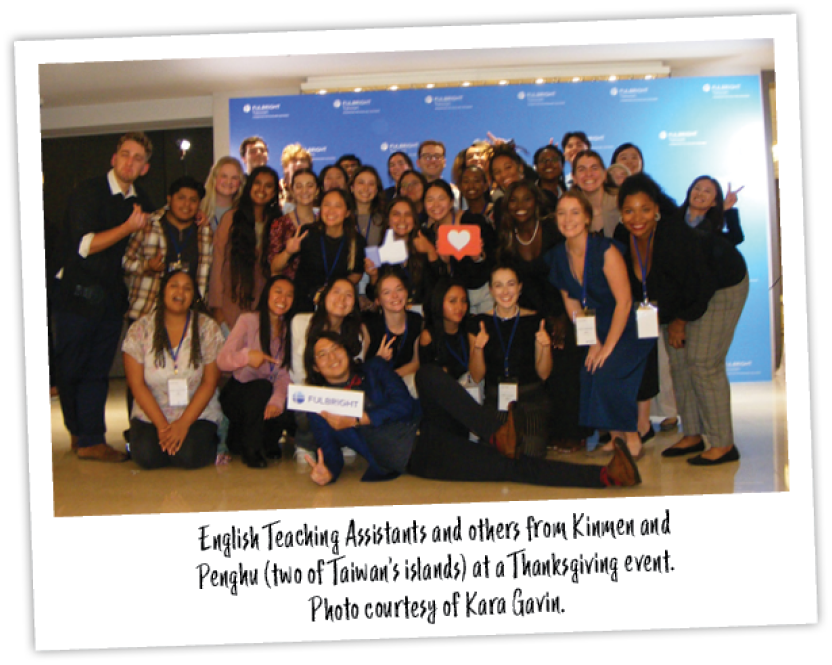
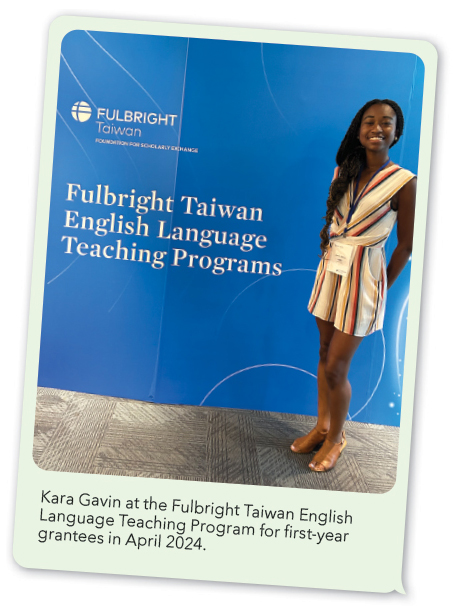
“I arrived in Taiwan and immediately changed my plans because the airline lost my luggage,” says Humanities Scholar Kara Gavin ’20, English. She was grateful to have a carry-on. “It was chaotic. I was taking it all in,” says Gavin. A day and a 50-minute plane ride later, she arrived in Penghu County, Taiwan, an archipelago of about 90 islands between China and the main island of Taiwan. “The little beach town is in its own little world,” says Gavin. “The smell of the sand gave me comfort.”
Gavin teaches beginner English at two local junior high schools. New to Asia and Mandarin, Gavin’s thinking cap is on 24 – 7, including learning Mandarin in between teaching classes. “Living independently for the first time is hard on its own, but doing it in a foreign country is a whole other ball game,” says Gavin. “I’m acquiring many new life skills that will last me a lifetime.”
One of those is sympathizing with her students and anyone learning a new language and culture. “I teach the English pronunciation and spelling of a word,” says Gavin. “Then, they like to share the Mandarin equivalent with me. It’s all about patience, balance, and trust.” She also models intercultural teamwork by developing and teaching lessons with her bilingual (Mandarin/English) Taiwanese co-teacher to foster student engagement and enrichment.
For Fulbright Scholars, it is equally important to engage with communities beyond the classroom. When they apply for the grant, the Fulbright Program asks them to develop ideas to share their passions and skills in a community project. For Gavin, this meant adding a little drama to have a lot of fun. As a performing artist, Gavin knows the theatre can be a powerful community-building outlet. “I wanted to encourage students and other community members to express themselves and share their culture with me and others,” says Gavin.
She found a kindred spirit in a professor at a local university. They formed a drama club at the university for English language learners at all levels to explore American play formats with Taiwanese traditions and histories.“Writing original bilingual plays, in English and Mandarin, based on folktales about island traditions is creating an artistic and fun cultural exchange and understanding outside of my ETA duties,” says Gavin.
Finding the right pace
For fellow Humanities Scholar Nailah-Benā Chambers ’23, global studies, a Fulbright award to Taiwan was a natural next step. Chambers began learning Mandarin and all things Taiwanese in sixth grade at a Taiwanese Mandarin language immersion school in her hometown of Richmond, Virginia. As her Mandarin improved, she tutored other English speakers. This oscillating pattern of being a student and a teacher makes Chambers adaptable and persistent, she says.
But it hasn’t always been easy. When she first visited Taipei, Taiwan, in the spring of 2023 on a Mandarin language-intensive study abroad program, “I was so confident. I walked into a 7-Eleven to shop. No one could understand me,” says Chambers. “It was a bit embarrassing. Even with my language and cultural skills, I had a long way to go to mastering Mandarin.”
Now on her Fulbright ETA grant, Chambers arrived on solid ground, both culturally and linguistically. “I felt such a sense of calm and familiarity. Taiwan is so welcoming,” says Chambers. “It calms you down. Things are much slower here than in the U.S.” Soon enough, Chambers was balancing classrooms at Huludun Elementary and Fu Chun Elementary in Taichung City, on the main island of Taiwan, with students at both schools on the extreme spectrum of English proficiency.
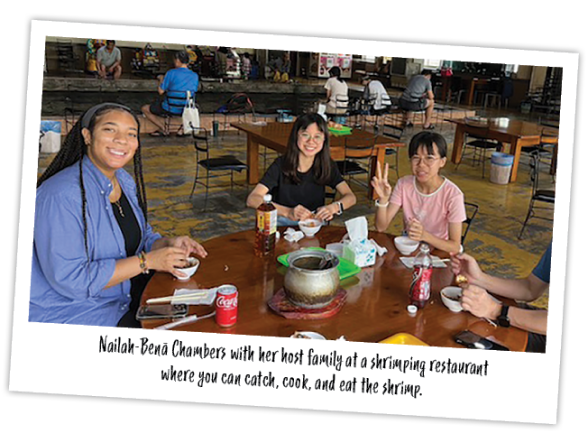
The upside of working with proficient English language learners is connecting on more advanced topics and sticking to Fulbright’s English-only immersion model. At one of her schools, the students are beginning English language learners, and the administrators only speak Mandarin. “My experience as a bilingual teacher and learner with a high level of understanding of the local language and culture has helped with classroom management and fostering powerful connections with students and administrators,” says Chambers. “It also helps to advance their grasp of the nuances of American English, especially when there are gray areas or misunderstandings.”
Keeping your ears open
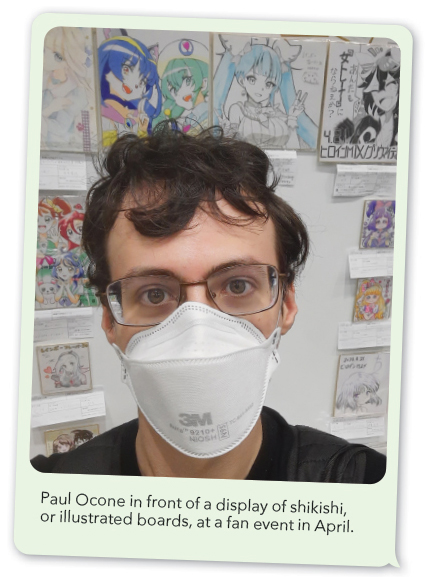
Watching anime, reading manga, (Japanese graphic novels), and participating in their fandom inspired Paul Ocone ’22, individualized study, a Linehan Artist Scholar, to research these subjects and learn Japanese. “I have deeply engaged in fan social life and communities—from leading an anime club to participating in and running conventions to moderating online communities—my affinity for and interest in anime fan spaces runs deep,” says Ocone. Part of Ocone’s observations include witnessing how some fan subcultures limit their membership in fear that a broader fanbase would weaken their subculture identity. In contrast, he says, other fan subcultures are more flexible while maintaining their identity.
Interested in adding to his initial research in U.S. fan spaces, Ocone is now at the epicenter of anime and manga culture as a Fulbright Student Researcher doing anthropological research with Morikawa Kaichirō, a leading scholar in this field at Meiji University’s School of Global Japanese Studies in Tokyo, also home to the Yoshihiro Yonezawa Memorial Library of Manga and Subcultures.
“I have had some amazing experiences participating in anime pilgrimage or anime tourism, including learning much from other fans and benefitting from their generosity,” says Ocone. “My Japanese is conversational—sometimes it’s challenging to understand specialized topics, but this has not deterred me from adding anime and manga tourism as a second research project.” In January, Ocone presented his work at the Popular Culture Tourism Stakeholders Summit in Japan.
Ocone is a sort of tourist himself, enjoying various aspects of Japanese pop culture. The daily musicality of Tokyo teaches him about enjoying the rhythm of the day. “Each train station plays a unique melody when the train departs,” says Ocone. These melodies or “hassha merodii,” are catchy and echo around in his brain like the convenience store jingles that also greet customers. “I was happily surprised when I heard a loudspeaker playing a symphony in my neighborhood,” says Ocone. “Another one played the following day and the next. I learned this was a daily sunset ritual.” He knows these sound experiences will play in his head long after returning to the U.S.
Learning new languages
This is not the first time David Bullman ’22, ancient studies, visited North Macedonia. He first went in 1995 as a performing musician and public affairs representative for the U.S. Army.
“North Macedonia was very different coming out of the Cold War,” says Bullman. “The infrastructure and general state of repair of public spaces and businesses is much better than I recall from that time.”
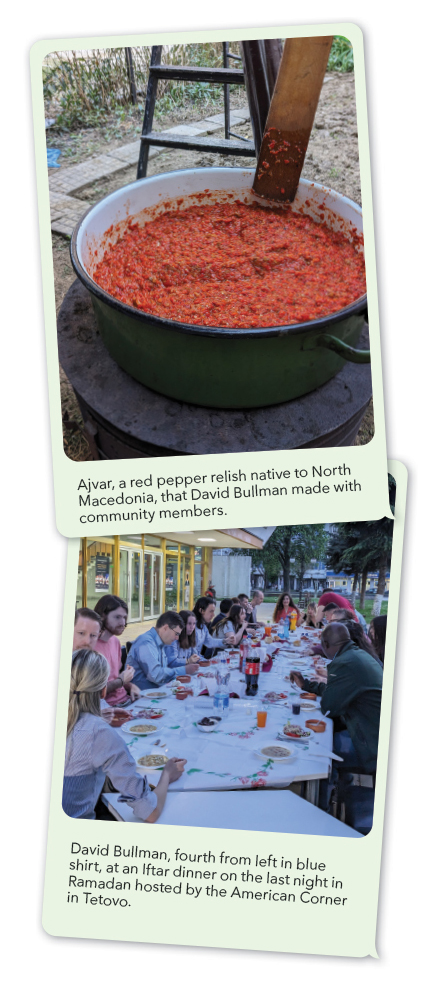
Now, as an ETA, Bullman teaches British civilization and American civilization in addition to three different levels of English at the University of Totovo in the Republic of North Macedonia, a landlocked country north of Greece. In Totovo, students begin learning English in elementary school and are fluent by the time they reach college. “I thought I would be teaching English basics,” says Bullman, “but it’s been great to teach a complex subject in the context of where my students live.”
His students are equally glad to help him with the local language. Macedonian and Albanian are the country’s two official languages. Bullman began learning some key Macedonian phrases in preparation for his trip. However, Albanian is the preferred language in Tetovo. After traveling with the Army to more than 15 countries on three continents, Bullman is used to rapidly switching gears and accepting help.
He eagerly takes on the student role when it comes to learning about new foods. Bullman’s apartment faces the Hapësira Socio-Kulturore Tetovë, a community center where locals and the nearby Peace Corps Volunteers sometimes organize activities, like an ajvar-making gathering. Ajvar is a delicacy across the Balkans made every fall. It’s a tradition passed down through centuries with many recipe variations. “Ajvar is made by charring red bell peppers that are then peeled, minced, seasoned, and cooked for hours,” says Bullman. It boils down to a relish that can be preserved for months, but locals tell Bullman that’s rare because it’s too good to keep for even one week. After participating in the preparation and getting to take home a few jars, Bullman agrees with the locals. Ajvar is now his go-to condiment on eggs, pasta, toast—anything goes.
Albanian and cooking are not the only languages Bullman tapped into while in Tetovo. As a lifelong clarinet player, Bullman hoped to create a musical exchange with local musicians. The opportunity presented itself when the dean of the Faculty of Art wanted to celebrate Thanksgiving. Bullman collaborated with the music faculty, the orchestra director, and students to create a concert of six songs. “I’m glad I returned to North Macedonia. The people are as warm and friendly as I remembered them to be,” says Bullman. “I wanted to come back and experience it myself again.”
Tapping into curiosity
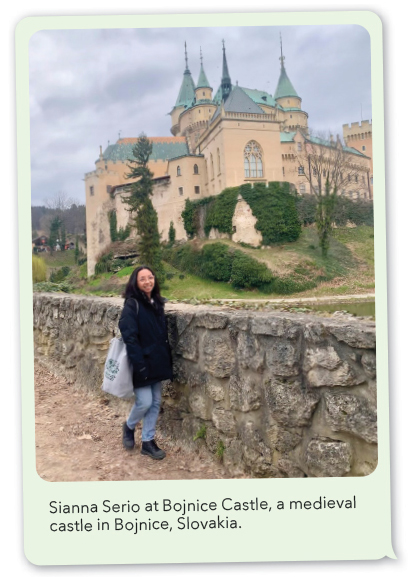
On her way to her Fulbright placement, Sianna Serio ’23, computer science, went city hopping. “I was headed to Žilina, Slovakia, east of Austria and south of Poland,” says Serio. “I flew into Vienna, Austria, then I took a one-hour bus ride crossing Austria’s eastern border into Slovakia to get to Bratislava, the capital.“ There she met other ETAs for orientation. “A week later, I hopped on a two-hour train ride to my teaching placement in Žilina and I met my wonderful mentor, Maria Veršova, who became my second mom.”
Serio teaches at the Hotel Academy, Žilina. The academy focuses on hotel management, gastronomy, and tourism. “My students are beginning English language learners,” says Serio. “I teach what the class is interested in, like American pop culture, because they rarely meet a native English speaker.” During outings with her students, they ask about a wide range of topics. “There are many topics that I would not have thought to cover if it were not for time spent outside of the classroom,” says Serio, “Some of those conversations became formal lessons, like the lesson on the three branches of the U. S. government.”
Serio appreciates her students’ curiosity. She tapped into her love of website development and design to improve her students’ confidence in writing and speaking English and prepare for their Maturita exam, a national high school exit exam. “Some of my students are helping me design a class webpage for them where I will showcase their class and post some of their practice writing in English,” says Serio. “These posts will include topics covered in the Maturita exam, information about their school, and answers to questions about Slovakia.”
Serio’s mentor Maria Veršova, head of the English department, is her motivation. She guides her through lesson planning, class schedules, and the challenges of relocating to a new country. “When my original housing plans fell through, Maria found housing for me five minutes from her house,” says Serio. “She helped me find health insurance and open a bank account. Her husband set up my internet.” They have welcomed Serio almost daily into their home for dinner, tea, coffee, or wine. Serio is a gracious guest and lent her graphic design expertise to help Veršova design invitation cards for her 50th birthday party. Veršova tells Serio she will always have a place to stay in Žilina.
Fulbright: The next generation
Teaching has defined the last decade for Tiffany Powell, a master’s student in UMBC’s TESOL program, a passion she invested in as an English language learner teacher in Seoul and in Miryang City, South Korea, for five years, and in Florida this past year. Now, she is in Iași, Romania, southwest of Ukraine, at the Alexandru Ioan Cuza University teaching American studies. Powell is committed to bridging culture, community, and belonging by bringing technology into the classroom.
Powell also decided to bring the research and cultural understanding closer to home by partnering with Romanian teachers to develop a five-part series on African American women’s history. “We talked about Black women in science in the context of the movie Hidden Figures and discussed Hollywood’s portrayal of Black life,” says Powell. The class is now creating a series on Romanian women. Helping students better understand the similarities and differences between U.S. and Romanian cultures has been an eye-opening experience for Powell.
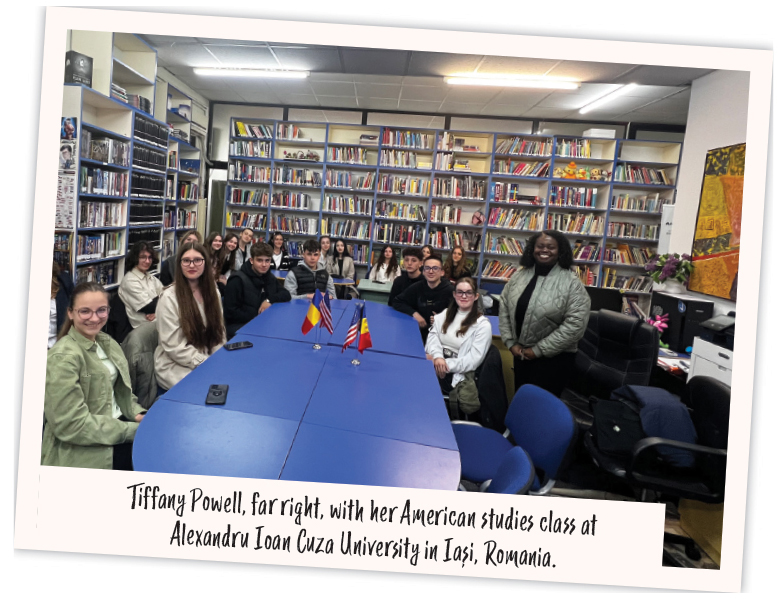
She sees the impact of a country formerly under communism. In Iași, sometimes the internet doesn’t work and, in her school, there are no clubs or student organizations to gain the skills needed to earn a Fulbright award. “My students have given me a new perspective. You may want to come in and make changes, but you must understand where they’re coming from. There is a saying in Iași, ‘It’s not impossible. It’s just difficult,’” says Powell. She is trying to help with the difficult part by leading Fulbright application and leadership workshops.
Powell, like the other Fulbrighters, will bring her experiences home with her and wherever she ends up teaching English next. When their Fulbright year ends, these Retriever ambassadors will find themselves as emissaries yet again, returning to their hometowns, sharing the good news of ajvar made in community, the freedom of a scooter ride along a Taiwanese beach, or the correct stroke order for writing the Mandarin number five. The lessons their students and host families passed along—including pausing to take a breath and appreciate their international successes small and large—will continue to form and shape the way they see the world.
“Having a flexible mindset and under-standing the historical context of your placement is key,” says Powell. “I carry myself as a U.S. representative. Living abroad teaches humility, adaptability, and open-mindedness to press on through challenging times.”
]]>
International travel offers ample opportunities to stretch yourself—one minute you may be the expert and the next, completely clueless about how something works. Retrievers currently in the...
https://umbc.edu/stories/a-journey-of-growth/
https://my3.my.umbc.edu/api/v0/pixel/news/142391/guest@my.umbc.edu/429a43e449ef9d4187b1ae1d4e63ca4e/api/pixel
alumni
ancient-studies
bioinformatics-and-computational-biology
cahss
cge
computer-science
education-abroad
english
feature
fulbright
global-studies
humanities
inds
linehan
llc
magazine
meyerhoff
spring-2024
story
UMBC News & Magazine
https://my3.my.umbc.edu/groups/umbc-news-magazine
https://assets1-my.umbc.edu/system/shared/avatars/groups/000/001/943/24435aa6207c452e7bc15cc74b42c7bb/xsmall.png?1748556657
https://assets1-my.umbc.edu/system/shared/avatars/groups/000/001/943/24435aa6207c452e7bc15cc74b42c7bb/original.png?1748556657
https://assets2-my.umbc.edu/system/shared/avatars/groups/000/001/943/24435aa6207c452e7bc15cc74b42c7bb/xxlarge.png?1748556657
https://assets2-my.umbc.edu/system/shared/avatars/groups/000/001/943/24435aa6207c452e7bc15cc74b42c7bb/xlarge.png?1748556657
https://assets3-my.umbc.edu/system/shared/avatars/groups/000/001/943/24435aa6207c452e7bc15cc74b42c7bb/large.png?1748556657
https://assets1-my.umbc.edu/system/shared/avatars/groups/000/001/943/24435aa6207c452e7bc15cc74b42c7bb/medium.png?1748556657
https://assets2-my.umbc.edu/system/shared/avatars/groups/000/001/943/24435aa6207c452e7bc15cc74b42c7bb/small.png?1748556657
https://assets1-my.umbc.edu/system/shared/avatars/groups/000/001/943/24435aa6207c452e7bc15cc74b42c7bb/xsmall.png?1748556657
https://assets2-my.umbc.edu/system/shared/avatars/groups/000/001/943/24435aa6207c452e7bc15cc74b42c7bb/xxsmall.png?1748556657
UMBC News & Magazine
5
0
false
Wed, 29 May 2024 14:32:52 -0400
A Journey of Growth
International travel offers ample opportunities to stretch yourself—one minute you may be the expert and the next, completely clueless about how something works. Retrievers currently in the Fulbright U.S. Student Program—teaching English or researching around the globe—find themselves oscillating between their teaching and student roles on a daily or hourly basis. By engaging their host communities through openness and cultural humility (and many shared cups of tea or coffee), these Fulbrighters are finding their balance along the way.
All eyes are on Milan Richardson ’23 as she helps her co-teacher keep score in a Jeopardy-like game her students are playing. Richardson teaches English to several classes of first through sixth-grade students at Jinsha Elementary School in Kinmen County, Taiwan. As she completes the Mandarin character for the numeral 5, a wave of giggles and chatter flows through the room.
Similar to a U.S. tally—four strokes and a strike though, the Mandarin character has 5 strokes total and needs to be written a certain way to represent 1, 2, 3, 4, or 5. “The students were so confused because I wrote the character strokes in the wrong order,” says Richardson, who is used to solving complex math as a Meyerhoff Scholar having earned a bachelor’s degree in bioinformatics and computational biology and minors in computer science and modern, languages, linguistics, and intercultural communication.
“I wanted to write the character correctly. I asked, and they showed me the proper order to write the strokes,” says Richardson, a Fulbright English Teaching Assistant (ETA). “They started clapping once I got it right. This was one of the many cool moments where my students were able to teach me.”
While she may be new to teaching in Taiwan, Richardson brings with her four years as an English and math tutor and a minor in Mandarin. “Taiwan was so different from any place I’ve ever been to. I was overwhelmed at first,” says Richardson. “I like it a lot, now. In my second month, I applied for a scooter license. Now I ride around the island and have taken my scooter other places on trips.”
Diplomas earned. Visas in hand. Vaccines completed. Luggage packed. Destination confirmed. Last summer, UMBC’s eight participants in the 2023 – 2024 Fulbright U.S. Student Program checked off all the important items on their to-do lists. The only thing left was to get to their placements on islands and in landlocked countries, cities, and countrysides across East Asia and Eastern Europe. It’s easier written than done. To adapt well to a new community, job, language, and culture, they must practice the art of humility and flexibility as their roles shift regularly from teacher to student.
Leading the Fulbright charge
All technicalities aside, the Fulbright experience is the beginning of building an international network of teachers and researchers who share the diversity and possibility of the U.S. with the world. In return, across the globe, communities welcome the next generation of leaders into their cities, neighborhoods, schools, and homes to share their country’s history, innovations, and culture. Since Fulbright’s inception in 1946, these reciprocal acts of kindness have created multiple paths forward to lifelong worldwide collaboration and understanding based on the simple act of giving someone different than yourself a chance.
“The Fulbright Program truly demonstrates public diplomacy in action,” says Brian Souders, M.A.’19, TESOL, and Ph.D. ’09, language, literacy, and culture, the associate director of global learning at UMBC’s Center for Global Engagement. In this role, Souders, who received a 2023 Fulbright International Education Administrator award to Germany, has led hundreds of Retrievers through the Fulbright application process as UMBC’s Fulbright Program advisor. “Whether in the classroom as teachers, students, or researchers, recipients learn about the world as much as they share what it means to be from the U.S. and UMBC alumni,” says Souders.
Thanks to Souders’ guidance, UMBC is one of 57 doctoral universities nationwide and three in Maryland to receive a Fulbright Top Producing Institution designation for 2023 – 2024, for the third time in the last five years. In the last decade, more than 80 UMBC alumni have received Fulbright awards. Out of the 10 Retrievers who received a 2023 – 2024 Fulbright, eight are currently placed internationally, seven are ETAs and one is on a research grant.
The hard work of play
There are U.S. Fulbright student scholars in more than 100 countries worldwide. Three Retrievers were placed in Taiwan—they keep in touch regularly, see each other at ETA trainings, and are planning to travel together during their Fulbright year. But they all arrived in Taiwan separately and faced different challenges settling in.
“I arrived in Taiwan and immediately changed my plans because the airline lost my luggage,” says Humanities Scholar Kara Gavin ’20, English. She was grateful to have a carry-on. “It was chaotic. I was taking it all in,” says Gavin. A day and a 50-minute plane ride later, she arrived in Penghu County, Taiwan, an archipelago of about 90 islands between China and the main island of Taiwan. “The little beach town is in its own little world,” says Gavin. “The smell of the sand gave me comfort.”
Gavin teaches beginner English at two local junior high schools. New to Asia and Mandarin, Gavin’s thinking cap is on 24 – 7, including learning Mandarin in between teaching classes. “Living independently for the first time is hard on its own, but doing it in a foreign country is a whole other ball game,” says Gavin. “I’m acquiring many new life skills that will last me a lifetime.”
One of those is sympathizing with her students and anyone learning a new language and culture. “I teach the English pronunciation and spelling of a word,” says Gavin. “Then, they like to share the Mandarin equivalent with me. It’s all about patience, balance, and trust.” She also models intercultural teamwork by developing and teaching lessons with her bilingual (Mandarin/English) Taiwanese co-teacher to foster student engagement and enrichment.
For Fulbright Scholars, it is equally important to engage with communities beyond the classroom. When they apply for the grant, the Fulbright Program asks them to develop ideas to share their passions and skills in a community project. For Gavin, this meant adding a little drama to have a lot of fun. As a performing artist, Gavin knows the theatre can be a powerful community-building outlet. “I wanted to encourage students and other community members to express themselves and share their culture with me and others,” says Gavin.
She found a kindred spirit in a professor at a local university. They formed a drama club at the university for English language learners at all levels to explore American play formats with Taiwanese traditions and histories.“Writing original bilingual plays, in English and Mandarin, based on folktales about island traditions is creating an artistic and fun cultural exchange and understanding outside of my ETA duties,” says Gavin.
Finding the right pace
For fellow Humanities Scholar Nailah-Benā Chambers ’23, global studies, a Fulbright award to Taiwan was a natural next step. Chambers began learning Mandarin and all things Taiwanese in sixth grade at a Taiwanese Mandarin language immersion school in her hometown of Richmond, Virginia. As her Mandarin improved, she tutored other English speakers. This oscillating pattern of being a student and a teacher makes Chambers adaptable and persistent, she says.
But it hasn’t always been easy. When she first visited Taipei, Taiwan, in the spring of 2023 on a Mandarin language-intensive study abroad program, “I was so confident. I walked into a 7-Eleven to shop. No one could understand me,” says Chambers. “It was a bit embarrassing. Even with my language and cultural skills, I had a long way to go to mastering Mandarin.”
Now on her Fulbright ETA grant, Chambers arrived on solid ground, both culturally and linguistically. “I felt such a sense of calm and familiarity. Taiwan is so welcoming,” says Chambers. “It calms you down. Things are much slower here than in the U.S.” Soon enough, Chambers was balancing classrooms at Huludun Elementary and Fu Chun Elementary in Taichung City, on the main island of Taiwan, with students at both schools on the extreme spectrum of English proficiency.
The upside of working with proficient English language learners is connecting on more advanced topics and sticking to Fulbright’s English-only immersion model. At one of her schools, the students are beginning English language learners, and the administrators only speak Mandarin. “My experience as a bilingual teacher and learner with a high level of understanding of the local language and culture has helped with classroom management and fostering powerful connections with students and administrators,” says Chambers. “It also helps to advance their grasp of the nuances of American English, especially when there are gray areas or misunderstandings.”
Keeping your ears open
Watching anime, reading manga, (Japanese graphic novels), and participating in their fandom inspired Paul Ocone ’22, individualized study, a Linehan Artist Scholar, to research these subjects and learn Japanese. “I have deeply engaged in fan social life and communities—from leading an anime club to participating in and running conventions to moderating online communities—my affinity for and interest in anime fan spaces runs deep,” says Ocone. Part of Ocone’s observations include witnessing how some fan subcultures limit their membership in fear that a broader fanbase would weaken their subculture identity. In contrast, he says, other fan subcultures are more flexible while maintaining their identity.
Interested in adding to his initial research in U.S. fan spaces, Ocone is now at the epicenter of anime and manga culture as a Fulbright Student Researcher doing anthropological research with Morikawa Kaichirō, a leading scholar in this field at Meiji University’s School of Global Japanese Studies in Tokyo, also home to the Yoshihiro Yonezawa Memorial Library of Manga and Subcultures.
“I have had some amazing experiences participating in anime pilgrimage or anime tourism, including learning much from other fans and benefitting from their generosity,” says Ocone. “My Japanese is conversational—sometimes it’s challenging to understand specialized topics, but this has not deterred me from adding anime and manga tourism as a second research project.” In January, Ocone presented his work at the Popular Culture Tourism Stakeholders Summit in Japan.
Ocone is a sort of tourist himself, enjoying various aspects of Japanese pop culture. The daily musicality of Tokyo teaches him about enjoying the rhythm of the day. “Each train station plays a unique melody when the train departs,” says Ocone. These melodies or “hassha merodii,” are catchy and echo around in his brain like the convenience store jingles that also greet customers. “I was happily surprised when I heard a loudspeaker playing a symphony in my neighborhood,” says Ocone. “Another one played the following day and the next. I learned this was a daily sunset ritual.” He knows these sound experiences will play in his head long after returning to the U.S.
Learning new languages
This is not the first time David Bullman ’22, ancient studies, visited North Macedonia. He first went in 1995 as a performing musician and public affairs representative for the U.S. Army.
“North Macedonia was very different coming out of the Cold War,” says Bullman. “The infrastructure and general state of repair of public spaces and businesses is much better than I recall from that time.”
Now, as an ETA, Bullman teaches British civilization and American civilization in addition to three different levels of English at the University of Totovo in the Republic of North Macedonia, a landlocked country north of Greece. In Totovo, students begin learning English in elementary school and are fluent by the time they reach college. “I thought I would be teaching English basics,” says Bullman, “but it’s been great to teach a complex subject in the context of where my students live.”
His students are equally glad to help him with the local language. Macedonian and Albanian are the country’s two official languages. Bullman began learning some key Macedonian phrases in preparation for his trip. However, Albanian is the preferred language in Tetovo. After traveling with the Army to more than 15 countries on three continents, Bullman is used to rapidly switching gears and accepting help.
He eagerly takes on the student role when it comes to learning about new foods. Bullman’s apartment faces the Hapësira Socio-Kulturore Tetovë, a community center where locals and the nearby Peace Corps Volunteers sometimes organize activities, like an ajvar-making gathering. Ajvar is a delicacy across the Balkans made every fall. It’s a tradition passed down through centuries with many recipe variations. “Ajvar is made by charring red bell peppers that are then peeled, minced, seasoned, and cooked for hours,” says Bullman. It boils down to a relish that can be preserved for months, but locals tell Bullman that’s rare because it’s too good to keep for even one week. After participating in the preparation and getting to take home a few jars, Bullman agrees with the locals. Ajvar is now his go-to condiment on eggs, pasta, toast—anything goes.
Albanian and cooking are not the only languages Bullman tapped into while in Tetovo. As a lifelong clarinet player, Bullman hoped to create a musical exchange with local musicians. The opportunity presented itself when the dean of the Faculty of Art wanted to celebrate Thanksgiving. Bullman collaborated with the music faculty, the orchestra director, and students to create a concert of six songs. “I’m glad I returned to North Macedonia. The people are as warm and friendly as I remembered them to be,” says Bullman. “I wanted to come back and experience it myself again.”
Tapping into curiosity
On her way to her Fulbright placement, Sianna Serio ’23, computer science, went city hopping. “I was headed to Žilina, Slovakia, east of Austria and south of Poland,” says Serio. “I flew into Vienna, Austria, then I took a one-hour bus ride crossing Austria’s eastern border into Slovakia to get to Bratislava, the capital.“ There she met other ETAs for orientation. “A week later, I hopped on a two-hour train ride to my teaching placement in Žilina and I met my wonderful mentor, Maria Veršova, who became my second mom.”
Serio teaches at the Hotel Academy, Žilina. The academy focuses on hotel management, gastronomy, and tourism. “My students are beginning English language learners,” says Serio. “I teach what the class is interested in, like American pop culture, because they rarely meet a native English speaker.” During outings with her students, they ask about a wide range of topics. “There are many topics that I would not have thought to cover if it were not for time spent outside of the classroom,” says Serio, “Some of those conversations became formal lessons, like the lesson on the three branches of the U. S. government.”
Serio appreciates her students’ curiosity. She tapped into her love of website development and design to improve her students’ confidence in writing and speaking English and prepare for their Maturita exam, a national high school exit exam. “Some of my students are helping me design a class webpage for them where I will showcase their class and post some of their practice writing in English,” says Serio. “These posts will include topics covered in the Maturita exam, information about their school, and answers to questions about Slovakia.”
Serio’s mentor Maria Veršova, head of the English department, is her motivation. She guides her through lesson planning, class schedules, and the challenges of relocating to a new country. “When my original housing plans fell through, Maria found housing for me five minutes from her house,” says Serio. “She helped me find health insurance and open a bank account. Her husband set up my internet.” They have welcomed Serio almost daily into their home for dinner, tea, coffee, or wine. Serio is a gracious guest and lent her graphic design expertise to help Veršova design invitation cards for her 50th birthday party. Veršova tells Serio she will always have a place to stay in Žilina.
Fulbright: The next generation
Teaching has defined the last decade for Tiffany Powell, a master’s student in UMBC’s TESOL program, a passion she invested in as an English language learner teacher in Seoul and in Miryang City, South Korea, for five years, and in Florida this past year. Now, she is in Iași, Romania, southwest of Ukraine, at the Alexandru Ioan Cuza University teaching American studies. Powell is committed to bridging culture, community, and belonging by bringing technology into the classroom.
Powell also decided to bring the research and cultural understanding closer to home by partnering with Romanian teachers to develop a five-part series on African American women’s history. “We talked about Black women in science in the context of the movie Hidden Figures and discussed Hollywood’s portrayal of Black life,” says Powell. The class is now creating a series on Romanian women. Helping students better understand the similarities and differences between U.S. and Romanian cultures has been an eye-opening experience for Powell.
She sees the impact of a country formerly under communism. In Iași, sometimes the internet doesn’t work and, in her school, there are no clubs or student organizations to gain the skills needed to earn a Fulbright award. “My students have given me a new perspective. You may want to come in and make changes, but you must understand where they’re coming from. There is a saying in Iași, ‘It’s not impossible. It’s just difficult,’” says Powell. She is trying to help with the difficult part by leading Fulbright application and leadership workshops.
Powell, like the other Fulbrighters, will bring her experiences home with her and wherever she ends up teaching English next. When their Fulbright year ends, these Retriever ambassadors will find themselves as emissaries yet again, returning to their hometowns, sharing the good news of ajvar made in community, the freedom of a scooter ride along a Taiwanese beach, or the correct stroke order for writing the Mandarin number five. The lessons their students and host families passed along—including pausing to take a breath and appreciate their international successes small and large—will continue to form and shape the way they see the world.
“Having a flexible mindset and under-standing the historical context of your placement is key,” says Powell. “I carry myself as a U.S. representative. Living abroad teaches humility, adaptability, and open-mindedness to press on through challenging times.”
]]>
International travel offers ample opportunities to stretch yourself—one minute you may be the expert and the next, completely clueless about how something works. Retrievers currently in the...
https://umbc.edu/stories/a-journey-of-growth-retriever-fulbright/
https://my3.my.umbc.edu/api/v0/pixel/news/142404/guest@my.umbc.edu/ed280c216f570c718be808f58bf7c55a/api/pixel
alumni
ancient-studies
bioinformatics-and-computational-biology
cahss
cge
computer-science
education-abroad
english
feature
fulbright
global-studies
humanities
inds
linehan
llc
magazine
meyerhoff
spring-2024
story
UMBC News & Magazine
https://my3.my.umbc.edu/groups/umbc-news-magazine
https://assets1-my.umbc.edu/system/shared/avatars/groups/000/001/943/24435aa6207c452e7bc15cc74b42c7bb/xsmall.png?1748556657
https://assets1-my.umbc.edu/system/shared/avatars/groups/000/001/943/24435aa6207c452e7bc15cc74b42c7bb/original.png?1748556657
https://assets2-my.umbc.edu/system/shared/avatars/groups/000/001/943/24435aa6207c452e7bc15cc74b42c7bb/xxlarge.png?1748556657
https://assets2-my.umbc.edu/system/shared/avatars/groups/000/001/943/24435aa6207c452e7bc15cc74b42c7bb/xlarge.png?1748556657
https://assets3-my.umbc.edu/system/shared/avatars/groups/000/001/943/24435aa6207c452e7bc15cc74b42c7bb/large.png?1748556657
https://assets1-my.umbc.edu/system/shared/avatars/groups/000/001/943/24435aa6207c452e7bc15cc74b42c7bb/medium.png?1748556657
https://assets2-my.umbc.edu/system/shared/avatars/groups/000/001/943/24435aa6207c452e7bc15cc74b42c7bb/small.png?1748556657
https://assets1-my.umbc.edu/system/shared/avatars/groups/000/001/943/24435aa6207c452e7bc15cc74b42c7bb/xsmall.png?1748556657
https://assets2-my.umbc.edu/system/shared/avatars/groups/000/001/943/24435aa6207c452e7bc15cc74b42c7bb/xxsmall.png?1748556657
UMBC News & Magazine
0
0
false
Wed, 29 May 2024 14:32:52 -0400
Meet a Retriever—Merryll Kallungal ’24, translational life science technology graduate
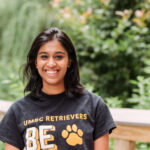
Meet Merryll Kallungal, a brand new graduate of the translational life science technology program at UMBC at the Universities at Shady Grove. In this program, students like Merryll learn hands-on skills through biotechnology labs and other applied experiences. We’re excited to hear all about her experience. Take it away, Merryll!
Q: What’s one essential thing you’d want another Retriever to know about you?
A: I majored in translational life science technology (TLST). I mainly attended the USG campus. I was part of the Peer Advisory Team. Outside of classes, I am interested in dancing, reading, and enjoying time with family.
Q: What’s the one thing you’d want someone who hasn’t joined the UMBC community to know about the support you find here?
A: All of the professors have been so wonderful in helping me with any questions i had, whether it be about classes or internship. Your advisors will always be helpful in figuring out what steps you have to take when it comes to registering for classes and also when looking for internships.
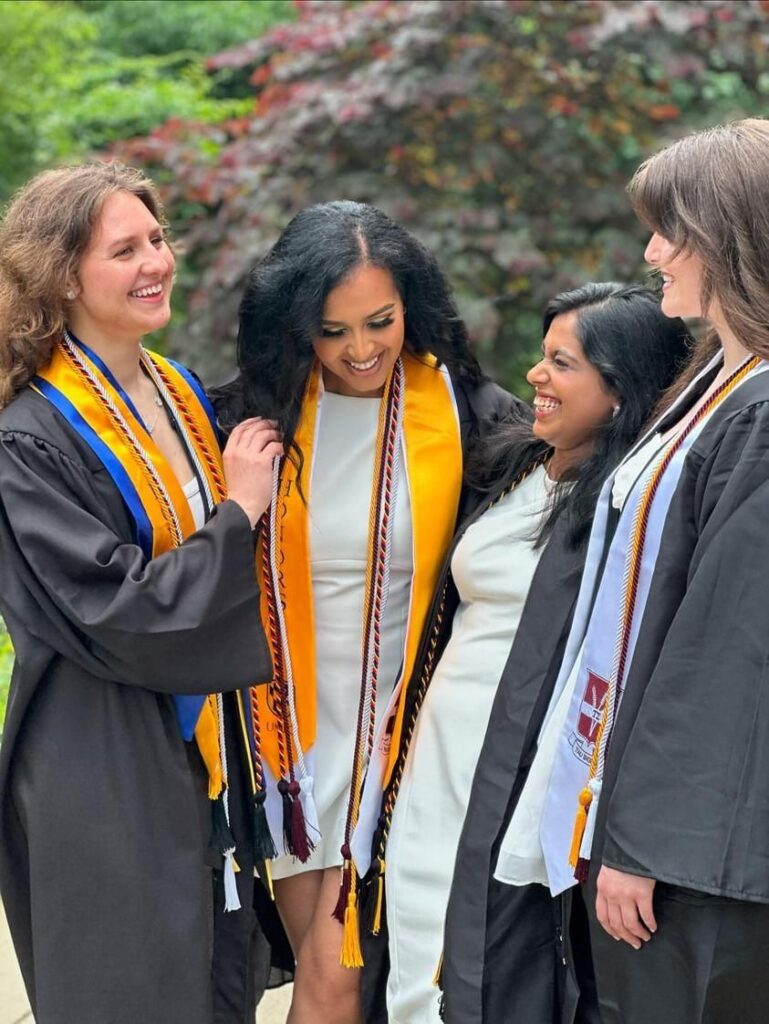 Kallungal (second from right) and classmates at UMBC-Shady Grove celebrate their recent graduation. Photo by Godwin Aizenofe ’24, translational life science technology.
Q: What did you love most about the translational life sciences program at UMBC-Shady Grove?
A: What I love about the TLST program is how close the students are with each other since we are smaller major. Also, how I was able to have that one-on-one relationship with my advisor who is also my professor.
Q: What brought you to UMBC in the first place?
A: I came to UMBC at USG because the program that I was interested was only offered at USG. Plus at USG, the smaller classes allowed me to interact with my professor and get any help I need.
Q: Were you a student leader? What did you like most about it? What advice would you give incoming students?
A: Aside from being the Vice President of the Biotech Club, I was also part of the USG student council, and both these leadership experiences have helped me immensely to become a better student and also improve my leadership skills.
Q: Where are you headed from here, now that you’ve graduated?
A: My post graduation plans are to enter the work field and join a biotech company where I was an intern for the past year, then slowly think about joining graduate school for my master’s.
* * * * *
UMBC’s greatest strength is its people. When people meet Retrievers and hear about the passion they bring, the relationships they create, the ways they support each other, and the commitment they have to inclusive excellence, they truly get a sense of our community. That’s what “Meet a Retriever” is all about.
Learn more about how UMBC can help you achieve your goals.
]]>
Meet Merryll Kallungal, a brand new graduate of the translational life science technology program at UMBC at the Universities at Shady Grove. In this program, students like Merryll learn hands-on...
https://umbc.edu/stories/merryll-kallungal-translational-life-sciences/
https://my3.my.umbc.edu/api/v0/pixel/news/142238/guest@my.umbc.edu/118e12968b4cef86b5bcd0e0f735fa8f/api/pixel
cnms
magazine
meet-a-retriever
perspectives
story
tlst
universities-at-shady-grove
UMBC News & Magazine
https://my3.my.umbc.edu/groups/umbc-news-magazine
https://assets1-my.umbc.edu/system/shared/avatars/groups/000/001/943/24435aa6207c452e7bc15cc74b42c7bb/xsmall.png?1748556657
https://assets1-my.umbc.edu/system/shared/avatars/groups/000/001/943/24435aa6207c452e7bc15cc74b42c7bb/original.png?1748556657
https://assets2-my.umbc.edu/system/shared/avatars/groups/000/001/943/24435aa6207c452e7bc15cc74b42c7bb/xxlarge.png?1748556657
https://assets2-my.umbc.edu/system/shared/avatars/groups/000/001/943/24435aa6207c452e7bc15cc74b42c7bb/xlarge.png?1748556657
https://assets3-my.umbc.edu/system/shared/avatars/groups/000/001/943/24435aa6207c452e7bc15cc74b42c7bb/large.png?1748556657
https://assets1-my.umbc.edu/system/shared/avatars/groups/000/001/943/24435aa6207c452e7bc15cc74b42c7bb/medium.png?1748556657
https://assets2-my.umbc.edu/system/shared/avatars/groups/000/001/943/24435aa6207c452e7bc15cc74b42c7bb/small.png?1748556657
https://assets1-my.umbc.edu/system/shared/avatars/groups/000/001/943/24435aa6207c452e7bc15cc74b42c7bb/xsmall.png?1748556657
https://assets2-my.umbc.edu/system/shared/avatars/groups/000/001/943/24435aa6207c452e7bc15cc74b42c7bb/xxsmall.png?1748556657
UMBC News & Magazine
1
0
false
Wed, 29 May 2024 12:11:55 -0400
Wed, 29 May 2024 12:11:55 -0400
Meet a Retriever–Bruce Perry Jr. ’97, UMBC Chief of Police
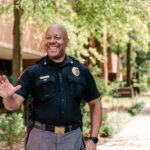
Meet Bruce Perry Jr. ’97, psychology. Bruce has spent 33 years at UMBC as both a student and staff member. He first joined the police department in 1994 as a student aide. After graduation, Bruce rejoined the police department in 1998 as an officer and has served in many roles over the years, including Operations Commander and Deputy Chief. In 2022, Bruce was named Chief of Police. Take it away, Bruce!
Q: What is your WHY? What brought you to UMBC?
A: In high school, I was in a club that had a field trip to UMBC. My guidance counselor highly recommended that I apply to three colleges. UMBC was one of those three and quickly became my top choice. I have been at UMBC ever since, practically my entire adult life, moving from a graduate to a staff member in a year.
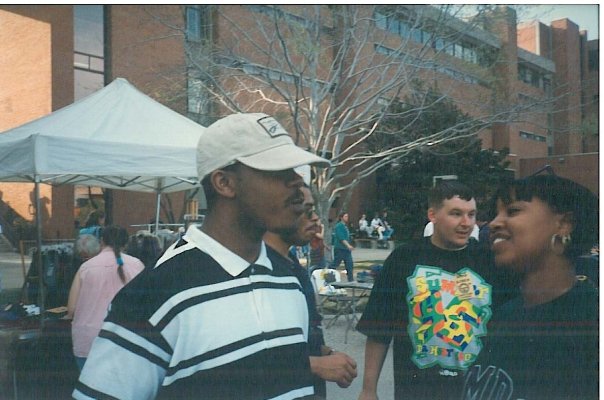 Bruce attending Quadmania as a UMBC student.
Q: Where have you found support in the UMBC community?
A: Once I moved into Chesapeake Hall as a freshman and participated in Playfair, I met several other students that I connected with and became friends with. As a staff member, I was able to connect with other staff, faculty, and students through committees, programs and meetings.
Q: What’s the one thing you’d want someone who hasn’t joined the UMBC community to know about the support you find here?
A: I love how collaborative the people on campus are. It is easy to just call or email someone and get a quick response. There are lots of activities that take place, there are many food options, and they get to use the RAC facilities for free. I would especially mention two big events that we have every year, Homecoming and Quadmania.
Q: Tell us about your current job. What do you like most about it?
A: I first joined the UMBC Police Department in 1994 as a student aide. After graduation, I rejoined the department in 1998 as an officer and has served in many roles over the years, including Operations Commander and Deputy Chief. In 2022, I was named Chief of Police. I love the opportunity to collaborate with others across campus. I have been involved with numerous campus groups, including the Alcohol and Other Drug Committee, the Hazing Awareness Work Group, the Employee of the Quarter Committee, Mental Health First Aid Instructors, and the Black Faculty and Staff Association (BFSA) to name a few. I like that I am able to interact with other colleagues around campus.
Q: Tell us what you love most about working in the UMBC Police Department.
A: Working in the police department, every day is a different day. The members of my department feel more like family members than co-workers, which is good since we have to rely on each other. I enjoy interacting with others on campus, volunteering, and being involved in different groups and committees.
Pictured right: The Retriever Weekly (Volume 33, Number 16) announcing the hiring of three new UMBC Police officers, including Bruce.
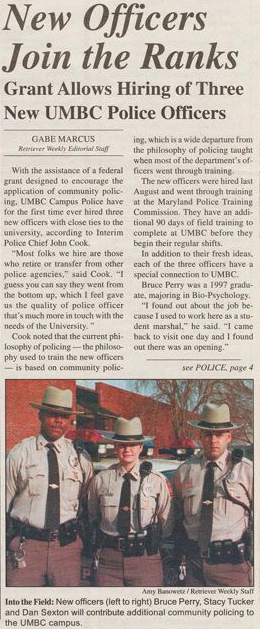
Q: Tell us about someone in the community who has inspired you or supported you, and how they did it.
A: I have been fortunate enough to have each supervisor that I have had since becoming an employee be a valuable mentor. They offered a lot of guidance and advice.
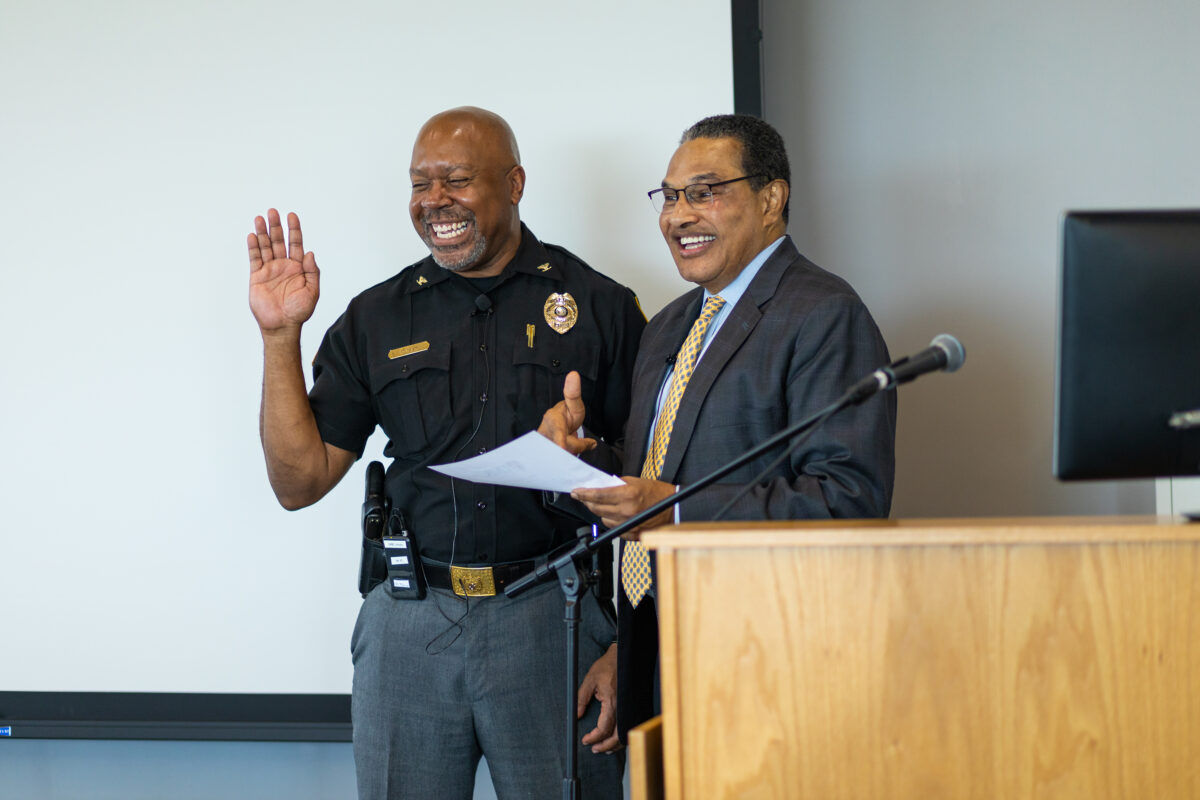 Bruce’s Chief of Police swearing-in ceremony in 2022. Pictured here with UMBC president emeritus Freeman A. Hrabowski, III.
Q: What would you tell someone who is considering a career at UMBC?
A: UMBC continues to be named as a top workplace by ModernThink’s Great Colleges to Work For program. UMBC ranks as a top institution nationwide in every category, from well-being and shared governance to mission and pride.
* * * * *
UMBC’s greatest strength is its people. When people meet Retrievers and hear about the passion they bring, the relationships they create, the ways they support each other, and the commitment they have to inclusive excellence, they truly get a sense of our community. That’s what “Meet a Retriever” is all about.
Learn more about how UMBC can help you achieve your goals.
]]>
Meet Bruce Perry Jr. ’97, psychology. Bruce has spent 33 years at UMBC as both a student and staff member. He first joined the police department in 1994 as a student aide. After graduation, Bruce...
https://umbc.edu/stories/meet-bruce-perry-umbc-chief-of-police/
https://my3.my.umbc.edu/api/v0/pixel/news/142230/guest@my.umbc.edu/b1f66ef2d515244870c41e32ad9bf4b8/api/pixel
alumni
impact
magazine
meet-a-retriever
story
umbc-police
UMBC News & Magazine
https://my3.my.umbc.edu/groups/umbc-news-magazine
https://assets1-my.umbc.edu/system/shared/avatars/groups/000/001/943/24435aa6207c452e7bc15cc74b42c7bb/xsmall.png?1748556657
https://assets1-my.umbc.edu/system/shared/avatars/groups/000/001/943/24435aa6207c452e7bc15cc74b42c7bb/original.png?1748556657
https://assets2-my.umbc.edu/system/shared/avatars/groups/000/001/943/24435aa6207c452e7bc15cc74b42c7bb/xxlarge.png?1748556657
https://assets2-my.umbc.edu/system/shared/avatars/groups/000/001/943/24435aa6207c452e7bc15cc74b42c7bb/xlarge.png?1748556657
https://assets3-my.umbc.edu/system/shared/avatars/groups/000/001/943/24435aa6207c452e7bc15cc74b42c7bb/large.png?1748556657
https://assets1-my.umbc.edu/system/shared/avatars/groups/000/001/943/24435aa6207c452e7bc15cc74b42c7bb/medium.png?1748556657
https://assets2-my.umbc.edu/system/shared/avatars/groups/000/001/943/24435aa6207c452e7bc15cc74b42c7bb/small.png?1748556657
https://assets1-my.umbc.edu/system/shared/avatars/groups/000/001/943/24435aa6207c452e7bc15cc74b42c7bb/xsmall.png?1748556657
https://assets2-my.umbc.edu/system/shared/avatars/groups/000/001/943/24435aa6207c452e7bc15cc74b42c7bb/xxsmall.png?1748556657
UMBC News & Magazine
0
0
false
Wed, 29 May 2024 07:27:43 -0400
Wed, 29 May 2024 07:27:43 -0400
Live Music Strikes a Chord for Retrievers
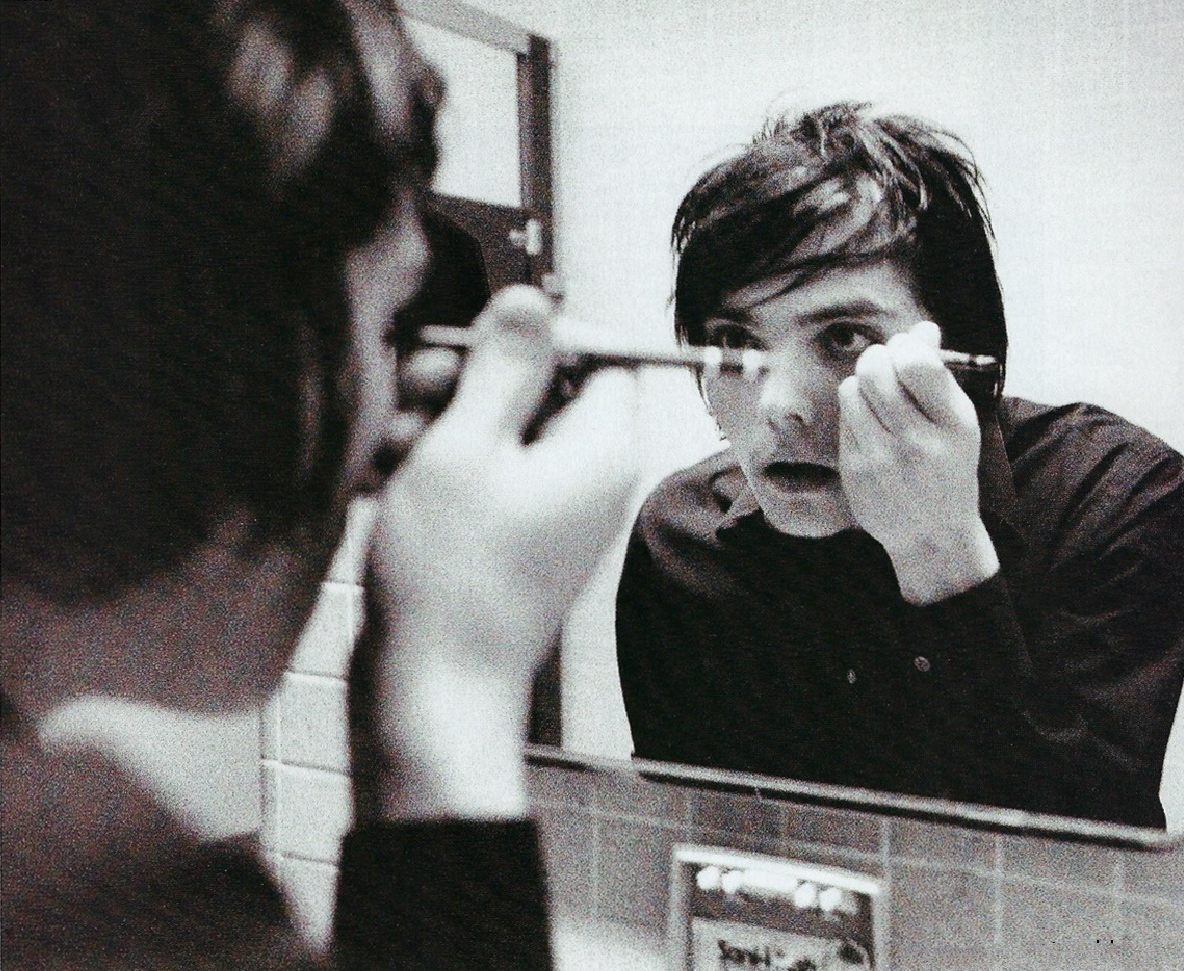 Singer Gerard Way of My Chemical Romance at the UMBC Fieldhouse (currently known as the RAC) on October 21, 2005. Photo by Kenneth Cappello.
It may be coincidental that UMBC was founded in the midst of rock n’ roll’s most revolutionary years, but early Retrievers certainly made sure to create spaces to bring live music to the campus, in intimate settings and on much bigger stages.
Since then, iconic bands and artists such as Frank Zappa, the Goo Goo Dolls, Alanis Morissette, All-American Rejects, the Strokes, Brand New, Foo Fighters, Yellowcard, All Time Low, My Chemical Romance, and more, have all played shows for UMBC’s students. But while UMBC has a rich history of hosting renowned artists, they have always had a soft spot for local music and student artists too.
On September 21, 1968, the Collage, an on-campus weekend coffee house, was first opened. The Collage was one of the first notable instances of live music on campus, often drawing in a large crowd, especially on Saturday nights, and was the go-to place to check out the best student performers, as well as local performers from the surrounding Baltimore area. With music, poetry readings, and films, it was a perfect social and artistic atmosphere for its students.
Although the Collage is no more, today, UMBC still supports its local and student musicians with the many events held on and off campus, and through the creative spaces it provides. The Students Events Board (seb) frequently hosts open mic nights where students can sing, play an instrument, and present poetry or spoken word. In recent years, (seb) seems to have drawn on a similar ethos to the Collage, with its Coffee House: Open Mic Night Edition.
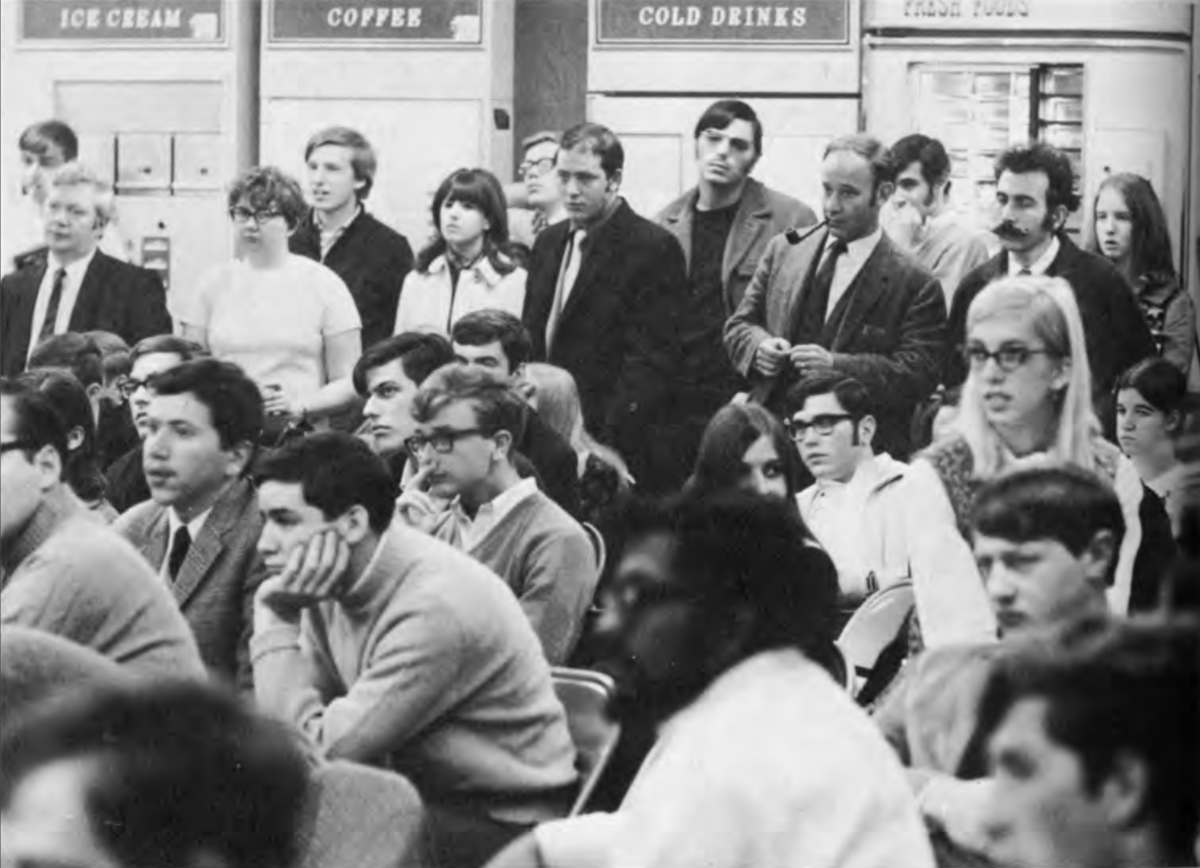
Audience members at the Collage in 1969.
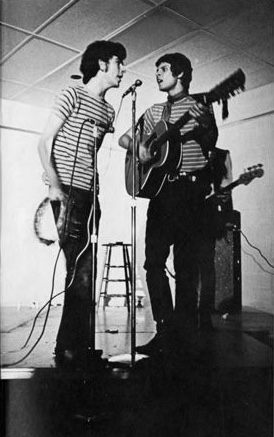
Two performers, Lewis and Dolgoff, on stage at
the Collage in 1969.
Yearly events like Quadmania and campus radio station WMBC’s and the Retriever Music Society’s (RMS) music festival often provide a chance for student artists to play for an audience, and the support and turnout for these events shows how tuned in Retrievers still are to good music.
WMBC’s recent revitalization has played a big role in organizing live music events and booking student and local bands for on-campus shows. WMBC’s station manager Sean Jilek ’25, computer science, says, “We have so much great music being made on campus and we really want to highlight that when we can. This year we made it a goal to have a UMBC band headline the festival, which is why we had Fly By the Seat. The station has been blown away with the turnout for the concerts we have hosted on campus.”
Additionally, off-campus, OCA Mocha, the UMBC student-founded coffee shop, provides a venue for UMBC’s student musicians, including jam sessions hosted by RMS, classical music from UMBC’s Cello Group, and performances by UMBC’s jazz groups.
While the Collage may now be gone, after all these years it is apparent that UMBC has expanded its creative spaces, and is still passionate about fostering these venues for its students. Jilek says, “I think this last semester has shown that small shows are something that people are interested in seeing on campus.”
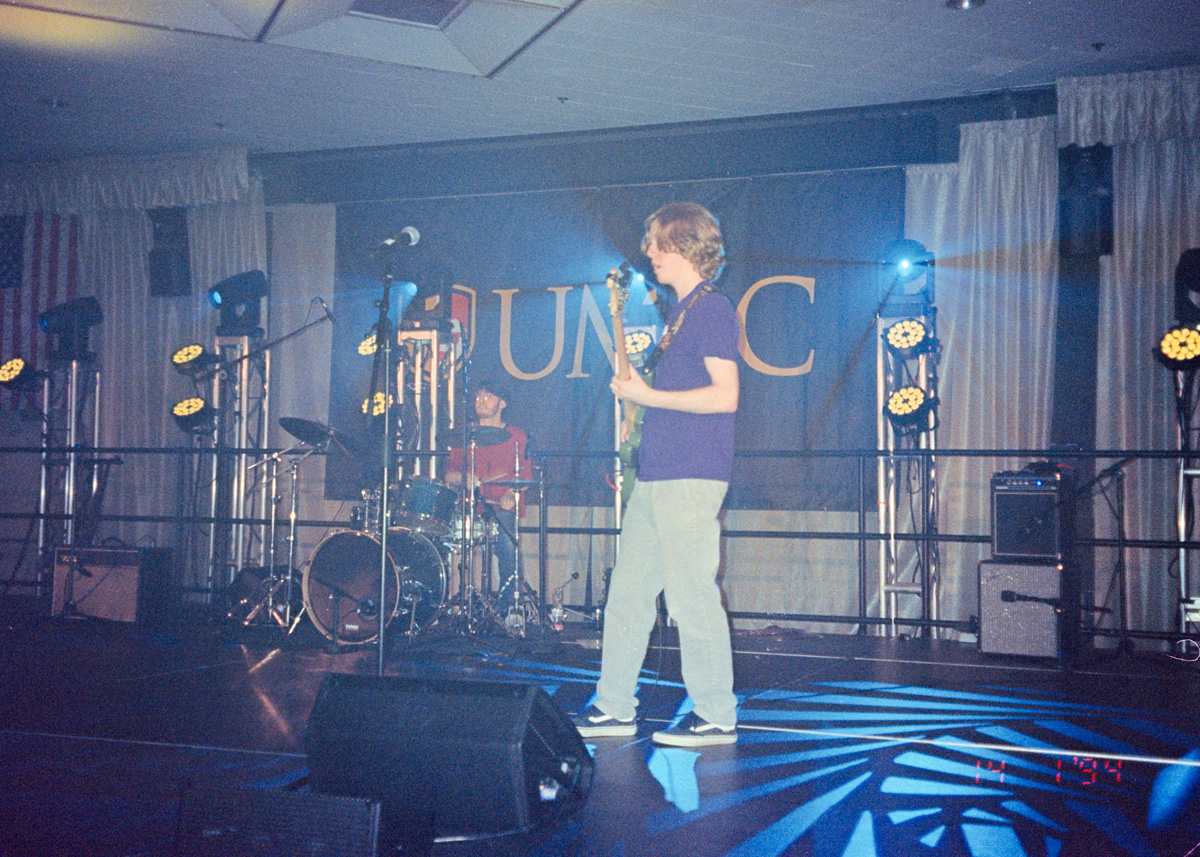 Fly By The Seat playing at WMBC & RMS’s 2024 Spring Music Festival. Photo by Erin Bennett.
]]>
Singer Gerard Way of My Chemical Romance at the UMBC Fieldhouse (currently known as the RAC) on October 21, 2005. Photo by Kenneth Cappello. It may be coincidental that UMBC was founded in the...
https://umbc.edu/stories/live-music-strikes-a-chord-for-retrievers/
https://my3.my.umbc.edu/api/v0/pixel/news/142186/guest@my.umbc.edu/c5eca86e23b324e19193e57aecf5d2d2/api/pixel
arts-and-culture
campus-life
music
oca-mocha
retriever-music-society
seb
spring-2024
story
wmbc
wmbc-radio
UMBC News & Magazine
https://my3.my.umbc.edu/groups/umbc-news-magazine
https://assets1-my.umbc.edu/system/shared/avatars/groups/000/001/943/24435aa6207c452e7bc15cc74b42c7bb/xsmall.png?1748556657
https://assets1-my.umbc.edu/system/shared/avatars/groups/000/001/943/24435aa6207c452e7bc15cc74b42c7bb/original.png?1748556657
https://assets2-my.umbc.edu/system/shared/avatars/groups/000/001/943/24435aa6207c452e7bc15cc74b42c7bb/xxlarge.png?1748556657
https://assets2-my.umbc.edu/system/shared/avatars/groups/000/001/943/24435aa6207c452e7bc15cc74b42c7bb/xlarge.png?1748556657
https://assets3-my.umbc.edu/system/shared/avatars/groups/000/001/943/24435aa6207c452e7bc15cc74b42c7bb/large.png?1748556657
https://assets1-my.umbc.edu/system/shared/avatars/groups/000/001/943/24435aa6207c452e7bc15cc74b42c7bb/medium.png?1748556657
https://assets2-my.umbc.edu/system/shared/avatars/groups/000/001/943/24435aa6207c452e7bc15cc74b42c7bb/small.png?1748556657
https://assets1-my.umbc.edu/system/shared/avatars/groups/000/001/943/24435aa6207c452e7bc15cc74b42c7bb/xsmall.png?1748556657
https://assets2-my.umbc.edu/system/shared/avatars/groups/000/001/943/24435aa6207c452e7bc15cc74b42c7bb/xxsmall.png?1748556657
UMBC News & Magazine
3
0
false
Fri, 24 May 2024 16:43:54 -0400
Fri, 24 May 2024 16:43:54 -0400
A resilient Class of 2024 celebrates its successes
Fly By The Seat playing at WMBC & RMS’s 2024 Spring Music Festival. Photo by Erin Bennett.
]]>
Singer Gerard Way of My Chemical Romance at the UMBC Fieldhouse (currently known as the RAC) on October 21, 2005. Photo by Kenneth Cappello. It may be coincidental that UMBC was founded in the...
https://umbc.edu/stories/live-music-strikes-a-chord-for-retrievers/
https://my3.my.umbc.edu/api/v0/pixel/news/142186/guest@my.umbc.edu/c5eca86e23b324e19193e57aecf5d2d2/api/pixel
arts-and-culture
campus-life
music
oca-mocha
retriever-music-society
seb
spring-2024
story
wmbc
wmbc-radio
UMBC News & Magazine
https://my3.my.umbc.edu/groups/umbc-news-magazine
https://assets1-my.umbc.edu/system/shared/avatars/groups/000/001/943/24435aa6207c452e7bc15cc74b42c7bb/xsmall.png?1748556657
https://assets1-my.umbc.edu/system/shared/avatars/groups/000/001/943/24435aa6207c452e7bc15cc74b42c7bb/original.png?1748556657
https://assets2-my.umbc.edu/system/shared/avatars/groups/000/001/943/24435aa6207c452e7bc15cc74b42c7bb/xxlarge.png?1748556657
https://assets2-my.umbc.edu/system/shared/avatars/groups/000/001/943/24435aa6207c452e7bc15cc74b42c7bb/xlarge.png?1748556657
https://assets3-my.umbc.edu/system/shared/avatars/groups/000/001/943/24435aa6207c452e7bc15cc74b42c7bb/large.png?1748556657
https://assets1-my.umbc.edu/system/shared/avatars/groups/000/001/943/24435aa6207c452e7bc15cc74b42c7bb/medium.png?1748556657
https://assets2-my.umbc.edu/system/shared/avatars/groups/000/001/943/24435aa6207c452e7bc15cc74b42c7bb/small.png?1748556657
https://assets1-my.umbc.edu/system/shared/avatars/groups/000/001/943/24435aa6207c452e7bc15cc74b42c7bb/xsmall.png?1748556657
https://assets2-my.umbc.edu/system/shared/avatars/groups/000/001/943/24435aa6207c452e7bc15cc74b42c7bb/xxsmall.png?1748556657
UMBC News & Magazine
3
0
false
Fri, 24 May 2024 16:43:54 -0400
Fri, 24 May 2024 16:43:54 -0400
A resilient Class of 2024 celebrates its successes
UMBC’s graduating Class of 2024 knows a thing or two about resilience. Many of this year’s 1,900-plus graduates began their collegiate journey at the onset of a global pandemic.
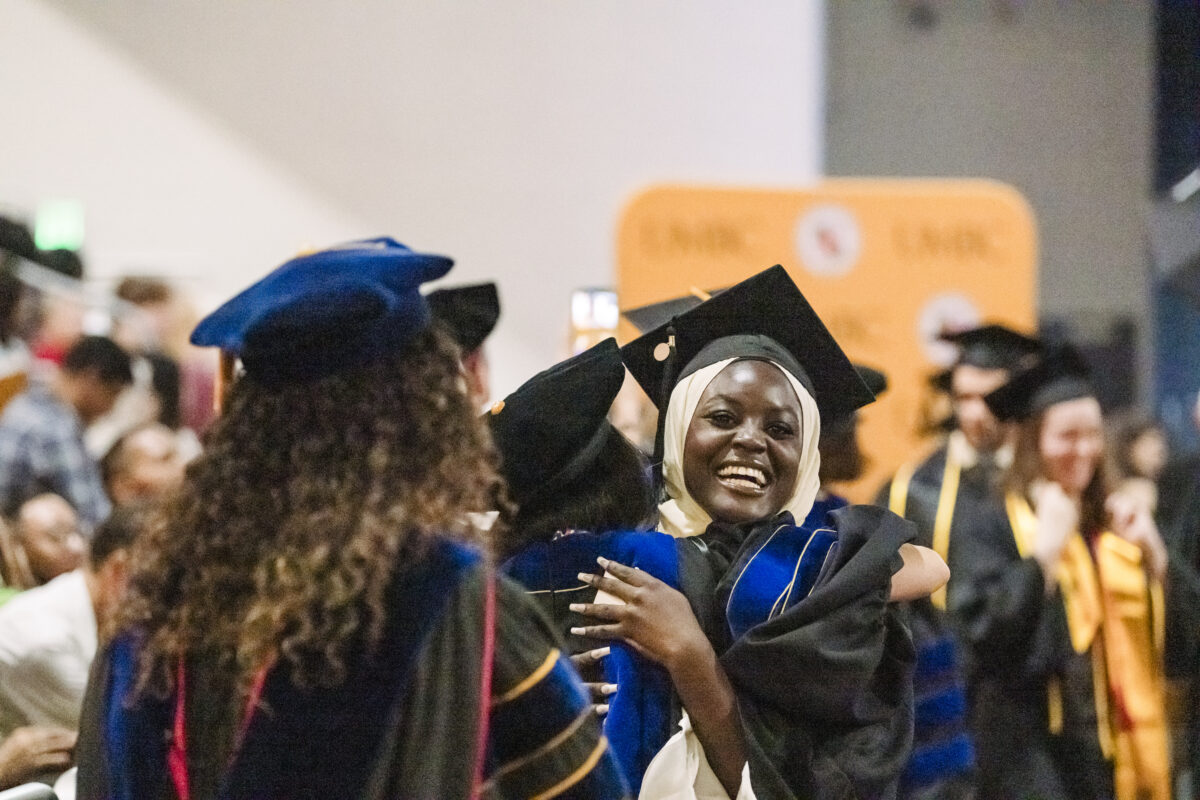
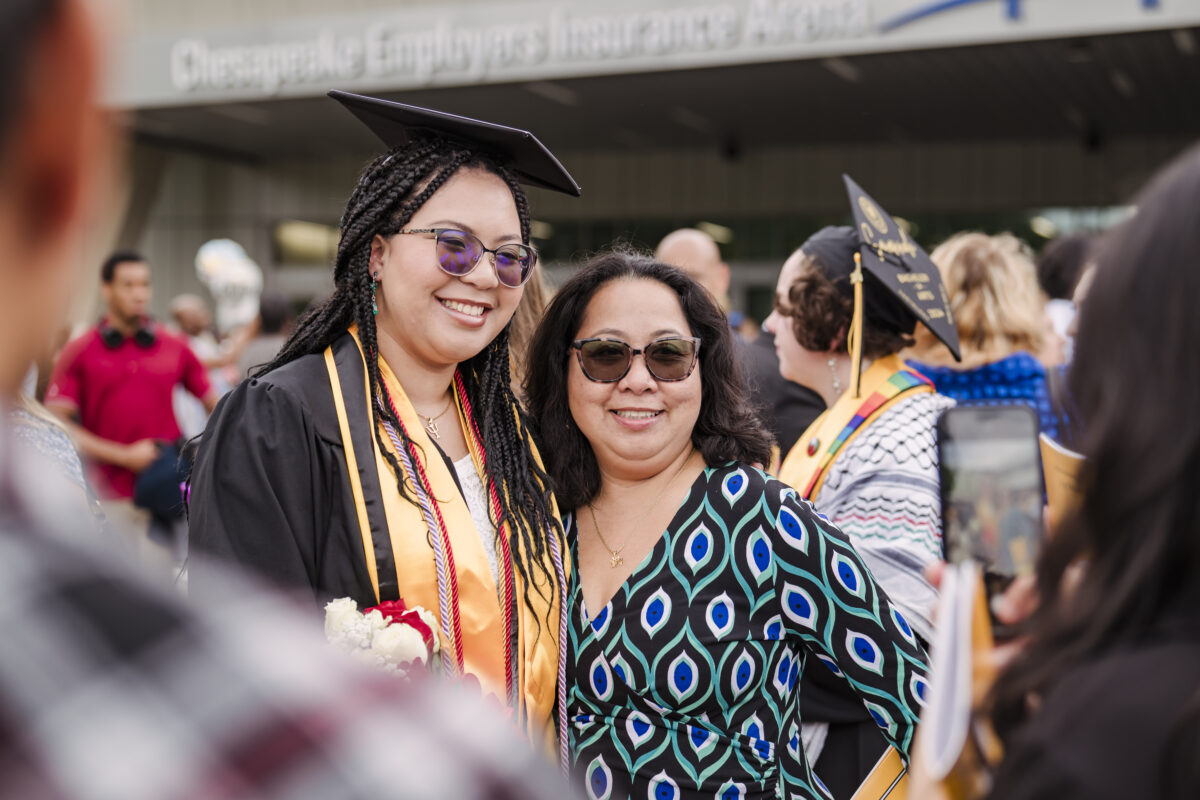
This week, as they walked across the Commencement stage adorned in black and gold regalia and mortarboards elaborately decorated with sayings such as “The tassel was worth the hassle,” “I did it,” and “The end is here,” the Class of 2024 reveled in the celebratory moment of reaching this milestone in the face of much adversity.
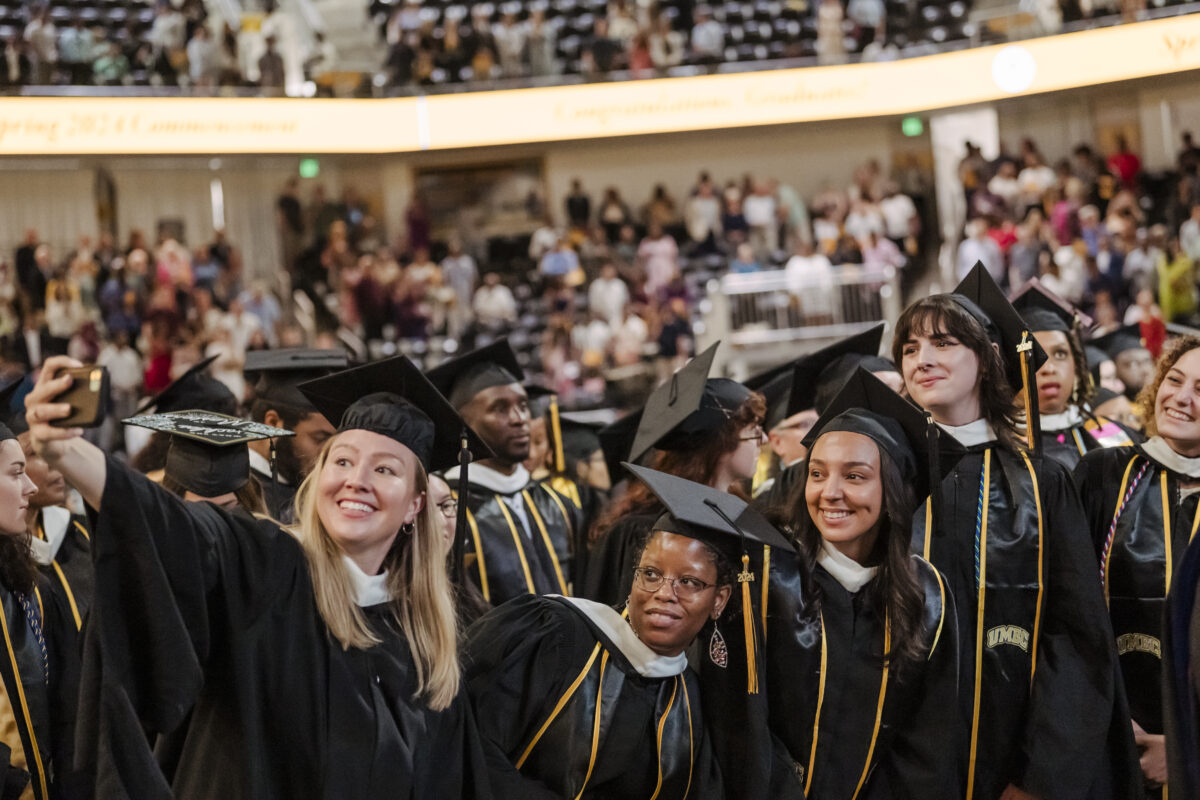 Class of 2024 graduates capturing Commencement day excitement.
“Resilience is a dynamic process. It’s a journey that we embark on in the face of challenges. Resilience is not just bouncing back or being able to recover—It’s the ability to bounce forward,” said graduate student speaker Grace De Oro, M.P.P. ’19, a Ph.D. candidate in public policy and president of the Graduate Student Association.
“We’ve all bounced forward to get here, right now, in this moment. This journey of resilience has not only brought us here, but it’s transformed us into stronger and more capable individuals.”
UMBC’s Spring 2024 Commencement video. (Elijah Davis, M.F.A. ’21/UMBC)
Service as a Retriever
During Thursday morning’s undergraduate ceremony for students in the College of Arts, Humanities, and Social Sciences; School of Social Work; and Erickson School of Aging Studies, co-valedictorian Nyla Howell ’24, geography and environmental systems and sociology, spoke to the value of service and how the graduating class will “serve with more than our degrees.”
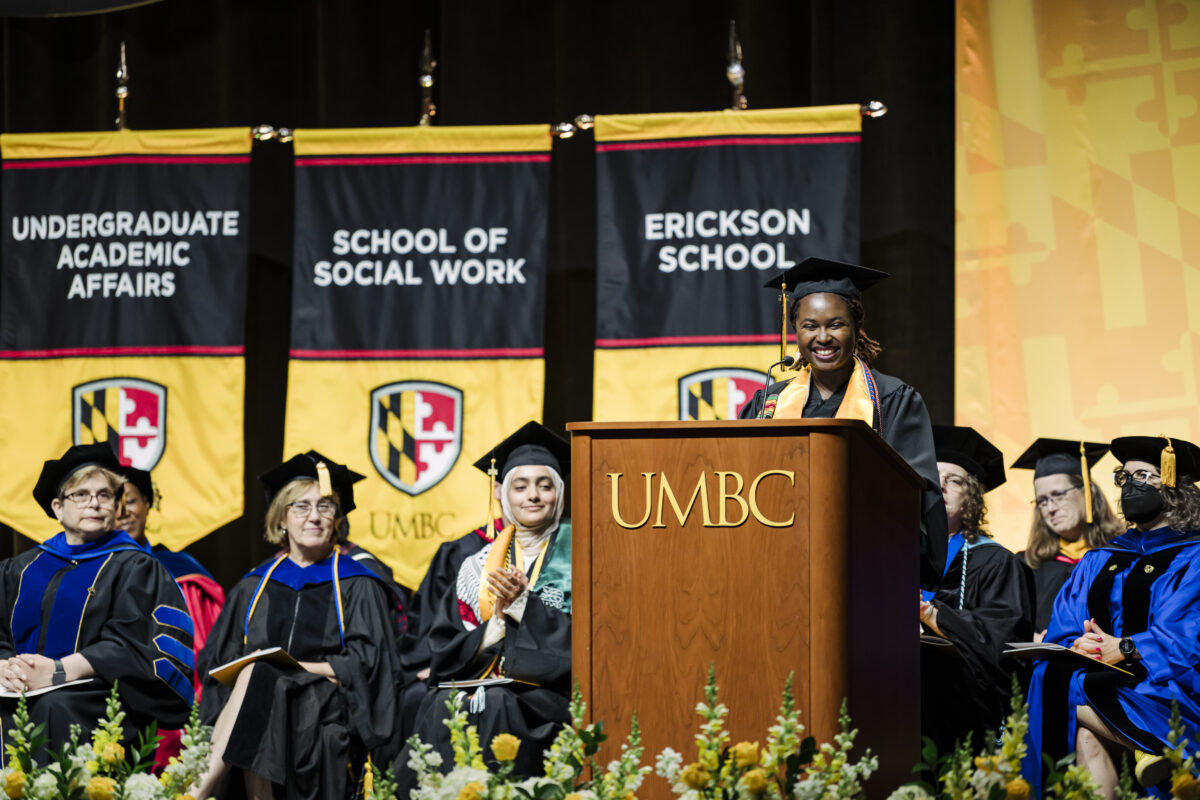 Valedictorian for the College of Arts, Humanities, and Social Sciences; School of Social Work; and Erickson School of Aging Studies morning ceremony, Nyla Howell ’24, speaks at Commencement.
“We all serve those around us daily by using our time and talent to encourage each other, give advice to each other, and take care of one another,” Howell said. “I believe that if we approach this next phase of life, despite all its uncertainty, with the intention of genuinely caring for others and living out our personal understandings of service, we will have the launch pads we need to do more than we ever believed we could.”
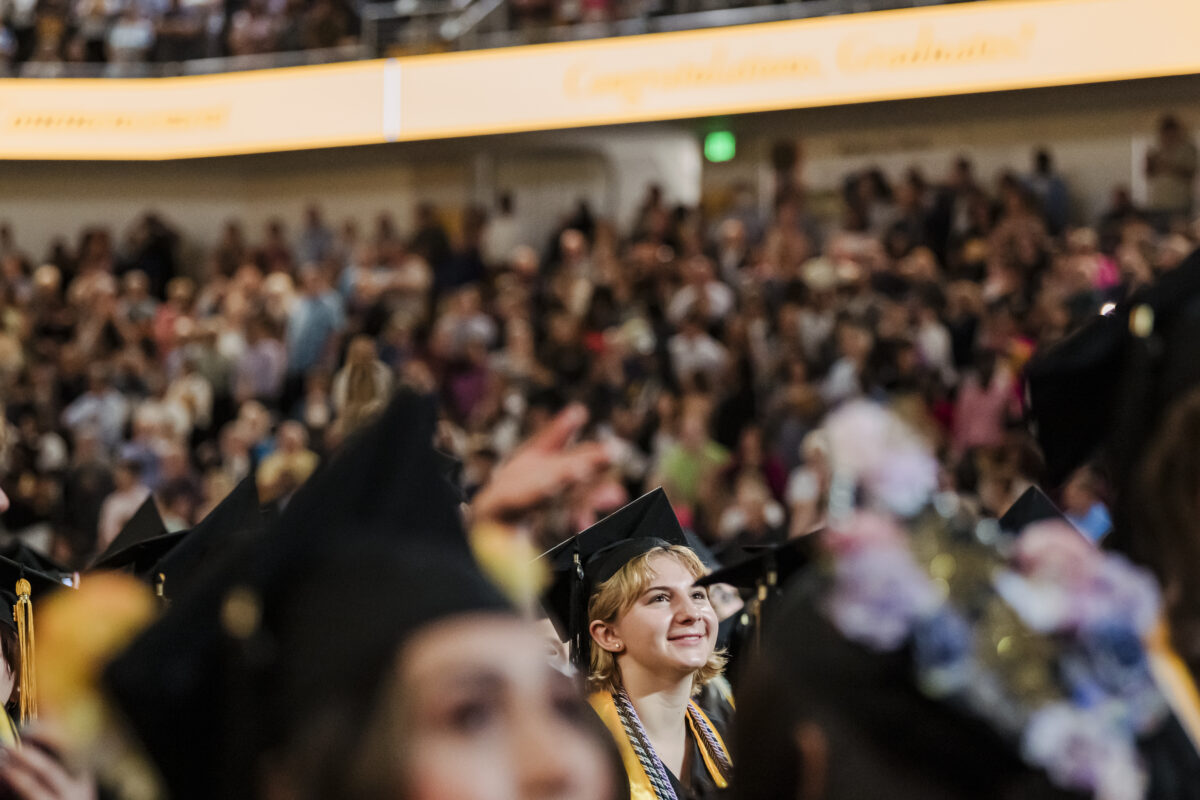
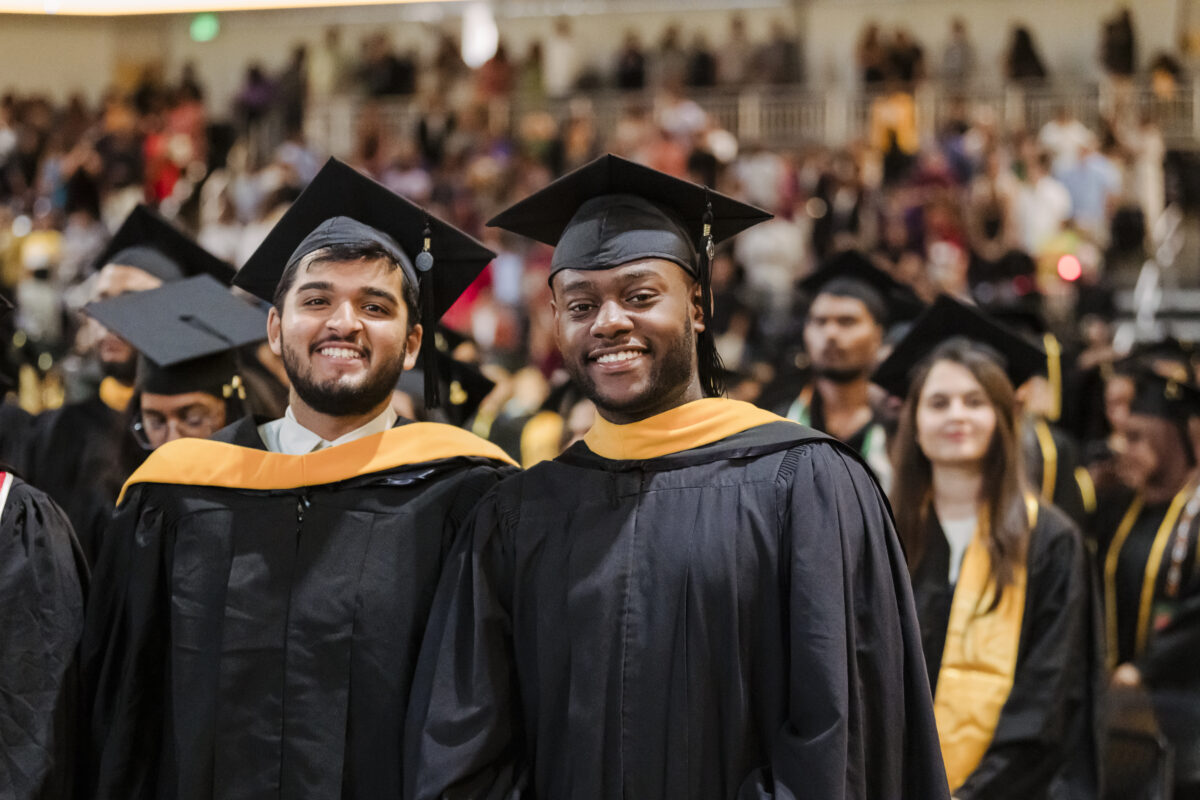
Howell, who is the first McNair Scholar to be a valedictorian at UMBC, has dedicated much of her time as an undergraduate in service to local communities and engaged in research examining how vulnerable and underrepresented communities can be better protected when disasters strike. Since 2021, Howell has worked as the food pantry manager of Retriever Essentials helping to combat food insecurity at UMBC. Howell’s leadership and public service efforts earned her scholarships from the France and Merrick Scholars Endowment and the Jacqueline C. Hrabowski Endowment.
She will continue her studies in geography as a Ph.D. student at Rutgers University as a fellow of the National Science Foundation’s Graduate Research Fellowship Program.
A dedication to STEM and the arts
During the afternoon ceremony for the College of Natural and Mathematical Sciences; College of Engineering and Information Technology; and Division of Undergraduate Academic Affairs, co-valedictorian D’Juan Moreland ’24, biological sciences and music, shared with his fellow graduates the lessons he has learned, particularly ones imparted to him by his mother.
Congratulations to our Engineering and Computing students #UMBCgrad @UMBC #UMBCengineering #UMBCComputing pic.twitter.com/M3gk0HkFLu
— Jamie Gurganus, PhD (@JamieRGurganus) May 23, 2024
“The first [lesson] is to celebrate yourself even in the little victories. The secondis to recognize who supported you. The lastis to set a good example because other people are watching your every move,” said Moreland. “Part of our achievement today is to set a strong example for those who are watching us right now. They don’t just see our success, but also our perseverance, as encouragement and inspiration for themselves.”
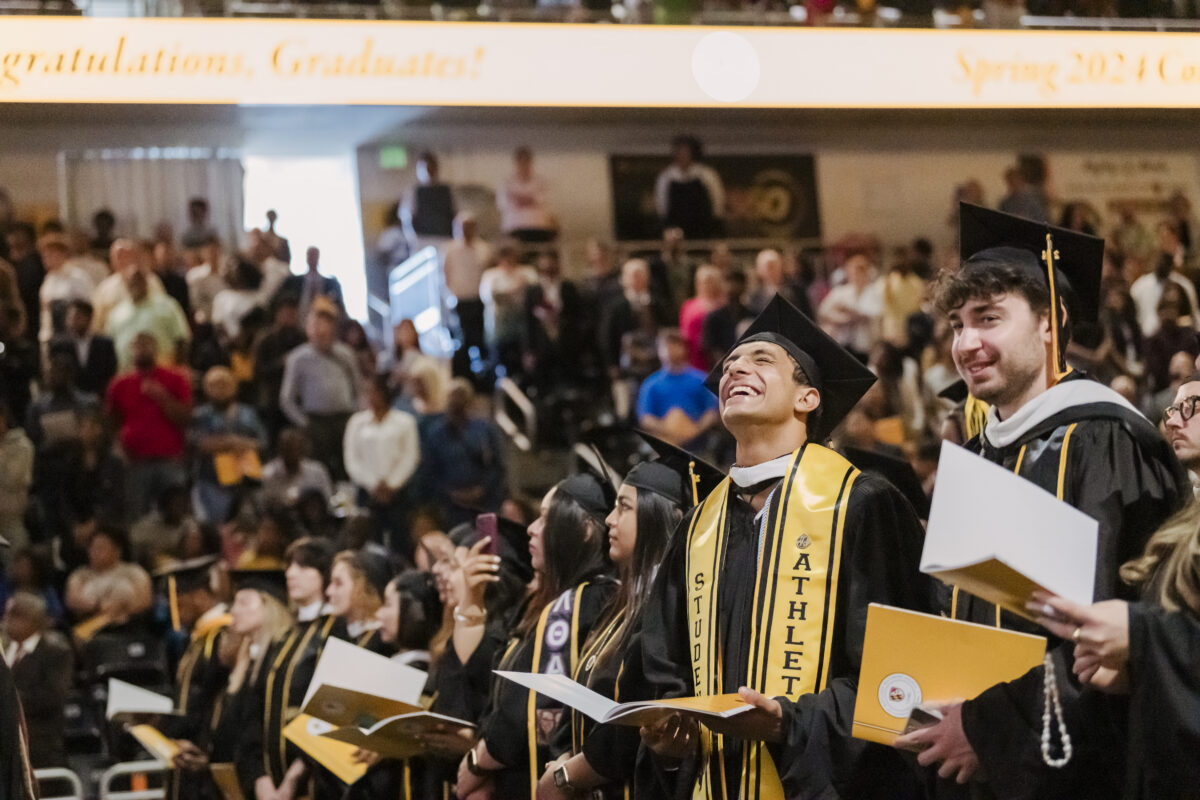 UMBC Class of 2024 graduates all smiles during Commencement.
During his time at UMBC, Moreland, a Meyherhoff Scholar, balanced and even found a way to intertwine his interests in biological sciences and music. He was a 2022 – 2023 recipient of a prestigious Goldwater Scholarship, for which he used his research on the song syllable use differences in female and male songbirds as the basis of his application. Moreland’s original composition “Ascension” won the inaugural UMBC Symphony Orchestra Composer Competition last year.
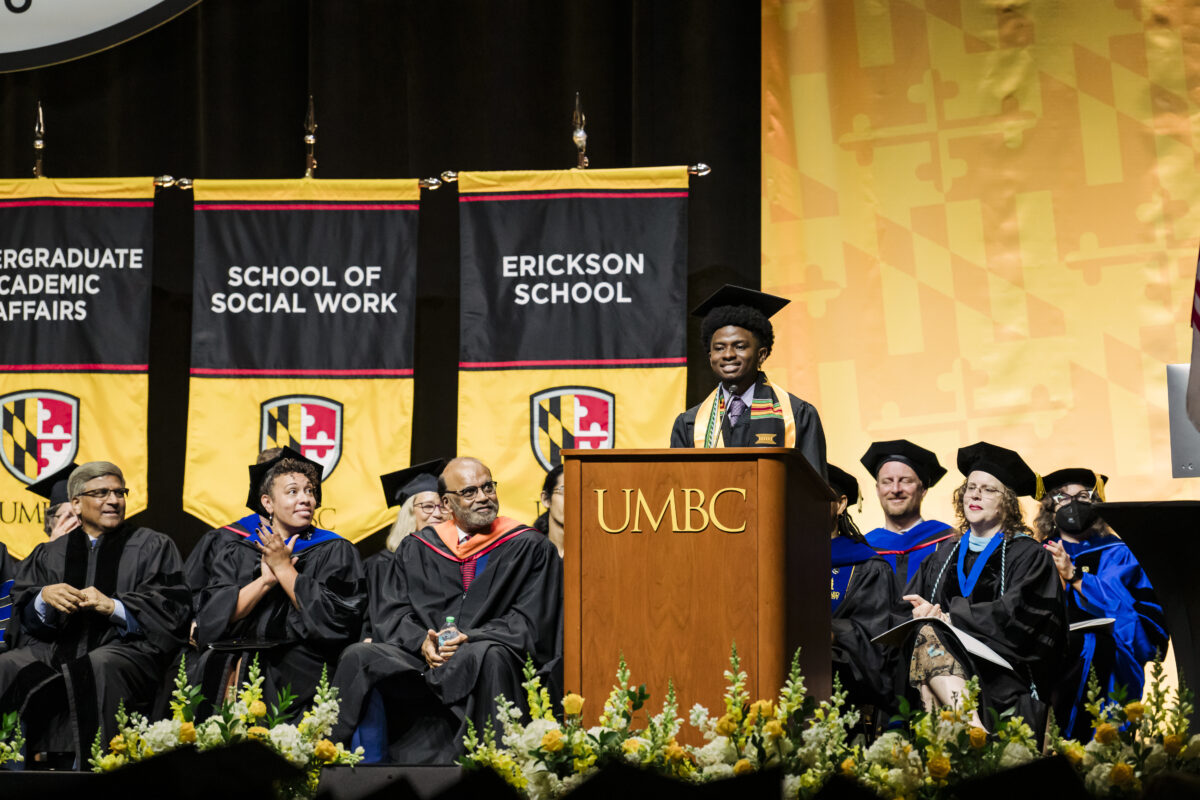 Valedictorian of the College of Natural and Mathematical Sciences; College of Engineering and Information Technology; and Division of Undergraduate Academic Affairs afternoon ceremony co-valedictorian, D’Juan Moreland ’24, addressing the audience during Commencement.
Additionally, he is a recipient of the Thomas V. Marsho and Martin Schwartz Memorial Fund scholarship and a recipient of the Ronald and Kathryn Shapiro Meyerhoff Mentoring scholarship. Moreland has dedicated much of his time to mentoring younger students, a passion that inspired him to create a mentoring program at his church for young Black men in middle and high school. Following graduation, Moreland will pursue a Ph.D. in neuroscience at the University of Pennsylvania.
“The DNA of UMBC”
The lineup of this year’s Commencement speakers included Mina Cheon, M.F.A. ’02, imaging and digital arts, the dean of undergraduate studies at the Maryland Institute College of Art and a 2018 UMBC Alumni Award winner. Farah Helal ’24, political science and global studies, also delivered remarks as the University System of Maryland student regent representative.
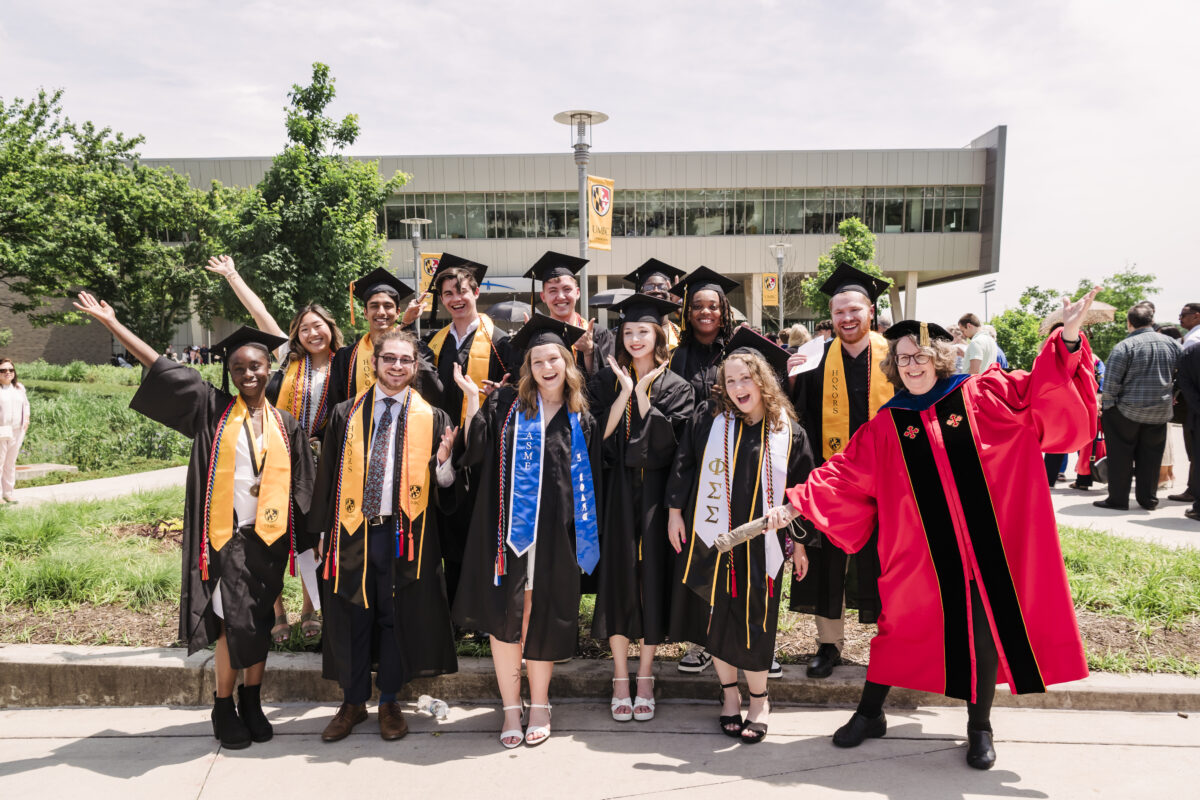
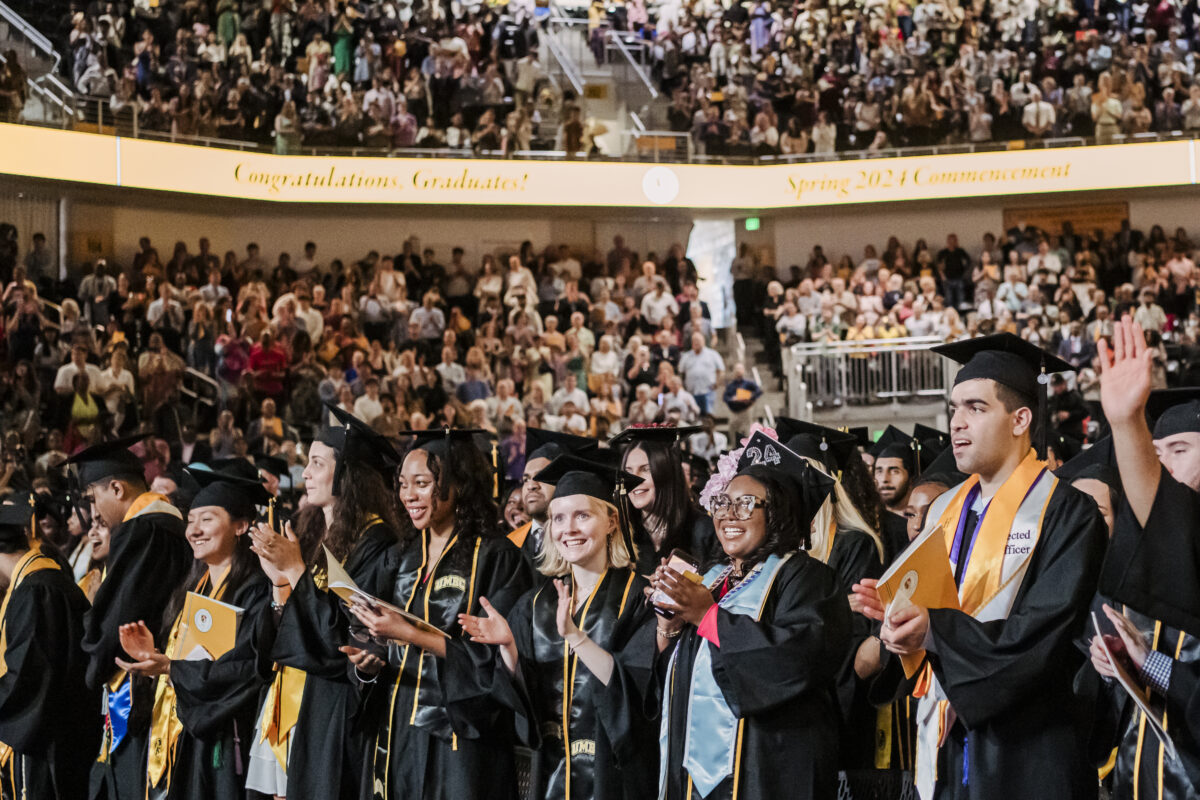
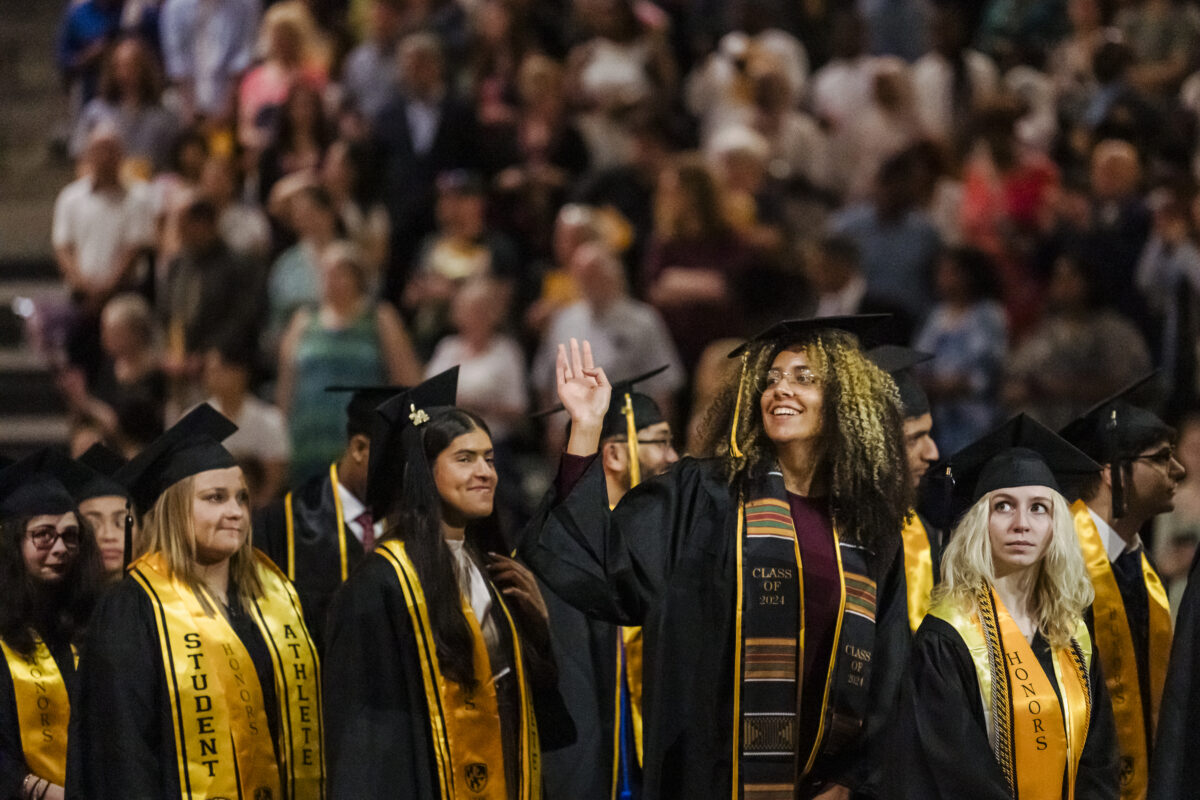
Sethuraman Panchanathan, director of the National Science Foundation, received an honorary doctor of science degree during the afternoon ceremony. He dazzled the crowd with an energetic speech advising new graduates to follow “the 10 C’s”—words like “commitment,” “courage,” “collaboration,” and “curiosity”—as they go on to the next chapter of their lives.
After grad, Chiad Onyeje, chem eng, will go to Johns Hopkins via the new Vivien Thomas Scholars Initiative program. His research will concentrate on the development of drug delivery biomaterials to open up new opportunities for disease & trauma treatment & prevention. #UMBCgrad pic.twitter.com/pVZ10ieEVs
— UMBC (@UMBC) May 17, 2024
“Retrievers, you have the DNA of UMBC,” Panchanathan said to the graduates. “That DNA is about lifting people up…and making sure people are given chances, making things accessible, and inspiring people.”
Congratulations to the Class of 2024! Please continue to share your messages of congratulations on social media using #UMBCgrad. Read more about Class of 2024 graduates on the UMBC News Site.
]]>
UMBC’s graduating Class of 2024 knows a thing or two about resilience. Many of this year’s 1,900-plus graduates began their collegiate journey at the onset of a global pandemic. This week,...
https://umbc.edu/stories/class-of-2024-commencement/
https://my3.my.umbc.edu/api/v0/pixel/news/142185/guest@my.umbc.edu/ba783fd9283fc597f7356a4051373b34/api/pixel
cahss
campus-life
class-of-2024
cnms
coeit
commencement
erickson-school
feature
magazine
public-policy
social-work
story
UMBC News & Magazine
https://my3.my.umbc.edu/groups/umbc-news-magazine
https://assets1-my.umbc.edu/system/shared/avatars/groups/000/001/943/24435aa6207c452e7bc15cc74b42c7bb/xsmall.png?1748556657
https://assets1-my.umbc.edu/system/shared/avatars/groups/000/001/943/24435aa6207c452e7bc15cc74b42c7bb/original.png?1748556657
https://assets2-my.umbc.edu/system/shared/avatars/groups/000/001/943/24435aa6207c452e7bc15cc74b42c7bb/xxlarge.png?1748556657
https://assets2-my.umbc.edu/system/shared/avatars/groups/000/001/943/24435aa6207c452e7bc15cc74b42c7bb/xlarge.png?1748556657
https://assets3-my.umbc.edu/system/shared/avatars/groups/000/001/943/24435aa6207c452e7bc15cc74b42c7bb/large.png?1748556657
https://assets1-my.umbc.edu/system/shared/avatars/groups/000/001/943/24435aa6207c452e7bc15cc74b42c7bb/medium.png?1748556657
https://assets2-my.umbc.edu/system/shared/avatars/groups/000/001/943/24435aa6207c452e7bc15cc74b42c7bb/small.png?1748556657
https://assets1-my.umbc.edu/system/shared/avatars/groups/000/001/943/24435aa6207c452e7bc15cc74b42c7bb/xsmall.png?1748556657
https://assets2-my.umbc.edu/system/shared/avatars/groups/000/001/943/24435aa6207c452e7bc15cc74b42c7bb/xxsmall.png?1748556657
UMBC News & Magazine
3
0
false
Fri, 24 May 2024 16:03:51 -0400
Fri, 24 May 2024 16:03:51 -0400
UMBC statistician selected to work with Addis Ababa University in Ethiopia
Yehenew Kifle, assistant professor of statistics at UMBC, has been awarded a fellowship by the Carnegie African Diaspora Fellowship Program (CADFP). Kifle will travel to Addis Ababa University (AAU) in Ethiopia to work with the Department of Epidemiology and Biostatistics. There, he will work with colleagues to enhance teaching and mentoring and grow research collaborations to support Ph.D. training in biostatistics.
 Yehenew Kifle visited the American Statistical Association in April 2024, around the signing of the agreement between the ASA and UMBC related to the African International Conference on Statistics. (Courtesy of Kifle)
Kifle will spend three months in Ethiopia this summer, working with his African host, Zeytu Gashaw Asfaw, associate professor of biostatistics at AAU. In addition to producing collaborative research, during his stay Kifle plans to conduct short-term training sessions and workshops on advanced software-aided statistical techniques for junior statisticians, graduate students, and medical professionals within the school of public health at AAU. He will also assist in crafting grant proposals aimed at increasing research collaborations in biostatistics between UMBC and AAU.
The Carnegie African Diaspora Fellowship Program, now in its 10th year, is designed to strengthen capacity for graduate education at host institutions and develop long-term, mutually beneficial collaborations between universities in Africa and the United States and Canada. It is funded by Carnegie Corporation of New York and managed by the Institute of International Education (IIE) in collaboration with the Association of African Universities. Nearly 650 fellowships have been awarded since the CADFP’s inception in 2013.
“I’m grateful for the opportunity to represent the University of Maryland, Baltimore County in its international outreach endeavors, highlighting the importance of CADFP,” Kifle says, adding, “I’m looking forward to sharing my expertise in teaching biostatistics graduate courses, offering mentorship, and supervising doctoral dissertations.” Additionally, Kifle plans to conduct seminars on his recent research findings and offer insights into improving graduate programs in biostatistics.
Building on international connections
Before arriving at UMBC, Kifle was a professor of statistics at the University of Limpopo in South Africa. UMBC signed a collaborative agreement with University of Limpopo in 2018, initiated by Kifle while he was a visiting faculty member from Limpopo at UMBC. Kifle first encountered UMBC’s strength in statistics at the 2015 African International Conference (AIC) on Statistics, a UMBC-led conference held in a different African country annually since 2014.
Since then, Kifle has been a leader in organizing the AIC, which recently received a pledge for support from the American Statistical Association. The Carnegie fellowship builds further on Kifle’s commitment to forging partnerships with African universities for the mutual benefit of scholars at UMBC and in Africa.
 Bimal Sinha (left), professor of statistics at UMBC, and Yehenew Kifle (center), assistant professor of statistics at UMBC, with N.M. Mokgalongs, president of University of Limpopo, at the 4th Annual African International Conference on Statistics. (Courtesy of Kifle)
Kifle’s work in Ethiopia is one of 60 new projects supported by the CADFP that pair African diaspora scholars with higher education institutions and collaborators in Africa to work together on curriculum development, research, graduate training, and mentoring activities in 2024.
“This is indeed exciting news for all of us in the department and at UMBC,” shared Bimal Sinha, professor of statistics at UMBC. “We are thrilled to know that Dr. Kifle will represent UMBC in this extraordinary outreach effort to offer seminars and training courses and possibly to jointly supervise doctoral dissertations. There is no doubt that many statistics departments in Ethiopia will benefit from Dr. Kifle’s vast teaching and research experiences.”
]]>
Yehenew Kifle, assistant professor of statistics at UMBC, has been awarded a fellowship by the Carnegie African Diaspora Fellowship Program (CADFP). Kifle will travel to Addis Ababa University...
https://umbc.edu/stories/kifle-travels-to-ethiopia/
https://my3.my.umbc.edu/api/v0/pixel/news/142177/guest@my.umbc.edu/39b867af6145be9b62a0a5382d82c1d6/api/pixel
cnms
mathstat
news
research
science-and-tech
story
UMBC News & Magazine
https://my3.my.umbc.edu/groups/umbc-news-magazine
https://assets1-my.umbc.edu/system/shared/avatars/groups/000/001/943/24435aa6207c452e7bc15cc74b42c7bb/xsmall.png?1748556657
https://assets1-my.umbc.edu/system/shared/avatars/groups/000/001/943/24435aa6207c452e7bc15cc74b42c7bb/original.png?1748556657
https://assets2-my.umbc.edu/system/shared/avatars/groups/000/001/943/24435aa6207c452e7bc15cc74b42c7bb/xxlarge.png?1748556657
https://assets2-my.umbc.edu/system/shared/avatars/groups/000/001/943/24435aa6207c452e7bc15cc74b42c7bb/xlarge.png?1748556657
https://assets3-my.umbc.edu/system/shared/avatars/groups/000/001/943/24435aa6207c452e7bc15cc74b42c7bb/large.png?1748556657
https://assets1-my.umbc.edu/system/shared/avatars/groups/000/001/943/24435aa6207c452e7bc15cc74b42c7bb/medium.png?1748556657
https://assets2-my.umbc.edu/system/shared/avatars/groups/000/001/943/24435aa6207c452e7bc15cc74b42c7bb/small.png?1748556657
https://assets1-my.umbc.edu/system/shared/avatars/groups/000/001/943/24435aa6207c452e7bc15cc74b42c7bb/xsmall.png?1748556657
https://assets2-my.umbc.edu/system/shared/avatars/groups/000/001/943/24435aa6207c452e7bc15cc74b42c7bb/xxsmall.png?1748556657
UMBC News & Magazine
0
0
false
Fri, 24 May 2024 10:39:34 -0400
Fri, 24 May 2024 10:39:34 -0400
The Passing of Antonio Moreira
Dear UMBC Community,
I write to you today with the sad news that Antonio Moreira, UMBC’s long-serving vice provost for academic affairs, has died. Tony passed away May 21 after a brief battle with pancreatic cancer.
Tony has been a trusted colleague and an academic leader at UMBC for decades, having served in the provost’s office since 1995. He has been a valued colleague and partner to me personally, as well as to all in the provost’s office and across campus. His devotion to UMBC and to academic excellence, his integrity, and his deep caring for students, faculty, and staff permeated everything he did.
His impact on the university has been profound, including through his leadership of Institutional Research, Analysis, and Decision Support; the Albin O. Kuhn Library & Gallery; the Center for Global Engagement; the Hilltop Institute; and the Office of Accessibility and Disability Services. Over the years, he helped lead the strengthening of UMBC’s academic profile and reputation and contributed significantly to the enhancement of opportunities afforded to our students and faculty through international programs and academic partnerships. He played a major role in all academic planning and academic space planning on campus, chaired the campus IT Steering Committee, the Classroom Committee, and the UMBC Diversity Council.
Tony joined UMBC in 1990 as professor and director of the Chemical and Biochemical Engineering Program, and he served as associate dean of what was then the College of Engineering before taking on the role of associate provost for academic affairs in 1995. He became vice provost in 1997, serving under five provosts during his tenure with the office. Throughout, Tony maintained teaching and research responsibilities and mentored many graduate students in the Department of Chemical, Biochemical, and Environmental Engineering, and he served as director of the Biochemical Regulatory Engineering program. He served on the International Board of Directors for the International Society for Pharmaceutical Engineering and as an associate editor for the Parenteral Drug Association’s Journal of Pharmaceutical Science and Technology.
Tony earned a B.S. in chemical engineering from the University of Porto in his native Portugal, completed his M.S. and Ph.D. in chemical and biochemical engineering at the University of Pennsylvania, and did postdoctoral work at the University of Waterloo in Canada. He served for several years on the faculty of Colorado State University and then spent a decade in the private biopharma sector before returning to academia and joining the UMBC community. During his time in the private sector, Tony led the biotechnology development group at Merck that brought alpha interferon to the market. Since joining UMBC, he has played a major role in promoting UMBC’s international reputation, spearheading research and scholarly collaboration with the University of Porto and the country of Portugal. He was honored by the president of Portugal with the National Order of Public Education and awarded the title of Comendador.
Tony will be long remembered for his kindness and decency as a mentor, colleague, and friend. I know his students, friends, and colleagues throughout the university and well beyond this campus will miss him deeply.
He is survived by his loving wife, Maria; daughters, Cecilia and Joana; their husbands, Christopher and Thomas; and four granddaughters, Danielle, Alexandra, Leanne, and Juliet. Our thoughts and condolences are with them during this difficult time. A memorial service and celebration of life will be held on June 11 at 5 p.m. at the University of Maryland College Park Chapel.
Sincerely,
David P. Dauwalder
Interim Provost and Senior Vice President for Academic Affairs
]]>
Dear UMBC Community, I write to you today with the sad news that Antonio Moreira, UMBC’s long-serving vice provost for academic affairs, has died. Tony passed away May 21 after a brief...
https://my3.my.umbc.edu/groups/announcements/posts/142176
https://my3.my.umbc.edu/api/v0/pixel/news/142178/guest@my.umbc.edu/816658b0b08a3c0153cf286c273711de/api/pixel
in-memoriam
rss
story
UMBC News & Magazine
https://my3.my.umbc.edu/groups/umbc-news-magazine
https://assets1-my.umbc.edu/system/shared/avatars/groups/000/001/943/24435aa6207c452e7bc15cc74b42c7bb/xsmall.png?1748556657
https://assets1-my.umbc.edu/system/shared/avatars/groups/000/001/943/24435aa6207c452e7bc15cc74b42c7bb/original.png?1748556657
https://assets2-my.umbc.edu/system/shared/avatars/groups/000/001/943/24435aa6207c452e7bc15cc74b42c7bb/xxlarge.png?1748556657
https://assets2-my.umbc.edu/system/shared/avatars/groups/000/001/943/24435aa6207c452e7bc15cc74b42c7bb/xlarge.png?1748556657
https://assets3-my.umbc.edu/system/shared/avatars/groups/000/001/943/24435aa6207c452e7bc15cc74b42c7bb/large.png?1748556657
https://assets1-my.umbc.edu/system/shared/avatars/groups/000/001/943/24435aa6207c452e7bc15cc74b42c7bb/medium.png?1748556657
https://assets2-my.umbc.edu/system/shared/avatars/groups/000/001/943/24435aa6207c452e7bc15cc74b42c7bb/small.png?1748556657
https://assets1-my.umbc.edu/system/shared/avatars/groups/000/001/943/24435aa6207c452e7bc15cc74b42c7bb/xsmall.png?1748556657
https://assets2-my.umbc.edu/system/shared/avatars/groups/000/001/943/24435aa6207c452e7bc15cc74b42c7bb/xxsmall.png?1748556657
UMBC News & Magazine
17
0
false
Fri, 24 May 2024 10:33:19 -0400
Pam Voulalas ’24—From molecular neuropharmacologist to classical music composer
As a high school student, Pam Voulalas ’24 was an aspiring clarinetist, determined to major in music and secure a position in a major symphony orchestra. But, on learning how infrequently symphony positions become available, she put down her clarinet. For 37 years.
Instead, she embarked on a career in the sciences, earning a Ph.D. and joining the faculty at the University of Maryland School of Pharmacy. Now, decades later, she returned to school, and graduates this week with a B.A. in music from UMBC.
Q: What was your career path in the sciences?
A: My Ph.D. studies were focused on synaptic plasticity in the brain—how the brain physically changes in response to exposure to novel stimuli.
When you’re exposed to something new, the brain processes that incoming information, creating a physical network that underlies long-term memory storage and retrieval. An important part of this network is an area of the brain called the hippocampus—the seat of learning and memory—which acts like a relay station. I was focusing on that part of the brain, trying to understand how different neurotransmitters interact with each other through their receptor systems to cause short-term stimuli to be transformed into long-term memories.
After completing my Ph.D. I went on to work as a postdoctoral fellow at the National Institutes of Health and Johns Hopkins School of Medicine before I then landed at the University of Maryland, Baltimore as a senior fellow (while I had three kids!). Later I joined the faculty in the School of Pharmacy there.
Q: What prompted you to leave your career and enroll in an undergraduate music program?
A: That was a sort of series of unexpected life events. I was collaborating with another researcher on a project studying plasticity in chronic neuropathic pain, and the funding was running out. Meanwhile, my husband and I both had parents with serious health issues, so I took what I thought was going to be a leave of absence to care for them. But I was also at a point where I was feeling like I was ready for a change, ready to move away from academic research.
During that period, I wanted to take a class in music theory at Howard Community College, but I learned that I couldn’t just take one class, I had to take three: theory, ear training, and piano keyboard skills. I thought I would just take the theory class, sign up for the other two, and drop them! Two years later I finished at HCC with an associate’s degree in music performance and my husband then asked me, “Are you going to finish this?” So I applied to UMBC.
Siblings, in Twelve Tones by Pam Voulalas, performed by Alice Massey, Braden McKibben, and Jennifer Sorrells.
(Video courtesy of Voulalas, Massey, McKibben, Sorrells, and the UMBC Department of Music)
Q: Why music composition?
A: As a scientist, I was very interested in the tiny details of brain function, down to the molecular level: what is learning and memory all about? What is the pathology of these processes? What does that look like? How does that work? In music, I think that composition was a purposeful choice of mine—it makes sense because I like learning about, if you will, the mechanics of music, the finer details.
I chose composition because I initially wanted to compose for clarinet ensembles. In 2016, I had picked up my clarinet again and joined the local community band. Within that group I found a bunch of interested clarinetists, and with them I formed a clarinet choir. We were together for about two years before COVID-19 hit. We performed at a few senior living communities and rehab centers, when it struck me that I could combine my musical skills with my knowledge of learning and memory and how to keep our neural circuits healthy throughout our lives.
As I got back to studying clarinet, I took lessons with people who were 70 to 85 years old who were still amazing players. I started thinking that a practical application of my love and interest in music would be to establish programs at senior living communities—places where people are still living independently and may still be playing or want to play their instruments. I could help them form ensembles on site, ideally leading to a performance. And that way they’re not just listening to music, they’re actively engaging—which is great for our brains—it’s great for everyone’s psyche, and it’s great for other residents to enjoy.
Q: You returned to school after a successful career in the sciences. What was it like being around other students who were so much younger than you?
A: Well, I was very nervous about transferring to UMBC. One of the players in my clarinet choir was a retired nurse, and she and I did the program together at HCC. I’m happy to say that both at HCC and also at UMBC, I never felt like I was playing the mother or the parent to younger students.
In fact, I feel like I added something to the classroom because, for example, some students can be timid about asking questions and putting themselves out there. I feel like I helped to be a role model for them, helping them by breaking the ice in certain circumstances.
I was just telling a friend of mine at lunch that I’ve had UMBC students want to hang out and talk, which I do feel has been pretty genuine. I can’t really explain that. I do believe that there is something special about the students who come to UMBC. I think this place attracts very open-minded individuals.
Q: At UMBC, who has been a mentor to you, or who has supported you in your work?
A: Who wasn’t a mentor?! I spent the most time with Dr. Linda Dusman, and then the three large ensemble directors, Dr. Philip Mann (Symphony Orchestra), Dr. Brian Kaufman (Wind Ensemble), and Dr. Patrick Crossland (New Music Ensemble). I had never had the opportunity to play in an orchestra before coming to UMBC! The very first person I connected with for orchestra was Dr. Nell Flanders, who was the orchestral director my second semester here. I was incredibly excited to be able to play orchestral repertoire. All of the faculty take their students seriously, setting the bar high. I love that. I love how the professors, every one of them from Dr. Airi Yoshioka to Dr. Lisa Cella, all push in a very gentle, supportive way. And I think this takes a lot of finesse—to encourage without completely stressing students out.
 Pam Voulalas (right) with Linda Dusman, professor of music.
(Image courtesy of Voulalas)
Q: As an undergraduate composition major, you had your works performed by professional ensembles that visited UMBC, including the Bergamot String Quartet and the Strata ensemble. That must have been an unusual experience.
A: That is one of the huge gifts and the glorious insights and understanding that Dr. Dusman has given to her composition students. And that’s another thing that I think really elevates the composition program here—that we do have those opportunities to write music for people who have the skills to be able to attack more complex pieces.
That’s a wonderful feeling—when you can compose something challenging knowing that the ensemble will be able to handle it. It’s both exciting and a little intimidating, because you’re hoping you’re going to write something that the musicians enjoy playing. And then when it all works, it’s magical, something being brought to life, very surreal.
Q: Out of the works you composed during your time at UMBC, is there one that stands out for you?
A: I have to say that two pieces stand out. One was this piece that I call my “sleep piece” entitled To Sleep, Perchance to Dream. The assignment was to compose a piece based on a graphic score. That was challenging, but it was also fun because I ended up tapping into my neuroscience background to develop the idea. It demanded improvisation, which is not something that I had ever done before. I felt like I grew a lot with that experience, because I needed to compose in a very different way. And since I was also a member of the ensemble in that case, I had to learn how to feel comfortable improvising. It ended up being a multimedia piece, so that was more complex than anything I had tackled before. The successful performance of that piece was very gratifying.
With improvisation, there are moments when a special kind of cohesion occurs which is very different from playing standard notation repertoire—you hope that the ensemble will reach its optimal cohesiveness during the performance. Of course, with improv, you just never know how it’s going to go! When it works well it is a wonderful feeling.
The other piece that was probably the most challenging was Phaistos, in which I had to interpret an ancient artifact—a series of hieroglyphics arranged in a spiral pattern—and compose a piece based on that. It was technically very demanding, but in the end, incredibly gratifying, especially given that the Strata trio did a fabulous job interpreting it. Those are the two standouts for me.
The Bergamot String Quartet performs Voulalas’s composition From Whence We Came.
(Video courtesy of Voulalas, the Bergamot String Quartet, and the UMBC Department of Music)
Q: This semester, as a member of UMBC’s New Music Ensemble, you performed Mauricio Kagel’s Staatstheater, a piece that features all sorts of theatrical gestures, many of which are intentionally absurd. What was that like for you?
A: Well, when Dr. Crossland first proposed it, we students were looking at each other like, “Okay….” Before I started this program, I loved all sorts of music. My husband and I have a collection that spans medieval and renaissance music, classical, jazz, minimalist, folk, rap, and a little bit of new music. But as far as really new music, very contemporary music, I hadn’t had a lot of exposure to that, and so it was very uncomfortable and foreign to me. I would put like the Kagel piece into that category, which ended up being both fun and enlightening.
One of the most interesting things that occurred to me as a student—and I was kind of warned by a student who graduated a year before me that this would happen—is that you come in as a mostly classically focused tonal person and then something happens, and your brain opens up to new musical possibilities. And I’ll never forget the moment when that happened. I was in my kitchen making breakfast, listening to the radio, a classical station, when I suddenly had this realization: This classical music was wonderful, but it’s not enough. Right? There’s so much more that can be done with instruments and music and sound. I feel like it was really then that this concept gelled for me. It was a very cool moment.
Q: What’s next for you?
A: I have a lot of experience writing grants for scientific research, and I’ve had some opportunities to do that for free for arts organizations and been very successful with that.
I’ve had a glorious career in science, but now I really am trying to focus on what kinds of work I can I do that will allow me to give back in one way or another—something that will have a lot of meaning for me and others while at the same time allowing me time to compose, because I have a lot of ideas for pieces I’d like to write for all kinds of different ensembles. And I do intend to keep studying. If I had the opportunity for advanced study in composition, I would like to do that.
I really would like to find ways to engage seniors citizens in music making. Aside from that, I have a dream to create a small, very intimate chamber space in Howard County, where we can present concerts of all genres of music performed by professionals and amateurs, including young students. Music is very big in Howard County—kids of all ages are achieving great things with their music. So that’s my dream—we’ll see!
The Strata ensemble perform’s Voulalas’s composition Phaistos.
(Video courtesy of Voulalas, Strata, and the UMBC Department of Music)
Q: Is there anything we missed?
A: I’m so in awe of and grateful for the faculty and the staff in the music department—every single one of them. I come from a field where it’s tough, the pressure is high, which can negatively affect the work environment and personal interactions, right? I know that a career in the arts is tough too. Maybe in a conservatory there’s a very different feel, but however the music department at UMBC manages to achieve it, I feel like they absolutely strike the right balance here.
And I know this sounds corny, but I feel so appreciative of the students here who I believe really accepted me as one of their own. I’m very grateful for that.
]]>
As a high school student, Pam Voulalas ’24 was an aspiring clarinetist, determined to major in music and secure a position in a major symphony orchestra. But, on learning how infrequently symphony...
https://umbc.edu/stories/pam-voulalas-24-from-molecular-neuropharmacologist-to-classical-music-composer/
https://my3.my.umbc.edu/api/v0/pixel/news/142174/guest@my.umbc.edu/109ceb47b514838d87ef5550f2782bbf/api/pixel
cahss
class-of-2024
music
news
story
UMBC News & Magazine
https://my3.my.umbc.edu/groups/umbc-news-magazine
https://assets1-my.umbc.edu/system/shared/avatars/groups/000/001/943/24435aa6207c452e7bc15cc74b42c7bb/xsmall.png?1748556657
https://assets1-my.umbc.edu/system/shared/avatars/groups/000/001/943/24435aa6207c452e7bc15cc74b42c7bb/original.png?1748556657
https://assets2-my.umbc.edu/system/shared/avatars/groups/000/001/943/24435aa6207c452e7bc15cc74b42c7bb/xxlarge.png?1748556657
https://assets2-my.umbc.edu/system/shared/avatars/groups/000/001/943/24435aa6207c452e7bc15cc74b42c7bb/xlarge.png?1748556657
https://assets3-my.umbc.edu/system/shared/avatars/groups/000/001/943/24435aa6207c452e7bc15cc74b42c7bb/large.png?1748556657
https://assets1-my.umbc.edu/system/shared/avatars/groups/000/001/943/24435aa6207c452e7bc15cc74b42c7bb/medium.png?1748556657
https://assets2-my.umbc.edu/system/shared/avatars/groups/000/001/943/24435aa6207c452e7bc15cc74b42c7bb/small.png?1748556657
https://assets1-my.umbc.edu/system/shared/avatars/groups/000/001/943/24435aa6207c452e7bc15cc74b42c7bb/xsmall.png?1748556657
https://assets2-my.umbc.edu/system/shared/avatars/groups/000/001/943/24435aa6207c452e7bc15cc74b42c7bb/xxsmall.png?1748556657
UMBC News & Magazine
0
0
false
Fri, 24 May 2024 08:52:38 -0400
Fri, 24 May 2024 08:52:38 -0400