Max Hartley ’24: Enthusiastic quantum thermodynamics researcher
Maxfield Hartley ’24, physics, is an “exceptionally talented student with a truly inquisitive mind,” according to his mentor, Associate Professor Sebastian Deffner. Max’s undergraduate research applying thermodynamic principles to music bends the mind, but leaves one wanting to know more—and his enthusiasm is contagious. Later this summer, Max is headed to an interdisciplinary and international doctoral program at the Okinawa Institute of Science and Technology in Okinawa, Japan.
Q: How did you connect with your mentor, physics professor Sebastian Deffner?
A: I took his thermodynamics class. It was one of the most interesting classes I’ve taken. I had been told that it was the hardest class in the physics major, and I just asked a ton of questions. Sometimes after class, I would have more questions, so I would follow him to his office and then to the dining hall—that was just how many questions I had. Over lunch, we’d talk about physics, or we’d talk about careers—because at this point I wasn’t really sure I wanted to be a physicist.
One of the things that made me feel more comfortable doing this was that in the second week of the semester he asked me to come to his office after class. And I was like, “Oh no. What have I done? He’s going to give me a talking to.” Which made what happened even more surprising. I sat down across from him and he said, “Max, you’re a very talented student.” And I said, “Thank you!” And he said, “No, it’s not a compliment, just an observation,” in the most German way you can possibly imagine.
It meant a lot. So even though I wasn’t necessarily awash in my own self-generated confidence, having him say that made me think, “Well, maybe he’s right. Maybe there’s something to this.” So I felt more confident after that. It was a big moment for me.
Then, I officially joined Dr. Deffner’s research group and got started on a really interesting project.
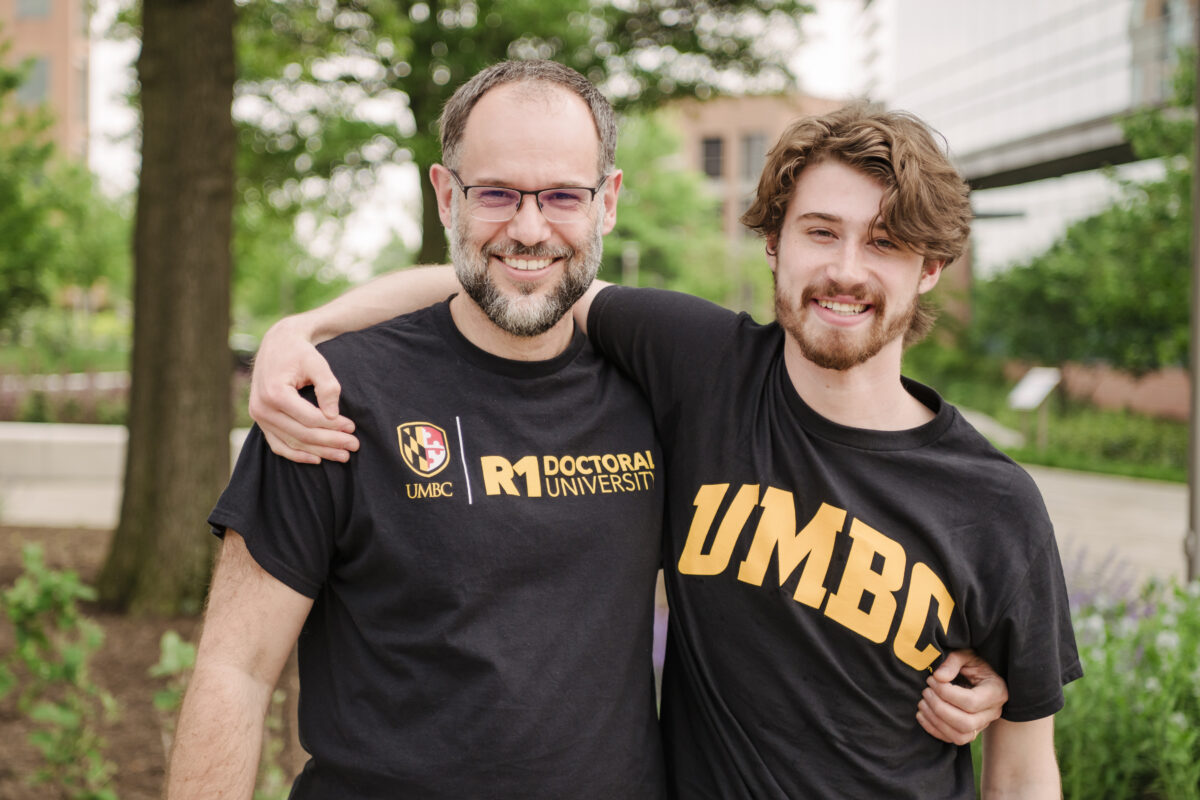 Hartley (right) and Deffner have grown close since Hartley joined Deffner’s research group. (Marlayna Demond ’11/UMBC)
Q: Tell me about the project.
A: It’s essentially a data analysis project, where we apply an analysis that is usually reserved for physical particle trajectories to musical melodies. In the same way that the particle trajectory is a series of positions, we think of a melody as a series of pitches.
Our central quantity is the entropy, which increases in an irreversible physical process. Irreversible means that it is vanishingly unlikely for the process to happen in reverse. In our analysis of music, we are interested in seeing if the “musical entropy” that we calculate increases over time, indicating irreversibility or directionality in music.
In general, I have always been interested in creating objectively defined quantities that can be used to analyze why music sounds the way it does to us. The possibility of creating a modern music theory which borrows ideas from thermodynamics is very cool to me. Then, we would be able to describe certain sounds as “hotter,” “colder,” “higher energy,” or “more entropic.” We could also go the other way, thinking of certain thermodynamic processes as more “consonant” or “dissonant.”
From our results so far, it looks like overall music does have some level of irreversible directionality that is similar to what we see in thermodynamics. We’re running some additional analyses now, such as controlling for the music’s key signature and comparing the results from music in different genres, and then we plan to submit our findings to a physics journal.
Q: How has Deffner supported you and your growth as a researcher?
A: Dr. Deffner has pushed me to have experiences in the physics department I might not have otherwise had. For example, he recruited me to volunteer with the Science Olympiad held for high school students at UMBC, and that experience was quite rewarding and fun. Dr. Deffner also answers all of the random physics questions I come up with, and he has assigned his postdoc, Emery Doucet, to help me with my project. I’ve had many useful conversations with Emery, and his generous guidance has helped me understand a lot better how to organize and scope a research project.
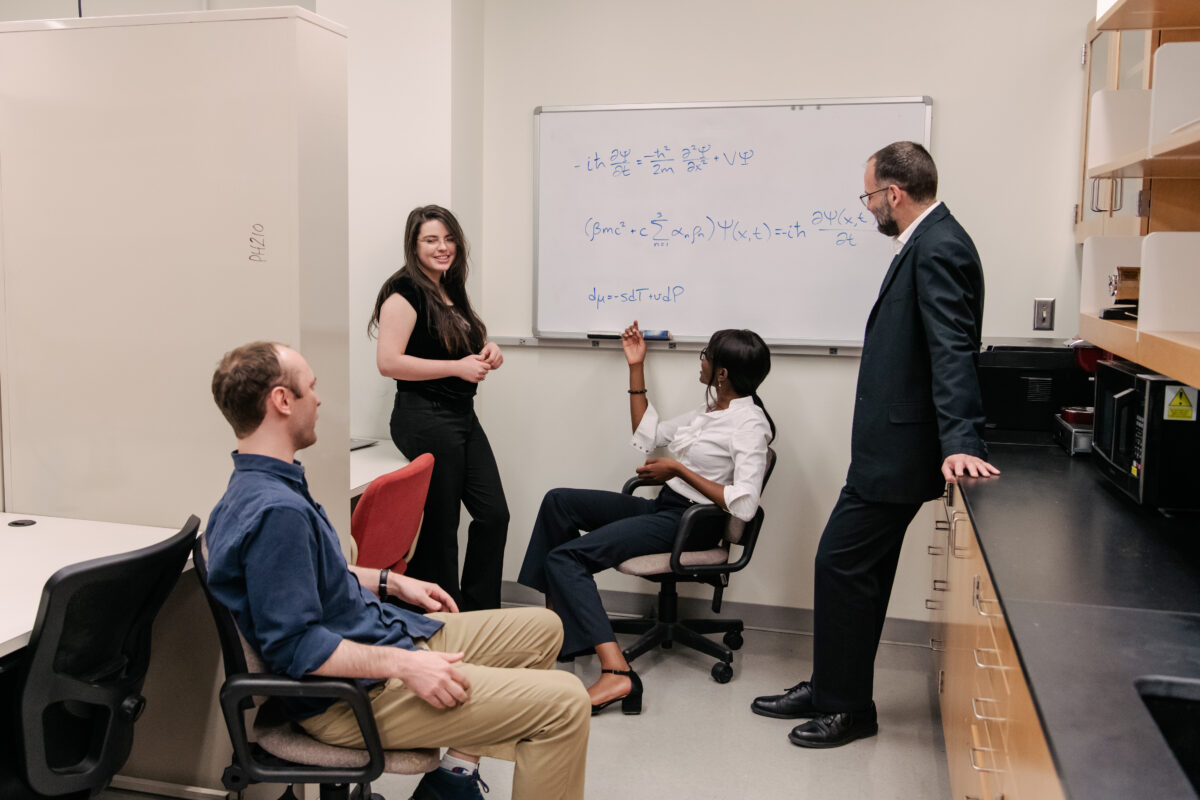 Deffner’s large research group includes postdoctoral fellows, graduate students, and undergraduates. (Marlayna Demond ’11/UMBC)
Q: What advice would you give to someone who’s uncertain about their major?
A: First, it’s hard to make big decisions. That’s what I struggle with. So I actually came into UMBC undeclared. I knew I wanted to do something in STEM, and I took as many classes as I could that would apply to all of the majors related to my wide-ranging interests.
I was considering computer science or computer engineering, and in my sophomore year, I sat down with my mom and told her I needed to decide what I wanted to do. I looked at physics, and everything—from the introductory courses to the 400-level classes—looked really cool. And I thought, well, that’s a good sign. Decision-making is still something I find difficult, though. Ask me about that one when I’m older!
My best advice for getting inspired is to knock on people’s doors and talk to them! Find a professor who’s studying something you think you’d possibly be interested in and have a conversation. Most professors will be quite happy to do this. Also, ask a lot of questions in class! It’s difficult, because the more questions you ask, the more chances you have to come off as a fool, but my advice is to embrace the experience of coming off as a fool. Over time it won’t bother you as much. Also, a majority of the time you’ll actually ask a question that somebody else was wondering about.
Q: Now that you’ve chosen physics, what would you say drives your passion for it?
A: First, I find thermodynamics in general interesting because it is more of an approach to physics than simply a branch of physics. In thermodynamics, we’re modeling a system about which we only have macroscopic information. The actual microscopic dynamics of the many molecules in a glass of water are incredibly complicated, but we cannot directly observe them, and we don’t actually care all that much.
Instead, we model properties we can observe, like heat and work, and we can still learn a lot about the glass of water. We dump everything we don’t know about what’s happening at the microscopic level into one variable, which we call the entropy. This act of encoding our ignorance in one variable, and developing a coherent theory around the quantities which we can measure, is very appealing to me.
What is the concept of “work” in physics? Work is what happens when force is applied to an object and the object moves in the direction of the force.
Second, I believe that using this type of thinking, thermodynamic thinking, is one of—if not the most—powerful tools in our quest to really understand what’s going on in the quantum world. What I mean by “really understand” is to answer questions such as: Why do quantum systems behave differently when we are measuring them? What precisely constitutes a measurement for that matter? Why do the weird quantum properties go away when we assemble many quantum objects (i.e. atoms) into a larger non-quantum object (i.e. my desk)?
Why do I think that thermodynamic thinking in particular is well suited to this? Well, it gets back to the ignorance aspect. Quantum mechanics is built on uncertainty: Certain quantities cannot be known precisely at the same time, and measuring a quantum system always changes the system in a very noticeable way. In these aspects, quantum theory is full of things we cannot know, and this is just begging to be treated through a phenomenological, thermodynamic lens.
Q: What’s next for you?
A: I looked at a lot of grad schools, and I found one that stood out among the rest: the Okinawa Institute of Science and Technology in Okinawa, Japan. I was accepted and will be leaving for Japan in August. The Institute seems amazing for several reasons. Most importantly, the people there are studying very interesting things, including a research group focusing on thermodynamics and quantum systems and another on information theory and space time. They’re ultimately trying to figure out quantum gravity, which is sort of the big thing in physics today, and they’re doing it through information theory.
One of the very unique things about the institute is that they don’t have academic departments. They only have research groups—they call them units—and they’re encouraged to work together. They try to break down the walls and just be a community of people learning stuff. In the buildings, they put people of different disciplines next to each other, so there’s lots of opportunities for interaction and collaboration.
I’ve never been to Asia at all, but I’ve always wanted to go to Japan. The entire program is taught in English, and it’s very international. You have students from different countries, with only a few graduate students there from each. They even provide housing and cover students’ travel to Japan. I’m super excited to start this next chapter and see where it leads me.
]]>
Maxfield Hartley ’24, physics, is an “exceptionally talented student with a truly inquisitive mind,” according to his mentor, Associate Professor Sebastian Deffner. Max’s undergraduate research...
https://umbc.edu/stories/max-hartley-quantum-thermodynamics/
https://my3.my.umbc.edu/api/v0/pixel/news/142066/guest@my.umbc.edu/d366123318798d32cc09186e4a900877/api/pixel
class-of-2024
news
story
UMBC News & Magazine
https://my3.my.umbc.edu/groups/umbc-news-magazine
https://assets1-my.umbc.edu/system/shared/avatars/groups/000/001/943/24435aa6207c452e7bc15cc74b42c7bb/xsmall.png?1748556657
https://assets1-my.umbc.edu/system/shared/avatars/groups/000/001/943/24435aa6207c452e7bc15cc74b42c7bb/original.png?1748556657
https://assets2-my.umbc.edu/system/shared/avatars/groups/000/001/943/24435aa6207c452e7bc15cc74b42c7bb/xxlarge.png?1748556657
https://assets2-my.umbc.edu/system/shared/avatars/groups/000/001/943/24435aa6207c452e7bc15cc74b42c7bb/xlarge.png?1748556657
https://assets3-my.umbc.edu/system/shared/avatars/groups/000/001/943/24435aa6207c452e7bc15cc74b42c7bb/large.png?1748556657
https://assets1-my.umbc.edu/system/shared/avatars/groups/000/001/943/24435aa6207c452e7bc15cc74b42c7bb/medium.png?1748556657
https://assets2-my.umbc.edu/system/shared/avatars/groups/000/001/943/24435aa6207c452e7bc15cc74b42c7bb/small.png?1748556657
https://assets1-my.umbc.edu/system/shared/avatars/groups/000/001/943/24435aa6207c452e7bc15cc74b42c7bb/xsmall.png?1748556657
https://assets2-my.umbc.edu/system/shared/avatars/groups/000/001/943/24435aa6207c452e7bc15cc74b42c7bb/xxsmall.png?1748556657
UMBC News & Magazine
6
0
false
Fri, 17 May 2024 15:37:22 -0400
Fri, 17 May 2024 15:37:22 -0400
Lee Blaney awarded funding to develop new ways to remove “forever chemicals” from water
Professor Lee Blaney, in the Department of Chemical, Biochemical, and Environmental Engineering, received $750,000 in funding from the Department of Defense’s Strategic Environmental Research and Development Program (SERDP) to develop new ways to remove substances dubbed “forever chemicals” from water.
Per- and polyfluoroalkyl substances, or PFAS, are used in products ranging from cleaning products and clothing to fire-fighting foam. They earned the nickname “forever chemicals” because of the way they persist in the environment. PFAS have been linked to decreased fertility in women, developmental effects in children, reduced immune function, and increased risk of cancer and obesity. The Environmental Protection Agency recently announced limitations on the amount of certain PFAS in drinking water.
Current technology such as activated carbon and anion-exchange resins can effectively remove the most common PFAS found in water, but do not perform well at removing short- and ultrashort-chain PFAS (which have fewer than eight carbon atoms in their chemical structure.)
The award from SERDP will fund Blaney’s work to develop materials called adsorbents specifically designed for treatment of these short-chain PFAS. Blaney’s colleagues on the project include Ke He, Ph.D. ’17, chemical and biochemical engineering, an assistant research scientist at UMBC, Wenqing Xu, an associate professor in civil and environmental engineering at Villanova University, and Jessica Ray, an assistant professor in civil and environmental engineering at the University of Washington.
]]>
Professor Lee Blaney, in the Department of Chemical, Biochemical, and Environmental Engineering, received $750,000 in funding from the Department of Defense’s Strategic Environmental Research and...
https://umbc.edu/quick-posts/lee-blaney-wins-funding-to-develop-new-ways-to-remove-forever-chemicals-from-water/
https://my3.my.umbc.edu/api/v0/pixel/news/142036/guest@my.umbc.edu/0a1bf138bc9415c48b8e98588cb7885a/api/pixel
cbee
coeit
news
quick-post
research
science-and-tech
UMBC News & Magazine
https://my3.my.umbc.edu/groups/umbc-news-magazine
https://assets1-my.umbc.edu/system/shared/avatars/groups/000/001/943/24435aa6207c452e7bc15cc74b42c7bb/xsmall.png?1748556657
https://assets1-my.umbc.edu/system/shared/avatars/groups/000/001/943/24435aa6207c452e7bc15cc74b42c7bb/original.png?1748556657
https://assets2-my.umbc.edu/system/shared/avatars/groups/000/001/943/24435aa6207c452e7bc15cc74b42c7bb/xxlarge.png?1748556657
https://assets2-my.umbc.edu/system/shared/avatars/groups/000/001/943/24435aa6207c452e7bc15cc74b42c7bb/xlarge.png?1748556657
https://assets3-my.umbc.edu/system/shared/avatars/groups/000/001/943/24435aa6207c452e7bc15cc74b42c7bb/large.png?1748556657
https://assets1-my.umbc.edu/system/shared/avatars/groups/000/001/943/24435aa6207c452e7bc15cc74b42c7bb/medium.png?1748556657
https://assets2-my.umbc.edu/system/shared/avatars/groups/000/001/943/24435aa6207c452e7bc15cc74b42c7bb/small.png?1748556657
https://assets1-my.umbc.edu/system/shared/avatars/groups/000/001/943/24435aa6207c452e7bc15cc74b42c7bb/xsmall.png?1748556657
https://assets2-my.umbc.edu/system/shared/avatars/groups/000/001/943/24435aa6207c452e7bc15cc74b42c7bb/xxsmall.png?1748556657
UMBC News & Magazine
1
0
false
Thu, 16 May 2024 14:39:36 -0400
Thu, 16 May 2024 14:39:36 -0400
In Gratitude
Dear UMBC Community,
The end of the spring semester is upon us, and we are speeding toward Commencement! As our students complete final projects and exams, and as our graduating students prepare to head out beyond UMBC to begin their next chapters, I want to extend my congratulations for everything you have accomplished during this semester and year.
It has been a challenging set of circumstances in which to have achieved so much, and that makes me especially grateful—to you and to UMBC. So, with this end-of-semester message, I want most of all to express that gratitude directly.
I am grateful to the entire UMBC community for caring for one another and for this great institution; for sharing your ideas and your feedback for how to make our community even better; and for showing up in pursuit of our academic mission and in service in so many places where you have been needed. Your work, your voices, and your care matter so much and are valued so deeply. Thank you.
To our faculty and staff, I would take that one step further. I am grateful to you for continuing to deliver the world-class education that our students expect and deserve, despite the many challenges, both on campus and in our world, that could have disrupted or distracted us from this core mission. You kept teaching, you kept mentoring, you remained in service to our students and our mission throughout, and, as a result, our students have continued learning and stayed on their educational paths.
Our shared governance leaders—students, faculty, and staff—are deserving of our gratitude as well, for taking on vexing issues while continuing to attend to the critical day-to-day functioning of our shared governance system. I am also grateful to all those who have taken on roles in the monumental process to prepare for our Middle States Commission on Higher Education accreditation evaluation.
My thanks to the co-chairs of this effort—psychology Professor and Chair Anne Brodsky, Interim Provost and Senior Vice President for Academic Affairs David Dauwalder, and Associate Vice Provost for Institutional Research, Analysis, and Decision Support Connie Pierson—as well as to the many individuals who are participating in myriad working groups and committees in support of this process. Your dedication will set a course for UMBC’s continued excellence.
I am grateful for and moved by the overwhelming support we continue to see for UMBC from within the campus community; from our alumni, parents, and friends; from the University System of Maryland; and from across the state, including elected officials. They all know, as I do, that UMBC is an extraordinary and special place, and they are with us on the journey to create UMBC’s future.
It is a bright future, to be sure, and I am excited for what lies ahead in the near term, including welcoming our new provost and new vice president for communications and marketing this summer, and moving forward together into strategic planning in the next academic year.
As I reflect on our path together these last several months and imagine all that is ahead for us, I am truly grateful to be here, in this role, at UMBC, at this moment in the history of this institution and our world. I am privileged to serve this university, one whose values are clear and unshakable, and one whose impact on individual lives and on the public good is truly transformative. I am honored to continue to move UMBC forward with all of you.
Sincerely,
President Valerie Sheares Ashby
]]>
Dear UMBC Community, The end of the spring semester is upon us, and we are speeding toward Commencement! As our students complete final projects and exams, and as our graduating students...
https://my3.my.umbc.edu/groups/announcements/posts/142008
https://my3.my.umbc.edu/api/v0/pixel/news/142013/guest@my.umbc.edu/97a6a70c6c7515872feacc147599d5b8/api/pixel
president
story
UMBC News & Magazine
https://my3.my.umbc.edu/groups/umbc-news-magazine
https://assets1-my.umbc.edu/system/shared/avatars/groups/000/001/943/24435aa6207c452e7bc15cc74b42c7bb/xsmall.png?1748556657
https://assets1-my.umbc.edu/system/shared/avatars/groups/000/001/943/24435aa6207c452e7bc15cc74b42c7bb/original.png?1748556657
https://assets2-my.umbc.edu/system/shared/avatars/groups/000/001/943/24435aa6207c452e7bc15cc74b42c7bb/xxlarge.png?1748556657
https://assets2-my.umbc.edu/system/shared/avatars/groups/000/001/943/24435aa6207c452e7bc15cc74b42c7bb/xlarge.png?1748556657
https://assets3-my.umbc.edu/system/shared/avatars/groups/000/001/943/24435aa6207c452e7bc15cc74b42c7bb/large.png?1748556657
https://assets1-my.umbc.edu/system/shared/avatars/groups/000/001/943/24435aa6207c452e7bc15cc74b42c7bb/medium.png?1748556657
https://assets2-my.umbc.edu/system/shared/avatars/groups/000/001/943/24435aa6207c452e7bc15cc74b42c7bb/small.png?1748556657
https://assets1-my.umbc.edu/system/shared/avatars/groups/000/001/943/24435aa6207c452e7bc15cc74b42c7bb/xsmall.png?1748556657
https://assets2-my.umbc.edu/system/shared/avatars/groups/000/001/943/24435aa6207c452e7bc15cc74b42c7bb/xxsmall.png?1748556657
UMBC News & Magazine
2
0
false
Wed, 15 May 2024 19:00:49 -0400
Thirsty in paradise: Water crises are a growing problem across the Caribbean islands

Written by Farah Nibbs, assistant professor of emergency and disaster health systems at UMBC.
In the popular imagination, the Caribbean is paradise, an exotic place to escape to. But behind the images of balmy beaches and lush hotel grounds lies a crisis, the likes of which its residents have never experienced.
Caribbean islands are in a water crisis, and their governments have warned that water scarcity may become the new norm.
Within the past five years, every island in the region has experienced some sort of water scarcity. For example, Trinidad is experiencing its worst drought in recent memory, and residents are under water restrictions through at least the end of June 2024, with fines for anyone who violates the rules.
Dominica, considered the nature island of the Caribbean for its mountain rain forests, is seeing a significant decrease in freshwater resources and increasingly frequent water shortages. In Grenada, known as the spice isle, drought has affected water systems throughout the island.
 Apartments in Havana, Cuba, store water to provide supplies when the public system isn’t operating. Roberto Machado Noa/LightRocket via Getty Images
Jamaica is also facing water restrictions and has had to resort to water shutoffs in recent years, limiting water availability to a few hours per day in some areas. St. Vincent and St. Kitts have had to ration water. Barbados has experienced several water bans in recent years.
In fact, recent data shows that the Caribbean is one of the most water-stressed regions in the world.
I study the intersection of critical infrastructure and disasters, particularly in the Caribbean. Safe water is essential for all human activity and public health. That’s why it is important to understand the root causes of the water crises and to find effective, affordable ways to improve water supply systems.
3 reasons water demand is outstripping supply in the Caribbean
Changing precipitation patterns and droughts are straining Caribbean water supplies, but water demand has also been outstripping supply for a number of reasons.
1. Rapid urbanization and industrialization
The Caribbean is one of the most rapidly urbanizing regions in the world. About three-quarters of its population lives in cities, and that percentage is rising, adding pressure on public water systems.
At the same time, increased industrialization and commercialization of agriculture have degraded water quality and in some cases encroached on sensitive water catchment areas, affecting the soil’s capacity to retain water.
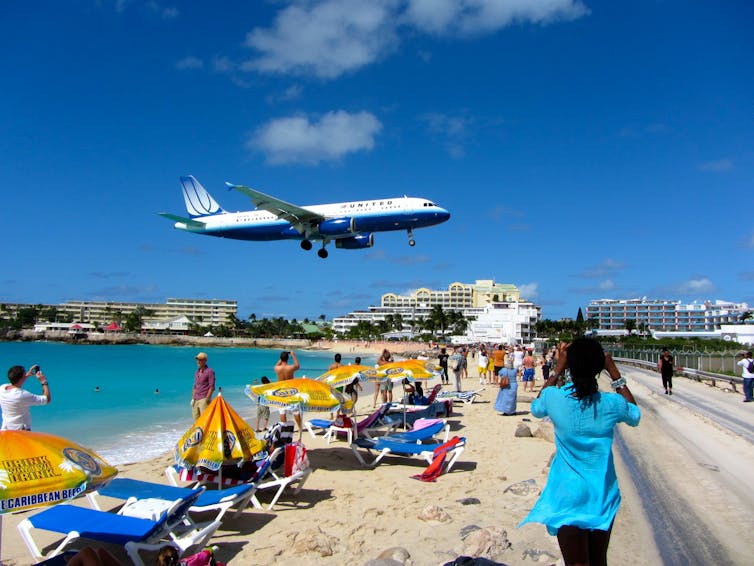 A plane lands in Sint Maarten. Visitors’ water needs come first on many islands that depend on tourism. Richie Diesterheft/Flickr, CC BY-SA
This competing demand for limited fresh water has reduced stream flows and led to water being drawn down from sensitive sources. In Dennery North, a major farming community in St. Lucia, water shortages have left residents collecting water from rivers and other sources for their homes and farms.
Unregulated extraction of groundwater can also worsen the problem. Many islands depend on groundwater.
For example, 90% of water supply in Barbados comes from groundwater, while in Jamaica it is 84%. However, increasing demand and changes in annual rainfall patterns are affecting the ability of aquifers or groundwater to recharge. As a result, supply isn’t keeping up with demand. This is a huge problem for the island of Utila, located off the coast of Honduras, where the current rate of aquifer recharge is only 2.5% annually. For comparison, Barbados has a recharge rate of 15% to 30% of annual rainfall.
2. Water-intensive tourism industry
It’s no secret that the Caribbean is a popular tourist destination, and tourist economies depend on vast quantities of water.
Even during water rationing, water is diverted to hotels and other tourist-dependent sites first. That can leave local residents without water for hours or days at a time and facing fines if they violate use restrictions.
Tourism not only increases the consumption of water but also the pollution of water resources. Building golf courses to attract more tourists further increases tourism’s water demand and runoff.
3. Weak water infrastructure governance
Another problem water systems face is weak governance that leads to excessive loss of treated water before it even reaches the customer.
A well-performing water utility will usually have water losses – known as nonrevenue water – below 30%. In the Caribbean, the average nonrevenue water is 46%, with some as high as 75%.
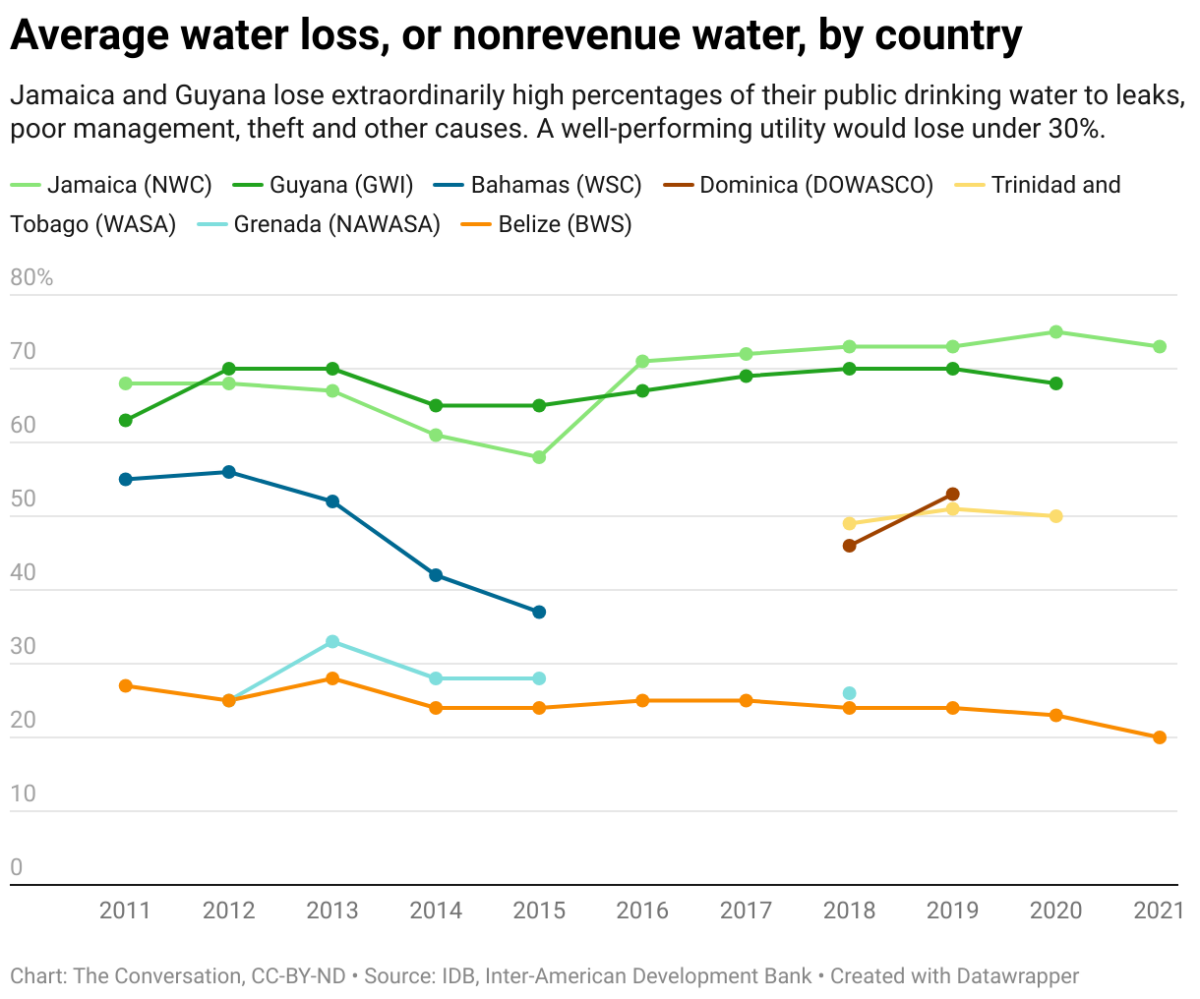
The reasons range from lack of appropriate management practices to metering inaccuracies, leaks and theft.
Climate change and extreme weather worsen water insecurity
These troubled water systems can struggle on good days. Worsening extreme weather, such as hurricanes and flooding, can damage infrastructure, leading to long outages and expensive repairs.
The Caribbean is the second-most disaster-prone region in the world. The islands face frequent earthquakes, landslides, devastating hurricanes and other destructive storms. As global temperatures and sea levels rise, the risk of extreme weather and storm surge causing erosion, flooding and saltwater contamination increases.
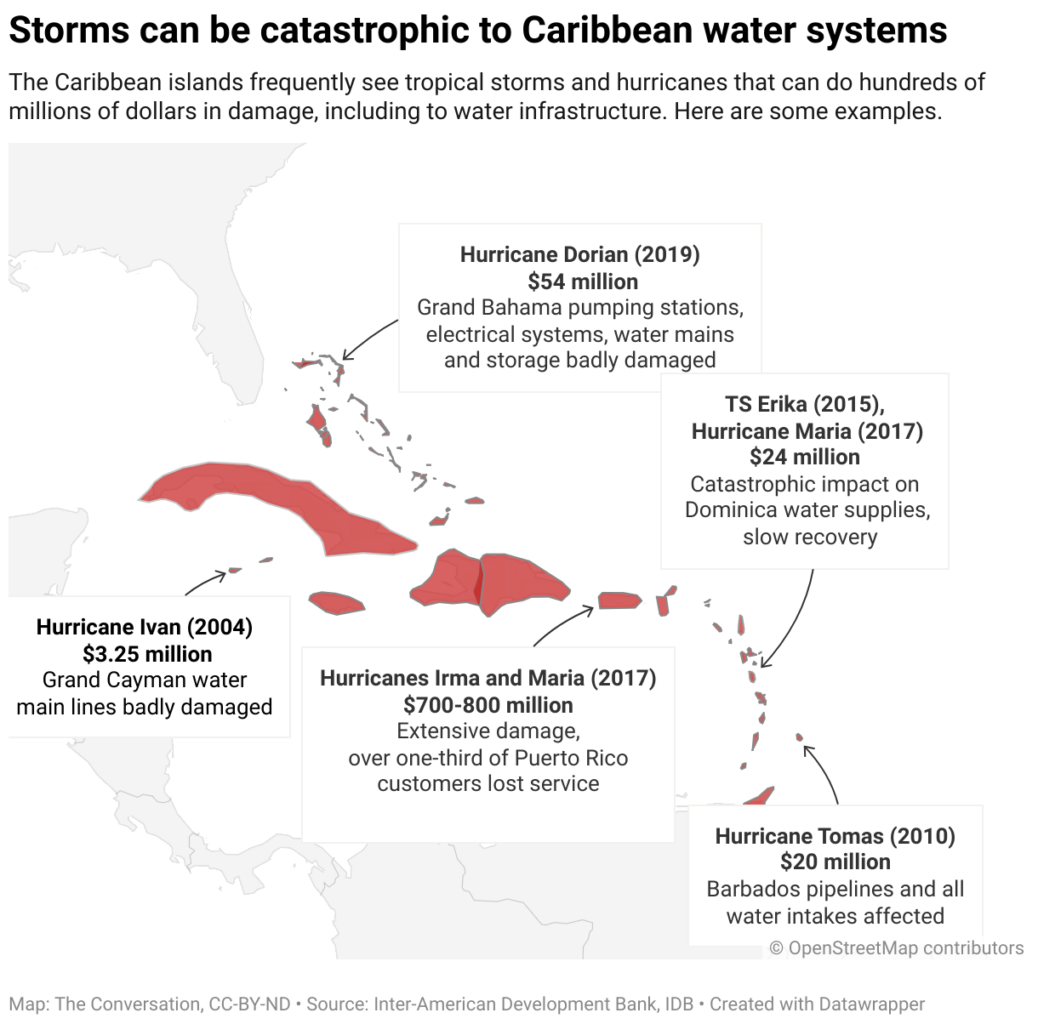
Three months after Hurricane Maria hit in 2017, well over 14% of the Caribbean population was still without potable water. Hurricane Dorian in 2019 left Grand Bahama Utility Co. and the country’s Water and Sewerage Corp. with U$54 million in damages. A year after Dorian, WSC was “still working on restoring operations to pre-Hurricane Dorian levels.”
How hybrid rainwater harvesting can help
Improving water access in the Caribbean means working on all of those challenges. Better governance and investment can help reduce water loss from theft and leaks. Government and social pressure and educating tourists can help reduce waste at hotels and resorts.
There are also ways to increase water supply. One involves being more strategic about how the islands use a practice the region has relied on for centuries: rainwater harvesting.
Rainwater harvesting involves capturing rainwater, often from where it runs off rooftops, and storing it for future use. It can replace irrigation, or the water can be treated for household uses.
 An example of a rainwater harvesting tank. Penny Mayes via Wikimedia, CC BY
Right now, rainwater harvesting is not managed as part of the islands’ centralized water management system. Instead, households bear the cost to finance, build and maintain their own systems. Finding technical support can be difficult, leaving households to contend with seasonal variations in water quantity and quality. That makes risks to drinking water safety difficult to identify.
If rainwater harvesting were instead combined with central water systems in a managed hybrid water model, I believe that could help expand safe rainwater harvesting and address water issues in the region.
It’s a relatively new concept, and integrating decentralized sources can be complex, including requiring separate pipes, but it has potential to reduce water stress. Decentralized sources, such as rainwater harvesting, groundwater or recycled gray water, could serve as backup water sources during shortages or provide water for nonpotable purposes, such as flushing toilets or irrigation, to reduce demand for treated water.
Engineers in Australia are weighing the potential of hybrid water systems to help face the challenges of delivering secure, safe and sustainable water in the future.
Fulfilling a human right in the islands
The World Health Organization has declared that access to a sufficient, safe and reliable water supply is a fundamental human right, and that to accomplish this, water suppliers have a responsibility to provide adequate quantities of potable water.
Hybrid water systems could help ensure water safety and security for island communities and improve the water systems’ resilience amid the human and environmental pressures facing the Caribbean.
This article is republished from The Conversation under a Creative Commons license. Read the original article and see more than 250 UMBC articles available in The Conversation.
]]>
Written by Farah Nibbs, assistant professor of emergency and disaster health systems at UMBC. In the popular imagination, the Caribbean is paradise, an exotic place to escape to. But behind...
https://umbc.edu/stories/water-crises-across-the-caribbean-islands/
https://my3.my.umbc.edu/api/v0/pixel/news/141952/guest@my.umbc.edu/2cb516f87ba22b91979c99be1906408e/api/pixel
cahss
cahss-research
discovery
edhs
magazine
research
story
the-conversation
UMBC News & Magazine
https://my3.my.umbc.edu/groups/umbc-news-magazine
https://assets1-my.umbc.edu/system/shared/avatars/groups/000/001/943/24435aa6207c452e7bc15cc74b42c7bb/xsmall.png?1748556657
https://assets1-my.umbc.edu/system/shared/avatars/groups/000/001/943/24435aa6207c452e7bc15cc74b42c7bb/original.png?1748556657
https://assets2-my.umbc.edu/system/shared/avatars/groups/000/001/943/24435aa6207c452e7bc15cc74b42c7bb/xxlarge.png?1748556657
https://assets2-my.umbc.edu/system/shared/avatars/groups/000/001/943/24435aa6207c452e7bc15cc74b42c7bb/xlarge.png?1748556657
https://assets3-my.umbc.edu/system/shared/avatars/groups/000/001/943/24435aa6207c452e7bc15cc74b42c7bb/large.png?1748556657
https://assets1-my.umbc.edu/system/shared/avatars/groups/000/001/943/24435aa6207c452e7bc15cc74b42c7bb/medium.png?1748556657
https://assets2-my.umbc.edu/system/shared/avatars/groups/000/001/943/24435aa6207c452e7bc15cc74b42c7bb/small.png?1748556657
https://assets1-my.umbc.edu/system/shared/avatars/groups/000/001/943/24435aa6207c452e7bc15cc74b42c7bb/xsmall.png?1748556657
https://assets2-my.umbc.edu/system/shared/avatars/groups/000/001/943/24435aa6207c452e7bc15cc74b42c7bb/xxsmall.png?1748556657
UMBC News & Magazine
0
0
false
Tue, 14 May 2024 08:31:51 -0400
Tue, 14 May 2024 08:31:51 -0400
Meet a Retriever—Ron Pettie ’82, retired police officer and true Retriever Believer

Meet Ron Pettie. Ron is a retired Baltimore City police officer and a loyal Retriever alumnus, graduating with a B.A. in English in 1982. When he’s not writing postcards to incoming UMBC students, commenting on UMBC Alumni Association Facebook posts, or attending alumni events, Ron can be found spending time with his wife Christine. Ron’s path in life may not have always gone according to plan, but he wouldn’t have it any other way. Take it away, Ron!
Q: What’s one essential thing you’d want another Retriever to know about you?
A: I am a true believer that education is priceless. I arrived at UMBC after receiving a top-notch education in the Baltimore City Public School System. I had the intention of working in engineering as a career, but at the end of my time at Baltimore Polytechnic Institute, Mr. Karl Yount led me to truly appreciate the English language. So, I set another goal to become an English teacher at Poly. I attended Catonsville Community and obtained an associate’s degree before moving on to UMBC to study English and focus on my goal. Well, fast-forward a few years later and I became a cop in Baltimore City, where I worked for 27 years before retiring as a sergeant. Here is where education became important. In the Baltimore City Police Department, I worked patrol, recruitment, applicant investigation, administrative sgt. to the major, medical abuse investigator, OSHA, Red Cross, and worker’s compensation liaison.
After retiring from the police department, I worked for another 10 years in security at Sinai Hospital before retiring as a lieutenant. I have seen the best and the worst in people. These days, I am officially retired and parenting two youngsters with my wife Christine.
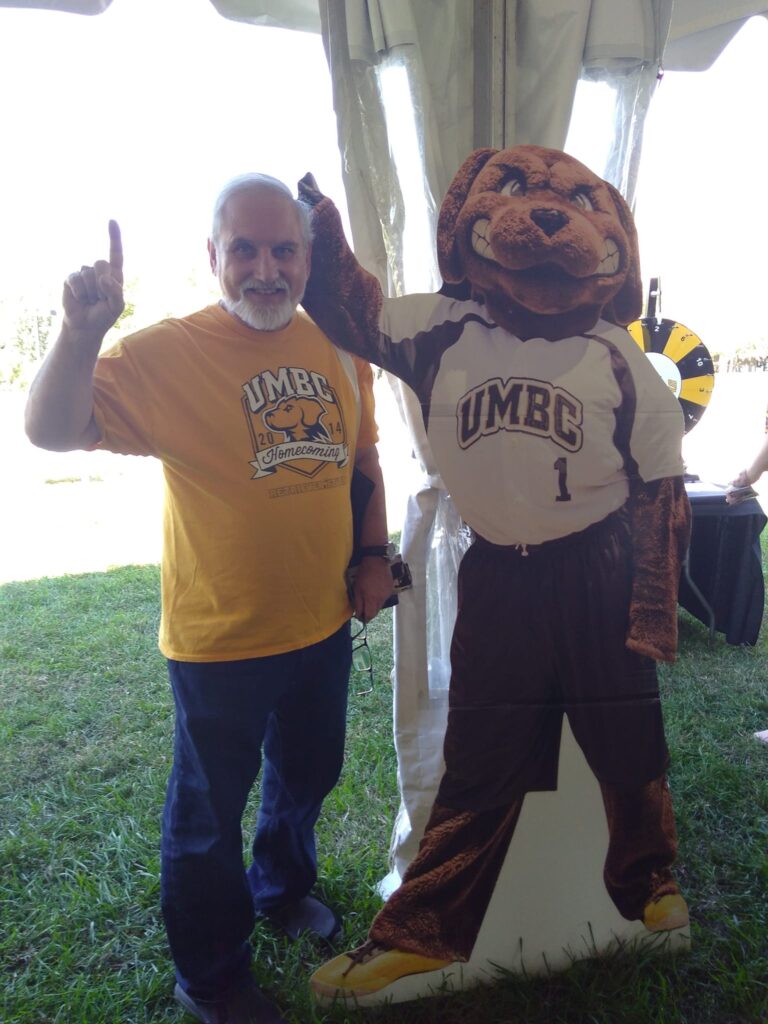
Pictured right: Ron at Homecoming 2022 positing with a cutout of True Grit.
Q: What’s the one thing you’d want someone who hasn’t joined the UMBC community to know about the support you find here?
A: UMBC is truly an all-inclusive, friendly, and down-to-earth place.
I still get chills every time I walk into the Albin O. Kuhn Library.
Q: Tell us about someone in the community who has inspired you or supported you, and how they did it.
A: My folks got me to college. The costs were a lot different back then. I bought my books myself, but my parents made it all possible. I also had the fortune of learning from some wonderful educators, including Ms. Barbara Dunsen, my 5th-grade teacher. We are good friends to this day. Ms. Dunsen, along with Carolyn Freeland, integrated the teaching staff at #226. I can’t forget Mr. Bachman and Karl Yount who poured the English language out to me. Then there’s UMBC…William Bettridge, Philip Landon, Kenneth Baldwin, Joan Korenman, William Edinger, Elizabeth Ermarth, and J. Leeds Barroll. So many folks were such great influences! I met some amazing educators and every one of my English professors had a knack for pushing me. There was also a group of English majors that ate lunch together, talked about lectures, compared books, and helped each other throughout our time at UMBC.
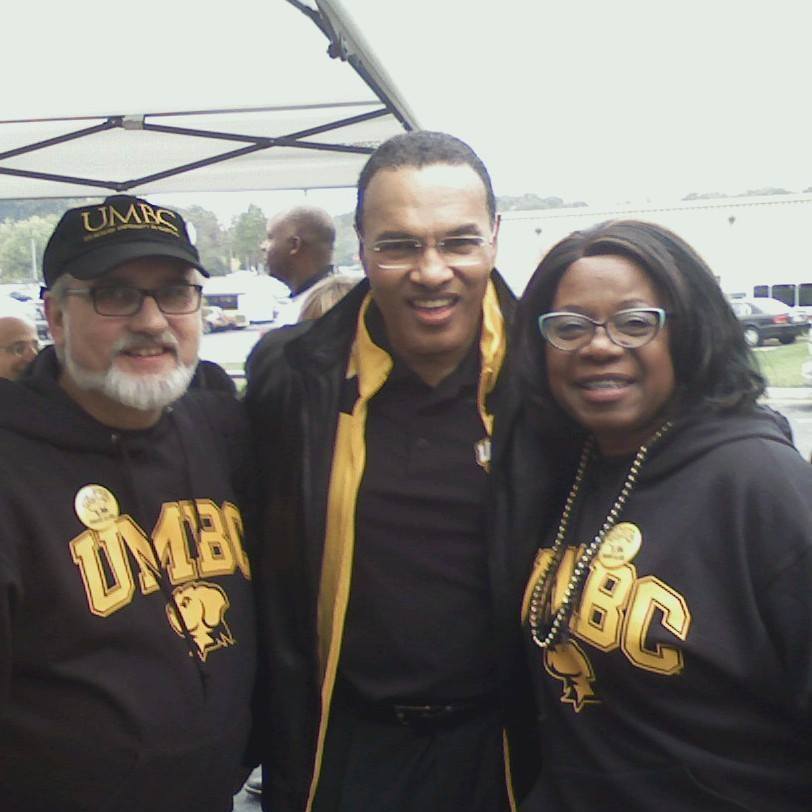

Left: Ron and Christine Pettie with UMBC president emeritus, Freeman A. Hrabowski, III. Right: Ron and Christine Pettie with UMBC President Valerie Sheares Ashby.
Q: What is your WHY? What brought you to UMBC?
A: I came to UMBC because I had heard there was a level of difficulty and I wanted to continue the challenges from Poly.
Q: What’s something you love about your academic program?
A: I have always loved writing. Now that I have time, I have recently rekindled my love of writing and started revisiting works from decades ago.
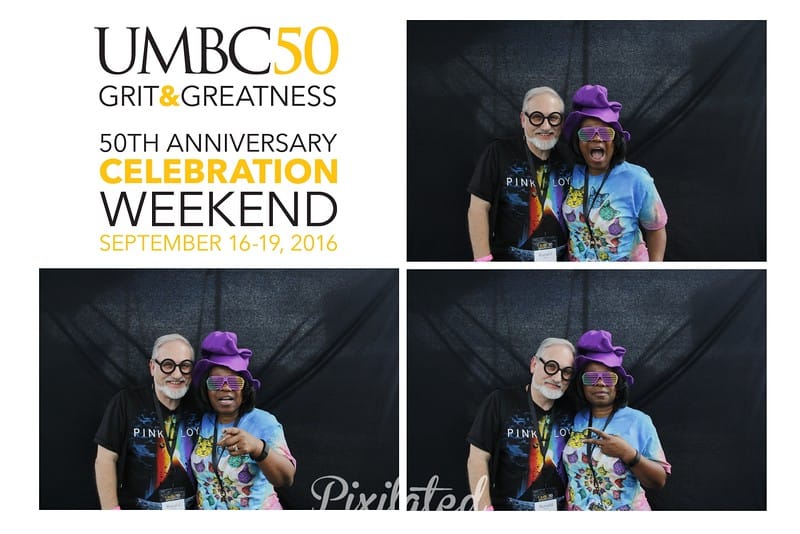 Ron and Christine Pettie at UMBC’s 50th anniversary celebration.
Q: What’s your favorite part of being a part of Retriever Nation?
A: There’s always something big at UMBC. What can I say…I enjoy visiting campus for events—especially Homecoming—hitting the bookstore for UMBC gear, catching shows at the Performing Arts and Humanities Building, and celebrating UMBC every chance I get.
Q: What drives you to support UMBC?
A: I give as much as I can and mostly throw my support to the English Department…but spread it out as well.
* * * * *
UMBC’s greatest strength is its people. When people meet Retrievers and hear about the passion they bring, the relationships they create, the ways they support each other, and the commitment they have to inclusive excellence, they truly get a sense of our community. That’s what “Meet a Retriever” is all about.
Learn more about how UMBC can help you achieve your goals.
]]>
Meet Ron Pettie. Ron is a retired Baltimore City police officer and a loyal Retriever alumnus, graduating with a B.A. in English in 1982. When he’s not writing postcards to incoming UMBC students,...
https://umbc.edu/stories/meet-ron-pettie-82-english/
https://my3.my.umbc.edu/api/v0/pixel/news/141901/guest@my.umbc.edu/bb83b052fdb91faa2658e944b675474e/api/pixel
alumni
impact
magazine
meet-a-retriever
story
UMBC News & Magazine
https://my3.my.umbc.edu/groups/umbc-news-magazine
https://assets1-my.umbc.edu/system/shared/avatars/groups/000/001/943/24435aa6207c452e7bc15cc74b42c7bb/xsmall.png?1748556657
https://assets1-my.umbc.edu/system/shared/avatars/groups/000/001/943/24435aa6207c452e7bc15cc74b42c7bb/original.png?1748556657
https://assets2-my.umbc.edu/system/shared/avatars/groups/000/001/943/24435aa6207c452e7bc15cc74b42c7bb/xxlarge.png?1748556657
https://assets2-my.umbc.edu/system/shared/avatars/groups/000/001/943/24435aa6207c452e7bc15cc74b42c7bb/xlarge.png?1748556657
https://assets3-my.umbc.edu/system/shared/avatars/groups/000/001/943/24435aa6207c452e7bc15cc74b42c7bb/large.png?1748556657
https://assets1-my.umbc.edu/system/shared/avatars/groups/000/001/943/24435aa6207c452e7bc15cc74b42c7bb/medium.png?1748556657
https://assets2-my.umbc.edu/system/shared/avatars/groups/000/001/943/24435aa6207c452e7bc15cc74b42c7bb/small.png?1748556657
https://assets1-my.umbc.edu/system/shared/avatars/groups/000/001/943/24435aa6207c452e7bc15cc74b42c7bb/xsmall.png?1748556657
https://assets2-my.umbc.edu/system/shared/avatars/groups/000/001/943/24435aa6207c452e7bc15cc74b42c7bb/xxsmall.png?1748556657
UMBC News & Magazine
0
0
false
Mon, 13 May 2024 08:24:51 -0400
Mon, 13 May 2024 08:24:51 -0400
From solar energy harvesting to advanced batteries: Cohort of new engineering faculty bolster UMBC’s commitment to Earth-friendly research
This April 22, as the campus community celebrated Earth Day, the feel of spring’s natural reawakening was in the air. Birds chirped from newly leafed trees and students strolled in the bright sunshine. But the pleasant day belied a concerning trend: In Maryland and beyond, the balance of Earth’s life-supporting systems is shifting, driven in large part by the heat-trapping greenhouse gasses we humans send into the atmosphere. The Earth is getting hotter; weather patterns are changing; and ecosystems are under stress.
“Climate change is pressing us to adopt a more Earth-friendly lifestyle, to develop renewable energy,” says Özgür Çapraz, an associate professor in the department of chemical, biochemical, and environmental engineering at UMBC, who studies advanced battery technologies. Çapraz, who joined UMBC in fall 2023 from a faculty position at Oklahoma State University, was one of three recent faculty hires in the College of Engineering and Information Technology (COEIT) who all specialize in different aspects of sustainability and renewable energy-related research.
The three hires were part of a COEIT effort to build off recognized strength in the environmental domain, while expanding expertise in important areas such as energy, says Lee Blaney, a professor in the department of chemical, biochemical, and environmental engineering who chaired the search.
The other two hires are Alok Ghanekar, an assistant professor in mechanical engineering, who studies materials that can improve some solar energy harvesting systems, turn waste heat into electricity, and better cool buildings; and Rajasekhar Anguluri, an assistant professor in computer science and electrical engineering, who specializes in the math describing large, complex systems such as the power grid.
The energy conundrum
“Ever since I studied science in high school, I have been interested in energy,” says Ghanekar, who was a postdoctoral researcher at the University of Southern California prior to joining UMBC this spring semester. “Growing up in India, there were regular power outages every week. It is less of a problem now, but energy demand is still growing.”
Across the world, in many ways, energy consumption drives progress and improves people’s lives. But the burning of fossil fuels to produce much of that energy is increasing the concentration of heat-trapping gasses in the atmosphere. While the exact consequences of this change are uncertain, it’s clear the Earth is warming, and that trend is likely to put extreme pressures on societies in the decades to come.
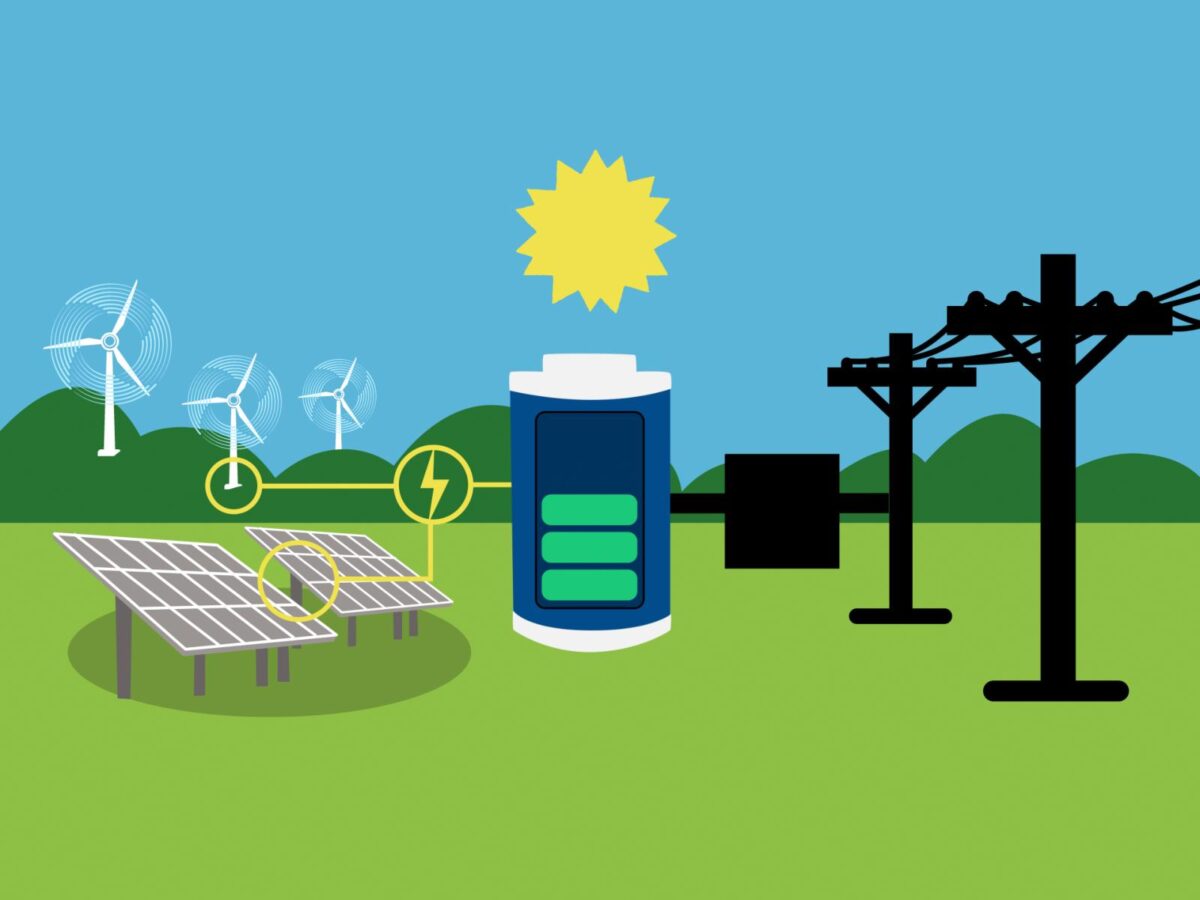 To tap intermittent renewable energy sources, we also need to develop solutions for storing and distributing the energy. (Image by Sara Levine | Pacific Northwest National Laboratory)
A big shift toward clean and renewable sources of energy could be part of the solution. Each of the new hires’ research touches this goal in some ways. In Ghanekar’s case, he studies human-designed materials called metamaterials that, among other potential uses, might one day help significantly increase the amount of energy from the sun that we are able to efficiently turn into electricity.
Getting more energy from the sun could help reduce greenhouse gas emissions, but since the sun doesn’t always shine, we also need ways to store that energy (perhaps with new battery technologies, the expertise of Çapraz) and ways to share that energy on the power grid without disrupting its delicate balance (a challenge that Anguluri has explored).
As academic researchers, they operate at the frontiers of knowledge, asking and seeking to answer fundamental questions that could push the technology forward: How exactly do batteries with new chemistries work, for example, or why does a material degrade over time? Anguluri’s math expertise spans a range of engineering disciplines. He and Ghanekar have already talked about collaborating to mathematically model the behavior of Ghanekar’s metamaterials.
No scientific “Eureka!” moment or technical advance by itself is likely to be a panacea to a problem as complex as global warming, but these incremental steps do offer people more tools.
“As scholars, we like to think, to solve interesting problems,” says Anguluri, who was a postdoc at Arizona State University before arriving at UMBC this year. “As citizens of the world, we must also look at our values and make wise choices.”
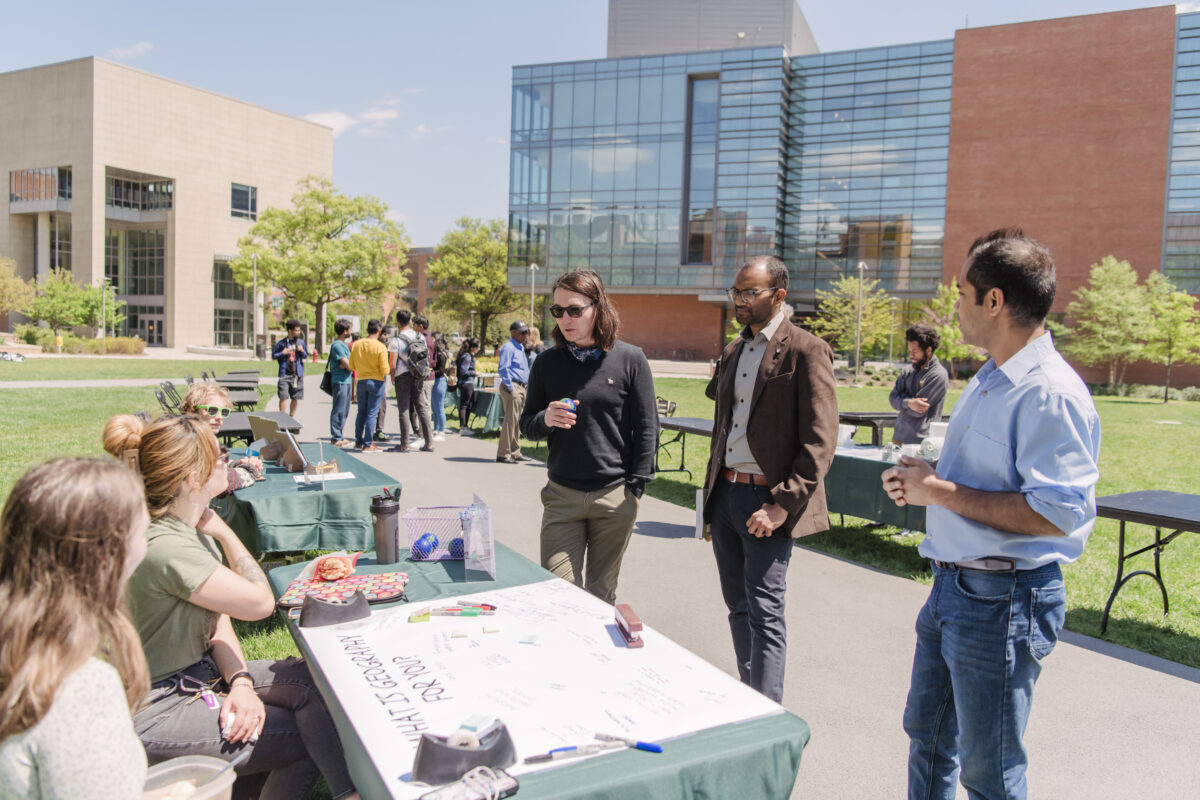 Çapraz, Anguluri, and Ghanekar chat with community members at the Earth Day Community Day event celebrating UMBC environmental research.(Marlayna Demond ’11/UMBC)
Building on a long-standing commitment
Studying people’s impact on the Earth, and working to mitigate environmental harms, is nothing new for researchers at UMBC.
The university boasts multiple research centers that advance environmental research, from the Center for Urban Environmental Research and Education to the Institute for Harnessing Data and Model Revolution in the Polar Regions. The university also has long-standing partnerships with NASA to develop new technology for environmental remote sensing.
Çapraz, Ghanekar, and Anguluri will join faculty at the university who study sustainable aquaculture, wildfire smoke, water and sediment pollution, fusion energy, and more.
“Sustainability research is an area of strength in COEIT,” says Vandana Janeja, the associate dean for research and faculty development in COEIT. “Now there’s a new sense of urgency about it and our recent hires are a testament to that.”
“Climate change is an issue that so many of our students are tapped into,” adds Blaney. “They’re really worried about the impacts of climate change and want to do something to address this global challenge.”
As the new UMBC faculty launch research projects and expand their labs, there will be growing opportunities for interested students to learn about and join their important work. And that’s good news, because as the Earth Day festivities on campus showcased, safeguarding our shared home is a duty shared by all of us.
]]>
This April 22, as the campus community celebrated Earth Day, the feel of spring’s natural reawakening was in the air. Birds chirped from newly leafed trees and students strolled in the bright...
https://umbc.edu/stories/new-sustainability-renewable-energy-faculty/
https://my3.my.umbc.edu/api/v0/pixel/news/141880/guest@my.umbc.edu/d4b5a640a511273cafe1b4d4c119478b/api/pixel
cbee
coeit
csee
meche
news
research
science-and-tech
story
sustainability
UMBC News & Magazine
https://my3.my.umbc.edu/groups/umbc-news-magazine
https://assets1-my.umbc.edu/system/shared/avatars/groups/000/001/943/24435aa6207c452e7bc15cc74b42c7bb/xsmall.png?1748556657
https://assets1-my.umbc.edu/system/shared/avatars/groups/000/001/943/24435aa6207c452e7bc15cc74b42c7bb/original.png?1748556657
https://assets2-my.umbc.edu/system/shared/avatars/groups/000/001/943/24435aa6207c452e7bc15cc74b42c7bb/xxlarge.png?1748556657
https://assets2-my.umbc.edu/system/shared/avatars/groups/000/001/943/24435aa6207c452e7bc15cc74b42c7bb/xlarge.png?1748556657
https://assets3-my.umbc.edu/system/shared/avatars/groups/000/001/943/24435aa6207c452e7bc15cc74b42c7bb/large.png?1748556657
https://assets1-my.umbc.edu/system/shared/avatars/groups/000/001/943/24435aa6207c452e7bc15cc74b42c7bb/medium.png?1748556657
https://assets2-my.umbc.edu/system/shared/avatars/groups/000/001/943/24435aa6207c452e7bc15cc74b42c7bb/small.png?1748556657
https://assets1-my.umbc.edu/system/shared/avatars/groups/000/001/943/24435aa6207c452e7bc15cc74b42c7bb/xsmall.png?1748556657
https://assets2-my.umbc.edu/system/shared/avatars/groups/000/001/943/24435aa6207c452e7bc15cc74b42c7bb/xxsmall.png?1748556657
UMBC News & Magazine
0
0
false
Fri, 10 May 2024 14:05:56 -0400
Fri, 10 May 2024 14:05:56 -0400
Chuck Peake—Pioneer of UMBC’s economics program

As Charles “Chuck” Peake celebrated his 90th birthday late one December evening in 2022, a contingent of middle-aged investors, bankers, and academics—Retriever alumni of various decades—were present to cheer on the founder of UMBC’s economics program. As their professor and mentor, Peake had built a tight-knit but inclusive community of economics students and, half a century later, those social bonds still held strong.
“I was honored on my 90th birthday to have several of my former students travel from around the country to celebrate our formative years together at UMBC,” says Peake.
While sitting around the table, one of those students, Andrew Colyer ’89, economics, was inspired to ask his mentor about the early days of UMBC and the role Peake played in building the economics department.
The house that Chuck built
At UMBC, one of the benefits of being such a young university—just 57 years old—is that we are still so connected with our past and able to learn from the pioneers who helped found this university. Peake is one of those pioneers—here from the very beginning when campus consisted of just three academic buildings, plywood sidewalks, a lot of mud, and a whole lot more vision.
“Dr. Albin O. Kuhn, UMBC’s first chancellor, could be seen in his spare time using his tractor to carve out the route for the loop road that he envisioned,” recalls Peake.
“Chuck came to UMBC with the vision that the fledgling campus could become the ‘Swarthmore of Public Higher Education,’” says Marsha Goldfarb, professor emerita, economics, referring to the liberal arts college ranked No. 1 multiple times by U.S. News & World Report.
Peake was hired as the university’s very first professor in economics and entrusted with a daunting task—building the economics department from the ground up. Peake was up for that challenge but, holding fast to his vision of what UMBC could become, he had two conditions.
Pictured right: Peake in his office in 1969.
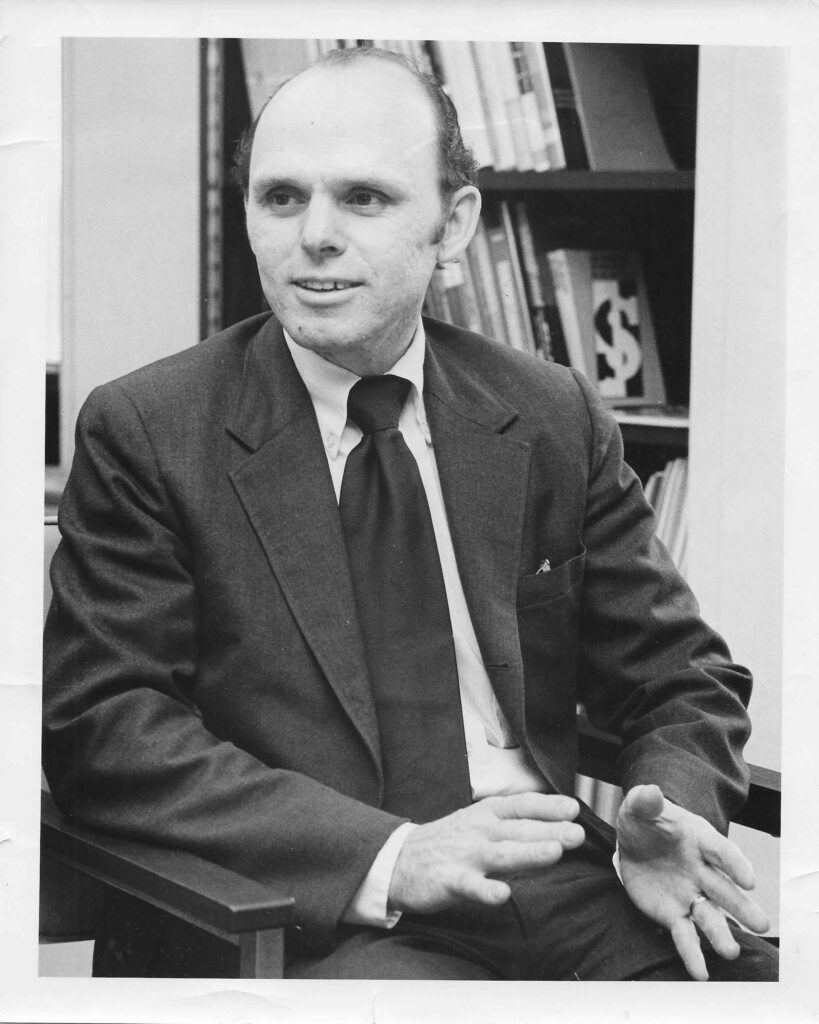
“First, I would get a graduate assistant, and second, economics professors would not be required to give large lectures.” However, Peake, recalls, “For the first economics course offered in 1967, we expected 30 or 40 students and, to our surprise, 170 students enrolled and we were compelled to offer a large lecture.”
Peake prioritized getting to know his students and engaging them in the learning process, says Joseph Gallagher ’93, economics. “As a student, the first thing Dr. Peake did was give you agency,” recalls Gallagher. “‘Mr. Gallagher, what are your thoughts on this?’ He did this with all his students. By empowering his students, it conveyed a gravity to his classes and made you take stock of your opinions and your own retention of concepts. Dr. Peake wanted you to be engaged in his class and wanted it to be a conversation.”
Of course, this type of classroom model is not really possible in a large lecture format. So, the emphasis quickly became recruiting additional faculty members to meet demand and decrease class sizes to support greater interaction between student and teacher. Peake set his sights high and started his recruitment efforts by contacting the department chairs of the top 10 economics programs in the country.
“Our strategy was to start with young faculty members who studied at the highest quality institutions,” says Peake. “Amazingly, our first six core faculty members did their graduate study at a top 10 economics program.”
The foundation for the economics department was in place. The students were eager to learn. The faculty members were young and ready to prove themselves. There was just one thing missing—a sense of community.
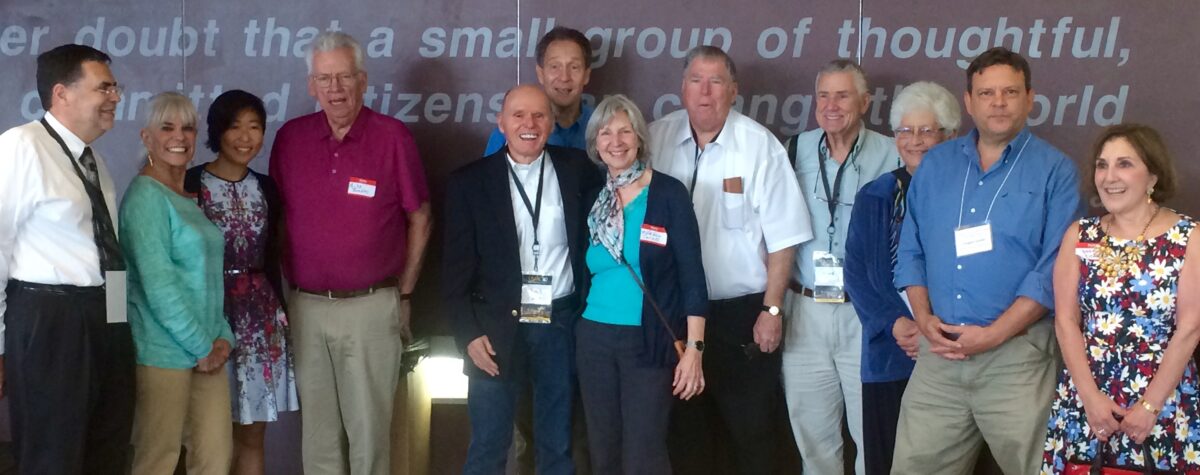 Peake and UMBC economics faculty from throughout the years return to the university to celebrate its 50th anniversary in 2016.
Building community beyond the classroom
“Dr. Peake was not only a great professor, role model, and mentor, but he was also very social and loved to have a good time,” says Donald Blair ’89, economics. “He definitely helped create a sense of strong culture within the economics department.”
Peake was instrumental in the formation of two student organizations: the Political Economy Club and the UMBC chapter of Omicron Delta Epsilon (ODE), an international economics honor society. He also sponsored the annual ODE banquet, when students were inducted into the honor society and awards were given out.
“This banquet was a major social event in the life of the department,” says Goldfarb.
At the banquet, recipients were also presented with the Gerald Goldman Scholarship, established in honor of an early economics major tragically killed during a summer construction project, the Omicron Delta Scholarship, and the Charles F. Peake Fund, established in honor of Peake by the UMBC Economics and Administrative Sciences Alumni Association, Inc. (EASAA).
Another endowment honoring Peake—the Charles F. Peake Endowment for Economics—was later started by Jack Mullen, III ’72, economics, the first UMBC alumnus to work on Wall Street, along with his wife, Carol Mullen ’70, American studies. This endowment helped establish the annual Mullen Lectures, which bring top economic minds from across the country to speak at UMBC.
As part of his community-building project, Peake began hosting social gatherings for the Political Economy Club and ODE at his home. He would cook a ham and students would bring various dishes for what Peake called a “Tennessee-style dinner.” One summer, he held a crab feast at his home to help educate out-of-state students on the culinary benefits of the Maryland blue crab.
“He was trying very hard to make UMBC more than just a commuter school,” says Colyer who, like Blair and Gallagher, credits Peake with much of his career success. “I definitely benefited from his getting to know me,” he says.
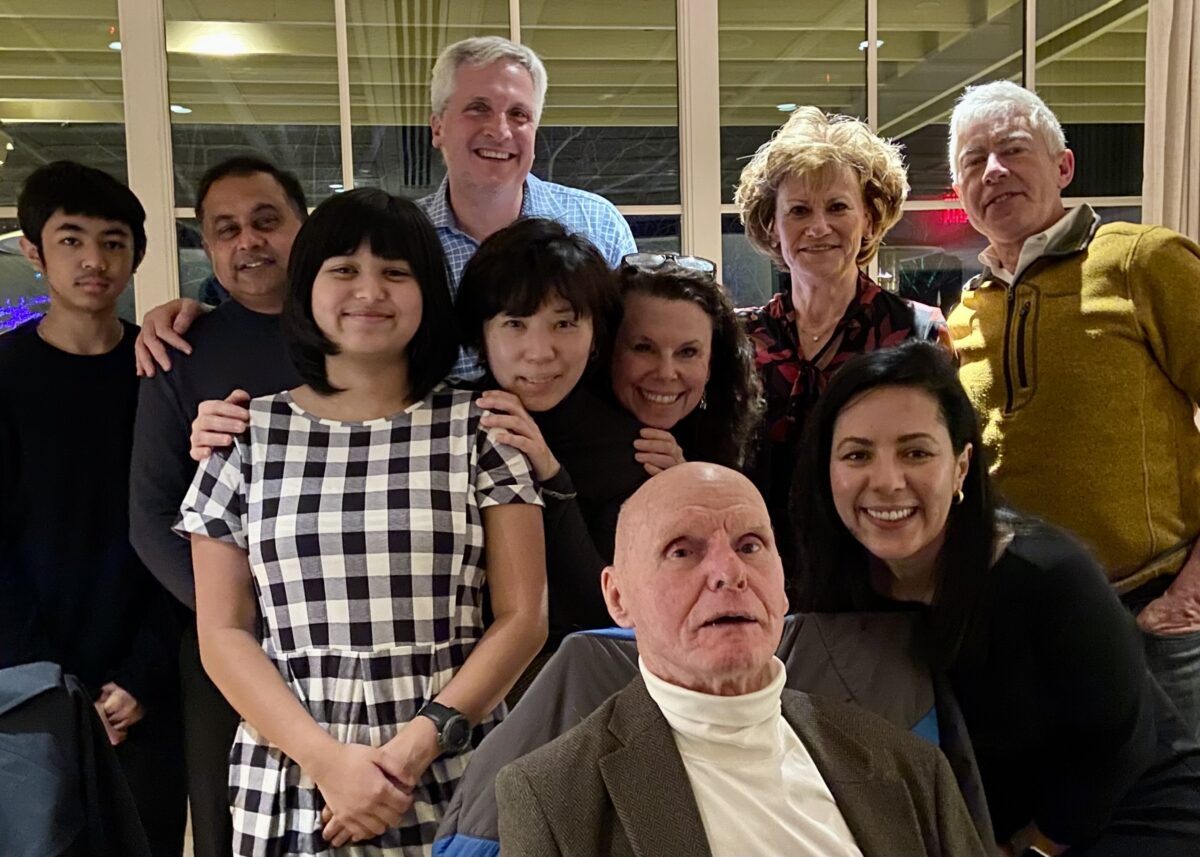 Peake on his 90th birthday surrounded by family, friends, and former students.
Credit where credit is due
“My office used to be down the hall from his office, and I just recall a line of students and alumni stopping by to hang out,” says David Mitch, current UMBC economics department chair.
“Dr. Peake helped me straighten up my life,” says Colyer, who had nearly failed out of another institution before transferring to UMBC. Today, Colyer is the director of research at The Ithaka Group and still values Peake’s practical approach to advising and education. “You weren’t just going to get an econ degree,” says Colyer. “Dr. Peake took some personal responsibility in making sure you had a career after graduation.”
Blair, who is now an investment banker at Raymond James, had a similar experience at UMBC. “I give Dr. Peake tons of the credit for steering me in the direction that completely influenced my career,” he says. “I was late to the job recruitment cycle, and Dr. Peake made calls on my behalf to the big four accounting firms at the time and was able to get me an interview and eventually a job at KPMG in Baltimore.”
“Dr. Peake’s influence went well beyond the classroom,” says Patricia Rudolph ’72, economics. “I believe that Dr. Peake’s help and guidance made my career possible. I had the vague idea that I wanted to be a college professor but I had no idea what I needed to do to achieve that goal. Dr. Peake took the time to help me through the entire process of applying for admission to a Ph.D. program.”
“He probably wrote more recommendations for grad school than any other professor,” says Colyer, who reconnected with Blair in the same MBA program at the University of Virginia.
 Peake spending time with his great grandchildren, Charlie and Cabell.
Innovating after retirement
Not even retirement can slow down a man like Peake. In fact, what he calls his “most important academic contribution to UMBC” didn’t even occur until 2001—two years after retiring—when the economics department launched its second major, the B.S. in financial economics, to go along with the traditional B.A. in economics.
“I spent about a decade preparing the proposed major,” says Peake. “With this credential, graduates found that it opened doors to Wall Street and other real-world pursuits well beyond academia.”
“Financial economics became extremely popular,” says Goldfarb. “And, before long, it attracted more students than the B.A.”
While Peake points to the B.S. as his most important academic contribution to UMBC, his former students know his kind nature and love for his students is his real legacy.
“He was always very supportive of his students and wanted the best for us,” says Blair.
“He always had time for everyone,” says Colyer, who was honored to have Dr. Peake attend his wedding.
“He is just a vessel of pure goodness,” adds Gallagher.
]]>
As Charles “Chuck” Peake celebrated his 90th birthday late one December evening in 2022, a contingent of middle-aged investors, bankers, and academics—Retriever alumni of various decades—were...
https://umbc.edu/stories/chuck-peake-pioneer-of-umbcs-economics-program/
https://my3.my.umbc.edu/api/v0/pixel/news/141827/guest@my.umbc.edu/c6986c0705e40bc34743fbc242e8cda6/api/pixel
cahss
economics
financial-economics
impact
magazine
spring-2024
story
umbc-history
UMBC News & Magazine
https://my3.my.umbc.edu/groups/umbc-news-magazine
https://assets1-my.umbc.edu/system/shared/avatars/groups/000/001/943/24435aa6207c452e7bc15cc74b42c7bb/xsmall.png?1748556657
https://assets1-my.umbc.edu/system/shared/avatars/groups/000/001/943/24435aa6207c452e7bc15cc74b42c7bb/original.png?1748556657
https://assets2-my.umbc.edu/system/shared/avatars/groups/000/001/943/24435aa6207c452e7bc15cc74b42c7bb/xxlarge.png?1748556657
https://assets2-my.umbc.edu/system/shared/avatars/groups/000/001/943/24435aa6207c452e7bc15cc74b42c7bb/xlarge.png?1748556657
https://assets3-my.umbc.edu/system/shared/avatars/groups/000/001/943/24435aa6207c452e7bc15cc74b42c7bb/large.png?1748556657
https://assets1-my.umbc.edu/system/shared/avatars/groups/000/001/943/24435aa6207c452e7bc15cc74b42c7bb/medium.png?1748556657
https://assets2-my.umbc.edu/system/shared/avatars/groups/000/001/943/24435aa6207c452e7bc15cc74b42c7bb/small.png?1748556657
https://assets1-my.umbc.edu/system/shared/avatars/groups/000/001/943/24435aa6207c452e7bc15cc74b42c7bb/xsmall.png?1748556657
https://assets2-my.umbc.edu/system/shared/avatars/groups/000/001/943/24435aa6207c452e7bc15cc74b42c7bb/xxsmall.png?1748556657
UMBC News & Magazine
0
0
false
Wed, 08 May 2024 14:38:47 -0400
Wed, 08 May 2024 14:38:47 -0400
COEIT convenes inaugural research day to encourage interdisciplinary collaborations

On April 19, more than 150 people gathered for the inaugural College of Engineering and Information Technology (COEIT) Research Day. The event was an opportunity for faculty and students to showcase their research and forge interdisciplinary collaborations, including with potential industry partners in attendance. Close to 100 COEIT researchers presented work, either in talks during four concurrent morning sessions or in the afternoon poster session.
“We are asking you to see how you can get together and solve major societal problems,” said Anupam Joshi, acting dean of COEIT, in opening remarks.
To incentivize such collaboration, COEIT is offering funding to teams that propose projects involving researchers from two or more of the colleges’ departments.
“The day was very well attended and several folks made new connections across departments in COEIT,” said Vandana Janeja, the associate dean for research and faculty development in COEIT. “I am already seeing a lot of interest in the interdisciplinary proposals.”
For Tasnim Nishat Islam, a Ph.D student in computer engineering, the day was a great chance to share her work and engage with other researchers. Islam presented a poster about research she is conducting with Mohamed Younis, computer science and electrical engineering, investigating ways to measure mental stress. “I’ve already connected with others who study similar ideas,” she said.
]]>
On April 19, more than 150 people gathered for the inaugural College of Engineering and Information Technology (COEIT) Research Day. The event was an opportunity for faculty and students to...
https://umbc.edu/quick-posts/coeit-research-day/
https://my3.my.umbc.edu/api/v0/pixel/news/141819/guest@my.umbc.edu/43f9e61f7f2d47aa5f7775ff02158c27/api/pixel
cbee
coeit
csee
is
meche
news
quick-post
research
science-and-tech
UMBC News & Magazine
https://my3.my.umbc.edu/groups/umbc-news-magazine
https://assets1-my.umbc.edu/system/shared/avatars/groups/000/001/943/24435aa6207c452e7bc15cc74b42c7bb/xsmall.png?1748556657
https://assets1-my.umbc.edu/system/shared/avatars/groups/000/001/943/24435aa6207c452e7bc15cc74b42c7bb/original.png?1748556657
https://assets2-my.umbc.edu/system/shared/avatars/groups/000/001/943/24435aa6207c452e7bc15cc74b42c7bb/xxlarge.png?1748556657
https://assets2-my.umbc.edu/system/shared/avatars/groups/000/001/943/24435aa6207c452e7bc15cc74b42c7bb/xlarge.png?1748556657
https://assets3-my.umbc.edu/system/shared/avatars/groups/000/001/943/24435aa6207c452e7bc15cc74b42c7bb/large.png?1748556657
https://assets1-my.umbc.edu/system/shared/avatars/groups/000/001/943/24435aa6207c452e7bc15cc74b42c7bb/medium.png?1748556657
https://assets2-my.umbc.edu/system/shared/avatars/groups/000/001/943/24435aa6207c452e7bc15cc74b42c7bb/small.png?1748556657
https://assets1-my.umbc.edu/system/shared/avatars/groups/000/001/943/24435aa6207c452e7bc15cc74b42c7bb/xsmall.png?1748556657
https://assets2-my.umbc.edu/system/shared/avatars/groups/000/001/943/24435aa6207c452e7bc15cc74b42c7bb/xxsmall.png?1748556657
UMBC News & Magazine
1
0
false
Wed, 08 May 2024 12:50:07 -0400
Wed, 08 May 2024 12:50:07 -0400
How 19th-century Spiritualists ‘canceled’ the idea of hell to address social and political concerns

Written by Lindsay DiCuirci, associate professor of English at UMBC.
Between Columbus and Cincinnati, Ohio, drivers pass a billboard on Interstate 71 that has achieved some internet fame.
Since 2004, a black sign has risen from this flat stretch of highway declaring “HELL IS REAL.” The H in “Hell” is painted in red, a color Christians have long associated with sin and Satan.
The developer who erected the warning, Jimmy Harston, has similar signs scattered across the Midwest, including ones that ask, “If you died today, where would you spend eternity?”
For years, this confrontational sign was mostly a local attraction. But it gained wider notoriety when Ohio’s two Major League Soccer teams, Columbus Crew and FC Cincinnati, dubbed their 2017 matchup “Hell is Real.” The sign has now spawned TikTok content, T-shirt designs, mugs and decals. But it also reflects a genuine belief in hell held by a majority of Americans today, though the numbers are slipping.
A 2023 Gallup poll found that 59% of respondents believe in hell, while 67% believe in heaven. The numbers for hell belief are far higher among those who identify as Protestant Christians (81%) and Republicans (79%).
Hell belief is holding steady in the U.S., but this was not always the case. In my research on spirit communication in 19th century American culture, I have found an organized effort to “cancel” hell by Spiritualists, who made up the fastest-growing religious movement of the century.
Spiritualists believed that people could maintain communication with the living even after death. They thought communicative spirits had a principal role to play in addressing the era’s most pressing social and political concerns, which would be impossible if souls were damned. This idea was a cornerstone of their practice and a driver of their politics.
Hell hath no fury
Many traditions, including Catholic Christianity, have beliefs about eternal destiny, but Protestant beliefs predominated in America’s settler colonies.
Puritan minister Michael Wigglesworth’s epic and best-selling poem “Day of Doom,” written in 1666, scared generations of believers with its vivid depiction of “yonder Lake,/where Fire and Brimstone flameth.”
A century later, revivalist minister Jonathan Edwards warned of the “dreadful pit of the glowing flames of the wrath of God” awaiting the unrepentant.
On the edges of organized religion, though, were believers interested in alternative afterlives. Swedish theologian and scientist Emmanuel Swedenborg, for example, speculated in 1758 that “The world of spirits is not heaven, nor is it hell; but it is a place or state intermediate between the two.”
Swedenborg’s ideas gained public traction in the U.S. after sisters Kate and Margaret Fox of Hydesville, New York, reported “rapping” and “knocking” sounds in their home. The knocking seemed responsive to the sisters’ questions, and they soon claimed that they could hold conversations with the deceased. Rising from this domestic drama was a national and international phenomenon that recalibrated people’s relationship with death and offered a balm to the grieving.
Some of the Foxes’ first advocates were Quaker activists Isaac and Amy Post. Isaac Post became a writing medium, recording alleged spirit communications from luminaries like George Washington and Napoleon Bonaparte and also everyday people.
 An 1841 painting ‘Pandemonium’ by John Martin, based on John Milton’s ‘Paradise Lost,’ where Pandemonium is the capital of Hell. John Martin via Wikimedia Commons
Spiritualists held that after shedding the body in death, the spirit would continue on a celestial journey. A spirit’s assignment was to help those still in their bodies to create a better, more just world. Through mediums, séances and object manipulation, spirits were believed to be able to enlighten the living by giving them a glimpse into life on a broader plane of existence.
Spiritualists felt that embodied life was narrow and full of biases, wants, needs and conflicts. In his 1850 book, “Singular Revelations,” spirit medium Eliab W. Capron recorded an insight he claimed to receive from the spirit of radical Methodist preacher Lorenzo Dow, who had died 14 years prior: “The Presbyterians say hell is a place of fire and brimstone that burns the soul forever. This is not so. The Hell is man’s own body, and when he escapes from that he escapes from bondage.”
Fires of reform
In neutralizing the threat of hell, Spiritualists believed that even deeply corrupted spirits could spur the living toward progressive reforms.
In an 1858 gathering of self-described “friends of free thought” in Vermont known as the Rutland Free Convention, Spiritualists and social reformers debated the question of hell vis-a-vis issues like slavery, the death penalty and maternity.
Lecturer and clairvoyant Andrew Jackson Davis cheekily announced to the Rutland crowd, “Hell has undergone the most extensive alterations and improvements” in the hands of Spiritualists. By caring “less about the fear of the devil, and more about the actual necessity of goodness,” people could act expediently to address real social problems rather than fight what Davis considered imaginary ones.
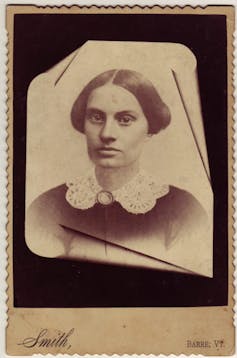 Spirit medium Achsa Sprague. vtdigger/via Wikimedia Commons
Spirit medium Ascha Sprague linked hell belief to the persistence of capital punishment in American jurisprudence, asking, “Who blames man that he hangs his brother between heaven and earth, when he has been taught to believe that the Almighty God, infinite in power and wisdom, will in a moment plunge him into a burning pit, and save him never?”
In other words, Spiritualists warned that the idea of hell allowed people to remain complacent: Let hell punish the brutal enslaver, the cruel prison warden, the merciless factory foreman, the abusive husband. Hell gave believers a way to escape the responsibility of addressing burning social ills in the here and now. By relinquishing the “bottomless pit, which they have been taught to believe in,” Isaac Post quoted a spirit saying, a new ethos of urgent and sweeping reform could materialize.
Even today, some spiritual activists consider hell belief an impediment to systemic social change. For example, prison abolitionist Hannah Bowman wrote in a 2023 collection on spirituality and abolition, “Insofar as hell is defined by coercion/confinement, separation, and retribution, it is to some degree related to any societal and state interventions reliant upon those practices.”
To hell and back
Putting out the fires of hell was not easy in the 19th century U.S., especially at the outbreak of the Civil War when mass death fed apocalyptic rhetoric. The promise of God’s “terrible swift sword” of judgment was sung out in the canonical words of suffragist Julia Ward Howe’s “Battle Hymn of the Republic.”
Spiritualism’s popularity waxed and waned after the war, and its reformist leanings largely faded. Mass casualty events like war and flu led to periodic revivals, especially of séance culture. But hell belief in America ultimately held steady and reignited by the middle of 20th century.
The reasons for this range from a decline in religious belief between the world wars to a religious revival following them, and the horrors of war itself. In his 1949 memoir, “To Hell and Back,” World War II 2nd Lt. Audie Murphy recounts a fellow soldier’s impromptu verses; “Oh, gather round me comrades and listen while / I speak / Of a war, a war, a war, where hell is six feet deep.” Hell was everywhere.
Cornell University’s Roper Center poll from 1957 – in the thick of the Cold War – found that 74% of Americans polled believed in an afterlife, but 84% felt that the dead were uncommunicative. These modern trends indicate that hell belief captures the zeitgeist of an era. It ebbs and flows along with attitudes about justice, human suffering and even the health of the planet.
The “Hell is Real” sign has experienced a similar flux. Last summer, street artist LISP pasted a cutout of a cartoonish red devil on the highway sign and shared the covert operation on Instagram. “Is nothing sacred?” one user asked, riffing on the sign’s iconic, if peculiar, status. The sign has since been replaced with a fresh one, a visible reminder that for some people, hell belief will never die.
This article is republished from The Conversation under a Creative Commons license. Read the original article and see more than 250 UMBC articles available in The Conversation.
]]>
Written by Lindsay DiCuirci, associate professor of English at UMBC. Between Columbus and Cincinnati, Ohio, drivers pass a billboard on Interstate 71 that has achieved some internet fame....
https://umbc.edu/stories/how-19th-century-spiritualists-canceled-the-idea-of-hell/
https://my3.my.umbc.edu/api/v0/pixel/news/141815/guest@my.umbc.edu/e9493bcec1f98516a303036504fe50b3/api/pixel
cahss
cahss-research
discovery
english
magazine
research
story
the-conversation
UMBC News & Magazine
https://my3.my.umbc.edu/groups/umbc-news-magazine
https://assets1-my.umbc.edu/system/shared/avatars/groups/000/001/943/24435aa6207c452e7bc15cc74b42c7bb/xsmall.png?1748556657
https://assets1-my.umbc.edu/system/shared/avatars/groups/000/001/943/24435aa6207c452e7bc15cc74b42c7bb/original.png?1748556657
https://assets2-my.umbc.edu/system/shared/avatars/groups/000/001/943/24435aa6207c452e7bc15cc74b42c7bb/xxlarge.png?1748556657
https://assets2-my.umbc.edu/system/shared/avatars/groups/000/001/943/24435aa6207c452e7bc15cc74b42c7bb/xlarge.png?1748556657
https://assets3-my.umbc.edu/system/shared/avatars/groups/000/001/943/24435aa6207c452e7bc15cc74b42c7bb/large.png?1748556657
https://assets1-my.umbc.edu/system/shared/avatars/groups/000/001/943/24435aa6207c452e7bc15cc74b42c7bb/medium.png?1748556657
https://assets2-my.umbc.edu/system/shared/avatars/groups/000/001/943/24435aa6207c452e7bc15cc74b42c7bb/small.png?1748556657
https://assets1-my.umbc.edu/system/shared/avatars/groups/000/001/943/24435aa6207c452e7bc15cc74b42c7bb/xsmall.png?1748556657
https://assets2-my.umbc.edu/system/shared/avatars/groups/000/001/943/24435aa6207c452e7bc15cc74b42c7bb/xxsmall.png?1748556657
UMBC News & Magazine
0
0
false
Wed, 08 May 2024 12:11:32 -0400
Wed, 08 May 2024 12:11:32 -0400
UMBC’s first Fulbright Scholar-in-Residence shares unique research on neurodiversity in language teaching and learning

Neurodiversity inclusion and representation have been at the forefront of Michael Canale’s 20-year career in the disability services and education field. Canale, M.A. ’24, intercultural communication, is the assistant director of UMBC’s Office of Student Disability Services and teaches the first-year seminar Introduction to Disability Studies. “Sometimes parents of neurodivergent students worry that their child is incapable of learning another language,” says Canale. “I work with parents to ease their fears by showing them how their child can excel in college with the proper individualized accommodations.” These can include note-taking software, counseling services, tutoring, time management support, and more.
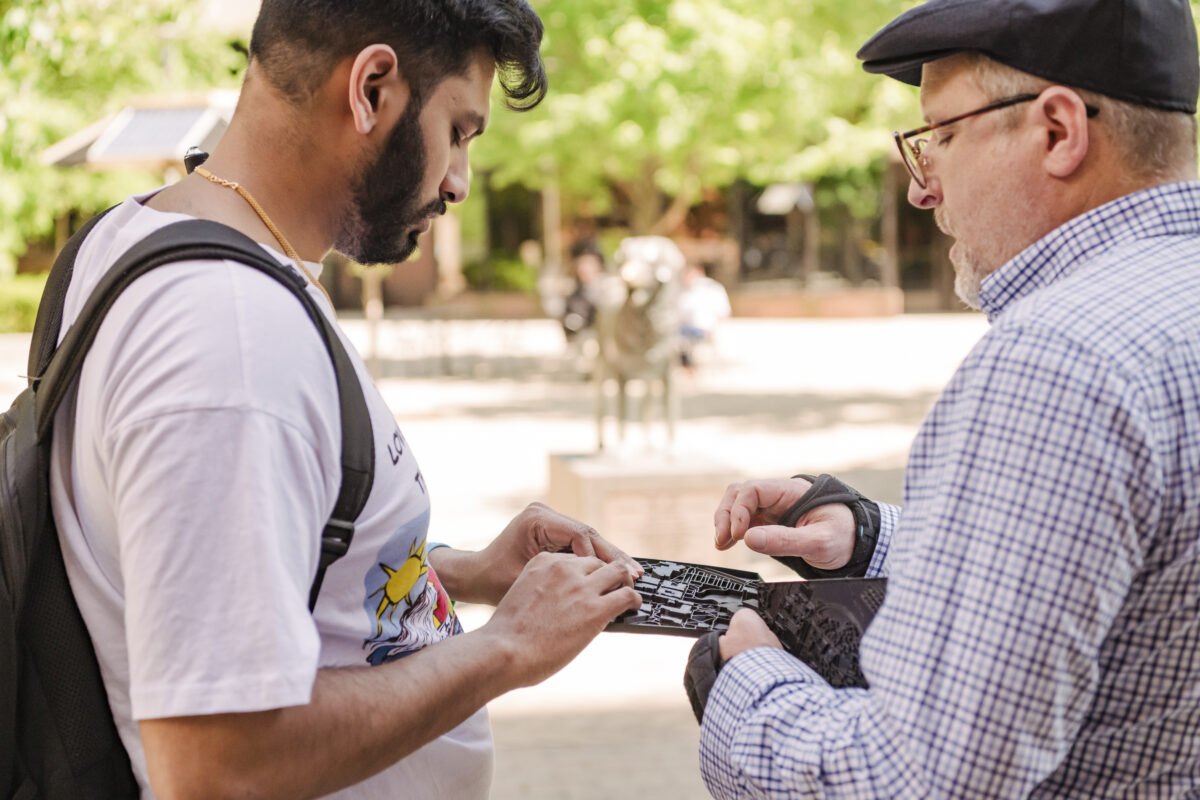 Michael Canale (r) has been working with Ph.D. students in human-centered computing to create personal tactile maps of campus for blind students at UMBC, like Shawn Abraham ’24, political science. (Marlayna Demond ’11/UMBC)
When Canele, who also received his post-master’s certificate in college teaching and learning science, heard that UMBC’s first Fulbright Scholar-in-Residence, Jules Buendgens-Kosten,would be teaching Language Learning and Special Education – Advanced Special Topics in Education, he was quick to enroll. The course, part of UMBC’s teaching English to speakers of other languages (TESOL) master’s program, was designed for anybody planning to work with heterogeneous groups of learners, including those of different neurotypes, both in special education and mainstream education settings.
Buendgens-Kosten, a research assistant at the Institute of English and American Studies at Goethe-Universität Frankfurt, Germany,began theirpartnership with UMBC as a research collaboration with Shannon Sauro, associate professor of education.Sauro recognized that Buendgens-Kosten’s expertise in English language teaching and teaching neurodivergent populations in Germany would add an international and non-U.S.-based perspective to UMBC’s TESOL program and education department.
My uni (@UMBC) just got so much geekier and cooler.
]]>
Neurodiversity inclusion and representation have been at the forefront of Michael Canale’s 20-year career in the disability services and education field. Canale, M.A. ’24, intercultural...
https://umbc.edu/stories/umbcs-first-fulbright-scholar-in-residence-research-on-neurodiversity/
https://my3.my.umbc.edu/api/v0/pixel/news/141776/guest@my.umbc.edu/9db27eba31ba49267d43df7a734d3ec0/api/pixel
cahss
cahss-research
coeit
community
education
fulbright
mlli
news
peaceworker
politicalscience
research
story
tesol
UMBC News & Magazine
https://my3.my.umbc.edu/groups/umbc-news-magazine
https://assets1-my.umbc.edu/system/shared/avatars/groups/000/001/943/24435aa6207c452e7bc15cc74b42c7bb/xsmall.png?1748556657
https://assets1-my.umbc.edu/system/shared/avatars/groups/000/001/943/24435aa6207c452e7bc15cc74b42c7bb/original.png?1748556657
https://assets2-my.umbc.edu/system/shared/avatars/groups/000/001/943/24435aa6207c452e7bc15cc74b42c7bb/xxlarge.png?1748556657
https://assets2-my.umbc.edu/system/shared/avatars/groups/000/001/943/24435aa6207c452e7bc15cc74b42c7bb/xlarge.png?1748556657
https://assets3-my.umbc.edu/system/shared/avatars/groups/000/001/943/24435aa6207c452e7bc15cc74b42c7bb/large.png?1748556657
https://assets1-my.umbc.edu/system/shared/avatars/groups/000/001/943/24435aa6207c452e7bc15cc74b42c7bb/medium.png?1748556657
https://assets2-my.umbc.edu/system/shared/avatars/groups/000/001/943/24435aa6207c452e7bc15cc74b42c7bb/small.png?1748556657
https://assets1-my.umbc.edu/system/shared/avatars/groups/000/001/943/24435aa6207c452e7bc15cc74b42c7bb/xsmall.png?1748556657
https://assets2-my.umbc.edu/system/shared/avatars/groups/000/001/943/24435aa6207c452e7bc15cc74b42c7bb/xxsmall.png?1748556657
UMBC News & Magazine
0
0
false
Tue, 07 May 2024 13:43:48 -0400
Tue, 07 May 2024 13:43:48 -0400

