CAHSS dean establishes a $400,000 education abroad scholarship

CAHSS students, are you ready to study abroad? Kimberly Moffitt, dean of the College of Arts, Humanities, and the Social Sciences (CAHSS), has established the CAHSS Dean’s Education Abroad Scholarship.
The scholarship guarantees $100,000 per year for the next four years to help offset the financial costs of studying abroad. Undergraduate and graduate students with at least one major in CAHSS, and who need additional financial support to study abroad can apply for awards ranging from $1,500 – $5,000. The inaugural round of scholarships have been awarded to 24.

Joseph Patarini ’25, environmental science and geography, is one of the CAHSS Dean’s Education Abroad Scholarship recipients. “Studying abroad is important to me because gaining a diverse global perspective is paramount to solving today’s top environmental issues. By getting outside of our comfort zone and exploring new academic opportunities we can deepen our understanding of global interconnectedness,” says Patarini, who will study in Morocco and Spain in summer 2024., “We can learn from new, diverse perspectives to enhance our problem-solving skills, contributing to a more holistic and adaptable approach.”
This grant makes it possible for me to study abroad and make the most of my undergrad experience,” says Ria Smith ’25, dance, CAHSS Dean’s Education Abroad Scholarship summer 2024 recipient to Italy. “I really appreciate how the College of Arts, Humanities, and Social Sciences is showing real commitment to the value of international exposure.”
For additional eligibility details contact the Education Abroad Office at educationabroad@umbc.edu. Scholarship applications for the 2024 – 2025 academic year are due September 10, 2024.
]]>
CAHSS students, are you ready to study abroad? Kimberly Moffitt, dean of the College of Arts, Humanities, and the Social Sciences (CAHSS), has established the CAHSS Dean’s Education Abroad...
https://umbc.edu/quick-posts/cahss-dean-education-abroad-scholarship/
https://my3.my.umbc.edu/api/v0/pixel/news/141222/guest@my.umbc.edu/69a323760ee9a2596adffce703ae297f/api/pixel
cahss
cge
community
international
news
quick-post
UMBC News & Magazine
https://my3.my.umbc.edu/groups/umbc-news-magazine
https://assets1-my.umbc.edu/system/shared/avatars/groups/000/001/943/24435aa6207c452e7bc15cc74b42c7bb/xsmall.png?1748556657
https://assets1-my.umbc.edu/system/shared/avatars/groups/000/001/943/24435aa6207c452e7bc15cc74b42c7bb/original.png?1748556657
https://assets2-my.umbc.edu/system/shared/avatars/groups/000/001/943/24435aa6207c452e7bc15cc74b42c7bb/xxlarge.png?1748556657
https://assets2-my.umbc.edu/system/shared/avatars/groups/000/001/943/24435aa6207c452e7bc15cc74b42c7bb/xlarge.png?1748556657
https://assets3-my.umbc.edu/system/shared/avatars/groups/000/001/943/24435aa6207c452e7bc15cc74b42c7bb/large.png?1748556657
https://assets1-my.umbc.edu/system/shared/avatars/groups/000/001/943/24435aa6207c452e7bc15cc74b42c7bb/medium.png?1748556657
https://assets2-my.umbc.edu/system/shared/avatars/groups/000/001/943/24435aa6207c452e7bc15cc74b42c7bb/small.png?1748556657
https://assets1-my.umbc.edu/system/shared/avatars/groups/000/001/943/24435aa6207c452e7bc15cc74b42c7bb/xsmall.png?1748556657
https://assets2-my.umbc.edu/system/shared/avatars/groups/000/001/943/24435aa6207c452e7bc15cc74b42c7bb/xxsmall.png?1748556657
UMBC News & Magazine
12
0
false
Tue, 23 Apr 2024 08:33:22 -0400
Tue, 23 Apr 2024 08:33:22 -0400
Sharing the beat of his own drum—Connor LeFevre ’23 finds success through UMBC’s music tech program

On a chilly February night, some of the most dedicated local music fans pile in for a floor show at a small grunge venue, Baltimore’s Ottobar. Tonight it’s a stacked indie bill and not one person seems to trickle in late, as they don’t want to miss a minute of the long night of live music ahead.
When the first band, Lean Tee, takes the floor and begins playing, the mood of the room shifts from anticipation to excitement. Connor LeFevre ’23, music technology, sits behind the drum kit in the center. Lean Tee’s music is full of hard-hitting drum beats, but LeFevre easily supports the rhythms of the guitar and bass without overshadowing either. His sticks complement the unmodulated and fervent sounds of the vocals.
This show and this energy represent a pretty typical night for LeFevre, as he has completely centered his life around music—a career move, he said, made possible by his major at UMBC, which gave him full-time access to recording spaces and instructors who remain active in their musical fields.
Lean Tee performing at the Ottobar.
Finding the rhythm of Baltimore’s music scene
Originally from New Jersey, LeFevre had to do some groundwork to find his way into the Baltimore music scene. He is currently a drummer for multiple local Baltimore bands—he wields his sticks for Lean Tee (indie rock), Love For Strangers (prog rock), and Curver (shoegaze), to name a few. He also works at a Hampden, Baltimore, music studio, The Moose House, as a junior engineer.
“Drumming is really fun for me, especially with bands that I’m fully involved in. But bands can be a lot,” says LeFevre. Playing so many different gigs requires him to memorize sets on tight turnaround times. “But recording is a lot less stressful. The client’s paying a lot of money, so you want to deliver them the best product possible. but it’s calmer in the moment because it’s a lot of smaller, micro decisions,” he says.
LeFevre goes for an uncomplicated personal style—usually a baggy t-shirt, hat, and glasses, easily fitting in with musicians in the indie scene. And while he may come off as laid back, music is something he takes seriously. He has been playing drums for roughly 10 years and first became interested in recording when he was in high school. “That’s when I bought my first recording interface and the first set of mics. And that was just to record drums to make demos,” he says. Eventually, he knew music tech was something he wanted to study in college.
Making musical connections
A deciding factor for LeFevre in attending the music technology program at UMBC was the studio space provided for students. “You have 24-hour access to the studio and you can use it for anything you want once you reach a certain year,” LeFevre says, and this alone made it worth it to come out of state. “Once you’re a sophomore in the program, you can use the whole thing—whenever you want, for free!”
LeFevre credits UMBC for making multiple connections for him. For one, he met all of the original members of Love For Strangers at UMBC. He says, “When lockdown started loosening up, I wanted to start a band, and I saw Jeff Hirshman during a Zoom class—he was practicing during class—and I was like, ‘Oh, that’s the person I want to be in a band with!’ Because they don’t care about anything but music, obviously.”
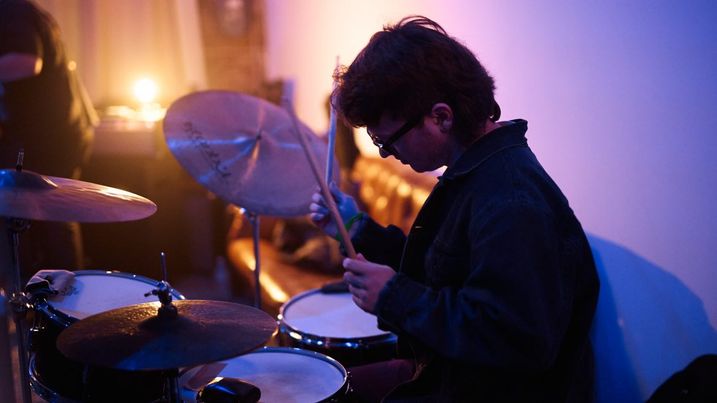 Photo by Nick Huges.
Hirshman, now the band’s main songwriter, recalls their encounter similarly, and after jamming together for the first time, they decided to start making music together. “I met Connor because we were in the same online music theory class during COVID,” says Hirshman ’24, music technology. “I would practice guitar in class, and he thought I seemed like a good rock guitarist. So he DM’ed me, and we met with a bassist and jammed, and we started writing music right away.”
Hirshman humorously remarks, “He was the first drummer I ever met who cared enough about drums to clean them.”
The community makes the program
During his time at UMBC, LeFevre appreciated the styles and output of many of his music technology professors. “Eric Taft, Alan Wonneberger, and Greg Kalember—all three of them had works that I really respected. Eric made a lot of records that had a big impact on me as a kid growing up,” says LeFevre “And then, Greg did things like the Pokémon movie soundtrack. So, a lot of the things they’d done, I had heard in my life without even knowing.”
Along with his professional accomplishments, Kalember brings his enthusiasm for teaching into the classroom. While he acknowledges that there are many new challenges in the ever-changing music tech industry, Kalember notes that the music community at UMBC presents an antidote to some of these modern problems.
“There is no substitute for being part of a music-making community every day for four years. You don’t get that on YouTube, or by working by yourself on your laptop,” says Kalember.
“Students will learn more by osmosis—by being around other students and faculty over their years here. There are all sorts of lessons to be learned about networking, being part of a collaboration, putting together a project and seeing it through, trying to convince other people to get on board with your vision, and setting your personal opinions aside in order to realize someone else’s creative vision,” says Kalember. “These are all key skills that I believe students need when trying to go out into the music industry.”
The music technology program gave LeFevre the ability to combine his outside projects with what he was learning in the classroom. For his senior project, he recorded a live video for his band Love For Strangers. “We recorded that at school,” he says, “and then the album that we’ve been sitting on, I also recorded that at UMBC.”
 Photo by Chris Daquino.
Kalember emphasizes the hands-on opportunities UMBC provides, “To work in the facilities at UMBC is a great advantage for our students. They have access to multiple studio spaces—each with its own quirks and advantages—our concert hall, networked performance spaces throughout the building, and an amazing collection of instruments,” he explains.
Kalember is also delighted to see all that LeFevre has accomplished. “I can say that I’ve seen tremendous progress in his drumming since I’ve been here. He was good the first time I saw him play, but he’s really made some strides from there and is playing at a very high level now,” says Kalember. “He’s really bought into the idea that collaborating is a big piece of success in the music industry, and he’s been very generous with his time and talents throughout our program. Everything I’ve seen him do both at UMBC and outside of school, has been executed with professionalism and skill.”
The music doesn’t stop after graduation
LeFevre has always kept himself busy with his projects. “I’ve played, like, pretty much every rock venue in this city,” he says. And things have been no different after graduating. He soon expects to put out an album with his UMBC band Love for Strangers, and he has many shows booked throughout the next few months.
Since graduating, LeFevre has been able to utilize his degree and the connections he’s made at UMBC in many ways. Tom Lagana, LeFevre’s guitar professor, helped him to get into a wedding group called Bachelor Boys Band, which is one of the many ways he is able to make a consistent income playing shows. But aside from playing shows in a multitude of bands and working at The Moose House, he also enjoys teaching recording and drums, as well as doing electronic repairs.
Back at the Ottobar, for the entirety of Lean Tee’s set, it’s evident how much precision and control LeFevre commands over the kit, a skill that becomes even more apparent as the final notes linger in the air. After a second’s pause after the last beat, the audience applauds.
*****
LeFevre will be on tour with Lean Tee during April and will also be playing multiple shows with Curver and Love for Strangers throughout both April and May. LeFevre suggests keeping up with these bands and other local live music through @baltshowplace on Instagram and Tumblr.
]]>
On a chilly February night, some of the most dedicated local music fans pile in for a floor show at a small grunge venue, Baltimore’s Ottobar. Tonight it’s a stacked indie bill and not one person...
https://umbc.edu/stories/beat-of-his-own-drum-connor-lefevre-music-tech/
https://my3.my.umbc.edu/api/v0/pixel/news/141064/guest@my.umbc.edu/3cecdd6b8cdce2599203e076670359de/api/pixel
alumni
cahss
campus-life
magazine
music
music-technology
story
UMBC News & Magazine
https://my3.my.umbc.edu/groups/umbc-news-magazine
https://assets1-my.umbc.edu/system/shared/avatars/groups/000/001/943/24435aa6207c452e7bc15cc74b42c7bb/xsmall.png?1748556657
https://assets1-my.umbc.edu/system/shared/avatars/groups/000/001/943/24435aa6207c452e7bc15cc74b42c7bb/original.png?1748556657
https://assets2-my.umbc.edu/system/shared/avatars/groups/000/001/943/24435aa6207c452e7bc15cc74b42c7bb/xxlarge.png?1748556657
https://assets2-my.umbc.edu/system/shared/avatars/groups/000/001/943/24435aa6207c452e7bc15cc74b42c7bb/xlarge.png?1748556657
https://assets3-my.umbc.edu/system/shared/avatars/groups/000/001/943/24435aa6207c452e7bc15cc74b42c7bb/large.png?1748556657
https://assets1-my.umbc.edu/system/shared/avatars/groups/000/001/943/24435aa6207c452e7bc15cc74b42c7bb/medium.png?1748556657
https://assets2-my.umbc.edu/system/shared/avatars/groups/000/001/943/24435aa6207c452e7bc15cc74b42c7bb/small.png?1748556657
https://assets1-my.umbc.edu/system/shared/avatars/groups/000/001/943/24435aa6207c452e7bc15cc74b42c7bb/xsmall.png?1748556657
https://assets2-my.umbc.edu/system/shared/avatars/groups/000/001/943/24435aa6207c452e7bc15cc74b42c7bb/xxsmall.png?1748556657
UMBC News & Magazine
1
0
false
Wed, 17 Apr 2024 16:25:01 -0400
Wed, 17 Apr 2024 16:25:01 -0400
UMBC partners with American Statistical Association to organize annual African International Conference on Statistics

The eighth iteration of the African International Conference on Statistics (AIC), scheduled for June 2024 in Tunis, Tunisia, will mark a new era for the conference. Originally championed by Bimal Sinha, UMBC professor of statistics, the first AIC took place in 2014 in Senegal. Each conference since has been held in a different African country in collaboration with local institutions.
In 2018, relationships that grew out of the conference led UMBC to sign a collaborative agreement with the University of Limpopo in South Africa to foster academic exchange. At that time, Yehenew Kifle, assistant professor of statistics, was a visiting professor at UMBC and a faculty member at the University of Limpopo. Today he has taken the helm of the AIC from the soon-to-retire Sinha, who remains a core member of the planning committee.
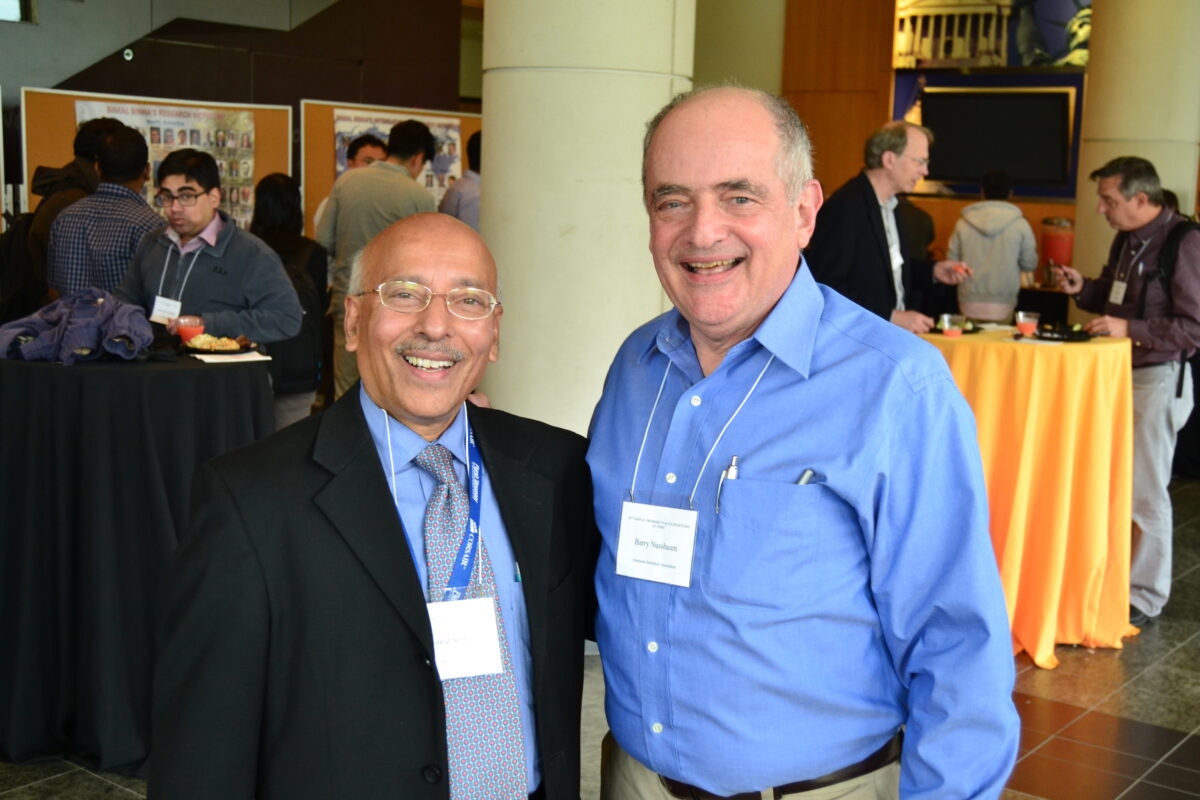 Bimal Sinha and Barry Nussbaum, former president of the American Statistical Association and current member of the AIC planning committee, at UMBC’s Probability and Statistics Day event in 2016. (Photo by Ricardo Moura)
This April, Kifle signed an agreement with the American Statistical Association (ASA) on behalf of UMBC that pledges financial support from the ASA for the conference for at least the next two years, with the possibility for an extended partnership.
“Through the African International Conference on Statistics, we achieved a significant milestone in 2018 by signing the first UMBC memorandum of understanding with an African university, which supports training for African students on a short- and long-term basis,” Kifle says. “Now we stand as partners with the world’s largest statistical association, the American Statistical Association. This partnership with ASA lays the foundation for great optimism about a promising future for the AIC.”
 Jesika Singh, University of Limpopo (center left), and Antonio Moreira, vice provost for academic affairs at UMBC (center right), sign the agreement between UMBC and the University of Limpopo in 2018.
The theme of the 2024 AIC is “Empowering Innovation: Advanced Statistics and Data Science for Sustainable Development in Africa.” The theme speaks to the power of statistics to support progress in areas like agriculture, economic development, and environmental conservation that are relevant to people all over the world.
“ASA is delighted to partner with UMBC on the African International Conference on Statistics,” shares Ronald Wasserstein, executive director of ASA. “The AIC has established itself as an important contributor to advancing statistical science in Africa. We hope ASA’s support will provide the opportunity for the creative and enthusiastic minds at UMBC to take the conference to still higher levels.”
]]>
The eighth iteration of the African International Conference on Statistics (AIC), scheduled for June 2024 in Tunis, Tunisia, will mark a new era for the conference. Originally championed by Bimal...
https://umbc.edu/stories/new-partnership-supports-african-international-conference-on-statistics/
https://my3.my.umbc.edu/api/v0/pixel/news/141065/guest@my.umbc.edu/bd641865df629d7f29b02e70aaba7084/api/pixel
cnms
mathstat
news
rca-2
science-and-tech
story
UMBC News & Magazine
https://my3.my.umbc.edu/groups/umbc-news-magazine
https://assets1-my.umbc.edu/system/shared/avatars/groups/000/001/943/24435aa6207c452e7bc15cc74b42c7bb/xsmall.png?1748556657
https://assets1-my.umbc.edu/system/shared/avatars/groups/000/001/943/24435aa6207c452e7bc15cc74b42c7bb/original.png?1748556657
https://assets2-my.umbc.edu/system/shared/avatars/groups/000/001/943/24435aa6207c452e7bc15cc74b42c7bb/xxlarge.png?1748556657
https://assets2-my.umbc.edu/system/shared/avatars/groups/000/001/943/24435aa6207c452e7bc15cc74b42c7bb/xlarge.png?1748556657
https://assets3-my.umbc.edu/system/shared/avatars/groups/000/001/943/24435aa6207c452e7bc15cc74b42c7bb/large.png?1748556657
https://assets1-my.umbc.edu/system/shared/avatars/groups/000/001/943/24435aa6207c452e7bc15cc74b42c7bb/medium.png?1748556657
https://assets2-my.umbc.edu/system/shared/avatars/groups/000/001/943/24435aa6207c452e7bc15cc74b42c7bb/small.png?1748556657
https://assets1-my.umbc.edu/system/shared/avatars/groups/000/001/943/24435aa6207c452e7bc15cc74b42c7bb/xsmall.png?1748556657
https://assets2-my.umbc.edu/system/shared/avatars/groups/000/001/943/24435aa6207c452e7bc15cc74b42c7bb/xxsmall.png?1748556657
UMBC News & Magazine
0
0
false
Wed, 17 Apr 2024 16:22:09 -0400
Wed, 17 Apr 2024 16:22:09 -0400
Inaugural CNMS Science Discovery Series hits the mark with community audience

The College of Natural and Mathematical Sciences (CNMS) hosted its first CNMS Science Discovery Series event on March 27. In this public series, CNMS faculty members present talks on a variety of scientific topics. The goal of the series is to give back to the community by offering an opportunity for non-experts to learn about the research happening in their backyards.
“I grew up with the Apollo moon landings and Carl Sagan’s Cosmos. They inspired me and countless others to dream of being a scientist, to ask questions, to explore the unknown and discover new knowledge,” shares CNMS Dean William R. LaCourse. “As a public university, I believe it is part of our mission to share our knowledge and passion for science with our community to inspire others to dream of a better and brighter future.”
More than 80 attendees came out to the Fine Arts Recital Hall on a rainy night to learn about “Life, But Not As We Know It” from the inaugural speaker, Stephen Freeland, professor of biological sciences. Freeland drew in the audience as he discussed how the 20 amino acids we call our “amino acid alphabet” here on Earth evolved. He also explained how his current research could help discover alternative amino acid alphabets that might exist elsewhere in the universe.
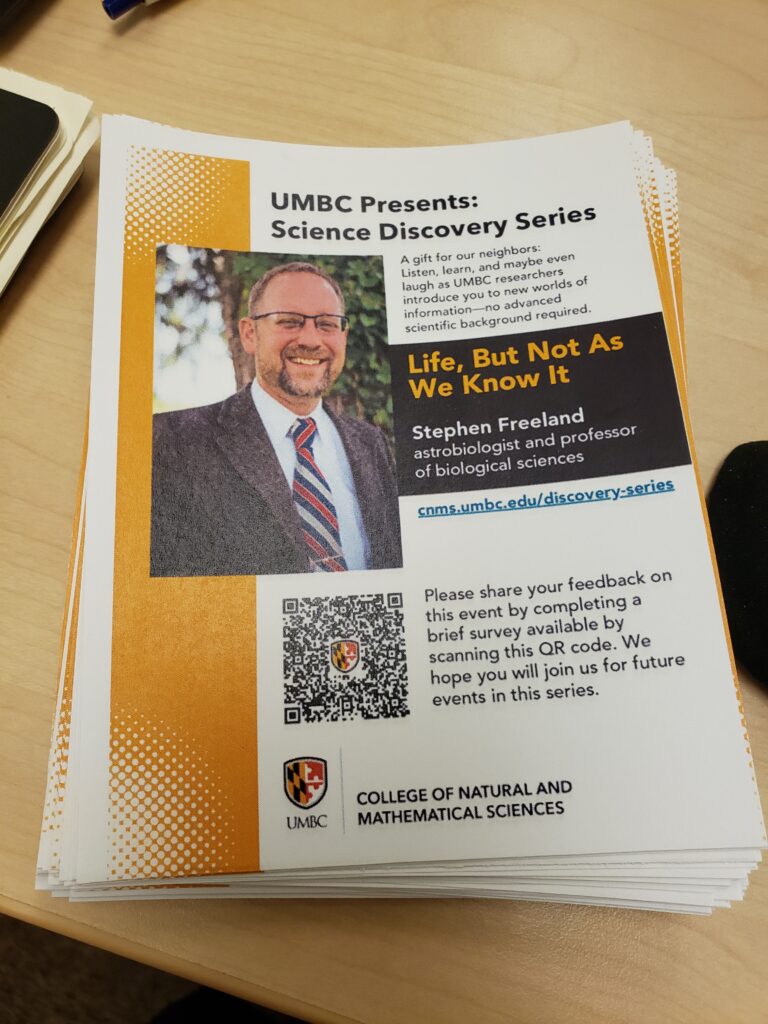
Audience members included families who had heard about the event through Catonsville Middle School, Mt. St. Joseph High School, and other local school and community organizations, as well as members of the UMBC community, including faculty, staff, and members of the UMBC Astronomy Club.
In the event evaluation form, one middle school teacher commented, “I loved the content and learned new things I hope to bring to my classroom.” Another attendee shared that the event “grew my curiosity. I plan to read more about amino acids and DNA.” Yet another said, “Great job taking such complex concepts and making them accessible.” Attendees also reported appreciating having access to CNMS faculty ambassadors during the reception, who were happy to answer their questions on a range of topics.
The college is already starting to plan the next CNMS Science Discovery Series event for fall 2024, incorporating feedback from the first attendees. The topic will be completely different, but the goal will be the same: connecting with the community by offering a free gift of knowledge to anyone interested in learning something new.
]]>
The College of Natural and Mathematical Sciences (CNMS) hosted its first CNMS Science Discovery Series event on March 27. In this public series, CNMS faculty members present talks on a variety of...
https://umbc.edu/quick-posts/inaugural-cnms-science-discovery-series/
https://my3.my.umbc.edu/api/v0/pixel/news/141066/guest@my.umbc.edu/6560ad849cb043c4c2359ff386e6b11e/api/pixel
biology
cnms
quick-post
quick-posts
science-and-tech
UMBC News & Magazine
https://my3.my.umbc.edu/groups/umbc-news-magazine
https://assets1-my.umbc.edu/system/shared/avatars/groups/000/001/943/24435aa6207c452e7bc15cc74b42c7bb/xsmall.png?1748556657
https://assets1-my.umbc.edu/system/shared/avatars/groups/000/001/943/24435aa6207c452e7bc15cc74b42c7bb/original.png?1748556657
https://assets2-my.umbc.edu/system/shared/avatars/groups/000/001/943/24435aa6207c452e7bc15cc74b42c7bb/xxlarge.png?1748556657
https://assets2-my.umbc.edu/system/shared/avatars/groups/000/001/943/24435aa6207c452e7bc15cc74b42c7bb/xlarge.png?1748556657
https://assets3-my.umbc.edu/system/shared/avatars/groups/000/001/943/24435aa6207c452e7bc15cc74b42c7bb/large.png?1748556657
https://assets1-my.umbc.edu/system/shared/avatars/groups/000/001/943/24435aa6207c452e7bc15cc74b42c7bb/medium.png?1748556657
https://assets2-my.umbc.edu/system/shared/avatars/groups/000/001/943/24435aa6207c452e7bc15cc74b42c7bb/small.png?1748556657
https://assets1-my.umbc.edu/system/shared/avatars/groups/000/001/943/24435aa6207c452e7bc15cc74b42c7bb/xsmall.png?1748556657
https://assets2-my.umbc.edu/system/shared/avatars/groups/000/001/943/24435aa6207c452e7bc15cc74b42c7bb/xxsmall.png?1748556657
UMBC News & Magazine
0
0
false
Wed, 17 Apr 2024 16:15:55 -0400
Wed, 17 Apr 2024 16:15:55 -0400
UMBC welcomes Candice Hill as new women’s basketball coach

UMBC is excited to announce Candice Hill as the new head coach for UMBC women’s basketball team. Hill is the 11th coach in the history of the program.
Hill returns to her home city of Baltimore after spending the last three seasons as associate head coach and recruiting coordinator at perennial Big East contender St. John’s University in New York.
“We are delighted to bring Candice to UMBC to lead our women’s basketball program,” said UMBC President Valerie Sheares Ashby. “Her approach to leadership, her coaching philosophy, and her values will help ensure the success of and support for our student-athletes, both on and off the court.”
Hill joined St. John’s as assistant coach and recruiting coordinator in April of 2021. She was elevated to associate head coach following the 2021-22 campaign and previously served in various roles at her alma mater, Loyola University Maryland, the University of Massachusetts (UMass), and Wilmington University in Delaware.
 Photo courtesy of St. John’s.
“I want to thank President Sheares Ashby and the entire athletics administration for believing in me and granting me the opportunity to be the leader of the UMBC women’s basketball program,” says Hill. “As a Baltimore native, UMBC has been a part of my journey and has always held a special place in my heart. The moment I stepped foot on campus I knew this is where I needed and wanted to be.”
Following the 2019-2020 season at UMass, Hill earned the Women’s Basketball Coaches Association’s prestigious Thirty Under 30 Award, an honor that recognizes up-and-coming coaches at all levels of women’s basketball.
“Candice is a fantastic addition to the Retriever family,” said Whitney Ames, associate athletics director and senior woman administrator. “Throughout the hiring process, Candice clearly communicated her passion for creating a student-athlete experience that encompasses athletic and academic success at the highest level. We’re excited to welcome her to campus and participate in her continued development of our women’s basketball program.”
Story by UMBC Athletics.
]]>
UMBC is excited to announce Candice Hill as the new head coach for UMBC women’s basketball team. Hill is the 11th coach in the history of the program. Hill returns to her home city of...
https://umbc.edu/stories/umbc-welcomes-new-womens-basketball-coach/
https://my3.my.umbc.edu/api/v0/pixel/news/140923/guest@my.umbc.edu/31e7eac9effe164ded7ecb8d19a06403/api/pixel
athletics
community
news
story
UMBC News & Magazine
https://my3.my.umbc.edu/groups/umbc-news-magazine
https://assets1-my.umbc.edu/system/shared/avatars/groups/000/001/943/24435aa6207c452e7bc15cc74b42c7bb/xsmall.png?1748556657
https://assets1-my.umbc.edu/system/shared/avatars/groups/000/001/943/24435aa6207c452e7bc15cc74b42c7bb/original.png?1748556657
https://assets2-my.umbc.edu/system/shared/avatars/groups/000/001/943/24435aa6207c452e7bc15cc74b42c7bb/xxlarge.png?1748556657
https://assets2-my.umbc.edu/system/shared/avatars/groups/000/001/943/24435aa6207c452e7bc15cc74b42c7bb/xlarge.png?1748556657
https://assets3-my.umbc.edu/system/shared/avatars/groups/000/001/943/24435aa6207c452e7bc15cc74b42c7bb/large.png?1748556657
https://assets1-my.umbc.edu/system/shared/avatars/groups/000/001/943/24435aa6207c452e7bc15cc74b42c7bb/medium.png?1748556657
https://assets2-my.umbc.edu/system/shared/avatars/groups/000/001/943/24435aa6207c452e7bc15cc74b42c7bb/small.png?1748556657
https://assets1-my.umbc.edu/system/shared/avatars/groups/000/001/943/24435aa6207c452e7bc15cc74b42c7bb/xsmall.png?1748556657
https://assets2-my.umbc.edu/system/shared/avatars/groups/000/001/943/24435aa6207c452e7bc15cc74b42c7bb/xxsmall.png?1748556657
UMBC News & Magazine
0
0
false
Mon, 15 Apr 2024 10:50:43 -0400
Mon, 15 Apr 2024 10:50:43 -0400
From thousands to millions to billions to trillions to quadrillions and beyond: Do numbers ever end?

Written by Manil Suri, professor of mathematics, UMBC
Curious Kids is a series for children of all ages. If you have a question you’d like an expert to answer, send it to curiouskidsus@theconversation.com.
Why don’t numbers end? – Reyhane, age 7, Tehran, Iran
Here’s a game: Ask a friend to give you any number and you’ll return one that’s bigger. Just add “1” to whatever number they come up with and you’re sure to win.
The reason is that numbers go on forever. There is no highest number. But why? As a professor of mathematics, I can help you find an answer.
First, you need to understand what numbers are and where they come from. You learned about numbers because they enabled you to count. Early humans had similar needs – whether to count animals killed in a hunt or keep track of how many days had passed. That’s why they invented numbers.
But back then, numbers were quite limited and had a very simple form. Often, the “numbers” were just notches on a bone, going up to a couple hundred at most.
How numbers evolved throughout the centuries.
When numbers got bigger
As time went on, people’s needs grew. Herds of livestock had to be counted, goods and services traded, and measurements made for buildings and navigation. This led to the invention of larger numbers and better ways of representing them.
About 5,000 years ago, the Egyptians began using symbols for various numbers, with a final symbol for one million. Since they didn’t usually encounter bigger quantities, they also used this same final symbol to depict “many.”
The Greeks, starting with Pythagoras, were the first to study numbers for their own sake, rather than viewing them as just counting tools. As someone who’s written a book on the importance of numbers, I can’t emphasize enough how crucial this step was for humanity.
By 500 BCE, Pythagoras and his disciples had not only realized that the counting numbers – 1, 2, 3 and so on – were endless, but also that they could be used to explain cool stuff like the sounds made when you pluck a taut string.
Zero is a critical number
But there was a problem. Although the Greeks could mentally think of very large numbers, they had difficulty writing them down. This was because they did not know about the number 0.
Think of how important zero is in expressing big numbers. You can start with 1, then add more and more zeroes at the end to quickly get numbers like a million – 1,000,000, or 1 followed by six zeros – or a billion, with nine zeros, or a trillion, 12 zeros.
It was only around 1200 CE that zero, invented centuries earlier in India, came to Europe. This led to the way we write numbers today.
This brief history makes clear that numbers were developed over thousands of years. And though the Egyptians didn’t have much use for a million, we certainly do. Economists will tell you that government expenditures are commonly measured in millions of dollars.
Also, science has taken us to a point where we need even larger numbers. For instance, there are about 100 billion stars in our galaxy – or 100,000,000,000 – and the number of atoms in our universe may be as high as 1 followed by 82 zeros.
Don’t worry if you find it hard to picture such big numbers. It’s fine to just think of them as “many,” much like the Egyptians treated numbers over a million. These examples point to one reason why numbers must continue endlessly. If we had a maximum, some new use or discovery would surely make us exceed it.
The symbols of math include +, -, x and =.
Exceptions to the rule
But under certain circumstances, sometimes numbers do have a maximum because people design them that way for a practical purpose.
A good example is a clock – or clock arithmetic, where we use only the numbers 1 through 12. There is no 13 o’clock, because after 12 o’clock we just go back to 1 o’clock again. If you played the “bigger number” game with a friend in clock arithmetic, you’d lose if they chose the number 12.
Since numbers are a human invention, how do we construct them so they continue without end? Mathematicians started looking at this question starting in the early 1900s. What they came up with was based on two assumptions: that 0 is the starting number, and when you add 1 to any number you always get a new number.
These assumptions immediately give us the list of counting numbers: 0 + 1 = 1, 1 + 1 = 2, 2 + 1 = 3, and so on, a progression that continues without end.
You might wonder why these two rules are assumptions. The reason for the first one is that we don’t really know how to define the number 0. For example: Is “0” the same as “nothing,” and if so, what exactly is meant by “nothing”?
The second might seem even more strange. After all, we can easily show that adding 1 to 2 gives us the new number 3, just like adding 1 to 2002 gives us the new number 2003.
But notice that we’re saying this has to hold for any number. We can’t very well verify this for every single case, since there are going to be an endless number of cases. As humans who can perform only a limited number of steps, we have to be careful anytime we make claims about an endless process. And mathematicians, in particular, refuse to take anything for granted.
Here, then, is the answer to why numbers don’t end: It’s because of the way in which we define them.
Now, the negative numbers
How do the negative numbers -1, -2, -3 and more fit into all this? Historically, people were very suspicious about such numbers, since it’s hard to picture a “minus one” apple or orange. As late as 1796, math textbooks warned against using negatives.
The negatives were created to address a calculation issue. The positive numbers are fine when you’re adding them together. But when you get to subtraction, they can’t handle differences like 1 minus 2, or 2 minus 4. If you want to be able to subtract numbers at will, you need negative numbers too.
A simple way to create negatives is to imagine all the numbers – 0, 1, 2, 3 and the rest – drawn equally spaced on a straight line. Now imagine a mirror placed at 0. Then define -1 to be the reflection of +1 on the line, -2 to be the reflection of +2, and so on. You’ll end up with all the negative numbers this way.
As a bonus, you’ll also know that since there are just as many negatives as there are positives, the negative numbers must also go on without end!
This article is republished from The Conversation under a Creative Commons license. Read the original article and see more than 250 UMBC articles available in The Conversation.
]]>
Written by Manil Suri, professor of mathematics, UMBC Curious Kids is a series for children of all ages. If you have a question you’d like an expert to answer, send it to...
https://umbc.edu/stories/do-numbers-ever-end/
https://my3.my.umbc.edu/api/v0/pixel/news/140920/guest@my.umbc.edu/a8382a1f744aebb5e038899164f37293/api/pixel
cnms
discovery
magazine
mathstat
story
the-conversation
UMBC News & Magazine
https://my3.my.umbc.edu/groups/umbc-news-magazine
https://assets1-my.umbc.edu/system/shared/avatars/groups/000/001/943/24435aa6207c452e7bc15cc74b42c7bb/xsmall.png?1748556657
https://assets1-my.umbc.edu/system/shared/avatars/groups/000/001/943/24435aa6207c452e7bc15cc74b42c7bb/original.png?1748556657
https://assets2-my.umbc.edu/system/shared/avatars/groups/000/001/943/24435aa6207c452e7bc15cc74b42c7bb/xxlarge.png?1748556657
https://assets2-my.umbc.edu/system/shared/avatars/groups/000/001/943/24435aa6207c452e7bc15cc74b42c7bb/xlarge.png?1748556657
https://assets3-my.umbc.edu/system/shared/avatars/groups/000/001/943/24435aa6207c452e7bc15cc74b42c7bb/large.png?1748556657
https://assets1-my.umbc.edu/system/shared/avatars/groups/000/001/943/24435aa6207c452e7bc15cc74b42c7bb/medium.png?1748556657
https://assets2-my.umbc.edu/system/shared/avatars/groups/000/001/943/24435aa6207c452e7bc15cc74b42c7bb/small.png?1748556657
https://assets1-my.umbc.edu/system/shared/avatars/groups/000/001/943/24435aa6207c452e7bc15cc74b42c7bb/xsmall.png?1748556657
https://assets2-my.umbc.edu/system/shared/avatars/groups/000/001/943/24435aa6207c452e7bc15cc74b42c7bb/xxsmall.png?1748556657
UMBC News & Magazine
0
0
false
Mon, 15 Apr 2024 10:39:08 -0400
Going the distance—virtual classrooms allow 300 former students to earn their degrees

The onset of COVID-19 brought a tremendous amount of uncertainty about the way students would learn going forward. But within that challenge, UMBC saw a unique opportunity to open its virtual doors to former students.
Finish Line began as an outreach program in the fall of 2020, targeting former Retrievers who had 60 or more credits but hadn’t completed their degree before leaving the university. And while these students might not have had the opportunity to return physically to campus, the sudden availability of a virtual classroom offered them a new pathway to their degree goals.
The intentional outreach and personalized advising offered through the program has allowed nearly 300 former students to return to UMBC to finish their degrees.
“The Finish Line program has allowed me and others from my office to exercise some of our most creative academic advising skills to enable former UMBC students to finish degrees they had intended to complete when they first began here,” says Ken Baron, assistant vice provost for academic advising and student success. “We are passionate about degree completion, and each semester, our Finish Line graduates help us recognize and celebrate what makes UMBC special—a place where hard work brings out the best in everyone.”
With the demands that come with everyday life—jobs, families, home responsibilities, operating a restaurant dynasty, etc.—this model allows UMBC to meet students where they are. It acknowledges that most don’t have the luxury of being a full-time student and works to best suit their needs and timeline.
“We’re proud to have redefined inclusive excellence in a way that honors UMBC’s core values and ethos,” says Baron.
]]>
The onset of COVID-19 brought a tremendous amount of uncertainty about the way students would learn going forward. But within that challenge, UMBC saw a unique opportunity to open its virtual...
https://umbc.edu/quick-posts/going-the-distance-virtually/
https://my3.my.umbc.edu/api/v0/pixel/news/140830/guest@my.umbc.edu/e64846dbd1bd88afaddec3ec2d2580e0/api/pixel
alumni
community
news
quick-post
quick-posts
UMBC News & Magazine
https://my3.my.umbc.edu/groups/umbc-news-magazine
https://assets1-my.umbc.edu/system/shared/avatars/groups/000/001/943/24435aa6207c452e7bc15cc74b42c7bb/xsmall.png?1748556657
https://assets1-my.umbc.edu/system/shared/avatars/groups/000/001/943/24435aa6207c452e7bc15cc74b42c7bb/original.png?1748556657
https://assets2-my.umbc.edu/system/shared/avatars/groups/000/001/943/24435aa6207c452e7bc15cc74b42c7bb/xxlarge.png?1748556657
https://assets2-my.umbc.edu/system/shared/avatars/groups/000/001/943/24435aa6207c452e7bc15cc74b42c7bb/xlarge.png?1748556657
https://assets3-my.umbc.edu/system/shared/avatars/groups/000/001/943/24435aa6207c452e7bc15cc74b42c7bb/large.png?1748556657
https://assets1-my.umbc.edu/system/shared/avatars/groups/000/001/943/24435aa6207c452e7bc15cc74b42c7bb/medium.png?1748556657
https://assets2-my.umbc.edu/system/shared/avatars/groups/000/001/943/24435aa6207c452e7bc15cc74b42c7bb/small.png?1748556657
https://assets1-my.umbc.edu/system/shared/avatars/groups/000/001/943/24435aa6207c452e7bc15cc74b42c7bb/xsmall.png?1748556657
https://assets2-my.umbc.edu/system/shared/avatars/groups/000/001/943/24435aa6207c452e7bc15cc74b42c7bb/xxsmall.png?1748556657
UMBC News & Magazine
1
0
false
Thu, 11 Apr 2024 16:20:56 -0400
Thu, 11 Apr 2024 16:20:56 -0400
Vote in the 2024 SGA Elections
Dear Students,
Student Government Association (SGA) election season is upon us! Every undergraduate student is a member of the SGA, and the SGA serves to represent undergraduates in the shared work of creating the best possible student experience and advancing the university.
The 2024 SGA elections are soon to be under way: Online early voting begins at 5 p.m. on Friday, April 12, and runs through Sunday, April 14. You can vote in person on campus between 10 a.m. and 7 p.m. Monday, April 15, through Thursday, April 18.
The elections matter, because SGA’s work is important—to you and to all of UMBC. Please take some time to visit SGA’s website to learn about the candidates in all of the races and find out about voting locations and hours. Then, cast your vote so that your voice is heard.
Sincerely,
President Valerie Sheares Ashby
]]>
Dear Students, Student Government Association (SGA) election season is upon us! Every undergraduate student is a member of the SGA, and the SGA serves to represent undergraduates in the...
https://my3.my.umbc.edu/groups/announcements-undergraduates/posts/140769
https://my3.my.umbc.edu/api/v0/pixel/news/140827/guest@my.umbc.edu/5232e05de43ea28c61e2b0ab43bc4ead/api/pixel
president
story
UMBC News & Magazine
https://my3.my.umbc.edu/groups/umbc-news-magazine
https://assets1-my.umbc.edu/system/shared/avatars/groups/000/001/943/24435aa6207c452e7bc15cc74b42c7bb/xsmall.png?1748556657
https://assets1-my.umbc.edu/system/shared/avatars/groups/000/001/943/24435aa6207c452e7bc15cc74b42c7bb/original.png?1748556657
https://assets2-my.umbc.edu/system/shared/avatars/groups/000/001/943/24435aa6207c452e7bc15cc74b42c7bb/xxlarge.png?1748556657
https://assets2-my.umbc.edu/system/shared/avatars/groups/000/001/943/24435aa6207c452e7bc15cc74b42c7bb/xlarge.png?1748556657
https://assets3-my.umbc.edu/system/shared/avatars/groups/000/001/943/24435aa6207c452e7bc15cc74b42c7bb/large.png?1748556657
https://assets1-my.umbc.edu/system/shared/avatars/groups/000/001/943/24435aa6207c452e7bc15cc74b42c7bb/medium.png?1748556657
https://assets2-my.umbc.edu/system/shared/avatars/groups/000/001/943/24435aa6207c452e7bc15cc74b42c7bb/small.png?1748556657
https://assets1-my.umbc.edu/system/shared/avatars/groups/000/001/943/24435aa6207c452e7bc15cc74b42c7bb/xsmall.png?1748556657
https://assets2-my.umbc.edu/system/shared/avatars/groups/000/001/943/24435aa6207c452e7bc15cc74b42c7bb/xxsmall.png?1748556657
UMBC News & Magazine
1
0
false
Thu, 11 Apr 2024 15:26:41 -0400
Stitching it all together, or how Ephraim Ruttenberg ’25 got hooked on math and crochet

In the back of a classroom, at a desk strewn with a colorful palette of commingled notebooks and skeins of yarn, sits Ephraim Ruttenberg ’25, mathematics. His fingers nimbly and nearly subconsciously manipulate a crochet hook while his ears eagerly take in a lecture on differential equations—one of his favorite subjects. Ruttenberg loves unraveling the principles behind complex theorems, and he’s eagerly extended that passion from mathematics to crochet.
Ruttenberg’s first love is math—he only picked up crochet in 2023 after seeing a math YouTuber explaining concepts with crocheted models of mathematical forms. But Ruttenberg’s math-themed crochet, where he creates intricate 3D shapes that bring abstract ideas into the physical world, has quickly become an important part of his life.
“Anything creative and artistic very much appeals to me, and I’m very inspired by what other people can make. Art seems to be a core part of the human experience,” Ruttenberg says. In particular, he says, “I like visual art. And this is the most fun and success I’ve had with making visual art.”
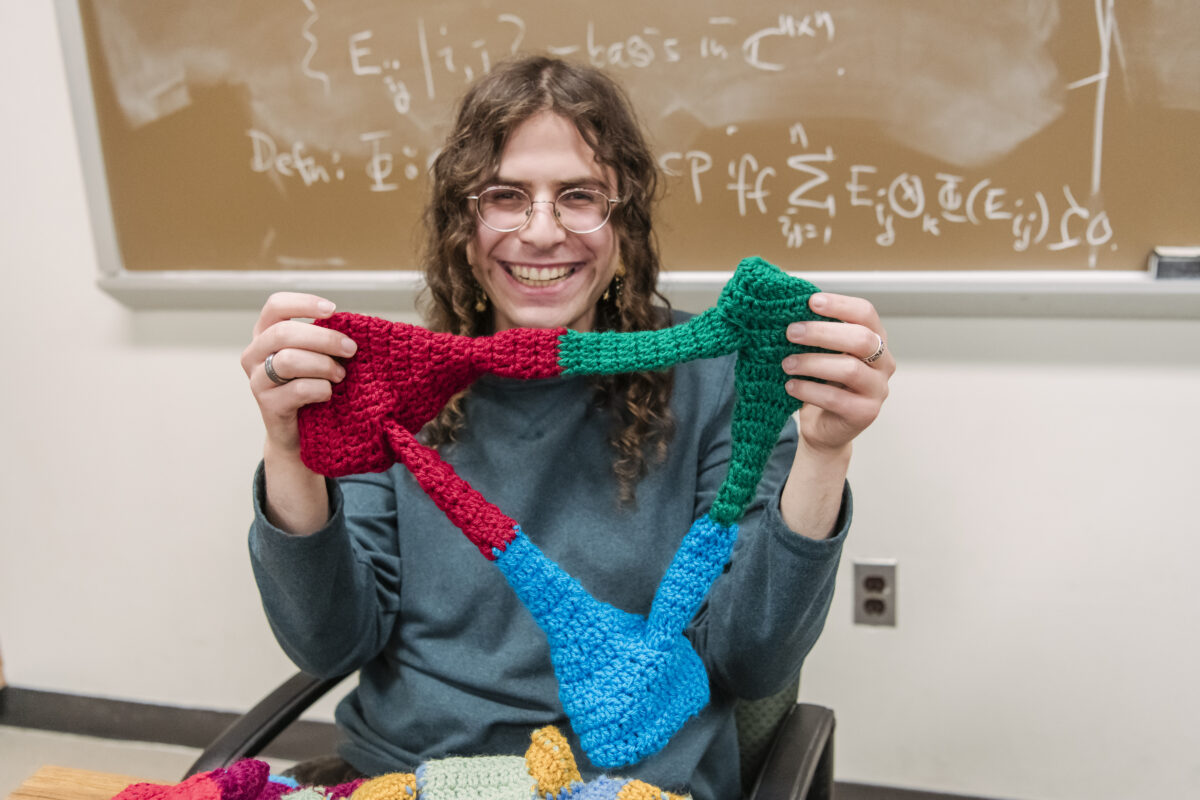 One of Ruttenberg’s creations is three Klein bottles stitched together. (Marlayna Demond ’11/UMBC)
Klein bottles and sea slugs
Although Ruttenberg’s primary motivation for pursuing crochet is as a hobby distinct from mathematics, as something to do with his hands while his mind chews on other things and simply as a way to create beautiful physical objects, he couldn’t help weaving in some math. He relies on a shape’s mathematical properties and reference images to translate them into crochet.
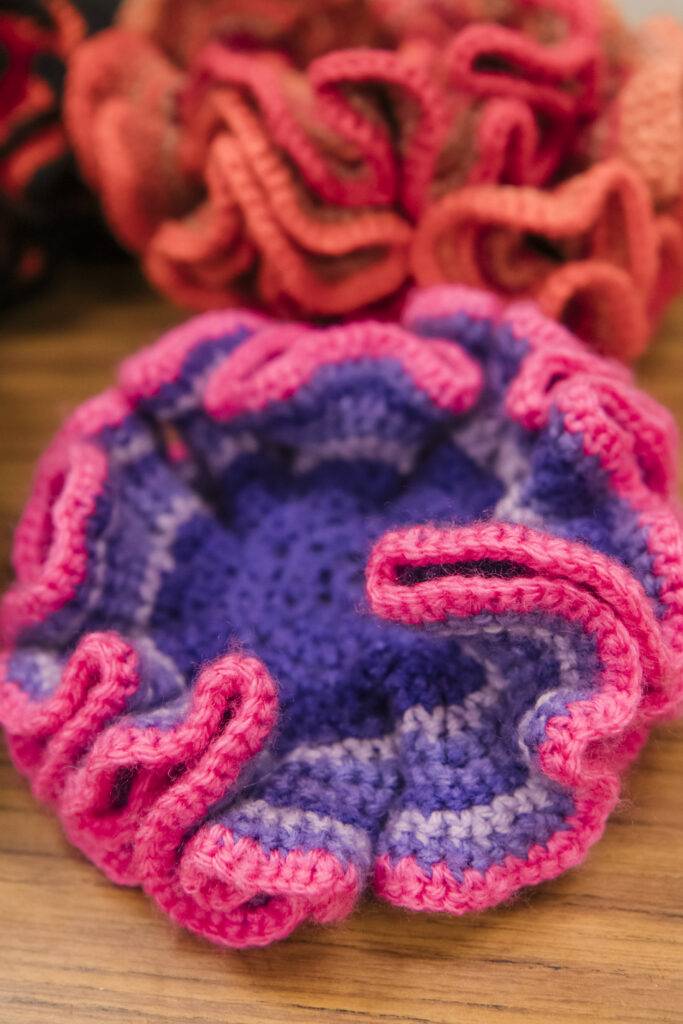
The shapes Ruttenberg creates include Klein bottles, single-sided surfaces reminiscent of Möbius strips closed up on themselves. Ruttenberg created a Klein bottle that can be worn as a hat, and another creation stitches three Klein bottles together. He’s also constructed dozens of what are called saddle surfaces, which are examples of “curved space” and look a lot like a brain coral or a sea slug with all of their folds and convolutions. Ruttenberg used three complete skeins of yarn—that’s nine football fields in length—to stitch the largest of these, and the surface’s curvaceous outer edge measures 50 feet despite it only being about a foot across.
 This saddle surface is Ruttenberg’s largest. Each shade of green required the same length of yarn, demonstrating how much the curvature adds length as you approach the perimeter of the piece. (Marlayna Demond ’11/UMBC)
Through his creations, Ruttenberg is hoping to investigate some mathematical concepts “that haven’t been explored in physical reality,” he says. “Also, I would like to do some math about crochet,” he says, such as how the physical properties of a crocheted object influence or define the pattern that describes it. In addition to the math, though, crochet for Ruttenberg is also “a creative, artistic pursuit.”
The beauty of patterns
Ruttenberg doesn’t use traditional crochet patterns for his work, choosing instead to invent his own shorthand notation for various stitches. “Because I like to make it up as I go along, it’s a little more satisfying to me,” he says. In fact, the symbols for stitches in crochet patterns echo the symbols and patterns in mathematics that he enjoys. “I was always interested in the aesthetics and visuals of math; all the symbols and things were sort of fascinating to me,” he shares.
This eye for patterns extends to Ruttenberg’s other interests and hobbies, like word games and juggling. “I love English spelling. I think the confluence of different languages is super cool. It makes patterns that I find very aesthetically pleasing,” he says. Ruttenberg is a Scrabble aficionado and typically has an online game going with friends.
Even mathematics has its own language to absorb. While the discipline’s lingo may puzzle non-mathematicians, “Something that I love about mathematics is all the different words, and all the jargon,” Ruttenberg says. “I love that math co-opts all these normal words for very technical things,” he says, like “ring” or “flag.”
With juggling, “There’s some math in there if you get into complicated patterns,” he says. “It’s all about permutations, and ‘How long does this ball stay in the air?’, and all that.”
Threading math joy throughout life
Ruttenberg is selling a few of his creations on Etsy, and he takes time to share his passion for mathematics in other ways. He tutors students from elementary school through college.
“I like the puzzle of teaching someone something, especially if they already have a misconception of the material that’s not serving them,” Ruttenberg says. “That, I find, is a cool puzzle—what’s the core of the misunderstanding here, and how can we give them a better way of thinking about it?”
Justin Webster, associate professor of mathematics and Ruttenberg’s academic advisor, quickly noted his mathematical talent and willingness to help others when Ruttenberg was in one of his courses. Ruttenberg is the president of UMBC’s chapter of Pi Mu Epsilon, the national mathematics honor society, which serves as UMBC’s math club. Pi Mu Epsilon hosts events for students and participates in outreach at local middle and high schools.
 Justin Webster serves as Ruttenberg’s academic advisor and the faculty advisor to UMBC’s chapter of Pi Mu Epsilon, the national mathematics honor society.
At these events, “Ephraim’s crochet work always steals the show,” Webster says. “The students are perplexed and engaged by his work. It is wonderful to have something which is both visual and tactile to engage the younger students.”
In part as a result of Webster’s mentoring, Ruttenberg plans to pursue a Ph.D. after graduating from UMBC. Exactly what he’ll study is uncertain. “Ephraim’s interests are very broad. And, like him, they are unique,” Webster says. “There is a certain amount of intellectual confidence that he has, which is rare.”
Ruttenberg will carry that confidence paired with generosity as he moves forward, melding his artistic and mathematical instincts in the world as he perceives it—a world where abstract theorems collide with soft fibers, and the geometry of a sphere meets the warmth of scarves. His work proves that equations need not be confined to dusty textbooks; they can be stitched into existence, one loop at a time.
]]>
In the back of a classroom, at a desk strewn with a colorful palette of commingled notebooks and skeins of yarn, sits Ephraim Ruttenberg ’25, mathematics. His fingers nimbly and nearly...
https://umbc.edu/stories/stitching-it-all-together-math-and-crochet/
https://my3.my.umbc.edu/api/v0/pixel/news/140828/guest@my.umbc.edu/1593675d67ced084d5a5cf66454a07b4/api/pixel
campus-life
cnms
magazine
mathstat
story
UMBC News & Magazine
https://my3.my.umbc.edu/groups/umbc-news-magazine
https://assets1-my.umbc.edu/system/shared/avatars/groups/000/001/943/24435aa6207c452e7bc15cc74b42c7bb/xsmall.png?1748556657
https://assets1-my.umbc.edu/system/shared/avatars/groups/000/001/943/24435aa6207c452e7bc15cc74b42c7bb/original.png?1748556657
https://assets2-my.umbc.edu/system/shared/avatars/groups/000/001/943/24435aa6207c452e7bc15cc74b42c7bb/xxlarge.png?1748556657
https://assets2-my.umbc.edu/system/shared/avatars/groups/000/001/943/24435aa6207c452e7bc15cc74b42c7bb/xlarge.png?1748556657
https://assets3-my.umbc.edu/system/shared/avatars/groups/000/001/943/24435aa6207c452e7bc15cc74b42c7bb/large.png?1748556657
https://assets1-my.umbc.edu/system/shared/avatars/groups/000/001/943/24435aa6207c452e7bc15cc74b42c7bb/medium.png?1748556657
https://assets2-my.umbc.edu/system/shared/avatars/groups/000/001/943/24435aa6207c452e7bc15cc74b42c7bb/small.png?1748556657
https://assets1-my.umbc.edu/system/shared/avatars/groups/000/001/943/24435aa6207c452e7bc15cc74b42c7bb/xsmall.png?1748556657
https://assets2-my.umbc.edu/system/shared/avatars/groups/000/001/943/24435aa6207c452e7bc15cc74b42c7bb/xxsmall.png?1748556657
UMBC News & Magazine
3
0
false
Thu, 11 Apr 2024 15:18:13 -0400
Thu, 11 Apr 2024 15:18:13 -0400
First data from UMBC’s HARP2 instrument on NASA PACE mission goes public
Data from NASA’s newest Earth-observing satellite, which will provide insight into ocean health, air quality, and the effects of a changing climate, are now available. The Plankton, Aerosol, Cloud, ocean Ecosystem (PACE) satellite launched on February 8, and after several subsequent weeks of testing of the spacecraft and instruments, the mission is gathering data that the public can access.
PACE includes three instruments: The Ocean Color Instrument (OCI), built at NASA Goddard Space Flight Center, observes the ocean, land, and atmosphere across more than 200 unique wavelengths spanning ultraviolet, visible, and near infrared light. It is particularly suited to identifying phytoplankton communities in the ocean.
HARP2, designed and built by UMBC scientists and engineers, and SPEXOne, built at the Netherlands Institute for Space Research (SRON) and Airbus Netherlands B.V., are both polarimeters, which measure light that has reflected off clouds and particles in the atmosphere. These particles, known as aerosols, can range from dust to smoke to sea spray and more.
“First light,” as the first data received from satellites in orbit is known, is a key milestone in the progression of any scientific instrument destined for space.
“When I look at the first light PACE images, I feel like I have put on magical eye glasses and am seeing the true characteristics of aerosol plumes from a satellite for the first time.”
Lorraine Remer
UMBC Climate Scientist
“To me, first light means the conclusion of all the engineering work to develop HARP2 and the beginning of our science quest exploring and understanding the data from PACE,” shares Vanderlei Martins, professor of physics at UMBC and lead of the HARP2 team. “First light means ‘It is working!’ and the question right after first light is, ‘What does it mean?’”
Answering big questions about Earth’s interrelated systems
With data from PACE’s polarimeters, scientists will be able to measure cloud properties and monitor, analyze, and identify atmospheric aerosols to better inform the public about air quality. Scientists will also be able to learn how aerosols interact with clouds and impact cloud formation, which is essential to creating accurate climate models.
The HARP2 team will focus on air pollution, the effect of aerosols produced by humans on cloud formation, and the energy balance of the planet, Martins says. “We will learn about the type of aerosols in Earth’s atmosphere: What they look like in terms of size and shape matters in terms of their health effects,” he says. “The way they absorb and scatter light affects how they interact with solar radiation and influence the energy balance of the planet: Do they produce heating or cooling of the planet, and in which circumstances?”
“I have plans to use PACE aerosol and ocean products to better understand how nutrient-rich aerosols are deposited into the global ocean and how ocean plankton communities respond to this nutrient source,” adds Lorraine Remer, a UMBC climate researcher affiliated with the Goddard Earth Science Technology and Research Center II, one of UMBC’s NASA-partnered research centers.
First, though, “We will spend the next weeks and months tuning our parameters to coax out the most and best possible information on aerosols and clouds,” Remer says. “Then, the next step is to compare PACE’s output with established sensors on the ground.” A validation experiment in September 2024 called PACE-PAX will enable and encourage those comparisons.
 The Ocean Color Instrument (OCI) has the unique ability to detect light that allows scientists to differentiate among communities of phytoplankton. This first image released from OCI identifies two different communities of these microscopic marine organisms in the ocean off the coast of South Africa on February 28, 2024. The central panel shows Synechococcus in pink and picoeukaryotes in green. The left panel shows a natural color view of the ocean, and the right panel displays the concentration of chlorophyll-a, a photosynthetic pigment used to identify the presence of phytoplankton. (Image by NASA)
PACE lets scientists put on “magical eye glasses”
Because of the power and unique capabilities of the instruments on PACE, “We see confident atmospheric parameters that have never been seen from any previous NASA mission,” Remer says. And because the data will be completely public, the benefits will go far beyond work that current PACE scientists will do.
“PACE data will be free for everyone around the globe and will be useful for decades to come,” Martins says. “Events on Earth will come and go, and they will be recorded forever by the PACE sensors. Beyond our own science studying aerosols, clouds, and the energy balance of the planet, this data will be explored by students and scientists for all sorts of applications that I can’t even imagine.”
Martins expects UMBC scientists to write proposals to analyze PACE data for many years, and many of these projects will involve opportunities for students at all levels to gain experience with research. For now, PACE scientists are still relishing the successful launch and return of first light from the PACE instruments.
“When I look at the first light PACE images,” Remer says, “I feel like I have put on magical eye glasses and am seeing the true characteristics of aerosol plumes from a satellite for the first time.”
Jeremy Werdell, PACE project scientist, shepherded the project from start to finish, beginning when Martins pitched him the idea of including a HARP2-like instrument on board. “We’ve been dreaming of PACE-like imagery for over two decades. It’s surreal to finally see the real thing,” he says. “The data from all three instruments is of such high quality that we can start distributing it publicly less than two months from launch, and I’m proud of our team for making that happen.”
]]>
Data from NASA’s newest Earth-observing satellite, which will provide insight into ocean health, air quality, and the effects of a changing climate, are now available. The Plankton, Aerosol,...
https://umbc.edu/stories/first-light-from-harp2-on-pace/
https://my3.my.umbc.edu/api/v0/pixel/news/140823/guest@my.umbc.edu/f6e83a436b1feb9f205418cba2f162e3/api/pixel
cnms
esi
gestar2
news
physics
research
science-and-tech
story
UMBC News & Magazine
https://my3.my.umbc.edu/groups/umbc-news-magazine
https://assets1-my.umbc.edu/system/shared/avatars/groups/000/001/943/24435aa6207c452e7bc15cc74b42c7bb/xsmall.png?1748556657
https://assets1-my.umbc.edu/system/shared/avatars/groups/000/001/943/24435aa6207c452e7bc15cc74b42c7bb/original.png?1748556657
https://assets2-my.umbc.edu/system/shared/avatars/groups/000/001/943/24435aa6207c452e7bc15cc74b42c7bb/xxlarge.png?1748556657
https://assets2-my.umbc.edu/system/shared/avatars/groups/000/001/943/24435aa6207c452e7bc15cc74b42c7bb/xlarge.png?1748556657
https://assets3-my.umbc.edu/system/shared/avatars/groups/000/001/943/24435aa6207c452e7bc15cc74b42c7bb/large.png?1748556657
https://assets1-my.umbc.edu/system/shared/avatars/groups/000/001/943/24435aa6207c452e7bc15cc74b42c7bb/medium.png?1748556657
https://assets2-my.umbc.edu/system/shared/avatars/groups/000/001/943/24435aa6207c452e7bc15cc74b42c7bb/small.png?1748556657
https://assets1-my.umbc.edu/system/shared/avatars/groups/000/001/943/24435aa6207c452e7bc15cc74b42c7bb/xsmall.png?1748556657
https://assets2-my.umbc.edu/system/shared/avatars/groups/000/001/943/24435aa6207c452e7bc15cc74b42c7bb/xxsmall.png?1748556657
UMBC News & Magazine
2
0
false
Thu, 11 Apr 2024 15:05:00 -0400
Thu, 11 Apr 2024 15:05:00 -0400