Leadership Announcement
Dear UMBC Community,
I am thrilled to announce the appointment of Tracey A. Reeves as Vice President for Communications and Marketing at UMBC. Tracey is a strategic thinker whose experience, expertise, and capacities as a highly collaborative leader will enable us to take communications and marketing at UMBC to great new heights in service of our ambitious aims. She joins UMBC from Bates College in Lewiston, Maine, where she serves currently as vice president for communications and marketing. She will begin at UMBC on June 3.
In her role at Bates, Tracey has been a trusted advisor to the president and senior leadership team on all aspects of strategic communications, and she has led a 17-member team of professionals in advancing Bates’ enrollment marketing, media relations, storytelling, and crisis and emergency response communications efforts, among others. She is a data-driven planner who is skilled at change management, building and supporting teams, and leveraging technology to help strengthen organizations and their brands.
At Bates and, before that, at the Georgia Institute of Technology, where she served first as assistant vice president for campus communications and then as associate vice president for research, academic, and faculty communications, Tracey developed and led comprehensive strategic plans for communications and marketing. She successfully implemented those plans through myriad challenges both local and global, including the COVID-19 pandemic, a national racial reckoning, deepening political and cultural divides, and, tragically, a mass shooting in Lewiston. Her skills and sensitivity in navigating crises are matched by her ability to envision and deliver innovative strategic initiatives, including several to promote Georgia Tech’s $1.2-billion research enterprise and the impact of its research on the communities it serves.
In joining our community at UMBC, Tracey is returning to the Baltimore area that she loves, a region where she spent more than two decades, including for the 10 years she served as director of media relations at the Johns Hopkins University. At Johns Hopkins from 2008 through 2018, she led a team of media relations representatives for the university’s central communications office, crafted high-level messaging and announcements, and served as a university spokesperson. She joined Johns Hopkins following a successful career as a newspaper reporter, including as a national and congressional correspondent for Knight Ridder Newspapers and as a staff writer and assistant editor with The Washington Post.
I know that Tracey is excited to return to Maryland and deeply inspired by UMBC’s mission and vision and the opportunity to join this institution she has long admired. As we welcome her, we embark upon a new era for communications and marketing at the university—to build upon UMBC’s remarkable momentum to help strengthen and sustain our position among the nation’s leading institutions and create the future we envision for UMBC. I could not be more enthusiastic about Tracey taking on this role, and I am grateful to the search committee and all who participated in this effort that has resulted in such an outstanding appointment. Thank you, and welcome, Tracey!
Sincerely,
President Valerie Sheares Ashby
]]>
Dear UMBC Community, I am thrilled to announce the appointment of Tracey A. Reeves as Vice President for Communications and Marketing at UMBC. Tracey is a strategic thinker whose experience,...
https://my3.my.umbc.edu/groups/announcements/posts/140565
https://my3.my.umbc.edu/api/v0/pixel/news/140592/guest@my.umbc.edu/8495cff5402b4ce1ea0231c50d09a136/api/pixel
president
story
UMBC News & Magazine
https://my3.my.umbc.edu/groups/umbc-news-magazine
https://assets1-my.umbc.edu/system/shared/avatars/groups/000/001/943/24435aa6207c452e7bc15cc74b42c7bb/xsmall.png?1748556657
https://assets1-my.umbc.edu/system/shared/avatars/groups/000/001/943/24435aa6207c452e7bc15cc74b42c7bb/original.png?1748556657
https://assets2-my.umbc.edu/system/shared/avatars/groups/000/001/943/24435aa6207c452e7bc15cc74b42c7bb/xxlarge.png?1748556657
https://assets2-my.umbc.edu/system/shared/avatars/groups/000/001/943/24435aa6207c452e7bc15cc74b42c7bb/xlarge.png?1748556657
https://assets3-my.umbc.edu/system/shared/avatars/groups/000/001/943/24435aa6207c452e7bc15cc74b42c7bb/large.png?1748556657
https://assets1-my.umbc.edu/system/shared/avatars/groups/000/001/943/24435aa6207c452e7bc15cc74b42c7bb/medium.png?1748556657
https://assets2-my.umbc.edu/system/shared/avatars/groups/000/001/943/24435aa6207c452e7bc15cc74b42c7bb/small.png?1748556657
https://assets1-my.umbc.edu/system/shared/avatars/groups/000/001/943/24435aa6207c452e7bc15cc74b42c7bb/xsmall.png?1748556657
https://assets2-my.umbc.edu/system/shared/avatars/groups/000/001/943/24435aa6207c452e7bc15cc74b42c7bb/xxsmall.png?1748556657
UMBC News & Magazine
2
0
false
Thu, 04 Apr 2024 17:16:10 -0400
Why rural white Americans’ resentment is a threat to democracy

Written by Thomas F. Schaller, professor of political science, UMBC
Rural white voters have long enjoyed outsize power in American politics. They have inflated voting power in the U.S. Senate, the U.S. House and the Electoral College.
Although there is no uniform definition of “rural,” and even federal agencies cannot agree on a single standard, roughly 20% of Americans live in rural communities, according to the Census Bureau’s definition. And three-quarters of them – or approximately 15% of the U.S. population – are white.
Since the rise of Jacksonian democracy and the expansion of the vote to all white men in the late 1820s, however, the support of rural white people has been vital to the governing power of almost every major party coalition. Which is why my co-author Paul Waldman and I describe rural white people as America’s “essential minority” in our book White Rural Rage: The Threat to American Democracy.
As a political scientist, I’ve written or co-written five books addressing issues of racial politics at some level of government or part of the country. My latest, White Rural Rage, seeks to understand the complex intersections of race, place and opinion and the implications they hold for our political system.
The unfortunate fact is that polls suggest many rural white people’s commitment to the American political system is eroding. Even when they are not members of militant organizations, rural white people, as a group, now pose four interconnected threats to the fate of the United States’ pluralist, constitutional democracy.
Although these do not apply to all rural white people, nor exclusively to them in general, when compared with other Americans, rural white people:
- Express the most racist, least inclusive, most xenophobic, most anti-LGBTQ+ and most anti-immigrant sentiments.
- Subscribe at the highest rates to conspiracy theories about QAnon, the 2020 presidential election, Barack Obama’s citizenship and COVID-19 vaccines.
- Support a variety of antidemocratic and unconstitutional positions and exhibit strong attachments to white nationalist and white Christian nationalist movements inimical to secular, constitutional governance.
- Are most likely to justify, if not call for, force or violence as acceptable alternatives to deliberative, peaceful democracy.
Let’s examine a few data points.
Xenophobia
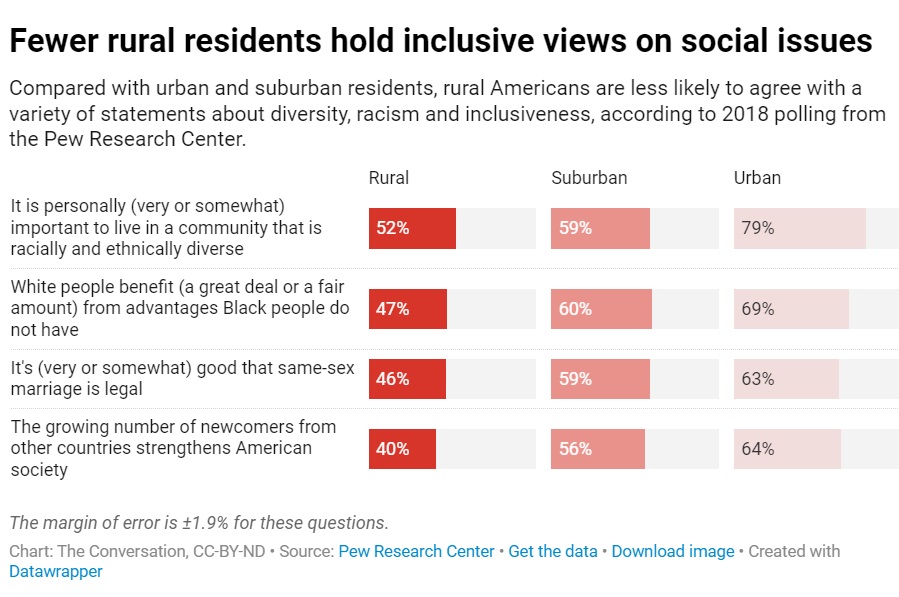
In a Pew Research Center poll conducted in 2018, 46% of white rural Americans said it is important to live in a diverse community. That’s a lower proportion than urban and suburban dwellers and even nonwhite rural residents.
And in rural areas, fewer than half the people said white people have advantages Black people do not, approve of the legalization of same-sex marriage, and say immigrants make American society stronger.
In addition, Cornell researchers found that rural whites reported feeling less comfortable with gay and lesbian people than urban whites do. And 49% of rural LGBTQ+ people between the ages of 10 and 24 called their own towns “unaccepting” of LGBTQ+ people – nearly twice the rate of suburban and urban LGBTQ+ young people who said the same about their communities.
Conspiracism
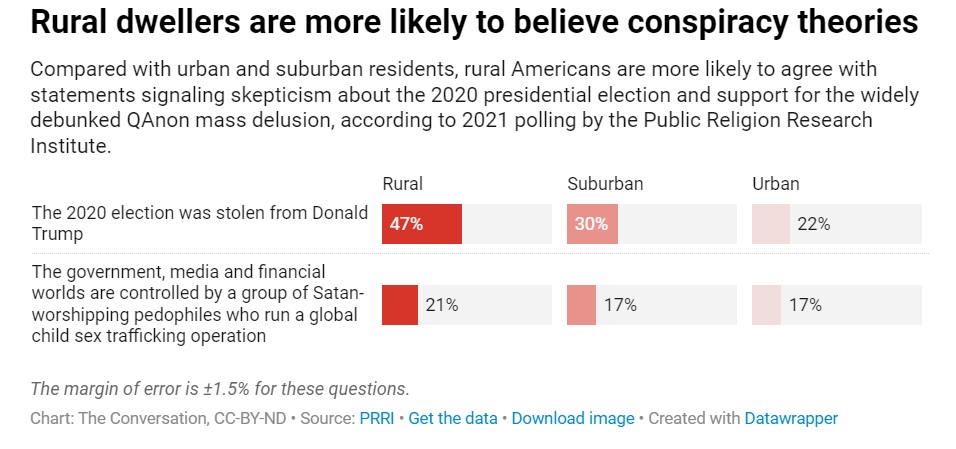
Polls in 2020 and 2021 indicated that QAnon supporters are 1.5 times more likely to live in rural areas than urban ones, and 49% of rural residents – 10 points higher than the national average – believe a “deep state” undermines Trump.
Rural residents are also more likely than urban and suburban residents to believe the 2020 election was stolen from Trump, according to 2021 polling by the Public Religion Research Institute.
And people who live in rural areas are also less confident as a whole than those who live in urban areas that votes will be counted accurately and fairly in their state or across the country, according to a 2022 poll from the Bipartisan Policy Center.
In addition, by our analysis, of the 139 U.S. House members who voted to reject the certification of Joe Biden’s presidential election just hours after a violent mob of Trump supporters rampaged through the Capitol, 103 – 74% – represented either “purely rural” or “rural/suburban” districts, as categorized by Bloomberg’s CityLab project.
Rural antidemocratic beliefs
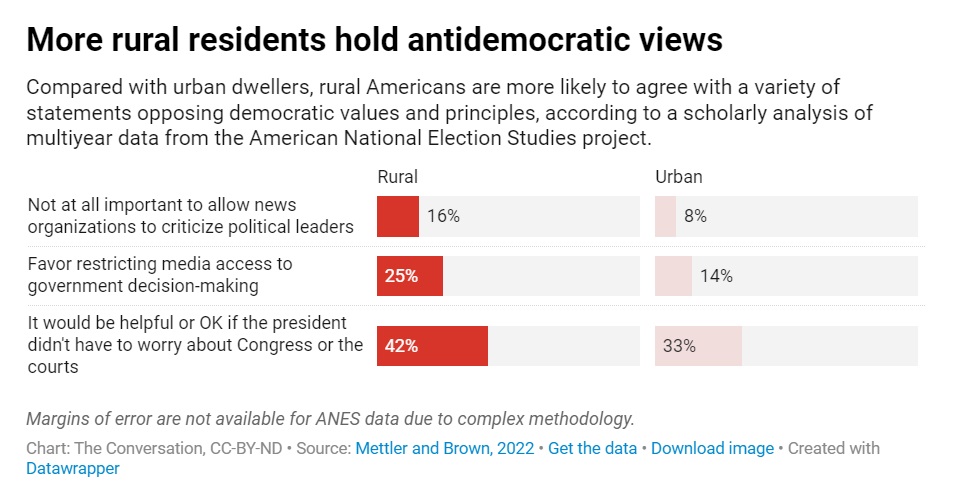
A scholarly analysis of multiyear data from the American National Election Studies project finds that rural citizens are “much more likely (than urban residents) to favor restrictions on the press” and to say it would be “helpful if the president could unilaterally work” without regard to Congress or the courts.
In addition, more than half of rural residents surveyed by the Public Religion Research Institute said being a Christian is important to “being truly American” – 10 percentage points more than in surburban or urban areas.
This is one of several signals that rural residents are disproportionately likely to support white Christian nationalism, an ideology that reaches beyond Christian ideas of faith and morality and into government. Its followers want the United States to base its laws on Christian values rather than maintain the centuries-old separation of church and state the founders saw as fundamental to a secular democracy.
Justification of violence
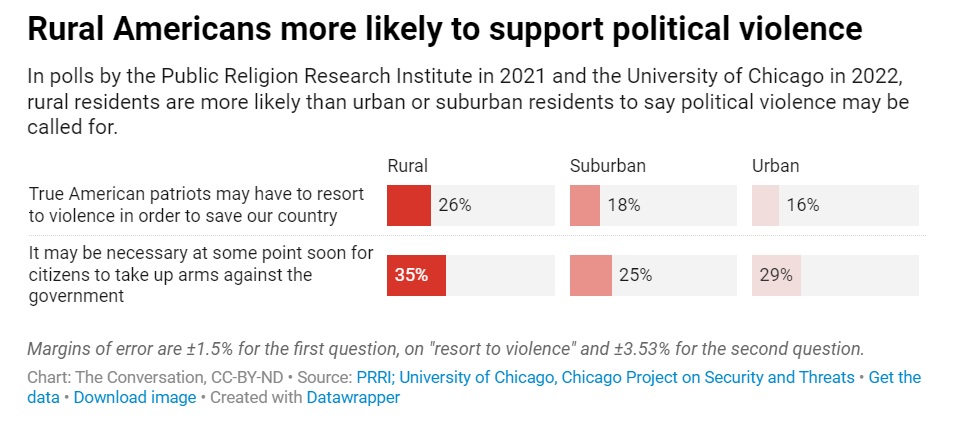
Rural residents are more likely than urban or suburban residents to say the political situation in the country is heading to a point where violence may be necessary to preserve the nation, according to polls from the Public Religion Research Institute in 2021 and the University of Chicago Institute of Politics in 2022.
Of the estimated 21 million Americans who in late 2021 said Joe Biden’s 2020 presidential win was “illegitimate,” according to the Chicago Project on Security and Threats, 30% lived in rural areas. And 27% of Americans who say Trump should be returned to office even if “by force” are rural residents. Those are minority views, but both proportions are significantly higher than the rural proportion of the overall population.
With the 2024 election fast approaching, the views of rural white people are once again of vital importance because they and the members of Congress who represent them disproportionately believe the 2020 election was stolen from Donald Trump by Joe Biden. A Pew Research Center study found 71% of rural white voters voted for Trump in 2020, so their preference in November will be key to who returns to the White House for a second term.
This article is republished from The Conversation under a Creative Commons license. Read the original article and see more than 250 UMBC articles available in The Conversation.
]]>
Written by Thomas F. Schaller, professor of political science, UMBC Rural white voters have long enjoyed outsize power in American politics. They have inflated voting power in the U.S....
https://umbc.edu/stories/rural-white-americans-resentment-and-democracy/
https://my3.my.umbc.edu/api/v0/pixel/news/140576/guest@my.umbc.edu/8c98be77372d135f63986d6f7f90bda3/api/pixel
cahss
cahss-research
discovery
magazine
political-science
research
story
UMBC News & Magazine
https://my3.my.umbc.edu/groups/umbc-news-magazine
https://assets1-my.umbc.edu/system/shared/avatars/groups/000/001/943/24435aa6207c452e7bc15cc74b42c7bb/xsmall.png?1748556657
https://assets1-my.umbc.edu/system/shared/avatars/groups/000/001/943/24435aa6207c452e7bc15cc74b42c7bb/original.png?1748556657
https://assets2-my.umbc.edu/system/shared/avatars/groups/000/001/943/24435aa6207c452e7bc15cc74b42c7bb/xxlarge.png?1748556657
https://assets2-my.umbc.edu/system/shared/avatars/groups/000/001/943/24435aa6207c452e7bc15cc74b42c7bb/xlarge.png?1748556657
https://assets3-my.umbc.edu/system/shared/avatars/groups/000/001/943/24435aa6207c452e7bc15cc74b42c7bb/large.png?1748556657
https://assets1-my.umbc.edu/system/shared/avatars/groups/000/001/943/24435aa6207c452e7bc15cc74b42c7bb/medium.png?1748556657
https://assets2-my.umbc.edu/system/shared/avatars/groups/000/001/943/24435aa6207c452e7bc15cc74b42c7bb/small.png?1748556657
https://assets1-my.umbc.edu/system/shared/avatars/groups/000/001/943/24435aa6207c452e7bc15cc74b42c7bb/xsmall.png?1748556657
https://assets2-my.umbc.edu/system/shared/avatars/groups/000/001/943/24435aa6207c452e7bc15cc74b42c7bb/xxsmall.png?1748556657
UMBC News & Magazine
1
0
false
Thu, 04 Apr 2024 10:45:00 -0400
Thu, 04 Apr 2024 10:45:00 -0400
Department of Justice-UMBC Agreement
Dear UMBC Community,
Today, UMBC voluntarily entered into an agreement with the U.S. Department of Justice that will bring meaningful improvements to the university’s work to prevent and respond to reports of sexual misconduct and sex discrimination under Title IX. This agreement concludes the DOJ investigation of UMBC’s Title IX compliance, the findings of which were announced on March 18. If you have not already viewed my letter and video message about the DOJ’s findings, which focused on the period 2015-2020, I encourage you to do so.
The agreement we signed today commits UMBC to implement measures to enhance the strength, accountability, and independence of the university’s Title IX office; provide specific support for student-athletes and the Athletics Department staff who serve them; expand training for students and employees to improve UMBC’s prevention and response to sex discrimination; and provide financial relief to certain current and former members of the Men’s and Women’s Swimming and Diving team, as determined by the DOJ. The agreement requires regular reporting by UMBC to the DOJ and will remain in effect through the 2028-2029 academic year. You can read the full agreement here.
Many of the agreement’s provisions are already under way. In the agreement, the DOJ acknowledges the significant steps the university has taken recently to help prevent and strengthen our response to sex discrimination and sexual misconduct. Those efforts have enhanced our Title IX reporting structures and procedures, expanded training and prevention initiatives, and provided additional support and resources to students and employees. The work is ongoing, and it has included the following improvements since my tenure began in 2022:
Created the role of and hired a Vice President for Institutional Equity and Chief Diversity Officer to oversee the work of the Office of Equity and Civil Rights, which is well on its way to being staffed with five full-time, permanent positions, including a Director and Title IX Coordinator, Training and Prevention Manager, Case Manager, and two investigatorsRestructured the Office of Equity and Civil Rights to provide greater access and privacy for students and employeesAppointed an external specialist to provide interim Title IX expertiseUpdated the Title IX website and developed targeted educational resourcesUndertook the process of strengthening the university’s Title IX and anti-discrimination policies and proceduresLaunched an annual mandatory online Title IX training module for all studentsImplemented mandatory reporter training for employeesExpanded Title IX training for all athletics staff, coaches, and student-athletes
Those efforts, combined with the additional measures to which we have committed in the agreement, will help us better serve our students and all members of the UMBC community. You can access our resources here. If you need immediate help, please contact the Retriever Support Line at 410-455-3167 or retrieversupport@umbc.edu.
As I have shared with many of you in recent days, the DOJ investigation has caused us to reckon with the past. We cannot take away the suffering and trauma that many of our students endured in those years, nor can we undo the actions or inactions of the past.
We can control how we respond to that painful past and how we ensure that this never happens again. Our resolve and resilience are our strengths, and my confidence in the UMBC community has never been greater. Today’s agreement with the DOJ is an important step forward toward healing and accountability. Our commitment and our work to ensure a safe and vibrant environment where all students may thrive will continue well beyond today.
Sincerely,
President Valerie Sheares Ashby
]]>
Dear UMBC Community, Today, UMBC voluntarily entered into an agreement with the U.S. Department of Justice that will bring meaningful improvements to the university’s work to prevent and respond...
https://my3.my.umbc.edu/groups/announcements/posts/140540
https://my3.my.umbc.edu/api/v0/pixel/news/140556/guest@my.umbc.edu/a5eb169faeafdb3299235b093ddeb71c/api/pixel
president
story
UMBC News & Magazine
https://my3.my.umbc.edu/groups/umbc-news-magazine
https://assets1-my.umbc.edu/system/shared/avatars/groups/000/001/943/24435aa6207c452e7bc15cc74b42c7bb/xsmall.png?1748556657
https://assets1-my.umbc.edu/system/shared/avatars/groups/000/001/943/24435aa6207c452e7bc15cc74b42c7bb/original.png?1748556657
https://assets2-my.umbc.edu/system/shared/avatars/groups/000/001/943/24435aa6207c452e7bc15cc74b42c7bb/xxlarge.png?1748556657
https://assets2-my.umbc.edu/system/shared/avatars/groups/000/001/943/24435aa6207c452e7bc15cc74b42c7bb/xlarge.png?1748556657
https://assets3-my.umbc.edu/system/shared/avatars/groups/000/001/943/24435aa6207c452e7bc15cc74b42c7bb/large.png?1748556657
https://assets1-my.umbc.edu/system/shared/avatars/groups/000/001/943/24435aa6207c452e7bc15cc74b42c7bb/medium.png?1748556657
https://assets2-my.umbc.edu/system/shared/avatars/groups/000/001/943/24435aa6207c452e7bc15cc74b42c7bb/small.png?1748556657
https://assets1-my.umbc.edu/system/shared/avatars/groups/000/001/943/24435aa6207c452e7bc15cc74b42c7bb/xsmall.png?1748556657
https://assets2-my.umbc.edu/system/shared/avatars/groups/000/001/943/24435aa6207c452e7bc15cc74b42c7bb/xxsmall.png?1748556657
UMBC News & Magazine
1
0
false
Wed, 03 Apr 2024 17:47:48 -0400
Mellon Foundation grants CAHSS $750K to establish Global Asias Initiative
Kimberly Moffitt, dean of the College of Arts, Humanities, and Socials Sciences, and co-pi Tamara Bhalla, associate professor of American studies and director of the Asian American studies minor, have been awarded a $750,000 grant from the Mellon Foundation to establish the Global Asias Initiative. The initiative will support the rethinking of Asian American issues on campus in a global, diasporic, and collaborative framework through community-engaged, public-facing scholarship and teaching.
“The impact and influence of the Asian diaspora in this region makes it clear that our world has more to offer in providing valuable opportunities for our students, while also creating additional partnerships with the greater Baltimore community,” says Moffitt.
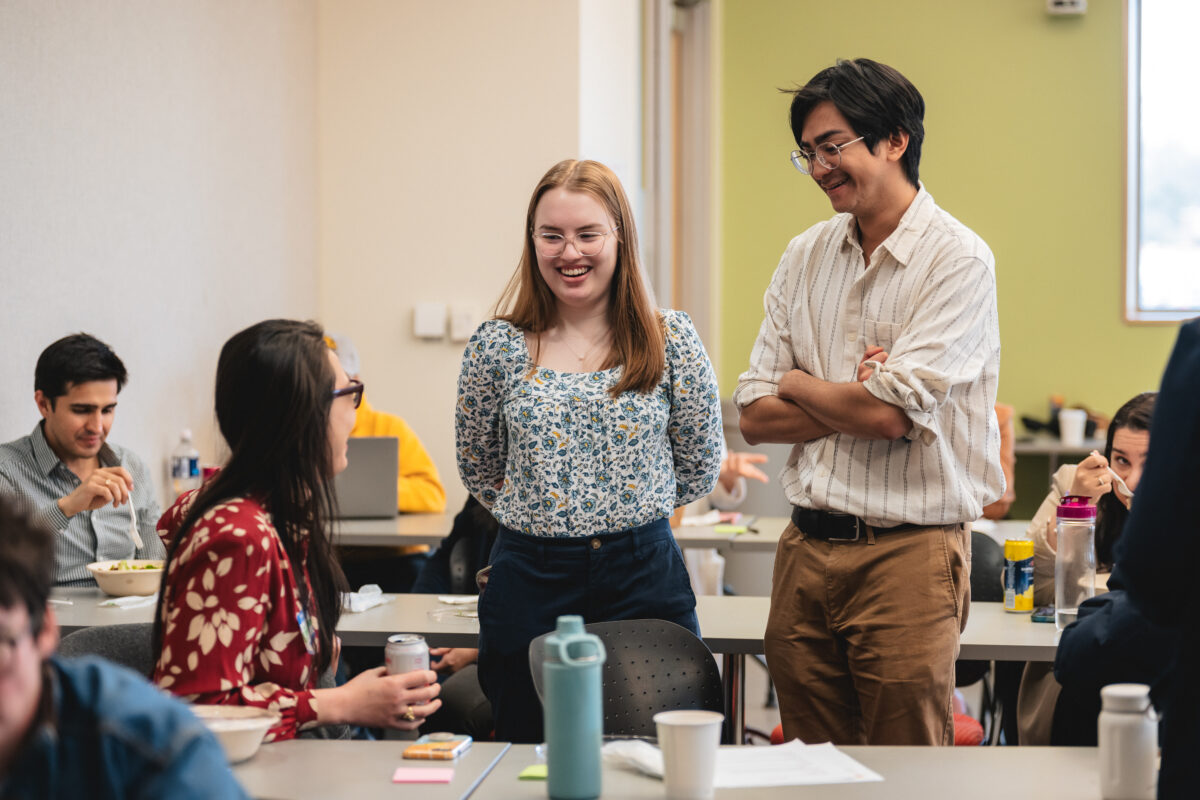 (l-r) Emily Yoon and students at the Global Asias Initiative launch workshop.
(Abnet Shiferaw)
UMBC’s existing Asian studies program and Asian American studies minor will grow into a more expansive Global Asias program that better serves and represents UMBC’s Asian American community, interested students, and beyond. This includes launching an undergraduate community-based research fellowship in Global Asias and the conversation series “Reframing Global Asias,” which invites prominent leaders, scholars, and community members in the field to present and discuss key issues, possibilities, challenges, and new research.
“Together,” says Bhalla, “we will create a forum for engaging in difficult yet productive intellectual conversations in Asian American studies, Asian diaspora studies, and Asian studies.”
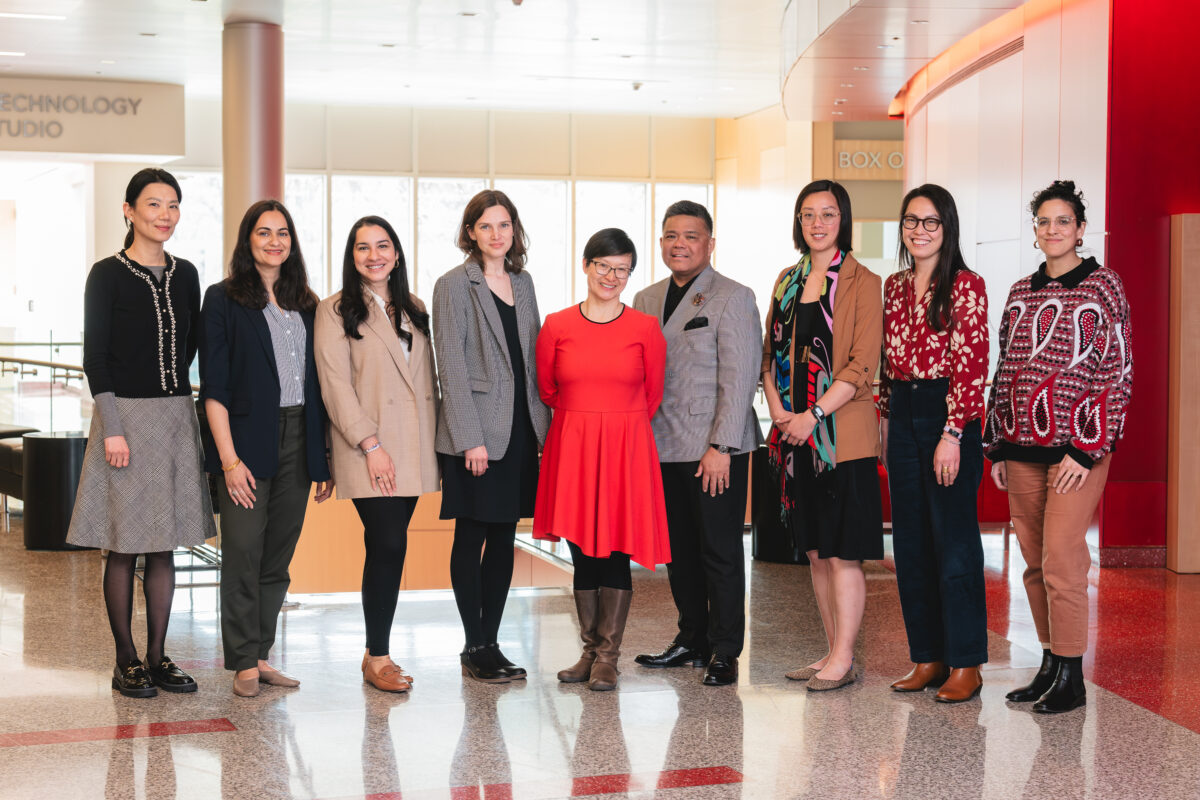 Global Asias Advisory Board, AY2023-2024. (l-r) Tamara Bhalla, Noor Zaidi, Meredith Oyen, Fan Yang, Theo Gonzalvez, Emily Yoon, and Priya Bhayana, project manager for the Global Asias Initiative. (Abnet Shiferaw)
Faculty across UMBC are collaborating to bring the Global Asia Initiative to fruition along with community partners:
-
Meredith Oyen, associate professor of history and director of the Asian studies program
-
Shin Yon Kim, Asian studies lecturer
-
Fan Yang, associate professor of media and communication studies
-
Emily Yoon, assistant professor of English
-
Noor Zaidi, assistant professor of history
-
Christopher Tong, associate professor of modern languages, linguistics, and intercultural communication
-
Theo Gonzalves, former American studies chair and professor, curator of Asian-Pacific American history at the Smithsonian National Museum of American History
-
Robbin Lee ’13, visual arts and media and communications studies, director of partnerships and mobilization at UpSurge Baltimore
Learn more about the Global Asias Iniatiave and Asian studies program.
]]>
Kimberly Moffitt, dean of the College of Arts, Humanities, and Socials Sciences, and co-pi Tamara Bhalla, associate professor of American studies and director of the Asian American studies minor,...
https://umbc.edu/quick-posts/umbc-to-establish-global-asias-initiative/
https://my3.my.umbc.edu/api/v0/pixel/news/140528/guest@my.umbc.edu/32bd2a6ff02002d0cfa31ee10d13251e/api/pixel
american-studies
asian-studies
cahss
english
history
mcs
mlli
news
policy-and-society
quick-post
quick-posts
research
visual-arts
UMBC News & Magazine
https://my3.my.umbc.edu/groups/umbc-news-magazine
https://assets1-my.umbc.edu/system/shared/avatars/groups/000/001/943/24435aa6207c452e7bc15cc74b42c7bb/xsmall.png?1748556657
https://assets1-my.umbc.edu/system/shared/avatars/groups/000/001/943/24435aa6207c452e7bc15cc74b42c7bb/original.png?1748556657
https://assets2-my.umbc.edu/system/shared/avatars/groups/000/001/943/24435aa6207c452e7bc15cc74b42c7bb/xxlarge.png?1748556657
https://assets2-my.umbc.edu/system/shared/avatars/groups/000/001/943/24435aa6207c452e7bc15cc74b42c7bb/xlarge.png?1748556657
https://assets3-my.umbc.edu/system/shared/avatars/groups/000/001/943/24435aa6207c452e7bc15cc74b42c7bb/large.png?1748556657
https://assets1-my.umbc.edu/system/shared/avatars/groups/000/001/943/24435aa6207c452e7bc15cc74b42c7bb/medium.png?1748556657
https://assets2-my.umbc.edu/system/shared/avatars/groups/000/001/943/24435aa6207c452e7bc15cc74b42c7bb/small.png?1748556657
https://assets1-my.umbc.edu/system/shared/avatars/groups/000/001/943/24435aa6207c452e7bc15cc74b42c7bb/xsmall.png?1748556657
https://assets2-my.umbc.edu/system/shared/avatars/groups/000/001/943/24435aa6207c452e7bc15cc74b42c7bb/xxsmall.png?1748556657
UMBC News & Magazine
0
0
false
Wed, 03 Apr 2024 11:06:07 -0400
Wed, 03 Apr 2024 11:06:07 -0400
Leadership Transitions
Dear UMBC Community,
I write to you today to communicate about some significant changes at the leadership level of the university. I felt it was important to share this information with you, as well as our plans for navigating the changes, both in the short term and the long term.
Director of Athletics
Very soon, we will launch a national search for a new director of athletics, as Brian Barrio is no longer serving in the role. I have met with the Athletics Department staff—both administrative staff and coaches—and many student-athletes to discuss this transition and assure them of my continued support. As a search gets under way, I have asked two members of the administrative team to take on temporary co-leadership of the department. Whitney Ames, associate athletic director for compliance, and Rich Franchak, senior associate athletic director for business and finance, will be serving in this capacity. Thank you, Whitney and Rich, for your dedication and leadership.
Vice President for Government Relations and Community Affairs
Candace Dodson-Reed has resigned from her role leading government relations and community affairs. Yaakov “Jake” Weissmann ’06, who has been serving as associate vice president for government and community affairs, is stepping in to lead the office. A veteran of Maryland state politics, Jake served as chief of staff for two state senate presidents and as assistant chief administrative officer for Montgomery County Executive Marc Elrich before joining UMBC last year. He has already proven to be an outstanding and expert colleague and advisor, and I am grateful for his service to UMBC.
Vice President for Institutional Advancement
Greg Simmons is departing from his role leading advancement for UMBC. We will move quickly to conduct a national search, and we will update you on that process soon. In the near term, we are grateful to Stanyell Odom, director of alumni engagement, and Kim Robinson, director of major gifts, who have agreed to provide temporary management and leadership of the division and its operations. We know this is a busy time of year for our advancement colleagues, so we felt it was critical to designate key leaders who could serve as point people for their colleagues in the division and who would have a direct line of communication to me and others in senior leadership. Thank you, Stanyell and Kim, for serving in these roles.
Office of the General Counsel
Our search for a general counsel, following last year’s retirement of David Gleason, is under way, and I expect to name a new chief legal advisor for the university in the near future. Bobbie Hoye, who had been serving as the point of contact for the Office of the General Counsel, has left her role as senior associate general counsel.
These transitions are significant, and they follow other changes in our senior leadership personnel and structure since I arrived at UMBC in August 2022. I understand some may worry that such transitions will be destabilizing for UMBC, and I know the impact of these transitions is in many cases felt personally, not just operationally or institutionally. I assure you that we will work to move UMBC as swiftly as possible through this period while attending thoughtfully to stability, continuity, and care for the community.
Universities, many of them centuries old, have a remarkable capacity to endure and evolve through all manner of demands, challenges, and opportunities. UMBC may be younger than many of its peers, but it is no less remarkable in its ability to grow, adapt, renew, and rise to any challenge. In the weeks and months ahead, we will celebrate our graduates who make us so proud, and we will welcome the newest members of Retriever Nation from around the state and around the world. They have placed their trust, and their futures, in UMBC because they recognize that we are a dynamic public research university that is dedicated to inclusive excellence in everything we do. I have every confidence we are worthy of their trust and will exceed their ambitious expectations.
The mission and values of this institution are strong and sure. I believe in UMBC and in all of you, and I am as dedicated as ever to the work of creating UMBC’s future.
Sincerely,
President Valerie Sheares Ashby
]]>
Dear UMBC Community, I write to you today to communicate about some significant changes at the leadership level of the university. I felt it was important to share this information with you, as...
https://my3.my.umbc.edu/groups/announcements/posts/140492
https://my3.my.umbc.edu/api/v0/pixel/news/140508/guest@my.umbc.edu/3247210982f6ec50f4cc680cf67012f6/api/pixel
president
story
UMBC News & Magazine
https://my3.my.umbc.edu/groups/umbc-news-magazine
https://assets1-my.umbc.edu/system/shared/avatars/groups/000/001/943/24435aa6207c452e7bc15cc74b42c7bb/xsmall.png?1748556657
https://assets1-my.umbc.edu/system/shared/avatars/groups/000/001/943/24435aa6207c452e7bc15cc74b42c7bb/original.png?1748556657
https://assets2-my.umbc.edu/system/shared/avatars/groups/000/001/943/24435aa6207c452e7bc15cc74b42c7bb/xxlarge.png?1748556657
https://assets2-my.umbc.edu/system/shared/avatars/groups/000/001/943/24435aa6207c452e7bc15cc74b42c7bb/xlarge.png?1748556657
https://assets3-my.umbc.edu/system/shared/avatars/groups/000/001/943/24435aa6207c452e7bc15cc74b42c7bb/large.png?1748556657
https://assets1-my.umbc.edu/system/shared/avatars/groups/000/001/943/24435aa6207c452e7bc15cc74b42c7bb/medium.png?1748556657
https://assets2-my.umbc.edu/system/shared/avatars/groups/000/001/943/24435aa6207c452e7bc15cc74b42c7bb/small.png?1748556657
https://assets1-my.umbc.edu/system/shared/avatars/groups/000/001/943/24435aa6207c452e7bc15cc74b42c7bb/xsmall.png?1748556657
https://assets2-my.umbc.edu/system/shared/avatars/groups/000/001/943/24435aa6207c452e7bc15cc74b42c7bb/xxsmall.png?1748556657
UMBC News & Magazine
1
0
false
Tue, 02 Apr 2024 18:52:10 -0400
Restaurateur and Retriever Lane Harlan goes back for seconds

Some have dark wood and cozy corners, some have bright, natural light and textured walls—but each of Lane Harlan’s establishments can be looked at like a love letter to the people of Baltimore, thoughtfully decorated with hand-chosen, local pieces and, in some cases, even the decor from her own living room.
The different vibes, each sumptuous in their own ways, are transporting for patrons. Harlan says that’s intentional. “I want them to feel like they’re elsewhere. They’re not in Baltimore, they’re somewhere else. I think it’s important if you can feel like you’re on an adventure.”
To say Harlan ’21, political science—the highly-accomplished restaurateur who opened W.C. Harlan, Clavel Mescaleria, Fadensonnen, the Coral Wig, and more—is well-known throughout Baltimore would be an understatement. Her acclaim continues to grow after the recent announcement that Clavel is a finalist for a coveted James Beard Award for “Outstanding Bar” (one step and one sip inside the unique taqueria and within a second, you’ll understand why). But while we all know of her success, it may come as a surprise that just like many students, she hit some academic roadblocks along the way.
The first course
When Harlan joined UMBC as a political science major in 2005, she was already a little different than your average first-year student. Growing up in a military family, she spent her childhood often moving. After graduating high school early, Harlan took her own version of a gap year, traveling to Spain to start her informal education in the hospitality industry. Upon return to Baltimore, she decided to set down roots at UMBC and experience life as an independent adult living in the city.
Brian Grodsky, political science chair, was one of the professors who helped Harlan connect with her major, especially in his classes about international justice.
“That class made me want to go to school forever. I felt like it was so fascinating and challenging at the same time,” says Harlan.
 Harlan enjoys a trip abroad in France in 2010. (Photo courtesy of Harlan)
Reflecting back on the student he taught nearly 15 years prior, Grodsky remembers Harlan as “one of those students for whom class didn’t just stop when she went home—she was always grappling with issues long after we walked out of the classroom.”
But if her childhood taught her anything, Harlan knew she still had a lot of the world to explore. “Studying abroad was one of the most important things I did in college. And if I hadn’t gone to UMBC, I wouldn’t have had that opportunity,” says Harlan.
Harlan spent a year studying abroad in France, learning the restaurant and bar business from the ground up. While she excelled academically in her upper-level courses through UMBC, she struggled with her math requirement. And so, when the opportunity to return to France through a teaching assistantship arose, she jumped at the chance and eventually decided to leave her formal education at UMBC behind.
Recipe for success
Over the next several years, Harlan worked with partners to build her growing restaurant dynasty, starting with W.C. Harlan, a foreclosed upon former dive bar turned accidental speakeasy. But she harkened back to lessons she learned at UMBC to help her during the exhaustive process.
 Behind the bar is where the magic happens and Harlan and her colleagues are testing out what they’ll serve patrons at Clavel that night. (Marlayna Demond ’11/UMBC)
“I used my sense of political science in that I was walking around with the petition to the neighbors, getting people to sign, saying that they supported the reopening of the bar, as well as taking it to the neighborhood associations and speaking with the council people,” she says.
 Harlan reaches for a functional and pleasingly aesthetic vessel for serving mezcal behind the bar. (Marlayna Demond ’11/UMBC)
After all this success, how is it that Harlan found herself back in the (virtual) UMBC classroom? In short—COVID.
“In the pandemic, businesses had to close, restaurants became carry-out operations, and suddenly there was more time in my life,” says Harlan. “I started to think about my time at UMBC, and I felt like I didn’t have closure from that period.”
Through UMBC’s Finish Line Program, Harlan re-enrolled and found herself again coming face to face with her one-time nemesis—the math requirement. She hired a tutor to come to Clavel once a week to help her study and go over homework. And though she admits it was difficult getting back into the swing of academia after so many years away, she persisted and completed her degree.
“I texted a photo of my diploma to my parents, and I said, ‘Dad, hang it on your wall! Be proud of me,’” she jokes. “But really, the reason I wanted to finish also was because everyone in life, you have many chapters, and I might want to have another chapter. And I knew I couldn’t do that without my undergraduate degree.”
While Harlan spends her free time traveling the world and even expanding her business ventures globally, she’s not going anywhere any time soon. “I love Baltimore. I can’t imagine my restaurants anywhere else, actually. I think Baltimore is filled with artists and opportunities and people who do things and they own them.”
]]>
Some have dark wood and cozy corners, some have bright, natural light and textured walls—but each of Lane Harlan’s establishments can be looked at like a love letter to the people of Baltimore,...
https://umbc.edu/stories/going-back-for-seconds/
https://my3.my.umbc.edu/api/v0/pixel/news/140495/guest@my.umbc.edu/a08cda9aad73f2ca01acb1a2a3b3e0db/api/pixel
alumni
cahss
magazine
polisci
spring-2024
story
UMBC News & Magazine
https://my3.my.umbc.edu/groups/umbc-news-magazine
https://assets1-my.umbc.edu/system/shared/avatars/groups/000/001/943/24435aa6207c452e7bc15cc74b42c7bb/xsmall.png?1748556657
https://assets1-my.umbc.edu/system/shared/avatars/groups/000/001/943/24435aa6207c452e7bc15cc74b42c7bb/original.png?1748556657
https://assets2-my.umbc.edu/system/shared/avatars/groups/000/001/943/24435aa6207c452e7bc15cc74b42c7bb/xxlarge.png?1748556657
https://assets2-my.umbc.edu/system/shared/avatars/groups/000/001/943/24435aa6207c452e7bc15cc74b42c7bb/xlarge.png?1748556657
https://assets3-my.umbc.edu/system/shared/avatars/groups/000/001/943/24435aa6207c452e7bc15cc74b42c7bb/large.png?1748556657
https://assets1-my.umbc.edu/system/shared/avatars/groups/000/001/943/24435aa6207c452e7bc15cc74b42c7bb/medium.png?1748556657
https://assets2-my.umbc.edu/system/shared/avatars/groups/000/001/943/24435aa6207c452e7bc15cc74b42c7bb/small.png?1748556657
https://assets1-my.umbc.edu/system/shared/avatars/groups/000/001/943/24435aa6207c452e7bc15cc74b42c7bb/xsmall.png?1748556657
https://assets2-my.umbc.edu/system/shared/avatars/groups/000/001/943/24435aa6207c452e7bc15cc74b42c7bb/xxsmall.png?1748556657
UMBC News & Magazine
3
0
false
Tue, 02 Apr 2024 14:18:39 -0400
Tue, 02 Apr 2024 14:18:39 -0400
Meet a Retriever—Aiman Raza ’22, applied environmental researcher in UMBC’s ICARE graduate program
Meet Aiman Raza ’22, biological sciences, and a current biological sciences master’s student in the Interdisciplinary Consortium for Applied Research in the Environment (ICARE) program. After studying at UMBC as an undergraduate, Aiman is thrilled to continue her graduate journey at UMBC studying brook trout using environmental DNA (eDNA). She says building connections in her cohort has helped enrich her academic experience and see the importance of interdisciplinary collaborations in environmental work.
Q: What’s the one thing you’d want someone who hasn’t joined the UMBC community to know about it?
A: The diversity of the UMBC community is one of the biggest strengths of this institution. No matter your background or interests, there is always a space for you to grow and thrive at UMBC.
Q: Tell us about someone in the community who has inspired you or supported you.
A: My faculty advisor, Tamra Mendelson, professor of biological sciences, has inspired and supported me throughout my academic journey. I first met Tamra when I was a freshman, and her passion for her research left such an impression on me that I decided to join her lab three years later as a graduate student.
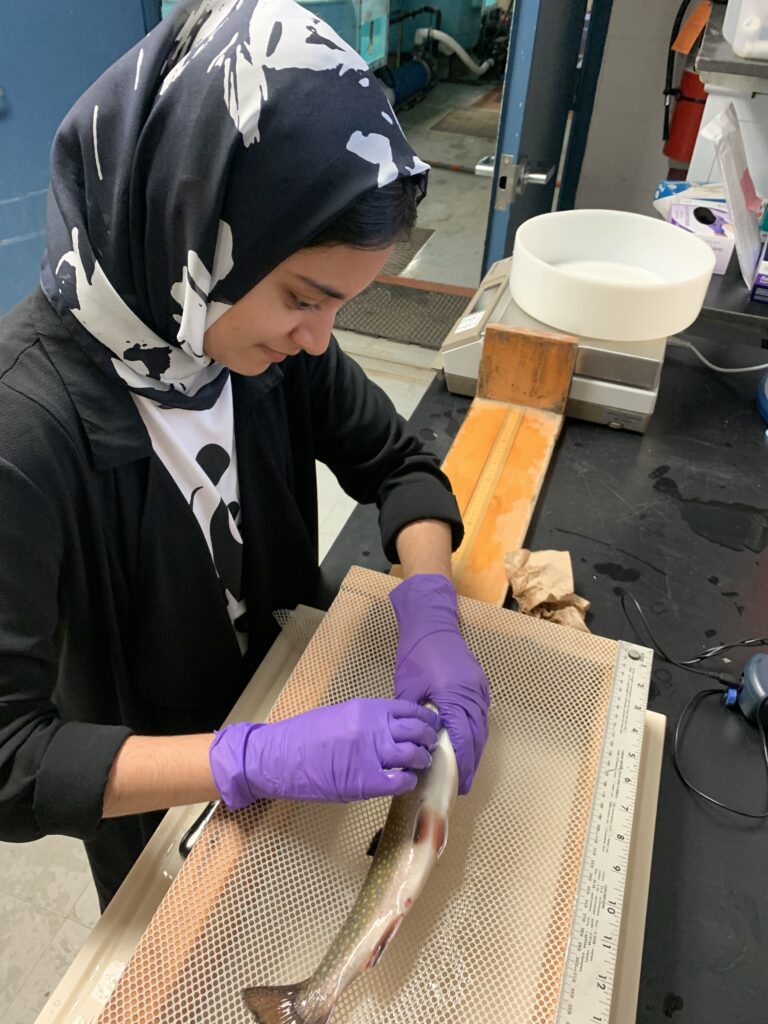 Aiman Raza tags a brook trout at the USGS Eastern Ecological Science Center in Leetown, WV, in January 2023. (Courtesy of Raza)
Q: Tell us about what you love about your academic program.
A: The ICARE program is making incredible strides in bridging the gap between research and environmental justice around Baltimore. With an interdisciplinary network of scientists and community leaders, ICARE is fulfilling its dual mission of increasing the diversity of the environmental workforce and conducting community-engaged research in and around Baltimore.
Q: What led you to pursue graduate education at UMBC?
A: I came back to UMBC as a master’s student because I was drawn to the ICARE program’s mission. I am passionate about conducting applied research with practical implications for my community. As an undergrad, I was involved with research in the biology department and heard about the ICARE program through my mentor. I knew that graduate school was the next step in pursuing a career in applied research, and the ICARE program’s goals aligned well with mine. I wanted to learn and grow in a program that brought diverse perspectives and focused on environmental justice in addressing environmental issues.
The ICARE program is making incredible strides in bridging the gap between research and environmental justice around Baltimore.
Aiman Raza ’22
Q: How has being part of a cohort-based program influenced your experience?
A: The ICARE program has cultivated a community of professionals who care deeply about building a more just and equitable future for all. Every day, I get to learn from my cohort members, who come from various backgrounds and disciplines. Their unique research projects and diverse perspectives have helped me realize the importance of interdisciplinary collaborations in environmental work. Building close connections with my cohort has enriched my graduate school experience both professionally and personally. I am constantly inspired by their passion and look forward to seeing the great work we accomplish in the future.
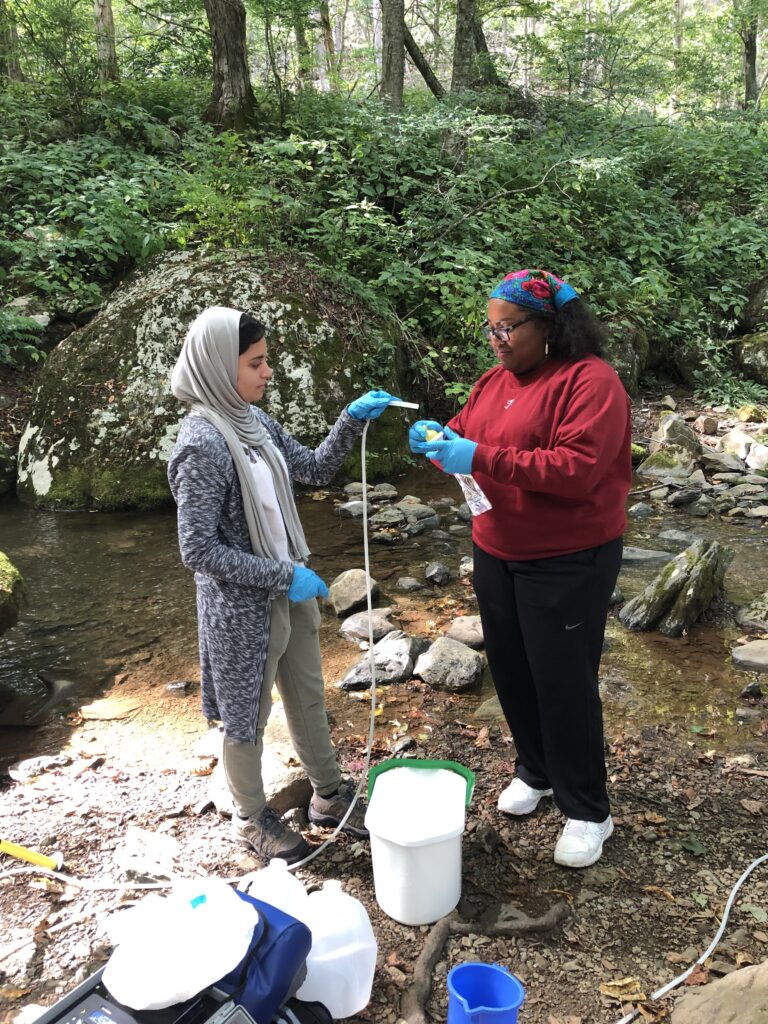 Aiman Raza (left) and fellow ICARE program member Autumn Powell collect water samples in Shenandoah National Park in September 2023. (Courtesy of Raza)
]]>
Meet Aiman Raza ’22, biological sciences, and a current biological sciences master’s student in the Interdisciplinary Consortium for Applied Research in the Environment (ICARE) program. After...
https://umbc.edu/stories/meet-a-retriever-aiman-raza-icare-masters-student/
https://my3.my.umbc.edu/api/v0/pixel/news/140545/guest@my.umbc.edu/35b69cce24da191080380fe45d77c793/api/pixel
alumni
biology
cnms
gradresearch
icare
impact
magazine
meet-a-retriever
perspectives
research
story
UMBC News & Magazine
https://my3.my.umbc.edu/groups/umbc-news-magazine
https://assets1-my.umbc.edu/system/shared/avatars/groups/000/001/943/24435aa6207c452e7bc15cc74b42c7bb/xsmall.png?1748556657
https://assets1-my.umbc.edu/system/shared/avatars/groups/000/001/943/24435aa6207c452e7bc15cc74b42c7bb/original.png?1748556657
https://assets2-my.umbc.edu/system/shared/avatars/groups/000/001/943/24435aa6207c452e7bc15cc74b42c7bb/xxlarge.png?1748556657
https://assets2-my.umbc.edu/system/shared/avatars/groups/000/001/943/24435aa6207c452e7bc15cc74b42c7bb/xlarge.png?1748556657
https://assets3-my.umbc.edu/system/shared/avatars/groups/000/001/943/24435aa6207c452e7bc15cc74b42c7bb/large.png?1748556657
https://assets1-my.umbc.edu/system/shared/avatars/groups/000/001/943/24435aa6207c452e7bc15cc74b42c7bb/medium.png?1748556657
https://assets2-my.umbc.edu/system/shared/avatars/groups/000/001/943/24435aa6207c452e7bc15cc74b42c7bb/small.png?1748556657
https://assets1-my.umbc.edu/system/shared/avatars/groups/000/001/943/24435aa6207c452e7bc15cc74b42c7bb/xsmall.png?1748556657
https://assets2-my.umbc.edu/system/shared/avatars/groups/000/001/943/24435aa6207c452e7bc15cc74b42c7bb/xxsmall.png?1748556657
UMBC News & Magazine
2
0
false
Mon, 01 Apr 2024 15:58:34 -0400
What is Volt Typhoon? A cybersecurity expert explains the Chinese hackers targeting US critical infrastructure
Aiman Raza (left) and fellow ICARE program member Autumn Powell collect water samples in Shenandoah National Park in September 2023. (Courtesy of Raza)
]]>
Meet Aiman Raza ’22, biological sciences, and a current biological sciences master’s student in the Interdisciplinary Consortium for Applied Research in the Environment (ICARE) program. After...
https://umbc.edu/stories/meet-a-retriever-aiman-raza-icare-masters-student/
https://my3.my.umbc.edu/api/v0/pixel/news/140545/guest@my.umbc.edu/35b69cce24da191080380fe45d77c793/api/pixel
alumni
biology
cnms
gradresearch
icare
impact
magazine
meet-a-retriever
perspectives
research
story
UMBC News & Magazine
https://my3.my.umbc.edu/groups/umbc-news-magazine
https://assets1-my.umbc.edu/system/shared/avatars/groups/000/001/943/24435aa6207c452e7bc15cc74b42c7bb/xsmall.png?1748556657
https://assets1-my.umbc.edu/system/shared/avatars/groups/000/001/943/24435aa6207c452e7bc15cc74b42c7bb/original.png?1748556657
https://assets2-my.umbc.edu/system/shared/avatars/groups/000/001/943/24435aa6207c452e7bc15cc74b42c7bb/xxlarge.png?1748556657
https://assets2-my.umbc.edu/system/shared/avatars/groups/000/001/943/24435aa6207c452e7bc15cc74b42c7bb/xlarge.png?1748556657
https://assets3-my.umbc.edu/system/shared/avatars/groups/000/001/943/24435aa6207c452e7bc15cc74b42c7bb/large.png?1748556657
https://assets1-my.umbc.edu/system/shared/avatars/groups/000/001/943/24435aa6207c452e7bc15cc74b42c7bb/medium.png?1748556657
https://assets2-my.umbc.edu/system/shared/avatars/groups/000/001/943/24435aa6207c452e7bc15cc74b42c7bb/small.png?1748556657
https://assets1-my.umbc.edu/system/shared/avatars/groups/000/001/943/24435aa6207c452e7bc15cc74b42c7bb/xsmall.png?1748556657
https://assets2-my.umbc.edu/system/shared/avatars/groups/000/001/943/24435aa6207c452e7bc15cc74b42c7bb/xxsmall.png?1748556657
UMBC News & Magazine
2
0
false
Mon, 01 Apr 2024 15:58:34 -0400
What is Volt Typhoon? A cybersecurity expert explains the Chinese hackers targeting US critical infrastructure

Written by Richard Forno, principal lecturer in computer science and electrical engineering, UMBC
Volt Typhoon is a Chinese state-sponsored hacker group. The United States government and its primary global intelligence partners, known as the Five Eyes, issued a warning on March 19, 2024, about the group’s activity targeting critical infrastructure.
The warning echoes analyses by the cybersecurity community about Chinese state-sponsored hacking in recent years. As with many cyberattacks and attackers, Volt Typhoon has many aliases and also is known as Vanguard Panda, Bronze Silhouette, Dev-0391, UNC3236, Voltzite and Insidious Taurus. Following these latest warnings, China again denied that it engages in offensive cyberespionage.
Volt Typhoon has compromised thousands of devices around the world since it was publicly identified by security analysts at Microsoft in May 2023. However, some analysts in both the government and cybersecurity community believe the group has been targeting infrastructure since mid-2021, and possibly much longer.
Volt Typhoon uses malicious software that penetrates internet-connected systems by exploiting vulnerabilities such as weak administrator passwords, factory default logins and devices that haven’t been updated regularly. The hackers have targeted communications, energy, transportation, water and wastewater systems in the U.S. and its territories, such as Guam.
In many ways, Volt Typhoon functions similarly to traditional botnet operators that have plagued the internet for decades. It takes control of vulnerable internet devices such as routers and security cameras to hide and establish a beachhead in advance of using that system to launch future attacks.
Operating this way makes it difficult for cybersecurity defenders to accurately identify the source of an attack. Worse, defenders could accidentally retaliate against a third party who is unaware that they are caught up in Volt Typhoon’s botnet.
Why Volt Typhoon matters
Disrupting critical infrastructure has the potential to cause economic harm around the world. Volt Typhoon’s operation also poses a threat to the U.S. military by potentially disrupting power and water to military facilities and critical supply chains.
FBI Director Christopher Wray testified at a congressional hearing on Jan. 31, 2024, about Chinese hackers targeting U.S. critical infrastructure.
Microsoft’s 2023 report noted that Volt Typhoon could “disrupt critical communications infrastructure between the United States and Asia region during future crises.” The March 2024 report, published in the U.S. by the Cybersecurity and Infrastructure Security Agency, likewise warned that the botnet could lead to “disruption or destruction of critical services in the event of increased geopolitical tensions and/or military conflict with the United States and its allies.”
Volt Typhoon’s existence and the escalating tensions between China and the U.S., particularly over Taiwan, underscore the latest connection between global events and cybersecurity.
Defending against Volt Typhoon
The FBI reported on Jan. 31, 2024, that it had disrupted Volt Typhoon’s operations by removing the group’s malware from hundreds of small office/home office routers. However, the U.S. is still determining the extent of the group’s infiltration of America’s critical infrastructure.
On March 25, 2024, the U.S. and U.K. announced that they had imposed sanctions on Chinese hackers involved in compromising their infrastructures. And other countries, including New Zealand, have revealed cyberattacks traced back to China in recent years.
All organizations, especially infrastructure providers, must practice time-tested safe computing centered on preparation, detection and response. They must ensure that their information systems and smart devices are properly configured and patched, and that they can log activity. And they should identify and replace any devices at the edges of their networks, such as routers and firewalls, that no longer are supported by their vendor.
Organizations can also implement strong user-authentication measures such as multifactor authentication to make it more difficult for attackers like Volt Typhoon to compromise systems and devices. More broadly, the comprehensive NIST Cybersecurity Framework can help these organizations develop stronger cybersecurity postures to defend against Volt Typhoon and other attackers.
Individuals, too, can take steps to protect themselves and their employers by ensuring their devices are properly updated, enabling multifactor authentication, never reusing passwords, and otherwise remaining vigilant to suspicious activity on their accounts, devices and networks.
For cybersecurity practitioners and society generally, attacks like Volt Typhoon can represent an enormous geopolitical cybersecurity threat. They are a reminder for everyone to monitor what’s going on in the world and consider how current events can affect the confidentiality, integrity and availability of all things digital.
This article is republished from The Conversation under a Creative Commons license. Read the original article and see more than 250 UMBC articles available in The Conversation.
]]>
Written by Richard Forno, principal lecturer in computer science and electrical engineering, UMBC Volt Typhoon is a Chinese state-sponsored hacker group. The United States government and its...
https://umbc.edu/stories/what-is-volt-typhoon-a-cybersecurity-expert-explains-the-chinese-hackers-targeting-us-critical-infrastructure/
https://my3.my.umbc.edu/api/v0/pixel/news/140406/guest@my.umbc.edu/2679c4356932f5f275c4c490c938aafd/api/pixel
coeit
csee
discovery
magazine
story
the-conversation
UMBC News & Magazine
https://my3.my.umbc.edu/groups/umbc-news-magazine
https://assets1-my.umbc.edu/system/shared/avatars/groups/000/001/943/24435aa6207c452e7bc15cc74b42c7bb/xsmall.png?1748556657
https://assets1-my.umbc.edu/system/shared/avatars/groups/000/001/943/24435aa6207c452e7bc15cc74b42c7bb/original.png?1748556657
https://assets2-my.umbc.edu/system/shared/avatars/groups/000/001/943/24435aa6207c452e7bc15cc74b42c7bb/xxlarge.png?1748556657
https://assets2-my.umbc.edu/system/shared/avatars/groups/000/001/943/24435aa6207c452e7bc15cc74b42c7bb/xlarge.png?1748556657
https://assets3-my.umbc.edu/system/shared/avatars/groups/000/001/943/24435aa6207c452e7bc15cc74b42c7bb/large.png?1748556657
https://assets1-my.umbc.edu/system/shared/avatars/groups/000/001/943/24435aa6207c452e7bc15cc74b42c7bb/medium.png?1748556657
https://assets2-my.umbc.edu/system/shared/avatars/groups/000/001/943/24435aa6207c452e7bc15cc74b42c7bb/small.png?1748556657
https://assets1-my.umbc.edu/system/shared/avatars/groups/000/001/943/24435aa6207c452e7bc15cc74b42c7bb/xsmall.png?1748556657
https://assets2-my.umbc.edu/system/shared/avatars/groups/000/001/943/24435aa6207c452e7bc15cc74b42c7bb/xxsmall.png?1748556657
UMBC News & Magazine
0
0
false
Mon, 01 Apr 2024 11:46:33 -0400
Hundreds of East Coast chemical engineering students to gather at UMBC for regional conference
Over the weekend of April 6 – 7, the UMBC student chapter of the American Institute of Chemical Engineers (AIChE) will host the 2024 Mid-Atlantic Regional Conference on campus. The event will feature workshops, research presentations, and a career fair with companies such as AstraZeneca and Astek Diagnostics and schools including Johns Hopkins University, Rutgers University, the University of Delaware, and Lehigh University. It will also feature the conferences’ two signature competitive events: Chemical Engineering Jeopardy and ChemE Car—a competition to build and operate a car powered and stopped by chemical reactions.
Organizers expect more than 350 attendees from more than 30 universities across the region. UMBC students are encouraged to register to attend, even if they aren’t chemical engineering majors. “As the premier student chemical engineering conference in the region, this event will offer great opportunities for networking, presenting research, landing internships and jobs, and general professional development,” says Terra Miley ’25, chemical engineering, who is serving as the communications chair for the student organizing committee.
]]>
Over the weekend of April 6 – 7, the UMBC student chapter of the American Institute of Chemical Engineers (AIChE) will host the 2024 Mid-Atlantic Regional Conference on campus. The event will...
https://umbc.edu/quick-posts/umbc-hosts-chemical-engineering-conference/
https://my3.my.umbc.edu/api/v0/pixel/news/140342/guest@my.umbc.edu/17d0be334ad4e2e0114406b43801fe6c/api/pixel
cbee
coeit
news
quick-post
quick-posts
science-and-tech
UMBC News & Magazine
https://my3.my.umbc.edu/groups/umbc-news-magazine
https://assets1-my.umbc.edu/system/shared/avatars/groups/000/001/943/24435aa6207c452e7bc15cc74b42c7bb/xsmall.png?1748556657
https://assets1-my.umbc.edu/system/shared/avatars/groups/000/001/943/24435aa6207c452e7bc15cc74b42c7bb/original.png?1748556657
https://assets2-my.umbc.edu/system/shared/avatars/groups/000/001/943/24435aa6207c452e7bc15cc74b42c7bb/xxlarge.png?1748556657
https://assets2-my.umbc.edu/system/shared/avatars/groups/000/001/943/24435aa6207c452e7bc15cc74b42c7bb/xlarge.png?1748556657
https://assets3-my.umbc.edu/system/shared/avatars/groups/000/001/943/24435aa6207c452e7bc15cc74b42c7bb/large.png?1748556657
https://assets1-my.umbc.edu/system/shared/avatars/groups/000/001/943/24435aa6207c452e7bc15cc74b42c7bb/medium.png?1748556657
https://assets2-my.umbc.edu/system/shared/avatars/groups/000/001/943/24435aa6207c452e7bc15cc74b42c7bb/small.png?1748556657
https://assets1-my.umbc.edu/system/shared/avatars/groups/000/001/943/24435aa6207c452e7bc15cc74b42c7bb/xsmall.png?1748556657
https://assets2-my.umbc.edu/system/shared/avatars/groups/000/001/943/24435aa6207c452e7bc15cc74b42c7bb/xxsmall.png?1748556657
UMBC News & Magazine
0
0
false
Fri, 29 Mar 2024 12:13:05 -0400
Fri, 29 Mar 2024 12:13:05 -0400
Urban development simulation helps students learn how to balance growth, equity, and environmental sustainability

Urban development firms Future Roots and Team Elle Woods are competing to win the City of Yorktown’s Elmwood District urban redevelopment project. The teams hover over their LEGO-built cities moving black, blue, red, and orange bricks representing new parking garages, low and high-rise office buildings, retail spaces, housing, and historic buildings. The site planners, financial analysts, marketing directors, environmental and equity directors, and community liaisons are mapping out neighborhood layouts that will entice former residents to return, draw professionals, and bring businesses to the once-thriving neighborhood.
The firms’ offices are on the first floor of UMBC’s Performing Arts and Humanities Building. This is POLI 443 Urban Policy Analysis where two groups of students, seven on each team, spend six weeks developing a hypothetical urban redevelopment plan based on their understanding of urban policy, problems, and solutions. The teams then compete for the winning bid—that is, the green light of industry experts who’ve come to campus to judge their proposals.
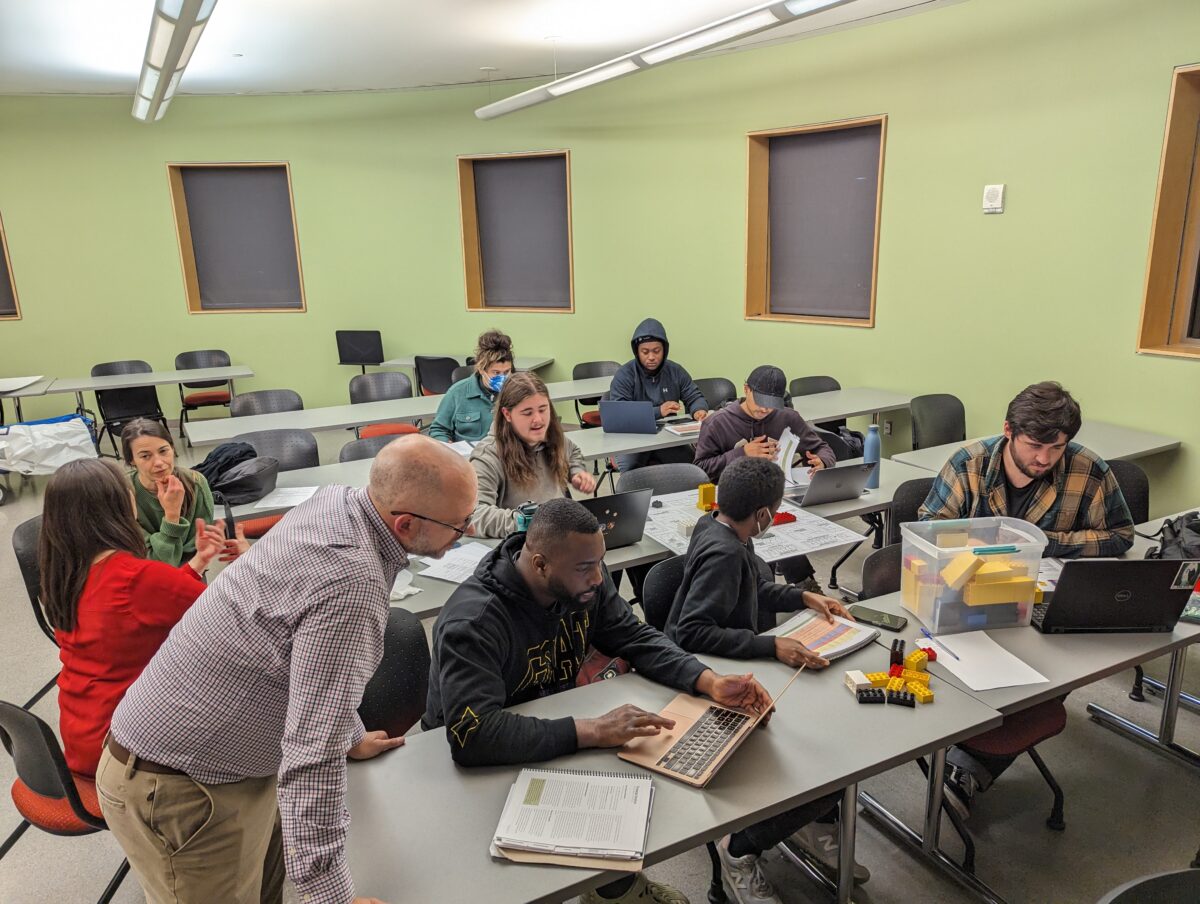 Eric Stokan (standing) with students during the semester as they brainstorm city designs. (Image courtesy of Stokan)
Building a vision
“I could lecture students about the ethical, financial, structural, and environmental issues cities grapple with in the land redevelopment process, but simulations create an entirely different learning process,” says Eric Stokan, associate professor of political science. Always looking for ways to make community development concepts more engaging, Stokan worked for several years on developing an urban development class simulation.
Around this time, Ghadeer Mansour ’13, political science, senior associate at the Urban Land Institute (ULI), reached out to her former political science professor, Carolyn Forestiere seeking a faculty member who might be interested in ULI’s UrbanPlan simulation curriculum program. ULI is a nonprofit global network of professionals in every real estate development and land use sector, focusing on decarbonization and net zero, increasing housing attainability, and education. The UrbanPlan exercise requires students to design a realistic land use redevelopment plan, including a 3-D city model, that addresses private and public sector needs and wants.
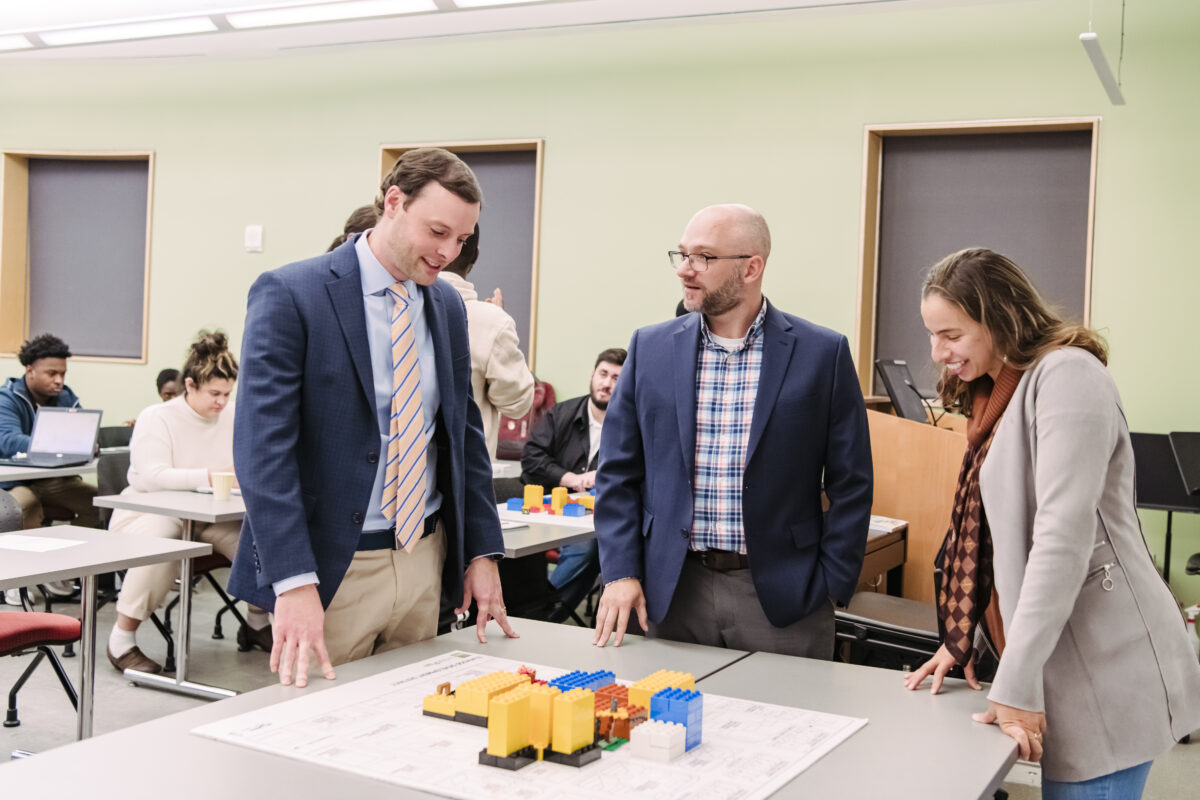 (l-r) Perry Mahle, a project manager at the Whiting-Turner Contracting Company and co-chair of the Urban Plan, with Stokan and Mansour. (Marlayna Demond ’11/UMBC)
Forestiere suggested Stokan to Mansour. “ULI had thought of everything a student needs to understand urban development. They had a whole step-by-step manual with tabs for the history of the town, design guidelines, site plan, roles, letters from residents, a glossary of terms, and a presentation checklist,” says Stokan. He first completed a condensed version of the simulation as a participant followed by a training tailored to educators adopting the simulation into their classroom.
“The simulation gives students a critical take on how to better balance equity and economic growth, and what that means for affordable housing,” says Stokan. “They have to confront those trade-offs and understand it’s not an all-or-nothing thing. They have to be able to balance growth, equity, and environmental sustainability.”
Balancing the books
Cooperation, teamwork, and compromise are necessary for sustainable development. International student Florian Dambacher,listens intently to Alex Schultz ’25, political science, the environmental and equity director; Sam Kennedy ’26, social work, the neighborhood liaison, and Meghna Chandrasekaran ’24, political science, the site planner as he calculates the expenses. His job is to ensure the team’s ideas for creating a sustainable, economically vibrant, distinctive district stay within the city’s budget requirements and profit projections while ensuring the designs encourage cross-generational interactions that maximize the surrounding commercial, educational, and cultural resources.
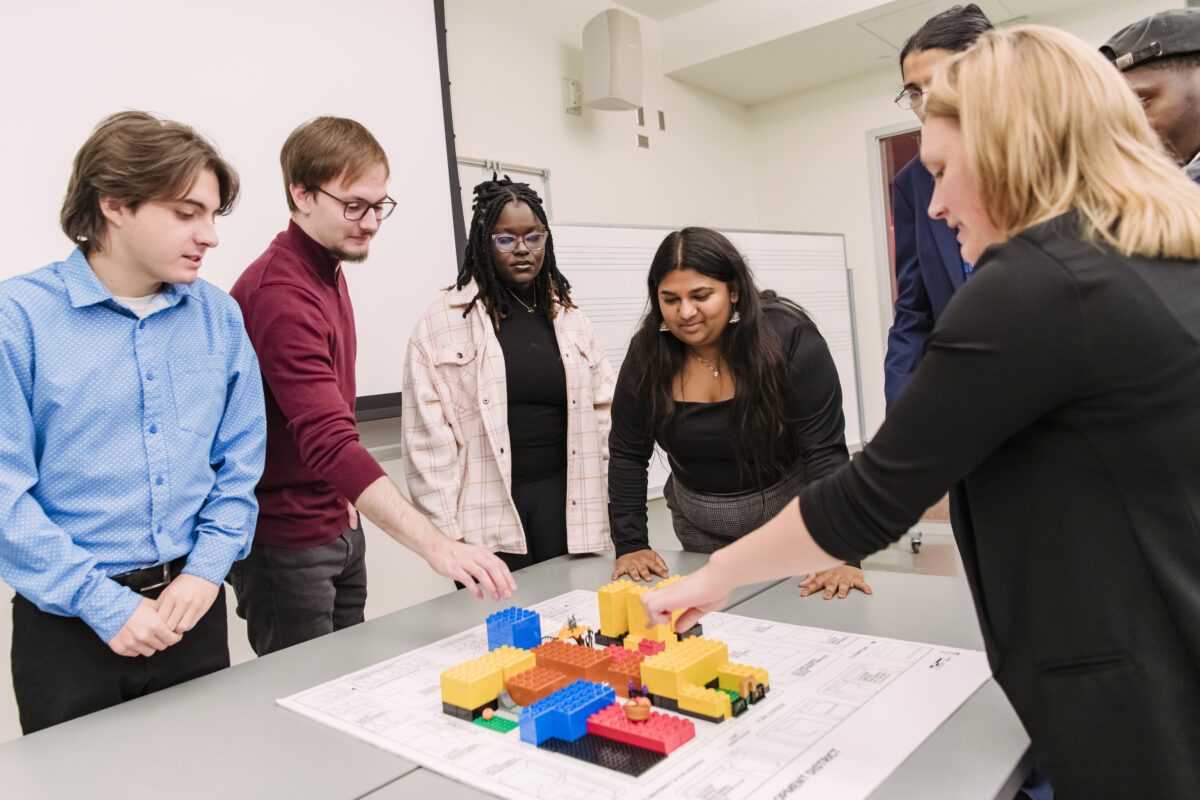 Florian Dambacher (in red) with Team Elle Woods. (Marlayna Demond ’11/UMBC)
“It was a bit daunting at first. You have all these different requirements. You have the city that wants something from you, the investors you have to answer to who have interest groups in the community that have demands, needs, and wants,” says Dambacher. Today he is the student, but when he returns home to Technische Universität Dortmund in western Germany, Dambacher plans on using this teaching tool with his high school students. He feels this kind of simulation can be a powerful tool in any subject. “Teaching the theoretical side of a topic may be enough, but having a practical aspect has a more lasting impact on students,” says Dambacher.
Accessibility in motion
With two internships under his belt, one at the Frederick County Transit Planning Department and the other at the Maryland Transit Administration Planning Department, Travis Martin ’25, political science, was more than ready for his role as site planner. His previous experience proved indispensable as he brainstormed ideas with Aurora Quezada ’24, the neighborhood liaison, and Suhaib Mirza ’25, political science, environment and equity director.
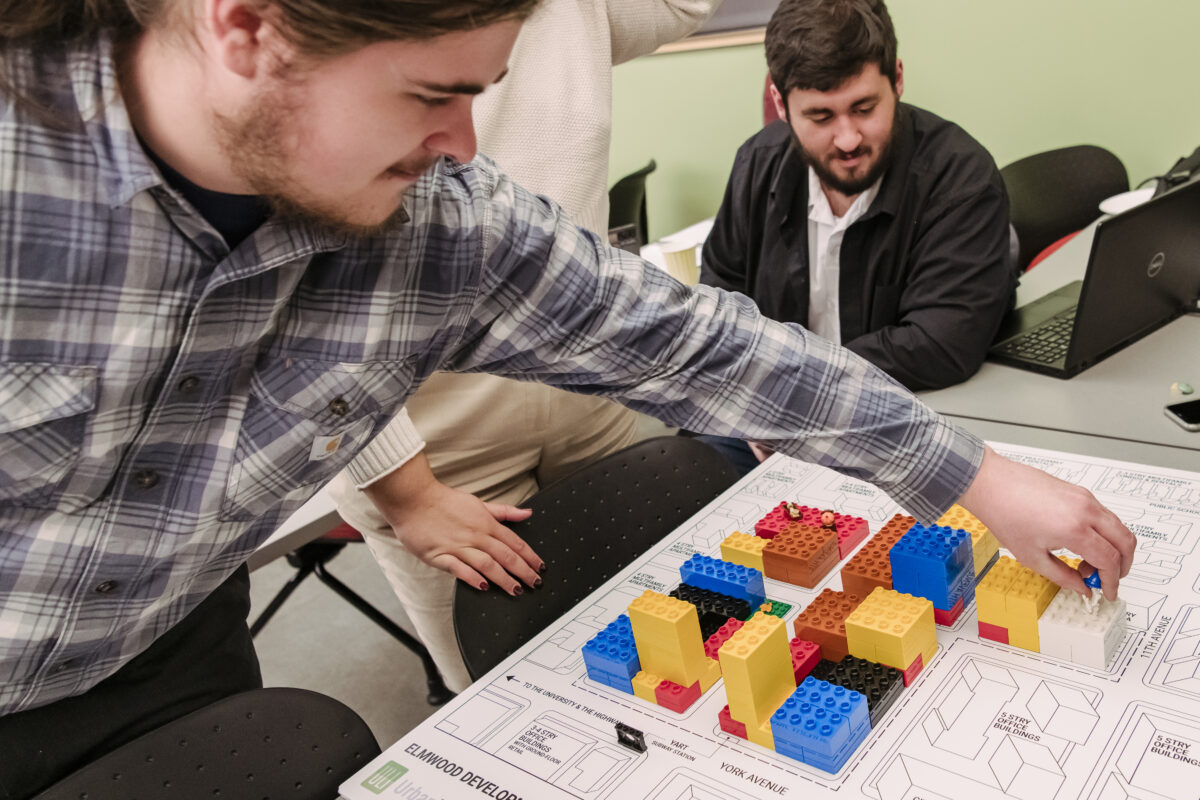 Travis Martin (left) works on Future Roots’ redevelopment map. (Marlayna Demond ’11/UMBC)
“A well-functioning transit system gives people the tools they need to be successful, to build a sustainable life,” says Martin, who enjoys exploring and analyzing transportation systems when he visits new cities. In the real world, he notes, there’s a lot more paperwork and sometimes years of deliberation before a development decision is made. The simulation made it possible for Travis to experience the entire proposal process. “Transportation is a social justice issue for me, not everyone is fortunate enough to have access to it.”
Defending the vision
On the day the industry professionals arrive to judge their projects, Team Elle Woods and Future Roots inspect every colorful block of their city model making sure it reflects their upcoming proposal. Stokan and Mansour are excited. This is what they have been looking forward to since they first connected. “Professor Stokan has been so welcoming and open about the whole process so that in many ways, students are leading the process themselves,” says Mansour. “Then we bring in professionals who do this planning work for their day jobs, and they mentor the students and help think through the trade-offs and issues they face as urban planners.”
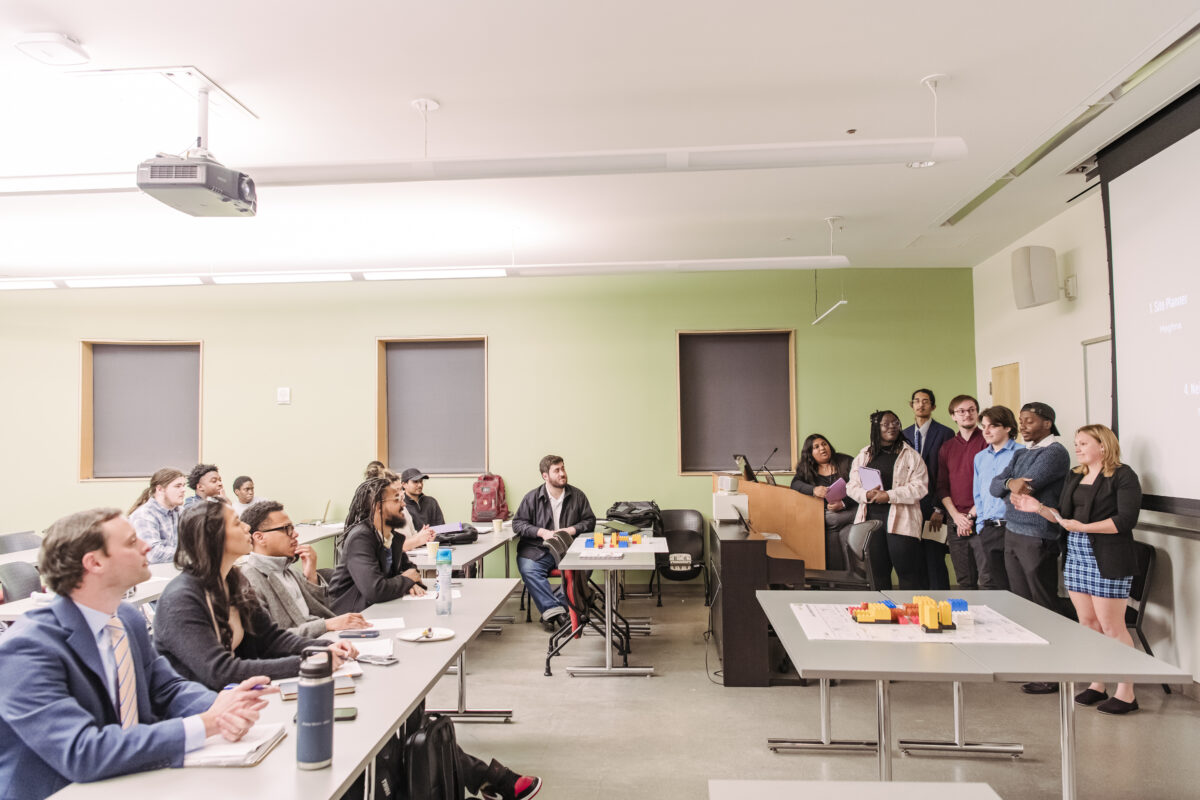 Team Elle Woods presents to the hypothetical city council. (Marlayna Demond ’11/UMBC)
Perry Mahle, a project manager at the Whiting-Turner Contracting Company, and Rose Dalay, operations and leasing specialist at SparkFlex, co-chairs of the UrbanPlan simulation, walk around the LEGO cities, chatting with students from both firms.
“Beyond meeting the metrics or asking the questions that the curriculum provides. I always try to ask questions to encourage students to evaluate their final decisions,” says Brennan Murray, assistant managing director of business and neighborhood development at the Baltimore Development Corporation. “Like in the real world, when industry professionals are presenting projects, you are going to get questions that call your thinking, your process, and your solutions into question. How students respond on the fly is a lesson in itself.”
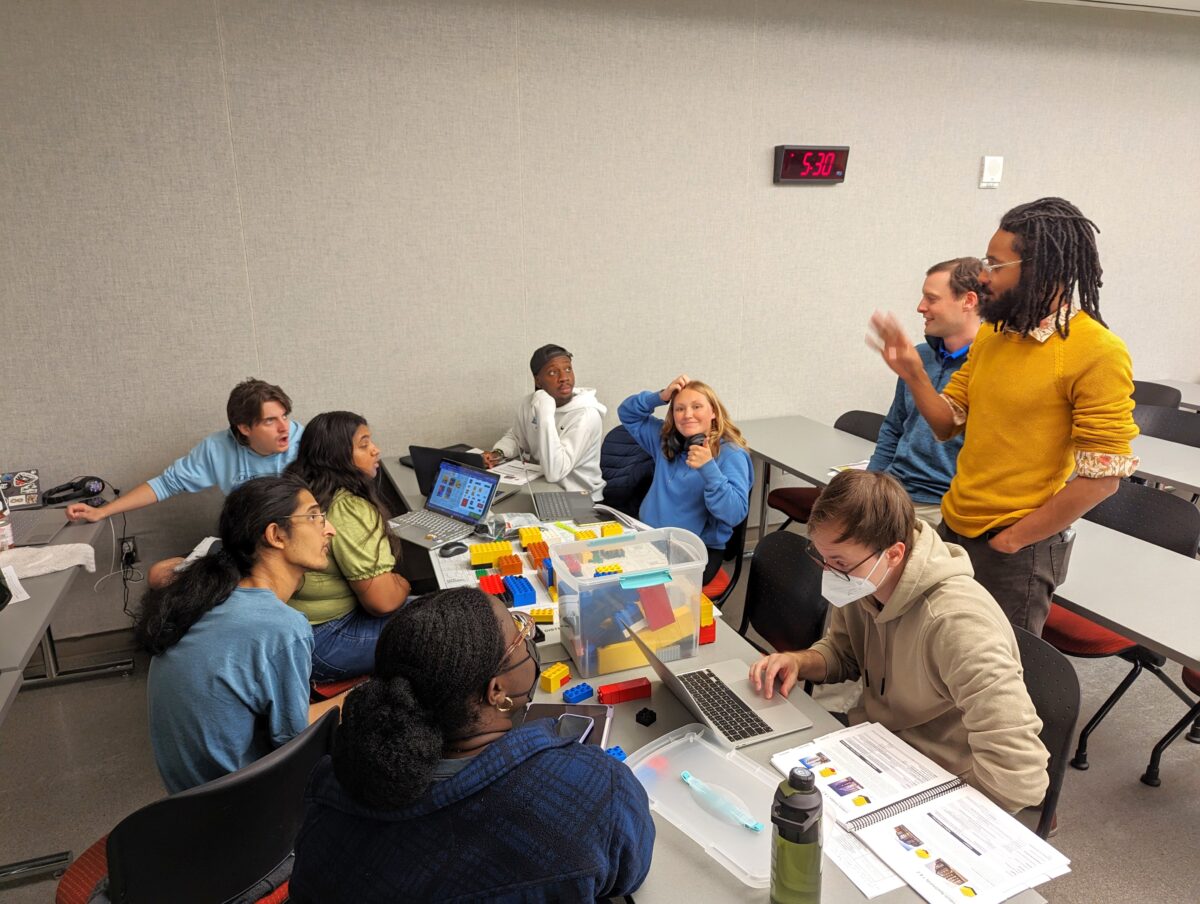 (r-l) Brennan Murray (in yellow) and Perry Mahle guide students during the semester. (Image courtesy of Stokan)
The two student firms stand before the council explaining their vision statements, site plan, and financial model. Team Elle Woods’ multimillion-dollar investment centers around multigenerational living, youth job development, and walkability.
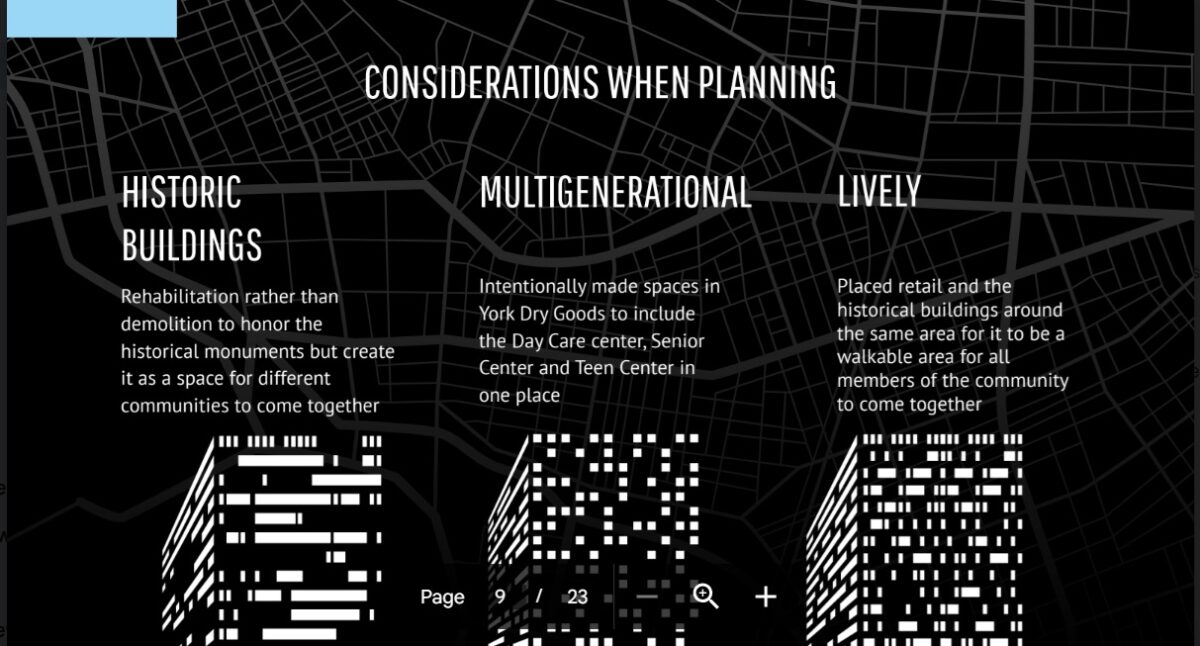
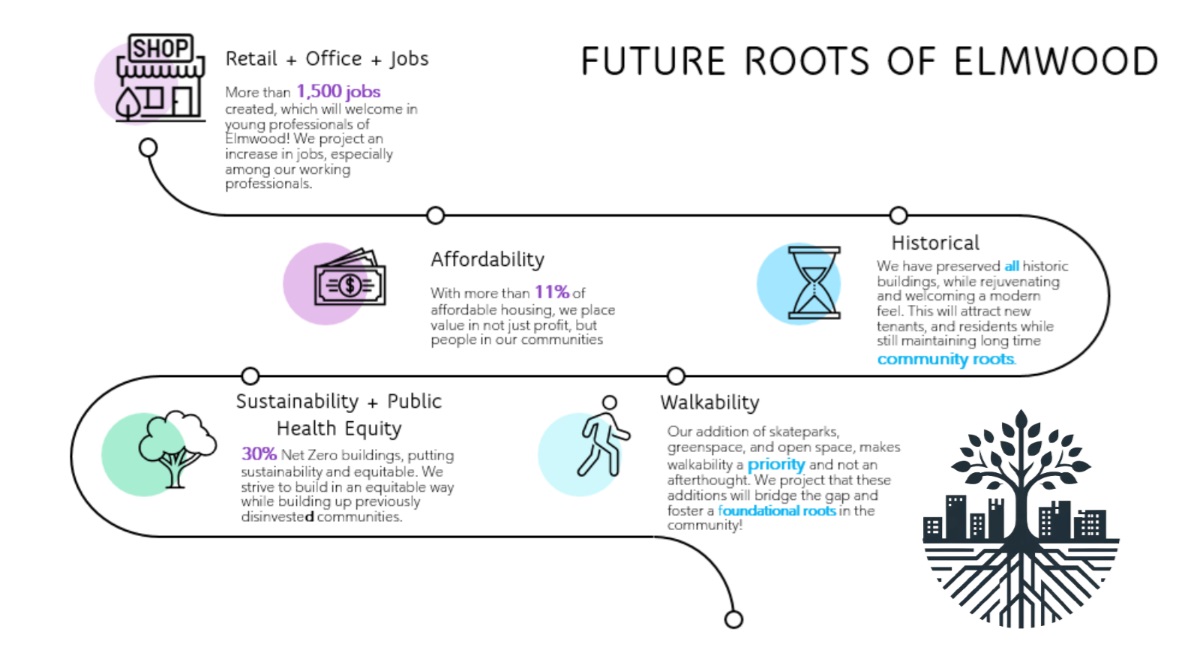
Left: Team Elle Woods’ redevelopment plan. Right: Future Roots’ redevelopment plan.
Future Roots’ plan is geared more toward walkability, integration of essential services, historic preservation, and environmental sustainability. The council demands a clear cause and effect for each item on the financial statement. They hone in on the long-term benefits every decision would have on the area’s multigenerational community.
Team Elle Woods won the bid on many grounds, but most importantly because their finances stayed in the green. Future Roots, while presenting a compelling case, resulted in debt. Martin, the transportation planner for the team, contested the decision, but ultimately he said, “The simulation was fun and made me feel like I was doing something important.”
Role vs. real-life
As the class prepared to celebrate the end of their project, Shanika Freeman ’24, individualized studies, reflects on what she describes as an eye-opening experience that will help her in her work as a leader in Baltimore City. She is well aware of the impact real estate development can have on a city. Freeman, who grew up in Baltimore City, says the real estate design choices historically driven by segregation—favoring white communities and ostracizing Black ones—have been linked to an increase in crime, incarceration, and recidivism.
Freeman is working on dismantling such inequalities as a member of the Baltimore County Public Library’s diversity, equity, and inclusion team. So when she was given the role of marketing director, Freeman initially didn’t want it. She was weary of the role marketing has played in the negative portrayal of urban neighborhoods.
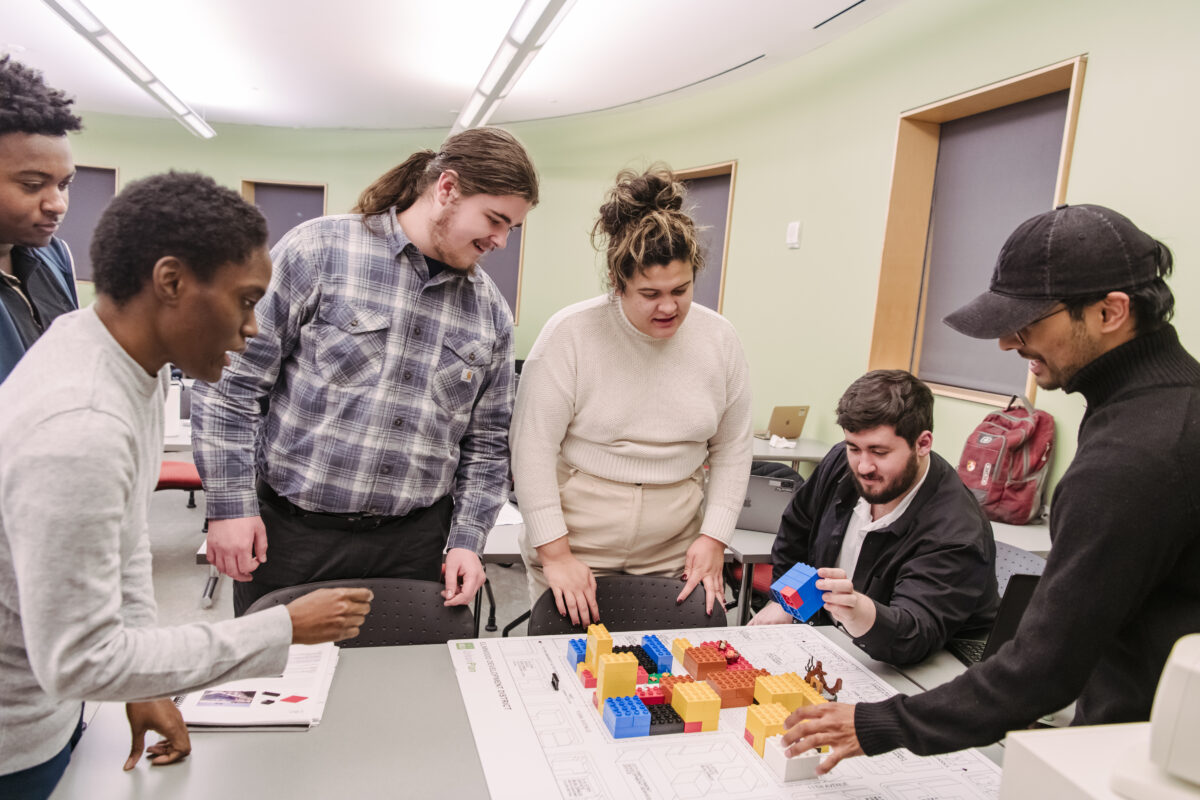 Shanika Freeman (left) with team Future Roots. (Marlayna Demond ’11/UMBC)
“I was put off by my role because I’m more into social justice, people over profit. Marketing and finance aren’t my thing. Having to shift my focus and my personal biases was really difficult, to be honest,” says Freeman. But she didn’t give up. She leaned in. “Once I dug deep into it, I got excited about it and came to understand that without money the city can’t build; if we can’t build, we can’t help more people. It’s a collaborative effort. I learned a lot about myself as a person and also about a career path that I might take in the future.”
The Urban Plan simulation will be a standalone class in the Honors College in fall 2024 and fall 2025. For more information, contact Eric Stokan: estokan@umbc.edu.
]]>
Urban development firms Future Roots and Team Elle Woods are competing to win the City of Yorktown’s Elmwood District urban redevelopment project. The teams hover over their LEGO-built cities...
https://umbc.edu/stories/urban-development-class-simulation/
https://my3.my.umbc.edu/api/v0/pixel/news/140265/guest@my.umbc.edu/590ccce4979499cf17ed4f4aa4929002/api/pixel
cahss
cahss-research
impact
magazine
politicalscience
research
story
UMBC News & Magazine
https://my3.my.umbc.edu/groups/umbc-news-magazine
https://assets1-my.umbc.edu/system/shared/avatars/groups/000/001/943/24435aa6207c452e7bc15cc74b42c7bb/xsmall.png?1748556657
https://assets1-my.umbc.edu/system/shared/avatars/groups/000/001/943/24435aa6207c452e7bc15cc74b42c7bb/original.png?1748556657
https://assets2-my.umbc.edu/system/shared/avatars/groups/000/001/943/24435aa6207c452e7bc15cc74b42c7bb/xxlarge.png?1748556657
https://assets2-my.umbc.edu/system/shared/avatars/groups/000/001/943/24435aa6207c452e7bc15cc74b42c7bb/xlarge.png?1748556657
https://assets3-my.umbc.edu/system/shared/avatars/groups/000/001/943/24435aa6207c452e7bc15cc74b42c7bb/large.png?1748556657
https://assets1-my.umbc.edu/system/shared/avatars/groups/000/001/943/24435aa6207c452e7bc15cc74b42c7bb/medium.png?1748556657
https://assets2-my.umbc.edu/system/shared/avatars/groups/000/001/943/24435aa6207c452e7bc15cc74b42c7bb/small.png?1748556657
https://assets1-my.umbc.edu/system/shared/avatars/groups/000/001/943/24435aa6207c452e7bc15cc74b42c7bb/xsmall.png?1748556657
https://assets2-my.umbc.edu/system/shared/avatars/groups/000/001/943/24435aa6207c452e7bc15cc74b42c7bb/xxsmall.png?1748556657
UMBC News & Magazine
1
0
false
Wed, 27 Mar 2024 15:08:39 -0400
Wed, 27 Mar 2024 15:08:39 -0400