Starting a New Semester Together
Dear UMBC Community,
Welcome to the first day of the spring semester! As classes get under way, I wanted to share a brief video message with the campus community. I am excited and inspired to partner with you this semester on both near-term action and long-term strategic planning.
Sincerely,
President Valerie Sheares Ashby
]]>
Dear UMBC Community, Welcome to the first day of the spring semester! As classes get under way, I wanted to share a brief video message with the campus community. I am excited and inspired to...
https://my3.my.umbc.edu/groups/announcements/posts/138462
https://my3.my.umbc.edu/api/v0/pixel/news/138494/guest@my.umbc.edu/5865f4efdd290c1ede5e93d712ee8ac0/api/pixel
president
story
UMBC News & Magazine
https://my3.my.umbc.edu/groups/umbc-news-magazine
https://assets1-my.umbc.edu/system/shared/avatars/groups/000/001/943/24435aa6207c452e7bc15cc74b42c7bb/xsmall.png?1748556657
https://assets1-my.umbc.edu/system/shared/avatars/groups/000/001/943/24435aa6207c452e7bc15cc74b42c7bb/original.png?1748556657
https://assets2-my.umbc.edu/system/shared/avatars/groups/000/001/943/24435aa6207c452e7bc15cc74b42c7bb/xxlarge.png?1748556657
https://assets2-my.umbc.edu/system/shared/avatars/groups/000/001/943/24435aa6207c452e7bc15cc74b42c7bb/xlarge.png?1748556657
https://assets3-my.umbc.edu/system/shared/avatars/groups/000/001/943/24435aa6207c452e7bc15cc74b42c7bb/large.png?1748556657
https://assets1-my.umbc.edu/system/shared/avatars/groups/000/001/943/24435aa6207c452e7bc15cc74b42c7bb/medium.png?1748556657
https://assets2-my.umbc.edu/system/shared/avatars/groups/000/001/943/24435aa6207c452e7bc15cc74b42c7bb/small.png?1748556657
https://assets1-my.umbc.edu/system/shared/avatars/groups/000/001/943/24435aa6207c452e7bc15cc74b42c7bb/xsmall.png?1748556657
https://assets2-my.umbc.edu/system/shared/avatars/groups/000/001/943/24435aa6207c452e7bc15cc74b42c7bb/xxsmall.png?1748556657
UMBC News & Magazine
0
0
false
Mon, 29 Jan 2024 15:15:02 -0500
Noor Zaidi, history, receives prestigious NEH faculty fellowship to complete book project

Noor Zaidi, assistant professor of history, received a National Endowment for the Humanities (NEH) fellowship to research and write Translations of Zaynab: Gender, Sectarianism, and Citizenship in Shi’a Islam. The book will analyze how the seventh-century figure, Zaynab bint Ali, granddaughter of the Prophet Muhammed, has been used in 20th-century political contexts.
“It is my great pleasure to announce NEH grant awards to support 260 exemplary humanities projects undertaken by scholars, higher education institutions, and organizations of every size,” stated NEH Chair Shelly C. Lowe (Navajo) in the NEH press release. “This funding will help preserve and expand access to community histories, strengthen the ability of small museums and archives to serve the public, and provide resources and educational opportunities for students to engage with history, literature, languages, and cultures.”
Zaidi, a 2017 UMBC postdoctoral fellow, is a scholar of the Middle East and South Asia. She specializes in the history of gender, sectarianism, and Shi’a Islam in national and transnational spaces. Her research explores “sites of sectarianization” through the 20th century, tracing the development and evolution of pilgrimage to two female shrines in Syria and Pakistan and prisons in Iraq as sites of memory and identity construction. Based on oral interviews, fieldwork, and archival research in Syria, Pakistan, and Iraq, Zaidi’s work explores the physical and imaginative spaces in which identity is made and contested and shows how transnational narratives become embedded in local contexts.
Thrilled and so grateful to receive an NEH fellowship this year!! None of us ever have any success without the support of others, and my colleagues @UMBC (and mentors elsewhere) have been so steadfast and encouraging, in the face of attacks on humanities, the global landscape 1/2 https://t.co/LBd6M1D0mU
— Noor Zaidi (@noorzzaidi) January 9, 2024
You can read Zaidi’s articles about “green” Ramadan, the hajj pilgrimage, and the Shiite Muslim holiday, Ashura, in The Conversation.
]]>
Noor Zaidi, assistant professor of history, received a National Endowment for the Humanities (NEH) fellowship to research and write Translations of Zaynab: Gender, Sectarianism, and Citizenship in...
https://umbc.edu/quick-posts/noor-zaidi-history-receives-neh-faculty-fellowship/
https://my3.my.umbc.edu/api/v0/pixel/news/138521/guest@my.umbc.edu/ec26a9121d95660496e4bdf15e8f9257/api/pixel
cahss
cahss-research
history
news
policy-and-society
quick-post
research
UMBC News & Magazine
https://my3.my.umbc.edu/groups/umbc-news-magazine
https://assets1-my.umbc.edu/system/shared/avatars/groups/000/001/943/24435aa6207c452e7bc15cc74b42c7bb/xsmall.png?1748556657
https://assets1-my.umbc.edu/system/shared/avatars/groups/000/001/943/24435aa6207c452e7bc15cc74b42c7bb/original.png?1748556657
https://assets2-my.umbc.edu/system/shared/avatars/groups/000/001/943/24435aa6207c452e7bc15cc74b42c7bb/xxlarge.png?1748556657
https://assets2-my.umbc.edu/system/shared/avatars/groups/000/001/943/24435aa6207c452e7bc15cc74b42c7bb/xlarge.png?1748556657
https://assets3-my.umbc.edu/system/shared/avatars/groups/000/001/943/24435aa6207c452e7bc15cc74b42c7bb/large.png?1748556657
https://assets1-my.umbc.edu/system/shared/avatars/groups/000/001/943/24435aa6207c452e7bc15cc74b42c7bb/medium.png?1748556657
https://assets2-my.umbc.edu/system/shared/avatars/groups/000/001/943/24435aa6207c452e7bc15cc74b42c7bb/small.png?1748556657
https://assets1-my.umbc.edu/system/shared/avatars/groups/000/001/943/24435aa6207c452e7bc15cc74b42c7bb/xsmall.png?1748556657
https://assets2-my.umbc.edu/system/shared/avatars/groups/000/001/943/24435aa6207c452e7bc15cc74b42c7bb/xxsmall.png?1748556657
UMBC News & Magazine
1
0
false
Mon, 29 Jan 2024 11:23:54 -0500
Meet a Retriever—Kevin Yang ’07, Alumni Association Executive Vice President

Meet Kevin Yang ’07, computer science and financial economics. Kevin is a real estate entrepreneur, the current executive vice president and vice president of finance of the UMBC Alumni Association Board of Directors, and one half of an alumni power couple. Kevin met his wife, Katelyn Niu ’05, biochemistry, when the pair found themselves in the same physics study group as undergrads (because where else do you find love at UMBC?). They both share a passion for UMBC that runs deep. Take it away, Kevin!
Q: What is your WHY? What brought you to UMBC?
A. I grew up in an immigrant family and witnessed the sacrifices that my parents made to give me an opportunity to achieve the American dream. Although they never had the chance to finish high school, my parents firmly believed in the importance of higher education. I came to UMBC for a quality STEM education and found it to be a perfect fit. UMBC offered the resources of a larger university and the individualized attention of a smaller college.
Q: What’s your favorite part of Retriever Nation?
A. I love UMBC’s commitment to inclusive excellence. Retriever Nation welcomes students from diverse backgrounds and provides them with the necessary support to succeed at UMBC and beyond. I am forever grateful for the amazing experience that I had at UMBC! In addition to receiving a quality education, I made many lifelong friends, including my wife. I have stayed engaged since graduation, and I am proud of UMBC’s commitment to inclusive excellence.
Q: Tell us what you love about your academic program or an organization you’re involved in.
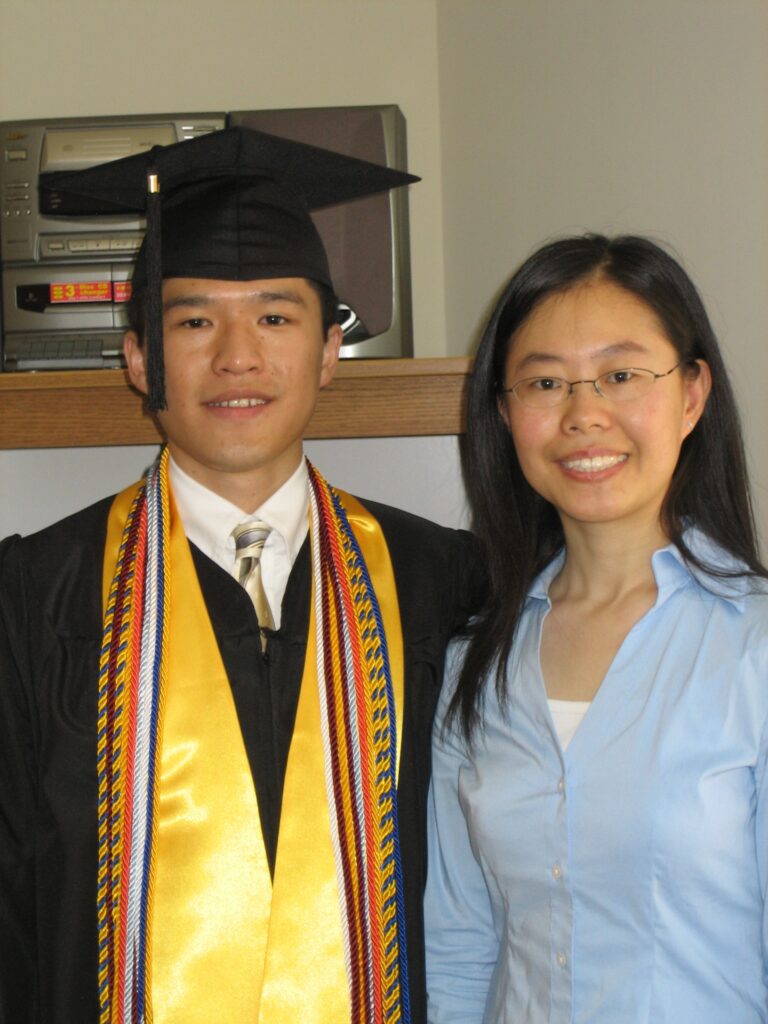
A. I had an excellent experience with the computer science program, which offered many opportunities beyond the classroom. As a tutor, teaching assistant, and research assistant in the computer science department, I learned valuable written and verbal communication skills, which was a highlight of my UMBC education.
UMBC community members work together to help our students achieve their academic and professional goals.
Today, I am a real estate entrepreneur, the Founder of KRY Properties. As a business owner, I love the ability to chart my own path. I often have to assume multiple roles, which is both challenging and rewarding. The analytical, problem-solving, and communication skills that I developed at UMBC gave me the confidence to pursue entrepreneurship.
Q: Where did you find support?
A. I built meaningful and long-lasting relationships at UMBC. I attribute much of my personal growth and academic achievements to my peers. We struggled together in challenging engineering courses, contemplated our futures from late night into early morning, and celebrated our birthdays at the local Olive Garden. We strengthened our bonds through highs and lows, and I will forever cherish those special memories.
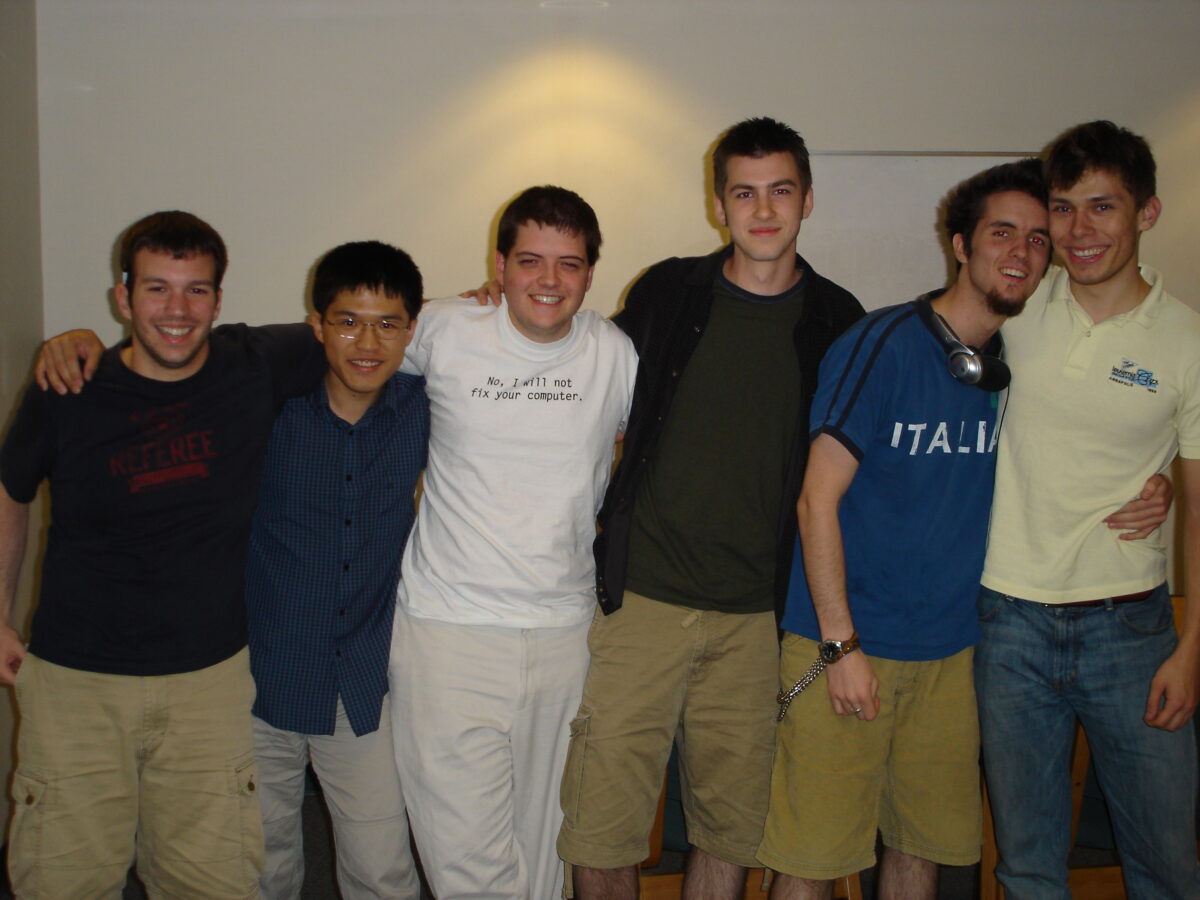 CMSC 441H, Algorithms with Professor Richard Chang, study group in Harbor Hall with fellow UMBC alumni JC Montminy, Kevin Yang, Donald Miner, Corey Weidenhammer, Alessandro Ferrucci, and Brandon Wilson.
Q: Tell us about someone in the community who has inspired you.
A. I received substantial financial and academic support from the Meyerhoff Scholars Program, which laid the foundation for my personal and professional successes. As a Meyerhoff Scholar, I learned about and took advantage of many incredible opportunities, such as summer internships at Georgia Tech and MIT. The Meyerhoff Scholars Program and its co-founder, Dr. Freeman A. Hrabowski, III, have inspired me to give back to the community that gave me so much.
Q: As alumni, how have you and Katelyn given back?
A. “To whom much is given, much is required.” I have been a donor every year since I graduated in 2007. My support focuses on scholarships, including the Meyerhoff Scholars Program and the Alumni Endowed Scholarship Fund. My wife, Katelyn, and I established an endowed scholarship in 2014 to support undergraduate students. Katelyn and I were fortunate to receive scholarships at UMBC. We are giving back so students who come after us can continue to have the same extraordinary experience that shaped our future.
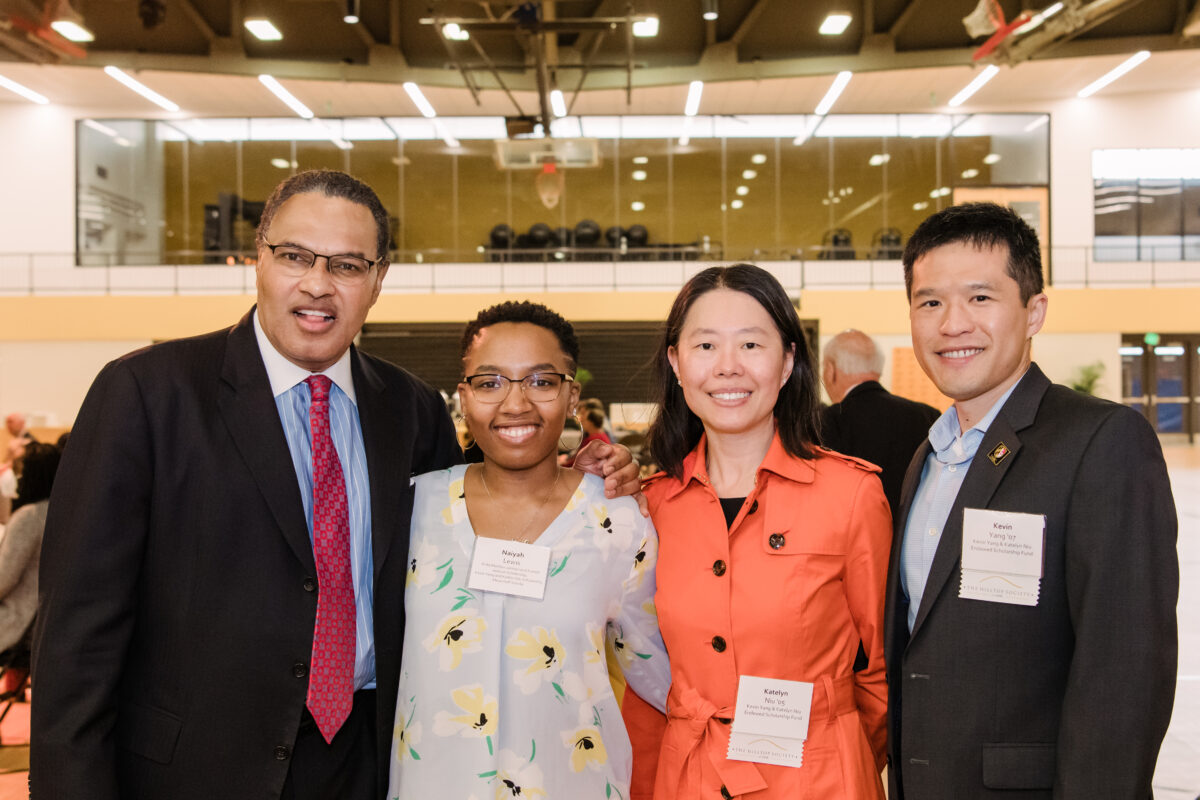 Katelyn Niu and Kevin Yang pose for a photo with Naiyah Lewis, one of their scholars, and UMBC President Emeritus Dr. Freeman A. Hrabowski, III, at the 2022 Endowed Scholars Luncheon.
Q: What’s the one thing you’d want someone who hasn’t joined the UMBC community to know about the support you find here?
A. UMBC community members work together to help our students achieve their academic and professional goals. We are proud of our collaborative culture!
* * * * *
UMBC’s greatest strength is its people. When people meet Retrievers and hear about the passion they bring, the relationships they create, the ways they support each other, and the commitment they have to inclusive excellence, they truly get a sense of our community. That’s what “Meet a Retriever” is all about.
Learn more about how UMBC can help you achieve your goals.
]]>
Meet Kevin Yang ’07, computer science and financial economics. Kevin is a real estate entrepreneur, the current executive vice president and vice president of finance of the UMBC Alumni...
https://umbc.edu/stories/meet-kevin-yang-alumni-association-vice-president/
https://my3.my.umbc.edu/api/v0/pixel/news/138486/guest@my.umbc.edu/a3688e5e3b57ddc1135a96deb38440d4/api/pixel
alumni
alumni-association
alumni-endowed-scholarship
biochemistry
coeit
compsci
financial-economics
impact
magazine
meet-a-retriever
meyerhoff-scholars
story
UMBC News & Magazine
https://my3.my.umbc.edu/groups/umbc-news-magazine
https://assets1-my.umbc.edu/system/shared/avatars/groups/000/001/943/24435aa6207c452e7bc15cc74b42c7bb/xsmall.png?1748556657
https://assets1-my.umbc.edu/system/shared/avatars/groups/000/001/943/24435aa6207c452e7bc15cc74b42c7bb/original.png?1748556657
https://assets2-my.umbc.edu/system/shared/avatars/groups/000/001/943/24435aa6207c452e7bc15cc74b42c7bb/xxlarge.png?1748556657
https://assets2-my.umbc.edu/system/shared/avatars/groups/000/001/943/24435aa6207c452e7bc15cc74b42c7bb/xlarge.png?1748556657
https://assets3-my.umbc.edu/system/shared/avatars/groups/000/001/943/24435aa6207c452e7bc15cc74b42c7bb/large.png?1748556657
https://assets1-my.umbc.edu/system/shared/avatars/groups/000/001/943/24435aa6207c452e7bc15cc74b42c7bb/medium.png?1748556657
https://assets2-my.umbc.edu/system/shared/avatars/groups/000/001/943/24435aa6207c452e7bc15cc74b42c7bb/small.png?1748556657
https://assets1-my.umbc.edu/system/shared/avatars/groups/000/001/943/24435aa6207c452e7bc15cc74b42c7bb/xsmall.png?1748556657
https://assets2-my.umbc.edu/system/shared/avatars/groups/000/001/943/24435aa6207c452e7bc15cc74b42c7bb/xxsmall.png?1748556657
UMBC News & Magazine
0
0
false
Fri, 26 Jan 2024 15:34:40 -0500
Fri, 26 Jan 2024 15:34:40 -0500
Alumna brings biology mural back to life

Walking down Academic Row, the ground floor windows of the Biological Sciences Building reflect the flow of student traffic, and colorful renditions of animals and microbes, silhouettes of researchers, and other elements of biology seem to pop off the wall and join the campus milieu.
For many, the images on the mural blend into the background of campus—just another wall in just another building. But the artist remembers the blank wall 10 years ago, covered sparsely in inspirational posters and placards.
“It was a huge wall, and visible from the outside,” says Anna Vikhlyayeva ’15, visual arts. In addition to wanting to beautify the space, Vikhlyayeva thought to herself, “The research of scientists can be very interesting and colorful and very inspiring for artists. What if by highlighting the biology research that people do in this building, other students will become more interested in biology?”
More than a mural
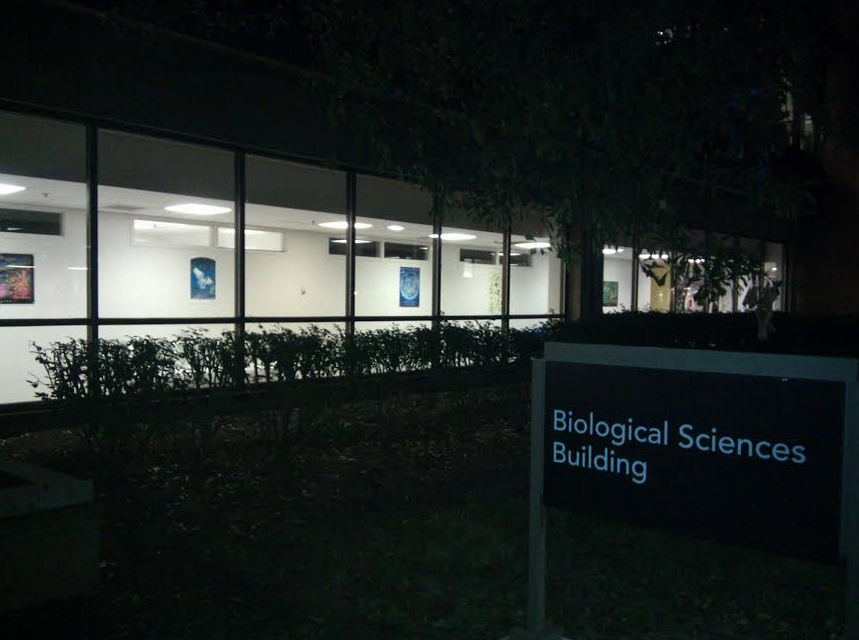 A “before” picture of the hallway in the biology building that the artist saw as an opportunity to emphasize the beauty of the world. (Photo courtesy of Vikhlyayeva)
In 2013 Vikhlyayeva took her plan to then-chair of the biology department Professor Philip Farabaugh, and it was perfect timing, he says. “I’d been thinking about branding the building in some way…and a mural was an obvious means to do that.” And in the decade since its installation, Farabaugh says, “I’m really gratified that the mural acts as a uniting image for all our faculty, staff, and students.”
But in December 2022 a combination of freezing temperatures and burst pipes resulted in damage across campus and significant flooding in the biology building. The bottom half of the mural fell victim to the water.
The challenges caused by the flood were hard to bear, particularly following COVID, says Farabaugh. “But, despite the disaster fatigue that everyone felt, the faculty, staff, and students responded with grace, energy, and yes, resiliency to the challenge.”
Vikhlyayeva, a working artist, still lives in the area, so when the biology building was reopened, Farabaugh emailed her to see if she’d be interested in repainting the damaged section. “I was happy to know that people in the building appreciate this wall so much that they want me to repair it,” says Vikhlyayeva. “Based on my images of the original mural, I’ve attempted to replicate the colors and designs the same.”
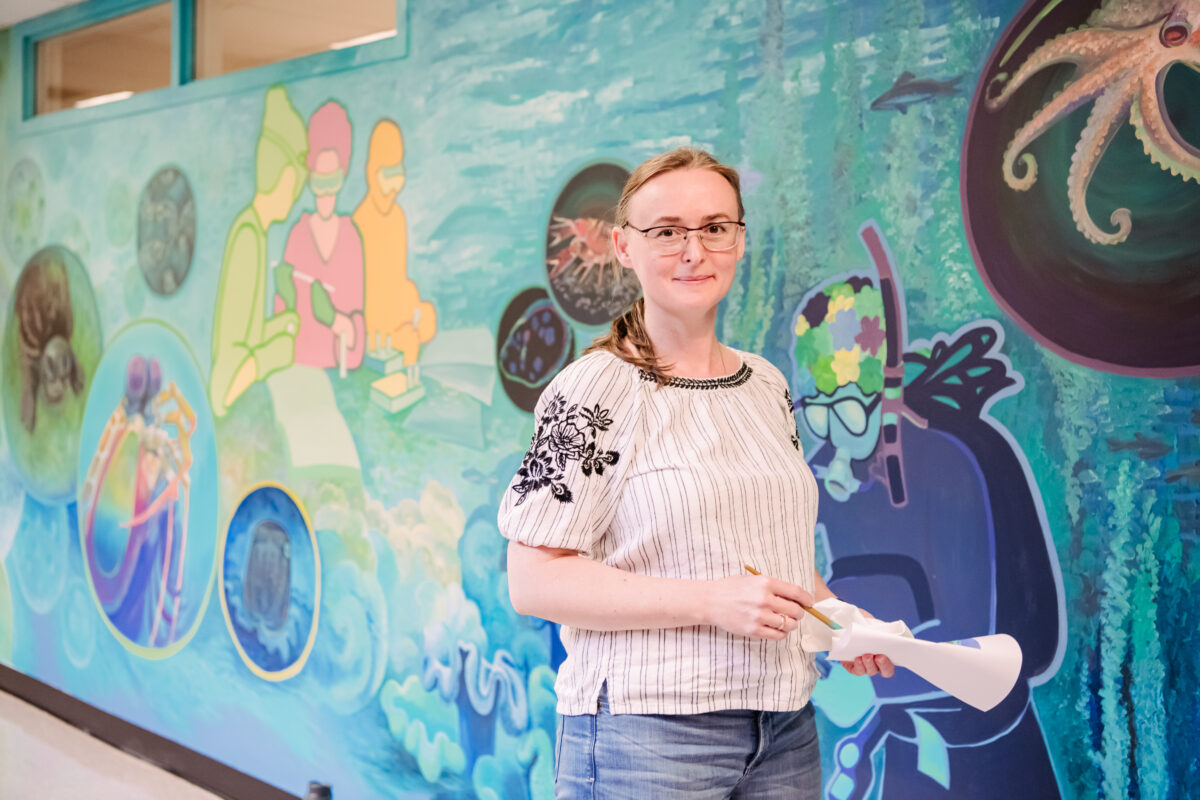 Anna Vikhlyayeva ’15 originally planned and painted the mural 10 years ago, but after water damage, she returned to repair it. (Marlayna Demond ’11/UMBC)
Farabaugh says different elements of the mural stick out to him at different times, including that “the integration of the realistic animals and stylized students works to emphasize their direct relationships.” He sees the figures in the mural “representing all the thousands of students who have passed through the building in the last almost 60 years. I hope that many of them feel that their experience of research in our building set them on a life path and the mural is a visible representation of that.”
A glow up, 10 years later
In summer 2023, Vikhlyayeva brought a folding camping stool and a vibrant palette of green and blue hues to tackle the lower portion of her mural.
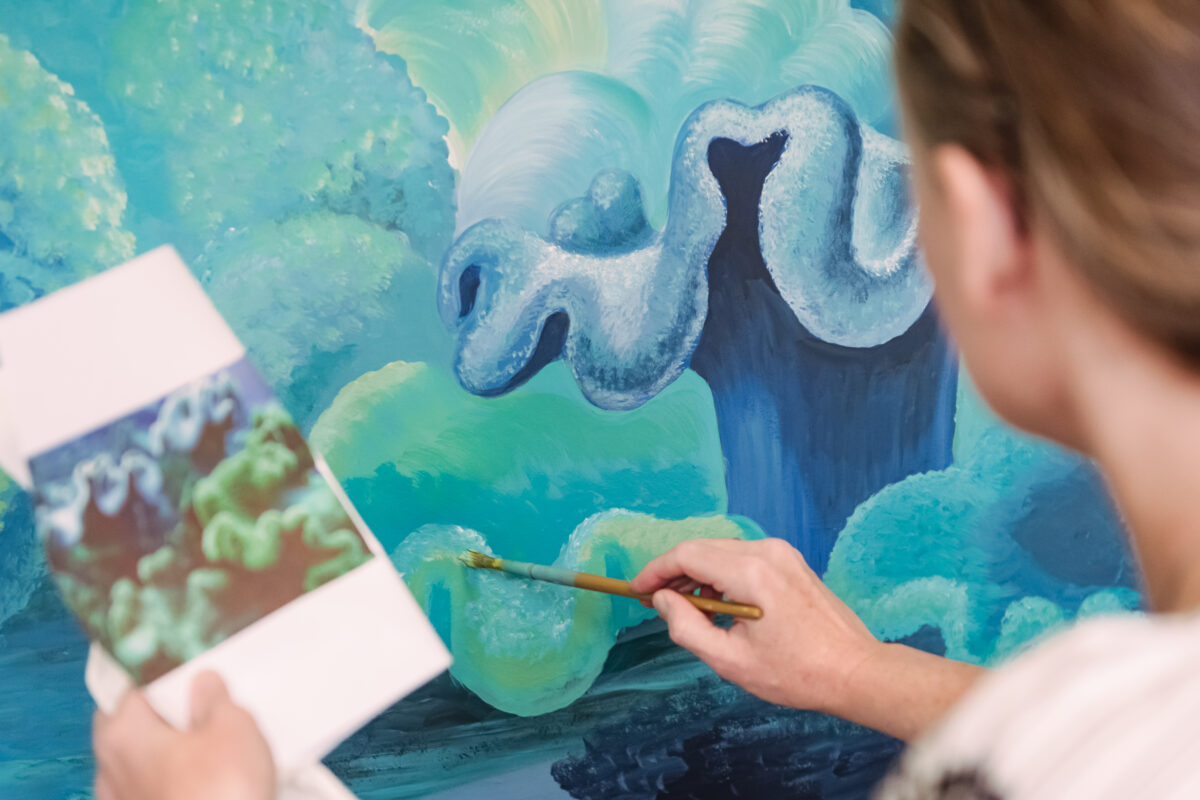 The artist chose her subject matter for the mural based on actual research happening in the building. (Marlayna Demond ’11/UMBC)
“I thought that bright colors, these nice pictures, will put other students in a good mood and give them inspiration to study and even to be more happy,” she says.
Farabaugh says that he’s enjoyed watching students and researchers claim the re-beautified space as their own, holding poster sessions in the hallway with the mural as the backdrop. “It really has become the heart of the building and, mixing a metaphor, its public face.”
]]>
Walking down Academic Row, the ground floor windows of the Biological Sciences Building reflect the flow of student traffic, and colorful renditions of animals and microbes, silhouettes of...
https://umbc.edu/stories/alumna-brings-mural-back-to-life/
https://my3.my.umbc.edu/api/v0/pixel/news/138351/guest@my.umbc.edu/00d4c5a608768c725983068949e8ecef/api/pixel
alumni
biology
cahss
campus-life
cnms
magazine
story
visual-arts
UMBC News & Magazine
https://my3.my.umbc.edu/groups/umbc-news-magazine
https://assets1-my.umbc.edu/system/shared/avatars/groups/000/001/943/24435aa6207c452e7bc15cc74b42c7bb/xsmall.png?1748556657
https://assets1-my.umbc.edu/system/shared/avatars/groups/000/001/943/24435aa6207c452e7bc15cc74b42c7bb/original.png?1748556657
https://assets2-my.umbc.edu/system/shared/avatars/groups/000/001/943/24435aa6207c452e7bc15cc74b42c7bb/xxlarge.png?1748556657
https://assets2-my.umbc.edu/system/shared/avatars/groups/000/001/943/24435aa6207c452e7bc15cc74b42c7bb/xlarge.png?1748556657
https://assets3-my.umbc.edu/system/shared/avatars/groups/000/001/943/24435aa6207c452e7bc15cc74b42c7bb/large.png?1748556657
https://assets1-my.umbc.edu/system/shared/avatars/groups/000/001/943/24435aa6207c452e7bc15cc74b42c7bb/medium.png?1748556657
https://assets2-my.umbc.edu/system/shared/avatars/groups/000/001/943/24435aa6207c452e7bc15cc74b42c7bb/small.png?1748556657
https://assets1-my.umbc.edu/system/shared/avatars/groups/000/001/943/24435aa6207c452e7bc15cc74b42c7bb/xsmall.png?1748556657
https://assets2-my.umbc.edu/system/shared/avatars/groups/000/001/943/24435aa6207c452e7bc15cc74b42c7bb/xxsmall.png?1748556657
UMBC News & Magazine
6
0
false
Tue, 23 Jan 2024 15:31:38 -0500
Tue, 23 Jan 2024 15:31:38 -0500
UMBC expands its next-generation tech analytics research with Phase II of the Center for Accelerated Real Time Analytics
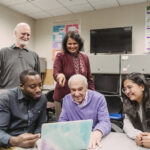
UMBC’s Center for Accelerated Real Time Analytics (CARTA) team will advance its work in investigating data analytics using next-generation computing hardware with the launch of the next phase of the multi-institutional research collaboration.
UMBC is partnering with Rutgers University, the University of Miami, and Arizona State University to deploy CARTA Phase II, a five-year initiative that explores data analytics research to develop new accelerated and real-time approaches to address advanced technology integration in industries such as health care, finance, and security.
CARTA initially launched in 2018 with funding provided by the National Science Foundation’s Industry-University Cooperative Research Centers (IUCRC) program to develop next-generation computing hardware to address data-intensive infrastructure challenges. The IUCRC grant has been extended to fund new and existing CARTA sites with an additional $100,000 per year (for the next five years) to build on the centers’ work in data analytics research.
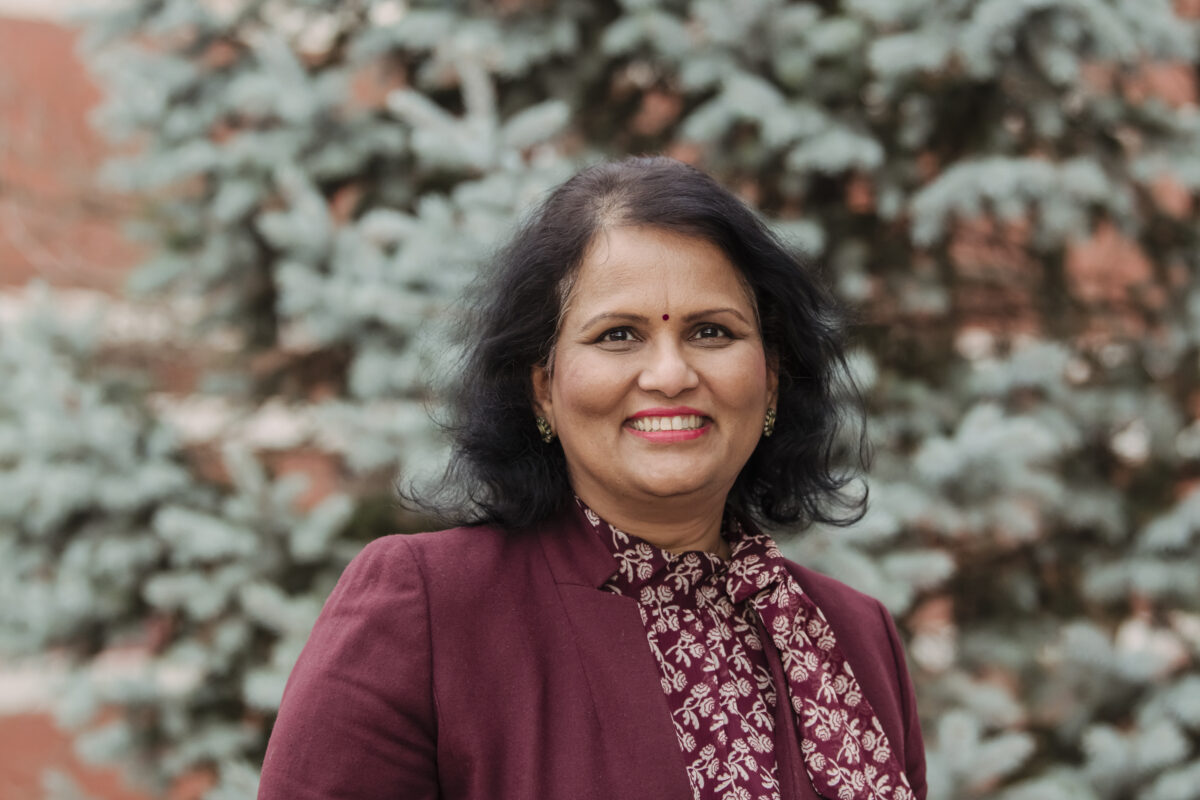 Karuna Joshi.
“CARTA’s focus has been on real-time analytics of large datasets on next generation technologies, or accelerated technologies, like high-performance computing, cloud computing, and quantum computing. This work will continue in Phase II,” says Karuna Joshi, associate professor of information systems and director of UMBC’s CARTA site.
Advancing industry collaborations
Since its launch, UMBC-CARTA faculty and student researchers have conducted more than 40 projects examining data analytics in Blockchain technology, malware analysis, medical data sharing, and evaluating bias in artificial intelligence in medical imaging. UMBC-CARTA collaborator Milton Halem, research professor of computer science and electrical engineering, will continue his work in weather and wildfire prediction research in the next phase of the initiative.
CARTA Phase II projects will largely focus on medical analytics (medical images and dataset sharing) and scientific and environmental datasets that can inform weather and wildfire predictions, Joshi explains, adding that “security is going to be the overlying paradigm across all of those various areas of research.”
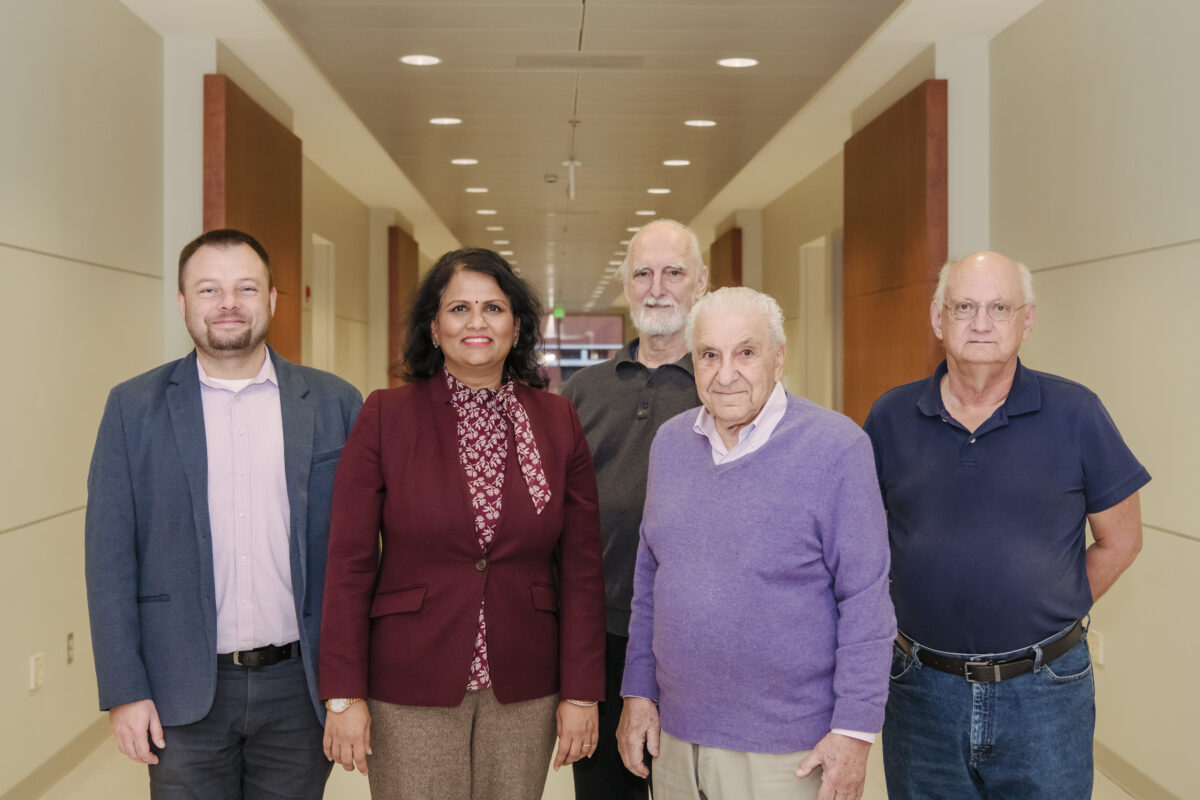 UMBC-CARTA faculty team, from left to right: Michal Mielech, Karuna Joshi, Tim Finin, Milton Halem, and John Dorband.
The CARTA sites are also aiming to expand their number of industry partner collaborations. In CARTA Phase I, UMBC worked with a range of industry partners that included NASA, IBM, the National Security Agency, Laboratory for Physical Sciences, the Department of Homeland Security, Morgan Stanley, RAD-AID, and Carestream.
“In Phase II, we are focusing more on collaborative projects with our university partners and building on those collaborations and making them stronger,” says Joshi. “We’re also looking at new avenues that our industry partners might be interested in such as smart cities, next-generation airports, and how to build secure image analytics and algorithms.”
As Phase II evolves, UMBC-CARTA research will also focus on large language models that are rising in popularity, such as ChatGPT, and digital twinning technologies, which is the process of creating a virtual model of a physical object.
Student collaboration at every level
Undergraduate, graduate, and post-doctoral students will continue to work on research projects at UMBC-CARTA. Since its inception, UMBC-CARTA has supported more than 15 graduate students and has provided opportunities for undergraduate students to strengthen their research skills through the NSF-funded Research Experiences for Undergraduates program.
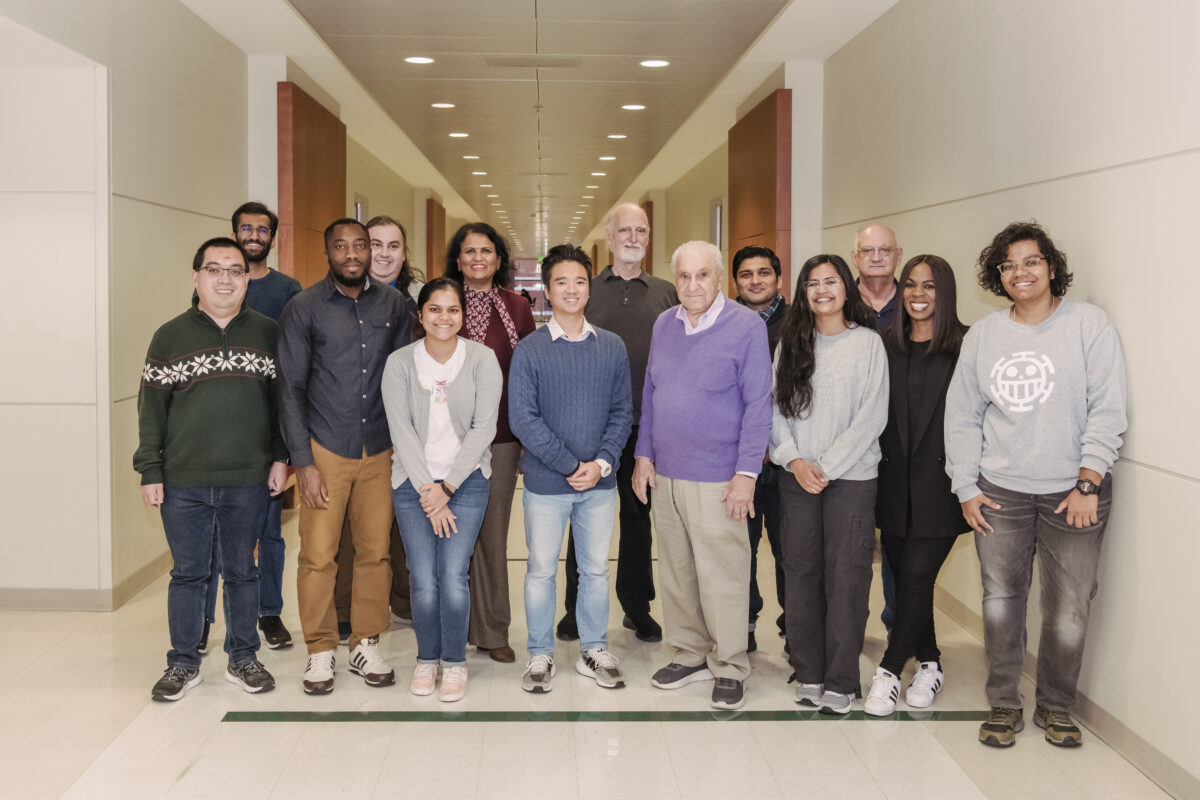 The UMBC-CARTA faculty and student team.
Kelvin Echenim, a second-year information systems Ph.D. student at UMBC, has worked on the CARTA team developing a scoring system to assess the comprehensiveness and user-friendliness of internet of things privacy policies.
“The scoring system aims to improve user comprehension and involvement in privacy matters by finding a balance between strict legal compliance and end-user practical accessibility,” says Echenim.
He adds that current and future research in CARTA Phase II will help expand his knowledge in solving complex problems in data-driven AI systems.
Read more about UMBC’s Center for Accelerated Real Time Analytics
]]>
UMBC’s Center for Accelerated Real Time Analytics (CARTA) team will advance its work in investigating data analytics using next-generation computing hardware with the launch of the next phase of...
https://umbc.edu/stories/center-for-accelerated-real-time-analytics/
https://my3.my.umbc.edu/api/v0/pixel/news/138235/guest@my.umbc.edu/e5020213f1745092504d89e69d3011f5/api/pixel
coeit
csee
is
news
research
science-and-tech
story
UMBC News & Magazine
https://my3.my.umbc.edu/groups/umbc-news-magazine
https://assets1-my.umbc.edu/system/shared/avatars/groups/000/001/943/24435aa6207c452e7bc15cc74b42c7bb/xsmall.png?1748556657
https://assets1-my.umbc.edu/system/shared/avatars/groups/000/001/943/24435aa6207c452e7bc15cc74b42c7bb/original.png?1748556657
https://assets2-my.umbc.edu/system/shared/avatars/groups/000/001/943/24435aa6207c452e7bc15cc74b42c7bb/xxlarge.png?1748556657
https://assets2-my.umbc.edu/system/shared/avatars/groups/000/001/943/24435aa6207c452e7bc15cc74b42c7bb/xlarge.png?1748556657
https://assets3-my.umbc.edu/system/shared/avatars/groups/000/001/943/24435aa6207c452e7bc15cc74b42c7bb/large.png?1748556657
https://assets1-my.umbc.edu/system/shared/avatars/groups/000/001/943/24435aa6207c452e7bc15cc74b42c7bb/medium.png?1748556657
https://assets2-my.umbc.edu/system/shared/avatars/groups/000/001/943/24435aa6207c452e7bc15cc74b42c7bb/small.png?1748556657
https://assets1-my.umbc.edu/system/shared/avatars/groups/000/001/943/24435aa6207c452e7bc15cc74b42c7bb/xsmall.png?1748556657
https://assets2-my.umbc.edu/system/shared/avatars/groups/000/001/943/24435aa6207c452e7bc15cc74b42c7bb/xxsmall.png?1748556657
UMBC News & Magazine
0
0
false
Wed, 17 Jan 2024 14:25:58 -0500
Wed, 17 Jan 2024 14:25:58 -0500
UMBC manufacturing research center gets boost from new partnership with U.S. Army

The Center for Research in Emergent Manufacturing (CREM), which started as the ambitious idea of two UMBC researchers in 2019, is launching a major new project with the U.S. Army and other partners this year. UMBC has received an initial amount of more than $3 million to fund the first year of the project, which will investigate ways to digitize the army’s supply chain.
CREM is led by director Nilanjan Banerjee, professor of computer science and electrical engineering, and associate director Donna Ruginski, associate vice president for center development in the Office of Research and Creative Achievement at UMBC. It aims to help manufacturers reap the benefits, and manage the risks, of new manufacturing approaches increasingly centered around computer systems—a concept known as digital manufacturing.
Since its founding, the center has already established programs to educate manufacturing professionals in cybersecurity. The new project will significantly advance the center’s research activities and impact.
“The partnership with the army is an important step in our evolution as a research center. We will be working on cutting edge problems for the Army in the areas of digitization,” says Banerjee.
“We’re new and full of energy,” says Ruginski. “I’m confident we’ll make a difference.”
From spinning jennies to generative AI
Manufacturing has come a long way since the 18th-century textile industry was revolutionized by the invention of machines such as spinning jennies, which greatly increased the amount of thread a single worker could produce. Since then, new technologies, such as the electric grid in the early 20th century and computers in the mid-century, brought further waves of change to the way goods are made.
On a modern factory floor, robots and their computer control systems increasingly take the place of humans in the assembly process, and the future of manufacturing will likely be even more automated and digitized than it is today. Companies are increasingly turning to new technologies such as smart sensors, AI, cloud computing, and advanced analytics to increase the flexibility, resilience, and efficiency of their operations. This transformation—called industry 4.0—holds enormous promise to improve living standards by increasing productivity, but it also comes with some perils, including vulnerability to cyberattacks.
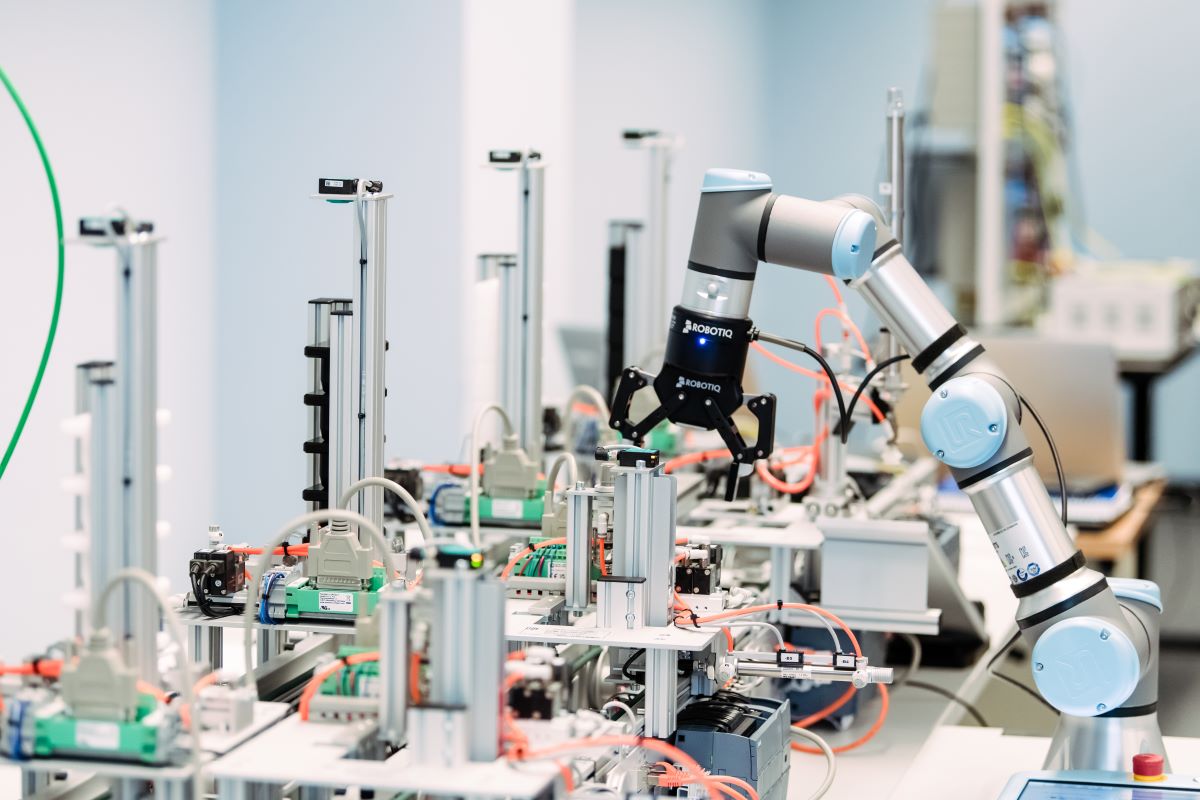 Equipment in the operations technology cyber range. (Marlayna Demond ’11/UMBC)
Training and research
UMBC aims to help manufacturers navigate the industry 4.0 shift. Part of that mission will be to educate future workers in digital manufacturing, be they UMBC students or working professionals looking to expand their skill set.
In 2020, under the auspices of CREM, Banerjee and Ruginski launched the Cybersecurity for Manufacturing Operational Technology (CyMOT) program to train manufacturing professionals in best practices for preventing cyberattacks on manufacturing operations. Through the program, CREM has educated more than 300 manufacturers from small and medium-sized businesses.
“The manufacturing sector has suffered a number of cyberattacks recently, so it’s important to make sure people in the sector are trained in cybersecurity,” says Banerjee.
CREM also hosts a state-of-the-art cybersecurity training and research facility, called a cyber range, specifically focused on digital manufacturing technology—one of only a few in the country. In the coming months, the cyber range will move to a new and dedicated location on the UMBC campus.
“The research and training efforts conducted by CREM under Dr. Banerjee’s leadership have wide-ranging consequences,” says Karl Steiner, the vice president for research and creative achievement at UMBC. “As digital manufacturing rapidly becomes a national and global standard, it is critical to develop adaptive cybersecurity strategies and protocols to secure the global supply pipeline. I am delighted that CREM is supported through one of three major research partnerships that UMBC developed in recent years with the U.S. Army.”
]]>
The Center for Research in Emergent Manufacturing (CREM), which started as the ambitious idea of two UMBC researchers in 2019, is launching a major new project with the U.S. Army and other...
https://umbc.edu/stories/crem-manufacturing-research-army/
https://my3.my.umbc.edu/api/v0/pixel/news/138230/guest@my.umbc.edu/9951b58bbc0b842e87c48f87014b9c88/api/pixel
coeit
crem
csee
news
rca-1
research
science-and-tech
story
UMBC News & Magazine
https://my3.my.umbc.edu/groups/umbc-news-magazine
https://assets1-my.umbc.edu/system/shared/avatars/groups/000/001/943/24435aa6207c452e7bc15cc74b42c7bb/xsmall.png?1748556657
https://assets1-my.umbc.edu/system/shared/avatars/groups/000/001/943/24435aa6207c452e7bc15cc74b42c7bb/original.png?1748556657
https://assets2-my.umbc.edu/system/shared/avatars/groups/000/001/943/24435aa6207c452e7bc15cc74b42c7bb/xxlarge.png?1748556657
https://assets2-my.umbc.edu/system/shared/avatars/groups/000/001/943/24435aa6207c452e7bc15cc74b42c7bb/xlarge.png?1748556657
https://assets3-my.umbc.edu/system/shared/avatars/groups/000/001/943/24435aa6207c452e7bc15cc74b42c7bb/large.png?1748556657
https://assets1-my.umbc.edu/system/shared/avatars/groups/000/001/943/24435aa6207c452e7bc15cc74b42c7bb/medium.png?1748556657
https://assets2-my.umbc.edu/system/shared/avatars/groups/000/001/943/24435aa6207c452e7bc15cc74b42c7bb/small.png?1748556657
https://assets1-my.umbc.edu/system/shared/avatars/groups/000/001/943/24435aa6207c452e7bc15cc74b42c7bb/xsmall.png?1748556657
https://assets2-my.umbc.edu/system/shared/avatars/groups/000/001/943/24435aa6207c452e7bc15cc74b42c7bb/xxsmall.png?1748556657
UMBC News & Magazine
0
0
false
Wed, 17 Jan 2024 11:45:52 -0500
Wed, 17 Jan 2024 11:45:52 -0500
Remembering Ed Orser (1941 – 2024)
“How do you ground the American experience in something you can get your hands around?” asks Orser. “I always thought it was helpful to bring things down to a certain scale. Maybe because that’s as much as I could try to get my mind around, but also it is because in some ways, that’s where we live our lives.”
– W. Ed Orser, quoted in Locale Hero, UMBC Review, by Richard Byrne
It is with great sadness that we share the news that W. Edward (Ed) Orser passed away on Monday, January 8, 2024. Ed was a beloved professor and researcher in the Department of American Studies at UMBC for over forty years. Upon his retirement in 2010, and in his honor, the Orser Center for the Study of Community, Place, and Culture was established at UMBC to foster innovative collaborations among scholars, students, and local community organizations across the disciplines whose research and teaching explore place-based study, especially focused on the Baltimore region.
Ed Orser earned a Ph.D. in American Studies from the University of New Mexico and came to UMBC in 1969, just four years after the university was formed, as one of the founding faculty members of the Department of American Studies. He served numerous terms as chair of the department and developed foundational courses still taught today.
Ed’s teaching and research interests were always closely connected. His courses on “Community in American Culture” and “American Environments: Landscape and Culture” not only became central parts of the American Studies curriculum, but led to a variety of research projects with students and to themes that became the focus of his own scholarship. Ed’s work as a publicly-engaged scholar in the local community was an inspiration for the Minor in Public Humanities for the College of Arts, Humanities, and Social Sciences (CAHSS), which is fittingly located in the Orser Center in American Studies.
Ed’s publications explore the social and cultural dynamics of the Baltimore region. His examination of the phenomenon of massive racial change in West Baltimore during the 1950s and 1960s led to the first book-length study of blockbusting and its consequences in post-World War II cities: Blockbusting in Baltimore: The Edmondson Village Story (University Press of Kentucky, 1994, 1997). Blockbusting in Baltimore was an influential, and widely imitated, text that is still cited in emerging scholarship on Baltimore and cities like it.
A collaborative research and teaching project with Professor Joseph Arnold of the History Department, resulted in an on-campus exhibition and the co-authored publication of From Village to Suburb: Catonsville, 1880-1940 (Donning Publishing Company, 1989). His first book, Searching for a Viable Alternative: The Macedonia Cooperative Community, 1937-1958 (Burt Franklin, 1981) explored the effort by a group of pacifists to establish an alternative community in North Georgia during and following World War II.
Articles on related topics have appeared in such journals as American Studies, Church History, the Maryland Historical Magazine, the International Journal of Oral History, the Public Historian, and the Journal of Urban History. Ed’s interest in environmental history in the Baltimore area resulted in publication of The Gwynns Falls: Baltimore Greenway to the Chesapeake Bay (The History Press, 2008) and the article, “A Tale of Two Park Plans: The Olmsted’s Vision for Baltimore and Seattle, 1903” (Maryland Historical Magazine, Winter 2003). His public history activity included co-authorship of The Gwynns Falls Trail Master Plan (with Diana Balmori, et al., 1995).
Ed received the UMBC Presidential Teaching Award in 1999 and the University System of Maryland Regents Award for Excellence in Teaching in 2003. The Baltimore Historical Society conferred Historian Honors recognition upon him in 2007.
Though deeply committed to Baltimore and UMBC, Ed also taught American Studies in a variety of international settings. In 1990-1991 he served as Senior Fulbright Lecturer at the University of Zagreb in Yugoslavia. In 2007, he taught in the American Studies Department at the University of Swansea in Wales. Prior to coming to UMBC, Ed served as a United States Peace Corps Volunteer teacher in Ethiopia. In his substantial service role at UMBC he was President of the Faculty Senate (1996-8) and a member of numerous university committees.
In retirement Ed served as president of the Friends of Maryland’s Olmsted Parks & Landscapes, a preservation and advocacy organization, and as Coordinator of the Urban Resources Initiative Internship program, which places interns with projects in Baltimore’s Department of Recreation and Parks and the Parks & People Foundation.
Ed and his wife Jo lived for many years in the Hunting Ridge neighborhood of Baltimore and he was known to bike to the UMBC campus. Ed and Jo recently moved to Charlestown Senior Living in Catonsville, where Ed continued to enjoy connecting with UMBC alumni and faculty.
Ed will be remembered for his contributions to how we understand cities, especially Baltimore, and issues of environmental justice. He influenced generations of students and mentored many faculty members. His kindness, humility, and generosity will be greatly missed in the Department of American Studies, the Orser Center, and across the UMBC campus.
We send our sincere condolences to Ed’s beloved family and invite the UMBC community to attend a memorial service celebrating Ed’s long and rich life at 11 a.m. on Saturday, January 20, at Salem Lutheran Church, 905 Frederick Road in Catonsville. All who knew and loved him are invited to attend. In lieu of flowers, the family requests contributions be made to Salem Lutheran Church (www.Salem-Catonsville.org/) or the Charlestown Scholars’ Fund (www.ccicharlestown.org/giving/scholars-fund).
In honor of Ed’s long contributions to the fields of urban and American studies, the Department of American Studies and the Orser Center are co-sponsoring a Humanities Forum lecture by noted urban historian Davarian Baldwin on May 1, 2024. American Studies & the Orser Center will continue to find ways to recognize the work of Ed Orser and his engagement with the study of place and community in the Baltimore region. A donation can be made to support that work in Ed’s name on the Department’s Giving Page.
You can read Ed’s obituary here.
]]>
“How do you ground the American experience in something you can get your hands around?” asks Orser. “I always thought it was helpful to bring things down to a certain scale. Maybe because that’s...
https://my3.my.umbc.edu/groups/announcements/posts/138175
https://my3.my.umbc.edu/api/v0/pixel/news/138177/guest@my.umbc.edu/f819aad0556344719a3c1d4766acb41b/api/pixel
in-memoriam
rss
story
UMBC News & Magazine
https://my3.my.umbc.edu/groups/umbc-news-magazine
https://assets1-my.umbc.edu/system/shared/avatars/groups/000/001/943/24435aa6207c452e7bc15cc74b42c7bb/xsmall.png?1748556657
https://assets1-my.umbc.edu/system/shared/avatars/groups/000/001/943/24435aa6207c452e7bc15cc74b42c7bb/original.png?1748556657
https://assets2-my.umbc.edu/system/shared/avatars/groups/000/001/943/24435aa6207c452e7bc15cc74b42c7bb/xxlarge.png?1748556657
https://assets2-my.umbc.edu/system/shared/avatars/groups/000/001/943/24435aa6207c452e7bc15cc74b42c7bb/xlarge.png?1748556657
https://assets3-my.umbc.edu/system/shared/avatars/groups/000/001/943/24435aa6207c452e7bc15cc74b42c7bb/large.png?1748556657
https://assets1-my.umbc.edu/system/shared/avatars/groups/000/001/943/24435aa6207c452e7bc15cc74b42c7bb/medium.png?1748556657
https://assets2-my.umbc.edu/system/shared/avatars/groups/000/001/943/24435aa6207c452e7bc15cc74b42c7bb/small.png?1748556657
https://assets1-my.umbc.edu/system/shared/avatars/groups/000/001/943/24435aa6207c452e7bc15cc74b42c7bb/xsmall.png?1748556657
https://assets2-my.umbc.edu/system/shared/avatars/groups/000/001/943/24435aa6207c452e7bc15cc74b42c7bb/xxsmall.png?1748556657
UMBC News & Magazine
2
0
false
Fri, 12 Jan 2024 17:34:18 -0500
UMBC welcomes Manfred H. M. van Dulmen as new provost and senior vice president
UMBC President Valerie Sheares Ashby has announced that Manfred H. M. van Dulmen will join the university in July as provost and senior vice president. He will succeed interim provost David Dauwalder.
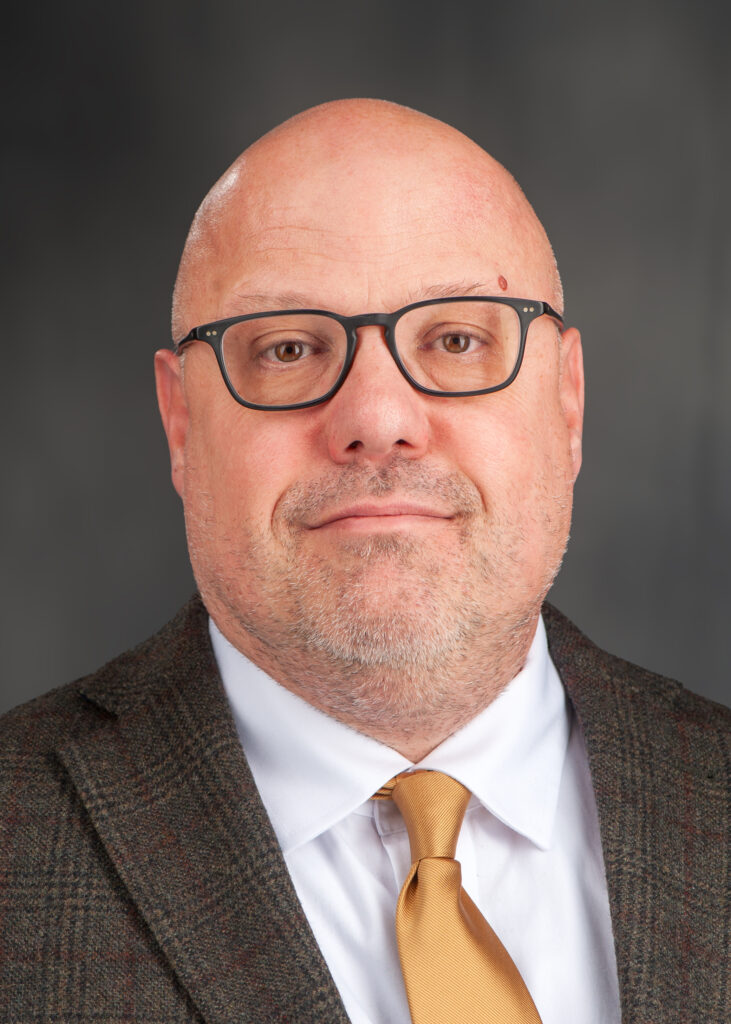 Manfred H. M. van Dulmen
“From the first time I met him, Manfred’s commitment to students, his care for people with whom he worked, his humility, and his drive for mission-driven excellence were clear, as was his desire to be at UMBC,” says President Sheares Ashby. “I could not be more thrilled about this appointment.”
Van Dulmen says UMBC’s values of inclusive excellence and history of innovation attracted him to the role, and he is excited to work with the UMBC community to articulate strategic priorities and chart a course to the future.
“It is a tremendous opportunity and privilege to be chosen to serve in this role, to build on the incredible history and legacy of the institution to further its excellence and its role as a national leader in higher education,” he said.
A record of success in academic leadership
Van Dulmen comes to UMBC from Kent State University in Ohio, where he is currently serving as senior associate provost and dean of the Graduate College. He started at Kent State as a faculty member in the Department of Psychological Sciences in 2004, and since then served in numerous academic leadership positions at the university, including as interim department chair and associate dean of the College of Arts and Sciences. He led Kent State through the COVID-19 pandemic and developed strategies for enhancing graduate education and for supporting student mental health. He also led strategic planning in academic affairs, helped to enhance and promote research strength across all disciplines, and led efforts resulting in new collaborative degree programs in data science and cybersecurity, as well as in innovative micro-credential programs at Kent State.
“As a first-generation college student and a first-generation immigrant to the U.S. who attended graduate school in America, Manfred is passionate about the transformative power of higher education and about its public mission in service of students and society broadly,” says President Sheares Ashby.
Van Dulmen is an award-winning scholar with a Ph.D. in family social science from the University of Minnesota. He has received millions of dollars in research funding, published more than 100 articles and book chapters, and edited or co-edited three books. He also founded and served as editor-in-chief of the Sage Publications journal Emerging Adulthood. His research interests include adolescent and young adult relationships and experiences, externalizing behavior problems and aggression, and measurement and methodology.
]]>
UMBC President Valerie Sheares Ashby has announced that Manfred H. M. van Dulmen will join the university in July as provost and senior vice president. He will succeed interim provost David...
https://umbc.edu/stories/umbc-welcomes-manfred-h-m-van-dulmen-as-new-provost-and-senior-vice-president/
https://my3.my.umbc.edu/api/v0/pixel/news/138172/guest@my.umbc.edu/6e08156070ecfcb164c3da2f04a3fa06/api/pixel
campus
community
news
story
UMBC News & Magazine
https://my3.my.umbc.edu/groups/umbc-news-magazine
https://assets1-my.umbc.edu/system/shared/avatars/groups/000/001/943/24435aa6207c452e7bc15cc74b42c7bb/xsmall.png?1748556657
https://assets1-my.umbc.edu/system/shared/avatars/groups/000/001/943/24435aa6207c452e7bc15cc74b42c7bb/original.png?1748556657
https://assets2-my.umbc.edu/system/shared/avatars/groups/000/001/943/24435aa6207c452e7bc15cc74b42c7bb/xxlarge.png?1748556657
https://assets2-my.umbc.edu/system/shared/avatars/groups/000/001/943/24435aa6207c452e7bc15cc74b42c7bb/xlarge.png?1748556657
https://assets3-my.umbc.edu/system/shared/avatars/groups/000/001/943/24435aa6207c452e7bc15cc74b42c7bb/large.png?1748556657
https://assets1-my.umbc.edu/system/shared/avatars/groups/000/001/943/24435aa6207c452e7bc15cc74b42c7bb/medium.png?1748556657
https://assets2-my.umbc.edu/system/shared/avatars/groups/000/001/943/24435aa6207c452e7bc15cc74b42c7bb/small.png?1748556657
https://assets1-my.umbc.edu/system/shared/avatars/groups/000/001/943/24435aa6207c452e7bc15cc74b42c7bb/xsmall.png?1748556657
https://assets2-my.umbc.edu/system/shared/avatars/groups/000/001/943/24435aa6207c452e7bc15cc74b42c7bb/xxsmall.png?1748556657
UMBC News & Magazine
1
0
false
Fri, 12 Jan 2024 15:55:01 -0500
Fri, 12 Jan 2024 15:55:01 -0500
Leadership Announcement
Dear UMBC Community,
It is my great pleasure to share the wonderful news that Manfred H. M. van Dulmen has accepted our invitation to join UMBC as provost and senior vice president. Manfred, who will begin in the role in July, currently serves as senior associate provost and dean of the Graduate College at Kent State University in Ohio, where he has spent the bulk of his career. I could not be more thrilled about this appointment, and I am deeply grateful to the members of the search committee and all who participated in this critically important search.
A faculty member in the Department of Psychological Sciences at Kent State since 2004 and a full professor since 2015, Manfred has excelled in academic leadership at all levels, including as interim department chair, associate dean of the College of Arts and Sciences, dean of the Graduate College, and associate provost for academic affairs and senior associate provost in the Office of the Provost. In these roles, he has led strategic planning in academic affairs; led the university through the COVID-19 pandemic; and developed strategies for enhancing graduate education and for supporting student mental health at both the undergraduate and graduate levels. He is deeply committed to diversity, equity, inclusion, and belonging, centering these principles in all his work.
Like UMBC, Kent State is a public Research 1 institution that values the combination of student success and research excellence. Manfred’s own record as a faculty member and an administrator demonstrates his understanding of faculty excellence as the integration of teaching, research, and service.
In coming to know UMBC, he cited such integration–that teaching, research, and service go hand-in-hand here–as a standout quality. And he said UMBC’s long-demonstrated interest in innovating and setting the course for where higher education needs to go spoke to him and contributed greatly to his enthusiasm for joining UMBC. He is particularly excited about working with the UMBC community to articulate and advance our strategic priorities for the future.
As a first-generation college student and a first-generation immigrant to the U.S. who attended graduate school in America, Manfred is passionate about the transformative power of higher education and about its public mission in service of students and society broadly.
From the first time I met him, his commitment to students, his care for people with whom he worked, his humility, and his drive for mission-driven excellence were clear, as was his desire to be at UMBC. The alignment of UMBC’s values with his own, along with the opportunity to help set the course for UMBC’s future, made this role–in this community, at this moment–uniquely appealing to him.
“It is a tremendous opportunity and privilege to be chosen to serve in this role, to build on the incredible history and legacy of the institution to further its excellence and its role as a national leader in higher education,” he said.
At Kent State, Manfred has helped to enhance and promote research strength across all disciplines. His own research is interdisciplinary in nature–his research interests include adolescent and young adult relationships and experiences, externalizing behavior problems and aggression, and measurement and methodology–and he has led efforts resulting in new collaborative degree programs in data science and cybersecurity, as well as in innovative micro-credential programs at Kent State.
An award-winning scholar, he has received more than $6.5 million in research funding, published more than 100 articles and book chapters, and edited or co-edited three books. Manfred founded and served as editor-in-chief of the Sage Publications Journal Emerging Adulthood. Before joining Kent State as an assistant professor in 2004, Manfred was a research associate at the Institute of Child Development at the University of Minnesota, where he earned his Ph.D. in family social science. He holds a doctorandus (the equivalent of a master’s degree in the U.S.) in clinical child and adolescent psychology from Vrije Universiteit Amsterdam.
My sincere gratitude to the search committee, led by music Professor Linda Dusman, for its dedication and outstanding work that has led us to this terrific result. Please join me in thanking them and in extending a warm UMBC welcome to Manfred!
Sincerely,
President Valerie Sheares Ashby
]]>
Dear UMBC Community, It is my great pleasure to share the wonderful news that Manfred H. M. van Dulmen has accepted our invitation to join UMBC as provost and senior vice president. Manfred,...
https://my3.my.umbc.edu/groups/announcements/posts/138136
https://my3.my.umbc.edu/api/v0/pixel/news/138152/guest@my.umbc.edu/bd50ad6a645f84975c8fa0223f48d395/api/pixel
president
story
UMBC News & Magazine
https://my3.my.umbc.edu/groups/umbc-news-magazine
https://assets1-my.umbc.edu/system/shared/avatars/groups/000/001/943/24435aa6207c452e7bc15cc74b42c7bb/xsmall.png?1748556657
https://assets1-my.umbc.edu/system/shared/avatars/groups/000/001/943/24435aa6207c452e7bc15cc74b42c7bb/original.png?1748556657
https://assets2-my.umbc.edu/system/shared/avatars/groups/000/001/943/24435aa6207c452e7bc15cc74b42c7bb/xxlarge.png?1748556657
https://assets2-my.umbc.edu/system/shared/avatars/groups/000/001/943/24435aa6207c452e7bc15cc74b42c7bb/xlarge.png?1748556657
https://assets3-my.umbc.edu/system/shared/avatars/groups/000/001/943/24435aa6207c452e7bc15cc74b42c7bb/large.png?1748556657
https://assets1-my.umbc.edu/system/shared/avatars/groups/000/001/943/24435aa6207c452e7bc15cc74b42c7bb/medium.png?1748556657
https://assets2-my.umbc.edu/system/shared/avatars/groups/000/001/943/24435aa6207c452e7bc15cc74b42c7bb/small.png?1748556657
https://assets1-my.umbc.edu/system/shared/avatars/groups/000/001/943/24435aa6207c452e7bc15cc74b42c7bb/xsmall.png?1748556657
https://assets2-my.umbc.edu/system/shared/avatars/groups/000/001/943/24435aa6207c452e7bc15cc74b42c7bb/xxsmall.png?1748556657
UMBC News & Magazine
1
0
false
Thu, 11 Jan 2024 15:00:08 -0500
Before 3 amputations, Chandra Smith was already an accessibility-for-all advocate
By Jessie Newburn
It’s 4 a.m. on a Wednesday—earlier than most people rise, though a preference for Chandra Smith, M.S. ’21, information systems. After saying her daily devotion, she begins to get ready for the day ahead: brushing her teeth, taking a shower, getting dressed and having some breakfast.
If she’s lucky, the day ahead is one where her employer’s “reasonable accommodations” for her disabilities allow her to work from home rather than having to schedule a Paratransit bus pickup near Baltimore, then get on the Marc train to D.C., then get picked up by another Paratransit bus to take her to work at the Defense Intelligence Agency: a process that takes several hours—each way—assuming the bus even shows up, which doesn’t always happen.
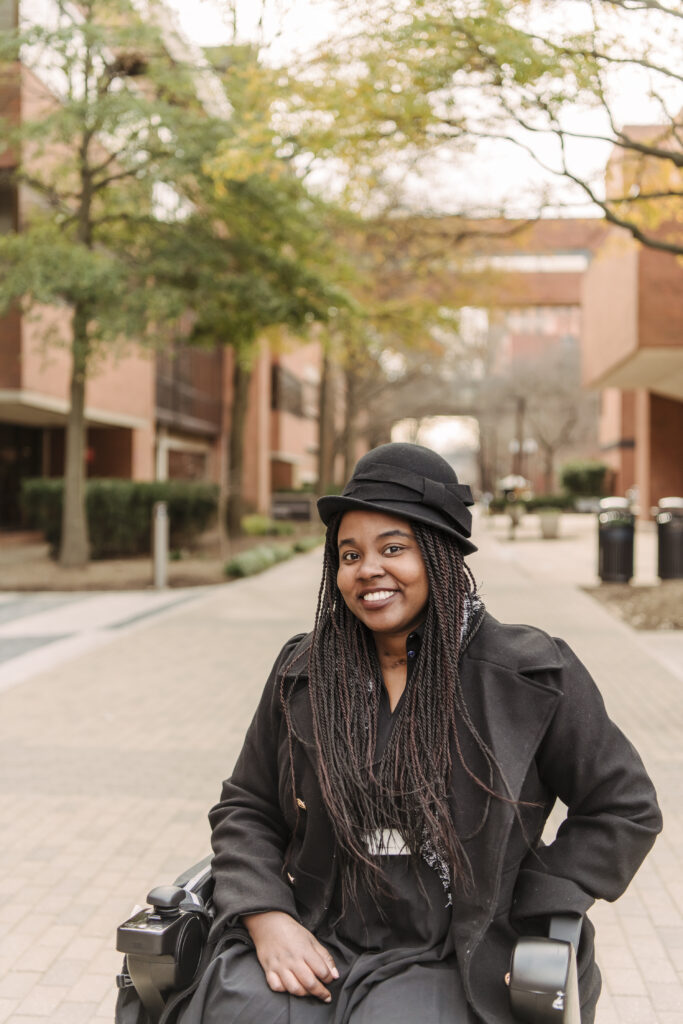 Smith on a visit to campus in 2023. (Marlayna Demond ’11/UMBC)
Everything Smith does now, even previously simple tasks such as getting dressed, have become complicated, time-consuming, and in her words, “close to an Olympic sport,” ever since Chandra’s Life As She Knew It screeched to a halt in the fall of 2021 when she fainted after fasting for religious purposes. She was medevaced to Georgetown University Hospital, when her body started shutting down, and then she was pumped with medicines to keep her organs functioning.
While life-saving, the emergency medicine she was given caused blood from her extremities to move to her core, essentially causing medical burns on 25 percent of her body and sepsis, triggering yet another medical emergency.
When a doctor told her she had 10 minutes to decide whether she wanted to live or die—with one small caveat: she’d be a triple amputee—Smith chose life.
She would go on to clock one year and one day from entering the hospital to exiting it, experiencing along the way: a stroke, dialysis, severe liver ketosis, three amputations, 10 painful surgeries (on one foot alone), and a host of other medical issues, procedures, and therapies.
Little did Smith know then, but the master’s degree in information systems she received from UMBC earlier that year would soon position her for a new role, a new voice and, ultimately, a new mission, not just within her job at the Defense Intelligence Agency (DIA), but in life.
“An upfront and center seat”
At age 32, Smith wasn’t looking for the campus-immersion experience she’d had when she was younger. “UMBC’s online masters program was the perfect mix of everything I wanted,” Smith says. Easy access to courses, professors with real-world experience, and fellow students from many walks of life and many parts of the world made picking UMBC an easy choice for Smith.
“I felt like I had an upfront and center seat in the field I was studying, as my professors wove challenges they faced in their jobs into the class instruction,” Smith says. Though, when reflecting on her experience at UMBC, the connections with other students stood out as most memorable to her.
“As I continued in the program, I often found myself in classes with people I’d met and worked with in previous classes,” she says. “To this day, I still come across people I recognize from the program when attending various professional conferences and events.”
A door opens
Long cloaked behind a “national-security exemption,” the nation’s seven intelligence agencies—including Smith’s employer, the DIA—had in recent years started addressing the complications of providing accessible technologies for disabled employees who needed what are called “reasonable accommodations” in order to do their work. This issue was particularly complex for those whose work involved top-clearance activities. For the DIA, a key area of concern was making sure their internal website met federal accessibility standards and requirements for online content.
The agency needed an IT engineer who could review various technologies used by employees—such as a Bluetooth hearing device for deaf or hard-of-hearing employees who need to access sensitive compartmented Information rooms or voice-to-text tools for someone with limited hand mobility. The official could then grant approval to use these technologies in national intelligence and top-secret environments. Smith, with her new degree in information systems, was the only person in her department with the skills to do this work.
 From left to right: Anne Arundel County Executive Steuart Pittman; Carol Beatty, Maryland Department of Disabilities; Chandra Smith, Ms. Wheelchair America 2024; Karrisa Kelly, director, Department of Aging and Disabilities. (Photo courtesy of Smith)
“The job just fell in my lap after I graduated,” Smith says, who notes that in this “before” version of her life, she saw the position as important, but it had yet to become personal to her. “As I dove in, I found the field and challenges fascinating in that I had to balance significant national-security concerns with the legitimate and legally compelling needs for people with various disabilities to be given ‘reasonable accommodations’ to do their intelligence-related work.”
And then things became personal
Only several months after earning her master’s degree, Smith experienced her medical trauma and began her year-long hospital stay of surgeries, occupational therapy, and recovery—including six months in the burn unit. But in the midst of this, Smith found time to apply for a higher government position, received the promotion, and came back to the DIA a notch up in her career, with more fire in her than ever and now positioned as a team lead, mentor, and accessibility policy creator.
“It’s one thing to try and think like someone who has various disabilities,” Smith says. “It’s another thing to be that person: to be a triple amputee and someone who, essentially, doesn’t have functioning appendages.” (Her one remaining appendage—her right hand—was rendered near-useless and stiff when she had a stroke in the hospital.) “There are so many more nuances and deeper levels of understanding about universal design and accessible technology I understand now because I have to face these hurdles and challenges myself.”
At UMBC, I felt like I had an upfront and center seat in the field I was studying, as my professors wove challenges they faced in their jobs into the class instruction.
Chandra Smith, M.S. ’21
In her new role, she still advocates for expanded definitions of reasonable accommodation hardware and software for employees, but now Smith gravitates toward policy and agency-wide mandates. And she’s creating change not just at the DIA, but across all the nation’s intelligence agencies. “I’m absolutely and avidly an advocate for universal design and making these technologies available to more people.”
Smith has had to advocate for herself and her own needs, too, including a desk printer she can access from her wheelchair, a sit-to-stand desk, working from home for a significant portion of the week, voice-recognition software, speech-to-text software, and a policy change for the need to provide biodata such as fingerprints. She asks, “How can someone provide a fingerprint if they don’t have a hand?”
There she is …
Of all the things a younger Smith never saw in her future, being crowned Ms. Wheelchair America 2024 was certainly one of them.
 Top 5 contestants and members of the board at the 2024 Ms. Wheelchair America (MWA) pageant. For the past 52 years, MWA has given women with disabilities an opportunity to enact meaningful change in society. (Photo courtesy of Smith)
But after her medical trauma, she was encouraged to compete in the Ms. Wheelchair Maryland 2023 contest, which she won; and that title allowed her to compete nationally, which she also won. More of a competition about resilience, advocacy, and helping to eliminate architectural and attitudinal barriers people with disabilities experience in the world, Smith’s response was, “I can do that!”
“The contest judges and members of the board were quite taken with Chandra’s presence, the clarity and logic with which she advocates about universal design, her personal story and challenges… and coming out all the stronger,” says Shelly Loose, president of Ms. Wheelchair America.
“Even before I was so personally impacted by these workplace and daily accessibility challenges of being disabled,” says Smith, “I could already see how designing for the few helps the many.”
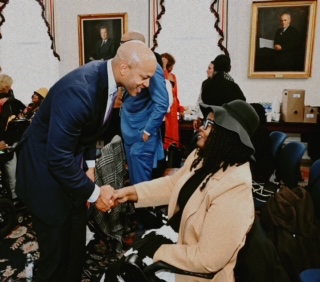 Maryland governor Wes Moore shakes hands with Smith at the governor’s mansion. (Photo courtesy of Smith)
For example, closed captioning of videos for hearing-impaired people helps many others with improved comprehension and retention. Ramps into buildings help people in wheelchairs and parents with strollers. “Universal design is inclusive. It should be the starting point, not an afterthought,” Smith says.
Maryland Governor Wes Moore heard of Smith’s work after she testified for a Prince George’s County universal-access bill. Soon after, he appointed her to a three-year term on the Maryland Commission on Disabilities, where she’s already working on accessibility policy recommendations to support a variety of disabilities. “We just recommended rewriting the MVA manual to a 6th-grade level to accommodate those with learning and reading disabilities,” Smith says. “Disabilities manifest in many ways—seen and unseen.”
Architecture and attitudes toward accessibility
For as much as Smith and others advocate for universal design and reasonable accommodations at work, at the end of the day, people and their attitudes about their peers with disabilities are the biggest hurdle to overcome, she says.
When Smith returned to work after her medical trauma, one coworker said, “If that happened to me, I’d kill myself.” Another one asked, “Do you know you’re missing a leg?”
Eyes rolled but mind set, Smith plows on. “There aren’t many people who look like me in a military-focused work environment, as most people who are disabled or use a wheelchair are discharged and don’t return to their former jobs,” she says.
While Smith has suffered quite a few “slings and arrows of outrageous fortune,” as Shakespeare put it, she knows the way forward is, well, forward. “When I was an able-bodied person, I had some bad days. As a disabled person, I have some incapacitating days. But I’ve come to understand that having difficult days doesn’t make a bad life. I appreciate more things now. I have more gratitude,” Smith says.
“I know it’s cliché and a bit corny, but if I help one employer add voice-to-text software for their employees or one property manager install a ramp for a building, I’ve done my job,” Smith says. “Universal design is a core value; it’s a perspective; it’s a way of seeing the world and making things accessible for all because—and I can speak from experience here—being disabled is a club anyone can join at any moment for any reason.”
]]>
By Jessie Newburn It’s 4 a.m. on a Wednesday—earlier than most people rise, though a preference for Chandra Smith, M.S. ’21, information systems. After saying her daily devotion, she begins...
https://umbc.edu/stories/chandra-smith-works-for-accessibility-for-all/
https://my3.my.umbc.edu/api/v0/pixel/news/138143/guest@my.umbc.edu/a99abdc07778f2d5e79b60d650ed79dc/api/pixel
alumni
coeit
is
magazine
story
UMBC News & Magazine
https://my3.my.umbc.edu/groups/umbc-news-magazine
https://assets1-my.umbc.edu/system/shared/avatars/groups/000/001/943/24435aa6207c452e7bc15cc74b42c7bb/xsmall.png?1748556657
https://assets1-my.umbc.edu/system/shared/avatars/groups/000/001/943/24435aa6207c452e7bc15cc74b42c7bb/original.png?1748556657
https://assets2-my.umbc.edu/system/shared/avatars/groups/000/001/943/24435aa6207c452e7bc15cc74b42c7bb/xxlarge.png?1748556657
https://assets2-my.umbc.edu/system/shared/avatars/groups/000/001/943/24435aa6207c452e7bc15cc74b42c7bb/xlarge.png?1748556657
https://assets3-my.umbc.edu/system/shared/avatars/groups/000/001/943/24435aa6207c452e7bc15cc74b42c7bb/large.png?1748556657
https://assets1-my.umbc.edu/system/shared/avatars/groups/000/001/943/24435aa6207c452e7bc15cc74b42c7bb/medium.png?1748556657
https://assets2-my.umbc.edu/system/shared/avatars/groups/000/001/943/24435aa6207c452e7bc15cc74b42c7bb/small.png?1748556657
https://assets1-my.umbc.edu/system/shared/avatars/groups/000/001/943/24435aa6207c452e7bc15cc74b42c7bb/xsmall.png?1748556657
https://assets2-my.umbc.edu/system/shared/avatars/groups/000/001/943/24435aa6207c452e7bc15cc74b42c7bb/xxsmall.png?1748556657
UMBC News & Magazine
0
0
false
Wed, 10 Jan 2024 16:06:00 -0500
Wed, 10 Jan 2024 16:06:00 -0500