<?xml version="1.0"?>
<News hasArchived="false" page="1" pageCount="1" pageSize="10" timestamp="Fri, 08 May 2026 02:50:40 -0400" url="https://my3.my.umbc.edu/groups/will/posts.xml?tag=minorities">
<NewsItem contentIssues="true" id="115239" important="false" status="posted" url="https://my3.my.umbc.edu/groups/will/posts/115239">
<Title>Diet Culture v. The Cultural Diet</Title>
<Body>
<![CDATA[
    <div class="html-content">
    <span><span><span><img src="https://lh3.googleusercontent.com/4asw3lXBNNFqCGdiqTXd-fYitKRptLhoqMtKvpZE-TA6clvavgv5BreiJF9VRqA98AKq0wuVW7sQPFWBDYC4eLusVl2mTkDWvGe1q1SKyJ2oa19Bja3d2_iE3rQVU8bAlurP8npn" width="128" height="162" style="max-width: 100%; height: auto;"></span></span></span><em>Positionality Statement: This post is written by Ojus Phogat, a second-year student at UMBC and a student-staff member at the Women’s Center.  I am a South Asian American woman who has felt the persistent effects of diet culture first-hand. In writing this blog, I hope to identify these impacts and uncover the systems of oppression that keep them afloat. As a reader, I wish to encourage you to alter the way you pass judgment on yourself and others. The more we engage in fatphobic rhetoric, which stems from white supremacy and the patriarchy, the more we uphold these oppressive systems. To all my fellow women of color who have ever been made to feel like less because of the way you look: I hope you learn that you have always been enough. </em><div><div>
    <p>When I was nine years old, I went to India for my grandfather’s funeral. After the cremation ritual, I was gathered into a room of extended family (most of whom were strangers to me) where the following conversation took place: </p>
    <div><div><div><div>
    <p><strong>Random Uncle:</strong> “Do you ever walk on the treadmill?” </p>
    <p><strong>Me</strong><em>,</em> <em>a fairly active kid who did hours of dance, basketball, and swimming, and was yes chubby</em>: “Hain Ji?” *<em>yes sir*</em></p>
    <p><strong>Random Uncle:</strong> “At what speed? ZERO!” </p>
    <p>*eruption of laughter from the surrounding guests*</p>
    <p><strong>His Wife</strong>: “Take it from me; all the housework you’ll have to do when you’re married will keep it off, but it’s better to start now. We only care about you.”</p>
    <p> <img width="424" height="239" src="https://lh5.googleusercontent.com/VlGCW-5DNKBfrxAxN5ZVFj1sCW9yGDW_73GlE7WkJ_WzWosBcx4i-1ICJsFvejciYoc5LXQu3cqGArwh41NBvWy6iJ97TVUYKb35dQGMVy__guLAHRZWMi5cuiYS0x2Z5MMWBq9c" style="max-width: 100%; height: auto;"></p>
    <p>Image Description: Picture of Oprah wearing a purple sweater and white button-down. Saying “what?”.  This image was a snippet from Oprah’s interview with Meghan Markle.</p>
    <p>While this was not the first time I heard these kinds of comments from family members, I was crushed. And I sat crying at my grandfather’s funeral, not out of the sadness of his passing (because, to be honest, I didn’t know him very well), but because relatives I didn’t even know decided their opinions on my body were so profound that they had a dire need to communicate them with all the surrounding patrons and me IMMEDIATELY.</p>
    <p><strong><img width="384" height="379" src="https://lh4.googleusercontent.com/5I5mHGV399ACV5RNFF0skIAn4GSAByc8evXLNDv_WceRSNFm4ehuGk0wv81wsLrLZj8_Rb6ELkfqGwUDuveLwB_S_-0R6WoEMiqvno8ug2woBa76Yd8Y_6wWy1v8-a6yW4mSxt62" alt="Kirstin Young – Medium" style="max-width: 100%; height: auto;"></strong></p>
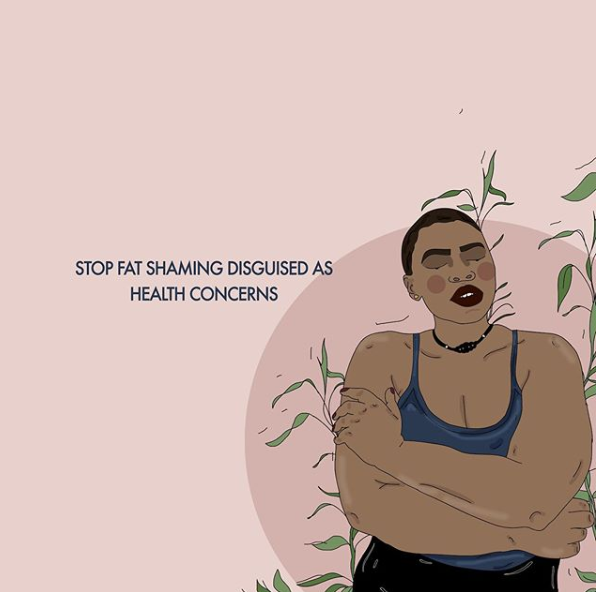
    <p>Image Description: Pictured is a graphic design from @recipiesforselflove on Instagram. The image displays a pale pink background and the text “stop fat-shaming disguised as health concerns” is placed slightly left of center. A black woman is illustrated in the bottom right-hand corner wearing a blue tank top and black pants. She is encompassed in a greyish-pink circle and surrounded by tall green plants.  </p>
    <p><strong>From the first moment of our consciousness, we (women of color) are raised to think of weight as one of our defining characteristics.</strong> Something that measures how much human decency we will be allotted, how many people will treat us with respect, and of course, “most importantly” (as many of my fellow South Asian women have been told) how many marriage proposals we will receive when we are older. It does not matter how much we work out or eat nutrient-rich meals; if we do not visually conform to society’s standard of the ideal body, we are not only ridiculed for it, but our existence itself is categorized as inferior. We are silenced, shunned, and demonized for simply existing in non-white, fat bodies. Whether it is from how we observe the world or how we are treated within it, we grow to learn that being fat equates with being of less value, and so we turn to the alternative: <em>ensuring “smallness” by</em><strong><em> any means necessary</em></strong>.  </p>
    <p>In order to contextualize western diet culture’s impact on specifically women of color, it is critical to understand its origin as being one compounded by systems of white supremacy and the patriarchy. These systems feed into the creation of a diet culture stemming from anti-blackness that is used as a tool to pit women and groups of color against one another. </p>
    </div></div></div></div>
    </div></div>
    <h2><strong>Diet Culture &amp; Women of Color</strong></h2>
    <div>
    <div>
    <p>For many communities of color, the discrepancy between how we are taught to consume food—in schools and from our friends—and the cultural foods we enjoy in the comfort of our own homes <strong>cultivates a relationship with food defined by confusion, embarrassment, and shame</strong>. We are taught that things like carbs and “fatty” oils are the <em>devil incarnate, </em>and for cultural diets—defined by dishes artfully composed of rice and noodles—this can be detrimental. The Indian meals of my childhood like <a href="https://www.vegrecipesofindia.com/moong-dal-khichdi-recipe/" rel="nofollow external" class="bo"><em>khichdi</em></a>, <a href="https://www.indianhealthyrecipes.com/pulao-recipe-veg-pulao-recipe/" rel="nofollow external" class="bo"><em>pulao</em></a>, and <a href="https://www.vegrecipesofindia.com/pav-bhaji-recipe-mumbai-pav-bhaji-a-fastfood-recipe-from-mumbai/" rel="nofollow external" class="bo"><em>pav bhaji</em></a>—rich in spices and made with a foundation of rice or bread—would be considered “unhealthy” because of the carbs and oil they contain. These very meals that nursed me back to health when I fell sick and energized me after hours of dance practice; would also be the source of my shame during school lunch periods and visits to the doctor’s office. Any nutritional value and traditional significance of these and other cultural dishes are often overshadowed by a mistaken idea of what is  “healthy”—which in this case really equates to practices that result in supposed physical “smallness.”  </p>
    <p>The need to conform society to one idea of “health”—which standardizes a “correct” diet —controls how communities of color and communities of women form their relationships with food and nourishment. Health, in this case, becomes a concept encompassing what patterned behaviors keeps one from becoming fat. It dictates how individuals must engage in nutrition in exchange for societal acceptance. This phenomenon, while detrimental to all people—in this case explicitly discussing those impacted by Western practices of diet culture—affects women of color differently as <strong>they live in the limbo of two different, often competing cultural identities</strong>, each with their own social diet pressures, in conjunction with the necessary pursuit of femininity. </p>
    <p>To center white-ness when creating the standard and “correct” American diet, colonizes nutrition and manipulates the mentality around health. It serves to Other<strong>*</strong> various cultural diets by making Western “health foods” the norm and vilifying any foods that stray from these guidelines. In turn, society claims that the very recipes that strengthened our ancestors, the very recipes that have quite literally borne and sustained our lineages are unacceptable. In reality, what is unacceptable is the rhetoric of disgust and inferiority that often marks cultural food sources. The idea that one should not consume the traditional dishes of their ancestry because of the “white” ideal diet is racist.</p>
    <p>Take, for instance, the narrative surrounding MSG (monosodium glutamate)—a food additive utilized in many foods and <a href="https://www.cnn.com/2020/01/18/asia/chinese-restaurant-syndrome-msg-intl-hnk-scli/index.html" rel="nofollow external" class="bo">“naturally found in foods like tomatoes and cheese”</a>(Yeung, 2020), but ridiculed because of its use in traditional Chinese meals. The media has marked MSG as a dangerous and unhealthy ingredient and has linked it to conditions like asthma, drowsiness, and headaches (but not by any scientific backing). This racist rhetoric has steered people away from MSG and has forced the Chinese American community to be mindful of the backlash they may face in using the ingredient, especially for restaurant owners. The overall stigma that surrounds this ingredient displays just how much power white institutions have in dispelling the use of products, especially when those products hold a particular significance in BI-POC cultural cuisines. </p>
    </div>
    <div><div><div></div></div></div>
    <div></div>
    </div>
    <h2><strong>The Implications of the Small Feminine Body </strong></h2>
    <p>There is also a physical element to the requirement of smallness for feminine bodies. It operates under the assumption that women should occupy as little space as physically possible so as to keep their positions of power stifled. The presumption is that women—as the “submissive” gender—must bolster male masculinity by embodying the opposite characteristics of what men possess. By this “rule,” if men are meant to be large to monopolize space and contribute to their dominance, women must then be as small as possible to make “smaller” men adhere to this expectation. Women alone must assume the burden of changing themselves to allow for men to conform to the ideals they have set. Straying away from this ideal—embodying fatness and taking up greater space as a woman—means undermining these systems of the patriarchy that award men greater dominion over the world. </p>
    <p>For women of color who reside in the western world, the pursuit of femininity means the expectation of smallness is compounded by the need (for survival purposes) to shed their melanin and present as light-skinned as possible. Because society masculinizes women of color, specifically brown and black women, they must pursue femininity more extremely because of their skin color. If not, they are ridiculed and solidify their low position on the social ladder. Because of this they feel a greater emphasis to conform to the ideals of western femininity, which encompasses the prerequisite of smallness. In doing so, they may often feel at odds with connecting to the traditional cultural foods they grew up with and abiding by the rules of the society in which they reside.  </p>
    <p>Imperialism's production of the beauty standard—the necessity of thinness and whiteness—for women and girls in places like India portrays this phenomenon at work. The <a href="https://projects.iq.harvard.edu/files/isl/files/occidentalisation_of_beauty_standards_eurocentrism.pdf" rel="nofollow external" class="bo">colonial impact left by Persia and Britain in South Asia</a> has ingrained ideologies about correct body shape, colorism, and anti-blackness. <img width="461" height="325" src="https://lh6.googleusercontent.com/g_Wbkry4iurmd9qSwijY2jFtveJm7Z11BlFzXf_vEMPieHfeSc75nxC6b3hw7ccYX8io9PHz1OsMlIHjzgFYF8-FRh2FVbhpKvhrGRBs379quQrC4uAGpSZJtqCZQ_4U9GXeHTJ-" alt="Britain, India and the Koh-i-Noor diamond – don't expect the jewel to be  prised out of the crown" style="max-width: 100%; height: auto;"></p>

    <p>Image Description: Pictured is a scene from the era of British rule in India. Depicted are British soldiers, dressed in red and white garments, invading an Indian palace. The soldiers hold rifles and clouds of smoke surround them.  </p>
    <p>Since the reign of the Mughals and later the British East India Company, Indian culture has been defined by the idea that the highest <a href="https://en.wikipedia.org/wiki/Cultural_capital" rel="nofollow external" class="bo">cultural capital</a><span><strong>**</strong></span> is awarded to those of lighter skin and less weight. Because conforming more to this ideal cultural behavior meant increasing one's socio-economic status, adhering to the beauty standard was a matter of SURVIVAL. It meant that the closer you were to being this standard the better you would be treated by the foreigners who had come to rule your land and who controlled economic and social production within it.</p>
    <p><strong><img width="290" height="578" src="https://lh3.googleusercontent.com/EUkoi4Tv_C4D8bctQle0qaCjYcg_HSB_V2qgCj3inD_01cDFeIGWhFgzp798CUUsJmeFWRQ1dvMsI0MLGrNoGxsuAJiV2cCtZEXAcRhPkp7kwtd8DN4Rsnu8ZClyliMNfgckf3Dh" alt="Fatphobia in the Vegan Movement | Taylor Wolfram" style="max-width: 100%; height: auto;"></strong></p>
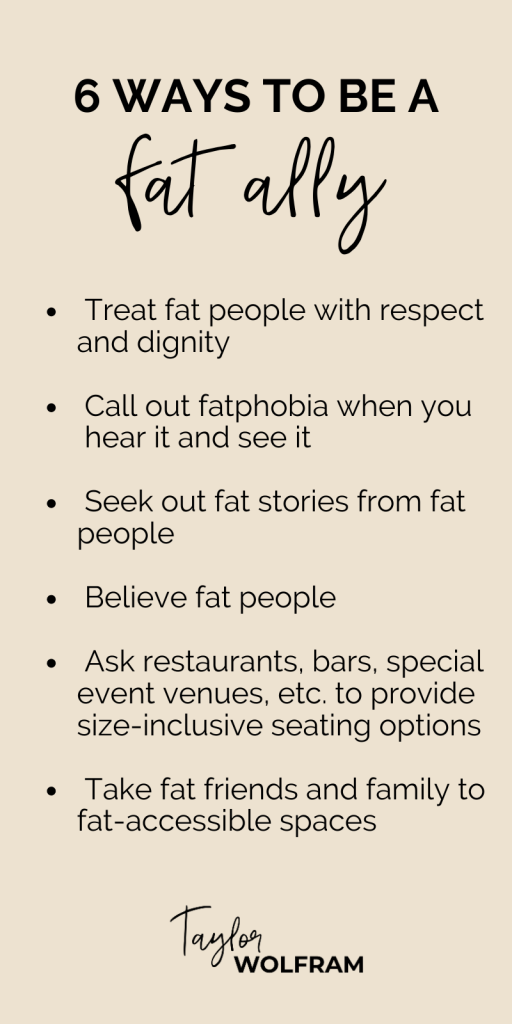
    <p>Image Description: Pictured is an infographic made up of a light tan background created by Taylor Wolfram. It says “6 Ways to Be a Fat Ally”. And lists “ treat fat people with respect and dignity, call out fatphobia when you hear it and see it, seek out fat stories from fat people, believe fat people, ask restaurants, bars, special event venues, etc, to provide size-inclusive seating options, take fat friends and family to fat-accessible spaces”. </p>
    <p>So with these foundational elements of diet culture’s impact in mind, we can then ask ourselves:</p>
    <div><div>
    <p><em>What can we do to mitigate and reverse the rather negative ramifications of this mindset?  </em></p>
    <p><strong>We can change the way we think and talk about bodies </strong></p>
    <p><em>They are vessels that carry us through our day, why must we comment on every one we see ...?</em></p>
    <p><strong>We can advocate for ourselves and others when disrespectful rhetoric is used</strong></p>
    <p><em>You deserve to be vocal and correct disrespect even if it is viewed as normalized.</em></p>
    <p><strong>And maybe most importantly we can learn to view ourselves from a neutral lens</strong></p>
    <p><em>Your body is none other than how you move physically from place to place. To frame it in this way may help the preoccupation with how we are perceived because of it.  </em></p>
    </div></div>
    <p>I know what you’re thinking: these tips are much easier said than done. And you are correct! But, this doesn’t mean we shouldn’t hold ourselves accountable when we say or think about bodies negatively. It also means that if you are being degraded for your appearance: <strong>STAND UP FOR YOURSELF</strong>! Real change can only be possible when we—women of color—learn that we are worthy of taking up space in this world. </p>
    <h2>Footnotes</h2>
    <p><strong>*</strong> The act of alienating something by highlighting its “abnormal” characteristics</p>
    <p><strong>** </strong>The amount of societal status one is given based on various factors (i.e., education, skills, wealth, and discussed the most in this case appearance) </p>
    <h2><strong>Resources and recommendations you should be sure to check out: </strong></h2>
    <div>
    <div>
    <p><a href="https://www.cnn.com/2020/01/18/asia/chinese-restaurant-syndrome-msg-intl-hnk-scli/index.html" rel="nofollow external" class="bo">CNN: <em>MSG in Chinese Food Isn't Unhealthy -- You're Just Racist, Activists Say.</em></a></p>
    <p>Yeung, Jessie. “MSG in Chinese Food Isn't Unhealthy -- You're Just Racist, Activists Say.” <em>CNN</em>, Cable News Network, 19 Jan. 2020, <a href="https://www.cnn.com/2020/01/18/asia/chinese-restaurant-syndrome-msg-intl-hnk-scli/index.html">https://www.cnn.com/2020/01/18/asia/chinese-restaurant-syndrome-msg-intl-hnk-scli/index.html</a>. </p>
    <p><a href="https://projects.iq.harvard.edu/files/isl/files/occidentalisation_of_beauty_standards_eurocentrism.pdf" rel="nofollow external" class="bo">Harvard University: <em>Occidentalisation of Beauty Standards: Eurocentrism in Asia</em></a></p>
    <p>Chen, Toby, et al. “Occidentalisation of Beauty Standards: Eurocentrism in Asia.” <em>Zenodo</em>, Harvard University , 16 Dec. 2020, <a href="https://zenodo.org/record/4325856#.YZvkpr1Ki3I">https://zenodo.org/record/4325856#.YZvkpr1Ki3I</a>.</p>
    <p><a href="https://www.nalgonapositivitypride.com/" rel="nofollow external" class="bo">Gloria Lucas: Nalgona Positivity Pride </a></p>
    <p><a href="https://youtu.be/2oP3STw2jC8" rel="nofollow external" class="bo">Yesika Salgado: What Comes After Loving Yourself? Advice from a Fat Fly Brown Girl </a></p>
    <p><a href="https://www.youtube.com/watch?v=I24aSNqzaOs" rel="nofollow external" class="bo">Yeskia Selgado: The Hunger </a></p>
    <p><a href="https://www.teenvogue.com/story/fat-is-not-a-bad-word" rel="nofollow external" class="bo">Teen Vogue: Fat is Not a Bad Word</a></p>
    <p><a href="https://www.taylorwolfram.com/" rel="nofollow external" class="bo">Taylor Wolfram: 6 ways to Be a Fat Ally </a></p>
    <p><a href="https://www.instagram.com/recipesforselflove/?hl=en" rel="nofollow external" class="bo">Allison Rachel: Recipes for Self-Love </a></p>
    <p><a href="https://www.npr.org/sections/codeswitch/2019/02/06/685506578/is-beauty-in-the-eyes-of-the-colonizer" rel="nofollow external" class="bo">NPR: Code Switch- Is Beauty In The Eyes of The Colonizer</a></p>
    </div>
    <div><div><div></div></div></div>
    <div></div>
    </div>
    </div>
]]>
</Body>
<Summary>Positionality Statement: This post is written by Ojus Phogat, a second-year student at UMBC and a student-staff member at the Women’s Center.  I am a South Asian American woman who has felt the...</Summary>
<Website>https://womenscenteratumbc.wordpress.com/2021/11/22/diet-culture-v-the-cultural-diet%ef%bf%bc/</Website>
<TrackingUrl>https://my3.my.umbc.edu/api/v0/pixel/news/115239/guest@my.umbc.edu/e00d00eebc2a6392d75a92315047070c/api/pixel</TrackingUrl>
<Tag>acceptance</Tag>
<Tag>beauty-standards</Tag>
<Tag>body-consciousness</Tag>
<Tag>body-neutrality</Tag>
<Tag>body-positivity</Tag>
<Tag>diversity</Tag>
<Tag>diversity-and-inclusion-issues</Tag>
<Tag>fatness</Tag>
<Tag>feminism</Tag>
<Tag>femmes</Tag>
<Tag>intersectionality</Tag>
<Tag>minorities</Tag>
<Tag>people-of-color</Tag>
<Tag>self-advocacy</Tag>
<Tag>social-awareness</Tag>
<Tag>south-asian-voices</Tag>
<Tag>women</Tag>
<Tag>women-of-color</Tag>
<Group token="womenscenter">Women's, Gender, &amp;amp; Equity Center</Group>
<GroupUrl>https://my3.my.umbc.edu/groups/womenscenter</GroupUrl>
<AvatarUrl>https://assets2-my.umbc.edu/system/shared/avatars/groups/000/000/125/78272a4842689b30dbf74672182b78f8/xsmall.png?1750974263</AvatarUrl>
<AvatarUrl size="original">https://assets1-my.umbc.edu/system/shared/avatars/groups/000/000/125/78272a4842689b30dbf74672182b78f8/original.png?1750974263</AvatarUrl>
<AvatarUrl size="xxlarge">https://assets1-my.umbc.edu/system/shared/avatars/groups/000/000/125/78272a4842689b30dbf74672182b78f8/xxlarge.png?1750974263</AvatarUrl>
<AvatarUrl size="xlarge">https://assets1-my.umbc.edu/system/shared/avatars/groups/000/000/125/78272a4842689b30dbf74672182b78f8/xlarge.png?1750974263</AvatarUrl>
<AvatarUrl size="large">https://assets1-my.umbc.edu/system/shared/avatars/groups/000/000/125/78272a4842689b30dbf74672182b78f8/large.png?1750974263</AvatarUrl>
<AvatarUrl size="medium">https://assets2-my.umbc.edu/system/shared/avatars/groups/000/000/125/78272a4842689b30dbf74672182b78f8/medium.png?1750974263</AvatarUrl>
<AvatarUrl size="small">https://assets1-my.umbc.edu/system/shared/avatars/groups/000/000/125/78272a4842689b30dbf74672182b78f8/small.png?1750974263</AvatarUrl>
<AvatarUrl size="xsmall">https://assets2-my.umbc.edu/system/shared/avatars/groups/000/000/125/78272a4842689b30dbf74672182b78f8/xsmall.png?1750974263</AvatarUrl>
<AvatarUrl size="xxsmall">https://assets3-my.umbc.edu/system/shared/avatars/groups/000/000/125/78272a4842689b30dbf74672182b78f8/xxsmall.png?1750974263</AvatarUrl>
<Sponsor>Women's Center</Sponsor>
<PawCount>6</PawCount>
<CommentCount>0</CommentCount>
<CommentsAllowed>false</CommentsAllowed>
<PostedAt>Mon, 22 Nov 2021 17:04:31 -0500</PostedAt>
<EditAt>Mon, 22 Nov 2021 17:07:26 -0500</EditAt>
</NewsItem>

<NewsItem contentIssues="true" id="97203" important="false" status="posted" url="https://my3.my.umbc.edu/groups/will/posts/97203">
<Title>Burnt out? Me too.</Title>
<Body>
<![CDATA[
    <div class="html-content">
    <p><em>Amelia Meman, GWST ’15, is the Assistant Director of the Women’s Center.  Amelia uses they/them and she/her pronouns.</em></p>


    <p><strong>Burnt out? Me too.</strong></p>


    <p>This is not a new feeling for me. I have gotten to this same point during other parts of my academic and now professional career. This apex where I thought that if I was able to give it enough gas, stomp on the accelerator, and shut my eyes I could sail across the swiftly oncoming ravine. </p>


    <div>
    <a href="https://womenscenteratumbc.files.wordpress.com/2020/11/greasecarflying.gif" rel="nofollow external" class="bo"><img src="https://womenscenteratumbc.files.wordpress.com/2020/11/greasecarflying.gif?w=480" alt="" style="max-width: 100%; height: auto;"></a>This is how I would like to navigate burnout. Goodbye, plebeian worries! <br>[Image description: a GIF from the movie Grease wherein main characters Sandy and Danny drive off into the sky in a red convertible. Sandy turns back to wave goodbye to the crowd.]</div>


    <p>Let me tell you… I’ve never been able to sail over the ravine.</p>


    <div>
    <a href="https://womenscenteratumbc.files.wordpress.com/2020/11/car-off-cliff.gif" rel="nofollow external" class="bo"><img src="https://womenscenteratumbc.files.wordpress.com/2020/11/car-off-cliff.gif?w=480" alt="" width="480" height="270" style="max-width: 100%; height: auto;"></a>This is me. [Image description: a GIF of a small green car spinning out and finally falling off a small cliff.]</div>


    <p>Burn out is unavoidable sometimes. Especially when we do not give ourselves the time and space to feel what we need to feel. It can come along for anyone doing anything. Maybe you don’t have the best apartment for experiencing alone time. Maybe you have way too many things going on between teaching your kids and managing online classes.</p>


    <p>In my case, I just work. I work and work and work. My ridiculous proclivity for work inspired Rihanna’s classic. No joke! (I’m lying.)</p>


    <p>I work because I really love my job and I feel a great sense of joy from having a purpose. I also work, because it’s my way of exerting control–and when you’re in a pandemic that has no end in sight, you crave a sense of control. So for this latest trip to Burnout Town, I have pushed aside my feelings and any sense of personal boundaries, so that I could focus on getting tasks and projects finished. </p>


    <p>I’m going to be using this ongoing metaphor of traveling on a road trip, so back to me in my car on a cliff: I pushed my car to its zenith mechanically and I also got a little (or maybe a lot) lost. The road was bumpy and dust was flying everywhere. The steering wheel was vibrating and I don’t remember when I last refueled, but all I wanted to do was get out of the rough patch we call Burnout Town by rocketing over the oncoming gulch. </p>


    <p>And now here I am, relating to you how to navigate Burnout Town, because I’m here now and it’s as crummy as the reviews it’s received on Yelp. </p>


    <h3><strong><em>Maybe you’re predisposed to burnout?</em></strong></h3>


    <p>Before I get into the roadmap, this wouldn’t be a Women’s Center blog if I didn’t also mention how identity connects to burnout. Recently, I attended a presentation about the impact of COVID-19 on women in higher education. Needless to say, the numbers are fairly depressing, but they’re important to witness, because there is a sharp divide along gender lines and along racial lines (and disability lines and class lines, etc.).</p>


    <p>The people who are doing both their professional work and family work are most often women. The people who feel most exhausted/overwhelmed are most often women. The people who are, in addition to working or searching for work, looking after children or elderly family members are, you guessed it, most often women. </p>


    <p><strong><em>Ultimately, women are predisposed to burn out. </em></strong></p>


    <p>And people with other marginalized identities are similarly situated. For example, women might bear the weight of stressors disproportionately to men, but when we dissect groups of women by race, we see that stressors are also disproportionately carried by women of color–especially Black women. </p>


    <p>Some might recall Sheryl Sandberg’s pop feminist concept of “lean in,” wherein, if you are a powerful woman at the top of your game, the feminist thing to do is to lean in and empower the other women around you rather than succumbing to the whitecisheterocapitalist competitive individuality that is typically ingrained in our definitions of success. What isn’t talked about is how white women frequently lean ON women of color for their social, emotional support. </p>


    <p>I appreciate what Loretta Ross said when she spoke out against racist/sexist stereotypes via the <a href="https://womenscenter.umbc.edu/tellingourstories/" rel="nofollow external" class="bo">Women’s Center’s Telling Our Stories campaign</a>; she said, “I am not your Tit,” which is to say: “I am not the person you can come to when you need to be nurtured, babied, supported unconditionally,” because as a Black woman, Loretta Ross doesn’t owe anyone that access to her energy, body, and psyche. Especially considering the long history of Black women being exploited as caretakers and caricatured as such (see <a href="https://theconversation.com/i-am-not-your-nice-mammy-how-racist-stereotypes-still-impact-women-111028" rel="nofollow external" class="bo">“I am not your nice Mammy” by Cheryl Thomson</a>). </p>


    <div>
    <a href="https://womenscenteratumbc.files.wordpress.com/2020/11/loretta-poster.jpg" rel="nofollow external" class="bo"><img src="https://womenscenteratumbc.files.wordpress.com/2020/11/loretta-poster.jpg?w=768" alt="" style="max-width: 100%; height: auto;"></a>Loretta Ross’s Telling Our Stories poster. [Image description: a graphic poster in yellow and navy blue. Top text reads “Women of Color: Telling Our Stories.” Below a cut out image of a Black woman wearing a bright red dress and red patterned vest is smiling. Next to her image reads, “My name is Loretta and I’m not your Tit.”]</div>


    <p>It’s not just annoyance or an unwillingness to get things done that makes stress such an issue for women and other minoritized folks: it’s really that consistently high levels of stress are deadly.</p>


    <h3><strong><em>Stress is killing marginalized people</em></strong></h3>


    <p>First, I should name that I am operating from the assumption that those with target identities face more stress than those with agent identities. The sociological concept that I am referring to here is called <a href="https://www.ncbi.nlm.nih.gov/pmc/articles/PMC2072932/" rel="nofollow external" class="bo">“minority stress theory,”</a> which posits that minorities experience heightened amounts of stressors by virtue of living in a systemically oppressive society.</p>


    <p>When we think about stress and where it lives in the body, I think many folks would locate stress in our minds. Stress, for us, is that little (or big) voice that tugs at your mind saying, “Hey, loser. Heads up: you have a huge project due tomorrow, you need to buy groceries, and all of your pandemic plants are dying!” In reality, though, everything is connected and stress manifests throughout a body. When we take in stressful inputs, or “stressors,” we might be <em>thinking</em> about a lot of things but we also might <em>feel our heart rate go up, our breath catch more often, or our insomnia gets the best of us.</em> Stressors impacting a body might also cause our necks and shoulders to get stiff with tension, as well as strengthen the headache making its way around your skull. </p>


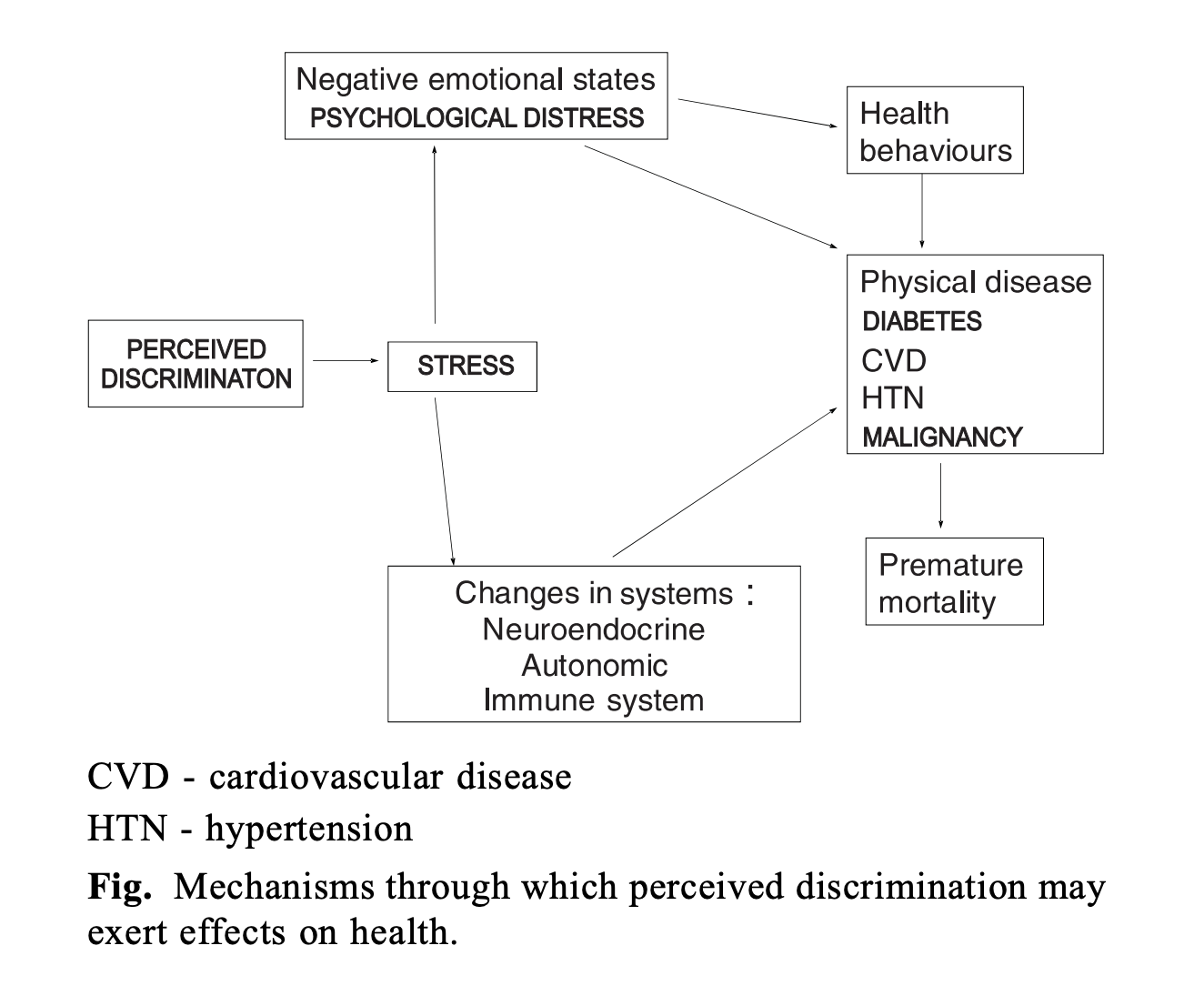
    <p>Ultimately, stress has inextricably holistic effects and at high, prolonged levels, the effects of stress add up. In a 2007 article on the connections between racial bias and health outcomes, a team of scholars (Ahmed, Mohammed, and Williams) synthesized the many patterns and trends to form the conclusion that <strong><em>bias is not just a social and political issue, but a public health issue.</em></strong> This is an excerpt from the Ahmed, et al. paper that outlines the pathways from racial bias incident to adverse health outcomes (the figure below visualizes this relationship):</p>


    <blockquote>
    <p>Allostasis is the body’s ability to maintain homeostasis and to adapt to stressful events by appropriately activating the neuroendocrine, autonomic, and immune systems, and then to return to the basal state when the stressful event is past. While allostasis is adaptive in the short term, the cumulative burden of cycles of allostasis in response to repeated or chronic stress can be damaging and lead to multiple disease states. The concept of “allostatic load” refers to the cumulative wear and tear that the body experiences on these multiple regulatory systems as a result of repeated cycles of allostasis as well as the inefficient regulation of these cycles… High allostatic load is associated with the metabolic syndrome, and predicts mortality, cardiovascular disease incidence, and decline in cognitive and physical function.</p>
    <cite>Williams, D. R., &amp; Mohammed, S. A. (2009). <a href="https://scholar.harvard.edu/davidrwilliams/dwilliam/publications/discrimination-and-racial-disparities-health-evidence-and-needed-research" rel="nofollow external" class="bo">Discrimination and Racial Disparities in Health: Evidence and Needed Research</a>. Journal of Behavioral Medicine , 32, 20-47.</cite>
    </blockquote>


    <img src="https://lh3.googleusercontent.com/p391nMwLv1Q6Zlg78t7GIFSA4Y_ci0bHER_pUC8jWaMxBWS9fN89xwWXgN_LaG8BuxCsRl-gRNIHDRFC_AxIVAX9Gyl8xojPqHlJNAWN4ISXHpu9dY3U_rVBdPbhn5M519lyVJzf" alt="" style="max-width: 100%; height: auto;">Figure from Williams and Mohammed (2009). [Image description: a diagram describing the relationship between bias-based stressors and physical diseases.]


    <p>I don’t share this information with the intention of being a harbinger of death nor am I trying to scare everyone into therapy. I talk about this stuff because it not only puts into perspective the vast importance of mental health and wellbeing but also the ways in which <strong><em>oppression impacts a body at a biological level.</em></strong> <strong><em>Burnout and stress and anxiety and depression are social justice issues, because we live in a socially unjust world</em></strong>–so in doing this critical social justice work, we need to continue to center the oppressed and bring an intentional, critical awareness to the fact that being well and surviving burnout hinges on being able to survive constant systemic violence.</p>


    <h3>Roadmap through Burnout Town</h3>


    <p>Okay, so enough with my TED Talk, you’ve reached the point where we can roll up our sleeves and return to this grand road trip metaphor I teased at the beginning of this blog. Let’s put the pedal to the metal… or… actually…</p>


    <h4>STEP 1: Notice where you are, how you are feeling</h4>


    <div>
    <a href="https://womenscenteratumbc.files.wordpress.com/2020/11/johntravolta.gif" rel="nofollow external" class="bo"><img src="https://womenscenteratumbc.files.wordpress.com/2020/11/johntravolta.gif?w=358" alt="" style="max-width: 100%; height: auto;"></a>I didn’t know I was going to rely so heavily on John Travolta for this blog, but here we are. [Image description: a GIF of John Travolta a la <em>Pulp Fiction </em>looking around as if he is lost. He is superimposed over a browser window that reads, “Unable to connect to the Internet.]</div>


    <p>Burnout, for me, often exists in tension with my own sense of perfectionism and anxiety. This is to the point that I often don’t notice how I’m feeling until I’m crashing. You might do this, too: At noon, I promise myself that if I just get my inbox down to zero, I’ll be able to get up from my computer and eat my lunch. Cut to 3:58 pm where I am bent over my keyboard and finalizing the last reply to an email and feeling mighty resentful that I have a meeting from 4 to 5, and my lunch is still in the office fridge.</p>


    <p>It’s really hard to know when to stop. </p>


    <p>Beyond the fact that we live in a Western, capitalist society that places value in the white knuckle pluck it takes to do the impossible–we’re just not always tuned into our bodies. That’s why this first step is the hardest because we have to learn what burnout feels like in our bodies and when to take notice. </p>


    <p>I am by no means perfect at this, but some things that have helped me come into a more compassionate awareness of my body and my feelings are things like mindfulness and grounding activities. I’m particularly fond of the “body scan,” which asks you to check in with each part of your body to see how you’re doing. </p>


    <p>There are <a href="https://www.healthline.com/health/grounding-techniques#physical-techniques" rel="nofollow external" class="bo">a lot of grounding techniques and they’re all a little bit different</a>, so if you haven’t found the one that resonates with you, fear not. Experiment and enjoy the process of finding what works for you.</p>


    <h4>STEP 2: Pull off the road and put the car in park</h4>


    <div>
    <a href="https://womenscenteratumbc.files.wordpress.com/2020/11/stop.gif" rel="nofollow external" class="bo"><img src="https://womenscenteratumbc.files.wordpress.com/2020/11/stop.gif?w=351" alt="" style="max-width: 100%; height: auto;"></a>This is me. [Image description: a GIF of a child getting frustrated and repeatedly asking a person moving around in front of them to stop.]</div>


    <p>Okay, so you’ve identified that something feels wrong and you’ve stopped your car. AWESOME! I mean, not awesome that something is wrong, but… well, you know. </p>


    <p>If it feels weird for me to celebrate your having to stop what you’re doing due to burnout, I want to be sorry, but I’m not. <strong><em>Here’s my thing: we don’t applaud saying “no” enough. </em></strong></p>


    <p>Saying “no” is boundary-making/-maintaining and it’s critical to protecting your energy. Some may react to your boundaries with negativity. The classic, “What is wrong with you? Why don’t you want to come with me to the Chipotle grand opening?” But when you make the decision to stop because you’re being compassionate toward yourself, it’s the next step in working through the burnout. </p>


    <p>I don’t have much advice to share with you on this (other than to celebrate people’s “no” moments more often), but remember that even when you stop, it doesn’t mean you’re stopping for forever. It doesn’t even have to mean you’re stopping for the day. It just means you are striving to be present with yourself and that is a really good thing.</p>


    <h4>STEP 3: Take your time in running diagnostics and ask for help if you need it</h4>


    <p>Process, process, process. Lots of mental health professionals (including my therapists) will ask if you’ve <em>processed these emotions</em>–but what the heck does that mean? Well, I’ll tell you!</p>


    <p>Processing emotion <strong><em>is</em></strong>.</p>


    <p>It just is. We’re doing it all the time, we just don’t know it until we have some big bad emotion we don’t want to feel. We might be processing joy as we watch our kid giggle at something mundane. We might be processing anger as we get cut off by someone driving erratically. The process is the doing and emotion is always going through you.</p>


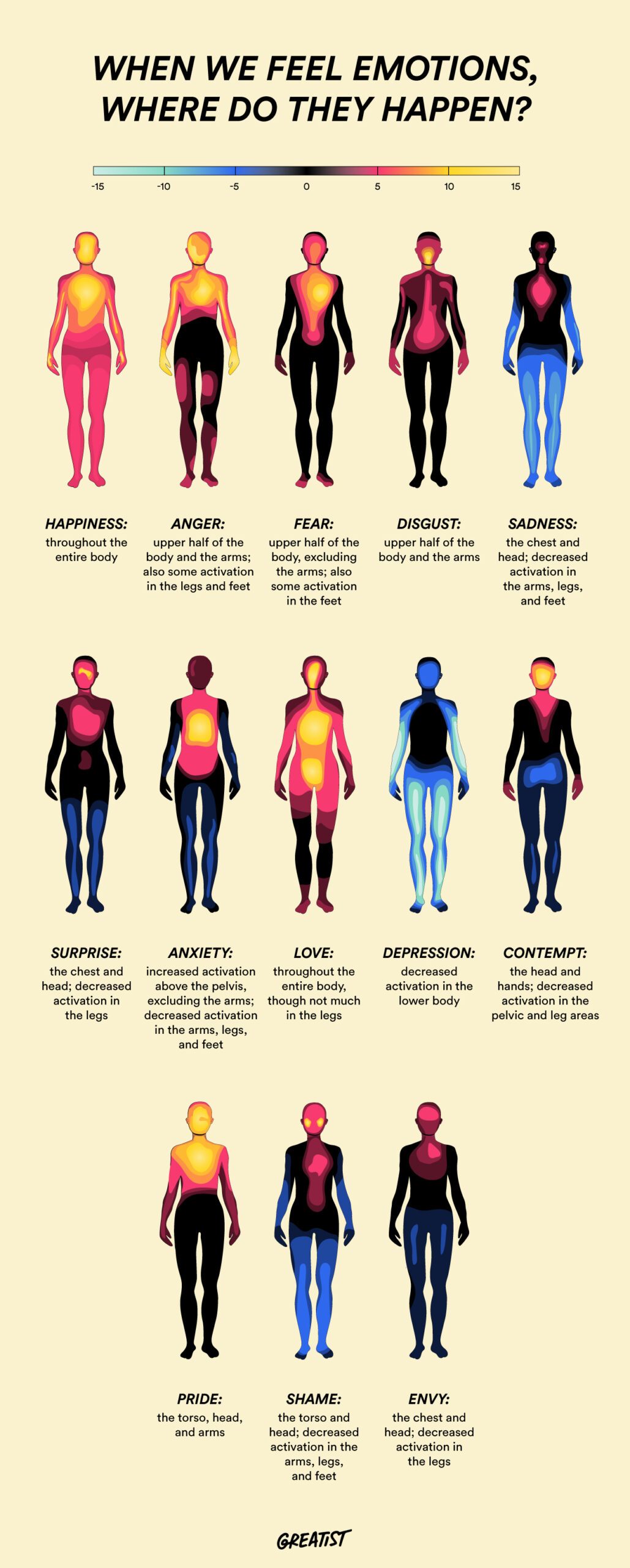
    <p>But if you’re having trouble, start with noticing what’s happening in your body. For example, let’s try right now: take a breath and scan throughout your body; are your feet on the ground flat or are they bouncing? Are your shoulders up near your ears or are they drawn down? Do you feel more weight on one side of your body than another? Are your eyelids feeling heavy?</p>


    <p>When we check in with our body, we can usually get a better idea of what’s happening. If your all tensed up around your shoulders and gritting your teeth, you might be angry. If you’re stomach hurts and your breathing a little heavier, you’re probably nervous. There’s a <a href="https://www.pnas.org/content/115/37/9198" rel="nofollow external" class="bo">whole science to this “emotional sensations” stuff:</a></p>


    <div>
    <a href="https://womenscenteratumbc.files.wordpress.com/2020/11/187598-not-sure-what-youre-feeling_-maybe-this-body-chart-will-help-1296x3223-body-2-scaled-1.jpg" rel="nofollow external" class="bo"><img src="https://womenscenteratumbc.files.wordpress.com/2020/11/187598-not-sure-what-youre-feeling_-maybe-this-body-chart-will-help-1296x3223-body-2-scaled-1.jpg?w=412" alt="" width="579" height="1440" style="max-width: 100%; height: auto;"></a>Full article from <em>Greatist</em> is here: <a href="https://greatist.com/connect/emotional-body-maps-infographic" rel="nofollow external" class="bo">Where Are Emotions Felt in the Body?</a> [Image description: an infographic showing representations of emotion as they are felt through the body.]</div>


    <p>And yeah, maybe you already knew that tears coming out of your eyes meant that you were feeling sad, fair enough, but the next step of understanding your emotions is to work through it. You can do so by talking it out, writing about it, doing some movement-based thing like dancing or walking, hugging a loved one for a long time. There are a whole bunch of things that you can do to work through your emotions. </p>


    <p>But what I really want to point out is that, foundationally,<strong><em> “processing emotion” is just feeling emotions. It’s not about expelling them, wringing them out of our bodies, or fixing our brains. Feelings are normal and valid and important–and try as we might, we cannot escape them, so we better get comfortable with having them along for the ride.</em></strong></p>


    <h4>STEP 4: Get back in the car, and go where you need to go whether that’s a rest stop, the McDonalds drive-thru, your grandma’s house, or a gas station</h4>


    <a href="https://womenscenteratumbc.files.wordpress.com/2020/11/img_2784.jpg" rel="nofollow external" class="bo"><img src="https://womenscenteratumbc.files.wordpress.com/2020/11/img_2784.jpg?w=879" alt="" style="max-width: 100%; height: auto;"></a>From Kate Allan (Instagram: @TheLatestKate). [Image description: a comic of a kiwi bird. The panels read, “A bit lost, over-tired, crying a lot, and handlin it.”]


    <p>Once you’ve done your body scan and taken the time to identify the emotion(s) or stressors that are impacting you, go take care of yourself. I know I just said this piece can be as simple as taking a walk, but there is a little more maintenance and intentionality involved.</p>


    <p>You have to actually slow down and make a plan to get better. For me, that sometimes just means blocking off time in my calendar for human moments like going to the bathroom, eating my lunch, or talking to a friend (usually not all three at once, though). For others, maintenance might be finding a therapist, taking a nap, or finally making the doctor’s appointment you need to make. Regardless of what it is, make a plan to do it and then… do it. </p>


    <p>Follow through with your care plans and maintain their value. Others might question your priorities or consider it too “woo” to take a 10 minute meditation break–but their judgment isn’t helping you feel better so why listen to it?</p>


    <p>I also understand that not everyone has understanding bosses or even the private space to meditate–and that’s why it’s important to create a plan that takes into consideration access, compatibility, and any communication that needs to happen beforehand. Normalize burnout, anxiety, depression, etc. Normalize the need to take time for yourself and to be curious about your healing journey. You’re worth it.</p>


    <h4>STEP 5: Know that it’s okay to get lost</h4>


    <p>I’m ending this blog here, with the sentiment that it’s okay to get lost. It’s okay to be burnt out. It’s okay to discover your rock bottom. It’s okay that this is hard freaking work. We’re in a pandemic, for goodness sake; and COVID-19 is not a scapegoat. It’s genuinely a massive shift to the gravity of our lives. </p>


    <p>And regardless of worldwide killer viruses, our lives are always complex. Burnout is just another means to learn more about our bodies, emotions, and human needs. <strong><em>Getting lost is just another form of discovery.</em></strong></p>


    <p>Burnout, stress, emotional angst–it’s real, it happens, and the important thing to know is that:</p>


    <ul>
    <li>this is temporary</li>
    <li>you’re not alone</li>
    <li>it’s not over, and </li>
    <li>getting lost is sometimes part of the journey.</li>
    </ul>


    <p><strong><em>Regardless of where you are, you can find yourself. </em></strong></p>


    <p>So even if you’re gunning the engine to get over the cliff or beyond the next highway or just out of this weird muddy rut, you can still slow down. Pull over. Take a beat to look up and be curious about the resilience of stars. Be in awe of the innumerable possibilities of where a breath can take you next. You got this.</p>


    <a href="https://womenscenteratumbc.files.wordpress.com/2020/11/img_2785.jpg" rel="nofollow external" class="bo"><img src="https://womenscenteratumbc.files.wordpress.com/2020/11/img_2785.jpg?w=1024" alt="" style="max-width: 100%; height: auto;"></a>A post from Seerut K. Chawla (Instagram/Twitter: @SeerutKChawla). [Image description: a tweet reading, “<em>Let it be</em> is such an underrated intervention. Everything does not need to be dissected or analysed. It’s okay to allow thoughts, feelings, reactions, sensations, to arise and let them run their own course. Name them if you want to. Let them be. And carry on living your life.” ]</div>
]]>
</Body>
<Summary>Amelia Meman, GWST ’15, is the Assistant Director of the Women’s Center.  Amelia uses they/them and she/her pronouns.      Burnt out? Me too.      This is not a new feeling for me. I have gotten...</Summary>
<Website>https://womenscenteratumbc.wordpress.com/2020/11/04/burnt-out-me-too/</Website>
<TrackingUrl>https://my3.my.umbc.edu/api/v0/pixel/news/97203/guest@my.umbc.edu/707e6ee4917f12fc5c6d731cbe1aca51/api/pixel</TrackingUrl>
<Tag>anxiety</Tag>
<Tag>burnout</Tag>
<Tag>diversity-and-inclusion-issues</Tag>
<Tag>emotions</Tag>
<Tag>grounding</Tag>
<Tag>health-disparities</Tag>
<Tag>intersectionality</Tag>
<Tag>issues</Tag>
<Tag>mental-health</Tag>
<Tag>minorities</Tag>
<Tag>recovery</Tag>
<Tag>stress</Tag>
<Tag>therapeutic</Tag>
<Tag>therapy</Tag>
<Tag>uncategorized</Tag>
<Group token="womenscenter">Women's, Gender, &amp;amp; Equity Center</Group>
<GroupUrl>https://my3.my.umbc.edu/groups/womenscenter</GroupUrl>
<AvatarUrl>https://assets2-my.umbc.edu/system/shared/avatars/groups/000/000/125/78272a4842689b30dbf74672182b78f8/xsmall.png?1750974263</AvatarUrl>
<AvatarUrl size="original">https://assets1-my.umbc.edu/system/shared/avatars/groups/000/000/125/78272a4842689b30dbf74672182b78f8/original.png?1750974263</AvatarUrl>
<AvatarUrl size="xxlarge">https://assets1-my.umbc.edu/system/shared/avatars/groups/000/000/125/78272a4842689b30dbf74672182b78f8/xxlarge.png?1750974263</AvatarUrl>
<AvatarUrl size="xlarge">https://assets1-my.umbc.edu/system/shared/avatars/groups/000/000/125/78272a4842689b30dbf74672182b78f8/xlarge.png?1750974263</AvatarUrl>
<AvatarUrl size="large">https://assets1-my.umbc.edu/system/shared/avatars/groups/000/000/125/78272a4842689b30dbf74672182b78f8/large.png?1750974263</AvatarUrl>
<AvatarUrl size="medium">https://assets2-my.umbc.edu/system/shared/avatars/groups/000/000/125/78272a4842689b30dbf74672182b78f8/medium.png?1750974263</AvatarUrl>
<AvatarUrl size="small">https://assets1-my.umbc.edu/system/shared/avatars/groups/000/000/125/78272a4842689b30dbf74672182b78f8/small.png?1750974263</AvatarUrl>
<AvatarUrl size="xsmall">https://assets2-my.umbc.edu/system/shared/avatars/groups/000/000/125/78272a4842689b30dbf74672182b78f8/xsmall.png?1750974263</AvatarUrl>
<AvatarUrl size="xxsmall">https://assets3-my.umbc.edu/system/shared/avatars/groups/000/000/125/78272a4842689b30dbf74672182b78f8/xxsmall.png?1750974263</AvatarUrl>
<Sponsor>Women's Center</Sponsor>
<PawCount>6</PawCount>
<CommentCount>0</CommentCount>
<CommentsAllowed>false</CommentsAllowed>
<PostedAt>Wed, 04 Nov 2020 14:46:07 -0500</PostedAt>
<EditAt>Wed, 04 Nov 2020 14:46:07 -0500</EditAt>
</NewsItem>

<NewsItem contentIssues="false" id="47048" important="false" status="posted" url="https://my3.my.umbc.edu/groups/will/posts/47048">
<Title>UMBC Second Generation Scholarship Form - Available Now</Title>
<Tagline>Do you qualify? If so, you still have time to apply!!</Tagline>
<Body>
<![CDATA[
    <div class="html-content">
    <h2>Second Generation Scholarship Form DEADLINE: Oct 17,2014</h2>
    <h4>Second Generation Scholarship Form</h4>
    <hr>
    <div><div>
    <h3>Statement of Purpose</h3>
    <p>The purpose of the Second Generation Scholarship Award is to provide support to outstanding UMBC undergraduates who have demonstrated a commitment to the advancement of minorities. The amount of the scholarship varies from year to year.</p>
    <p>For the 2014-2015 academic year, two $1,000 scholarship will be given. The recipients will be notified in early November and the awards will be formally presented at the W.E.B. Dubois Lecture on November 12, 2014. <strong>Attendance at the lecture is mandatory</strong>. </p>
    <h3>Criteria</h3>
    <p>The student selected to receive this award should:</p>
    <ul>
    <li>Be a full-time, undergraduate, degree-seeking student in good standing at UMBC.</li>
    <li>Have a minimum 2.75 GPA.</li>
    <li>Submit two letters of recommendation, one of which should be from a UMBC faculty from whom the applicant has taken a course.</li>
    <li>Have completed or enrolled in an Africana Studies Course.</li>
    <li>Submit a transcript (unofficial transcripts are accepted).</li>
    <li>Demonstrate a commitment to the advancement of minorities that is reflected by a pattern of service to the community, extracurricular activities, or other community involvement.</li>
    </ul>
    <p>* Please note that your application will be given to the scholarship selection committee just as you have submitted it.  It will not be edited and spelling errors will not be corrected.*  </p>
    <p><strong>See website for application form and details.  </strong></p>
    <p><strong>APPLICATION DEADLINE:</strong><strong>October 17, 2014</strong></p>
    </div></div>
    </div>
]]>
</Body>
<Summary>Second Generation Scholarship Form DEADLINE: Oct 17,2014  Second Generation Scholarship Form     Statement of Purpose  The purpose of the Second Generation Scholarship Award is to provide support...</Summary>
<Website>http://alumni.umbc.edu/s/1325/index_social.aspx?sid=1325&amp;gid=1&amp;pgid=426&amp;cid=1063&amp;post_id=0</Website>
<TrackingUrl>https://my3.my.umbc.edu/api/v0/pixel/news/47048/guest@my.umbc.edu/f720b8f961a7894a2892136a52905e7e/api/pixel</TrackingUrl>
<Tag>access</Tag>
<Tag>community</Tag>
<Tag>diversity</Tag>
<Tag>funding</Tag>
<Tag>inclusion</Tag>
<Tag>learning</Tag>
<Tag>minorities</Tag>
<Tag>scholarships</Tag>
<Tag>service</Tag>
<Tag>underrepresented</Tag>
<Group token="themosaic">The Mosaic: Center for Cultural Diversity </Group>
<GroupUrl>https://my3.my.umbc.edu/groups/themosaic</GroupUrl>
<AvatarUrl>https://assets3-my.umbc.edu/system/shared/avatars/groups/000/000/079/8da8369525d899e6fa49decd5a80b73f/xsmall.png?1755890395</AvatarUrl>
<AvatarUrl size="original">https://assets2-my.umbc.edu/system/shared/avatars/groups/000/000/079/8da8369525d899e6fa49decd5a80b73f/original.png?1755890395</AvatarUrl>
<AvatarUrl size="xxlarge">https://assets3-my.umbc.edu/system/shared/avatars/groups/000/000/079/8da8369525d899e6fa49decd5a80b73f/xxlarge.png?1755890395</AvatarUrl>
<AvatarUrl size="xlarge">https://assets2-my.umbc.edu/system/shared/avatars/groups/000/000/079/8da8369525d899e6fa49decd5a80b73f/xlarge.png?1755890395</AvatarUrl>
<AvatarUrl size="large">https://assets3-my.umbc.edu/system/shared/avatars/groups/000/000/079/8da8369525d899e6fa49decd5a80b73f/large.png?1755890395</AvatarUrl>
<AvatarUrl size="medium">https://assets4-my.umbc.edu/system/shared/avatars/groups/000/000/079/8da8369525d899e6fa49decd5a80b73f/medium.png?1755890395</AvatarUrl>
<AvatarUrl size="small">https://assets1-my.umbc.edu/system/shared/avatars/groups/000/000/079/8da8369525d899e6fa49decd5a80b73f/small.png?1755890395</AvatarUrl>
<AvatarUrl size="xsmall">https://assets3-my.umbc.edu/system/shared/avatars/groups/000/000/079/8da8369525d899e6fa49decd5a80b73f/xsmall.png?1755890395</AvatarUrl>
<AvatarUrl size="xxsmall">https://assets1-my.umbc.edu/system/shared/avatars/groups/000/000/079/8da8369525d899e6fa49decd5a80b73f/xxsmall.png?1755890395</AvatarUrl>
<Sponsor>Africana Studies and Committee for Black and Latino Alumni</Sponsor>
<PawCount>3</PawCount>
<CommentCount>0</CommentCount>
<CommentsAllowed>false</CommentsAllowed>
<PostedAt>Fri, 03 Oct 2014 10:28:55 -0400</PostedAt>
</NewsItem>

</News>