The long shot—4-time Olympian Cleopatra Borel ’02 inducted to Athletics Hall of Fame

Cleopatra Borel had no athletic aspirations when she arrived in Baltimore from Trinidad and Tobago in 1997. She enrolled at what was then Coppin State College on the advice of her high school math teacher, a Coppin alum. Powerfully built and an eager learner, Borel quickly developed in the throwing events and broke Coppin’s shot put record early in her tenure there.
After the Eagles’ coach left the program, UMBC offered Borel an athletic scholarship and she made the move to Hilltop Circle.
 Borel at a competition when she was a student. Photo courtesy of Borel.
Borel ’02, interdisciplinary studies, flourished both academically and athletically at UMBC. She earned All-America honors (top eight) in the shot put both indoors and outdoors in the 2000 – 01 season. However, she would have only one more crack at the NCAAs, with one year of indoor track and field eligibility remaining.
On March 9, 2002, Cleo, as she was known at UMBC, took to the shot put circle at the University of Arkansas. On her next-to-last throw, she uncorked a personal best of 17.50 meters (57’5”), putting her in first place. When the last shot had landed, the black-and-gold clad Retriever had outdistanced the field and captured UMBC’s first Division I national title.
In her first year of eligibility (2006 – 07), the UMBC Athletic Hall of Fame Committee tabbed Borel for induction. However, some events on her calendar kept getting in the way of her returning to campus—namely the 2004, 2008, 2012, and 2016 Olympics. At 37 years old, she produced her best finish, placing seventh at the 2016 Rio Games. Her final Olympic moment occurred as she served as Trinidad and Tobago’s flag bearer at the closing ceremonies.
Borel returned to the United States in January 2022 to coach the throwers at the University of Texas Rio Grande Valley. And, in October 2023, she finally made the journey back to Hilltop Circle to be inducted into the UMBC Athletics Hall of Fame.
We asked Borel to reflect on her incredible journey.
Q: You arrived at UMBC under unusual circumstances and remain the only Retriever to win an individual NCAA Championship. Reflecting on your time here, what did it mean for you to be a Retriever and how did your UMBC experience assist you in all of your endeavors?
Borel: I walked away from a very good situation at Coppin State College, not knowing how things would evolve at UMBC. However, I have to say, taking a chance on UMBC is still among the top three best decisions I have made thus far. My UMBC student-athlete experience prepared me for life as an Olympic athlete, essentially taking on the world.
I believe I was prepared to navigate life on the professional track and field circuit because of [UMBC Athletics Director] Dr. Charles Brown’s sports management class and because my event Coach Brian King and track and field Head Coach David Bobb ’97 taught me to work hard, be confident, and play to my strengths.
 Left to right, David Bobb ’97, Borel, and Brian King. Photo by Max Franz for UMBC.
UMBC’s academic accomplishments, artistic expressions, community outreach initiatives, and of course athletic triumphs reflect the unwavering commitment we all share in making our school a truly exceptional place—a special place where a young person can take a chance and, through hard work and dedication, rise to the top of their field.
Q: What did it mean for you to represent Trinidad and Tobago in international competitions, including four Olympic Games?
Borel: Trinidad and Tobago is a small, developing nation in the Caribbean with a population of less than 1.4 million individuals on two islands. As a result, I felt like one of a few sporting ambassadors representing my country. I am proud to have been responsible for the playing of my national anthem at stadiums across the globe.
UMBC’s academic accomplishments, artistic expressions, community outreach initiatives, and of course athletic triumphs reflect the unwavering commitment we all share in making our school a truly exceptional place.
Cleopatra Borel ’02
Q: What prompted you to develop the Cleopatra Borel Foundation and what is its mission?
Borel: The mission of the Cleopatra Borel Foundation is to facilitate the development of youth through sport and education. We believe this can be accomplished at the grassroots level in Trinidad and Tobago by assisting with coaches’ education, gear, and equipment distribution.
Q: Anything else you would like to share with the UMBC community?
Borel: It was indeed an honor to represent you at the NCAAs and on a global level. I am a proud Retriever, excited to see how UMBC will continue to positively influence Maryland and the world.
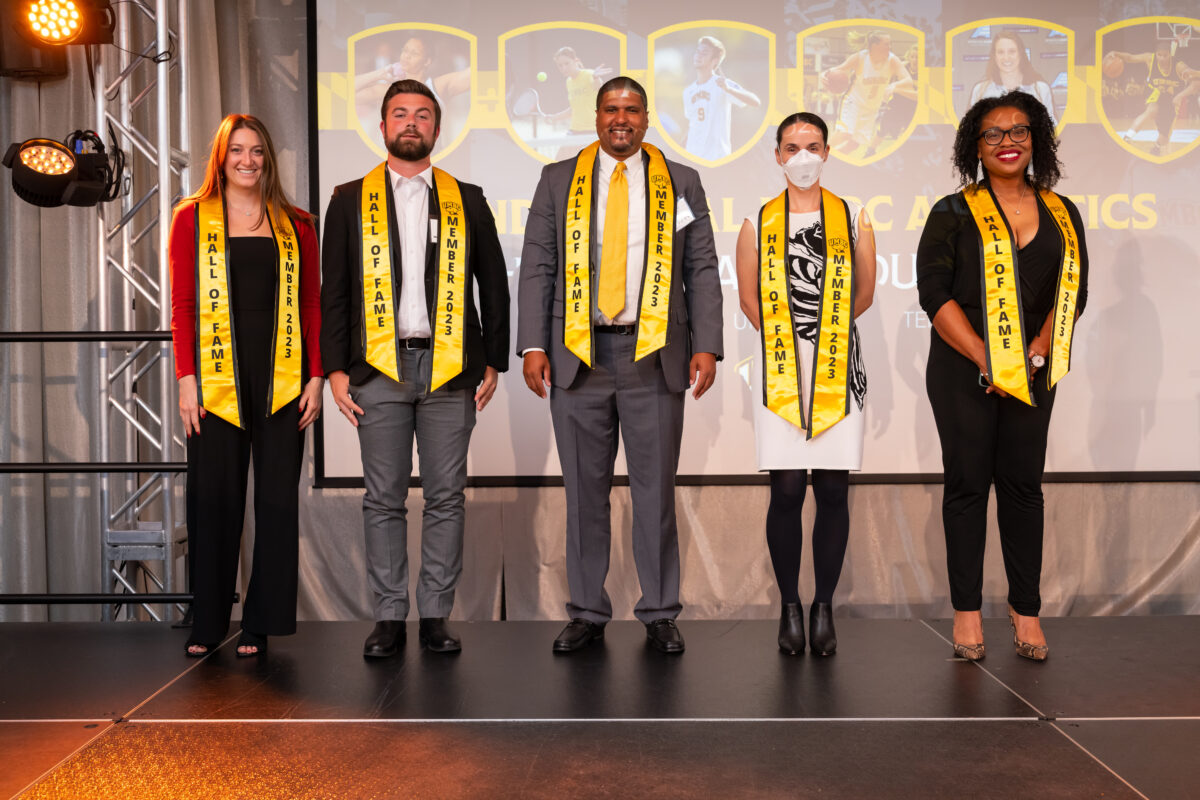 The 2023 Hall of Fame inductees included (left to right) Emily Escobedo, ’17, women’s swimming and diving; Pete Caringi III, ’15, men’s soccer; Brian Hodges, ’07, men’s basketball; Cornelia Carapcea, ’09, tennis and Cleopatra Borel, ’02 , track and field. Carlee Cassidy Dewey ’10, women’s basketball, could not attend for personal reasons and will be formally inducted in 2024. Photo by Max Franz for UMBC.
By Steve Levy ’85
]]>
Cleopatra Borel had no athletic aspirations when she arrived in Baltimore from Trinidad and Tobago in 1997. She enrolled at what was then Coppin State College on the advice of her high school math...
https://umbc.edu/stories/olympian-shot-put-cleopatra-borel-hall-of-fame/
https://my3.my.umbc.edu/api/v0/pixel/news/137213/guest@my.umbc.edu/fe54ce890ccc8e25e90d5b622da7dea2/api/pixel
alumni
at-play
athletics
fall-2023
inds
magazine
UMBC Magazine
https://my3.my.umbc.edu/groups/retired-1945
https://assets2-my.umbc.edu/images/avatars/group/8/xsmall.png?1793799644
https://assets4-my.umbc.edu/images/avatars/group/8/original.png?1793799644
https://assets3-my.umbc.edu/images/avatars/group/8/xxlarge.png?1793799644
https://assets4-my.umbc.edu/images/avatars/group/8/xlarge.png?1793799644
https://assets1-my.umbc.edu/images/avatars/group/8/large.png?1793799644
https://assets2-my.umbc.edu/images/avatars/group/8/medium.png?1793799644
https://assets1-my.umbc.edu/images/avatars/group/8/small.png?1793799644
https://assets2-my.umbc.edu/images/avatars/group/8/xsmall.png?1793799644
https://assets4-my.umbc.edu/images/avatars/group/8/xxsmall.png?1793799644
UMBC Magazine
0
0
false
Tue, 14 Nov 2023 15:11:49 -0500
Class Promo! GES 383 - Statistical & Thematic Cartography
Don't know what classes to take? Consider 383!
Check out the attached flyer by class instructor Cheryl Knott!
- 4-credit course
- Counts as an elective for the GIScience certificate
- Only recommended prerequisite is GES 286 or permission of instructor
- Tell a compelling story with a map!
Professors, if you would like to promote any of your classes offered this spring feel free to send a flyer or message to
celineb1@umbc.edu!

The nonprofit AI4ALL has offered its Discover AI program to UMBC students since 2021. They have now revised their programs and invite UMBC students in computing-related majors interested in Artificial Intelligence technology to apply for their new, free, online
AI4ALL Ignite program that begins in
Spring 2024.
What is AI4ALL? AI4ALL is a national nonprofit transforming the pipeline of AI practitioners and creating a more inclusive, human-centered discipline. It empowers students to be AI Changemakers by cultivating an environment where they develop skills in critical thinking and relationship-building and expertise in responsible AI. AI4ALL champions the diverse next-generation AI changemakers through education, ethics, and relationship-driven networks.
What is AI4ALL Ignite? The AI4ALL Ignite program gives undergraduates the opportunity to
- Work on an AI portfolio project with mentorship and guidance from AI industry experts
- Present their AI portfolio project in a student symposium and network with AI industry professionals.
- Participate in extensive and practical training in career readiness and technical AI internship interviews
- Train in mock AI technical interviews and network in opportunity chats with AI recruiters
How to apply. Eligibility and Deadlines:
- Spring 2024 Cohort Early Application Deadline: December 15, 2023
- Spring 2024 Cohort Final Application Deadline: January 22, 2024
AI4ALL Ignite is open to undergraduate students in a major or minor related to computing, e.g., Computer Science, Computer Engineering, Information Systems, Mathematics, and Bioinformatics. While all are welcome to apply, AI4ALL prioritizes students whose race, gender, or ethnicity has been historically excluded from AI: Black, Hispanic and Latinx, and Indigenous folks; and women, gender-expansive, and non-binary folks. You can find full eligibility on the
AI4ALL Ignite website.
]]>
The nonprofit AI4ALL has offered its Discover AI program to UMBC students since 2021. They have now revised their programs and invite UMBC students in computing-related majors interested in...
https://ai-4-all.org/ai4all-ignite/
https://my3.my.umbc.edu/api/v0/pixel/news/137083/guest@my.umbc.edu/d5c8132838c54a210478ce509c640f1e/api/pixel
ai
ai4all
Computer Science and Electrical Engineering
https://my3.my.umbc.edu/groups/csee
https://assets3-my.umbc.edu/system/shared/avatars/groups/000/000/099/d117dca133c64bf78a4b7696dd007189/xsmall.png?1314043393
https://assets1-my.umbc.edu/system/shared/avatars/groups/000/000/099/d117dca133c64bf78a4b7696dd007189/original.png?1314043393
https://assets1-my.umbc.edu/system/shared/avatars/groups/000/000/099/d117dca133c64bf78a4b7696dd007189/xxlarge.png?1314043393
https://assets4-my.umbc.edu/system/shared/avatars/groups/000/000/099/d117dca133c64bf78a4b7696dd007189/xlarge.png?1314043393
https://assets3-my.umbc.edu/system/shared/avatars/groups/000/000/099/d117dca133c64bf78a4b7696dd007189/large.png?1314043393
https://assets1-my.umbc.edu/system/shared/avatars/groups/000/000/099/d117dca133c64bf78a4b7696dd007189/medium.png?1314043393
https://assets2-my.umbc.edu/system/shared/avatars/groups/000/000/099/d117dca133c64bf78a4b7696dd007189/small.png?1314043393
https://assets3-my.umbc.edu/system/shared/avatars/groups/000/000/099/d117dca133c64bf78a4b7696dd007189/xsmall.png?1314043393
https://assets3-my.umbc.edu/system/shared/avatars/groups/000/000/099/d117dca133c64bf78a4b7696dd007189/xxsmall.png?1314043393
Computer Science and Electrical Engineering
0
0
true
Tue, 14 Nov 2023 14:40:45 -0500
Tue, 14 Nov 2023 14:46:40 -0500
USE CAUTION - Email Scams Are Being Sent Daily
The Career Center works very hard to ensure that job postings in Handshake are legitimate positions and Handshake has shown to be a very reliable source to find great opportunities. However, scammers are becoming more and more creative and they are circumventing Handshake.
***We have recently seen an uptick in fraudulent job offers emailed directly from scammers to students posing as legitimate employer. ***
Please see the following most recent email scams; THESE ARE FRAUDULENT: They are not from UMBC or Career Services.
---------- Forwarded message ---------
From:
Career Services <
tonim1@umbc.edu>
Date: Mon, Nov 13, 2023 at 10:51 AM
Subject: Job Opening!
To: YOU
An administrative assistant to perform various administrative tasks like making or receiving payment, keeping record and processing paperwork when necessary, with a good weekly pay is needed, Please find the position and some basic information below.
Job Description
Administrative Assistant
Work remotely: Yes
Job Type : Part time (15 to 20 hours weekly)
Duties:
> Running personal errands.
> Making Purchases, receiving and making payment
> Perform official assignment to detail/ instruction.
This position will be a home-based and flexible part time job, You can be working from home, School or any location
Interested in this position, Send your resume to
drbm789@gmail.com . Then text (443) 267-2747 for updates
Once again, this email is a scam. Notice the email comes from a "Gmail account" and NOT a UMBC email URL.
Please visit our Fraudulent Jobs & Email Scams page HERE to learn about about what to look out for and wat to do in the event you receive one of these emails.
The Career Center is here to support you. If you encounter a position that you fear may be fraudulent, don't hesitate to reach out to us careers@umbc.edu
View on myUMBC
]]>
The Career Center works very hard to ensure that job postings in Handshake are legitimate positions and Handshake has shown to be a very reliable source to find great opportunities. However,...
https://my3.my.umbc.edu/api/v0/pixel/news/137082/guest@my.umbc.edu/5965decbbdced527903aa73f8812c5f4/api/pixel
UMBC Graduate Student Association
https://my3.my.umbc.edu/groups/gsa
https://assets1-my.umbc.edu/system/shared/avatars/groups/000/000/141/6944ed1afb7c0b0557d52a5e61a6d9c9/xsmall.png?1688588974
https://assets1-my.umbc.edu/system/shared/avatars/groups/000/000/141/6944ed1afb7c0b0557d52a5e61a6d9c9/original.png?1688588974
https://assets2-my.umbc.edu/system/shared/avatars/groups/000/000/141/6944ed1afb7c0b0557d52a5e61a6d9c9/xxlarge.png?1688588974
https://assets3-my.umbc.edu/system/shared/avatars/groups/000/000/141/6944ed1afb7c0b0557d52a5e61a6d9c9/xlarge.png?1688588974
https://assets1-my.umbc.edu/system/shared/avatars/groups/000/000/141/6944ed1afb7c0b0557d52a5e61a6d9c9/large.png?1688588974
https://assets1-my.umbc.edu/system/shared/avatars/groups/000/000/141/6944ed1afb7c0b0557d52a5e61a6d9c9/medium.png?1688588974
https://assets2-my.umbc.edu/system/shared/avatars/groups/000/000/141/6944ed1afb7c0b0557d52a5e61a6d9c9/small.png?1688588974
https://assets1-my.umbc.edu/system/shared/avatars/groups/000/000/141/6944ed1afb7c0b0557d52a5e61a6d9c9/xsmall.png?1688588974
https://assets1-my.umbc.edu/system/shared/avatars/groups/000/000/141/6944ed1afb7c0b0557d52a5e61a6d9c9/xxsmall.png?1688588974
UMBC Graduate Student Association
https://assets4-my.umbc.edu/system/shared/thumbnails/news/000/137/082/2ac3b7cab1c0e974de23ced698378d78/xxlarge.jpg?1699989235
https://assets1-my.umbc.edu/system/shared/thumbnails/news/000/137/082/2ac3b7cab1c0e974de23ced698378d78/xlarge.jpg?1699989235
https://assets4-my.umbc.edu/system/shared/thumbnails/news/000/137/082/2ac3b7cab1c0e974de23ced698378d78/large.jpg?1699989235
https://assets4-my.umbc.edu/system/shared/thumbnails/news/000/137/082/2ac3b7cab1c0e974de23ced698378d78/medium.jpg?1699989235
https://assets2-my.umbc.edu/system/shared/thumbnails/news/000/137/082/2ac3b7cab1c0e974de23ced698378d78/small.jpg?1699989235
https://assets1-my.umbc.edu/system/shared/thumbnails/news/000/137/082/2ac3b7cab1c0e974de23ced698378d78/xsmall.jpg?1699989235
https://assets1-my.umbc.edu/system/shared/thumbnails/news/000/137/082/2ac3b7cab1c0e974de23ced698378d78/xxsmall.jpg?1699989235
1
0
true
Tue, 14 Nov 2023 14:14:54 -0500
Todays meeting!!!!
You don’t want to miss this!
Happy Tuesday everyone,
Today we will be talking about the Paradox of Control!
A summary from our presenter for today:
“We will be mainly focusing on Stoicism even though it also has applications in Taoism and Buddhism.
Topics covered include:
How do we negotiate our efforts and with the possibility of failure?
Is the power we attribute to ourselves and others real or legitimate?
Why do we ache to attach meaning to the events and actions in our lives? How do you live without attaching meaning to such things?
How do you come to trust yourself in the face of uncertainty? How do you have faith or courage yourself when you’re fully aware of how you’ve failed?
We claim these stoic concepts as positive and worth following - but do we ever really follow them? How feasible is it to apply these concepts in our lives?
Self-sabotage, anxiety, relationships, trust in oneself, we exalt flexibility yet punish and shame people for making mistakes, judgement and meaning as a crutch, social metrics of power”
Stop by today at 4:30-5:30 in PAHB 456 for more!
-Liv
]]>
Happy Tuesday everyone, Today we will be talking about the Paradox of Control! A summary from our presenter for today: “We will be mainly focusing on Stoicism even though it also has...
https://my3.my.umbc.edu/api/v0/pixel/news/137077/guest@my.umbc.edu/27dbb3dc01a499db7c3d706adfaf3568/api/pixel
Philosophers Anonymous
https://my3.my.umbc.edu/groups/philanon
https://assets1-my.umbc.edu/system/shared/avatars/groups/000/001/569/6090ea4aaa67546aada70551896be84f/xsmall.png?1724608252
https://assets1-my.umbc.edu/system/shared/avatars/groups/000/001/569/6090ea4aaa67546aada70551896be84f/original.png?1724608252
https://assets4-my.umbc.edu/system/shared/avatars/groups/000/001/569/6090ea4aaa67546aada70551896be84f/xxlarge.png?1724608252
https://assets1-my.umbc.edu/system/shared/avatars/groups/000/001/569/6090ea4aaa67546aada70551896be84f/xlarge.png?1724608252
https://assets2-my.umbc.edu/system/shared/avatars/groups/000/001/569/6090ea4aaa67546aada70551896be84f/large.png?1724608252
https://assets2-my.umbc.edu/system/shared/avatars/groups/000/001/569/6090ea4aaa67546aada70551896be84f/medium.png?1724608252
https://assets1-my.umbc.edu/system/shared/avatars/groups/000/001/569/6090ea4aaa67546aada70551896be84f/small.png?1724608252
https://assets1-my.umbc.edu/system/shared/avatars/groups/000/001/569/6090ea4aaa67546aada70551896be84f/xsmall.png?1724608252
https://assets3-my.umbc.edu/system/shared/avatars/groups/000/001/569/6090ea4aaa67546aada70551896be84f/xxsmall.png?1724608252
Philosophers Anonymous
0
0
true
Tue, 14 Nov 2023 12:31:43 -0500
Undergraduate Research: ATOMS lab (Dr. Josephson, PI)
John Velkey, '24 Chemical Engineering - traditional track
John Velkey,
'24 Chemical Engineering - traditional track, Mathematics minor
Where was your Research?
ATOMS lab with Dr. Josephson
When did you start your Research?
January 2023
What is the focus of your Research?
Writing programs in Lean 4 that perform scientific calculations, and have verifiable mathematics
What are you looking forward to the most about your Research?
Opportunities to present research to broader audiences at conferences
What was the best part of your Research OR What was the biggest learning moment of your Research ?
I have really enjoyed the process of learning a new programming language.
What advice do you have for students who are interested in getting involved in research or an internship?
Apply early and often, and tailor applications to individual opportunities.
Are you a member of any clubs/campus organizations?
I am a teaching fellow for ENCH 300 - Chemical Process Thermodynamics.
What are your goals after graduation?
I am looking forward to getting into the workforce and taking a bit of a break from school, (for now)
Learn more about John Velkey:
@_Velkey on X (FKA Twitter), LinkedIn: https://www.linkedin.com/in/john-velkey
]]>
John Velkey, '24 Chemical Engineering - traditional track, Mathematics minor Where was your Research? ATOMS lab with Dr. Josephson When did you start your Research? January 2023 What is...
https://my3.my.umbc.edu/api/v0/pixel/news/137075/guest@my.umbc.edu/36b44db7e1b3b3fbb5c73f42b917386c/api/pixel
fall-2023
internship
research
student-highlight
ug
ugrad
Chemical, Biochemical and Environmental Engineering
https://my3.my.umbc.edu/groups/cbee
https://assets4-my.umbc.edu/system/shared/avatars/groups/000/000/771/b5e579e81b2e3624611890fa3ca2716a/xsmall.png?1746794587
https://assets2-my.umbc.edu/system/shared/avatars/groups/000/000/771/b5e579e81b2e3624611890fa3ca2716a/original.png?1746794587
https://assets1-my.umbc.edu/system/shared/avatars/groups/000/000/771/b5e579e81b2e3624611890fa3ca2716a/xxlarge.png?1746794587
https://assets2-my.umbc.edu/system/shared/avatars/groups/000/000/771/b5e579e81b2e3624611890fa3ca2716a/xlarge.png?1746794587
https://assets2-my.umbc.edu/system/shared/avatars/groups/000/000/771/b5e579e81b2e3624611890fa3ca2716a/large.png?1746794587
https://assets4-my.umbc.edu/system/shared/avatars/groups/000/000/771/b5e579e81b2e3624611890fa3ca2716a/medium.png?1746794587
https://assets1-my.umbc.edu/system/shared/avatars/groups/000/000/771/b5e579e81b2e3624611890fa3ca2716a/small.png?1746794587
https://assets4-my.umbc.edu/system/shared/avatars/groups/000/000/771/b5e579e81b2e3624611890fa3ca2716a/xsmall.png?1746794587
https://assets1-my.umbc.edu/system/shared/avatars/groups/000/000/771/b5e579e81b2e3624611890fa3ca2716a/xxsmall.png?1746794587
Chemical, Biochemical and Environmental Engineering
https://assets4-my.umbc.edu/system/shared/thumbnails/news/000/137/075/2265d75ae4b30f82ae419ff078f070aa/xxlarge.jpg?1699981430
https://assets2-my.umbc.edu/system/shared/thumbnails/news/000/137/075/2265d75ae4b30f82ae419ff078f070aa/xlarge.jpg?1699981430
https://assets3-my.umbc.edu/system/shared/thumbnails/news/000/137/075/2265d75ae4b30f82ae419ff078f070aa/large.jpg?1699981430
https://assets2-my.umbc.edu/system/shared/thumbnails/news/000/137/075/2265d75ae4b30f82ae419ff078f070aa/medium.jpg?1699981430
https://assets1-my.umbc.edu/system/shared/thumbnails/news/000/137/075/2265d75ae4b30f82ae419ff078f070aa/small.jpg?1699981430
https://assets2-my.umbc.edu/system/shared/thumbnails/news/000/137/075/2265d75ae4b30f82ae419ff078f070aa/xsmall.jpg?1699981430
https://assets3-my.umbc.edu/system/shared/thumbnails/news/000/137/075/2265d75ae4b30f82ae419ff078f070aa/xxsmall.jpg?1699981430
0
0
true
Tue, 14 Nov 2023 12:09:48 -0500
Wed, 10 Sep 2025 11:53:04 -0400
Study finds strongest evidence yet for local sources of cosmic ray electrons
A new study using data from the CALorimetric Electron Telescope (CALET)instrument on the International Space Station has found evidence for nearby, young sources of cosmic ray electrons, contributing to a greater understanding of how the galaxy functions as a whole.
The study included more than seven million data points representing particles arriving at CALET’s detector since 2015, and CALET’s ability to detect electrons at the highest energies is unique. As a result, the data includes more electrons at high energies than any previous work. That makes the statistical analysis of the data more robust and lends support to the conclusion that there are one or more local sources of cosmic ray electrons.
“This is one of the primary things that CALET is made to look for,” says Nicholas Cannady, an assistant research scientist with UMBC’s Center for Space Sciences and Technology, a partnership with NASA Goddard Space Flight Center, and a leader on the study. With this paper, he adds, “We were really able to push into the realm where we have few events and start to look for things at the highest energies, which is exciting.”
A better understanding of the galaxy
 Nicholas Cannady, the lead U.S. scientist on the new study, is excited that the CALET mission is bearing fruitful results. (Image courtesy of Cannady)
Current theory posits that the aftermath of supernovae (exploding stars), called supernova remnants, produce these high energy electrons, which are a specific type of cosmic ray. Electrons lose energy very quickly after leaving their source, so the rare electrons arriving at CALET with high energy are believed to originate in supernova remnants that are relatively nearby (on a cosmic scale), Cannady explains.
The study’s results are “a strong indicator that the paradigm that we have for understanding these high-energy electrons—that they come from supernova remnants and that they are accelerated the way that we think they are—is correct,” Cannady says. The findings “give insight into what’s going on in these supernova remnants, and offer a way to understand the galaxy and these sources in the galaxy better.”
CALET is a collaborative project built and operated by groups in Japan, Italy, and the United States, led by Shoji Torii. The lead contributors to this work in Japan are Torii, Yosui Akaike, and Holger Motz at Waseda University in Tokyo, and Louisiana State University is the lead institution in the U.S. The findings were published in Physical Review Letters.
New data lead to new cosmic ray sources
Previous work found that the number of electrons arriving at CALET decreased steadily as energy increased up to about 1 teravolt (TeV), or 1 trillion electron volts. The number of electrons arriving with even greater energy was extremely low. But in this study, CALET did not see the expected dropoff. Instead, the results suggest that the number of particles plateau, and then even increase, at the highest energies—all the way up to 10 TeV in a few cases.
Previous experiments could only measure particles up to about 4 TeV, so the highest energy event candidates above that in this study are a crucial new source of information about potential nearby sources of cosmic ray electrons. Cannady led the effort to individually analyze each of those events to confirm they represent a real signal, and a deeper dive into those events is forthcoming.
Addressing challenges
It’s difficult to distinguish between electrons and protons at high energies, and there are many more protons arriving than electrons, which poses challenges to an accurate analysis. To tell the particles apart, a program developed by the researchers analyzes how the particles break down when they hit the detector. Protons and electrons break down differently, so comparing the cascade of particles they create in that process can filter out the protons. However, at the highest energies, the differences between protons and electrons decrease, making it harder to accurately remove only the protons from the data.
To address this, Cannady led the CALET team’s effort to simulate the breakdown patterns of both protons and electrons coming from the exact direction each of the high-energy events arrived from. That increased the team’s ability to determine whether the events are electrons or protons as accurately as possible.
Based on that work, “We believe we are evaluating the likelihood of events being protons in a realistic fashion,” Cannady says. Enough presumed electrons remain in the dataset after that careful analysis to conclude there is a real signal.
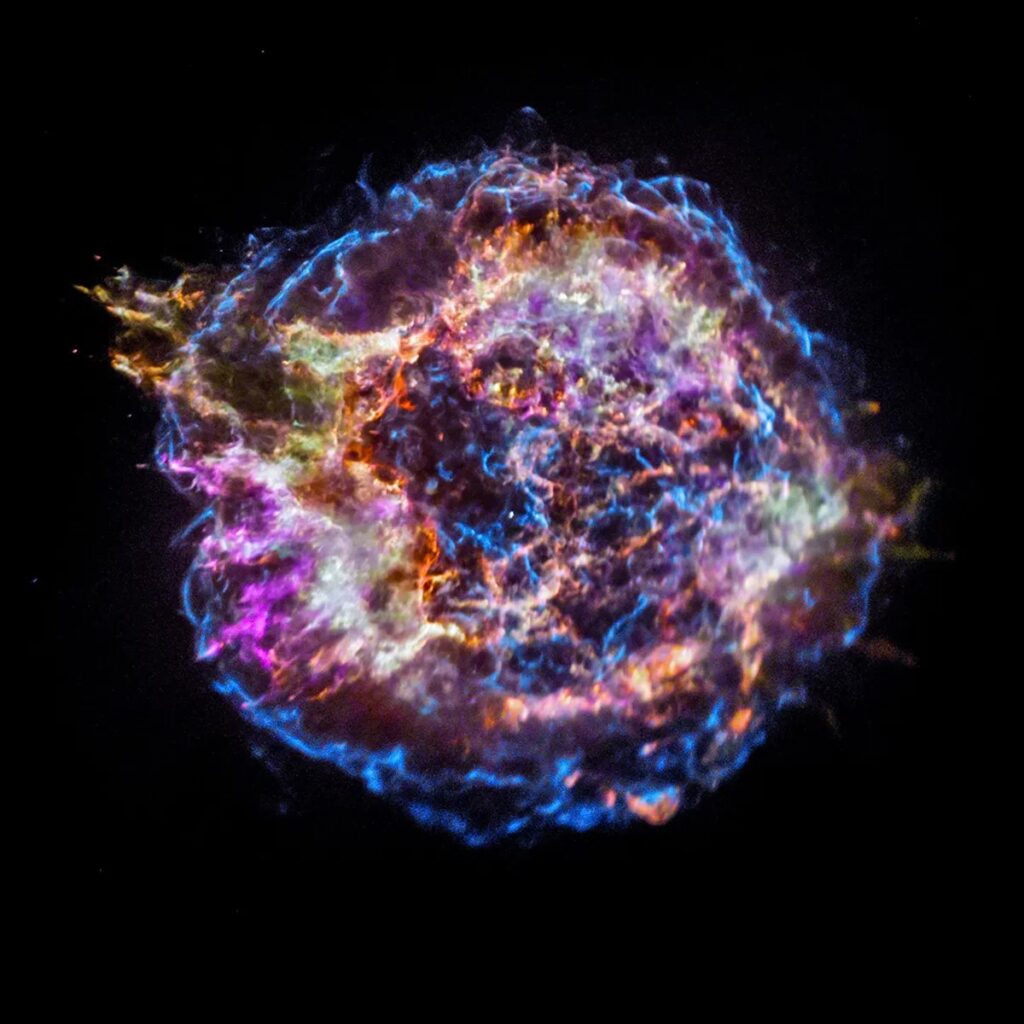 An x-ray image of Cassiopeia A, an example of a young supernova remnant. (Image courtesy of NASA)
Pushing boundaries
T. Gregory Guzik, professor of physics at LSU and the U.S. CALET collaboration lead, is excited that further analysis of the data suggested that electrons coming from the three best candidates for nearby supernova remnants can explain the high-energy arrivals.
“These CALET observations open the tantalizing possibility that matter from a particular nearby supernova remnant can be measured at Earth,” Guzik shares. “Continued CALET measurement through the life of the International Space Station will help shed new light on the origin and transport of relativistic matter in our galaxy.”
For Cannady, “The most exciting part is seeing things at the highest energies. We have some candidates above 10 TeV—and if it is borne out that these are real electron events, it’s really a smoking gun for clear evidence of a nearby source,” he says. “This is essentially what CALET was put up to do, so it’s exciting to be working on this and to finally be getting results that are pushing the bounds of what we’ve seen before.”
]]>
A new study using data from the CALorimetric Electron Telescope (CALET)instrument on the International Space Station has found evidence for nearby, young sources of cosmic ray electrons,...
https://umbc.edu/stories/calet-detects-high-energy-cosmic-ray-electrons/
https://my3.my.umbc.edu/api/v0/pixel/news/137074/guest@my.umbc.edu/d13963f002bb21b25ab24a7c0429d237/api/pixel
csst
news
research
science-and-tech
UMBC News & Magazine
https://my3.my.umbc.edu/groups/umbc-news-magazine
https://assets1-my.umbc.edu/system/shared/avatars/groups/000/001/943/24435aa6207c452e7bc15cc74b42c7bb/xsmall.png?1748556657
https://assets1-my.umbc.edu/system/shared/avatars/groups/000/001/943/24435aa6207c452e7bc15cc74b42c7bb/original.png?1748556657
https://assets2-my.umbc.edu/system/shared/avatars/groups/000/001/943/24435aa6207c452e7bc15cc74b42c7bb/xxlarge.png?1748556657
https://assets2-my.umbc.edu/system/shared/avatars/groups/000/001/943/24435aa6207c452e7bc15cc74b42c7bb/xlarge.png?1748556657
https://assets3-my.umbc.edu/system/shared/avatars/groups/000/001/943/24435aa6207c452e7bc15cc74b42c7bb/large.png?1748556657
https://assets1-my.umbc.edu/system/shared/avatars/groups/000/001/943/24435aa6207c452e7bc15cc74b42c7bb/medium.png?1748556657
https://assets2-my.umbc.edu/system/shared/avatars/groups/000/001/943/24435aa6207c452e7bc15cc74b42c7bb/small.png?1748556657
https://assets1-my.umbc.edu/system/shared/avatars/groups/000/001/943/24435aa6207c452e7bc15cc74b42c7bb/xsmall.png?1748556657
https://assets2-my.umbc.edu/system/shared/avatars/groups/000/001/943/24435aa6207c452e7bc15cc74b42c7bb/xxsmall.png?1748556657
UMBC News & Magazine
2
0
false
Tue, 14 Nov 2023 11:50:52 -0500
Tue, 14 Nov 2023 11:50:52 -0500
Study finds strongest evidence yet for local sources of cosmic ray electrons
A new study using data from the CALorimetric Electron Telescope (CALET)instrument on the International Space Station has found evidence for nearby, young sources of cosmic ray electrons, contributing to a greater understanding of how the galaxy functions as a whole.
The study included more than seven million data points representing particles arriving at CALET’s detector since 2015, and CALET’s ability to detect electrons at the highest energies is unique. As a result, the data includes more electrons at high energies than any previous work. That makes the statistical analysis of the data more robust and lends support to the conclusion that there are one or more local sources of cosmic ray electrons.
“This is one of the primary things that CALET is made to look for,” says Nicholas Cannady, an assistant research scientist with UMBC’s Center for Space Sciences and Technology, a partnership with NASA Goddard Space Flight Center, and a leader on the study. With this paper, he adds, “We were really able to push into the realm where we have few events and start to look for things at the highest energies, which is exciting.”
A better understanding of the galaxy
Nicholas Cannady, the lead U.S. scientist on the new study, is excited that the CALET mission is bearing fruitful results. (Image courtesy of Cannady)
Current theory posits that the aftermath of supernovae (exploding stars), called supernova remnants, produce these high energy electrons, which are a specific type of cosmic ray. Electrons lose energy very quickly after leaving their source, so the rare electrons arriving at CALET with high energy are believed to originate in supernova remnants that are relatively nearby (on a cosmic scale), Cannady explains.
The study’s results are “a strong indicator that the paradigm that we have for understanding these high-energy electrons—that they come from supernova remnants and that they are accelerated the way that we think they are—is correct,” Cannady says. The findings “give insight into what’s going on in these supernova remnants, and offer a way to understand the galaxy and these sources in the galaxy better.”
CALET is a collaborative project built and operated by groups in Japan, Italy, and the United States, led by Shoji Torii. The lead contributors to this work in Japan are Torii, Yosui Akaike, and Holger Motz at Waseda University in Tokyo, and Louisiana State University is the lead institution in the U.S. The findings were published in Physical Review Letters.
New data lead to new cosmic ray sources
Previous work found that the number of electrons arriving at CALET decreased steadily as energy increased up to about 1 teravolt (TeV), or 1 trillion electron volts. The number of electrons arriving with even greater energy was extremely low. But in this study, CALET did not see the expected dropoff. Instead, the results suggest that the number of particles plateau, and then even increase, at the highest energies—all the way up to 10 TeV in a few cases.
Previous experiments could only measure particles up to about 4 TeV, so the highest energy event candidates above that in this study are a crucial new source of information about potential nearby sources of cosmic ray electrons. Cannady led the effort to individually analyze each of those events to confirm they represent a real signal, and a deeper dive into those events is forthcoming.
Addressing challenges
It’s difficult to distinguish between electrons and protons at high energies, and there are many more protons arriving than electrons, which poses challenges to an accurate analysis. To tell the particles apart, a program developed by the researchers analyzes how the particles break down when they hit the detector. Protons and electrons break down differently, so comparing the cascade of particles they create in that process can filter out the protons. However, at the highest energies, the differences between protons and electrons decrease, making it harder to accurately remove only the protons from the data.
To address this, Cannady led the CALET team’s effort to simulate the breakdown patterns of both protons and electrons coming from the exact direction each of the high-energy events arrived from. That increased the team’s ability to determine whether the events are electrons or protons as accurately as possible.
Based on that work, “We believe we are evaluating the likelihood of events being protons in a realistic fashion,” Cannady says. Enough presumed electrons remain in the dataset after that careful analysis to conclude there is a real signal.
An x-ray image of Cassiopeia A, an example of a young supernova remnant. (Image courtesy of NASA)
Pushing boundaries
T. Gregory Guzik, professor of physics at LSU and the U.S. CALET collaboration lead, is excited that further analysis of the data suggested that electrons coming from the three best candidates for nearby supernova remnants can explain the high-energy arrivals.
“These CALET observations open the tantalizing possibility that matter from a particular nearby supernova remnant can be measured at Earth,” Guzik shares. “Continued CALET measurement through the life of the International Space Station will help shed new light on the origin and transport of relativistic matter in our galaxy.”
For Cannady, “The most exciting part is seeing things at the highest energies. We have some candidates above 10 TeV—and if it is borne out that these are real electron events, it’s really a smoking gun for clear evidence of a nearby source,” he says. “This is essentially what CALET was put up to do, so it’s exciting to be working on this and to finally be getting results that are pushing the bounds of what we’ve seen before.”
]]>
A new study using data from the CALorimetric Electron Telescope (CALET)instrument on the International Space Station has found evidence for nearby, young sources of cosmic ray electrons,...
https://umbc.edu/stories/calet-detects-high-energy-cosmic-ray-electrons/
https://my3.my.umbc.edu/api/v0/pixel/news/137202/guest@my.umbc.edu/bae1852ae8f6168160dedadc8bbe6128/api/pixel
csst
news
research
science-and-tech
UMBC News
https://my3.my.umbc.edu/groups/umbc-news
https://assets2-my.umbc.edu/system/shared/avatars/groups/000/001/944/2c79aeea85b1abb37f8cf9fbcdc382b0/xsmall.png?1632921809
https://assets4-my.umbc.edu/system/shared/avatars/groups/000/001/944/2c79aeea85b1abb37f8cf9fbcdc382b0/original.png?1632921809
https://assets4-my.umbc.edu/system/shared/avatars/groups/000/001/944/2c79aeea85b1abb37f8cf9fbcdc382b0/xxlarge.png?1632921809
https://assets1-my.umbc.edu/system/shared/avatars/groups/000/001/944/2c79aeea85b1abb37f8cf9fbcdc382b0/xlarge.png?1632921809
https://assets1-my.umbc.edu/system/shared/avatars/groups/000/001/944/2c79aeea85b1abb37f8cf9fbcdc382b0/large.png?1632921809
https://assets1-my.umbc.edu/system/shared/avatars/groups/000/001/944/2c79aeea85b1abb37f8cf9fbcdc382b0/medium.png?1632921809
https://assets4-my.umbc.edu/system/shared/avatars/groups/000/001/944/2c79aeea85b1abb37f8cf9fbcdc382b0/small.png?1632921809
https://assets2-my.umbc.edu/system/shared/avatars/groups/000/001/944/2c79aeea85b1abb37f8cf9fbcdc382b0/xsmall.png?1632921809
https://assets4-my.umbc.edu/system/shared/avatars/groups/000/001/944/2c79aeea85b1abb37f8cf9fbcdc382b0/xxsmall.png?1632921809
UMBC News
0
0
false
Tue, 14 Nov 2023 11:50:52 -0500
Study finds strongest evidence yet for local sources of cosmic ray electrons
A new study using data from the CALorimetric Electron Telescope (CALET)instrument on the International Space Station has found evidence for nearby, young sources of cosmic ray electrons, contributing to a greater understanding of how the galaxy functions as a whole.
The study included more than seven million data points representing particles arriving at CALET’s detector since 2015, and CALET’s ability to detect electrons at the highest energies is unique. As a result, the data includes more electrons at high energies than any previous work. That makes the statistical analysis of the data more robust and lends support to the conclusion that there are one or more local sources of cosmic ray electrons.
“This is one of the primary things that CALET is made to look for,” says Nicholas Cannady, an assistant research scientist with UMBC’s Center for Space Sciences and Technology, a partnership with NASA Goddard Space Flight Center, and a leader on the study. With this paper, he adds, “We were really able to push into the realm where we have few events and start to look for things at the highest energies, which is exciting.”
A better understanding of the galaxy
Nicholas Cannady, the lead U.S. scientist on the new study, is excited that the CALET mission is bearing fruitful results. (Image courtesy of Cannady)
Current theory posits that the aftermath of supernovae (exploding stars), called supernova remnants, produce these high energy electrons, which are a specific type of cosmic ray. Electrons lose energy very quickly after leaving their source, so the rare electrons arriving at CALET with high energy are believed to originate in supernova remnants that are relatively nearby (on a cosmic scale), Cannady explains.
The study’s results are “a strong indicator that the paradigm that we have for understanding these high-energy electrons—that they come from supernova remnants and that they are accelerated the way that we think they are—is correct,” Cannady says. The findings “give insight into what’s going on in these supernova remnants, and offer a way to understand the galaxy and these sources in the galaxy better.”
CALET is a collaborative project built and operated by groups in Japan, Italy, and the United States, led by Shoji Torii. The lead contributors to this work in Japan are Torii, Yosui Akaike, and Holger Motz at Waseda University in Tokyo, and Louisiana State University is the lead institution in the U.S. The findings were published in Physical Review Letters.
New data lead to new cosmic ray sources
Previous work found that the number of electrons arriving at CALET decreased steadily as energy increased up to about 1 teravolt (TeV), or 1 trillion electron volts. The number of electrons arriving with even greater energy was extremely low. But in this study, CALET did not see the expected dropoff. Instead, the results suggest that the number of particles plateau, and then even increase, at the highest energies—all the way up to 10 TeV in a few cases.
Previous experiments could only measure particles up to about 4 TeV, so the highest energy event candidates above that in this study are a crucial new source of information about potential nearby sources of cosmic ray electrons. Cannady led the effort to individually analyze each of those events to confirm they represent a real signal, and a deeper dive into those events is forthcoming.
Addressing challenges
It’s difficult to distinguish between electrons and protons at high energies, and there are many more protons arriving than electrons, which poses challenges to an accurate analysis. To tell the particles apart, a program developed by the researchers analyzes how the particles break down when they hit the detector. Protons and electrons break down differently, so comparing the cascade of particles they create in that process can filter out the protons. However, at the highest energies, the differences between protons and electrons decrease, making it harder to accurately remove only the protons from the data.
To address this, Cannady led the CALET team’s effort to simulate the breakdown patterns of both protons and electrons coming from the exact direction each of the high-energy events arrived from. That increased the team’s ability to determine whether the events are electrons or protons as accurately as possible.
Based on that work, “We believe we are evaluating the likelihood of events being protons in a realistic fashion,” Cannady says. Enough presumed electrons remain in the dataset after that careful analysis to conclude there is a real signal.
An x-ray image of Cassiopeia A, an example of a young supernova remnant. (Image courtesy of NASA)
Pushing boundaries
T. Gregory Guzik, professor of physics at LSU and the U.S. CALET collaboration lead, is excited that further analysis of the data suggested that electrons coming from the three best candidates for nearby supernova remnants can explain the high-energy arrivals.
“These CALET observations open the tantalizing possibility that matter from a particular nearby supernova remnant can be measured at Earth,” Guzik shares. “Continued CALET measurement through the life of the International Space Station will help shed new light on the origin and transport of relativistic matter in our galaxy.”
For Cannady, “The most exciting part is seeing things at the highest energies. We have some candidates above 10 TeV—and if it is borne out that these are real electron events, it’s really a smoking gun for clear evidence of a nearby source,” he says. “This is essentially what CALET was put up to do, so it’s exciting to be working on this and to finally be getting results that are pushing the bounds of what we’ve seen before.”
]]>
A new study using data from the CALorimetric Electron Telescope (CALET)instrument on the International Space Station has found evidence for nearby, young sources of cosmic ray electrons,...
https://umbc.edu/stories/calet-detects-high-energy-cosmic-ray-electrons/
https://my3.my.umbc.edu/api/v0/pixel/news/137214/guest@my.umbc.edu/162cb24582cdddbaf33ad878957078f2/api/pixel
csst
news
research
science-and-tech
UMBC Magazine
https://my3.my.umbc.edu/groups/retired-1945
https://assets2-my.umbc.edu/images/avatars/group/8/xsmall.png?1793799644
https://assets4-my.umbc.edu/images/avatars/group/8/original.png?1793799644
https://assets3-my.umbc.edu/images/avatars/group/8/xxlarge.png?1793799644
https://assets4-my.umbc.edu/images/avatars/group/8/xlarge.png?1793799644
https://assets1-my.umbc.edu/images/avatars/group/8/large.png?1793799644
https://assets2-my.umbc.edu/images/avatars/group/8/medium.png?1793799644
https://assets1-my.umbc.edu/images/avatars/group/8/small.png?1793799644
https://assets2-my.umbc.edu/images/avatars/group/8/xsmall.png?1793799644
https://assets4-my.umbc.edu/images/avatars/group/8/xxsmall.png?1793799644
UMBC Magazine
0
0
false
Tue, 14 Nov 2023 11:50:52 -0500
THURSDAY 11/16 Poli CoM Movie Night 7pm PUP 204
See the flyer to vote on which movie you want to watch!
 ]]>
Image
https://assets3-my.umbc.edu/system/shared/attachments/b25a4bb0b17b1b1edf0af07324fa8828/6aef170b/news/000/137/072/30380a8007526340ff8ca09a4c764147/Watch Party Flyer .jpg?1699980440
https://my3.my.umbc.edu/api/v0/pixel/news/137072/guest@my.umbc.edu/bb5eef11ba8a09471affd80205988f60/api/pixel
Political Science
https://my3.my.umbc.edu/groups/poli
https://assets1-my.umbc.edu/system/shared/avatars/groups/000/000/617/47f5d6b9ad18d16095cd0d4fc758b168/xsmall.png?1368723437
https://assets4-my.umbc.edu/system/shared/avatars/groups/000/000/617/47f5d6b9ad18d16095cd0d4fc758b168/original.png?1368723437
https://assets4-my.umbc.edu/system/shared/avatars/groups/000/000/617/47f5d6b9ad18d16095cd0d4fc758b168/xxlarge.png?1368723437
https://assets1-my.umbc.edu/system/shared/avatars/groups/000/000/617/47f5d6b9ad18d16095cd0d4fc758b168/xlarge.png?1368723437
https://assets3-my.umbc.edu/system/shared/avatars/groups/000/000/617/47f5d6b9ad18d16095cd0d4fc758b168/large.png?1368723437
https://assets3-my.umbc.edu/system/shared/avatars/groups/000/000/617/47f5d6b9ad18d16095cd0d4fc758b168/medium.png?1368723437
https://assets2-my.umbc.edu/system/shared/avatars/groups/000/000/617/47f5d6b9ad18d16095cd0d4fc758b168/small.png?1368723437
https://assets1-my.umbc.edu/system/shared/avatars/groups/000/000/617/47f5d6b9ad18d16095cd0d4fc758b168/xsmall.png?1368723437
https://assets1-my.umbc.edu/system/shared/avatars/groups/000/000/617/47f5d6b9ad18d16095cd0d4fc758b168/xxsmall.png?1368723437
Political Science
0
0
true
Tue, 14 Nov 2023 11:48:35 -0500