Perfect your website with 3 simple UX research methods
 User testing doesn’t have to be difficult at all. I’m going to talk about three lean research methods that are neither extensive nor expensive to carry out but will in turn provide you with valuable feedback.
The methods can be used for anything, test a landing page or test a whole mobile app. The important thing is to gather feedback: design for yourself, and only your point of view counts; design for others, and you need to hear their thoughts.
Which method, or methods, you choose will have significant consequences for your design, and different methods are more suitable for different objectives.
Experience sampling
This technique is used to ask participants a single question throughout their day to note their experiences. Keep it very simple like “What events do you input into your calendar app?” The idea is to get a number of people answering at different times of the day to yield various responses. You then collect the answers into a spreadsheet and analyze.
Results
The results provide insight about what the user needs, identify pain points and delight, currently in your product. It can bring inspiration about new features—things currently missing in your current version.
Preparations
You’ll need to figure out a bunch of things in order to run the test. First, what question are you trying to find the answer to? How many times in the day will you ask it? How you’ll you be asking—email, text message, phone call, online survey? You need to decide how to collect this data. You’ll also need to figure out who will be in charge of collecting this data and analyzing it.
You will also need to figure out who the participants are, how many of them will be in your study? Make sure that they can receive your question—not everyone has access to iMessage, so you can’t send it over from your computer. When it comes to the participants, you’ll need to make sure they are prepped themselves. Go over the test expectations, ie. the question will be asked 4 times through out the day. It’s also a good idea to run a practice test to make sure the participants can follow along throughout the test. This will wrinkle out any concerns or questions about it.
Running the test
It’s great to let the participants know they are doing well. You should be monitoring the answers as they come in and let the participants know if they have not answered the question correctly, they may have misread or misunderstood it. And of course, on conclusion thank them for their time.
Card sorting
This research method is meant to uncover the best way to structure information within your design. In the test, participants will group items into a sequence that is logical to them. If you are not sure about the navigation of your site, or the categories for your app, this test is perfect for you.
Results
What you can expect from this test is to figure out the way your target audience perceives your content. You’ll have a new way to think about terminology, the relationships between the items, and any missing features; all thanks to a dendrogram structure resulting from the test.
Preparations
This test can run in so many different ways! You’ll need to decide what content you want the participants to test, it can be current content or future content you’d like to create. You should not have more then 100 items to sort through; it can be quiet complex to sort things so the golden rule is less than 100.
There are various ways in which the participants can partake in a card sorting test; you can organize it in person with index cards or create the test online and send out a link. If you do this online, analyzing results can be much easier. Some well know online tools include SimpleCardSort, Optimal Workshop, and UX Punk.
There is more to consider: do you want the participants to preform the test individually or as a group of 3-4 people? Is the card sort going to be open or close sort? (Open sort means that you allow the participants to create and name the groups themselves, as many as they see if. A close sort means that you provide the categories and they’ll have to fit the items into them.)
Running the test
This only works if you are conducting the test in person, but you need to take notes. Write down when the users are confused about an item; if they are unsure help clarify, but don’t lead them with your own suggestions just explain what the item is—make a note that they were confused. If they seem to have trouble placing an item into a group where you see it jumping from one category to another, make a note of it.
Usability testing
This is a research method that gives you insight about how users use your product by observing their behavior. This testing is usually done one-on-one where you observe the users’ actions and listen to them comment as they go through the test.
Results
Usability testing points out the flaws and delights in your products. You’ll be able to take away things that currently work well, areas to improve upon, data about satisfaction, currently missing features and user input. It’s much more convincing to bring a quote from a user about a frustration point to your boss than just to say that the frustration point exists. Users are such a powerful motivator!
Preparations
A usability test is a walk-through your site. It usually tests a small portion, like the sign up process or maybe using the core feature of your site for the first time; if you were designing Facebook, it could be the process of signing up and adding a few friends in a couple of different ways.
You’ll need to figure out a bunch more for this test then the previous two. First, what are you testing? What are the steps you want the participants to take? For example, ‘You want to add a friend by email.’ You should also have a bunch of warm up questions just to get the participant familiar.
Additionally, you will be to figure out who will be taking the participant through the test and who will be taking notes. It’s impossible for one person to do both, as notes will be missed. It’s also recommended to record the session on top of that. Allow enough time for one participant to go through the test without rushing them before the next appointment is up; ideal test time is 30 min, so allow for a 45 min session.
Running the test
You should also provide a quick brief to the participant telling them why are they here and what they will be doing, you need to make them as comfortable as you can because being observed is not easy for most people. While the participants are going through the scenarios, insist they think out loud, that’s the only way you’ll be able to get access to their reaction, impression and thoughts; observing is not actually enough. Lastly, don’t help them out! Do not lead them; allow them to figure it out. It’s okay if they fail, or keep on failing. The point of the test is for you to find out where the participants trip up and not to get them from point A to B by holding their hand.
Source


 ]]>
User testing doesn’t have to be difficult at all. I’m going to talk about three lean research methods that are neither extensive nor expensive to carry out but will in turn provide you with...
http://rss.feedsportal.com/c/35285/f/661066/s/39803780/sc/4/l/0L0Swebdesignerdepot0N0C20A140C0A40Cperfect0Eyour0Ewebsite0Ewith0E30Esimple0Eux0Eresearch0Emethods0C/story01.htm
https://my3.my.umbc.edu/api/v0/pixel/news/43728/guest@my.umbc.edu/6c61774ab3aadafeef706f63a6cc2291/api/pixel
art
css
design
development
html
html5
illustrator
improving-websites
javascript
mysql
oracle
photoshop
php
sql
usability-testing
user-testing
ux-design
ux-testing
website-research
Web Developer - Build Group
https://my3.my.umbc.edu/groups/retired-583
https://assets3-my.umbc.edu/system/shared/avatars/groups/000/000/583/fc60f5d7abc2e080599bb6dc465db54d/xsmall.png?1363101197
https://assets4-my.umbc.edu/system/shared/avatars/groups/000/000/583/fc60f5d7abc2e080599bb6dc465db54d/original.jpg?1363101197
https://assets4-my.umbc.edu/system/shared/avatars/groups/000/000/583/fc60f5d7abc2e080599bb6dc465db54d/xxlarge.png?1363101197
https://assets4-my.umbc.edu/system/shared/avatars/groups/000/000/583/fc60f5d7abc2e080599bb6dc465db54d/xlarge.png?1363101197
https://assets3-my.umbc.edu/system/shared/avatars/groups/000/000/583/fc60f5d7abc2e080599bb6dc465db54d/large.png?1363101197
https://assets3-my.umbc.edu/system/shared/avatars/groups/000/000/583/fc60f5d7abc2e080599bb6dc465db54d/medium.png?1363101197
https://assets4-my.umbc.edu/system/shared/avatars/groups/000/000/583/fc60f5d7abc2e080599bb6dc465db54d/small.png?1363101197
https://assets3-my.umbc.edu/system/shared/avatars/groups/000/000/583/fc60f5d7abc2e080599bb6dc465db54d/xsmall.png?1363101197
https://assets4-my.umbc.edu/system/shared/avatars/groups/000/000/583/fc60f5d7abc2e080599bb6dc465db54d/xxsmall.png?1363101197
Web Developer - Build Group
0
0
true
Fri, 18 Apr 2014 04:15:56 -0400
Fri, 18 Apr 2014 04:15:56 -0400
UMBC: Big Brainiacs
]]>
User testing doesn’t have to be difficult at all. I’m going to talk about three lean research methods that are neither extensive nor expensive to carry out but will in turn provide you with...
http://rss.feedsportal.com/c/35285/f/661066/s/39803780/sc/4/l/0L0Swebdesignerdepot0N0C20A140C0A40Cperfect0Eyour0Ewebsite0Ewith0E30Esimple0Eux0Eresearch0Emethods0C/story01.htm
https://my3.my.umbc.edu/api/v0/pixel/news/43728/guest@my.umbc.edu/6c61774ab3aadafeef706f63a6cc2291/api/pixel
art
css
design
development
html
html5
illustrator
improving-websites
javascript
mysql
oracle
photoshop
php
sql
usability-testing
user-testing
ux-design
ux-testing
website-research
Web Developer - Build Group
https://my3.my.umbc.edu/groups/retired-583
https://assets3-my.umbc.edu/system/shared/avatars/groups/000/000/583/fc60f5d7abc2e080599bb6dc465db54d/xsmall.png?1363101197
https://assets4-my.umbc.edu/system/shared/avatars/groups/000/000/583/fc60f5d7abc2e080599bb6dc465db54d/original.jpg?1363101197
https://assets4-my.umbc.edu/system/shared/avatars/groups/000/000/583/fc60f5d7abc2e080599bb6dc465db54d/xxlarge.png?1363101197
https://assets4-my.umbc.edu/system/shared/avatars/groups/000/000/583/fc60f5d7abc2e080599bb6dc465db54d/xlarge.png?1363101197
https://assets3-my.umbc.edu/system/shared/avatars/groups/000/000/583/fc60f5d7abc2e080599bb6dc465db54d/large.png?1363101197
https://assets3-my.umbc.edu/system/shared/avatars/groups/000/000/583/fc60f5d7abc2e080599bb6dc465db54d/medium.png?1363101197
https://assets4-my.umbc.edu/system/shared/avatars/groups/000/000/583/fc60f5d7abc2e080599bb6dc465db54d/small.png?1363101197
https://assets3-my.umbc.edu/system/shared/avatars/groups/000/000/583/fc60f5d7abc2e080599bb6dc465db54d/xsmall.png?1363101197
https://assets4-my.umbc.edu/system/shared/avatars/groups/000/000/583/fc60f5d7abc2e080599bb6dc465db54d/xxsmall.png?1363101197
Web Developer - Build Group
0
0
true
Fri, 18 Apr 2014 04:15:56 -0400
Fri, 18 Apr 2014 04:15:56 -0400
UMBC: Big Brainiacs

Big Brainiacs
Engineer Corey Fleischer returns to URCAD to reach the next generation of innovators.
In 2005, an undergraduate researcher named Corey Fleischer �05, and �08, M.S., mechanical engineering, presented �Microarchitectured Egg-Box Cores for Sandwich Panels� at UMBC�s Undergraduate Research and Creative Achievement Day (URCAD). If that name sounds familiar, you might recognize Fleischer as the winner of Discovery Channel�s engineering-based reality competition �The Big Brain Theory: Pure Genius.� After graduating, Fleischer went on to become a senior mechanical engineer at Lockheed Martin, earn five patents, and establish the Baltimore Foundery, a not-for-profit space that provides Baltimore innovators with access to industrial grade tools and training to use them.
Now Fleischer is returning to URCAD to inspire the next generation of innovators. As the event�s featured guest speaker, Fleischer will offer a window into his passion for problem-solving and quest for new knowledge. He recently said in an interview with UMBC, �As long as I continue to learn, I�ll be happy.�
Undergraduates who share Fleischer�s excitement for learning, problem-solving and innovative thinking will present their research and creative work at the 18th annual URCAD, to be held on Wednesday, April 23, from 9:30 a.m. to 4:00 p.m.
Diane M. Lee, Vice Provost and Dean of Undergraduate Education, began URCAD with the vision that undergraduates should have an opportunity to engage in the full research experience, including presenting their results.
Janet McGlynn, Director of Communications and Outreach for the Office of Undergraduate Education, explains, �URCAD is the largest of our annual undergraduate research symposia and includes the broadest range of student work. From original choreography to biochemistry and policy analysis to quantum computing, innovative student work is on display. Graduates tell us that their URCAD experience provided valuable preparation for the level of conference participation expected of them in graduate school.�
McGlynn encourages all students, including those who are not yet involved in research, to attend URCAD. �Students who attend URCAD find out what others are doing and gain ideas for their own innovative projects. It can be inspiring to see what others have accomplished right here on this campus,� she says.
This year, the full-day event includes over 50 oral presentations and over 150 poster presentations, plus film screenings and artistic performances. These examples offer a glimpse of the exceptional work that UMBC students will present at URCAD:
� Ke �Coco� Tang �14, political science, filmed interviews with members of Jordanian civil society to explore their reaction to the Syrian refugee population.
� Fadaka Adebayo �15, health administration and policy, designed a linguistically and culturally appropriate social marketing toolkit to help older Hispanic and African American adults with type-2 diabetes improve their self-management practices.
� Caleb Williams �15, dance, and Hannah Korangkool �15, design, created “I�m Here,” an artistic performance that explores male gender expression and deconstructs definitions of gender and sexuality.
� Cathy Hornback �14, computer science, and Abdullah Ali �14, information systems, built an adaptive interface to provide easier access to computers for users who experience difficulty with pointing.
� Amy Rizkallah �14 and James Han �14, biological sciences, conducted protein chemical modifications on the amino acid residues of cromatine, a protein found in the venom of the South American rattlesnake, to determine where DNA-crotamine complexes are formed. Their research has potential implications for improving drug design.
A full list of presenters and abstracts can be found on the URCAD website.
(04/18/2014)
]]>
Big Brainiacs Engineer Corey Fleischer returns to URCAD to reach the next generation of innovators. In 2005, an undergraduate researcher named Corey Fleischer �05, and �08, M.S., mechanical...
https://umbc.edu/stories/umbc-big-brainiacs/
https://my3.my.umbc.edu/api/v0/pixel/news/122667/guest@my.umbc.edu/8faf9d9caeda05589693df7ce38afe78/api/pixel
window-stories
UMBC News & Magazine
https://my3.my.umbc.edu/groups/umbc-news-magazine
https://assets1-my.umbc.edu/system/shared/avatars/groups/000/001/943/24435aa6207c452e7bc15cc74b42c7bb/xsmall.png?1748556657
https://assets1-my.umbc.edu/system/shared/avatars/groups/000/001/943/24435aa6207c452e7bc15cc74b42c7bb/original.png?1748556657
https://assets2-my.umbc.edu/system/shared/avatars/groups/000/001/943/24435aa6207c452e7bc15cc74b42c7bb/xxlarge.png?1748556657
https://assets2-my.umbc.edu/system/shared/avatars/groups/000/001/943/24435aa6207c452e7bc15cc74b42c7bb/xlarge.png?1748556657
https://assets3-my.umbc.edu/system/shared/avatars/groups/000/001/943/24435aa6207c452e7bc15cc74b42c7bb/large.png?1748556657
https://assets1-my.umbc.edu/system/shared/avatars/groups/000/001/943/24435aa6207c452e7bc15cc74b42c7bb/medium.png?1748556657
https://assets2-my.umbc.edu/system/shared/avatars/groups/000/001/943/24435aa6207c452e7bc15cc74b42c7bb/small.png?1748556657
https://assets1-my.umbc.edu/system/shared/avatars/groups/000/001/943/24435aa6207c452e7bc15cc74b42c7bb/xsmall.png?1748556657
https://assets2-my.umbc.edu/system/shared/avatars/groups/000/001/943/24435aa6207c452e7bc15cc74b42c7bb/xxsmall.png?1748556657
UMBC News & Magazine
0
0
false
Fri, 18 Apr 2014 04:00:00 -0400
defense: Learning Hierarchical Workflows Using Community Detection, 4/18
MS Thesis Defense
Learning Hierarchical Workflows Using Community Detection
Akshay Peshave
1:00pm Friday, 18 April 2014, ITE 325b
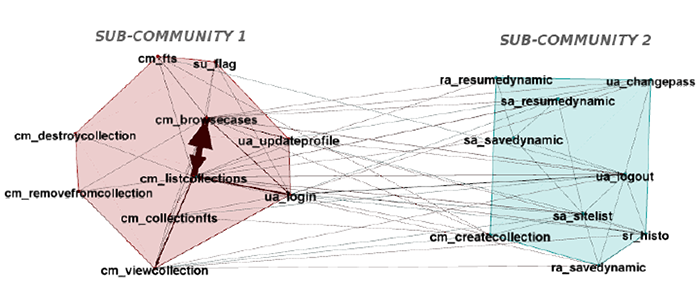
Workflows identified from user event logs and click-stream data are useful as knowledge bases for behavioral analysis and recommendation systems. In this study we identify abstractions or summaries of event logs modeled as user activity flow networks. The abstractions are identified based on structural properties as well as user activity flow dynamics over the network using community detection methods. We apply a fast modularity optimization and multi-level resolution approach to detect hierarchical community structure in user activity flow networks. The detected communities are compared to those detected by the information-theoretic map equation minimization approach to weigh pros and cons of the fast modularity optimization approach in the workflows context. We further attempt to identify the most probable sources and sinks of user activity in individual communities and trim the network accordingly to reduce entropy of the workflow abstractions.
Committee: Drs. Tim Oates (chair), Matt Schmill and Tim Finin
]]>
MS Thesis Defense Learning Hierarchical Workflows Using Community Detection Akshay Peshave 1:00pm Friday, 18 April 2014, ITE 325b Workflows identified from user event logs and click-stream...
http://www.csee.umbc.edu/2014/04/defense-learning-hierarchical-workflows-using-community-detection-418/?utm_source=rss&utm_medium=rss&utm_campaign=defense-learning-hierarchical-workflows-using-community-detection-418
https://my3.my.umbc.edu/api/v0/pixel/news/43727/guest@my.umbc.edu/c99f8a59d37a8c6ab66a0c89d9fdbc6c/api/pixel
defense
graduate
news
research
talks
Computer Science and Electrical Engineering
https://my3.my.umbc.edu/groups/csee
https://assets3-my.umbc.edu/system/shared/avatars/groups/000/000/099/d117dca133c64bf78a4b7696dd007189/xsmall.png?1314043393
https://assets1-my.umbc.edu/system/shared/avatars/groups/000/000/099/d117dca133c64bf78a4b7696dd007189/original.png?1314043393
https://assets1-my.umbc.edu/system/shared/avatars/groups/000/000/099/d117dca133c64bf78a4b7696dd007189/xxlarge.png?1314043393
https://assets4-my.umbc.edu/system/shared/avatars/groups/000/000/099/d117dca133c64bf78a4b7696dd007189/xlarge.png?1314043393
https://assets3-my.umbc.edu/system/shared/avatars/groups/000/000/099/d117dca133c64bf78a4b7696dd007189/large.png?1314043393
https://assets1-my.umbc.edu/system/shared/avatars/groups/000/000/099/d117dca133c64bf78a4b7696dd007189/medium.png?1314043393
https://assets2-my.umbc.edu/system/shared/avatars/groups/000/000/099/d117dca133c64bf78a4b7696dd007189/small.png?1314043393
https://assets3-my.umbc.edu/system/shared/avatars/groups/000/000/099/d117dca133c64bf78a4b7696dd007189/xsmall.png?1314043393
https://assets3-my.umbc.edu/system/shared/avatars/groups/000/000/099/d117dca133c64bf78a4b7696dd007189/xxsmall.png?1314043393
Computer Science and Electrical Engineering
0
0
true
Fri, 18 Apr 2014 00:16:53 -0400
defense: Learning Hierarchical Workflows Using Community Detection, 4/18
MS Thesis Defense
Learning Hierarchical Workflows Using Community Detection
Akshay Peshave
1:00pm Friday, 18 April 2014, ITE 325b
Workflows identified from user event logs and click-stream data are useful as knowledge bases for behavioral analysis and recommendation systems. In this study we identify abstractions or summaries of event logs modeled as user activity flow networks. The abstractions are identified based on structural properties as well as user activity flow dynamics over the network using community detection methods. We apply a fast modularity optimization and multi-level resolution approach to detect hierarchical community structure in user activity flow networks. The detected communities are compared to those detected by the information-theoretic map equation minimization approach to weigh pros and cons of the fast modularity optimization approach in the workflows context. We further attempt to identify the most probable sources and sinks of user activity in individual communities and trim the network accordingly to reduce entropy of the workflow abstractions.
Committee: Drs. Tim Oates (chair), Matt Schmill and Tim Finin
]]>
MS Thesis Defense Learning Hierarchical Workflows Using Community Detection Akshay Peshave 1:00pm Friday, 18 April 2014, ITE 325b Workflows identified from user event logs and click-stream...
http://www.csee.umbc.edu/2014/04/defense-learning-hierarchical-workflows-using-community-detection-418/
https://my3.my.umbc.edu/api/v0/pixel/news/43869/guest@my.umbc.edu/f0772c96b78e4cd73b4252ece960614b/api/pixel
defense
graduate
news
research
talks
Computer Science and Electrical Engineering
https://my3.my.umbc.edu/groups/csee
https://assets3-my.umbc.edu/system/shared/avatars/groups/000/000/099/d117dca133c64bf78a4b7696dd007189/xsmall.png?1314043393
https://assets1-my.umbc.edu/system/shared/avatars/groups/000/000/099/d117dca133c64bf78a4b7696dd007189/original.png?1314043393
https://assets1-my.umbc.edu/system/shared/avatars/groups/000/000/099/d117dca133c64bf78a4b7696dd007189/xxlarge.png?1314043393
https://assets4-my.umbc.edu/system/shared/avatars/groups/000/000/099/d117dca133c64bf78a4b7696dd007189/xlarge.png?1314043393
https://assets3-my.umbc.edu/system/shared/avatars/groups/000/000/099/d117dca133c64bf78a4b7696dd007189/large.png?1314043393
https://assets1-my.umbc.edu/system/shared/avatars/groups/000/000/099/d117dca133c64bf78a4b7696dd007189/medium.png?1314043393
https://assets2-my.umbc.edu/system/shared/avatars/groups/000/000/099/d117dca133c64bf78a4b7696dd007189/small.png?1314043393
https://assets3-my.umbc.edu/system/shared/avatars/groups/000/000/099/d117dca133c64bf78a4b7696dd007189/xsmall.png?1314043393
https://assets3-my.umbc.edu/system/shared/avatars/groups/000/000/099/d117dca133c64bf78a4b7696dd007189/xxsmall.png?1314043393
Computer Science and Electrical Engineering
0
0
true
Fri, 18 Apr 2014 00:16:53 -0400
Translational Bioinformatics Approaches to Evaluate and Implement Genomic Medicine Programs

Figure 27: Casey is an assistant professor at UMD
Dr. Casey Overby, Assistant Professor Program for Personalized and Genomic
Medicine University of Maryland - Baltimore
1:00pm Friday, 25 April 2014, ITE 325b, UMBC
Abstract: There is a growing evidence base to support the use of many genomic
applications in healthcare. There are, however, several barriers to healthcare
providers making use of genomic data and information on a routine basis. This
talk will describe some of the challenges and successes with implementing
genomic medicine programs within the Program for Personalized and Genomic
Medicine at UMB, introduce one way to conceptualize translational research and
translational bioinformatics in this context, describe a proposed model for
evaluating and implementing genomic medicine programs, and describe some of the
current and planned research in translational bioinformatics
Bio: Casey L. Overby is an Assistant Professor of Medicine in the Program for
Personalized and Genomic Medicine and the Center for Health-related Informatics
and Bio-Imaging at the University of Maryland School of Medicine. She received
her Masters of Biotechnology from the University of Pennsylvania in 2006, her
PhD in Biomedical and Health Informatics and a Graduate Certificate in Public
Health Genetics from the University of Washington in 2011. In 2013, she
completed her post-doctoral training in the Department of Biomedical Informatics
at Columbia University and started her position at University of Maryland,
Baltimore.
]]>
Figure 27: Casey is an assistant professor at UMD Dr. Casey Overby, Assistant Professor Program for Personalized and Genomic Medicine University of Maryland - Baltimore...
https://drkoru.us/posts.html#translational-bioinformatics-approaches-to-evaluate-and-implement-genomic-medicine-programs
https://my3.my.umbc.edu/api/v0/pixel/news/54196/guest@my.umbc.edu/9bd989ec82a80f50a061329c45cc5a04/api/pixel
Health IT Community @ UMBC
https://my3.my.umbc.edu/groups/hit
https://assets2-my.umbc.edu/system/shared/avatars/groups/000/000/362/b95466b8b139e9e1fa1400d527798b7c/xsmall.png?1419188005
https://assets4-my.umbc.edu/system/shared/avatars/groups/000/000/362/b95466b8b139e9e1fa1400d527798b7c/original.jpg?1419188005
https://assets2-my.umbc.edu/system/shared/avatars/groups/000/000/362/b95466b8b139e9e1fa1400d527798b7c/xxlarge.png?1419188005
https://assets1-my.umbc.edu/system/shared/avatars/groups/000/000/362/b95466b8b139e9e1fa1400d527798b7c/xlarge.png?1419188005
https://assets1-my.umbc.edu/system/shared/avatars/groups/000/000/362/b95466b8b139e9e1fa1400d527798b7c/large.png?1419188005
https://assets2-my.umbc.edu/system/shared/avatars/groups/000/000/362/b95466b8b139e9e1fa1400d527798b7c/medium.png?1419188005
https://assets2-my.umbc.edu/system/shared/avatars/groups/000/000/362/b95466b8b139e9e1fa1400d527798b7c/small.png?1419188005
https://assets2-my.umbc.edu/system/shared/avatars/groups/000/000/362/b95466b8b139e9e1fa1400d527798b7c/xsmall.png?1419188005
https://assets1-my.umbc.edu/system/shared/avatars/groups/000/000/362/b95466b8b139e9e1fa1400d527798b7c/xxsmall.png?1419188005
Health IT Community @ UMBC
0
0
false
Fri, 18 Apr 2014 00:00:00 -0400
Fri, 18 Apr 2014 00:00:00 -0400
talk: Translational Bioinformatics Approaches to Evaluate and Implement Genomic Medicine Programs, 1pm 4/25
Translational Bioinformatics Approaches to Evaluate
and Implement Genomic Medicine Programs
Dr. Casey Overby, Assistant Professor
Program for Personalized and Genomic Medicine
University of Maryland – Baltimore
1:00pm Friday, 25 April 2014, ITE 325b, UMBC
There is a growing evidence base to support the use of many genomic applications in healthcare. There are, however, several barriers to healthcare providers making use of genomic data and information on a routine basis. In this talk, I will describe some of our challenges and successes with implementing genomic medicine programs within the Program for Personalized and Genomic Medicine at UMB, introduce one way to conceptualize translational research and translational bioinformatics in this context, describe a proposed model for evaluating and implementing genomic medicine programs, and describe some of my current and planned research in translational bioinformatics.
Casey L. Overby is an Assistant Professor of Medicine in the Program for Personalized and Genomic Medicine and the Center for Health-related Informatics and Bio-Imaging at the University of Maryland School of Medicine. She received her Masters of Biotechnology from the University of Pennsylvania in 2006, her PhD in Biomedical and Health Informatics and a Graduate Certificate in Public Health Genetics from the University of Washington in 2011. In 2013, she completed her post-doctoral training in the Department of Biomedical Informatics at Columbia University and started her position at University of Maryland, Baltimore.
Host: Marie desJardins, Sorry, you need javascript to view this email address.
]]>
Translational Bioinformatics Approaches to Evaluate and Implement Genomic Medicine Programs Dr. Casey Overby, Assistant Professor Program for Personalized and Genomic Medicine University of...
http://www.csee.umbc.edu/2014/04/talk-translational-bioinformatics-approaches-to-evaluate-and-implement-genomic-medicine-programs-1pm-425/
https://my3.my.umbc.edu/api/v0/pixel/news/43870/guest@my.umbc.edu/965ca9fd503c9c06d8dc6a93f1f8eead/api/pixel
bioinformatics
news
research
talks
Computer Science and Electrical Engineering
https://my3.my.umbc.edu/groups/csee
https://assets3-my.umbc.edu/system/shared/avatars/groups/000/000/099/d117dca133c64bf78a4b7696dd007189/xsmall.png?1314043393
https://assets1-my.umbc.edu/system/shared/avatars/groups/000/000/099/d117dca133c64bf78a4b7696dd007189/original.png?1314043393
https://assets1-my.umbc.edu/system/shared/avatars/groups/000/000/099/d117dca133c64bf78a4b7696dd007189/xxlarge.png?1314043393
https://assets4-my.umbc.edu/system/shared/avatars/groups/000/000/099/d117dca133c64bf78a4b7696dd007189/xlarge.png?1314043393
https://assets3-my.umbc.edu/system/shared/avatars/groups/000/000/099/d117dca133c64bf78a4b7696dd007189/large.png?1314043393
https://assets1-my.umbc.edu/system/shared/avatars/groups/000/000/099/d117dca133c64bf78a4b7696dd007189/medium.png?1314043393
https://assets2-my.umbc.edu/system/shared/avatars/groups/000/000/099/d117dca133c64bf78a4b7696dd007189/small.png?1314043393
https://assets3-my.umbc.edu/system/shared/avatars/groups/000/000/099/d117dca133c64bf78a4b7696dd007189/xsmall.png?1314043393
https://assets3-my.umbc.edu/system/shared/avatars/groups/000/000/099/d117dca133c64bf78a4b7696dd007189/xxsmall.png?1314043393
Computer Science and Electrical Engineering
0
0
true
Thu, 17 Apr 2014 23:28:57 -0400
Thu, 24 Apr 2014 21:28:57 -0400
talk: Translational Bioinformatics Approaches to Evaluate and Implement Genomic Medicine Programs, 1pm 4/25
Translational Bioinformatics Approaches to Evaluate
and Implement Genomic Medicine Programs
Dr. Casey Overby, Assistant Professor
Program for Personalized and Genomic Medicine
University of Maryland – Baltimore
1:00pm Friday, 25 April 2014, ITE 325b, UMBC
There is a growing evidence base to support the use of many genomic applications in healthcare. There are, however, several barriers to healthcare providers making use of genomic data and information on a routine basis. In this talk, I will describe some of our challenges and successes with implementing genomic medicine programs within the Program for Personalized and Genomic Medicine at UMB, introduce one way to conceptualize translational research and translational bioinformatics in this context, describe a proposed model for evaluating and implementing genomic medicine programs, and describe some of my current and planned research in translational bioinformatics.
Casey L. Overby is an Assistant Professor of Medicine in the Program for Personalized and Genomic Medicine and the Center for Health-related Informatics and Bio-Imaging at the University of Maryland School of Medicine. She received her Masters of Biotechnology from the University of Pennsylvania in 2006, her PhD in Biomedical and Health Informatics and a Graduate Certificate in Public Health Genetics from the University of Washington in 2011. In 2013, she completed her post-doctoral training in the Department of Biomedical Informatics at Columbia University and started her position at University of Maryland, Baltimore.
Host: Marie desJardins, Sorry, you need javascript to view this email address.
]]>
Translational Bioinformatics Approaches to Evaluate and Implement Genomic Medicine Programs Dr. Casey Overby, Assistant Professor Program for Personalized and Genomic Medicine University of...
http://www.csee.umbc.edu/2014/04/talk-translational-bioinformatics-approaches-to-evaluate-and-implement-genomic-medicine-programs-1pm-425/?utm_source=rss&utm_medium=rss&utm_campaign=talk-translational-bioinformatics-approaches-to-evaluate-and-implement-genomic-medicine-programs-1pm-425
https://my3.my.umbc.edu/api/v0/pixel/news/43726/guest@my.umbc.edu/d1ef68d2adb2706bc8b6396913a7c951/api/pixel
bioinformatics
news
research
talks
Computer Science and Electrical Engineering
https://my3.my.umbc.edu/groups/csee
https://assets3-my.umbc.edu/system/shared/avatars/groups/000/000/099/d117dca133c64bf78a4b7696dd007189/xsmall.png?1314043393
https://assets1-my.umbc.edu/system/shared/avatars/groups/000/000/099/d117dca133c64bf78a4b7696dd007189/original.png?1314043393
https://assets1-my.umbc.edu/system/shared/avatars/groups/000/000/099/d117dca133c64bf78a4b7696dd007189/xxlarge.png?1314043393
https://assets4-my.umbc.edu/system/shared/avatars/groups/000/000/099/d117dca133c64bf78a4b7696dd007189/xlarge.png?1314043393
https://assets3-my.umbc.edu/system/shared/avatars/groups/000/000/099/d117dca133c64bf78a4b7696dd007189/large.png?1314043393
https://assets1-my.umbc.edu/system/shared/avatars/groups/000/000/099/d117dca133c64bf78a4b7696dd007189/medium.png?1314043393
https://assets2-my.umbc.edu/system/shared/avatars/groups/000/000/099/d117dca133c64bf78a4b7696dd007189/small.png?1314043393
https://assets3-my.umbc.edu/system/shared/avatars/groups/000/000/099/d117dca133c64bf78a4b7696dd007189/xsmall.png?1314043393
https://assets3-my.umbc.edu/system/shared/avatars/groups/000/000/099/d117dca133c64bf78a4b7696dd007189/xxsmall.png?1314043393
Computer Science and Electrical Engineering
0
0
true
Thu, 17 Apr 2014 23:28:57 -0400
Thu, 17 Apr 2014 23:28:57 -0400
6 Reasons to Nominate Someone Great…


There’s really no question that Retrievers are some of the best and brightest in Maryland and around the world. Our alumni are teaching at Harvard and MIT. They’re doctors and researchers at Johns Hopkins and the National Institutes of Health. They’re leading the charge for non-profits that are changing the world. They’re starting super cool businesses.
And on top of all that, they’re just good, nice people who care about their friends, family and community. But if that’s not enough motivation to start typing now, we’ve put together six more reasons why you should nominate someone you know:
- You can brag about how you “knew them when.”
- Seriously, can you think of a better way to tell a friend how awesome you think they are?
- Good karma. Need we say more?
- We have a brand-new faculty award, so you can say thanks to that teacher who changed your life.
- Your fellow alums deserve to be recognized for how awesome they are!
- You’ll have a great reason to come to the alumni awards to eat tasty snacks and visit with old friends.
]]>
There’s really no question that Retrievers are some of the best and brightest in Maryland and around the world. Our alumni are teaching at Harvard and MIT. They’re doctors and researchers at Johns...
https://umbc.edu/stories/6-reasons-to-nominate-someone-great/
https://my3.my.umbc.edu/api/v0/pixel/news/122668/guest@my.umbc.edu/da6f4b4d1a01a28d831d1da2b6794854/api/pixel
5-reasons
alumni
alumni-awards
nominate
retrievers
umbc
university-of-maryland-baltimore-county
UMBC News & Magazine
https://my3.my.umbc.edu/groups/umbc-news-magazine
https://assets1-my.umbc.edu/system/shared/avatars/groups/000/001/943/24435aa6207c452e7bc15cc74b42c7bb/xsmall.png?1748556657
https://assets1-my.umbc.edu/system/shared/avatars/groups/000/001/943/24435aa6207c452e7bc15cc74b42c7bb/original.png?1748556657
https://assets2-my.umbc.edu/system/shared/avatars/groups/000/001/943/24435aa6207c452e7bc15cc74b42c7bb/xxlarge.png?1748556657
https://assets2-my.umbc.edu/system/shared/avatars/groups/000/001/943/24435aa6207c452e7bc15cc74b42c7bb/xlarge.png?1748556657
https://assets3-my.umbc.edu/system/shared/avatars/groups/000/001/943/24435aa6207c452e7bc15cc74b42c7bb/large.png?1748556657
https://assets1-my.umbc.edu/system/shared/avatars/groups/000/001/943/24435aa6207c452e7bc15cc74b42c7bb/medium.png?1748556657
https://assets2-my.umbc.edu/system/shared/avatars/groups/000/001/943/24435aa6207c452e7bc15cc74b42c7bb/small.png?1748556657
https://assets1-my.umbc.edu/system/shared/avatars/groups/000/001/943/24435aa6207c452e7bc15cc74b42c7bb/xsmall.png?1748556657
https://assets2-my.umbc.edu/system/shared/avatars/groups/000/001/943/24435aa6207c452e7bc15cc74b42c7bb/xxsmall.png?1748556657
UMBC News & Magazine
0
0
false
Thu, 17 Apr 2014 20:14:12 -0400
The Hero, the Murderer, and South Africa

Once upon a time, a little boy with no lower legs worked hard and became an Olympic gold medalist. This is the stuff of fairy tales. Unfortunately, this one did not have a happy ending.
The athlete, of course, is Oscar Pistorius who is accused of murdering his girlfriend, Reeva Steenkamp.
This sad tale has grabbed the world’s attention not just for its celebrity fascination but also because it has exposed societal ills his home country of South Africa.
1.Violence against women. In 2009, 57% of all female homicide victims in South Africa were killed by a significant other. Some South African women think a conviction for Pistorius might indicate that the court system is ready to take violence against women seriously.
2. Gun ownership isn’t just a hot topic in the United States. South Africa only has 12.7 guns per 100 people, as opposed to the U.S.’s 88.8 guns per 100 persons, but their presence is still controversial.
Pistorius’s defense asserts that their client shot after mistaking his girlfriend for an intruder and the trial raises questions about when gun ownership makes society safer versus more violent. Since the majority of South African gun owners are white men, this issue is also tied to persistent racial tensions.
3. Hero worship. Pistorius’s inspiring story and subsequent fall from grace has left many wondering about the role of national heroes. In the words of Atlantic blogger Lane Wallace,
We want to believe the fairy tale.
Whatever the outcome of the trial, this ending clearly isn’t “happily-ever-after.”
]]>
Once upon a time, a little boy with no lower legs worked hard and became an Olympic gold medalist. This is the stuff of fairy tales. Unfortunately, this one did not have a happy ending. The...
http://usdemocrazy.net/the-hero-the-murderer-and-south-africa/
https://my3.my.umbc.edu/api/v0/pixel/news/43722/guest@my.umbc.edu/6ae6e1bcbbcfd952965b1ff8de24760c/api/pixel
africa
current
democracy
domestic-violence
gun-control
gun-rights
guns
news
politics
south-africa
us
usdemocrazy
USDemocrazy
https://my3.my.umbc.edu/groups/retired-12
https://assets1-my.umbc.edu/system/shared/avatars/groups/000/000/012/f0935e4cd5920aa6c7c996a5ee53a70f/xsmall.png?1279120129
https://assets4-my.umbc.edu/system/shared/avatars/groups/000/000/012/f0935e4cd5920aa6c7c996a5ee53a70f/original.jpg?1279120129
https://assets3-my.umbc.edu/system/shared/avatars/groups/000/000/012/f0935e4cd5920aa6c7c996a5ee53a70f/xxlarge.png?1279120129
https://assets4-my.umbc.edu/system/shared/avatars/groups/000/000/012/f0935e4cd5920aa6c7c996a5ee53a70f/xlarge.png?1279120129
https://assets4-my.umbc.edu/system/shared/avatars/groups/000/000/012/f0935e4cd5920aa6c7c996a5ee53a70f/large.png?1279120129
https://assets1-my.umbc.edu/system/shared/avatars/groups/000/000/012/f0935e4cd5920aa6c7c996a5ee53a70f/medium.png?1279120129
https://assets2-my.umbc.edu/system/shared/avatars/groups/000/000/012/f0935e4cd5920aa6c7c996a5ee53a70f/small.png?1279120129
https://assets1-my.umbc.edu/system/shared/avatars/groups/000/000/012/f0935e4cd5920aa6c7c996a5ee53a70f/xsmall.png?1279120129
https://assets1-my.umbc.edu/system/shared/avatars/groups/000/000/012/f0935e4cd5920aa6c7c996a5ee53a70f/xxsmall.png?1279120129
USDemocrazy
13
3
true
Thu, 17 Apr 2014 18:06:34 -0400
To Hoax, or not to Hoax… That is the Question

It’s often said that “Tragedy + Time = Comedy.”
But just how much time is enough time ? 10 years? 40 years? Or should some events never be made fun of?
We’ve certainly all heard our fair share of distasteful Holocaust, Adolf Hitler, and Nazi jokes – but most of us are able to easily dismiss them as immature and, frankly, ignorant.
But what about the 9/11 attacks?
A 14 year-old girl who identified herself as Sarah tweeted a terroristic threat – which she unfortunately intended as a joke – to American Airlines, which read:
@AmericanAir hello my name’s Ibrahim and I’m from Afghanistan. I’m part of Al Qaida and on June 1st I’m gonna do something really big bye.
In turn, American Airlines responded:
Sarah, we take these threats very seriously. Your IP address and details will be forwarded to security and the FBI.
Naturally, Sarah frantically replied that she was “kidding,” “joking,” and that she was not actually from Afghanistan (…as if we needed that last part clarified).
Two days after her tweet, Sarah was arrested by the Rotterdam Police in the Netherlands.
Many are split as to whether or not she deserved the arrest.
On one hand, Sarah made an immature decision as an attention-seeking 14 year-old, and on the other, she made light of a day on which nearly 3,000 people lost their lives.
Regardless of where you stand, it’s safe to say we can all agree that this “joke” was just too soon.
]]>
It’s often said that “Tragedy + Time = Comedy.” But just how much time is enough time ? 10 years? 40 years? Or should some events never be made fun of? We’ve certainly all heard our...
http://usdemocrazy.net/to-hoax-or-not-to-hoax-that-is-the-question/
https://my3.my.umbc.edu/api/v0/pixel/news/43723/guest@my.umbc.edu/c53e211379d4c9ae02a4bbe48d5772ff/api/pixel
9-11
current
democracy
news
politics
uncategorized
us
usdemocrazy
USDemocrazy
https://my3.my.umbc.edu/groups/retired-12
https://assets1-my.umbc.edu/system/shared/avatars/groups/000/000/012/f0935e4cd5920aa6c7c996a5ee53a70f/xsmall.png?1279120129
https://assets4-my.umbc.edu/system/shared/avatars/groups/000/000/012/f0935e4cd5920aa6c7c996a5ee53a70f/original.jpg?1279120129
https://assets3-my.umbc.edu/system/shared/avatars/groups/000/000/012/f0935e4cd5920aa6c7c996a5ee53a70f/xxlarge.png?1279120129
https://assets4-my.umbc.edu/system/shared/avatars/groups/000/000/012/f0935e4cd5920aa6c7c996a5ee53a70f/xlarge.png?1279120129
https://assets4-my.umbc.edu/system/shared/avatars/groups/000/000/012/f0935e4cd5920aa6c7c996a5ee53a70f/large.png?1279120129
https://assets1-my.umbc.edu/system/shared/avatars/groups/000/000/012/f0935e4cd5920aa6c7c996a5ee53a70f/medium.png?1279120129
https://assets2-my.umbc.edu/system/shared/avatars/groups/000/000/012/f0935e4cd5920aa6c7c996a5ee53a70f/small.png?1279120129
https://assets1-my.umbc.edu/system/shared/avatars/groups/000/000/012/f0935e4cd5920aa6c7c996a5ee53a70f/xsmall.png?1279120129
https://assets1-my.umbc.edu/system/shared/avatars/groups/000/000/012/f0935e4cd5920aa6c7c996a5ee53a70f/xxsmall.png?1279120129
USDemocrazy
13
6
true
Thu, 17 Apr 2014 17:56:55 -0400
