    
|
If you are currently participating in the Affiliate Program in Europe or South America, you will now be supported by the affiliate network partner PHG, and gain access to improved reporting tools. To continue earning commissions without interruption, set up a new affiliate account and update all existing links by March 31, 2014. Join now or learn more.
]]>|
|
After Maryland was hit with heavy snowfall last Thursday, WYPR’s Maryland Morning looked into the question: how do our older neighbors plan for and deal with this kind of weather? Sheilah Kast, the program’s host, spoke with Erickson School Dean Judah Ronch about tips and suggestions for helping elders during snowstorms.

Ronch discussed how elders can be vulnerable when they lose power and heat in their homes during storms, which can make them more susceptible to injury, cause them to become disoriented and it can even spoil food which can lead to lack of nutrition.
“That affects both body and mind. Their thinking gets to be a little less clear, and they may make decisions which really aren’t typical of what they can do,” Ronch said.
Ronch added you can help elders by creating a buddy system and forming relationships before storms and emergencies happen. He said having a plan in place and making sure the person has everything they need in advance can go a long way.
“Having a checklist of what the person needs, for example, do you have enough food, do you have enough water, do you have all the medications you would need for let’s say a four to five-day period?” Ronch said. “I think those who are checking in on older adults should check in before, during and after the event.”
You can listen to the full interview on WYPR here.
]]>|
|

UMBC President Freeman A. Hrabowski, III, takes your questions.
Q. UMBC has made significant investments in creating physical spaces where collaboration in pedagogy and research can flourish. And the movement toward a new Interdisciplinary Life Sciences Building promises to take that effort even further. Why is it important that there are physical spaces in which to do this sort of collaboration? And, stepping back and looking at the larger picture: What other research collaboration efforts at UMBC are you most excited about?
– Richard Byrne ’86, English
A. What’s important as we build a new facility, such as the proposed Interdisciplinary Life Sciences Building, is to remember that our faculty are collaborating across disciplines, and that more and more UMBC faculty are collaborating with their colleagues at the University of Maryland, Baltimore (UMB).
Our deans and department chairs are actively looking for ways to work with our new Vice President of Research, Karl Steiner, and with our Provost, Philip Rous, to address different requests for proposals from the National Institutes of Health and National Science Foundation which are increasingly focused on interdisciplinarity.
It’s also important to listen when our Dean of the College of Natural and Mathematical Sciences, William LaCourse, and others say that they need spaces that can be used by people in multiple departments and how the research and the teaching that they do is increasingly being accomplished in teams that solve problems by combining different disciplinary perspectives.
What that all means is that we need flexibility in the research facilities themselves – the sort of flexibility that you see built into in the foundation of our joint project with the Howard Hughes Medical Institute to create the Collaboratory.
We need to be able to make changes in our research facilities as priorities change at national agencies or right here on campus.
As far as research collaborations here at UMBC go, I think the future of our campus is heavily tied to our ability to collaborate with University of Maryland, Baltimore. We are increasingly working with the different schools there, including medicine and pharmacy. More and more faculty are getting to know each other at both campuses and looking at ways they can collaborate. So we will see collaborations on cybersecurity and health care, or between environmental science and health.
There are exciting new state initiatives that are going to help us do this. They will help us build research endowments and to boost the research park and other research infrastructure on our campus – by supporting research faculty and emphasizing not only tech commercialization, but also broader research on campus in disciplines that extend beyond science and engineering. The latter is particularly important as we think about the policy implications of our work and as we attack problems that pose major challenges in our society, including the achievement gap and income inequality.
UMBC will be seen as a major driver of the economy, not just because of our science and engineering infrastructure and strengths, but also more importantly and more broadly, because faculty are working across disciplines to solve problems in our society and to create a cadre of leaders – humanists, artists, policymakers, teachers, social workers – who can address critical problems in the wider world.
That is why we have invested heavily as a university in creating spaces where faculty and students in the arts and humanities and social sciences can collaborate with each other. It’s important that our pioneering Imaging Research Center, one of the engines of interdisciplinary research and collaboration, is located on the first floor of the Information Technology and Engineering Building. We also are only months away from the opening of the second phase of our Performing Arts and Humanities Building. Soon, our music and dance students will have new spaces to explore their arts in the same way that our theatre and English students have explored new vistas in the first phase of the building.
We have tangible strengths and opportunities across disciplines at UMBC – and we’re finding the spaces to nurture them so that they grow even stronger.
To send a question to President Hrabowski, click here.
]]>
 Universities are filled with people who have great ideas.
In fact, the view that universities act as a repository of great ideas has a firm hold on the public imagination. Students go to classes to obtain these ideas. Professors pore over tomes or fiddle with knobs and text tubes in traditional laboratories. And universities didn’t gain a reputation of “ivory towers” where ideas were chewed over in isolation out of thin air.
Yet I hope this issue of UMBC Magazine may help you rethink the notion of our university as a place that contains ideas Because if the feature stories in this issue have a common theme, it is that the great ideas our faculty, students, alumni and staff have at UMBC don’t exist only to be debated or discussed or memorized. They also form the basis for doing and making.
Our feature on innovative spaces for research and teaching highlight the energy and intelligence behind creating spaces where the best new thinking can be taught and acted upon. Whether it’s a CyberHive at the bwtech@UMBC that seeks to spark collaborations in the university’s burgeoning technology fields, a joint project (“The Collaboratory”) between the College of Natural and Mathematical Science and the Howard Hughes Medical Institute that will change teaching at UMBC, or an off-campus studio for visual arts graduate students that takes artists into the surrounding neighborhoods, the university is increasingly finding spaces for its community to think and create.
This article also points to another wonderful trend: UMBC alumni are carrying the banner of doing and making from the university into the local community. Betamore – a business incubator founded by Greg Cangialosi ’96, English – and The Foundery – created by Corey Fleischer ’05, ’08, M.S., mechanical engineering – are perfect examples of places where thinking is transformed into tangible acts of creation.
This same culture of creation is also present in Kathryn Masterson’s profile of Amy Hurst and Shaun Kane, assistant professors of human centered computing at UMBC, the culture of making is also at the heart of this duo’s work.
Hurst and Kane are rising stars in the field of accessibility and assistive technology for the disabled, and the community that they have created in UMBC’s Prototyping and Design Lab (aka “The Pad”) has drawn students and faculty from across disciplines into active collaboration.
It’s not just applied research and better ways of teaching that are being forged at UMBC. As Elizabeth Heubeck ’91 discovered in her profiles of five couples who found love at UMBC, relationships that last a lifetime are also being created at UMBC.
We hope this issue inspires you to reflect your own great idea and ask the question: “What can I do to make it happen?”
– Richard Byrne ’86
]]>
Once in a while you might get a call asking for your support for UMBC and its mission.
The person on the other end of the line? A UMBC student.
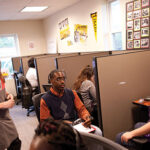
Five nights a week, UMBC students assemble at Alumni House and reach out to alumni and parents via the university’s Phonathon. The program was brought back to campus in 2011 after being outsourced to a third party for eight years.
Dayna Carpenter, UMBC’s director of annual giving, says that the university made the change because it was students who could make the most tangibleconnection to donors.
“People were really excited to talk to actual UMBC students and to have meaningful conversations,” said Carpenter.
Success is measured in numbers – and giving is up since the switch was made. But the relationships built by the Phonathon effort are just as important. Students and alumni swap stories about their time at UMBC, and a few students have received internship and job offers from alumni whom they’ve connected with during a phone call.
Logan Wern, UMBC’s Phonathon coordinator, says that students’ understanding of philanthropy has also increased: “Many of our students realize and understand the importance of fundraising and the good it does here on campus.”
One of the efforts that has benefited from the Phonathon is the Retriever Learning Center. The effort was heavily funded by alumni and it is a place beloved (and used) by many students.
“It’s because of the donors’ outstanding support that UMBC is able to offer so many resources for students and alumni alike,” says student caller Jordan Coffie ’14.
– Katharine Scrivener
 Public policy and economics professor Tim Brennan has had a distinguished career as an educator, researcher and expert on communications and media. Now, he’s taking it to Washington, where he will serve as chief economist for the Federal Communications Commission (FCC).
Brennan has been an economist with the U.S. Department of Justice Antitrust Division and senior economist for the White House Council of Economic Advisers. He has also served as a staff consultant to the Federal Trade Commission, advised on competition law internationally, and received the Distinguished Service Award last year from the Public Utility Research Center.
“I am very pleased that Tim Brennan has agreed to join the Commission as our chief economist,” says FCC Chairman Tom Wheeler. “His long and distinguished consideration of regulation, competition and monopoly issues will enable him to contribute immediately and materially to our work.”
Brennan’s research has focused on antitrust, copyright, telecommunications, media policy, electricity markets and related fields. He is also a senior fellow with Resources for the Future, a nonprofit social science research organization that seeks to improve global policymaking on environmental and natural resource issues.
“I expect to learn a lot, and it is an honor,” says Brennan of his new position at the FCC. The commission has a number of leading economists on staff, but has also brought in scholars from academia for several years to provide outside perspectives and advice on challenging issues. Previous chief economists include Steven Wildman from Michigan State University and Marius Schwartz from Georgetown University.
– Max Cole
 Most classes offer valuable knowledge and some credits toward a degree.
But three students in a UMBC class on entrepreneurship taught by Gib Mason, economics ’95 (who is also chief operating officer and vice president of administration and finance at the UMBC Training Centers) got something more: a payout for their ideas and jobs helping to make their project a reality.
Josh Massey ’14 , Andres Camacho ’14, and Hashem Kanfash ’16 were students in Mason’s Creativity, Innovation and Invention class who developed a customizable GPS driven navigation app that targets the dynamic environment of college campuses under the name Banana Bones. The app directs users – walking or driving – to desired campus locations, and even creates customizable self-guided tours.
After winning a competition sponsored by the UMBC Alex Brown Center for Entrepreneurship, the mobile app was snapped up by Hanover-based Tecore Networks, a global supplier of 3G, and 4G/LTE mobile network infrastructure.
“Working on this project provided us with real-life understanding of how corporations are formed, built, and acquired,” says Massey.
Massey and his two co-founders students will continue to work with engineers and executives at Tecore to take the app through the final stages of development, and a portion of the funds from the Banana Bones acquisition will support a future collaborative space on the UMBC campus for aspiring entrepreneurs.
“Supporting and mentoring the next generation of entrepreneurs and technologists here in Maryland is a vital part of our future,” says Tecore’s president and CEO Jay Salkini.
– Nicole Ruediger
 Helping pave the way to success for graduate students from diverse backgrounds is the primary goal of PROMISE: Maryland’s Alliance for Graduate Education and the Professoriate (or AGEP). And the Maryland program’s excellence in achieving that goal has been rewarded with an additional five years of funding from the National Science Foundation (NSF).
Founded in 2002 as an alliance between UMBC, the University of Maryland, College Park, and the University of Maryland, Baltimore, PROMISE is the engine for a wide-ranging array of programs (including intensive courses in sharpening dissertation skills and professional development) and mentoring opportunities aimed primarily at graduate students from underrepresented minority communities.
The new NSF grant, which provides $1,750,000 in funding over the next three years, is aimed at expanding the program across the entire University System of Maryland (USM). The new funding will include expanded activities for postdoctoral fellows and the creation of a new annual graduate student research and careers conference as well as a new conference for undergraduates considering graduate school.
The grant will also allow PROMISE to offer more opportunities for participants in its Professors in Training program to teach at campuses across the USM, as well as institutions like Anne Arundel Community College, the Community College of Baltimore County and the new Ana G. Mendez University Capital Area Campus in Wheaton.
– Richard Byrne ’86
]]>
Photography by Marlayna Demond ’11
* * * *
Much of the journey of creation takes place in the space of the human mind. Yet that journey is not a solitary one. Intellects require companionship. Great ideas spark new approaches – and more new ideas – when they are tested by conversation and forged in collaboration. And those combinations require spaces to encourage and enhance their work.
A research university such as UMBC excels in creating such spaces. Not only do its professors and students create them on (or nearby) the campus, but the university’s alumni carry that spirit of exploration into our community.
We invite you to take a closer looks at these spaces where the next great ideas in numerous disciplines are being developed or taught right now by members of the UMBC community.
 Reminders of the urgency of connecting are everywhere at Betamore – a business incubator occupying nearly 8,000 square feet on the top floor of a four-story building in Federal Hill with a view of South Baltimore that could get anyone’s creative juices flowing.
A screen-printed poster in the front room puts it bluntly: “Stop Tweeting Boring Shit.”
Co-founded by Greg Cangialosi ’96, English in January 2013, Betamore offers entrepreneurs who pay a monthly membership fee the chance to share everything from a beer-stocked fridge or an internet connection to nooks and crannies in which to take refuge and large couches for the occasional power nap.
Startups in fields including healthcare, education, software development and cybersecurity currently share the space. Yet what these entrepreneurs discover is that knowledge is the most important thing shared at Betamore through a regular lineup of guest speakers, classes, happy hours, and old fashioned mentoring from Cangialosi and his fellow co-founders Mike Brenner and Sean Lane.
Part of Betamore’s attraction for its resident companies is that variety and unpredictability. “It’s the mystique of not knowing who’s around you,” quips Cangialosi.
Brenner concurs: “By programming the space and bringing in different minds, there’s bound to be a really interesting outcome.”
After graduating from UMBC, Cangialosi started Blue Sky Factory – a successful email marketing company that he sold in 2011 to pursue Betamore and a number of other projects. (Cangialosi is also the managing director of Baltimore Angels, a group that nurtures and invests in local entrepreneurs.)
The space itself is only one element of the Betamore complex. Its founders also created an “Academy” – which features open, fee-based classes for those who want to learn technology and business skills (such as web development or digital marketing sales) from those already succeeding in business. The Federal Hill site also provides a headquarters for Betamore Works – a matchmaking venture that hooks up Betamore graduates with potential employers.
Betamore’s flexible design reflects the way creative people tend to work. While the site itself is a key part of Betamore, Cangialosi says that the venture’s potential to create new collaborations and innovations in Baltimore are even more important than the space itself.
“We love the space, and we love Federal Hill,” says Cangialosi. “The density of its ‘live, work, play’ environment – and its potential to become a serious tech hub in Baltimore – is what we really love about it.”
– Sarah Truckey
Find out more about Betamore at: http://www.betamore.com/
 Each year, Imaging and Digital Arts (IMDA) students at UMBC nearing completion of their Master of Fine Arts degrees present their work in an exhibition at the Center for Arts, Design and Visual Culture (CADVC), bringing a wide range of visually stunning and socially conscious multimedia installation, photography, sculpture and design to the campus community. Yet much of the work displayed each year at the CADVC is created and shaped in the program’s off-campus studios in nearby Pigtown.
When the IMDA Studios were founded 13 years ago, the only on-campus spaces available for graduate students to pursue their work were scattered across multiple buildings, So Jon Sturgeon (chair of visual arts in 2001) and Vin Grabill (present chair and the director of the IMDA program at the time) sought an off-campus site to provide unified studio space for graduate students.
They settled on a space in the Raleigh Industrial Center. Stephen Bradley, director of the IMDA program, says that “the purpose of the Raleigh studios was to offer students a unique fabrication space where they could experiment with installation, performance and other hybrid artistic forms that required larger open raw space.”
Experimentation is a key concept behind the 4,800 square foot space, which has an open floor plan that allows for customizable individual studios. Students drape, shift, and even remove the false walls that compose their spaces, or install televisions and projectors and mount shelves and speakers as their projects develop and transform.
Indeed, Bradley sees the space as a laboratory of sorts. “Artists work like chemists in a lot of ways,” he observes. “They’re bringing things together, creating hybrid works, mixing metaphors.”
For Jason Hughes ’15, the studio is where he investigates the relationship between labor, value and self-worth in complex and provocative collages, sculptures and art objects made from millions of dollars in shredded U.S. currency. Taking notice of Baltimore’s many crumbling, vacant buildings, Hughes’ began creating his own bricks made with shredded cash, and plans to rebuild disintegrating walls in nearby homes and yards with these bricks and then photograph them.
For Charlotte Keniston, the IMDA Studios are a staging ground for community focused projects and collaborations. She lives a few blocks away from the space and works directly with Pigtown residents, exploring and challenging the persistence of food deserts in Baltimore neighborhoods. Keniston’s “pop-up groceries” make overstocked, fresh produce that would otherwise go to waste available for Pigtown residents.
Keniston also engaged her community in a collaboration called A Full Plate, which delved into what food means to the project participants “in relation to their families, their communities, their health, power, place and spirituality.” Participants had a meal and then painted on the ceramic plates from which they had eaten.
Bradley observes that the location of the studios in the community has allowed students to question their responsibilities as artists and cultivate relationships. “It’s not a one way street,” he concludes.
– Alicia Dewitt
For more about UMBC’s IMDA program: http://art.umbc.edu/graduate/overview.php
 It begins with a spark.
A group of strangers gathers at one end of an old copper mill. The air smells of sawdust and machinery grease. Feet shift nervously as welding instructor Audrey Van de Castle instructs her students to don heavy visors to protect their eyes from the flash.
“It’s brighter than staring at the sun,” she says, demonstrating the fusion of steel to steel with a careful wave of the wand. “Watch you don’t get a sunburn.”
A few safety and procedure points later, the Welding 101 students are ready to practice their new skills. This mix of artists, tinkers – and the just plain curious – is part of a growing “maker” culture sweeping the nation. And since July of last year, the Baltimore Foundery has nurtured those with that particular drive to create.
At the helm is co-founder Corey Fleischer ’05, ’08, mechanical engineering, a senior mechanical engineer at Lockheed Martin who has many of the same tools found here in his own garage workshop. (Fleischer was also the winner of The Big Brain Theory: Pure Genius – an engineering-based reality competition that appeared last summer on the Discovery Channel.)
“This [space] has always been in the back of my mind,” says Fleischer, who opened the not-for-profit space to provide access to industrial grade tools and education with the goal of sparking innovation within the Baltimore community. “We knew Baltimore needed a place like this.”
Since its opening, the Foundery has hosted an increasing number of classes, including the popular Welding 101, aluminum brazing, and even an introduction to microcontrollers. At Halloween, Fleischer and other involved in the project carved pumpkins using power tools, and they recently built their own steel sign, which welcomes all who pass their South Central Avenue doorway.
“You don’t think welding is approachable, but it’s not that hard,” said Fleischer, who learned how to weld in high school specifically so he could build his own go-karts for racing. “And like everything, the only way you’re going to get good is through practice and trial and error.”
One of the first students to arrive on this night is Hayley Evans, an art student who has brought her own visor. Behind a red protective curtain, she waits patiently for her turn to wield the flux welder.
“Think I could try that again?” she asks a fellow student. Moving to a prime spot at the workbench, she carefully pulls a bead of liquid 600-degree steel in a straight line. Although she’s studying environmental design, she’s interested in artistic metal work as well, she explains.
“We’ve had fathers and sons, we’ve had wives and husbands come in together. And artists…lots of artists,” says Fleischer, who notes a nearly equal interest from women and men.
“I thought it would all be tinkers or garage mechanics like me,” he concludes, “but all kinds of people show up. I love that.”
– Jenny O’Grady
Learn more about the Baltimore Foundery at bmorefoundery.com
 Measurement is the key to everything in science, technology, engineering and mathematics (STEM) fields. It’s also the key to demonstrating how these disciplines are tied together. But how can one make that point to a freshman STEM major?
William LaCourse, the dean of UMBC’s College of Natural and Mathematical Sciences, has created a new interdisciplinary course for freshmen to illuminate just why measurement matters.
He is excited about the new offering: “This [class] goes right to the heart of what science is all about.”
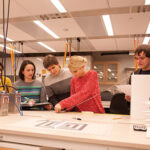
Yet a course that seeks to explain measurement across disciplines requires a space that is adaptable, flexible and collaborative. Thus, the measurement class will be the first to be taught in UMBC’s newest space: the Collaboratory.
The Collaboratory is a joint venture between UMBC and the Howard Hughes Medical Institute (HHMI). UMBC provided the space and HHMI funded the $1.7 million build out. The space will be shared between the university (which will use it during the academic year) and the institute (which will use it in the summer).
The faculty who are involved in the creation and teaching of the new course are delighted by the possibilities offered by the Collaboratory.
“This space is pretty unique compared to other labs on campus set up to allow for different types of experiments that are not department specific,” says Tara Carpenter, a senior lecturer in chemistry. “The fact that the lab benches can be repositioned allows for a unique group dynamic, which is not something that can be done in other laboratories.”
Sarah Leupen, a senior lecturer in biological sciences, agrees. “You’re not limited by physical space to find the answer to the question you’re asking.”
The Collaboratory is designed so that almost every inch of it can be adapted to some sort of purpose in pedagogy or research. Even the walls.
“The ability to write on the walls is really cool,” observes Anne Spence, a professor of the practice in mechanical engineering.
– Nicole Ruediger
 Proximity. Potentiality. Coffee.
This morning, you can almost hear the first two qualities over the hiss of the coffeemaker as the employees of Integrata Security watch a presentation by their CEO, Mike Geppi in the CyberHive – a joint project between bwtech@UMBC, the Maryland Department of Business and Economic Development, Corporate Office Properties Trust (COPT) and Merritt Properties.
The Cyber Hive is a collaborative space with four tenants (including Integrata Security) and six affiliates. Tenants have dedicated office space and access to the common areas, while affiliates have access to the common areas. “It’s very high tech,” says Geppi.
Integrata Security is developing technology for secure wireless networks. The National Security Agency (NSA) was interested in how to make wireless networks secure, and after a survey of commercially available solutions, the agency determined that none was secure enough. So the NSA invented a new technology, which Integrata has licensed and is developing for commercial and government use.
For Geppi, part of the CyberHive’s allure is its location. “Being close to the NSA is fantastic,” he says. “Not only is the location of the CyberHive great but we also have access to the talent on the UMBC campus.”
Ellen Hemmerly, president and executive director of bwtech@UMBC, says that combination was just what she and her team had in mind with the venture, which will further boost the research park’s already burgeoning presence in the cybertechnology field.
“It adds to our cyber program at bwtech@UMBC by providing co-working space and meeting space that will facilitate the growing of our affiliate program, which houses cybersecurity companies that don’t need a dedicated office space,” she says “We also hope it will facilitate partnerships between cyber companies, UMBC faculty and students.”
Geppi says the design of the Cyber Hive makes it a naturally collaborative environment. “We do interact with other companies and that’s a real benefit. Having startups talk with each other. It typically leads to opportunity. We can develop strategic partnerships or find customers. Some of the entrepreneurs here are going through the exact same thing I’m going through and it’s good to be able to compare notes.”
While Geppi meets with his team, Tyler Simon and John Linford meet in a private office. They are both research scientists for Paratools, a software engineering firm. Simon, who is also a research scientist in the computer science and electrical engineering department at UMBC, agrees with Geppi about the Cyber Hive’s possibilities for collaboration.
“People are more likely to collaborate because they just walk by,” Simon observes. “It’s better than just a bunch of closed offices.”
Linford concurs: “It’s the first incubator I’ve been in that has that feature.”
– Nicole Ruediger
For more information about the Cyber Hive: http://www.bwtechumbc.com/pdf/cyberhive.pdf
]]>
The habitat in central Maryland where Jill Sisson Quinn ’97, English grew up isn’t very different from the habitat in central Wisconsin where she lives now. The birds, insects, and trees are similar; you can use the same field guides, she says. Yet when she moved to the Midwest in 2005, she had traded a place full of rivers for one full of lakes, and “it was a huge problem for me,” she says. “I would wake up in the middle of the night and I would feel like I was moving to another planet.”
Is this homesickness, or an acute sensitivity to one’s environment? Quinn’s work suggests that the two things tangle like roots from different plants, complicating where personal experience starts and human nature begins. The essays in her 2010 collection, Deranged: Finding a Sense of Place in the Landscape and in the Lifespan, are remarkable literary hybrids designed to explore these complications. In one piece, she weaves a discussion of Lucy, the 3.2-million-year-old skeleton of a human ancestor, alongside a remembrance of Fatso, a tree near her childhood home. In another, a breakup is a launchpad for thinking about shrinking forests, and how life at their edges is different than their interiors.
The shifting definition of place is a constant in Deranged, and she refers often to her childhood home – more precisely, the branches of the Patapsco River not far from it. As she writes in the book’s introduction, “I like to believe that there is some un-faulty guide steering me home, and hope that if I am not there now, I soon will be.”
Quinn has been publishing these lyric essays since 2001, but their sensibility is predated by the interest in science and literature she cultivated as a student. When she arrived at UMBC, she was committed to writing poetry, inspired in part by what she had learned about astronomy.
“I remember reading the textbook religiously,” she says. “I remember it talking about stars and the birth and death of stars, and how stars aren’t really alive but that we owe our existence to stars, because the atoms that make up our bodies were formed in the centers of stars. I never read a textbook that personified things and gave this eminence to them. That really moved me.”
She wrote her honors thesis on the work of Heather McHugh, a poet who draws heavily on nature. “She’s always been an environmental writer,” says James C. McKusick, her thesis advisor, who is now dean of the Davidson Honors College at the University of Montana. “Both in her prose and her poetry, she reflects deeply on people’s relationships with place, or with humankind’s relationship with the natural world. She reflects on that in a way that a poet should, with a lot of concrete imagery – a lot of deeply thought and felt images.”
Quinn’s writing process involves a lot of walking – 6.7 miles every day with her dog, to be exact – and a lot of thinking about connections: “I discover something in nature that’s weird, like a wasp, or these beautiful rocks, and I’ve got this question in my head. I know I’m going to connect them, and then I research the nature, and the connection grows out of that.”
Last year Quinn received a $30,000 Rona Jaffe Foundation Writers’ Award, given annually to emerging women writers. The prize has allowed her to take a half-time sabbatical from her job as a high-school English teacher. She’s currently at work on her second book, titled The Doctrine of Signatures, which leverages her close study of nature to address larger spiritual questions. This is perhaps an unlikely pursuit for a nature writer, who’s generally expected to be a John McPhee-like rover. But in Quinn’s particular line of work, depth trumps breadth.
“I’m not a traveler,” she says. “I don’t think I’ll ever exhaust Wisconsin or Maryland.”
– Mark Athitakis
For more about Jill Sisson Quinn and her work visit http://www.jillsissonquinn.com/
]]>
By Kathryn Masterson
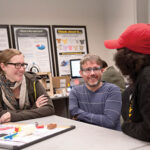
Every Monday morning at UMBC’s Prototyping and Design Lab (better known on campus as “The Pad”), Amy Hurst and Shaun Kane convene a meeting of students across disciplines who work in the space. Some of the students come to the lab to build things, but many are exploring how to use technology to make computers and the wider world accessible for people with disabilities.
Hurst and Kane are both assistant professors of human-centered computing in UMBC’s department of information systems. It’s a field that focuses on the user end of technology, combining elements of computer science, design, and behavioral science.
In mainstream human-computer interaction studies, Kane observes, the work often centers on making small improvements in a user’s computer experience, such as making a mouse respond better. In the accessibility research that Kane and Hurst focus on – which investigates how to put technology to work for people whose physical or mental disabilities make even simple tasks difficult – the chance for a breakthrough is higher.
“There is a great potential to make a substantial difference in people’s lives,” Kane says.
The projects that their students bring to Monday meetings are as diverse as the majors of the attendees. An engineering major is building a device to create plastic molds using a wooden box, a metal frame and what looks like a vacuum cleaner. An undergraduate biology major is experimenting with electroplating figures built using the lab’s 3-D printers. And a doctoral student in human centered computing is experimenting with ways to help visually impaired people choose outfits that are both fashionable and appropriate for different situations. Another engineer shows off a decorative lamp he created with “Twinkle”– The Pad’s collective nickname for its laser cutter.
Hurst and Kane help these students and others refine their ideas and provide positive and constructive feedback. Yet the weekly meeting is more than a taking of the pulse of campus undergraduate and graduate research being done. The gathering also reinforces a culture Hurst and Kane have intentionally built at The Pad: an atmosphere of collaboration and teamwork where members of the community are invested and involved in each other’s work.
“We really started to develop a community” in the past year, Hurst says. “You can go to the lab and know people will be there, all the time. Students have ownership of the space.”
Both professors observe that human centered computing is a field where sharing ideas, expertise and energy is the only pathway to success. After less than five years, their own collaborations with students and other faculty are already winning recognition and grants – and drawing those on campus who are interested in using technology to help people into their orbit.
Collaborators at The Pad don’t just revel in the act of creative partnership. Hurst and Kane also celebrate the simple joys of making and building in an atmosphere that allows for play and fun.
Kane insists that assistive technology that stretches beyond aiding in daily tasks can add richness to people’s lives. At times, Kane tells his students: “Let’s try to do something that’s not useful, that’s just for fun.”
 Assistive technology can be something as simple as the white cane used by a blind person to tiny wearable computers such as Google Glass, with which people with physical disabilities can take pictures, search the web and crowdsource opinions on various things. It is a field thathas opened up into new vistas in recent years, and Hurst and Kane and their research are right in the thick of it.
Smartphones, tablets and other handheld technology gadgets are putting greater computing power at the fingertips of the population as a whole. Developments in 3-D printers, which can produce prototypes more quickly and cheaply, are also pushing the possibilities forward.
“The work is really exciting,” Kane says. “There is a lot of potential.”
Both in The PAD and in other research, Hurst and Kane design assistive technology for people with visual impairments, aphasia, and also people with motor-control issues that make it difficult for them to point and click.
One important mantra in the field of accessibility and human computer interaction is: “You are not your user.”
It’s an admonition of sorts for the designers and engineers involved to look beyond themselves and put themselves in the place of (or better yet, collaborate with) the people who will use the technology.
One of the problems of assistive technology is that users commonly abandon it if it does not meet their specific wants or needs. So getting feedback from the users is critical if assistive technology is to be both useful and used.
Hurst believes the best way to get true feedback is to dive in and volunteer with groups that serve the disabled and build relationships that will guide research. As a Ph.D. student at Carnegie Mellon University, Hurst spent three years working at a cerebral palsy center in Pittsburgh. Her time in the center’s computer lab led her to research software that detects when someone seems to be having a problem operating a computer. (She recently received a grant from the National Institute on Disability and Rehabilitation Research to continue that work.)
“Go out and find ways to do service,” Hurst says. “I make my students do that.”
One of Hurst and Kane’s Ph.D.students, Patrick Carrington ’16, spent last summer volunteering in a spinal cord clinic in Baltimore to further his research on developing interfaces for power wheelchairs. He worked as a therapy tech, helping people from their wheelchairs to therapy mats and working with physical therapists.
Working alongside colleagues at the center allowed Carrington to develop relationships with people for whom he was designing technology. “I didn’t have to sit and be creepy in the corner,” he says.
At times, the relationships go beyond volunteering into direct collaboration. Working with the National Federation for the Blind in Baltimore, Hurst and Kane developed tactile plates to help display traditionally visual information – graphs of equations, or a picture from the Hubble telescope – as plastic plates that people could touch to understand shapes or curves.
The tactile plates may seem plain when compared to the sleek design of a pair of Google Glasses. But for a visually impaired person, the plates not only offer a chance to better understand something they may not have been able to access before, but are something they can create themselves on a 3-D printer.
In 2012, Kane, Hurst and several students travelled to New York to display these tactile plates, Braille rings and other pieces at Maker Faire – an invention festival that attracts thousands of people. Their work received the festival’s editor’s choice award and a blue ribbon hangs right inside the front door of the Pad.
 Michele Williams ’16 is a doctoral student who works with both professors. She specializes in developing navigation aids for the blind and in helping make fashion more accessible to blind people. She says that the success of The Pad and its collaborative atmosphere are rooted in the deep partnership between Hurst and Kane.
Williams say that students often refer to as a single entity: “You say it all as one: AmyandShaun.”
Hurst grew up in California, making things with her dad in the family garage. She recalls that as an undergraduate studying computer science at Georgia Tech, she was more inspired by what technology could do for people than what the latest trends in software were.
The possibilities to use technology to help people really clicked for her, Hurst says, when she participated in research at a hospital clinic involving patients with Parkinson’s disease. The effort to develop software that would replace a paper test for detecting tremors didn’t go anywhere, but the experience of working with people in need and using technology to assist them stayed with her.
Kane, who grew up in Massachusetts, was born with a physical disability. His limbs are short and he has the use of only one arm and hand. When he was younger, he recalls, the “moody teenager” in him was resistant to doing work involving disability. But after enrolling at the University of Massachusetts at Amherst, Kane observed a class that was designing toys for an autistic boy. The design challenges of the work, coupled with the altruistic possibilities, appealed to him.
Hurst and Kane’s collaboration started in graduate school, when Hurst, a Ph.D. student at Carnegie Mellon, approached Kane, who was studying at the University of Washington, at a conference. She introduced herself and told him they should get to know each other because they had worked with the same people and did similar work. Soon, they were seeing each other at conferences, skipping sessions to take walks and talk.
When it came time to look for jobs (Hurst completed her Ph.D. in 2010; Kane in 2011) neither one of them wanted to teach at a university or department where they were only researchers working in their area of interest. So they both were attracted by UMBC’s information systems department – which boasts one of the few human computer interaction specializations in the country – and by the breadth of knowledge among the faculty at the university.
“Being in a place with a lot of experts makes it really fun,” Hurst says.
There is a sign on the door of Hurst’s office: “Keep Calm and Make.” When she first visited UMBC, she remembers asking: “Where do you make stuff?”
UMBC did not have a specific space dedicated to the rapid prototyping necessary to keeping up with technology, so when Kane came to UMBC a year later, they launched The Pad.
The Pad is a place to collaborate and make. “We let people loose,” Hurst says. And after the Monday meeting, the students in The Pad go directly back to making things. There are the telltale bleeps and bloops of the 3-D printer, where Joshua Dutterer ’14, the lab’s resident prototyper, makes a Statue of Liberty figure that he will try to electroplate at Hurst’s suggestion.
Hurst wants Dutterer to make something that conducts electricity but is also beautiful, and then publish an article about it so he gets recognized for what he’s done. “I don’t think anyone else is doing this,” she says of Dutterer’s work. “It’s a nice opportunity for us to be first on the scene.”
The electroplating work also interests others in The Pad. For Carrington, it may offer a way for a power wheelchair to charge a tablet or another piece of technology on the go.
Work made by students at The Pad is celebrated a few steps inside the door in a “museum” – a bookshelf of toys, trinkets and small pieces of assistive technology built by 3-D printers. Braille rings, can openers and bottle holders for people who have problems gripping sit side by side with UMBC tchotchkes, interlocking puzzles, figurines of an angel, a DNA helix, a hand making the hang-ten sign, a Yoda head and an Iron Man reactor for a Halloween costume.
The smart, quirky ebullience of the museum is a reflection of the sort of students who end up finding a home in The Pad. Hurst and Kane say specific areas of study pursued by undergraduates or graduate students who show interest are less important than the qualities of independence, teamwork, adventure and a passion to build that they bring to The Pad.
“We demand passionate people,” says Hurst. “This environment does not work for everyone.”
It also helps to not take oneself too seriously. Hurst and Kane took the team out for a night of laser tag after a particularly intense deadline had passed.
 Hurst and Kane’s spirit of collaboration is starting to spread across campus.
Each semester, The Pad hosts an intern from The Shriver Center’s SUCCESS program, which helps people with intellectual disabilities acquire post-secondary-school skills. These interns help with coding or other research, giving them job skill experience and making The Pad an even more diverse work space.
The duo’s research into assistive technology – and the energy of its students – has also been a key element in work done at The Erickson School. Judah Ronch, the school’s director, works with Hurst and Kane and their colleagues on projects that use technology to help the aging population. Ronch marvels at the possibilities of the work. “I think it’s really accelerated the rate we can develop solutions for the elderly,” he says.
Collaborating on societal problems with people who come from a multidisciplinary approach has been exciting and rewarding, Ronch says. “These are the kind of hybrid, interdisciplinary individuals our field needs. To them, nothing is not interesting, and nothing can’t be done. It encourages us to think bigger.”
The Pad is not a literal factory. The things made there are prototypes, not products. Yet even in the initial making, the work that Hurst and Kane and their students are doing is a leap into a world where technology can improve more lives of those whose existence is circumscribed by disability. Their intellectual contributions are helping to open up technology and the world beyond for many more people.
“The world is a better place when people can do the things they want to do without barriers,” says Kane.
]]>