How to See the Stars
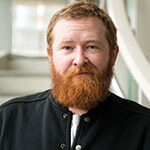
With Andrew Vaché, laboratory specialist, department of physics
By Meredith Purvis
We are made of star stuff, as scientist Carl Sagan once wrote, so it’s no wonder we are fascinated by the night sky. But stargazers who live inside the halo of light pollution thrown up by cities, the wonders of the stars can be difficult to see. Get just a few miles outside those urban landscapes, and one can be wowed by a vast expanse of constellations and solar systems. And if you want to improve the view? Try UMBC’s massive telescope (operated by the Joint Center for Astrophysics), which gives UMBC students and faculty a better look deep into space. Researcher Andrew Vaché has a number of tips that will help you get better acquainted with the stars above us.
Tools of the Trade
- Binoculars or starter telescope
- Star charts on paper or smartphone
- Dark sky
- Astronomy club membership card
- Weather app
 Step 1: KNOW WHAT YOU’RE LOOKING FOR
“So many people have an interest in astronomy,” says Vaché, “but they don’t know where to start.” He advises would-be astronomers to begin with the basics, including spending some time online familiarizing yourself with star charts, or downloading a GPS-based app that maps constellations based on your location. There’s also a website (calsky.org) that aggregates what you can see and when –from space stations to solar flares.
Step 2: IMPROVE YOUR VIEW
Get out of the city and past the light pollution it throws up to find a place where the skies are darker. “You don’t have to go far,” Vaché points out. Even a destination 20 minutes outside the city can yield a much blacker night and clearer view. And it’s also a good idea to check the weather. Clouds will definitely kill the view. Vaché recommends the Clear Sky Chart (cleardarksky.com). “It’s a great resource for planning a good night, especially if travel is involved,” he says.
Step 3: FIND THE BEST TOOLS
Once you know what to look for in the night sky (and have a dark place and clear night to do so), it’s time to boost your stargazing power. Something as simple as binoculars can improve the view. “People are often surprised at the difference a decent set of binoculars can make,” says Vaché. In fact, you could easily spend the rest of your life stargazing with binoculars only, and many novice astronomers do. A decent telescope will certainly improve the view, however. And while you don’t need one the size of UMBC’s instrument to glean a lot from the night sky, you should expect to spend a couple hundred dollars on the equipment, and invest some time in how to use it. The most important job of a telescope is to gather light, so you’ll want to consider the telescope’s aperture, or how much light it lets in. Another helpful hint is to look for a “go-to” telescope, which, when pointed at an object in the night sky, will automatically focus in on what’s there. It’s a feature that helps new users skip some of the frustration and get straight to the stargazing.
 Step 4: FIND FELLOW STARGAZERS
Stargazing can be a solitary business, but it doesn’t have to be. Vaché recommends that novice astronomers join an astronomy club or visit an astronomy center or planetarium. “When you’re just getting started, it’s helpful to see what types of set-ups other astronomers are using,” says Vaché. Many planetariums and astronomy centers – including UMBC – offer free educational opportunities like open houses or star walks. UMBC’s astrophysics lab offers private tours and a monthly public viewing on first Thursdays, where you can learn about the telescope and see a selection of planets, nearby nebulae and even more distant galaxies.
Step 5: GET AMBITIOUS
Once you’re feeling more confident, you may want to reward yourself with more exotic views. Vaché says there are plenty of “dream destinations” for astronomers – some of them not so far away from UMBC. The Monongahela National Forest in West Virginia affords impressive views, and Cherry Springs State Park in central Pennsylvania is the only certified dark sky location on the East Coast. The certification, given by the International Dark-Sky Association (IDA), recognizes the park’s exceptional commitment to dark-sky protection and restoration on public lands, which makes it an excellent destination for Mid-Atlantic astronomers.
 By the Numbers
- UMBC’s telescope has 3 cameras
- UMBC’s telescope offers more than 20 filters
- First view of the night sky attained in August 2000
- On any given night, UMBC’s telescope can take images of 5-10 different objects
- You can easily see 3 planets from UMBC (Jupiter, Saturn, and Mars)
]]>
With Andrew Vaché, laboratory specialist, department of physics By Meredith Purvis We are made of star stuff, as scientist Carl Sagan once wrote, so it’s no wonder we are fascinated by the...
https://umbc.edu/stories/how-to-see-the-stars/
https://my3.my.umbc.edu/api/v0/pixel/news/122815/guest@my.umbc.edu/d73c72051d35eb892cb8d2aadae41160/api/pixel
discovery
winter-2014
UMBC News & Magazine
https://my3.my.umbc.edu/groups/umbc-news-magazine
https://assets1-my.umbc.edu/system/shared/avatars/groups/000/001/943/24435aa6207c452e7bc15cc74b42c7bb/xsmall.png?1748556657
https://assets1-my.umbc.edu/system/shared/avatars/groups/000/001/943/24435aa6207c452e7bc15cc74b42c7bb/original.png?1748556657
https://assets2-my.umbc.edu/system/shared/avatars/groups/000/001/943/24435aa6207c452e7bc15cc74b42c7bb/xxlarge.png?1748556657
https://assets2-my.umbc.edu/system/shared/avatars/groups/000/001/943/24435aa6207c452e7bc15cc74b42c7bb/xlarge.png?1748556657
https://assets3-my.umbc.edu/system/shared/avatars/groups/000/001/943/24435aa6207c452e7bc15cc74b42c7bb/large.png?1748556657
https://assets1-my.umbc.edu/system/shared/avatars/groups/000/001/943/24435aa6207c452e7bc15cc74b42c7bb/medium.png?1748556657
https://assets2-my.umbc.edu/system/shared/avatars/groups/000/001/943/24435aa6207c452e7bc15cc74b42c7bb/small.png?1748556657
https://assets1-my.umbc.edu/system/shared/avatars/groups/000/001/943/24435aa6207c452e7bc15cc74b42c7bb/xsmall.png?1748556657
https://assets2-my.umbc.edu/system/shared/avatars/groups/000/001/943/24435aa6207c452e7bc15cc74b42c7bb/xxsmall.png?1748556657
UMBC News & Magazine
0
0
false
Mon, 17 Feb 2014 18:54:11 -0500
Essential Plugins for WordPress
WordPress is a brilliant Content Management System, in fact it the single most popular CMS system in the world with a huge number of plugins and templates available for you to build just about any site you can imagine. This flexibility is one of the many items which make WordPress one of the best website development programs available, this article will highlight a few of the essential WordPress accessories for your site.
]]>
WordPress is a brilliant Content Management System, in fact it the single most popular CMS system in the world with a huge number of plugins and templates available for you to build just about any...
http://www.htmlgoodies.com/beyond/cms/essential-plugins-for-wordpress.html
https://my3.my.umbc.edu/api/v0/pixel/news/41476/guest@my.umbc.edu/3f5510c135390ee6379436b13156ffb9/api/pixel
html
htmlgoodies
learning
Web Developer - Build Group
https://my3.my.umbc.edu/groups/retired-583
https://assets3-my.umbc.edu/system/shared/avatars/groups/000/000/583/fc60f5d7abc2e080599bb6dc465db54d/xsmall.png?1363101197
https://assets4-my.umbc.edu/system/shared/avatars/groups/000/000/583/fc60f5d7abc2e080599bb6dc465db54d/original.jpg?1363101197
https://assets4-my.umbc.edu/system/shared/avatars/groups/000/000/583/fc60f5d7abc2e080599bb6dc465db54d/xxlarge.png?1363101197
https://assets4-my.umbc.edu/system/shared/avatars/groups/000/000/583/fc60f5d7abc2e080599bb6dc465db54d/xlarge.png?1363101197
https://assets3-my.umbc.edu/system/shared/avatars/groups/000/000/583/fc60f5d7abc2e080599bb6dc465db54d/large.png?1363101197
https://assets3-my.umbc.edu/system/shared/avatars/groups/000/000/583/fc60f5d7abc2e080599bb6dc465db54d/medium.png?1363101197
https://assets4-my.umbc.edu/system/shared/avatars/groups/000/000/583/fc60f5d7abc2e080599bb6dc465db54d/small.png?1363101197
https://assets3-my.umbc.edu/system/shared/avatars/groups/000/000/583/fc60f5d7abc2e080599bb6dc465db54d/xsmall.png?1363101197
https://assets4-my.umbc.edu/system/shared/avatars/groups/000/000/583/fc60f5d7abc2e080599bb6dc465db54d/xxsmall.png?1363101197
Web Developer - Build Group
0
0
true
Mon, 17 Feb 2014 18:53:00 -0500
Heaven, Hell & Eisenhower – Allan Jirikowic ’77, INDS

It’s almost two weeks till Christmas, and Chief Ike’s Mambo Room in the Adams Morgan neighborhood of D.C. has hung up its stockings.
There are loads of them—maybe two dozen, dangling out of arm’s reach above the cluttered bar and along an opposite wall. Each bears a name – Doug, Angela, D-Rok, Baby G – painted in glitter glue.
I ask the bar’s white-bearded owner, Allan Jirikowic ’77, interdisciplinary studies, (who has probably withstood his share of Santa Claus comparisons) about the stockings, but he would rather talk about a mural – one of many – he’s commissioned for the D.C. dive bar he’s owned for 23 years.
“You have Marion Barry riding on the Lion of Judah, next to Fidel Castro with Nixon and Elvis,” Jirikowic says, gesturing toward the painting’s characters. “And over there, Nikita Khrushchev.”
Jirikowic grew up in Silver Spring and enrolled at UMBC in 1972. He studied under Herbert Blau, the forward-thinking theater director who led the university’s arts and humanities division from 1974 to 1978. “I was about to drop out,” he says, until Blau came aboard and shook things up for him.
When Jirikowic graduated in 1976, he still didn’t know what to do. “I was in a complete quandary,” he says, chuckling. But eventually he drifted back down to the District, where as a bar owner, actor, gadfly and Falstaffian bon viveur, Jirikowic has helped build numerous institutions that have jostled the culture of the often-stodgy federal city. He has also gotten a lot of people drunk.
With his friend Bill Warrell, Jirikowic helped launch and manage the influential downtown art hub d.c. space in a part of the city still shell-shocked after the 1968 riots. The venue brought hundreds of shows to D.C., including an early performance by Laurie Anderson. But after several years at dc space, he began to wonder what was next.
So Jirikowic bartended elsewhere. Couriered. At one point, he even appraised houses. He loathed that, mostly, but it helped him understand certain cold facts of life. “It gave me an immense education about how this country really works,” he says.
In 1988, Jirikowic threw his weight behind a new enterprise: a rooftop bar in Adams Morgan that he called Krakatoa Lounge. A Washington Post feature observed that Krakatoa resembled “a high school gym that’s been decorated for a very ‘80s dance.” The bar was a success – Jirikowic guesses he sold more than 6,000 daiquiris in one season – but a short-lived one.
Subsequently Jirikowic launched more watering holes: the landmark Adams Morgan bar, Hell, and a fiesta-themed joint called Rancho Deluxe. He also made himself a fixture on local stages as an actor, involving himself in scrappy theater organizations such as Studio Theatre and the Capital Fringe Festival, which have become major forces in the D.C. arts scene.
On the cusp of the 1990s, Jirikowic leased a building on the 1700 block of Columbia Road NW, and transformed it and an abutting property into three conceptual bars: Chaos, Pandemonium, and later, Chief Ike’s, which is named after former President Eisenhower. He decorated them lavishly, some of his decor salvaged from junk yards or simply found around town. The tacky Chief Ike’s and its two upstairs bars draw a loyal (and perpetually under-35) customer base.
Often to the chagrin of his neighbors, Jirikowic has become a fierce protector of Adams Morgan bacchanalia. He favors life, liberty, art, and dance, and the business that comes with them. He’s a member of the board of the neighborhood’s business improvement district and also heads up his local citizens’ association.
“I have to be politically active to protect the interests of the right to party, for art, for the joie de vivre of the neighborhood,” he says.
After a motley career spent as the life of D.C’s art scene and its party, Jirikowic sometimes wonders if he should have done something more conventional.
“You know it’s kind of funny,” Jirikowic says. “You just do what you do, and then all of a sudden it’s what you’ve done.”
– Ally Schweitzer
]]>
It’s almost two weeks till Christmas, and Chief Ike’s Mambo Room in the Adams Morgan neighborhood of D.C. has hung up its stockings. There are loads of them—maybe two dozen, dangling out of...
https://umbc.edu/stories/heaven-hell-eisenhower-allan-jirikowic-77-inds-2/
https://my3.my.umbc.edu/api/v0/pixel/news/122816/guest@my.umbc.edu/078c1e683d00558a2e11399850e0adc6/api/pixel
alumni
inds
winter-2014
UMBC News & Magazine
https://my3.my.umbc.edu/groups/umbc-news-magazine
https://assets1-my.umbc.edu/system/shared/avatars/groups/000/001/943/24435aa6207c452e7bc15cc74b42c7bb/xsmall.png?1748556657
https://assets1-my.umbc.edu/system/shared/avatars/groups/000/001/943/24435aa6207c452e7bc15cc74b42c7bb/original.png?1748556657
https://assets2-my.umbc.edu/system/shared/avatars/groups/000/001/943/24435aa6207c452e7bc15cc74b42c7bb/xxlarge.png?1748556657
https://assets2-my.umbc.edu/system/shared/avatars/groups/000/001/943/24435aa6207c452e7bc15cc74b42c7bb/xlarge.png?1748556657
https://assets3-my.umbc.edu/system/shared/avatars/groups/000/001/943/24435aa6207c452e7bc15cc74b42c7bb/large.png?1748556657
https://assets1-my.umbc.edu/system/shared/avatars/groups/000/001/943/24435aa6207c452e7bc15cc74b42c7bb/medium.png?1748556657
https://assets2-my.umbc.edu/system/shared/avatars/groups/000/001/943/24435aa6207c452e7bc15cc74b42c7bb/small.png?1748556657
https://assets1-my.umbc.edu/system/shared/avatars/groups/000/001/943/24435aa6207c452e7bc15cc74b42c7bb/xsmall.png?1748556657
https://assets2-my.umbc.edu/system/shared/avatars/groups/000/001/943/24435aa6207c452e7bc15cc74b42c7bb/xxsmall.png?1748556657
UMBC News & Magazine
0
0
false
Mon, 17 Feb 2014 18:52:46 -0500
Hearts and Minds

Finding Love at UMBC
By Elizabeth Heubeck ’91
* * * *
Maybe it was a first date at Quadmania. A coffee at the Commuter Cafe. A pizza at Sorrento’s.
Ask those who’ve studied and worked at UMBC, however, and you’ll find that many of them didn’t just get their degree or a job at UMBC. They found long-term relationships that are still going strong.
As Valentine’s Day approaches, we’ve asked five couples who found their significant other at UMBC to share their stories.
We hope you’ll enjoy the ride down memory lane. And feel the love.
Katelyn Niu and Kevin Yang

In the fall of 2003, Kevin Yang ’07 computer science and financial economics and Katelyn Niu ’05, biochemistry, found themselves in the same physics study group.
But their relationship began to bloom a year later, when a computer virus brought them together.
“Katelyn’s computer was affected by a virus, and she called me for help,” Kevin recalls.
He admits that he took his time fixing the computer problem, making several trips to Katelyn’s place at Walker Avenue Apartments. “That gave us time to chat,” he says.
Kevin and Katelyn also began bumping into one another more frequently in the dining hall. “I wasn’t stalking her or anything, but I have a good memory and I memorized her schedule. I’d show up [at the dining hall] a little before she’d get there,” he says with a playful grin.
While Kevin found the time in his full academic schedule to see Katelyn, her recollection of life as an undergraduate at UMBC is a little different.
“I was always so busy studying,” Katelyn says, who earned a joint Ph.D./D.D.S. from the University of Maryland, Baltimore, after graduation.
Katelyn was eventually won over by Kevin’s persistence. The couple married this past fall at the Center Club in Baltimore after a two-year engagement. They live in Ellicott City, a half-way point between Katelyn’s commute to her dentist’s office in Hagerstown andKevin’s position as an investment analyst at T. Rowe Price in downtown Baltimore.
While life as young commuting professionals is busy, Katelyn and Kevin stay connected to UMBC. She uses the pool on occasion; he plays tennis on the campus’s courts. They volunteer their time at recruiting events for prospective students, and attend alumni events. They also see UMBC President Freeman A. Hrabowski, III and his wife, Jackie, from time to time.
“I was a Meyerhoff Scholar,” says Kevin. “He was the founder. We’ve kept in touch .”
Katie and Jessica Porras

For the two years that Katie Walrod and Jessica Porras worked together at UMBC, a large part of their jobs involved making sure students felt comfortable and engaged on campus. As the university’s community director and assistant community director, respectively, Katie and Jessica focused on helping students find success at college outside the classroom.
Eventually, some of the very same issues which Katie and Jessica assisted students in tackling – in particular, finding their identity – proved near and dear to their own hearts.
During their time as staffers at UMBC (Katie from 2003 to 2007, and Jessica from 2005 to 2007), they developed a strong friendship within a tight-knit and supportive environment.
“I loved our co-workers. We worked with some amazing people, and the students were great. It was a really special time,” Katie says.
The setting was conducive for falling in love. And over time, that’s exactly what happened – though neither woman realized it at the time. It wasn’t until after they’d moved on to other jobs literally a continent away from each other – Jessica at Gonzaga University in Washington state and Katie at George Washington University in Washington, D.C. – that their relationship moved beyond friendship.
Katie observes that the blossoming of her relationship with Jessica after leaving UMBC had to do with a gradual deepening of their feelings for one another, and not the environment at the university.
“One of the first things that struck me about UMBC is how accepting students are. It was the first campus I’d been on where it was okay for students and staff to be ‘out’,” Katie says.
Indeed, when the couple wed in May of 2011 in D.C., many of their friends from UMBC came to the wedding ceremony as guests.
The couple has settled in the District. Katie took Jessica’s last name, which was a sacrifice she wanted to make since Jessica had agreed to uproot herself from the West Coast and move across the country to be together.
They both work now for George Washington University, where Katie as an associate director in the Office of Students Rights & Responsibilities and Jessica is an academic advisor in the Columbian College academic advising office. The couple is enjoying life as newlyweds, and is thinking of starting a family in the near future.
Amy Young-Buckler and John Buckler

It’s not clear which came first for John Buckler ‘93 ancient studies: interest in Amy Young ’92, history, or a disinterest in biology indicated by his chronic class absences.
What’s certain is that in 1991, John spent more time sitting by the pond outside of the Albin O. Kuhn Library getting to know Amy than learning about cells and molecules.
With its fountain and the surrounding trees flowering in springtime, the pond is admittedly conducive to romance. “In April, we’d hang out and talk there,” recalls John. “I began to get interested in her, and I spent a lot of time figuring out how to ask her on a date.”
Amy figured out John was interested when, as she sat huddled in a cubicle of the library working on her senior thesis, John would “casually” stop by – sometimes at 3 a.m.
The now-married couple’s first date finally happened during spring finals week. Fittingly, it took place on campus. “I had been awake for almost two days typing my senior thesis. John asked me if I wanted to meet after I was done that day,” Amy recalls. “By the time we met, I was so exhausted. I don’t know what I agreed to.”
What Amy agreed to was a rendezvous at the Student Union. Over a bucket of Rolling Rocks and mozzarella sticks, the two UMBC students’ feelings for each other began to gel. Twenty-three years later, the couple remains together, through exciting educational and career moves, a 1996 wedding, and the birth of their son, who is now four years old.
In 1995, the couple began graduate school at the University of Maryland, College Park, where Amy eventually received her master’s degree in library science and John earned a master’s degree in anthropology.
Today, John works for the U.S. Department of Agriculture as a geographic information systems developer for the Economic Research Service, where he spends much of his time performing computerized mapping of the agency’s databases and applications. Amy is the library media specialist for the Meade Heights Elementary School in Anne Arundel County. The couple lives with their son in Columbia, Maryland.
While Amy and John have come a long way from their days at UMBC, they have vivid memories of sitting along the stone wall bordering the pond 20 years ago and contemplating their future.
“At UMBC, I figured out what I wanted to do with my life, I met Amy. It gave me the tools to move forward,” John says.
Amy agrees: “For me, it was just one of those times and places where everything kind of happened. All the pieces just fell into place.”
Lisa and Dwayne Price

From the start, Lisa (Dates) Price ’87, information systems and Dwayne Price ’87, information systems, ’87, seemed destined to become a couple.
They met on the first day of freshman orientation. Later, they were assigned to the same orientation team. And though they lived in different dorms freshman year (Dwayne in Patapsco; Lisa in in Susquehanna), they shared a circle of friends and a major.
Lisa acknowledges how her feelings for Dwayne began to change as she got to know him better that first semester. “Probably around October or November, I started to see Dwayne a little bit differently,” she recalls. “My relationship [with a former boyfriend] had gone the way most long distance relationships did. I started doing some reconnaissance to see what Dwayne’s situation might be.”
Though Dwayne was not in a committed relationship, Lisa waited some time before making her feelings known. She chose Valentine’s Day to make her move – sort of. A sorority on campus was selling homemade Valentine’s Cards, so she bought one and sent it to Dwayne, signing it, “Your Secret Admirer.”
Wayne was stumped. He asked his friends (including Lisa) who the secret admirer might be. She played dumb, for a while, but a month or so later, she confessed. That risky move turned out to be the turning point.
Their commitment was tested when Lisa received an opportunity to participate in a co-op through UMBC that extended from the summer through the following semester. It meant the two wouldn’t see each other regularly for several months. “It was part of us building the foundation for the rest of our lives,” Lisa says. (Dwayne later completed a co-op as part of his UMBC experience.)
To make up for lost time together, and lost credits, Lisa and Dwayne spent a summer together on campus, working and taking classes.
“You felt like you owned the campus,” Lisa recalls.
Dwayne concurs: “We had the whole campus to ourselves.”
Two years after graduation, they married. They also both decided to pursue master’s degrees in management information systems.
Over the years, the couple has remained highly involved in UMBC, serving on the alumni board in various capacities and offering advice to prospective students. Their two children – Devin, 20, and Layne, 18 – both attend UMBC.
“No one believes us, but we didn’t push them to go there. They could have gone anywhere they wanted, and they chose UMBC,” says Lisa.
Bob and Patti Pfeiff

Bob Pfeiff ’82, economics, was a quiet, slightly home-sick freshman from rural Southern Maryland. Patti Kattowski’81, health science and policy and sociology, was a bubbly sophomore from New Jersey. They met and fell in love at UMBC.
Both Bob and Patti lived in the same residence hall on a campus that, in the 70’s, was limited to just three dormitories – which were still called Dorms One, Two, and Three.
“We traveled in the same circles. It was a really tight group of people who lived together in the dorm,” Patti recalls.
In spite of (or perhaps because of) their dramatic personality differences, the two undergraduates were drawn to each other. “Bob was so shy, and I was so out there,” Patti says.
Patti and Bob began to date by the spring of his freshman year. As neither one of them had a car on campus, their social activities were limited to activities on or near campus. “Going home wasn’t an option,” Patti says. “You found your fun.”
That they did. They swam laps together; frequented the ‘party room’ of Dorm Three; watched men’s lacrosse games. (Patti played both field hockey and lacrosse for UMBC.) Occasionally, by bus or borrowed car, they ventured into downtown Baltimore or Georgetown.
“If there was anything happening on campus, a performance of any sort, we went,” Patti says.
In 1981, not long after Bob and Patti graduated from UMBC, they got engaged. For their “honeymoon,” they drove to Pensacola, where Bob reported to Navy flight training after having been commissioned by the U.S. Navy. He then spent ten years as a naval officer, managing weapons and control systems at sea.
After Bob retired from the Navy, the couple settled in Fairfax, VA and raised a son, now 19. Bob has worked for a number of technology companies; currently, he is a senior software architect at Microsoft. Patti has worked in both several industries, including restaurant and real estate. Now, she is employed at a private boys’ school in Bethesda as the headmaster’s executive assistant.
Bob and Patti still recall their undergraduate days as a significant part of their lives together.
“It’s part of our history,” Bob says.
Patti, effervescent as ever, comments: “It’s been a fun ride.”
]]>
Finding Love at UMBC By Elizabeth Heubeck ’91 * * * * Maybe it was a first date at Quadmania. A coffee at the Commuter Cafe. A pizza at Sorrento’s. Ask those who’ve studied and worked at...
https://umbc.edu/stories/hearts-and-minds/
https://my3.my.umbc.edu/api/v0/pixel/news/122817/guest@my.umbc.edu/7d227ab4bbdddbd9fa82b89365b8cc83/api/pixel
alumni
winter-2014
UMBC News & Magazine
https://my3.my.umbc.edu/groups/umbc-news-magazine
https://assets1-my.umbc.edu/system/shared/avatars/groups/000/001/943/24435aa6207c452e7bc15cc74b42c7bb/xsmall.png?1748556657
https://assets1-my.umbc.edu/system/shared/avatars/groups/000/001/943/24435aa6207c452e7bc15cc74b42c7bb/original.png?1748556657
https://assets2-my.umbc.edu/system/shared/avatars/groups/000/001/943/24435aa6207c452e7bc15cc74b42c7bb/xxlarge.png?1748556657
https://assets2-my.umbc.edu/system/shared/avatars/groups/000/001/943/24435aa6207c452e7bc15cc74b42c7bb/xlarge.png?1748556657
https://assets3-my.umbc.edu/system/shared/avatars/groups/000/001/943/24435aa6207c452e7bc15cc74b42c7bb/large.png?1748556657
https://assets1-my.umbc.edu/system/shared/avatars/groups/000/001/943/24435aa6207c452e7bc15cc74b42c7bb/medium.png?1748556657
https://assets2-my.umbc.edu/system/shared/avatars/groups/000/001/943/24435aa6207c452e7bc15cc74b42c7bb/small.png?1748556657
https://assets1-my.umbc.edu/system/shared/avatars/groups/000/001/943/24435aa6207c452e7bc15cc74b42c7bb/xsmall.png?1748556657
https://assets2-my.umbc.edu/system/shared/avatars/groups/000/001/943/24435aa6207c452e7bc15cc74b42c7bb/xxsmall.png?1748556657
UMBC News & Magazine
0
0
false
Mon, 17 Feb 2014 18:51:03 -0500
Forget the Smoking Gun… – Gus Russo ’72

Catonsville resident Gus Russo ’72, political science is married to the mob. And to U.S. history. He is a writer and investigative reporter specializing in the shadowy netherworld of American crime and politics. Russo has worked on 15 television documentaries for major networks in the United States and elsewhere, and he is the author of seven books – including “Where Were You? America Remembers the JFK Assassination” (Lyons Press, 2013).
The 1960s and 1970s (when I was a student at UMBC) were not just defined by musical revolutions, but also by the tumult of politics and conspiracy – and the frantic efforts by public officials to keep secrets: Who killed JFK, MLK and RFK? Why were we in a senseless and seemingly endless war in Vietnam? Who ordered the Watergate break-in and what were the burglars after in the Democratic National Committee headquarters? What were all those silver discs people thought they saw in the sky?
In the 1980s, I gave up work as a musician to embark upon a journey to find answers to those sorts of questions as an investigative journalist. While it’s often portrayed as a glamorous profession, the skills and tools I employ are the same mundane ones that previous generations of gumshoes have relied upon: developing and working sources, skip-tracing (locating subjects), and obtaining documentary records from courts, real estate transactions, federal archives and law enforcement agencies.
Other than giving faster access to a small percentage of available records, the digital revolution hasn’t changed the work much. Investigative reporters rarely find their best stories online. The real truth (or as close as we can get to it) often lies buried in undigitized repositories of primary source documents, or in the closely guarded memories of the first-hand players and witnesses.
It’s often hard to win the trust of those actors and witnesses to history. It requires patience and perseverance, especially in the areas that most interest me: organized crime and intelligence agencies domestic and foreign. Old school wiseguys and retired spies don’t open up their vaults (or memories) just because you sent a nice email or even snail mail. I’ve sent Christmas presents, birthday presents, get-well cards, and funeral floral arrangements. (When I’m in the middle of a project, I have “Edible Arrangements” on speed dial.) I’ve hopped on countless planes, trains and autos to take someone out to dinner and slowly gain their trust. It often takes many months. In some cases, years.
But more often than not, determination pays off. When I flew to Chicago in 2000 to take ten members of former boss Sam Giancana’s family to dinner in a suburban restaurant infamous for its parking lot whackings, I thought I must have lost my mind. But it worked. The clan introduced me to many of Sam’s still-living friends and associates – a treasure trove of information for my then work-in-progress, The Outfit.
Then there is the paper trail – and the elusive “smoking gun” that everybody wants to find. But the truth is that document trolling is painstaking and boring 99 percent of the time. (I should know: Staff members at the National Archives have told me I’ve spent more hours there over the last 20 years than any other researcher.) And for every useful page, I’ve discarded a thousand others.
It’s also difficult to find the best documents. They certainly aren’t all at the National Archives. I’ve pulled FBI files from garages and attics of retired agents. My eyes have gone blurry pouring over faded real estate quitclaim deeds. I’ve begged Congressional committee chairmen to open up investigative files stored in the Library of Congress before the traditional 50-year lockdown date expires, and appealed FBI and CIA denials more times than I can count. When the FBI tried to tell me they only held 275 pages on the mob’s longtime fixer, Sidney Korshak, I hounded them for two years to obtain the rest of what I intuited they must possess. Eventually I was rewarded with 7,500 pages delivered to my doorstep at no charge. Maybe they felt guilty about the two-year runaround.
There was gold in those files, but there were no “smoking guns.” In fact, that concept should be erased from the minds of budding and seasoned journalists alike. The only “smoking gun” proof is the literal kind: a perpetrator caught holding one of them over the body of a victim. Nothing that dispositive can ever be found after the fact. Any document can be forged, any picture Photoshopped, and any witness mistaken or corrupted.
The seasoned investigative reporter knows that the more sensational the information you have, the more corroboration is needed so that one can arrive, at best, at an approximate truth based on a preponderance of evidence. If you require concrete proofs in your life, I suggest majoring in math. Otherwise you’ll be in for one major disappointment after another.
Serious investigative work – pounding the pavement, working the phones, and poring through over documents – can max out your stamina and your credit card. But it’s the only way I have been able to find answers to the questions that dog me about the shadow powers in our country.
Plus, you make some lasting human connections along the way. (What a concept!) In the week that I wrote this piece, I had phone calls from Sam Giancana’s daughter, Carlos Marcello’s son, the man who found Lee Harvey Oswald hiding in a Dallas theater after the Kennedy assassination, and two members of JFK’s Secret Service detail.
Often when these friends call or we visit in person, I feel sad for a generation that has been led to believe that all information, knowledge and wisdom reside inside in an invisible digital server or the “cloud.” It is a failure of my generation, which created and sold the myth, and it certainly doesn’t bode well for the future of my profession.
]]>
Catonsville resident Gus Russo ’72, political science is married to the mob. And to U.S. history. He is a writer and investigative reporter specializing in the shadowy netherworld of American...
https://umbc.edu/stories/forget-the-smoking-gun-gus-russo-72/
https://my3.my.umbc.edu/api/v0/pixel/news/122818/guest@my.umbc.edu/b7838c4e03609943faeaf7a853ae32c6/api/pixel
perspectives
winter-2014
UMBC News & Magazine
https://my3.my.umbc.edu/groups/umbc-news-magazine
https://assets1-my.umbc.edu/system/shared/avatars/groups/000/001/943/24435aa6207c452e7bc15cc74b42c7bb/xsmall.png?1748556657
https://assets1-my.umbc.edu/system/shared/avatars/groups/000/001/943/24435aa6207c452e7bc15cc74b42c7bb/original.png?1748556657
https://assets2-my.umbc.edu/system/shared/avatars/groups/000/001/943/24435aa6207c452e7bc15cc74b42c7bb/xxlarge.png?1748556657
https://assets2-my.umbc.edu/system/shared/avatars/groups/000/001/943/24435aa6207c452e7bc15cc74b42c7bb/xlarge.png?1748556657
https://assets3-my.umbc.edu/system/shared/avatars/groups/000/001/943/24435aa6207c452e7bc15cc74b42c7bb/large.png?1748556657
https://assets1-my.umbc.edu/system/shared/avatars/groups/000/001/943/24435aa6207c452e7bc15cc74b42c7bb/medium.png?1748556657
https://assets2-my.umbc.edu/system/shared/avatars/groups/000/001/943/24435aa6207c452e7bc15cc74b42c7bb/small.png?1748556657
https://assets1-my.umbc.edu/system/shared/avatars/groups/000/001/943/24435aa6207c452e7bc15cc74b42c7bb/xsmall.png?1748556657
https://assets2-my.umbc.edu/system/shared/avatars/groups/000/001/943/24435aa6207c452e7bc15cc74b42c7bb/xxsmall.png?1748556657
UMBC News & Magazine
0
0
false
Mon, 17 Feb 2014 18:49:36 -0500
Discovery – Winter 2014
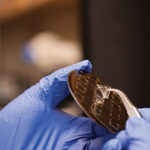
THE BODY ELECTRIC
Monitoring significant developments in a patient’s health outside a hospital can be challenging, but two UMBC researchers – Tinoosh Mohsenin and Gymama Slaughter – have won separate grants from the National Science Foundation (NSF) to help meet those challenges.
Mohsenin received a $100,000 grant from the NSF to develop signal processing architecture to detect seizures. The award of $150,000 to Slaughter from the foundation was to pursue work on nanoelectric probe arrays.
When patients are in a hospital, they often are connected to a myriad of monitoring devices. Outside the hospital, however, it is more difficult to monitor for important warning signs of distress.
Research pursued by Mohsenin – an assistant professor of computer engineering at UMBC – aims to develop monitoring devices and systems as good as those provided in a hospital.
Mohsenin runs UMBC’s Energy Efficient High Performance Computing Lab. Working with professor of computer science and electrical engineering Tim Oates and researchers at the University of Maryland Medical Center, she is developing wearable monitors to detect when someone is having a seizure no matter where they are.
A wearable seizure monitoring and alerting system could provide greater independence for patients with epilepsy. The technology available at present is bulky and uncomfortable. “There are not very efficient devices for people who suffer from epilepsy or those people whose epilepsy cannot be treated with medication,” Mohsenin says.
What Mohsenin envisions is a monitor with a comfortable headband that would measure EEG signals, and an arm band that would contain an accelerometer and could measure other signals such as pulse.
Mohsenin and Oates are working on a variety of representations and machine learning algorithms to extract useful information from multi-physiological signals for such a device. The amount of computation the devices have to do is daunting, she says.
On the same floor of UMBC’s Information Technology and Engineering Building, Gymama Slaughter, an assistant professor of computer science and electrical engineering, is exploring how nanotechnology might produce a device that can monitor brain activity without risk.
A key problem in monitoring brain activity is physiological. To place brain monitors on a patient requires major surgery. It is a process fraught with peril.
In the Bioelectronics Lab she created from the ground up at UMBC, Slaughter is working in the nanoscale on artifacts so small they are at molecular or near molecular levels. The brain monitoring device she is working on is like a pyramid, literally one cubic millimeter in size with a tip pitch of 20 nanometers. (A millimeter is 4/100th of an inch.)
She is using gold for the device because it is an excellent electrical conductor, perfect for measuring electrical activity, and yet causes no adverse reaction in the body.
The neurosensors will collect data on brain activity, including what happens when a patient deals with Parkinson’s disease, strokes, epilepsy, brain damage, or Alzheimer’s.
“It might eventually measure how people behave,” says Slaughter, who also recently received a prestigious faculty early development award from the NSF. “What happens in the brain during anger, jealousy, or sadness?” It may also help understand researchers understand brain disorders such as obsessive compulsive disorder.
– Joel N. Shurkin
ON THE TRAIL OF TRUTH
 In 2008, Jeffrey Davis, associate professor and chair of UMBC’s department of political science, published Justice Across Borders: The Struggle for Human Rights in US Courts (Cambridge University Press). The book made a keen impression on the field. William J. Aceves, a professor at California Western School of Law, called Justice Across Borders “an indispensable and innovative contribution to the study of human rights and the growing literature on international justice.”
Davis’s new book, Seeking Human Rights Justice in Latin America: Truth, Extra-Territorial Courts, and the Process of Justice (Cambridge University Press), will likely cement his status as a leading figure in human rights studies. It is a compelling study of what Davis calls the “twisted path” that justice follows when survivors and families of victims of human rights abuses in countries like El Salvador, Guatemala and Peru come up against a “thicket of impunity” in their judicial systems at home and take their cases to courts and bodies outside their national borders.
Davis shows “how secret dossiers, moldy police files, and clandestine communiqués are being pieced together” to do battle with “the many-headed monster that obstructs the search for justice.” And the dozens of redacted CIA memos and State Department cables cited here give the volume a haunting quality. But the heart of Davis’ story is the restoration of human dignity that drives victims to pursue justice. “As long as that dignity remains unrestored,” Davis maintains, “the risk of more violence exists.”
Q: What you call “the right to truth” figures prominently in your argument. What is that?
A: The right to truth grew out of a demand by families of the disappeared to know the whereabouts and fates of their loved ones. Often the intent of human rights violators is to erase the victim from society and to create terror and anxiety among the survivors. Truth overturns this intent. Courts have recognized the right to truth to be a universal and fundamental human right, enshrined in treaties and customary international law, because without truth there can be no meaningful justice. The right obligates states to conduct a full investigation and inform the families about the violations committed against their loved ones as well as the motives for those violations. It also requires states to publicly reveal their findings and return the victim’s remains.
Q: One woman interviewed for the book observed that the process of justice was “not just about punishing the people responsible for these crimes but also about the way that we live our relationship with the dead and the disappeared.”
A: Too often we think of justice as a result – a guilty verdict or a prison sentence. When you look at those who work for human rights justice in places with entrenched impunity, you see that justice means something more – it is a process with many important steps along the way. Certainly, it might include a guilty verdict, but that’s only part of it. For victims and their families it also includes the experience of sitting in a courtroom and telling their story. It includes the official acceptance of the truth, public apologies, and the return of the victims’ remains, among other possible elements in a complex process.
– Danny Postel
POWER DOWN
 It has been close to two decades now since the concept of “e-government” began to sweep through city halls and county seats across the country. Proponents trumpeted the possibility that putting information and services online would revolutionize government, not only increasing its efficiency and effectiveness but spurring citizen input and activity in its proceedings.
Donald Norris – professor and chair of UMBC’s public policy department – didn’t believe the hype. Change comes slowly and incrementally in government organizations, he argues. He was downright skeptical about claims of a cyber-revolution in government.
But as a good social scientist, Norris knew his hunch was not enough. So he decided to research e-government further. In 2011, following up on his earlier e-government research, he conducted two nationwide surveys of local e-government in the United States, eventually writing about his findings with Christopher Reddick, professor and chair of the Department of Public Administration at the University of Texas at San Antonio.
What Norris and Reddick concluded was that American local governments did adopt e-government models and practices rapidly. The problem was that they weren’t using those tools to do much more than save paper that they once used for press releases, mailings, and manuals.
“There’s an awful lot of information that governments put out through the web, but it’s like a bulletin board,” Norris says. “You can go to it, you can look at it, and you can download it and that’s pretty much it.”
In an article published in the journal Public Administration Review (“Local E-Government in the United States: Transformation or Incremental Change?”), Norris and Reddick argued that a key promise of e-government advocates went unfulfilled because the movement has resulted in very little interactivity between governments and citizens. They also noted that few policy changes have occurred as a result of the e-government wave.
“The cyber-optimists said people will come flocking to governmental websites to get governmental data, to interact with governmental officials, and to learn about policy,” Norris observes. “People don’t do that. They get excited when there’s an exciting issue or candidate, or if somebody is going to build a gas station in their backyard, but most of the time people aren’t interested in interacting with government.”
Norris does see some positive changes from e-government, including easier and faster access to public information. Lengthy budget documents can now be obtained online (as can driver’s license renewals), and citizens can fire off opinions to city councilors or county executives by email in a matter of seconds.
“It’s improved efficiency,” Norris says. “It’s also lowered cost in some areas. If you can get people out of line and online, the amount of staffing that you have to have at the front desk is reduced.”
So what is the future of e-government in the United States? Norris says that based on current evidence, the revolution may have stalled.
“My prediction was that in 2020 it will look pretty much like it does today,” Norris asserts. “There will just be more of it. It will not be interactive or any more transactional than it is today.”
– Max Cole
STEPPING UP
 UMBC is known for the diversity of its student population – and the university is taking active steps to ensure that the ranks of its faculty become equally diverse.
One of the most exciting initiatives to make that happen is UMBC’s Postdoctoral Fellowship for Faculty Diversity – a two-year residence program that offers promising scholars who are committed to diversity in the academy substantial support to prepare them for possible tenure track appointments at UMBC.
Fellows selected for the program are provided with teaching and research mentors and encouraged to participate in multiple professional development opportunities across campus. Recipients also receive tangible support in the form of a stipend, health benefits, and additional funding for conference travel and the preparation of scholarly work.
“UMBC recognizes the challenges that American universities face in recruiting and supporting a diverse professoriate,” says President Freeman A. Hrabowski, III. “We are tackling that challenge head on through this fellowship, while also extending our commitment to inclusive excellence.”
The current cohort of three scholars recruited to the program in 2013 – Kara N. Hunt (media and communications studies), Rwany Sibaja (history) and Evelyn Kamaria Thomas (mathematics and statistics) – hope to follow in the footsteps of Viviana MacManus – a member of the 2011 cohort who was recently named as an assistant professor of gender and women’s studies at UMBC.
MacManus received her Ph.D. at the University of California, San Diego, in the department of literature in 2011, and she is delighted that her fellowship has led to the appointment.
“I feel welcome and wanted here,” observes MacManus. “The warm and supportive community within the department of gender and women’s studies was a major reason why I stayed at UMBC. I felt supported intellectually, community-wise on campus, and personally. I had the support that I needed to succeed.”
UMBC provost Philip Rous says that the fellowship is already starting to achieve its main goals, and that the university will select the next cohort of fellows for the program in the coming year.
“The program allows the UMBC community to benefit from the presence of outstanding young scholars who bring their diverse backgrounds and perspectives to invigorate our scholarship and enhance the education of our students,” says Rous. “We also believe that this program will help us attract to UMBC the next generation of outstanding faculty and to enhance the diversity of our scholarly community to better serve our students and our local and global communities.”
MacManus says that the support she received was also a key element in the transition from fellow to faculty member. “The fellowship gave me time and support to transition from graduate school to the faculty,” she says. “ I designed my own classes, but also had the time to do my own research. I learned how to balance that, which I think is hard for new faculty right out of graduate school.
“I think I’m super fortunate,” concludes MacManus. “I keep telling everyone that I think I won the jackpot.”
– Richard Byrne ’86
]]>
THE BODY ELECTRIC Monitoring significant developments in a patient’s health outside a hospital can be challenging, but two UMBC researchers – Tinoosh Mohsenin and Gymama Slaughter – have won...
https://umbc.edu/stories/discovery-winter-2014/
https://my3.my.umbc.edu/api/v0/pixel/news/122819/guest@my.umbc.edu/89424ed30b016208182aec709ed74faf/api/pixel
discovery
winter-2014
UMBC News & Magazine
https://my3.my.umbc.edu/groups/umbc-news-magazine
https://assets1-my.umbc.edu/system/shared/avatars/groups/000/001/943/24435aa6207c452e7bc15cc74b42c7bb/xsmall.png?1748556657
https://assets1-my.umbc.edu/system/shared/avatars/groups/000/001/943/24435aa6207c452e7bc15cc74b42c7bb/original.png?1748556657
https://assets2-my.umbc.edu/system/shared/avatars/groups/000/001/943/24435aa6207c452e7bc15cc74b42c7bb/xxlarge.png?1748556657
https://assets2-my.umbc.edu/system/shared/avatars/groups/000/001/943/24435aa6207c452e7bc15cc74b42c7bb/xlarge.png?1748556657
https://assets3-my.umbc.edu/system/shared/avatars/groups/000/001/943/24435aa6207c452e7bc15cc74b42c7bb/large.png?1748556657
https://assets1-my.umbc.edu/system/shared/avatars/groups/000/001/943/24435aa6207c452e7bc15cc74b42c7bb/medium.png?1748556657
https://assets2-my.umbc.edu/system/shared/avatars/groups/000/001/943/24435aa6207c452e7bc15cc74b42c7bb/small.png?1748556657
https://assets1-my.umbc.edu/system/shared/avatars/groups/000/001/943/24435aa6207c452e7bc15cc74b42c7bb/xsmall.png?1748556657
https://assets2-my.umbc.edu/system/shared/avatars/groups/000/001/943/24435aa6207c452e7bc15cc74b42c7bb/xxsmall.png?1748556657
UMBC News & Magazine
0
0
false
Mon, 17 Feb 2014 18:48:00 -0500
UMBC featured in The Baltimore Sun’s February Education Supplement
UMBC is featured in two articles in The Baltimore Sun’s February Education Supplement. Josh Massey, an interdisciplinary studies major, is profiled in an article titled “Tools of success” for his role in developing “Banana Bones,” a mobile campus navigation app to help students and visitors find their away across college campuses.
Massey and two of his fellow classmates, Andres Camacho and Hashem Kanfash, started the app as part of a class project that was later purchased by Tecor Networks. “None of us is really a techie,” said Massey, explaining why they didn’t produce the app themselves. “We knew we needed someone to help with the programming.”
UMBC’s Global Studies program is featured in an article titled “A global perspective,” which focuses on new programs that go beyond the traditional study abroad experience. Political Science Professor and Global Studies Program Director Devin Hagerty is quoted in the article describing the program, in which students are required to study abroad and take courses across several disciplines.
“This program is based on a global competence concept involving knowledge of other cultures and the ability to embrace change and learn about cultures outside your own environment. This way, if you are transferred to an office in Berlin or Stockholm, you will have the confidence to hit the ground running,” Hagerty said.
To read the full article featuring “Banana Bones,” click here. You can read the full article featuring the Global Studies program here.
]]>
UMBC is featured in two articles in The Baltimore Sun’s February Education Supplement. Josh Massey, an interdisciplinary studies major, is profiled in an article titled “Tools of success” for his...
https://umbc.edu/stories/umbc-featured-in-the-baltimore-suns-february-education-supplement/
https://my3.my.umbc.edu/api/v0/pixel/news/122820/guest@my.umbc.edu/f489b8afbf604d2671948a61da86517f/api/pixel
policy-and-society
UMBC News & Magazine
https://my3.my.umbc.edu/groups/umbc-news-magazine
https://assets1-my.umbc.edu/system/shared/avatars/groups/000/001/943/24435aa6207c452e7bc15cc74b42c7bb/xsmall.png?1748556657
https://assets1-my.umbc.edu/system/shared/avatars/groups/000/001/943/24435aa6207c452e7bc15cc74b42c7bb/original.png?1748556657
https://assets2-my.umbc.edu/system/shared/avatars/groups/000/001/943/24435aa6207c452e7bc15cc74b42c7bb/xxlarge.png?1748556657
https://assets2-my.umbc.edu/system/shared/avatars/groups/000/001/943/24435aa6207c452e7bc15cc74b42c7bb/xlarge.png?1748556657
https://assets3-my.umbc.edu/system/shared/avatars/groups/000/001/943/24435aa6207c452e7bc15cc74b42c7bb/large.png?1748556657
https://assets1-my.umbc.edu/system/shared/avatars/groups/000/001/943/24435aa6207c452e7bc15cc74b42c7bb/medium.png?1748556657
https://assets2-my.umbc.edu/system/shared/avatars/groups/000/001/943/24435aa6207c452e7bc15cc74b42c7bb/small.png?1748556657
https://assets1-my.umbc.edu/system/shared/avatars/groups/000/001/943/24435aa6207c452e7bc15cc74b42c7bb/xsmall.png?1748556657
https://assets2-my.umbc.edu/system/shared/avatars/groups/000/001/943/24435aa6207c452e7bc15cc74b42c7bb/xxsmall.png?1748556657
UMBC News & Magazine
0
0
false
Mon, 17 Feb 2014 18:47:19 -0500
NPR story about CS education
Should elementary school kids be coding already?
Check out today's NPR story on how important computer science and coding skills are for today's kids:
Marie
]]>
Check out today's NPR story on how important computer science and coding skills are for today's kids:...
https://my3.my.umbc.edu/api/v0/pixel/news/41453/guest@my.umbc.edu/bd8a0cf85e7fdaeb5a6728879011dfdd/api/pixel
Computer Science Education Club
https://my3.my.umbc.edu/groups/retired-692
https://assets4-my.umbc.edu/system/shared/avatars/groups/000/000/692/5be786c6b78d9bf1f3e31cac0735c929/xsmall.png?1534697909
https://assets2-my.umbc.edu/system/shared/avatars/groups/000/000/692/5be786c6b78d9bf1f3e31cac0735c929/original.png?1534697909
https://assets2-my.umbc.edu/system/shared/avatars/groups/000/000/692/5be786c6b78d9bf1f3e31cac0735c929/xxlarge.png?1534697909
https://assets4-my.umbc.edu/system/shared/avatars/groups/000/000/692/5be786c6b78d9bf1f3e31cac0735c929/xlarge.png?1534697909
https://assets3-my.umbc.edu/system/shared/avatars/groups/000/000/692/5be786c6b78d9bf1f3e31cac0735c929/large.png?1534697909
https://assets4-my.umbc.edu/system/shared/avatars/groups/000/000/692/5be786c6b78d9bf1f3e31cac0735c929/medium.png?1534697909
https://assets1-my.umbc.edu/system/shared/avatars/groups/000/000/692/5be786c6b78d9bf1f3e31cac0735c929/small.png?1534697909
https://assets4-my.umbc.edu/system/shared/avatars/groups/000/000/692/5be786c6b78d9bf1f3e31cac0735c929/xsmall.png?1534697909
https://assets4-my.umbc.edu/system/shared/avatars/groups/000/000/692/5be786c6b78d9bf1f3e31cac0735c929/xxsmall.png?1534697909
Computer Science Education
1
1
true
Mon, 17 Feb 2014 18:46:27 -0500
Changing Communities – Sherece West-Scantlebury ’07, Ph.D. PubPol

From an early age, Sherece West-Scantlebury ’07, Ph.D., public policy recalls being preoccupied by a single question: Why is this community the way it is?
It was a question that first took root in West-Scantlebury’s own childhood in Brookyn, where she was born to a single teenage mother and lived in public housing. Her family later moved to Baltimore, where they made ends meet on public assistance. In both places, West-Scantlebury recalls witnessing “the usual ills associated with public housing” – drug addiction, alcoholism, domestic violence and abuse. But she also remembers the working people with big dreams who seldom saw those dreams come to fruition.
“I just wanted to know how and why people lived – we lived – that way,” says West-Scantlebury. “It was just always something that drove me.”
Education was the start of her path to find answers. West-Scantlebury earned an undergraduate degree in public administration at Bowie State University, then obtained an Alfred P. Sloan Foundation Policy Institutes grant that led to a master’s degree in public policy from the Gerald R. Ford School at the University of Michigan.
West-Scantlebury wasn’t content with studying policy, however. She pursued a career in the nonprofit sector to help address fundamental social problems through targeted programs and investment in communities.
“I was born with the heart to affect social justice,” she says. “I didn’t choose philanthropy, it chose me.”
West-Scantlebury worked for twelve years as a program associate at Baltimore’s Annie E. Casey Foundation in Baltimore and worked on a doctorate at UMBC.
Even before obtaining her Ph.D., West-Scantlebury was named as president and CEO of the Louisiana-based Carrier Foundation. When Hurricane Katrina hit in 2005, she found herself helping lead (and eventually becoming the CEO) of the Louisiana Recovery Foundation, charged with the fair distribution of donations pouring into the governor’s office.
Two years later, West-Scantlebury was tapped to head the Winthrop Rockefeller Foundation in Little Rock, AR. The foundation’s mission is to improve the lives of all Arkansans by supporting education and economic development programs, and furthering the cause of racial, economic and social justice.
In 2012, the Winthrop Rockefeller Foundation oversaw more than $4.6 million in grants awarded to 65 different groups. West-Scantlebury says the foundation is focused on solving what she calls the “old and difficult problems that keep Arkansas in the bottom five [in the United States] on indicators of children and family well-being. I want us to be number one on those indicators one day.”
West-Scantlebury observes that the faculty staff and students in UMBC’s public policy department were all invested in her success as a nonprofit administrator. “There was great camaraderie, and a determination that we would all complete the program and make great contributions.”
The feeling of accomplishment is mutual, says Donald Norris, chair of the public policy department. Norris nominated West-Scantlebury for UMBC’s 2013 Outstanding Alumna of the Year award in the Social and Behavioral Sciences, which she received at Homecoming last year.
“Sherece’s excellent and effective career in public service and community leadership embodies the best of UMBC and demonstrates the best qualities of her graduate education,” says Norris.
West-Scantlebury has long moved past merely trying to answer her own question about why a community takes its shape. She says she is proud to work for a foundation that supports the demanding but essential long-term changes required to make Arkansas a better place, and help to engineer those changes through grants that target poverty reduction, education and community development.
The keys to success, says West-Scantlebury, are determination, collaboration and patience. “Collective action creates change, but it isn’t fast or easy,” she insists. “It’s about neighbor working with neighbor, but it’s also about sticking with it.”
– Michelle Gienow
]]>
From an early age, Sherece West-Scantlebury ’07, Ph.D., public policy recalls being preoccupied by a single question: Why is this community the way it is? It was a question that first took root...
https://umbc.edu/stories/changing-communities-sherece-west-scantlebury-07-ph-d-pubpol/
https://my3.my.umbc.edu/api/v0/pixel/news/122821/guest@my.umbc.edu/a5c020e4dad52a3a0faf8d3a3c55774e/api/pixel
alumni
winter-2014
UMBC News & Magazine
https://my3.my.umbc.edu/groups/umbc-news-magazine
https://assets1-my.umbc.edu/system/shared/avatars/groups/000/001/943/24435aa6207c452e7bc15cc74b42c7bb/xsmall.png?1748556657
https://assets1-my.umbc.edu/system/shared/avatars/groups/000/001/943/24435aa6207c452e7bc15cc74b42c7bb/original.png?1748556657
https://assets2-my.umbc.edu/system/shared/avatars/groups/000/001/943/24435aa6207c452e7bc15cc74b42c7bb/xxlarge.png?1748556657
https://assets2-my.umbc.edu/system/shared/avatars/groups/000/001/943/24435aa6207c452e7bc15cc74b42c7bb/xlarge.png?1748556657
https://assets3-my.umbc.edu/system/shared/avatars/groups/000/001/943/24435aa6207c452e7bc15cc74b42c7bb/large.png?1748556657
https://assets1-my.umbc.edu/system/shared/avatars/groups/000/001/943/24435aa6207c452e7bc15cc74b42c7bb/medium.png?1748556657
https://assets2-my.umbc.edu/system/shared/avatars/groups/000/001/943/24435aa6207c452e7bc15cc74b42c7bb/small.png?1748556657
https://assets1-my.umbc.edu/system/shared/avatars/groups/000/001/943/24435aa6207c452e7bc15cc74b42c7bb/xsmall.png?1748556657
https://assets2-my.umbc.edu/system/shared/avatars/groups/000/001/943/24435aa6207c452e7bc15cc74b42c7bb/xxsmall.png?1748556657
UMBC News & Magazine
0
0
false
Mon, 17 Feb 2014 18:46:25 -0500
Back Story – Winter 2014

Music is more than entertainment. It is woven inextricably into the fabric of our culture – and investigating that complex weave can tell us many things about ourselves. Theodore Gonzalves, an associate professor (and chair) of American studies and Michelle Scott, an associate professor of history, have both received Smithsonian Institution fellowships to study music’s cultural impact. They talked recently about why that research is so important.
UMBC Magazine: How can scholarship shape our understanding of music?
Theodore Gonzalves: Understanding music actually helps us to understand the kinds of questions we face as families, as nations and as communities. It’s a great way to learn about history, it’s a great way to learn about politics, about gender, about all sorts of things. What we have to do is get beyond the notion that music is just merely entertainment.
Michelle Scott: I would even flip the question around a little bit. I think music enhances the study of scholarship of pretty much any field. In my classroom there aren’t too many lectures where I don’t find some type of popular music to play to really enhance the lived experience of an era that we’re studying. If we’re going to talk about the Great Depression, we’re going to be hearing songs that will talk about the bread lines. I really think music gives voices to the voiceless.
What sort of cultural impact can music have?
Scott: Vaudeville happened in the 1920s and 1930s. So why are we still thinking about that? But those Vaudevillians then went into early motion pictures in Hollywood or into radio. Some of the formats of the skits followed into early television, and so a lot of the production part of Vaudeville we still see in contemporary entertainment.
Gonzalves: I see it in two different ways at least. One is to think about music as a metaphor for a mirror, another is a metaphor for a light. Mirrors can often just reflect exactly what is in front of you and music and art can do that. It can provide a realistic and graphic depiction of what’s in front of you. It may look like a fun house mirror, it may look a little strange, but a lot of art can reflect the conditions as artists and audiences see them. But music could also be a way to imagine a different world, a new world that doesn’t yet quite exist.
What’s going to change about music and how we study it?
Gonzalves: Music making continues to change. It is now digital and portable and it can be zapped around the world instantaneously. We have access to music in a way that we’ve never had access to it before. I hope we can separate out the signal from the noise. There are traditions that are slowly fading away as a result of not being actively recorded. Then there’s marketing that passes for music. There are billions to be made in terms of drawing eyeballs to certain commodities and it’s done under the guise of listening to music. We should be more critical and discerning listeners in terms of thinking about what are the histories and traditions that we should be learning from music itself.
Scott: Music connects you to a larger human world to look at issues of political protest, gender discrimination and racial violence and it makes it plain. You don’t have to be in an institution of higher learning to grasp it. You don’t have to be in the classroom. You can pick up your mp3 player, your radio, or podcast, and all of a sudden you’re filled with many more questions that you might not have the answers to, but you have the questions and a communal audience to talk about how you are going to solve some of these issues. It’s just a really wonderful gateway into some of life’s most fundamental questions.
– Max Cole
]]>
Music is more than entertainment. It is woven inextricably into the fabric of our culture – and investigating that complex weave can tell us many things about ourselves. Theodore Gonzalves, an...
https://umbc.edu/stories/back-story-winter-2014/
https://my3.my.umbc.edu/api/v0/pixel/news/122822/guest@my.umbc.edu/1c90d1e6ad48dc950055163eb5285e00/api/pixel
perspectives
winter-2014
UMBC News & Magazine
https://my3.my.umbc.edu/groups/umbc-news-magazine
https://assets1-my.umbc.edu/system/shared/avatars/groups/000/001/943/24435aa6207c452e7bc15cc74b42c7bb/xsmall.png?1748556657
https://assets1-my.umbc.edu/system/shared/avatars/groups/000/001/943/24435aa6207c452e7bc15cc74b42c7bb/original.png?1748556657
https://assets2-my.umbc.edu/system/shared/avatars/groups/000/001/943/24435aa6207c452e7bc15cc74b42c7bb/xxlarge.png?1748556657
https://assets2-my.umbc.edu/system/shared/avatars/groups/000/001/943/24435aa6207c452e7bc15cc74b42c7bb/xlarge.png?1748556657
https://assets3-my.umbc.edu/system/shared/avatars/groups/000/001/943/24435aa6207c452e7bc15cc74b42c7bb/large.png?1748556657
https://assets1-my.umbc.edu/system/shared/avatars/groups/000/001/943/24435aa6207c452e7bc15cc74b42c7bb/medium.png?1748556657
https://assets2-my.umbc.edu/system/shared/avatars/groups/000/001/943/24435aa6207c452e7bc15cc74b42c7bb/small.png?1748556657
https://assets1-my.umbc.edu/system/shared/avatars/groups/000/001/943/24435aa6207c452e7bc15cc74b42c7bb/xsmall.png?1748556657
https://assets2-my.umbc.edu/system/shared/avatars/groups/000/001/943/24435aa6207c452e7bc15cc74b42c7bb/xxsmall.png?1748556657
UMBC News & Magazine
0
0
false
Mon, 17 Feb 2014 18:44:42 -0500