Forget the Smoking Gun… – Gus Russo ’72

Catonsville resident Gus Russo ’72, political science is married to the mob. And to U.S. history. He is a writer and investigative reporter specializing in the shadowy netherworld of American crime and politics. Russo has worked on 15 television documentaries for major networks in the United States and elsewhere, and he is the author of seven books – including “Where Were You? America Remembers the JFK Assassination” (Lyons Press, 2013).
The 1960s and 1970s (when I was a student at UMBC) were not just defined by musical revolutions, but also by the tumult of politics and conspiracy – and the frantic efforts by public officials to keep secrets: Who killed JFK, MLK and RFK? Why were we in a senseless and seemingly endless war in Vietnam? Who ordered the Watergate break-in and what were the burglars after in the Democratic National Committee headquarters? What were all those silver discs people thought they saw in the sky?
In the 1980s, I gave up work as a musician to embark upon a journey to find answers to those sorts of questions as an investigative journalist. While it’s often portrayed as a glamorous profession, the skills and tools I employ are the same mundane ones that previous generations of gumshoes have relied upon: developing and working sources, skip-tracing (locating subjects), and obtaining documentary records from courts, real estate transactions, federal archives and law enforcement agencies.
Other than giving faster access to a small percentage of available records, the digital revolution hasn’t changed the work much. Investigative reporters rarely find their best stories online. The real truth (or as close as we can get to it) often lies buried in undigitized repositories of primary source documents, or in the closely guarded memories of the first-hand players and witnesses.
It’s often hard to win the trust of those actors and witnesses to history. It requires patience and perseverance, especially in the areas that most interest me: organized crime and intelligence agencies domestic and foreign. Old school wiseguys and retired spies don’t open up their vaults (or memories) just because you sent a nice email or even snail mail. I’ve sent Christmas presents, birthday presents, get-well cards, and funeral floral arrangements. (When I’m in the middle of a project, I have “Edible Arrangements” on speed dial.) I’ve hopped on countless planes, trains and autos to take someone out to dinner and slowly gain their trust. It often takes many months. In some cases, years.
But more often than not, determination pays off. When I flew to Chicago in 2000 to take ten members of former boss Sam Giancana’s family to dinner in a suburban restaurant infamous for its parking lot whackings, I thought I must have lost my mind. But it worked. The clan introduced me to many of Sam’s still-living friends and associates – a treasure trove of information for my then work-in-progress, The Outfit.
Then there is the paper trail – and the elusive “smoking gun” that everybody wants to find. But the truth is that document trolling is painstaking and boring 99 percent of the time. (I should know: Staff members at the National Archives have told me I’ve spent more hours there over the last 20 years than any other researcher.) And for every useful page, I’ve discarded a thousand others.
It’s also difficult to find the best documents. They certainly aren’t all at the National Archives. I’ve pulled FBI files from garages and attics of retired agents. My eyes have gone blurry pouring over faded real estate quitclaim deeds. I’ve begged Congressional committee chairmen to open up investigative files stored in the Library of Congress before the traditional 50-year lockdown date expires, and appealed FBI and CIA denials more times than I can count. When the FBI tried to tell me they only held 275 pages on the mob’s longtime fixer, Sidney Korshak, I hounded them for two years to obtain the rest of what I intuited they must possess. Eventually I was rewarded with 7,500 pages delivered to my doorstep at no charge. Maybe they felt guilty about the two-year runaround.
There was gold in those files, but there were no “smoking guns.” In fact, that concept should be erased from the minds of budding and seasoned journalists alike. The only “smoking gun” proof is the literal kind: a perpetrator caught holding one of them over the body of a victim. Nothing that dispositive can ever be found after the fact. Any document can be forged, any picture Photoshopped, and any witness mistaken or corrupted.
The seasoned investigative reporter knows that the more sensational the information you have, the more corroboration is needed so that one can arrive, at best, at an approximate truth based on a preponderance of evidence. If you require concrete proofs in your life, I suggest majoring in math. Otherwise you’ll be in for one major disappointment after another.
Serious investigative work – pounding the pavement, working the phones, and poring through over documents – can max out your stamina and your credit card. But it’s the only way I have been able to find answers to the questions that dog me about the shadow powers in our country.
Plus, you make some lasting human connections along the way. (What a concept!) In the week that I wrote this piece, I had phone calls from Sam Giancana’s daughter, Carlos Marcello’s son, the man who found Lee Harvey Oswald hiding in a Dallas theater after the Kennedy assassination, and two members of JFK’s Secret Service detail.
Often when these friends call or we visit in person, I feel sad for a generation that has been led to believe that all information, knowledge and wisdom reside inside in an invisible digital server or the “cloud.” It is a failure of my generation, which created and sold the myth, and it certainly doesn’t bode well for the future of my profession.
]]>
Catonsville resident Gus Russo ’72, political science is married to the mob. And to U.S. history. He is a writer and investigative reporter specializing in the shadowy netherworld of American...
https://umbc.edu/stories/forget-the-smoking-gun-gus-russo-72/
https://my3.my.umbc.edu/api/v0/pixel/news/122818/guest@my.umbc.edu/b7838c4e03609943faeaf7a853ae32c6/api/pixel
perspectives
winter-2014
UMBC News & Magazine
https://my3.my.umbc.edu/groups/umbc-news-magazine
https://assets1-my.umbc.edu/system/shared/avatars/groups/000/001/943/24435aa6207c452e7bc15cc74b42c7bb/xsmall.png?1748556657
https://assets1-my.umbc.edu/system/shared/avatars/groups/000/001/943/24435aa6207c452e7bc15cc74b42c7bb/original.png?1748556657
https://assets2-my.umbc.edu/system/shared/avatars/groups/000/001/943/24435aa6207c452e7bc15cc74b42c7bb/xxlarge.png?1748556657
https://assets2-my.umbc.edu/system/shared/avatars/groups/000/001/943/24435aa6207c452e7bc15cc74b42c7bb/xlarge.png?1748556657
https://assets3-my.umbc.edu/system/shared/avatars/groups/000/001/943/24435aa6207c452e7bc15cc74b42c7bb/large.png?1748556657
https://assets1-my.umbc.edu/system/shared/avatars/groups/000/001/943/24435aa6207c452e7bc15cc74b42c7bb/medium.png?1748556657
https://assets2-my.umbc.edu/system/shared/avatars/groups/000/001/943/24435aa6207c452e7bc15cc74b42c7bb/small.png?1748556657
https://assets1-my.umbc.edu/system/shared/avatars/groups/000/001/943/24435aa6207c452e7bc15cc74b42c7bb/xsmall.png?1748556657
https://assets2-my.umbc.edu/system/shared/avatars/groups/000/001/943/24435aa6207c452e7bc15cc74b42c7bb/xxsmall.png?1748556657
UMBC News & Magazine
0
0
false
Mon, 17 Feb 2014 18:49:36 -0500
Discovery – Winter 2014
THE BODY ELECTRIC
Monitoring significant developments in a patient’s health outside a hospital can be challenging, but two UMBC researchers – Tinoosh Mohsenin and Gymama Slaughter – have won separate grants from the National Science Foundation (NSF) to help meet those challenges.
Mohsenin received a $100,000 grant from the NSF to develop signal processing architecture to detect seizures. The award of $150,000 to Slaughter from the foundation was to pursue work on nanoelectric probe arrays.
When patients are in a hospital, they often are connected to a myriad of monitoring devices. Outside the hospital, however, it is more difficult to monitor for important warning signs of distress.
Research pursued by Mohsenin – an assistant professor of computer engineering at UMBC – aims to develop monitoring devices and systems as good as those provided in a hospital.
Mohsenin runs UMBC’s Energy Efficient High Performance Computing Lab. Working with professor of computer science and electrical engineering Tim Oates and researchers at the University of Maryland Medical Center, she is developing wearable monitors to detect when someone is having a seizure no matter where they are.
A wearable seizure monitoring and alerting system could provide greater independence for patients with epilepsy. The technology available at present is bulky and uncomfortable. “There are not very efficient devices for people who suffer from epilepsy or those people whose epilepsy cannot be treated with medication,” Mohsenin says.
What Mohsenin envisions is a monitor with a comfortable headband that would measure EEG signals, and an arm band that would contain an accelerometer and could measure other signals such as pulse.
Mohsenin and Oates are working on a variety of representations and machine learning algorithms to extract useful information from multi-physiological signals for such a device. The amount of computation the devices have to do is daunting, she says.
On the same floor of UMBC’s Information Technology and Engineering Building, Gymama Slaughter, an assistant professor of computer science and electrical engineering, is exploring how nanotechnology might produce a device that can monitor brain activity without risk.
A key problem in monitoring brain activity is physiological. To place brain monitors on a patient requires major surgery. It is a process fraught with peril.
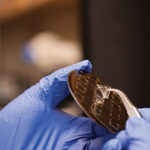
In the Bioelectronics Lab she created from the ground up at UMBC, Slaughter is working in the nanoscale on artifacts so small they are at molecular or near molecular levels. The brain monitoring device she is working on is like a pyramid, literally one cubic millimeter in size with a tip pitch of 20 nanometers. (A millimeter is 4/100th of an inch.)
She is using gold for the device because it is an excellent electrical conductor, perfect for measuring electrical activity, and yet causes no adverse reaction in the body.
The neurosensors will collect data on brain activity, including what happens when a patient deals with Parkinson’s disease, strokes, epilepsy, brain damage, or Alzheimer’s.
“It might eventually measure how people behave,” says Slaughter, who also recently received a prestigious faculty early development award from the NSF. “What happens in the brain during anger, jealousy, or sadness?” It may also help understand researchers understand brain disorders such as obsessive compulsive disorder.
– Joel N. Shurkin
ON THE TRAIL OF TRUTH
 In 2008, Jeffrey Davis, associate professor and chair of UMBC’s department of political science, published Justice Across Borders: The Struggle for Human Rights in US Courts (Cambridge University Press). The book made a keen impression on the field. William J. Aceves, a professor at California Western School of Law, called Justice Across Borders “an indispensable and innovative contribution to the study of human rights and the growing literature on international justice.”
Davis’s new book, Seeking Human Rights Justice in Latin America: Truth, Extra-Territorial Courts, and the Process of Justice (Cambridge University Press), will likely cement his status as a leading figure in human rights studies. It is a compelling study of what Davis calls the “twisted path” that justice follows when survivors and families of victims of human rights abuses in countries like El Salvador, Guatemala and Peru come up against a “thicket of impunity” in their judicial systems at home and take their cases to courts and bodies outside their national borders.
Davis shows “how secret dossiers, moldy police files, and clandestine communiqués are being pieced together” to do battle with “the many-headed monster that obstructs the search for justice.” And the dozens of redacted CIA memos and State Department cables cited here give the volume a haunting quality. But the heart of Davis’ story is the restoration of human dignity that drives victims to pursue justice. “As long as that dignity remains unrestored,” Davis maintains, “the risk of more violence exists.”
Q: What you call “the right to truth” figures prominently in your argument. What is that?
A: The right to truth grew out of a demand by families of the disappeared to know the whereabouts and fates of their loved ones. Often the intent of human rights violators is to erase the victim from society and to create terror and anxiety among the survivors. Truth overturns this intent. Courts have recognized the right to truth to be a universal and fundamental human right, enshrined in treaties and customary international law, because without truth there can be no meaningful justice. The right obligates states to conduct a full investigation and inform the families about the violations committed against their loved ones as well as the motives for those violations. It also requires states to publicly reveal their findings and return the victim’s remains.
Q: One woman interviewed for the book observed that the process of justice was “not just about punishing the people responsible for these crimes but also about the way that we live our relationship with the dead and the disappeared.”
A: Too often we think of justice as a result – a guilty verdict or a prison sentence. When you look at those who work for human rights justice in places with entrenched impunity, you see that justice means something more – it is a process with many important steps along the way. Certainly, it might include a guilty verdict, but that’s only part of it. For victims and their families it also includes the experience of sitting in a courtroom and telling their story. It includes the official acceptance of the truth, public apologies, and the return of the victims’ remains, among other possible elements in a complex process.
– Danny Postel
POWER DOWN
 It has been close to two decades now since the concept of “e-government” began to sweep through city halls and county seats across the country. Proponents trumpeted the possibility that putting information and services online would revolutionize government, not only increasing its efficiency and effectiveness but spurring citizen input and activity in its proceedings.
Donald Norris – professor and chair of UMBC’s public policy department – didn’t believe the hype. Change comes slowly and incrementally in government organizations, he argues. He was downright skeptical about claims of a cyber-revolution in government.
But as a good social scientist, Norris knew his hunch was not enough. So he decided to research e-government further. In 2011, following up on his earlier e-government research, he conducted two nationwide surveys of local e-government in the United States, eventually writing about his findings with Christopher Reddick, professor and chair of the Department of Public Administration at the University of Texas at San Antonio.
What Norris and Reddick concluded was that American local governments did adopt e-government models and practices rapidly. The problem was that they weren’t using those tools to do much more than save paper that they once used for press releases, mailings, and manuals.
“There’s an awful lot of information that governments put out through the web, but it’s like a bulletin board,” Norris says. “You can go to it, you can look at it, and you can download it and that’s pretty much it.”
In an article published in the journal Public Administration Review (“Local E-Government in the United States: Transformation or Incremental Change?”), Norris and Reddick argued that a key promise of e-government advocates went unfulfilled because the movement has resulted in very little interactivity between governments and citizens. They also noted that few policy changes have occurred as a result of the e-government wave.
“The cyber-optimists said people will come flocking to governmental websites to get governmental data, to interact with governmental officials, and to learn about policy,” Norris observes. “People don’t do that. They get excited when there’s an exciting issue or candidate, or if somebody is going to build a gas station in their backyard, but most of the time people aren’t interested in interacting with government.”
Norris does see some positive changes from e-government, including easier and faster access to public information. Lengthy budget documents can now be obtained online (as can driver’s license renewals), and citizens can fire off opinions to city councilors or county executives by email in a matter of seconds.
“It’s improved efficiency,” Norris says. “It’s also lowered cost in some areas. If you can get people out of line and online, the amount of staffing that you have to have at the front desk is reduced.”
So what is the future of e-government in the United States? Norris says that based on current evidence, the revolution may have stalled.
“My prediction was that in 2020 it will look pretty much like it does today,” Norris asserts. “There will just be more of it. It will not be interactive or any more transactional than it is today.”
– Max Cole
STEPPING UP
 UMBC is known for the diversity of its student population – and the university is taking active steps to ensure that the ranks of its faculty become equally diverse.
One of the most exciting initiatives to make that happen is UMBC’s Postdoctoral Fellowship for Faculty Diversity – a two-year residence program that offers promising scholars who are committed to diversity in the academy substantial support to prepare them for possible tenure track appointments at UMBC.
Fellows selected for the program are provided with teaching and research mentors and encouraged to participate in multiple professional development opportunities across campus. Recipients also receive tangible support in the form of a stipend, health benefits, and additional funding for conference travel and the preparation of scholarly work.
“UMBC recognizes the challenges that American universities face in recruiting and supporting a diverse professoriate,” says President Freeman A. Hrabowski, III. “We are tackling that challenge head on through this fellowship, while also extending our commitment to inclusive excellence.”
The current cohort of three scholars recruited to the program in 2013 – Kara N. Hunt (media and communications studies), Rwany Sibaja (history) and Evelyn Kamaria Thomas (mathematics and statistics) – hope to follow in the footsteps of Viviana MacManus – a member of the 2011 cohort who was recently named as an assistant professor of gender and women’s studies at UMBC.
MacManus received her Ph.D. at the University of California, San Diego, in the department of literature in 2011, and she is delighted that her fellowship has led to the appointment.
“I feel welcome and wanted here,” observes MacManus. “The warm and supportive community within the department of gender and women’s studies was a major reason why I stayed at UMBC. I felt supported intellectually, community-wise on campus, and personally. I had the support that I needed to succeed.”
UMBC provost Philip Rous says that the fellowship is already starting to achieve its main goals, and that the university will select the next cohort of fellows for the program in the coming year.
“The program allows the UMBC community to benefit from the presence of outstanding young scholars who bring their diverse backgrounds and perspectives to invigorate our scholarship and enhance the education of our students,” says Rous. “We also believe that this program will help us attract to UMBC the next generation of outstanding faculty and to enhance the diversity of our scholarly community to better serve our students and our local and global communities.”
MacManus says that the support she received was also a key element in the transition from fellow to faculty member. “The fellowship gave me time and support to transition from graduate school to the faculty,” she says. “ I designed my own classes, but also had the time to do my own research. I learned how to balance that, which I think is hard for new faculty right out of graduate school.
“I think I’m super fortunate,” concludes MacManus. “I keep telling everyone that I think I won the jackpot.”
– Richard Byrne ’86
]]>
THE BODY ELECTRIC Monitoring significant developments in a patient’s health outside a hospital can be challenging, but two UMBC researchers – Tinoosh Mohsenin and Gymama Slaughter – have won...
https://umbc.edu/stories/discovery-winter-2014/
https://my3.my.umbc.edu/api/v0/pixel/news/122819/guest@my.umbc.edu/89424ed30b016208182aec709ed74faf/api/pixel
discovery
winter-2014
UMBC News & Magazine
https://my3.my.umbc.edu/groups/umbc-news-magazine
https://assets1-my.umbc.edu/system/shared/avatars/groups/000/001/943/24435aa6207c452e7bc15cc74b42c7bb/xsmall.png?1748556657
https://assets1-my.umbc.edu/system/shared/avatars/groups/000/001/943/24435aa6207c452e7bc15cc74b42c7bb/original.png?1748556657
https://assets2-my.umbc.edu/system/shared/avatars/groups/000/001/943/24435aa6207c452e7bc15cc74b42c7bb/xxlarge.png?1748556657
https://assets2-my.umbc.edu/system/shared/avatars/groups/000/001/943/24435aa6207c452e7bc15cc74b42c7bb/xlarge.png?1748556657
https://assets3-my.umbc.edu/system/shared/avatars/groups/000/001/943/24435aa6207c452e7bc15cc74b42c7bb/large.png?1748556657
https://assets1-my.umbc.edu/system/shared/avatars/groups/000/001/943/24435aa6207c452e7bc15cc74b42c7bb/medium.png?1748556657
https://assets2-my.umbc.edu/system/shared/avatars/groups/000/001/943/24435aa6207c452e7bc15cc74b42c7bb/small.png?1748556657
https://assets1-my.umbc.edu/system/shared/avatars/groups/000/001/943/24435aa6207c452e7bc15cc74b42c7bb/xsmall.png?1748556657
https://assets2-my.umbc.edu/system/shared/avatars/groups/000/001/943/24435aa6207c452e7bc15cc74b42c7bb/xxsmall.png?1748556657
UMBC News & Magazine
0
0
false
Mon, 17 Feb 2014 18:48:00 -0500
UMBC featured in The Baltimore Sun’s February Education Supplement
UMBC is featured in two articles in The Baltimore Sun’s February Education Supplement. Josh Massey, an interdisciplinary studies major, is profiled in an article titled “Tools of success” for his role in developing “Banana Bones,” a mobile campus navigation app to help students and visitors find their away across college campuses.
Massey and two of his fellow classmates, Andres Camacho and Hashem Kanfash, started the app as part of a class project that was later purchased by Tecor Networks. “None of us is really a techie,” said Massey, explaining why they didn’t produce the app themselves. “We knew we needed someone to help with the programming.”
UMBC’s Global Studies program is featured in an article titled “A global perspective,” which focuses on new programs that go beyond the traditional study abroad experience. Political Science Professor and Global Studies Program Director Devin Hagerty is quoted in the article describing the program, in which students are required to study abroad and take courses across several disciplines.
“This program is based on a global competence concept involving knowledge of other cultures and the ability to embrace change and learn about cultures outside your own environment. This way, if you are transferred to an office in Berlin or Stockholm, you will have the confidence to hit the ground running,” Hagerty said.
To read the full article featuring “Banana Bones,” click here. You can read the full article featuring the Global Studies program here.
]]>
UMBC is featured in two articles in The Baltimore Sun’s February Education Supplement. Josh Massey, an interdisciplinary studies major, is profiled in an article titled “Tools of success” for his...
https://umbc.edu/stories/umbc-featured-in-the-baltimore-suns-february-education-supplement/
https://my3.my.umbc.edu/api/v0/pixel/news/122820/guest@my.umbc.edu/f489b8afbf604d2671948a61da86517f/api/pixel
policy-and-society
UMBC News & Magazine
https://my3.my.umbc.edu/groups/umbc-news-magazine
https://assets1-my.umbc.edu/system/shared/avatars/groups/000/001/943/24435aa6207c452e7bc15cc74b42c7bb/xsmall.png?1748556657
https://assets1-my.umbc.edu/system/shared/avatars/groups/000/001/943/24435aa6207c452e7bc15cc74b42c7bb/original.png?1748556657
https://assets2-my.umbc.edu/system/shared/avatars/groups/000/001/943/24435aa6207c452e7bc15cc74b42c7bb/xxlarge.png?1748556657
https://assets2-my.umbc.edu/system/shared/avatars/groups/000/001/943/24435aa6207c452e7bc15cc74b42c7bb/xlarge.png?1748556657
https://assets3-my.umbc.edu/system/shared/avatars/groups/000/001/943/24435aa6207c452e7bc15cc74b42c7bb/large.png?1748556657
https://assets1-my.umbc.edu/system/shared/avatars/groups/000/001/943/24435aa6207c452e7bc15cc74b42c7bb/medium.png?1748556657
https://assets2-my.umbc.edu/system/shared/avatars/groups/000/001/943/24435aa6207c452e7bc15cc74b42c7bb/small.png?1748556657
https://assets1-my.umbc.edu/system/shared/avatars/groups/000/001/943/24435aa6207c452e7bc15cc74b42c7bb/xsmall.png?1748556657
https://assets2-my.umbc.edu/system/shared/avatars/groups/000/001/943/24435aa6207c452e7bc15cc74b42c7bb/xxsmall.png?1748556657
UMBC News & Magazine
0
0
false
Mon, 17 Feb 2014 18:47:19 -0500
NPR story about CS education
Should elementary school kids be coding already?
Check out today's NPR story on how important computer science and coding skills are for today's kids:
Marie
]]>
Check out today's NPR story on how important computer science and coding skills are for today's kids:...
https://my3.my.umbc.edu/api/v0/pixel/news/41453/guest@my.umbc.edu/bd8a0cf85e7fdaeb5a6728879011dfdd/api/pixel
Computer Science Education Club
https://my3.my.umbc.edu/groups/retired-692
https://assets4-my.umbc.edu/system/shared/avatars/groups/000/000/692/5be786c6b78d9bf1f3e31cac0735c929/xsmall.png?1534697909
https://assets2-my.umbc.edu/system/shared/avatars/groups/000/000/692/5be786c6b78d9bf1f3e31cac0735c929/original.png?1534697909
https://assets2-my.umbc.edu/system/shared/avatars/groups/000/000/692/5be786c6b78d9bf1f3e31cac0735c929/xxlarge.png?1534697909
https://assets4-my.umbc.edu/system/shared/avatars/groups/000/000/692/5be786c6b78d9bf1f3e31cac0735c929/xlarge.png?1534697909
https://assets3-my.umbc.edu/system/shared/avatars/groups/000/000/692/5be786c6b78d9bf1f3e31cac0735c929/large.png?1534697909
https://assets4-my.umbc.edu/system/shared/avatars/groups/000/000/692/5be786c6b78d9bf1f3e31cac0735c929/medium.png?1534697909
https://assets1-my.umbc.edu/system/shared/avatars/groups/000/000/692/5be786c6b78d9bf1f3e31cac0735c929/small.png?1534697909
https://assets4-my.umbc.edu/system/shared/avatars/groups/000/000/692/5be786c6b78d9bf1f3e31cac0735c929/xsmall.png?1534697909
https://assets4-my.umbc.edu/system/shared/avatars/groups/000/000/692/5be786c6b78d9bf1f3e31cac0735c929/xxsmall.png?1534697909
Computer Science Education
1
1
true
Mon, 17 Feb 2014 18:46:27 -0500
Changing Communities – Sherece West-Scantlebury ’07, Ph.D. PubPol

From an early age, Sherece West-Scantlebury ’07, Ph.D., public policy recalls being preoccupied by a single question: Why is this community the way it is?
It was a question that first took root in West-Scantlebury’s own childhood in Brookyn, where she was born to a single teenage mother and lived in public housing. Her family later moved to Baltimore, where they made ends meet on public assistance. In both places, West-Scantlebury recalls witnessing “the usual ills associated with public housing” – drug addiction, alcoholism, domestic violence and abuse. But she also remembers the working people with big dreams who seldom saw those dreams come to fruition.
“I just wanted to know how and why people lived – we lived – that way,” says West-Scantlebury. “It was just always something that drove me.”
Education was the start of her path to find answers. West-Scantlebury earned an undergraduate degree in public administration at Bowie State University, then obtained an Alfred P. Sloan Foundation Policy Institutes grant that led to a master’s degree in public policy from the Gerald R. Ford School at the University of Michigan.
West-Scantlebury wasn’t content with studying policy, however. She pursued a career in the nonprofit sector to help address fundamental social problems through targeted programs and investment in communities.
“I was born with the heart to affect social justice,” she says. “I didn’t choose philanthropy, it chose me.”
West-Scantlebury worked for twelve years as a program associate at Baltimore’s Annie E. Casey Foundation in Baltimore and worked on a doctorate at UMBC.
Even before obtaining her Ph.D., West-Scantlebury was named as president and CEO of the Louisiana-based Carrier Foundation. When Hurricane Katrina hit in 2005, she found herself helping lead (and eventually becoming the CEO) of the Louisiana Recovery Foundation, charged with the fair distribution of donations pouring into the governor’s office.
Two years later, West-Scantlebury was tapped to head the Winthrop Rockefeller Foundation in Little Rock, AR. The foundation’s mission is to improve the lives of all Arkansans by supporting education and economic development programs, and furthering the cause of racial, economic and social justice.
In 2012, the Winthrop Rockefeller Foundation oversaw more than $4.6 million in grants awarded to 65 different groups. West-Scantlebury says the foundation is focused on solving what she calls the “old and difficult problems that keep Arkansas in the bottom five [in the United States] on indicators of children and family well-being. I want us to be number one on those indicators one day.”
West-Scantlebury observes that the faculty staff and students in UMBC’s public policy department were all invested in her success as a nonprofit administrator. “There was great camaraderie, and a determination that we would all complete the program and make great contributions.”
The feeling of accomplishment is mutual, says Donald Norris, chair of the public policy department. Norris nominated West-Scantlebury for UMBC’s 2013 Outstanding Alumna of the Year award in the Social and Behavioral Sciences, which she received at Homecoming last year.
“Sherece’s excellent and effective career in public service and community leadership embodies the best of UMBC and demonstrates the best qualities of her graduate education,” says Norris.
West-Scantlebury has long moved past merely trying to answer her own question about why a community takes its shape. She says she is proud to work for a foundation that supports the demanding but essential long-term changes required to make Arkansas a better place, and help to engineer those changes through grants that target poverty reduction, education and community development.
The keys to success, says West-Scantlebury, are determination, collaboration and patience. “Collective action creates change, but it isn’t fast or easy,” she insists. “It’s about neighbor working with neighbor, but it’s also about sticking with it.”
– Michelle Gienow
]]>
From an early age, Sherece West-Scantlebury ’07, Ph.D., public policy recalls being preoccupied by a single question: Why is this community the way it is? It was a question that first took root...
https://umbc.edu/stories/changing-communities-sherece-west-scantlebury-07-ph-d-pubpol/
https://my3.my.umbc.edu/api/v0/pixel/news/122821/guest@my.umbc.edu/a5c020e4dad52a3a0faf8d3a3c55774e/api/pixel
alumni
winter-2014
UMBC News & Magazine
https://my3.my.umbc.edu/groups/umbc-news-magazine
https://assets1-my.umbc.edu/system/shared/avatars/groups/000/001/943/24435aa6207c452e7bc15cc74b42c7bb/xsmall.png?1748556657
https://assets1-my.umbc.edu/system/shared/avatars/groups/000/001/943/24435aa6207c452e7bc15cc74b42c7bb/original.png?1748556657
https://assets2-my.umbc.edu/system/shared/avatars/groups/000/001/943/24435aa6207c452e7bc15cc74b42c7bb/xxlarge.png?1748556657
https://assets2-my.umbc.edu/system/shared/avatars/groups/000/001/943/24435aa6207c452e7bc15cc74b42c7bb/xlarge.png?1748556657
https://assets3-my.umbc.edu/system/shared/avatars/groups/000/001/943/24435aa6207c452e7bc15cc74b42c7bb/large.png?1748556657
https://assets1-my.umbc.edu/system/shared/avatars/groups/000/001/943/24435aa6207c452e7bc15cc74b42c7bb/medium.png?1748556657
https://assets2-my.umbc.edu/system/shared/avatars/groups/000/001/943/24435aa6207c452e7bc15cc74b42c7bb/small.png?1748556657
https://assets1-my.umbc.edu/system/shared/avatars/groups/000/001/943/24435aa6207c452e7bc15cc74b42c7bb/xsmall.png?1748556657
https://assets2-my.umbc.edu/system/shared/avatars/groups/000/001/943/24435aa6207c452e7bc15cc74b42c7bb/xxsmall.png?1748556657
UMBC News & Magazine
0
0
false
Mon, 17 Feb 2014 18:46:25 -0500
Back Story – Winter 2014

Music is more than entertainment. It is woven inextricably into the fabric of our culture – and investigating that complex weave can tell us many things about ourselves. Theodore Gonzalves, an associate professor (and chair) of American studies and Michelle Scott, an associate professor of history, have both received Smithsonian Institution fellowships to study music’s cultural impact. They talked recently about why that research is so important.
UMBC Magazine: How can scholarship shape our understanding of music?
Theodore Gonzalves: Understanding music actually helps us to understand the kinds of questions we face as families, as nations and as communities. It’s a great way to learn about history, it’s a great way to learn about politics, about gender, about all sorts of things. What we have to do is get beyond the notion that music is just merely entertainment.
Michelle Scott: I would even flip the question around a little bit. I think music enhances the study of scholarship of pretty much any field. In my classroom there aren’t too many lectures where I don’t find some type of popular music to play to really enhance the lived experience of an era that we’re studying. If we’re going to talk about the Great Depression, we’re going to be hearing songs that will talk about the bread lines. I really think music gives voices to the voiceless.
What sort of cultural impact can music have?
Scott: Vaudeville happened in the 1920s and 1930s. So why are we still thinking about that? But those Vaudevillians then went into early motion pictures in Hollywood or into radio. Some of the formats of the skits followed into early television, and so a lot of the production part of Vaudeville we still see in contemporary entertainment.
Gonzalves: I see it in two different ways at least. One is to think about music as a metaphor for a mirror, another is a metaphor for a light. Mirrors can often just reflect exactly what is in front of you and music and art can do that. It can provide a realistic and graphic depiction of what’s in front of you. It may look like a fun house mirror, it may look a little strange, but a lot of art can reflect the conditions as artists and audiences see them. But music could also be a way to imagine a different world, a new world that doesn’t yet quite exist.
What’s going to change about music and how we study it?
Gonzalves: Music making continues to change. It is now digital and portable and it can be zapped around the world instantaneously. We have access to music in a way that we’ve never had access to it before. I hope we can separate out the signal from the noise. There are traditions that are slowly fading away as a result of not being actively recorded. Then there’s marketing that passes for music. There are billions to be made in terms of drawing eyeballs to certain commodities and it’s done under the guise of listening to music. We should be more critical and discerning listeners in terms of thinking about what are the histories and traditions that we should be learning from music itself.
Scott: Music connects you to a larger human world to look at issues of political protest, gender discrimination and racial violence and it makes it plain. You don’t have to be in an institution of higher learning to grasp it. You don’t have to be in the classroom. You can pick up your mp3 player, your radio, or podcast, and all of a sudden you’re filled with many more questions that you might not have the answers to, but you have the questions and a communal audience to talk about how you are going to solve some of these issues. It’s just a really wonderful gateway into some of life’s most fundamental questions.
– Max Cole
]]>
Music is more than entertainment. It is woven inextricably into the fabric of our culture – and investigating that complex weave can tell us many things about ourselves. Theodore Gonzalves, an...
https://umbc.edu/stories/back-story-winter-2014/
https://my3.my.umbc.edu/api/v0/pixel/news/122822/guest@my.umbc.edu/1c90d1e6ad48dc950055163eb5285e00/api/pixel
perspectives
winter-2014
UMBC News & Magazine
https://my3.my.umbc.edu/groups/umbc-news-magazine
https://assets1-my.umbc.edu/system/shared/avatars/groups/000/001/943/24435aa6207c452e7bc15cc74b42c7bb/xsmall.png?1748556657
https://assets1-my.umbc.edu/system/shared/avatars/groups/000/001/943/24435aa6207c452e7bc15cc74b42c7bb/original.png?1748556657
https://assets2-my.umbc.edu/system/shared/avatars/groups/000/001/943/24435aa6207c452e7bc15cc74b42c7bb/xxlarge.png?1748556657
https://assets2-my.umbc.edu/system/shared/avatars/groups/000/001/943/24435aa6207c452e7bc15cc74b42c7bb/xlarge.png?1748556657
https://assets3-my.umbc.edu/system/shared/avatars/groups/000/001/943/24435aa6207c452e7bc15cc74b42c7bb/large.png?1748556657
https://assets1-my.umbc.edu/system/shared/avatars/groups/000/001/943/24435aa6207c452e7bc15cc74b42c7bb/medium.png?1748556657
https://assets2-my.umbc.edu/system/shared/avatars/groups/000/001/943/24435aa6207c452e7bc15cc74b42c7bb/small.png?1748556657
https://assets1-my.umbc.edu/system/shared/avatars/groups/000/001/943/24435aa6207c452e7bc15cc74b42c7bb/xsmall.png?1748556657
https://assets2-my.umbc.edu/system/shared/avatars/groups/000/001/943/24435aa6207c452e7bc15cc74b42c7bb/xxsmall.png?1748556657
UMBC News & Magazine
0
0
false
Mon, 17 Feb 2014 18:44:42 -0500
At Play – Winter 2014

GOALS ORIENTED
Both the women’s and men’s soccer squads can look back on 2013 as an amazing journey – breaking new ground for UMBC’s athletics program while proving that winners on the field can also excel in academics.
Both UMBC soccer teams won the America East regular season and conference championships – and claimed bids to the NCAA tournament with decisive victories in front of home fans at Retriever Soccer Park.
Expectations were high for the men’s squad going into the season, and they were fulfilled when the team won its NCAA bid – and the right to host the university’s first-ever home game in the tournament – with resounding 4-0 victory against the University of Hartford.
The Retriever men compiled a 16-1-3 record in 2013 and rose to fifth in national soccer polls. Their season ended after a 2-2 see-saw second-round NCAA tournament game against the University of Connecticut that ended with the Retrievers bowing out on penalty kicks.
The story of the Retriever women’s soccer team was even more astonishing. Its appearance in the NCAA Tournament capped off a reversal of fortune that saw the squad go from last place in the America East conference to first place in 2013, earning a 13-6-2 record, a regular season title and a conference tournament championship along the way.
The women’s team bested Stony Brook University 2-1 in the America East title game to earn its bid to the NCAA tournament, but their season ended with a hard-fought 2-0 loss in the first round to the fourth-ranked team in the nation – Virginia Tech – in Blacksburg, VA.
UMBC’s soccer success netted players and coaches numerous honors from the America East conference. Men’s head coach Pete Caringi, Jr. and his staff were voted by the league’s coaches as the Coaching Staff of the Year. Three of the team’s players also received the league’s highest honors, including senior forward Pete Caringi, III (Striker of the Year); senior midfielder Kadeem Dacres (Midfielder of the Year) and junior fullback Oumar Ballo (Defender of the Year).
Women’s head coach Leslie Wray and her staff received the Coaching Staff of the Year award from the America East conference, while junior midfielder Jessy Brown shared Midfielder of the Year honors with Hartford University’s Stephanie Santos. (Brown was also named as the MVP of the America East tournament.)
Both teams also matched their success between the lines with excellence in the classroom. In the most recent College Team Academic Awards given by the National College Coaches Association for the 2011-2012 seasons, UMBC was among only 150 schools where both the men’s and women’s teams received this honor for having cumulative team grade point averages at 3.0 or higher.
And as the America East conference gave out its individual honors, both women’s team standout Jessy Brown (who has a 3.70 GPA in biological sciences) and junior midfielder Michael DiCesare (who scored the only goal in the November 6 win that clinched the men’s regular season title for UMBC) were also named to the America East’s All-Academic team.
– Richard Byrne ’ 86
DEGREE OF INSPIRATION
 With its many indie performances and off-beat exhibits, Baltimore is quickly becoming a city known for its art scene. Katie Kopajtic ’11, acting, is catching that process in real time in b.f.a. – an original web series featuring other recent UMBC graduates (many of whom were involved in the UMBC Theatre Department’s award-winning 2011 production of Las Meninas).
“We were inspired by local artists doing big things,” Kopajtic explains. “We wanted to show what’s going on in Baltimore’s art scene in a way that parallels real life.”
The seriesfollows a group of friends as they try to navigate the acting world after graduation. The cast and crew filmed a pilot episode, but Kopajtic – who serves as writer, director and producer, and also acts in the series – knew the homegrown project would need significant funding to continue to its conclusion.
“We had to think about what it would take to film an entire season,” she says. “Things like rentals and even post-production costs like editing—those add up fast.”
So the b.f.a. team launched a crowdfunding campaign on Indiegogo, eventually raising $7,000 toward a full series production budget of $10,000. Kiirstn Pagan ‘11, theatre, who served as the project’s marketing director, observes that the cast and crew were brought into the creative side of the project as the fundraising was ongoing.
“All of the cast members ended up being very involved in the writing process,” Pagan says. “We had multiple meetings over the summer to go over Katie’s scripts, where everyone was able to help mold the story, making it more interesting, funny, and compelling.”
After a June premiere of the pilot episode at Creative Alliance in Highlandtown, Kopajtic and her cast and crew were able to schedule the final round of filming on a reduced budget beginning in August.
“It was disappointing, but we came to terms with it,” says Kopajtic. “We learned to cut costs without cutting corners.”
The b.f.a. team found low-and-no-cost shooting locations (including Joe Squared and Ottobar) to stretch that budget, and they collaborated with Station North Arts and Entertainment and the Annex Theatre to use the set and lights at a new city arts space called The Chicken Box.
Sean McComas ‘11, acting BFA, says the opportunity to stretch his skill set from theatre into film was an unexpected perk of his involvement in b.f.a.
“In theater, you are always following a character’s journey from start to finish,” McComas explains. “You may rehearse out of sequence, but in performance you actually go on a journey. In film, that is not the case.”
Filming wrapped in November, and the new episodes debuted online every two weeks through late fall. Kopajtic hopes to expand the series into a feature-length film, but she believes that b.f.a. is already achieving its goal: showcase Baltimore and the people who live and work there.
“b.f.a is a glimpse into the real lives of artists,” she says. “It shows people working hard, struggling to put themselves out there. That’s Baltimore. That’s what we do.”
– Laura Lefavor ‘13
To watch b.f.a., go to bfatheseries.com.
BANG THE DRUM
 Every band needs a beat. And the heartbeat of the Down and Dirty Dawg Band – UMBC’s provider of musical pep at athletics events and other campus commemorations – is the UMBC drumline.
A fixture at Midnight Madness, athletic events and in local parades, the drumline began a little more than three years ago, when Eddy Mosenkis ’13, biological science, rounded up two other students – Will Gass ’13, business, and Cody Kenlak ’14 – to add to the musical ensemble.
For a year, they shared playing time and equipment with the Down and Dirty Dawg Band. But it didn’t take long for band director Matt Basch to recognize they’d make a great addition to his ensemble.
Merging their efforts with those of the Down and Dirty Dawg Band in 2011 boosted the drumline’s funding and proved to be a boon to its recruitment efforts, allowing the percussionists to get bigger and better.
Basch has lived and breathed drumline since he first heard one as a freshman in high school. He was hooked immediately and joined as a high school sophomore. The hard work, discipline and athleticism of drumline are something he wants others to experience at UMBC as well.
Mosenkis says the drumline and the Down and Dirty Dawg band expanded his horizons as a musician.
“It was truly an experience that has broadened my personality as the years progressed,” he observes. And it’s still an important fixture in Mosenkis’ life. “I come back to visit them as often as I can. I like remaining up-to-date on how they’re doing.”
– Katharine Scrivener
]]>
GOALS ORIENTED Both the women’s and men’s soccer squads can look back on 2013 as an amazing journey – breaking new ground for UMBC’s athletics program while proving that winners on the field...
https://umbc.edu/stories/at-play-winter-2014/
https://my3.my.umbc.edu/api/v0/pixel/news/122823/guest@my.umbc.edu/67ad9b4accbe9bee5fc56a1397e44d92/api/pixel
campus-life
winter-2014
UMBC News & Magazine
https://my3.my.umbc.edu/groups/umbc-news-magazine
https://assets1-my.umbc.edu/system/shared/avatars/groups/000/001/943/24435aa6207c452e7bc15cc74b42c7bb/xsmall.png?1748556657
https://assets1-my.umbc.edu/system/shared/avatars/groups/000/001/943/24435aa6207c452e7bc15cc74b42c7bb/original.png?1748556657
https://assets2-my.umbc.edu/system/shared/avatars/groups/000/001/943/24435aa6207c452e7bc15cc74b42c7bb/xxlarge.png?1748556657
https://assets2-my.umbc.edu/system/shared/avatars/groups/000/001/943/24435aa6207c452e7bc15cc74b42c7bb/xlarge.png?1748556657
https://assets3-my.umbc.edu/system/shared/avatars/groups/000/001/943/24435aa6207c452e7bc15cc74b42c7bb/large.png?1748556657
https://assets1-my.umbc.edu/system/shared/avatars/groups/000/001/943/24435aa6207c452e7bc15cc74b42c7bb/medium.png?1748556657
https://assets2-my.umbc.edu/system/shared/avatars/groups/000/001/943/24435aa6207c452e7bc15cc74b42c7bb/small.png?1748556657
https://assets1-my.umbc.edu/system/shared/avatars/groups/000/001/943/24435aa6207c452e7bc15cc74b42c7bb/xsmall.png?1748556657
https://assets2-my.umbc.edu/system/shared/avatars/groups/000/001/943/24435aa6207c452e7bc15cc74b42c7bb/xxsmall.png?1748556657
UMBC News & Magazine
0
0
false
Mon, 17 Feb 2014 18:42:40 -0500
Donald Norris, Public Policy, in The Washington Times
A recent article in The Washington Times reviews states that have experienced glitches after rolling out health exchange websites as part of the Affordable Care Act. The article mentions the Maryland website which experienced software defects, causing state officials to offer retroactive coverage to users who couldn’t purchase plans in time for the start of the new year.

In the article, Public Policy Professor and Chair Donald Norris offered insight into how the health exchange website problems could affect the upcoming Democratic primary in the race for governor. He said Lt. Gov. Anthony Brown will likely win despite being the target of criticism for the website’s problems.
“If he does win and the website continues to have problems the GOP nominee, whoever that is, will certainly use [Obamacare issues] against him, though I can’t imagine that that alone would cause him to lose,” Norris said.
To read the full article in The Washington Times, click here.
]]>
A recent article in The Washington Times reviews states that have experienced glitches after rolling out health exchange websites as part of the Affordable Care Act. The article mentions the...
https://umbc.edu/stories/donald-norris-public-policy-in-the-washington-times/
https://my3.my.umbc.edu/api/v0/pixel/news/122824/guest@my.umbc.edu/25f59874f92dea5a009911473eb062c6/api/pixel
arts-and-culture
cahss
publicpolicy
UMBC News & Magazine
https://my3.my.umbc.edu/groups/umbc-news-magazine
https://assets1-my.umbc.edu/system/shared/avatars/groups/000/001/943/24435aa6207c452e7bc15cc74b42c7bb/xsmall.png?1748556657
https://assets1-my.umbc.edu/system/shared/avatars/groups/000/001/943/24435aa6207c452e7bc15cc74b42c7bb/original.png?1748556657
https://assets2-my.umbc.edu/system/shared/avatars/groups/000/001/943/24435aa6207c452e7bc15cc74b42c7bb/xxlarge.png?1748556657
https://assets2-my.umbc.edu/system/shared/avatars/groups/000/001/943/24435aa6207c452e7bc15cc74b42c7bb/xlarge.png?1748556657
https://assets3-my.umbc.edu/system/shared/avatars/groups/000/001/943/24435aa6207c452e7bc15cc74b42c7bb/large.png?1748556657
https://assets1-my.umbc.edu/system/shared/avatars/groups/000/001/943/24435aa6207c452e7bc15cc74b42c7bb/medium.png?1748556657
https://assets2-my.umbc.edu/system/shared/avatars/groups/000/001/943/24435aa6207c452e7bc15cc74b42c7bb/small.png?1748556657
https://assets1-my.umbc.edu/system/shared/avatars/groups/000/001/943/24435aa6207c452e7bc15cc74b42c7bb/xsmall.png?1748556657
https://assets2-my.umbc.edu/system/shared/avatars/groups/000/001/943/24435aa6207c452e7bc15cc74b42c7bb/xxsmall.png?1748556657
UMBC News & Magazine
0
0
false
Mon, 17 Feb 2014 17:53:45 -0500
February PHA Woman of the Month
Our PHA Woman of the Month for February is Nicole Rangos!
Nicole is VP of Public Relations for PHA and Phi Sigma Sigma’s Sisterhood Development Chair.
Nicole is a junior Biology major with a Psychology minor. Nicole has been very active in helping with both fall and spring recruitment. She has been awesome with her position as VP of Public Relations for PHA. She always thinks of ways to get the word out about any events and reaches out to see if she can help with Recruitment. She is very reliable and always follows through with her job. For the past few weeks, Nicole disaffiliated from her membership in Phi Sigma Sigma to help with recruitment as a Rho Gamma. Nicole loved her experience, helping potential new members find their home in the UMBC Greek community.
Outside of Greek life, Nicole is a Teaching Assistant for Biology 141. This past summer she worked in a molecular biology lab at the University of Miami’s Miller School of Medicine, conducting research on axon regeneration.
Nicole is a truly dedicated sister and member of the PHA family.
Congratulations, Nicole!
]]>
Our PHA Woman of the Month for February is Nicole Rangos! Nicole is VP of Public Relations for PHA and Phi Sigma Sigma’s Sisterhood Development Chair. Nicole is a junior Biology major with a...
Photo
https://assets3-my.umbc.edu/system/shared/attachments/de0c59361f38d36f12e860773fcc1b7c/6a9bead8/news/000/041/452/21a38ed2ee0c2c081c31286d29db2acc/PHA Woman of the Month- Nicole Rangos.jpg?1392677047
https://my3.my.umbc.edu/api/v0/pixel/news/41452/guest@my.umbc.edu/5f65bb87d2f333dea2697b591edb3901/api/pixel
Panhellenic Association
https://my3.my.umbc.edu/groups/pha
https://assets4-my.umbc.edu/system/shared/avatars/groups/000/000/667/9a4e19be531cae41596cb24482ebe4c3/xsmall.png?1675695765
https://assets4-my.umbc.edu/system/shared/avatars/groups/000/000/667/9a4e19be531cae41596cb24482ebe4c3/original.png?1675695765
https://assets3-my.umbc.edu/system/shared/avatars/groups/000/000/667/9a4e19be531cae41596cb24482ebe4c3/xxlarge.png?1675695765
https://assets1-my.umbc.edu/system/shared/avatars/groups/000/000/667/9a4e19be531cae41596cb24482ebe4c3/xlarge.png?1675695765
https://assets4-my.umbc.edu/system/shared/avatars/groups/000/000/667/9a4e19be531cae41596cb24482ebe4c3/large.png?1675695765
https://assets1-my.umbc.edu/system/shared/avatars/groups/000/000/667/9a4e19be531cae41596cb24482ebe4c3/medium.png?1675695765
https://assets2-my.umbc.edu/system/shared/avatars/groups/000/000/667/9a4e19be531cae41596cb24482ebe4c3/small.png?1675695765
https://assets4-my.umbc.edu/system/shared/avatars/groups/000/000/667/9a4e19be531cae41596cb24482ebe4c3/xsmall.png?1675695765
https://assets4-my.umbc.edu/system/shared/avatars/groups/000/000/667/9a4e19be531cae41596cb24482ebe4c3/xxsmall.png?1675695765
Panhellenic Association
https://assets2-my.umbc.edu/system/shared/thumbnails/news/000/041/452/607553fe86411875fb0521a2f0b3430e/xxlarge.jpg?1392677068
https://assets3-my.umbc.edu/system/shared/thumbnails/news/000/041/452/607553fe86411875fb0521a2f0b3430e/xlarge.jpg?1392677068
https://assets3-my.umbc.edu/system/shared/thumbnails/news/000/041/452/607553fe86411875fb0521a2f0b3430e/large.jpg?1392677068
https://assets2-my.umbc.edu/system/shared/thumbnails/news/000/041/452/607553fe86411875fb0521a2f0b3430e/medium.jpg?1392677068
https://assets2-my.umbc.edu/system/shared/thumbnails/news/000/041/452/607553fe86411875fb0521a2f0b3430e/small.jpg?1392677068
https://assets1-my.umbc.edu/system/shared/thumbnails/news/000/041/452/607553fe86411875fb0521a2f0b3430e/xsmall.jpg?1392677068
https://assets1-my.umbc.edu/system/shared/thumbnails/news/000/041/452/607553fe86411875fb0521a2f0b3430e/xxsmall.jpg?1392677068
0
0
true
Mon, 17 Feb 2014 17:44:42 -0500
On the Road: A Website Offers Help Finding a Hotel Where You Can Light Up
A new website, Smoketel.com, books only smoking rooms at hotels around the world.


 ]]>
A new website, Smoketel.com, books only smoking rooms at hotels around the world.
http://www.nytimes.com/2014/02/18/business/a-website-offers-help-finding-a-hotel-where-you-can-light-up.html?partner=rss&emc=rss
https://my3.my.umbc.edu/api/v0/pixel/news/41465/guest@my.umbc.edu/14a258fc4bc888c0d6540fe8de8f7c09/api/pixel
expedia-inc-expe-nasdaq
hotels-and-travel-lodgings
marriott-international-inc-mar-nasdaq
new
smoketel-com
smoking-and-tobacco
technology
york
Web Developer - Build Group
https://my3.my.umbc.edu/groups/retired-583
https://assets3-my.umbc.edu/system/shared/avatars/groups/000/000/583/fc60f5d7abc2e080599bb6dc465db54d/xsmall.png?1363101197
https://assets4-my.umbc.edu/system/shared/avatars/groups/000/000/583/fc60f5d7abc2e080599bb6dc465db54d/original.jpg?1363101197
https://assets4-my.umbc.edu/system/shared/avatars/groups/000/000/583/fc60f5d7abc2e080599bb6dc465db54d/xxlarge.png?1363101197
https://assets4-my.umbc.edu/system/shared/avatars/groups/000/000/583/fc60f5d7abc2e080599bb6dc465db54d/xlarge.png?1363101197
https://assets3-my.umbc.edu/system/shared/avatars/groups/000/000/583/fc60f5d7abc2e080599bb6dc465db54d/large.png?1363101197
https://assets3-my.umbc.edu/system/shared/avatars/groups/000/000/583/fc60f5d7abc2e080599bb6dc465db54d/medium.png?1363101197
https://assets4-my.umbc.edu/system/shared/avatars/groups/000/000/583/fc60f5d7abc2e080599bb6dc465db54d/small.png?1363101197
https://assets3-my.umbc.edu/system/shared/avatars/groups/000/000/583/fc60f5d7abc2e080599bb6dc465db54d/xsmall.png?1363101197
https://assets4-my.umbc.edu/system/shared/avatars/groups/000/000/583/fc60f5d7abc2e080599bb6dc465db54d/xxsmall.png?1363101197
Web Developer - Build Group
0
0
true
Mon, 17 Feb 2014 17:34:58 -0500
]]>
A new website, Smoketel.com, books only smoking rooms at hotels around the world.
http://www.nytimes.com/2014/02/18/business/a-website-offers-help-finding-a-hotel-where-you-can-light-up.html?partner=rss&emc=rss
https://my3.my.umbc.edu/api/v0/pixel/news/41465/guest@my.umbc.edu/14a258fc4bc888c0d6540fe8de8f7c09/api/pixel
expedia-inc-expe-nasdaq
hotels-and-travel-lodgings
marriott-international-inc-mar-nasdaq
new
smoketel-com
smoking-and-tobacco
technology
york
Web Developer - Build Group
https://my3.my.umbc.edu/groups/retired-583
https://assets3-my.umbc.edu/system/shared/avatars/groups/000/000/583/fc60f5d7abc2e080599bb6dc465db54d/xsmall.png?1363101197
https://assets4-my.umbc.edu/system/shared/avatars/groups/000/000/583/fc60f5d7abc2e080599bb6dc465db54d/original.jpg?1363101197
https://assets4-my.umbc.edu/system/shared/avatars/groups/000/000/583/fc60f5d7abc2e080599bb6dc465db54d/xxlarge.png?1363101197
https://assets4-my.umbc.edu/system/shared/avatars/groups/000/000/583/fc60f5d7abc2e080599bb6dc465db54d/xlarge.png?1363101197
https://assets3-my.umbc.edu/system/shared/avatars/groups/000/000/583/fc60f5d7abc2e080599bb6dc465db54d/large.png?1363101197
https://assets3-my.umbc.edu/system/shared/avatars/groups/000/000/583/fc60f5d7abc2e080599bb6dc465db54d/medium.png?1363101197
https://assets4-my.umbc.edu/system/shared/avatars/groups/000/000/583/fc60f5d7abc2e080599bb6dc465db54d/small.png?1363101197
https://assets3-my.umbc.edu/system/shared/avatars/groups/000/000/583/fc60f5d7abc2e080599bb6dc465db54d/xsmall.png?1363101197
https://assets4-my.umbc.edu/system/shared/avatars/groups/000/000/583/fc60f5d7abc2e080599bb6dc465db54d/xxsmall.png?1363101197
Web Developer - Build Group
0
0
true
Mon, 17 Feb 2014 17:34:58 -0500


