    
|
|
|

 I ride UMBC Transit to work every day.
Yes, I’m likely helping reduce UMBC’s carbon footprint by doing so. But what I have found over the five years that I’ve been a rider is that the feeling of virtuousness is outweighed by the camaraderie I’ve found with my fellow riders.
For a little over four years, I battled the commute by DC Metro and MARC train with the hardy group of souls who ride the Halethorpe Line and the BWI/MARC Line. Students, faculty and staff together – braving the blustery winds at the Halethorpe MARC station, or the crowded trains and inevitable commuting delays.
When I moved closer to UMBC late in 2012, I switched over to the Catonsville Line and the Arbutus Line. These lines primarily serve the off-campus housing near the university – and the eager chatter of students in multiple languages reminds me not only how diverse our campus is, but just how far many people travel to get a UMBC education.
This issue of UMBC Magazine takes sustainability as its theme. One thing that has surprised me as we have assembled this issue is how hard the university is working to overcome the history and geography that made UMBC a primarily commuter campus through much of its existence. The campus is becoming more of a community as its residential student population grows. There are more ways than ever to get to campus without being one person in one car. And the university is also coordinating efforts to become more ecologically friendly in how we dispose of our waste, heat our classrooms and offices, and construct new buildings to more exacting environmental standards.
Another surprise has been the scope of research on campus devoted to sustainability. We’ve tackled some of this research in previous issues of UMBC Magazine, but had no problem filling more than half of the space we normally allot to features with stories about the ways that UMBC faculty are pondering just how to make our city and our planet a greener place.
The magazine that you hold in your hand is also playing its part in UMBC’s sustainability efforts. Before the first issue of UMBC Magazine was published, the university decided that it would be printed on paper that was at least 50 percent postconsumer recycled (Roland Cascades Opaque). According to our suppliers, the use of this paper preserves trees (139), cuts down on the creation of solid waste (6,542 pounds worth) and prevents the release of 12, 882 pounds of net greenhouse gases.
We hope you enjoy this issue of UMBC Magazine! And perhaps enjoy it more knowing the efforts we are making to harmonize its production with UMBC’s goals to be a greener university.
— Richard Byrne ’86
]]>
The torch has been passed at the College of Arts, Humanities and Social Sciences (CAHSS) – and it has been passed from one historian to another.
Scott E. Casper arrived on campus as the new dean of the CAHSS and professor of history in July, following John Jeffries, who retired and is now a professor emeritus of history and dean emeritus of the college.
Casper was the interim dean of the College of Liberal Arts at the University of Nevada, Reno and a professor of history at that university, serving as chair of the department and director of graduate studies. He was also chair of the university’s faculty senate.
UMBC’s new dean of CAHSS brings with him a distinguished record in teaching and research. Casper is the author of Sarah Johnson’s Mount Vernon: The Forgotten History of an American Shrine (Hill and Wang)and Constructing American Lives: Biography and Culture in Nineteenth-Century America (The University of North Carolina Press). He was named the University of Nevada, Reno Foundation Professor in 2010 and the Carnegie Endowment for the Advancement of Teaching/Council for Advancement and Support of Education Nevada Professor of the Year in 2008.
Casper received his A.B. in history from Princeton University in 1986; his M.A. and M. Phil. in American studies from Yale University in 1990; and his Ph.D. in American studies from Yale University in 1992.
– Richard Byrne ’86
Each year, the UMBC Alumni Association presents Outstanding Alumni of the Year Awards to honor alumni for their professional and personal achievements and service to the university.
The annual awards presentation ceremony – which will be held this year on Thursday, October 10 at the Albin O. Kuhn Library – is one of the highlights of UMBC Homecoming 2013.
This year’s awardees are:
Jeehye Yun ’97, computer science as Outstanding Alumnus of the Year in Engineering and Information Technology. Yun is CEO of Secured Sciences Group LLC – a successful information technology company headquartered in the bwtech@UMBC research park.
Ricardo Zwaig ’77, Spanish as Outstanding Alumnus of the Year in the Humanities. Zwaig was appointed as a district court judge in Howard County in 2010 by Governor Martin O’Malley. He was the first male Hispanic district court judge in Maryland.
Dr. Mary Loeken, M.S. ’80, biological sciences as Outstanding Alumna in the Natural and Mathematical Sciences. Loeken is a research investigator at Joslin Diabetes Center and an associate professor at Harvard Medical School whose research on diabetic pregnancy was featured in the Summer 2012 issue of UMBC Magazine.
Sherece West-Scantlebury, P.h.D. ’07, public policy as Outstanding Alumna in theSocial and Behavioral Sciences. West-Scantlebury is president and CEO of the Winthrop Rockefeller Foundation – a dynamic Midwestern philanthropic organization.
Brigitte Pribnow Moore ’05, acting as Outstanding Alumna in the Visual and Performing Arts. Moore is executive director of the Young Playwrights’ Theater in Washington, DC.
For more information about the awards and UMBC Homecoming 2013, visit our website: http://homecoming.umbc.edu/
– Jenny O’Grady and Richard Byrne ’86

Over the past two decades, UMBC has grown by leaps and bounds as a research institution – in size, in capacity for interdisciplinary collaboration, and in its continuing efforts to integrate undergraduates into the process of discovery. The task of the university’s new vice president for research, Karl V. Steiner, will be to continue and intensify that growth.
Steiner was hired to take the reins from Geoffrey Summers, a professor of physics at UMBC, who has retired after serving as vice president since 2008. Summers was also the founding dean of UMBC’s College of Natural and Mathematical Sciences in 2005.
In his previous position as senior associate provost for research development at the University of Delaware, Steiner fostered notable interdisciplinary collaborations among engineers, life scientists, social scientists, health scientists and other researchers. He was a professor in the electrical and computer engineering department and the biomedical engineering program, and served in a variety of other positions, including founding associate director of the Delaware Biotechnology Institute, executive director of the Center for Composite Materials, founding executive director of the Fraunhofer Research Center – Delaware, and president and founder of Lightweight Solutions, Inc.
Steiner received his Engineering Diploma in electrical engineering from the University of Applied Sciences in Braunschweig Wolfenbüttel, Germany, in 1983; his master’s degree in electrical engineering from the University of Delaware in 1989; and his Doktor Ingenieur in mechanical engineering from the Institute for Composite Materials (IVW) at the University of Kaiserslautern, Germany, in 1995. He is a co-holder of two patents, and has authored over 80 publications in prominent science, technology and engineering journals.
– Richard Byrne ’86

For the fourth year running, The Chronicle of Higher Education has named UMBC one of the best colleges in the nation for which to work. It was also the second year in a row that UMBC made the Chronicle’s “Honor Roll” for ranking highly across all categories in which faculty and staff across the country were asked to rate their workplaces.
The Chronicle results are based on responses from nearly 45,000 people at 300 institutions nationwide. UMBC received high ratings in seven categories, including collaborative governance, teaching environment and diversity.
But how do UMBC faculty and staff view UMBC in their own words? A recent survey conducted to prepare for the creation of the university’s new strategic plan (Our UMBC: A Strategic Plan for Advancing Excellence)is one place to look.
The survey of faculty, staff and students was conducted earlier this year as part of a year-long preparation to commence work on the new plan. A word cloud derived from responses of faculty and staff was presented at the university’s annual retreat in August (in the shape of a retriever, of course), revealing that among the words that came up most often were “engaged,” “diverse,” “collaborative,” “innovative,” “supportive,” “inclusive,” community” and “entrepreneurial.”
UMBC Provost Philip Rous also formally unveiled the strategic planning process at this year’s university retreat. The creation of the plan will unfold over the next two years and its implementation will coincide with UMBC’s 50th anniversary in 2016. You can find out more about Our UMBC: A Strategic Plan for Advancing Excellence by visiting www.umbc.edu/planning.
– Richard Byrne ’86
]]>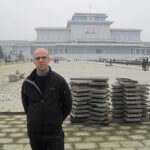
 Brian Souders ’09, Ph.D., language, literacy and culture, has directed UMBC’s Study Abroad program since 2000. His own travels and study have taken him to (among many locations) Finland and Russia, but Souders spent a week this past spring in one of the most secretive and closed-off nations in the world: North Korea.
Officially known as the Democratic People’s Republic of Korea (or DPRK), North Korea hosts only a few thousand tourists annually – and only a fraction of that number are Americans.
A week spent in North Korea in March is not a spring break trip to Cancún by any stretch of the imagination. Most group tours do not start with a two-hour orientation that involves each individual signing a statement that they are not a journalist trying to sneak into the country. Nor do most group tours elsewhere in the world have a long list of rules and regulations – no photographs of soldiers, scenes of poverty, strategic buildings or anything that could remotely be construed as a military target or a source of embarrassment to the North Korean government.
In exchange for our agreement to these conditions? We were to be accompanied at all times by guides from the North Korean state travel agency. No long strolls on your own across Kim Il Sung Square in the capital city of Pyongyang. In fact, there was no time scheduled for any individual activity. Our assigned guides could get into serious trouble were we to wander off.
The best way to describe the week I spent in North Korea is “time travel.” A journey back to my very first visit to the then-Soviet Union in 1982. At the time, I was a high school exchange student spending my junior year in Finland – and our program included a weekend trip to Leningrad (now St. Petersburg).
As was the case in Leningrad in the latter days of the Cold War, Pyongyang is devoid of any commercial advertising. The city is full of propaganda in support of the Korean Workers’ Party (North Korea’s Communist Party) and the Korean People’s Army. The same lantern-jawed proletarians depicted in Soviet propaganda posters also appeared in Pyongyang with Asian – instead of European – features.
Even more ubiquitous were images of the three men who have ruled North Korea since its founding in 1948: the Great Leader and Eternal President, Kim Il Sung (1948-1994); his son, the Dear Leader Kim Jong Il (1994-2012); and his grandson, current leader, Kim Jong Un.
In the 1980s, the cult of personality among Soviet leaders had largely vanished, with only founder Vladimir Lenin’s portrait still widely displayed. The cult of the Kim family, however, is inescapable – disseminated via posters and portraits in libraries, schools, public squares, and in every single car of the Pyongyang metro.
Our itinerary for the week also included visits to Mansu Hill (where statues of Kim Il Sung and Kim Jong Il tower over the square) and Kumsusan Palace of the Sun (where both men are buried). We also paid a five-hour visit to the International Friendship Exhibition Hall, a museum with an endless maze of corridors connecting rooms filled with the more than 90,000 gifts given to the Great Leader and the Dear Leader by a long list of dead dictators – including the late presidents of Iraq, Libya, Romania, the Soviet Union.
“If you were to spend one minute looking at each gift in this museum to the Eternal President and his son, the Dear Leader,” our guide told us as the tour commenced, “you could spend a year here.”
We exchanged silent glances of panic.
In March, the Korean Peninsula is swept by chilly winds from Siberia. But the contrast between South and North Korea in March is revealing.
When I visited South Korea in March 2012 to run the Seoul Marathon, I regularly had to open the windows in my overheated hotel room. But I rarely did so in North Korea – where hot water was sporadic, electricity intermittent (even in the capital) and indoor heating was not universal.
As our group headed into the Light Industry section of the Museum of the Three Revolutions during our trip, I had a bad feeling.
“Bundle up,” I told one of my fellow travelers. “We’re going inside.” We could see our own breath as we wandered from exhibition to exhibition.
I did catch a few memorable and unscripted glimpses of the country seen through the windows of our comfortable tour bus. The public face of Pyongyang glistened in comparison with empty, pothole-filled highways that wound past high-rise apartment rows marked by extreme poverty.
And I saw life beyond the city, too – glimpses of a stunning countryside where peasant farmers hacked through the snow-covered fields, following ox-powered plows in the bitter cold as they prepared for spring planting.
But was I able to experience the “real” North Korea? Our group never entered a regular shop or interacted with anyone other than roller-blading children at Kim Il Sung Stadium. We never touched (or even saw) North Korean currency.
The answer, sadly, is no.
]]>
Adam Grossman ’06, environmental science, and ’98, M.S., civil engineering, has always loved competition.
As an unheralded runner out of Pikesville High School, Grossman helped UMBC’s track and field program find success as a sprinter and member of the relay teams – and eventually earned a spot in the university’s Athletic Hall of Fame in 2011.
Five years after his last track meet, this former Retriever has found another – and even more high profile – way to continue his passion to compete.
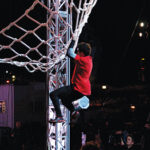
He’s a ninja.
Grossman discovered the TV show American Ninja Warrior by accident one night and quickly grew enamored with it. A video submission earned Grossman a spot on the NBC show in 2011, and he has made the competition cut for three straight years, earning his way through mandatory regional rounds to the show’s final round in Las Vegas in both 2012 and 2013.
The show’s grand prize is $500,000, but Grossman – who works for the U.S. Navy as an engineer with a focus on pollution prevention – doesn’t really expect to see that money.
“I do it for the camaraderie and the competition,” he says. “Even though I’m in shape and I’m pretty good at this, I see winning the $500,000 as kind of like winning the Lotto. I just like doing the things [on the show]. It’s so much fun.”
One of the centerpieces of American Ninja Warrior is a brutal four-stage obstacle course testing the strength and endurance of competitors in numerous ways. There are usually six to eight obstacles per stage with names such as “Quintuple Step,” “Warped Wall” and “Cliffhanger,” each of which requires a different skill set and approach. Contestants need to be well-rounded athletes, because failure in any single obstacle results in elimination.
Not surprisingly, finishing the obstacle course without failure for the first time in competition is Grossman’s favorite American Ninja Warrior memory. He did so in Miami last year during the preliminary round of the regional tryouts. Grossman had been eliminated the previous year when he lost his battle with the Warped Wall, and he’d been looking forward to a rematch. The wall loomed as the final obstacle in Miami and he was elated when made it to the top and hit the red buzzer signifying his completion of the course.
“It seemed pretty surreal,” Grossman said. “I got to do an interview with Angela Sun, the show’s sideline reporter, and then got to run by the audience and high-five everyone.”
Grossman now trains for American Ninja Warrior year-round at his home in Northern Virginia, teaming up with Mike Bernardo, another regular participant in the show whom he met at the finals in Las Vegas. They have jointly stepped up the intensity of their training and even go to local gyms that have elements found in various obstacles courses on the show. It is a specialized training that Grossman credits with improving his competition skills over the past year.
Being a ninja warrior has its costs, however. Grossman has to balance his job with his training and travel – and contestants must pay for expenses they incur at the regional level out of their own pocket. But Grossman doesn’t see himself quitting anytime soon.
“As long as the show gets renewed, I’m going back,” he says.
– Jeff Seidel ’85
]]>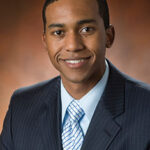
Isaac Kinde ’05, biological sciences, has a habit of surrounding himself with the right people.
As a high school student in Redlands, Calif., he ranked at the top of his class, applying to the top national research universities. Then, as a Meyerhoff Scholar at UMBC, he collaborated with like-minded undergraduate researchers to examine the molecular makeup of HIV. Now, in his eighth year of an M.D./Ph.D. program at the Johns Hopkins University, he works alongside some of the nation’s leading cancer researchers in the Sidney Kimmel Comprehensive Cancer Center.
“I never had a master plan for my life,” Kinde says. “I just remember thinking that being around the right people would be helpful. And, I think that’s been the common thread.”
Named one of Forbes magazine’s “30 Under 30” rising stars this year, Kinde’s research has focused on developing effective screening tests for cancer – specifically colon, pancreatic, and ovarian and endometrial cancers. He created a preliminary technology that can detect ovarian and endometrial cancers in women who exhibit no symptoms of the diseases.
Using samples collected during annual exams, Kinde and his team use this new technology to sequence the DNA and distinguish any genetic mutations that are precursors to these types of cancer. Kinde’s findings are particularly exciting because—for the first time—researchers are detecting cancers based on specific DNA alterations. (Current screening tests, which are not recommended for general use due to their ineffectiveness, only study cancerous cells versus normal cells.)
Since Kinde began working in the Ludwig Center for Cancer Genetics & Therapeutics, which is part of the Kimmel Center, he has co-authored six articles in publications including Science Translational Medicine, Nature, and PLoS One. His advisor, Dr. Bert Vogelstein, director of the Ludwig Center and a professor of oncology and pathology, recalls being “immediately impressed with Isaac’s curiosity, earnestness, and intelligence.”
That strong first impression led Vogelstein to do something he admits that he rarely if ever does: reserve a space for Kinde in his laboratory, where the UMBC alumnus has joined the ranks of an ambitious group of researchers tackling some of the world’s biggest public-health issues.
Some of Kinde’s earliest exposures to medical research occurred in the laboratory of Michael Summers, a professor of chemistry and biochemistry at UMBC and a Howard Hughes Medical Institute investigator. Kinde worked with Summers on designing a new class of HIV inhibitors, examining a part of the virus that hadn’t been targeted before.
“I was close to working 40 hours a week [in the lab] and even more during the summer and winter breaks,” Kinde says. “And I just remember really loving what I was doing.”
In August, Kinde will begin the final stages of what will be a ten-year journey. He’s already completed the first two years of medical school and will now move through two-month rotations across a variety of departments such as medicine, surgery, and obstetrics and gynecology. After completing these required rotations (and finishing medical school), he’ll choose a specialty for his residency.
But Kinde says that UMBC – and the Meyerhoff Scholars Program in particular – have helped shape his remarkable trajectory.
“The Meyerhoff Program is one big family,” says Kinde. “It provides the mentorship you need and surrounds you with like-minded people who also want to succeed. And it has a proven track record of producing very successful people.”
Count Isaac Kinde as one of them – with even greater successes on the horizon.
– B. Rose Huber
]]>
 With Kristin Schenning ’15, Mimi Dietrich ’70, and Vickie Greisman ’13
By Meredith Purvis
Americans take immense pride in their flag. The simple rectangle of red, white and blue fabric sewn together is a national symbol that helps knit Americans together as a people. But how much does the average person know about the actual flag that “Star Spangled Banner” author Francis Scott Key saw flying over Fort McHenry during the War of 1812?
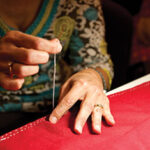
Kristin Schenning, a UMBC graduate student and the education director for the Maryland State Historical Society, and a team of volunteers want to help Americans reconnect with that fabled pastby creating a full-sized replica of the famous flag. The project is called: “Stitching History: Recreating the Star Spangled Banner Flag.”
Step 1: Brush Up On Your History
Before you sew a stitch, you need a pattern. And this pattern required Schenning to crack open some history books. The flag that flew above Fort McHenry was created in 1813 by Mary Pickersgill, a Baltimore flag maker. Pickersgill worked for six weeks in a local brewery by candlelight to stitch the 30’ x 42’ flag that inspired Key to pen the anthem.
“[The War of 1812] is sometimes called the forgotten war, but what we got from that war is so important in how we see ourselves as Americans,” says Schenning.
Step 2: Get to the Market
Once you’ve brushed up on history, you’ll need supplies. And making a 30’ x 42’ flag requires a lot of material, especially if you want to find materials that match the original fabrics used by Pickersgill. Thanks to research done by the Smithsonian Institution, Schenning was able to make a shopping list. The most challenging item to obtain was English wool bunting. “You can’t just get this fabric at a store or take in a piece of the original flag for duplication,” she says. So Schenning sought out weavers, and settled on a family-run company in Pennsylvania that could replicate it. She also turned to Baltimore-based businesses G. Krug and Son for iron grommets, and to Historic Ships for rope splicing.
Step 3: Marshal Your Troops

You need many skilled hands to help lighten the workload of recreating history. So Schenning turned to local quilting clubs and guilds for expert help. In just a few months, she was able to recruit around 200 stitchers. The volunteers also needed to understand the history. “We took the stitchers on several field trips to Fort McHenry, the Flag House and the Smithsonian,” she says.
Several of these volunteers are UMBC alumni, including former UMBC Alumna of the Year Award winner Mimi Dietrich ‘70 and Vicki Greisman ’13. Both women have worked on the project since it kicked off on July 4 – and Schenning and her volunteers wanted to complete the flag in roughly the same time and manner that Pickersgill did.
“Because of the place [of the flag] in Baltimore’s history, this project has a real place in my heart,” say Dietrich
“People are thrilled [by the project],” adds Greisman.
Schenning also invited in the public for open sewing days. While it may seem odd to ask folks without any sewing experience to come in and put a stitch in the flag, there was a good reasonto seek the extra help: “The goal of this project is hands-on history,” Schenning explains. “We want people to identify with that iconic national symbol, and to be able to put themselves in Mary Pickersgill’s place.”

Step 4: Run It Up the Flagpole (We’ll All Salute!)
All this hard work in recreating history deserves some celebration, and Schenning and the Maryland Historical Society are planning a number of events featuring the flag. Upon its completion, the flag will fly over Fort McHenry on Defender’s Day in September 2013, and will travel around the state of Maryland and beyond, retracing the path of key events in Maryland during the War of 1812. There are also ongoing discussions about a national tour as well.
“I was one of the first students to attend UMBC when it was founded, and we’re referred to as pioneers,” says Dietrich. “I like that. I like to get involved with projects [like this] and help figure them out.”

By the numbers
110 yards of red fabric
110 yards of white fabric
55 yards of blue fabric
15 stars
13 stripes
200 volunteers
6 weeks of work
$10,000 for supplies
]]>
Transportation counts for more than one third of UMBC’s carbon footprint, so getting more students, faculty and staff to campus with fewer vehicles is high on the university’s sustainability agenda.
The university has a dedicated system of commuter buses serving surrounding communities (UMBC Transit), but a campus initiative called Transportation Alternatives for a Greener UMBC (TAG UMBC) now offers alternatives to single passenger commuting that make driving to the university a greener experience as well.
TAG UMBC works alongside the Climate Change Taskforce, specifically the Transportation Workgroup chaired by Julianne Simpson, the university’s assistant director for planning .
“The taskforce has different initiatives to reduce pollution and emissions,” says Simpson. “Transportation has been the most active because it’s something that’s tangible.”
One TAG UMBC initiative was to place two electric car-charging stations in the Stadium Parking Lot. The stations, installed in October 2011, were funded by the Baltimore Electric Vehicle Initiative (BEVI) and are free and open to use by the entire UMBC community.
TAG UMBC also sponsors a carpooling program with Parking Services and Off-Campus Student Services. Participants are matched with other individuals who live nearby – and carpool drivers receive a special parking permit that allows them to park closer to campus as an incentive.
The most popular of TAG UMBC’s green alternatives is Zipcar, which has been in place since May 2011. The service allows students—and even faculty and staff—to rent one of two campus Zipcars for personal use. According to Lena Salins ’13, theatre and anthropology, Zipcar is a great resource for residential students without cars on campus.
“I had opted not to get a meal plan senior year since my apartment on campus had a full kitchen, but I had no way to get to the grocery store,” says Salins. “Zipcar was really useful for those short trips I couldn’t have made otherwise.”
Simpson hopes that bringing greater visibility to TAG UMBC initiatives will make the campus community reflect on the impact their vehicles have on the environment – and create support for future green transportation alternatives, such as the bike share program that is currently in the works.
“It’s all about implementing a system of awareness,” says Simpson. “That’s the key to greener transportation at UMBC.”
– Laura Lefavor ’13
]]>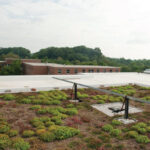
Want to see UMBC’s sustainable future? Just make your way to the roof of Patapsco Hall – where efforts make UMBC greener are intersecting with pedagogy and academic research.
A recent $16.5 million renovation and addition to the residence hall – designed by Newman Architects and built by KBE Building Corporation – recently received a Leadership in Energy and Environmental Design (LEED) Gold certification. It is the first building on campus to receive this designation.
One of the key features in obtaining this certification is Patapsco Hall’s “green roof.” These green roofs are important elements of sustainable design since they help reduce storm water runoff that is key cause of pollution in the Chesapeake Bay and in other local streams and rivers. Rooftop vegetation helps to insulate the building, reducing energy consumption. Vegetated surfaces also improve air quality and capture the greenhouse gas carbon dioxide.
Patapsco Hall’s green roof is also the platform for a research project focusing on sustainable design and construction. The green roof is paired with an identically-sized control area. Each area features dedicated drainage systems and rainwater quantity and quality measurement devices.
Andrew J. Miller, a professor in UMBC’s geography and environmental systems department, says that the data generated by the system will document storm water retention and monitor runoff from both portions of the roof, allowing comparisons in terms of quantity and quality. Storm water retention totals and storm hydrographs are displayed in real-time in the building’s lobby – and Miller plans incorporate the data into his classes.
When I teach hydrology, I always have the students access real data from local USGS stream gages as well as rainfall data from nearby sources,” he observes. “One of the best ways to assess [green roofs’] effectiveness is to have monitoring sites side by side on the same roof, comparing how much water runs off the traditional roof compared with the green roof. Having such a monitoring site right here on campus collecting information in real time presents a great educational opportunity.”
The LEED rating system was developed by the U.S. Green Building Council (USGBC) in 2000 and provides verification that a building was designed and built using aspects of efficient environmental health conservation strategies. Certifications of Silver, Gold, and Platinum recognizes varying levels of design and performance in areas including sustainable site development, water savings, energy efficiency, materials selection, and indoor environmental quality.
The push for new LEED designated sites at UMBC is not limited to Patapsco. The university’s Performing Arts and Humanities Building has been awarded a LEED Silver designation. Its sustainable features include a rainwater harvesting system (for on-site irrigation), use of pervious concrete sidewalks and a white roof which will reduce the building’s urban heat island effect.
– Chelsea Haddaway
]]>
Most people stop thinking about their trash once they toss it in a bin. But with composting, the bin is only the beginning.
“Composting is a way to make food waste into new food growth,” explains Madeline Hall ’12, geography and environmental systems, who was a key player in establishing a composting program at UMBC. “It’s a way to bring the process full circle.”
Even before she became a Student Government Association sustainability intern in 2011, Hall was working to show that composting was something students really wanted. But before composting could become a part of UMBC’s sustainability efforts, Hall needed to forge a new relationship between the university (which oversees campus waste disposal) and Chartwells (which holds the university’s catering contract). And because UMBC’s Campus Card Office oversees the Chartwells contract, it also became involved with compost planning.
Angie Hammerbacher, manager of the Campus Card Office, worked with Hall to sort out the logistics of composting on a large scale. “It’s just the natural direction UMBC was going in,” says Hammerbacher. “The community understood that something needed to be done to promote sustainability on campus, and composting was one of the ways we could do that.”
Because of UMBC’s size, the accumulated waste needs to be taken off campus to be composted. So the university signed a contract with Waste Neutral to do so, and composting was introduced into the True Grits dining hall in July 2011.
True Grits employees are trained to recognize compostable material, which includes not only food waste but also paper products without a plastic coating. This waste is taken to a special dumpster outside the dining hall, which is emptied by the contractors twice per week.
UMBC’s composting is carried out almost completely behind the scenes, so student advocacy is a key element in building a constituency for the effort. Brent Mattox ’13, computer science, continued Hall’s efforts when he took on the sustainability intern post last year.
“At the end of the day, our success is all about outreach,” says Mattox. “It starts with the students—if people see that we really want it, they’ll start to make the changes too.”
Mattox organized composting at large campus events such as Quadmania and EcoFest to help advertise the program. He also helped implement an extension of UMBC’s composting program to The Commons in February.
To date, 107.77 tons of waste has been composted at UMBC between the dining hall, The Commons and campus events.
“Composting at UMBC is unique because so many people have to come together to make it happen,” says Hall. “And to do that at a time when resources could easily be allocated elsewhere—that really shows our campus’ commitment to sustainable actions.”
– Laura Lefavor’13
]]>