Transitioning from Industry to Academia: Advice for Young PhDs (By, Dr. Sujata Bhatia)
 Guest Blogger: Dr. Sujata Bhatia, Harvard University:
On August 16-17, 2013, I had the distinct honor of attending the 10th Anniversary Celebration of the PROMISE Summer Success Institute as a Distinguished Guest Speaker. A question that arose from young PhDs during each of my mentoring sessions was, “How did you manage the transition from industry to academia?” Indeed, my background as an academic leader is completely non-traditional: after completing my MD and PhD degrees, I spent close to eight years working in biomedical research and product development at DuPont. I transitioned to my current position at Harvard in 2011, and found the transition to be very smooth. Here are my tips for a young PhD who would like to keep the door open to academia.
1. Recognize that various opportunities are available in academia, even if you have started your career in industry. In other words, you have many options, and each of these options will have different demands. You might decide to pursue a position at either a research-intensive university or at a primarily undergraduate institution. The research and teaching demands of these positions will be different (heavier emphasis on research at the former, heavier emphasis on teaching at the latter). It behooves you to show that you are competent at both, which leads to points #2 and #3.
2. Look for opportunities to teach part-time at local universities while you are working in industry. From 2009 to 2011, I served as an adjunct faculty member in the Department of Chemical and Biological Engineering at the University of Delaware, while still working full-time at DuPont. I taught courses in biochemical engineering and biomedical engineering, and also prepared a textbook to inform my teaching. Many universities are happy to have adjunct professors from local industry, particularly in science and engineering fields. Students benefit from the practical perspective that industry practitioners bring to the classroom. As a university teacher, you will benefit by gaining valuable teaching experience, strengthening your academic network, and testing out whether you enjoy interacting with students. I am convinced that my positive teaching evaluations from the University of Delaware, as well as my experience writing a textbook, were pivotal factors in Harvard’s decision to hire me.
3. Look for opportunities to publish while in industry. I received a key piece of advice from a gentleman at DuPont who transitioned into an academic leadership position at Rutgers University: when someone types your name into PubMed or Google Scholar, at least one publication from the past year should show up. Publishing your work gives you legitimacy in your technical field, and forces you to stay current in your technical field. If you are working on projects that involve intellectual property, talk with your supervisor about the possibility of publishing the work after patents have been filed. If you absolutely cannot disclose your current projects in industry, think about publishing a review paper or book chapter (or even a book!) on your technical expertise.
4. Keep your academic network alive. You should set a goal of attending at least one major technical conference a year. Again, talk with your supervisor about the possibility of presenting your work to an external audience. Even if you cannot give a technical talk on your industry work at a conference, you could give a general overview talk on your technical field, and you can still use the opportunity to network with academics. You should also look for opportunities to give seminars at universities – these visits will allow you to meet faculty one-on-one.
5. Browse academic job postings. My favorite websites for academic job postings are higheredjobs.com and chronicle.com. By browsing the listings on these websites, you will have an idea of which universities are hiring, as well as the specific job opportunities and requirements. I would suggest that you start applying to positions even if you haven’t completely decided to make the switch, just so that you can gain experience with applying and interviewing. I applied for several positions, and interviewed at two other universities, before interviewing for my current job at Harvard.
Transitioning from industry to academia is not impossible. In fact, it is a career path that is unique and valuable – you will bring a special flavor to your teaching, research, and overall leadership style. If you develop your teaching, research, and publishing skills while pursuing an industrial project, you will certainly be an asset to any academic department.
Sujata K. Bhatia, MD, PhD, PE
Assistant Dean, Harvard Summer School
Assistant Director of Undergraduate Studies, Biomedical Engineering, Harvard University
Associate, Harvard Kennedy School of Government
206C Pierce Hall, 29 Oxford Street
Cambridge MA 02138
~~~~~~~~~~~~~~~~~~~~~~~~~
Dr. Bhatia served as a Mentor-in-Residence for the 2013 PROMISE SSI. She was an excellent mentor for students, postdocs, and alumni. More about Dr. Bhatia: http://belfercenter.ksg.harvard.edu/experts/2760/sujata_k_bhatia.html
]]>
Guest Blogger: Dr. Sujata Bhatia, Harvard University: On August 16-17, 2013, I had the distinct honor of attending the 10th Anniversary Celebration of the PROMISE Summer Success...
http://promiseagep.wordpress.com/2013/08/28/transitioning-from-industry-to-academia-advice-for-young-phds-by-dr-sujata-bhatia/
https://my3.my.umbc.edu/api/v0/pixel/news/34767/guest@my.umbc.edu/05381769857336f28d56f3c9da96bb85/api/pixel
academic-enrichment
advising
agep
development
dupont
gradschool
gradstudents
harvard
harvard-university
jobs-and-funding
learning
maryland
nsf
postdoc
prof-it-professors-in-training
professor
professoriate
promise
support
teaching
university-of-delaware
Grad Student & Postdoc Development
https://my3.my.umbc.edu/groups/gspd
https://assets3-my.umbc.edu/system/shared/avatars/groups/000/000/066/4b2a0ea3017d894b96de7bd4a45729d5/xsmall.png?1781730740
https://assets4-my.umbc.edu/system/shared/avatars/groups/000/000/066/4b2a0ea3017d894b96de7bd4a45729d5/original.png?1781730740
https://assets2-my.umbc.edu/system/shared/avatars/groups/000/000/066/4b2a0ea3017d894b96de7bd4a45729d5/xxlarge.png?1781730740
https://assets1-my.umbc.edu/system/shared/avatars/groups/000/000/066/4b2a0ea3017d894b96de7bd4a45729d5/xlarge.png?1781730740
https://assets1-my.umbc.edu/system/shared/avatars/groups/000/000/066/4b2a0ea3017d894b96de7bd4a45729d5/large.png?1781730740
https://assets2-my.umbc.edu/system/shared/avatars/groups/000/000/066/4b2a0ea3017d894b96de7bd4a45729d5/medium.png?1781730740
https://assets3-my.umbc.edu/system/shared/avatars/groups/000/000/066/4b2a0ea3017d894b96de7bd4a45729d5/small.png?1781730740
https://assets3-my.umbc.edu/system/shared/avatars/groups/000/000/066/4b2a0ea3017d894b96de7bd4a45729d5/xsmall.png?1781730740
https://assets1-my.umbc.edu/system/shared/avatars/groups/000/000/066/4b2a0ea3017d894b96de7bd4a45729d5/xxsmall.png?1781730740
PROMISE @ UMBC: Graduate Student Development
0
0
false
Wed, 28 Aug 2013 08:01:29 -0400
Wed, 28 Aug 2013 08:01:29 -0400
Transitioning from Industry to Academia: Advice for Young PhDs (By, Dr. Sujata Bhatia)
Guest Blogger: Dr. Sujata Bhatia, Harvard University:
On August 16-17, 2013, I had the distinct honor of attending the 10th Anniversary Celebration of the PROMISE Summer Success Institute as a Distinguished Guest Speaker. A question that arose from young PhDs during each of my mentoring sessions was, “How did you manage the transition from industry to academia?” Indeed, my background as an academic leader is completely non-traditional: after completing my MD and PhD degrees, I spent close to eight years working in biomedical research and product development at DuPont. I transitioned to my current position at Harvard in 2011, and found the transition to be very smooth. Here are my tips for a young PhD who would like to keep the door open to academia.
1. Recognize that various opportunities are available in academia, even if you have started your career in industry. In other words, you have many options, and each of these options will have different demands. You might decide to pursue a position at either a research-intensive university or at a primarily undergraduate institution. The research and teaching demands of these positions will be different (heavier emphasis on research at the former, heavier emphasis on teaching at the latter). It behooves you to show that you are competent at both, which leads to points #2 and #3.
2. Look for opportunities to teach part-time at local universities while you are working in industry. From 2009 to 2011, I served as an adjunct faculty member in the Department of Chemical and Biological Engineering at the University of Delaware, while still working full-time at DuPont. I taught courses in biochemical engineering and biomedical engineering, and also prepared a textbook to inform my teaching. Many universities are happy to have adjunct professors from local industry, particularly in science and engineering fields. Students benefit from the practical perspective that industry practitioners bring to the classroom. As a university teacher, you will benefit by gaining valuable teaching experience, strengthening your academic network, and testing out whether you enjoy interacting with students. I am convinced that my positive teaching evaluations from the University of Delaware, as well as my experience writing a textbook, were pivotal factors in Harvard’s decision to hire me.
3. Look for opportunities to publish while in industry. I received a key piece of advice from a gentleman at DuPont who transitioned into an academic leadership position at Rutgers University: when someone types your name into PubMed or Google Scholar, at least one publication from the past year should show up. Publishing your work gives you legitimacy in your technical field, and forces you to stay current in your technical field. If you are working on projects that involve intellectual property, talk with your supervisor about the possibility of publishing the work after patents have been filed. If you absolutely cannot disclose your current projects in industry, think about publishing a review paper or book chapter (or even a book!) on your technical expertise.
4. Keep your academic network alive. You should set a goal of attending at least one major technical conference a year. Again, talk with your supervisor about the possibility of presenting your work to an external audience. Even if you cannot give a technical talk on your industry work at a conference, you could give a general overview talk on your technical field, and you can still use the opportunity to network with academics. You should also look for opportunities to give seminars at universities – these visits will allow you to meet faculty one-on-one.
5. Browse academic job postings. My favorite websites for academic job postings are higheredjobs.com and chronicle.com. By browsing the listings on these websites, you will have an idea of which universities are hiring, as well as the specific job opportunities and requirements. I would suggest that you start applying to positions even if you haven’t completely decided to make the switch, just so that you can gain experience with applying and interviewing. I applied for several positions, and interviewed at two other universities, before interviewing for my current job at Harvard.
Transitioning from industry to academia is not impossible. In fact, it is a career path that is unique and valuable – you will bring a special flavor to your teaching, research, and overall leadership style. If you develop your teaching, research, and publishing skills while pursuing an industrial project, you will certainly be an asset to any academic department.
Sujata K. Bhatia, MD, PhD, PE
Assistant Dean, Harvard Summer School
Assistant Director of Undergraduate Studies, Biomedical Engineering, Harvard University
Associate, Harvard Kennedy School of Government
206C Pierce Hall, 29 Oxford Street
Cambridge MA 02138
~~~~~~~~~~~~~~~~~~~~~~~~~
Dr. Bhatia served as a Mentor-in-Residence for the 2013 PROMISE SSI. She was an excellent mentor for students, postdocs, and alumni. More about Dr. Bhatia: http://belfercenter.ksg.harvard.edu/experts/2760/sujata_k_bhatia.html
]]>
Guest Blogger: Dr. Sujata Bhatia, Harvard University: On August 16-17, 2013, I had the distinct honor of attending the 10th Anniversary Celebration of the PROMISE Summer Success...
https://promiseagep.wordpress.com/2013/08/28/transitioning-from-industry-to-academia-advice-for-young-phds-by-dr-sujata-bhatia/
https://my3.my.umbc.edu/api/v0/pixel/news/35867/guest@my.umbc.edu/4c2b84f3448337ae698a8b919f9899ef/api/pixel
academic-enrichment
advising
agep
development
dupont
gradschool
gradstudents
harvard
harvard-university
jobs-and-funding
learning
maryland
nsf
postdoc
prof-it-professors-in-training
professor
professoriate
promise
support
teaching
university-of-delaware
Grad Student & Postdoc Development
https://my3.my.umbc.edu/groups/gspd
https://assets3-my.umbc.edu/system/shared/avatars/groups/000/000/066/4b2a0ea3017d894b96de7bd4a45729d5/xsmall.png?1781730740
https://assets4-my.umbc.edu/system/shared/avatars/groups/000/000/066/4b2a0ea3017d894b96de7bd4a45729d5/original.png?1781730740
https://assets2-my.umbc.edu/system/shared/avatars/groups/000/000/066/4b2a0ea3017d894b96de7bd4a45729d5/xxlarge.png?1781730740
https://assets1-my.umbc.edu/system/shared/avatars/groups/000/000/066/4b2a0ea3017d894b96de7bd4a45729d5/xlarge.png?1781730740
https://assets1-my.umbc.edu/system/shared/avatars/groups/000/000/066/4b2a0ea3017d894b96de7bd4a45729d5/large.png?1781730740
https://assets2-my.umbc.edu/system/shared/avatars/groups/000/000/066/4b2a0ea3017d894b96de7bd4a45729d5/medium.png?1781730740
https://assets3-my.umbc.edu/system/shared/avatars/groups/000/000/066/4b2a0ea3017d894b96de7bd4a45729d5/small.png?1781730740
https://assets3-my.umbc.edu/system/shared/avatars/groups/000/000/066/4b2a0ea3017d894b96de7bd4a45729d5/xsmall.png?1781730740
https://assets1-my.umbc.edu/system/shared/avatars/groups/000/000/066/4b2a0ea3017d894b96de7bd4a45729d5/xxsmall.png?1781730740
PROMISE @ UMBC: Graduate Student Development
0
0
false
Wed, 28 Aug 2013 08:01:29 -0400
On Creative Leadership
I have spent nearly a decade experimenting with a single goal in mind: to create scalable, predictably insightful, inspirational environments. I have led creative teams in these environments, and I’m currently doing it as the Director of Web Interface and Development at Astonish (a digital marketing company in Rhode Island, US).
It hasn’t been easy, because forcing inspiration is impossible. You have to use finesse and let it come to you. What follows is what I’ve found to help my team and me harness inspiration effectively.
Accessing Your Creativity …In The Shower
It’s 4:30 in the morning. The sun is starting to smear pink across the sky, and I’m in bed, working. Laying in bed in the dark is comfortable, but it’s hardly a working environment. Yet, I am solving problems. At this moment, I am more connected with my subconscious (the most creative part of my brain) than I will be at any other time today.
I have been practicing this combined meditation and creative thinking for several months now. It has been a hugely beneficial experiment, which started early one morning in the shower. Ever have a great idea in the shower? I have had hundreds, and I now know why.
Your morning shower is a breeding ground for ideas and sparks of inspiration. When you stumble into the shower shortly after you wake, you’re able to relax and, because you’re still tired, you’re able to reconnect with your subconscious. I’ve found this state to be so helpful in solving problems that I’ve had to devise ways to take notes on the shower wall.

The relaxed state of your morning shower helps you to reconnect with your subconscious. (Image source: Simon Law)
My wife is constantly surprised to find product diagrams, flow charts, code and wireframes written in soap, kids shower crayons and anything else I can find. I’ve even considered painting the walls with idea paint, to have a bit more creativity.
I’m sure you’ve had a spark of inspiration or maybe just a moment of clear insight in the shower. I’ve asked many people about their creative abilities during their morning routine, and the answers always support my assumption. The reason? It’s because your insight, inspiration and creative abilities were always there; they’re just more accessible in that relaxed state because you are not grasping for them.
Science
You see, the harder you grasp to be creative, the more easily it slips through your fingers. Have you ever noticed how difficult it is to sit down at work and just flip on the creative switch? Do you find yourself intentionally distracting yourself? Browsing Amazon, reading your news feed and skimming Facebook are all ways to indirectly access your creative abilities. Sometimes it’s important to turn off your desire to be creative and just let it come to you.

Distraction-free environments help our brains to “take our minds off the problem” just long enough to get the answer we’re looking for. (Image source: TZA)
John Kounios of Drexel University studies the brain and looks for scientific explanations for the delivery of insight. In one study, Kounios asked subjects to solve puzzles while undergoing a brain scan. He found that insight, or the inspiration needed to solve a problem, comes from the visual cortex. However, in the time leading up to a puzzle being displayed on the screen, the subjects’ brain activity was around the temporal lobe. As Kounios explains in his TED talk:
“This is the mind turning in on itself. This is the mind disengaging from the world. This empowers a person to imagine new and different ways to transfer reality, creatively, into something better.”
Our brain looks for a distraction-free environment to get inspired. This might seem a bit contradictory to what I just said. Believe it or not, your intentional distraction (Amazon and Facebook) can help to relax your brain and “take your mind off the problem” just long enough to get the answer you’re looking for.
Managing A Team
This creates an interesting situation for individuals in a corporate environment. Small studios and agencies usually respect and understand the creative process a bit more. I’ve known a lot of directors who understand the need for a little distraction at work, even if they don’t really know why it works.
When it comes to managing a team of creatives, you have to balance finesse and creative leadership. In fact, I like to eliminate the word “manage” altogether. Take a Web designer. A Web designer already needs to manage their time, creative process, projects, clients and more. Isn’t that enough management already?
If you have the right people on your team, they shouldn’t need to be managed — they need leadership. They need someone to pull them to an answer, not push them. If you trust your team, they’ll come through for you. However, they’ll do a much better job of it if they enjoy their work and are trusted to work openly when they want to. Why restrict your team? Why force them to work the way you want them to or even when you want them to?

Trust and good leadership can steer your team to enjoy their work and do a much better job. (Image source: opensource.com)
This notion that a creative team should have working hours, such as 9:00 to 5:00, baffles me. Sure, I get it: Your accounts team answers the phone during that time. Well, the fact is that they don’t need to be inspired to answer the phone. And yes, motivation and inspiration are very different.
Work With The Grain, Not Against It
An extremely talented designer and front-end developer named Jeff is on my Web development team. Jeff commutes 30 miles to and from work every day. Having a set schedule from 9:00 to 5:00 would require Jeff to get up earlier every morning to fight traffic for over an hour. Sitting in stop-and-go traffic and getting frustrated by the people around him doesn’t exactly scream “distraction-free moments of inspiration.”
Having the freedom to arrive at work around 9:30 or 10:00 cuts Jeff’s commute by over 25 minutes. Does this mean that Jeff works less? Absolutely not! Not only does Jeff make up his time, but he also works smarter. And because his day starts off with way less stress, he’s even more likely to enjoy his work and stick around to get the job done.
This is just one example; there are hundreds. Some people like to listen to music while they work; others play Netflix in the background. Sometimes a good meeting can get a team in the right mindset; other times, they just want to be left alone. Lead people with respect and trust and you’ll get so much more out of them. Not to mention that you’ll learn whether they are the right fit for your team.
There is no better way to make the cream rise to the top than by letting it sit for a while. If you keep stirring it, you’ll never get it to settle.
“Rage, Rage Against The Dying Of The Light”
As a leader of creatives, your job is to provide an insight-sparking, inspirational environment, while guarding against distraction.
The creatives on my team work smart and fast. They do this because they are in touch with their brains’ ability to perform different tasks. At 4:30 in the morning, I might be working on a problem that I went to bed with. You might work on a coding problem at 11:00 pm until about the time I wake up. We are all different; the important thing is to know why and how we are different.
I get to know my team and work closely with everyone on it. They all have different needs and like to be communicated with differently. At the same time, they all enjoy working on different types of projects at different times.
Each member of my team has an inspiration schedule, a time when they know they are more likely to be creative. During those times, there are no meetings, distractions or interruptions. This is their time to increase their working memory, to build, to design and to solve problems.
Being a leader, my job is to help them understand what this time means for them and to fight anyone who jeopardizes it. Don’t dismiss this point. It is vital to the clients, products and team that your creatives have the time to do their job right. Remember that they will get the job done either way, because you trust them to come through. Wouldn’t it be better to ensure that they have time during the day to do it, when they have allocated time to do it, rather than bombard them with meetings and problems?
Finding And Feeding Inspiration
It’s as if the sky parts and a divine entity comes down and delivers the answer directly into your brain. Understanding where inspiration comes from or how you’ve solved the problem isn’t easy, but at that point you don’t care because you’re off and running.
In 2013, learning code, understanding design patterns and analyzing data are extremely easy. Our tools, documentation and frameworks are accessible and ubiquitous. What’s both rare and stubborn is a great imagination. The concept of “thinking outside the box” is based on the idea of being creative with knowledge.
Imagination is vital, but without inspiration, it can lie dormant. If imagination is the playground, then inspiration is the gravity that pulls you down the slide, bounces you on the seesaw or propels you on the swing. Without inspiration, imagination is as pointless as a slide in outer space. It’s the powerful force behind creation.
Harnessing inspiration is almost impossible. Yet, we can cultivate ideas by finding patterns in our moments of inspiration. We’ve already talked about relaxation, daily schedules and the link to your subconscious. What about your mood and other factors that play into it?
Music
I love music. In fact, music is the only thing I love more than food. Music comes in so many different forms, is readily available and is creative in itself. I bet you already know that different types of music have different effects on people. Some types help you to concentrate, while others make you want to get up and dance; some types help you to relax, while others keep you up all night.
I remember my science teacher in school telling me that listening to classical music helps mice navigate a maze faster than listening to heavy metal. Is this really true?
Remember when we talked about John Kounios and brain activity around the temporal lobe? Well, that temporal lobe is in charge of receiving auditory signals, such as from music. When your brain activity is focused on this area, it’s redirecting energy from other areas, helping you to concentrate. This, and the fact that music has a direct correlation to increased amounts of dopamine and adrenaline, means you can have a direct and significant emotional response to the right type of music.

When your brain activity is focused on this area, it’s redirecting energy from other areas, helping you to concentrate. (Image source: opensource.com)
Classical music is very rhythmic and, oddly enough, predictable. Classical also usually has a slower tempo, less than 60 beats per minute, whereas pop and jazz have unpredictable variances in tone and rhythm and often a much faster tempo.
Why is this important? Remember that the more opportunities your brain has to turn in on itself, away from distraction, the greater the chance of finding insight. Classical music lends itself to a distraction-free environment and provides relaxation, which the brain enjoys. You’re favorite Coldplay song might trigger a powerful emotional response, but that type of music is actually better saved for menial tasks. Upbeat pop music can help you stay on track by distracting you from what you are doing, which is helpful when you’re inputting data and answering emails.
Vinod Menon, Professor of Psychiatry and Behavioral Sciences at Stanford University’s School of Medicine, has written an interesting article on the subject. In the paper, Menon writes about music’s effect on the brain during an MRI. To simplify, the brain performs better when predictable patterns are in the music. During sudden breaks in the sound, the brain reacts to check on what’s happening. Your brain turns its attention back to the music, rather than stays on what you were concentrating on.
Experiment with this theory on your own. I have found Italian opera to be particularly conducive to creative thinking. Take some time today to create a short playlist on Spotify. Add five to eight of the top-ranked classical pieces, then drop in an AC/DC song. Shuffle the playlist, and then try to focus on a task. I bet you won’t even consciously hear the classical music (once you get into the groove), but when “Highway to Hell” comes on, you’ll be pulled away from what you’re working on, as if waking from a great dream.
Weather
Controlling a playlist is easy, but one thing science may never solve is how to control the weather. And what has the human race done for thousands of years when it can’t control something? We try to understand it, which helps us control our response to it.
The things in this world that affect our brain are absolutely amazing. For example, even subconsciously, wet and rainy weather will depress us, while beautiful sunny days will make us happy. So, if we have a big creative deadline and the forecast calls for rain, we must be screwed, right? Wrong.
As Joe Forgas of the University of New South Wales puts it:
“It seems counter-intuitive but a little bit of sadness turns out to be a good thing.”
You see, memory is actually more active and accessible during periods of sadness. Forgas studies the brain and the weather’s effect on it. He found, surprisingly, that subjects retain more information on rainy gloomy days than subjects who are asked the same things on beautiful sunny days. In his book Imagine: How Creativity Works, Jonah Lehrer attributes this as the reason why some tortured artists are so amazing at what they do.
Memory, especially our working memory, is vital to the creative process.
Human RAM
Random access memory (RAM) is a computer’s ability to access data without (for lack of a better explanation) having to dig for it. The human brain works like this, too. Our RAM is called working memory. This working memory directly correlates to our ability to be creative and unique.
If you want to redesign the interface of a Web form, what’s the first thing you do? You go onto the Web, trying to find something. Can you guess what you’re not finding? Inspiration. You’re building a working memory. Whether you know it or not, your brain is retaining everything you see. And your ability to access it randomly later is the working memory in action. The more you see, the more your brain can hold.
I am not a scientist, but I suspect that this is one of the reasons why you have that moment of insight during your morning shower. You try so hard during the day to solve a problem; you’re trying to force the answer by researching and scouring the Internet. During that time, your brain is retaining all that information. Later that night, during REM sleep, your brain catalogs everything it’s seen.
I propose that your mind, tapped into the subconscious during deep sleep while recounting the day’s working memory, is able to solve the problem for you. It’s only after you wake — during that morning routine — that you’re able to access it. This is why forcing inspiration, while impossible, does reap positive results.
Finely Tuned Problem-Solving Sessions
We’ve learned that you can’t force inspiration, and, although we try to control our environment, doing so is hard as well because so much plays into it. The problem is that sometimes you have to be inspirational on the fly. Well, practice makes perfect.
Last summer, I read an article by Seth Godin titled “Impresarios.” In the article, Godin talks about how impresarios “weave together resources and opportunities and put on a show.” This gave me an idea, and I will forever be in Godin’s debt because I am now my own version of an impresario. An impresario is someone who organizes and often finances concerts, plays and theatrical productions. In my case, I organize brainstorming events.
Every month, my team and I enter our planning room for at least three hours. We lock the doors, opening it only for pizza and beer deliveries. Our mission is to solve one problem. In past sessions, we have redesigned the user interface that powers our systems, solved marketing problems by “remarketing,” and found new and creative ways to present information. The role of an impresario has had such a direct and positive impact on the way we do business that I am now introducing the role to every team in our 100+ person company.
Why does having an impresario work? Well, certain rules guide the team to moments of insight:
- Identify a very specific problem to solve, and stay focused.
- Provide the necessary tools to spark inspiration (white boards, markers, paper, etc.).
- Be technology-agnostic! Don’t worry about how you will solve the problem; focus only on the why.
- There are no wrong answers; some are just better than others.
- Celebrate failures.
My team looks forward to their time spent locked up together because it gives us an opportunity to be creative in front of each other. Support their ideas, and help them grow. Don’t force your opinions and thoughts. If the group is moving in the wrong direction, ask them questions until they find the right path.
Celebrating Failures
Admitting defeat is one thing; celebrating it an entirely other. Only good can come from openness and honesty. We all learn from our own mistakes, but if you don’t share yours, how can I learn from it? Celebrating failures and realizing that “missing the target” isn’t a bad thing will help your team to grow, recover and build things faster.
At the end of the process, my team always has something to show for it. On occasion, we have realized that the problem we set out to solve was the wrong problem to focus on. We failed to find a solution because there was no reason to find one. That in itself was the solution, and presenting the outcome of the session to our company helped us to refocus.
The only failure I’m not comfortable with is the failure to try.
In Retrospect
I’ve found a groove. I go to bed, thinking hard about a problem, and fall asleep trying to solve it. Waking early in the morning and refocusing my efforts brings the solution closer to my consciousness. I’ll often get to work quite early, continually working on the problem. Then, when I feel my creativity beginning to slip, I’ll hit the gym.
Getting my energy level up, increasing my adrenaline and getting my mind off the topic help to realign my thoughts. Then, I hit the sauna for a good 20 minutes. Nothing like 80 °C heat in a quiet room and with eyes closed to restart that relaxed, creative meditation. Then, I head back to work.

Keep in mind that we all have our own ways of getting our minds off topic, and later realigning our thoughts — and making things better. (Image source: opensource.com)
I don’t know if I’ll be able to continue this schedule over time, nor do I expect you to follow it. Right now, I’m treating this as an experiment, and it’s proving to be highly fruitful.
Here are the big take-aways from my experience:
- Respect your teammates and their periods of inspiration.
- Protect your team from the day’s distractions and interruptions.
- Deliver freedom as a gift. You’ll see boundless gains in creativity from the team.
- Try to more deeply understand your brain and its ability to be affected by its environment.
- And, of course, celebrate your failures!
Thoughts?
Please feel free to share your experiences and thoughts in the comments section below.
(al) (il) (ea)
© Jesse Friedman for Smashing Magazine, 2013.
]]>
I have spent nearly a decade experimenting with a single goal in mind: to create scalable, predictably insightful, inspirational environments. I have led creative teams in these...
http://www.smashingmagazine.com/2013/08/28/on-creative-leadership/
https://my3.my.umbc.edu/api/v0/pixel/news/34765/guest@my.umbc.edu/9952888b20324c685b20b130eb2359ee/api/pixel
creativity
css
design
development
global-web-design
html
inspiration
javascript
mysql
opinion-column
php
process
sql
web
workflow
Web Developer - Build Group
https://my3.my.umbc.edu/groups/retired-583
https://assets3-my.umbc.edu/system/shared/avatars/groups/000/000/583/fc60f5d7abc2e080599bb6dc465db54d/xsmall.png?1363101197
https://assets4-my.umbc.edu/system/shared/avatars/groups/000/000/583/fc60f5d7abc2e080599bb6dc465db54d/original.jpg?1363101197
https://assets4-my.umbc.edu/system/shared/avatars/groups/000/000/583/fc60f5d7abc2e080599bb6dc465db54d/xxlarge.png?1363101197
https://assets4-my.umbc.edu/system/shared/avatars/groups/000/000/583/fc60f5d7abc2e080599bb6dc465db54d/xlarge.png?1363101197
https://assets3-my.umbc.edu/system/shared/avatars/groups/000/000/583/fc60f5d7abc2e080599bb6dc465db54d/large.png?1363101197
https://assets3-my.umbc.edu/system/shared/avatars/groups/000/000/583/fc60f5d7abc2e080599bb6dc465db54d/medium.png?1363101197
https://assets4-my.umbc.edu/system/shared/avatars/groups/000/000/583/fc60f5d7abc2e080599bb6dc465db54d/small.png?1363101197
https://assets3-my.umbc.edu/system/shared/avatars/groups/000/000/583/fc60f5d7abc2e080599bb6dc465db54d/xsmall.png?1363101197
https://assets4-my.umbc.edu/system/shared/avatars/groups/000/000/583/fc60f5d7abc2e080599bb6dc465db54d/xxsmall.png?1363101197
Web Developer - Build Group
0
0
true
Wed, 28 Aug 2013 06:51:08 -0400
Wed, 28 Aug 2013 06:51:08 -0400
Finding the Middle Ground: How to Compromise with Clients
No one is right 100% of the time, not even the most experienced and battle-tested professional designers among us. If you’re doing work for a client and they shoot down what you feel is a strong design concept, don’t take it personally.
It’s perfectly normal for clients and designers to have many meetings, going back and forth on design concepts and ideas until they are both are satisfied. Unfortunately, in the process, a few of us who are very passionate about our craft sometimes forget about the client’s opinions.
Here’s the bottom line: Your client needs a website that looks as good as it works, while you need a successfully completed project that’s portfolio-worthy.
Clients might not know what they want out of a design specifically, but they likely know more than you about their industry.
No matter how outrageous their suggestions seem to you, it’s important to maintain an open mind.
The key to a successful collaboration is your attentiveness to the client’s needs, and your ability to design a website that satisfies those needs. The good news is that both are in your control.
Walk a Mile in Your Client’s Shoes
Right from the start, make it a priority to truly understand where the client is coming from. Get to know them and their company, and understand why they are coming to you for the project.
When trying to understand your client and his/her needs, keep the following things in mind.
What is your client’s level of involvement in the project?
How inclined the client is in overseeing the design project will be a major factor in what you will be producing for them.
If they’re very attached to the project, then they will be more particular about the details.
If they are simply overseeing the project, then they will probably be involved more indirectly, at a macro level.

Who has the final say?
Identify the role of the person you will be pitching your design concepts to if you want your strongest design to make it to the end of the negotiation.
Find a way to solve their problems. Appeal to their needs. If you truly believe in a design idea, find out more about the decision-makers and how you can sell your concept to them, heeding their preferences and concerns in mind.
What is their level of web design knowledge?
Gauge early on the type of diction or amount of jargon your client understands. Use this to your advantage when explaining the reason behind your concepts in order to minimize misunderstanding.
Less tech-savvy clients might not know what they need or how to communicate their needs. Instead of bombarding them with web design jargon — conversion rates, responsive web design, adaptive layouts, font stack, analytics, open source frameworks, UI, UX, bounce rate, CSS, and other conventional terms we use to communicate with other web designers — translate what you want to say in a language they will understand.
You will have much better chemistry during the negotiation, too. Everyone appreciates a smooth operator.
Two Harmful Mindsets You Should Avoid When Working with Clients
Your opinion and expectations on what design would be best for the website you’re tasked in developing might not be the same as your client’s.
During negotiations, the amount that you compromise could very well determine the success of the site. You might have a strong grasp of what’s going on in the web design world, but your client will know more about their industry and target demographic.
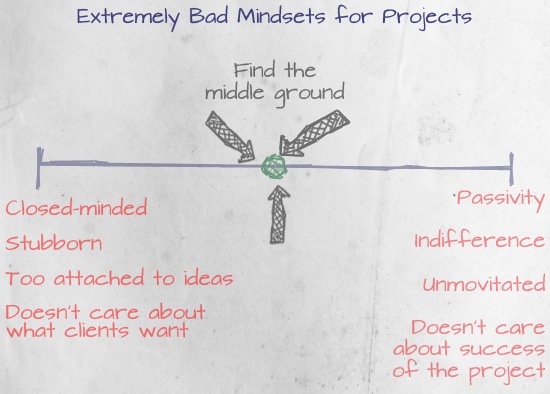
There are two very harmful mindsets when working with clients, and every designer can fall victim to them.
"I know what’s right for my client, and they should use my ideas. No exceptions."
While passion and confidence in the effectiveness of a design are great strengths for a designer to have, step back and look at it from your client’s point of view. The design concept you’ve submitted might be good, but that doesn’t necessarily mean it fulfills the purpose and goals of the site.
Don’t be too attached to your designs. Step back from what you’re doing once in a while and ask yourself if this is really the best thing for the client’s project.
More importantly, don’t take anything personally. One of the most unprofessional things you can do is get emotionally involved and take rejection the wrong way.
"Whatever the client says goes. I’m just here to do what they say for the money."
This is the other extreme. Actually, this can be more harmful than the previous mindset.
To be frank, if you think of design work like this, then you should review what motivated you to become a designer.
Not only is this mindset harmful to your overall body of work and the success of your website design projects, but it also shows that you do not care.
Every time you submit a design, it should be your strongest possible, while fulfilling the client’s requirements.
Achieving Balance
Finding and harnessing just the right amount of passion for your work is imperative.
Too little passion signals that you are apathetic, and too much can make you take things personally or get too attached to your designs and to being right.
Find a middle ground, where your passion is balanced and your understanding of the client’s needs is clear. A client’s needs will dictate the flow of your work, even if you think they are shooting themselves in the foot by accepting anything other than your ideas.
Disagreements will undoubtedly arise during negotiations, so keep your cool and focus on the goal.
"Do the right thing." When you disagree with an idea that the client insists on implementing, politely suggest an alternative. Be absolutely sure that your claims are 100% accurate, and back them up with quantitative data, such as focus groups and A/B tests. You might also be able to convince them by showing work you have done that turned out to be a huge success.
Necessary Compromise: You Win Some, You Lose Some
Pick your battles, and know when to give in and when to negotiate for something you think would really benefit the client. Something as trivial as the size of a button is not as important when you compare it to the site’s information architecture. Give in on the size of the button, but make sure to get your point across for the site’s structure.
It’s impossible to know everything the client will need without asking the right questions, and it is difficult to handle rejection when you’ve put your heart into doing exactly what you think the client has told you to do. Of course, don’t rub it in if they’re wrong. A feeling that you’re not on their side will decrease a client’s trust in you.
Be graceful when receiving criticism. The best response is to return with something that satisfies all of the client’s needs, both aesthetic and functional.
With this conceptual approach to negotiations I have discussed, a web designer will appear more desirable to work with and, thus, gain more clients, resulting in a stronger portfolio and more clients — a virtuous cycle of positive outcomes for all parties involved.
Related Content
About the Author
 Rick Debus is the founder and CEO of Signazon.com, a national e-commerce printing company based in Dallas, Texas. With over 15 years of web design and development experience, he’s passionate about bringing unique and innovative solutions to the Internet. Connect with him on Google+.
The post Finding the Middle Ground: How to Compromise with Clients appeared first on Six Revisions.
]]>
No one is right 100% of the time, not even the most experienced and battle-tested professional designers among us. If you’re doing work for a client and they shoot down what you feel is a strong...
http://feedproxy.google.com/~r/SixRevisions/~3/2C9eS9IwdHc/
https://my3.my.umbc.edu/api/v0/pixel/news/34937/guest@my.umbc.edu/6b300fbca136756e5e9bfca32de5c984/api/pixel
css
database
design
development
freelance
html
javascript
mysql
sql
web
Web Developer - Build Group
https://my3.my.umbc.edu/groups/retired-583
https://assets3-my.umbc.edu/system/shared/avatars/groups/000/000/583/fc60f5d7abc2e080599bb6dc465db54d/xsmall.png?1363101197
https://assets4-my.umbc.edu/system/shared/avatars/groups/000/000/583/fc60f5d7abc2e080599bb6dc465db54d/original.jpg?1363101197
https://assets4-my.umbc.edu/system/shared/avatars/groups/000/000/583/fc60f5d7abc2e080599bb6dc465db54d/xxlarge.png?1363101197
https://assets4-my.umbc.edu/system/shared/avatars/groups/000/000/583/fc60f5d7abc2e080599bb6dc465db54d/xlarge.png?1363101197
https://assets3-my.umbc.edu/system/shared/avatars/groups/000/000/583/fc60f5d7abc2e080599bb6dc465db54d/large.png?1363101197
https://assets3-my.umbc.edu/system/shared/avatars/groups/000/000/583/fc60f5d7abc2e080599bb6dc465db54d/medium.png?1363101197
https://assets4-my.umbc.edu/system/shared/avatars/groups/000/000/583/fc60f5d7abc2e080599bb6dc465db54d/small.png?1363101197
https://assets3-my.umbc.edu/system/shared/avatars/groups/000/000/583/fc60f5d7abc2e080599bb6dc465db54d/xsmall.png?1363101197
https://assets4-my.umbc.edu/system/shared/avatars/groups/000/000/583/fc60f5d7abc2e080599bb6dc465db54d/xxsmall.png?1363101197
Web Developer - Build Group
0
0
true
Wed, 28 Aug 2013 06:00:09 -0400
 Guest Blogger: Dr. Sujata Bhatia, Harvard University:


