Got something to say about today’s top issues?
Where student voices shape the conversation
We’re looking for university students who are interested in sharing their perspectives on social and political topics on a new and growing social media platform.
Whether you identify as progressive, democratic socialist, moderate, or anywhere in between, this is a space for open, thoughtful, and respectful dialogue.
If you’re interested in expressing your ideas, engaging in meaningful discussion, and connecting with other students who care about what’s happening in the world, we’d love to hear from you.
To get involved, email: contact@therest.online or go to https://thereset.online
]]>
We’re looking for university students who are interested in sharing their perspectives on social and political topics on a new and growing social media platform. Whether you identify as...
https://my3.my.umbc.edu/api/v0/pixel/news/160561/guest@my.umbc.edu/836e63f5bf5ebb0e6d26631d9e0b3d39/api/pixel
Random
https://my3.my.umbc.edu/groups/random
https://assets4-my.umbc.edu/system/shared/avatars/groups/000/001/083/3569ced5d21506feef9e1ce0cd9e0178/xsmall.png?1434550835
https://assets1-my.umbc.edu/system/shared/avatars/groups/000/001/083/3569ced5d21506feef9e1ce0cd9e0178/original.png?1434550835
https://assets4-my.umbc.edu/system/shared/avatars/groups/000/001/083/3569ced5d21506feef9e1ce0cd9e0178/xxlarge.png?1434550835
https://assets4-my.umbc.edu/system/shared/avatars/groups/000/001/083/3569ced5d21506feef9e1ce0cd9e0178/xlarge.png?1434550835
https://assets2-my.umbc.edu/system/shared/avatars/groups/000/001/083/3569ced5d21506feef9e1ce0cd9e0178/large.png?1434550835
https://assets1-my.umbc.edu/system/shared/avatars/groups/000/001/083/3569ced5d21506feef9e1ce0cd9e0178/medium.png?1434550835
https://assets1-my.umbc.edu/system/shared/avatars/groups/000/001/083/3569ced5d21506feef9e1ce0cd9e0178/small.png?1434550835
https://assets4-my.umbc.edu/system/shared/avatars/groups/000/001/083/3569ced5d21506feef9e1ce0cd9e0178/xsmall.png?1434550835
https://assets1-my.umbc.edu/system/shared/avatars/groups/000/001/083/3569ced5d21506feef9e1ce0cd9e0178/xxsmall.png?1434550835
Random
0
0
true
Thu, 04 Jun 2026 20:45:39 -0400
Got something to say about today’s top issues?
Where student voices shape the conversation
We’re looking for university students who are interested in sharing their perspectives on social and political topics on a new and growing social media platform.
Whether you identify as progressive, democratic socialist, moderate, or anywhere in between, this is a space for open, thoughtful, and respectful dialogue.
If you’re interested in expressing your ideas, engaging in meaningful discussion, and connecting with other students who care about what’s happening in the world, we’d love to hear from you.
To get involved, email: contact@therest.online or go to https://thereset.online
]]>
We’re looking for university students who are interested in sharing their perspectives on social and political topics on a new and growing social media platform. Whether you identify as...
https://my3.my.umbc.edu/api/v0/pixel/news/160560/guest@my.umbc.edu/926eadf2145c4d3a1833470e3859ae4d/api/pixel
Current Events
https://my3.my.umbc.edu/groups/current-events
https://assets4-my.umbc.edu/system/shared/avatars/groups/000/001/082/76cb2624c9d093d029a3a43ae55148f1/xsmall.png?1434551082
https://assets1-my.umbc.edu/system/shared/avatars/groups/000/001/082/76cb2624c9d093d029a3a43ae55148f1/original.png?1434551082
https://assets2-my.umbc.edu/system/shared/avatars/groups/000/001/082/76cb2624c9d093d029a3a43ae55148f1/xxlarge.png?1434551082
https://assets4-my.umbc.edu/system/shared/avatars/groups/000/001/082/76cb2624c9d093d029a3a43ae55148f1/xlarge.png?1434551082
https://assets3-my.umbc.edu/system/shared/avatars/groups/000/001/082/76cb2624c9d093d029a3a43ae55148f1/large.png?1434551082
https://assets4-my.umbc.edu/system/shared/avatars/groups/000/001/082/76cb2624c9d093d029a3a43ae55148f1/medium.png?1434551082
https://assets4-my.umbc.edu/system/shared/avatars/groups/000/001/082/76cb2624c9d093d029a3a43ae55148f1/small.png?1434551082
https://assets4-my.umbc.edu/system/shared/avatars/groups/000/001/082/76cb2624c9d093d029a3a43ae55148f1/xsmall.png?1434551082
https://assets3-my.umbc.edu/system/shared/avatars/groups/000/001/082/76cb2624c9d093d029a3a43ae55148f1/xxsmall.png?1434551082
Current Events
1
0
true
Thu, 04 Jun 2026 20:42:59 -0400
Thu, 04 Jun 2026 20:44:16 -0400
Got something to say about today’s top issues?
Where student voices shape the conversation
We’re looking for university students who are interested in sharing their perspectives on social and political topics on a new and growing social media platform.
Whether you identify as progressive, democratic socialist, moderate, or anywhere in between, this is a space for open, thoughtful, and respectful dialogue.
If you’re interested in expressing your ideas, engaging in meaningful discussion, and connecting with other students who care about what’s happening in the world, we’d love to hear from you.
To get involved, email: contact@therest.online or go to https://thereset.online
]]>
We’re looking for university students who are interested in sharing their perspectives on social and political topics on a new and growing social media platform. Whether you identify as...
https://my3.my.umbc.edu/api/v0/pixel/news/160559/guest@my.umbc.edu/e89b98380d5f399430b99edf9f54ea4c/api/pixel
Campus Life Discussion Group
https://my3.my.umbc.edu/groups/campus-life
https://assets4-my.umbc.edu/system/shared/avatars/groups/000/001/084/99a3812141d4296fa601af58724d8a7f/xsmall.png?1434550697
https://assets2-my.umbc.edu/system/shared/avatars/groups/000/001/084/99a3812141d4296fa601af58724d8a7f/original.png?1434550697
https://assets2-my.umbc.edu/system/shared/avatars/groups/000/001/084/99a3812141d4296fa601af58724d8a7f/xxlarge.png?1434550697
https://assets3-my.umbc.edu/system/shared/avatars/groups/000/001/084/99a3812141d4296fa601af58724d8a7f/xlarge.png?1434550697
https://assets3-my.umbc.edu/system/shared/avatars/groups/000/001/084/99a3812141d4296fa601af58724d8a7f/large.png?1434550697
https://assets4-my.umbc.edu/system/shared/avatars/groups/000/001/084/99a3812141d4296fa601af58724d8a7f/medium.png?1434550697
https://assets2-my.umbc.edu/system/shared/avatars/groups/000/001/084/99a3812141d4296fa601af58724d8a7f/small.png?1434550697
https://assets4-my.umbc.edu/system/shared/avatars/groups/000/001/084/99a3812141d4296fa601af58724d8a7f/xsmall.png?1434550697
https://assets3-my.umbc.edu/system/shared/avatars/groups/000/001/084/99a3812141d4296fa601af58724d8a7f/xxsmall.png?1434550697
Campus Life Discussion Group
1
0
true
Thu, 04 Jun 2026 20:36:39 -0400
Thu, 04 Jun 2026 20:39:46 -0400
Collow contributes to Canadian and Global Smoke Transport Visualizations
Do you recall the smell of wildfire smoke in parts of the U.S. in the summer of 2023 and being surprised that this was due to wildfires in ... Canada? In fact, that was the most intense wildfire season on record for Canada. Fires from Alberta in western Canada combined with wildfires in Quebec in eastern Canada contributed to thick smoke that affected air quality over much of the continent. Allison Collow (610.1/UMBC) provided scientific insight for two visualizations from NASA Goddard's Scientific Visualization Studio (SVS), the first being "Long-range Transport of 2023 Canadian Wildfire Smoke into the Northeastern United States." "When intense fires loft smoke above the atmospheric boundary layer, it can be transported thousands of miles across continents and oceans. An example of this occurred during the month of June 2023 and is visualized ... using aerosol information from the forward processing configuration of NASA’s Goddard Earth Observing System (GEOS)" (i.e., GEOS-FP). With the combination of pressure systems and circulations, "from May 31 – July 7, 2023, smoke from wildfires in Canada is seen traveling thousands of miles, blanketing various regions of the United States and particularly impacting the eastern U.S. with record-breaking poor air quality," demonstrating that smoke can transport far from its source and affect air quality and health conditions in faraway locations.
Dr. Collow contributed to this second SVS Global Smoke Forecast Visualization, which updates daily, is available online to the public, and appears on the Earth Information Center screens in the Smithsonian Natural History Museum and on the Hyperwall in the NASA Headquarters lobby. "In addition to toxic chemicals, smoke emitted by wildfires contains particles with diameter smaller than 2.5 microns (PM2.5). PM2.5 is dangerous to breathe in because the particles are small enough to penetrate the lungs and then enter the bloodstream. {Again], wildfire smoke can travel thousands of miles, impacting populations distant from the source. It is therefore important that smoke is tracked and forecasts are provided to alert the public of impending poor air quality. Earth system models that couple aerosols with meteorology are valuable tools for providing air quality forecasts. NASA’s GEOS-FP is one such system that provides near-real-time analyses and forecasts of aerosols in addition to fields necessary for forecasting the weather twice daily each day at 00z and 12z (midnight and noon UTC, the worldwide time standard)."
]]>
Do you recall the smell of wildfire smoke in parts of the U.S. in the summer of 2023 and being surprised that this was due to wildfires in ... Canada? In fact, that was the most intense wildfire...
https://my3.my.umbc.edu/api/v0/pixel/news/159177/guest@my.umbc.edu/fb8dd415cb4506aa18f62da08f5e721b/api/pixel
gestar2
Goddard Earth Sciences Technology and Research II
https://my3.my.umbc.edu/groups/gestar2
https://assets3-my.umbc.edu/system/shared/avatars/groups/000/001/988/1dcee2628d726541e45f1ba8c31afe98/xsmall.png?1645477833
https://assets1-my.umbc.edu/system/shared/avatars/groups/000/001/988/1dcee2628d726541e45f1ba8c31afe98/original.png?1645477833
https://assets1-my.umbc.edu/system/shared/avatars/groups/000/001/988/1dcee2628d726541e45f1ba8c31afe98/xxlarge.png?1645477833
https://assets4-my.umbc.edu/system/shared/avatars/groups/000/001/988/1dcee2628d726541e45f1ba8c31afe98/xlarge.png?1645477833
https://assets2-my.umbc.edu/system/shared/avatars/groups/000/001/988/1dcee2628d726541e45f1ba8c31afe98/large.png?1645477833
https://assets4-my.umbc.edu/system/shared/avatars/groups/000/001/988/1dcee2628d726541e45f1ba8c31afe98/medium.png?1645477833
https://assets1-my.umbc.edu/system/shared/avatars/groups/000/001/988/1dcee2628d726541e45f1ba8c31afe98/small.png?1645477833
https://assets3-my.umbc.edu/system/shared/avatars/groups/000/001/988/1dcee2628d726541e45f1ba8c31afe98/xsmall.png?1645477833
https://assets3-my.umbc.edu/system/shared/avatars/groups/000/001/988/1dcee2628d726541e45f1ba8c31afe98/xxsmall.png?1645477833
Goddard Earth Sciences Technology and Research II
https://assets3-my.umbc.edu/system/shared/thumbnails/news/000/159/177/44b59de20b4a6da9e484ae327d2ae017/xxlarge.jpg?1780610817
https://assets3-my.umbc.edu/system/shared/thumbnails/news/000/159/177/44b59de20b4a6da9e484ae327d2ae017/xlarge.jpg?1780610817
https://assets2-my.umbc.edu/system/shared/thumbnails/news/000/159/177/44b59de20b4a6da9e484ae327d2ae017/large.jpg?1780610817
https://assets2-my.umbc.edu/system/shared/thumbnails/news/000/159/177/44b59de20b4a6da9e484ae327d2ae017/medium.jpg?1780610817
https://assets3-my.umbc.edu/system/shared/thumbnails/news/000/159/177/44b59de20b4a6da9e484ae327d2ae017/small.jpg?1780610817
https://assets4-my.umbc.edu/system/shared/thumbnails/news/000/159/177/44b59de20b4a6da9e484ae327d2ae017/xsmall.jpg?1780610817
https://assets1-my.umbc.edu/system/shared/thumbnails/news/000/159/177/44b59de20b4a6da9e484ae327d2ae017/xxsmall.jpg?1780610817
Allison Collow wears a white blouse and dark sweater, stands in front of her research poster.
0
0
false
Thu, 04 Jun 2026 18:08:31 -0400
I have a suitcase full of hair.
By Abigail Asare, Psychology Major, Student Staff Member
Don’t worry. It’s not human. I never had enough money for that. My room was cluttered with excessive bags of synthetic beauty supply hair, so I had to get creative. I put any leftover or new packs of braiding hair in this random empty suitcase I found lying around. I haven’t opened it in months, though. I stopped getting my hair done altogether because I became increasingly fed up with each hairdresser I went to. All the people I went to did hair in their garages, kitchens, or basements. Some had their cosmetology licence, others did not. They all had the same supplies, carts, and cabinets full of hairspray, mousse, pomades, and gels. When I meet them, I show them the style I want. Whether they follow it, I do not know. The aunties will go through the packs of hair and slowly take them out. They brush it out, then separate it into smaller pieces for the individual braids. After about 10 minutes of this, they will roughly blow out my hair, even though I already did before the appointment. The whirring of the machine always overwhelms my ears, and my head bobs from side to side to match the trajectory of the brush. After about three rounds of this, they can actually start.
The stylists always make several remarks about my hair. They’ll talk about how thin my edges are, how my hair is very hard, and ask about the possibility of relaxing it. After hearing the same thing and always being disappointed by the end of a 7-hour hair appointment costing over $180 (not including the hair I bought), I was over it. So last October, I took out my braids, and I just stared at myself in the mirror. I thought, “Has my hair always been this thin? My hairline receding?” I had to come to terms with the fact that I probably had traction alopecia. I had small bald spots on my hairline, and my ends were damaged. I was scared to wear my hair out, but I knew if I didn’t start, I was going to end up bald. After the second week of embracing my natural hair, I started getting flashbacks to my younger self.
In first grade, I remember playing on the playground during recess and falling hard. I fell so hard that one of my braids loosened and landed on the mulch. My friends’ shock alerted the recess monitor to come over and check on us. In the best way my six-year-old self could explain, I told them it was no alarm, and my hair was fake. Using my small hands to make the gestures and motions of braiding. I demonstrated to them that I regularly had my real hair braided in with extensions. The white recess monitor gave me a confused look with a bit of disgust. She claimed I was too young to be doing that. In retrospect, she was right. It didn’t make sense not to wash my hair for a month because I didn’t want to ruin my braids. It was unusual that my mom started letting me braid my hair with synthetic hair as young as four. And it was even more unusual that I was now twenty with an entire suitcase of hair extensions. But I remembered something else, the reason why braiding felt like my only option.
The first time I was ever misgendered was the year prior, in kindergarten. One day, a classmate came up to me and asked me a question.
“Abigail, I never really knew if you were a boy or a girl because your hair is so short,” she snickered. I do not remember if I said anything back. I was just deeply confused about why she had told me this. The measly strands on her head did not grow past her shoulders either, but for some reason, mine confused her concept of the gender binary. My six-year-old self deduced that it must be because my hair was different and not in a good way. The last time I can recall being misgendered was in my junior year of high school. It was one of those weeks between a hair appointment, so I had to go to school with my natural hair. I was in the gym waiting for my flu vaccine when I got called up by an older black lady.
“Excuse me, young man, please get into line,” she bellowed across the gym. When I got down from the bleachers and my face got closer, she awkwardly shifted her gaze from mine, realizing her mistake. Even with a ten-year difference, these experiences are identical. A reminder that if I wore my natural hair, I was losing out on my femininity. I wish I could say I was misgendered when I had braids in, but that never happened, not once. Long synthetic hair always confirmed my femininity; it never failed me. These experiences do not even include the ridicule I faced because of my dark skin, large nose, and other features that distanced me from whatever a pretty girl should look like. I could never rid myself of that inherent shame. If it happened at school, I came home to the same comments. It followed me everywhere, came from anyone, especially those who looked like me. I could never become confident when everyone and everything reminded me to be ashamed of my appearance. This made me deeply uncomfortable in my own skin and disappointed whenever I looked in the mirror.
Not only do braids, wigs, weaves, sew-ins, etc., hide natural hair for enhanced femininity. These styles symbolize class. Earlier, I mentioned that the suitcase I found was just lying around. It actually belonged to my mom. She brought that suitcase with her when she left her home country years ago. It carried a few clothes and nothing else. In my American privilege, I filled it with plastic extensions. However, I think that’s what she wanted. She knew that hair, especially for black women, signified class. It was a reflection of the life she could give me. She wanted a daughter who had a choice in how her hair looked. One who had the money to get her hair done. One who didn’t have to be forced to cut her hair low from primary to secondary school. A daughter who could ascribe a higher social status than she held in her youth. She needed to teach me to look the part, and the easiest way was with my hair. That is why she started so early; she needed to teach me that I would be judged for my appearance. Every time she roughly combed my hair, she was teaching me that beauty is pain. That beauty for young black girls is distorted and contingent on compensating for overtly black features when needed.
When my mom used to relax my hair in elementary school, she would always tell me I looked so beautiful now that my hair felt softer. When she went to sleep, I would sneak into the bathroom and take a wide-tooth comb and run through my hair over, and over, and over again. Not once did that comb ever glide through like all the TV ads I saw. After all the chemicals, heat, and brushing, it resisted endlessly. I have always known my entire life that my hair would never fit into whatever beauty standards there were. I tried so desperately to ignore this. I wanted to look beautiful. I was already too dark, and I didn’t need short coily hair to add to it. I tried to find solace in needing my hair done. However, it never resolved those mixed feelings I had, the ones I have been carrying for the past sixteen years. I was tired of the back-to-back hair appointments and of all the hair that shed onto my bathroom floor. I just didn’t want to feel bad about myself anymore.
For my college essay, I wrote about the same sentiments I’ve shared in this post. I remember my high school teacher left a singular comment on my paper. You just wrote about your hair? I always wished that it could just be hair, but it never could be. Hair never meant anything to my teacher because she didn’t grow up with the threat of a hot comb. The simple act of combing hair never became a sensory overload. Her hair was probably never policed. And I can guarantee she did not have an entire suitcase of hair. Black people have never had the luxury of it just being hair. From the slaves who were forcefully shaved to dehumanize them. To the various institutions globally that continue to have mandates on acceptable black hair dating back to the colonial era. How race and class operate is deeply entangled in appearance. Appearance dictates what features are less than and how to treat people according to such standards. Most systems of oppression are thinly upheld by the simple belief that someone’s appearance dictates their place in society. I receive microaggressions from classmates depending on how my hair looks. I have to manage my facial expressions so that I constantly look happy because someone told me my dark skin always made my face look upset. These beliefs have been internalized across generations. That’s why when I go to church or family functions, the first comments my aunts make are about my hair.
“Your braids are old. When are you getting them done again?”
“Have you thought about getting a wig installed or sew-in?”
“You really walk around like that?”
And you know what, yes, I do really walk around like that. There is nothing wrong with coily hair. I hate wearing braids and wigs. I hate that I have been hiding my hair for years. I like how short my hair is. I like that it’s lightweight and that it shrinks. I like that it’s sort of water-resistant. I like my hair because it’s mine. I love my hair because it connects me to all the people who’ve come before me. I love my hair because it’s resilient. I’m resilient even in a world that makes me feel ugly sometimes. The mere existence of coily hair is a form of resistance; just being yourself is resistance. So, I am truly moving past that dark green, tropical, late 90s suitcase. I wear my natural hair to class, to work, to formal occasions, everywhere. I am still getting used to it, and I haven’t deconstructed all the negative beliefs that I have about my hair. Nor have I properly learned how to take care of it. My hair is still falling out, but it will grow back with time. I really don’t want to open that suitcase again. So I am making sure it stays in my closet, buried under the church dresses I no longer wear.
]]>
By Abigail Asare, Psychology Major, Student Staff Member Don’t worry. It’s not human. I never had enough money for that. My room was cluttered with excessive bags of synthetic beauty supply...
https://womenscenteratumbc.wordpress.com/2026/06/04/i-have-a-suitcase-full-of-hair/
https://my3.my.umbc.edu/api/v0/pixel/news/160557/guest@my.umbc.edu/ec7d368414884fb3af3d743eea83e8a2/api/pixel
bipoc-voices
black-voices
body-positivity
feminism
intersectionality
Women's, Gender, & Equity Center
https://my3.my.umbc.edu/groups/womenscenter
https://assets2-my.umbc.edu/system/shared/avatars/groups/000/000/125/78272a4842689b30dbf74672182b78f8/xsmall.png?1750974263
https://assets1-my.umbc.edu/system/shared/avatars/groups/000/000/125/78272a4842689b30dbf74672182b78f8/original.png?1750974263
https://assets1-my.umbc.edu/system/shared/avatars/groups/000/000/125/78272a4842689b30dbf74672182b78f8/xxlarge.png?1750974263
https://assets1-my.umbc.edu/system/shared/avatars/groups/000/000/125/78272a4842689b30dbf74672182b78f8/xlarge.png?1750974263
https://assets1-my.umbc.edu/system/shared/avatars/groups/000/000/125/78272a4842689b30dbf74672182b78f8/large.png?1750974263
https://assets2-my.umbc.edu/system/shared/avatars/groups/000/000/125/78272a4842689b30dbf74672182b78f8/medium.png?1750974263
https://assets1-my.umbc.edu/system/shared/avatars/groups/000/000/125/78272a4842689b30dbf74672182b78f8/small.png?1750974263
https://assets2-my.umbc.edu/system/shared/avatars/groups/000/000/125/78272a4842689b30dbf74672182b78f8/xsmall.png?1750974263
https://assets3-my.umbc.edu/system/shared/avatars/groups/000/000/125/78272a4842689b30dbf74672182b78f8/xxsmall.png?1750974263
Women's Center
6
0
false
Thu, 04 Jun 2026 17:27:53 -0400
UMBC Institute of Politics brings state and local government to campus—and gives students opportunities to showcase leadership
When UMBC founded the Institute of Politics (IoP) in fall 2024, the new politics research center housed in the College of Arts, Humanities, and the Social Science outlined a clear mandate: to produce public-facing and community-engaged research and events on political, policy, and social issues for the betterment of Maryland, and to include UMBC students every step of the way.
Two years on, the IoP and its signature research product, the UMBC Poll, have already become indispensable to policy makers and the press and are garnering a reputation for accuracy and up-to-the-minute relevancy. Thanks to covering such hot button issues as Gov. Wes Moore’s approval ratings and the Key Bridge rebuild, the UMBC Poll has garnered over 400 mentions in the press so far in 2026.
True to the IoP’s founding mission, students are centered in the work. IoP Director Mileah Kromer and Associate Director Ian Anson are committed to giving their students hands-on experience in developing, conducting, analyzing, and publicizing high-visibility political polls. That commitment kicked up a notch as spring semester came to an end. The IoP held two events that brought policy-minded Retrievers together with state and local leaders to share visions for a better future–and to learn from each other how to bring those visions to fruition.
Students share UMBC Poll results on parks and recreation use
 Institute of Politics student research assistant Sofia Cabrera presents IoP research to state and county officials (Brad Ziegler/UMBC)
On April 29, IoP research assistants Trisha Sirsat, Audrey Grutzik, and Sofia Cabrera presented results from the IoP’s March statewide poll and April poll of Baltimore County. Each poll included an array of questions that gauged residents’ opinions toward parks, recreation, and public lands. The audience of state and county leaders included Maryland Department of Natural Resources Secretary Joshua Kurtz and Baltimore County Director of Recreation and Parks Bryan Sheppard. The students’ presentation provided analysis regarding visitation, preferred activities, and areas for expansion and improvement. When the leaders peppered the students with questions, the students were prepared.
“I was really impressed with the quality of the analysis,” said Kurtz, who appreciated how the student’s youthful perspective added to the value of the research. “Having our young people who are about to step into the professional world and be the next set of leaders doing this research is critically important.”
AAPI event connects students with careers in politics
 Lt. Governor Aruna Miller hugs Institute of Politics student research assistant Trisha Sirsat (Maryland GovPics)
A week later, the IoP brought another set of leaders to campus to engage with students, this time to mark Asian American and Pacific Islander Heritage Month. Politics Everywhere: Understanding the AAPI Vote was co-moderated by Sirsat and UMBC alum Del. Mark Chang ’99 and kicked off with a keynote by Lt. Gov. Aruna Miller followed by a panel including Dels. David Moon, Kris Valderrama, and Harry Bhandari, Ph.D. ’21, and Sushant Sidh, principal at Capitol Strategies.
The event was inspired by Del. Chang, who worked with Sirsat to develop questions for the panelists. The panelists shared similar stories of having been written off, undervalued, or discriminated against early in their careers until learning that they deserved to have their voice heard—a lesson they urged the assembled students to take to heart.
“Volunteer, work on a campaign. And when the time comes, run for office. Don’t ever keep that off your list of things to do, said Lt. Gov. Miller, who added this incentive: “When any of you decide to run, give me a call. I would love to be able to be the first one that writes you a check for your campaign.”
The students say working on critical policy research and engaging with local and state leaders shows them how government actually works and helps them make connections for the future.
“It was really exciting and fulfilling to see leaders so invested and interested in our work,” says Sirsat, a junior majoring in political science. “I think it’s really valuable to meet and have conversations with experts in positions you may want one day.”
Kromer says the recent events, and all of the IoP’s work, are key to living up to the IoP’s commitment to its public-facing mission. “I want to elevate the voices of everyday Marylanders and provide policymakers useful information about how they can better serve the residents of the state,” says Kromer, who adds that students can look forward to more exciting opportunities in the fall.
]]>
When UMBC founded the Institute of Politics (IoP) in fall 2024, the new politics research center housed in the College of Arts, Humanities, and the Social Science outlined a clear mandate: to...
https://umbc.edu/stories/umbc-institute-of-politics-brings-power-to-campus/
https://my3.my.umbc.edu/api/v0/pixel/news/160558/guest@my.umbc.edu/628a334332bca71c1dad3809908a830d/api/pixel
cahss
news
politicalscience
story
uncategorized
UMBC News & Magazine
https://my3.my.umbc.edu/groups/umbc-news-magazine
https://assets1-my.umbc.edu/system/shared/avatars/groups/000/001/943/24435aa6207c452e7bc15cc74b42c7bb/xsmall.png?1748556657
https://assets1-my.umbc.edu/system/shared/avatars/groups/000/001/943/24435aa6207c452e7bc15cc74b42c7bb/original.png?1748556657
https://assets2-my.umbc.edu/system/shared/avatars/groups/000/001/943/24435aa6207c452e7bc15cc74b42c7bb/xxlarge.png?1748556657
https://assets2-my.umbc.edu/system/shared/avatars/groups/000/001/943/24435aa6207c452e7bc15cc74b42c7bb/xlarge.png?1748556657
https://assets3-my.umbc.edu/system/shared/avatars/groups/000/001/943/24435aa6207c452e7bc15cc74b42c7bb/large.png?1748556657
https://assets1-my.umbc.edu/system/shared/avatars/groups/000/001/943/24435aa6207c452e7bc15cc74b42c7bb/medium.png?1748556657
https://assets2-my.umbc.edu/system/shared/avatars/groups/000/001/943/24435aa6207c452e7bc15cc74b42c7bb/small.png?1748556657
https://assets1-my.umbc.edu/system/shared/avatars/groups/000/001/943/24435aa6207c452e7bc15cc74b42c7bb/xsmall.png?1748556657
https://assets2-my.umbc.edu/system/shared/avatars/groups/000/001/943/24435aa6207c452e7bc15cc74b42c7bb/xxsmall.png?1748556657
UMBC News & Magazine
2
0
false
Thu, 04 Jun 2026 17:22:20 -0400
Thu, 04 Jun 2026 17:22:20 -0400
Humanities Books: A Room in Bombay
Manil Suri moved to the United States after spending the first 20 years of his life living in a 400-square-foot room in Bombay, India, with his father, Ram, and mother, Prem, to whom he dedicated his latest book, A Room in Bombay. The rest of the apartment was shared between three other families. “In the apartment lived my family, which was Hindu, and three Muslim families. We had a lot of fights, but those fights were really not about religion. They were about the shared bathroom, or the shared kitchen, or resources, or money, or space,” explains Suri, a professor of mathematics at UMBC.
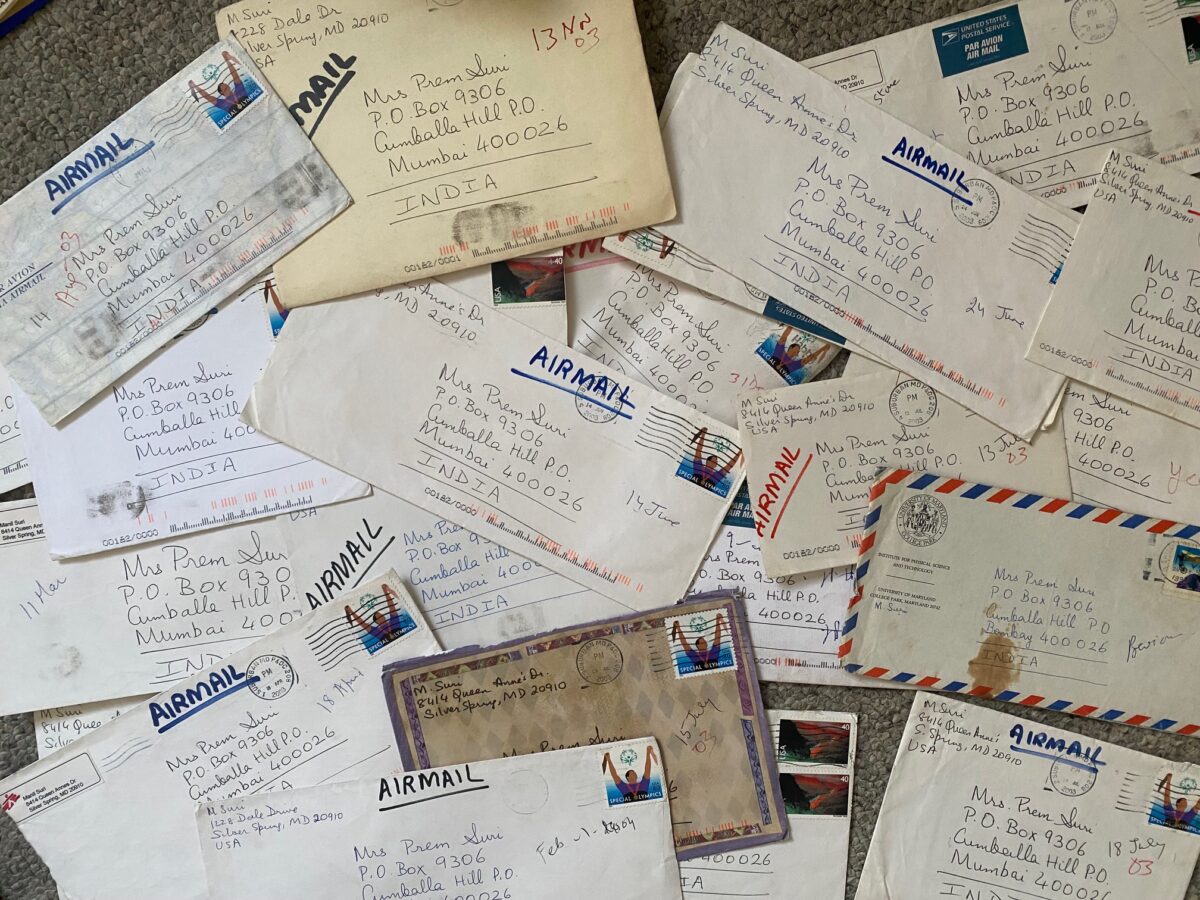 Some of the envelopes from letters Suri sent to his mom, Prem, in India once he moved to the U.S. (Image courtesy of Manil Suri)
Suri is also an award-winning author of three novels named after Hindu gods: The Death of Vishnu, The Age of Shiva, and The City of Devi. His fourth book, The Big Bang of Numbers: How to Build the Universe Using Only Math, is a humanities-based approach to mathematical concepts. They all paved the way for Suri’s most personal and most recent book. In three parts, Suri shares his life growing up in this room in Bombay and his life in the United States, drawing on more than 2,700 letters he wrote to his mother, which she saved in bundles organized by year, beginning with his time as a graduate student at Carnegie Mellon University. The letters chronicle his life in the U.S., including his relationship with his partner Larry, whom he took twice to meet his parents in the room in Bombay.
Q: Who is your book for?
A: I think it’s a book that, first of all, I want to work as a story. People who like a good narrative will enjoy it. It also ties into a different idea of immigration. You hear drastic tales of how immigrants are being shunned and put into prisons. But there’s another side of immigration, too, a little more subtle, perhaps. People immigrate for all sorts of reasons—including “finding themselves,” as I did.
 Aditya Desai ’09, English, a fellow writer, editor, teacher, and activist in Baltimore, and a great fan of Suri’s work, interviewed Suri during an Asian Studies Program book event in spring 2026. (Brad Ziegler/UMBC)
Also, I’ve already received a few pieces of feedback from people who are taking care of their aging parents. There are a huge number of people in various generations who are doing that. So I think it’ll appeal to them and help them negotiate the very difficult road ahead that many will face.
Q: How did the timing for publishing this memoir come about?
A: I have published three novels and a book on math. I felt I had to write the math book as a public service, since I had one foot in the humanities and one in the sciences—and needed to make something out of it. Once this math book was done, there was this other lingering project [the memoir] that I actually started around 2010.

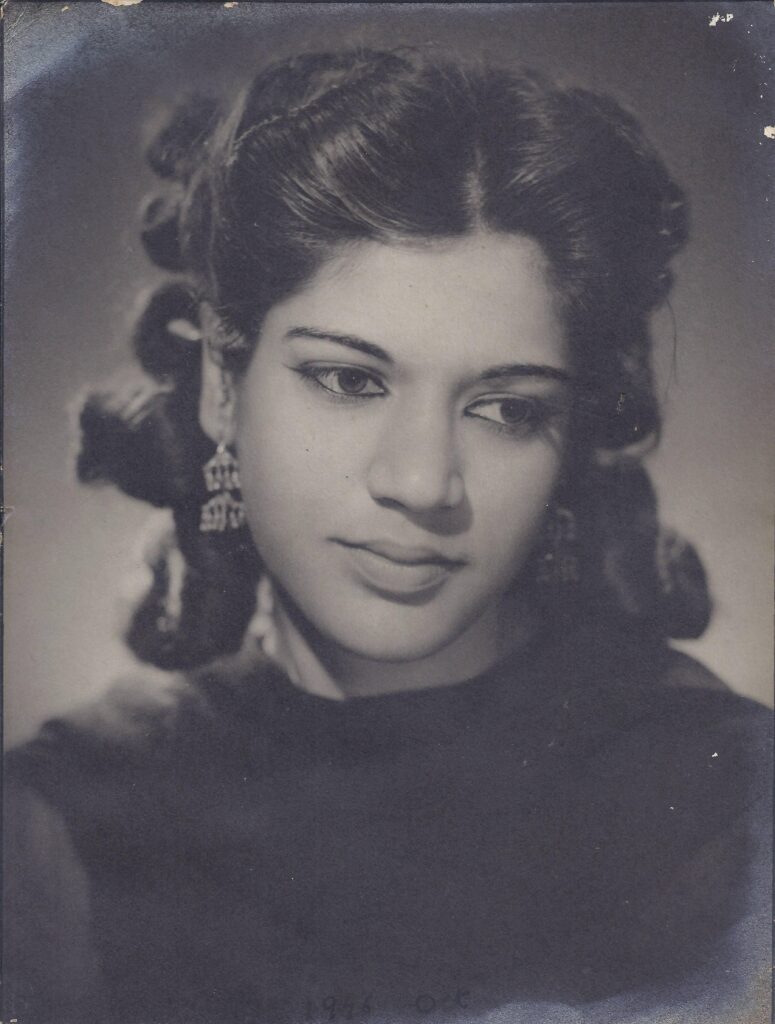
 (l-r): Suri’s mom, Prem Suri, in Bombay (date unknown), Prem in 1946, and Suri with Prem and his father, Ram, at Juhu Chowpatty Beach, Mumbai in 1961.
My mother passed away in 2013, and there was a big gap before I really got into writing the memoir. I needed that distance, since it would have been too much to have written it too close to her passing.
Q: Your mom had this intense love for you, which you wrote was sometimes overwhelming. How did that carry on through the room and through the rest of your life?
A: I think what happened with my mother was that my identity almost melded with hers when I was growing up. It’s only once I came to the U.S. that I was able to separate the two a little and move on. She would always say, “The U.S. has made you unemotional.” It was something I learned after coming here, to keep some distance, and move away from that merging of personalities.
Keeping boundaries is always hard, but it also tunes you to being more conscious of them. I don’t have any kids, so I don’t have to worry about that boundary.
Q: How did you feel coming to the United States?
A: When I first came to the U.S., I spent one week with a typical American family, and suddenly I had my own bedroom. That was exhilarating, but also a little weird. After that, I was in a dorm room with a roommate, so that was again a shared room for one year.
But after that year, I moved into an apartment where I had my own room. Since then, I’ve always had my own bedroom. Even though I’m married now, I need my own bedroom.
Q: A Room in Bombay centers around four families with very different backgrounds that often argue and have major disagreements. How does that tie into today’s world?
A: I think the book actually offers a lesson pertinent to our times. Although it was my Hindu family and three Muslim families sharing this apartment, the fights we had—and there were a lot of them—were really not about religion. They were about the shared bathroom, or the shared kitchen, or resources, or money, or space.
The same applies to most of the clashes going on in the world. Even though people try to put a religious spin on them, there are so many other reasons underlying all this strife. It’s property and boundaries, space, and resources.
Very rarely is it really religion. It’s not the cultural differences that are the cause of friction, it’s other things. Look deeper, and you’ll probably find an economic reason.
Q: Why did you choose to write the book as a memoir as opposed to an epistolary novel?
A: First of all, in terms of the letters, what I wrote are not letters to be treasured like Letters Between a Father and Son, a collection of intimate letters between Nobel laureate V.S. Naipaul and his son. Most of my letters are very ordinary and come with no claim of literary value. I was desperately trying to find things to say, and wrote three or four times a week just to keep my parents happy and engaged.
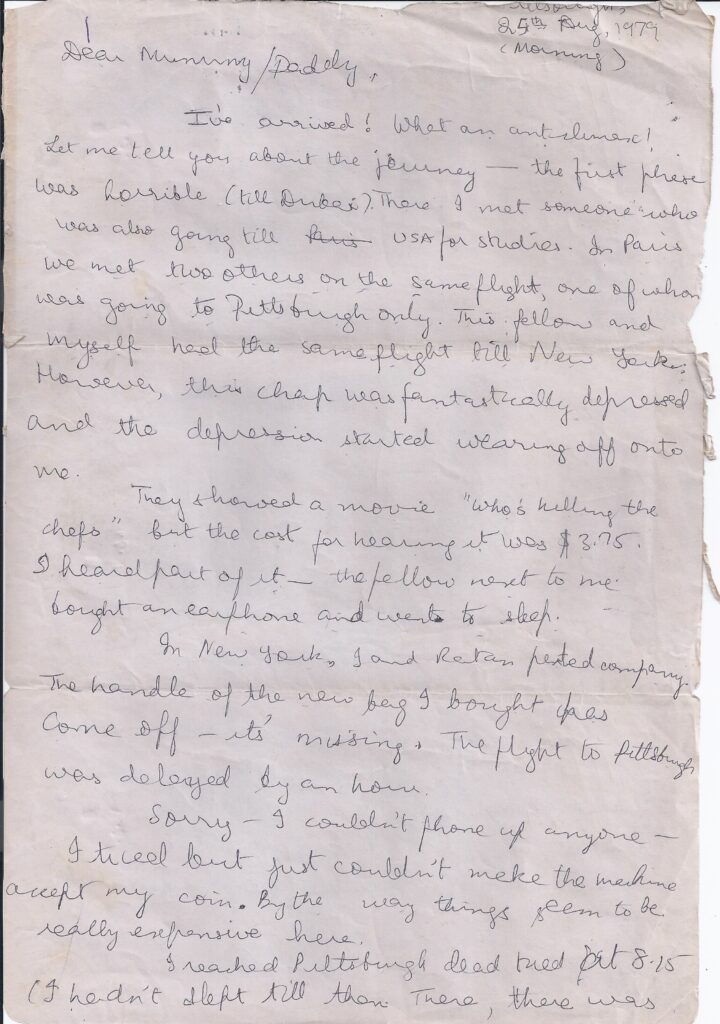 A letter Suri wrote to his father, Ram, in 1979.
There’s also so much more that happened that is not covered by the letters. I did keep some journals, especially once my mother came to the U.S. In fact, I had too much material. The first draft of this novel was about 50 percent longer, excess that I had to edit out.
Q: How do you choose what parts of the book to keep and what to cut?
A: That can be a painful decision, but fortunately, my editor helped by telling me what could be trimmed or shortened. Eventually, I had to get ruthless enough and ask myself: Is the story coming across? How much do I really need to put in for that? What examples have already been included to illustrate something—if there are two of them, let’s get rid of one.
A lot of nice, entertaining experiences had to be jettisoned in the interest of a story that keeps moving. You know, that’s what they say to writers: Kill your darlings. It’s a hard, murderous task to be a writer.
Q: There is a lot of stigma still in South Asian cultures around coming out. Did you intentionally want to address that?
A: Yes, the South Asian LGBTQ+ community is definitely one of the audiences I aimed for in this book, and in particular, their parents. Because even with my mother, who was so enlightened in many ways, there was this up and down that she went through after I came out to her. I think it really eats away at you if you cannot come out to your parents.
At the end of part two in the book, I talk about coming out to my dad. It happened after he took me to his friend’s house to introduce me to his 19-year-old daughter. Afterwards, my father said, “Well, what did you think of the daughter?” And I said, “You can’t be serious. First of all, she’s like half my age.” I ended up telling him about my relationship with my partner, to which he said, “I didn’t know, I didn’t know.” But then I noticed he was still looking expectantly at me. I realized then that he was still waiting for an answer to his question about whether I wanted to marry his friend’s daughter!
I always wanted to have a long conversation with him, which I thought I would have the next time I went back. But he passed away two months later, so that opportunity never came. I found out from my uncle that he had told all his brothers I was gay, even in that short period. So even though my mother always said, “He won’t be able to handle it. Don’t tell him,” as it turned out, he was fine with it.
As far as creating a supportive atmosphere for coming out in the South Asian LGBTQ+ community goes, I’d love to help in any way I could. It would be a good thing for members to give the book to their parents, “Here is someone else’s experience. It may help you.”
Q: Out of the twelve letters that you kept from the hundreds your mom wrote to you, is there one that really stands out to you?
A: The one that’s at the end of the book. It’s a full letter that really crystallizes a lot of things about how she viewed my coming out and how she was aware of losing some of her faculties in terms of memory and concentration. All those things are in that letter, which is why it’s probably the most poignant.
Read more about books from the humanities at UMBC.
]]>
Manil Suri moved to the United States after spending the first 20 years of his life living in a 400-square-foot room in Bombay, India, with his father, Ram, and mother, Prem, to whom he dedicated...
https://umbc.edu/stories/humanities-books-a-room-in-bombay/
https://my3.my.umbc.edu/api/v0/pixel/news/160556/guest@my.umbc.edu/9b67a293e9b6faf4fff6d4a7338ae592/api/pixel
arts-and-culture
cnms
humanitiesbooks
mathematics
news
retriever-authors
story
UMBC News & Magazine
https://my3.my.umbc.edu/groups/umbc-news-magazine
https://assets1-my.umbc.edu/system/shared/avatars/groups/000/001/943/24435aa6207c452e7bc15cc74b42c7bb/xsmall.png?1748556657
https://assets1-my.umbc.edu/system/shared/avatars/groups/000/001/943/24435aa6207c452e7bc15cc74b42c7bb/original.png?1748556657
https://assets2-my.umbc.edu/system/shared/avatars/groups/000/001/943/24435aa6207c452e7bc15cc74b42c7bb/xxlarge.png?1748556657
https://assets2-my.umbc.edu/system/shared/avatars/groups/000/001/943/24435aa6207c452e7bc15cc74b42c7bb/xlarge.png?1748556657
https://assets3-my.umbc.edu/system/shared/avatars/groups/000/001/943/24435aa6207c452e7bc15cc74b42c7bb/large.png?1748556657
https://assets1-my.umbc.edu/system/shared/avatars/groups/000/001/943/24435aa6207c452e7bc15cc74b42c7bb/medium.png?1748556657
https://assets2-my.umbc.edu/system/shared/avatars/groups/000/001/943/24435aa6207c452e7bc15cc74b42c7bb/small.png?1748556657
https://assets1-my.umbc.edu/system/shared/avatars/groups/000/001/943/24435aa6207c452e7bc15cc74b42c7bb/xsmall.png?1748556657
https://assets2-my.umbc.edu/system/shared/avatars/groups/000/001/943/24435aa6207c452e7bc15cc74b42c7bb/xxsmall.png?1748556657
UMBC News & Magazine
1
0
false
Thu, 04 Jun 2026 16:35:39 -0400
Thu, 04 Jun 2026 16:35:39 -0400
Eye wash checks
All,
With students both leaving and joining labs at the end of classes, it is important to make sure eye wash inspections continue weekly through the summer. This one simple task tends to be the single most cited deficiency during out environmental safety and health inspections. If you need tags for documentation, please let me know and I can guide you in the right direction.
Thanks!!
]]>
All, With students both leaving and joining labs at the end of classes, it is important to make sure eye wash inspections continue weekly through the summer. This one simple task tends to be...
https://my3.my.umbc.edu/api/v0/pixel/news/160555/guest@my.umbc.edu/08c8b267f1b6d37683d7e8015fe0b8f2/api/pixel
ILSB Research Labs
https://my3.my.umbc.edu/groups/ilsb-research
https://assets3-my.umbc.edu/system/shared/avatars/groups/000/001/724/ff70a7fc6f7a37fd2f16958e4eaa2046/xsmall.png?1780674394
https://assets4-my.umbc.edu/system/shared/avatars/groups/000/001/724/ff70a7fc6f7a37fd2f16958e4eaa2046/original.png?1780674394
https://assets1-my.umbc.edu/system/shared/avatars/groups/000/001/724/ff70a7fc6f7a37fd2f16958e4eaa2046/xxlarge.png?1780674394
https://assets3-my.umbc.edu/system/shared/avatars/groups/000/001/724/ff70a7fc6f7a37fd2f16958e4eaa2046/xlarge.png?1780674394
https://assets2-my.umbc.edu/system/shared/avatars/groups/000/001/724/ff70a7fc6f7a37fd2f16958e4eaa2046/large.png?1780674394
https://assets1-my.umbc.edu/system/shared/avatars/groups/000/001/724/ff70a7fc6f7a37fd2f16958e4eaa2046/medium.png?1780674394
https://assets2-my.umbc.edu/system/shared/avatars/groups/000/001/724/ff70a7fc6f7a37fd2f16958e4eaa2046/small.png?1780674394
https://assets3-my.umbc.edu/system/shared/avatars/groups/000/001/724/ff70a7fc6f7a37fd2f16958e4eaa2046/xsmall.png?1780674394
https://assets1-my.umbc.edu/system/shared/avatars/groups/000/001/724/ff70a7fc6f7a37fd2f16958e4eaa2046/xxsmall.png?1780674394
ILSB Research Labs
0
0
false
Thu, 04 Jun 2026 16:08:00 -0400
From Baltimore City to Bergen, Norway: Fulbrighter Shanika Freeman ’24 researches the reentry process of women in one of the world’s most humane systems
After Shanika Freeman ’24 walked across the stage, she had something on her mind—basic human rights. For the past four years, Freeman’s research has focused on the reentry experiences of formerly incarcerated women in the United States and Maryland. Basic human rights—including access to healthy food, education, housing, healthcare, clothing, and job skills development—are difficult to access for people in the reentry process due to limited to no financial resources, support networks, services, and stigma.
“In Maryland, over 15,000 women are released from prison every year. Just imagine, you’ve been released, and unfortunately, you couldn’t get a transitional program or reentry program, so you are basically by yourself,” said Freeman during her individualized study major’s capstone presentation. “You go out, you kiss the ground because you know you are free, but you are only given about $50 to $100 of gate money to find transportation and all your basic needs.”
Reentry programs are not the root of these obstacles. During her research, Freeman learned that the U.S.incarceration system’s emphasis on punishments rather than rehabilitation means many women are released without workforce skills needed to meet the demands of a changing job, let alone recreate a new life. All of these factors increase recidivism rates.
“I wasn’t born to be caged up and chained up,” is a quote by Susan Burton that inspired Freeman to continue her research on successful reentry pathways. Burton is the founder of A New Way of Life Reentry Project, a non-profit organization in California that provides safe housing, pro bono legal services, advocacy, and family reunification for formerly incarcerated women. Leading with compassion inspired Freeman to seek similar approaches in her own work.
She didn’t know at the time that her search would lead her to Norway, whose incarceration system is widely recognized as one of the most humane rehabilitative institutions in the world. Their rehabilitation process emphasizes mentorship, skill-building, communal living, mirroring regular life based on the Norwegians’ belief that the only right a person loses through incarceration is liberty. As a result, Norway has one of the lowest rates of recidivism in the world. Thanks to a 2025 – 2026 Fulbright U.S. Student Program award, Freeman crossed the Atlantic to Bergen, Norway, to conduct research on the reentry experiences of Norwegian women into the community after incarceration.
Janteloven, a culture of humility
For the first time, Freeman boarded a plane, leaving the United States and Baltimore for Bergen, a city on Norway’s southwestern coast known as the city between the seven mountains. Freeman quickly found that life in Bergen is about enjoying nature. She remembers walking from her small studio apartment to the University of Bergen and seeing hikers everywhere. While cross-country skiing is the official national sport, hiking is an integral part of Bergen culture. Freeman joined the locals on both activities, and suited up with hiking boots and cross-country skis—also a first.

 Left: Freeman cross-country skiing in Gausdal, Norway. Right: Freeman enjoys a walk in the mountains.
“I love this city. It’s not crowded. You can take a hike up a mountain any day of the week. Mount Fløyen is the closest and most popular mountain in Bergen,” said Freeman. “So many beautiful views and at the top, you can also get hot chocolate, coffee, and Norwegian waffles. It’s all really nice.” While she enjoyed the outdoors, Freeman did have some first-day jitters when it came time to join the research team.
“I was a bit hesitant when I arrived because I had just graduated with my bachelor’s, and most of my colleagues had a Ph.D. or were earning one. I was a bit worried about fitting in. But they welcomed me with open arms,” says Freeman. “Bergensere really value you and your voice, no matter what. It doesn’t matter if you have a degree or not, they really value you and make sure your voice is heard.”
This practice of equality and community above all is called Janteloven, a Scandinavian cultural, social, and literary concept that emphasizes equality, humility, and collective conformity over individual achievement. Freeman’s welcome was an example of Janteloven. This extends to architecture, clothing, and even standing in line.
I was a bit hesitant when I arrived because I had just graduated with my bachelor’s, and most of my colleagues had a Ph.D. or were earning one. I was a bit worried about fitting in. But they welcomed me with open arms,” says Freeman. “Bergensere really value you and your voice, no matter what. It doesn’t matter if you have a degree or not, they really value you and make sure your voice is heard.
Shanika Freeman ’24
Individualized Study
“From my perspective, a lot of Norwegians are sort of hard to crack because they don’t usually do small talk. Back in Baltimore, if you’re standing in line at the grocery store, you can strike up a conversation with anyone. Not here so much,” explains Freeman. “They’re not being rude. They value your time, and they value their time as well, and don’t want to inconvenience anybody. It’s a cultural norm.”
Janteloven in the prison system
Possibly because of this norm, it took time for Freeman to find participants who wanted to focus on their own story. “It’s such a sensitive subject that I researched. One of the challenges I faced was helping participants feel comfortable speaking,” said Freeman. “I talked about their feelings during incarceration and reentry. It’s a very vulnerable state to be in.” Her Fulbright research advisors stepped in and connected Freeman with a few participants and guided her to pivot from solely focusing on reentry to include the system side of the process by speaking with experts in the field of criminology and penology—the philosophy, management, and effectiveness of prison systems and rehabilitation methods.
“One of my main findings was that Norway’s successful reentry is shaped primarily by its welfare system. It is set up to help with social support, housing, education, and job support. They have something called the import model,” said Freeman, “which means that they rely on external public services like healthcare, education, and libraries that are delivered by community providers rather than the prison staff themselves.” Freeman notes that this is in stark contrast to what she found in her research on the U.S. reentry process, where these services are usually contracted out. In Norway, staff are almost always civilians from the same communities into which the residents—Norway doesn’t use the term inmate or prisoner—will be released.
Freeman found a successful example to observe at WayBack, a Norwegian nonprofit foundation that supports formerly incarcerated individuals’ return to society by coordinating services and building networks for successful reintegration. However, the process doesn’t end there. WayBack’s approach to intervention is also based on peer-to-peer mentorship, a form of rehabilitation support Freeman has rarely seen in Baltimore.
 Freeman presents her research at Bergen Global. (Image courtesy of Freeman)
“Norway’s welfare state and broader cultural belief systems, Janteloven included, reinforce the idea that the conviction and sentence to prison itself is the punishment,” Freeman explained. “So while you are inside, rehabilitation should be the main priority.”
But nothing is perfect. Another of Freeman’s findings includes the shortcomings of the Norwegian incarceration system. Freeman explained that there are prisons where women have limited gender-specific support and lack the services needed to overcome major barriers, including trauma, addiction, and mental health. “There was a recent report criticizing Trondheim Prison, a few hours from Bergen, due to human rights violations,” said Freeman, after submitting her research. “This was extremely surprising to me. They were in violation of mishandling medication, isolation, and unsanitary conditions, to name a few. So, despite all of the progress, there are still things that aren’t being addressed as quickly as others might want, but at least they are working to address it.”
Human rights in Bergen and Baltimore
After four seasons in Norway, Freeman is packing up and preparing to return home to Baltimore, leaving with a greater appreciation for Janteloven. She is hopeful that one day she will return to the city between the seven mountains either for travel or to pursue a master’s program to continue her research. In the meantime, Freeman is already working on adding a visual element to her research, as she plans to spend the summer filming a documentary on the impact of incarceration on Baltimore communities and families.
“Having both the reentering system and the criminal system perspectives made my research stronger. My main goal is to work with reentry programs or even programs inside the prison system,” says Freeman. “I want people to think about the human rights of people in the prison system. No matter what they did, just because they were inside, it doesn’t mean they don’t deserve basic human rights.”
Read more Fulbright stories and learn about UMBC’s Fulbright preparation.
]]>
After Shanika Freeman ’24 walked across the stage, she had something on her mind—basic human rights. For the past four years, Freeman’s research has focused on the reentry experiences of formerly...
https://umbc.edu/stories/from-baltimore-city-to-bergen-norway-fulbright-shanika-freeman-expands-her-research/
https://my3.my.umbc.edu/api/v0/pixel/news/160554/guest@my.umbc.edu/b95daa68b2e4f15f656d7bd54ea77e58/api/pixel
cahss
fulbright
inds
international
news
policy-and-society
story
UMBC News & Magazine
https://my3.my.umbc.edu/groups/umbc-news-magazine
https://assets1-my.umbc.edu/system/shared/avatars/groups/000/001/943/24435aa6207c452e7bc15cc74b42c7bb/xsmall.png?1748556657
https://assets1-my.umbc.edu/system/shared/avatars/groups/000/001/943/24435aa6207c452e7bc15cc74b42c7bb/original.png?1748556657
https://assets2-my.umbc.edu/system/shared/avatars/groups/000/001/943/24435aa6207c452e7bc15cc74b42c7bb/xxlarge.png?1748556657
https://assets2-my.umbc.edu/system/shared/avatars/groups/000/001/943/24435aa6207c452e7bc15cc74b42c7bb/xlarge.png?1748556657
https://assets3-my.umbc.edu/system/shared/avatars/groups/000/001/943/24435aa6207c452e7bc15cc74b42c7bb/large.png?1748556657
https://assets1-my.umbc.edu/system/shared/avatars/groups/000/001/943/24435aa6207c452e7bc15cc74b42c7bb/medium.png?1748556657
https://assets2-my.umbc.edu/system/shared/avatars/groups/000/001/943/24435aa6207c452e7bc15cc74b42c7bb/small.png?1748556657
https://assets1-my.umbc.edu/system/shared/avatars/groups/000/001/943/24435aa6207c452e7bc15cc74b42c7bb/xsmall.png?1748556657
https://assets2-my.umbc.edu/system/shared/avatars/groups/000/001/943/24435aa6207c452e7bc15cc74b42c7bb/xxsmall.png?1748556657
UMBC News & Magazine
3
0
false
Thu, 04 Jun 2026 15:16:08 -0400
Thu, 04 Jun 2026 15:16:08 -0400
Hanover Roundtable: Sustaining Research Growth in Today's Funding Environment
Thursday, June 25th @noon EST
 Roundtable: Sustaining Research Growth in Today’s Funding Environment
Thursday, June 25th | 12-12:45 PM ET / 9-9:45 AM PT
REGISTER NOW
Amid rapid changes in the federal funding landscape, institutions of higher education are confronting a host of new challenges as they strive to sustain and grow their grant portfolios.
In this roundtable discussion, we will hear from grants and research leaders about the strategies they are deploying to keep their organizations on course.
Topics will include efforts to diversify funding sources, respond to shifting priorities, strengthen institutional research capacity, and explore emerging opportunities in uncharted areas.
Panelists:
- Kirsten Wisneski – Founding Director, Research Development Office, University of North Carolina Wilmington (NC)
- Tamara Gabrus – Senior Director, Research Advancement and Strategy, University of Central Florida (FL)
- Dr. P. Karen Murphy – Associate Dean for Research and Outreach, The Pennsylvania State University College of Education (PA)
- Dr. Randy Heflin – Senior Associate Vice President Research and Innovation, Virginia Tech (VA)
Moderators:
- Mallory Waters – Grants Advisor, Hanover Research
- Tom Kuhn – Senior Grants Consultant, Hanover Research
Unable to attend? Register and Hanover will send a copy of the recording and slides after the webinar.
About Hanover Research: Hanover provides research development, grant writing, and strategic advising support to a wide range of organizations. Our professionals deliver customized proposal review, revision, and production support, while also helping to align strategic priorities to funding trends and opportunities at all levels. To learn more about Hanover Research, visit www.hanoverresearch.com.
]]>
Roundtable: Sustaining Research Growth in Today’s Funding Environment Thursday, June 25th | 12-12:45 PM ET / 9-9:45 AM PT REGISTER NOW Amid rapid changes in the federal funding landscape,...
https://my3.my.umbc.edu/api/v0/pixel/news/160553/guest@my.umbc.edu/bd5752111c211a3b6bf7d057ce7f7dd8/api/pixel
Center for Social Science Scholarship
https://my3.my.umbc.edu/groups/csss
https://assets4-my.umbc.edu/system/shared/avatars/groups/000/000/825/333a55a4dd50a0fafb33f7e2e5b0df03/xsmall.png?1544752142
https://assets2-my.umbc.edu/system/shared/avatars/groups/000/000/825/333a55a4dd50a0fafb33f7e2e5b0df03/original.png?1544752142
https://assets3-my.umbc.edu/system/shared/avatars/groups/000/000/825/333a55a4dd50a0fafb33f7e2e5b0df03/xxlarge.png?1544752142
https://assets3-my.umbc.edu/system/shared/avatars/groups/000/000/825/333a55a4dd50a0fafb33f7e2e5b0df03/xlarge.png?1544752142
https://assets4-my.umbc.edu/system/shared/avatars/groups/000/000/825/333a55a4dd50a0fafb33f7e2e5b0df03/large.png?1544752142
https://assets1-my.umbc.edu/system/shared/avatars/groups/000/000/825/333a55a4dd50a0fafb33f7e2e5b0df03/medium.png?1544752142
https://assets2-my.umbc.edu/system/shared/avatars/groups/000/000/825/333a55a4dd50a0fafb33f7e2e5b0df03/small.png?1544752142
https://assets4-my.umbc.edu/system/shared/avatars/groups/000/000/825/333a55a4dd50a0fafb33f7e2e5b0df03/xsmall.png?1544752142
https://assets3-my.umbc.edu/system/shared/avatars/groups/000/000/825/333a55a4dd50a0fafb33f7e2e5b0df03/xxsmall.png?1544752142
Center for Social Science Scholarship
0
0
false
Thu, 04 Jun 2026 14:31:02 -0400