Capping years of rising success, UMBC chemical engineering club shines as student conference hosts
On the first weekend of April, hundreds of chemical engineering students from across the Mid-Atlantic converged on the UMBC campus for two days of learning, networking, and friendly competition. They heard talks from academic and industry leaders, attended workshops and a career fair, competed in rounds of ChemE Jeopardy, mixed chemicals to power small cars along a track in the ChemE Car competition, and mingled over catered lunches, dinners, and cups of evening hot cocoa.
The activities were all part of the 2024 Mid-Atlantic Student Regional Conference of the American Institute of Chemical Engineers (AIChE)—hosted by the UMBC student chapter of the national group. Around 400 people attended the event, an increase from last year’s conference at Virginia Tech. Organizing the logistics, recruiting speakers and sponsors, securing rooms, and ordering thousands of plates worth of food presented a formidable challenge—one that the UMBC students tackled with aplomb.
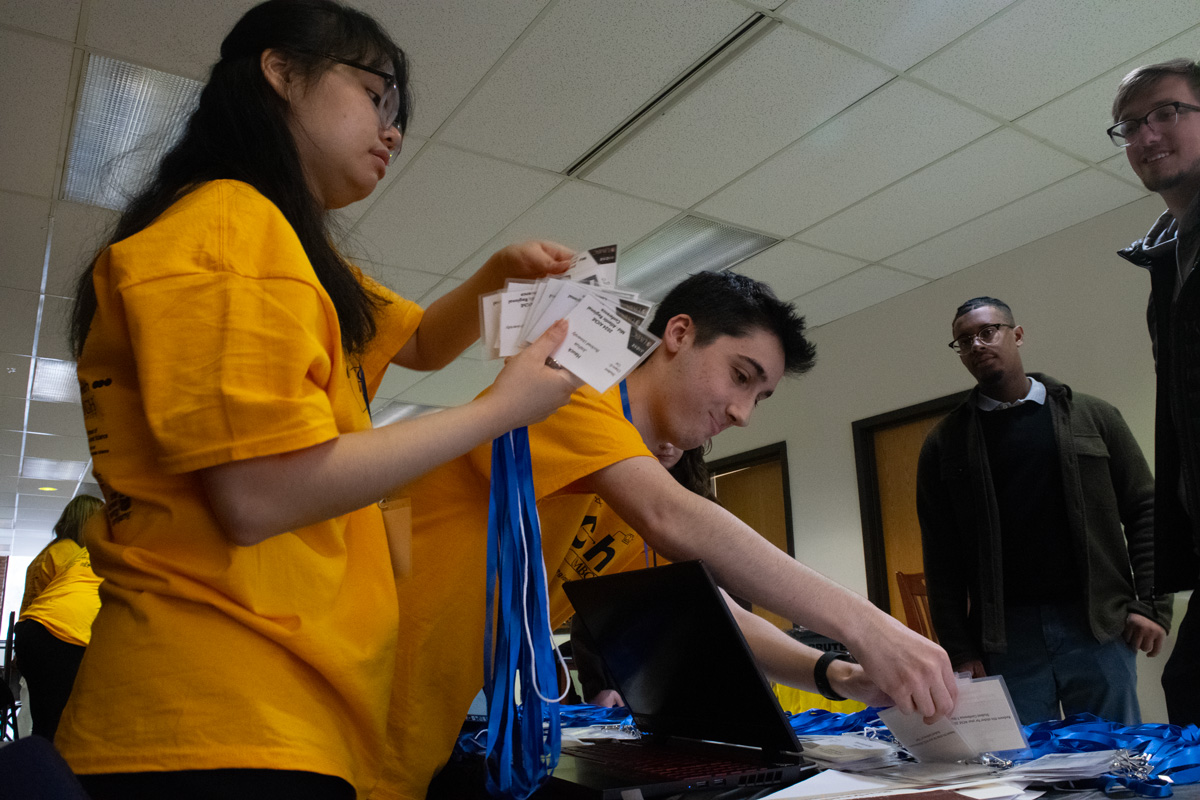 Managing check-in. (Photo by Danielle Clark)
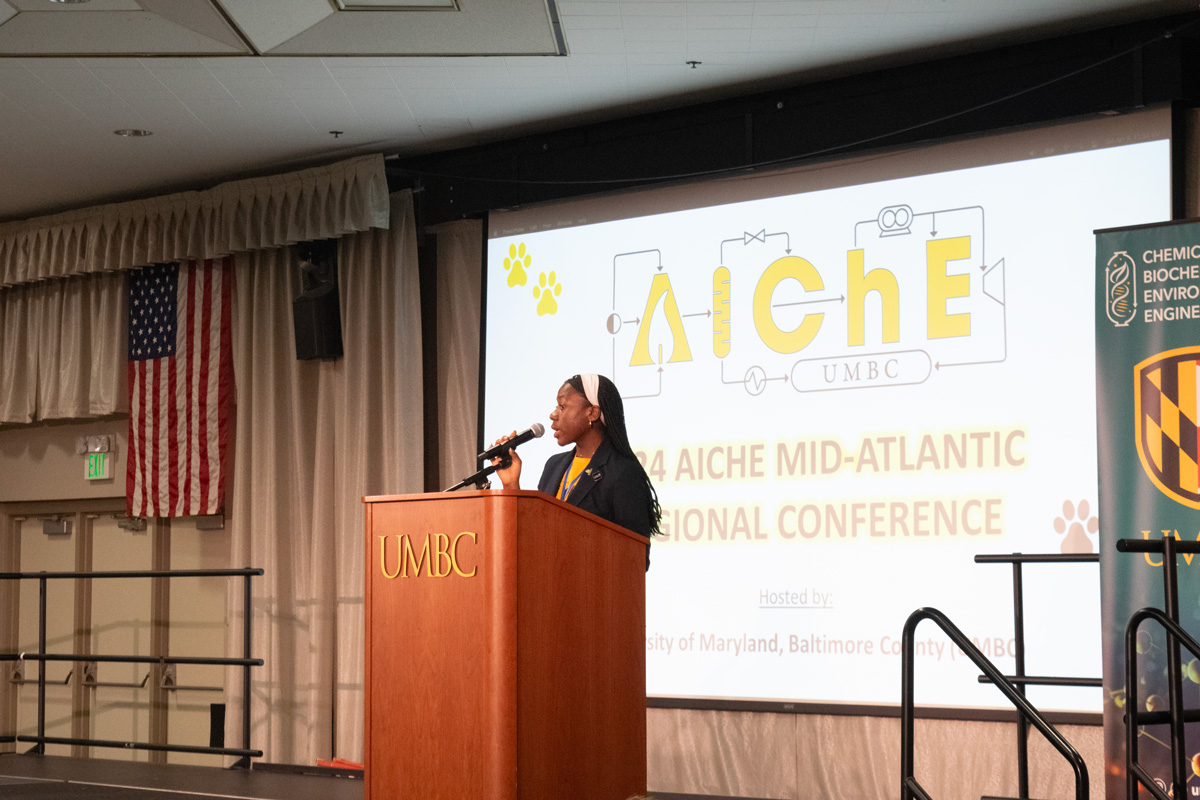 Welcoming attendees. (Photo by Danielle Clark)
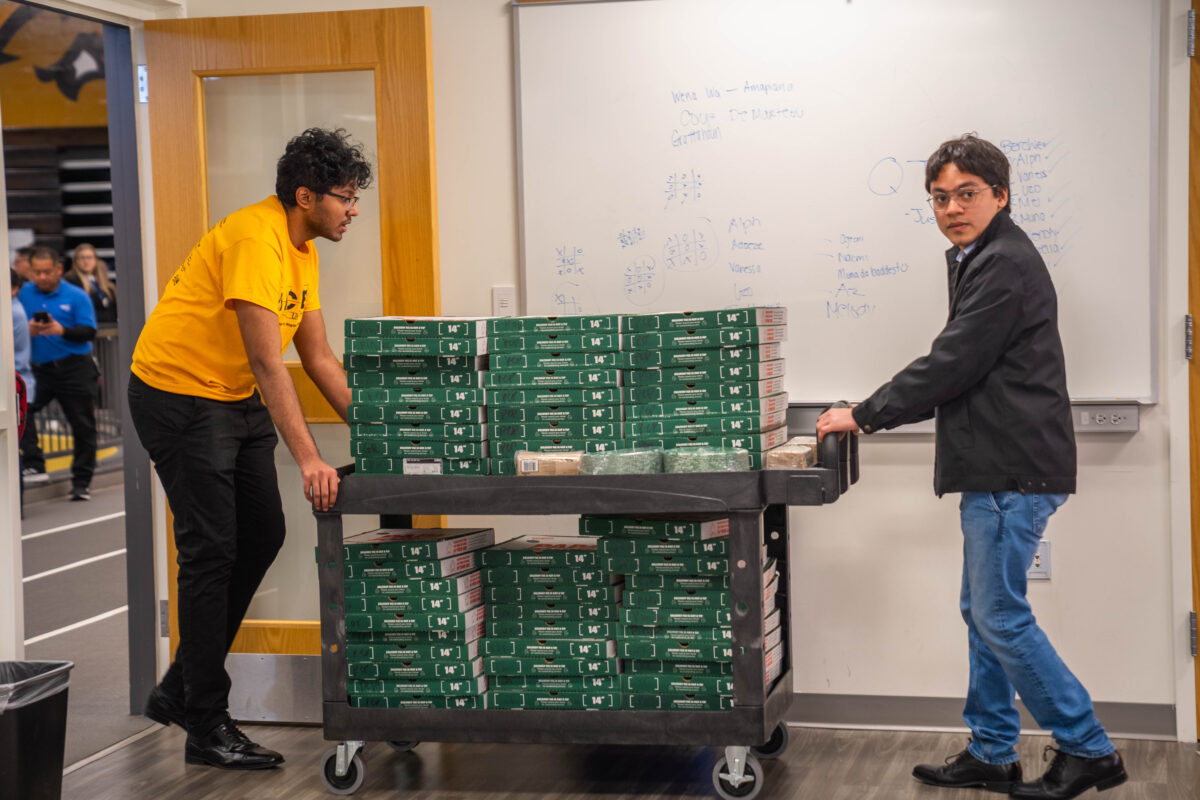 Delivering pizza. (Photo by Julianna Falconer)
“I am feeling fantastic after the conference,” says Pavan Umashankar ’25, chemical engineering and biochemistry and molecular biology, who served as the chair of the conference organizing committee. “I am super proud of everyone’s commitment and dedication to make it a resounding success.”
“Truly, I could gush about the UMBC conference planning team all day,” says Alyssa Block, the membership associate of ChemE student programs for AIChE. “These students really are the future leaders of their profession and of AIChE: engaged, excited, collaborative, supportive of each other, and willing to lend a hand.”
A club on the upswing
Hosting an AIChE regional conference for the first time at UMBC marked a milestone for a student club that has seen increasing levels of engagement and success in recent years. While many college clubs across the country are in decline post-Covid, UMBC’s AIChE student chapter is on a clear upward trajectory. The club sent its first team to compete in ChemE Jeopardy at the spring 2019 AIChE regional meeting. Just three years later, the UMBC team won the national ChemE Jeopardy competition.
Neha Raikar, a senior lecturer in the Department of Chemical, Biochemical, and Environmental Engineering (CBEE) and one of the advisors to the student AIChE chapter, remembers attending the 2019 meeting: “Back then, we wondered if we would ever be able to host a regional conference at UMBC,” she says. “We’ve achieved that goal.”
It was especially remarkable, she adds, to see some members of UMBC’s first ChemE Jeopardy and ChemE car teams return to this year’s conference as industry representatives.
Strong attendance and smooth conference logistics weren’t the only successes of the weekend—UMBC also triumphed in the ChemE Jeopardy and ChemE car competitions.
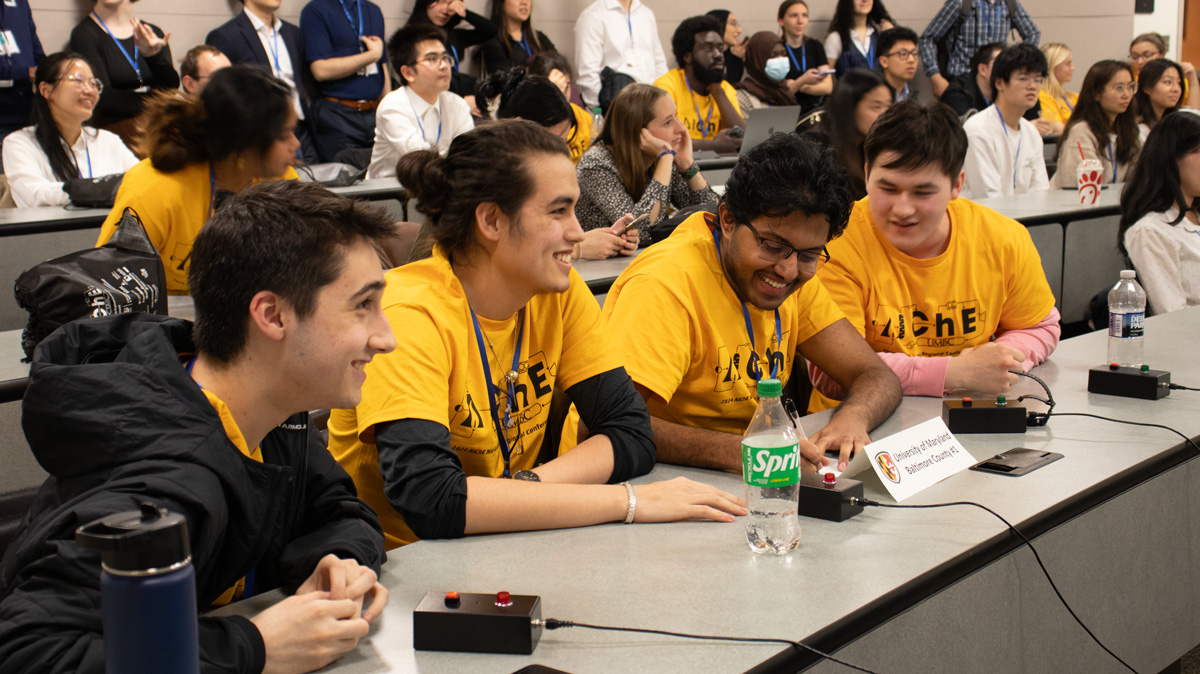 The UMBC #1 Jeopardy team during a preliminary round. (Photo by Patch Hatley)
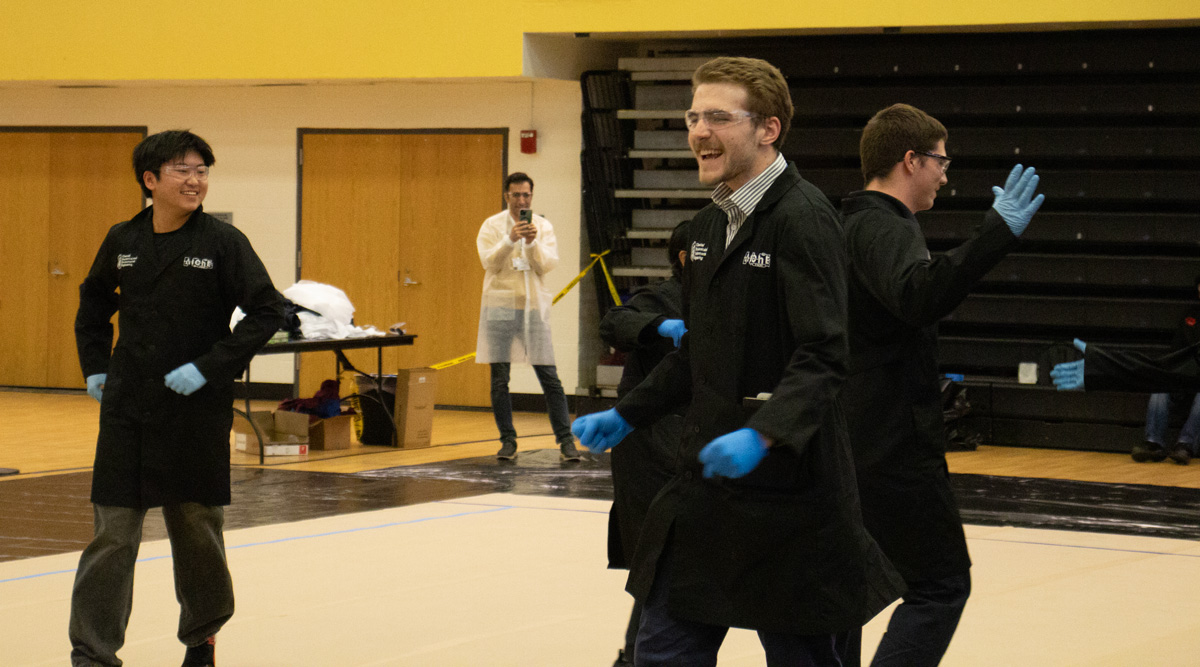 The UMBC ChemE Car team celebrates a good run. (Photo by Patch Hatley)
“Planning for the conference was already a significant undertaking, and on top of that, many of our students participated, and excelled, in the competitions,” says Raikar. “Their achievements not only showcased their individual capabilities but also the strength of our club as a whole, which is growing and thriving.”
A winning formula
AIChE chapter members and their advisors ascribe the club’s success to the hard work and dedication of the students coupled with the support of the CBEE department, college, and university. Thirteen CBEE students formed the conference planning committee, which met regularly to ensure all conference planning efforts were on track. An additional 37 students and 14 faculty and staff also volunteered their time—as check-in staff, poster and presentation judges, and more. About 10 UMBC alumni actively participated in the conference, and others contributed to fundraising efforts, helping the organizing committee secure sponsorships from notable companies such as AstraZeneca, ExxonMobil, Advanced Thermal Batteries, and Astek Diagnostics and from the chemical engineering department of Columbia University.
An Dang ’24, chemical engineering, led the fundraising efforts. She gamely approached industry representatives at the UMBC career fair and made the pitch. “I’m not an extrovert, and being in these roles forced me to go out of my comfort zone,” she says.
“Securing sponsorships was vital for making the conference possible, and An did a remarkable job” says Mariajosé Castellanos, another CBEE faculty who advises the AIChE chapter. Castellanos also praised the management skills of conference planning committee chair Umashankar. “Despite his modesty, Pavan is a true mastermind in everything he does,” she says.
For their part, the students applauded the support of the CBEE department, especially the work of their two advisors, Raikar and Castellanos, and the event planning support of Andrea Miller, the CBEE graduate program coordinator.
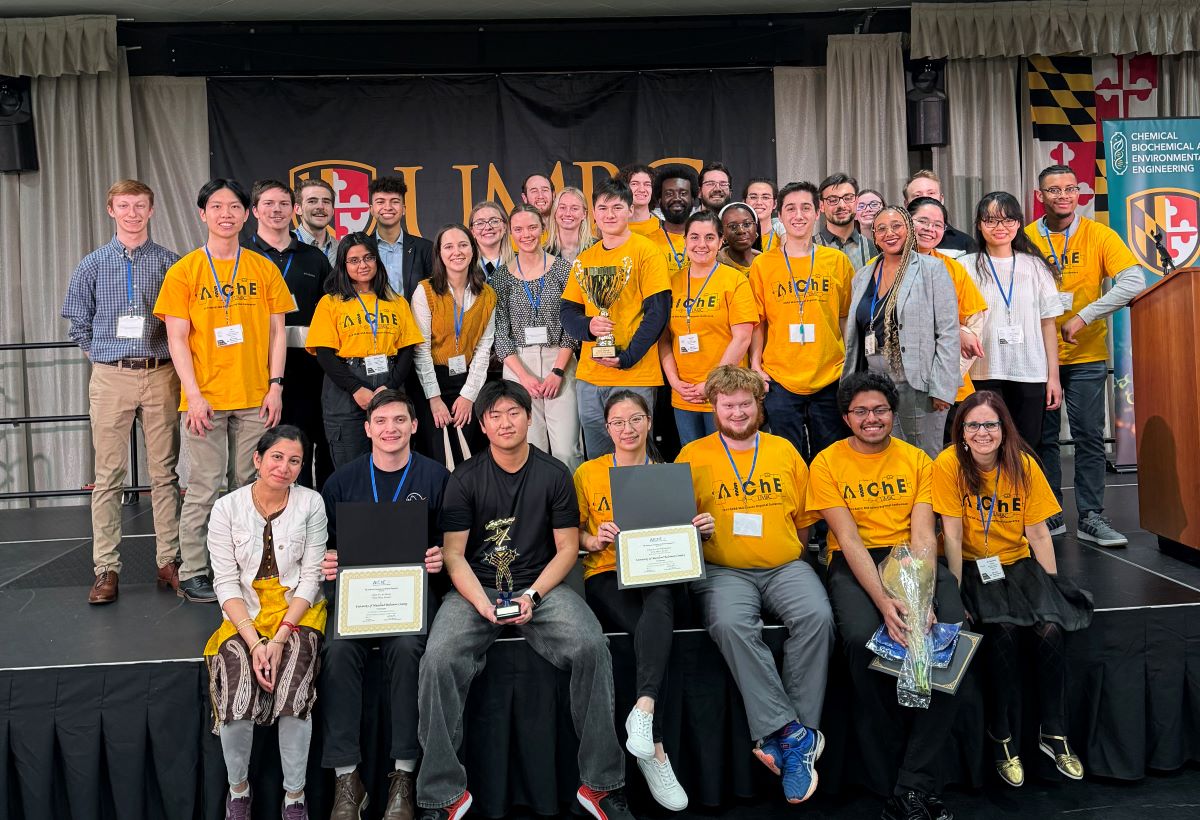 UMBC AIChE chapter students and faculty advisors pose for a group photo after a successful conference. (Photo courtesy of Mariajosé Castellanos.)
The conference was both a marker of the club’s success and an opportunity for individual students to grow their skill sets.
“I have developed leadership and project management skills, which will be incredibly useful throughout my professional career,” says Umashankar.
Ben Welling ’25, chemical engineering, the leader of the UMBC ChemE car team, believes his experience with the competition helped him land internships. “I talked about it extensively with employers. They like leadership experience and it shows you are willing to do more than is required.”
Raikar sees a bright future for the student stars of this year’s conference and for the club as a whole. “I hope the conference will boost the club membership and participation of students in other AIChE activities,” she says. And, she adds, the conference shows that with support, “UMBC students can accomplish any task.”
]]>
On the first weekend of April, hundreds of chemical engineering students from across the Mid-Atlantic converged on the UMBC campus for two days of learning, networking, and friendly competition....
https://umbc.edu/stories/umbc-chemical-engineering-club-shines-as-student-conference-hosts/
https://my3.my.umbc.edu/api/v0/pixel/news/142266/guest@my.umbc.edu/73e17cd25ad64e55b2130e8bf14c39f0/api/pixel
cbee
coeit
community
news
story
UMBC News & Magazine
https://my3.my.umbc.edu/groups/umbc-news-magazine
https://assets1-my.umbc.edu/system/shared/avatars/groups/000/001/943/24435aa6207c452e7bc15cc74b42c7bb/xsmall.png?1748556657
https://assets1-my.umbc.edu/system/shared/avatars/groups/000/001/943/24435aa6207c452e7bc15cc74b42c7bb/original.png?1748556657
https://assets2-my.umbc.edu/system/shared/avatars/groups/000/001/943/24435aa6207c452e7bc15cc74b42c7bb/xxlarge.png?1748556657
https://assets2-my.umbc.edu/system/shared/avatars/groups/000/001/943/24435aa6207c452e7bc15cc74b42c7bb/xlarge.png?1748556657
https://assets3-my.umbc.edu/system/shared/avatars/groups/000/001/943/24435aa6207c452e7bc15cc74b42c7bb/large.png?1748556657
https://assets1-my.umbc.edu/system/shared/avatars/groups/000/001/943/24435aa6207c452e7bc15cc74b42c7bb/medium.png?1748556657
https://assets2-my.umbc.edu/system/shared/avatars/groups/000/001/943/24435aa6207c452e7bc15cc74b42c7bb/small.png?1748556657
https://assets1-my.umbc.edu/system/shared/avatars/groups/000/001/943/24435aa6207c452e7bc15cc74b42c7bb/xsmall.png?1748556657
https://assets2-my.umbc.edu/system/shared/avatars/groups/000/001/943/24435aa6207c452e7bc15cc74b42c7bb/xxsmall.png?1748556657
UMBC News & Magazine
0
0
false
Thu, 30 May 2024 12:51:16 -0400
Thu, 30 May 2024 12:51:16 -0400
Fall 2023 McNair Saturday Academy
Summary of Resources for our Fall 2023 Academy Sessions!
Please see the following for a summary of resources from our Fall 2023 semester:
Date: October 7, 2023
Topic 1: Funding Graduate Studies - Fellowships vs. Scholarships vs. Assistantships vs. Loans
Location: SOND 101
Time: 1:00 - 2:30pm
Topic 2: Boundary Setting with Others: Thriving Without Overcommitting
Location: SOND 101
Time: 3:00 - 4:15pm
Date: November 4, 2023
Topic 1: Setting Your Intentions for Success [
myUMBC]
Location: SOND 101
Time: 1:00 - 2:10pm
Topic 2: Navigating Long-term Burnout
Location: SOND 101
Time: 3:00 - 4:45pm
Date: December 2, 2023
Topic: Applying to Summer Research Program: Writing a Captivating Personal Statement
Location: SOND 101 (Zoom option available)
Time: 1:00 - 2:30pm
]]>
Please see the following for a summary of resources from our Fall 2023 semester: Date: October 7, 2023 Topic 1: Funding Graduate Studies - Fellowships vs. Scholarships vs. Assistantships...
https://my3.my.umbc.edu/api/v0/pixel/news/142254/guest@my.umbc.edu/2f05724a1cc12b012df54195de433211/api/pixel
mcnair
McNair Scholars Program
https://my3.my.umbc.edu/groups/public-mcnair
https://assets1-my.umbc.edu/system/shared/avatars/groups/000/000/871/c7dfbbb2c4b908a2b8841c6ebbdfa8d6/xsmall.png?1612555388
https://assets4-my.umbc.edu/system/shared/avatars/groups/000/000/871/c7dfbbb2c4b908a2b8841c6ebbdfa8d6/original.png?1612555388
https://assets1-my.umbc.edu/system/shared/avatars/groups/000/000/871/c7dfbbb2c4b908a2b8841c6ebbdfa8d6/xxlarge.png?1612555388
https://assets3-my.umbc.edu/system/shared/avatars/groups/000/000/871/c7dfbbb2c4b908a2b8841c6ebbdfa8d6/xlarge.png?1612555388
https://assets2-my.umbc.edu/system/shared/avatars/groups/000/000/871/c7dfbbb2c4b908a2b8841c6ebbdfa8d6/large.png?1612555388
https://assets1-my.umbc.edu/system/shared/avatars/groups/000/000/871/c7dfbbb2c4b908a2b8841c6ebbdfa8d6/medium.png?1612555388
https://assets3-my.umbc.edu/system/shared/avatars/groups/000/000/871/c7dfbbb2c4b908a2b8841c6ebbdfa8d6/small.png?1612555388
https://assets1-my.umbc.edu/system/shared/avatars/groups/000/000/871/c7dfbbb2c4b908a2b8841c6ebbdfa8d6/xsmall.png?1612555388
https://assets4-my.umbc.edu/system/shared/avatars/groups/000/000/871/c7dfbbb2c4b908a2b8841c6ebbdfa8d6/xxsmall.png?1612555388
McNair Scholars Program
0
0
true
Thu, 30 May 2024 12:34:35 -0400
Lost and Found in PAHB 423
PSA - There is a lost and found at the English Department front office at PAHB 423 for anyone who has lost something (electronics, watches, keys, jewelry, makeup) on the third or fourth floor of the PAHB. We have an assortment of items here.
]]>
PSA - There is a lost and found at the English Department front office at PAHB 423 for anyone who has lost something (electronics, watches, keys, jewelry, makeup) on the third or fourth floor of...
https://my3.my.umbc.edu/api/v0/pixel/news/142253/guest@my.umbc.edu/bbf13db5b5c783e4ec9092483ada5ad4/api/pixel
Lost & Found
https://my3.my.umbc.edu/groups/lost-and-found
https://assets3-my.umbc.edu/system/shared/avatars/groups/000/001/086/055b16101a3381e4f963bdb30117593a/xsmall.png?1434668237
https://assets2-my.umbc.edu/system/shared/avatars/groups/000/001/086/055b16101a3381e4f963bdb30117593a/original.png?1434668237
https://assets2-my.umbc.edu/system/shared/avatars/groups/000/001/086/055b16101a3381e4f963bdb30117593a/xxlarge.png?1434668237
https://assets3-my.umbc.edu/system/shared/avatars/groups/000/001/086/055b16101a3381e4f963bdb30117593a/xlarge.png?1434668237
https://assets2-my.umbc.edu/system/shared/avatars/groups/000/001/086/055b16101a3381e4f963bdb30117593a/large.png?1434668237
https://assets1-my.umbc.edu/system/shared/avatars/groups/000/001/086/055b16101a3381e4f963bdb30117593a/medium.png?1434668237
https://assets2-my.umbc.edu/system/shared/avatars/groups/000/001/086/055b16101a3381e4f963bdb30117593a/small.png?1434668237
https://assets3-my.umbc.edu/system/shared/avatars/groups/000/001/086/055b16101a3381e4f963bdb30117593a/xsmall.png?1434668237
https://assets3-my.umbc.edu/system/shared/avatars/groups/000/001/086/055b16101a3381e4f963bdb30117593a/xxsmall.png?1434668237
Lost & Found
0
0
true
Thu, 30 May 2024 11:47:05 -0400
Thu, 30 May 2024 11:52:59 -0400
On PACE to Unravel Earth’s Mysteries
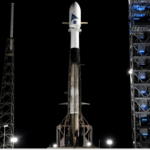
The third time’s the charm. Against a calm and crisp dark night sky on Florida’s Cape Canaveral on February 8, 2024, just after 1:30 a.m., the Plankton, Aerosol, Cloud, Ocean Ecosystem (PACE) spacecraft rocketed to orbit carrying on board Hyper-Angular Rainbow Polarimeter (HARP2)–UMBC’s wide-angle imaging polarimeter. The launch marked the first time NASA deployed a university payload on a large operational Earth science space mission.
Written by: Anne Wainscott-Sargent

Following two scrubbed night launches the two previous nights due to strong winds, Thursday’s successful takeoff was well worth the wait for the core team of UMBC Earth and Space Institute researchers, graduate students, and their families and friends who journeyed from Baltimore to watch the historic launch.
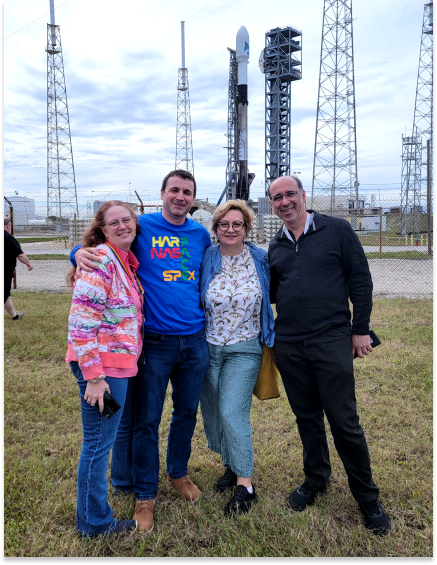 Left to right: Margo Young, Dominik Cieslak, Magdalena Kuzmicz-Cieslak, and Vanderlei Martins stand in front of the PACE spacecraft the day before its launch.
Photo credit: Margo Young
Arriving by bus a little before midnight to the Banana Creek Launch Viewing Area at Kennedy Space Center, just over six miles from Space Launch Complex-40, the close-knit UMBC entourage huddled together waiting for the final countdown.
When it came, they—along with hundreds of other space launch watchers—held their breath and then yelled and clapped as SpaceX’s Falcon 9 rocket blasted off and propelled PACE 400 miles above Earth into sun-synchronous orbit. Minutes later the Falcon 9’s first stage—SpaceX’s reusable rocket booster—successfully landed at Landing Zone 1. The crowd gasped audibly at the sonic boom, caused when the spacecraft broke the sound barrier.
“It still doesn’t quite feel real,” said Noah Christian Sienkiewicz, a calibration scientist who earned his master’s degree in atmospheric physics from UMBC in 2019 and expects to complete his physics doctorate this summer. “I grew up watching Carl Sagan and dreamed of going into astrophysics. I never thought I’d be the person making the instruments that will go up and do the measurements.”
“It’s so exciting—I’m going to cry,” uttered Margo Young from the upper bleacher. “I don’t always see the pieces and parts put together, so this is really historic.”
Young serves as UMBC’s HARP program administrator, where she has overseen procurement and other back-end support for HARP since the program’s inception in 2013. “I get to see students come full circle—working in the lab and then graduating and becoming civil servants where they continue to be involved because it’s such an amazing project,” she explained.
On the path to PACE
The UMBC HARP team’s remarkable journey from idea to mission reality spanned over 15 years, and involved countless hours of design, modeling, testing, and validation. Earlier iterations of HARP flew first on private aircraft over the Maryland countryside and then an award-winning “cubesat” version launched into orbit from the International Space Station (ISS), all stepping stones on the path to PACE.
For the three multidisciplinary HARP2 physics, optics, and research engineering leads, Vanderlei Martins, Roberto Borda, and Dominik Cieslak, HARP2’s launch represents a career-defining moment that at times seemed against all odds for a mid-size public university. UMBC’s strong partnerships with NASA, such as the Goddard Earth Science Technology and Research (GESTAR) Center II that supports Borda’s and Cieslak’s roles, help enable milestones like this.
“I feel like I’m still dreaming,” said a visibly emotional Cieslak, research engineer, who captured the launch on his long-range camera. Transfixed by the sight of live satellite footage of the PACE spacecraft heading to orbit, he added, “This is the last time we will physically see it [HARP2],” before hugging his long-time colleague, Borda.
“We’re very proud to have UMBC in space,” added Martins, professor of physics, who watched the big moment from a VIP viewing area three miles from the launch site. “We dreamed big from the beginning. The team persevered and just kept going.”
Always more to do
“I never despaired of having HARP2 on the PACE satellite,” admitted UMBC’s HARP2 manager, Lorraine Remer, research professor in the Joint Center for Earth Systems Technology. Her bigger worry wasn’t HARP2’s viability, but whether PACE would ever launch. “PACE was canceled four times and reinstated four times,” she recalled, noting that the program “survived a lengthy government shutdown and a global pandemic that destroyed our supply chains.”
Immediately after launch, Remer had to return to Maryland and the Goddard Space Flight Center to oversee HARP2 being turned on within 36 hours of launch. “It would be nice to bask in the successful launch, but I haven’t had much time to contemplate the success. There is just more work to do all the time,” she said.
Remer and the rest of the team would soon be relieved to learn that HARP2 had successfully begun its operations and was transmitting data back to Earth as designed. The first data, known as “first light,” from HARP2 and the other instruments on PACE arrived as planned, and NASA released the first wave of data on April 11. All of the data from PACE will be free to access and completely public, allowing anyone to conduct their own analyses and contribute to our understanding of Earth’s complex systems.
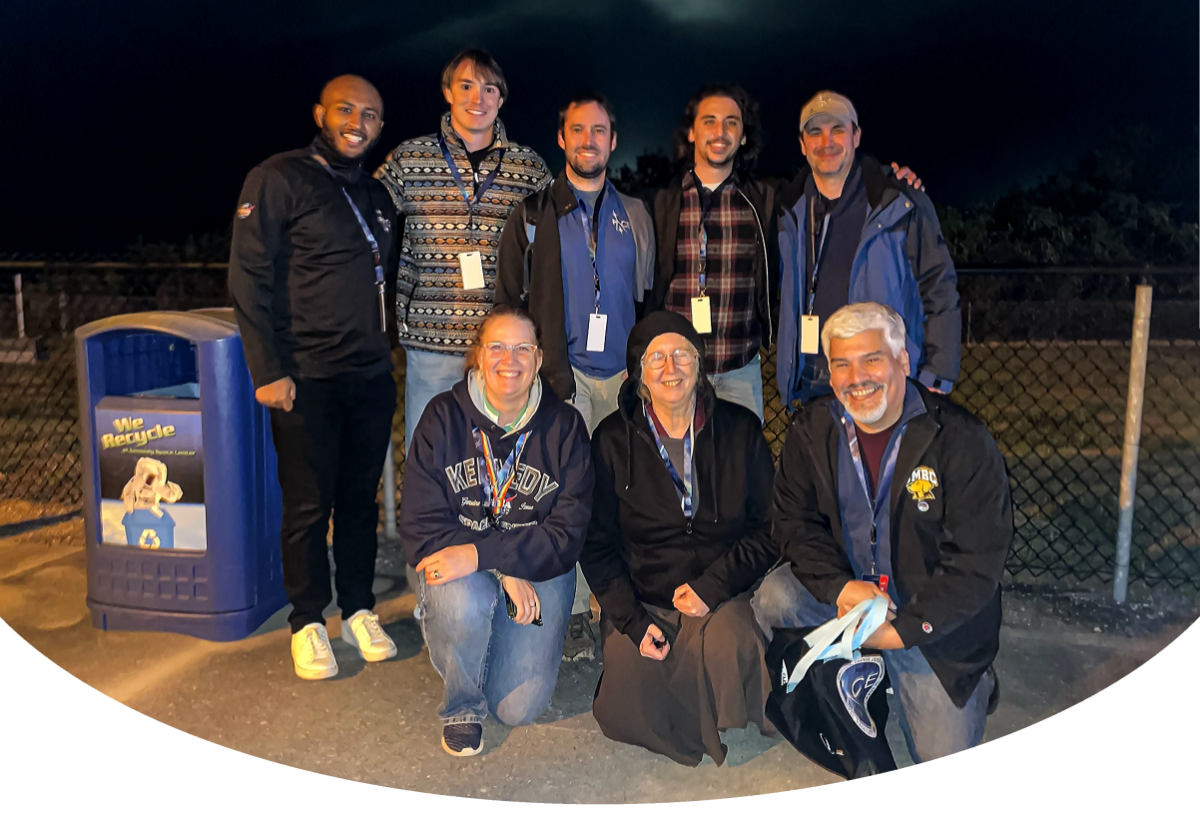 Members of the HARP team eagerly await the PACE launch at Kennedy Space Center’s Banana Creek Launch Viewing Area before the final countdown. Top, left to right: Yomiyu Fekadu, Ian Decker, Ben Cramer, Noah Sienkiewicz, Dominik Cieslak. Bottom, left to right: Margo Young, Lorraine Remer, Roberto Borda. Photo credit: Anne Wainscott-Sargent
An international effort
NASA’s PACE mission clears the path for revolutionary new measurements of Earth’s oceans and atmosphere. HARP2 measures aerosol particles and clouds, as well as properties of land and water surfaces. By analyzing particles like dust, wildfire smoke, or urban pollution, the science community gains deeper insights into air quality as well as global warming and its impacts. Scientists will be able see through things like sun glint to ascertain patterns never before possible.
A second polarimeter on PACE, the Spectro-polarimeter for Planetary Exploration (SPEXone), developed through a Dutch consortium consisting of SRON Netherlands Institute for Space Research and Airbus Defence and Space Netherlands, will measure sunlight reflected from Earth’s atmosphere, land surface and ocean.
There are undergraduate students and Ph.D.s integrated into the team who put in a lot of effort to make this real. We’re really thankful for the environment at this university—we’re able to work with students who find a career in this industry and field of research.
Roberto Borda
These two companion polarimeter instruments are important because the interaction between aerosols and clouds is the biggest unknown factor in atmospheric temperature change, according to reports from the U.N.’s Intergovernmental Panel on Climate Change.
“I have watched Dr. Martins and his team work toward this moment for about a decade, and have been aware of the trials and tribulations along the way. Seeing the smiles on their faces in the control station after the launch made it all worthwhile,” shared UMBC Vice President for Research Karl V. Steiner. “The HARP2 mission as an integral part of PACE is making all of us proud here on the UMBC campus. We cannot wait to see the science that will come from this engineering masterpiece conceptualized and created right here in Maryland.”

Waiting game
In the days leading up to the PACE launch, the HARP2 team knew there might be delays because of the weather so they rented a large Airbnb in neighboring Cocoa Beach for the full week. Earlier in the week, over grilled food at the shared house, the team reflected on their journey.
According to Martins, a key strategy was bringing together engineering and physics students, who typically don’t communicate well across disciplines.
“We introduced engineering students to the physics students and made them work together very quickly so they spoke the same language,” he said, crediting this multidisciplinary collaboration to the team’s ability to rapidly iterate and problem solve.
Borda, senior research engineer overseeing HARP2’s optical design, said a key technical challenge was determining how to best compensate for the effects of polarized light waves inside the instrument.
“It’s continuous work and you cannot do it alone. We needed a fantastic team with not only the staff but also students working at different levels,” Borda said. “There are undergraduate students and Ph.D.s integrated into the team who put in a lot of effort to make this real. We’re really thankful for the environment at this university—we’re able to work with students who find a career in this industry and field of research.”
Nurturing future career scientists
Martins echoed Borda’s pride in the broad level of participation in the HARP program, from high school students to senior scientists. “We’ve had people from our team who now work in all levels of industry—at NASA, at NOAA, or in private industry. We’ve even had some students start their own company.”
Young, the program administrator, estimates that the cooperative agreements between UMBC and NASA have resulted in 20 UMBC graduates finding roles with NASA.
UMBC alumna Elissa Ogburn is one such graduate. She began working on HARP2 as a computer science major, tasked with creating a database that supported ground communications so researchers could communicate with the instrument when it was in space.
After graduating from UMBC in 2021, Ogburn joined NASA on the PACE project as a test conductor—responsible for integrating and testing the instruments onto the PACE spacecraft. During launch, she was one of five test conductors in the PACE Control Room in Titusville, Florida, who powered up the spacecraft for the last time and configured it for launch.
“I never imagined having a job at NASA or working with people who were this smart, helpful, and kind. Every single person I’ve worked with was so fun. It’s also cool to have seen the whole process beginning as a student at UMBC. PACE is my first mission, so I’m learning everything as I go,” Ogburn said.
Close collaboration
The partnership between NASA and UMBC goes back over two decades. NASA Goddard Space Flight Center and UMBC are located just up the road from one another.
Jeremy Werdell, PACE project scientist at Goddard, recalled how initial calls to industry and academia for a polarimetry instrument for PACE were not promising due to cost and other factors.
However, Martins immediately suggested to Werdell that his lab develop a polarimeter, given his team’s experience with airborne instruments and the HARP cubesat, and the rest is history. In the end, NASA selected two polarimeters—HARP2 and SPEXone. Each instrument measures polarization differently: HARP2 is multispectral (measuring only four wavelengths of light) and hyperangular, so it looks at the same piece of real estate multiple times from dozens of different viewing directions. Its wide swath coverage means HARP2 will cover the globe every two days. SPEXone, on the other hand, is hyperspectral (measuring a continuous spectrum of light from the ultraviolet to near-infrared) but only views Earth at five angles. It has a narrower swath, meaning it will take almost a month to cover the globe.
“They’re small and mighty and miraculously complement each other very, very well,” said Werdell. “Having multi-band, multi-angle polarimetry is going to open up a lot of really interesting opportunities for discovery, because we can see clouds and aerosols in very different ways.” HARP2 provides daily views that will help scientists understand how aerosols and clouds interact and their role in warming and cooling in the atmosphere.
“Understanding where aerosols are, how they’re transported, how they interact with clouds, and whether they absorb or reflect radiation is important to everybody because those characteristics are what drive warming of the atmosphere.” Werdell said.
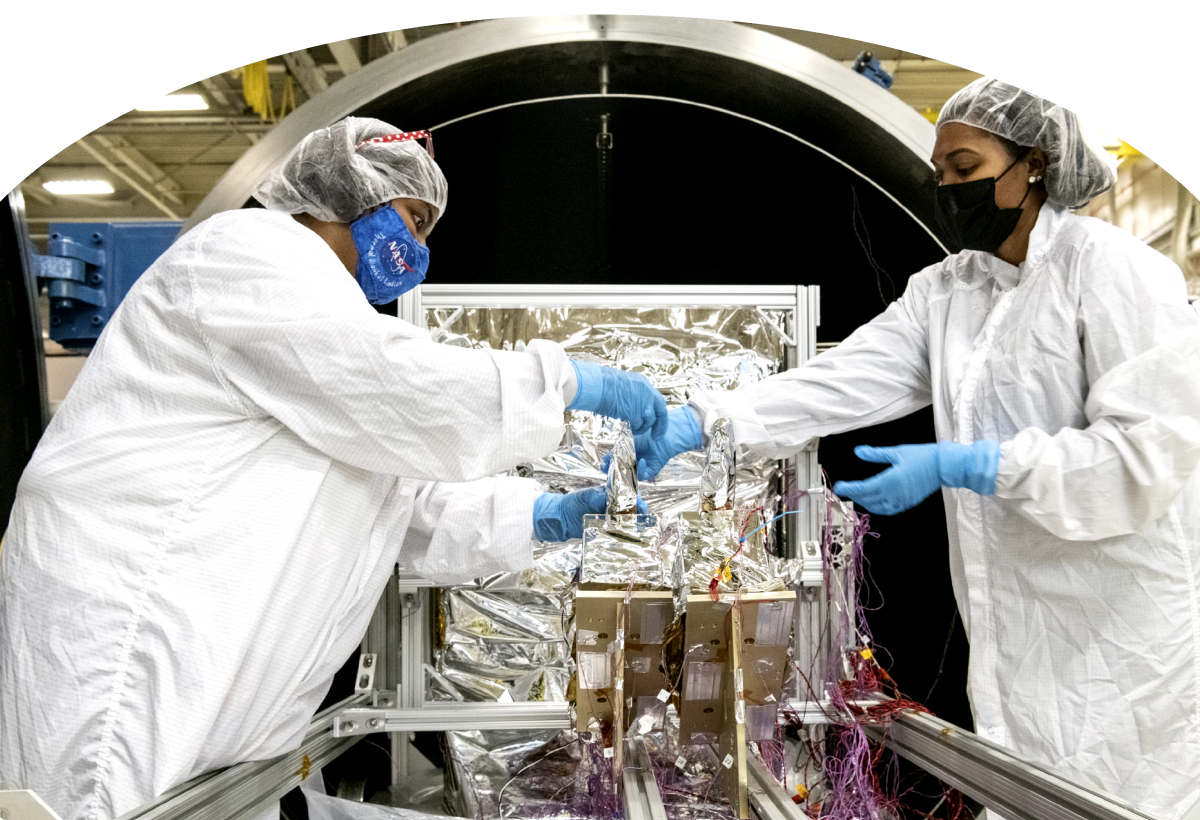 HARP2 calibration testing at Goddard Space Flight Center in Maryland, before the instrument was delivered to NASA. Photo Credit: Katherine Mellos/NASA
Better air quality models
Onsite at the Cape for the first launch attempts, Nirandi Jayasinghe and Rachel Smith, both physics graduate research assistants at UMBC, shared their excitement for the PACE mission and HARP2’s potential to help modelers predict air quality, rain, or if the atmosphere is warming or cooling.
Jayasinghe is a data modeler who comes up with different methods to retrieve information from HARP2. Originally from Sri Lanka, Jayasinghe notes that her hometown used to be one of her country’s cleanest cities, and now due to development in Sri Lanka’s dominant neighbor, India, the air quality is extremely bad. She said HARP2 can help close the gap that exists in understanding the twilight zone—where a cloud starts and where it stops—by providing more accurate measurements.
No other place would have let me be involved in the entire process…. Not only did I get to do hands-on stuff, but I also was part of the design and saw it all come together on a NASA mission.
Yomiyu Fekadu ’20, mechanical engineering, M.S. ’23, engineering management
Smith adds that this will go a long way in understanding cloud formation processes, weather patterns, forecasting, and climate modeling—information important for agriculture, transportation, disaster preparedness, and infrastructure planning.
“Even simple things like weather forecasting are impacted by how much dust is in the air,” said Smith, a 2026 doctoral candidate who earned her M.S. in atmospheric physics from UMBC in 2023. HARP2 will help address whether clouds have a net cooling effect or a net warming effect, which will allow for more accurate models of where Earth’s climate is headed. Smith notes that during events like the Canadian wildfires in 2023 no one could accurately predict rainfall, because the forecasting models were not accounting for the number of airborne aerosols.
“I’m really excited to see what new science questions come out of the instruments that we’re putting up in space,” she concluded.
Bouncing back from disaster
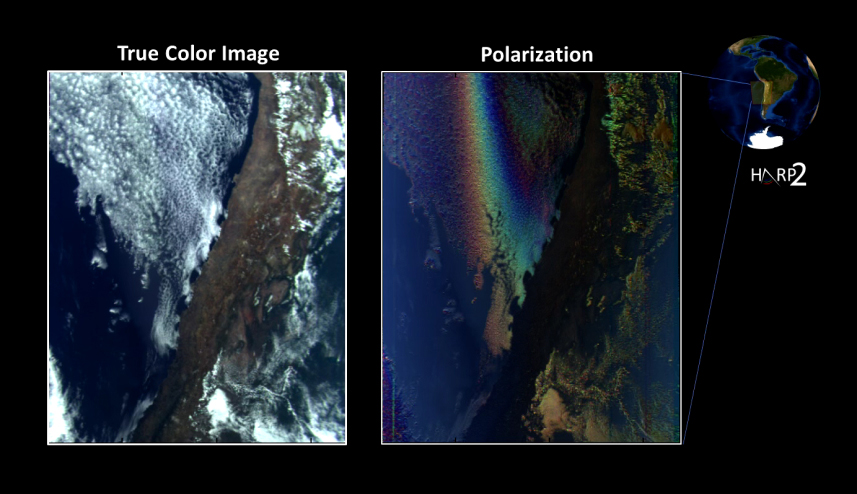
The first images from PACE’s HARP2 polarimeter captured data on clouds over the west coast of South America on March 11, 2024. The view of polarized light that the polarimeter “sees” (on the right) can help scientists better understand the droplets that make up the cloudbow—a rainbow produced by sunlight reflected from cloud droplets instead of rain droplets—which can reveal how the clouds respond to pollution and other particles in the atmosphere. Photo Credit: UMBC
The HARP2 team has come a long way from initial concept to PACE. What impresses Werdell the most is the UMBC team’s resilience in the face of setbacks.
The most devastating moment came in February 2022, one month before the team was set to deliver HARP2 to NASA for integration on the spacecraft. As the instrument was in the last few seconds of vibration tests, the bonding on one of the prisms loosened and shattered.
“It tactically put us to point zero,” recalled Cieslak, who was shocked and humbled when so many NASA scientists volunteered their time and expertise to help the HARP2 team get back on track. “We got an extension, and within two months we had built a new engineering model and were able to prove the new solution worked. By September, we were back to where we were before the incident,” he added.
First-time NASA launch attendee Yomiyu Fekadu ’20, mechanical engineering, M.S. ’23, engineering management, recalled that time well, as he helped assemble HARP2 as an intern under Benjamin Cramer ’17, M.S. ’20, mechanical engineer on the program.
“Especially after the failure, and the review board assessment, I helped put everything back together and do the test plans for construction and other documentation so NASA could give us the go-ahead to move on,” Fekadu said.
The experience was pivotal to his career. “It was everything I could have asked for,” said Fekado, now a systems engineer at Northrop Grumman. “No other place would have let me be involved in the entire process, including making parts for HARP2 in the machine shop. Not only did I get to do hands-on stuff, but I also was part of the design and saw it all come together on a NASA mission.”
As the HARP2 group left the viewing platform to line up for bus rides back to the Space Center, the smiles and easy camaraderie conveyed a collective sense of pride, relief, and excitement.
“I‘m now just anxious to see the first bytes of data,” said Cieslak, echoing the feeling of his colleagues.
In addition to the HARP team, several additional UMBC GESTAR II scientists and engineers were instrumental in their contributions to the overall PACE mission, including Ivona Cetinić, Andrew Sayer, Violeta Sanjuan Calzado, Bridget Seegers, Susanne Craig, Dirk Aurin, Meng Gao, and Ian Carroll.
]]>
The third time’s the charm. Against a calm and crisp dark night sky on Florida’s Cape Canaveral on February 8, 2024, just after 1:30 a.m., the Plankton, Aerosol, Cloud, Ocean Ecosystem (PACE)...
https://umbc.edu/stories/on-pace-to-unravel-earths-mysteries/
https://my3.my.umbc.edu/api/v0/pixel/news/142403/guest@my.umbc.edu/a46596b93a4edec977a7026fd62f7574/api/pixel
news
story
UMBC News & Magazine
https://my3.my.umbc.edu/groups/umbc-news-magazine
https://assets1-my.umbc.edu/system/shared/avatars/groups/000/001/943/24435aa6207c452e7bc15cc74b42c7bb/xsmall.png?1748556657
https://assets1-my.umbc.edu/system/shared/avatars/groups/000/001/943/24435aa6207c452e7bc15cc74b42c7bb/original.png?1748556657
https://assets2-my.umbc.edu/system/shared/avatars/groups/000/001/943/24435aa6207c452e7bc15cc74b42c7bb/xxlarge.png?1748556657
https://assets2-my.umbc.edu/system/shared/avatars/groups/000/001/943/24435aa6207c452e7bc15cc74b42c7bb/xlarge.png?1748556657
https://assets3-my.umbc.edu/system/shared/avatars/groups/000/001/943/24435aa6207c452e7bc15cc74b42c7bb/large.png?1748556657
https://assets1-my.umbc.edu/system/shared/avatars/groups/000/001/943/24435aa6207c452e7bc15cc74b42c7bb/medium.png?1748556657
https://assets2-my.umbc.edu/system/shared/avatars/groups/000/001/943/24435aa6207c452e7bc15cc74b42c7bb/small.png?1748556657
https://assets1-my.umbc.edu/system/shared/avatars/groups/000/001/943/24435aa6207c452e7bc15cc74b42c7bb/xsmall.png?1748556657
https://assets2-my.umbc.edu/system/shared/avatars/groups/000/001/943/24435aa6207c452e7bc15cc74b42c7bb/xxsmall.png?1748556657
UMBC News & Magazine
1
0
false
Thu, 30 May 2024 11:45:24 -0400
Free Farmers Market TODAY!
All summer long!
.jpg) ]]>
Flyer
https://assets2-my.umbc.edu/system/shared/attachments/e76d0c383a1dc871d951e98154121c9a/6a7fb939/news/000/142/252/7494d0d2a566b7525b4e9b4d0eae43b5/FREE Farmers Market (3).jpg?1717081966
https://my3.my.umbc.edu/api/v0/pixel/news/142252/guest@my.umbc.edu/39f54ba0e777acfd79a303467deb30ac/api/pixel
Retriever Essentials
https://my3.my.umbc.edu/groups/retrieveressentials
https://assets4-my.umbc.edu/system/shared/avatars/groups/000/001/389/07b12dca5bf1da16311c6d47125fe746/xsmall.png?1762874117
https://assets2-my.umbc.edu/system/shared/avatars/groups/000/001/389/07b12dca5bf1da16311c6d47125fe746/original.png?1762874117
https://assets3-my.umbc.edu/system/shared/avatars/groups/000/001/389/07b12dca5bf1da16311c6d47125fe746/xxlarge.png?1762874117
https://assets3-my.umbc.edu/system/shared/avatars/groups/000/001/389/07b12dca5bf1da16311c6d47125fe746/xlarge.png?1762874117
https://assets3-my.umbc.edu/system/shared/avatars/groups/000/001/389/07b12dca5bf1da16311c6d47125fe746/large.png?1762874117
https://assets1-my.umbc.edu/system/shared/avatars/groups/000/001/389/07b12dca5bf1da16311c6d47125fe746/medium.png?1762874117
https://assets2-my.umbc.edu/system/shared/avatars/groups/000/001/389/07b12dca5bf1da16311c6d47125fe746/small.png?1762874117
https://assets4-my.umbc.edu/system/shared/avatars/groups/000/001/389/07b12dca5bf1da16311c6d47125fe746/xsmall.png?1762874117
https://assets3-my.umbc.edu/system/shared/avatars/groups/000/001/389/07b12dca5bf1da16311c6d47125fe746/xxsmall.png?1762874117
Retriever Essentials
0
0
true
Thu, 30 May 2024 11:12:56 -0400
Move out sale!!!
Links to new products included for price comparison
]]>
Galanz Microwave (screenshot attached - used) = $15 Tangelo Vivid 300 Mini Projector (original packing - unused) - https://tangelotech.com/products/tangelo-vivid-300-mini-projector = $100...
Photo
https://assets4-my.umbc.edu/system/shared/attachments/87e19fbaa1e746ea3b98db54cb19c431/6a7fb939/news/000/142/251/de517cde31ed97ac4c1d35a3f0e055ea/8633669 (1).jpg?1717080139
https://my3.my.umbc.edu/api/v0/pixel/news/142251/guest@my.umbc.edu/10e3ee898df59ab868e8a0e683a401b1/api/pixel
Classifieds
https://my3.my.umbc.edu/groups/classifieds
https://assets4-my.umbc.edu/system/shared/avatars/groups/000/001/081/27816fed47150f6fda5f96e75013749f/xsmall.png?1434550723
https://assets2-my.umbc.edu/system/shared/avatars/groups/000/001/081/27816fed47150f6fda5f96e75013749f/original.png?1434550723
https://assets1-my.umbc.edu/system/shared/avatars/groups/000/001/081/27816fed47150f6fda5f96e75013749f/xxlarge.png?1434550723
https://assets1-my.umbc.edu/system/shared/avatars/groups/000/001/081/27816fed47150f6fda5f96e75013749f/xlarge.png?1434550723
https://assets3-my.umbc.edu/system/shared/avatars/groups/000/001/081/27816fed47150f6fda5f96e75013749f/large.png?1434550723
https://assets3-my.umbc.edu/system/shared/avatars/groups/000/001/081/27816fed47150f6fda5f96e75013749f/medium.png?1434550723
https://assets3-my.umbc.edu/system/shared/avatars/groups/000/001/081/27816fed47150f6fda5f96e75013749f/small.png?1434550723
https://assets4-my.umbc.edu/system/shared/avatars/groups/000/001/081/27816fed47150f6fda5f96e75013749f/xsmall.png?1434550723
https://assets3-my.umbc.edu/system/shared/avatars/groups/000/001/081/27816fed47150f6fda5f96e75013749f/xxsmall.png?1434550723
Classifieds
0
0
false
Thu, 30 May 2024 10:45:09 -0400
Putting UMBC Research on the Map
]]>
Flyer
https://assets2-my.umbc.edu/system/shared/attachments/e76d0c383a1dc871d951e98154121c9a/6a7fb939/news/000/142/252/7494d0d2a566b7525b4e9b4d0eae43b5/FREE Farmers Market (3).jpg?1717081966
https://my3.my.umbc.edu/api/v0/pixel/news/142252/guest@my.umbc.edu/39f54ba0e777acfd79a303467deb30ac/api/pixel
Retriever Essentials
https://my3.my.umbc.edu/groups/retrieveressentials
https://assets4-my.umbc.edu/system/shared/avatars/groups/000/001/389/07b12dca5bf1da16311c6d47125fe746/xsmall.png?1762874117
https://assets2-my.umbc.edu/system/shared/avatars/groups/000/001/389/07b12dca5bf1da16311c6d47125fe746/original.png?1762874117
https://assets3-my.umbc.edu/system/shared/avatars/groups/000/001/389/07b12dca5bf1da16311c6d47125fe746/xxlarge.png?1762874117
https://assets3-my.umbc.edu/system/shared/avatars/groups/000/001/389/07b12dca5bf1da16311c6d47125fe746/xlarge.png?1762874117
https://assets3-my.umbc.edu/system/shared/avatars/groups/000/001/389/07b12dca5bf1da16311c6d47125fe746/large.png?1762874117
https://assets1-my.umbc.edu/system/shared/avatars/groups/000/001/389/07b12dca5bf1da16311c6d47125fe746/medium.png?1762874117
https://assets2-my.umbc.edu/system/shared/avatars/groups/000/001/389/07b12dca5bf1da16311c6d47125fe746/small.png?1762874117
https://assets4-my.umbc.edu/system/shared/avatars/groups/000/001/389/07b12dca5bf1da16311c6d47125fe746/xsmall.png?1762874117
https://assets3-my.umbc.edu/system/shared/avatars/groups/000/001/389/07b12dca5bf1da16311c6d47125fe746/xxsmall.png?1762874117
Retriever Essentials
0
0
true
Thu, 30 May 2024 11:12:56 -0400
Move out sale!!!
Links to new products included for price comparison
]]>
Galanz Microwave (screenshot attached - used) = $15 Tangelo Vivid 300 Mini Projector (original packing - unused) - https://tangelotech.com/products/tangelo-vivid-300-mini-projector = $100...
Photo
https://assets4-my.umbc.edu/system/shared/attachments/87e19fbaa1e746ea3b98db54cb19c431/6a7fb939/news/000/142/251/de517cde31ed97ac4c1d35a3f0e055ea/8633669 (1).jpg?1717080139
https://my3.my.umbc.edu/api/v0/pixel/news/142251/guest@my.umbc.edu/10e3ee898df59ab868e8a0e683a401b1/api/pixel
Classifieds
https://my3.my.umbc.edu/groups/classifieds
https://assets4-my.umbc.edu/system/shared/avatars/groups/000/001/081/27816fed47150f6fda5f96e75013749f/xsmall.png?1434550723
https://assets2-my.umbc.edu/system/shared/avatars/groups/000/001/081/27816fed47150f6fda5f96e75013749f/original.png?1434550723
https://assets1-my.umbc.edu/system/shared/avatars/groups/000/001/081/27816fed47150f6fda5f96e75013749f/xxlarge.png?1434550723
https://assets1-my.umbc.edu/system/shared/avatars/groups/000/001/081/27816fed47150f6fda5f96e75013749f/xlarge.png?1434550723
https://assets3-my.umbc.edu/system/shared/avatars/groups/000/001/081/27816fed47150f6fda5f96e75013749f/large.png?1434550723
https://assets3-my.umbc.edu/system/shared/avatars/groups/000/001/081/27816fed47150f6fda5f96e75013749f/medium.png?1434550723
https://assets3-my.umbc.edu/system/shared/avatars/groups/000/001/081/27816fed47150f6fda5f96e75013749f/small.png?1434550723
https://assets4-my.umbc.edu/system/shared/avatars/groups/000/001/081/27816fed47150f6fda5f96e75013749f/xsmall.png?1434550723
https://assets3-my.umbc.edu/system/shared/avatars/groups/000/001/081/27816fed47150f6fda5f96e75013749f/xxsmall.png?1434550723
Classifieds
0
0
false
Thu, 30 May 2024 10:45:09 -0400
Putting UMBC Research on the Map
Spring on UMBC’s main campus brings a host of familiar sights and sounds: blooms on the magnolia trees, the chatter of red-winged blackbirds calling from the reeds around Library Pond, greening grass on the campus Quad, and black-and-gold-bedecked Grit Guides leading groups of prospective Retrievers around what may soon become a home away from home.
The guides cover the usual highlights—Academic Row, the Retriever Activity Center, the AOK Library, eating establishments, and residential halls. UMBC is a place to live, to learn, and to find community. And while some of the functions of campus spaces are obvious, others are often hidden.
Look more closely, and you’ll see faculty and students turning the everyday infrastructure and green oases of UMBC into out-of-the-ordinary laboratories. Beeswax sculptures, tactile maps, robots helping other robots—read on to discover some of the amazing ways Retrievers are using the campus itself for experiential learning and diverse research.
Written by: Catherine Meyers & Sarah L. Hansen, M.S. ’15

Two students wearing knee-high waders stand several meters apart in the middle of a rapidly flowing stream at the north end of UMBC’s campus. One releases a Ping-Pong ball, which bobs along with the current, as the second starts a timer, stopping it when the ball reaches his feet to determine the stream’s flow rate.
Nearby, another student measures the size of rocks in the streambed using a device called a gravelometer—a rectangular piece of metal with square holes of various sizes. The smallest hole a given rock will fit through becomes its measurement.
Farther along, other students capture photos that include reference posts on the stream bank. Each small group of students also takes measurements of the water depth at one-foot intervals along strings hung from one bank to the other. The students (with the help of specialized software) will use these measurements and photos to generate 3D models of the streambed.
“It’s a little DIY, but we get some amazing pictures,” says Charles Kaylor, the instructor and director of GIS and cartography labs in the Department of Geography and Environmental Systems (GES).
This is the “stream lab” in Exploring the Environment: A Geospatial Perspective, a course best known in the UMBC community for its semesterly launch of a dozen or so brightly-colored balloons that dot the campus skyline. Throughout the semester, students train their brains in the ways geographic data can help answer a wide range of research questions.
For the students, there are a range of perks to the course. “It’s cool to see different applications of computer science, which can sometimes feel pretty theoretical,” says George Rush ’24, computer science. Luke Thomas ’27, GES, who was partnered with Rush, is grateful for the senior’s support with the programming aspects of the coursework.
Rhonda Plofkin, Ph.D. student in GES and the graduate assistant for the class, concurs that having students with different strengths facilitates peer learning. “This is real-life stuff that geomorphologists do in the field,” she adds.
For some, the benefits are just as real, but simpler: “The cold water wakes me up,” Anthony Roytenberg ’24, computer science, says with a smile.
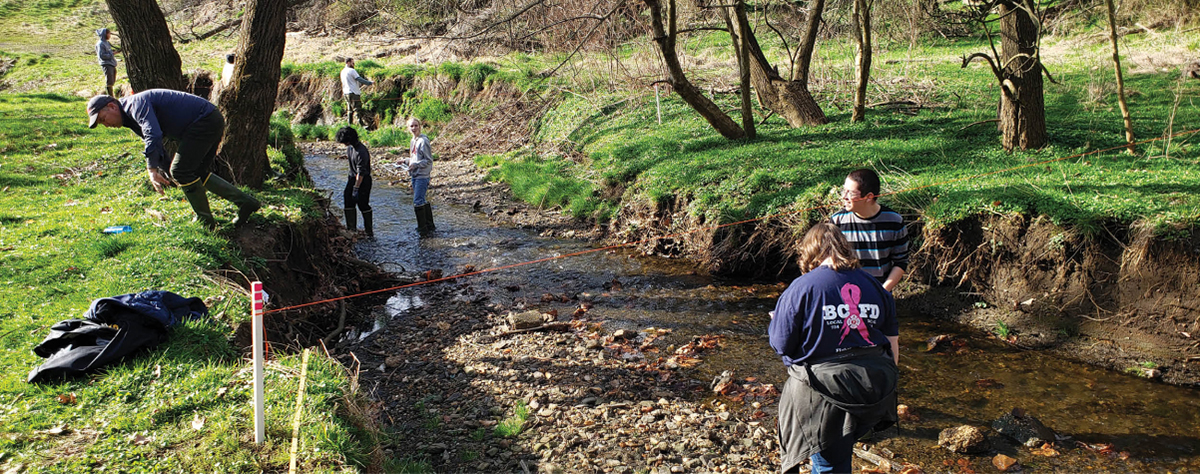 Students collect data that measure flow rate, depth, pebble size, and more as part of the “stream lab” in a popular, interdisciplinary GES course. Photo by Sarah Hansen, M.S. ’15.

When Alieh Rezaei arrived at UMBC from Iran, she couldn’t take her eyes off the ground. Almost immediately she was mesmerized by the flora and fauna of her new residence, and as an master of fine
arts student in the intermedia and digital arts (IMDA) program, she decided to incorporate pieces of UMBC into her artwork. She walked around campus, picking up windfalls of seeds and exploring hidden nooks of nature. A place that would come to be her sanctuary,
Rezaei, M.F.A. ’22, says, was Joseph Beuys Sculpture Park.
“The solidity of the stones alongside the growth of the oaksand the evolving shape of the garden reflect concepts of erosion and growth,” says Rezaei. “As an immigrant, I found solace in my attachment to the settled and solid stones, representing a sense of
grounding to me.”
Rezaei was drawn to UMBC’s M.F.A. program because of its multidisciplinary approach and the freedom she felt to choose an unconventional path. She praised Kathy O’Dell, IMDA professor emerita, who was her advisor. “Kathy was someone who—it was like I was floating in the air and Kathy held my hand and grounded me. She was very supportive for the whole journey.”
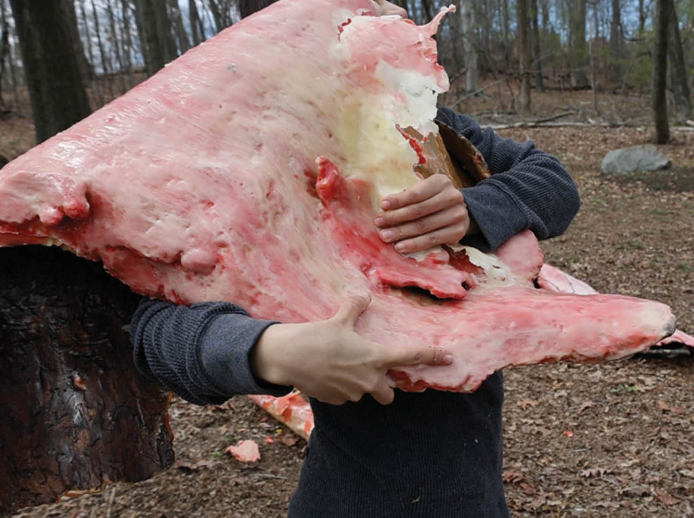
A photograph from Rezaei’s three-hour performance “The Tongue in the Landscape” at the Joseph Beuys Sculpture Park featuring the artist laboriously peeling the wax layer off the pieces of bark. Photo courtesy of Rezaei.
To create the art for her thesis project, Rezaei used almost exclusively materials collected on or near campus, including fallen tree bark, shattered wood, and seeds. She bought her main material—beeswax— from Baltimore beekeepers. One piece, “The Collective Womb,” featured hundreds of native seeds, called Devil’s Darning Needles, held together by beeswax around orange peels.
When the pieces were finished, Rezaei immediately knew the stage she wanted to showcase them on—Joseph Beuys Sculpture Park. “I installed my pieces there and had a performance as a way to extend the concept of public sculpture, aiming to reactivate the space and revive the concept of ecological engagement central to Beuys’ 7000 Oaks project.”


A composite of several microscope images of phages discovered by UMBC students in the Phage Hunters program demonstrates the variety of shapes phages can take. Photo by Tagide deCarvalho.
IchabodCrane. MindFlayer. Annihilus. TonyStarch. These are viruses previously completely unknown to science discovered by UMBC students in the Phage Hunters program, a two-course undergraduate genetics and bioinformatics sequence.
Since its launch in 2008, UMBC students have discovered 661 viruses that infect bacteria, called phages. Ninety-seven of them originated in samples collected on campus, with the most popular location being the Library Pond. Seventy-seven phages have been sequenced and 60 have been fully characterized and submitted to GenBank, an international digital repository of genetic and protein sequences.
Steven Caruso ’94, Ph.D. ’02, biological sciences, principal lecturer of biological sciences, runs the genetics course where the students collect samples, isolate their phages, image them with help from Tagide deCarvalho, “and growth,” says Rezaei. “As an immigrant, I found present their findings. They learn foundational laboratory techniques and get a taste for research.
Phage Hunters gives students “a first glimpse of what research is, with all that goes with it: determination, grit, inspiration, frustration, and more,” says Ivan Erill, professor of biological sciences and co-instructor for the bioinformatics course with Caruso. “Students get to see all the possible outcomes of a research project, from total success culminating in a DNA extraction for sequencing to failure to isolate a phage in the first place.”

In the basement of the Meyerhoff Chemistry Building, in a tiled expanse called the Molecular Characterization and Analysis Complex, sits a sleek, roughly human-sized instrument with the power to measure extremely tiny amounts of chemicals. Amanda Belunis, a chemistry Ph.D. student now in her final year, knows the instrument like an old friend, having turned to it to analyze a smorgasbord of UMBC water samples.
Belunis studies a group of chemicals called per- and polyfluoroalkyl substances, or PFAS. The chemicals are used in products as varied as makeup, clothing, and fire-fighting foam and are found in trace amounts in many water sources as well as in human blood. Dubbed “forever chemicals” because of the way they persist in the environment, they present a growing concern to human health.
Belunis’s research is part of a growing effort by scientists to understand how PFAS enter and travel through the environment and, ultimately, figure out ways to remove them.
To validate her procedures for measuring PFAS concentrations, Belunis tested water from drinking fountains, the sink in her chemistry lab, the pool, and the pond and streams around UMBC, all of which contained trace amounts of PFAS, as would be expected. Confident her methods worked on real-life samples, she then turned her attention to analyzing water in aquaculture fish tanks.
“My lab mates and I sometimes discuss how all of us have these chemicals in our bodies,” says Belunis. “It’s concerning, which is why we need to do more studies.”
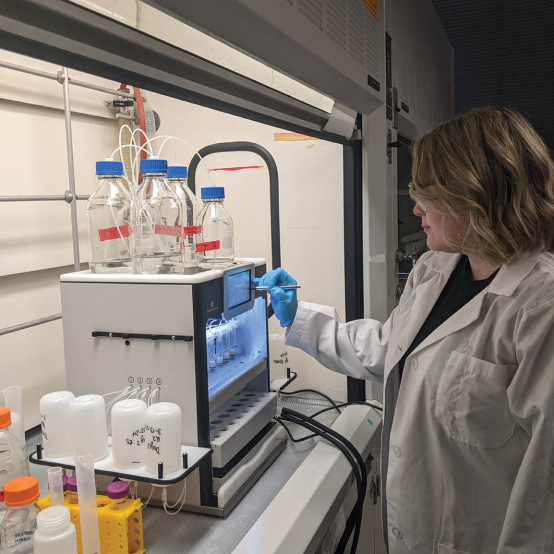
Amanda Belunis prepares samples for later analysis in the Molecular Characterization and Analysis Complex. Photo by Catherine Meyers.

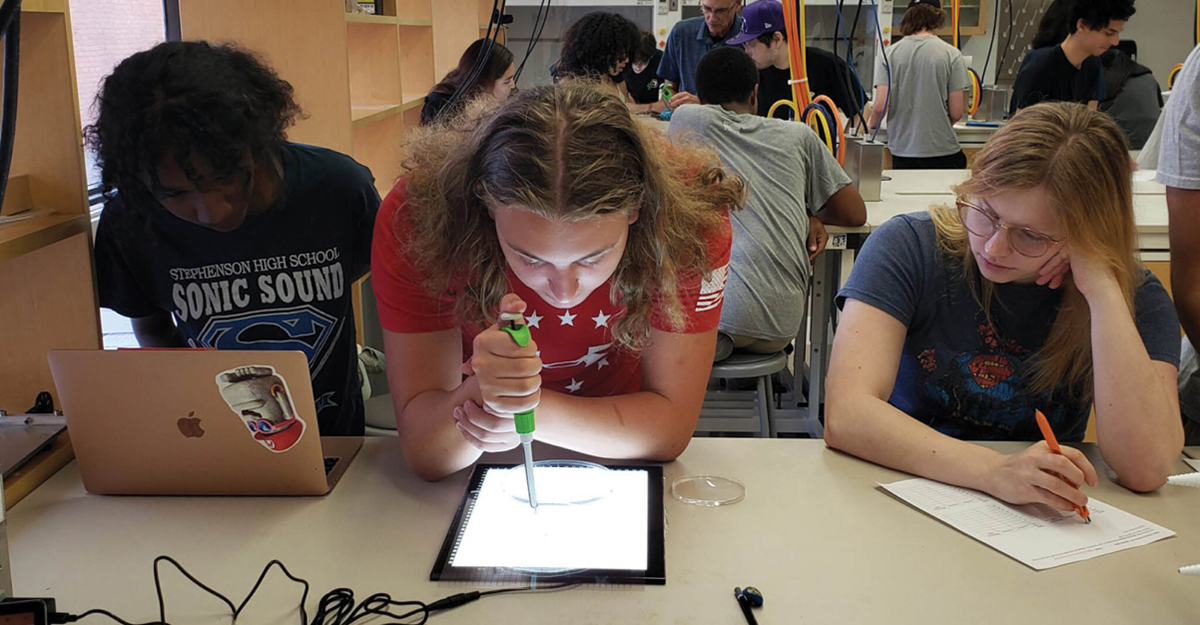 In addition to measuring buildings, students in Math in Action discovered other ways that math naturally interacts with their lives and studies. Here they are recording the movements of brine shrimp. Photo by Sarah Hansen, M.S. ’15.
When asked how to measure the height of a building, most students in Math in Action, a new laboratory course for non-STEM majors, “came up with various ways to measure the height directly—for example, by dropping down a string and then measuring the string or stacking up various objects,” says Alexis O’Malley ’18, mathematics and psychology, who teaches the lab.
But today, students are peering along the edges of homemade clinometers—plastic protractors with drinking straws attached—taking measurements from safely on the ground with a meter stick, and running simple calculations based on the properties of triangles to measure the height of UMBC’s Administration Building (123 feet, 2 inches).
Throughout the course, “I want students to see how math can be used to solve problems creatively,” O’Malley says.
Math in Action covers different math concepts each week through hands-on activities. The purpose of the clinometer activity is to remind students that “science is based on measurement, and you can build a tool to measure almost anything,” shares William R. LaCourse, dean of the College of Natural and Mathematical Sciences, who originally generated the idea for the course to help a wider range of students develop math skills relevant to their everyday lives. The course, he adds, “is a doorway to a lot of different math concepts.”

Shawn Abraham ’24, political science, has gotten lost on the UMBC campus more times than he can remember. As a blind student, he finds his way using a white cane, auditory cues, mental maps, and by asking people for directions. “People are surprised when I tell them, but big cities are much easier to navigate,” Abraham says. “College campuses are hard to get around.”
Tactile maps are one tool that could help. Erin Higgins and Kirk Crawford, Ph.D. students in human-centered computing, have recently been working with blind students at UMBC to create and test 3D-printed maps of campus.
The researchers launched the project after being approached by Michael Canale, assistant director of the Office of Student Disability Services. He says UMBC currently has four completely blind students enrolled and his office wants to provide personalized maps that each student can carry with them as they navigate campus. He’d also like to see a large 3D-printed map mounted somewhere on campus.
“A beautiful tactile map could be used by visitors of all kinds,” Canale said. “It’s the principle of universal design.”
Meanwhile, Md Osman Gani, an assistant professor of information systems, is spearheading a new project, named MyPath, to develop a Google Maps–style app to help wheelchair users navigate campus.
“Uneven surfaces, discontinuous sidewalks, and steep slopes can make wheelchair travel challenging, and even impossible” Gani says. The MyPath app would help by providing users with personalized turn-by-turn navigation with real-time updates. The app will rely on a machine learning model that recognizes path accessibility conditions based on crowd-sourced data, and Gani is currently recruiting wheelchair users to contribute data using their smartphones.
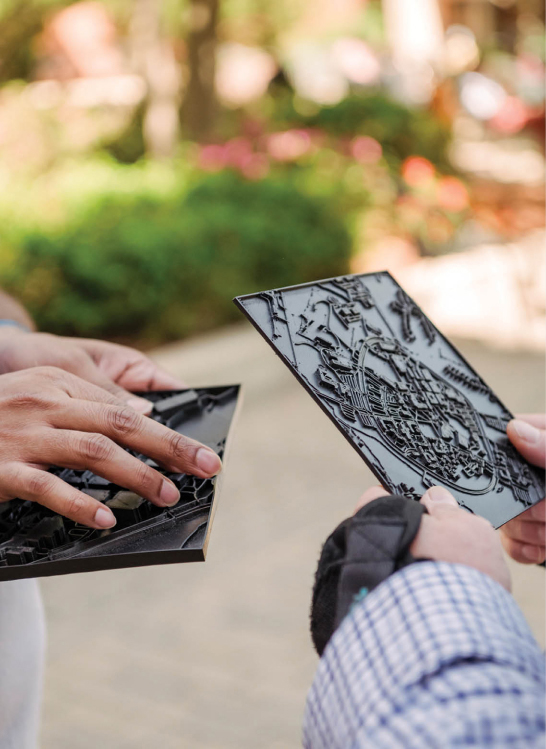
Shawn Abraham (left) tests prototype tactile maps made with 3-D printers with Michael Canale (right).

It’s 7 a.m. in July, and Megan Curtiss ’23, GES, is standing next to a tree just outside The Loop on UMBC’s southeast corner. It’s wrapped in a thin metal band at about chest height. Curtiss carefully measures the small gap between the two ends of the band with digital calipers three times, takes the average, and then moves on to the next tree. Only 98 to go.
This scene played out weekly from March to October 2023 as Curtiss collected data for a study led by Matthew Baker, GES professor, and Nancy Sonti, a research ecologist with the U.S. Forest Service. “It became like a morning meditation,” Curtiss shares.
The metal bands, call dendrobands, “are a cheap and easy way to get pretty detailed information,” Curtiss says. By measuring the trees’ growth over time, the goal is to look at how trees of different species and in different immediate environments (such as a parking lot versus a forest) handle conditions like fluctuating temperatures and water availability.
After attending Anne Arundel Community College in her 30s, Curtiss then found a home at UMBC. She began working with Baker in fall 2022 and will enter the GES master’s program at UMBC this fall. A graduate degree was not something Curtiss originally planned on, but now she’s excited about the further experiences it will bring. “I’m looking forward to the unexpected,” Curtiss says.

Take a left off Hilltop Circle, just past the greenhouse on the right and toward the Walker Avenue apartments, and you’ll find yourself outside a traditional brick building that used to house trial rooms and detention cells. In 2021, UMBC turned this former courthouse into the main hub for the Center for Real-time Distributed Sensing and Autonomy (CARDS). Researchers here develop artificial intelligence-enabled smart robots for military and search-and-rescue operations.
On a sunny day in spring, you will likely see students gathered in the courthouse’s “backyard,” huddled around dog-like Spot robots and wheeled vehicles called Jackals and Huskies.
The researchers outfit the robots with a host of custom devices, such as cameras and radar to sense their surroundings and microprocessors to run on-board algorithms. While the robots can be commanded via voice and gesture, the ultimate goal is for them to operate mostly autonomously.
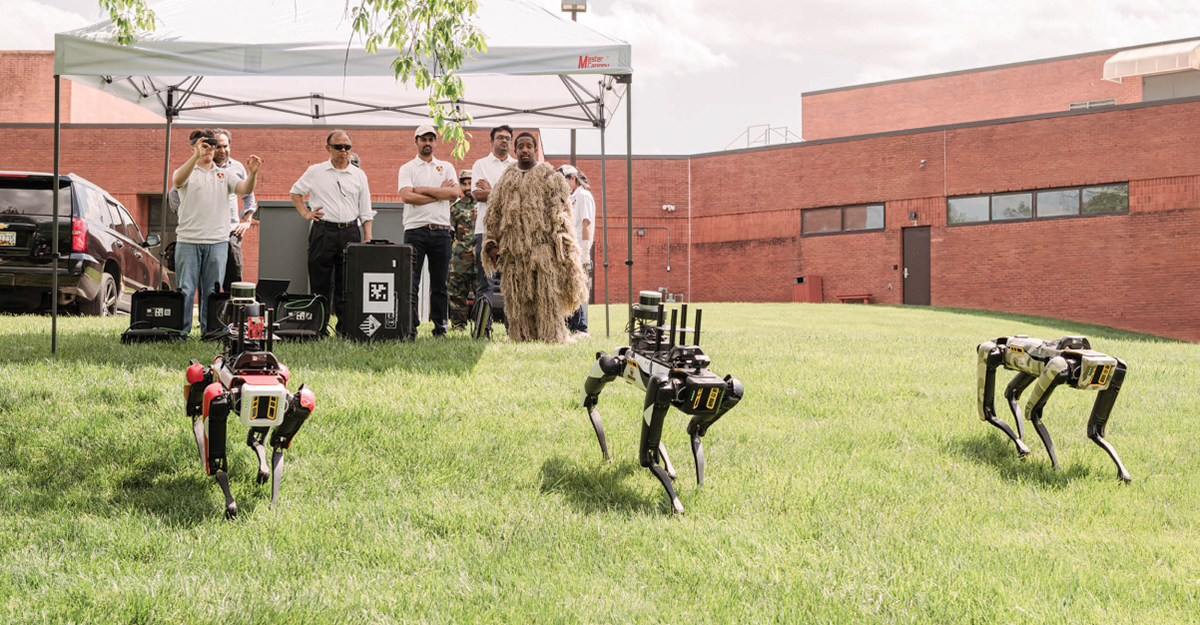 On the back lawn of the courthouse building, student researcher Kevin Rippy, left, controls three Spot robots with gestures. Another student stands by in a ghillie suit, a type of camouflage clothing.
Recently, the team has demonstrated this capability by verbally assigning the robots the task of jointly surveying a given area. The robots must translate the instructions from plain English into machine-level commands, divide up duties, detect and avoid obstacles, come to a fellow robot’s aid in the case of unexpected problems, and identify and keep track of the objects and people within their assigned perimeter.
“People from around campus will see us testing and will stop to watch,” says Aryya Gangopadhyay, a professor in information systems who directs CARDS. “The robots are an attention getter.”

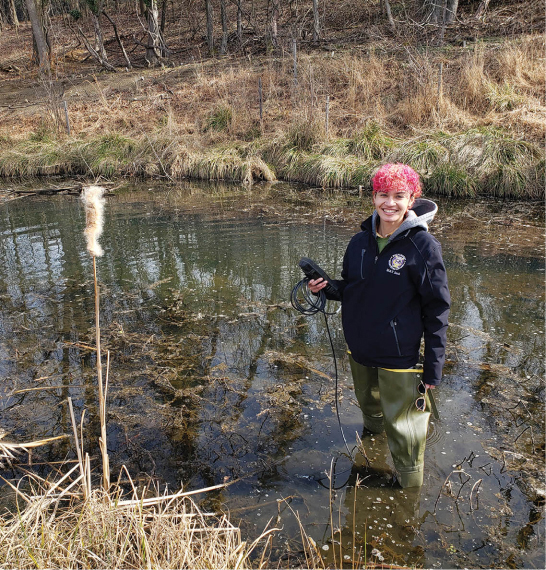
Erin Hamner collected weekly water quality data from this stream for six months, using the battery-powered digital probe she’s holding. (Image by Sarah L. Hansen, M.S. ’15)
After traipsing across a swampy field between research sites, Erin Hamner ’22, GES, and a current master’s student in the Interdisciplinary Consortium for Applied Research in the Environment program, scampers down a streambank in thigh-high waders and plunges a battery-powered probe into the water. It reports concentrations of ammonia and nitrates—key water quality measures. The probe also measures the water’s conductivity, which indicates the level of ions, such as salts used to melt snow.
It’s beautiful out today, but Hamner completed the trek to a dozen campus sites weekly from September 2023 to February 2024, sometimes dealing with mud, snow, or rain. The goal of her master’s thesis is to confirm that stormwater management features UMBC has installed to reduce flooding, filter storm runoff, and otherwise improve water quality are working as intended—or if they aren’t, to suggest improvements.
Hamner and her collaborators in Facilities Management and the Office of Sustainability want to see the data collection effort continue after she graduates. So she is working with faculty in GES to incorporate crowd-sourced stormwater monitoring into the undergraduate curriculum, including generating a public dashboard.
“Erin has done incredible groundwork collecting water quality data across our campus, generating useful data that can tell us about the health of UMBC’s waterways,” says Taylor Smith, assistant director of sustainability.
Long-term data will help the university “see how our development affects our watershed so we can continue to be good stewards,” Smith adds, noting that, “data like Erin’s can help us advocate for more greenspace and stream buffers around campus.”
]]>
Spring on UMBC’s main campus brings a host of familiar sights and sounds: blooms on the magnolia trees, the chatter of red-winged blackbirds calling from the reeds around Library Pond, greening...
https://umbc.edu/stories/putting-umbc-research-on-the-map/
https://my3.my.umbc.edu/api/v0/pixel/news/142303/guest@my.umbc.edu/93196282138c9d99f3c2930689edf3cd/api/pixel
biological-sciences
cahss
campus-life
cards
chemistry
cnms
coeit
computer-science
feature
ges
humancentered-computing
icare
imda
information-systems
joseph-beuys
magazine
mathematics
political-science
psychology
science-and-tech
sds
spring-2024
story
UMBC News & Magazine
https://my3.my.umbc.edu/groups/umbc-news-magazine
https://assets1-my.umbc.edu/system/shared/avatars/groups/000/001/943/24435aa6207c452e7bc15cc74b42c7bb/xsmall.png?1748556657
https://assets1-my.umbc.edu/system/shared/avatars/groups/000/001/943/24435aa6207c452e7bc15cc74b42c7bb/original.png?1748556657
https://assets2-my.umbc.edu/system/shared/avatars/groups/000/001/943/24435aa6207c452e7bc15cc74b42c7bb/xxlarge.png?1748556657
https://assets2-my.umbc.edu/system/shared/avatars/groups/000/001/943/24435aa6207c452e7bc15cc74b42c7bb/xlarge.png?1748556657
https://assets3-my.umbc.edu/system/shared/avatars/groups/000/001/943/24435aa6207c452e7bc15cc74b42c7bb/large.png?1748556657
https://assets1-my.umbc.edu/system/shared/avatars/groups/000/001/943/24435aa6207c452e7bc15cc74b42c7bb/medium.png?1748556657
https://assets2-my.umbc.edu/system/shared/avatars/groups/000/001/943/24435aa6207c452e7bc15cc74b42c7bb/small.png?1748556657
https://assets1-my.umbc.edu/system/shared/avatars/groups/000/001/943/24435aa6207c452e7bc15cc74b42c7bb/xsmall.png?1748556657
https://assets2-my.umbc.edu/system/shared/avatars/groups/000/001/943/24435aa6207c452e7bc15cc74b42c7bb/xxsmall.png?1748556657
UMBC News & Magazine
1
0
false
Thu, 30 May 2024 10:42:29 -0400
Thu, 30 May 2024 10:42:29 -0400
The outdoor pool will open for Rec swim 5/30/24
The outdoor pool will open for Rec swim from 12pm-2pm today, May 29th. Should the weather change rec swim may be moved indoors. We will continue to post when rec swim is available. #GetActive
]]>
The outdoor pool will open for Rec swim from 12pm-2pm today, May 29th. Should the weather change rec swim may be moved indoors. We will continue to post when rec swim is available. #GetActive
https://recreation.umbc.edu/pool-schedule/
https://my3.my.umbc.edu/api/v0/pixel/news/142249/guest@my.umbc.edu/03fc02a98f96598cd3186ac2fc850080/api/pixel
Recreation at the RAC
https://my3.my.umbc.edu/groups/recsports
https://assets3-my.umbc.edu/system/shared/avatars/groups/000/000/257/f9c91c92f9b48ff33e640906e80bc588/xsmall.png?1661189624
https://assets3-my.umbc.edu/system/shared/avatars/groups/000/000/257/f9c91c92f9b48ff33e640906e80bc588/original.png?1661189624
https://assets4-my.umbc.edu/system/shared/avatars/groups/000/000/257/f9c91c92f9b48ff33e640906e80bc588/xxlarge.png?1661189624
https://assets2-my.umbc.edu/system/shared/avatars/groups/000/000/257/f9c91c92f9b48ff33e640906e80bc588/xlarge.png?1661189624
https://assets1-my.umbc.edu/system/shared/avatars/groups/000/000/257/f9c91c92f9b48ff33e640906e80bc588/large.png?1661189624
https://assets4-my.umbc.edu/system/shared/avatars/groups/000/000/257/f9c91c92f9b48ff33e640906e80bc588/medium.png?1661189624
https://assets1-my.umbc.edu/system/shared/avatars/groups/000/000/257/f9c91c92f9b48ff33e640906e80bc588/small.png?1661189624
https://assets3-my.umbc.edu/system/shared/avatars/groups/000/000/257/f9c91c92f9b48ff33e640906e80bc588/xsmall.png?1661189624
https://assets3-my.umbc.edu/system/shared/avatars/groups/000/000/257/f9c91c92f9b48ff33e640906e80bc588/xxsmall.png?1661189624
Recreation at the RAC
https://assets2-my.umbc.edu/system/shared/thumbnails/news/000/142/249/12059c268a74f3db7ed26b87efe23461/xxlarge.jpg?1717078445
https://assets3-my.umbc.edu/system/shared/thumbnails/news/000/142/249/12059c268a74f3db7ed26b87efe23461/xlarge.jpg?1717078445
https://assets2-my.umbc.edu/system/shared/thumbnails/news/000/142/249/12059c268a74f3db7ed26b87efe23461/large.jpg?1717078445
https://assets3-my.umbc.edu/system/shared/thumbnails/news/000/142/249/12059c268a74f3db7ed26b87efe23461/medium.jpg?1717078445
https://assets4-my.umbc.edu/system/shared/thumbnails/news/000/142/249/12059c268a74f3db7ed26b87efe23461/small.jpg?1717078445
https://assets4-my.umbc.edu/system/shared/thumbnails/news/000/142/249/12059c268a74f3db7ed26b87efe23461/xsmall.jpg?1717078445
https://assets4-my.umbc.edu/system/shared/thumbnails/news/000/142/249/12059c268a74f3db7ed26b87efe23461/xxsmall.jpg?1717078445
0
0
true
Thu, 30 May 2024 10:14:21 -0400
UMBC’s College of Engineering and Information Technology aligns with UBalt’s Merrick School of Business to deliver enhanced degrees
An agreement between the College of Engineering and Information Technology at UMBC and The University of Baltimore’s Merrick School of Business will offer students from both institutions enhanced opportunities for their graduate-level degrees and future careers.
UMBC students may apply credits from UMBC’s M.S. in Engineering Management, Post-Baccalaureate Graduate Certificate in Project Management, or the Post-Baccalaureate Graduate Certificate in Engineering Management to UBalt’s MBA. UBalt students may apply credits from the MBA program or the Post-Baccalaureate Graduate Certificate in Business Fundamentals to UMBC’s M.S. in Engineering Management. This collaborative effort to satisfy certain requirements for these programs is intended to increase the marketability of students at both institutions, as they build out their career paths in a growing number of fields that require multiple areas of focus.
A candidate for an engineering job, for example, may benefit from having educational experience in business. The MBA degree, a stalwart of business professionals across a wide range of fields, is made even more attractive when combined with graduate-level learning in a vital area such as project management.
Both UMBC and UBalt are members of the University System of Maryland, the state’s longtime organization of 12 colleges and universities, three regional centers for higher education, and the system office, all working together to improve the quality of life in Maryland. The partnership maximizes the strengths at each of the USM sister institutions so those seeking managerial education at UMBC will have access to programs offered by an AACSB-accredited School of Business and those in the UBalt MBA may continue to evolve their professional goals with technical skill sets offered by the UMBC School of Engineering.
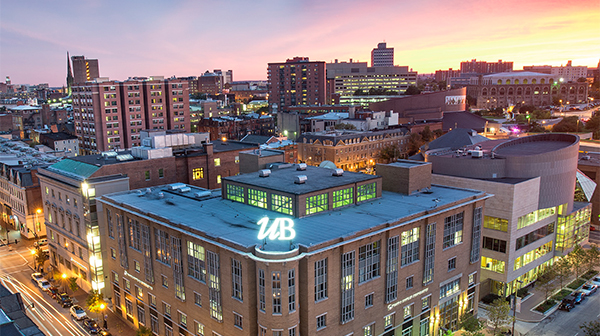 The Thumel Business Center, home of the Merrick School of Business, at The University of Baltimore. (Photo courtesy of UBalt.)
“This agreement leverages the strengths of UMBC’s engineering program and UBalt’s business program to provide students with accelerated pathways to earn graduate degrees or certificates from both institutions,” says Dr. Raju Balakrishnan, dean of the Merrick School of Business. “This is another excellent example of how USM institutions collaborate to provide students with even more enhanced educational opportunities.”
UMBCs acting dean of the College of Engineering and Information Technology Anupam Joshi adds, “We are excited to provide students from both institutions additional options to grow and acquire valuable knowledge and skills. We also look forward to exploring new ways to expand this partnership.”
Admission into these collaborative courses is straightforward:
- UMBC students must be enrolled in or have completed an M.S. in Engineering Management or Post-Baccalaureate Certificate in Engineering Management or Project Management at UMBC. These UMBC students may apply to either or both of the UBalt programs in the final semester of their respective programs and will be subject to standard application procedures.
- Similarly, UBalt students will have to be enrolled in the MBA or the Graduate Certificate in Business Fundamentals and may apply to any of the UMBC programs in the final semester of their respective programs and will be subject to standard application procedures.
- Both UBalt and UMBC will accept up to 12 transfer credits of the other institution’s courses.
The introduction of the new collaboration is expected to be available to applicants in Fall 2024.
For further details, visit UBalt’s page.
Learn more about the Merrick School of Business at The University of Baltimore.
Learn more about the College of Engineering and Information Technology at UMBC.
]]>
An agreement between the College of Engineering and Information Technology at UMBC and The University of Baltimore’s Merrick School of Business will offer students from both institutions enhanced...
https://umbc.edu/quick-posts/umbc-ubalt-enhanced-degree-options/
https://my3.my.umbc.edu/api/v0/pixel/news/142250/guest@my.umbc.edu/a15c6427e429e269f682df3dbcec6081/api/pixel
coeit
news
quick-post
UMBC News & Magazine
https://my3.my.umbc.edu/groups/umbc-news-magazine
https://assets1-my.umbc.edu/system/shared/avatars/groups/000/001/943/24435aa6207c452e7bc15cc74b42c7bb/xsmall.png?1748556657
https://assets1-my.umbc.edu/system/shared/avatars/groups/000/001/943/24435aa6207c452e7bc15cc74b42c7bb/original.png?1748556657
https://assets2-my.umbc.edu/system/shared/avatars/groups/000/001/943/24435aa6207c452e7bc15cc74b42c7bb/xxlarge.png?1748556657
https://assets2-my.umbc.edu/system/shared/avatars/groups/000/001/943/24435aa6207c452e7bc15cc74b42c7bb/xlarge.png?1748556657
https://assets3-my.umbc.edu/system/shared/avatars/groups/000/001/943/24435aa6207c452e7bc15cc74b42c7bb/large.png?1748556657
https://assets1-my.umbc.edu/system/shared/avatars/groups/000/001/943/24435aa6207c452e7bc15cc74b42c7bb/medium.png?1748556657
https://assets2-my.umbc.edu/system/shared/avatars/groups/000/001/943/24435aa6207c452e7bc15cc74b42c7bb/small.png?1748556657
https://assets1-my.umbc.edu/system/shared/avatars/groups/000/001/943/24435aa6207c452e7bc15cc74b42c7bb/xsmall.png?1748556657
https://assets2-my.umbc.edu/system/shared/avatars/groups/000/001/943/24435aa6207c452e7bc15cc74b42c7bb/xxsmall.png?1748556657
UMBC News & Magazine
0
0
false
Thu, 30 May 2024 09:56:26 -0400
Thu, 30 May 2024 09:56:26 -0400
Emails Restored: Update to Email Issue from Earlier today
The emails that were inadvertently quarantined earlier today have been restored to all accounts.
If you have any questions or would like additional information about what occurred or any other part of the restoration process, please don’t hesitate to contact either me at damian@umbc.edu or Stacy Cahill at string1@umbc.edu. I would also like to thank the staff in DoIT who worked this afternoon to make sure every email was restored as quickly as possible and nothing was lost.
Again, we are very sorry for the inconvenience and appreciate everyone's patience as we restored the emails.
Damian Doyle
Deputy CIO and Senior Associate VP
DoIT
]]>
The emails that were inadvertently quarantined earlier today have been restored to all accounts. If you have any questions or would like additional information about what occurred or any other...
https://my3.my.umbc.edu/api/v0/pixel/news/142244/guest@my.umbc.edu/c53bc3bd7330c364def39e16f707654c/api/pixel
Division of Information Technology (DoIT)
https://my3.my.umbc.edu/groups/doit
https://assets2-my.umbc.edu/system/shared/avatars/groups/000/000/021/d27760c5de12c74b73faec8d0e631acf/xsmall.png?1727453227
https://assets2-my.umbc.edu/system/shared/avatars/groups/000/000/021/d27760c5de12c74b73faec8d0e631acf/original.JPG?1727453227
https://assets1-my.umbc.edu/system/shared/avatars/groups/000/000/021/d27760c5de12c74b73faec8d0e631acf/xxlarge.png?1727453227
https://assets3-my.umbc.edu/system/shared/avatars/groups/000/000/021/d27760c5de12c74b73faec8d0e631acf/xlarge.png?1727453227
https://assets2-my.umbc.edu/system/shared/avatars/groups/000/000/021/d27760c5de12c74b73faec8d0e631acf/large.png?1727453227
https://assets2-my.umbc.edu/system/shared/avatars/groups/000/000/021/d27760c5de12c74b73faec8d0e631acf/medium.png?1727453227
https://assets2-my.umbc.edu/system/shared/avatars/groups/000/000/021/d27760c5de12c74b73faec8d0e631acf/small.png?1727453227
https://assets2-my.umbc.edu/system/shared/avatars/groups/000/000/021/d27760c5de12c74b73faec8d0e631acf/xsmall.png?1727453227
https://assets4-my.umbc.edu/system/shared/avatars/groups/000/000/021/d27760c5de12c74b73faec8d0e631acf/xxsmall.png?1727453227
Division of Information Technology (DoIT)
0
0
false
Wed, 29 May 2024 18:21:38 -0400