UMBC: Partners in Leadership
Partners in Leadership
UMBC named first university in Maryland to host a Naval ROTC unit.
Beginning April 1, students passionate about serving as commissioned officers in the Navy and Marine Corps saw a new name on the Naval ROTC scholarship program’s application list: the University of Maryland, Baltimore County.
UMBC and the Naval Service Training Command (NSTC) have signed an agreement to host a Naval ROTC unit at UMBC. The multi-year program, which runs concurrently with a student’s regular college or university degree path, will prepare midshipmen for leadership positions as U.S. Navy officers in an increasingly technical and globally interconnected environment.
“We are delighted to have been selected for this honor,” says UMBC President Freeman Hrabowski. “Many of our students are from military families, and many want to serve their country through the Navy. Already, hundreds of our graduates are working for the Navy. We envision many more doing so through this program.”
UMBC is the first higher education institution in Maryland to be selected as an NROTC host site and one of only 75 colleges and universities in the nation. The agreement is part of the new Maryland NROTC consortium that includes the University of Maryland, College Park. UMBC also enables students to participate in the Army University ROTC program through Johns Hopkins University and the Air Force ROTC program through the University of Maryland, College Park.
“I am so pleased that the U.S. Navy is establishing an ROTC program at UMBC,” Senator Barbara Mikulski said. “With the Naval Academy already in Annapolis, Maryland has a proud history of supporting those who sacrifice so much to keep us safe. Now, UMBC, a longtime leader in math and science education, will grow that historic relationship as it teaches and trains our young leaders for the jobs of tomorrow.”
With this agreement, students can take courses toward a UMBC undergraduate degree while fulfilling their Navy ROTC commitment through classes in Naval Science and participation in the unit’s drills, physical training, and other activities. A Professor of Naval Science appointed by the NSTC, in collaboration with UMBC, will lead the NROTC and coordinate instruction on campus.
“By partnering with UMBC, we are continuing to work with elite colleges and universities committed to producing graduates with exemplary education, character and leadership for service to our nation,” says Rear Adm. Richard A. Brown, Commander, Naval Service Training Command. “We are excited to have a host unit in the state of Maryland, a state with a honored naval tradition.”
Students selected for this highly competitive national program will receive four-year scholarships covering full tuition and mandatory fees, as well as stipends for books and living expenses. Students pursuing any academic major may apply to the program for study beginning in fall 2016.
For more information on the program, including how to apply, visit the Naval ROTC website.
(04/6/2015)
© University of Maryland, Baltimore County � 1000 Hilltop Circle, Baltimore, MD 21250 � 410-455-1000 �
]]>
Partners in Leadership UMBC named first university in Maryland to host a Naval ROTC unit. Beginning April 1, students passionate about serving as commissioned officers in the Navy and Marine...
https://umbc.edu/stories/umbc-partners-in-leadership/
https://my3.my.umbc.edu/api/v0/pixel/news/121730/guest@my.umbc.edu/b8e2bcb629b729a72d02dccc992436c6/api/pixel
window-stories
UMBC News & Magazine
https://my3.my.umbc.edu/groups/umbc-news-magazine
https://assets1-my.umbc.edu/system/shared/avatars/groups/000/001/943/24435aa6207c452e7bc15cc74b42c7bb/xsmall.png?1748556657
https://assets1-my.umbc.edu/system/shared/avatars/groups/000/001/943/24435aa6207c452e7bc15cc74b42c7bb/original.png?1748556657
https://assets2-my.umbc.edu/system/shared/avatars/groups/000/001/943/24435aa6207c452e7bc15cc74b42c7bb/xxlarge.png?1748556657
https://assets2-my.umbc.edu/system/shared/avatars/groups/000/001/943/24435aa6207c452e7bc15cc74b42c7bb/xlarge.png?1748556657
https://assets3-my.umbc.edu/system/shared/avatars/groups/000/001/943/24435aa6207c452e7bc15cc74b42c7bb/large.png?1748556657
https://assets1-my.umbc.edu/system/shared/avatars/groups/000/001/943/24435aa6207c452e7bc15cc74b42c7bb/medium.png?1748556657
https://assets2-my.umbc.edu/system/shared/avatars/groups/000/001/943/24435aa6207c452e7bc15cc74b42c7bb/small.png?1748556657
https://assets1-my.umbc.edu/system/shared/avatars/groups/000/001/943/24435aa6207c452e7bc15cc74b42c7bb/xsmall.png?1748556657
https://assets2-my.umbc.edu/system/shared/avatars/groups/000/001/943/24435aa6207c452e7bc15cc74b42c7bb/xxsmall.png?1748556657
UMBC News & Magazine
0
0
false
Mon, 15 Jun 2015 17:34:00 -0400
UMBC: Path to Power

Path to Power
Professor Thomas Schaller makes sense of institutional shifts in modern American politics
in The Stronghold.
The Republican Party has lost four of the last six U.S. presidential elections and lost the popular vote in five of the last six, while at the same time establishing powerful majorities in both houses of Congress. How can we make sense of these seemingly contradictory trends in the party�s popularity?
In his new book The Stronghold: How Republicans Captured Congress but Surrendered the White House (Yale University Press, 2015), Thomas Schaller examines the institutional transformation of the national Republican Party since President Ronald Reagan left office in 1989. Schaller, professor and chair of political science, is a nationally recognized scholar of American politics and political institutions. He has already received widespread praise for the book, which is poised to make a lasting impact on political discourse in America.
�I call this book an ideological institutional argument,� explains Schaller. �It talks about the lining up of the Republican Party, as it�s become more conservative, with congressional strength, and that makes intuitive sense.�
The core argument of Schaller�s book centers around the idea that Republicans have not just become a congressional party, but one that is focused on the House of Representatives. In conducting research for his book, Schaller observed that Republicans have pursued a path of what he calls �retrenchment� over the last 25 years � maximizing the power of a fixed share of Republican voters who tend to show up at the polls more during midterm elections.
Schaller argues that by pursuing retrenchment with a focus on its congressional wing, the Republican Party has shifted attention away from developing a fuller national strategy that would help presidential candidates become more competitive.
�The Republicans, despite their presidential woes, are doing pretty well on the rest of the ballot, but it sends a bit of a false confirmation of their message because it�s appealing to a somewhat significantly contracted electorate in a country where we�re lucky to have 60% of the eligible voters turn out in a presidential election and 35% of the eligible electorate in midterm elections,� says Schaller. �So it�s appealing to only one-third of the electorate.�
With its in-depth analysis of how and why Democrats have been able to succeed in recent presidential elections and Republicans have become more of a House-centered party, Schaller is hopeful The Stronghold will provide a deeper level of understanding for readers seeking to learn more about modern political institutions.
�There�s this conventional wisdom in the mainstream media and Washington that you have to really prove that you can govern effectively or you won�t be given the reins of power. I just don�t think that�s true anymore,� asserts Schaller. �Americans are upset with gridlock. They hate partisanship and they say they want the two parties to work together, but the structural incentives for both parties, especially for the Republicans, is not to cooperate.�
Schaller is presenting a Social Sciences Forum talk on his new book on Wednesday, February 11 at 4:30 p.m. in the University Center, Room 310. To hear Schaller explain more about the main argument of his book, watch the video below.
Schaller has received extensive local and national media coverage for The Stronghold. For a complete list, see below:
Surrendering the White House? (NBC�s Meet the Press-Press Pass)
Create jobs, defeat ISIS are top U.S. priorities (MSNBC�s Morning Joe)
The GOP�s field of dreams (MSNBC�s The Cycle)
Conservatives better suited to Congress (Baltimore Sun column)
Paul Ryan may not be running in 2016, but he�ll loom large over the election (Talking Points Memo column)
Key to understanding the new Congress: Gingrich�s contract with America (American Prospect column)
What the GOP is losing by winning (National Journal)
Newt�s shocking legacy: Was he more important than Reagan? (Salon)
The Stronghold: How Republicans Captured Congress but Surrendered the White House (Majority Report with Sam Seder)
Tom Schaller: Virtually Speaking with Jay Ackroyd (Blog Talk Radio)
Political Tomfoolery (Nicole Sandler Show- Radio or Not!)
Congressionalization (Slate�s The Gist Podcast)
New Books in Political Science with Heath Brown (New Books Network)
The Stronghold: How Republicans Captured Congress but Surrendered the White House (WYPR�s Maryland Morning)
How the GOP Captured Congress (WYPR�s Midday with Dan Rodricks)
Thomas Schaller on the C4 Show (WBAL Radio)
(Updated 2/10/2015)
© University of Maryland, Baltimore County � 1000 Hilltop Circle, Baltimore, MD 21250 � 410-455-1000 �
]]>
Path to Power Professor Thomas Schaller makes sense of institutional shifts in modern American politics in The Stronghold. The Republican Party has lost four of the last six U.S. presidential...
https://umbc.edu/stories/umbc-path-to-power/
https://my3.my.umbc.edu/api/v0/pixel/news/121731/guest@my.umbc.edu/5e8abeb68cf5036d2086989e1110640f/api/pixel
window-stories
UMBC News & Magazine
https://my3.my.umbc.edu/groups/umbc-news-magazine
https://assets1-my.umbc.edu/system/shared/avatars/groups/000/001/943/24435aa6207c452e7bc15cc74b42c7bb/xsmall.png?1748556657
https://assets1-my.umbc.edu/system/shared/avatars/groups/000/001/943/24435aa6207c452e7bc15cc74b42c7bb/original.png?1748556657
https://assets2-my.umbc.edu/system/shared/avatars/groups/000/001/943/24435aa6207c452e7bc15cc74b42c7bb/xxlarge.png?1748556657
https://assets2-my.umbc.edu/system/shared/avatars/groups/000/001/943/24435aa6207c452e7bc15cc74b42c7bb/xlarge.png?1748556657
https://assets3-my.umbc.edu/system/shared/avatars/groups/000/001/943/24435aa6207c452e7bc15cc74b42c7bb/large.png?1748556657
https://assets1-my.umbc.edu/system/shared/avatars/groups/000/001/943/24435aa6207c452e7bc15cc74b42c7bb/medium.png?1748556657
https://assets2-my.umbc.edu/system/shared/avatars/groups/000/001/943/24435aa6207c452e7bc15cc74b42c7bb/small.png?1748556657
https://assets1-my.umbc.edu/system/shared/avatars/groups/000/001/943/24435aa6207c452e7bc15cc74b42c7bb/xsmall.png?1748556657
https://assets2-my.umbc.edu/system/shared/avatars/groups/000/001/943/24435aa6207c452e7bc15cc74b42c7bb/xxsmall.png?1748556657
UMBC News & Magazine
0
0
false
Mon, 15 Jun 2015 17:33:00 -0400
UMBC: PFASA 2015

Honoring Excellence
UMBC community celebrates ten distinguished faculty and staff members at annual awards ceremony.
The campus community celebrated the exceptional performance, leadership, and service of ten faculty and staff members at the Presidential Faculty and Staff Awards Ceremony held on April 1, 2015.
“The Presidential Faculty and Staff Awards Ceremony is an important annual tradition for the UMBC community,” says President Freeman Hrabowski. “Our faculty and staff are dedicated to fulfilling the University’s mission and vision, and this event gives us the opportunity to honor their professional achievements and commitment to our campus.”
The 2015-18 Presidential Teaching Professor is Michelle R. Scott, associate professor and director of graduate studies in history and an affiliate associate professor in gender and women’s studies; Africana studies; and the language, literacy and culture doctoral program. She is also recipient of the 2015 University System of Maryland Board of Regents’ Faculty Award for Excellence in Mentoring. Scott, who joined the UMBC faculty in 2002, is a nationally recognized scholar in the fields of African American history and the history of music, and highly regarded as a dynamic role model, teacher, and mentor.
Katherine Seley-Radtke, professor of chemistry and biochemistry, is the 2015-18 Presidential Research Professor. A UMBC faculty member since 2003, she is internationally known in her field for research focused on the design and synthesis of chemotherapeutic agents to treat infectious diseases and cancer, and biological probes to explore the structure and function of DNA.
The 2014-15 Presidential Distinguished Staff Award, Professional Staff recipient is Susan Martin, associate director, Center for Women in Technology (CWIT). Martin began her tenure at UMBC in 2005, and joined CWIT in 2010. She has been integral to CWIT’s efforts to increase diversity in engineering and computing fields by expanding resources that support student success and graduation rates.
Susan L. Harrell, executive administrative assistant, English, received the 2014-15 Presidential Distinguished Staff Award, Non-Exempt Staff. Harrell has served UMBC’s department of English for 33 years. She is also the department’s graduate program coordinator and administrative assistant for the medieval and early modern studies minor. Known for her administrative skills, loyalty and work ethic, her colleagues consider her a model of professionalism and dedication.
The recipient of the 2015 University System of Maryland Board of Regents’ Faculty Award for Excellence in Teaching is Eileen O’Brien, senior lecturer, psychology. She joined the UMBC faculty in 2003 and has spearheaded successful innovations in course design on campus and throughout the University System of Maryland.
Kate Brown, professor of history, has received the 2015 University System of Maryland Board of Regents’ Faculty Award for Excellence in Research/Scholarship/Creative Activity. An internationally recognized scholar who joined the UMBC faculty in 2000, her work is characterized by leaders in the field as original, fearless, and based on an imaginative approach to sources, oral history, and narrative. Her book Plutopia: Nuclear Families in Atomic Cities and the Great Soviet and American Plutonium Disasters has won several prestigious book prizes, and she recently received a collaborative fellowship from the American Council of Learned Societies for the project “Chernobyl Revisited.”
The 2013-14 University System of Maryland Board of Regents’ Staff Award for Exceptional Contribution to the Mission of UMBC (Professional Staff) goes to David Hoffman ’13 Ph.D., language, literacy and culture, who joined the UMBC community in 2003. He has been a leading force behind UMBC’s BreakingGround movement, and his dedication to supporting students as they become engaged citizens has had a significant impact on the campus and garnered national attention for UMBC.
Julie Rosenthal is the recipient of the 2013-14 University System of Maryland Board of Regents’ Staff Award for Exceptional Contribution to the Mission of UMBC (Non-Exempt Staff). She joined the UMBC community in 2008, and her dedication and initiatives have played an important role in building the Asian Studies program. She has also had a major impact through community service, namely her work organizing Food on the 15th and the Asian Food Pantry.
Dottie Caplan, executive administrative assistant, College of Natural and Mathematical Sciences, has received the 2014-15 Karen L. Wensch Endowment Award for Outstanding Non-Exempt Staff. Caplan, whose UMBC career began in 1997, is committed to serving both CNMS and the campus, and her coworkers call her an invaluable asset to UMBC.
The 2014-15 Jakubik Family Endowment Award goes to Brian V. Souders ’09 Ph.D., language, literacy and culture. Souders, associate director of International Education Services, began his UMBC career in 2000, and his initiatives have significantly increased the number of students who have participated in study abroad experiences and received prestigious awards and fellowships.
To learn more about the awards ceremony and all of this year’s recipients, see the Presidential Faculty and Staff Awards website.
(04/1/2015)
© University of Maryland, Baltimore County � 1000 Hilltop Circle, Baltimore, MD 21250 � 410-455-1000 �
]]>
Honoring Excellence UMBC community celebrates ten distinguished faculty and staff members at annual awards ceremony. The campus community celebrated the exceptional performance, leadership,...
https://umbc.edu/stories/umbc-pfasa-2015/
https://my3.my.umbc.edu/api/v0/pixel/news/121732/guest@my.umbc.edu/2ac4af54fffa850193701ef740cd12f6/api/pixel
window-stories
UMBC News & Magazine
https://my3.my.umbc.edu/groups/umbc-news-magazine
https://assets1-my.umbc.edu/system/shared/avatars/groups/000/001/943/24435aa6207c452e7bc15cc74b42c7bb/xsmall.png?1748556657
https://assets1-my.umbc.edu/system/shared/avatars/groups/000/001/943/24435aa6207c452e7bc15cc74b42c7bb/original.png?1748556657
https://assets2-my.umbc.edu/system/shared/avatars/groups/000/001/943/24435aa6207c452e7bc15cc74b42c7bb/xxlarge.png?1748556657
https://assets2-my.umbc.edu/system/shared/avatars/groups/000/001/943/24435aa6207c452e7bc15cc74b42c7bb/xlarge.png?1748556657
https://assets3-my.umbc.edu/system/shared/avatars/groups/000/001/943/24435aa6207c452e7bc15cc74b42c7bb/large.png?1748556657
https://assets1-my.umbc.edu/system/shared/avatars/groups/000/001/943/24435aa6207c452e7bc15cc74b42c7bb/medium.png?1748556657
https://assets2-my.umbc.edu/system/shared/avatars/groups/000/001/943/24435aa6207c452e7bc15cc74b42c7bb/small.png?1748556657
https://assets1-my.umbc.edu/system/shared/avatars/groups/000/001/943/24435aa6207c452e7bc15cc74b42c7bb/xsmall.png?1748556657
https://assets2-my.umbc.edu/system/shared/avatars/groups/000/001/943/24435aa6207c452e7bc15cc74b42c7bb/xxsmall.png?1748556657
UMBC News & Magazine
0
0
false
Mon, 15 Jun 2015 17:33:00 -0400
UMBC: Progress through Partnership
Progress through Partnership
UMBC hosts a conversation with U.S. Secretary of Education Arne Duncan.
Note: This story was posted prior to the 2/18 campus event. A recap of the event, including video, will be posted shortly.
UMBC�s national leadership in innovative teaching and K-12 partnerships makes the university a fitting choice to host �A Conversation with Arne Duncan,� scheduled for Wednesday, February 18, 2:30-3:30 p.m. This talk by U.S. Secretary of Education Duncan will focus on opportunities to continue strengthening education across the continuum, from early childhood through college.
UMBC community members, particularly students interested in teaching careers, are invited to attend this lecture in the Performing Arts and Humanities Building Concert Hall. Members of the public interested in learning about UMBC�s collaborative work with K-12 schools are welcome as well. The event is free, but an RSVP is requested.
Secretary Duncan will highlight the U.S. Department of Education�s K-12 priorities and Maryland�s role as a leader in core reforms. He will also share the significant progress made by U.S. schools, thanks to the commitment and collaborative leadership of parents, teachers, principals, school districts, and state officials who strive to help every student succeed in school and in life.
�We are delighted with Secretary Duncan�s second visit to campus and his recognition of UMBC’s commitment to exceptional programs for both prospective and experienced teachers,� shares Eugene Schaffer, professor and chair of education.
The focus of Secretary Duncan�s talk � supporting students� educational progress through partnership � is core to what makes UMBC teaching programs so exceptional.
�UMBC is fortunate to have many partnerships with K-12 education across a broad range of fields,� reflects Dean Scott Casper of UMBC�s College of Arts, Humanities, and Social Sciences.
Schaffer shares, �We have worked with our partners from pre-K through high school from four surrounding school systems to develop unique programs in biology, chemistry and physics, as well as state- and nationally -recognized programs in the arts, humanities, elementary and early childhood education.�
Secretary Duncan, America�s top education official, first visited the university last May, when he commended UMBC for our commitment to K-12 partnerships and outreach, in addition to a strong record of producing graduates committed to teach at high-need schools.
UMBC serves as a pipeline for K-12 teachers at a critical time for schools across the nation. Schaffer explains that at the graduate level this means working with partners to provide �advanced degrees and specialized training to experienced teachers in mathematics, science, literacy and English as a Second Language.� UMBC undergraduates aspiring to teaching careers also have a wealth of training and support opportunities, including the Sherman STEM Teacher Scholars Program and the TEACH (Federal Teacher Education Assistant for College and Higher Education) Grant Program.
The Sherman STEM Teacher Scholars Program is a selective scholarship program that identifies and nurtures students seeking to become math and science teachers serving high-need communities. �The Sherman program teaches UMBC students to be empathetic to the complexity of students� situations, while still serving as teachers who help them grow academically,� says Rehana Shafi, director of the Sherman program.
�We do this by sending our students into classrooms with teachers who are great mentors and role models, and by educating them about the challenges students in these communities face every day. They learn how to have sensitive conversations with students and to create meaningful lesson plans because they are geared toward the specific populations they serve.�
About 75 percent of the Sherman program�s graduates go on to teach students in communities that are financially challenged. Shafi adds that K-12 schools say one of the extra benefits of the program is the opportunity for UMBC students to talk with their students about how college is important and attainable. �They demystify college and share what students need to do to prepare for it.�
The TEACH Grant Program provides grants of up to $4,000 a year to students who are completing or plan to complete course work needed to begin a career in teaching. Students commit to teaching in a high-need field at an elementary school, secondary school or educational service agency that serves students from low-income families for at least four full academic years within eight years after completing (or ceasing enrollment in) their course of study.
�The grant is critical to students� ability to pursue their degree so they can go on to pursue a career in teaching,� says Shafi. �Many students would not have been able to continue their education without it.�
Educational partnerships and teacher training for both UMBC students and professional teachers are an important part of UMBC�s mission. �Our school partnership programs help students develop into engaged citizens who understand the complex issues some K-12 students in Maryland are facing,� Shafi shares. �These programs provide thoughtful, meaningful and reflective training experiences. At UMBC, it is important for us to leave campus, go out to communities, and help make a difference. It�s part of who we are as a university.�
(02/16/2015)
© University of Maryland, Baltimore County � 1000 Hilltop Circle, Baltimore, MD 21250 � 410-455-1000 �
]]>
Progress through Partnership UMBC hosts a conversation with U.S. Secretary of Education Arne Duncan. Note: This story was posted prior to the 2/18 campus event. A recap of the event, including...
https://umbc.edu/stories/umbc-progress-through-partnership/
https://my3.my.umbc.edu/api/v0/pixel/news/121733/guest@my.umbc.edu/f2e4616f3e1754b6d35eca2c9e0cf2d7/api/pixel
window-stories
UMBC News & Magazine
https://my3.my.umbc.edu/groups/umbc-news-magazine
https://assets1-my.umbc.edu/system/shared/avatars/groups/000/001/943/24435aa6207c452e7bc15cc74b42c7bb/xsmall.png?1748556657
https://assets1-my.umbc.edu/system/shared/avatars/groups/000/001/943/24435aa6207c452e7bc15cc74b42c7bb/original.png?1748556657
https://assets2-my.umbc.edu/system/shared/avatars/groups/000/001/943/24435aa6207c452e7bc15cc74b42c7bb/xxlarge.png?1748556657
https://assets2-my.umbc.edu/system/shared/avatars/groups/000/001/943/24435aa6207c452e7bc15cc74b42c7bb/xlarge.png?1748556657
https://assets3-my.umbc.edu/system/shared/avatars/groups/000/001/943/24435aa6207c452e7bc15cc74b42c7bb/large.png?1748556657
https://assets1-my.umbc.edu/system/shared/avatars/groups/000/001/943/24435aa6207c452e7bc15cc74b42c7bb/medium.png?1748556657
https://assets2-my.umbc.edu/system/shared/avatars/groups/000/001/943/24435aa6207c452e7bc15cc74b42c7bb/small.png?1748556657
https://assets1-my.umbc.edu/system/shared/avatars/groups/000/001/943/24435aa6207c452e7bc15cc74b42c7bb/xsmall.png?1748556657
https://assets2-my.umbc.edu/system/shared/avatars/groups/000/001/943/24435aa6207c452e7bc15cc74b42c7bb/xxsmall.png?1748556657
UMBC News & Magazine
0
0
false
Mon, 15 Jun 2015 17:33:00 -0400
UMBC: The Science of Attraction
The Science of Attraction
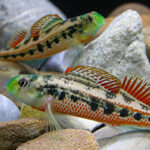
Biologist Tamra Mendelson explains how sexual selection plays a major role in the evolution of vibrant features, from stripes to tail feathers.
Male cardinals are red. Male peacocks have bright tail plumage. Conventional biological wisdom says that species look different because they are adapting to different environments � food, predators, or climate. That assumption is missing a major piece of the puzzle, say researchers at UMBC and the University of Colorado, Boulder.
In a recent study published in the journal Ecology Letters and featured in The Baltimore Sun, Tamra Mendelson and her co-authors suggest that sexual attraction plays a significant role in how animals � even those of the same species living in similar environments � can adapt different characteristics to attract mates. The researchers propose that animals don�t just respond to their environments, they respond to each other.
�It turns out males in particular don�t have to adapt to the environment,� says Mendelson, an associate professor of biological sciences at UMBC and lead author on the study. �They�re adapting to the opposite sex.�
This implies, says Mendelson, that populations in similar environments may come up with different ways to solve the same problem. For example, males in one population might evolve a flashy feather to attract females, whereas males in another population might evolve a colorful beak.
This helps explain the wide array of vivid colors and arresting features we finding in creatures like birds-of-paradise. It also highlights the point that just because two individuals don�t look the same or act the same, doesn�t mean they�re not the same species.
The next steps will involve testing the model, Mendelson explains. She will do experiments called reciprocal transplants: placing species A in the habitat of species B, and species B in the habitat of species A. According to Mendelson�s model there shouldn�t be any difference in how the males perform in their reversed habitats.
Next, Mendelson and her colleagues will do a reciprocal transplant of the sexual environment. This involves allowing males of species A to compete with each other for females of species B and vice versa.
Mendelson says, �I want to understand why and what ornaments are going to be particularly attractive.� She hopes this will help scientists understand the development of such varied and complex ornamentation.
�What kind of a mutation would be successful?� Mendelson asks. �Mutations drive evolution. You could argue that it is mutation that is the most important thing. What is it about the female fish brain that makes certain male ornamentation more attractive?�
Mendelson and Natalie Roberts, PhD student in biological sciences, will use video animations of darter fish to ask that question in their ongoing research. Amazingly, fish respond readily to video images of other fish, so the researchers will manipulate videos of male darters to see if and how they can make them more attractive to fish of the opposite sex.
�We can use the videos to create mutations that don�t exist yet, to see what could happen in the future,” says Mendelson.
Will an extra fin stripe or spot of color make a fish more attractive? Only the TV-watching darters can tell us.
(Updated 2/6/2015)
© University of Maryland, Baltimore County � 1000 Hilltop Circle, Baltimore, MD 21250 � 410-455-1000 �
]]>
The Science of Attraction Biologist Tamra Mendelson explains how sexual selection plays a major role in the evolution of vibrant features, from stripes to tail feathers. Male cardinals are...
https://umbc.edu/stories/umbc-the-science-of-attraction/
https://my3.my.umbc.edu/api/v0/pixel/news/121734/guest@my.umbc.edu/2dd83d490004e35b1a1eee22d9127d51/api/pixel
window-stories
UMBC News & Magazine
https://my3.my.umbc.edu/groups/umbc-news-magazine
https://assets1-my.umbc.edu/system/shared/avatars/groups/000/001/943/24435aa6207c452e7bc15cc74b42c7bb/xsmall.png?1748556657
https://assets1-my.umbc.edu/system/shared/avatars/groups/000/001/943/24435aa6207c452e7bc15cc74b42c7bb/original.png?1748556657
https://assets2-my.umbc.edu/system/shared/avatars/groups/000/001/943/24435aa6207c452e7bc15cc74b42c7bb/xxlarge.png?1748556657
https://assets2-my.umbc.edu/system/shared/avatars/groups/000/001/943/24435aa6207c452e7bc15cc74b42c7bb/xlarge.png?1748556657
https://assets3-my.umbc.edu/system/shared/avatars/groups/000/001/943/24435aa6207c452e7bc15cc74b42c7bb/large.png?1748556657
https://assets1-my.umbc.edu/system/shared/avatars/groups/000/001/943/24435aa6207c452e7bc15cc74b42c7bb/medium.png?1748556657
https://assets2-my.umbc.edu/system/shared/avatars/groups/000/001/943/24435aa6207c452e7bc15cc74b42c7bb/small.png?1748556657
https://assets1-my.umbc.edu/system/shared/avatars/groups/000/001/943/24435aa6207c452e7bc15cc74b42c7bb/xsmall.png?1748556657
https://assets2-my.umbc.edu/system/shared/avatars/groups/000/001/943/24435aa6207c452e7bc15cc74b42c7bb/xxsmall.png?1748556657
UMBC News & Magazine
0
0
false
Mon, 15 Jun 2015 17:32:00 -0400
UMBC: Thinking Out Loud

Thinking Out Loud
URCAD 2015 celebrates undergraduate student experiences in research and creative achievement.
As a transfer student from Montgomery College, Trevor Blank ’05, American studies, was fascinated by the history and folklore of a structure that once stood on UMBC’s campus: the Hillcrest Building, constructed in 1921 as the Spring Grove State Hospital. A different person might read a book about their new interest and move on, but Blank chose to write the book on it instead.
His research on the site as an undergraduate carried through to his graduate studies at Indiana University’s Folklore Institute and Pennsylvania State University, Harrisburg, and produced a co-authored volume on the hospital facility. Today, Blank is an assistant professor of communication at SUNY Potsdam and author or editor of seven books, including The Last Laugh: Folk Humor, Celebrity Culture, and Mass-Mediated Disasters in the Digital Age (University of Wisconsin Press 2013). On April 22, 2015, UMBC welcomes him back to campus to reflect on his path as a researcher as featured speaker for the 19th annual Undergraduate Research and Creative Achievement Day (URCAD).
Diane M. Lee, vice provost and dean of undergraduate education, shares that UMBC began organizing URCAD in the late 1990s to highlight the particularly robust research opportunities that UMBC undergraduate students experience. She expects this year’s participating students will find inspiration and insight in Blank’s remarks. “Dr. Blank’s story is a wonderful reminder about the value of the distinctive undergraduate experience UMBC provides,” she explains.
For Janet McGlynn, director of communications and outreach for the Office of Undergraduate Education, URCAD itself provides students with an essential piece of research training: a foundation in research communications. She shares, “Undergraduate researchers and URCAD presenters who go on to graduate school find that they are well prepared to present their work in department meetings or larger symposia. They know how to make a poster and how to talk about their work to either a general or an expert audience.”
URCAD 2015 features over 200 presentations, including artistic performances, film screenings, and oral and poster presentations, across all disciplines. A few highlights:
Paul Tschirgi ’15, visual arts, and Courtney Tyler ’15, dance, filmed original choreography and animated the videos to allow viewers to experience the performances using game controllers.
JR Smith ’15, computer science; Savannah Myers ’16, visual arts; Paul Tschirgi ’15, visual arts; Ben Walsh ’15, computer science; Samantha Carestia ’15, visual arts; Brandon Cole ’15, visual arts; Celeste Haskett, ’16, visual arts; and Jeff Hurd ’15, computer science, created an educational video game, Bandit, where the player becomes a fox running through Baltimore as the Pratt Street Riot breaks out during the American Civil War.
Jack Neumeier ’16, interdisciplinary studies; Jasper Dudley ’17, design and interdisciplinary studies; and Mai Huong Vu Huynh-Teage ’16, design, constructed “The Kraken,” an entry for the Kinetic Sculpture Race that explores the effect of pollution on aquatic ecosystems.
Julie Norton ’15, biological sciences; Kevin Liao, ’16, biological sciences; Mimi Way, ’15, biological sciences; and Brittnie Prakash ’15, biological sciences, isolated the Bacillus bacteriophage from soil found in central Russia.
Shannon Mitchell ’15, American Studies and psychology, analyzed geographic differences in newspaper coverage of the 2012 Trayvon Martin case.
Nnamdi Edokobi ’15, biochemistry and molecular biology, examined environmental and other risk factors impacting disparate rates of breast cancer among Baltimore City populations.
Hunter Somerville ’15, computer engineering; Kevin Sears ’15, computer engineering; Michael Warren ’15, mechanical engineering; and Sergei Grishin ’15, computer engineering, worked to develop a device that can automatically control airflow, increasing HVAC efficiency.
Each of these projects represents months or years of independent and collaborative research and creative production.
Savannah Myers is enthusiastic about showcasing her group’s interdisciplinary work on the video game Bandit, which teaches players about the Pratt Street Riots. She shares, “I’m excited to show what can be accomplished with 3D animation and a group of both artists and programmers at the student level. Often times people don’t realize how much work and research goes into creating interactive experiences.”
The interdisciplinary team behind “The Kraken” emphasizes the labor and rewards of their collaborative experience as well, which they describe as a demonstration of best practices for arts integration in STEM. The team members also see the project as a reflection of their values as researchers, artists, builders and designers. For Mai Huong Vu Huynh-Teage, creating “The Kraken” as an entry into Baltimore’s Kinetic Sculpture Race is an opportunity to bring greater attention to “pollution, environmental change and conservation.” It’s appropriate that the team’s “sneak peek” demonstration of the moving sculpture at URCAD coincides with Earth Day.
For a full list of URCAD presenters and abstracts, see the URCAD website. Support student presenters and get a glimpse of research projects throughout the day on social media via #URCAD.
(04/21/2015)
© University of Maryland, Baltimore County � 1000 Hilltop Circle, Baltimore, MD 21250 � 410-455-1000 �
]]>
Thinking Out Loud URCAD 2015 celebrates undergraduate student experiences in research and creative achievement. As a transfer student from Montgomery College, Trevor Blank ’05, American...
https://umbc.edu/stories/umbc-thinking-out-loud/
https://my3.my.umbc.edu/api/v0/pixel/news/121736/guest@my.umbc.edu/3efa317d9370a0f4a7dc6d2ae06d74a3/api/pixel
window-stories
UMBC News & Magazine
https://my3.my.umbc.edu/groups/umbc-news-magazine
https://assets1-my.umbc.edu/system/shared/avatars/groups/000/001/943/24435aa6207c452e7bc15cc74b42c7bb/xsmall.png?1748556657
https://assets1-my.umbc.edu/system/shared/avatars/groups/000/001/943/24435aa6207c452e7bc15cc74b42c7bb/original.png?1748556657
https://assets2-my.umbc.edu/system/shared/avatars/groups/000/001/943/24435aa6207c452e7bc15cc74b42c7bb/xxlarge.png?1748556657
https://assets2-my.umbc.edu/system/shared/avatars/groups/000/001/943/24435aa6207c452e7bc15cc74b42c7bb/xlarge.png?1748556657
https://assets3-my.umbc.edu/system/shared/avatars/groups/000/001/943/24435aa6207c452e7bc15cc74b42c7bb/large.png?1748556657
https://assets1-my.umbc.edu/system/shared/avatars/groups/000/001/943/24435aa6207c452e7bc15cc74b42c7bb/medium.png?1748556657
https://assets2-my.umbc.edu/system/shared/avatars/groups/000/001/943/24435aa6207c452e7bc15cc74b42c7bb/small.png?1748556657
https://assets1-my.umbc.edu/system/shared/avatars/groups/000/001/943/24435aa6207c452e7bc15cc74b42c7bb/xsmall.png?1748556657
https://assets2-my.umbc.edu/system/shared/avatars/groups/000/001/943/24435aa6207c452e7bc15cc74b42c7bb/xxsmall.png?1748556657
UMBC News & Magazine
0
0
false
Mon, 15 Jun 2015 17:32:00 -0400
UMBC: Tiny Tools, Big Results
Tiny Tools, Big Results
Chemist Ryan White works to transform research on how brain cells communicate with each other.
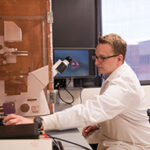
In his chemistry lab at UMBC, assistant professor Ryan White peers through the microscope at a 25 um sensor, the size of a single strand of hair. Attached to the sensor, beyond the realm of microscopic resolution, are DNA aptamers�single strands of DNA that can change shape when molecules bind to them. The material White works with is incredibly tiny, but it has the potential to lead to remarkable insights.
�The brain is a complicated place,� says White. In the last 100 years scientists have focused on neurons. �They�re thought of as the main player,� he explains. Other cell types in the brain have been overlooked and it turns out that some of them are essential partners in brain function. That means, says White, that scientists now need tools to study interactions between neurons and other brain cells.
White and his team are interested in looking at astrocytes, a type of support cell in the brain. There is evidence that communication between astrocytes and neurons is important in a genetic disorder called Fragile X syndrome, one of the few known genetic causes of autism spectrum disorder.
It turns out that healthy astrocytes can help repair the abnormal neurons. However, not much is known about the communication between astrocytes and neurons. White and his team aim to develop a tool�a tiny sensor�that will help scientists study the interactions between these two cell types.
White makes the sensor by inserting a piece of gold wire into a micropipette. The pipette is pulled�fashioned into a polished glass needle with a gold disk at the end. Attached to the gold disk are aptamers. When an aptamer changes shape White is able to record an electrical signal that allows him to calculate how many molecules of ATP are released. �Right now we�re looking at tens to thousands of molecules,� he says.
ATP is typically thought of as the energy currency of the cell, but in this case White and his team are looking to see if cells communicate with each other through ATP. The big question: is there a hotspot for ATP activity in the astrocyte and can White determine the mechanism of ATP release? Answers to those questions could help White and his collaborator, Mary McKenna at the University of Maryland School of Medicine, unravel some of the mysteries behind Fragile X syndrome.
White doesn�t plan to stop with Fragile X syndrome. �The most exciting thing about the sensor,� he says, �is we can just change out the aptamer to look at different molecules� that may hold the key to answering other important questions in science and medicine.
White, who joined UMBC in 2011, also has a vision for research that goes beyond the microscope. His research builds on his experiences as a graduate student at the University of Utah and a post-doc at the University of California, Santa Barbara, but White attributes much of his success in science to an undergraduate research experience at the University of North Carolina, Chapel Hill. He shares, �I don�t think without that I would be where I am today.�
Now White is carrying on that tradition. His lab currently includes four undergraduates and two graduate students. Two of his former undergraduates, Samiullah �Sam� Wagan �13, biology, and James Taylor �14, chemistry, have gone on to careers in science and medicine. Wagan is a medical school student at the University of St. Louis and Taylor is a graduate student in chemistry at the University of North Carolina, Chapel Hill.
White says Wagan and Taylor were integral to lab experiments while at UMBC and published their research alongside graduate students. He believes it�s essential to give undergraduates projects they can make their own, rather than assigning them minor tasks simply supporting other research, as is the norm at many other universities. �This is your chance to get hands on experience,� he tells them, �Your project is not set in stone.�
�I encourage undergraduate students to formulate their own questions in the lab,� White explains. Even if their projects don�t work out as planned, he notes, that is �a valuable lesson if they want to go on in research.�
White�s lab demonstrates how, by working together on complementary projects, undergraduate and graduate students can contribute the fresh perspectives that research thrives on as they develop into the next generation of innovative scientists.
(03/19/2015)
© University of Maryland, Baltimore County � 1000 Hilltop Circle, Baltimore, MD 21250 � 410-455-1000 �
]]>
Tiny Tools, Big Results Chemist Ryan White works to transform research on how brain cells communicate with each other. In his chemistry lab at UMBC, assistant professor Ryan White peers...
https://umbc.edu/stories/umbc-tiny-tools-big-results/
https://my3.my.umbc.edu/api/v0/pixel/news/121735/guest@my.umbc.edu/1b780e528e48b5c28f56ef1b40bc3837/api/pixel
window-stories
UMBC News & Magazine
https://my3.my.umbc.edu/groups/umbc-news-magazine
https://assets1-my.umbc.edu/system/shared/avatars/groups/000/001/943/24435aa6207c452e7bc15cc74b42c7bb/xsmall.png?1748556657
https://assets1-my.umbc.edu/system/shared/avatars/groups/000/001/943/24435aa6207c452e7bc15cc74b42c7bb/original.png?1748556657
https://assets2-my.umbc.edu/system/shared/avatars/groups/000/001/943/24435aa6207c452e7bc15cc74b42c7bb/xxlarge.png?1748556657
https://assets2-my.umbc.edu/system/shared/avatars/groups/000/001/943/24435aa6207c452e7bc15cc74b42c7bb/xlarge.png?1748556657
https://assets3-my.umbc.edu/system/shared/avatars/groups/000/001/943/24435aa6207c452e7bc15cc74b42c7bb/large.png?1748556657
https://assets1-my.umbc.edu/system/shared/avatars/groups/000/001/943/24435aa6207c452e7bc15cc74b42c7bb/medium.png?1748556657
https://assets2-my.umbc.edu/system/shared/avatars/groups/000/001/943/24435aa6207c452e7bc15cc74b42c7bb/small.png?1748556657
https://assets1-my.umbc.edu/system/shared/avatars/groups/000/001/943/24435aa6207c452e7bc15cc74b42c7bb/xsmall.png?1748556657
https://assets2-my.umbc.edu/system/shared/avatars/groups/000/001/943/24435aa6207c452e7bc15cc74b42c7bb/xxsmall.png?1748556657
UMBC News & Magazine
0
0
false
Mon, 15 Jun 2015 17:32:00 -0400
Kraken Released... and wins in Bmore Kinetic Sculpture Race!
This weekend, UMBC spread sustainability at the Annual Kinetic Sculpture Race in Baltimore and took home a grand prize! Students created the sustainable kinetic sculpture: professor Steven McAlpine taught INDS classes in fall and again in spring, with the class project of designing and building a sustainable sculpture. The environmentally themed "kraken upcycle" was the result- a seamonster made of plastic. The message behind it was meant to convey that petroleum/ plastics/ pollution is today's seamonster, and recycled materials were used to create the sculpture!
]]>
This weekend, UMBC spread sustainability at the Annual Kinetic Sculpture Race in Baltimore and took home a grand prize! Students created the sustainable kinetic sculpture: professor Steven...
https://my3.my.umbc.edu/api/v0/pixel/news/52267/guest@my.umbc.edu/65b4cac9942db72ab0eacde0f18f515d/api/pixel
Sustainability Matters at UMBC
https://my3.my.umbc.edu/groups/sustainability
https://assets1-my.umbc.edu/system/shared/avatars/groups/000/000/086/91091ac32f525d88daa6d6b721420ac1/xsmall.png?1586269437
https://assets3-my.umbc.edu/system/shared/avatars/groups/000/000/086/91091ac32f525d88daa6d6b721420ac1/original.png?1586269437
https://assets4-my.umbc.edu/system/shared/avatars/groups/000/000/086/91091ac32f525d88daa6d6b721420ac1/xxlarge.png?1586269437
https://assets2-my.umbc.edu/system/shared/avatars/groups/000/000/086/91091ac32f525d88daa6d6b721420ac1/xlarge.png?1586269437
https://assets2-my.umbc.edu/system/shared/avatars/groups/000/000/086/91091ac32f525d88daa6d6b721420ac1/large.png?1586269437
https://assets4-my.umbc.edu/system/shared/avatars/groups/000/000/086/91091ac32f525d88daa6d6b721420ac1/medium.png?1586269437
https://assets4-my.umbc.edu/system/shared/avatars/groups/000/000/086/91091ac32f525d88daa6d6b721420ac1/small.png?1586269437
https://assets1-my.umbc.edu/system/shared/avatars/groups/000/000/086/91091ac32f525d88daa6d6b721420ac1/xsmall.png?1586269437
https://assets3-my.umbc.edu/system/shared/avatars/groups/000/000/086/91091ac32f525d88daa6d6b721420ac1/xxsmall.png?1586269437
Sustainability Matters at UMBC
https://assets1-my.umbc.edu/system/shared/thumbnails/news/000/052/267/ac503f9e2345aa0e0cb346bec68f7ce5/xxlarge.jpg?1434386118
https://assets1-my.umbc.edu/system/shared/thumbnails/news/000/052/267/ac503f9e2345aa0e0cb346bec68f7ce5/xlarge.jpg?1434386118
https://assets4-my.umbc.edu/system/shared/thumbnails/news/000/052/267/ac503f9e2345aa0e0cb346bec68f7ce5/large.jpg?1434386118
https://assets1-my.umbc.edu/system/shared/thumbnails/news/000/052/267/ac503f9e2345aa0e0cb346bec68f7ce5/medium.jpg?1434386118
https://assets2-my.umbc.edu/system/shared/thumbnails/news/000/052/267/ac503f9e2345aa0e0cb346bec68f7ce5/small.jpg?1434386118
https://assets2-my.umbc.edu/system/shared/thumbnails/news/000/052/267/ac503f9e2345aa0e0cb346bec68f7ce5/xsmall.jpg?1434386118
https://assets3-my.umbc.edu/system/shared/thumbnails/news/000/052/267/ac503f9e2345aa0e0cb346bec68f7ce5/xxsmall.jpg?1434386118
81
11
true
Mon, 15 Jun 2015 12:38:48 -0400
Thu, 18 Jun 2015 09:23:28 -0400
Large 3-tier cart on wheels
Call Julie Rosenthal, Asian Studies x52094/julier@umbc.edu
Great condition. Please pass the word to any department or program who may need this.
]]>
Great condition. Please pass the word to any department or program who may need this.
https://my3.my.umbc.edu/api/v0/pixel/news/52266/guest@my.umbc.edu/892bc8256e0796cc13ce44fe4c961db5/api/pixel
Retriever Exchange
https://my3.my.umbc.edu/groups/retriever-exchange
https://assets4-my.umbc.edu/system/shared/avatars/groups/000/000/773/252410409cf803b42636c8732e2ddb6e/xsmall.png?1748556691
https://assets4-my.umbc.edu/system/shared/avatars/groups/000/000/773/252410409cf803b42636c8732e2ddb6e/original.png?1748556691
https://assets2-my.umbc.edu/system/shared/avatars/groups/000/000/773/252410409cf803b42636c8732e2ddb6e/xxlarge.png?1748556691
https://assets2-my.umbc.edu/system/shared/avatars/groups/000/000/773/252410409cf803b42636c8732e2ddb6e/xlarge.png?1748556691
https://assets4-my.umbc.edu/system/shared/avatars/groups/000/000/773/252410409cf803b42636c8732e2ddb6e/large.png?1748556691
https://assets4-my.umbc.edu/system/shared/avatars/groups/000/000/773/252410409cf803b42636c8732e2ddb6e/medium.png?1748556691
https://assets4-my.umbc.edu/system/shared/avatars/groups/000/000/773/252410409cf803b42636c8732e2ddb6e/small.png?1748556691
https://assets4-my.umbc.edu/system/shared/avatars/groups/000/000/773/252410409cf803b42636c8732e2ddb6e/xsmall.png?1748556691
https://assets3-my.umbc.edu/system/shared/avatars/groups/000/000/773/252410409cf803b42636c8732e2ddb6e/xxsmall.png?1748556691
Retriever Exchange
0
3
true
Mon, 15 Jun 2015 11:48:43 -0400
Graduate Assistantship Opportunities
UMBC's Residential Life
Residential Life is opening a search for a Graduate Assistant Coordinator for Facilities, and a Graduate Conferences Coordinator. Both postings are 20 hours a week, 12-month positions that include tuition remission, on-campus housing, 10 meals a week while the university is in session, and a financial stipend as compensation. If you know of a new graduate student or a potential candidate for one or either position, please encourage them to apply!
Graduate Assistant Coordinator, Residential Facilities
- Assist with the supervision of Maintenance Assistants (12), summer Project Assistants (25) and an Office Assistant (1).
- Assist with development, coordination and implementation of Safety and Security program planning.
- Assist with publications and educational components for Residential Facilities (fliers, workshops).
- Serve as a liaison with Physical Plant Project Managers on designated projects or tasks.
- Provide feedback to the Assistant Director about facilities issues and performance of paraprofessional staff and resident student concerns.
- Additional duties attached in the position description.
Apply by email to Frank Caldwell at
caldwell@umbc.edu. The best consideration deadline to apply is Friday,
June 19th by COB.
Graduate Conferences Coordinator
- Attend regular UMBC Events meetings, and weekly during peak summer season
- Recruitment and selection of summer staff members
- Aid in facilitation of summer staff meetings
- Serve on the summer conference on-call duty rotation, as well as the facilities grad on-call rotation
- Collaborate with campus partners (Dining, Campus Card, Commons, etc.)
- Support departmental initiatives
- Additional duties attached in the position description.
Apply by email to Roger Becks at
rbecks@umbc.edu. The best consideration deadline to apply is Friday,
June 19th by COB.

