UMBC: Soccer Story
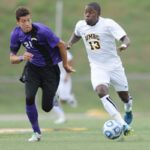
Home Team
Retriever Fever and spirited fans lift UMBC Men�s Soccer to even greater heights.
The sun rises and crews get to work cutting the plush Riviera Bermuda grass, repainting lines and repairing divots with green dyed sand.
UMBC has the only Bermuda grass field in the America East Conference and it has to be pristine for the next game. Plus, with the growing success of UMBC soccer, there�s a good chance the field will see a lot more action throughout the fall.
As the defending America East champion, UMBC men�s soccer team is familiar with the thrill of victory. However, the 2013 season marks a lot of firsts for the team, including cracking the top ten in both the National Soccer Coaches Association of America (NSCAA) and Top Drawer Soccer rankings. The team currently ranks 7th in NSCAA and 6th in Top Drawer Soccer, and have already clinched a spot in the six-team America East championships. UMBC women�s soccer is seeing similar success, completing the best turnaround in conference history by going from last in the conference a season ago to capturing its first-ever regular season title.
�We have maintained a quality program for quite some time, but these are heights we have not scaled before and this marks an exciting, new era for our team,� said Steve Levy, Associate Athletic Director.
UMBC�s unprecedented success comes at a time when soccer has never been more popular in the United States. With the 2014 World Cup less than 12 months away, that interest will only continue to grow. But if you were to visit UMBC campus on a game night, you�d think the Cup was just days away.
Our students and alumni have a strong tradition of supporting the UMBC soccer program. Each fall, �Retriever Fever� sweeps the campus community, bringing with it a surge of school spirit and camaraderie. Halls are decorated, events are planned and thousands of students converge on the campus for Homecoming week, all leading up to the men�s soccer match. This year, more than 1,700 attended the Saturday game.
�Every year we draw more and more fans and alumni back to campus as a community, while the events and support get better and better,� said Anthony Adams, Men�s Soccer Associate Head Coach. �I would challenge anyone to come to a men’s soccer game and not see tremendous school spirit.�
Despite having fewer resources when compared to other top university programs in the country, UMBC has continued to consistently rank well in game attendance and participation. During the 2012 soccer season, the university was 13th in attendance nationally, and numbers are up from 995 to 1,228 per game in 2013.
Nowhere is this school spirit and support more evident than right on the sidelines. Each home game, thousands of students, alumni and fans turn out�complete with banner flag, rally drum, matching apparel and organized chants. Lot 17, named for the original spot where fans would gather before and after each game, has been a way for UMBC�s soccer fans to get organized. Following the 2010 season, men�s soccer saw a significant rise in attendance at home games after an appearance in the 2010 NCAA tournament, advancing to the second round. With help from an enthusiastic men�s soccer club team, Lot 17 was formed and is a now quintessential part of the school�s soccer heritage. The fan-based group often travels to away games and can be found taking over opposing stadiums with their cheering.
Soccer is a sport I am very passionate about,� said Edward �Teddy� Tibert, a UMBC club soccer player and lead organizer for Lot 17. �I think that�s what makes it great�we’re so unique from other schools in the sense that the greatness of soccer isn’t taken away by all the shine that football brings.�
This Saturday at 1 p.m., the America East Conference action continues as UMBC men�s soccer travels to UMass Lowell to battle the River Hawks. Women’s soccer will host their America East semifinal game this Sunday at 1 p.m. at Retriever Soccer Park. For tickets and more information, visit www.umbcretrievers.com.
(10/30/13)
� 410-455-1000 �
UMBC is an Equal Opportunity and Affirmative Action Institution
]]>
Home Team Retriever Fever and spirited fans lift UMBC Men�s Soccer to even greater heights. The sun rises and crews get to work cutting the plush Riviera Bermuda grass, repainting lines and...
https://umbc.edu/stories/umbc-soccer-story/
https://my3.my.umbc.edu/api/v0/pixel/news/123003/guest@my.umbc.edu/914f08b196164e36f038acea5e2898ca/api/pixel
window-stories
UMBC News & Magazine
https://my3.my.umbc.edu/groups/umbc-news-magazine
https://assets1-my.umbc.edu/system/shared/avatars/groups/000/001/943/24435aa6207c452e7bc15cc74b42c7bb/xsmall.png?1748556657
https://assets1-my.umbc.edu/system/shared/avatars/groups/000/001/943/24435aa6207c452e7bc15cc74b42c7bb/original.png?1748556657
https://assets2-my.umbc.edu/system/shared/avatars/groups/000/001/943/24435aa6207c452e7bc15cc74b42c7bb/xxlarge.png?1748556657
https://assets2-my.umbc.edu/system/shared/avatars/groups/000/001/943/24435aa6207c452e7bc15cc74b42c7bb/xlarge.png?1748556657
https://assets3-my.umbc.edu/system/shared/avatars/groups/000/001/943/24435aa6207c452e7bc15cc74b42c7bb/large.png?1748556657
https://assets1-my.umbc.edu/system/shared/avatars/groups/000/001/943/24435aa6207c452e7bc15cc74b42c7bb/medium.png?1748556657
https://assets2-my.umbc.edu/system/shared/avatars/groups/000/001/943/24435aa6207c452e7bc15cc74b42c7bb/small.png?1748556657
https://assets1-my.umbc.edu/system/shared/avatars/groups/000/001/943/24435aa6207c452e7bc15cc74b42c7bb/xsmall.png?1748556657
https://assets2-my.umbc.edu/system/shared/avatars/groups/000/001/943/24435aa6207c452e7bc15cc74b42c7bb/xxsmall.png?1748556657
UMBC News & Magazine
0
0
false
Wed, 30 Oct 2013 04:00:00 -0400
UMBC: The Body Electric
The Body Electric
UMBC researchers forge links between tech and medicine
Monitoring significant developments in a patient�s health outside a hospital setting can be challenging, but two UMBC researchers � Tinoosh Mohsenin and Gymama Slaughter � have won separate grants from the National Science Foundation (NSF) to help meet those challenges.
Mohsenin received a $100,000 grant from the NSF to develop signal processing architecture to detect seizures. The award of $150,000 to Slaughter from the foundation was to pursue work on nanoelectric probe arrays.
Not only does the work done by these two UMBC professors have important implications for basic medical science, but it is also research that may also provide more insight into how we think and feel, or improve how people with disabilities navigate in the world.
Watch and Wear
When patients are in a hospital, they often are connected to a myriad of monitoring devices attached to various parts of their body. Any changes are noted quickly by doctors or nurses.
Outside the hospital, however, it is more difficult to monitor for important warning signs of distress. The parent of a child with juvenile epilepsy, for instance, must watch until their child goes to sleep and be ready to act for signs of distress � because just before sleep is usually when such seizures occur. The fear and uncertainty of epilepsy for both patients and caregivers puts limits on their independence and reduces their quality of life.
Research pursued by Tinoosh Mohsenin � an assistant professor of computer engineering at UMBC � aims to give those parents (and patients everywhere) monitoring devices and systems as good as those provided in a hospital.
Mohsenin runs UMBC�s Energy Efficient High Performance Computing Lab, which is involved with the design and implementation of various signal processing algorithms and hardware that require real time processing within a limited power budget. Working with professor of computer science and electrical engineering Tim Oates at the computer science department and researchers at the University of Maryland Medical Center, she is developing wearable monitors to detect when someone is having a seizure no matter where they are.
A wearable seizure monitoring and alerting system could provide greater independence for patients with epilepsy. The technology available at present to monitor for seizures outside hospitals is bulky and uncomfortable. The current devices usually are worn in caps with electrodes attached to the head. They use a great deal of power, all drawn from batteries.
Worse yet, these devices are subject to a lot of noise due to movement of cap and a high number of false positives � and may not distinguish between a seizure and the patient brushing their teeth.
�There are not very efficient devices for people who suffer from epilepsy or those people whose epilepsy cannot be treated with medication,� she says.
At present, the only physiological signals measured by most of epilepsy monitors are electroencephalograph (EEG) signals. But Mohsenin envisions a device that measures even more indicators � including heart rate, oxygenation, and sweat/sudomotor response. She also wants to add an accelerometer for motion detection, which would pick up shaking and recognize if the patient falls.
What Mohsenin envisions is a monitor with a comfortable headband that would measure EEG signals, and an arm band that would contain an accelerometer and could measure other signals such as pulse.
�It has to be very accurate,� says Mohsenin, who even has ambitions for the device to call for medical assistance when it detects a seizure in a patient who is alone.
Each device would have to be trained for each patient because seizures and patients vary. And the device must also work within a �power budget� that uses as little power as possible with long battery life.
Presently Mohsenin and Oates are working on the variety of representations and machine learning algorithms to extract useful information from multi-physiological signals for such a device. The amount of computation the devices have to do is daunting, she says. She is concentrating mostly on creating the processor hardware and its low power implementation.
Mohsenin and colleagues at Georgia Institute of Technology are also working on another personalized wearable biomedical project � a wireless and wearable intraural device in the form of dental retainer that allows individuals with tetraplegia to access computers, drive wheelchairs, and control their environments.
Going for Gold
One of the key problems in monitoring brain activity is physiological. To place brain monitors on a patient requires major surgery, in which holes are drilled into the skull and part of the skull is lifted up. A relatively large, flat, and rigid device is then inserted. It is a process is fraught with peril.
Gymama Slaughter, an assistant professor of computer science and electrical engineering, is exploring how nanotechnology might produce a device that can monitor brain activity without such risk.
In the Bioelectronics Lab she created from the ground up at UMBC, Slaughter is working in the nano-scale on artifacts so small they are at molecular or near molecular scale.
The brain monitoring device she is working on is like a pyramid, literally one cubic millimeter in size with a tip pitch of 20 nanometers. (A millimeter is 4/100th of an inch.)
She is using gold for the device because it is an excellent electrical conductor, perfect for measuring electrical activity, and yet causes no adverse reaction in the body.
The device is also small enough to be inserted with a conventional syringe and flexible enough to be comfortable. It can also conform to the shape of the brain and be placed between the brain and the skull.
�A seven-gauge syringe will do it,� she observes, �and [the device] will enable large number of neurons to be interfaced simultaneously,� she said. The result is a monitor that will enable hundreds, thousands, or even millions of simultaneous electrophysiological recordings.
These neurosensors will collect data on brain activity, including what happens when a patient acquires Parkinson�s disease, strokes, epilepsy, brain damage, or Alzheimer�s.
�It might eventually measure how people behave,� says Slaughter. �What happens in the brain during anger, jealousy, or sadness?� It may also help understand researchers understand brain disorders such as obsessive compulsive disorder.
Slaughter is also working on a number of other projects: one monitor will give a running count of blood sugar in diabetics and deliver insulin when blood sugar is high to help people with diabetes avoid the usual complications, and another monitor tracks what happens when brain cells react to the brain toxins involved in Parkinson�s disease.
She is also pursuing a project to harvest energy from within the body to power bio-implantable devices without using external battery with the hope to improve individual�s well-being. Slaughter adds that the realization of energy harvesting from within the body is an attractive proposition not only for sensing and actuating, but also may have uses for electronics and defense technologies.
� Joel N.Shurkin
(10/30/13)
]]>
The Body Electric UMBC researchers forge links between tech and medicine Monitoring significant developments in a patient�s health outside a hospital setting can be challenging, but two UMBC...
https://umbc.edu/stories/umbc-the-body-electric/
https://my3.my.umbc.edu/api/v0/pixel/news/123001/guest@my.umbc.edu/33488524bd7e18a7ce7ad0b55166e121/api/pixel
window-stories
UMBC News & Magazine
https://my3.my.umbc.edu/groups/umbc-news-magazine
https://assets1-my.umbc.edu/system/shared/avatars/groups/000/001/943/24435aa6207c452e7bc15cc74b42c7bb/xsmall.png?1748556657
https://assets1-my.umbc.edu/system/shared/avatars/groups/000/001/943/24435aa6207c452e7bc15cc74b42c7bb/original.png?1748556657
https://assets2-my.umbc.edu/system/shared/avatars/groups/000/001/943/24435aa6207c452e7bc15cc74b42c7bb/xxlarge.png?1748556657
https://assets2-my.umbc.edu/system/shared/avatars/groups/000/001/943/24435aa6207c452e7bc15cc74b42c7bb/xlarge.png?1748556657
https://assets3-my.umbc.edu/system/shared/avatars/groups/000/001/943/24435aa6207c452e7bc15cc74b42c7bb/large.png?1748556657
https://assets1-my.umbc.edu/system/shared/avatars/groups/000/001/943/24435aa6207c452e7bc15cc74b42c7bb/medium.png?1748556657
https://assets2-my.umbc.edu/system/shared/avatars/groups/000/001/943/24435aa6207c452e7bc15cc74b42c7bb/small.png?1748556657
https://assets1-my.umbc.edu/system/shared/avatars/groups/000/001/943/24435aa6207c452e7bc15cc74b42c7bb/xsmall.png?1748556657
https://assets2-my.umbc.edu/system/shared/avatars/groups/000/001/943/24435aa6207c452e7bc15cc74b42c7bb/xxsmall.png?1748556657
UMBC News & Magazine
0
0
false
Wed, 30 Oct 2013 04:00:00 -0400
UMBC: THE BODY ELECTRIC
THE BODY ELECTRIC
UMBC researchers forge links between tech and medicine
Monitoring significant developments in a patient�s health outside a hospital setting can be challenging, but two UMBC researchers � Tinoosh Mohsenin and Gymama Slaughter � have won separate grants from the National Science Foundation (NSF) to help meet those challenges.
Mohsenin received a $100,000 grant from the NSF to develop signal processing architecture to detect seizures. The award of $150,000 to Slaughter from the foundation was to pursue work on nanoelectric probe arrays.
Not only does the work done by these two UMBC professors have important implications for basic medical science, but it is also research that may also provide more insight into how we think and feel, or improve how people with disabilities navigate in the world.
WATCH AND WEAR
When patients are in a hospital, they often are connected to a myriad of monitoring devices attached to various parts of their body. Any changes are noted quickly by doctors or nurses.
Outside the hospital, however, it is more difficult to monitor for important warning signs of distress. The parent of a child with juvenile epilepsy, for instance, must watch until their child goes to sleep and be ready to act for signs of distress � because just before sleep is when they usually such seizures occur. The fear and uncertainty of epilepsy for both patients and caregivers puts limits on their independence and reduces their quality of life.
Research pursued by Tinoosh Mohsenin � an assistant professor of computer engineering at UMBC �aims to give those parents (and patients everywhere) monitoring devices and systems as good as those provided in a hospital.
Mohsenin runs UMBC�s Energy Efficient High Performance Computing Lab, which is involved with the design and implementation of various signal processing algorithms and hardware that require real time processing within a limited power budget. Working with professor of computer science and electrical engineering Tim Oates at the computer science department and researchers at the University of Maryland Medical Center, she is developing wearable monitors to detect when someone is having a seizure no matter where they are.
A wearable seizure monitoring and alerting system could provide greater independence for patients with epilepsy. The technology available at present to monitor for seizures outside hospitals is bulky and uncomfortable. The current devices usually are worn in caps with electrodes attached to the head. They use a great deal of power, all drawn from batteries.
Worse yet, these devices are subject to a lot of noise due to movement of cap and a high number of false positives � and may not distinguish between a seizure and the patient brushing their teeth.
�There are not very efficient devices for people who suffer from epilepsy or those people whose epilepsy cannot be treated with medication,� she says.
At present, the only physiological signals measured by most of epilepsy monitors are electroencephalograph (EEG) signals. But Mohsenin envisions a device that measures even more indicators � including heart rate, oxygenation, and sweat/sudomotor response. She also wants to add an accelerometer for motion detection, which would pick up shaking and recognize if the patient falls.
What Mohsenin envisions is a monitor with a comfortable headband that would measure EEG signals, and an arm band that would contain an accelerometer and could measure other signals such as pulse.
�It has to be very accurate,� says Mohsenin, who even has ambitions for the device to call for medical assistance when it detects a seizure in a patient who is alone.
Each device would have to be trained for each patient because seizures and patients vary. And the device must also work within a �power budget� that uses as little power as possible with long battery life.
Presently Mohsenin and Oates are working on the variety of representations and machine learning algorithms to extract useful information from multi-physiological signals for such a device. The amount of computation the devices have to do is daunting, she says. She is concentrating mostly on creating the processor hardware and its low power implementation.
Mohsenin and colleagues at Georgia Institute of Technology are also working on another personalized wearable biomedical project � a wireless and wearable intraural device in the form of dental retainer that allows individuals with tetraplegia to access computers, drive wheelchairs, and control their environments.
GOING FOR GOLD
One of the key problems in monitoring brain activity is physiological. To place brain monitors on a patient requires major surgery, in which holes are drilled into the skull and part of the skull is lifted up. A relatively large, flat, and rigid device is then inserted. It is a process is fraught with peril.
Gymama Slaughter, an assistant professor of computer science and electrical engineering, is exploring how nanotechnology might produce a device that can monitor brain activity without such risk.
In the Bioelectronics Lab she created from the ground up at UMBC, Slaughter is working in the nano-scale on artifacts so small they are at molecular or near molecular scale.
The brain monitoring device she is working on is like a pyramid, literally one cubic millimeter in size with a tip pitch of 20 nanometers. (A millimeter is 4/100th of an inch.)
She is using gold for the device because it is an excellent electrical conductor, perfect for measuring electrical activity, and yet causes no adverse reaction in the body.
The device is also small enough to be inserted with a conventional syringe and flexible enough to be comfortable. It can also conform to the shape of the brain and be placed between the brain and the skull.
�A seven-gauge syringe will do it,� she observes, �and [the device] will enable large number of neurons to be interfaced simultaneously,� she said. The result is a monitor that will enable hundreds, thousands, or even millions of simultaneous electrophysiological recordings.
These neurosensors will collect data on brain activity, including what happens when a patient acquires Parkinson�s disease, strokes, epilepsy, brain damage, or Alzheimer�s.
�It might eventually measure how people behave,� says Slaughter. �What happens in the brain during anger, jealousy, or sadness?� It may also help understand researchers understand brain disorders such as obsessive compulsive disorder.
Slaughter is also working on a number of other projects: one monitor will give a running count of blood sugar in diabetics and deliver insulin when blood sugar is high to help people with diabetes avoid the usual complications, and another monitor tracks what happens when brain cells react to the brain toxins involved in Parkinson�s disease.
She is also pursuing a project to harvest energy from within the body to power bio-implantable devices without using external battery with the hope to improve individual�s well-being. Slaughter adds that the realization of energy harvesting from within the body is an attractive proposition not only for sensing and actuating, but also may have uses for electronics and defense technologies.
� Joel N.Shurkin
(10/30/13)
]]>
THE BODY ELECTRIC UMBC researchers forge links between tech and medicine Monitoring significant developments in a patient�s health outside a hospital setting can be challenging, but two UMBC...
https://umbc.edu/stories/umbc-the-body-electric-2/
https://my3.my.umbc.edu/api/v0/pixel/news/123002/guest@my.umbc.edu/5b335189473bb3acea129402ff4dafd6/api/pixel
window-stories
UMBC News & Magazine
https://my3.my.umbc.edu/groups/umbc-news-magazine
https://assets1-my.umbc.edu/system/shared/avatars/groups/000/001/943/24435aa6207c452e7bc15cc74b42c7bb/xsmall.png?1748556657
https://assets1-my.umbc.edu/system/shared/avatars/groups/000/001/943/24435aa6207c452e7bc15cc74b42c7bb/original.png?1748556657
https://assets2-my.umbc.edu/system/shared/avatars/groups/000/001/943/24435aa6207c452e7bc15cc74b42c7bb/xxlarge.png?1748556657
https://assets2-my.umbc.edu/system/shared/avatars/groups/000/001/943/24435aa6207c452e7bc15cc74b42c7bb/xlarge.png?1748556657
https://assets3-my.umbc.edu/system/shared/avatars/groups/000/001/943/24435aa6207c452e7bc15cc74b42c7bb/large.png?1748556657
https://assets1-my.umbc.edu/system/shared/avatars/groups/000/001/943/24435aa6207c452e7bc15cc74b42c7bb/medium.png?1748556657
https://assets2-my.umbc.edu/system/shared/avatars/groups/000/001/943/24435aa6207c452e7bc15cc74b42c7bb/small.png?1748556657
https://assets1-my.umbc.edu/system/shared/avatars/groups/000/001/943/24435aa6207c452e7bc15cc74b42c7bb/xsmall.png?1748556657
https://assets2-my.umbc.edu/system/shared/avatars/groups/000/001/943/24435aa6207c452e7bc15cc74b42c7bb/xxsmall.png?1748556657
UMBC News & Magazine
0
0
false
Wed, 30 Oct 2013 04:00:00 -0400
Hussein and Perkins Sweep CCSA Weekly Awards
CHARLOTTE, N.C. � UMBC seniors Mohamed Hussein and Tim Perkins have swept the Coastal Collegiate Swimming Association (CCSA) weekly awards, the conference office announced on Wednesday morning. Hussein gains his second Swimmer of the Week honor in the past three weeks while Perkins garners the Diver of the Week accolade for the second consecutive week.
]]>
CHARLOTTE, N.C. � UMBC seniors Mohamed Hussein and Tim Perkins have swept the Coastal Collegiate Swimming Association (CCSA) weekly awards, the conference office announced on Wednesday morning....
http://www.umbcretrievers.com/release.asp?RELEASE_ID=8269
https://my3.my.umbc.edu/api/v0/pixel/news/37700/guest@my.umbc.edu/2b49f9ebbb4dbb576eb25f0acf229b91/api/pixel
UMBC Athletics
https://my3.my.umbc.edu/groups/athletics
https://assets2-my.umbc.edu/system/shared/avatars/groups/000/000/009/69595c9b99f609d75fbb8232d9bd73d3/xsmall.png?1709304849
https://assets4-my.umbc.edu/system/shared/avatars/groups/000/000/009/69595c9b99f609d75fbb8232d9bd73d3/original.jpg?1709304849
https://assets3-my.umbc.edu/system/shared/avatars/groups/000/000/009/69595c9b99f609d75fbb8232d9bd73d3/xxlarge.png?1709304849
https://assets3-my.umbc.edu/system/shared/avatars/groups/000/000/009/69595c9b99f609d75fbb8232d9bd73d3/xlarge.png?1709304849
https://assets4-my.umbc.edu/system/shared/avatars/groups/000/000/009/69595c9b99f609d75fbb8232d9bd73d3/large.png?1709304849
https://assets4-my.umbc.edu/system/shared/avatars/groups/000/000/009/69595c9b99f609d75fbb8232d9bd73d3/medium.png?1709304849
https://assets1-my.umbc.edu/system/shared/avatars/groups/000/000/009/69595c9b99f609d75fbb8232d9bd73d3/small.png?1709304849
https://assets2-my.umbc.edu/system/shared/avatars/groups/000/000/009/69595c9b99f609d75fbb8232d9bd73d3/xsmall.png?1709304849
https://assets3-my.umbc.edu/system/shared/avatars/groups/000/000/009/69595c9b99f609d75fbb8232d9bd73d3/xxsmall.png?1709304849
UMBC Athletics
1
0
true
Wed, 30 Oct 2013 01:00:00 -0400
Women's Soccer Takes Home Two Major Awards as Six Players Receive Postseason Recognition
For the first time since joining the America East, the UMBC women's soccer took home a major award, with the league's front-runner snagging two of the six key distinctions. The Retrievers' staff was named Coaching Staff of the Year by the league's coaches and red-shirt junior Jessy Brown garnered Co-Midfielder of the Year recognition. Six UMBC players were honored for nine conference honors, the most-ever by the women's soccer team, as announced by the conference office on Wednesday.
]]>
For the first time since joining the America East, the UMBC women's soccer took home a major award, with the league's front-runner snagging two of the six key distinctions. The Retrievers' staff...
http://www.umbcretrievers.com/release.asp?RELEASE_ID=8270
https://my3.my.umbc.edu/api/v0/pixel/news/37727/guest@my.umbc.edu/dd2224fa213961dec77f1ac550a2555b/api/pixel
UMBC Athletics
https://my3.my.umbc.edu/groups/athletics
https://assets2-my.umbc.edu/system/shared/avatars/groups/000/000/009/69595c9b99f609d75fbb8232d9bd73d3/xsmall.png?1709304849
https://assets4-my.umbc.edu/system/shared/avatars/groups/000/000/009/69595c9b99f609d75fbb8232d9bd73d3/original.jpg?1709304849
https://assets3-my.umbc.edu/system/shared/avatars/groups/000/000/009/69595c9b99f609d75fbb8232d9bd73d3/xxlarge.png?1709304849
https://assets3-my.umbc.edu/system/shared/avatars/groups/000/000/009/69595c9b99f609d75fbb8232d9bd73d3/xlarge.png?1709304849
https://assets4-my.umbc.edu/system/shared/avatars/groups/000/000/009/69595c9b99f609d75fbb8232d9bd73d3/large.png?1709304849
https://assets4-my.umbc.edu/system/shared/avatars/groups/000/000/009/69595c9b99f609d75fbb8232d9bd73d3/medium.png?1709304849
https://assets1-my.umbc.edu/system/shared/avatars/groups/000/000/009/69595c9b99f609d75fbb8232d9bd73d3/small.png?1709304849
https://assets2-my.umbc.edu/system/shared/avatars/groups/000/000/009/69595c9b99f609d75fbb8232d9bd73d3/xsmall.png?1709304849
https://assets3-my.umbc.edu/system/shared/avatars/groups/000/000/009/69595c9b99f609d75fbb8232d9bd73d3/xxsmall.png?1709304849
UMBC Athletics
0
0
true
Wed, 30 Oct 2013 01:00:00 -0400
Barnes & Noble to Release New Version of the Nook
The new device comes as the bookseller, the nation’s largest bookstore chain, continues to face questions about its long-term viability.


 ]]>
The new device comes as the bookseller, the nation’s largest bookstore chain, continues to face questions about its long-term viability.
http://www.nytimes.com/2013/10/30/business/media/barnes-noble-to-release-new-version-of-the-nook.html?partner=rss&emc=rss
https://my3.my.umbc.edu/api/v0/pixel/news/37695/guest@my.umbc.edu/c353c91b29f89ca02abae43545e2d227/api/pixel
barnes-and-noble-inc-bks-nyse
barnes-and-noble-nook
e-books-and-readers
forrester-research-inc-forr-nasdaq
gartner-inc-it-nyse
huseby-michael-p
new
technology
york
Web Developer - Build Group
https://my3.my.umbc.edu/groups/retired-583
https://assets3-my.umbc.edu/system/shared/avatars/groups/000/000/583/fc60f5d7abc2e080599bb6dc465db54d/xsmall.png?1363101197
https://assets4-my.umbc.edu/system/shared/avatars/groups/000/000/583/fc60f5d7abc2e080599bb6dc465db54d/original.jpg?1363101197
https://assets4-my.umbc.edu/system/shared/avatars/groups/000/000/583/fc60f5d7abc2e080599bb6dc465db54d/xxlarge.png?1363101197
https://assets4-my.umbc.edu/system/shared/avatars/groups/000/000/583/fc60f5d7abc2e080599bb6dc465db54d/xlarge.png?1363101197
https://assets3-my.umbc.edu/system/shared/avatars/groups/000/000/583/fc60f5d7abc2e080599bb6dc465db54d/large.png?1363101197
https://assets3-my.umbc.edu/system/shared/avatars/groups/000/000/583/fc60f5d7abc2e080599bb6dc465db54d/medium.png?1363101197
https://assets4-my.umbc.edu/system/shared/avatars/groups/000/000/583/fc60f5d7abc2e080599bb6dc465db54d/small.png?1363101197
https://assets3-my.umbc.edu/system/shared/avatars/groups/000/000/583/fc60f5d7abc2e080599bb6dc465db54d/xsmall.png?1363101197
https://assets4-my.umbc.edu/system/shared/avatars/groups/000/000/583/fc60f5d7abc2e080599bb6dc465db54d/xxsmall.png?1363101197
Web Developer - Build Group
0
0
true
Wed, 30 Oct 2013 00:11:00 -0400
With Firefox OS, an $80 Smartphone Tries to Prove Its Worth
]]>
The new device comes as the bookseller, the nation’s largest bookstore chain, continues to face questions about its long-term viability.
http://www.nytimes.com/2013/10/30/business/media/barnes-noble-to-release-new-version-of-the-nook.html?partner=rss&emc=rss
https://my3.my.umbc.edu/api/v0/pixel/news/37695/guest@my.umbc.edu/c353c91b29f89ca02abae43545e2d227/api/pixel
barnes-and-noble-inc-bks-nyse
barnes-and-noble-nook
e-books-and-readers
forrester-research-inc-forr-nasdaq
gartner-inc-it-nyse
huseby-michael-p
new
technology
york
Web Developer - Build Group
https://my3.my.umbc.edu/groups/retired-583
https://assets3-my.umbc.edu/system/shared/avatars/groups/000/000/583/fc60f5d7abc2e080599bb6dc465db54d/xsmall.png?1363101197
https://assets4-my.umbc.edu/system/shared/avatars/groups/000/000/583/fc60f5d7abc2e080599bb6dc465db54d/original.jpg?1363101197
https://assets4-my.umbc.edu/system/shared/avatars/groups/000/000/583/fc60f5d7abc2e080599bb6dc465db54d/xxlarge.png?1363101197
https://assets4-my.umbc.edu/system/shared/avatars/groups/000/000/583/fc60f5d7abc2e080599bb6dc465db54d/xlarge.png?1363101197
https://assets3-my.umbc.edu/system/shared/avatars/groups/000/000/583/fc60f5d7abc2e080599bb6dc465db54d/large.png?1363101197
https://assets3-my.umbc.edu/system/shared/avatars/groups/000/000/583/fc60f5d7abc2e080599bb6dc465db54d/medium.png?1363101197
https://assets4-my.umbc.edu/system/shared/avatars/groups/000/000/583/fc60f5d7abc2e080599bb6dc465db54d/small.png?1363101197
https://assets3-my.umbc.edu/system/shared/avatars/groups/000/000/583/fc60f5d7abc2e080599bb6dc465db54d/xsmall.png?1363101197
https://assets4-my.umbc.edu/system/shared/avatars/groups/000/000/583/fc60f5d7abc2e080599bb6dc465db54d/xxsmall.png?1363101197
Web Developer - Build Group
0
0
true
Wed, 30 Oct 2013 00:11:00 -0400
With Firefox OS, an $80 Smartphone Tries to Prove Its Worth
Despite limitations, the Firefox OS-running ZTE Open shows promise for low-cost smartphones.
While the word “smartphone” usually evokes images of pricey iPhones and Android handsets, plenty of inexpensive smartphones are also hitting the market—ripe for the millions of cell phone owners who want a smartphone, but can’t (or don’t want to) pay hundreds of dollars for one.
]]>
Despite limitations, the Firefox OS-running ZTE Open shows promise for low-cost smartphones. While the word “smartphone” usually evokes images of pricey iPhones and Android handsets, plenty of...
http://www.technologyreview.com/news/520626/with-firefox-os-an-80-smartphone-tries-to-prove-its-worth/
https://my3.my.umbc.edu/api/v0/pixel/news/37696/guest@my.umbc.edu/7e2b8cbc827692d21e2d2991a7c0e7cb/api/pixel
development
internet
mit
technology
web
Web Developer - Build Group
https://my3.my.umbc.edu/groups/retired-583
https://assets3-my.umbc.edu/system/shared/avatars/groups/000/000/583/fc60f5d7abc2e080599bb6dc465db54d/xsmall.png?1363101197
https://assets4-my.umbc.edu/system/shared/avatars/groups/000/000/583/fc60f5d7abc2e080599bb6dc465db54d/original.jpg?1363101197
https://assets4-my.umbc.edu/system/shared/avatars/groups/000/000/583/fc60f5d7abc2e080599bb6dc465db54d/xxlarge.png?1363101197
https://assets4-my.umbc.edu/system/shared/avatars/groups/000/000/583/fc60f5d7abc2e080599bb6dc465db54d/xlarge.png?1363101197
https://assets3-my.umbc.edu/system/shared/avatars/groups/000/000/583/fc60f5d7abc2e080599bb6dc465db54d/large.png?1363101197
https://assets3-my.umbc.edu/system/shared/avatars/groups/000/000/583/fc60f5d7abc2e080599bb6dc465db54d/medium.png?1363101197
https://assets4-my.umbc.edu/system/shared/avatars/groups/000/000/583/fc60f5d7abc2e080599bb6dc465db54d/small.png?1363101197
https://assets3-my.umbc.edu/system/shared/avatars/groups/000/000/583/fc60f5d7abc2e080599bb6dc465db54d/xsmall.png?1363101197
https://assets4-my.umbc.edu/system/shared/avatars/groups/000/000/583/fc60f5d7abc2e080599bb6dc465db54d/xxsmall.png?1363101197
Web Developer - Build Group
0
0
true
Wed, 30 Oct 2013 00:00:00 -0400
The Problem with Thigh Gaps

What must you have to be beautiful?
Ask any of the young women who belong to internet “thinspo” communities and they will tell you two words: thigh gaps.
Thigh gaps have become the most recent obsession of these young women because of their supposed indication of thinness. The concept is that when the feet touch, a visible gap should be seen between the upper thighs.
So what’s the problem? Isn’t this a sign of slender and; subsequently, healthy legs?
Doctors say otherwise. Having a thigh gap is only a result of two things: having a genetically predisposed structure of wide set hips and pelvis or being so extensively malnourished that the muscles on the thigh waste away leaving a gap.
This internet obsession that has plagued the pages of Tumblr, Instagram, and Pinterest raises alarm for those in the medical community.
“The issue of focusing on a particular body part is very common, what is new is these things have taken on a life of their own because of the Internet and social media.” –
Claire Mysko from the National Eating Disorder Association.
These “thinspo” communities share pictures of emaciated women as “thinspiration.”
This distorted sense of beauty is becoming more accessible and widespread due to social media. Thankfully, public figures such as plus-size model Robyn Lawley have started to advocate against the glorification of thigh gaps and instead are emphasizing having healthy, strong bodies.
We’re hoping more will follow their lead and help thinspiration reach its expiration.
]]>
What must you have to be beautiful? Ask any of the young women who belong to internet “thinspo” communities and they will tell you two words: thigh gaps. Thigh gaps have become the most recent...
http://usdemocrazy.net/the-problem-with-thigh-gaps/
https://my3.my.umbc.edu/api/v0/pixel/news/37743/guest@my.umbc.edu/6ed706431e18df1281c07e5271347fac/api/pixel
beauty
current
democracy
health
media
news
politics
self-image
us
usdemocrazy
USDemocrazy
https://my3.my.umbc.edu/groups/retired-12
https://assets1-my.umbc.edu/system/shared/avatars/groups/000/000/012/f0935e4cd5920aa6c7c996a5ee53a70f/xsmall.png?1279120129
https://assets4-my.umbc.edu/system/shared/avatars/groups/000/000/012/f0935e4cd5920aa6c7c996a5ee53a70f/original.jpg?1279120129
https://assets3-my.umbc.edu/system/shared/avatars/groups/000/000/012/f0935e4cd5920aa6c7c996a5ee53a70f/xxlarge.png?1279120129
https://assets4-my.umbc.edu/system/shared/avatars/groups/000/000/012/f0935e4cd5920aa6c7c996a5ee53a70f/xlarge.png?1279120129
https://assets4-my.umbc.edu/system/shared/avatars/groups/000/000/012/f0935e4cd5920aa6c7c996a5ee53a70f/large.png?1279120129
https://assets1-my.umbc.edu/system/shared/avatars/groups/000/000/012/f0935e4cd5920aa6c7c996a5ee53a70f/medium.png?1279120129
https://assets2-my.umbc.edu/system/shared/avatars/groups/000/000/012/f0935e4cd5920aa6c7c996a5ee53a70f/small.png?1279120129
https://assets1-my.umbc.edu/system/shared/avatars/groups/000/000/012/f0935e4cd5920aa6c7c996a5ee53a70f/xsmall.png?1279120129
https://assets1-my.umbc.edu/system/shared/avatars/groups/000/000/012/f0935e4cd5920aa6c7c996a5ee53a70f/xxsmall.png?1279120129
USDemocrazy
77
75
true
Tue, 29 Oct 2013 23:31:33 -0400
Referencing Wordpress's Native Ajax Handler in JavaScript
In WordPress, AJAX requests go through wp-admin/admin-ajax.php. Despite the name, you don't have to have administrator privileges to use it. Rob Gravelle describes how to add our JavaScript files to the page in such a way that we can reference the path to admin-ajax.php on the server.
]]>
In WordPress, AJAX requests go through wp-admin/admin-ajax.php. Despite the name, you don't have to have administrator privileges to use it. Rob Gravelle describes how to add our JavaScript files...
http://www.htmlgoodies.com/HTML5/javascript/referencing-wordpresss-native-ajax-handler-in-javascript.html
https://my3.my.umbc.edu/api/v0/pixel/news/37697/guest@my.umbc.edu/e6b523037e0667adfb01934175d87d3f/api/pixel
html
htmlgoodies
learning
Web Developer - Build Group
https://my3.my.umbc.edu/groups/retired-583
https://assets3-my.umbc.edu/system/shared/avatars/groups/000/000/583/fc60f5d7abc2e080599bb6dc465db54d/xsmall.png?1363101197
https://assets4-my.umbc.edu/system/shared/avatars/groups/000/000/583/fc60f5d7abc2e080599bb6dc465db54d/original.jpg?1363101197
https://assets4-my.umbc.edu/system/shared/avatars/groups/000/000/583/fc60f5d7abc2e080599bb6dc465db54d/xxlarge.png?1363101197
https://assets4-my.umbc.edu/system/shared/avatars/groups/000/000/583/fc60f5d7abc2e080599bb6dc465db54d/xlarge.png?1363101197
https://assets3-my.umbc.edu/system/shared/avatars/groups/000/000/583/fc60f5d7abc2e080599bb6dc465db54d/large.png?1363101197
https://assets3-my.umbc.edu/system/shared/avatars/groups/000/000/583/fc60f5d7abc2e080599bb6dc465db54d/medium.png?1363101197
https://assets4-my.umbc.edu/system/shared/avatars/groups/000/000/583/fc60f5d7abc2e080599bb6dc465db54d/small.png?1363101197
https://assets3-my.umbc.edu/system/shared/avatars/groups/000/000/583/fc60f5d7abc2e080599bb6dc465db54d/xsmall.png?1363101197
https://assets4-my.umbc.edu/system/shared/avatars/groups/000/000/583/fc60f5d7abc2e080599bb6dc465db54d/xxsmall.png?1363101197
Web Developer - Build Group
0
0
true
Tue, 29 Oct 2013 23:09:00 -0400
Talk: Zatyko on Cloud Forensics, Noon Fri 11/1, ITE 229, UMBC

Center for Information Security and Assurance
University of Maryland, Baltimore County
Cloud Forensics and its Many Challenges
Ken Zatyko
Assured Information Security, Inc.
12-1pm, Friday 1 November 2013, ITE 229, UMBC
In this presentation, we present a challenge question for today’s cyber experts, cyber scientists, and cyber analysts. Does Locard’s Exchange Principle apply in digital forensics? The dramatic increase in cybercrime and the repeated cyber intrusions into critical infrastructure demonstrate the need for improved security. The Executive Office of the President noted on May 12, 2011 “cyber threat is one of the most serious economic and national security challenges we face as a nation.” We believe addressing whether or not Locard’s Exchange Principle applies to digital forensics is a fundamental question that can guide or limit the scientific search for digital evidence.
Locard’s Exchange Principle is often stated in forensics publications “every contact leaves a trace…” Essentially Locard’s Exchange Principle is applied to crime scenes in which the perpetrator(s) of a crime comes into contact with the scene. The perpetrator(s) will both bring something into the scene, and leave with something from the scene. In the cyber world, the perpetrator may or may not come in physical contact with the crime scene, thus, this brings a new facet to crime scene analysis. According to the World of Forensic Science, Locard’s publications make no mention of an “exchange principle,” although he did make the observation “Il est impossible au malfaiteur d’agir avec l’intensité que suppose l’action criminelle sans laisser des traces de son passage.” (It is impossible for a criminal to act, especially considering the intensity of a crime, without leaving traces of this presence.)
The term “principle of exchange” first appears in Police and Crime-Detection, in 1940, and was adapted from Locard’s observations. The field of digital forensics can be strictly defined as “the application of computer science and investigative procedures for a legal purpose involving the analysis of digital evidence after proper search authority, chain of custody, validation with mathematics, use of validated tools, repeatability, reporting, and possible expert presentation. (Zatyko, 2007).” Furthermore, digital evidence is defined as information stored or transmitted in binary form that may be relied on in court. (National Institute of Justice, 2004). However, digital forensics tools and techniques have also been used by cyber analysts and researchers to conduct media analysis, compile damage assessments, build timelines, and determine attribution. According to the Department of Defense Cyber Crime Center’s training program, cyber analysts require knowledge on how network intrusions occur, how various logs are created, what is electronic evidence, how electronic artifacts are forensically gathered, and the ability to analyze data to produce comprehensive reports and link analysis charts.
Our hypothesis is that Locard’s Exchange Principle does apply to cyber crimes involving computer networks such as identity theft, electronic bank fraud, or denial of service attacks, even if the perpetrator does not need to physically come in contact with the crime scene. Although the perpetrator may make virtual contact with the crime scene through the use of a proxy machine, we believe he will still “leave a trace” and digital evidence will exist. This presentation will explore with audience input “where in the cloud is digital evidence found” and new ways it can lead to attribution. It will explore what new standards and techniques are needed to find these digital traces. Read ahead information can be found at here.
Ken Zatyko was previously the Director of the Department of Defense Computer Forensics Laboratory where he led the largest accredited, internationally recognized, leading-edge computer forensics laboratory located in Maryland. For several months, Mr. Zatyko has been working with NIST on a working group to further standards and technology to solve cloud forensics challenges. Mr. Zatyko is currently the Vice President of Maryland Operations with Assured Information Security.
Host: Dr. Alan T. Sherman, Sorry, you need javascript to view this email address.
]]>
Center for Information Security and Assurance University of Maryland, Baltimore County Cloud Forensics and its Many Challenges Ken Zatyko Assured Information Security, Inc. 12-1pm, Friday...
http://www.csee.umbc.edu/2013/10/digital-cloud-forensics/
https://my3.my.umbc.edu/api/v0/pixel/news/37694/guest@my.umbc.edu/3ab044be7b086401e302197f676d823e/api/pixel
computer-engineering
computer-science
cybersecurity
news
talks
Computer Science and Electrical Engineering
https://my3.my.umbc.edu/groups/csee
https://assets3-my.umbc.edu/system/shared/avatars/groups/000/000/099/d117dca133c64bf78a4b7696dd007189/xsmall.png?1314043393
https://assets1-my.umbc.edu/system/shared/avatars/groups/000/000/099/d117dca133c64bf78a4b7696dd007189/original.png?1314043393
https://assets1-my.umbc.edu/system/shared/avatars/groups/000/000/099/d117dca133c64bf78a4b7696dd007189/xxlarge.png?1314043393
https://assets4-my.umbc.edu/system/shared/avatars/groups/000/000/099/d117dca133c64bf78a4b7696dd007189/xlarge.png?1314043393
https://assets3-my.umbc.edu/system/shared/avatars/groups/000/000/099/d117dca133c64bf78a4b7696dd007189/large.png?1314043393
https://assets1-my.umbc.edu/system/shared/avatars/groups/000/000/099/d117dca133c64bf78a4b7696dd007189/medium.png?1314043393
https://assets2-my.umbc.edu/system/shared/avatars/groups/000/000/099/d117dca133c64bf78a4b7696dd007189/small.png?1314043393
https://assets3-my.umbc.edu/system/shared/avatars/groups/000/000/099/d117dca133c64bf78a4b7696dd007189/xsmall.png?1314043393
https://assets3-my.umbc.edu/system/shared/avatars/groups/000/000/099/d117dca133c64bf78a4b7696dd007189/xxsmall.png?1314043393
Computer Science and Electrical Engineering
0
0
true
Tue, 29 Oct 2013 22:53:32 -0400
Tue, 29 Oct 2013 22:53:32 -0400


