Over Coffee – Fall 2012

From the moment we rise each day, we are surrounded by messages from the media: news, advertising, images, sounds, video, texts. How do we make sense of it all intellectually? Students in UMBC’s Media & Communication Studies (MCS) major are trying to do just that. UMBC Magazine sat down with Jason Loviglio, director of the program, and Donald Snyder, a lecturer and director of the MCS internship program, to find out more about one of UMBC’s fastest growing majors.
* * * * *
UMBC Magazine: People might be surprised that many of the major’s introductory classes are grounded in theory, rather than producing media.
Jason Loviglio: Any humanities discipline should have as its goal to help young minds think critically, to peel away layers of distracting information, misleading information, and misinformation to get at implicit truths and implicit facts that are harder to see. All of us on the MCS faculty see ourselves as engaged in the difficult task of encouraging students to think critically, to look for implicit meanings, and to read against the grain whenever possible.
Donald Snyder: We’ve also tried to balance the theoretical core with practical applications of media literacy in the world of today or the world of tomorrow. Students have responded overwhelmingly positively to the push toward internships. We talk to them about the importance of getting really good practical experience and figuring out what it means to be a professional. Our lab-based courses and our new course in media literacy will focus on digital and public projects. It’s very exciting with the technologies we have available to us in terms of production and distribution.
UMBC Magazine: Why is UMBC such a good place for a media and communication studies program?
Loviglio: The fact that the program exists has everything to do with the culture of collaboration at UMBC. There was an interest at the highest levels of the university to create something along these lines. It was entrusted to humanities people and we made it after our own interests: we made it rigorous, we made it critical, we made it writing intensive, and we made it interesting to us.
We also had support from our dean, John Jeffries, and from three provosts. And the most important thing is that we had massive support from other humanities departments and programs, who volunteered time and resources to build the capacity to run a major that is now one of the middle- to large-sized majors in the college. In some cases, they lost students to us. That spirit of collaboration and cross-disciplinary cooperation is a credit to an atmosphere at UMBC that has been encouraged from top-down, but that was really built from bottom-up.
Snyder: With the growth that we’ve experienced, there was certainly a demand for this type of intellectual field at UMBC.
UMBC Magazine: The job market in traditional media is shrinking. What value does an MCS degree offer?
Loviglio: The first thing we’re eager to tell students is what we’re not. We’re not a narrow pre-professional major and we’re not preparing students for specific technical positions within the media industries as they exist right now. What we’re trying to do is much more like what a classical liberal arts discipline has always tried to do, which is teach the skills of communication, critical thinking, and love of learning. The major offers skills that we think will serve students as workers and citizens in the 21st century better than anything else we can think of.
Snyder: Thinking about media in a broader way instead of just narrow media tracks is one of the reasons we built this interdisciplinary model. We’ve had students who have combined environmental science and MCS, communicating essential environmental issues to the public. We’ve had theatre students who have talked about bringing new social media platforms to that more traditional art form. The major certainly has been valuable for students to really establish themselves within all kinds of different fields.
— Stefanie Mavronis ’12
]]>
From the moment we rise each day, we are surrounded by messages from the media: news, advertising, images, sounds, video, texts. How do we make sense of it all intellectually? Students in UMBC’s...
https://umbc.edu/stories/over-coffee-fall-2012/
https://my3.my.umbc.edu/api/v0/pixel/news/123723/guest@my.umbc.edu/b0106e69f6d128fefbc3104b46a6a706/api/pixel
fall-2012
perspectives
UMBC News & Magazine
https://my3.my.umbc.edu/groups/umbc-news-magazine
https://assets1-my.umbc.edu/system/shared/avatars/groups/000/001/943/24435aa6207c452e7bc15cc74b42c7bb/xsmall.png?1748556657
https://assets1-my.umbc.edu/system/shared/avatars/groups/000/001/943/24435aa6207c452e7bc15cc74b42c7bb/original.png?1748556657
https://assets2-my.umbc.edu/system/shared/avatars/groups/000/001/943/24435aa6207c452e7bc15cc74b42c7bb/xxlarge.png?1748556657
https://assets2-my.umbc.edu/system/shared/avatars/groups/000/001/943/24435aa6207c452e7bc15cc74b42c7bb/xlarge.png?1748556657
https://assets3-my.umbc.edu/system/shared/avatars/groups/000/001/943/24435aa6207c452e7bc15cc74b42c7bb/large.png?1748556657
https://assets1-my.umbc.edu/system/shared/avatars/groups/000/001/943/24435aa6207c452e7bc15cc74b42c7bb/medium.png?1748556657
https://assets2-my.umbc.edu/system/shared/avatars/groups/000/001/943/24435aa6207c452e7bc15cc74b42c7bb/small.png?1748556657
https://assets1-my.umbc.edu/system/shared/avatars/groups/000/001/943/24435aa6207c452e7bc15cc74b42c7bb/xsmall.png?1748556657
https://assets2-my.umbc.edu/system/shared/avatars/groups/000/001/943/24435aa6207c452e7bc15cc74b42c7bb/xxsmall.png?1748556657
UMBC News & Magazine
0
0
false
Sat, 06 Oct 2012 21:31:24 -0400
Staging the Struggle – Photo Essay
Essays by Maurice Berger, Research Professor and Chief Curator at UMBC’s Center for Art, Design and Visual Culture. Click on any photo to enlarge. Return to Staging the Struggle.
 |
Ernest C. Withers
Sanitation Workers Assembling for a Solidarity March, Memphis, March 28, 1968
Gelatin silver print National Museum of African American History and Culture, Smithsonian Institution
This image from the African American photographer Ernest Withers—one of the most famous pictures of the civil rights era— stands as a tribute to the slain leader Martin Luther King, Jr. and a poignant reminder of the continued urgency of the struggle he died for. The photograph also reminds us of how important visual culture was to the epic battle against racism and segregation, depicting as it does not just protestors but the placards carried by black sanitation workers in the strike that brought the civil rights leader to Memphis, Tennessee on the day of his murder in April 1968 – an event immortalized in this now iconic photograph. |
 |
Negro Baseball Pictorial Yearbook, 1945
Collection of Civil Rights Archive/ CADVC-UMBC, Baltimore, MD
For more than 75 years, black players were banned from major league baseball. In response to this unwritten policy, the Negro leagues were formed in the late nineteenth century, a collection of professional baseball associations made up of predominantly African-American teams. The Negro leagues issued posters and handbills for distribution to black audiences, typified by this Negro Leagues yearbook from 1945. Its players were routinely covered in African-American periodicals, but remained invisible in the mainstream media. |
 |
Sepia,November, 1959
Collection of Civil Rights Archive/ CADVC-UMBC, Baltimore, MD
The birth of the black pictorial magazine was an important event in civil rights history. Publications such as Ebony, Jet, and Tan (the first black women’s magazine), Our World, Say, and Sepia – the magazine illustrated here – played a major role in promoting affirmative black imagery in a popular culture awash with negative depictions. These publications emphasized photo-essays about African-American achievement and celebrity but also reported on the harsh reality of racism. The magazines’ upbeat content catered to subscribers and sponsors alike, providing readers with pictures that defied stereotypes and advertisers with stories that sold the idea of black success, stability, and affluence. |
 |
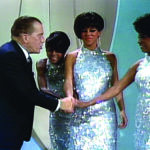
Screen Capture from The Ed Sullivan Show, c. 1966
(Ed Sullivan, The Supremes: Diana Ross, Florence Ballard, Mary Wilson) Courtesy The Ed Sullivan Show/SOFA Entertainment
While simultaneously entertaining Americans of all races, The Ed Sullivan Show (which ran from 1948 to 1971) did much to advance the cause of civil rights. If prime-time dramas and situation comedies of the civil rights era rarely featured African-American actors or subject matter, the program actively showcased black acts, making it a civil rights trailblazer. By depicting black and white performers interacting as equals, and by bringing these entertainers into the homes of millions of Americans, black and white, on a weekly basis, the program set an example of racial acceptance and integration, not just for the entertainment industry but for the nation at large. |
 |
Lunchbox and Thermos: Julia, 1969
Collection Civil Rights Archive, CADVC
Julia (NBC, 1968-1971) was one of the earliest weekly, nationally broadcast built around a contemporary black character. The series centered on the everyday life of Julia Baker, a recently widowed nurse—played by Diahann Carroll—and her young son. Many critics viewed the show as groundbreaking, because of its refusal to promote racial stereotypes: Julia was intelligent, self-sufficient, well dressed, and beautiful, a far cry from the black servants and buffoons of 1950s television. If Julia broke ground, though, it did so in ways that would not intimidate white viewers: the main character rarely interacted with black friends or associates; she readily excused white people’s bad behavior; and she never demonstrated racial awareness or pride. |
 |
Childs Family, Washington, D.C., 1958
Collection of Faith Childs, New York
The most powerful and sustained vehicle for black self-representation and celebration did not require the cooperation of the media. Far from the stage sets of Hollywood and the advertising agencies of Madison Avenue, a simple, ever-present device was stoking a quiet visual revolution: the snapshot camera. As the popularity of increasingly inexpensive and easily accessible cameras swept across the nation in the early twentieth century, the images created by these cameras did for African Americans what a century and half of mainstream representation often could not: made visible the complexity of a people too often ignored by or erased from mainstream culture. |
]]>
Essays by Maurice Berger, Research Professor and Chief Curator at UMBC’s Center for Art, Design and Visual Culture. Click on any photo to enlarge. Return to Staging the Struggle. Ernest C....
https://umbc.edu/stories/staging-the-struggle-photo-essay/
https://my3.my.umbc.edu/api/v0/pixel/news/123724/guest@my.umbc.edu/cf5936006aa49fd8546c36de4a95c2e0/api/pixel
discovery
fall-2012
UMBC News & Magazine
https://my3.my.umbc.edu/groups/umbc-news-magazine
https://assets1-my.umbc.edu/system/shared/avatars/groups/000/001/943/24435aa6207c452e7bc15cc74b42c7bb/xsmall.png?1748556657
https://assets1-my.umbc.edu/system/shared/avatars/groups/000/001/943/24435aa6207c452e7bc15cc74b42c7bb/original.png?1748556657
https://assets2-my.umbc.edu/system/shared/avatars/groups/000/001/943/24435aa6207c452e7bc15cc74b42c7bb/xxlarge.png?1748556657
https://assets2-my.umbc.edu/system/shared/avatars/groups/000/001/943/24435aa6207c452e7bc15cc74b42c7bb/xlarge.png?1748556657
https://assets3-my.umbc.edu/system/shared/avatars/groups/000/001/943/24435aa6207c452e7bc15cc74b42c7bb/large.png?1748556657
https://assets1-my.umbc.edu/system/shared/avatars/groups/000/001/943/24435aa6207c452e7bc15cc74b42c7bb/medium.png?1748556657
https://assets2-my.umbc.edu/system/shared/avatars/groups/000/001/943/24435aa6207c452e7bc15cc74b42c7bb/small.png?1748556657
https://assets1-my.umbc.edu/system/shared/avatars/groups/000/001/943/24435aa6207c452e7bc15cc74b42c7bb/xsmall.png?1748556657
https://assets2-my.umbc.edu/system/shared/avatars/groups/000/001/943/24435aa6207c452e7bc15cc74b42c7bb/xxsmall.png?1748556657
UMBC News & Magazine
0
0
false
Sat, 06 Oct 2012 21:26:37 -0400
Interrogating Images: Q&A with Maurice Berger
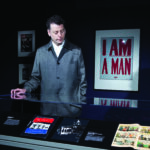
Whether he is enlightening readers on the nuances of photographs with his posts on “The Lens” blog at The New York Times, curating an exhibit such as For All the World to See, or testing the boundaries of memoir and cultural criticism (as he did with his book White Lies: Race and the Myths of Whiteness), you can count on Maurice Berger to be at the forefront of American culture’s engagement with its history and visual culture.
Berger is research professor and the chief curator at UMBC’s Center for Arts, Design and Visual Culture (CADVC). He is also a consulting curator at the Jewish Museum in New York City. He took a B.A. from Hunter College and his Ph.D. from the Graduate Center at the City University of New York. Berger’s range of activities is prolific – including cultural criticism in books and articles, curating exhibits and filmmaking. (His short film, Threshold, was screened in May at the Whitney Biennial.)
Berger’s interests range widely, and he has written about and organized exhibits taking in the grand sweep of 20th Century U.S. culture and its artistic movements. Yet it is his eagerness to tackle some of the thorniest issues in American race relations that has catapulted him to greatest prominence. Early in his career, Berger was a key voice in the debate over whether art museums were perpetuating racism (including a 1990 piece in Art in America – “Are Art Museums Racist?”). And his memoir, White Lies, dissected his own experience and attitudes about race while simultaneously conducting a rigorous yet empathetic analysis of the entire fraught concept of racial categories. (The New York Times called the book “startlingly original.”)
As Berger receives recognition and rewards for For All the World to See and his other work in cultural research (including an Emmy Award nomination for his work on a PBS Sunday Arts story about For All the World to See and the “Outstanding Exhibition in a University Art Museum 2010″ from the Association of Art Museum Curators), he is moving forward on new projects that include three future exhibits that will also appear at the CADVC in coming years: a 25th anniversary exhibit for the center and a new exhibit tracing the influence of modernism on the birth of American television.
Berger talked with UMBC Magazine recently about his career and those future exhibits. He is particularly excited about the opportunity to reach even wider audiences through his posts on “The Lens” blog.
“It’s an opportunity to explore the story of race in America through photographs,” Berger says. “The enormous audience that the Times affords will provides me with a broad, international platform to explore the fraught, but also vital, subject of race. The response to my first piece this July, on Gordon Parks’ civil rights photographs, was extraordinary. My plan is to write an essay every other month.”
– Richard Byrne ’86
UMBC Magazine: One thing that immediately stands out to me when looking at your career is that you have spent a great deal of time questioning how race works in our institutions and in our own individual lives – as you did so eloquently with your own life in White Lies.
Maurice Berger: My interest in questioning institutional attitudes about race goes back to my childhood, to growing up in an environment in which very few white people lived or worked. I saw how the system operated very early in life. I could walk around a department store and not be followed by security guards, for example, while my black friends would walk around the same stores and be followed. Even early on, I understood.
I also saw teachers who would treat black students quite differently from the way they treated me – since I for most of my early education I was one of the few white kids in the schools I attended. Even from that early vantage point, I could see things were not quite equal – and that institutions had certain kinds of collective attitudes.
I became a professor at Hunter College in the early 1980s. (First thing you know I was back as a professor at my undergraduate college.) And even there, I found it interesting that I had only one African-American colleague – and he was an artist, not an art historian. I had never heard a black artist discussed in any of my art history classes as an undergraduate or a graduate student, perhaps with the exception of a mention of Jacob Lawrence in passing.
Given that my field is 20th century American art and culture, that’s pretty amazing. And my teaching career began just about the time I began publishing in 1980. So at that point, I started to see that there was a problem. And I realized that I had to do something about it as an art historian and a cultural historian (as well as a responsible human being).
As you see with White Lies, I’ve always been thinking about these issues. But the reason that the memoir was published in 1999 and not in 1989 was that I wasn’t ready. One of the hardest things that I have accomplished as a writer was to write autobiographically. It brings up memories. It brings up things you’d rather not think about. It exposes you in a certain way. And then when you publish it, you rightfully (in an almost paranoid way) feel that what you’ve published isn’t a piece of writing, but you. If it is rejected, then you are rejected.
The good news is that White Lies was widely reviewed and almost every review was very positive and some were raves (it even was nominated for several awards). The book remains in print and it still has a relatively wide audience, especially among young people and in academia. So it turned out all right, but it was very scary at the time.
UMBC Magazine: When I went back and read the profile of you that The New York Times published shortly after White Lies came out, one of the things you noted was that readers’ responses to the book were very different and very personal. Telling your own story seemed to compel readers to share their journeys.
Berger: I think with race – and attitudes and behavior around race – if you want to change, it has to begin with personal honesty. I’ve always said that if people can’t see the problem and acknowledge the problem, then you can’t get past it.
Remember, so much of what I am writing about in White Lies is not just the domain of white supremacy in the South, it is also the domain of white liberals and leftists. Racism is not limited to conservatives or Southerners. We all need to collectively – and, even more important, intimately and privately, where there is less room to be rebuked or embarrassed – assess ourselves.
And that’s the point of White Lies. And it’s also part of the apparatus of For All the World to See. All the images and stories in the exhibit invite you to think about your own attitudes. Or, if you are older, to reflect on when you yourself first saw these images. How did they make you feel? Did they help change your attitudes? Did they awaken you to the reality of racism and segregation and the problems they presented for the country?
UMBC Magazine: Do you remember the moment when you had the vision for For All the World to See? Was there a particular image that set you in the direction you took in the exhibit?
Berger: It’s a funny thing to think about, because I can usually answer that question when someone asks it about a particular project. It’s not that I don’t remember with regard to For All the World to See, but the thing that’s different with this project – and possibly why it has been so well received and reached so many people (almost one million to date) – is that for the first time, in a dynamic and comprehensive way, I have been able to put together my two primary cultural research areas. The first is the history of American race relations – the issues of race and racism and the analysis of them.
The other interest I have been able to bring to bear on For All the World to See is how visual images manipulate, inspire, infiltrate and integrate ideas in American society and culture. As a cultural historian, my focus is on visual culture and how it operates in society.
So maybe that’s why I can’t remember a particular image. This project has been so natural. It’s the culmination of the two things I have been most driven to do and to explore, two things that have preoccupied me for most of my life.
UMBC Magazine: One of things in the exhibit that impressed me greatly was the way that the iconic journalistic images of the political and moral battles of the Civil Rights movement are juxtaposed and connected with lesser-known visual images created to build self-esteem in the African-American community and portray life in that community as very much like that in white America.
Berger: Until this project most exhibitions of Civil Rights history or Civil Rights culture focused on one particular thing: The way that photographers, and mostly well-known photographers or photojournalists (many of them white), documented the struggle for Civil Rights. And what that has meant is that these exhibitions are dominated by images of the events that we have come to associate with the Civil Rights movement: the protests, the marches, conflagrations, violence, poverty, and all the outward vestiges of racial segregation and prejudice. And that is what Civil Rights imagery has come to mean for most Americans.
For All the World to See argues that the Civil Rights movement is not just about who documented it, or the story of these protests and other events. It proposes that images of all kinds—from film and television to picture magazines and advertising (to quote the great, late photographer Gordon Parks) were employed by African Americans as a “weapon” against racism in America.
Thus, the story of the visual culture of the civil rights movement is far more complicated than we realize. For as [Supreme Court Justice] Thurgood Marshall said, the struggle for civil rights was not just about the protests or the legal cases, but also about African-American morale and legitimacy. How do you inspire a community that is continually beaten down by the realities of racism to rise up and keep the faith? How do you convince white people that the habitually negative and subservient images of black Americans in the culture at large were wrong and immoral? And, perhaps most important, how do you bolster the morale of African Americans scarred by racism and segregation? How to you reflect back to them images that showed the wholesome nature of black life, despite the onslaught of racism in myriad forms?
And, just as importantly, while much of white America did not perpetuate Jim Crow segregation, most white people remained uninformed about the African American community and the pervasive reality of racism, particularly their own. Once again, visual culture played an important role in educating white Americans about the reality of race and racism in America. Affirmative images of black people served as a very important aspect of the movement. These images not only bolstered the morale of African Americans in the face of withering prejudice, but also reminded white Americans that black people led the same kinds of lives and had the same kinds of family relationships as their white counterparts. Such imagery, in other words, powerfully appealed to the empathy of white readers and viewers.
UMBC Magazine: What’s next for you as a cultural historian and curator?
Berger: I am working on a number of projects simultaneously. Much of what I’ll continue to do revolves around the question of American race relations and the study of racism and segregation in America. I am working on another large Civil Rights exhibition and book, though it’s still a long way off, and it will be at CADVC in 2017: The Site of Memory: Reimagining the History of Civil Rights. Plus, I will be contributing regularly to the “Lens” blog at The New York Times, which I am very excited about. Writing for the Times gives me a broad, international platform through which I can share my ideas about race in America (and hopefully make a difference, even change minds and hearts).
I’ve also had a long term relationship with The Jewish Museum, where I have worked on a number of projects over the past twenty years. Last December, shortly after she came on board, newly hired Jewish Museum director Claudia Gould asked me to join the museum as consulting curator. She felt that my work and my point of view were a good fit. Over the past eight months, we’ve been working together with our colleagues to reshape the mandate of the museum and move forward in a bigger and more dynamic way.
I am also working on a collaborative project with The Jewish Museum and the CADVC, an exhibition and companion book (the latter to be published by Yale University Press): Revolution of the Eye: Modern Art and the Birth of American Television. It’s the first major research project in a long time that does not focus on the story of American race relations It tells the extraordinary story of the birth and rise of American television from the 1940s to the 1960s, and how its executives and writers and producers – most of whom were Jewish – embraced the modernist avant garde as a source of inspiration, aesthetics, and ideas. Television pioneers such as Rod Serling were actively looking at surrealism; Ernie Kovacs was embracing both Dadaist and surrealist sensibilities in his work. And CBS employed some of the top modern artists and designers of the period to help them develop what was at the time one of the most progressive design campaigns of any American company.
The exhibit also argues that television was born not just in the spirit of entertainment, some of it frivolous, but also with deeply held artistic and intellectual concepts and ambitions. This story is virtually unknown to most Americans (and even most art and cultural historians).
Yet, even an institution as famous as the Museum of Modern Art (MOMA) got into the act of producing, curating, and analyzing the medium. In the 1950s, the museum established the MOMA “Television Project,” dedicated to exploring the creative possibilities of television and producing content that sold the gospel of modern art and established the importance of modern artists. We will actually be working with MoMA to produce an array of public programs and TV screenings around the exhibition.
Ultimately, and despite the commercialism of it all, art has always been present on television. The point of “Revolution of the Eye” is that art is in the medium’s DNA.
I am also proud to say that I will also be curating CADVC’s 25th anniversary exhibition, which will open in 2014. So at UMBC alone, over the next five years, three of my projects will premiere.
– Return to Staging the Struggle
]]>
Whether he is enlightening readers on the nuances of photographs with his posts on “The Lens” blog at The New York Times, curating an exhibit such as For All the World to See, or testing the...
https://umbc.edu/stories/interrogating-images-qa-with-maurice-berger-2/
https://my3.my.umbc.edu/api/v0/pixel/news/123725/guest@my.umbc.edu/e296e6809465e02397d7ee273a61938d/api/pixel
fall-2012
perspectives
UMBC News & Magazine
https://my3.my.umbc.edu/groups/umbc-news-magazine
https://assets1-my.umbc.edu/system/shared/avatars/groups/000/001/943/24435aa6207c452e7bc15cc74b42c7bb/xsmall.png?1748556657
https://assets1-my.umbc.edu/system/shared/avatars/groups/000/001/943/24435aa6207c452e7bc15cc74b42c7bb/original.png?1748556657
https://assets2-my.umbc.edu/system/shared/avatars/groups/000/001/943/24435aa6207c452e7bc15cc74b42c7bb/xxlarge.png?1748556657
https://assets2-my.umbc.edu/system/shared/avatars/groups/000/001/943/24435aa6207c452e7bc15cc74b42c7bb/xlarge.png?1748556657
https://assets3-my.umbc.edu/system/shared/avatars/groups/000/001/943/24435aa6207c452e7bc15cc74b42c7bb/large.png?1748556657
https://assets1-my.umbc.edu/system/shared/avatars/groups/000/001/943/24435aa6207c452e7bc15cc74b42c7bb/medium.png?1748556657
https://assets2-my.umbc.edu/system/shared/avatars/groups/000/001/943/24435aa6207c452e7bc15cc74b42c7bb/small.png?1748556657
https://assets1-my.umbc.edu/system/shared/avatars/groups/000/001/943/24435aa6207c452e7bc15cc74b42c7bb/xsmall.png?1748556657
https://assets2-my.umbc.edu/system/shared/avatars/groups/000/001/943/24435aa6207c452e7bc15cc74b42c7bb/xxsmall.png?1748556657
UMBC News & Magazine
0
0
false
Sat, 06 Oct 2012 21:23:12 -0400
Interrogating Images: Q&A with Maurice Berger
Whether he is enlightening readers on the nuances of photographs with his posts on “The Lens” blog at The New York Times, curating an exhibit such as For All the World to See, or testing the boundaries of memoir and cultural criticism (as he did with his book White Lies: Race and the Myths of Whiteness), you can count on Maurice Berger to be at the forefront of American culture’s engagement with its history and visual culture.
Berger is research professor and the chief curator at UMBC’s Center for Arts, Design and Visual Culture (CADVC). He is also a consulting curator at the Jewish Museum in New York City. He took a B.A. from Hunter College and his Ph.D. from the Graduate Center at the City University of New York. Berger’s range of activities is prolific – including cultural criticism in books and articles, curating exhibits and filmmaking. (His short film, Threshold, was screened in May at the Whitney Biennial.)
Berger’s interests range widely, and he has written about and organized exhibits taking in the grand sweep of 20th Century U.S. culture and its artistic movements. Yet it is his eagerness to tackle some of the thorniest issues in American race relations that has catapulted him to greatest prominence. Early in his career, Berger was a key voice in the debate over whether art museums were perpetuating racism (including a 1990 piece in Art in America – “Are Art Museums Racist?”). And his memoir, White Lies, dissected his own experience and attitudes about race while simultaneously conducting a rigorous yet empathetic analysis of the entire fraught concept of racial categories. (The New York Times called the book “startlingly original.”)
As Berger receives recognition and rewards for For All the World to See and his other work in cultural research (including an Emmy Award nomination for his work on a PBS Sunday Arts story about For All the World to See and the “Outstanding Exhibition in a University Art Museum 2010″ from the Association of Art Museum Curators), he is moving forward on new projects that include three future exhibits that will also appear at the CADVC in coming years: a 25th anniversary exhibit for the center and a new exhibit tracing the influence of modernism on the birth of American television.
Berger talked with UMBC Magazine recently about his career and those future exhibits. He is particularly excited about the opportunity to reach even wider audiences through his posts on “The Lens” blog.
“It’s an opportunity to explore the story of race in America through photographs,” Berger says. “The enormous audience that the Times affords will provides me with a broad, international platform to explore the fraught, but also vital, subject of race. The response to my first piece this July, on Gordon Parks’ civil rights photographs, was extraordinary. My plan is to write an essay every other month.”
– Richard Byrne ’86
UMBC Magazine: One thing that immediately stands out to me when looking at your career is that you have spent a great deal of time questioning how race works in our institutions and in our own individual lives – as you did so eloquently with your own life in White Lies.
Maurice Berger: My interest in questioning institutional attitudes about race goes back to my childhood, to growing up in an environment in which very few white people lived or worked. I saw how the system operated very early in life. I could walk around a department store and not be followed by security guards, for example, while my black friends would walk around the same stores and be followed. Even early on, I understood.
I also saw teachers who would treat black students quite differently from the way they treated me – since I for most of my early education I was one of the few white kids in the schools I attended. Even from that early vantage point, I could see things were not quite equal – and that institutions had certain kinds of collective attitudes.
I became a professor at Hunter College in the early 1980s. (First thing you know I was back as a professor at my undergraduate college.) And even there, I found it interesting that I had only one African-American colleague – and he was an artist, not an art historian. I had never heard a black artist discussed in any of my art history classes as an undergraduate or a graduate student, perhaps with the exception of a mention of Jacob Lawrence in passing.
Given that my field is 20th century American art and culture, that’s pretty amazing. And my teaching career began just about the time I began publishing in 1980. So at that point, I started to see that there was a problem. And I realized that I had to do something about it as an art historian and a cultural historian (as well as a responsible human being).
As you see with White Lies, I’ve always been thinking about these issues. But the reason that the memoir was published in 1999 and not in 1989 was that I wasn’t ready. One of the hardest things that I have accomplished as a writer was to write autobiographically. It brings up memories. It brings up things you’d rather not think about. It exposes you in a certain way. And then when you publish it, you rightfully (in an almost paranoid way) feel that what you’ve published isn’t a piece of writing, but you. If it is rejected, then you are rejected.
The good news is that White Lies was widely reviewed and almost every review was very positive and some were raves (it even was nominated for several awards). The book remains in print and it still has a relatively wide audience, especially among young people and in academia. So it turned out all right, but it was very scary at the time.
UMBC Magazine: When I went back and read the profile of you that The New York Times published shortly after White Lies came out, one of the things you noted was that readers’ responses to the book were very different and very personal. Telling your own story seemed to compel readers to share their journeys.
Berger: I think with race – and attitudes and behavior around race – if you want to change, it has to begin with personal honesty. I’ve always said that if people can’t see the problem and acknowledge the problem, then you can’t get past it.
Remember, so much of what I am writing about in White Lies is not just the domain of white supremacy in the South, it is also the domain of white liberals and leftists. Racism is not limited to conservatives or Southerners. We all need to collectively – and, even more important, intimately and privately, where there is less room to be rebuked or embarrassed – assess ourselves.
And that’s the point of White Lies. And it’s also part of the apparatus of For All the World to See. All the images and stories in the exhibit invite you to think about your own attitudes. Or, if you are older, to reflect on when you yourself first saw these images. How did they make you feel? Did they help change your attitudes? Did they awaken you to the reality of racism and segregation and the problems they presented for the country?
UMBC Magazine: Do you remember the moment when you had the vision for For All the World to See? Was there a particular image that set you in the direction you took in the exhibit?
Berger: It’s a funny thing to think about, because I can usually answer that question when someone asks it about a particular project. It’s not that I don’t remember with regard to For All the World to See, but the thing that’s different with this project – and possibly why it has been so well received and reached so many people (almost one million to date) – is that for the first time, in a dynamic and comprehensive way, I have been able to put together my two primary cultural research areas. The first is the history of American race relations – the issues of race and racism and the analysis of them.
The other interest I have been able to bring to bear on For All the World to See is how visual images manipulate, inspire, infiltrate and integrate ideas in American society and culture. As a cultural historian, my focus is on visual culture and how it operates in society.
So maybe that’s why I can’t remember a particular image. This project has been so natural. It’s the culmination of the two things I have been most driven to do and to explore, two things that have preoccupied me for most of my life.
UMBC Magazine: One of things in the exhibit that impressed me greatly was the way that the iconic journalistic images of the political and moral battles of the Civil Rights movement are juxtaposed and connected with lesser-known visual images created to build self-esteem in the African-American community and portray life in that community as very much like that in white America.
Berger: Until this project most exhibitions of Civil Rights history or Civil Rights culture focused on one particular thing: The way that photographers, and mostly well-known photographers or photojournalists (many of them white), documented the struggle for Civil Rights. And what that has meant is that these exhibitions are dominated by images of the events that we have come to associate with the Civil Rights movement: the protests, the marches, conflagrations, violence, poverty, and all the outward vestiges of racial segregation and prejudice. And that is what Civil Rights imagery has come to mean for most Americans.
For All the World to See argues that the Civil Rights movement is not just about who documented it, or the story of these protests and other events. It proposes that images of all kinds—from film and television to picture magazines and advertising (to quote the great, late photographer Gordon Parks) were employed by African Americans as a “weapon” against racism in America.
Thus, the story of the visual culture of the civil rights movement is far more complicated than we realize. For as [Supreme Court Justice] Thurgood Marshall said, the struggle for civil rights was not just about the protests or the legal cases, but also about African-American morale and legitimacy. How do you inspire a community that is continually beaten down by the realities of racism to rise up and keep the faith? How do you convince white people that the habitually negative and subservient images of black Americans in the culture at large were wrong and immoral? And, perhaps most important, how do you bolster the morale of African Americans scarred by racism and segregation? How to you reflect back to them images that showed the wholesome nature of black life, despite the onslaught of racism in myriad forms?
And, just as importantly, while much of white America did not perpetuate Jim Crow segregation, most white people remained uninformed about the African American community and the pervasive reality of racism, particularly their own. Once again, visual culture played an important role in educating white Americans about the reality of race and racism in America. Affirmative images of black people served as a very important aspect of the movement. These images not only bolstered the morale of African Americans in the face of withering prejudice, but also reminded white Americans that black people led the same kinds of lives and had the same kinds of family relationships as their white counterparts. Such imagery, in other words, powerfully appealed to the empathy of white readers and viewers.
UMBC Magazine: What’s next for you as a cultural historian and curator?
Berger: I am working on a number of projects simultaneously. Much of what I’ll continue to do revolves around the question of American race relations and the study of racism and segregation in America. I am working on another large Civil Rights exhibition and book, though it’s still a long way off, and it will be at CADVC in 2017: The Site of Memory: Reimagining the History of Civil Rights. Plus, I will be contributing regularly to the “Lens” blog at The New York Times, which I am very excited about. Writing for the Times gives me a broad, international platform through which I can share my ideas about race in America (and hopefully make a difference, even change minds and hearts).
I’ve also had a long term relationship with The Jewish Museum, where I have worked on a number of projects over the past twenty years. Last December, shortly after she came on board, newly hired Jewish Museum director Claudia Gould asked me to join the museum as consulting curator. She felt that my work and my point of view were a good fit. Over the past eight months, we’ve been working together with our colleagues to reshape the mandate of the museum and move forward in a bigger and more dynamic way.
I am also working on a collaborative project with The Jewish Museum and the CADVC, an exhibition and companion book (the latter to be published by Yale University Press): Revolution of the Eye: Modern Art and the Birth of American Television. It’s the first major research project in a long time that does not focus on the story of American race relations It tells the extraordinary story of the birth and rise of American television from the 1940s to the 1960s, and how its executives and writers and producers – most of whom were Jewish – embraced the modernist avant garde as a source of inspiration, aesthetics, and ideas. Television pioneers such as Rod Serling were actively looking at surrealism; Ernie Kovacs was embracing both Dadaist and surrealist sensibilities in his work. And CBS employed some of the top modern artists and designers of the period to help them develop what was at the time one of the most progressive design campaigns of any American company.
The exhibit also argues that television was born not just in the spirit of entertainment, some of it frivolous, but also with deeply held artistic and intellectual concepts and ambitions. This story is virtually unknown to most Americans (and even most art and cultural historians).
Yet, even an institution as famous as the Museum of Modern Art (MOMA) got into the act of producing, curating, and analyzing the medium. In the 1950s, the museum established the MOMA “Television Project,” dedicated to exploring the creative possibilities of television and producing content that sold the gospel of modern art and established the importance of modern artists. We will actually be working with MoMA to produce an array of public programs and TV screenings around the exhibition.
Ultimately, and despite the commercialism of it all, art has always been present on television. The point of “Revolution of the Eye” is that art is in the medium’s DNA.
I am also proud to say that I will also be curating CADVC’s 25th anniversary exhibition, which will open in 2014. So at UMBC alone, over the next five years, three of my projects will premiere.
– Return to Staging the Struggle
]]>
Whether he is enlightening readers on the nuances of photographs with his posts on “The Lens” blog at The New York Times, curating an exhibit such as For All the World to See, or testing the...
https://umbc.edu/stories/interrogating-images-qa-with-maurice-berger/
https://my3.my.umbc.edu/api/v0/pixel/news/123726/guest@my.umbc.edu/ed8a5167c8be4d290da27a3320afbc32/api/pixel
fall-2012
perspectives
UMBC News & Magazine
https://my3.my.umbc.edu/groups/umbc-news-magazine
https://assets1-my.umbc.edu/system/shared/avatars/groups/000/001/943/24435aa6207c452e7bc15cc74b42c7bb/xsmall.png?1748556657
https://assets1-my.umbc.edu/system/shared/avatars/groups/000/001/943/24435aa6207c452e7bc15cc74b42c7bb/original.png?1748556657
https://assets2-my.umbc.edu/system/shared/avatars/groups/000/001/943/24435aa6207c452e7bc15cc74b42c7bb/xxlarge.png?1748556657
https://assets2-my.umbc.edu/system/shared/avatars/groups/000/001/943/24435aa6207c452e7bc15cc74b42c7bb/xlarge.png?1748556657
https://assets3-my.umbc.edu/system/shared/avatars/groups/000/001/943/24435aa6207c452e7bc15cc74b42c7bb/large.png?1748556657
https://assets1-my.umbc.edu/system/shared/avatars/groups/000/001/943/24435aa6207c452e7bc15cc74b42c7bb/medium.png?1748556657
https://assets2-my.umbc.edu/system/shared/avatars/groups/000/001/943/24435aa6207c452e7bc15cc74b42c7bb/small.png?1748556657
https://assets1-my.umbc.edu/system/shared/avatars/groups/000/001/943/24435aa6207c452e7bc15cc74b42c7bb/xsmall.png?1748556657
https://assets2-my.umbc.edu/system/shared/avatars/groups/000/001/943/24435aa6207c452e7bc15cc74b42c7bb/xxsmall.png?1748556657
UMBC News & Magazine
0
0
false
Sat, 06 Oct 2012 21:23:12 -0400
How to Win a Blind Taste Test (With Science!)

 With Josh Wilhide ’10 M.S., Mass Spectrometry Facility Manager
On a hot summer day, there’s nothing quite like the perky fizz of a just-opened soda to keep you cool and caffeinated. As consumers, many of us are incredibly loyal to a particular brand – even to the point of being sommelier-level tasters of sodas.
Many people can tell the difference between Coke and Pepsi blindfolded. But how does the hardworking human taste bud stand up to the massive data-collecting power of one of UMBC’s mass spectrometers?
Josh Wilhide ’10 M.S., chemistry, can quench our thirst for this particular knowledge quite handily. Using one of the mass spectrometers in UMBC’s Molecular Characterization & Analysis Complex (or MCAC), and a bit of basic scientific reasoning, the mysteries of cola will be revealed!
TOOLS OF THE TRADE
- An oh-so-discerning palate
- Cups and paper for secret voting (no cheating!)
- Sample colas: Pepsi, Coke and generic (Giant brand)
- A mass spectrometer, if you can get one. Oh wait, we have seven of them right here at UMBC.
]]>
With Josh Wilhide ’10 M.S., Mass Spectrometry Facility Manager On a hot summer day, there’s nothing quite like the perky fizz of a just-opened soda to keep you cool and caffeinated. As...
https://umbc.edu/stories/how-to-win-a-blind-taste-test-with-science/
https://my3.my.umbc.edu/api/v0/pixel/news/123727/guest@my.umbc.edu/ba34e8f3de3324579ec6624be0a6ced6/api/pixel
discovery
fall-2012
how-to
UMBC News & Magazine
https://my3.my.umbc.edu/groups/umbc-news-magazine
https://assets1-my.umbc.edu/system/shared/avatars/groups/000/001/943/24435aa6207c452e7bc15cc74b42c7bb/xsmall.png?1748556657
https://assets1-my.umbc.edu/system/shared/avatars/groups/000/001/943/24435aa6207c452e7bc15cc74b42c7bb/original.png?1748556657
https://assets2-my.umbc.edu/system/shared/avatars/groups/000/001/943/24435aa6207c452e7bc15cc74b42c7bb/xxlarge.png?1748556657
https://assets2-my.umbc.edu/system/shared/avatars/groups/000/001/943/24435aa6207c452e7bc15cc74b42c7bb/xlarge.png?1748556657
https://assets3-my.umbc.edu/system/shared/avatars/groups/000/001/943/24435aa6207c452e7bc15cc74b42c7bb/large.png?1748556657
https://assets1-my.umbc.edu/system/shared/avatars/groups/000/001/943/24435aa6207c452e7bc15cc74b42c7bb/medium.png?1748556657
https://assets2-my.umbc.edu/system/shared/avatars/groups/000/001/943/24435aa6207c452e7bc15cc74b42c7bb/small.png?1748556657
https://assets1-my.umbc.edu/system/shared/avatars/groups/000/001/943/24435aa6207c452e7bc15cc74b42c7bb/xsmall.png?1748556657
https://assets2-my.umbc.edu/system/shared/avatars/groups/000/001/943/24435aa6207c452e7bc15cc74b42c7bb/xxsmall.png?1748556657
UMBC News & Magazine
0
0
false
Sat, 06 Oct 2012 21:20:36 -0400
Sat, 06 Oct 2012 21:20:36 -0400
Discovery – Fall 2012
EXPLORING THE BORDER
When human beings have to be at a certain place at a certain time, they have lots of handy aids to do so: alarm clocks and watches, maps and GPS systems.
Michelle Starz-Gaiano, an assistant professor of biology at UMBC, is fascinated by the question of how cells do the same thing.
“Cells leave on time and get to a destination on time during development,” she says. “They get to the right places almost all the time and they don’t get lost.”
What guides cells? One aspect of this question that researchers in Starz-Gaiano’s lab want to understand is how cells decide which particular ones in an organism will move and which will stay.
For instance, many cells must divide as a person develops from an egg to an embryo, to a human being. And as they divide, those cells must also reorganize themselves – and many of those cells migrate to different locations within an organism to fulfill their missions.
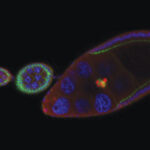
Starz-Gaiano and her colleagues are studying cell migration in fruit flies, concentrating specifically on a population of cells called “border cells.”
“Genes and proteins are similar between humans and flies,” Starz-Gaiano observes. “So if we can understand how they work in a simple system like flies, it really predicts how they’re going to act in humans.”
The relative simplicity of fruit flies also helps aid researchers. “In flies you can see how molecular changes translate to the whole organism,” she says.
How do Starz-Gaiano and her colleagues unlock the secrets of cell migration in flies? Biologists call it “loss of function” – but what it comes down to is simple subtraction and observation.
“We take away one gene at a time and see if the cells migrate or not,” she relates. “Then we can infer that those genes are required for cell migration.”
Studying cell migration is not just about exploring genetics. The observation of the border cells requires a great deal of live imaging with a microscope – which offers an enhanced look inside the process that is not available with a simpler two-dimensional observation.
“One surprise that came out of the live imaging is that [the migrating border cells] rotate,” says Starz-Gaiano. “People have done a tremendous amount of work looking at cell migration in tissue culture dishes where the cells are moving across two dimensions.” Live imaging offers the “huge advantage to look at the whole tissue at once.”
Interdisciplinary collaborations with the mathematics and chemistry departments, funded with help from the National Science Foundation (NSF) and the National Institutes of Health (NIH), have been a key to advancing the work being done in Starz-Gaiano’s research lab. (She is also the recipient of an NSF Early Career Award.)
The NSF’s Undergraduate Biology Mathematics Program has allowed Starz-Gaiano to team up with assistant professor of mathematics Bradford Peercy. “We’re doing some mathematical modeling to answer some of the harder questions about how the cells are moving and which cells are specified to move,” she observes.
Another grant from the NIH’s Chemistry Biology Interface Program (aimed to encourage interdisciplinary work by graduate students) is facilitating collaboration between Starz-Gaiano and UMBC professor of chemistry Katherine Seley-Radtke to explore applications that the cell migration research might have on drug design. Because cell movement is controlled in part by a cascade of molecules, this partnership is allowing researchers to work toward assembling drugs, molecule by molecule, that may inhibit some of the biological processes that promote cell migration.
— Nicole Ruediger
WIRELESS IS MORE

Most professors urge students to write concisely. But the students in Denise Meringolo’s public history class recently faced an extreme challenge to be succinct: Turn in a final project just 150 words long.
The work submitted by Meringolo’s students helped create a new smartphone app for Baltimore Heritage, a nonprofit preservation organization. The app leads users on a walking tour of Baltimore – and the 150 words is about as much text as can be read easily on an iPhone screen.
As an assistant professor of history and the coordinator of the public history track in the historical studies M.A. program, Meringolo often uses her Introduction to Public History class to collaborate with external partners on ways to enhance public understanding of history. Yet some of these classroom collaborations were never implemented by partner organizations, an outcome that was frustrating to a professor who likes to call her class: “Committing History in Public.”
Meringolo’s luck changed when she met Eli Pousson through UMBC’s Orser Center for Place, Community and Culture – where they are both board members. Pousson is the field officer for Baltimore Heritage, which needed content for their new “Explore Baltimore Heritage” app.
“It seemed like a very natural partnership,” says Pousson.
The collaboration on the app allowed UMBC students like Shae Adams ’13, M.A., historical studies, to wrestle with the issues faced each day by public historians. “I’ve had years of practice writing traditional research papers,” says Adams. “But to tease out a single story from that research and tell it in about 150 words? Much more challenging. Throughout the semester, I found myself loving the inherent challenge of interpretative public history.”
Meringolo’s partnership with Baltimore Heritage will continue this fall, when the graduate students in a class she’s called “West Side Stories” will create digital narratives – including oral histories – for the organization’s app.
Ironically, Meringolo doesn’t even own a smartphone yet. But she teaches her students that the principles of good storytelling stay the same no matter how the tale is conveyed.
“The mode of delivery is changing, not the impulse behind it,” says Meringolo, who has just published a new study of her discipline’s trends from the nineteenth century until today titled Museums, Monuments and National Parks: Toward a New Genealogy of Public History (University of Massachusetts Press).
It’s no surprise that Meringolo sees her own work as part of that continuum, and she values the fact that UMBC is also becoming ever more engaged in the work of public history. “Public history is an intellectual discipline in the service of the community, and public universities are supposed to be in service to the world around them,” she says. “The more we can recognize that humanities scholarship is also a problem-solving toolbox, the more we can be relevant to the world around us.”
Meringolo has her sights set on 2016, when the National Council on Public History will hold its annual conference in Baltimore. UMBC’s partnership with Baltimore Heritage is one concrete example of what’s in the problem-solving toolbox of the humanities at the university. But the professor who likes “committing history in public” also hopes that it’s another step toward making UMBC a model of community collaboration by the time public historians arrive in Baltimore.
— Chelsea Haddaway
]]>
EXPLORING THE BORDER When human beings have to be at a certain place at a certain time, they have lots of handy aids to do so: alarm clocks and watches, maps and GPS systems. Michelle...
https://umbc.edu/stories/discovery-fall-2012/
https://my3.my.umbc.edu/api/v0/pixel/news/123728/guest@my.umbc.edu/1e7799715f9cd358a71f3d4f5e7e4f50/api/pixel
discovery
fall-2012
UMBC News & Magazine
https://my3.my.umbc.edu/groups/umbc-news-magazine
https://assets1-my.umbc.edu/system/shared/avatars/groups/000/001/943/24435aa6207c452e7bc15cc74b42c7bb/xsmall.png?1748556657
https://assets1-my.umbc.edu/system/shared/avatars/groups/000/001/943/24435aa6207c452e7bc15cc74b42c7bb/original.png?1748556657
https://assets2-my.umbc.edu/system/shared/avatars/groups/000/001/943/24435aa6207c452e7bc15cc74b42c7bb/xxlarge.png?1748556657
https://assets2-my.umbc.edu/system/shared/avatars/groups/000/001/943/24435aa6207c452e7bc15cc74b42c7bb/xlarge.png?1748556657
https://assets3-my.umbc.edu/system/shared/avatars/groups/000/001/943/24435aa6207c452e7bc15cc74b42c7bb/large.png?1748556657
https://assets1-my.umbc.edu/system/shared/avatars/groups/000/001/943/24435aa6207c452e7bc15cc74b42c7bb/medium.png?1748556657
https://assets2-my.umbc.edu/system/shared/avatars/groups/000/001/943/24435aa6207c452e7bc15cc74b42c7bb/small.png?1748556657
https://assets1-my.umbc.edu/system/shared/avatars/groups/000/001/943/24435aa6207c452e7bc15cc74b42c7bb/xsmall.png?1748556657
https://assets2-my.umbc.edu/system/shared/avatars/groups/000/001/943/24435aa6207c452e7bc15cc74b42c7bb/xxsmall.png?1748556657
UMBC News & Magazine
0
0
false
Sat, 06 Oct 2012 21:17:34 -0400
Conserve and Protect – Lekelia “Kiki” Jenkins '97, BioSci
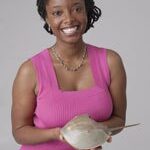
As a child, Lekelia “Kiki” Jenkins ’97, biological sciences, could often be found on a fishing pier on the Chesapeake Bay, dangling a line for fish or chicken-necking for blue crabs with her family.
Today, you’re more apt to find her on a commercial fishing boat in Ecuador as she researches how fishermen can keep from catching protected species such as sea turtles.
It’s a race against time as Jenkins works with fishermen and government regulators to adopt new technologies out on the water. It can take 15 years or longer to come up with a new device to keep sea turtles from being snared by hooks or to prevent dolphins from getting tangled in nets.
“When you’re looking at some of the forecasts of when animals are going to go extinct – like leatherback turtles, which could be a decade before they’re extinct in the Pacific Ocean – then 15 years is too long of a time frame,” said Jenkins, who is now an assistant professor at the University of Washington in Seattle.
Jenkins focuses not only on the mechanics of the devices she’s helping to streamline – called bycatch reduction devices – but also the factors that lead commercial fishermen to adopt them or reject them. In particular, she’s been evaluating barriers that might prevent fishermen in other countries from using the devices that American regulators are pushing.
She blends a touch of the social sciences into biology, understanding not just how the animals behave with the devices, but how the people who use them behave, too.
“It’s really about the people, and the people are having an impact on the environment,” Jenkins said. “What’s going to effect change really starts with humans and why they do what they do, and where there are opportunities to improve that.”
Jenkins also studies how commercial fishermen might switch their fishing gear to different types that are less lethal to protected species – from nets, say, to baited fishing lines. She is also working on recounting historic fishing harvests to better understand how humans have influenced marine life.
Jenkins’ research often takes her out on the water, working alongside commercial fishermen.
“Fishermen are wonderful. They like me, so I’m lucky,” Jenkins says with a laugh. “They are really sweet, very open. They take their time to share.”
Jenkins’ career path was shaped by her mentors at UMBC. A former junior zookeeper at what is now the Maryland Zoo in Baltimore, Jenkins initially considered studying veterinary medicine and endocrinology, so she could work in captive breeding.
But it was in the late UMBC professor of biological sciences Carl Weber’s ecology class that she found her calling.
“I was reading through the textbook, a chapter we weren’t assigned on conservation ecology, and I thought, ‘This is it! This is what I want to do,’” Jenkins recalls.
In addition to Weber, Jenkins credits other UMBC faculty, including associate professor of geography and environmental systems Sandy Parker, senior lecturer in chemistry Mark Perks, and former associate vice provost Teresa Viancour (who let Jenkins into the lab at night to observe electric fish) with helping her understand where her biology training at UMBC could take her.
Jenkins also found a “wonderful oasis” in UMBC’s dance department, where she earned a minor and found a creative outlet in an interest she continues today. In fact, after Jenkins earned her Ph.D. in marine conservation at Duke University in 2006, she choreographed a dance about her dissertation on sea turtles. It won second place in a dance competition sponsored by the American Association for the Advancement of Science.
Jenkins says the arts and science can mesh better than many might think. In fact, art can be used to communicate science to non-scientists.
“What I tell people all the time is that, especially when it comes to the environment, people’s interest in environmental issues are triggered by all sorts of things,” she said. That could be experiences in nature, photography, poetry or literature. It makes sense, she said, to communicate science through those same channels.
“If we as scientists want to deliver information back to stakeholders and people who care about the environment, doing scientific papers is insufficient,” she said.
Jenkins practices what she preaches, writing general-interest articles alongside each of her academic papers. In 2011, for example, she blogged about a research trip to Ecuador for the New York Times.
Jenkins hopes her work – whether with regulators, fishermen or regular folks – can help save vulnerable species.
“I want to make a difference. I want to have a lasting conservation impact,” Jenkins said. “When I did my dissertation, I said to my advisor: ‘I want to do work that someone’s going to use. It’s not going to sit on a shelf.’”
— Pamela Wood
]]>
As a child, Lekelia “Kiki” Jenkins ’97, biological sciences, could often be found on a fishing pier on the Chesapeake Bay, dangling a line for fish or chicken-necking for blue crabs with her...
https://umbc.edu/stories/conserve-and-protect-lekelia-kiki-jenkins-97-biosci-2/
https://my3.my.umbc.edu/api/v0/pixel/news/123729/guest@my.umbc.edu/4439599b4d6e4cde464e7128a970073c/api/pixel
alumni
fall-2012
UMBC News & Magazine
https://my3.my.umbc.edu/groups/umbc-news-magazine
https://assets1-my.umbc.edu/system/shared/avatars/groups/000/001/943/24435aa6207c452e7bc15cc74b42c7bb/xsmall.png?1748556657
https://assets1-my.umbc.edu/system/shared/avatars/groups/000/001/943/24435aa6207c452e7bc15cc74b42c7bb/original.png?1748556657
https://assets2-my.umbc.edu/system/shared/avatars/groups/000/001/943/24435aa6207c452e7bc15cc74b42c7bb/xxlarge.png?1748556657
https://assets2-my.umbc.edu/system/shared/avatars/groups/000/001/943/24435aa6207c452e7bc15cc74b42c7bb/xlarge.png?1748556657
https://assets3-my.umbc.edu/system/shared/avatars/groups/000/001/943/24435aa6207c452e7bc15cc74b42c7bb/large.png?1748556657
https://assets1-my.umbc.edu/system/shared/avatars/groups/000/001/943/24435aa6207c452e7bc15cc74b42c7bb/medium.png?1748556657
https://assets2-my.umbc.edu/system/shared/avatars/groups/000/001/943/24435aa6207c452e7bc15cc74b42c7bb/small.png?1748556657
https://assets1-my.umbc.edu/system/shared/avatars/groups/000/001/943/24435aa6207c452e7bc15cc74b42c7bb/xsmall.png?1748556657
https://assets2-my.umbc.edu/system/shared/avatars/groups/000/001/943/24435aa6207c452e7bc15cc74b42c7bb/xxsmall.png?1748556657
UMBC News & Magazine
0
0
false
Sat, 06 Oct 2012 21:16:15 -0400
Conserve and Protect – Lekelia “Kiki” Jenkins ’97, BioSci
As a child, Lekelia “Kiki” Jenkins ’97, biological sciences, could often be found on a fishing pier on the Chesapeake Bay, dangling a line for fish or chicken-necking for blue crabs with her family.
Today, you’re more apt to find her on a commercial fishing boat in Ecuador as she researches how fishermen can keep from catching protected species such as sea turtles.
It’s a race against time as Jenkins works with fishermen and government regulators to adopt new technologies out on the water. It can take 15 years or longer to come up with a new device to keep sea turtles from being snared by hooks or to prevent dolphins from getting tangled in nets.
“When you’re looking at some of the forecasts of when animals are going to go extinct – like leatherback turtles, which could be a decade before they’re extinct in the Pacific Ocean – then 15 years is too long of a time frame,” said Jenkins, who is now an assistant professor at the University of Washington in Seattle.
Jenkins focuses not only on the mechanics of the devices she’s helping to streamline – called bycatch reduction devices – but also the factors that lead commercial fishermen to adopt them or reject them. In particular, she’s been evaluating barriers that might prevent fishermen in other countries from using the devices that American regulators are pushing.
She blends a touch of the social sciences into biology, understanding not just how the animals behave with the devices, but how the people who use them behave, too.
“It’s really about the people, and the people are having an impact on the environment,” Jenkins said. “What’s going to effect change really starts with humans and why they do what they do, and where there are opportunities to improve that.”
Jenkins also studies how commercial fishermen might switch their fishing gear to different types that are less lethal to protected species – from nets, say, to baited fishing lines. She is also working on recounting historic fishing harvests to better understand how humans have influenced marine life.
Jenkins’ research often takes her out on the water, working alongside commercial fishermen.
“Fishermen are wonderful. They like me, so I’m lucky,” Jenkins says with a laugh. “They are really sweet, very open. They take their time to share.”
Jenkins’ career path was shaped by her mentors at UMBC. A former junior zookeeper at what is now the Maryland Zoo in Baltimore, Jenkins initially considered studying veterinary medicine and endocrinology, so she could work in captive breeding.
But it was in the late UMBC professor of biological sciences Carl Weber’s ecology class that she found her calling.
“I was reading through the textbook, a chapter we weren’t assigned on conservation ecology, and I thought, ‘This is it! This is what I want to do,’” Jenkins recalls.
In addition to Weber, Jenkins credits other UMBC faculty, including associate professor of geography and environmental systems Sandy Parker, senior lecturer in chemistry Mark Perks, and former associate vice provost Teresa Viancour (who let Jenkins into the lab at night to observe electric fish) with helping her understand where her biology training at UMBC could take her.
Jenkins also found a “wonderful oasis” in UMBC’s dance department, where she earned a minor and found a creative outlet in an interest she continues today. In fact, after Jenkins earned her Ph.D. in marine conservation at Duke University in 2006, she choreographed a dance about her dissertation on sea turtles. It won second place in a dance competition sponsored by the American Association for the Advancement of Science.
Jenkins says the arts and science can mesh better than many might think. In fact, art can be used to communicate science to non-scientists.
“What I tell people all the time is that, especially when it comes to the environment, people’s interest in environmental issues are triggered by all sorts of things,” she said. That could be experiences in nature, photography, poetry or literature. It makes sense, she said, to communicate science through those same channels.
“If we as scientists want to deliver information back to stakeholders and people who care about the environment, doing scientific papers is insufficient,” she said.
Jenkins practices what she preaches, writing general-interest articles alongside each of her academic papers. In 2011, for example, she blogged about a research trip to Ecuador for the New York Times.
Jenkins hopes her work – whether with regulators, fishermen or regular folks – can help save vulnerable species.
“I want to make a difference. I want to have a lasting conservation impact,” Jenkins said. “When I did my dissertation, I said to my advisor: ‘I want to do work that someone’s going to use. It’s not going to sit on a shelf.’”
— Pamela Wood
]]>
As a child, Lekelia “Kiki” Jenkins ’97, biological sciences, could often be found on a fishing pier on the Chesapeake Bay, dangling a line for fish or chicken-necking for blue crabs with her...
https://umbc.edu/stories/conserve-and-protect-lekelia-kiki-jenkins-97-biosci/
https://my3.my.umbc.edu/api/v0/pixel/news/123730/guest@my.umbc.edu/cc0c993dad75aee302576feb80de62dd/api/pixel
alumni
fall-2012
UMBC News & Magazine
https://my3.my.umbc.edu/groups/umbc-news-magazine
https://assets1-my.umbc.edu/system/shared/avatars/groups/000/001/943/24435aa6207c452e7bc15cc74b42c7bb/xsmall.png?1748556657
https://assets1-my.umbc.edu/system/shared/avatars/groups/000/001/943/24435aa6207c452e7bc15cc74b42c7bb/original.png?1748556657
https://assets2-my.umbc.edu/system/shared/avatars/groups/000/001/943/24435aa6207c452e7bc15cc74b42c7bb/xxlarge.png?1748556657
https://assets2-my.umbc.edu/system/shared/avatars/groups/000/001/943/24435aa6207c452e7bc15cc74b42c7bb/xlarge.png?1748556657
https://assets3-my.umbc.edu/system/shared/avatars/groups/000/001/943/24435aa6207c452e7bc15cc74b42c7bb/large.png?1748556657
https://assets1-my.umbc.edu/system/shared/avatars/groups/000/001/943/24435aa6207c452e7bc15cc74b42c7bb/medium.png?1748556657
https://assets2-my.umbc.edu/system/shared/avatars/groups/000/001/943/24435aa6207c452e7bc15cc74b42c7bb/small.png?1748556657
https://assets1-my.umbc.edu/system/shared/avatars/groups/000/001/943/24435aa6207c452e7bc15cc74b42c7bb/xsmall.png?1748556657
https://assets2-my.umbc.edu/system/shared/avatars/groups/000/001/943/24435aa6207c452e7bc15cc74b42c7bb/xxsmall.png?1748556657
UMBC News & Magazine
0
0
false
Sat, 06 Oct 2012 21:16:15 -0400
At Play – Fall 2012

PUZZLE POWER
Marie desJardins, a professor of computer science at UMBC, specializes in research on artificial intelligence. But at the 2012 American Crossword Puzzle Tournament in March, her research became downright competitive when desJardins crossed pencils with a crossword-solving computer program.
The progam, dubbed “Dr. Fill,” was going up against one of the best crossword puzzle solvers in the country. DesJardins is the top-ranked female solver in the Mid-Atlantic region and she is the 44th best solver in the country. (Dr. Fill finished the same tournament in 141st place.)
“I didn’t realize I could be this good at crossword puzzles,” says desJardins. She adds that her development as a crossword competitor also highlights the hurdles to bringing more women into the sciences.
“A lot of girls think that they must not be intrinsically good at ‘that stuff,’” argues desJardins, who adds that the biggest impediments are “the psychological blocks we put up for ourselves.”
DesJardins has been closely involved in programs at UMBC to remove those blocks, including the Center for Women and Information Technology (CWIT). She also works with the Multi-Agent Planning and Learning Lab (MAPLE), which she founded in 2003 to facilitate student research in artificial intelligence.
DesJardins has her eye on next year’s tournament – if she can reconcile it with an academic conference scheduled for the same weekend. “I might go to that conference,” she says. “But I’ll have to leave early to go to the tournament.”
— Andrew Holter ’12
NOT CAMERA SHY

Even on a campus as welcoming as UMBC, some incoming freshmen and transfer students find that orientation makes them nervous. There’s the stress of course selection and presentations on campus life, but also the question that comes with joining any new community: Will I make new friends?
This year’s contingent of UMBC Orientation Peer Advisors (OPA) decided to break the ice with a bit of video comedy, powered with the Mika song “Love Today” as a soundtrack. This year’s advisors are caught in a range of fun and goofy activities: playing video games, dancing, tossing a football, chasing ducks, bumping into things, and that perennial undergraduate favorite: sleeping.
Christina Animashaun ’13, who studies media communications and photography, teamed up with Jason Palumbo ’13, a graphic design major, to make the video in a single day. Palumbo was behind the camera, and Animashaun coordinated the sequences. Spontaneity was a key to the feel of the video: “It was very much talking out the storyboards,” says Animashaun, “as opposed to having it all set and ready to go.”
An introductory video made by the Orientation Peer Advisors has become a staple through the years, but the 2012 video duo wanted to get this year’s orientation started with a jolt of humor and movement.
“On the morning [of orientation], people are rolling up at 8 or 8:30 a.m,” says Animashaun. “They’re hyped up on coffee, and then you [show the video]. It’s like, ‘Hey, we’re real people. We’re real students…” Palumbo finishes the thought: “…and we also like to dance.”
Watch the video here.
— Nathan Glover ’12
SPURS OF THE MOMENT

North London’s Tottenham Hotspur Football Club (often called “Spurs” for short) is one of the world’s great soccer teams, having recently played in the UEFA Champions League and finishing fourth in the English Premier League last season. Clad in iconic white and dark blue uniforms adorned with a cockerel, Spurs are known for playing an attractive, free-flowing and attacking football.
For one sweltering day in late July, however, Spurs found a home on UMBC’s campus, which they used as a training facility before a July 28 friendly match at Baltimore’s M&T Stadium against Liverpool Football Club –another one of England’s biggest and most iconic teams.
Tottenham stars including Gareth Bale, Aaron Lennon, and longtime U.S. men’s national team goalkeeper Brad Friedel got in a morning training session on UMBC’s soccer field under the watchful eye of new Spurs coach Andres Villas Boas. Spurs players then adjourned for lunch at the True Grits dining hall.
Later that day, young Maryland soccer players sampled how Tottenham coaches players in its own football academy at an afternoon clinic led by Spurs’ head of football development Mark Jones.
“We plan for everyone to get 2,000 or so touches of the ball this afternoon,” Jones told the players and their parents before putting them through an afternoon of coaching and drills.
It is the second time in four years that world soccer powers have used UMBC’s state-of-the-art facilities on visits to the region. In 2009, English and Italian soccer powers Chelsea and AC Milan trained at UMBC before a friendly match.
— Richard Byrne ’86
THE RINGS THING

Every four years, the Olympic Games give athletes a chance to chase their dreams and compete at the highest level.
For UMBC swimmers Mohamed Hussein ’13 (Egypt), Patrick Husson ’14 (USA) and Pierre De Waal ’13 (South Africa), those dreams almost became reality. Husson and De Waal competed in the Olympic Trials of their respective home countries but fell short of earning a trip to London.
Hussein did his teammates one better – qualifying for Egypt’s team in the 100-meter freestyle and the 200-meter individual medley. But his trip to London was cut short by FINA, the international governing body of swimming, which abruptly changed the qualifying times required to make the Olympics. Hussein’s times fell just short.
“[In] all the past Olympic games, FINA allowed more than 1,200 swimmers to participate in the competition,” Hussein observes.
Despite the disappointment, Hussein remains one of the best swimmers in his native Egypt as well as at UMBC, and calls 2012 “the best year in my swimming career.”
De Waal had to return to South Africa to compete in the Olympic Trials during the spring semester. After a day and a half of travel from Baltimore to Durban, De Waal took to the pool for his best event, the 200-meter butterfly, where he fell to fellow countryman Chad le Clos, who went on to win gold in the Olympics over U.S. Olympic swimming star Michael Phelps.
Former walk-on Patrick Husson also swam in the Olympic Trials in his best event, the 200-meter breaststroke, finishing 99th out of 132 competitors.
“The three of them have all raised the level of our competition and our team,” UMBC swim coach Chad Cradock ’97 says.
— Dan Levin ’13
]]>
PUZZLE POWER Marie desJardins, a professor of computer science at UMBC, specializes in research on artificial intelligence. But at the 2012 American Crossword Puzzle Tournament in March, her...
https://umbc.edu/stories/at-play-fall-2012/
https://my3.my.umbc.edu/api/v0/pixel/news/123731/guest@my.umbc.edu/ccbf2223861605ba4fae3cadcccad43c/api/pixel
campus-life
fall-2012
UMBC News & Magazine
https://my3.my.umbc.edu/groups/umbc-news-magazine
https://assets1-my.umbc.edu/system/shared/avatars/groups/000/001/943/24435aa6207c452e7bc15cc74b42c7bb/xsmall.png?1748556657
https://assets1-my.umbc.edu/system/shared/avatars/groups/000/001/943/24435aa6207c452e7bc15cc74b42c7bb/original.png?1748556657
https://assets2-my.umbc.edu/system/shared/avatars/groups/000/001/943/24435aa6207c452e7bc15cc74b42c7bb/xxlarge.png?1748556657
https://assets2-my.umbc.edu/system/shared/avatars/groups/000/001/943/24435aa6207c452e7bc15cc74b42c7bb/xlarge.png?1748556657
https://assets3-my.umbc.edu/system/shared/avatars/groups/000/001/943/24435aa6207c452e7bc15cc74b42c7bb/large.png?1748556657
https://assets1-my.umbc.edu/system/shared/avatars/groups/000/001/943/24435aa6207c452e7bc15cc74b42c7bb/medium.png?1748556657
https://assets2-my.umbc.edu/system/shared/avatars/groups/000/001/943/24435aa6207c452e7bc15cc74b42c7bb/small.png?1748556657
https://assets1-my.umbc.edu/system/shared/avatars/groups/000/001/943/24435aa6207c452e7bc15cc74b42c7bb/xsmall.png?1748556657
https://assets2-my.umbc.edu/system/shared/avatars/groups/000/001/943/24435aa6207c452e7bc15cc74b42c7bb/xxsmall.png?1748556657
UMBC News & Magazine
0
0
false
Sat, 06 Oct 2012 21:14:11 -0400
Up on the Roof – Fall 2012
UMBC President Freeman A. Hrabowski, III, takes your questions. Q. When you speak about UMBC’s achievements, you always stress the …
]]>
UMBC President Freeman A. Hrabowski, III, takes your questions. Q. When you speak about UMBC’s achievements, you always stress the …
https://magazine.umbc.edu/up-on-the-roof-fall-2012/
https://my3.my.umbc.edu/api/v0/pixel/news/107129/guest@my.umbc.edu/1e1ecaccb9f0188123e0c5285063d0ab/api/pixel
fall-2012
perspectives
UMBC Magazine
https://my3.my.umbc.edu/groups/retired-1945
https://assets3-my.umbc.edu/images/avatars/group/8/xsmall.png?1785165141
https://assets3-my.umbc.edu/images/avatars/group/8/original.png?1785165141
https://assets1-my.umbc.edu/images/avatars/group/8/xxlarge.png?1785165141
https://assets1-my.umbc.edu/images/avatars/group/8/xlarge.png?1785165141
https://assets2-my.umbc.edu/images/avatars/group/8/large.png?1785165141
https://assets4-my.umbc.edu/images/avatars/group/8/medium.png?1785165141
https://assets4-my.umbc.edu/images/avatars/group/8/small.png?1785165141
https://assets3-my.umbc.edu/images/avatars/group/8/xsmall.png?1785165141
https://assets3-my.umbc.edu/images/avatars/group/8/xxsmall.png?1785165141
UMBC Magazine
0
0
false
Sat, 06 Oct 2012 17:42:35 -0400