<?xml version="1.0"?>
<News hasArchived="true" page="976" pageCount="10747" pageSize="10" timestamp="Wed, 12 Aug 2026 14:02:07 -0400" url="https://my3.my.umbc.edu/posts.xml?mode=recent&amp;page=976">
<NewsItem contentIssues="false" id="147107" important="true" status="posted" url="https://my3.my.umbc.edu/posts/147107">
<Title>Celebrating Black History Month Intersectionally</Title>
<Tagline>Black and DisAbility history are intertwined: learn more...</Tagline>
<Body>
<![CDATA[
    <div class="html-content">
    <p>Accessibility and Disability Services and Student Disability Services joins <a href="https://my3.my.umbc.edu/groups/themosaic/posts/146984" rel="nofollow external" class="bo">The Mosaic Center</a>and all UMBC partners with honoring Black History Month.</p>
    <p>Rediscover how some members of the Black Civil Rights Movement also played essential roles as activists in the US Disability Rights Movement, and paved the way for disability rights activists to influence social change and legislation. Many people with disabilities were part of both movements and continue to be today.</p>
    <p><a href="https://www.youtube.com/watch?v=Hw1ATXKfr9g" rel="nofollow external" class="bo">Dr. Sami Schalk presented at UMBC in March of 2023 on<strong><em> 504 and Beyond: Disability Politics and the Black Panther Party</em></strong></a>via the <a href="https://my3.my.umbc.edu/groups/dreshercenter" rel="nofollow external" class="bo">Dresher Center</a> - in co-sponsorship with ADS and I3B.</p>
    <p><a href="https://wid.org/why-black-disabled-history-matters/" rel="nofollow external" class="bo">Why Black Disabled History Matters by Dikko Yusef of WID </a>provides a great summary.</p>
    <p>Some of the intersectionality within the documentary  <a href="https://www.netflix.com/title/81001496" rel="nofollow external" class="bo">Crip Camp</a> shows how intersectional being black and disabled can be - beyond the Black Panthers. Further back in history, learn new things about the famous Black figures who also had disabilities. For instance, Harriet Tubman lived with epilepsy and narcolepsy, a reminder that disability is both directly and indirectly linked to many forms of violence.</p>
    <p>In the links described below, you may rediscover or learn for the first time about Black history  being made in this moment, and there is so much to learn from the past.  Research forays have been known to start at <a href="https://www.nytimes.com/2020/07/08/obituaries/brad-lomax-overlooked.html" rel="nofollow external" class="bo">Brad Lomax</a>, and end up at the <a href="https://www.bing.com/videos/search?q=wild+zappers+free+your+mind&amp;docid=607993256091386652&amp;mid=F1BC47382F8E3C35D564F1BC47382F8E3C35D564&amp;view=detail&amp;FORM=VIRE" rel="nofollow external" class="bo">Wild Zappers</a>, a DC-based all black all deaf dance company - what new-to-you ancestral influencers and history-makers will become front-of-mind to you? The research of <a href="https://healthpolicyresearch-scholars.org/scholars/stephanie-keeney-parks/" rel="nofollow external" class="bo">Dr. Stephanie Keeney Parks</a> takes a racially nuanced approach to Autism via <a href="https://www.pbs.org/search/?q=in+a+different+key" rel="nofollow external" class="bo">In A Different Key</a>. In 2022 <a href="https://www.badbitcheshavebaddaystoo.com/" rel="nofollow external" class="bo">Megan Thee Stallion launched a website to support mental health</a>.  <a href="https://habengirma.com/faq/" rel="nofollow external" class="bo">Haben Girma</a> remains an important advocate for disability inclusion.</p>
    <p><strong>Important figures in Black History:</strong></p>
    <ul>
    <li>National Disability Rights Network (NDRN) has a Black History Bio for each day of February: <a href="https://www.ndrn.org/resource/disability-rights-in-black/" rel="nofollow external" class="bo">(link)https://www.ndrn.org/resource/disability-rights-in-black/</a>
    </li>
    <li>On the website for Respect Ability, an advocacy organization, you can find an article featuring the experiences and voices of current African-American celebrities who have disabilities. <a href="https://www.respectability.org/2018/02/highlighting-african-americans-disabilities-honor-black-history-month/" rel="nofollow external" class="bo">(link)https://www.respectability.org/2018/02/highlighting-african-americans-disabilities-honor-black-history-month/</a>
    </li>
    <li>Learn about Black History heroes who are or were deaf or blind: <a href="https://dcmp.org/learn/203-black-history-month" rel="nofollow external" class="bo">(link)https://dcmp.org/learn/203-black-history-month</a>
    </li>
    </ul>
    <p><span><span>·<span>       Enter</span></span></span> “Black History” plus any disability (i.e. "autism," "dyslexia," etc.) into a search engine and explore more about the intersectionality of disability.</p>
    <p><strong>Explore Black History and Disability Rights:</strong></p>
    <p><strong>The National Center for Learning Disabilities (NCLD)</strong> has a great article about the integral role Black disability rights activists played in securing rights for all US citizens with disabilities.  (link)<a href="https://www.ncld.org/news/honoring-black-history-month-unsung-heroes-of-the-disability-rights-movement/" rel="nofollow external" class="bo">https://www.ncld.org/news/honoring-black-history-month-unsung-heroes-of-the-disability-rights-movement/</a> For more on Brad Lomax, a leader in the 1977 protests that led to the implementation of section 504 of the rehabilitation act, see this NYT obituary (link) <a href="https://www.nytimes.com/2020/07/08/obituaries/brad-lomax-overlooked.html" rel="nofollow external" class="bo">https:/www.nytimes.com/2020/07/08/obituaries/brad-lomax-overlooked.html</a></p>
    <p><strong>Black Disabled and Proud: College Students with Disabilities</strong><span> is a website by the HBCU Disability Consortium. Their page titled “Black Lives Matter and Disability” speaks to the recent and daily making of Black history as it intersects with disability. <a href="https://www.blackdisabledandproud.org/black-lives-matter.html" rel="nofollow external" class="bo">(link)https://www.blackdisabledandproud.org/black-lives-matter.html</a> The page includes links to thoughtful articles as well as self-care info.</span></p>
    <p><strong>The Disability Visibility Project’s</strong> Black Lives Matter page has podcasts (with transcripts) that explore the individual experiences of people who are actively contributing individually and/or organizing to raise awareness about being Black and having a  disability.  <a rel="nofollow external" class="bo">(link)https://disabilityvisibilityproject.com/tag/black-lives-matter/</a>  Click through on the posts and find things like Jen White Johnson’s Black Disability Lives Matter mural <a href="https://jenwhitejohnson.com/Black-Disabled-Lives-Matter-Mural-Project" rel="nofollow external" class="bo">(link)https://jenwhitejohnson.com/Black-Disabled-Lives-Matter-Mural-Project</a> </p>
    <p>The <a href="https://www.zinnedproject.org/news/teach-black-freedom-struggle-classes" rel="nofollow external" class="bo">Zinn Education Project offers Teach The Black Freedom Struggle classes with ASL and transcripts via this link</a> - with the reminder that violence in any format may create disability. If you are looking for UMBC-based disability resources - use these links:</p>
    <ul>
    <li>
    <a href="https://sds.umbc.edu/" rel="nofollow external" class="bo">Student Disability Services</a>: For ALL students - graduate and undergraduate, as well as<a href="https://sds.umbc.edu/resources/information-for-faculty/" rel="nofollow external" class="bo"> Information for Faculty </a>working with student accommodations</li>
    <li>
    <a href="https://accessibility.umbc.edu/" rel="nofollow external" class="bo">Accessibility and Disability Services</a>: Work Accommodation for Faculty, Staff and Student Employees as well as technical accessibility support</li>
    <li><a href="https://accessibility.umbc.edu/report-campus-accessibility-concern/" rel="nofollow external" class="bo">Report Accessibility Concerns online 24/7 here</a></li>
    </ul>
    <p>Photo credit: <a href="https://unsplash.com/@unseenhistories" rel="nofollow external" class="bo">Unseen Histories</a> downloaded from Unsplash.com </p>
    </div>
]]>
</Body>
<Summary>Accessibility and Disability Services and Student Disability Services joins The Mosaic Centerand all UMBC partners with honoring Black History Month.  Rediscover how some members of the Black...</Summary>
<Website>https://my3.my.umbc.edu/groups/dreshercenter/events/113876</Website>
<TrackingUrl>https://my3.my.umbc.edu/api/v0/pixel/news/147107/guest@my.umbc.edu/24dd26fda70a3cb67e8da429aade203b/api/pixel</TrackingUrl>
<Tag>access</Tag>
<Tag>alice</Tag>
<Tag>art</Tag>
<Tag>black</Tag>
<Tag>blm</Tag>
<Tag>care</Tag>
<Tag>disability</Tag>
<Tag>evers</Tag>
<Tag>handicap</Tag>
<Tag>health</Tag>
<Tag>history</Tag>
<Tag>injury</Tag>
<Tag>intersectional</Tag>
<Tag>jen</Tag>
<Tag>johnson</Tag>
<Tag>lives</Tag>
<Tag>matter</Tag>
<Tag>medgar</Tag>
<Tag>musgrove</Tag>
<Tag>power</Tag>
<Tag>rights</Tag>
<Tag>white</Tag>
<Tag>women</Tag>
<Tag>wong</Tag>
<Tag>wound</Tag>
<Group token="accessibility">Office of Disability Access and Resources</Group>
<GroupUrl>https://my3.my.umbc.edu/groups/accessibility</GroupUrl>
<AvatarUrl>https://assets4-my.umbc.edu/system/shared/avatars/groups/000/001/480/1109171419a1b66ae0d9168429adfb61/xsmall.png?1565792941</AvatarUrl>
<AvatarUrl size="original">https://assets1-my.umbc.edu/system/shared/avatars/groups/000/001/480/1109171419a1b66ae0d9168429adfb61/original.jpg?1565792941</AvatarUrl>
<AvatarUrl size="xxlarge">https://assets1-my.umbc.edu/system/shared/avatars/groups/000/001/480/1109171419a1b66ae0d9168429adfb61/xxlarge.png?1565792941</AvatarUrl>
<AvatarUrl size="xlarge">https://assets4-my.umbc.edu/system/shared/avatars/groups/000/001/480/1109171419a1b66ae0d9168429adfb61/xlarge.png?1565792941</AvatarUrl>
<AvatarUrl size="large">https://assets3-my.umbc.edu/system/shared/avatars/groups/000/001/480/1109171419a1b66ae0d9168429adfb61/large.png?1565792941</AvatarUrl>
<AvatarUrl size="medium">https://assets1-my.umbc.edu/system/shared/avatars/groups/000/001/480/1109171419a1b66ae0d9168429adfb61/medium.png?1565792941</AvatarUrl>
<AvatarUrl size="small">https://assets1-my.umbc.edu/system/shared/avatars/groups/000/001/480/1109171419a1b66ae0d9168429adfb61/small.png?1565792941</AvatarUrl>
<AvatarUrl size="xsmall">https://assets4-my.umbc.edu/system/shared/avatars/groups/000/001/480/1109171419a1b66ae0d9168429adfb61/xsmall.png?1565792941</AvatarUrl>
<AvatarUrl size="xxsmall">https://assets1-my.umbc.edu/system/shared/avatars/groups/000/001/480/1109171419a1b66ae0d9168429adfb61/xxsmall.png?1565792941</AvatarUrl>
<Sponsor>Office of Accessibility &amp; Disability Services</Sponsor>
<ThumbnailUrl size="xxlarge">https://assets1-my.umbc.edu/system/shared/thumbnails/news/000/147/107/09d168c83b2fb9c5affa9c1e839d5216/xxlarge.jpg?1738813254</ThumbnailUrl>
<ThumbnailUrl size="xlarge">https://assets1-my.umbc.edu/system/shared/thumbnails/news/000/147/107/09d168c83b2fb9c5affa9c1e839d5216/xlarge.jpg?1738813254</ThumbnailUrl>
<ThumbnailUrl size="large">https://assets1-my.umbc.edu/system/shared/thumbnails/news/000/147/107/09d168c83b2fb9c5affa9c1e839d5216/large.jpg?1738813254</ThumbnailUrl>
<ThumbnailUrl size="medium">https://assets1-my.umbc.edu/system/shared/thumbnails/news/000/147/107/09d168c83b2fb9c5affa9c1e839d5216/medium.jpg?1738813254</ThumbnailUrl>
<ThumbnailUrl size="small">https://assets1-my.umbc.edu/system/shared/thumbnails/news/000/147/107/09d168c83b2fb9c5affa9c1e839d5216/small.jpg?1738813254</ThumbnailUrl>
<ThumbnailUrl size="xsmall">https://assets4-my.umbc.edu/system/shared/thumbnails/news/000/147/107/09d168c83b2fb9c5affa9c1e839d5216/xsmall.jpg?1738813254</ThumbnailUrl>
<ThumbnailUrl size="xxsmall">https://assets2-my.umbc.edu/system/shared/thumbnails/news/000/147/107/09d168c83b2fb9c5affa9c1e839d5216/xxsmall.jpg?1738813254</ThumbnailUrl>
<ThumbnailAltText>two black young women with their hair in white headbands at a 1960's era protest  with one larger sign behind them reading "Martyr Medgar Evers" and a poem that begins "The Black Man Fell and helpless lay/ A Gaping Wound upon his back/ A Witness to the Savage Way/ A Beast Had Made His Foul Attack...."</ThumbnailAltText>
<PawCount>7</PawCount>
<CommentCount>0</CommentCount>
<CommentsAllowed>false</CommentsAllowed>
<PostedAt>Thu, 06 Feb 2025 12:14:50 -0500</PostedAt>
<EditAt>Tue, 29 Apr 2025 20:12:15 -0400</EditAt>
</NewsItem>

<NewsItem contentIssues="false" id="147117" important="false" status="posted" url="https://my3.my.umbc.edu/posts/147117">
<Title>PLANNING AND ESTIMATION USING B-SPLINES WITH APPLICATION TO AUTONOMOUS VEHICLES</Title>
<Tagline>NOT-TO-BE-MISSED SEMINAR:  Fri., 2/7, ENG 112, 2:30 P.M.</Tagline>
<Body>
<![CDATA[
    <div class="html-content">
    <div>Dr. Randal Beard, professor and chair, electrical and computer engineering department, University of Utah, will be visiting tomorrow to give a seminar.  Please see abstract and biography below.</div>
    <div><br></div>
    <div><br></div>
    <div>
    <div>Abstract:</div>
    <div><br></div>
    <div>The state-of-the art in autonomous vehicles requires planning and estimation techniques that capture the continuous-time aspects of the problem.  For example, discretely sampling a trajectory to ensure collision avoidance at those samples does not necessarily guarantee that the trajectory is safe.  Some of our recent work uses B-splines to represent the continuous trajectory, where safety at every point on the trajectory can be guaranteed by checking the convex hull of the control points.  In this talk we will give a tutorial overview of the B-spline parameterization for trajectories of dynamic systems.  We will overview applications of these techniques to planning problems for autonomous vehicles with an emphasis on unmanned aircraft systems.  We will also describe recent results in applying B-spline techniques to estimation problem where measurement delays, and out-of-sequence measurements, and clock mismatch issues are handled in a natural way.</div>
    <div><br></div>
    <div>Bio: </div>
    <div><br></div>
    <div>Randal W. Beard received the B.S. degree in electrical engineering from the University of Utah, Salt Lake City in 1991, the M.S. degree in electrical engineering in 1993, the M.S. degree in mathematics in 1994, and the Ph.D. degree in electrical engineering in 1995, all from Rensselaer Polytechnic Institute, Troy, NY. Since 1996, he has been with the Electrical and Computer Engineering Department at Brigham Young University, Provo, UT, where he is currently the Steven White University Professor, and the department chair. His primary research focus is autonomous control of small air vehicles and multivehicle coordination and control. He is a past associate editor for the IEEE Transactions on Automatic Control, the IEEE Control Systems Magazine, and the Journal of Intelligent and Robotic Systems.  He is a fellow of IEEE and AIAA.</div>
    <div><br></div>
    </div>
    <div>Light refreshments will be provided.</div>
    <div><br></div>
    <div>Looking forward to seeing you there!</div>
    </div>
]]>
</Body>
<Summary>Dr. Randal Beard, professor and chair, electrical and computer engineering department, University of Utah, will be visiting tomorrow to give a seminar.  Please see abstract and biography below....</Summary>
<Website>http://me.umbc.edu</Website>
<TrackingUrl>https://my3.my.umbc.edu/api/v0/pixel/news/147117/guest@my.umbc.edu/d5486d4f2027be93807733baa182b41a/api/pixel</TrackingUrl>
<Group token="me">Mechanical Engineering</Group>
<GroupUrl>https://my3.my.umbc.edu/groups/me</GroupUrl>
<AvatarUrl>https://assets3-my.umbc.edu/system/shared/avatars/groups/000/000/096/f53891bd1b141a18c1dbc498e1eda286/xsmall.png?1359683367</AvatarUrl>
<AvatarUrl size="original">https://assets1-my.umbc.edu/system/shared/avatars/groups/000/000/096/f53891bd1b141a18c1dbc498e1eda286/original.jpg?1359683367</AvatarUrl>
<AvatarUrl size="xxlarge">https://assets4-my.umbc.edu/system/shared/avatars/groups/000/000/096/f53891bd1b141a18c1dbc498e1eda286/xxlarge.png?1359683367</AvatarUrl>
<AvatarUrl size="xlarge">https://assets3-my.umbc.edu/system/shared/avatars/groups/000/000/096/f53891bd1b141a18c1dbc498e1eda286/xlarge.png?1359683367</AvatarUrl>
<AvatarUrl size="large">https://assets1-my.umbc.edu/system/shared/avatars/groups/000/000/096/f53891bd1b141a18c1dbc498e1eda286/large.png?1359683367</AvatarUrl>
<AvatarUrl size="medium">https://assets3-my.umbc.edu/system/shared/avatars/groups/000/000/096/f53891bd1b141a18c1dbc498e1eda286/medium.png?1359683367</AvatarUrl>
<AvatarUrl size="small">https://assets1-my.umbc.edu/system/shared/avatars/groups/000/000/096/f53891bd1b141a18c1dbc498e1eda286/small.png?1359683367</AvatarUrl>
<AvatarUrl size="xsmall">https://assets3-my.umbc.edu/system/shared/avatars/groups/000/000/096/f53891bd1b141a18c1dbc498e1eda286/xsmall.png?1359683367</AvatarUrl>
<AvatarUrl size="xxsmall">https://assets3-my.umbc.edu/system/shared/avatars/groups/000/000/096/f53891bd1b141a18c1dbc498e1eda286/xxsmall.png?1359683367</AvatarUrl>
<Sponsor>Mechanical Engineering</Sponsor>
<PawCount>0</PawCount>
<CommentCount>0</CommentCount>
<CommentsAllowed>true</CommentsAllowed>
<PostedAt>Thu, 06 Feb 2025 11:21:56 -0500</PostedAt>
</NewsItem>

<NewsItem contentIssues="false" id="147116" important="false" status="posted" url="https://my3.my.umbc.edu/posts/147116">
<Title>FOUND - black USB jump drive in ITE 241</Title>
<Body>
<![CDATA[
    <div class="html-content">If you lost a black USB jump drive, it's at the front desk of ITE 217.</div>
]]>
</Body>
<Summary>If you lost a black USB jump drive, it's at the front desk of ITE 217.</Summary>
<TrackingUrl>https://my3.my.umbc.edu/api/v0/pixel/news/147116/guest@my.umbc.edu/82bf09a18f4d7a5403c707d5952d6999/api/pixel</TrackingUrl>
<Group token="lost-and-found">Lost &amp;amp; Found</Group>
<GroupUrl>https://my3.my.umbc.edu/groups/lost-and-found</GroupUrl>
<AvatarUrl>https://assets3-my.umbc.edu/system/shared/avatars/groups/000/001/086/055b16101a3381e4f963bdb30117593a/xsmall.png?1434668237</AvatarUrl>
<AvatarUrl size="original">https://assets2-my.umbc.edu/system/shared/avatars/groups/000/001/086/055b16101a3381e4f963bdb30117593a/original.png?1434668237</AvatarUrl>
<AvatarUrl size="xxlarge">https://assets2-my.umbc.edu/system/shared/avatars/groups/000/001/086/055b16101a3381e4f963bdb30117593a/xxlarge.png?1434668237</AvatarUrl>
<AvatarUrl size="xlarge">https://assets3-my.umbc.edu/system/shared/avatars/groups/000/001/086/055b16101a3381e4f963bdb30117593a/xlarge.png?1434668237</AvatarUrl>
<AvatarUrl size="large">https://assets2-my.umbc.edu/system/shared/avatars/groups/000/001/086/055b16101a3381e4f963bdb30117593a/large.png?1434668237</AvatarUrl>
<AvatarUrl size="medium">https://assets1-my.umbc.edu/system/shared/avatars/groups/000/001/086/055b16101a3381e4f963bdb30117593a/medium.png?1434668237</AvatarUrl>
<AvatarUrl size="small">https://assets2-my.umbc.edu/system/shared/avatars/groups/000/001/086/055b16101a3381e4f963bdb30117593a/small.png?1434668237</AvatarUrl>
<AvatarUrl size="xsmall">https://assets3-my.umbc.edu/system/shared/avatars/groups/000/001/086/055b16101a3381e4f963bdb30117593a/xsmall.png?1434668237</AvatarUrl>
<AvatarUrl size="xxsmall">https://assets3-my.umbc.edu/system/shared/avatars/groups/000/001/086/055b16101a3381e4f963bdb30117593a/xxsmall.png?1434668237</AvatarUrl>
<Sponsor>Lost &amp; Found</Sponsor>
<PawCount>0</PawCount>
<CommentCount>0</CommentCount>
<CommentsAllowed>true</CommentsAllowed>
<PostedAt>Thu, 06 Feb 2025 11:10:27 -0500</PostedAt>
</NewsItem>

<NewsItem contentIssues="true" id="147105" important="true" status="posted" url="https://my3.my.umbc.edu/posts/147105">
<Title>Public Humanities Program presents Chicory Soul of the Butterfly Exhibit</Title>
<Tagline>Now on View in the AOK Library Rotunda</Tagline>
<Body>
<![CDATA[
    <div class="html-content">
    <div>
    <em>Soul
     of the Butterfly</em> exhibit is now on view in the Rotunda in the AOK 
    Library at UMBC! Come see the amazing work focused on Baltimore’s 
    Chicory Magazine. </div>
    <div><br></div>
    <div>Mark 
    your calendars for our event launch on April 7 at 4:30 PM when we will 
    announce the official merger of Orser Center and Public Humanities while
     discussing the history of Chicory! </div>
    <span><div><br></div>
    <div>In the meantime, stop by and make some poetry :)</div>
    <div><br></div>
    <div>—</div></span>
    <p>In the 1960s, Black writers in Baltimore utilized <a href="https://my3.my.umbc.edu/groups/pubhum/posts/146940/13ba5/51dd0e11672ced8addc3b4b8ff1f0d7c/web/link?link=https%3A%2F%2Fcollections.digitalmaryland.org%2Fdigital%2Fcollection%2Fmdcy%2Fsearch" rel="nofollow external" class="bo"><em>Chicory</em></a><em>, </em>a
     poetry magazine published by the Enoch Pratt Free Library from 
    1966-1983, as an artistic form for activism. Its five editors published 
    the work by everyone from children to seniors, from social workers to 
    people in prison about everything from bad housing and schools to 
    celebrations of Black joy.  Visit this enlightening exhibition that 
    explores this radical publication.</p>
    <span><p><em><span>Soul of the Butterfly</span></em> is a traveling exhibit that uses <em>Chicory </em>to
     tell the story of how Black artist-activists in Baltimore have been 
    making change since the 1960s. Featuring poetry, artwork, and photos, it
     reminds us why the Baltimore <em>Afro-American</em> called <em>Chicory</em> “the
     most authentic microphone of Black folks talking ever devised.” It 
    connects past and present by featuring work by young writers, artists, 
    and creators in Baltimore in conversation with this history.</p>
    <p><span><em>Soul of the Butterfly</em></span> was
     co-curated by a team of students at Rutgers University-Newark, Bard 
    High School Early College Baltimore, Dewmore Baltimore, and Writers in 
    Baltimore Schools led by Dr. Mary Rizzo and Erin Santana.</p></span><div>Special thanks to </div>
    <div><a href="https://my3.my.umbc.edu/groups/pubhum/posts/146940/13ba5/565822398d26ebeb6a8fb16b48a7ec49/web/link?link=https%3A%2F%2Fwww.instagram.com%2Fchicory_baltimore%2F" rel="nofollow external" class="bo">Chicory Baltimore</a></div>
    <div><a href="https://my3.my.umbc.edu/groups/pubhum/posts/146940/13ba5/83fa51be3e5c4227a0e74a0151f1ebec/web/link?link=https%3A%2F%2Flibrary.umbc.edu%2Fspecialcollections%2F" rel="nofollow external" class="bo">UMBC Special Collections</a></div>
    <div><a href="https://my3.my.umbc.edu/groups/pubhum/posts/146940/13ba5/e3fe2960fd23f18a921dbf374d7f4173/web/link?link=https%3A%2F%2Famst.umbc.edu%2F" rel="nofollow external" class="bo">UMBC American Studies </a></div>
    <div>Markele Cullins, BFA '19</div>
    </div>
]]>
</Body>
<Summary>Soul  of the Butterfly exhibit is now on view in the Rotunda in the AOK  Library at UMBC! Come see the amazing work focused on Baltimore’s  Chicory Magazine.        Mark  your calendars for our...</Summary>
<TrackingUrl>https://my3.my.umbc.edu/api/v0/pixel/news/147105/guest@my.umbc.edu/f3ba962e2293e1e2b915391a918720dd/api/pixel</TrackingUrl>
<Tag>news</Tag>
<Group token="dreshercenter">Dresher Center for the Humanities</Group>
<GroupUrl>https://my3.my.umbc.edu/groups/dreshercenter</GroupUrl>
<AvatarUrl>https://assets4-my.umbc.edu/system/shared/avatars/groups/000/000/437/6dda54c5192d6585a47c6fdf52414404/xsmall.png?1755621628</AvatarUrl>
<AvatarUrl size="original">https://assets3-my.umbc.edu/system/shared/avatars/groups/000/000/437/6dda54c5192d6585a47c6fdf52414404/original.png?1755621628</AvatarUrl>
<AvatarUrl size="xxlarge">https://assets1-my.umbc.edu/system/shared/avatars/groups/000/000/437/6dda54c5192d6585a47c6fdf52414404/xxlarge.png?1755621628</AvatarUrl>
<AvatarUrl size="xlarge">https://assets3-my.umbc.edu/system/shared/avatars/groups/000/000/437/6dda54c5192d6585a47c6fdf52414404/xlarge.png?1755621628</AvatarUrl>
<AvatarUrl size="large">https://assets4-my.umbc.edu/system/shared/avatars/groups/000/000/437/6dda54c5192d6585a47c6fdf52414404/large.png?1755621628</AvatarUrl>
<AvatarUrl size="medium">https://assets1-my.umbc.edu/system/shared/avatars/groups/000/000/437/6dda54c5192d6585a47c6fdf52414404/medium.png?1755621628</AvatarUrl>
<AvatarUrl size="small">https://assets2-my.umbc.edu/system/shared/avatars/groups/000/000/437/6dda54c5192d6585a47c6fdf52414404/small.png?1755621628</AvatarUrl>
<AvatarUrl size="xsmall">https://assets4-my.umbc.edu/system/shared/avatars/groups/000/000/437/6dda54c5192d6585a47c6fdf52414404/xsmall.png?1755621628</AvatarUrl>
<AvatarUrl size="xxsmall">https://assets1-my.umbc.edu/system/shared/avatars/groups/000/000/437/6dda54c5192d6585a47c6fdf52414404/xxsmall.png?1755621628</AvatarUrl>
<Sponsor>Public Humanities Program</Sponsor>
<ThumbnailUrl size="xxlarge">https://assets1-my.umbc.edu/system/shared/thumbnails/news/000/147/105/0fb769e708c82cbbdbc89c930b257f48/xxlarge.jpg?1738808442</ThumbnailUrl>
<ThumbnailUrl size="xlarge">https://assets4-my.umbc.edu/system/shared/thumbnails/news/000/147/105/0fb769e708c82cbbdbc89c930b257f48/xlarge.jpg?1738808442</ThumbnailUrl>
<ThumbnailUrl size="large">https://assets2-my.umbc.edu/system/shared/thumbnails/news/000/147/105/0fb769e708c82cbbdbc89c930b257f48/large.jpg?1738808442</ThumbnailUrl>
<ThumbnailUrl size="medium">https://assets3-my.umbc.edu/system/shared/thumbnails/news/000/147/105/0fb769e708c82cbbdbc89c930b257f48/medium.jpg?1738808442</ThumbnailUrl>
<ThumbnailUrl size="small">https://assets2-my.umbc.edu/system/shared/thumbnails/news/000/147/105/0fb769e708c82cbbdbc89c930b257f48/small.jpg?1738808442</ThumbnailUrl>
<ThumbnailUrl size="xsmall">https://assets4-my.umbc.edu/system/shared/thumbnails/news/000/147/105/0fb769e708c82cbbdbc89c930b257f48/xsmall.jpg?1738808442</ThumbnailUrl>
<ThumbnailUrl size="xxsmall">https://assets1-my.umbc.edu/system/shared/thumbnails/news/000/147/105/0fb769e708c82cbbdbc89c930b257f48/xxsmall.jpg?1738808442</ThumbnailUrl>
<PawCount>3</PawCount>
<CommentCount>0</CommentCount>
<CommentsAllowed>true</CommentsAllowed>
<PostedAt>Thu, 06 Feb 2025 11:00:39 -0500</PostedAt>
</NewsItem>

<NewsItem contentIssues="true" id="146596" important="false" status="posted" url="https://my3.my.umbc.edu/posts/146596">
<Title>Interpersonal Support Group</Title>
<Tagline>Practice building healthy relationships with RIH!</Tagline>
<Body>
<![CDATA[
    <div class="html-content">
    <span>In a time where we are transitioning from quarantine/isolation into forming new personal connection peers, this group is here to help students who are struggling to make connections. Are you struggling to establish or maintain connections with other people? Are you having a difficult time disengaging with people you consider to be toxic? This group can help you build those interpersonal skills needed to help make connections with people in a small and safe setting. In this group you will get feedback/guidance from other students with diverse sets of perspectives. The process of giving and receiving feedback can help build confidence in trying to connect better with your peers.</span><br><div>
    <span><br></span><div><span>Group meets Thursdays from 1 - 2:30 p.m. beginning February 27.</span></div>
    <div><span><br></span></div>
    <div>
    <p><span>The first step to joining any group is to complete an Initial Consultation appointment. Please call us at 410-455-2542 or visit the RetrieverCare portal to schedule.</span></p>
    <p><span>For general group questions, or if you need accommodations for a disability, please send a secure message to CC Front Desk via the <a href="https://myretrievercare.umbc.edu/" rel="nofollow external" class="bo">patient portal</a> at least one week prior to the start of group and RIH will arrange for services.</span></p>
    <p><span>All RIH services are LGBTQIA2S+ friendly and are welcoming to all diverse populations.</span></p>
    </div>
    </div>
    </div>
]]>
</Body>
<Summary>In a time where we are transitioning from quarantine/isolation into forming new personal connection peers, this group is here to help students who are struggling to make connections. Are you...</Summary>
<Website>http://health.umbc.edu</Website>
<AttachmentKind>Flyer</AttachmentKind>
<AttachmentUrl>https://assets4-my.umbc.edu/system/shared/attachments/253e8d93df1961957bad11c59ceb2089/6a7cb51f/news/000/146/596/a0b5fdf3b820fef7f83a0eb3a1f3ad17/Interpersonal Support Group Spring 2025.pdf?1737726911</AttachmentUrl>
<Attachments>
<Attachment kind="Flyer" url="https://my3.my.umbc.edu/posts/146596/attachments/55021"></Attachment>
</Attachments>
<TrackingUrl>https://my3.my.umbc.edu/api/v0/pixel/news/146596/guest@my.umbc.edu/488900fbce797d0e03e9b115935306bf/api/pixel</TrackingUrl>
<Group token="health">Retriever Integrated Health</Group>
<GroupUrl>https://my3.my.umbc.edu/groups/health</GroupUrl>
<AvatarUrl>https://assets4-my.umbc.edu/system/shared/avatars/groups/000/001/957/945334db348ced892f4790b8b1a2cd53/xsmall.png?1629944942</AvatarUrl>
<AvatarUrl size="original">https://assets1-my.umbc.edu/system/shared/avatars/groups/000/001/957/945334db348ced892f4790b8b1a2cd53/original.png?1629944942</AvatarUrl>
<AvatarUrl size="xxlarge">https://assets4-my.umbc.edu/system/shared/avatars/groups/000/001/957/945334db348ced892f4790b8b1a2cd53/xxlarge.png?1629944942</AvatarUrl>
<AvatarUrl size="xlarge">https://assets1-my.umbc.edu/system/shared/avatars/groups/000/001/957/945334db348ced892f4790b8b1a2cd53/xlarge.png?1629944942</AvatarUrl>
<AvatarUrl size="large">https://assets3-my.umbc.edu/system/shared/avatars/groups/000/001/957/945334db348ced892f4790b8b1a2cd53/large.png?1629944942</AvatarUrl>
<AvatarUrl size="medium">https://assets1-my.umbc.edu/system/shared/avatars/groups/000/001/957/945334db348ced892f4790b8b1a2cd53/medium.png?1629944942</AvatarUrl>
<AvatarUrl size="small">https://assets2-my.umbc.edu/system/shared/avatars/groups/000/001/957/945334db348ced892f4790b8b1a2cd53/small.png?1629944942</AvatarUrl>
<AvatarUrl size="xsmall">https://assets4-my.umbc.edu/system/shared/avatars/groups/000/001/957/945334db348ced892f4790b8b1a2cd53/xsmall.png?1629944942</AvatarUrl>
<AvatarUrl size="xxsmall">https://assets1-my.umbc.edu/system/shared/avatars/groups/000/001/957/945334db348ced892f4790b8b1a2cd53/xxsmall.png?1629944942</AvatarUrl>
<Sponsor>Retriever Integrated Health</Sponsor>
<ThumbnailUrl size="xxlarge">https://assets4-my.umbc.edu/system/shared/thumbnails/news/000/146/596/3ce2fdf3ce4c8faebe4b3a53d7d250c3/xxlarge.jpg?1737488350</ThumbnailUrl>
<ThumbnailUrl size="xlarge">https://assets4-my.umbc.edu/system/shared/thumbnails/news/000/146/596/3ce2fdf3ce4c8faebe4b3a53d7d250c3/xlarge.jpg?1737488350</ThumbnailUrl>
<ThumbnailUrl size="large">https://assets4-my.umbc.edu/system/shared/thumbnails/news/000/146/596/3ce2fdf3ce4c8faebe4b3a53d7d250c3/large.jpg?1737488350</ThumbnailUrl>
<ThumbnailUrl size="medium">https://assets3-my.umbc.edu/system/shared/thumbnails/news/000/146/596/3ce2fdf3ce4c8faebe4b3a53d7d250c3/medium.jpg?1737488350</ThumbnailUrl>
<ThumbnailUrl size="small">https://assets4-my.umbc.edu/system/shared/thumbnails/news/000/146/596/3ce2fdf3ce4c8faebe4b3a53d7d250c3/small.jpg?1737488350</ThumbnailUrl>
<ThumbnailUrl size="xsmall">https://assets4-my.umbc.edu/system/shared/thumbnails/news/000/146/596/3ce2fdf3ce4c8faebe4b3a53d7d250c3/xsmall.jpg?1737488350</ThumbnailUrl>
<ThumbnailUrl size="xxsmall">https://assets3-my.umbc.edu/system/shared/thumbnails/news/000/146/596/3ce2fdf3ce4c8faebe4b3a53d7d250c3/xxsmall.jpg?1737488350</ThumbnailUrl>
<PawCount>3</PawCount>
<CommentCount>0</CommentCount>
<CommentsAllowed>true</CommentsAllowed>
<PostedAt>Thu, 06 Feb 2025 10:46:43 -0500</PostedAt>
</NewsItem>

<NewsItem contentIssues="true" id="147114" important="true" status="posted" url="https://my3.my.umbc.edu/posts/147114">
<Title>Free Farmers Market TODAY!</Title>
<Tagline>Apartment Community Center at 2PM</Tagline>
<Body>
<![CDATA[
    <div class="html-content"><img src="https://my3.my.umbc.edu/system/shared/attachments/news/000/146/688/66c090c8a353a276ed62f49e7376f6a5/FREE%20Farmers%20Market%20(2).jpg" style="max-width: 100%; height: auto;"></div>
]]>
</Body>
<Summary></Summary>
<AttachmentKind>Image</AttachmentKind>
<AttachmentUrl>https://assets4-my.umbc.edu/system/shared/attachments/5dcb22dd2b38fd888c3466d303f2ab14/6a7cb51f/news/000/147/114/53933c2f19d81612a278a4cb107a61b5/FREE Farmers Market (2).jpg?1738856536</AttachmentUrl>
<Attachments>
<Attachment kind="Image" url="https://my3.my.umbc.edu/posts/147114/attachments/55287"></Attachment>
</Attachments>
<TrackingUrl>https://my3.my.umbc.edu/api/v0/pixel/news/147114/guest@my.umbc.edu/86b1ce9b1d021781b3aacb17dde1e872/api/pixel</TrackingUrl>
<Group token="retrieveressentials">Retriever Essentials</Group>
<GroupUrl>https://my3.my.umbc.edu/groups/retrieveressentials</GroupUrl>
<AvatarUrl>https://assets4-my.umbc.edu/system/shared/avatars/groups/000/001/389/07b12dca5bf1da16311c6d47125fe746/xsmall.png?1762874117</AvatarUrl>
<AvatarUrl size="original">https://assets2-my.umbc.edu/system/shared/avatars/groups/000/001/389/07b12dca5bf1da16311c6d47125fe746/original.png?1762874117</AvatarUrl>
<AvatarUrl size="xxlarge">https://assets3-my.umbc.edu/system/shared/avatars/groups/000/001/389/07b12dca5bf1da16311c6d47125fe746/xxlarge.png?1762874117</AvatarUrl>
<AvatarUrl size="xlarge">https://assets3-my.umbc.edu/system/shared/avatars/groups/000/001/389/07b12dca5bf1da16311c6d47125fe746/xlarge.png?1762874117</AvatarUrl>
<AvatarUrl size="large">https://assets3-my.umbc.edu/system/shared/avatars/groups/000/001/389/07b12dca5bf1da16311c6d47125fe746/large.png?1762874117</AvatarUrl>
<AvatarUrl size="medium">https://assets1-my.umbc.edu/system/shared/avatars/groups/000/001/389/07b12dca5bf1da16311c6d47125fe746/medium.png?1762874117</AvatarUrl>
<AvatarUrl size="small">https://assets2-my.umbc.edu/system/shared/avatars/groups/000/001/389/07b12dca5bf1da16311c6d47125fe746/small.png?1762874117</AvatarUrl>
<AvatarUrl size="xsmall">https://assets4-my.umbc.edu/system/shared/avatars/groups/000/001/389/07b12dca5bf1da16311c6d47125fe746/xsmall.png?1762874117</AvatarUrl>
<AvatarUrl size="xxsmall">https://assets3-my.umbc.edu/system/shared/avatars/groups/000/001/389/07b12dca5bf1da16311c6d47125fe746/xxsmall.png?1762874117</AvatarUrl>
<Sponsor>Retriever Essentials</Sponsor>
<PawCount>0</PawCount>
<CommentCount>0</CommentCount>
<CommentsAllowed>true</CommentsAllowed>
<PostedAt>Thu, 06 Feb 2025 10:42:32 -0500</PostedAt>
</NewsItem>

<NewsItem contentIssues="false" id="147015" important="false" status="posted" url="https://my3.my.umbc.edu/posts/147015">
<Title>February's Ultra release enhances content creation, assessment management, and instructor grading</Title>
<Tagline>Updates for AI Tools, file rendering, assessment security</Tagline>
<Body>
<![CDATA[
    <div class="html-content">
    <p>The February update for Ultra features enhancements to support content creation, improved file rendering, assessment security, and grading workflows. Additionally, updates to the AI Course Design Assistant provides increases flexibility for test question and learning module generation. Let's explore this month's update!</p>
    <p><strong>Content Creation &amp; Management</strong></p>
    <ul>
    <li><span>With a simple click, instructors can now change a top level folder to a learning module, and quickly enjoy all the benefits of <a href="https://help.blackboard.com/Learn/Instructor/Ultra/Course_Content/Create_Content/Create_Containers_for_Content/Create_Learning_Modules#ultra_modules" rel="nofollow external" class="bo">using learning modules</a>. This includes thumbnail images, navigation, sequencing, and progress bars -- a very popular feature reported by UMBC students!</span></li>
    <li>Instructors can use the new image block <a href="https://help.blackboard.com/Learn/Instructor/Ultra/Course_Content/Create_Content/Create_Course_Materials/Create_Content_Items_or_Documents" rel="nofollow external" class="bo">in Ultra Documents</a> to upload their own images, use the AI Design Assistant to generate images, or select images from Unsplash.</li>
    <li>
    <span>Files uploaded by instructors to Blackboard now retain their original formatting and characteristics wherever instructors can upload files. </span>Student files will also display with the exact same formatting as when they were submitted. </li>
    </ul>
    <p><img src="https://help.blackboard.com/sites/default/files/styles/rich_text_large/public/images/2025-01/ultra_Containers_foldertolearningmodule.png.webp" alt="Example of the new option to change a folder to a learning module in the dropdown menu." width="500" style="max-width: 100%; height: auto;"></p>
    <p><em>Image 1: Example of the new option to change a folder to a learning module in the dropdown menu.</em></p>
    <p><strong>AI Course Design Assistant</strong></p>
    <ul>
    <li>Instructors can now set the number of questions <a href="https://help.blackboard.com/Learn/Instructor/Ultra/Course_Content/Create_Content/AI_Design_Assistant#testquestion" rel="nofollow external" class="bo">generated for tests and question banks</a> to a maximum of 20, which reduces the chance that similar questions will be generated. </li>
    <li>Instructors can exclude descriptions <a href="https://help.blackboard.com/Learn/Instructor/Ultra/Course_Content/Create_Content/AI_Design_Assistant#coursestructure" rel="nofollow external" class="bo">from learning modules</a> when generating these elements.</li>
    </ul>
    <div><strong>Communication &amp; Engagement</strong></div>
    <div><ul>
    <li>Groups can only be <a href="https://help.blackboard.com/Learn/Instructor/Ultra/Interact/Course_Groups/Create_Groups" rel="nofollow external" class="bo">created at the Groups tab</a> -- however, groups can still be assigned to activities and assessments once created.</li>
    <li>Instructors will also receive warnings if groups are empty to help make informed decisions and avoid disruptions in group management. </li>
    </ul></div>
    <p><strong>Reporting</strong></p>
    <ul><li>IP addresses are now in <a href="https://help.blackboard.com/Learn/Instructor/Ultra/Performance/Student_Activity_Log" rel="nofollow external" class="bo">the student activity log</a> for assessment submissions and drafts.</li></ul>
    <p><img src="https://help.blackboard.com/sites/default/files/styles/rich_text_large/public/images/2025-01/ultra_instructor_ActivityLog_IPAddressRN.png.webp" alt="Image 2: Example of the new IP address column that’s included in the student activity log." width="500" style="max-width: 100%; height: auto;"></p>
    <p><em>Image 2: Example of the new IP address column that’s included in the student activity log.</em></p>
    <p><strong>Assessments</strong></p>
    <ul>
    <li>Assignments will be converted <a href="https://help.blackboard.com/Learn/Instructor/Ultra/Assignments/Create_and_Edit_Assignments#NewAssignmentPage" rel="nofollow external" class="bo">to the new interface</a>, which was launched in August 2024. An assignment is an assessment without individual questions (e.g., multiple choice, essay, etc.). Tests will NOT be converted.</li>
    <li><span>The Tests Settings panel was updated to remove assignment specific options (e.g., collect submissions offline, peer review, grading rubric). </span></li>
    <li>Instructors must add at least one question to a test to make it visible to students or to add release conditions.</li>
    <li>When an instructor or exam proctor enters <a href="https://help.blackboard.com/Learn/Instructor/Ultra/Tests_Pools_Surveys/Test_and_Survey_Options#AccessCodes" rel="nofollow external" class="bo">an access code for an assessment</a> on a student's computer, the code is masked (*******) to ensure enhanced security. </li>
    <li><span>Students can now be confident that their files are successfully attached, received, and stored for assessments. They will be notified immediately if there are any issues with their file submissions including timed assessments.</span></li>
    </ul>
    <p><strong>Grading &amp; the Gradebook</strong></p>
    <ul>
    <li><span>The Grading interface is updated to provide more space to instructors.</span></li>
    <li>Instructors can enter discussion and journal grades directly in the Grid view or Grades &amp; Participation page with improved accuracy and consistency.</li>
    <li>Grades and feedback for assignments, journals, and discussions are mapped to the corresponding attempt or submission whenever possible.</li>
    <li>Instructors can choose to exclude attempts that they do not intend to grade. Excluded attempts are removed from the Needs Grading workflow and any gradebook calculations.</li>
    </ul>
    <p><img src="https://help.blackboard.com/sites/default/files/styles/rich_text_large/public/images/2025-01/ultra_instructor_gradinginterfaceAFTER_0.png.webp" alt="Image 3: Example of the newly designed grading interface" width="500" style="max-width: 100%; height: auto;"></p>
    <p><em>Image 3: Example of the newly designed grading interface</em></p>
    <p>Faculty should see the latest updates in their Ultra courses around February 6-7, 2025. The next update to our Ultra test environment will take place on <span>February 11, 2025</span>; release notes are posted to the <a href="https://wiki.umbc.edu/x/LohnB" rel="nofollow external" class="bo">What's New in Ultra</a><span> that same week. Faculty who are interested in test driving new features before they are released to production should </span><a href="http://my.umbc.edu/go/request-help" rel="nofollow external" class="bo">open an RT ticket</a><span> to request early access. Please </span><a href="http://umbc.edu/go/ultra" rel="nofollow external" class="bo">watch the FAQs</a><span>, including </span><a href="https://wiki.umbc.edu/x/LohnB" rel="nofollow external" class="bo">the What's New with Ultra page</a><span>, and myUMBC for additional information about Ultra.</span></p>
    <div>
    <div><span><strong>Connect with Instructional Technology</strong></span></div>
    <div><span>As always, if you have any questions about teaching, learning, and technology at UMBC, please consider the following options:</span></div>
    <ul>
    <li>
    <a href="http://www.umbc.edu/faq" rel="nofollow external" class="bo">Check our extensive FAQ collection</a><span> </span>
    </li>
    <ul><li><span><a href="https://wiki.umbc.edu/x/LohnB" rel="nofollow external" class="bo"><span>What's new in Ultra?</span></a><span> </span><span>|</span><span> </span><a href="https://wiki.umbc.edu/x/bwrSAQ" rel="nofollow external" class="bo"><span>Known Issues</span></a><span> </span></span></li></ul>
    <li><span><a href="http://my.umbc.edu/go/request-help" rel="nofollow external" class="bo">Open a ticket via RT</a></span></li>
    <li>
    <span>Follow the </span><a href="http://my.umbc.edu/groups/instructional-technology" rel="nofollow external" class="bo">Instructional Technology</a><span> &amp; </span><a href="http://my.umbc.edu/groups/doit" rel="nofollow external" class="bo">DoIT</a><span> myUMBC groups</span>
    </li>
    <li>
    <a href="http://doit.umbc.edu/itnm/staff/" rel="nofollow external" class="bo">Request a consult</a><span> with <a href="http://doit.umbc.edu/itnm/staff" rel="nofollow external" class="bo">instructional technology staff</a></span>
    </li>
    <li>
    <span><a href="http://pivot.umbc.edu" rel="nofollow external" class="bo">PIVOT</a> | <a href="https://doit.umbc.edu/itnm/academic-continuity/" rel="nofollow external" class="bo">Academic Continuity</a></span><span> </span><span>|</span><span> </span><span><a href="https://fdc.umbc.edu/teaching/keep-on-teaching/" rel="nofollow external" class="bo">Keep On Teaching</a></span><span> </span><span>|</span><span> </span><span><a href="https://doit.umbc.edu/students" rel="nofollow external" class="bo">Student Technology Resources</a></span>
    </li>
    </ul>
    <div><em>Thumbnail-image: New to Ultra [decorative]</em></div>
    <div><div></div></div>
    </div>
    </div>
]]>
</Body>
<Summary>The February update for Ultra features enhancements to support content creation, improved file rendering, assessment security, and grading workflows. Additionally, updates to the AI Course Design...</Summary>
<Website>https://my3.my.umbc.edu/groups/instructional-technology/posts/147015</Website>
<TrackingUrl>https://my3.my.umbc.edu/api/v0/pixel/news/147015/guest@my.umbc.edu/779e1153654283834c9e55a2f6959c3a/api/pixel</TrackingUrl>
<Tag>ai-design-assistant</Tag>
<Tag>blackboard</Tag>
<Tag>content-management</Tag>
<Tag>course-management</Tag>
<Tag>gradebook</Tag>
<Tag>grading</Tag>
<Tag>ultra-experience</Tag>
<Tag>ultra-update</Tag>
<Group token="instructional-technology">Instructional Technology</Group>
<GroupUrl>https://my3.my.umbc.edu/groups/instructional-technology</GroupUrl>
<AvatarUrl>https://assets2-my.umbc.edu/system/shared/avatars/groups/000/001/164/dec3b026b81ee6d890a8f82f75c94a2e/xsmall.png?1446126703</AvatarUrl>
<AvatarUrl size="original">https://assets1-my.umbc.edu/system/shared/avatars/groups/000/001/164/dec3b026b81ee6d890a8f82f75c94a2e/original.png?1446126703</AvatarUrl>
<AvatarUrl size="xxlarge">https://assets2-my.umbc.edu/system/shared/avatars/groups/000/001/164/dec3b026b81ee6d890a8f82f75c94a2e/xxlarge.png?1446126703</AvatarUrl>
<AvatarUrl size="xlarge">https://assets1-my.umbc.edu/system/shared/avatars/groups/000/001/164/dec3b026b81ee6d890a8f82f75c94a2e/xlarge.png?1446126703</AvatarUrl>
<AvatarUrl size="large">https://assets1-my.umbc.edu/system/shared/avatars/groups/000/001/164/dec3b026b81ee6d890a8f82f75c94a2e/large.png?1446126703</AvatarUrl>
<AvatarUrl size="medium">https://assets4-my.umbc.edu/system/shared/avatars/groups/000/001/164/dec3b026b81ee6d890a8f82f75c94a2e/medium.png?1446126703</AvatarUrl>
<AvatarUrl size="small">https://assets3-my.umbc.edu/system/shared/avatars/groups/000/001/164/dec3b026b81ee6d890a8f82f75c94a2e/small.png?1446126703</AvatarUrl>
<AvatarUrl size="xsmall">https://assets2-my.umbc.edu/system/shared/avatars/groups/000/001/164/dec3b026b81ee6d890a8f82f75c94a2e/xsmall.png?1446126703</AvatarUrl>
<AvatarUrl size="xxsmall">https://assets3-my.umbc.edu/system/shared/avatars/groups/000/001/164/dec3b026b81ee6d890a8f82f75c94a2e/xxsmall.png?1446126703</AvatarUrl>
<Sponsor>Instructional Technology</Sponsor>
<ThumbnailUrl size="xxlarge">https://assets2-my.umbc.edu/system/shared/thumbnails/news/000/147/015/4d74ce3b53234369b21c1d9addca073c/xxlarge.jpg?1738678850</ThumbnailUrl>
<ThumbnailUrl size="xlarge">https://assets2-my.umbc.edu/system/shared/thumbnails/news/000/147/015/4d74ce3b53234369b21c1d9addca073c/xlarge.jpg?1738678850</ThumbnailUrl>
<ThumbnailUrl size="large">https://assets3-my.umbc.edu/system/shared/thumbnails/news/000/147/015/4d74ce3b53234369b21c1d9addca073c/large.jpg?1738678850</ThumbnailUrl>
<ThumbnailUrl size="medium">https://assets2-my.umbc.edu/system/shared/thumbnails/news/000/147/015/4d74ce3b53234369b21c1d9addca073c/medium.jpg?1738678850</ThumbnailUrl>
<ThumbnailUrl size="small">https://assets2-my.umbc.edu/system/shared/thumbnails/news/000/147/015/4d74ce3b53234369b21c1d9addca073c/small.jpg?1738678850</ThumbnailUrl>
<ThumbnailUrl size="xsmall">https://assets3-my.umbc.edu/system/shared/thumbnails/news/000/147/015/4d74ce3b53234369b21c1d9addca073c/xsmall.jpg?1738678850</ThumbnailUrl>
<ThumbnailUrl size="xxsmall">https://assets1-my.umbc.edu/system/shared/thumbnails/news/000/147/015/4d74ce3b53234369b21c1d9addca073c/xxsmall.jpg?1738678850</ThumbnailUrl>
<ThumbnailAltText>Black and white robot dog running with the words "New to Ultra" written on  light turquoise background</ThumbnailAltText>
<PawCount>1</PawCount>
<CommentCount>0</CommentCount>
<CommentsAllowed>true</CommentsAllowed>
<PostedAt>Thu, 06 Feb 2025 10:11:18 -0500</PostedAt>
<EditAt>Tue, 29 Apr 2025 11:50:08 -0400</EditAt>
</NewsItem>

<NewsItem contentIssues="false" id="147113" important="false" status="posted" url="https://my3.my.umbc.edu/posts/147113">
<Title>In the world of math, the hunt for eloquent solutions excites these researchers&#160;</Title>
<Body>
<![CDATA[
    <div class="html-content">
    <img width="150" height="150" src="https://umbc.edu/wp-content/uploads/2025/02/UCM2025-Math-Story-Illustration-Opening-SR-FS-FNL-150x150.png" alt="boy floating in space, surounded by a pie chart, bar chart, calculator, protractor, and model of a curved surface; orange background with blue spray at the edges" style="max-width: 100%; height: auto;">
    <p>Some mathematical and statistical challenges are so fundamental that the solutions can be applied to an array of real-world applications—which we all benefit from. But it’s not necessarily the applications that excite researchers. They’re on the hunt to develop an elegant set of equations or a more accurate model because of the work’s inherent beauty and satisfaction, and, simply, because it’s fun.</p>


    <p>This past fall, members of the <a href="http://mathstat.umbc.edu" rel="nofollow external" class="bo">UMBC Department of Mathematics and Statistics</a> received at least three major grants to pursue work with significant real-world potential, from self-driving cars to treatments for Alzheimer’s. And while the mathematical work underpinning these potential uses can seem opaque, abstract, and just plain hard to many people, these mathematicians and statisticians see the process of thinking about the challenges as exciting and stimulating in and of themselves.   </p>



    <h4><strong>Optimizing optimization</strong></h4>


    <img width="150" height="202" src="https://umbc.edu/wp-content/uploads/2025/02/draganescu.jpg" alt="portrait of man" style="max-width: 100%; height: auto;">Andrei Draganescu (courtesy of Draganescu)


    <p><strong>Andrei Draganescu</strong>, associate professor of mathematics, has received a grant from the National Science Foundation to pursue a creative new approach for solving optimization problems. Anytime a system performs a basic functionality, but you would like to make it better or more efficient, that’s an optimization problem, Draganescu explains. </p>


    <p>Optimization means maximizing or minimizing something, such as cost, time, or power output. Think about today’s large language models, such as ChatGPT: Before it can respond effectively to any prompts, the model must rely on an algorithm to “learn” an optimal set of parameters from a vast amount of training data. Only once those parameters are fixed can it use them as a basis to determine the best response to your prompt. The time, electricity, and human work hours involved in training can cost billions of dollars, not including the capital investment in the hardware itself—so even a very small increase in efficiency makes a huge difference.  </p>


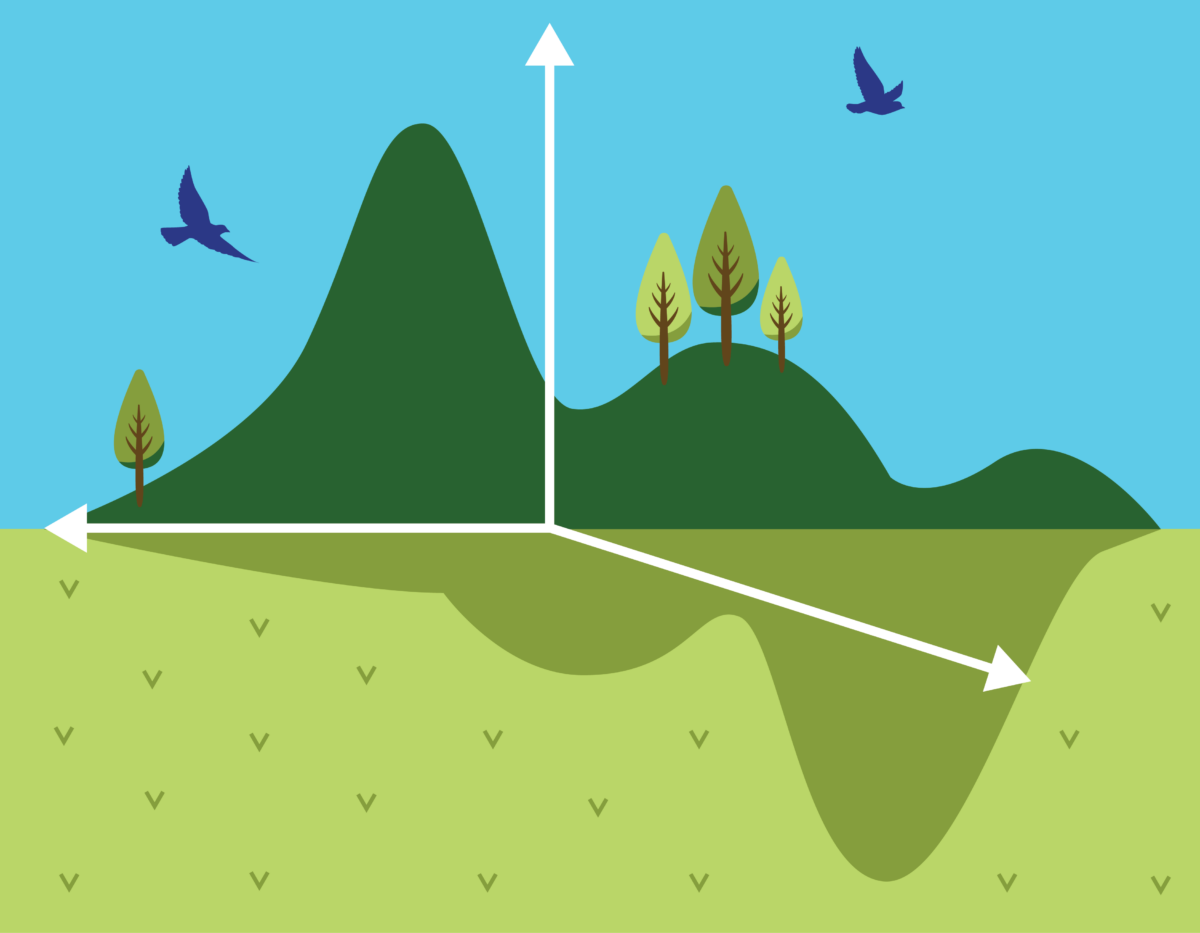
    <p>All of the possible combinations of parameters can be represented as points along a curved surface with hills and valleys. An algorithm developed by a mathematician can search for the lowest or highest point on that surface to solve the optimization problem, depending if you are looking for a minimum or a maximum. One risk with these algorithms is that they may end up at a <em>local </em>minimum or maximum—the peak of a single hill or the base of a single valley—that isn’t actually the <em>global</em> maximum or minimum across the entire surface.</p>


    <p>In his grant application, Draganescu proposed a novel way of solving this kind of problem. “Because this type of problem is so old, it’s hard to find something new. But I think I did,” Draganescu says. Rather than searching for the minimum or maximum along a series of straight lines that approximate its curved surface, Draganescu has proposed a way to search directly along a set of well defined curves. The idea for the new approach “is a completely new angle,” he says, and in correspondence with colleagues to date, “nobody has contradicted me so far.”</p>


    <img width="1200" height="933" src="https://umbc.edu/wp-content/uploads/2025/02/UCM2025-Math-Story-Illustration-hills-and-valleys-SR-FS-FNL-1200x933.png" alt="green hills with trees and birds situated on 3D axes" style="max-width: 100%; height: auto;">All of the possible combinations of parameters for a system can be represented as points along a curved surface with hills and valleys. (Fiona Suherman/UMBC)


    <h4><strong>Sticking with the hard problems</strong></h4>


    <p>In math, there are many problems that are easy to express but extremely difficult to solve. Some have puzzled mathematicians for centuries. Draganescu’s Ph.D. advisor encouraged his students to think about these problems from time to time, in case they found a solution, of course, but also to keep their creative juices flowing. Draganescu continues the practice today.</p>


    <p>“Sometimes I’ve spent days in a row on some of these very hard problems that nobody knows how to solve,” he says. “And of course I would love the glory, but honestly, that’s not where the fun is. I’m old enough to know that the fun is actually thinking about it.”</p>


    <blockquote>
    <p>“And of course I would love the glory, but honestly, that’s not where the fun is. I’m old enough to know that the fun is actually thinking about it.”</p>
    <cite>Andrei Draganescu</cite>
    </blockquote>


    <p>Draganescu’s sticktoitiveness sometimes pays off in his everyday work. In the case of the idea that underpins his recent proposal, “I was surprised that it actually worked out. But ‘working out’ means many many months of work,” he says. “From having the initial idea to trusting that it could go somewhere, there were a lot of mistakes in the calculations and all that.” So why did he persist, knowing there was a good chance it <em>wouldn’t </em>“work out”? “I stuck with it because it was fun. I enjoy thinking about these problems.” </p>


    <p>Draganescu is continuing to develop his new technique for solving optimization problems, which could improve efforts to optimize all kinds of systems, from AI to airline schedules to agriculture—all because he found joy from sitting with a sticky problem.</p>


    <h4><strong>Replicating the real world</strong></h4>


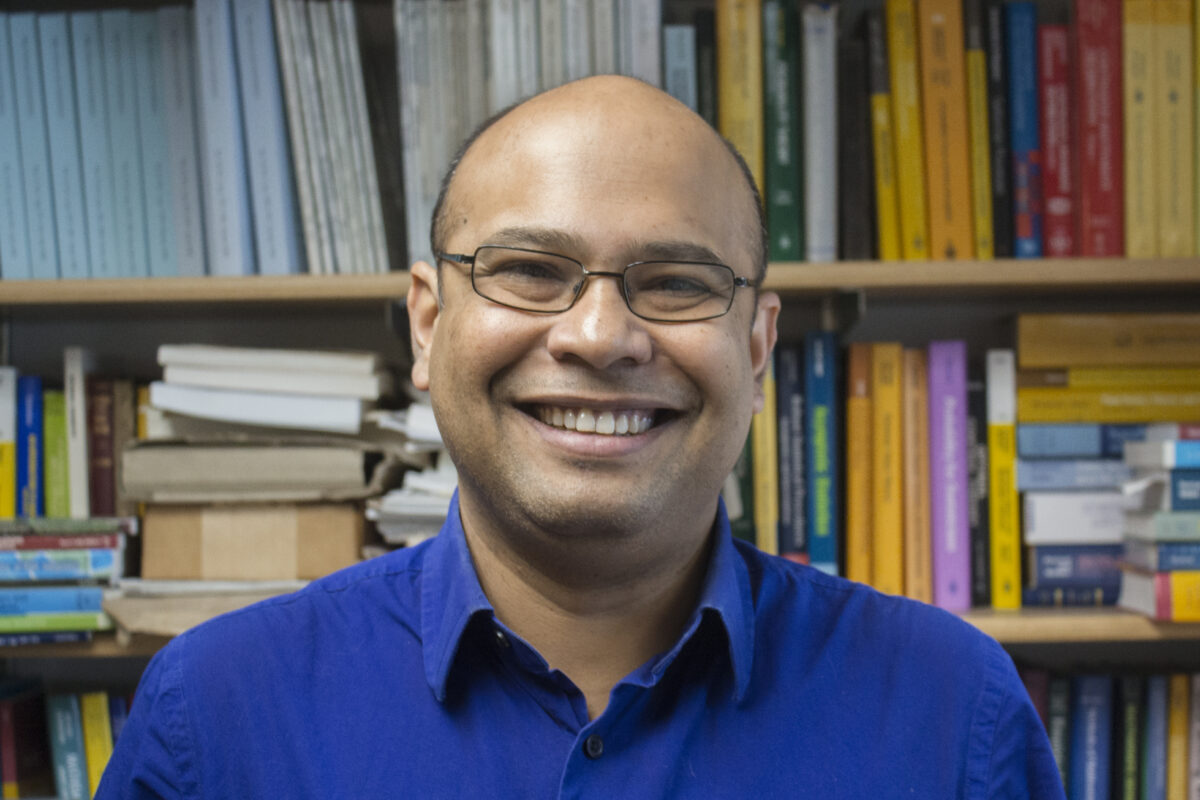
    <img width="1200" height="800" src="https://umbc.edu/wp-content/uploads/2025/02/ansu-1200x800.jpg" alt="portrait of man in front of bookshelves" style="max-width: 100%; height: auto;">Ansu Chatterjee (courtesy of Chatterjee)


    <p><strong>Ansu Chatterjee, </strong>professor of statistics, is another UMBC math mind whose work could have a major impact on a wide range of fields. He and UMBC colleagues <strong>Animikh Biswas</strong>, professor of mathematics, and <strong>Karuna Joshi,</strong> professor of information systems, have received an <a href="https://www.nsf.gov/awardsearch/showAward?AWD_ID=2436549&amp;HistoricalAwards=false" rel="nofollow external" class="bo">NSF grant</a> to <a href="https://umbc.edu/stories/digital-twinning-nsf-study/" rel="nofollow external" class="bo">expand the use of “digital twin” technology</a>. The grant proposal highlighted the potential to advance diagnosis and treatment for neurodegenerative diseases such as Alzheimer’s or Parkinson’s, but digital twin technology has a huge range of potential applications.</p>


    <p>A digital twin is “essentially a clone of something in the physical world replicated inside a computer,” Chatterjee says. Additional applications could include forest management or weather forecasting. These twins can offer up predictions about which direction a hurricane will turn, which treatment protocol might be most effective for a particular patient, or whether it’s the right time for a prescribed burn in a forest—but there will always be uncertainties in the models. </p>


    <p>“Measuring those uncertainties is a huge task,” Chatterjee says. How to deal with those uncertainties is one of the things the team wants to focus on with the new grant, which is very statistics-heavy, Chatterjee notes. Understanding and reducing the uncertainties requires understanding the physical processes at play in the real-world version of the system, and then working them into the model—and that’s hard. </p>


    <h4><strong>Beyond the black box</strong></h4>


    <p>Typical AI models are frequently “black box models,” which means even the people who created them don’t always understand exactly what they’re doing. For one thing, they are not constrained by objective truth in the physical world, Chatterjee explains. “It’s not even attempting to get the biology or the chemistry correct,” he says, and that’s not acceptable for a digital twin that’s modeling the human brain and may be used to determine a real human’s treatment plan. </p>


    <blockquote>
    <p>“You don’t get the model right unless you get the underlying math of the molecules that constitute it right. So mathematics and statistics have to be the underpinning of anything related to digital twins.”</p>
    <cite>Ansu Chatterjee</cite>
    </blockquote>


    <p>“You don’t get the model right unless you get the underlying math of the molecules that constitute it right,” Chatterjee says. “So mathematics and statistics have to be the underpinning of anything related to digital twins.”</p>


    <p>The digital twins Chatterjee and colleagues hope to further with their new research need not only replicate the outcomes of a system, but also the system’s mechanisms and internal processes. Again, that’s hard—especially when humans don’t yet fully understand many of these systems, such as the human brain, how cancer develops, or how various environmental factors influence carbon sequestration, for example.</p>


    <p>“We are at the foundation of digital twins,” Chaterjee says. Once they are developed to a point where they are usable, digital twins and AI more generally would “open up a vast amount of opportunities for making fairly rapid progress with the actual science. This is where AI can help in scientific progress. It can suggest opportunities and possibilities which then can be verified,” Chatterjee says. “It would rule out certain possibilities. There would of course be false positives and false negatives, but as digital twins keep improving, it would be more and more convenient to use those first to find out a lot more interesting things.”</p>


    <img width="900" height="700" src="https://umbc.edu/wp-content/uploads/2025/02/UCM2025-Math-Story-Illustration-digital-twin-SR-FS-FNL.png" alt="cartoon boy on left side; outline of the same boy on the right side filled in with an artist's rendering of circuit boards and 1s and 0s" style="max-width: 100%; height: auto;">A digital twin is “essentially a clone of something in the physical world replicated inside a computer,” Ansu Chatterjee says. (Illustration by Sadaf Rehman ’19/UMBC)


    <h4><strong>Fundamental building blocks</strong></h4>


    <p>Chatterjee and colleagues are aware of the risks associated with digital twins. “There’s quite a lot of ethical issues that are related to digital twins in general, and it goes up several notches when it’s digital twins related to humans.” For example, there are regulatory concerns around who owns the data put into a digital twin (such as someone’s genomic data) and who is compensated when the twin is used for profit. “It’s exciting, and it’s also kind of a nightmare,” Chatterjee says. </p>


    <p>That’s why he and colleagues will be working directly with federal regulatory agencies to make recommendations about how to handle these AI models. “This grant is sort of laying down the first fundamental steps—saying this is what should be done, this is how the first steps should be done,” Chatterjee says. </p>


    <p>While that work is critical, it’s the math that truly excites Chatterjee. “For me, it’s about building the fundamental building blocks, whether it’s cancer or neurodegenerative diseases or forests” he says. “The essential ingredients for the digital component of it rely on the same math, the same statistics.”</p>


    <h4><strong>Defining possible</strong></h4>


    <img width="317" height="281" src="https://umbc.edu/wp-content/uploads/2025/02/kvalheim.jpg" alt="portrait of man in front of long hallway with tall windows on one side" style="max-width: 100%; height: auto;">Matthew Kvalheim (courtesy of Kvalheim)


    <p><strong>Matthew Kvalheim</strong>, assistant professor of mathematics, is also working on developing tools that can help people in a wide range of situations. His ultimate goal? To be able to tell researchers whether whatever they are trying to do with their system is possible or impossible. Sound vague? That’s the point. </p>


    <p>“I’m never thinking about a specific application,” Kvalheim says. “I’m always working at the fundamental level, with a class of mathematical models that can describe all of them.” For Kvalheim, it’s the underlying math that is exciting—which is fortunate for all the people working on applications who will eventually use his multi-purpose tools. </p>


    <p>“For any real world system, you might want it to do some behavior, or <em>not </em>do some behavior,” Kvalheim says. This might be making sure two self-driving cars don’t collide, preventing a humanoid robot from falling on its face, or keeping an electronic device at a safe temperature. </p>


    <p>“Lots of people work on the set of models that I study,” he says, and the vast majority of them are investigating a particular application. These other researchers are very good at coming up with solutions that result in <em>stability</em>, or maintaining a certain state in a system, and <em>safety</em>, or preventing dangerous states in the system, “but there’s one thing they can’t do,” Kvalheim says. “They can’t determine if the thing they are trying to do, to make their system stable and safe in the way they want, is just fundamentally impossible. There could be a fundamental law of nature that says too bad, you can’t do it. You could try forever, but the heat death of the universe will occur first.”</p>


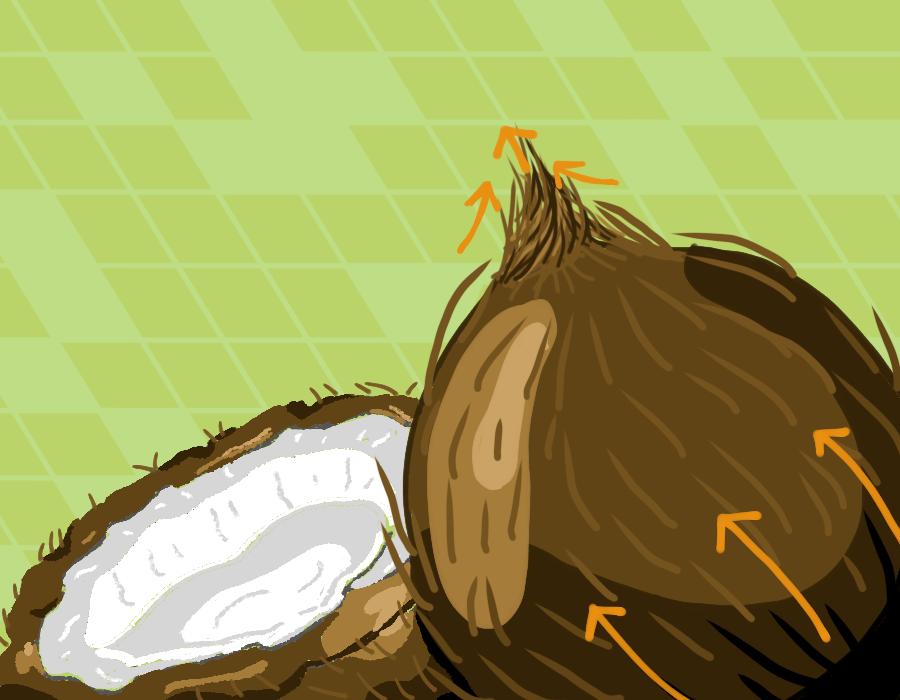
    <img width="900" height="700" src="https://umbc.edu/wp-content/uploads/2025/02/UCM2025-Math-Story-Illustration-hairy-ball-theorem-SR-FS-FNL.png" alt="a hairy whole coconut on the right has three orange arrows pointing up from the bottom, and smaller orange arrows at the top where the hairs converge; on the left is a half-coconut; lime green background" style="max-width: 100%; height: auto;">A tool Kvalheim has already published to help prove impossibility relies on math that is closely related to something called the <a href="https://en.wikipedia.org/wiki/Hairy_ball_theorem" rel="nofollow external" class="bo">“hairy ball theorem.”</a> If you imagine certain 3D shapes covered by directional vectors—or, to make it simpler, hairs—”Try as you might, you can’t comb that hair flat everywhere without creating a cowlick somewhere,” Kvalheim says. (Illustration by Sadaf Rehman ’19/UMBC)


    <h4><strong>A license to look</strong></h4>


    <p>Kvalheim would like to discover new fundamental limitations that hold true for any application you could come up with, and also new fundamental capabilities. The U.S. Air Force recently awarded him a grant to further this work. He’s trying to generate a sort of mathematical litmus test that any practitioner can use to find out whether the thing they are trying to do with their system (whatever it is!) is fundamentally possible or impossible. If it’s impossible, it saves them a lot of time, energy, and money. And if it’s possible? “It’s like giving people a license to go look for it,” Kvalheim says.</p>


    <p>The best part is that the end user of one of Kvalheim’s tools wouldn’t need to understand all the pure math behind it. “The idea is to produce useful tools that they can use even if they don’t have the time or interest in diving into all the details,” he says.</p>


    <img width="900" height="700" src="https://umbc.edu/wp-content/uploads/2025/02/UCM2025-Math-Story-Illustration-lorenz-attractor-SR-FS-FNL.png" alt="purple butterflies on a cyan background" style="max-width: 100%; height: auto;">Kvalheim’s stability research is applicable even to the Lorenz system, which is a set of ordinary differential equations. Solutions to this system can vary chaotically depending on the initial parameters, but converge toward and stay within a bounded space. This space appears butterfly-shaped when represented visually.<br>(Illustration by Fiona Suherman/UMBC)


    <p>Math undergirds just about everything, Kvalhiem says, so it’s important to study the general case, rather than focus on specific applications. He wants people to see that it’s important “to know when there are fundamental laws of nature telling them that it is impossible or possible to do things that they want, and that math allows you to discover such laws of nature—and not just for one real-world system, but for many systems all at once.”</p>


    <p>Somewhere a math or stat researcher is helping prevent your car from crashing, providing life-saving medical tools for yourself or a loved one, reducing wildfire risk where you live, or improving your experience with an AI tutor—and you might never even know it. There are humans behind each of these innovations who find joy and value in the math puzzles and problems that are all around us. And some of them work at UMBC. </p>
    </div>
]]>
</Body>
<Summary>Some mathematical and statistical challenges are so fundamental that the solutions can be applied to an array of real-world applications—which we all benefit from. But it’s not necessarily the...</Summary>
<Website>https://umbc.edu/stories/math-hunt-for-solutions-excites-researchers/</Website>
<TrackingUrl>https://my3.my.umbc.edu/api/v0/pixel/news/147113/guest@my.umbc.edu/5eda238a49360864da7dc841ee6f4d04/api/pixel</TrackingUrl>
<Tag>cnms</Tag>
<Tag>mathstat</Tag>
<Tag>news</Tag>
<Tag>research</Tag>
<Tag>science-and-tech</Tag>
<Tag>story</Tag>
<Group token="umbc-news-magazine">UMBC News &amp;amp; Magazine</Group>
<GroupUrl>https://my3.my.umbc.edu/groups/umbc-news-magazine</GroupUrl>
<AvatarUrl>https://assets1-my.umbc.edu/system/shared/avatars/groups/000/001/943/24435aa6207c452e7bc15cc74b42c7bb/xsmall.png?1748556657</AvatarUrl>
<AvatarUrl size="original">https://assets1-my.umbc.edu/system/shared/avatars/groups/000/001/943/24435aa6207c452e7bc15cc74b42c7bb/original.png?1748556657</AvatarUrl>
<AvatarUrl size="xxlarge">https://assets2-my.umbc.edu/system/shared/avatars/groups/000/001/943/24435aa6207c452e7bc15cc74b42c7bb/xxlarge.png?1748556657</AvatarUrl>
<AvatarUrl size="xlarge">https://assets2-my.umbc.edu/system/shared/avatars/groups/000/001/943/24435aa6207c452e7bc15cc74b42c7bb/xlarge.png?1748556657</AvatarUrl>
<AvatarUrl size="large">https://assets3-my.umbc.edu/system/shared/avatars/groups/000/001/943/24435aa6207c452e7bc15cc74b42c7bb/large.png?1748556657</AvatarUrl>
<AvatarUrl size="medium">https://assets1-my.umbc.edu/system/shared/avatars/groups/000/001/943/24435aa6207c452e7bc15cc74b42c7bb/medium.png?1748556657</AvatarUrl>
<AvatarUrl size="small">https://assets2-my.umbc.edu/system/shared/avatars/groups/000/001/943/24435aa6207c452e7bc15cc74b42c7bb/small.png?1748556657</AvatarUrl>
<AvatarUrl size="xsmall">https://assets1-my.umbc.edu/system/shared/avatars/groups/000/001/943/24435aa6207c452e7bc15cc74b42c7bb/xsmall.png?1748556657</AvatarUrl>
<AvatarUrl size="xxsmall">https://assets2-my.umbc.edu/system/shared/avatars/groups/000/001/943/24435aa6207c452e7bc15cc74b42c7bb/xxsmall.png?1748556657</AvatarUrl>
<Sponsor>UMBC News &amp; Magazine</Sponsor>
<PawCount>0</PawCount>
<CommentCount>0</CommentCount>
<CommentsAllowed>false</CommentsAllowed>
<PostedAt>Thu, 06 Feb 2025 09:24:45 -0500</PostedAt>
<EditAt>Thu, 06 Feb 2025 09:24:45 -0500</EditAt>
</NewsItem>

<NewsItem contentIssues="false" id="147112" important="false" status="posted" url="https://my3.my.umbc.edu/posts/147112">
<Title>URCAD is April 16, 2025</Title>
<Tagline>Register to present your research or creative work!</Tagline>
<Body>
<![CDATA[
    <div class="html-content"><div>
    <div>
    <p><strong><span>Registration:</span> </strong>January 3 -February 14, 2025</p>
    <p><a href="https://my3.my.umbc.edu/groups/amst/posts/147110/6e99d/dd99463da0f3394fab6030baa37a8020/web/link?link=https%3A%2F%2Fapps.my.umbc.edu%2Furcad%2Fform%2Fedit.php%3Fid%3Dnew" rel="nofollow external" class="bo">URCAD Student Registration</a><br></p>
    <p> <a href="https://my3.my.umbc.edu/groups/amst/posts/147110/6e99d/693be22a3180ff5b58accda9dcf431c9/web/link?link=https%3A%2F%2Fapps.my.umbc.edu%2Furcad%2Fmentors%2Fumbc%2F" rel="nofollow external" class="bo">Mentor Approval</a><br></p>
    <p> <a href="https://my3.my.umbc.edu/groups/amst/posts/147110/6e99d/bea3eca49697aa5ea5b31b06512224a5/web/link?link=https%3A%2F%2Fapps.my.umbc.edu%2Furcad%2Fmentors%2Foff-campus%2F" rel="nofollow external" class="bo">Review for Non-UMBC Mentors</a></p>
    <h3>Undergraduate Research and Creative Achievement Day</h3>
    <p>On Wednesday April 16, 2025, <span>Undergraduate Research and Creative Achievement Day (URCAD)</span> will
     feature research, scholarship, and creative work carried out by UMBC 
    undergraduates. Student work will be shared through oral presentations, 
    posters, artistic exhibits, performances, and film. Over 300 presenters 
    participate annually. Researchers work with faculty mentors on 
    independent research, or research that is part of the mentor’s on-going 
    projects. They are from all disciplines, and can be working on a thesis,
     capstone project, part of a scholars or honors program, or they can be 
    unaffiliated. This campus-wide celebration of achievement affirms UMBC’s
     commitment to the twin goals of research and a distinctive 
    undergraduate experience.</p>
    <p>All
     current undergraduates who have conducted research, scholarship or 
    creative work in the last year may apply to present their results at 
    URCAD. Mentors, fellow students, friends, family members, high school 
    teachers and students, graduate school recruiters, and the general 
    public are invited to attend.</p>
    <p>For information on how to prepare your 200-word abstract for the URCAD application please visit our <a href="https://my3.my.umbc.edu/groups/amst/posts/147110/6e99d/3e49f42ce9c43a3abd195227ca1af484/web/link?link=https%3A%2F%2Fur.umbc.edu%2Furcad%2Ffaqs%2Furcad-abstract-guidelines%2F" rel="nofollow external" class="bo">guidelines page.</a></p>
    </div>
    </div></div>
]]>
</Body>
<Summary>Registration: January 3 -February 14, 2025   URCAD Student Registration     Mentor Approval     Review for Non-UMBC Mentors   Undergraduate Research and Creative Achievement Day   On Wednesday...</Summary>
<AttachmentKind>Photo</AttachmentKind>
<AttachmentUrl>https://assets3-my.umbc.edu/system/shared/attachments/680c928d3557f57924d271eb6501c045/6a7cb520/news/000/147/112/0a4f2189abe31e0d2257dded4c6e3fa7/unnamed.jpg?1738850373</AttachmentUrl>
<Attachments>
<Attachment kind="Photo" url="https://my3.my.umbc.edu/posts/147112/attachments/55286"></Attachment>
</Attachments>
<TrackingUrl>https://my3.my.umbc.edu/api/v0/pixel/news/147112/guest@my.umbc.edu/a0c599b46801b86e30aac549393eb150/api/pixel</TrackingUrl>
<Group token="pubhum">Public Humanities</Group>
<GroupUrl>https://my3.my.umbc.edu/groups/pubhum</GroupUrl>
<AvatarUrl>https://assets4-my.umbc.edu/system/shared/avatars/groups/000/001/722/06d51ce32ccfc3f27c53c96c7cc67734/xsmall.png?1574391548</AvatarUrl>
<AvatarUrl size="original">https://assets1-my.umbc.edu/system/shared/avatars/groups/000/001/722/06d51ce32ccfc3f27c53c96c7cc67734/original.png?1574391548</AvatarUrl>
<AvatarUrl size="xxlarge">https://assets2-my.umbc.edu/system/shared/avatars/groups/000/001/722/06d51ce32ccfc3f27c53c96c7cc67734/xxlarge.png?1574391548</AvatarUrl>
<AvatarUrl size="xlarge">https://assets3-my.umbc.edu/system/shared/avatars/groups/000/001/722/06d51ce32ccfc3f27c53c96c7cc67734/xlarge.png?1574391548</AvatarUrl>
<AvatarUrl size="large">https://assets4-my.umbc.edu/system/shared/avatars/groups/000/001/722/06d51ce32ccfc3f27c53c96c7cc67734/large.png?1574391548</AvatarUrl>
<AvatarUrl size="medium">https://assets3-my.umbc.edu/system/shared/avatars/groups/000/001/722/06d51ce32ccfc3f27c53c96c7cc67734/medium.png?1574391548</AvatarUrl>
<AvatarUrl size="small">https://assets3-my.umbc.edu/system/shared/avatars/groups/000/001/722/06d51ce32ccfc3f27c53c96c7cc67734/small.png?1574391548</AvatarUrl>
<AvatarUrl size="xsmall">https://assets4-my.umbc.edu/system/shared/avatars/groups/000/001/722/06d51ce32ccfc3f27c53c96c7cc67734/xsmall.png?1574391548</AvatarUrl>
<AvatarUrl size="xxsmall">https://assets1-my.umbc.edu/system/shared/avatars/groups/000/001/722/06d51ce32ccfc3f27c53c96c7cc67734/xxsmall.png?1574391548</AvatarUrl>
<Sponsor>Public Humanities</Sponsor>
<PawCount>0</PawCount>
<CommentCount>0</CommentCount>
<CommentsAllowed>true</CommentsAllowed>
<PostedAt>Thu, 06 Feb 2025 09:00:07 -0500</PostedAt>
</NewsItem>

<NewsItem contentIssues="false" id="147110" important="false" status="posted" url="https://my3.my.umbc.edu/posts/147110">
<Title>URCAD is April 16, 2025</Title>
<Tagline>Register to present your research or creative work!</Tagline>
<Body>
<![CDATA[
    <div class="html-content">
    <p><strong><span>Registration:</span> </strong>January 3 -February 14, 2025</p>
    <p><a href="https://apps.my.umbc.edu/urcad/form/edit.php?id=new" rel="nofollow external" class="bo">URCAD Student Registration</a><br></p>
    <p> <a href="https://apps.my.umbc.edu/urcad/mentors/umbc/" rel="nofollow external" class="bo">Mentor Approval</a><br></p>
    <p> <a href="https://apps.my.umbc.edu/urcad/mentors/off-campus/" rel="nofollow external" class="bo">Review for Non-UMBC Mentors</a></p>
    <h3>Undergraduate Research and Creative Achievement Day</h3>
    <p>On Wednesday April 16, 2025, <span>Undergraduate Research and Creative Achievement Day (URCAD)</span> will
     feature research, scholarship, and creative work carried out by UMBC 
    undergraduates. Student work will be shared through oral presentations, 
    posters, artistic exhibits, performances, and film. Over 300 presenters 
    participate annually. Researchers work with faculty mentors on 
    independent research, or research that is part of the mentor’s on-going 
    projects. They are from all disciplines, and can be working on a thesis,
     capstone project, part of a scholars or honors program, or they can be 
    unaffiliated. This campus-wide celebration of achievement affirms UMBC’s
     commitment to the twin goals of research and a distinctive 
    undergraduate experience.</p>
    <p>All
     current undergraduates who have conducted research, scholarship or 
    creative work in the last year may apply to present their results at 
    URCAD. Mentors, fellow students, friends, family members, high school 
    teachers and students, graduate school recruiters, and the general 
    public are invited to attend.</p>
    <p>For information on how to prepare your 200-word abstract for the URCAD application please visit our <a href="https://ur.umbc.edu/urcad/faqs/urcad-abstract-guidelines/" rel="nofollow external" class="bo">guidelines page.</a></p>
    </div>
]]>
</Body>
<Summary>Registration: January 3 -February 14, 2025  URCAD Student Registration    Mentor Approval    Review for Non-UMBC Mentors  Undergraduate Research and Creative Achievement Day  On Wednesday April...</Summary>
<AttachmentKind>Image</AttachmentKind>
<AttachmentUrl>https://assets1-my.umbc.edu/system/shared/attachments/882f8f716e0393f6acc3588fc3371098/6a7cb520/news/000/147/110/4039afadfc76df51bf9c362deaa31bb0/unnamed.jpg?1738850059</AttachmentUrl>
<Attachments>
<Attachment kind="Image" url="https://my3.my.umbc.edu/posts/147110/attachments/55284"></Attachment>
</Attachments>
<TrackingUrl>https://my3.my.umbc.edu/api/v0/pixel/news/147110/guest@my.umbc.edu/3057596a93b77aa4bc56c2f09cc53567/api/pixel</TrackingUrl>
<Group token="amst">American Studies Department</Group>
<GroupUrl>https://my3.my.umbc.edu/groups/amst</GroupUrl>
<AvatarUrl>https://assets1-my.umbc.edu/system/shared/avatars/groups/000/000/571/f1a862c4a5a31b363f857fee1e038fea/xsmall.png?1700059172</AvatarUrl>
<AvatarUrl size="original">https://assets4-my.umbc.edu/system/shared/avatars/groups/000/000/571/f1a862c4a5a31b363f857fee1e038fea/original.png?1700059172</AvatarUrl>
<AvatarUrl size="xxlarge">https://assets1-my.umbc.edu/system/shared/avatars/groups/000/000/571/f1a862c4a5a31b363f857fee1e038fea/xxlarge.png?1700059172</AvatarUrl>
<AvatarUrl size="xlarge">https://assets2-my.umbc.edu/system/shared/avatars/groups/000/000/571/f1a862c4a5a31b363f857fee1e038fea/xlarge.png?1700059172</AvatarUrl>
<AvatarUrl size="large">https://assets2-my.umbc.edu/system/shared/avatars/groups/000/000/571/f1a862c4a5a31b363f857fee1e038fea/large.png?1700059172</AvatarUrl>
<AvatarUrl size="medium">https://assets3-my.umbc.edu/system/shared/avatars/groups/000/000/571/f1a862c4a5a31b363f857fee1e038fea/medium.png?1700059172</AvatarUrl>
<AvatarUrl size="small">https://assets1-my.umbc.edu/system/shared/avatars/groups/000/000/571/f1a862c4a5a31b363f857fee1e038fea/small.png?1700059172</AvatarUrl>
<AvatarUrl size="xsmall">https://assets1-my.umbc.edu/system/shared/avatars/groups/000/000/571/f1a862c4a5a31b363f857fee1e038fea/xsmall.png?1700059172</AvatarUrl>
<AvatarUrl size="xxsmall">https://assets2-my.umbc.edu/system/shared/avatars/groups/000/000/571/f1a862c4a5a31b363f857fee1e038fea/xxsmall.png?1700059172</AvatarUrl>
<Sponsor>American Studies Department</Sponsor>
<PawCount>0</PawCount>
<CommentCount>0</CommentCount>
<CommentsAllowed>true</CommentsAllowed>
<PostedAt>Thu, 06 Feb 2025 08:57:46 -0500</PostedAt>
</NewsItem>

</News>