It is a 1B1B unit 1000sqft. The name of the community is Caton House Apartments. 
Below is the link to the photos of the apartment. I have also attached a picture of the floor plan
My contact info: 667-301-8550 or v56@umbc.edu

Dear Retrievers,
It has come to our attention that a fraudulent email claiming to be from the Office of Financial Aid and Scholarships regarding a personal assistant job posting has been sent to members of our campus community. This email is NOT legitimate and did not originate from our office.
We urge you not to click on any links, download any attachments, or respond to the sender.
If you received this email:
Mark the email as spam.
Do not provide any personal or financial information.
If you have already interacted with the email, please contact the Department of Information Technology (DOIT) help desk as soon as possible for further assistance.
To help protect yourself from scams, always verify the sender’s email address and be cautious of any unsolicited emails requesting sensitive information. Additionally, any employment opportunities through the Office of Financial Aid and Scholarships will be accessible through the Handshake platform.
If you have any questions or concerns, please don’t hesitate to contact us.
Thank you for your vigilance in keeping our campus community safe.
Sincerely,
The Office of Financial aid and Scholarships.

Packed and energized sporting arenas. Clinching the closing medal ceremony of the Olympics for the first time. Primetime broadcasts with viewership in the many millions—women’s sports are starting to get the time and attention they’ve deserved all along.
At UMBC, our women athletes have been gathering championship rings and lifting each other up along the way. You’re invited to join the stands and cheer on these world-class Retrievers.
By Kara Newhouse
The women of the UMBC volleyball team stood at the edge of their home court with eyes toward the rafters. To the right of the American and Maryland flags hung two banners with black cloths draped over them. The home opener match of the 2024 season would start soon, but first, a bit of pomp and circumstance for the Retrievers who won the past four America East Conference tournaments.
A game announcer directed attention to a massive video screen which showed senior Mila Ilieva, economics, blocking a hit and clinching a 3-0 sweep of the Binghamton Bearcats in the 2023 championship. On the floor, current players grinned, reliving their victory as triumphant music kicked on. All eyes returned to the rafters and up went the black cloths to reveal two black and gold banners listing the volleyball team’s three regular season titles and four tournament wins.
On its way up, one cloth got stuck, hanging at an angle as the players turned for a photo and a crew in the rafters fixed it. Not the smoothest of unveilings, but it was perhaps reflective of the trajectory of women’s sports in this country, a path punctuated by moments of great promise—the passage of Title IX, packed crowds at the 1999 Women’s World Cup, Simone Biles and Katie Ledecky’s medal dominance at the Rio Olympics—but often regressing to the status quo as a “niche interest” ignored by investors and corporate broadcasters.
This year, however, the veil keeping women’s sports from mainstream popularity has finally lifted. The final game of 2024 NCAA women’s March Madness netted over 18 million average viewers—4 million more than the men’s final. At the Paris Olympics, the women’s marathon medals were given during the closing ceremony instead of the men’s for the first time. Professional leagues are smashing attendance records and making expansion plans.
As a recent viral T-shirt declares: Everyone watches women’s sports. And Retriever athletics is full of women worth watching. In addition to volleyball victories, UMBC boasts four consecutive America East championships in softball. Swimming alumna Emily Escobedo ’17, finished third in the 200-meter breaststroke at NCAA championships as a Retriever and later won a world championship in the same event. The lacrosse team is coached by a hall-of-famer. Shot putter Cleopatra Borel ’02, was the college’s first national champion and competed in four Olympics for Trinidad and Tobago. That’s just what’s in the record books. At UMBC, student-athletes are also supported as teammates, scholars, and aspiring leaders. Are you watching with us?
For Kennedy Lamb ’20, English, the recent popularity of women’s sports is overdue. “It’s about time these women’s sports teams, especially at UMBC, get that attention,” said Lamb, who won an America East championship with Retriever softball in 2019.
During her time as a student-athlete, Lamb experienced a similar change in viewership to what’s happening nationally. She remembers looking out from the diamond as a first-year student to see just a few parents. “We love the parents, but you always wish that maybe another sports team or maybe a friend or someone from your math class would show up,” she said. Over the ensuing years, as the softball team turned into a winning one, her wish came true. “By the time I was a senior, the hill was filled.”
Lamb got a reminder of how that felt when she attended a Washington Mystics game against the Indiana Fever, the team on which mega-popular Caitlin Clark plays. Both times the Fever came to Washington, the arena sold out. Lamb said her friends and family who are longtime WNBA fans recalled how they used to get cheap tickets to games with middling attendance. “Now it was this sought after activity. Tickets were expensive. And seeing the electricity in the stadium reminded me of the electricity of being on the UMBC softball team,” Lamb said.
Clark’s celebrity drew large crowds across WNBA cities this year, but it wasn’t only the Clark effect bringing people in. The New York Liberty, for instance, averaged the second highest home attendance in the regular season with 12,700 fans. Five years ago, the Liberty’s home game average was 2,200 fans.
For Tiffany D. Tucker, UMBC’s new director of athletics, physical education, and recreation, the popularity of the WNBA and other women’s sports is payoff from decades of work by athletes, coaches, executives, fans, investors, and allies. It’s not that the product on the floor changed, but “sometimes people need an invitation,” Tucker said. “It’s as if they’ve been peeping in, and it’s like, ‘I want to be a part of it,’ and now everybody feels like they’ve been invited and that they’re a part of the team.”
As she dives into her new role, she plans to extend the same invitation for all to watch UMBC women’s athletics.
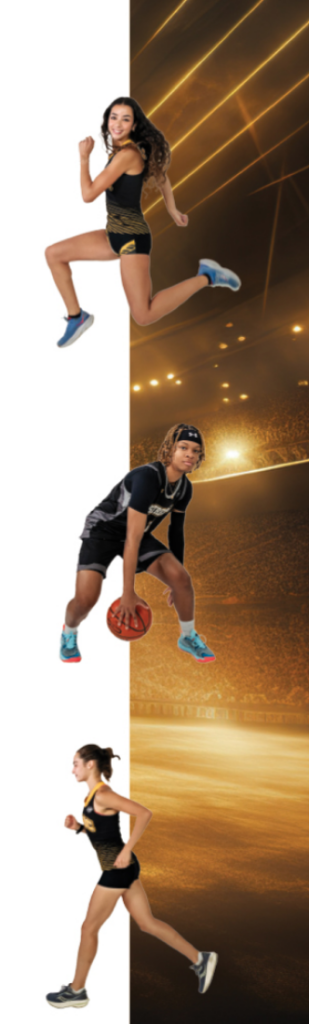 Top to bottom: LynaBeraich, Tiara Bellamy,Lexi Tepper.
After the volleyball banner ceremony, Tucker sat at center court with President Valerie Sheares Ashby to watch the contest against Lehigh University.
“Let’s go, Serin! You got it!” the athletics director called as setter Serin Maden, an economics junior, stepped up for a serve.
A former basketball coach who once aspired to be an author and international speaker, Tucker’s voice carried easily over the cacophony of the crowd and thwacks of palms smacking leather.
“Let’s go, Jada!” she called shortly after Maden’s serve. “Let’s go, Aysia!” a few minutes later.
Tucker was less than four weeks into the job. Asked how many names she’d learned in those weeks, she exhaled. “I try to get them all, I try,” she said. Counting both men and women student-athletes, that’s almost 400 names. “I’m going team by team,” Tucker added with a deep laugh.
At once the mark of a good leader, Tucker’s effort is also a benefit of UMBC’s size. “When you’re a student-athlete at a smaller, mid-major institution, you may know the name [of administrators], or you may know where the offices are to certain resources,” Tucker said.
“These are the same people who are here to support our women’s sporting events. These are people who are readily there to help you, not that they’re not there at a larger institution, but because of the size of the institution, I think it’s a little bit more intimate and relational.”
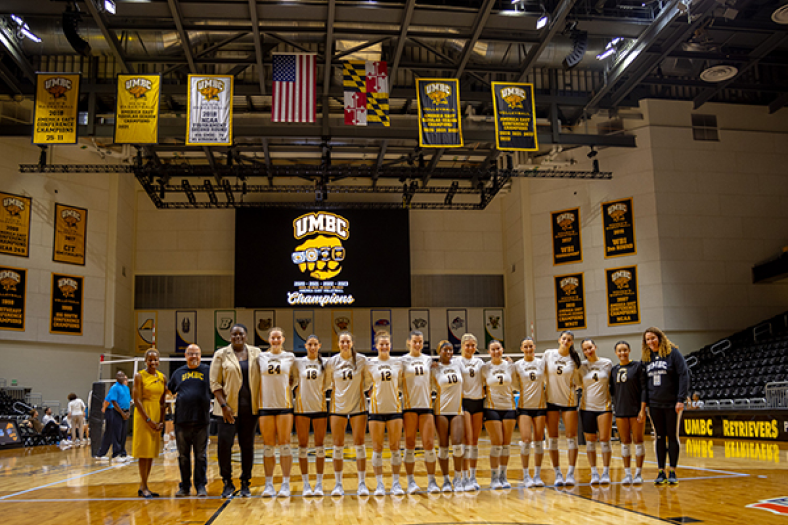 UMBC volleyball celebrated winning the last four America East Conference tournaments. Photo by Luna Siesko for UMBC.
In the stands behind Tucker, a row of preteen girls got into the Retriever spirit, barking loudly to support the home team. Sporting shiny red jerseys, these girls were volleyball players from Shepherdstown Middle School in West Virginia, attending their first college game. Though the Retrievers lost, the match was “really fun” and “cool,” the girls said with big smiles afterward. Their favorite part? “The rallies,” according to one. “Yeah, the rallies!” another girl echoed.
A third player had a different thought. “The way they supported each other,” she said. “They huddled after every point and high fived and cheered for each other.” At this, the rest of the tweens bobbed their heads in agreement and declared that they wanted to take that back to their own matches.
That kind of support cuts across sports at UMBC. “There’s this camaraderie when you’re all together, day in day out, waking up at 5:30 for practice,” said Lamb, who is the godmother to the child of one of her former softball teammates. “It’s one thing to have great friends who you see in your English class, but ultimately you don’t grind with them. Being a DI athlete is a grind. You have no choice but to lean on others. You can’t do it alone. And that’s a type of friendship that isn’t found everywhere.”
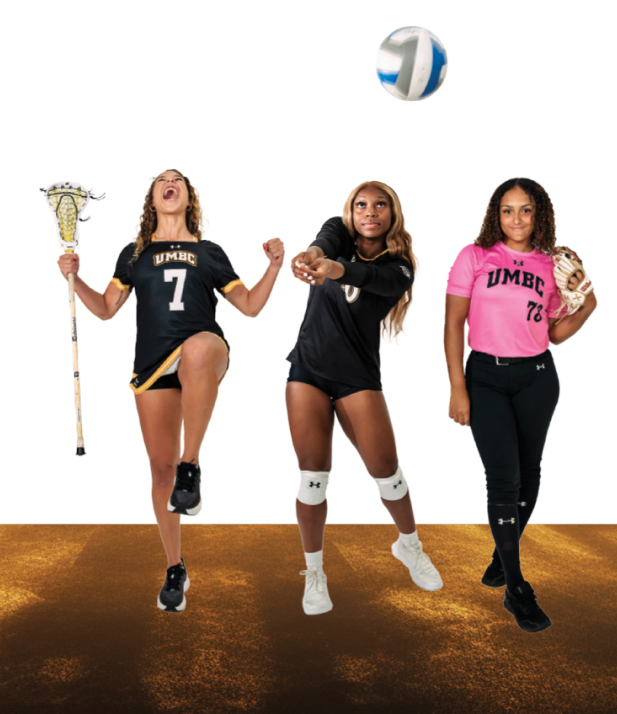 Left to right: Katana Nelson, Jada James, Mikayla Bryant.
Aysia Miller ’24, biological sciences, knows something about grinding with teammates. She won four America East championships in volleyball with four different pathways to the trophy. Her first year, the Retrievers were the underdogs facing the heavyweight University of Albany. Her sophomore year, the team blew out everyone in conference play but struggled in the tournament. Her junior year, they started the season strong but hit a losing stretch midway. Her senior year was the magic one.
“It was just like everything was clicking, and it was honestly pretty perfect,” said Miller, who is now a master’s student in applied molecular biology. With an extra year of athletic eligibility because of COVID-19, Miller has the unusual opportunity to achieve a five-peat. But the team struggled at the start of the season, losing nine in a row.
After the Lehigh match, Miller said she and her teammates knew they needed to improve. “Ultimately, I do believe that culturally our team is in a good spot. We have each other’s backs,” she said. “No one is turning on each other, and we’re not blaming one another about losing, about not things not going our way. And it kind of all comes down to what are our values as a team, what’s important, and how we’re able to treat each other.”
Shared values can be the difference between a thriving locker room and a toxic one. During the women’s basketball preseason, the team spent an afternoon defining and performing skits about the core values posted in their locker room: service, toughness, family, loyalty, commitment, and consistency.
Team bonding activities like that one, as well as movie nights, a trip to the state fair, and the thrill of competition are what motivated Riley Donahue ’24, political science, to stay for another year as a master’s student in public policy. As a transfer student, Donahue has experienced multiple sets of coaches. From her perspective, positive culture starts at the top, and she loves the tone set by Coach Candice Hill and her staff. “They want to make sure everybody’s OK, and they have an open door policy if you need to come and talk to them,” Donahue said.
“I want to fill the stands. I want women athletes to really feel their value and know that they are loved.”
— Tiffany D. Tucker, athletics director
Hill isn’t the only coach with that policy. “By open door, I mean literally anyone walks through our door,” said Amy Slade, the women’s lacrosse head coach entering her 17th season with the Retrievers. “We could be meeting with a recruit, and someone walks in and we’re like, ‘Hey, what’s up?’”
Slade and her staff hold monthly “coaches’ corner” meetings with each player. The young women may discuss lighthearted topics, like their favorite TV shows. Or they may share serious matters, like a parent’s cancer diagnosis. In either case, Slade said her goal is not to solve their problems, but to validate emotions and offer mom hugs, tough love, or referrals to mental health professionals as needed. “We’re making time each month just for you. And I think that’s important,” said Slade, who was inducted into the National Lacrosse Hall of Fame in 2021.
While coaches keep doors open for student-athletes to come inward, the rest of the college opens doors to go outward and excel beyond their sports. Players and staff are proud that academics get just as much emphasis as athletics at UMBC. That’s what drew Donahue here from Auburn University as a junior. Right away, Donahue jumped into an internship fair that led to working on Brooke Lierman’s successful campaign for Maryland Comptroller. The following spring, she interned in the Maryland legislature for Delegate Cheryl Pasteur.
“It was a haul to Annapolis,” Donahue said, but she paid for gas with money she earns from NIL (name, image, likeness) deals. “It was really fun to sit in on judicial hearings, to walk through the Senate building …and I enjoyed being around it and helping draft bills, helping make scholarships for students.”
Donahue is president of UMBC’s Student Athlete Advisory Committee (SAAC) and the America East chair for the NCAA Division 1 SAAC. Eventually, she wants to be president of the United States. “This place challenges you academically, and that’s what I want. Because the career that I want to go into is not going to be easy,” she said.
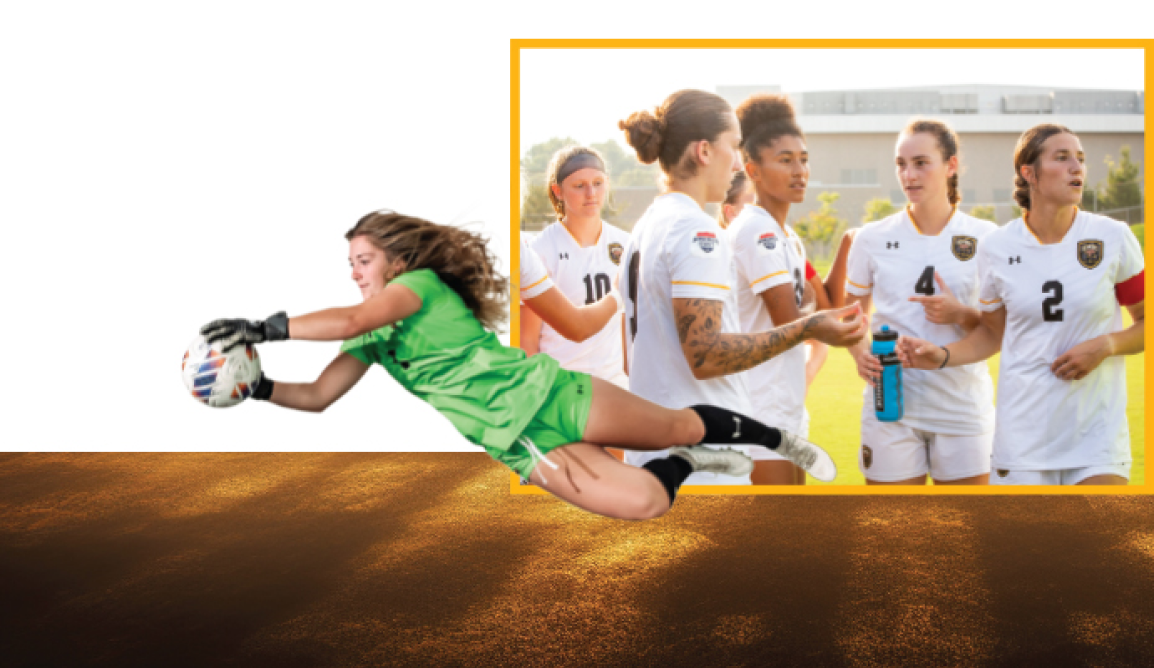 The women’s soccer team huddles on the field at Retriever Soccer Park. Photo by Jill Fannon, M.F.A. ’11.
Women’s sports have a long history at UMBC, thanks in large part to Linda “Louie” Sowers ’70, American studies. Sowers, who played volleyball in high school, arrived at UMBC in its inaugural 1966 semester. Looking around campus, she found something missing: women’s sports. So in her second year, she approached athletic director Dick Watts with a request to change that. “I was a little sophomore, and he was an intimidating person…so it took a lot of courage for me just to go in there and ask,” she recalled.
Five years before Title IX mandated equality of athletic opportunities among other things, many male athletic directors might have brushed off Sowers’ request. But according to Sowers, Watts handed her a piece of paper and asked her to get signatures of female students who wanted to play sports. If she gathered enough names, he would hire a volleyball coach.
Sowers took that paper to the cafeteria, located in one of the only campus buildings at the time. “I basically just, in between classes, went up and down all the tables and got as many girls as I could,” Sowers recalled. “I had girls that said ‘I’ve never played before,’ and I would say, ‘I don’t care. It doesn’t matter. Just come and play.’”
She collected 66 signatures, and Watts hired a volleyball coach that spring. The next fall, Watts added a women’s athletic director, plus field hockey and basketball teams. “Because we were such a small school…it was like this little core group of us that wound up playing all three sports,” Sowers said. More than 50 years later, she still attends Ravens games with one of those friends and keeps in touch with others by text and email.
In Sowers’ day, spectators included just a few parents and male athletes. Even today, crowds tend to follow a team’s success. Teams that have yet to lift trophies said they’re still hoping to see more fans.
One misty September night at Retriever Soccer Park as the women’s team mounted a comeback win over Mount St. Mary’s, parents in slickers and some fellow student-athletes—including Miller—cheered from wet bleachers. One dad rang a cowbell after every Retrievers play. Center fullback Lauren Reid, psychology and visual arts, said she’s grateful for family support but wished more peers would show up.
Reid knows how it feels to put on her cleats for a packed house. Last June she traveled to soccer-mad Brazil as a member of the Jamaican women’s national team. When Brazilian legend Marta took the field, the energy shift was incredible, Reid said. “I think it would give us the same feeling here if our whole student body was showing up,” she continued.
Tucker, too, said she wants to see growth in crowds to mirror what’s happening at a national level: “I want to fill the stands. I want women athletes to really feel their value and know that they are loved.”
Tucker plans to personally visit rotary clubs, local churches, schools, and others to extend the invitation. She wants to saturate the community with her message about Retriever women’s athletics.
“We have some of the best scholars. We have some of the best athletes in the country right here on our campus, and they’re passionate about what they do. They’re very disciplined. And it’s fun. It’s action-packed. It’s right here in your backyard,” Tucker said.
Consider yourself invited.
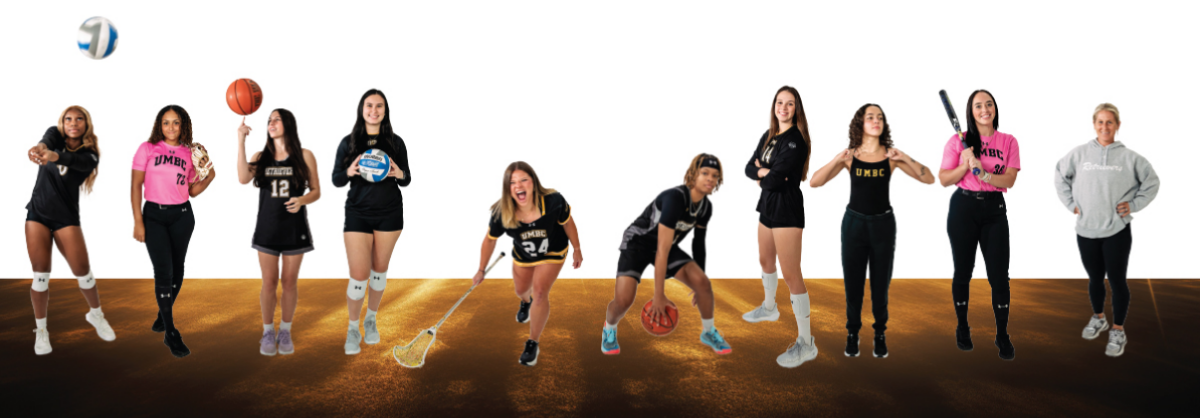 Left to right: Jada James, Mikayla Bryant, Lauren Thompson, Aysia Miller, Grace Bruce, Tiara Bellamy, Claudia Llamas, Bruna de Padua, Jerzie Nutile, and Amy Slade.
]]>
Left to right: Jada James, Mikayla Bryant, Lauren Thompson, Aysia Miller, Grace Bruce, Tiara Bellamy, Claudia Llamas, Bruna de Padua, Jerzie Nutile, and Amy Slade.
]]>

For almost 70 years, Milt Halem, now a research professor at UMBC after a career at NASA, has deployed the latest computing technology—from vacuum tubes in the ’50s to artificial intelligence today—to tackle some of science’s toughest problems.
Colorful screen prints cover the walls of Milt Halem’s Rockville, Maryland, apartment. One shows a high-altitude view of the Nile River, cutting through desert sands before emptying into a turquoise Mediterranean. In another, the fragile blue marble of the Earth rises above a desolate lunar surface.
One large picture, taking centerplace on the dining room wall, is more enigmatic—filled with alternating red, yellow, and blue patches. “This is what’s known as the quasi-biennial oscillation,” Halem explains.
Tens of thousands of feet up, in Earth’s stratosphere, the winds around the equator regularly shift direction, blowing east for many months, and then west, and then east again. A satellite measured the shifts, and Halem, a former NASA scientist and current UMBC professor, turned six years of that data into art.
Halem’s framed prints, many of which he created himself while taking evening and weekend classes at the Corcoran School of the Arts and Design in Washington, D.C., are a window into his nearly 70-year-long scientific career. For roughly 40 years of that time, he worked for NASA, the famed federal space agency. Halem harnessed NASA’s space-based instrument “eyes” and ever-evolving computer “brains” to advance humanity’s understanding of Earth and our place in the cosmos and, in 1996, was recognized with NASA’s highest award, the Distinguished Service Medal.
In 2003, after retiring from NASA, Halem joined UMBC as a research professor. In his more than two decades at the university, he has nurtured connections with government and industry, brought in research money and equipment, regularly taught a popular graduate course, and mentored more than a dozen Ph.D. students, helping them pursue their passions and propel their careers.
“I think of myself as a computational scientist: I use computers to both discover and explore new territory,” Halem says. “What I love is the computer’s ability to represent, and to explain, the world around us.”
Halem began his working life at the dawn of the computing age, and his career trajectory mirrors the steady rise of those digital devices. After earning a bachelor’s degree in mathematics from the City College of New York in 1951, Halem was drafted into the Korean War effort and served on U.S. Army bases for two years, first in New Jersey and then in Arizona. After a stint clearing rocks off the golf course so that the officers could play, Halem’s skills were better put to use on some of the Army’s first attempts to use what at the time were relatively new-fangled devices called computers to improve surveillance of battlefields.
In 1955, Halem received a fellowship to work with an IBM 704 computer installed at New York University. The computer took up significant floor space with its multiple cabinet-sized components, filled with vacuum tubes for logic operations and magnetic tape for memory. It was state-of-the-art in its day, able to execute about 40,000 instructions per second.
“You could say 1955 was my start in high-performance computing,” Halem says. “I’ve been acquiring and managing and programming and doing research on computers ever since.”
In the late 1950s, NASA established the Goddard Space Flight Center (GSFC) and, shortly after, opened a New York campus—the Goddard Institute for Space Studies—focused on theoretical research.

Milt Halem delivers remarks during a conference at NASA Goddard Space Flight Center, 1986. Photo by NASA.
Because of Halem’s experience with computers, he was hired as contract support. In the subsequent years, he worked with some of the most advanced computers of the time, using them to model the Earth’s atmosphere and predict the scientific value of launching new Earth-observing instruments. In 1968, he also earned his Ph.D. in applied mathematics from NYU.
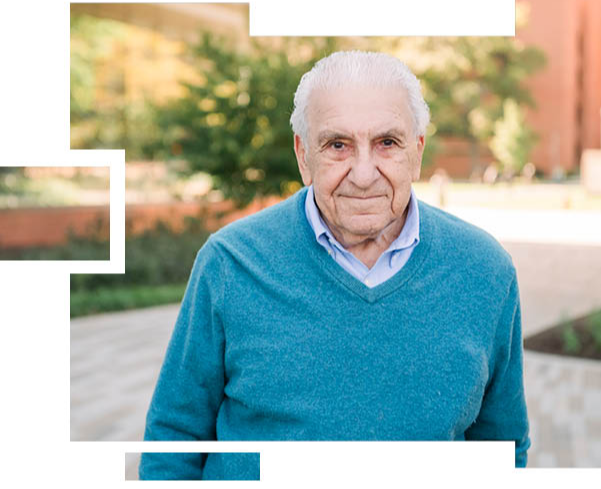
Halem at UMBC in 2024.
In the late ’70s, Halem moved to Goddard’s main facility, GSFC, in Maryland to continue his computing work. In 1983, he became chief of the Space Data and Computing Division and shifted from using supercomputers to being a force in their development. The division had recently developed the Goodyear Massively Parallel Processor (MPP), a trailblazing computer containing 16,384 processors working simultaneously. This degree of parallelism, which lies at the heart of today’s supercomputers, marked a radical departure from traditional computing.
“The MPP was a relatively simple concept, but it took us more than a decade to develop it,” says Jim Fischer, who managed the MPP’s fabrication contract and applications programs. “Milt found people to help and money to support the machine. And then he offered it to the U.S. science community to try it out, and they recognized its architecture as a solution. Milt pumped us to world class by force of will.”
In the ensuing years, Halem and Fischer pursued making the power of MPPs more accessible and less expensive. In 1994, their staff demonstrated the “Beowulf” computing cluster, composed entirely of mass market personal computers networked with Ethernet and running the Linux open source operating system.
Now 30 years later, the Beowulf approach sits at the core of most of the world’s supercomputers and much of the cloud infrastructure, putting vast amounts of affordable computing resources at the fingertips of scientists, engineers, and even social media users.
After Halem arrived at UMBC in his 70s, he continued to engage with the latest computing technology. He was instrumental in securing the donation of high-performance IBM computing equipment from NASA to the university, and he helped run a new computing research center. With his students, he has explored the frontiers of quantum computing and AI.
“I’ve followed the evolution of high-performance computing my entire career,” Halem says.

Computers can do many things—from recommending videos you might like to rendering life-like graphics—but Halem is most interested in what they can do for science.
“Science is based on the notion of observations and then explaining the observations by some theoretical process,” says Halem. “That was the way science evolved until the mid-20th century. Then computers came along and became the third pillar of science.”
Halem’s passion fit with NASA’s mission. Though the agency was born out of the Cold War and the space race with the Soviets, it has concentrated its efforts on the peaceful use of space to advance science.
NASA launches satellites that observe Earth from space with a suite of scientific instruments (including some designed at UMBC), and a large part of Halem’s research has been using computers to understand how that data can improve our understanding of the Earth’s air, water, and land and the physical processes that link them. Halem has also advanced weather forecasting through, among other techniques, finding new ways to incorporate observations into the weather models.
As an administrator at NASA, Halem always put the science first, according to his colleagues. “I believe that Milt left a legacy of making decisions that are in the best interest of science,” says Dan Duffy, the chief of the Computational and Information Sciences and Technology Office at GSFC, who sits in Halem’s old NASA office and has continued to work with him on special projects since Halem joined UMBC.
“His motivation was always driven by the scientific community’s needs,” Fischer adds. “It was very high-minded.”
At UMBC, Halem has continued his devotion to computing for science’s sake. In doing so, he has supported the research community and shaped his students’ lives.

Jennifer Sleeman, Ph.D. ’17, computer science, was co-mentored by Halem on her Ph.D. thesis, which involved mapping topics from past climate reports from the Intergovernmental Panel on Climate Change and trying to predict the contents of future reports.
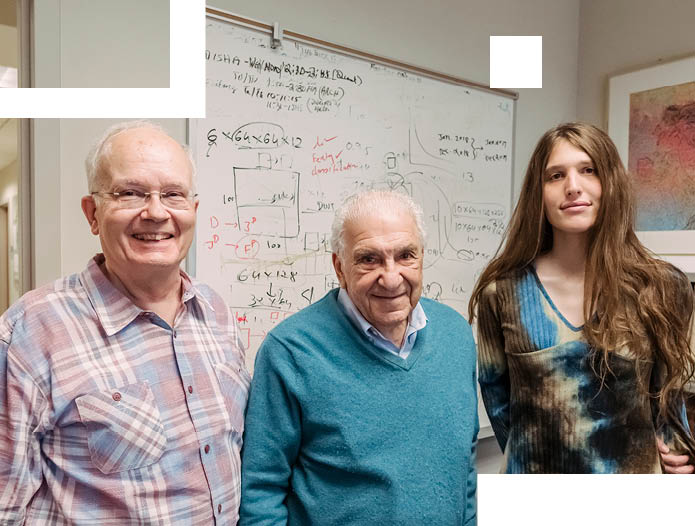
Jim Fischer, Milt Halem, and Sophia Hamer (left to right) in Halem’s UMBC office. One of Halem’s screen prints hangs in the upper right.
“Milt and I would have discussions about my thesis, and I always like to describe it as: Milt decided to adopt me. I was close to the end of my Ph.D., and I changed my focus based on working with him,” she said. “It really changed the trajectory of my career.” After graduating, she became a research assistant professor at UMBC. She currently studies weather and climate-related topics as a senior AI research scientist at Johns Hopkins Applied Physics Laboratory while she continues to work part-time with Halem and his students.
Sophia Hamer ’22, mathematics and computer science, who is currently working with Halem as a master’s student, also credits Halem with helping her find her career footing. She first met him to discuss a research project when she was an undergraduate and just emerging from a time when she struggled with her grades and with choosing a major.
“Dr. Halem took a chance on me,” she says. “I honestly think that was the turning point for me. Before I was thinking, ‘I’m just gonna squeak out of here with a degree and hopefully my GPA isn’t too bad to get a job.’ But now, my entire perspective has shifted: I’m about to graduate with a master’s, and I’m doing impactful research in a field I really like. I never thought that would be possible.”
“Milt is tough—he pushes you—but he also works closely with you,” Sleeman adds. “I really grew from that relationship.”
Both Sleeman and Hamer are working with Halem on a project to be the first to use AI to make regional weather predictions, one of a couple AI projects Halem is currently pursuing.
In his embrace of AI, Halem is yet again advancing alongside the technology that has defined his career. Gone are the days of mere 40,000 instructions per second. Now advanced computer chips power computationally hungry “neural networks” originally inspired by the workings of the human brain. Neural networks are behind celebrity chatbots such as ChatGPT—and forecasters are increasingly turning to them to predict the weather too.
While traditional weather models simulate the physics of the Earth and its atmosphere to make predictions about the future, AI forecasting models simply examine vast datasets of past weather and learn how to spot patterns.
So far, the main advantage of AI forecasting is speed. What can take days for a physics-based model can be done in only minutes or seconds with AI. AI weather models offer great promise for distributed, real-time weather forecasting, for example as natural disasters unfold. Halem and his students are looking in particular to predict wildfires.
While much AI weather forecasting research is undertaken by leading tech companies such as Google and Microsoft, Halem thinks his students are more than holding their own.
“I’ve got a new generation of computer scientists making breakthroughs,” says Halem. “Two students who are writing up their master’s theses are doing leading AI computations to rival what some big tech companies are doing.”
The work of weather and climate modeling is growing in importance as global warming unfolds and the Earth’s natural patterns shift. “Applying what I know to a real-world problem has been an amazing experience,” Hamer says.
The projects are also yet one more demonstration of Halem’s constant intellectual evolution.
“Milt has an amazing ability to learn new things,” says Anupam Joshi, the acting dean of the College of Engineering and Information Technology. “He was trained as a mathematician who then specialized in high-performance computing and in the last few years has become an expert in using AI systems to model weather and climate phenomena. It speaks to his intellectual capabilities but also his perseverance and his grit.”
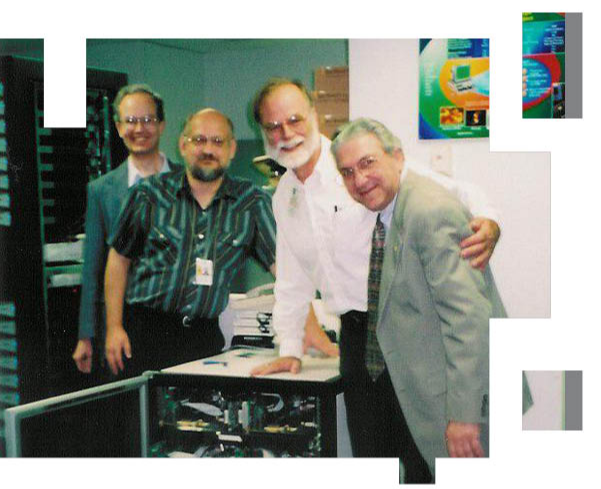
Halem (far right) poses with (from left to right) NASA’s Jim Fischer and John Dorband, and Microsoft Fellow Jim Gray next to the first Beowulf computing cluster. Photo by NASA.
Now in his tenth decade of life, Halem shows few signs of slowing down. When not spending time with his large family, he’s still tackling some of science’s thorniest problems, such as how to predict weather patterns months to years in advance.
“He’s like the energizer bunny,” says Fischer, his former NASA colleague.
Duffy agrees. “He has an amazing amount of energy; he never seems to stop. He has a willingness to listen, learn, and ask questions and is an amazing role model for his students.”
Halem says it’s the computation challenges that drive him. “I have to keep moving because the computational instrument continues to evolve,” he says. He continues to be on the lookout for new ideas—the latest he’s come across being an AI research scientist. “The AI agent can use large language models to read the literature; it can write computer code and conduct experiments by itself. It can write the paper on what it discovered. So that’s probably the ultimate research goal that I would like to see if I can make an impact on,” Halem explains.
“Milt is probably one of the most dedicated people I know to the research,” Sleeman says. “He’s so tenacious, and it’s just so impressive. It’s a privilege to continue to work with him.”
“Milt is incredible,” adds Joshi. “If we could replicate him, we would.” And maybe, in some sense, Halem’s AI scientist would do just that.
 ]]>
]]>

UMBC at the Universities at Shady Grove finds itself uniquely situated—at home within the country’s third largest biotech hub where the demand for highly skilled workers is growing. These Retrievers are filling specialized roles after graduating with the training they need to succeed in this booming industry.
It’s an early Friday morning in the Biological Sciences and Engineering Building and nine students, working in small groups, are bustling back and forth between fume hoods and a large centrifuge. They carefully swish flasks containing cells and growth medium. The smell of sanitizing alcohol pervades the space. Neon orange test tube racks and turquoise tube caps stand out within the sterile white look of the work benches, hoods, and lab coats.
As the cells use oxygen to release energy, they produce carbon dioxide. The CO2 turns the solution yellow, indicating successful cell growth. After the experiment, students sterilize their solution with bleach for disposal; in response to the alkalinity, it blooms to a brilliant magenta. In another room, one student offers tips to her classmate on how to use a pipet more effectively, and the instructor flits between groups, answering questions as needed—but for the most part, the students operate confidently on their own.
This is a regular day in Biotechnology 303: Applied Cell Biology in UMBC’s Translational Life Science Technology (TLST) program. The program, offered by UMBC’s College of Natural and Mathematical Sciences (CNMS) exclusively at the Universities at Shady Grove (USG), a multi-institution education facility in Rockville, Maryland, is designed to offer hands-on training to prepare students for careers in the booming biotech industry in USG’s backyard.
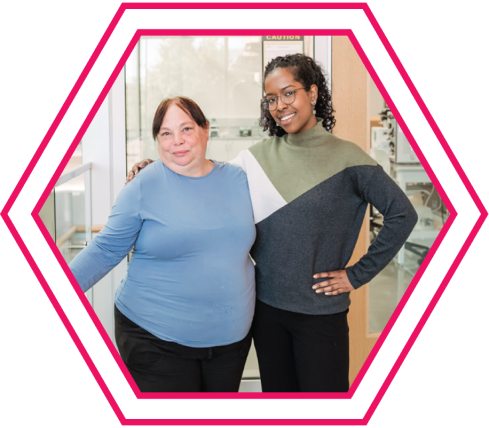
Elizabeth Friar (left) and Samantha Petros ’23 have stayed in touch since Petros graduated.
It was the promise of experiential work with real-world applications that drew Samantha Petros ’23 to the TLST program. “I really liked the convenience of the USG campus, and a lot of the courses were really focused on hands-on learning,” she says. Without really knowing what the work would look like before she started the program, “I was able to try out a lot of different things in a very low-stakes environment and get an idea as to what I found interesting.”
That turned out to be cell culture work. Applied Cell Biology with Elizabeth Friar, lecturer and undergraduate program director in TLST, “cemented that benchwork is what I enjoy doing,” Petros says. From then on, “There was a clearly defined arrowhead in the direction I wanted to go.”
That was a big shift from where she started, as a film major at Montgomery College (MC). A virology course to meet her science requirement turned her on to MC’s biotech associate degree, and then she transitioned to the TLST program at UMBC. After learning some basic lab techniques in TLST classes, she landed a part-time job, where she carried out entry-level manufacturing tasks for malaria vaccines. Today, Petros is thriving as a cell culture specialist studying malaria at Axle Informatics, a contractor for the National Institute of Allergy and Infectious Diseases.
The position she’s in now traditionally requires a master’s degree, which she doesn’t have—yet, anyway. “Knowing that I have valuable skill sets from TLST—working in manufacturing, getting good connections with my professors, and going to the networking events that TLST offers—all of that compounds and has got me to where I am now,” Petros says. “I genuinely believe that I wouldn’t be here if it weren’t for all of those factors, with TLST obviously being the biggest one.”
TLST is a young program, but it is growing quickly. The first class—just two students—arrived in fall 2019. Friar joined in summer 2020 and began laying the groundwork for the program’s eventual growth. Today, “It’s humming along,” she says. There are currently 50 students who have declared TLST as their major. “Now we’re thinking about what we can do next. How can we expand?”
TLST is unique as the only undergraduate STEM program at UMBC without a footprint on the main campus. The location choice at USG is intentional. The Capital Biohealth Region, encompassing the District of Columbia, Virginia, and Maryland, is the third most competitive biotech hub in the country—and Montgomery County, Maryland, is the hub of the hub, boasting more than 350 life science companies and located a stone’s throw from the NIH, FDA, and National Institute of Standards and Technology (NIST). For TLST alumni, the employment options are seemingly limitless: 80 percent of American pharmaceutical companies are within a two-hour drive, and they can expect a nearly 23 percent growth rate in the biotech industry over the next 10 years—well above the national average.
As Friar puts it, “Regenxbio is down the street. MacroGenics is down the street. MilliporeSigma is opening their new lab right next door, and they’ve now hired eight of our alumni. Soon we’ll have an NIH vaccine lab right down the street. ATCC is right down the street.” All these biotech companies need qualified workers—and TLST is providing them.
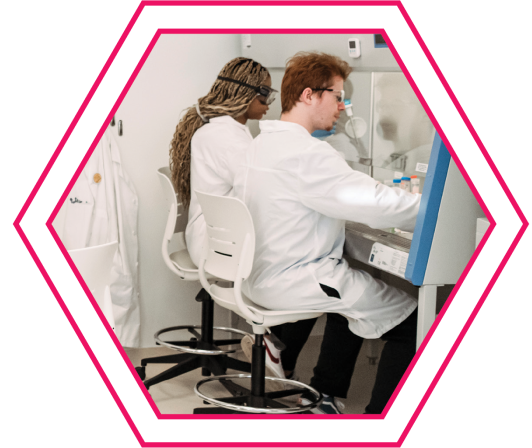
Steven Schaffer (right) and Princess Nyamali work under a biosafety cabinet in Elizabeth Friar’s Applied Cell Biology course.
Jeff Galvin, CEO of American Gene Technologies (AGT), has hired TLST alumni and would hire more. “The TLST program seems to provide a great overview of not just biotechnology techniques,” he says, but it gives students “an understanding of the business in general. I find that UMBC students lean toward being self-motivated problem-solvers. It seems that the administration from the top all the way down promotes that idea of creating value through creative, hard work.”
Titina Sirak ’20, TLST, had a major impact at AGT. She established a brand-new laboratory certified to handle human cells from scratch, Galvin says, “And that’s not easy—there’s a lot of regulations associated with that, even economics.” While she wasn’t an expert at first, “she was able to do enough things right that the project came to life.”
Galvin emphasizes the importance of “learning how to learn,” saying, “Things are changing so fast, that it’s the folks who can adapt and become lifetime learners who are going to be the most successful.And that’s something I saw from the students coming out of TLST.”
So far, TLST has graduated 25 students, and 94 percent of them were employed in the biotech industry within three months of walking across the Commencement stage. “We’ve had a number of really standout students who have gone on to do really great things, so I’m very excited about how it’s going,” Friar says.
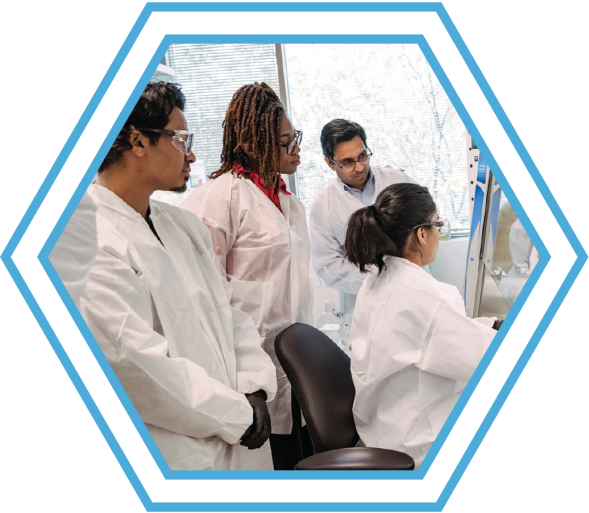
Merryll Kallungal ’24 works under a biosafety cabinet at ATCC. Interns Jason Bose (left) and Tamilore Akinde (second from left) and an ATCC lead scientist observe.
So is William R. LaCourse, CNMS dean, which offers the TLST program. He envisioned the program years before the first two students walked onto the USG campus, and it came together with input from faculty at Montgomery College and five departments at UMBC.
“TLST is an innovative and practical education that combines ‘know-what’ and ‘know-how,’” says LaCourse. “It is a highly flexible program with various pathways to serve the ever-changing needs of a growing industry. TLST is where the silos of disciplines break down and cross-disciplinary knowledge is the goal—both in content and practice.”
The program is shaping up just as LaCourse and Annica Wayman ’99, mechanical engineering, and former associate dean for Shady Grove Affairs in CNMS who led TLST’s launch, had hoped. The state of Maryland is growing its biotech hub while UMBC students are gaining the skills they need to succeed in the workplace and getting well-paying jobs, and the student population is growing.
Just as important as high-demand lab skills, students and alumni value the relationships they’ve formed with faculty. “Every teacher I had was very supportive, very understanding, very willing to work with me,” Petros says. “I think it’s important to get your money’s worth out of college, and I definitely feel like I got that and more in TLST because of the support network that I had there and my teachers.”
Petros is still in touch periodically with Wayman and Friar. “Dr. Wayman was a shining inspiration. She’s just a wonderful person. She’s so knowledgeable and always willing to help,” Petros says. The support she has and the success she’s found now have inspired Petros to look back and help those coming up behind her. In addition to USG resources, as a student Petros attended networking events offered by BioBuzz, a community resource for biotech industry professionals and job seekers in the Capital Biohealth Region. In fact, it’s how she found her current role.
Today Petros is a BioBuzz Ambassador. “I wish I had known about BioBuzz when I first started in biotech,” she says. “Now I want to be that advocate for younger students or people who are just starting in science.”
“Our students come to us because they want to make a difference in people’s lives, but they don’t necessarily want to go to medical school,” Friar says. It doesn’t hurt that “we have some really spectacular facilities that are a real draw for students,” she adds.
The Biological Sciences and Engineering Building opened at USG in fall 2019 and boasts beautiful modern laboratories and classrooms plus plenty of comfy nooks for meeting with a study group or just relaxing. TLST has also received over $1 million dollars from the National Institute for Innovation in Manufacturing Pharmaceuticals, some of which has supported further upgrades and additions to the teaching laboratories.
A flow cytometer, a machine that can detect properties of interest in up to 10,000 cells per minute, will enable a new mixed undergraduate/graduate course in flow cytometry launching next spring, for example. And equipment to practice skills like protein purification, biomanufacturing processes, and cell culture create rare opportunities for undergraduates. A required TLST course covers the wide range of instrumentation you might find in a modern biotech laboratory.
It’s normal for students to start off nervous when they use complicated and expensive equipment or work with human cells for the first time. “But by the end, they are old hands, and I think they would feel comfortable tackling anything in that lab on their own,” Friar says. “And it’s because the curriculum is really well scaffolded. We add skills as they go along, and then we repeat the old skills. The program is set up to foster growth and independence.”
Princess Nyamali stepped away from the centrifuge for a moment during Biotechnology 303 to share that the TLST coursework “is a really good foundation.” She’s currently completing an internship at NIST, and “everything I’m learning in this cell culture class is stuff I’m doing at NIST.” While it might have been daunting at first, trying so many different things across the TLST curriculum “helps you know that you want to do it,” she says, in addition to showing potential employers that you can.
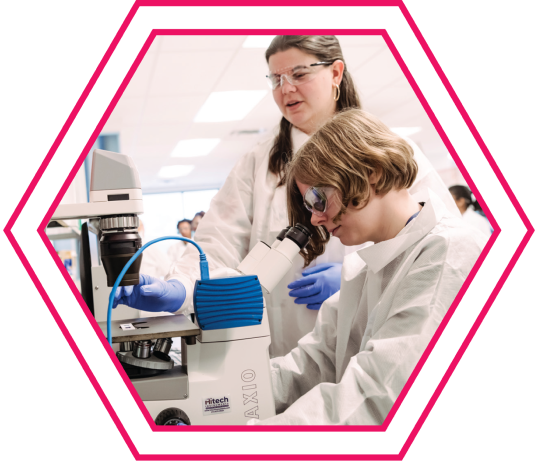
TLST student Fae Switzer works at the microscope with guidance from her mentor, Emma Todd, at ATCC.
Although the two-year program initially targeted transfers from regional community colleges, “we were getting so much interest from students on the Catonsville campus, we went ahead and put it on the list of majors for freshmen applying to UMBC,” Friar says. “That’s been the fastest growing cohort in our major.”
Steven Schaffer transferred to TLST after starting on the main campus in bioinformatics. Now he is in the bioinformatics track within TLST; the other option is a biomanufacturing track. Schaffer likes that there is a strong cohort connection because everyone takes mostly the same classes together. “I would recommend TLST. It’s a growing field and the skills you learn are very versatile,” Schaffer adds.
Schaffer hopes to eventually take on a role that leans into engineering at a place like Northrop Grumman. But before that, he’s eyeing UMBC’s Master of Professional Studies in biotechnology. The M.P.S. degree offers advanced instruction in the life sciences, plus coursework in regulatory affairs, leadership, management, and financial management. Friar describes it as “a cross between a science master’s and an M.B.A.”
Soon, the confident students in Friar’s cell biology class will arrive in labs across Montgomery County, the capital region, and beyond. They will contribute to drug discovery and production, design manufacturing processes, and, eventually, lead teams and make strategic decisions for major biotech companies.
Jeff Galvin, the ATG CEO, referred to TLST alumni as “academic decathletes.” Like decathletes, they have an array of skills and perform all of them admirably. But rather than medals, they’re seeking an opportunity to contribute to positive change through their work. They’ll translate basic science into diagnostic tests, treatments for disease, and more to improve the lives of their neighbors in Maryland and those in need around the world.
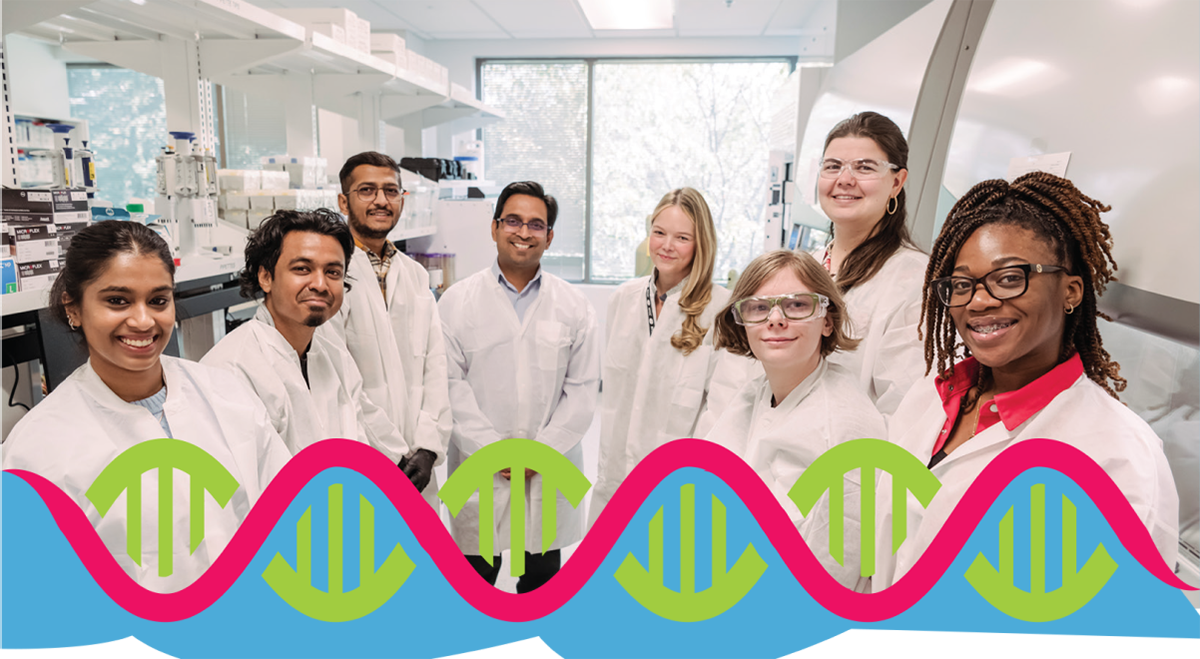
ATCC’s SPARC internship program offers opportunities for TLST students to conduct meaningful work in the biotech industry. Merryll Kallungal (far left) transitioned from her internship to a full-time role at ATCC this summer.
Just 10 minutes from USG in Gaithersburg, Maryland, biotech company ATCC has capitalized on the TLST talent pipeline. Their Student Partnership and Research Collaboration (SPARC) Program requires USG enrollment and offers qualified students paid, part-time career opportunities throughout the academic year at ATCC’s research facility. As the leading developer and supplier of authenticated cell lines, microorganisms, and associated data for academia, industry, and government, a successful internship at ATCC is a feather in the cap for students pursuing a TLST degree.
Of the seven interns selected for the SPARC program this year, four are TLST students—and they are thriving. The interns praised their SPARC experience while donning lab coats, shoe booties, safety glasses, and gloves in one of ATCC’s labs—where keeping employees safe and protecting lab samples and products from contamination is mission critical.
“I love the TLST program!” exclaimed Fae Switzer, who has wanted to pursue a career in biotech since she learned about CRISPR, the gene-editing platform, as a child. Switzer, a SPARC associate biologist in the microphysiological unit, notes that things she learned in her UMBC classes prepared her for the internship, and things she’s learning at ATCC now are helping her in her classes.
Jason Bose, a SPARC associate biologist on the microbiology team, knew he was interested in biologybut not medical school. When Bose learned about TLST, he thought, “Wow, this aligns with what I want to do,” he says. “It’s been really great so far.” He even uses the basic coding skills and tricks for Excel spreadsheets that he learned in class—which at the time he wasn’t so sure about. “Yep, I use them all the time at ATCC,” he says.
Tamilore Akinde completed an internship last summer at ATCC’s headquarters in Manassas, Virginia, and now she is a SPARC intern. “I like that TLST teaches multidisciplinary skills,” she says. Being able to pivot toward different opportunities that come her way is valuable, she adds.
“The hands-on lab training provided by the TLST program has prepared students for impactful careers at ATCC,” shares Ruth Cheng, general manager and senior vice president for research and industrial solutions at ATCC. “Witnessing students like Merryll Kallungal transition from the SPARC program to a full-time role in cryobiology R&D is a testament to the power of this collaboration.”
After interning at ATCC, Kallungal graduated from TLST in May and assumed a full-time associate biologist role in the cryobiology group in June. The lab techniques she learned in TLST came in handy at ATCC, and she has already learned a lot of new things, too. “I absolutely love what I do,” she says.

Walking into the Albin O. Kuhn Library Gallery, you always know you’re going to see some well-curated photos and works of art, but the trove of images currently on the walls for Revisions: Celebrating 50 Years of the UMBC Photography Collections (closes December 15) are assembled as an remarkable representational sample of the nearly 3 million images that make up the UMBC archive.
Known today as one of the country’s premiere university collections of photographs, the Photography Collections had a modest but auspicious beginning. In 1974, the Baltimore lithographer and photographer Edward Bafford donated to UMBC Special Collections a remarkable early image by Arthur Stieglitz (1864–1946), a photographer widely credited with helping transform photography into a serious art form. Bafford’s gift coincided with the foundational purchase of more than 5,400 photographs by labor activist Lewis Hine that documented horrific child labor practices.
Over time, the Photography Collections at UMBC have expanded through purchases and gifts. One special acquisition stands out for its regional importance: In 2014, the collection received the photo archives of the Baltimore Sun, including more than 750,000 prints, negatives, and transparencies from the 1930s through the 1980s.
Housed in the Special Collections department of the Library, the collections are open to the public, and are widely used by scholars and photographers. An increasing number of images have been digitized for online viewing, available through the Library’s website.
Looking back at a half-century of collecting, the exhibition offered thematic groupings and visual juxtapositions of photographs from the nineteenth century to the present. Co-curated by Beth Saunders, curator and head of Special Collections, and Emily Hauver ’06, curator of the Albin O. Kuhn Library Gallery, Revisions asked viewers to approach the history of photography with fresh eyes. In this photo essay, Hauver offers her thoughts on a few stand-out images in the show.
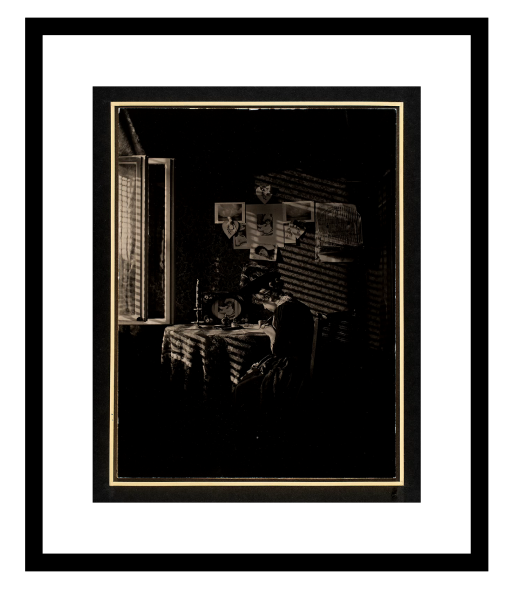
Sun Rays-Paula, Berlin is a particularly apt founding image for a university collection; it was made when the great Steiglitz was himself a student, and could thus be viewed as a symbol of the endurance of formative educational experiences on the making of an individual’s personal and professional identity. UMBC’s Photography Collections were conceived of as a teaching tool through which budding photographers enrolled at the university can contemplate the elements of successful photographs through the close study of master prints.
Alfred Stieglitz (American, 1864–1946), Sun Rays—Paula, Berlin, 1889. Gelatin silver print, 1929. Gift of Edward Bafford, P74-07-001.
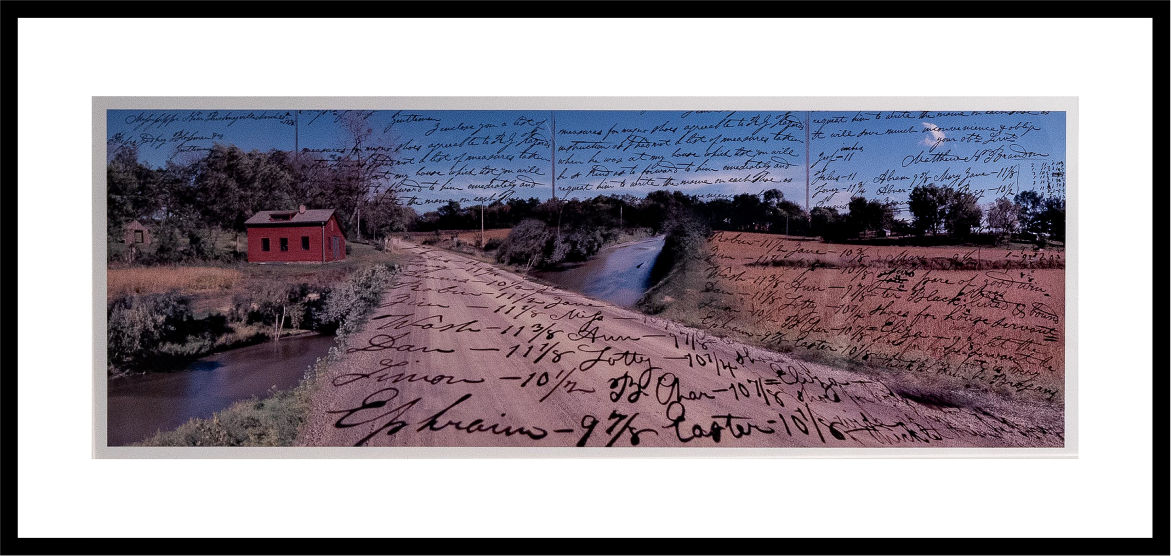
Stephen Marc, American, born 1954, [Nishnabotna Ferry House], ca. 2001–2008. Inkjet print. Stephen Marc Collection, Coll353-P001.
Bringing the past palpably into the present, this photograph by Stephen Marc utilizes digital montage to weave together elements from the landscape of slavery—in this case a site associated with the Underground Railroad, the Nishnabotna Ferry House, and an 1836 letter from a Mississippi slaveholder ordering shoes for the people he enslaved. The names of the enslaved, which appear to be marching along the path to freedom and a better future, memorialize both the individuals held captive and those who succeeded in escaping.
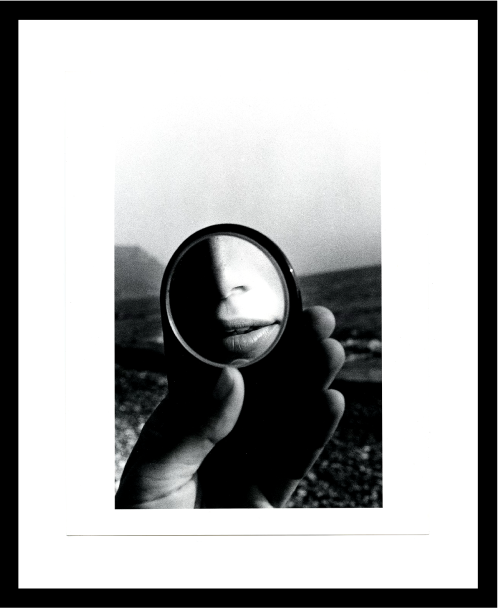
Ralph Gibson (American, born 1939), Elba, c.1983. Gelatin silver print. Gift of Carol A. Merritt, P93-14-004.
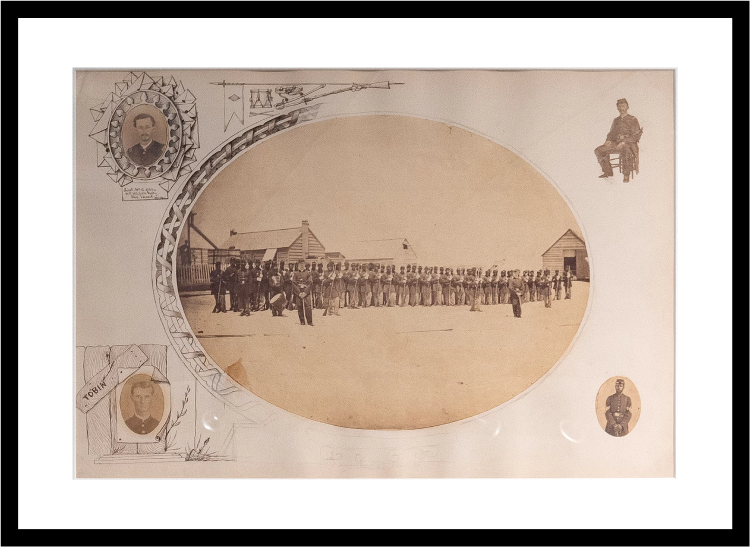
This composition comprises several photographs of Black Union soldiers and white officers and is embellished with hand-drawn elements. Posing for portraits during the Civil War— the first major conflict to be extensively documented through photography—allowed Black men to assert their newfound identity and freedom as soldiers. The person who made this composition sought to memorialize the patriotism of Black soldiers through the visual image, showcasing the commitment of these men to fight for their own liberation. The fact that the embellishments are incomplete draw a poignant, if unintentional, parallel to the unfinished business of achieving true racial equality in this country.


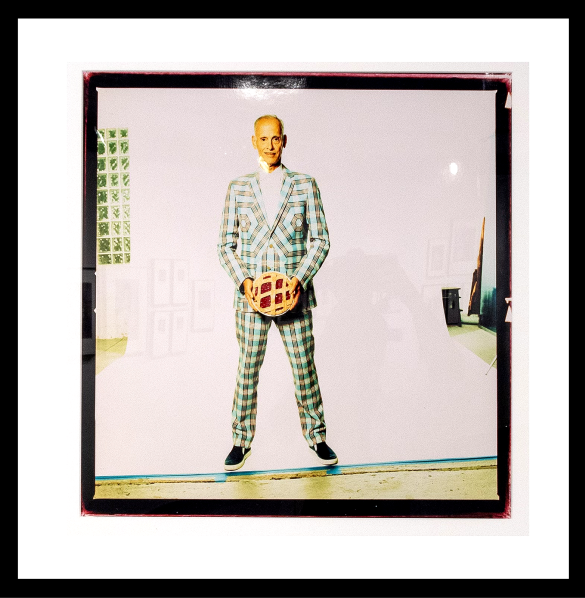
John Waters, 2013
What could be more “Baltimore” than John Waters? In this image, taken by Sam Holden, a Baltimore-based photographer who tragically passed away at the age of 44 in 2019, the filmmaker grins impishly at the camera while posing with a cherry pie.
Sam Holden (American, 1970–2014), John Waters, 2013. Cross processed chromogenic print. Sam Holden Collection, Coll255_IA-001.

Marble Steps, 1954
Row after row of white marble steps for which the city of Baltimore is famous are seen in this photograph by Aubrey Bodine, one of Maryland’s best-known photographers. The geometry and contrasting tones of the steps pair with Bodine’s meticulous composition to manipulate the viewer’s perception by drawing the eye down the block and giving the impression of depth that defies the flat surface of this photograph.
A. Aubrey Bodine (American, 1906–1970), Marble Steps, 1954. Gelatin silver print. Gift of Mrs. A. Aubrey Bodine, P86-19-032.
This photograph by Mary Ellen Mark flips the typical script of looking at a photograph wherein the observer looks upon a passive subject. Here, the photograph appears to be looking back. Despite the visual distortion caused by the screen covering the door’s small window, the power of this woman’s gaze implores us to make a connection, challenging us to engage on a deeper level with her and, perhaps, with ourselves. It’s made all the more compelling knowing that it was taken on Ward 81, a women’s security ward of the Oregon State Mental Institution.
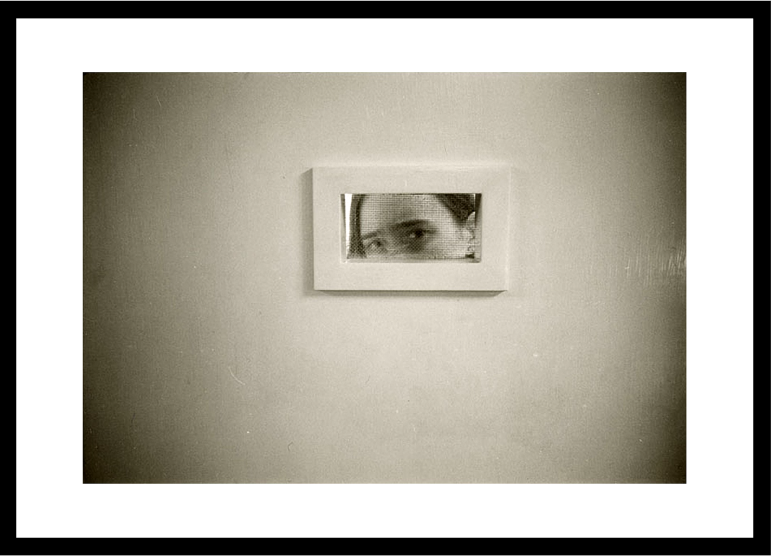
Mary Ellen Mark (American, 1940–2015), Ward 81, Oregon State Hospital, Salem, Oregon, 1976. Gelatin silver print. Gift of Andrew Cahan, P2013-32-001.
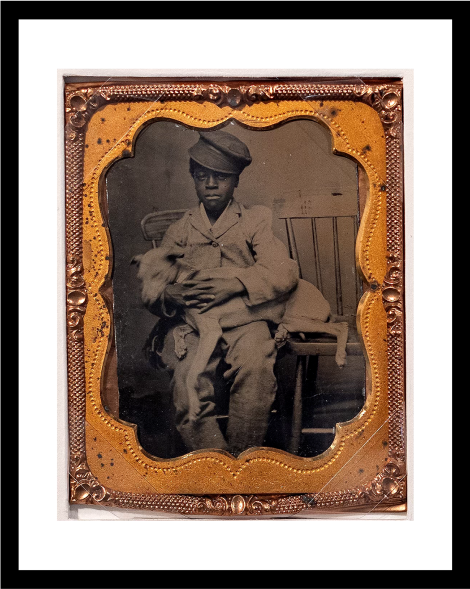
Our collections hold thousands of images of anonymous people. Here, a small tintype shows an unusual pairing—a Black boy with a dog—framed in a case. We don’t know his name or where the photo was taken, but we can date this image to the 1870s. As we gaze back into his eyes, we wonder: Who was he? What was his story?
Unidentified photographer, Boy and dog, c. 1870s. Tintype. Library purchase, P78-120-006.
Mirrors, with which photographs have long been metaphorically compared, offer opportunities to extend the narrative possibilities of a photograph beyond what is in front of the camera to what is behind, beside and beyond. This photograph by Ralph Gibson is compelling because it elicits conflicting reactions at once: comfort with the familiarity of the subjects (a nose, mouth, hand, landscape) and unease with the disjointed way they have been assembled.
Unidentified photographer, Boy and dog, c. 1870s. Tintype. Library purchase, P78-120-006
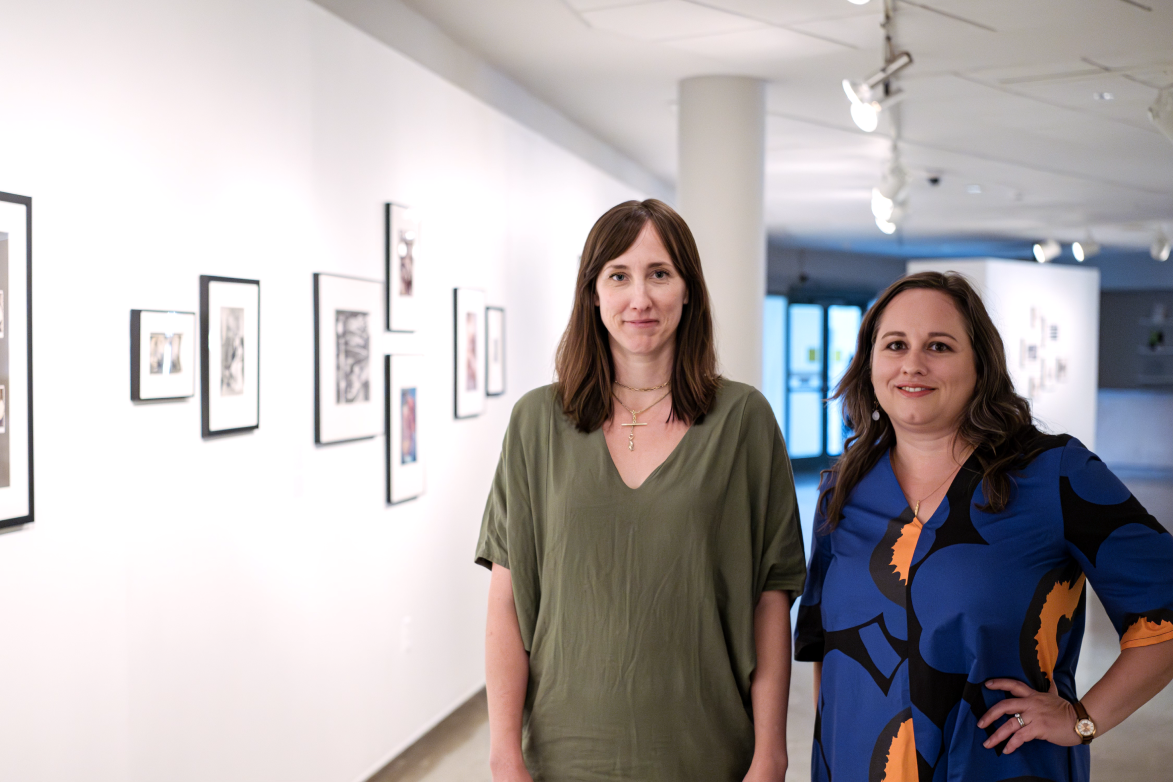
Emily Hauver ’06, curator of the Albin O. Kuhn Library Gallery, and Beth Saunders, curator and head of Special Collections, worked together to comb through the university’s extensive collections to display a stunning representation of what is available in the archives.
By Emily Hauver ’06 and Thomas Moore
]]>