Study finds strongest evidence yet for local sources of cosmic ray electrons
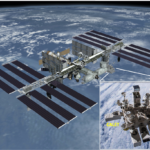
A new study using data from the CALorimetric Electron Telescope (CALET)instrument on the International Space Station has found evidence for nearby, young sources of cosmic ray electrons, contributing to a greater understanding of how the galaxy functions as a whole.
The study included more than seven million data points representing particles arriving at CALET’s detector since 2015, and CALET’s ability to detect electrons at the highest energies is unique. As a result, the data includes more electrons at high energies than any previous work. That makes the statistical analysis of the data more robust and lends support to the conclusion that there are one or more local sources of cosmic ray electrons.
“This is one of the primary things that CALET is made to look for,” says Nicholas Cannady, an assistant research scientist with UMBC’s Center for Space Sciences and Technology, a partnership with NASA Goddard Space Flight Center, and a leader on the study. With this paper, he adds, “We were really able to push into the realm where we have few events and start to look for things at the highest energies, which is exciting.”
A better understanding of the galaxy
 Nicholas Cannady, the lead U.S. scientist on the new study, is excited that the CALET mission is bearing fruitful results. (Image courtesy of Cannady)
Current theory posits that the aftermath of supernovae (exploding stars), called supernova remnants, produce these high energy electrons, which are a specific type of cosmic ray. Electrons lose energy very quickly after leaving their source, so the rare electrons arriving at CALET with high energy are believed to originate in supernova remnants that are relatively nearby (on a cosmic scale), Cannady explains.
The study’s results are “a strong indicator that the paradigm that we have for understanding these high-energy electrons—that they come from supernova remnants and that they are accelerated the way that we think they are—is correct,” Cannady says. The findings “give insight into what’s going on in these supernova remnants, and offer a way to understand the galaxy and these sources in the galaxy better.”
CALET is a collaborative project built and operated by groups in Japan, Italy, and the United States, led by Shoji Torii. The lead contributors to this work in Japan are Torii, Yosui Akaike, and Holger Motz at Waseda University in Tokyo, and Louisiana State University is the lead institution in the U.S. The findings were published in Physical Review Letters.
New data lead to new cosmic ray sources
Previous work found that the number of electrons arriving at CALET decreased steadily as energy increased up to about 1 teravolt (TeV), or 1 trillion electron volts. The number of electrons arriving with even greater energy was extremely low. But in this study, CALET did not see the expected dropoff. Instead, the results suggest that the number of particles plateau, and then even increase, at the highest energies—all the way up to 10 TeV in a few cases.
Previous experiments could only measure particles up to about 4 TeV, so the highest energy event candidates above that in this study are a crucial new source of information about potential nearby sources of cosmic ray electrons. Cannady led the effort to individually analyze each of those events to confirm they represent a real signal, and a deeper dive into those events is forthcoming.
Addressing challenges
It’s difficult to distinguish between electrons and protons at high energies, and there are many more protons arriving than electrons, which poses challenges to an accurate analysis. To tell the particles apart, a program developed by the researchers analyzes how the particles break down when they hit the detector. Protons and electrons break down differently, so comparing the cascade of particles they create in that process can filter out the protons. However, at the highest energies, the differences between protons and electrons decrease, making it harder to accurately remove only the protons from the data.
To address this, Cannady led the CALET team’s effort to simulate the breakdown patterns of both protons and electrons coming from the exact direction each of the high-energy events arrived from. That increased the team’s ability to determine whether the events are electrons or protons as accurately as possible.
Based on that work, “We believe we are evaluating the likelihood of events being protons in a realistic fashion,” Cannady says. Enough presumed electrons remain in the dataset after that careful analysis to conclude there is a real signal.
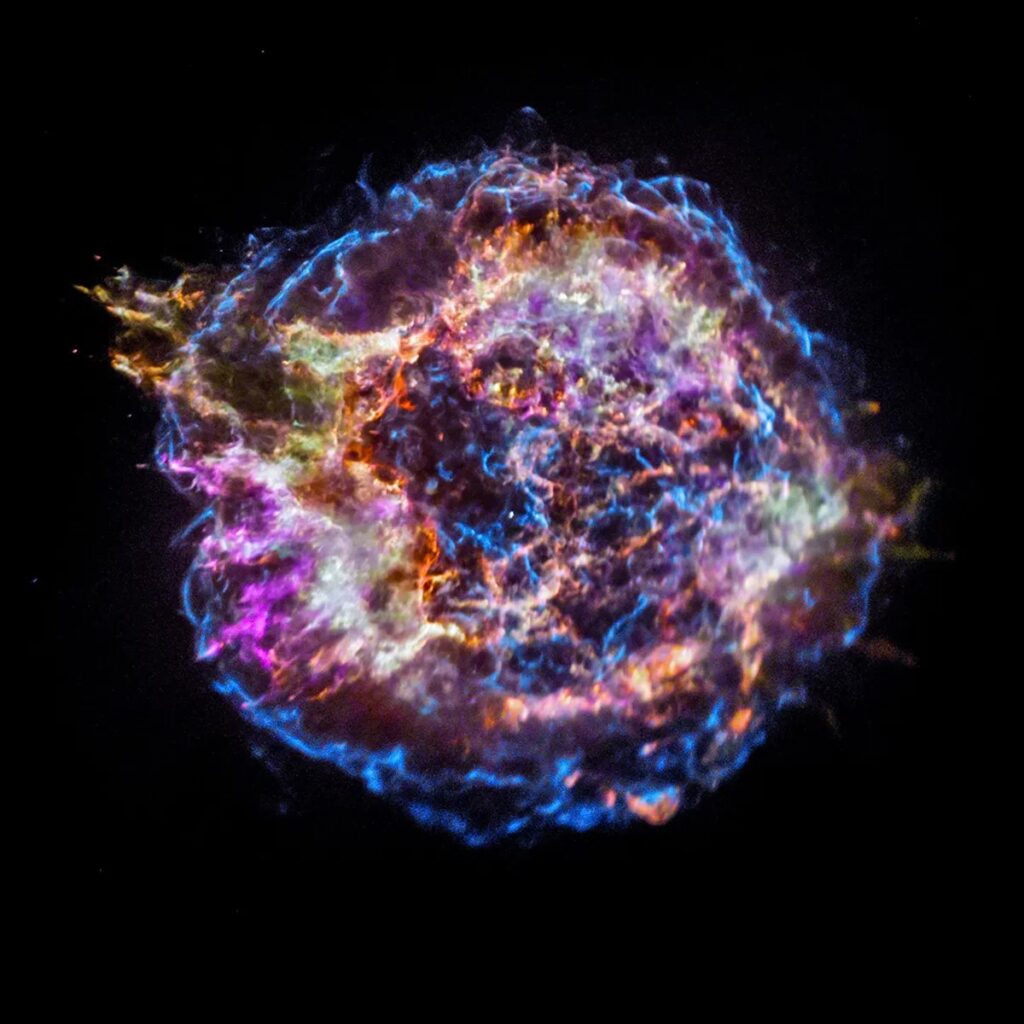 An x-ray image of Cassiopeia A, an example of a young supernova remnant. (Image courtesy of NASA)
Pushing boundaries
T. Gregory Guzik, professor of physics at LSU and the U.S. CALET collaboration lead, is excited that further analysis of the data suggested that electrons coming from the three best candidates for nearby supernova remnants can explain the high-energy arrivals.
“These CALET observations open the tantalizing possibility that matter from a particular nearby supernova remnant can be measured at Earth,” Guzik shares. “Continued CALET measurement through the life of the International Space Station will help shed new light on the origin and transport of relativistic matter in our galaxy.”
For Cannady, “The most exciting part is seeing things at the highest energies. We have some candidates above 10 TeV—and if it is borne out that these are real electron events, it’s really a smoking gun for clear evidence of a nearby source,” he says. “This is essentially what CALET was put up to do, so it’s exciting to be working on this and to finally be getting results that are pushing the bounds of what we’ve seen before.”
]]>
A new study using data from the CALorimetric Electron Telescope (CALET)instrument on the International Space Station has found evidence for nearby, young sources of cosmic ray electrons,...
https://umbc.edu/stories/calet-detects-high-energy-cosmic-ray-electrons/
https://my3.my.umbc.edu/api/v0/pixel/news/137074/guest@my.umbc.edu/d13963f002bb21b25ab24a7c0429d237/api/pixel
csst
news
research
science-and-tech
UMBC News & Magazine
https://my3.my.umbc.edu/groups/umbc-news-magazine
https://assets1-my.umbc.edu/system/shared/avatars/groups/000/001/943/24435aa6207c452e7bc15cc74b42c7bb/xsmall.png?1748556657
https://assets1-my.umbc.edu/system/shared/avatars/groups/000/001/943/24435aa6207c452e7bc15cc74b42c7bb/original.png?1748556657
https://assets2-my.umbc.edu/system/shared/avatars/groups/000/001/943/24435aa6207c452e7bc15cc74b42c7bb/xxlarge.png?1748556657
https://assets2-my.umbc.edu/system/shared/avatars/groups/000/001/943/24435aa6207c452e7bc15cc74b42c7bb/xlarge.png?1748556657
https://assets3-my.umbc.edu/system/shared/avatars/groups/000/001/943/24435aa6207c452e7bc15cc74b42c7bb/large.png?1748556657
https://assets1-my.umbc.edu/system/shared/avatars/groups/000/001/943/24435aa6207c452e7bc15cc74b42c7bb/medium.png?1748556657
https://assets2-my.umbc.edu/system/shared/avatars/groups/000/001/943/24435aa6207c452e7bc15cc74b42c7bb/small.png?1748556657
https://assets1-my.umbc.edu/system/shared/avatars/groups/000/001/943/24435aa6207c452e7bc15cc74b42c7bb/xsmall.png?1748556657
https://assets2-my.umbc.edu/system/shared/avatars/groups/000/001/943/24435aa6207c452e7bc15cc74b42c7bb/xxsmall.png?1748556657
UMBC News & Magazine
2
0
false
Tue, 14 Nov 2023 11:50:52 -0500
Tue, 14 Nov 2023 11:50:52 -0500
Study finds strongest evidence yet for local sources of cosmic ray electrons
A new study using data from the CALorimetric Electron Telescope (CALET)instrument on the International Space Station has found evidence for nearby, young sources of cosmic ray electrons, contributing to a greater understanding of how the galaxy functions as a whole.
The study included more than seven million data points representing particles arriving at CALET’s detector since 2015, and CALET’s ability to detect electrons at the highest energies is unique. As a result, the data includes more electrons at high energies than any previous work. That makes the statistical analysis of the data more robust and lends support to the conclusion that there are one or more local sources of cosmic ray electrons.
“This is one of the primary things that CALET is made to look for,” says Nicholas Cannady, an assistant research scientist with UMBC’s Center for Space Sciences and Technology, a partnership with NASA Goddard Space Flight Center, and a leader on the study. With this paper, he adds, “We were really able to push into the realm where we have few events and start to look for things at the highest energies, which is exciting.”
A better understanding of the galaxy
Nicholas Cannady, the lead U.S. scientist on the new study, is excited that the CALET mission is bearing fruitful results. (Image courtesy of Cannady)
Current theory posits that the aftermath of supernovae (exploding stars), called supernova remnants, produce these high energy electrons, which are a specific type of cosmic ray. Electrons lose energy very quickly after leaving their source, so the rare electrons arriving at CALET with high energy are believed to originate in supernova remnants that are relatively nearby (on a cosmic scale), Cannady explains.
The study’s results are “a strong indicator that the paradigm that we have for understanding these high-energy electrons—that they come from supernova remnants and that they are accelerated the way that we think they are—is correct,” Cannady says. The findings “give insight into what’s going on in these supernova remnants, and offer a way to understand the galaxy and these sources in the galaxy better.”
CALET is a collaborative project built and operated by groups in Japan, Italy, and the United States, led by Shoji Torii. The lead contributors to this work in Japan are Torii, Yosui Akaike, and Holger Motz at Waseda University in Tokyo, and Louisiana State University is the lead institution in the U.S. The findings were published in Physical Review Letters.
New data lead to new cosmic ray sources
Previous work found that the number of electrons arriving at CALET decreased steadily as energy increased up to about 1 teravolt (TeV), or 1 trillion electron volts. The number of electrons arriving with even greater energy was extremely low. But in this study, CALET did not see the expected dropoff. Instead, the results suggest that the number of particles plateau, and then even increase, at the highest energies—all the way up to 10 TeV in a few cases.
Previous experiments could only measure particles up to about 4 TeV, so the highest energy event candidates above that in this study are a crucial new source of information about potential nearby sources of cosmic ray electrons. Cannady led the effort to individually analyze each of those events to confirm they represent a real signal, and a deeper dive into those events is forthcoming.
Addressing challenges
It’s difficult to distinguish between electrons and protons at high energies, and there are many more protons arriving than electrons, which poses challenges to an accurate analysis. To tell the particles apart, a program developed by the researchers analyzes how the particles break down when they hit the detector. Protons and electrons break down differently, so comparing the cascade of particles they create in that process can filter out the protons. However, at the highest energies, the differences between protons and electrons decrease, making it harder to accurately remove only the protons from the data.
To address this, Cannady led the CALET team’s effort to simulate the breakdown patterns of both protons and electrons coming from the exact direction each of the high-energy events arrived from. That increased the team’s ability to determine whether the events are electrons or protons as accurately as possible.
Based on that work, “We believe we are evaluating the likelihood of events being protons in a realistic fashion,” Cannady says. Enough presumed electrons remain in the dataset after that careful analysis to conclude there is a real signal.
An x-ray image of Cassiopeia A, an example of a young supernova remnant. (Image courtesy of NASA)
Pushing boundaries
T. Gregory Guzik, professor of physics at LSU and the U.S. CALET collaboration lead, is excited that further analysis of the data suggested that electrons coming from the three best candidates for nearby supernova remnants can explain the high-energy arrivals.
“These CALET observations open the tantalizing possibility that matter from a particular nearby supernova remnant can be measured at Earth,” Guzik shares. “Continued CALET measurement through the life of the International Space Station will help shed new light on the origin and transport of relativistic matter in our galaxy.”
For Cannady, “The most exciting part is seeing things at the highest energies. We have some candidates above 10 TeV—and if it is borne out that these are real electron events, it’s really a smoking gun for clear evidence of a nearby source,” he says. “This is essentially what CALET was put up to do, so it’s exciting to be working on this and to finally be getting results that are pushing the bounds of what we’ve seen before.”
]]>
A new study using data from the CALorimetric Electron Telescope (CALET)instrument on the International Space Station has found evidence for nearby, young sources of cosmic ray electrons,...
https://umbc.edu/stories/calet-detects-high-energy-cosmic-ray-electrons/
https://my3.my.umbc.edu/api/v0/pixel/news/137202/guest@my.umbc.edu/bae1852ae8f6168160dedadc8bbe6128/api/pixel
csst
news
research
science-and-tech
UMBC News
https://my3.my.umbc.edu/groups/umbc-news
https://assets2-my.umbc.edu/system/shared/avatars/groups/000/001/944/2c79aeea85b1abb37f8cf9fbcdc382b0/xsmall.png?1632921809
https://assets4-my.umbc.edu/system/shared/avatars/groups/000/001/944/2c79aeea85b1abb37f8cf9fbcdc382b0/original.png?1632921809
https://assets4-my.umbc.edu/system/shared/avatars/groups/000/001/944/2c79aeea85b1abb37f8cf9fbcdc382b0/xxlarge.png?1632921809
https://assets1-my.umbc.edu/system/shared/avatars/groups/000/001/944/2c79aeea85b1abb37f8cf9fbcdc382b0/xlarge.png?1632921809
https://assets1-my.umbc.edu/system/shared/avatars/groups/000/001/944/2c79aeea85b1abb37f8cf9fbcdc382b0/large.png?1632921809
https://assets1-my.umbc.edu/system/shared/avatars/groups/000/001/944/2c79aeea85b1abb37f8cf9fbcdc382b0/medium.png?1632921809
https://assets4-my.umbc.edu/system/shared/avatars/groups/000/001/944/2c79aeea85b1abb37f8cf9fbcdc382b0/small.png?1632921809
https://assets2-my.umbc.edu/system/shared/avatars/groups/000/001/944/2c79aeea85b1abb37f8cf9fbcdc382b0/xsmall.png?1632921809
https://assets4-my.umbc.edu/system/shared/avatars/groups/000/001/944/2c79aeea85b1abb37f8cf9fbcdc382b0/xxsmall.png?1632921809
UMBC News
0
0
false
Tue, 14 Nov 2023 11:50:52 -0500
Study finds strongest evidence yet for local sources of cosmic ray electrons
A new study using data from the CALorimetric Electron Telescope (CALET)instrument on the International Space Station has found evidence for nearby, young sources of cosmic ray electrons, contributing to a greater understanding of how the galaxy functions as a whole.
The study included more than seven million data points representing particles arriving at CALET’s detector since 2015, and CALET’s ability to detect electrons at the highest energies is unique. As a result, the data includes more electrons at high energies than any previous work. That makes the statistical analysis of the data more robust and lends support to the conclusion that there are one or more local sources of cosmic ray electrons.
“This is one of the primary things that CALET is made to look for,” says Nicholas Cannady, an assistant research scientist with UMBC’s Center for Space Sciences and Technology, a partnership with NASA Goddard Space Flight Center, and a leader on the study. With this paper, he adds, “We were really able to push into the realm where we have few events and start to look for things at the highest energies, which is exciting.”
A better understanding of the galaxy
Nicholas Cannady, the lead U.S. scientist on the new study, is excited that the CALET mission is bearing fruitful results. (Image courtesy of Cannady)
Current theory posits that the aftermath of supernovae (exploding stars), called supernova remnants, produce these high energy electrons, which are a specific type of cosmic ray. Electrons lose energy very quickly after leaving their source, so the rare electrons arriving at CALET with high energy are believed to originate in supernova remnants that are relatively nearby (on a cosmic scale), Cannady explains.
The study’s results are “a strong indicator that the paradigm that we have for understanding these high-energy electrons—that they come from supernova remnants and that they are accelerated the way that we think they are—is correct,” Cannady says. The findings “give insight into what’s going on in these supernova remnants, and offer a way to understand the galaxy and these sources in the galaxy better.”
CALET is a collaborative project built and operated by groups in Japan, Italy, and the United States, led by Shoji Torii. The lead contributors to this work in Japan are Torii, Yosui Akaike, and Holger Motz at Waseda University in Tokyo, and Louisiana State University is the lead institution in the U.S. The findings were published in Physical Review Letters.
New data lead to new cosmic ray sources
Previous work found that the number of electrons arriving at CALET decreased steadily as energy increased up to about 1 teravolt (TeV), or 1 trillion electron volts. The number of electrons arriving with even greater energy was extremely low. But in this study, CALET did not see the expected dropoff. Instead, the results suggest that the number of particles plateau, and then even increase, at the highest energies—all the way up to 10 TeV in a few cases.
Previous experiments could only measure particles up to about 4 TeV, so the highest energy event candidates above that in this study are a crucial new source of information about potential nearby sources of cosmic ray electrons. Cannady led the effort to individually analyze each of those events to confirm they represent a real signal, and a deeper dive into those events is forthcoming.
Addressing challenges
It’s difficult to distinguish between electrons and protons at high energies, and there are many more protons arriving than electrons, which poses challenges to an accurate analysis. To tell the particles apart, a program developed by the researchers analyzes how the particles break down when they hit the detector. Protons and electrons break down differently, so comparing the cascade of particles they create in that process can filter out the protons. However, at the highest energies, the differences between protons and electrons decrease, making it harder to accurately remove only the protons from the data.
To address this, Cannady led the CALET team’s effort to simulate the breakdown patterns of both protons and electrons coming from the exact direction each of the high-energy events arrived from. That increased the team’s ability to determine whether the events are electrons or protons as accurately as possible.
Based on that work, “We believe we are evaluating the likelihood of events being protons in a realistic fashion,” Cannady says. Enough presumed electrons remain in the dataset after that careful analysis to conclude there is a real signal.
An x-ray image of Cassiopeia A, an example of a young supernova remnant. (Image courtesy of NASA)
Pushing boundaries
T. Gregory Guzik, professor of physics at LSU and the U.S. CALET collaboration lead, is excited that further analysis of the data suggested that electrons coming from the three best candidates for nearby supernova remnants can explain the high-energy arrivals.
“These CALET observations open the tantalizing possibility that matter from a particular nearby supernova remnant can be measured at Earth,” Guzik shares. “Continued CALET measurement through the life of the International Space Station will help shed new light on the origin and transport of relativistic matter in our galaxy.”
For Cannady, “The most exciting part is seeing things at the highest energies. We have some candidates above 10 TeV—and if it is borne out that these are real electron events, it’s really a smoking gun for clear evidence of a nearby source,” he says. “This is essentially what CALET was put up to do, so it’s exciting to be working on this and to finally be getting results that are pushing the bounds of what we’ve seen before.”
]]>
A new study using data from the CALorimetric Electron Telescope (CALET)instrument on the International Space Station has found evidence for nearby, young sources of cosmic ray electrons,...
https://umbc.edu/stories/calet-detects-high-energy-cosmic-ray-electrons/
https://my3.my.umbc.edu/api/v0/pixel/news/137214/guest@my.umbc.edu/162cb24582cdddbaf33ad878957078f2/api/pixel
csst
news
research
science-and-tech
UMBC Magazine
https://my3.my.umbc.edu/groups/retired-1945
https://assets2-my.umbc.edu/images/avatars/group/8/xsmall.png?1793799644
https://assets4-my.umbc.edu/images/avatars/group/8/original.png?1793799644
https://assets3-my.umbc.edu/images/avatars/group/8/xxlarge.png?1793799644
https://assets4-my.umbc.edu/images/avatars/group/8/xlarge.png?1793799644
https://assets1-my.umbc.edu/images/avatars/group/8/large.png?1793799644
https://assets2-my.umbc.edu/images/avatars/group/8/medium.png?1793799644
https://assets1-my.umbc.edu/images/avatars/group/8/small.png?1793799644
https://assets2-my.umbc.edu/images/avatars/group/8/xsmall.png?1793799644
https://assets4-my.umbc.edu/images/avatars/group/8/xxsmall.png?1793799644
UMBC Magazine
0
0
false
Tue, 14 Nov 2023 11:50:52 -0500
THURSDAY 11/16 Poli CoM Movie Night 7pm PUP 204
See the flyer to vote on which movie you want to watch!
 ]]>
Image
https://assets3-my.umbc.edu/system/shared/attachments/741622eb06583489ca4b36850da7e8a4/6af0c782/news/000/137/072/30380a8007526340ff8ca09a4c764147/Watch Party Flyer .jpg?1699980440
https://my3.my.umbc.edu/api/v0/pixel/news/137072/guest@my.umbc.edu/bb5eef11ba8a09471affd80205988f60/api/pixel
Political Science
https://my3.my.umbc.edu/groups/poli
https://assets1-my.umbc.edu/system/shared/avatars/groups/000/000/617/47f5d6b9ad18d16095cd0d4fc758b168/xsmall.png?1368723437
https://assets4-my.umbc.edu/system/shared/avatars/groups/000/000/617/47f5d6b9ad18d16095cd0d4fc758b168/original.png?1368723437
https://assets4-my.umbc.edu/system/shared/avatars/groups/000/000/617/47f5d6b9ad18d16095cd0d4fc758b168/xxlarge.png?1368723437
https://assets1-my.umbc.edu/system/shared/avatars/groups/000/000/617/47f5d6b9ad18d16095cd0d4fc758b168/xlarge.png?1368723437
https://assets3-my.umbc.edu/system/shared/avatars/groups/000/000/617/47f5d6b9ad18d16095cd0d4fc758b168/large.png?1368723437
https://assets3-my.umbc.edu/system/shared/avatars/groups/000/000/617/47f5d6b9ad18d16095cd0d4fc758b168/medium.png?1368723437
https://assets2-my.umbc.edu/system/shared/avatars/groups/000/000/617/47f5d6b9ad18d16095cd0d4fc758b168/small.png?1368723437
https://assets1-my.umbc.edu/system/shared/avatars/groups/000/000/617/47f5d6b9ad18d16095cd0d4fc758b168/xsmall.png?1368723437
https://assets1-my.umbc.edu/system/shared/avatars/groups/000/000/617/47f5d6b9ad18d16095cd0d4fc758b168/xxsmall.png?1368723437
Political Science
0
0
true
Tue, 14 Nov 2023 11:48:35 -0500
Lost in Space-Time
As part of the Lost in Space-Time series of the New Scientist, Associate Professor Sebastian Deffner explains Quantum Darwinism in simple terms. Lost in Space-Time, is a monthly dispatch on the biggest ideas in the cosmos. In the November issue, Dr. Deffner explained why everything looks normal to our point of view, despite the fact that the quantum realm is full of strange effects.
https://www.newscientist.com/article/2400473-why-the-quantum-universe-is-weirder-than-you-think/
]]>
As part of the Lost in Space-Time series of the New Scientist, Associate Professor Sebastian Deffner explains Quantum Darwinism in simple terms. Lost in Space-Time, is a monthly dispatch on the...
https://my3.my.umbc.edu/api/v0/pixel/news/137071/guest@my.umbc.edu/a98845a3610cc3f154401c380d96abcf/api/pixel
Physics
https://my3.my.umbc.edu/groups/physics
https://assets1-my.umbc.edu/system/shared/avatars/groups/000/000/602/92740316e784a1ffbc6263cda396b05a/xsmall.png?1520366549
https://assets2-my.umbc.edu/system/shared/avatars/groups/000/000/602/92740316e784a1ffbc6263cda396b05a/original.jpg?1520366549
https://assets3-my.umbc.edu/system/shared/avatars/groups/000/000/602/92740316e784a1ffbc6263cda396b05a/xxlarge.png?1520366549
https://assets3-my.umbc.edu/system/shared/avatars/groups/000/000/602/92740316e784a1ffbc6263cda396b05a/xlarge.png?1520366549
https://assets1-my.umbc.edu/system/shared/avatars/groups/000/000/602/92740316e784a1ffbc6263cda396b05a/large.png?1520366549
https://assets4-my.umbc.edu/system/shared/avatars/groups/000/000/602/92740316e784a1ffbc6263cda396b05a/medium.png?1520366549
https://assets3-my.umbc.edu/system/shared/avatars/groups/000/000/602/92740316e784a1ffbc6263cda396b05a/small.png?1520366549
https://assets1-my.umbc.edu/system/shared/avatars/groups/000/000/602/92740316e784a1ffbc6263cda396b05a/xsmall.png?1520366549
https://assets2-my.umbc.edu/system/shared/avatars/groups/000/000/602/92740316e784a1ffbc6263cda396b05a/xxsmall.png?1520366549
Physics
https://assets1-my.umbc.edu/system/shared/thumbnails/news/000/137/071/599c7da3a8060e730b3099876f451387/xxlarge.jpg?1699978379
https://assets3-my.umbc.edu/system/shared/thumbnails/news/000/137/071/599c7da3a8060e730b3099876f451387/xlarge.jpg?1699978379
https://assets4-my.umbc.edu/system/shared/thumbnails/news/000/137/071/599c7da3a8060e730b3099876f451387/large.jpg?1699978379
https://assets2-my.umbc.edu/system/shared/thumbnails/news/000/137/071/599c7da3a8060e730b3099876f451387/medium.jpg?1699978379
https://assets1-my.umbc.edu/system/shared/thumbnails/news/000/137/071/599c7da3a8060e730b3099876f451387/small.jpg?1699978379
https://assets4-my.umbc.edu/system/shared/thumbnails/news/000/137/071/599c7da3a8060e730b3099876f451387/xsmall.jpg?1699978379
https://assets3-my.umbc.edu/system/shared/thumbnails/news/000/137/071/599c7da3a8060e730b3099876f451387/xxsmall.jpg?1699978379
0
0
false
Tue, 14 Nov 2023 11:29:44 -0500
Wed, 22 Nov 2023 08:45:49 -0500
Talk: College Student to Tech Job, 12-1pm ET, Mon. Nov 20
Q&A and Advice with UMBC Alum Max Poole
College Student to Tech Job, Q&A and Advice with Max Poole
12-1pm ET Monday, November 20, TE 325b
UMBC alumnus Max Poole will detail his time at UMBC, his internships and his work at eBay and LinkedIn. Max will go over the tips and tricks which helped him succeed in college and land his internships. After he will share his experiences working at eBay and LinkedIn and provide advice on how to succeed at your first tech jobs. There will also be plenty of time for Q&A and a sign up sheet for practice interviews at the end of the talk. This talk is meant to provide value to all students interested in a software engineering career from Freshmen to Seniors!
Max Poole graduated from UMBC summa cum laude in 2018 as a Sondheim Scholar and member of the Honors College. He earned BS degrees from the Mathematics and Computer Science departments and earned a BA from the Economics department. Max also worked closely with the Shriver Center, creating the Creative Coders program as well as leading the annual "March to College Day" with Arbutus Middle School.
This talk is NOT endorsed by LinkedIn and is not a hiring event.
]]>
College Student to Tech Job, Q&A and Advice with Max Poole 12-1pm ET Monday, November 20, TE 325b UMBC alumnus Max Poole will detail his time at UMBC, his internships and his work at eBay...
https://my3.my.umbc.edu/api/v0/pixel/news/137070/guest@my.umbc.edu/a7b5cf48ef52f7d2637534615aa6185e/api/pixel
Computer Science and Electrical Engineering
https://my3.my.umbc.edu/groups/csee
https://assets3-my.umbc.edu/system/shared/avatars/groups/000/000/099/d117dca133c64bf78a4b7696dd007189/xsmall.png?1314043393
https://assets1-my.umbc.edu/system/shared/avatars/groups/000/000/099/d117dca133c64bf78a4b7696dd007189/original.png?1314043393
https://assets1-my.umbc.edu/system/shared/avatars/groups/000/000/099/d117dca133c64bf78a4b7696dd007189/xxlarge.png?1314043393
https://assets4-my.umbc.edu/system/shared/avatars/groups/000/000/099/d117dca133c64bf78a4b7696dd007189/xlarge.png?1314043393
https://assets3-my.umbc.edu/system/shared/avatars/groups/000/000/099/d117dca133c64bf78a4b7696dd007189/large.png?1314043393
https://assets1-my.umbc.edu/system/shared/avatars/groups/000/000/099/d117dca133c64bf78a4b7696dd007189/medium.png?1314043393
https://assets2-my.umbc.edu/system/shared/avatars/groups/000/000/099/d117dca133c64bf78a4b7696dd007189/small.png?1314043393
https://assets3-my.umbc.edu/system/shared/avatars/groups/000/000/099/d117dca133c64bf78a4b7696dd007189/xsmall.png?1314043393
https://assets3-my.umbc.edu/system/shared/avatars/groups/000/000/099/d117dca133c64bf78a4b7696dd007189/xxsmall.png?1314043393
Computer Science and Electrical Engineering
0
0
true
Tue, 14 Nov 2023 10:55:22 -0500
Transition for Confluence (wiki.umbc.edu)
Changes to wiki.umbc.edu, migration plan to Confluence Cloud
Atlassian, the maker of the Confluence software platform, is ending support for its server products in February 2024. Due to this change, we are migrating Confluence, our campus wiki (
wiki.umbc.edu) to their Confluence Cloud platform. This migration is planned for mid-December; more information will be published soon on specific timing.
What will change? The Confluence Cloud platform has a modern user interface and introduces some new features. The URL will change as part of this process from wiki.umbc.edu to umbc.atlassian.net/wiki. All links for wiki.umbc.edu will be redirected to the new site at the same location. If you are a frequent editor of any spaces on wiki.umbc.edu, you will enter the new system as an editor. There will be a process for requesting edit access to the new system once we migrate.
We will freeze all edits to wiki.umbc.edu one week prior to the migration in mid-December, and alert editors and space administrators when the new system is ready to go. After the migration, users will notice some features, terminology, and user interface differences. DoIT is offering support for editors on the new system upon request.
For additional information, please feel free to contact Ally Hepp at
ahepp@umbc.edu.
To report issues after the migration, please submit a support request at help.umbc.edu.
]]>
Atlassian, the maker of the Confluence software platform, is ending support for its server products in February 2024. Due to this change, we are migrating Confluence, our campus wiki...
https://my3.my.umbc.edu/api/v0/pixel/news/137068/guest@my.umbc.edu/a7ff65088d1413c8ecbdba1bf4240b35/api/pixel
help
project
Division of Information Technology (DoIT)
https://my3.my.umbc.edu/groups/doit
https://assets2-my.umbc.edu/system/shared/avatars/groups/000/000/021/d27760c5de12c74b73faec8d0e631acf/xsmall.png?1727453227
https://assets2-my.umbc.edu/system/shared/avatars/groups/000/000/021/d27760c5de12c74b73faec8d0e631acf/original.JPG?1727453227
https://assets1-my.umbc.edu/system/shared/avatars/groups/000/000/021/d27760c5de12c74b73faec8d0e631acf/xxlarge.png?1727453227
https://assets3-my.umbc.edu/system/shared/avatars/groups/000/000/021/d27760c5de12c74b73faec8d0e631acf/xlarge.png?1727453227
https://assets2-my.umbc.edu/system/shared/avatars/groups/000/000/021/d27760c5de12c74b73faec8d0e631acf/large.png?1727453227
https://assets2-my.umbc.edu/system/shared/avatars/groups/000/000/021/d27760c5de12c74b73faec8d0e631acf/medium.png?1727453227
https://assets2-my.umbc.edu/system/shared/avatars/groups/000/000/021/d27760c5de12c74b73faec8d0e631acf/small.png?1727453227
https://assets2-my.umbc.edu/system/shared/avatars/groups/000/000/021/d27760c5de12c74b73faec8d0e631acf/xsmall.png?1727453227
https://assets4-my.umbc.edu/system/shared/avatars/groups/000/000/021/d27760c5de12c74b73faec8d0e631acf/xxsmall.png?1727453227
Division of Information Technology (DoIT)
https://assets3-my.umbc.edu/system/shared/thumbnails/news/000/137/068/278aaf86dd9d20e64a343496d9be7c62/xxlarge.jpg?1699975768
https://assets1-my.umbc.edu/system/shared/thumbnails/news/000/137/068/278aaf86dd9d20e64a343496d9be7c62/xlarge.jpg?1699975768
https://assets3-my.umbc.edu/system/shared/thumbnails/news/000/137/068/278aaf86dd9d20e64a343496d9be7c62/large.jpg?1699975768
https://assets1-my.umbc.edu/system/shared/thumbnails/news/000/137/068/278aaf86dd9d20e64a343496d9be7c62/medium.jpg?1699975768
https://assets2-my.umbc.edu/system/shared/thumbnails/news/000/137/068/278aaf86dd9d20e64a343496d9be7c62/small.jpg?1699975768
https://assets4-my.umbc.edu/system/shared/thumbnails/news/000/137/068/278aaf86dd9d20e64a343496d9be7c62/xsmall.jpg?1699975768
https://assets4-my.umbc.edu/system/shared/thumbnails/news/000/137/068/278aaf86dd9d20e64a343496d9be7c62/xxsmall.jpg?1699975768
4
0
true
Tue, 14 Nov 2023 10:49:51 -0500
Wed, 08 May 2024 12:46:23 -0400
Performance and Discussion: La bella en su jaula
A joint event between UMBC and Morgan State University
Co-Sponsored by LHFA
Thursday, November 16, 2023 · 5 - 7 PM
Fine Arts : 459
RSVP at the following link:
The Spanish programs at Morgan State University and the University of Maryland Baltimore County present:
La bella en su jaula/The Beauty in Her Cage, a play by Argentinian playwright Rubén Mosquera, based on the real story of Felicitas Guerrero, who is remembered as one of the first cases recognized as femicide in Argentina in 1872. The production touches on the role of women in a society ruled by patriarchal values.
- A free performance of the play will take place at the Carl J. Murphy Fine Arts Center at Morgan State University on Wednesday, November 15 at 7pm. The entire production will be performed in Spanish with subtitles.
- On November 16, a dialogue with the playwright, Mosquera, and actresses, Zoe Bertona and Natalia Vacis, will take place on the UMBC campus at 5pm in Fine Arts Room 459.
By engaging in this dialogue, we hope to contribute to our collective understanding of gender-related issues, provoke meaningful discussions, and inspire action towards creating a safer and more equitable society.
Morgan State University sponsorship: the Department of World Languages and International Studies and the Latinx, Latin America and Caribbean Studies Minor.
UMBC sponsorship: Department of Modern Languages, Linguistics, and Intercultural Communication; the Department of Gender, Women's + Sexuality Studies; the Language, Literacy, and Cultural Doctoral Program; the Dresher Center for the Humanities, the Latinx and Hispanic Faculty Association and the Latin American Feminisms Faculty Workgroup.
Please see the attached flyer for more details.
]]>
Co-Sponsored by LHFA Thursday, November 16, 2023 · 5 - 7 PM Fine Arts : 459 RSVP at the following link: https://my3.my.umbc.edu/groups/dreshercenter/events/123873 The Spanish...
Flyer
https://assets2-my.umbc.edu/system/shared/attachments/f86564f364a4981e23b9c2cbd40551e4/6af0c783/news/000/137/066/7f18e8b6d0675b0115fa7062fec8d356/_FLYER THE BEAUTY IN HER CAGE.pdf?1699975220
https://my3.my.umbc.edu/api/v0/pixel/news/137066/guest@my.umbc.edu/cc2200f72cbc746cb9cbce430e73ff2a/api/pixel
LHFA
https://my3.my.umbc.edu/groups/lhfa
https://assets4-my.umbc.edu/system/shared/avatars/groups/000/001/544/fd3fa754b0ac1869050c5dd06ded3982/xsmall.png?1716304477
https://assets1-my.umbc.edu/system/shared/avatars/groups/000/001/544/fd3fa754b0ac1869050c5dd06ded3982/original.jpg?1716304477
https://assets3-my.umbc.edu/system/shared/avatars/groups/000/001/544/fd3fa754b0ac1869050c5dd06ded3982/xxlarge.png?1716304477
https://assets2-my.umbc.edu/system/shared/avatars/groups/000/001/544/fd3fa754b0ac1869050c5dd06ded3982/xlarge.png?1716304477
https://assets1-my.umbc.edu/system/shared/avatars/groups/000/001/544/fd3fa754b0ac1869050c5dd06ded3982/large.png?1716304477
https://assets2-my.umbc.edu/system/shared/avatars/groups/000/001/544/fd3fa754b0ac1869050c5dd06ded3982/medium.png?1716304477
https://assets1-my.umbc.edu/system/shared/avatars/groups/000/001/544/fd3fa754b0ac1869050c5dd06ded3982/small.png?1716304477
https://assets4-my.umbc.edu/system/shared/avatars/groups/000/001/544/fd3fa754b0ac1869050c5dd06ded3982/xsmall.png?1716304477
https://assets3-my.umbc.edu/system/shared/avatars/groups/000/001/544/fd3fa754b0ac1869050c5dd06ded3982/xxsmall.png?1716304477
LHFA
0
0
true
Tue, 14 Nov 2023 10:20:20 -0500
Videos: Dr. Bryan Dewsbury & Dr. Helen Chen's Presentations
Hear from Invited Speakers on Assessing Equity & ePortfolios
Dear Colleagues,
If you were unable to attend the two recent presentations by invited speakers, we invite you to read about these speakers and view the recordings and slides from their presentations on the Faculty Development Center webpage. We have heard many positive comments from attendees about these informational and inspirational presentations.
Dr. Bryan Dewsbury returned to UMBC to present on Assessing Equity - Reflecting on the Elements of a Successful Inclusive Course Experience. He engaged the audience in thinking about the meaning we want students to take away from our classes, finding ways to help all students feel connected and engaged. He shared strategies for finding out who our students are and teaching and assessing in ways that support all our learners.
Dr. Helen Chen visited us virtually to present on From Outcomes to Evidence: Using ePortfolios to Document Learning. Watch her presentation to learn more about why ePortfolios are considered a meta high impact practice and how they can be implemented at the course, program, and institutional level. Helen shared a variety of intriguing examples of students' portfolios and discussed some considerations for successful implementation.
Please note that a UMBC login is required for access to these materials. You must be logged into myUMBC for authentication, and not just your UMBC email.
We hope that these resources are useful to you!
Best,
Linda
]]>
Dear Colleagues, If you were unable to attend the two recent presentations by invited speakers, we invite you to read about these speakers and view the recordings and slides from their...
https://calt.umbc.edu/programs/past-presentations/
https://my3.my.umbc.edu/api/v0/pixel/news/137067/guest@my.umbc.edu/61fd0ed9e71e1d1acca004bb6032ba56/api/pixel
Faculty Development Center
https://my3.my.umbc.edu/groups/calt
https://assets2-my.umbc.edu/system/shared/avatars/groups/000/000/405/6d165d1d261a63782e515a4772dd6407/xsmall.png?1612800122
https://assets1-my.umbc.edu/system/shared/avatars/groups/000/000/405/6d165d1d261a63782e515a4772dd6407/original.png?1612800122
https://assets1-my.umbc.edu/system/shared/avatars/groups/000/000/405/6d165d1d261a63782e515a4772dd6407/xxlarge.png?1612800122
https://assets1-my.umbc.edu/system/shared/avatars/groups/000/000/405/6d165d1d261a63782e515a4772dd6407/xlarge.png?1612800122
https://assets3-my.umbc.edu/system/shared/avatars/groups/000/000/405/6d165d1d261a63782e515a4772dd6407/large.png?1612800122
https://assets4-my.umbc.edu/system/shared/avatars/groups/000/000/405/6d165d1d261a63782e515a4772dd6407/medium.png?1612800122
https://assets1-my.umbc.edu/system/shared/avatars/groups/000/000/405/6d165d1d261a63782e515a4772dd6407/small.png?1612800122
https://assets2-my.umbc.edu/system/shared/avatars/groups/000/000/405/6d165d1d261a63782e515a4772dd6407/xsmall.png?1612800122
https://assets2-my.umbc.edu/system/shared/avatars/groups/000/000/405/6d165d1d261a63782e515a4772dd6407/xxsmall.png?1612800122
Faculty Development Center
https://assets4-my.umbc.edu/system/shared/thumbnails/news/000/137/067/b18630e53b4f08f74aea5ae8d38b35e5/xxlarge.jpg?1699975063
https://assets2-my.umbc.edu/system/shared/thumbnails/news/000/137/067/b18630e53b4f08f74aea5ae8d38b35e5/xlarge.jpg?1699975063
https://assets2-my.umbc.edu/system/shared/thumbnails/news/000/137/067/b18630e53b4f08f74aea5ae8d38b35e5/large.jpg?1699975063
https://assets4-my.umbc.edu/system/shared/thumbnails/news/000/137/067/b18630e53b4f08f74aea5ae8d38b35e5/medium.jpg?1699975063
https://assets1-my.umbc.edu/system/shared/thumbnails/news/000/137/067/b18630e53b4f08f74aea5ae8d38b35e5/small.jpg?1699975063
https://assets3-my.umbc.edu/system/shared/thumbnails/news/000/137/067/b18630e53b4f08f74aea5ae8d38b35e5/xsmall.jpg?1699975063
https://assets1-my.umbc.edu/system/shared/thumbnails/news/000/137/067/b18630e53b4f08f74aea5ae8d38b35e5/xxsmall.jpg?1699975063
A black man sitting at a table smiling and wearing a blue sweater. A portrait of an Asian woman smiling and wearing a black suit jacket and pink blouse.
0
0
false
Tue, 14 Nov 2023 10:20:16 -0500
Thu, 26 Mar 2026 13:54:06 -0400
Ana Oskoz Named Vice Provost for Faculty Affairs
Dear UMBC Community,
Following an internal search, Ana Oskoz, professor of Spanish, has accepted an appointment as vice provost for Faculty Affairs. She will assume the role on Monday, November 27.
Oskoz is currently an associate dean in the College of Arts, Humanities, and Social Sciences. Prior to serving as associate dean, she led the Department of Modern Languages, Linguistics, and Intercultural Communication as chair.
Oskoz joined the faculty of the UMBC in 2003. She was promoted to associate professor with tenure in 2009 and achieved promotion to the rank of professor in 2019. She earned her Ph.D. at the University of Iowa in foreign language and ESL (English as a Second Language) education in 2003. Prior to her Ph.D., Oskoz earned a Master of Arts in foreign language education at the University of Iowa, a Master of Arts in teaching of Spanish as a second language from the University of the Basque Country in Spain, and a Bachelor of Arts in Spanish language and literature from the University of Deusto, also in Spain.
Please join me in congratulating Ana Oskoz on her new leadership role at UMBC.
David P. Dauwalder
Interim Provost and Senior Vice President for Academic Affairs
]]>
Dear UMBC Community, Following an internal search, Ana Oskoz, professor of Spanish, has accepted an appointment as vice provost for Faculty Affairs. She will assume the role on Monday,...
https://my3.my.umbc.edu/api/v0/pixel/news/137033/guest@my.umbc.edu/3dffb3fb07ac1ee5fa9b902604d00bd4/api/pixel
Announcements - Campus
https://my3.my.umbc.edu/groups/announcements
https://assets1-my.umbc.edu/system/shared/avatars/groups/000/002/082/f861304a6d022c22e70244ebc8f87f49/xsmall.png?1691177756
https://assets2-my.umbc.edu/system/shared/avatars/groups/000/002/082/f861304a6d022c22e70244ebc8f87f49/original.png?1691177756
https://assets4-my.umbc.edu/system/shared/avatars/groups/000/002/082/f861304a6d022c22e70244ebc8f87f49/xxlarge.png?1691177756
https://assets4-my.umbc.edu/system/shared/avatars/groups/000/002/082/f861304a6d022c22e70244ebc8f87f49/xlarge.png?1691177756
https://assets3-my.umbc.edu/system/shared/avatars/groups/000/002/082/f861304a6d022c22e70244ebc8f87f49/large.png?1691177756
https://assets1-my.umbc.edu/system/shared/avatars/groups/000/002/082/f861304a6d022c22e70244ebc8f87f49/medium.png?1691177756
https://assets2-my.umbc.edu/system/shared/avatars/groups/000/002/082/f861304a6d022c22e70244ebc8f87f49/small.png?1691177756
https://assets1-my.umbc.edu/system/shared/avatars/groups/000/002/082/f861304a6d022c22e70244ebc8f87f49/xsmall.png?1691177756
https://assets2-my.umbc.edu/system/shared/avatars/groups/000/002/082/f861304a6d022c22e70244ebc8f87f49/xxsmall.png?1691177756
Announcements - Campus
21
0
false
Tue, 14 Nov 2023 10:16:36 -0500