Room Available in Catonsville - end of August/Sept. 1
Close to UMBC – MUST BE OK WITH CATS
Two young, female professionals looking for a third roommate
to take 1 large bedroom in a Catonsville townhouse by the end of AUGUST/BEGNINNING
OF SEPTEMBER. Female Preferred. Rent is $500, roommates split BGE and internet costs equally. Landlord
pays for water bill.
Looking for someone who is considerate, friendly, clean, quiet,
responsible, and respectful! The house is social but roommates enjoy personal
space, the landlord is nice and easygoing. MUST BE COMFORTABLE LIVING WITH TWO
CATS (who are very cute btw). The cats generally keep to themselves but are
free to roam the house.
You would be paying first month’s rent for September and a
security deposit equal to first month rent. Move-in date would be at the earliest around last week of August - will confirm/update of any change of timeline after contact.
The 3-bedroom townhouse is located in a safe and quiet neighborhood,
right next to downtown Catonsville, off of 695 (easy highway access), a 5
minute drive to UMBC campus! You would be living with two other female roommates,
both recent graduates of UMBC and young professionals. There are 2 bedrooms on
the upper level, one of which is occupied, the other would be your room. You
would share a bathroom with only one of the roommates. The other roommate lives
in the basement and has a bathroom in the basement.
The shared common areas such as the living room and dining
room for the most part are fully furnished - landlord provided some furniture. (The
bedroom is not furnished, would need to provide your own.) Laundry is available in-unit.
If interested and for more information, please email Amalia at
amalia2@umbc.edu and
cc: Saaraa at saaraa.n.farooq@gmail.com.
]]>
Two young, female professionals looking for a third roommate to take 1 large bedroom in a Catonsville townhouse by the end of AUGUST/BEGNINNING OF SEPTEMBER. Female Preferred. Rent is $500,...
Photo
https://assets2-my.umbc.edu/system/shared/attachments/cd8887132be86f63c55974e1978efa30/6af0bcc2/news/000/077/420/e0b43d7adf04f77c81d846f9d8eee988/ISy78vigzwba611000000000.jpg?1531059923
https://my3.my.umbc.edu/api/v0/pixel/news/77420/guest@my.umbc.edu/571b4d39c63862ddb3c82895494ba082/api/pixel
Classifieds
https://my3.my.umbc.edu/groups/classifieds
https://assets4-my.umbc.edu/system/shared/avatars/groups/000/001/081/27816fed47150f6fda5f96e75013749f/xsmall.png?1434550723
https://assets2-my.umbc.edu/system/shared/avatars/groups/000/001/081/27816fed47150f6fda5f96e75013749f/original.png?1434550723
https://assets1-my.umbc.edu/system/shared/avatars/groups/000/001/081/27816fed47150f6fda5f96e75013749f/xxlarge.png?1434550723
https://assets1-my.umbc.edu/system/shared/avatars/groups/000/001/081/27816fed47150f6fda5f96e75013749f/xlarge.png?1434550723
https://assets3-my.umbc.edu/system/shared/avatars/groups/000/001/081/27816fed47150f6fda5f96e75013749f/large.png?1434550723
https://assets3-my.umbc.edu/system/shared/avatars/groups/000/001/081/27816fed47150f6fda5f96e75013749f/medium.png?1434550723
https://assets3-my.umbc.edu/system/shared/avatars/groups/000/001/081/27816fed47150f6fda5f96e75013749f/small.png?1434550723
https://assets4-my.umbc.edu/system/shared/avatars/groups/000/001/081/27816fed47150f6fda5f96e75013749f/xsmall.png?1434550723
https://assets3-my.umbc.edu/system/shared/avatars/groups/000/001/081/27816fed47150f6fda5f96e75013749f/xxsmall.png?1434550723
Classifieds
0
0
true
Sun, 08 Jul 2018 10:28:31 -0400
Wed, 11 Jul 2018 16:01:22 -0400
UMBC launches cybersecurity research collaboration with Japanese and UK partners
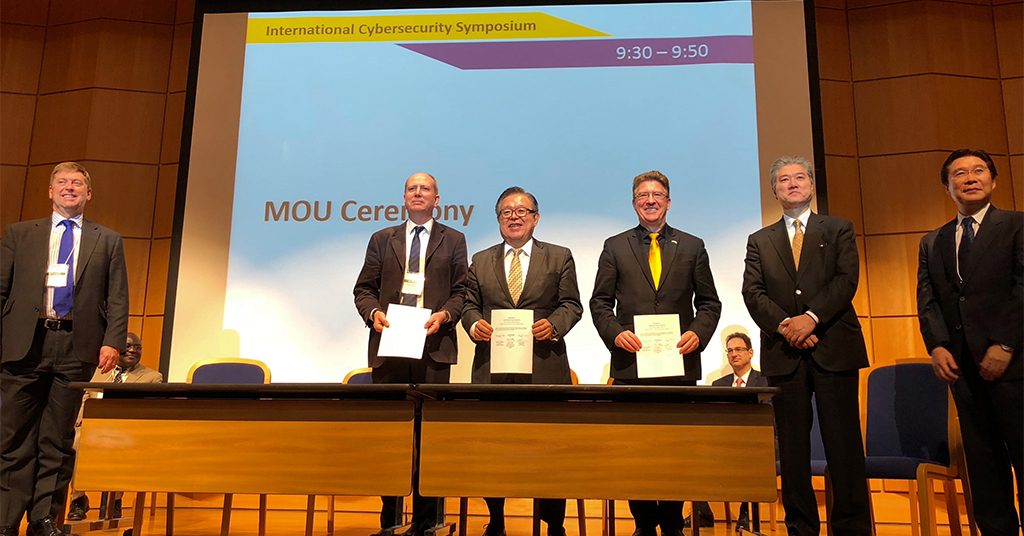 University leaders, including Karl V. Steiner, third from right, signed the three-nation agreement in a ceremony at the sixth International Cybersecurity Symposium in Japan. Photo courtesy of Karl V. Steiner
UMBC launches infrastructure-focused cybersecurity research collaboration with Japanese and UK partners
UMBC is one of three leading academic institutions collaborating on a new research initiative focused on cybersecurity for critical national infrastructures, including information technology, public transit, and financial services. University leaders signed the three-nation agreement in a ceremony at the sixth International Cybersecurity Symposium in Japan.
UMBC, Keio Research Institute (KRIS) in Japan, and Royal Holloway University of London (RHUL) in the UK will partner to investigate the use of common system simulation tools for modeling critical national infrastructure. This partnership is part of a broader international collaboration, the International Cybersecurity Center of Excellence (INCS-COE). It will also involve Hitachi, an international operator in power systems, telecommunication, railways, and other core infrastructure areas.
Because cybersecurity attacks may not be limited to national borders, this collaboration argues that defense against such attacks should not be siloed either.
“Cybersecurity can no longer be treated as a national issue,” emphasizes Karl V. Steiner, vice president for research at UMBC. “Long-term and productive international collaborations are needed to make significant progress.”
Jun Murai, professor of environment and information studies at Keio University, notes, “We look forward to working with our research colleagues in the UK and U.S. to help address the increasingly challenging cyber threats to the security of our respective critical national infrastructures.”
Working with a common toolset will enable mixed nationality teams to run simulations together. This will help cybersecurity experts learn how to more effectively address human factors, including cultural differences, in predicting how attacks and responses to those attacks might play out across different geographies.
“We are excited to participate in this new research collaboration with our colleagues in Japan and the UK to help us better understand and address some of the key cybersecurity challenges that our nations face from increasingly aggressive international adversaries,” says Anupam Joshi, director of UMBC’s Center for Cybersecurity.
The partners in this research see the modeling of system security as increasingly vital for industry and government, for both training purposes and vulnerability analysis.
“This initiative creates many future opportunities including, for example, the opportunity to address the impact on critical national infrastructure security of the exponential growth of the internet of things, and for potential exchanges of expert staff and students,” explains Keith Mayes, head of the Information Security Group (ISG) at Royal Holloway University.
Steiner shares Mayes’s excitement about expanding opportunities for both established and emerging researchers in this growing field. Thanks to leading academic programs in cybersecurity, the bwtech@UMBC Cyber Incubator, and UMBC’s internationally-known Center for Cybersecurity, he says, “UMBC is uniquely positioned in Maryland to become a major global force for research in cybersecurity.”
“This partnership,” says Steiner, “builds important connections to move this essential work forward.”
Adapted from a UMBC News article written by Megan Hanks. Photo by Marlayna Demond ’11 for UMBC.
The post UMBC launches cybersecurity research collaboration with Japanese and UK partners appeared first on Department of Computer Science and Electrical Engineering.
]]>
University leaders, including Karl V. Steiner, third from right, signed the three-nation agreement in a ceremony at the sixth International Cybersecurity Symposium in Japan. Photo courtesy of Karl...
https://www.csee.umbc.edu/2018/07/umbc-cybersecurity-research-collaboration-japanese-uk-partners/
https://my3.my.umbc.edu/api/v0/pixel/news/77417/guest@my.umbc.edu/fb69bb7ce9baa05f22981b1dd26cee4d/api/pixel
computer-engineering
computer-science
cybersecurity
research
UMBC Cybersecurity Institute Group
https://my3.my.umbc.edu/groups/cybersecurity
https://assets3-my.umbc.edu/system/shared/avatars/groups/000/000/485/196da6a7ec6f4c31eab2e474c17a9ab7/xsmall.png?1734891477
https://assets3-my.umbc.edu/system/shared/avatars/groups/000/000/485/196da6a7ec6f4c31eab2e474c17a9ab7/original.png?1734891477
https://assets4-my.umbc.edu/system/shared/avatars/groups/000/000/485/196da6a7ec6f4c31eab2e474c17a9ab7/xxlarge.png?1734891477
https://assets4-my.umbc.edu/system/shared/avatars/groups/000/000/485/196da6a7ec6f4c31eab2e474c17a9ab7/xlarge.png?1734891477
https://assets2-my.umbc.edu/system/shared/avatars/groups/000/000/485/196da6a7ec6f4c31eab2e474c17a9ab7/large.png?1734891477
https://assets3-my.umbc.edu/system/shared/avatars/groups/000/000/485/196da6a7ec6f4c31eab2e474c17a9ab7/medium.png?1734891477
https://assets3-my.umbc.edu/system/shared/avatars/groups/000/000/485/196da6a7ec6f4c31eab2e474c17a9ab7/small.png?1734891477
https://assets3-my.umbc.edu/system/shared/avatars/groups/000/000/485/196da6a7ec6f4c31eab2e474c17a9ab7/xsmall.png?1734891477
https://assets3-my.umbc.edu/system/shared/avatars/groups/000/000/485/196da6a7ec6f4c31eab2e474c17a9ab7/xxsmall.png?1734891477
UMBC Center for Cybersecurity
1
0
true
Sun, 08 Jul 2018 09:06:00 -0400
Room for rent !
Looking for a chill roommate
We're looking for a fourth roommate for the upstairs room of a spacious brick home near the Catonsville downtown area, a five minute drive to UMBC and a short walking distance from a shuttle. The place has 3 bedrooms and a large basement and 2.5 bathrooms.
The rent is $1650 without utilities, and utilities are about $200 monthly max on the hottest and coldest times of the year, and probably half of that at other times. So divided between four people that's about $440 including utilities.
The lease begins on August 1 so if you're interested please contact us right away.
301 508 0134
Our landlord is a really chill younger dude who’s UMBC alumni. He’s really communicative and helpful. Although it’s an older building he renovated it really well. There’s also a garden w a patio, and he’s going to lend us some furniture.
Please text 301 508 0134 if you're interested and want more info about us.
So the lease starts on August 1 so if you're interested text the number ASAP (or e-mail me at
mamu1@umbc.edu) and we can quickly all meet up in a public space and decide where to go from there.
Thank you!
-Maya
CALL 301 508 0134
]]>
We're looking for a fourth roommate for the upstairs room of a spacious brick home near the Catonsville downtown area, a five minute drive to UMBC and a short walking distance from a shuttle. The...
https://my3.my.umbc.edu/api/v0/pixel/news/77416/guest@my.umbc.edu/32a75653b90a55841a0b3f78c2910ba8/api/pixel
Classifieds
https://my3.my.umbc.edu/groups/classifieds
https://assets4-my.umbc.edu/system/shared/avatars/groups/000/001/081/27816fed47150f6fda5f96e75013749f/xsmall.png?1434550723
https://assets2-my.umbc.edu/system/shared/avatars/groups/000/001/081/27816fed47150f6fda5f96e75013749f/original.png?1434550723
https://assets1-my.umbc.edu/system/shared/avatars/groups/000/001/081/27816fed47150f6fda5f96e75013749f/xxlarge.png?1434550723
https://assets1-my.umbc.edu/system/shared/avatars/groups/000/001/081/27816fed47150f6fda5f96e75013749f/xlarge.png?1434550723
https://assets3-my.umbc.edu/system/shared/avatars/groups/000/001/081/27816fed47150f6fda5f96e75013749f/large.png?1434550723
https://assets3-my.umbc.edu/system/shared/avatars/groups/000/001/081/27816fed47150f6fda5f96e75013749f/medium.png?1434550723
https://assets3-my.umbc.edu/system/shared/avatars/groups/000/001/081/27816fed47150f6fda5f96e75013749f/small.png?1434550723
https://assets4-my.umbc.edu/system/shared/avatars/groups/000/001/081/27816fed47150f6fda5f96e75013749f/xsmall.png?1434550723
https://assets3-my.umbc.edu/system/shared/avatars/groups/000/001/081/27816fed47150f6fda5f96e75013749f/xxsmall.png?1434550723
Classifieds
0
0
true
Sun, 08 Jul 2018 08:53:24 -0400
Creative Alliance seeks Development Associate
Development Associate
Classification: Full-time, Exempt
Reports to: Development Director
Salary Range: $36,000 - $40,000
Date Revised: July 2, 2018
]]>
Development Associate
Classification: Full-time, Exempt
Reports to: Development Director
Salary Range: $36,000 - $40,000
Date Revised: July 2, 2018
https://www.baltimoreculture.org/programs/jobsplus/17733
https://my3.my.umbc.edu/api/v0/pixel/news/77415/guest@my.umbc.edu/07c3fc8c753ef54d2b74c0bdabd94acc/api/pixel
alliance
arts
baltimore
cultural
culture
development
full-time
fundraisers
greater
jobs
museum
nonprofit
opportunities
organizations
positions
studies
Museum Practice
https://my3.my.umbc.edu/groups/museumpractice
https://assets2-my.umbc.edu/system/shared/avatars/groups/000/000/780/ec390e445f99f5d8c57a847f02552fbc/xsmall.png?1384380461
https://assets3-my.umbc.edu/system/shared/avatars/groups/000/000/780/ec390e445f99f5d8c57a847f02552fbc/original.png?1384380461
https://assets1-my.umbc.edu/system/shared/avatars/groups/000/000/780/ec390e445f99f5d8c57a847f02552fbc/xxlarge.png?1384380461
https://assets4-my.umbc.edu/system/shared/avatars/groups/000/000/780/ec390e445f99f5d8c57a847f02552fbc/xlarge.png?1384380461
https://assets2-my.umbc.edu/system/shared/avatars/groups/000/000/780/ec390e445f99f5d8c57a847f02552fbc/large.png?1384380461
https://assets3-my.umbc.edu/system/shared/avatars/groups/000/000/780/ec390e445f99f5d8c57a847f02552fbc/medium.png?1384380461
https://assets2-my.umbc.edu/system/shared/avatars/groups/000/000/780/ec390e445f99f5d8c57a847f02552fbc/small.png?1384380461
https://assets2-my.umbc.edu/system/shared/avatars/groups/000/000/780/ec390e445f99f5d8c57a847f02552fbc/xsmall.png?1384380461
https://assets1-my.umbc.edu/system/shared/avatars/groups/000/000/780/ec390e445f99f5d8c57a847f02552fbc/xxsmall.png?1384380461
Museum Practice
0
0
true
Sat, 07 Jul 2018 11:53:05 -0400
The UMBC Carbon Zero Project
Committed to Sustainability and Reducing Carbon Emmissions
JCET Faculty member Jasper Lewis mentored UMBC students
Reese Burke, Kennedy Lamb & Samina Musa in The Carbon Zero Project as part
of the UMBC Interdisciplinary CoLab. The Carbon Zero Project
produced videos highlighting UMBC's commitment to sustainability and reducing
carbon emissions. Kudos to Dr. Lewis and the The Carbon Zero Project
team!

]]>
JCET Faculty member Jasper Lewis mentored UMBC students Reese Burke, Kennedy Lamb & Samina Musa in The Carbon Zero Project as part of the UMBC Interdisciplinary CoLab. The Carbon Zero...
https://jcet.umbc.edu/
https://my3.my.umbc.edu/api/v0/pixel/news/77412/guest@my.umbc.edu/b8866b3f40fc722c11f73b78edca105a/api/pixel
Joint Center for Earth Systems Technology
https://my3.my.umbc.edu/groups/jcet
https://assets2-my.umbc.edu/system/shared/avatars/groups/000/000/429/5f87a3fcca7c117d0f4186749a5c6c59/xsmall.png?1524593851
https://assets4-my.umbc.edu/system/shared/avatars/groups/000/000/429/5f87a3fcca7c117d0f4186749a5c6c59/original.JPG?1524593851
https://assets1-my.umbc.edu/system/shared/avatars/groups/000/000/429/5f87a3fcca7c117d0f4186749a5c6c59/xxlarge.png?1524593851
https://assets4-my.umbc.edu/system/shared/avatars/groups/000/000/429/5f87a3fcca7c117d0f4186749a5c6c59/xlarge.png?1524593851
https://assets4-my.umbc.edu/system/shared/avatars/groups/000/000/429/5f87a3fcca7c117d0f4186749a5c6c59/large.png?1524593851
https://assets1-my.umbc.edu/system/shared/avatars/groups/000/000/429/5f87a3fcca7c117d0f4186749a5c6c59/medium.png?1524593851
https://assets1-my.umbc.edu/system/shared/avatars/groups/000/000/429/5f87a3fcca7c117d0f4186749a5c6c59/small.png?1524593851
https://assets2-my.umbc.edu/system/shared/avatars/groups/000/000/429/5f87a3fcca7c117d0f4186749a5c6c59/xsmall.png?1524593851
https://assets4-my.umbc.edu/system/shared/avatars/groups/000/000/429/5f87a3fcca7c117d0f4186749a5c6c59/xxsmall.png?1524593851
Joint Center for Earth Systems Technology
https://assets1-my.umbc.edu/system/shared/thumbnails/news/000/077/412/3352906289269b64e5fe565434461c95/xxlarge.jpg?1530908081
https://assets3-my.umbc.edu/system/shared/thumbnails/news/000/077/412/3352906289269b64e5fe565434461c95/xlarge.jpg?1530908081
https://assets4-my.umbc.edu/system/shared/thumbnails/news/000/077/412/3352906289269b64e5fe565434461c95/large.jpg?1530908081
https://assets3-my.umbc.edu/system/shared/thumbnails/news/000/077/412/3352906289269b64e5fe565434461c95/medium.jpg?1530908081
https://assets1-my.umbc.edu/system/shared/thumbnails/news/000/077/412/3352906289269b64e5fe565434461c95/small.jpg?1530908081
https://assets4-my.umbc.edu/system/shared/thumbnails/news/000/077/412/3352906289269b64e5fe565434461c95/xsmall.jpg?1530908081
https://assets1-my.umbc.edu/system/shared/thumbnails/news/000/077/412/3352906289269b64e5fe565434461c95/xxsmall.jpg?1530908081
1
0
true
Fri, 06 Jul 2018 16:15:21 -0400
Fri, 06 Jul 2018 16:20:33 -0400
UMBC research forum held on health justice
The forum was the fourth in a series organized by UMBC’s Office of the Vice President for Research to bring together faculty tackling shared topics from widely diverse angles. “We established the research forum series in 2014 to provide an opportunity for scientists and scholars to collaboratively explore multiple facets of a topic central to the research and scholarship of UMBC,” says Karl Steiner, vice president for research. Previous forum focus areas include high-performance computing, climate change and the environment, and the visualization of science.
UMBC’s
Dresher Center for the Humanities co-sponsored and helped organize the latest forum, focused on how the humanities can help address challenges related to health care access. Dresher Center Director
Jessica Berman shared, “It was exciting to see how much humanistic scholarship is taking place all across campus and the potential partnerships it creates, between UMBC and other universities. This research forum helped to highlight the humanities in their capacity not only to ask good questions but also to help solve important problems such as health justice and access.”
Racism in Health Care Policy
Keynote speaker Graham Mooney, professor in the Institute of the History of Medicine at Johns Hopkins University, presented his research on the Baltimore Medical Care Plan of 1948. “By using the history of medicine and public policy we can better understand how the process of racism and segregation have interacted to prevent black residents’ access to quality medical care in Baltimore,” explained Mooney.
Graham Mooney, professor in the Institute of the History of Medicine at Johns Hopkins University
The topic led to an interactive conversation about the negative impact the 1948 plan had on the quality of life of Baltimore’s black community and how it served as a model for similar approaches in other states, and later for Medicare and Medicaid. During the discussion, Shawn Bediako, associate professor of psychology, argued that analyses of health care access across U.S. history should also include how black communities have responded to inequities. He mentioned, as examples, the establishment of the National Negro Health Movement and Office of Negro Health Work.
Shawn Bediako, associate professor of psychology
Listening to Communities
Valuing community voices was a key theme in the two interdisciplinary panel discussions that followed. These discussions revealed how key humanities methods, such as attending to history, paying attention to narrative—including who gets to speak and when—and thinking critically about how we understand and value specific human experiences can be crucial to addressing issues important to contemporary public life.
In the first of those panels, Kristen Slesar, from the Narrative Medicine Program at Columbia University, shared her experience using personal narratives to inform medical research. Slesar is a licensed clinical social worker and psychotherapist who focuses on child trauma. She regularly teaches about health care justice and health care for underserved communities.
Scott Casper, dean of the College of arts, humanities, and social sciences (CAHSS), then moderated a discussion on “Listening as Public Practice: Towards Equity and Justice” that included Bediako as well as colleagues Drew Holladay, assistant professor of English; Amy Hurst, associate professor of information systems; and Denise Meringolo, associate professor of history. The panelists explored how centering the narratives of individuals in their research improves the quality of their findings and the potential impact of their work. “Confronting the barriers to health equity compels us to look across disciplines and toward collaborations among social scientists, scientists and engineers, and humanists and artists,” noted Casper.
(L to R) Dean Casper, Kristen Slesar, Shawn Bediako, Drew Holladay, Amy Hurst, and Denise Meringolo.
Lawrence Brown, assistant professor of community health and policy at Morgan State University, spoke during the second panel about the impacts of residential displacement and financial disinvestment on community health. In addition to his work on the impact of historical trauma on community health, he also leads the student-driven #BmoreLEADfree project focused on ending lead poisoning in Baltimore.
Berman then led a group discussion on the topic “Communication, the Urban Environment, and Health Justice,” with Dena Aufseeser, assistant professor of geography and environmental systems; Katherine Bankole-Medina, professor of history at Coppin State University; Dawn Biehler, associate professor of geography and environmental systems; and Jennifer Maher, associate professor of English. The discussion showed how paying attention to the ways local communities understand issues of health and the environment can challenge the kinds of changes we propose and the ways we communicate about them.
New Health Equity Collaborative
The forum also introduced UMBC’s new Collaborative for the Interdisciplinary Promotion of Health Equity Research (CIPHER). The collaborative will form working groups bringing together UMBC researchers across different fields to examine current challenges to health care equity, and to inform innovative solutions for the future.
Bediako, whose research focuses on health care inequities experienced by patients with sickle cell disease, will serve as the founding convener of this initiative. He shares, “I am most excited that CIPHER will aim to reach across disciplinary boundaries and use multiple perspectives to address specific challenges to health equity.”
Banner image: (L to R) Courtney C. Hobson M.A.’14, history, coordinator for the Dresher Center; Karl Steiner; Rachel Brubaker M.A. ’00, history, assistant director for grants and program development for the Dresher Center; Don Engel, assistant vice president for research; Scott Casper; and Jessica Berman. All photos by Kait McCaffrey for UMBC.
]]>
By Catalina Sofia Dansberger Duque for news.umbc.edu How does unequal access to health care affect the lives and experiences of people from different communities across Baltimore and the...
Photo
https://assets1-my.umbc.edu/system/shared/attachments/07fa2d03b116c73a92aea252e1540003/6af0bcc2/news/000/077/411/9e020ebb181dfd3fb1229c6ceb076a60/Bediako-8504-1024x683.jpg?1530905534
https://my3.my.umbc.edu/api/v0/pixel/news/77411/guest@my.umbc.edu/9e39253e6a1e14ee1c997dbaa64d339b/api/pixel
ovpr-news-2018
Archived RCA News
https://my3.my.umbc.edu/groups/research
https://assets4-my.umbc.edu/system/shared/avatars/groups/000/000/794/4bca2aa331eb7e472d63d97e0798b600/xsmall.png?1743706368
https://assets2-my.umbc.edu/system/shared/avatars/groups/000/000/794/4bca2aa331eb7e472d63d97e0798b600/original.jpg?1743706368
https://assets3-my.umbc.edu/system/shared/avatars/groups/000/000/794/4bca2aa331eb7e472d63d97e0798b600/xxlarge.png?1743706368
https://assets4-my.umbc.edu/system/shared/avatars/groups/000/000/794/4bca2aa331eb7e472d63d97e0798b600/xlarge.png?1743706368
https://assets2-my.umbc.edu/system/shared/avatars/groups/000/000/794/4bca2aa331eb7e472d63d97e0798b600/large.png?1743706368
https://assets4-my.umbc.edu/system/shared/avatars/groups/000/000/794/4bca2aa331eb7e472d63d97e0798b600/medium.png?1743706368
https://assets4-my.umbc.edu/system/shared/avatars/groups/000/000/794/4bca2aa331eb7e472d63d97e0798b600/small.png?1743706368
https://assets4-my.umbc.edu/system/shared/avatars/groups/000/000/794/4bca2aa331eb7e472d63d97e0798b600/xsmall.png?1743706368
https://assets3-my.umbc.edu/system/shared/avatars/groups/000/000/794/4bca2aa331eb7e472d63d97e0798b600/xxsmall.png?1743706368
Office of the Vice President for Research
https://assets2-my.umbc.edu/system/shared/thumbnails/news/000/077/411/2395875e478bfbd3051ff911aa2f8a4d/xxlarge.jpg?1530905599
https://assets1-my.umbc.edu/system/shared/thumbnails/news/000/077/411/2395875e478bfbd3051ff911aa2f8a4d/xlarge.jpg?1530905599
https://assets2-my.umbc.edu/system/shared/thumbnails/news/000/077/411/2395875e478bfbd3051ff911aa2f8a4d/large.jpg?1530905599
https://assets1-my.umbc.edu/system/shared/thumbnails/news/000/077/411/2395875e478bfbd3051ff911aa2f8a4d/medium.jpg?1530905599
https://assets2-my.umbc.edu/system/shared/thumbnails/news/000/077/411/2395875e478bfbd3051ff911aa2f8a4d/small.jpg?1530905599
https://assets1-my.umbc.edu/system/shared/thumbnails/news/000/077/411/2395875e478bfbd3051ff911aa2f8a4d/xsmall.jpg?1530905599
https://assets3-my.umbc.edu/system/shared/thumbnails/news/000/077/411/2395875e478bfbd3051ff911aa2f8a4d/xxsmall.jpg?1530905599
0
0
true
Fri, 06 Jul 2018 15:33:27 -0400
Prof. Meyer explains how big data is changing astronomy
UMBC’s
Eileen Meyer, assistant professor of physics, argues that recent technological advances in the big data era are changing how astronomers learn about the universe. In
an article published in outlets from
Popular Science to
Smithsonian Magazine, Meyer describes recent research that discovered thousands of black holes near the center of the Milky Way. The research team found them not with a new telescope, but “by digging through old, long-archived data,” she writes. “Astronomers are gathering an exponentially greater amount of data every day—so much that it will take years to uncover all the hidden signals buried in the archives.”
Over the past several decades, advances in communications have allowed astronomy research to shift away from being conducted largely by individual scientists working with the instruments available at their own institutions. Today, large, international research teams collaborate on projects, often using instruments shared by several institutions across multiple countries.
The research instruments themselves are also vastly more powerful today than in the past. Older instruments could only detect visible light (with wavelengths from about 400 to 700 billionths of a meter). New instruments examine everything from gamma rays (extremely high-energy waves with wavelengths less than a trillionth of a meter) to radio waves (with wavelengths as big as a meter).
Newer equipment can also quickly process more data—a lot more. Meyer writes that the Hubble Space Telescope has made 1.3 million observations since its launch in 1990, and it transmits 20 GB of data per week, “which is impressive for a telescope first designed in the 1970s.” Compare that to the Square Kilometer Array, scheduled for completion in 2020. “In just one year of activity,” Meyer notes, “it will generate more data than the entire internet.”
“These ambitious projects will test scientists’ ability to handle data,” Meyer writes. Archives will need to have capacity to store, and then make accessible, a million times more data than can be stored on a typical 1 terabyte external hard drive.
Although it poses challenges, “the data deluge will make astronomy become a more collaborative and open science than ever before,” Meyer says. Whereas before you had to be “an academic or eccentric rich person with access to a good telescope” to do this kind of research, Meyer says, that’s no longer the case. “Thanks to internet archives,
robust learning communities and
new outreach initiatives, citizens can now participate in science.”
Meyer has taken advantage of huge, stored data sets in her own work studying the jets of high-speed plasma that spew from black holes. She collected 400 raw images taken over 13 years by Hubble to reveal the structure of these jets for the first time.
“This kind of work was only possible because other observers, for other purposes, just happened to capture images of the source I was interested in, back when I was in kindergarten,” she says. “As astronomical images become larger, higher resolution and ever more sensitive, this kind of research will become the norm.”
Meyer’s article, originally published on The Conversation, has been republished in Salon, Popular Science, Smithsonian Magazine, Chicago Tribune, Space.com, Raw Story, Phys.org, and several other outlets, receiving nearly 90,000 views to date.
Image: An artist’s concept of a supermassive black hole. Credit: NASA/JPL-Caltech
]]>
By Sarah Hansen for news.umbc.edu UMBC’s Eileen Meyer, assistant professor of physics, argues that recent technological advances in the big data era are changing how astronomers learn about...
https://my3.my.umbc.edu/api/v0/pixel/news/77410/guest@my.umbc.edu/972afd092fcb13a27143443646b2afe9/api/pixel
ovpr-news-2018
Archived RCA News
https://my3.my.umbc.edu/groups/research
https://assets4-my.umbc.edu/system/shared/avatars/groups/000/000/794/4bca2aa331eb7e472d63d97e0798b600/xsmall.png?1743706368
https://assets2-my.umbc.edu/system/shared/avatars/groups/000/000/794/4bca2aa331eb7e472d63d97e0798b600/original.jpg?1743706368
https://assets3-my.umbc.edu/system/shared/avatars/groups/000/000/794/4bca2aa331eb7e472d63d97e0798b600/xxlarge.png?1743706368
https://assets4-my.umbc.edu/system/shared/avatars/groups/000/000/794/4bca2aa331eb7e472d63d97e0798b600/xlarge.png?1743706368
https://assets2-my.umbc.edu/system/shared/avatars/groups/000/000/794/4bca2aa331eb7e472d63d97e0798b600/large.png?1743706368
https://assets4-my.umbc.edu/system/shared/avatars/groups/000/000/794/4bca2aa331eb7e472d63d97e0798b600/medium.png?1743706368
https://assets4-my.umbc.edu/system/shared/avatars/groups/000/000/794/4bca2aa331eb7e472d63d97e0798b600/small.png?1743706368
https://assets4-my.umbc.edu/system/shared/avatars/groups/000/000/794/4bca2aa331eb7e472d63d97e0798b600/xsmall.png?1743706368
https://assets3-my.umbc.edu/system/shared/avatars/groups/000/000/794/4bca2aa331eb7e472d63d97e0798b600/xxsmall.png?1743706368
Office of the Vice President for Research
https://assets4-my.umbc.edu/system/shared/thumbnails/news/000/077/410/53d474266f0eba48e4df65250fe2c56b/xxlarge.jpg?1530905156
https://assets3-my.umbc.edu/system/shared/thumbnails/news/000/077/410/53d474266f0eba48e4df65250fe2c56b/xlarge.jpg?1530905156
https://assets3-my.umbc.edu/system/shared/thumbnails/news/000/077/410/53d474266f0eba48e4df65250fe2c56b/large.jpg?1530905156
https://assets2-my.umbc.edu/system/shared/thumbnails/news/000/077/410/53d474266f0eba48e4df65250fe2c56b/medium.jpg?1530905156
https://assets3-my.umbc.edu/system/shared/thumbnails/news/000/077/410/53d474266f0eba48e4df65250fe2c56b/small.jpg?1530905156
https://assets1-my.umbc.edu/system/shared/thumbnails/news/000/077/410/53d474266f0eba48e4df65250fe2c56b/xsmall.jpg?1530905156
https://assets4-my.umbc.edu/system/shared/thumbnails/news/000/077/410/53d474266f0eba48e4df65250fe2c56b/xxsmall.jpg?1530905156
1
0
true
Fri, 06 Jul 2018 15:26:09 -0400
Fri, 06 Jul 2018 15:27:08 -0400
Prof. Green receives nearly $1 million NIH epigenetics grant
UMBC biologist Erin Green has received a five-year, nearly $1 million grant from the National institutes of Health to examine how cells respond to environmental signals at the molecular level. Her work could provide clues to understanding processes as broad as how cancers take hold, the causes of autism, and aging.
“Any cell, in any species, is constantly bombarded with different signals from its environment,” says Green, assistant professor of biological sciences. Those signals, she explains, “have consequences for how the cell grows, whether it lives or dies, or if it stays as it is or turns into something else, like a cancer cell.”
Green studies epigenetic modifications—changes to DNA that do not involve a change in the sequence of bases (A, T, G, and C). Inside cells, long strands of DNA are wound tightly around proteins called histones. The modifications Green studies involve adding or removing small groups of atoms to the histones, influencing which sections of DNA are “unwound” and eventually translated into protein.
Erin Green conducts an experiment in her lab.
Epigenetic modifications can impact how genes are expressed within minutes, making them one of the fastest ways a cell can respond to environmental signals. “One challenge in the field, though, is directly linking specific modifications to environmental changes,” Green notes. There are many studies that correlate certain epigenetic changes with diseases or environmental conditions—from air pollution to in utero alcohol exposure—but figuring out exactly how the changes lead to complex health conditions has been much trickier.
Green’s work will explore the mechanism of a particular enzyme that adds methyl groups to histones, one of the most common epigenetic changes, using budding yeast as a model organism. Her enzyme is within a class of proteins that is also found in humans, and so far, she says, “many of the things that we know about them in humans started out in yeast research.” The human version of the enzyme Green is studying, a gene called MLL5, is already known to be expressed differently in some cancers, mutated in some cases of autism, and required for male fertility.
Why use yeast in her research? With yeast, Green explains, “we can test many conditions and look at the direct biochemical and molecular outcomes, which is much harder to do in other systems.” She’ll start by looking at how exposure to certain toxic oxygen compounds, a situation known as oxidative stress, affects the enzyme’s activity.
Erin Green and graduate student Khoa Tran work in Green’s lab.
Green’s earlier work, supported by a
UMBC START award, looked much more narrowly at a specific enzyme activity, but this new grant will allow her lab to paint with a broader brush. “We’ve been looking in a very targeted way,” she says. “By doing this bigger, more open-ended experiment we might uncover other things that would be good to look at. Are there other stress response pathways that this enzyme might be controlling?”
“I think having a system where we can directly answer these questions in a more controlled and easily manipulated environment is really powerful,” Green says. “If we’re able to…learn more about the function of this enzyme in yeast, that’s likely to give us a handle on what it might be doing in humans.”
Banner image: Erin Green. All photos by Marlayna Demond ’11 for UMBC.
]]>
By Sarah Hansen for news.umbc.edu UMBC biologist Erin Green has received a five-year, nearly $1 million grant from the National institutes of Health to examine how cells respond to...
Photo
https://assets4-my.umbc.edu/system/shared/attachments/17559770a7b2dbe397fa27283af63f59/6af0bcc2/news/000/077/409/377905b7f444ac2e2f44443f031d45ff/Erin-Green-0769.jpg?1530904771
https://my3.my.umbc.edu/api/v0/pixel/news/77409/guest@my.umbc.edu/86e1a880b103b16f6cdcb5c96c6da409/api/pixel
ovpr-news-2018
Archived RCA News
https://my3.my.umbc.edu/groups/research
https://assets4-my.umbc.edu/system/shared/avatars/groups/000/000/794/4bca2aa331eb7e472d63d97e0798b600/xsmall.png?1743706368
https://assets2-my.umbc.edu/system/shared/avatars/groups/000/000/794/4bca2aa331eb7e472d63d97e0798b600/original.jpg?1743706368
https://assets3-my.umbc.edu/system/shared/avatars/groups/000/000/794/4bca2aa331eb7e472d63d97e0798b600/xxlarge.png?1743706368
https://assets4-my.umbc.edu/system/shared/avatars/groups/000/000/794/4bca2aa331eb7e472d63d97e0798b600/xlarge.png?1743706368
https://assets2-my.umbc.edu/system/shared/avatars/groups/000/000/794/4bca2aa331eb7e472d63d97e0798b600/large.png?1743706368
https://assets4-my.umbc.edu/system/shared/avatars/groups/000/000/794/4bca2aa331eb7e472d63d97e0798b600/medium.png?1743706368
https://assets4-my.umbc.edu/system/shared/avatars/groups/000/000/794/4bca2aa331eb7e472d63d97e0798b600/small.png?1743706368
https://assets4-my.umbc.edu/system/shared/avatars/groups/000/000/794/4bca2aa331eb7e472d63d97e0798b600/xsmall.png?1743706368
https://assets3-my.umbc.edu/system/shared/avatars/groups/000/000/794/4bca2aa331eb7e472d63d97e0798b600/xxsmall.png?1743706368
Office of the Vice President for Research
https://assets3-my.umbc.edu/system/shared/thumbnails/news/000/077/409/492ac8e3c1194431b6dae1cef7d95529/xxlarge.jpg?1530904847
https://assets2-my.umbc.edu/system/shared/thumbnails/news/000/077/409/492ac8e3c1194431b6dae1cef7d95529/xlarge.jpg?1530904847
https://assets2-my.umbc.edu/system/shared/thumbnails/news/000/077/409/492ac8e3c1194431b6dae1cef7d95529/large.jpg?1530904847
https://assets2-my.umbc.edu/system/shared/thumbnails/news/000/077/409/492ac8e3c1194431b6dae1cef7d95529/medium.jpg?1530904847
https://assets1-my.umbc.edu/system/shared/thumbnails/news/000/077/409/492ac8e3c1194431b6dae1cef7d95529/small.jpg?1530904847
https://assets1-my.umbc.edu/system/shared/thumbnails/news/000/077/409/492ac8e3c1194431b6dae1cef7d95529/xsmall.jpg?1530904847
https://assets2-my.umbc.edu/system/shared/thumbnails/news/000/077/409/492ac8e3c1194431b6dae1cef7d95529/xxsmall.jpg?1530904847
3
0
true
Fri, 06 Jul 2018 15:21:05 -0400
Fri, 06 Jul 2018 15:21:28 -0400
UMBC’s Evan Avila wins iOme Challenge
Entry aims to help millennials save for retirement
Evan Avila ‘20, economics and political science, is a millennial with retirement on his mind, and his fresh ideas are now capturing the interest of policymakers. Avila recently won first place in the national 2018
iOme Challenge, which asked students across the United States to innovate policies to help millennials save for retirement. Avila presented his winning paper,
Rethinking Millennial Retirement: Policy Recommendations for a Gig Economy, to policymakers on June 20 at a symposium on Capitol Hill.
Evan Avila delivers his award-winning paper. Photo courtesy of WISER.
This year’s iOme (“I Owe Me”) Challenge asked participants to imagine they were invited to join a bipartisan task force to address a growing retirement crisis in the U.S. What policies might they propose on issues relating to gig economy workers or using social media to increase awareness about saving for retirement?
Avila had dealt with these topics before, in the classroom and through volunteering with tax assistance and financial counseling. Avila has served as a certified volunteer in the federal
Volunteers Income Tax Assistance (VITA) program at UMBC, which provides tax return filing support for eligible people no cost to them. He’s also offered financial literacy clinics for fellow college students and was familiar with their common questions and concerns about how to make smart financial decisions.
Avila applied this knowledge and experience to creating an iOme Challenge entry that contest judge David Wegge, interim dean of Schneider School of Business and Economics at St. Norbert College, said, “demonstrated great policy depth, a keen understanding of the challenges millennials face, and creativity in devising solutions that are achievable for this age cohort.”
Cindy Hounsell is president of the
Women’s Institute for a Secure Retirement (WISER), which sponsored the competition. She shared, “We are impressed by Mr. Avila’s response to the more complicated challenges and deterrents millennials face in preparing for their future retirement.”
L to R: Doug Lamdin, Cindy Hounsell, Evin Avila. Photo courtesy of WISER.
UMBC economics professor Doug Lamdin mentored Avila as he developed his three-part policy proposal and transformed his essay into a
video. He shares that typically students enter the contest as teams, but he wasn’t surprised that even competing as a team of one Avila emerged the winner.
“That Evan won the competition is not exactly a surprise. He had a very strong proposal,” said Lamdin. “Evan balanced the demands of the competition, usually placed on a team, exceptionally well in addition to a full class schedule, working as a teaching assistant, a research assistant, presenting at the Undergraduate Research and Creative Activities Day (URCAD), volunteering at the Esperanza Center teaching English, and his activities as a Sondheim Scholar.”
Avila, who recently completed his fourth semester with a 4.0, is currently serving as an intern in the Office of Comptroller of the Currency in Washington, D.C. This follows an
internship in 2017 at the U.S. Census Bureau, where he worked in the Economics Indicators division, focusing on how to efficiently process massive quantities of survey data in a precise way.
Looking ahead, Avila plans to pursue a career in tax or administrative law. “I came from a Peruvian and Mexican household. I saw how hard my parents worked and the challenges they faced to have financial security,” says Avila. “In college, I see my peers trying to make sense of personal budgets, savings, loans, credit, and retirement. It is very rewarding to help people be financially literate and understand the laws and policies that affect their wallet.”
Banner image: Evan Avila with his economics internship supervisor in 2017. Photo by Marlayna Demond ’11 for UMBC.
]]>
By Catalina Sofia Dansberger Duque for news.umbc.edu Evan Avila ‘20, economics and political science, is a millennial with retirement on his mind, and his fresh ideas are now capturing the...
Photo
https://assets4-my.umbc.edu/system/shared/attachments/149360389c007a93cd24a1b09fb5d02c/6af0bcc2/news/000/077/408/3f54e27d6a63e1397fe94938013a9161/DSC_7991-e1530118475246-1024x635.jpg?1530904137
https://my3.my.umbc.edu/api/v0/pixel/news/77408/guest@my.umbc.edu/6dd2d8d93858281c3bcc22f30a026b8c/api/pixel
ovpr-news-2018
Archived RCA News
https://my3.my.umbc.edu/groups/research
https://assets4-my.umbc.edu/system/shared/avatars/groups/000/000/794/4bca2aa331eb7e472d63d97e0798b600/xsmall.png?1743706368
https://assets2-my.umbc.edu/system/shared/avatars/groups/000/000/794/4bca2aa331eb7e472d63d97e0798b600/original.jpg?1743706368
https://assets3-my.umbc.edu/system/shared/avatars/groups/000/000/794/4bca2aa331eb7e472d63d97e0798b600/xxlarge.png?1743706368
https://assets4-my.umbc.edu/system/shared/avatars/groups/000/000/794/4bca2aa331eb7e472d63d97e0798b600/xlarge.png?1743706368
https://assets2-my.umbc.edu/system/shared/avatars/groups/000/000/794/4bca2aa331eb7e472d63d97e0798b600/large.png?1743706368
https://assets4-my.umbc.edu/system/shared/avatars/groups/000/000/794/4bca2aa331eb7e472d63d97e0798b600/medium.png?1743706368
https://assets4-my.umbc.edu/system/shared/avatars/groups/000/000/794/4bca2aa331eb7e472d63d97e0798b600/small.png?1743706368
https://assets4-my.umbc.edu/system/shared/avatars/groups/000/000/794/4bca2aa331eb7e472d63d97e0798b600/xsmall.png?1743706368
https://assets3-my.umbc.edu/system/shared/avatars/groups/000/000/794/4bca2aa331eb7e472d63d97e0798b600/xxsmall.png?1743706368
Office of the Vice President for Research
https://assets1-my.umbc.edu/system/shared/thumbnails/news/000/077/408/d1568bcfec4cb93b5ae6503a29516f9e/xxlarge.jpg?1530904489
https://assets3-my.umbc.edu/system/shared/thumbnails/news/000/077/408/d1568bcfec4cb93b5ae6503a29516f9e/xlarge.jpg?1530904489
https://assets1-my.umbc.edu/system/shared/thumbnails/news/000/077/408/d1568bcfec4cb93b5ae6503a29516f9e/large.jpg?1530904489
https://assets3-my.umbc.edu/system/shared/thumbnails/news/000/077/408/d1568bcfec4cb93b5ae6503a29516f9e/medium.jpg?1530904489
https://assets3-my.umbc.edu/system/shared/thumbnails/news/000/077/408/d1568bcfec4cb93b5ae6503a29516f9e/small.jpg?1530904489
https://assets2-my.umbc.edu/system/shared/thumbnails/news/000/077/408/d1568bcfec4cb93b5ae6503a29516f9e/xsmall.jpg?1530904489
https://assets4-my.umbc.edu/system/shared/thumbnails/news/000/077/408/d1568bcfec4cb93b5ae6503a29516f9e/xxsmall.jpg?1530904489
0
0
true
Fri, 06 Jul 2018 15:16:01 -0400
Rapid sepsis test wins UMBC Cangialosi Business Competition
Six finalists pitched creative business ideas to a panel of judges during UMBC’s fifth annual Cangialosi Business Innovation Competition (CBIC), held on April 25, 2018 in the new UMBC Event Center. The business ideas ranged from online tools and apps to products with medical applications.
The Cangialosi Business Innovation Competition is for undergraduate and graduate students who are serious about starting a business, explains Vivian Armor ’73, American studies, director of the Alex. Brown Center for Entrepreneurship at UMBC. Throughout the course of the competition, each team is paired with an industry mentor who provides guidance and professional advice ahead of a final Shark Tank-style event. The structure of the event and its focus on mentorship are inspired by the vision of entrepreneur Greg Cangialosi ‘96, English, reflecting on his own undergraduate days at UMBC and what he has learned in the years since then about moving from an idea to a successful company.
Miranda Marvel, Ph.D. ‘19, marine estuarine environmental sciences, shared SensorFish, which took third place in the competition. She explained how fish mortality due to stress is a common problem that fish owners face. SensorFish are special type of zebrafish bred to change color based on common stressors that fish commonly encounter, such as poor water quality or particular illnesses. Because the fish change color immediately when they are experiencing a problem in the tank, their owners can more quickly work to fix the problem, keeping the fish healthy.
Miranda Marvel presented SensorFish at the Cangialosi Business Innovation Competition.
Second place was awarded to Matrix Cast, an idea presented by Flo de Sande ‘18, mechanical engineering. Matrix Cast is a plastic cast that can be altered to fit all arm shapes and sizes. de Sande explained that Matrix Cast offers a low-cost cast option for physicians working in remote or low-resource locations, such as communities served through Doctors Without Borders or military installations in conflict zones. The cast is a “pressure vessel” type design, which, while made from plastic, is very sturdy, explained de Sande during her business pitch.
Flo de Sande was recognized with second place in the 2018 competition.
GermoSense, a rapid sepsis-detection test developed by Mustafa Al-Adhami, M.S. ‘15, mechanical engineering, Ph.D. ‘19, mechanical engineering, received first place in the competition. Sepsis is a life-threatening blood infection that, if not treated promptly, can lead to serious complications and even death in mere days. Currently, the test that medical professionals rely on to determine antibiotic efficacy for sepsis patients can take several days to yield results. Because of this challenge, physicians often start patients who they suspect have sepsis on broad spectrum antibiotics, which can possibly help if the patient has sepsis but might be unnecessary and ineffective for people facing other medical conditions that are presenting similarly to sepsis, or in the case of antibiotic resistance.
Al-Adhami explained that GermoSense is able to determine whether a patient has sepsis within one hour, which can lead to shorter hospital stays, help prevent antibiotic resistance by avoiding unnecessary antibiotic use, and reduce medical costs. GermoSense costs approximately $100 to use, compared to comparable tests that can cost $170 or more. At last year’s CBIC, Al-Adhami presented GermoSense, then at an earlier stage of development, and took third place in the competition.
Mustafa Al-Adhami received first place in the competition for GermoSense, a rapid sepsis-detection test.
The contest’s additional three finalists included UniVerse by Allison Gross ‘18, certificate in English as a second language; Frey Custom Cues by Christopher Bodan ‘19, interdisciplinary studies, and Michelle Barrow ‘08, gender and women’s studies, and marketing coordinator in the division of professional studies at UMBC, and James Baker; and Skanaroo by Vincent Celebrado-Royer ‘17, business technology administration, and Tyler Little ‘20, computer science.
For Cangialosi, the event was not just about identifying top projects, but, more broadly, about helping young entrepreneurs move toward success one step at a time. Taking in the creativity and energy of the event, he reflected, “This room is filled with dreams and entrepreneurial spirit.”
Banner image: Mustafa Al-Adhami, M.S. ‘15, mechanical engineering, Ph.D. ‘19, mechanical engineering, left; Greg Cangialosi ’96, English; Flo de Sande ’18, mechanical engineering; and Miranda Marvel ‘Ph.D. ‘19, marine estuarine environmental sciences, after the competition. All photos by Marlayna Demond ’11 for UMBC.
]]>
By Megan Hanks for news.umbc.edu. Six finalists pitched creative business ideas to a panel of judges during UMBC’s fifth annual Cangialosi Business Innovation Competition (CBIC), held on April...
Photo
https://assets4-my.umbc.edu/system/shared/attachments/9fa84146067027c41d6d5051009b7bbe/6af0bcc2/news/000/077/407/99644a15c905e2bea0236398dd480dd5/Cangialosi-CBIC-event18-7667.jpg?1530903602
https://my3.my.umbc.edu/api/v0/pixel/news/77407/guest@my.umbc.edu/d002e84d4977806095dfca273fd0685e/api/pixel
ovpr-news-2018
Archived RCA News
https://my3.my.umbc.edu/groups/research
https://assets4-my.umbc.edu/system/shared/avatars/groups/000/000/794/4bca2aa331eb7e472d63d97e0798b600/xsmall.png?1743706368
https://assets2-my.umbc.edu/system/shared/avatars/groups/000/000/794/4bca2aa331eb7e472d63d97e0798b600/original.jpg?1743706368
https://assets3-my.umbc.edu/system/shared/avatars/groups/000/000/794/4bca2aa331eb7e472d63d97e0798b600/xxlarge.png?1743706368
https://assets4-my.umbc.edu/system/shared/avatars/groups/000/000/794/4bca2aa331eb7e472d63d97e0798b600/xlarge.png?1743706368
https://assets2-my.umbc.edu/system/shared/avatars/groups/000/000/794/4bca2aa331eb7e472d63d97e0798b600/large.png?1743706368
https://assets4-my.umbc.edu/system/shared/avatars/groups/000/000/794/4bca2aa331eb7e472d63d97e0798b600/medium.png?1743706368
https://assets4-my.umbc.edu/system/shared/avatars/groups/000/000/794/4bca2aa331eb7e472d63d97e0798b600/small.png?1743706368
https://assets4-my.umbc.edu/system/shared/avatars/groups/000/000/794/4bca2aa331eb7e472d63d97e0798b600/xsmall.png?1743706368
https://assets3-my.umbc.edu/system/shared/avatars/groups/000/000/794/4bca2aa331eb7e472d63d97e0798b600/xxsmall.png?1743706368
Office of the Vice President for Research
https://assets2-my.umbc.edu/system/shared/thumbnails/news/000/077/407/f45a4830dc8235969beca82304d14506/xxlarge.jpg?1530903749
https://assets2-my.umbc.edu/system/shared/thumbnails/news/000/077/407/f45a4830dc8235969beca82304d14506/xlarge.jpg?1530903749
https://assets2-my.umbc.edu/system/shared/thumbnails/news/000/077/407/f45a4830dc8235969beca82304d14506/large.jpg?1530903749
https://assets1-my.umbc.edu/system/shared/thumbnails/news/000/077/407/f45a4830dc8235969beca82304d14506/medium.jpg?1530903749
https://assets2-my.umbc.edu/system/shared/thumbnails/news/000/077/407/f45a4830dc8235969beca82304d14506/small.jpg?1530903749
https://assets1-my.umbc.edu/system/shared/thumbnails/news/000/077/407/f45a4830dc8235969beca82304d14506/xsmall.jpg?1530903749
https://assets2-my.umbc.edu/system/shared/thumbnails/news/000/077/407/f45a4830dc8235969beca82304d14506/xxsmall.jpg?1530903749
0
0
true
Fri, 06 Jul 2018 15:02:38 -0400
Fri, 06 Jul 2018 15:02:47 -0400
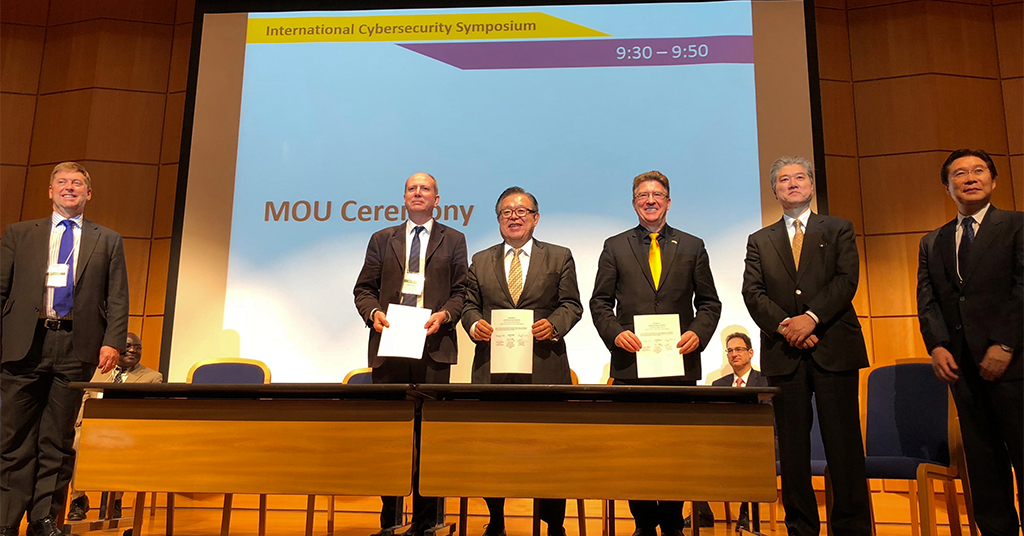 University leaders, including Karl V. Steiner, third from right, signed the three-nation agreement in a ceremony at the sixth International Cybersecurity Symposium in Japan. Photo courtesy of Karl V. Steiner


