UMBC receives $6 million gift from the George and Betsy Sherman Family Foundation for two urban education initiatives
"If we don’t serve children and we can’t get education right then we get more of the same. I think things can change for individuals, and if we can change things for individuals then that is where the hope lies,” reflects Mavis Sanders, director for the new center.
]]>
"If we don’t serve children and we can’t get education right then we get more of the same. I think things can change for individuals, and if we can change things for individuals then that is where...
http://news.umbc.edu/umbc-receives-major-gift-from-the-george-and-betsy-sherman-family-foundation-for-two-urban-education-initiatives/
https://my3.my.umbc.edu/api/v0/pixel/news/72417/guest@my.umbc.edu/6922322c7a44327bfd1943948b8fe00f/api/pixel
alumni
cahss
cfr
community
diversityinclusion
education
innovation
majoraward
policy-and-society
roi
shermanscholars
Corporate and Foundation Relations
https://my3.my.umbc.edu/groups/retired-1004
https://assets1-my.umbc.edu/system/shared/avatars/groups/000/001/004/c1481a88d8e582ce58f9413d5ac93360/xsmall.png?1421856866
https://assets4-my.umbc.edu/system/shared/avatars/groups/000/001/004/c1481a88d8e582ce58f9413d5ac93360/original.png?1421856866
https://assets3-my.umbc.edu/system/shared/avatars/groups/000/001/004/c1481a88d8e582ce58f9413d5ac93360/xxlarge.png?1421856866
https://assets1-my.umbc.edu/system/shared/avatars/groups/000/001/004/c1481a88d8e582ce58f9413d5ac93360/xlarge.png?1421856866
https://assets2-my.umbc.edu/system/shared/avatars/groups/000/001/004/c1481a88d8e582ce58f9413d5ac93360/large.png?1421856866
https://assets3-my.umbc.edu/system/shared/avatars/groups/000/001/004/c1481a88d8e582ce58f9413d5ac93360/medium.png?1421856866
https://assets3-my.umbc.edu/system/shared/avatars/groups/000/001/004/c1481a88d8e582ce58f9413d5ac93360/small.png?1421856866
https://assets1-my.umbc.edu/system/shared/avatars/groups/000/001/004/c1481a88d8e582ce58f9413d5ac93360/xsmall.png?1421856866
https://assets3-my.umbc.edu/system/shared/avatars/groups/000/001/004/c1481a88d8e582ce58f9413d5ac93360/xxsmall.png?1421856866
Corporate and Foundation Relations
0
0
false
Thu, 02 Nov 2017 05:54:41 -0400
UMBC receives $6 million gift from the George and Betsy Sherman Family Foundation for two urban education initiatives
"If we don’t serve children and we can’t get education right then we get more of the same. I think things can change for individuals, and if we can change things for individuals then that is where the hope lies,” reflects Mavis Sanders, director for the new center.
]]>
"If we don’t serve children and we can’t get education right then we get more of the same. I think things can change for individuals, and if we can change things for individuals then that is where...
https://news.umbc.edu/umbc-receives-major-gift-from-the-george-and-betsy-sherman-family-foundation-for-two-urban-education-initiatives/
https://my3.my.umbc.edu/api/v0/pixel/news/108285/guest@my.umbc.edu/37c984f3c212ba4b53c22548c654cdf7/api/pixel
alumni
cahss
cfr
community
diversityandinclusion
education
innovation
majoraward
policy-and-society
roi
shermanscholars
UMBC News
https://my3.my.umbc.edu/groups/umbc-news
https://assets2-my.umbc.edu/system/shared/avatars/groups/000/001/944/2c79aeea85b1abb37f8cf9fbcdc382b0/xsmall.png?1632921809
https://assets4-my.umbc.edu/system/shared/avatars/groups/000/001/944/2c79aeea85b1abb37f8cf9fbcdc382b0/original.png?1632921809
https://assets4-my.umbc.edu/system/shared/avatars/groups/000/001/944/2c79aeea85b1abb37f8cf9fbcdc382b0/xxlarge.png?1632921809
https://assets1-my.umbc.edu/system/shared/avatars/groups/000/001/944/2c79aeea85b1abb37f8cf9fbcdc382b0/xlarge.png?1632921809
https://assets1-my.umbc.edu/system/shared/avatars/groups/000/001/944/2c79aeea85b1abb37f8cf9fbcdc382b0/large.png?1632921809
https://assets1-my.umbc.edu/system/shared/avatars/groups/000/001/944/2c79aeea85b1abb37f8cf9fbcdc382b0/medium.png?1632921809
https://assets4-my.umbc.edu/system/shared/avatars/groups/000/001/944/2c79aeea85b1abb37f8cf9fbcdc382b0/small.png?1632921809
https://assets2-my.umbc.edu/system/shared/avatars/groups/000/001/944/2c79aeea85b1abb37f8cf9fbcdc382b0/xsmall.png?1632921809
https://assets4-my.umbc.edu/system/shared/avatars/groups/000/001/944/2c79aeea85b1abb37f8cf9fbcdc382b0/xxsmall.png?1632921809
UMBC News
0
0
false
Thu, 02 Nov 2017 05:54:41 -0400
Day Four: “Signs of the Kingdom”
Acts 5:12-16 – “The apostles performed many signs and wonders among the people. And all the believers used to meet together in Solomon’s Colonnade. No one else dared join them, even though they were highly regarded by the people. Nevertheless, more and more men and women believed in the Lord and were added to their number. As a result, people brought the sick into the streets and laid them on beds and mats so that at least Peter’s shadow might fall on some of them as he passed by. Crowds gathered also from the towns around Jerusalem, bringing their sick and those tormented by impure spirits, and all of them were healed.”
“[…] When Jesus performed miracles, his actions had a significance beyond the immediate act of healing. His actions were signs of the Kingdom of God. They were indications of a higher order breaking into our natural order. His healings were a sign that God is the ultimate healer. His control over nature was a sign of God’s control over nature. His resurrection was the firstfruits of the new order of resurrection life. And in all these things God was in Christ, drawing our attention to who he was and pointing us to the future.” [C. Brown, That You May Believe: Miracles and Faith Then and Now]
Application: The signs and wonders point to the One, who is the healer, the Savior, Jesus. Let’s pray for greater activity of the Holy Spirit in our church so that there will be more added to our number.
– MK


 ]]>
Acts 5:12-16 – “The apostles performed many signs and wonders among the people. And all the believers used to meet together in Solomon’s Colonnade. No one else dared join them, even though they...
http://www.agape-churches.org/missioncontrol/?p=189
https://my3.my.umbc.edu/api/v0/pixel/news/71696/guest@my.umbc.edu/bddf5eb9ce8f61ac0c125ded1d7b1540/api/pixel
supernatural
the-holy-spirit-series
Agape Campus Christian Fellowship
https://my3.my.umbc.edu/groups/agapeumbc
https://assets1-my.umbc.edu/system/shared/avatars/groups/000/000/223/3fb22546e0a13fb8b5d7345218eef2a5/xsmall.png?1755319577
https://assets1-my.umbc.edu/system/shared/avatars/groups/000/000/223/3fb22546e0a13fb8b5d7345218eef2a5/original.png?1755319577
https://assets4-my.umbc.edu/system/shared/avatars/groups/000/000/223/3fb22546e0a13fb8b5d7345218eef2a5/xxlarge.png?1755319577
https://assets1-my.umbc.edu/system/shared/avatars/groups/000/000/223/3fb22546e0a13fb8b5d7345218eef2a5/xlarge.png?1755319577
https://assets2-my.umbc.edu/system/shared/avatars/groups/000/000/223/3fb22546e0a13fb8b5d7345218eef2a5/large.png?1755319577
https://assets2-my.umbc.edu/system/shared/avatars/groups/000/000/223/3fb22546e0a13fb8b5d7345218eef2a5/medium.png?1755319577
https://assets4-my.umbc.edu/system/shared/avatars/groups/000/000/223/3fb22546e0a13fb8b5d7345218eef2a5/small.png?1755319577
https://assets1-my.umbc.edu/system/shared/avatars/groups/000/000/223/3fb22546e0a13fb8b5d7345218eef2a5/xsmall.png?1755319577
https://assets1-my.umbc.edu/system/shared/avatars/groups/000/000/223/3fb22546e0a13fb8b5d7345218eef2a5/xxsmall.png?1755319577
Agape Campus Christian Fellowship
2
0
false
Thu, 02 Nov 2017 04:09:30 -0400
20th Undergraduate Research Symposium shines a light on students’ diverse contributions to science
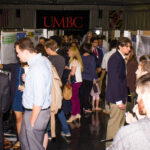
UMBC’s Undergraduate Research Symposium for the Chemical and Biological Sciences has become a destination for young researchers across the Eastern Seaboard, and it’s still growing. This year’s 20th running of the event was the largest yet, with 307 students from 47 institutions presenting 245 distinct research projects to 54 faculty judges, on topics from ecology to molecular biology to inorganic chemistry.
Nearly 100 UMBC students participated in the flagship event, which offers a rare opportunity for undergraduates to gather in large numbers to discuss their work with one another and practice presenting their findings to a wide range of people.
UMBC President Freeman Hrabowski described UMBC’s culture in his morning address, emphasizing the importance of persistence. “Success is about grit—the determination to never never never give up,” he said. “It’s that passion for continuing to learn.”
At UMBC, he continued, which welcomes students from more than 100 countries, “we are interested in making the point to America through you and others that science is exciting, that anyone who is willing to put in the effort can do it, and that you can never ask enough questions.”
Those questions can lead to important answers that impact the lives of others. “The nobility of scientific research is that you work on problems to help people you may never see. Something about that gives me goosebumps,” Hrabowski shared, adding, “What you are doing will save humankind.”
That includes research by students like Emily Bush, from Elmira College in Elmira, New York. She’s studying the effects of eugenol, an oily substance extractable from various herbs, on cancer cells. The scientist who judged her poster conducts research on the same cell lines, so Bush is heading home armed with useful feedback, inspired to “go back to the lab and really get some results and draw conclusions.”
Myra Dickey, of Salisbury University in Maryland, studied endangered spotted turtles in her research. By examining their DNA, she found that both sexes tend to disperse from their birthplace, which reduces the risk of inbreeding, but populations are so small and isolated that inbreeding’s detrimental effects are still a major concern. That means habitat conservation for the turtles is critical to their long-term survival.
Steven Lawrence and Moises Ridriguez, students at Medgar Evers College in Brooklyn, New York, presented research they conducted through the Research Initiative for Scientific Enhancement (RISE) program at Columbia University and New York University, respectively. Lawrence learned new coding skills to analyze data collected from surveys of Dominican women about their concerns related to HIV. His findings will inform educational programs in Dominica, and he says the experience encouraged him to pursue health outreach activities. Rodriguez studied the relationship between the presence of a molecule called RAGE and the shape of cells in the brain called microglia. His results suggest that RAGE is involved in the inflammatory response, which is part of aging.
Ryan White, associate professor of chemistry and Ohio Eminent Scholar at the University of Cincinnati and former associate professor of chemistry and biochemistry at UMBC, encouraged attendees to recognize the value of their work in his plenary talk. “Undergraduate research projects are not just side projects to give you experience and something to put on your resume,” he said. “Small discoveries you make along the way can really build momentum and lead to something bigger.”
White rebuffed rhetoric in the media suggesting millennials are “lazy” or “hopeless.” “You’re doing research, you’re critically thinking about what you’re doing, you’re solving problems,” he shared. “So my charge to you is to go out there and continue to do that—to prove all these articles wrong.”
White’s interdisciplinary lab is developing a range of bio-inspired sensors, with the broad goal of “building sensors that can help people by providing information to inform personalized medicine,” he said. To do that, he’s employing knowledge and techniques from nanoscience, electrochemistry, and biology—and several undergraduate students.
Dean Bill LaCourse, of the College of Natural and Mathematical Sciences, was also optimistic, and echoed Hrabowski’s sentiments about the value of diversity in science. “When I do my research, I ask questions from the world from which I came,” he shared. “What’s beautiful about a room like this, and all your faces, all your backgrounds, is that the number of problems that can be addressed, the number of questions that can be asked, is multiplied.”
Looking out at the next generation of scientists, he reminded them, “You can answer questions to change the world that you grew up in. You have the power to create the future.”
Image: Students and guests explore the research posters in the University Center Ballroom. Photo by Mohammed Arafat ’19.
]]>
UMBC’s Undergraduate Research Symposium for the Chemical and Biological Sciences has become a destination for young researchers across the Eastern Seaboard, and it’s still growing. This year’s...
https://umbc.edu/stories/20th-undergraduate-research-symposium-shines-a-light-on-students-diverse-contributions-to-science/
https://my3.my.umbc.edu/api/v0/pixel/news/120610/guest@my.umbc.edu/edf3906dbab48ecef0784e3a66f26dfb/api/pixel
biology
chembiochem
cnms
science-and-technology
undergradresearch
UMBC News & Magazine
https://my3.my.umbc.edu/groups/umbc-news-magazine
https://assets1-my.umbc.edu/system/shared/avatars/groups/000/001/943/24435aa6207c452e7bc15cc74b42c7bb/xsmall.png?1748556657
https://assets1-my.umbc.edu/system/shared/avatars/groups/000/001/943/24435aa6207c452e7bc15cc74b42c7bb/original.png?1748556657
https://assets2-my.umbc.edu/system/shared/avatars/groups/000/001/943/24435aa6207c452e7bc15cc74b42c7bb/xxlarge.png?1748556657
https://assets2-my.umbc.edu/system/shared/avatars/groups/000/001/943/24435aa6207c452e7bc15cc74b42c7bb/xlarge.png?1748556657
https://assets3-my.umbc.edu/system/shared/avatars/groups/000/001/943/24435aa6207c452e7bc15cc74b42c7bb/large.png?1748556657
https://assets1-my.umbc.edu/system/shared/avatars/groups/000/001/943/24435aa6207c452e7bc15cc74b42c7bb/medium.png?1748556657
https://assets2-my.umbc.edu/system/shared/avatars/groups/000/001/943/24435aa6207c452e7bc15cc74b42c7bb/small.png?1748556657
https://assets1-my.umbc.edu/system/shared/avatars/groups/000/001/943/24435aa6207c452e7bc15cc74b42c7bb/xsmall.png?1748556657
https://assets2-my.umbc.edu/system/shared/avatars/groups/000/001/943/24435aa6207c452e7bc15cc74b42c7bb/xxsmall.png?1748556657
UMBC News & Magazine
0
0
false
Wed, 01 Nov 2017 20:36:03 -0400
George Derek Musgrove launches book at the National Museum of African American History and Culture

George Derek Musgrove ’97, associate professor of history, launched his new book Chocolate City: A History of Race and Democracy in the Nation’s Capital, University of North Carolina Press, with co-author Chris Myers Asch at the National Museum of African American History and Culture on November 2.
 Top of page: George Derek Musgrove, Chris Myers Asch with moderator at the Oprah Winfrey Theatre in the National African American History and Culture Museum.
While teaching the history of the District of Columbia at the University of the District Columbia (UDC), Musgrove and Asch discovered the need for an accessible and comprehensive text that tells the full history of our nation’s capital.
After six years of research and writing they have produced a sweeping history of race and democracy in D.C. They argue that because of the consistent presence of a large black population, race, above and beyond other factors, has proven to be the most significant explanation for social, economic, and political divisions in the District — and as a bellwether for the country, D.C. shows how race has been the central fault line in American democracy.
“D.C. is a beacon for black America. In the 1830s it was a magnet for free blacks,” explains Musgrove, who has taught at UMBC since 2012. “During the Civil War it was a place to which slaves could escape from Maryland and Virginia and tens of thousands poured into the city. In the late 19th century it had the largest black population of any city in the country, and in 1957 it became the first majority black city in the United States.”
Like its namesake, the 1975 Parliament Funkadelic album Chocolate City, the book centers on the everyday people who make up the D.C. beyond Capitol Hill. It is a narrative focused on a city that is also a national stage.
 Cover image courtesy of George Derek Musgrove.
For Musgrove, D.C. history includes the successful strivers but also the working people. It is the story of its more famous citizens like Mary Church Terrell and Walter Fauntroy, but also of welfare moms who create housing cooperatives, the struggles and triumphs of Irish immigrants in the mid-19th century, and the black elites of the Jazz Age.
In the process of weaving a national and local story, Musgrove and Asch realized two things: first, that D.C. history tells a unique story about American democracy by having the distinction of being the only city that is run by Congress and, second, how race influences this mode of governance.
The city provides us “a window into our democracy and how it is perverted by issues of race. These issues play out in the streets of the city,” explains Musgrove. “Keep it in mind that we are defining race not as black and white, but as Latinos, Ethiopians, as whites, and Native Americans. The latter group was central to understanding race and government for the first hundred years after contact.”
Musgrove and Asch draw on this vast documented history of the city and present the stories for a mass audience in one place with the hope that it will allow professors to engage new students of D.C. history, provide context for activists fighting gentrification, and help members of the neighborhoods continue to actively discuss their city’s history.
“Our hope is that people of goodwill will look at the lessons of D.C. history and use them to guide some of their activism,” says Musgrove.“We think it is a good guide for future action for making a better city, for making something really democratic of the alleged capital of the free world.”
Q&A: Read UMBC Magazine’s interview with Derek Musgrove ’97
For more information…
Chocolate City Facebook page:
Facebook.com/chocolatecitybook
Places to Purchase:
UNC Press
Amazon
Banner image: George Derek Musgrove, Chris Myers Asch with moderator at the Oprah Winfrey Theatre in the National African American History and Culture Museum. Photo by Marlayna Demond ’11 for UMBC.
]]>
George Derek Musgrove ’97, associate professor of history, launched his new book Chocolate City: A History of Race and Democracy in the Nation’s Capital, University of North Carolina Press, with...
https://umbc.edu/stories/george-derek-musgrove-launches-book-at-the-national-museum-of-african-american-history-and-culture/
https://my3.my.umbc.edu/api/v0/pixel/news/120611/guest@my.umbc.edu/605ca43af11082a98f23341d7a94fc6c/api/pixel
alumni
cahss
community
diversityandinclusion
history
innovation
policy-and-society
roi
UMBC News & Magazine
https://my3.my.umbc.edu/groups/umbc-news-magazine
https://assets1-my.umbc.edu/system/shared/avatars/groups/000/001/943/24435aa6207c452e7bc15cc74b42c7bb/xsmall.png?1748556657
https://assets1-my.umbc.edu/system/shared/avatars/groups/000/001/943/24435aa6207c452e7bc15cc74b42c7bb/original.png?1748556657
https://assets2-my.umbc.edu/system/shared/avatars/groups/000/001/943/24435aa6207c452e7bc15cc74b42c7bb/xxlarge.png?1748556657
https://assets2-my.umbc.edu/system/shared/avatars/groups/000/001/943/24435aa6207c452e7bc15cc74b42c7bb/xlarge.png?1748556657
https://assets3-my.umbc.edu/system/shared/avatars/groups/000/001/943/24435aa6207c452e7bc15cc74b42c7bb/large.png?1748556657
https://assets1-my.umbc.edu/system/shared/avatars/groups/000/001/943/24435aa6207c452e7bc15cc74b42c7bb/medium.png?1748556657
https://assets2-my.umbc.edu/system/shared/avatars/groups/000/001/943/24435aa6207c452e7bc15cc74b42c7bb/small.png?1748556657
https://assets1-my.umbc.edu/system/shared/avatars/groups/000/001/943/24435aa6207c452e7bc15cc74b42c7bb/xsmall.png?1748556657
https://assets2-my.umbc.edu/system/shared/avatars/groups/000/001/943/24435aa6207c452e7bc15cc74b42c7bb/xxsmall.png?1748556657
UMBC News & Magazine
0
0
false
Wed, 01 Nov 2017 20:33:02 -0400
When I Was in College, I Didn't Know ...
by David Hoffman
I was a sensitive young man, sometimes confused or hurt by social situations and people's behavior. In the years after college, I finally started to see patterns in circumstances that had baffled me or caused me pain. I began to write them down, so that I would not forget.
I'm glad I did. Even now, decades later, I still sometimes need the reminders.
I first published my list ten years ago, and have been thrilled that others have found it useful. I'm hoping that's true for you, and that you'll add your own insights--even the ones you're still working out--as comments.
1.
A very large portion of people’s behavior is driven by insecurity. And a very large portion of the behavior that stems from insecurity can look like confidence.
2.
In many situations, people face a choice between doing something in a way that feels right, resonates, comes from the heart, makes sense, and fits the moment; or doing the thing in the way that they think they are supposed to do it. Examples: Giving a speech; proposing marriage; dealing with somebody’s emotional crisis; disciplining a child; interviewing a job candidate; responding “heroically” to a threat. More often than not, the genuine approach produces more satisfying results. And more often than not, people instead choose to do what they think they are supposed to do. (Part of the problem is that people’s sense of what they are supposed to do comes from many sources, including media, that present the relevant situations in misleading ways. For example, the media may capture the mechanical aspects of an effective speech but not the way the words match the emotions of the moment).
3.
Situations take a while to play out. There’s no need to panic, or to assume that what initially seems to be true will always be true.
4.
People tend to overreact.
5.
A situation that has been imagined, read about, etc. may not be easily recognized when it becomes a real situation. This is because the feel of the imagined situation may have been very distinctive, but the real situation feels much more like every other real situation. Examples: “corruption,” “falling in love,” “heroism.”
6.
In many situations, a variety of motivations drive people’s choice of actions. These motivations can range from deeply spiritual to simply practical. However, over time, the more abstract motivations tend to be forgotten, and the more practical motivations remembered and acted upon. It’s hard to cling to a concept; but practicalities—deadlines, costs, etc.—are hard to forget, and create their own inertia. As a result, people repeatedly find themselves going through the motions: continuing to do things that they once made the choice to do, but without retaining any sense of connection to their deepest needs and motivations. They feel lost, and their activities provide no real sustenance.
7.
People are not their roles.
8.
Many situations apparently resolved through formal processes, such as hiring staff, or creating legislation, are really resolved through a complex combination of formal and informal processes. Very often, the informal processes—which may be unacknowledged and hidden from view—are the more important ones.
9.
The key to effective communication is to understand one’s audience. And a lot of people can’t or don’t bother to understand many audiences for their communications.
10.
People may have to hear the same good idea many times before it enters their consciousness.
11.
Ideas are not appreciated or rewarded in proportion to their truth, beauty, explanatory power, or even social value. Other factors typically matter more. Among them: The credentials of the idea’s originator (however arbitrary their connection to the idea); the prospect that somebody can turn a profit from the idea; and the degree to which the idea departs from, or even improves upon, accepted wisdom (the more it does, the less likely it will be appreciated and rewarded).
12.
Often people want things for reasons they can’t quite put their finger on. It’s just something that they feel—maybe the subtle combination of a number of subjective factors (“I want Chinese food—even though we had Chinese last night;” “I want to go home now;” “I want this job despite the fact that it pays less than the other one”). Because they are personal impulses rather than the products of reasoning, these desires can be difficult to assert or defend. In forums where a collective decision is being made, logical arguments may be favored and impulsive arguments dismissed. But the impulses are real, and their connection to people’s welfare is real as well. It is perfectly legitimate to act on such impulses, and to resist the people who try to defeat them with arguments.
13.
Many actions appear to reflect clear, easily inferred motives but in fact do not. People and institutions do all sorts of things that may seem planned, polished and connected to a strategic agenda, but actually are the products of inertia, laziness, whim, jittery responses to incomplete information, or other motives more complex or confused than they seem.
14.
Social change happens in a gestalt—not as the result of any single well-conceived, well-executed program, policy or intervention. There is no single initiative that will save the world. This is because people, institutions, relationships and cultures are extremely complex. Any single action aimed at social change, however well-conceived and widely supported, is likely to be challenged, diverted, thwarted, misunderstood and/or misapplied in a thousand different ways. But honest, thoughtful efforts can have a cumulative effect. Slowly, person-by-person, relationship-by-relationship, they shift the underlying culture and expectations. So the good that we do is not always the immediate good that we intend.
15.
People express opinions for a lot of different reasons. That they really, deeply believe in what they are saying is only one of them.
16.
Overly zealous advocacy of a certain perspective alienates people who might otherwise have adopted that perspective in due time.
17.
The most insidious way to attack or undermine an idea is to call something else by its name.
18.
There are many situations that feel rotten, even when handled perfectly. (Examples: consoling somebody on the death of a friend; apologizing for a mistake that caused a lot of harm). So it is a mistake to assume from the rotten feeling that you have said or done the wrong thing.
19.
A picture left in the same place on the wall long enough will become invisible.
20.
Some things can be learned only through experience.
21.
When the true relationship between cause and effect is unknown, very simple patterns can appear vastly more complicated than they really are.
22.
Perceptions freeze more easily than situations. Once a person has formed a perception of a situation, he or she is likely to miss the fact that the situation has shifted subtly or gradually over time.
23.
Ambiguities in the early part of an arrangement can be costly to resolve. They may be the only things making the arrangement possible. Business deals, marriages, friendships—all may depend on the parties failing to reveal and resolve conflicts in their perceptions about the facts behind their transactions. If one of the parties, at the commencement of an arrangement, sees that these unresolved conflicts may exist, it can be very tempting to keep quiet about them and hope for the best. But the cost of cleaning up the messes that can arise when these conflicts come to light later, long after all parties have begun to take actions consistent with their own perceptions, can be far, far greater. In general, it is much better to name and attempt to resolve ambiguities on the front end of an arrangement rather than risk the catastrophe of having them derail the arrangement later.
24.
Justice is often associated with equality. “Splitting the difference” has a ring of fairness to it. Exhibiting “balance” in reporting on a situation—for example, devoting the same amount of journalistic space to each side of a controversy—seems evenhanded. But in situations in which there actually is a fundamental underlying inequality, treating people equally is fundamentally unjust. For example, if two people disagree about ten aspects of a transaction, but one of the two people is correct about all ten aspects and the other is simply lying for his or her own gain, it would be unjust to conclude that each person must be right about five of the ten sources of disagreement, or to simply “split the difference.”
25.
The two major sources of happiness are self-expression and love. And in truth, they are the same things.
]]>
by David Hoffman I was a sensitive young man, sometimes confused or hurt by social situations and people's behavior. In the years after college, I finally started to see patterns in...
https://my3.my.umbc.edu/api/v0/pixel/news/71673/guest@my.umbc.edu/c2742f68b6eb3a4824e68901094516ec/api/pixel
Co-Create UMBC
https://my3.my.umbc.edu/groups/co-create
https://assets4-my.umbc.edu/system/shared/avatars/groups/000/000/002/5b8f025dafb56cb8d3088b7259aadcfb/xsmall.png?1499890363
https://assets2-my.umbc.edu/system/shared/avatars/groups/000/000/002/5b8f025dafb56cb8d3088b7259aadcfb/original.jpg?1499890363
https://assets1-my.umbc.edu/system/shared/avatars/groups/000/000/002/5b8f025dafb56cb8d3088b7259aadcfb/xxlarge.png?1499890363
https://assets4-my.umbc.edu/system/shared/avatars/groups/000/000/002/5b8f025dafb56cb8d3088b7259aadcfb/xlarge.png?1499890363
https://assets1-my.umbc.edu/system/shared/avatars/groups/000/000/002/5b8f025dafb56cb8d3088b7259aadcfb/large.png?1499890363
https://assets1-my.umbc.edu/system/shared/avatars/groups/000/000/002/5b8f025dafb56cb8d3088b7259aadcfb/medium.png?1499890363
https://assets2-my.umbc.edu/system/shared/avatars/groups/000/000/002/5b8f025dafb56cb8d3088b7259aadcfb/small.png?1499890363
https://assets4-my.umbc.edu/system/shared/avatars/groups/000/000/002/5b8f025dafb56cb8d3088b7259aadcfb/xsmall.png?1499890363
https://assets1-my.umbc.edu/system/shared/avatars/groups/000/000/002/5b8f025dafb56cb8d3088b7259aadcfb/xxsmall.png?1499890363
Co-Create UMBC
https://assets3-my.umbc.edu/system/shared/thumbnails/news/000/071/673/79d40ec908dc7ee842105a346fe2c336/xxlarge.jpg?1509555235
https://assets1-my.umbc.edu/system/shared/thumbnails/news/000/071/673/79d40ec908dc7ee842105a346fe2c336/xlarge.jpg?1509555235
https://assets1-my.umbc.edu/system/shared/thumbnails/news/000/071/673/79d40ec908dc7ee842105a346fe2c336/large.jpg?1509555235
https://assets4-my.umbc.edu/system/shared/thumbnails/news/000/071/673/79d40ec908dc7ee842105a346fe2c336/medium.jpg?1509555235
https://assets4-my.umbc.edu/system/shared/thumbnails/news/000/071/673/79d40ec908dc7ee842105a346fe2c336/small.jpg?1509555235
https://assets4-my.umbc.edu/system/shared/thumbnails/news/000/071/673/79d40ec908dc7ee842105a346fe2c336/xsmall.jpg?1509555235
https://assets3-my.umbc.edu/system/shared/thumbnails/news/000/071/673/79d40ec908dc7ee842105a346fe2c336/xxsmall.jpg?1509555235
106
13
true
Wed, 01 Nov 2017 20:13:03 -0400
UMBC scientists measure plant productivity from space, with applications from farming to forest conservation

Two researchers at UMBC’s Joint Center for Earth Systems Technology (JCET) and colleagues have found that instrumentation on the International Space Station (ISS) can collect data measuring the photosynthetic activity of various ecosystems and landscapes in a way that is both more comprehensive and more nuanced than standard land-based techniques.
“We’re laying the groundwork for developing ways of monitoring vegetation,” says Fred Huemmrich, JCET scientist and lead author on the new study. High-resolution monitoring of photosynthesis on landscapes such as agricultural fields, forests, and grasslands could inform everything from farming practices to our understanding of climate change.
Being able to detect productivity at high resolution could help farmers “evaluate how the field is doing, where there are problems, and perhaps identify things like insect damage and stress responses,” says Huemmrich, noting that similar techniques have successfully detected differences in fertilizer application on corn fields. The same information could be gleaned for managed forests, for example, to detect stress caused by destructive bark beetles.
On a larger scale, Huemmrich says that “most of what we know about how ecosystems respond to climate change and increased carbon dioxide in the atmosphere is from models,” rather than concrete data. If scientists could use satellites, like the ISS, to track photosynthesis in real-time around the globe, that could greatly increase our understanding of how climate change is affecting vegetation. Plants are crucial for managing the global climate, because they take carbon dioxide out of the atmosphere and release oxygen during photosynthesis.
The current gold-standard method for measuring photosynthesis relies on a network of hundreds of “flux towers” around the globe—structures on the ground that detect the flux of carbon in the area by “sniffing the air,” explains Huemmrich, but “the towers can’t be everywhere.” Remote sensing from a satellite would allow scientists to measure carbon fluxes in other places, even those that are inaccessible from the ground.
The new JCET study demonstrates an effective way to do just that, using images taken by the hyperspectral imager for coastal ocean (HICO), which is mounted on the ISS. Petya Campbell, a JCET scientist who was second author on the study, analyzed 26 total HICO images of three sites. Her analysis determined the photosynthetic productivity of vegetation canopies by detecting their reflectance of different wavelengths of light. Reflectance is a reliable measurement of photosynthesis because the amounts of different compounds present in leaves (such as chlorophyll and water) determine the plant’s photosynthetic activity, and each reflects differently.
The team found that multiple algorithms they used with the HICO data matched well with the tried-and-true data coming from the towers, providing strong evidence that this method of remote productivity monitoring can work well in both grasslands and forests. After further confirmation, researchers will be able to trust data about areas not also covered by flux towers. That’s an important advance, Campbell explains, because remote imaging spectroscopy “provides the only practical approach to map canopy functional traits, which are impossible to frequently measure on the ground and comprehensively map across space.”
In some cases, the measurements deduced from HICO data also provide information that flux towers can’t. Remote sensing does a better job distinguishing boundaries in a landscape, such as where a farm field transitions to a forest, and it also performs better on slopes. Plus, data collected by instruments on the ISS are unique because the space station is not in a “sun-synchronous” orbit, which means it passes over the same locations on Earth at different times of day. That allows researchers to detect differences in photosynthesis between morning and afternoon, as well as throughout the growing season and from many viewing angles.
Since the submission of Huemmrich and Campbell’s study, HICO has gone offline, but that doesn’t mean this kind of work is over. A new spectrometer is headed to the ISS in 2018, as well as other instruments that can measure water evaporating from leaves, plant fluorescence, and heat stress. “If NASA had asked me what four instruments I would want in space to study plants, that’s what I would have told them,” Huemmrich says. “Now we’re looking forward to having all four of these instruments on the space station and being able to do something with them.”
Learn more from the full article published in IEEE Journal of Special Topics in Applied Earth Observations and Remote Sensing.
Image: The international space station, provided by NASA.
]]>
Two researchers at UMBC’s Joint Center for Earth Systems Technology (JCET) and colleagues have found that instrumentation on the International Space Station (ISS) can collect data measuring the...
https://umbc.edu/stories/umbc-scientists-measure-plant-productivity-from-space-with-applications-from-farming-to-forest-conservation/
https://my3.my.umbc.edu/api/v0/pixel/news/120612/guest@my.umbc.edu/b6c72bea216ff4094294fcf05db43848/api/pixel
jcet
research
science-and-technology
UMBC News & Magazine
https://my3.my.umbc.edu/groups/umbc-news-magazine
https://assets1-my.umbc.edu/system/shared/avatars/groups/000/001/943/24435aa6207c452e7bc15cc74b42c7bb/xsmall.png?1748556657
https://assets1-my.umbc.edu/system/shared/avatars/groups/000/001/943/24435aa6207c452e7bc15cc74b42c7bb/original.png?1748556657
https://assets2-my.umbc.edu/system/shared/avatars/groups/000/001/943/24435aa6207c452e7bc15cc74b42c7bb/xxlarge.png?1748556657
https://assets2-my.umbc.edu/system/shared/avatars/groups/000/001/943/24435aa6207c452e7bc15cc74b42c7bb/xlarge.png?1748556657
https://assets3-my.umbc.edu/system/shared/avatars/groups/000/001/943/24435aa6207c452e7bc15cc74b42c7bb/large.png?1748556657
https://assets1-my.umbc.edu/system/shared/avatars/groups/000/001/943/24435aa6207c452e7bc15cc74b42c7bb/medium.png?1748556657
https://assets2-my.umbc.edu/system/shared/avatars/groups/000/001/943/24435aa6207c452e7bc15cc74b42c7bb/small.png?1748556657
https://assets1-my.umbc.edu/system/shared/avatars/groups/000/001/943/24435aa6207c452e7bc15cc74b42c7bb/xsmall.png?1748556657
https://assets2-my.umbc.edu/system/shared/avatars/groups/000/001/943/24435aa6207c452e7bc15cc74b42c7bb/xxsmall.png?1748556657
UMBC News & Magazine
0
0
false
Wed, 01 Nov 2017 19:27:52 -0400
Congratulations to Prof. Charissa Cheah on her Fulbright!
Charissa Cheah, professor of psychology, has received a Fulbright to collaborate with psychologists at the University of Palermo in Sicily to explore Muslim Tunisian immigrant adolescent identity development, civic engagement, positive youth development, and risk behavior engagement. The award is one of only six Fulbright awards open to all academic disciplines and specializations in the humanities, sciences, social sciences and the arts to conduct research in Italy.
]]>
Charissa Cheah, professor of psychology, has received a Fulbright to collaborate with psychologists at the University of Palermo in Sicily to explore Muslim Tunisian immigrant adolescent identity...
http://news.umbc.edu/charissa-cheah-receives-fulbright-award-to-research-identity-development-of-muslim-tunisian-immigrant-adolescents-in-sicily/
https://my3.my.umbc.edu/api/v0/pixel/news/71695/guest@my.umbc.edu/bff020e458cd3e1e4bcb27cdc178e1e3/api/pixel
Asian & Asian American Faculty & Staff Council
https://my3.my.umbc.edu/groups/aaafsc
https://assets3-my.umbc.edu/system/shared/avatars/groups/000/001/330/94ddadbbdb616fb525b5072e500c09df/xsmall.png?1490208817
https://assets1-my.umbc.edu/system/shared/avatars/groups/000/001/330/94ddadbbdb616fb525b5072e500c09df/original.jpeg?1490208817
https://assets1-my.umbc.edu/system/shared/avatars/groups/000/001/330/94ddadbbdb616fb525b5072e500c09df/xxlarge.png?1490208817
https://assets1-my.umbc.edu/system/shared/avatars/groups/000/001/330/94ddadbbdb616fb525b5072e500c09df/xlarge.png?1490208817
https://assets1-my.umbc.edu/system/shared/avatars/groups/000/001/330/94ddadbbdb616fb525b5072e500c09df/large.png?1490208817
https://assets1-my.umbc.edu/system/shared/avatars/groups/000/001/330/94ddadbbdb616fb525b5072e500c09df/medium.png?1490208817
https://assets1-my.umbc.edu/system/shared/avatars/groups/000/001/330/94ddadbbdb616fb525b5072e500c09df/small.png?1490208817
https://assets3-my.umbc.edu/system/shared/avatars/groups/000/001/330/94ddadbbdb616fb525b5072e500c09df/xsmall.png?1490208817
https://assets3-my.umbc.edu/system/shared/avatars/groups/000/001/330/94ddadbbdb616fb525b5072e500c09df/xxsmall.png?1490208817
Asian & Asian American Faculty & Staff Council
3
0
false
Wed, 01 Nov 2017 19:05:33 -0400
Full Circle Fine Art Services seeks Photo Lab Technician
Photography Lab Technician
]]>
Photography Lab Technician
http://www.baltimoreculture.org/programs/jobsplus/15391
https://my3.my.umbc.edu/api/v0/pixel/news/71694/guest@my.umbc.edu/f733fd63851373274a4d24e5e7a0d725/api/pixel
alliance
arts
baltimore
cultural
culture
greater
jobs
museum
nonprofit
opportunities
organizations
part-time
positions
studies
visual-art
Museum Practice
https://my3.my.umbc.edu/groups/museumpractice
https://assets2-my.umbc.edu/system/shared/avatars/groups/000/000/780/ec390e445f99f5d8c57a847f02552fbc/xsmall.png?1384380461
https://assets3-my.umbc.edu/system/shared/avatars/groups/000/000/780/ec390e445f99f5d8c57a847f02552fbc/original.png?1384380461
https://assets1-my.umbc.edu/system/shared/avatars/groups/000/000/780/ec390e445f99f5d8c57a847f02552fbc/xxlarge.png?1384380461
https://assets4-my.umbc.edu/system/shared/avatars/groups/000/000/780/ec390e445f99f5d8c57a847f02552fbc/xlarge.png?1384380461
https://assets2-my.umbc.edu/system/shared/avatars/groups/000/000/780/ec390e445f99f5d8c57a847f02552fbc/large.png?1384380461
https://assets3-my.umbc.edu/system/shared/avatars/groups/000/000/780/ec390e445f99f5d8c57a847f02552fbc/medium.png?1384380461
https://assets2-my.umbc.edu/system/shared/avatars/groups/000/000/780/ec390e445f99f5d8c57a847f02552fbc/small.png?1384380461
https://assets2-my.umbc.edu/system/shared/avatars/groups/000/000/780/ec390e445f99f5d8c57a847f02552fbc/xsmall.png?1384380461
https://assets1-my.umbc.edu/system/shared/avatars/groups/000/000/780/ec390e445f99f5d8c57a847f02552fbc/xxsmall.png?1384380461
Museum Practice
0
0
true
Wed, 01 Nov 2017 17:22:00 -0400
Wed, 01 Nov 2017 17:22:00 -0400
The Baltimore Symphony Orchestra seeks Freelance Graphic Designer
The Baltimore Symphony Orchestra is looking for a qualified Freelance Graphic Designer to assist in the creation of graphic design in both print and digital platforms.
Design hours may vary, standard of 10 – 20 hours per week.
SUMMARY
]]>
The Baltimore Symphony Orchestra is looking for a qualified Freelance Graphic Designer to assist in the creation of graphic design in both print and digital platforms. Design hours may vary,...
http://www.baltimoreculture.org/programs/jobsplus/15390
https://my3.my.umbc.edu/api/v0/pixel/news/71693/guest@my.umbc.edu/a61171dbfff7a2555f5e6acee6390524/api/pixel
alliance
arts
baltimore
cultural
culture
design
greater
jobs
museum
nonprofit
opportunities
organizations
positions
studies
Museum Practice
https://my3.my.umbc.edu/groups/museumpractice
https://assets2-my.umbc.edu/system/shared/avatars/groups/000/000/780/ec390e445f99f5d8c57a847f02552fbc/xsmall.png?1384380461
https://assets3-my.umbc.edu/system/shared/avatars/groups/000/000/780/ec390e445f99f5d8c57a847f02552fbc/original.png?1384380461
https://assets1-my.umbc.edu/system/shared/avatars/groups/000/000/780/ec390e445f99f5d8c57a847f02552fbc/xxlarge.png?1384380461
https://assets4-my.umbc.edu/system/shared/avatars/groups/000/000/780/ec390e445f99f5d8c57a847f02552fbc/xlarge.png?1384380461
https://assets2-my.umbc.edu/system/shared/avatars/groups/000/000/780/ec390e445f99f5d8c57a847f02552fbc/large.png?1384380461
https://assets3-my.umbc.edu/system/shared/avatars/groups/000/000/780/ec390e445f99f5d8c57a847f02552fbc/medium.png?1384380461
https://assets2-my.umbc.edu/system/shared/avatars/groups/000/000/780/ec390e445f99f5d8c57a847f02552fbc/small.png?1384380461
https://assets2-my.umbc.edu/system/shared/avatars/groups/000/000/780/ec390e445f99f5d8c57a847f02552fbc/xsmall.png?1384380461
https://assets1-my.umbc.edu/system/shared/avatars/groups/000/000/780/ec390e445f99f5d8c57a847f02552fbc/xxsmall.png?1384380461
Museum Practice
0
0
true
Wed, 01 Nov 2017 17:10:28 -0400
Wed, 01 Nov 2017 17:10:28 -0400