Micro Economics – Mike Adelstein ’96
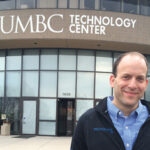
Mike Adelstein ’96, biochemistry and molecular biology, gets excited by the littlest things.
As president and CEO of Potomac Photonics Inc., he leads a company that uses advanced manufacturing technologies (high-tech lasers and 3-D printing) to create and manufacture essential and ultra-tiny parts used in products ranging from space satellites to espresso makers.
Nearly every prototype that Potomac Photonics produces can fit in Adelstein’s palm, or his shirt pocket, and he keeps plenty of examples on hand to share with visitors.
“Look at this!” he says, eyes shining, as he produces a thread-like sample for examination. It’s a surgical suture, which is impressive enough at that scale. But, wait. There’s more!
“Our client needed micro-wells laser-drilled into the suture, where they could insert radiation,” he explains. And Potomac Photonics engineers rose to the task, figuring out how to drill 25,000 holes, each just one micron thick, in each of the tiny sutures. Doctors at Walter Reed Army Hospital are now using this technology to deliver highly localized treatment for breast and prostate cancer.
Adelstein says that devising these micro products, and the potential they have to improve everyday lives in so many ways, make him eager to arrive at the company’s headquarters in the university’s bwtech@UMBC Research & Technology Park each day. “We’re involved in fabricating devices to diagnose concussions, develop new pharmaceutical drugs,” he says. “The things we are doing are actually making an impact on the world.”
Adelstein joined Potomac Photonics as a sales administrator in 1997, not long after graduating from UMBC with a major in biochemistry and molecular biology. “UMBC was really tough for me,” he recalls. “Learning never came easy to me, but I persevered and I got through.” The university’s supportive faculty and collaborative student environment, he says, helped reward his perseverance with a structure for success.
That resilience served him well over the next dozen years. As Adelstein focused on growing the contract-manufacturing unit at Potomac, he also earned an M.S. in technology management from University of Maryland, University College and became a CPA. In 2011, Adelstein was promoted to become Potomac’s president and CEO. A year later, he led a buyout of the company.
Among his first acts after the buyout was to move Potomac Photonics from Lanham to bwtech@UMBC. The company completed its move to the university’s research and technology park in March 2013.
Ellen Hemmerly, executive director of bwtech@UMBC, worked closely with Adelstein to make the move to the research park possible. “Mike wanted to move Potomac Photonics here for all of the right reasons,” she observes. “He wanted to grow his company. He wanted to be affiliated with UMBC. He wanted to collaborate with faculty. And he wanted to hire students.”
Indeed, since the move to bwtech@UMBC, Potomac has grown from 18 to 26 employees. Adelstein points with pride to the fact that six members of his staff have affiliations with UMBC – either as graduates or student interns. “And that’s only going to be growing,” he says.
The company’s director of research and development, Amir Harandi, Ph.D ’14, mechanical engineering, is one of those employees with UMBC connections. He began working at Potomac as a graduate student, and stepped into his current role after completing his degree.
“Mike is a great CEO,” says Harandi, “and this is a great environment for an engineer. Research and development really is the driver of the company.” That drive and growth is demonstrated by the company’s current build out of 2,000 square feet of additional R&D space at bwtech@UMBC.
Adelstein is committed to creating a work culture where employees feel respected and valued — and where opportunity abounds. High school graduates who start as technicians at the company can receive training to become engineers, for example. And Potomac Photonics does pro bono work for organizations including the Boy Scouts of America and the U.S. Marine Corps.
“Potomac’s culture very much parallels what [President Freeman A. Hrabowski, III] has brought to UMBC,” says Adelstein, who was named UMBC’s Alumnus of the Year in natural and mathematical sciences in 2014. “Our core values are based on lifelong education, opportunity, social responsibility, diversity, collaboration, and hard work.”
— Sue de Pasquale
]]>
Mike Adelstein ’96, biochemistry and molecular biology, gets excited by the littlest things. As president and CEO of Potomac Photonics Inc., he leads a company that uses advanced manufacturing...
https://umbc.edu/stories/micro-economics-mike-adelstein-96/
https://my3.my.umbc.edu/api/v0/pixel/news/121576/guest@my.umbc.edu/65322bce5a6bc377ee980d00b840ee42/api/pixel
alumni
fall-2015
UMBC News & Magazine
https://my3.my.umbc.edu/groups/umbc-news-magazine
https://assets1-my.umbc.edu/system/shared/avatars/groups/000/001/943/24435aa6207c452e7bc15cc74b42c7bb/xsmall.png?1748556657
https://assets1-my.umbc.edu/system/shared/avatars/groups/000/001/943/24435aa6207c452e7bc15cc74b42c7bb/original.png?1748556657
https://assets2-my.umbc.edu/system/shared/avatars/groups/000/001/943/24435aa6207c452e7bc15cc74b42c7bb/xxlarge.png?1748556657
https://assets2-my.umbc.edu/system/shared/avatars/groups/000/001/943/24435aa6207c452e7bc15cc74b42c7bb/xlarge.png?1748556657
https://assets3-my.umbc.edu/system/shared/avatars/groups/000/001/943/24435aa6207c452e7bc15cc74b42c7bb/large.png?1748556657
https://assets1-my.umbc.edu/system/shared/avatars/groups/000/001/943/24435aa6207c452e7bc15cc74b42c7bb/medium.png?1748556657
https://assets2-my.umbc.edu/system/shared/avatars/groups/000/001/943/24435aa6207c452e7bc15cc74b42c7bb/small.png?1748556657
https://assets1-my.umbc.edu/system/shared/avatars/groups/000/001/943/24435aa6207c452e7bc15cc74b42c7bb/xsmall.png?1748556657
https://assets2-my.umbc.edu/system/shared/avatars/groups/000/001/943/24435aa6207c452e7bc15cc74b42c7bb/xxsmall.png?1748556657
UMBC News & Magazine
0
0
false
Fri, 04 Sep 2015 17:54:10 -0400
Bold Horizons – Kavita Krishnaswamy ’07

Like many UMBC alumnae, Kavita Krishnaswamy ’07, mathematics and computer science, feels driven to create a better world for the next generation. More than most alumnae, however, she has a visceral, personal sense of what that better world might require.
Krishnaswamy lives with spinal muscular atrophy, a progressive neurological condition that has gradually robbed her of the ability to move below the neck. Today, she is a doctoral student in computer science at UMBC, and she has devoted the past six years of her life to designing prototypes for robotic assistive tools that could give more independence to people with severe neurological challenges.
“As a person with a disability, I have some control over my environment,” she says. “But I think we’re on the verge of a new wave of assistive technologies that could provide much more independence to people with disabilities and their caregivers.”
The digital prototypes that Krishnaswamy has painstakingly designed during the past few years are part of that new wave. Large slings and lifters that can safely move patients from a lying to a sitting position. A five-armed robot that can help reposition patients in bed. And finely-coordinated robots that can assist with eating and toothbrushing tasks.
“Kavita is just unbelievably focused and unbelievably driven,” says Tim Oates, a professor of computer science and electrical engineering. “She wants to create tools that will help herself, but more than that, she wants to create tools that will help people in the future.”
Krishnaswamy was born in India and raised in Columbia. She entered UMBC as an undergraduate through the Meyerhoff Scholars Program, and she says that she immediately felt welcomed in the campus community. She credits Sue Evans, a senior lecturer in computer science and electrical engineering, with helping her stay determined in programming, and Suddappa Seetharama Gowda, a professor of mathematics, with helping her find tools to continue to type complex mathematical formulas even as her handwriting deteriorated.
During her undergraduate years, Krishnaswamy was occasionally able to visit campus, but she has pursued her entire doctoral program from home, with the aid of Skype and other software. “She’s been able to do every single class,” Oates says. “She can hear the lectures, see the boards, and participate in the discussions. I’m very pleased with how we’ve been able to work with her as an institution.”
Krishnaswamy says it is vital for the designers of assistive technologies to spend more time listening to the people who might actually use their devices. “Many assistive devices so far have been designed with caregivers in mind,” she says. “And I understand that – they have great needs. But there’s also a need to assist the people with disabilities themselves.”
To fulfill the principle of participatory design in her own endeavors, Krishnaswamy has assembled a network of people with disabilities, and consults with them as she moves her prototypes from digital form to physical form.
Krishnaswamy herself, meanwhile, is acting as an ambassador to Suitable Technologies, the makers of a technology known as Beam – a wheeled robot with a mounted camera that allows users to visit museums and conferences without being physically present.
“It’s a wonderful technology that has allowed me to travel across the world,” Krishnaswamy says.
For Krishnaswamy’s own robotic protoypes, the next step will be bringing them from idea and design to the marketplace. “I’ve been talking to a number of vendors,” she says, “and we hope to have a few things built by 2017.” A key element, she says, will be tools that allow users with severe disabilities to control the robots with simple voice commands, mouse movements, or even facial gestures.
Oates, for his part, has little doubt that Krishnaswamy will find partners for these projects. “One of Kavita’s many strong talents,” he says, “is her ability to rally people to help her build things.”
Krishnaswamy says assistive robotics shouldn’t be understood as concerning only people with rare severe conditions like her own. With an aging population and the explosion of conditions such as Alzheimer’s disease, many millions of people and their caregivers could benefit from smarter and nimbler robots. “We need to create more technology and better technology,” she says, “so that society as a whole can be more independent.”
— David Glenn
]]>
Like many UMBC alumnae, Kavita Krishnaswamy ’07, mathematics and computer science, feels driven to create a better world for the next generation. More than most alumnae, however, she has a...
https://umbc.edu/stories/bold-horizons-kavita-krishnaswamy-07/
https://my3.my.umbc.edu/api/v0/pixel/news/121577/guest@my.umbc.edu/b72eee72205762c18859222f49cb32ce/api/pixel
alumni
fall-2015
UMBC News & Magazine
https://my3.my.umbc.edu/groups/umbc-news-magazine
https://assets1-my.umbc.edu/system/shared/avatars/groups/000/001/943/24435aa6207c452e7bc15cc74b42c7bb/xsmall.png?1748556657
https://assets1-my.umbc.edu/system/shared/avatars/groups/000/001/943/24435aa6207c452e7bc15cc74b42c7bb/original.png?1748556657
https://assets2-my.umbc.edu/system/shared/avatars/groups/000/001/943/24435aa6207c452e7bc15cc74b42c7bb/xxlarge.png?1748556657
https://assets2-my.umbc.edu/system/shared/avatars/groups/000/001/943/24435aa6207c452e7bc15cc74b42c7bb/xlarge.png?1748556657
https://assets3-my.umbc.edu/system/shared/avatars/groups/000/001/943/24435aa6207c452e7bc15cc74b42c7bb/large.png?1748556657
https://assets1-my.umbc.edu/system/shared/avatars/groups/000/001/943/24435aa6207c452e7bc15cc74b42c7bb/medium.png?1748556657
https://assets2-my.umbc.edu/system/shared/avatars/groups/000/001/943/24435aa6207c452e7bc15cc74b42c7bb/small.png?1748556657
https://assets1-my.umbc.edu/system/shared/avatars/groups/000/001/943/24435aa6207c452e7bc15cc74b42c7bb/xsmall.png?1748556657
https://assets2-my.umbc.edu/system/shared/avatars/groups/000/001/943/24435aa6207c452e7bc15cc74b42c7bb/xxsmall.png?1748556657
UMBC News & Magazine
0
0
false
Fri, 04 Sep 2015 17:51:31 -0400
A Royal Road – Keri Burneston ’99

What does it take to be the Miss Exotic World, Reigning Queen of Burlesque? And, what’s more, to make a career from an art form that you love? Ask Trixie Little (aka Keri Burneston ’99, visual and performing arts). Little took her crown in June at the Burlesque Hall of Fame Weekend Tournament of Tease in Las Vegas, and she offered UMBC Magazine her reflections on a career onstage that’s been capped with this unique honor.
I’m Trixie Little. I am the Reigning Queen of Burlesque 2015. I have been performing my own style of “acrobatic burlesque” since 2002, primarily with my partner in life and art, The Evil Hate Monkey. I live in New York City now, and I have been performing full time since 2007.
I was among the last of the painting majors in UMBC’s Visual Arts Department. (I graduated just as digital media was taking over.) I never really wanted to be a painter, but I knew I was a visual person, and I figured having a traditional foundation in visual art – as well as a solid liberal arts education – would help me no matter what career I chose.
On a class trip to Italy to study Renaissance painting during my time at UMBC, I was inspired by how intertwined the work of these painters was with the politics of their time, the demands of their benefactors, and the expectations of both the church and the town. It occurred to me that art was meant to be an active part of the culture and the times, something I didn’t think I could achieve by hanging a painting in some obscure gallery.
I had another epiphany on that trip: It is up to the artist to figure out how to communicate effectively with the audience, and not the other way around. Many artists I knew back then were disgusted when people didn’t “get” their work. But those Renaissance painters taught me that artists must learn how to navigate the opinions and tastes of our audience. It is up to the artist to bring their ideas to the world in ways that audiences will swallow – even (and especially) when they are pushing the boundaries of their art.
 The trip also pushed me to look forward. In our modern, and often disconnected, age, how do artists best communicate? For me, performing in front of people felt like the most direct way. This revelation was the birth of me as a populist and a performer!
I worked on a number of projects after graduating. An interpretation of Bizet’s opera Carmen featuring elaborately-dressed hot dogs as puppets that clocked in at under 10 minutes. A water ballet inspired by my love of Busby Berkeley performed in public pools every summer in Baltimore at Patterson Park and elsewhere. (That troupe became a nonprofit organization called Fluid Movement.)
Eventually, I wanted to do something edgier. Something that played with sexuality and female power in an overt way. My own movie star fantasy. That’s when I found burlesque.
It was 2002. Burlesque was already enjoying a resurgence in New York, Los Angeles, and New Orleans. I jumped in with both feet, dragging my boyfriend along with me to play my sidekick, The Evil Hate Monkey. Together, we pioneered a form of burlesque that integrated acrobatics and strong characters into the striptease.
By 2006, we were successful enough to quit our day jobs to travel and perform full time.
Yet we had a vision, and knew that we needed more skill to achieve it. So Monkey and I moved to Vermont for a two-year professional circus training program. We studied partner acrobatics and duo trapeze.
All that work paid off – and not just with a crown. We have headlined countless burlesque festivals around the world, and toured Australia four times performing our own cabaret show. We have even had a feature length movie made by my fellow alumna Kirsten D’Andrea Hollander ’97 about our lives as performers: Us Naked: Trixie and Monkey.
But success makes you reflect on the tricky negotiation of making art and making a living. As an artist, you’re always thinking ahead to the next big act you want to create, the next costume you need to develop, or the next acrobatic skill you need to learn. You have to evolve and improve constantly. Stagnation is not an option. To stay at the top of your game, you have to put in endless hours of blood, sweat, and tears.
The business side requires just as much effort. You need to reinvest to build an empire that will sustain you. Often that involves taking bigger risks, including producing your own shows and international tours, creating all of your own merchandise, and finding side projects that don’t dilute your image.
In between my ongoing circus training, development of costumes, and maintenance of my repertoire, I am always looking for better and better festivals, shows, or venues to present my work. But I haven’t neglected the populist in me. The Trixie who also wants to present new work on television and in film in ways that doesn’t dilute the sexiness, authenticity, or the comedy of it.
With my newly acquired crown and title, I have a platform that just might help me do all of that and more.
]]>
What does it take to be the Miss Exotic World, Reigning Queen of Burlesque? And, what’s more, to make a career from an art form that you love? Ask Trixie Little (aka Keri Burneston ’99, visual and...
https://umbc.edu/stories/a-royal-road-keri-burneston-99/
https://my3.my.umbc.edu/api/v0/pixel/news/121578/guest@my.umbc.edu/3da21e54103cfd6d7b538cad12c9586c/api/pixel
alumni
fall-2015
UMBC News & Magazine
https://my3.my.umbc.edu/groups/umbc-news-magazine
https://assets1-my.umbc.edu/system/shared/avatars/groups/000/001/943/24435aa6207c452e7bc15cc74b42c7bb/xsmall.png?1748556657
https://assets1-my.umbc.edu/system/shared/avatars/groups/000/001/943/24435aa6207c452e7bc15cc74b42c7bb/original.png?1748556657
https://assets2-my.umbc.edu/system/shared/avatars/groups/000/001/943/24435aa6207c452e7bc15cc74b42c7bb/xxlarge.png?1748556657
https://assets2-my.umbc.edu/system/shared/avatars/groups/000/001/943/24435aa6207c452e7bc15cc74b42c7bb/xlarge.png?1748556657
https://assets3-my.umbc.edu/system/shared/avatars/groups/000/001/943/24435aa6207c452e7bc15cc74b42c7bb/large.png?1748556657
https://assets1-my.umbc.edu/system/shared/avatars/groups/000/001/943/24435aa6207c452e7bc15cc74b42c7bb/medium.png?1748556657
https://assets2-my.umbc.edu/system/shared/avatars/groups/000/001/943/24435aa6207c452e7bc15cc74b42c7bb/small.png?1748556657
https://assets1-my.umbc.edu/system/shared/avatars/groups/000/001/943/24435aa6207c452e7bc15cc74b42c7bb/xsmall.png?1748556657
https://assets2-my.umbc.edu/system/shared/avatars/groups/000/001/943/24435aa6207c452e7bc15cc74b42c7bb/xxsmall.png?1748556657
UMBC News & Magazine
0
0
false
Fri, 04 Sep 2015 17:49:32 -0400
William Blake, Political Science, Explains the Supreme Court Long Conference in The New York Times

William Blake, a new assistant professor in the political science department, was quoted in a recent New York Times article about a study he conducted with two colleagues that investigated why the Supreme Court grants a smaller percentage of cases during the first conference of its term compared to others throughout the year. The research points to new law clerks as the reason because they receive limited training and are reluctant to provide recommendations due to reputation concerns.
For the study, Blake and his colleagues analyzed clerks’ pool memos from 1987 to 1994 that were released as part of Justice Harry A. Blackmun’s papers. “The bottom line, the study said, is that ‘litigants face an arbitrary and legally irrelevant disadvantage that is empirically attributable to the clerks’ initial hesitation to recommend grants,’” stated the New York Times article.
The study suggested additional training for law clerks to recommend granting more cases from the start. Blake said it wouldn’t be feasible to add more conferences during the summer for justices to consider cases.
“I don’t think we’re going to tell the justices to cut their vacations short,” he said.
Professor Blake’s research interests are in public law and the U.S. Supreme Court and state supreme courts.
]]>
William Blake, a new assistant professor in the political science department, was quoted in a recent New York Times article about a study he conducted with two colleagues that investigated why the...
https://umbc.edu/stories/william-blake-political-science-explains-the-supreme-court-long-conference-in-the-new-york-times/
https://my3.my.umbc.edu/api/v0/pixel/news/121579/guest@my.umbc.edu/0d3760d37059f60c465e2e5f5c524589/api/pixel
cahss
policy-and-society
politicalscience
UMBC News & Magazine
https://my3.my.umbc.edu/groups/umbc-news-magazine
https://assets1-my.umbc.edu/system/shared/avatars/groups/000/001/943/24435aa6207c452e7bc15cc74b42c7bb/xsmall.png?1748556657
https://assets1-my.umbc.edu/system/shared/avatars/groups/000/001/943/24435aa6207c452e7bc15cc74b42c7bb/original.png?1748556657
https://assets2-my.umbc.edu/system/shared/avatars/groups/000/001/943/24435aa6207c452e7bc15cc74b42c7bb/xxlarge.png?1748556657
https://assets2-my.umbc.edu/system/shared/avatars/groups/000/001/943/24435aa6207c452e7bc15cc74b42c7bb/xlarge.png?1748556657
https://assets3-my.umbc.edu/system/shared/avatars/groups/000/001/943/24435aa6207c452e7bc15cc74b42c7bb/large.png?1748556657
https://assets1-my.umbc.edu/system/shared/avatars/groups/000/001/943/24435aa6207c452e7bc15cc74b42c7bb/medium.png?1748556657
https://assets2-my.umbc.edu/system/shared/avatars/groups/000/001/943/24435aa6207c452e7bc15cc74b42c7bb/small.png?1748556657
https://assets1-my.umbc.edu/system/shared/avatars/groups/000/001/943/24435aa6207c452e7bc15cc74b42c7bb/xsmall.png?1748556657
https://assets2-my.umbc.edu/system/shared/avatars/groups/000/001/943/24435aa6207c452e7bc15cc74b42c7bb/xxsmall.png?1748556657
UMBC News & Magazine
0
0
false
Fri, 04 Sep 2015 17:35:22 -0400
Amy Bhatt, Gender and Women’s Studies, Discusses Her Research on Immigrant Tech Communities in the Seattle Times
 In an in-depth Seattle Times story about the difficulty in finding employment that women in immigrant tech communities experience, Amy Bhatt, an assistant professor of gender and women’s studies, was quoted in the article and provided perspective on many of the harsh realities that women in such communities encounter.
“It’s very challenging for many of the women who come here as spouses,” said Bhatt, who did her Ph.D. research at the University of Washington on high-tech immigrant communities in the Seattle area. “They are a highly educated group of women, trained in fields like engineering and computer science, coming to what they think is the land of opportunity and equality. They come here and they’re relegated to the status of being a housewife. For some, there’s real anxiety and depression.”
Bhatt researches global studies of gender, families and social reproduction, contemporary and historical ethnic formation, and globalization and transnational migration. She is co-author of Roots and Reflections: South Asians in the Pacific Northwest.
]]>
In an in-depth Seattle Times story about the difficulty in finding employment that women in immigrant tech communities experience, Amy Bhatt, an assistant professor of gender and women’s studies,...
https://umbc.edu/stories/amy-bhatt-gender-and-womens-studies-discusses-her-research-on-immigrant-tech-communities-in-the-seattle-times/
https://my3.my.umbc.edu/api/v0/pixel/news/121580/guest@my.umbc.edu/b5a180639dd8785999302d36b3c14de9/api/pixel
cahss
gwst
policy-and-society
UMBC News & Magazine
https://my3.my.umbc.edu/groups/umbc-news-magazine
https://assets1-my.umbc.edu/system/shared/avatars/groups/000/001/943/24435aa6207c452e7bc15cc74b42c7bb/xsmall.png?1748556657
https://assets1-my.umbc.edu/system/shared/avatars/groups/000/001/943/24435aa6207c452e7bc15cc74b42c7bb/original.png?1748556657
https://assets2-my.umbc.edu/system/shared/avatars/groups/000/001/943/24435aa6207c452e7bc15cc74b42c7bb/xxlarge.png?1748556657
https://assets2-my.umbc.edu/system/shared/avatars/groups/000/001/943/24435aa6207c452e7bc15cc74b42c7bb/xlarge.png?1748556657
https://assets3-my.umbc.edu/system/shared/avatars/groups/000/001/943/24435aa6207c452e7bc15cc74b42c7bb/large.png?1748556657
https://assets1-my.umbc.edu/system/shared/avatars/groups/000/001/943/24435aa6207c452e7bc15cc74b42c7bb/medium.png?1748556657
https://assets2-my.umbc.edu/system/shared/avatars/groups/000/001/943/24435aa6207c452e7bc15cc74b42c7bb/small.png?1748556657
https://assets1-my.umbc.edu/system/shared/avatars/groups/000/001/943/24435aa6207c452e7bc15cc74b42c7bb/xsmall.png?1748556657
https://assets2-my.umbc.edu/system/shared/avatars/groups/000/001/943/24435aa6207c452e7bc15cc74b42c7bb/xxsmall.png?1748556657
UMBC News & Magazine
0
0
false
Fri, 04 Sep 2015 17:34:07 -0400
Robert Provine, Psychology, Explains the Science of Laughter

 Psychology Research Professor and Professor Emeritus Robert Provine recently conducted two interviews with podcast programs to explain his research on neglected human instincts such as laughter, hiccuping, and sneezing.
On WBUR’s “You’re the Expert,” a program that brings together comedians and academics in which panelists learn more about research topics of broad interest, Provine appeared at DC Improv Comedy Club to record the segment in front of a live audience. The podcast addressed a wide range of topics, and Provine talked about his research process in trying to get people to laugh.
“The key ingredient to get people to laugh is not a joke. It’s about having other people around. It’s about relationships,” he noted. Listen to the full segment on WBUR.
In another podcast titled “Here We Are,” which is hosted by comedian Shane Mauss as he interviews science experts to gain a better understanding of human behavior, he talked with Provine about his research and the difference between laughter and humor.
“Historically, humor and laughter have been pretty much treated as the same thing. I separated them out and focused on laughter in part because I didn’t know what to do with humor. As a neuroscientist coming to the study of human behavior, I wanted to have something that I could describe in detail and analyze the neuro-mechanisms involved in it,” Provine said. Listen to the full segment on Here We Are’s website.
]]>
Psychology Research Professor and Professor Emeritus Robert Provine recently conducted two interviews with podcast programs to explain his research on neglected human instincts such as laughter,...
https://umbc.edu/stories/robert-provine-psychology-explains-the-science-of-laughter/
https://my3.my.umbc.edu/api/v0/pixel/news/121581/guest@my.umbc.edu/f97286f90f9cdbbdc0a0e79cfb4f78da/api/pixel
cahss
policy-and-society
psychology
UMBC News & Magazine
https://my3.my.umbc.edu/groups/umbc-news-magazine
https://assets1-my.umbc.edu/system/shared/avatars/groups/000/001/943/24435aa6207c452e7bc15cc74b42c7bb/xsmall.png?1748556657
https://assets1-my.umbc.edu/system/shared/avatars/groups/000/001/943/24435aa6207c452e7bc15cc74b42c7bb/original.png?1748556657
https://assets2-my.umbc.edu/system/shared/avatars/groups/000/001/943/24435aa6207c452e7bc15cc74b42c7bb/xxlarge.png?1748556657
https://assets2-my.umbc.edu/system/shared/avatars/groups/000/001/943/24435aa6207c452e7bc15cc74b42c7bb/xlarge.png?1748556657
https://assets3-my.umbc.edu/system/shared/avatars/groups/000/001/943/24435aa6207c452e7bc15cc74b42c7bb/large.png?1748556657
https://assets1-my.umbc.edu/system/shared/avatars/groups/000/001/943/24435aa6207c452e7bc15cc74b42c7bb/medium.png?1748556657
https://assets2-my.umbc.edu/system/shared/avatars/groups/000/001/943/24435aa6207c452e7bc15cc74b42c7bb/small.png?1748556657
https://assets1-my.umbc.edu/system/shared/avatars/groups/000/001/943/24435aa6207c452e7bc15cc74b42c7bb/xsmall.png?1748556657
https://assets2-my.umbc.edu/system/shared/avatars/groups/000/001/943/24435aa6207c452e7bc15cc74b42c7bb/xxsmall.png?1748556657
UMBC News & Magazine
0
0
false
Fri, 04 Sep 2015 17:33:33 -0400
Christy Chapin, History, Publishes New Book About the History of the American Health Care System

 Christy Chapin, an assistant professor of history, recently published a new book which traces how private and public interests merged to place insurance companies at the center of the U.S. healthcare system. The book, Ensuring America’s Health: The Public Creation of the Corporate Health Care System, was published earlier this year by Cambridge University Press.
“Christy Chapin’s Ensuring America’s Health changes the scholarly conversation about the history of our health care system. It explains how both public and private forces created Medicare in 1965 and how the ‘insurance company model’ of health care finance has prevailed ever since. This book is the best treatment we have of the historical dimensions of our current health care crisis and will prove to be an indispensable resource for historians and policy makers,” stated Edward Berkowitz of George Washington University in a review.
 Chapin’s research interests include political, business, economic history, and capitalism studies and she is a scholar of twentieth-century political history. She recently wrote a blog post in Public Seminar which discusses the history of health care financing and said of her new book: “It’s a story about insurance company power and how, among other problems, this corporate dominance has fueled high health care costs.”
In another column posted on the History News Network website, Chapin noted that it’s important to look back to the early twentieth century to understand rising health care costs and insurance company mergers, writing “AMA leaders spent decades attacking health care financing experiments that they believed would evolve into corporations. They worried that doctors would be pulled into large bureaucratic organizations under the supervision of non-physicians. Consequently, AMA officials fought both health insurance and group practice – any market form that might develop into a corporation.”
Read more about Professor Chapin’s work on the history department website.
]]>
Christy Chapin, an assistant professor of history, recently published a new book which traces how private and public interests merged to place insurance companies at the center of the U.S....
https://umbc.edu/stories/christy-chapin-history-publishes-new-book-about-the-history-of-the-american-health-care-system/
https://my3.my.umbc.edu/api/v0/pixel/news/121582/guest@my.umbc.edu/89b341ebae07c0f4f1137c1c689bac82/api/pixel
cahss
history
policy-and-society
UMBC News & Magazine
https://my3.my.umbc.edu/groups/umbc-news-magazine
https://assets1-my.umbc.edu/system/shared/avatars/groups/000/001/943/24435aa6207c452e7bc15cc74b42c7bb/xsmall.png?1748556657
https://assets1-my.umbc.edu/system/shared/avatars/groups/000/001/943/24435aa6207c452e7bc15cc74b42c7bb/original.png?1748556657
https://assets2-my.umbc.edu/system/shared/avatars/groups/000/001/943/24435aa6207c452e7bc15cc74b42c7bb/xxlarge.png?1748556657
https://assets2-my.umbc.edu/system/shared/avatars/groups/000/001/943/24435aa6207c452e7bc15cc74b42c7bb/xlarge.png?1748556657
https://assets3-my.umbc.edu/system/shared/avatars/groups/000/001/943/24435aa6207c452e7bc15cc74b42c7bb/large.png?1748556657
https://assets1-my.umbc.edu/system/shared/avatars/groups/000/001/943/24435aa6207c452e7bc15cc74b42c7bb/medium.png?1748556657
https://assets2-my.umbc.edu/system/shared/avatars/groups/000/001/943/24435aa6207c452e7bc15cc74b42c7bb/small.png?1748556657
https://assets1-my.umbc.edu/system/shared/avatars/groups/000/001/943/24435aa6207c452e7bc15cc74b42c7bb/xsmall.png?1748556657
https://assets2-my.umbc.edu/system/shared/avatars/groups/000/001/943/24435aa6207c452e7bc15cc74b42c7bb/xxsmall.png?1748556657
UMBC News & Magazine
0
0
false
Fri, 04 Sep 2015 17:33:04 -0400
Jason Loviglio, Media and Communication Studies, Analyzes Podcast Movement 2015 in Antenna
Last month, more than 1,000 podcasters gathered in Texas for the second annual “Podcast Movement” to discuss the latest in the industry. Jason Loviglio, associate professor and chair of media and communication studies, published a first-hand account of his experience at the conference in Antenna, a popular media and cultural studies blog.
 Loviglio, who is an expert in media history and radio studies, wrote in great detail about the various conference sessions which ranged from an awards session presented by the “Academy of Podcasting” to the keynote address by Sarah Koenig of the overwhelmingly popular podcast Serial.
“Koenig’s talk was exquisitely produced and disarmingly personal. After nearly a year, she still manages to seem genuinely staggered by the podcast’s runaway success. And yet somehow she knows exactly which sorts of behind-the-scenes tidbits about the reporting, production, and post-fame spin-control we’re desperate to hear,” Loviglio wrote.
Loviglio noted that Koenig took the time to explain the importance of collaboration in creating successful podcasts, which many view as a highly individual process. “Koenig credited producer Julie Snyder with providing some of the most important improvements draft to draft, a valuable lesson about the importance of collaboration, another point often lost in the highly individualistic, ‘bootstraps’ narratives and underfunded business model of the business podcasters.”
Read “What I Learned at Podcast Movement 2015” on the Antenna website.
]]>
Last month, more than 1,000 podcasters gathered in Texas for the second annual “Podcast Movement” to discuss the latest in the industry. Jason Loviglio, associate professor and chair of media and...
https://umbc.edu/stories/jason-loviglio-media-and-communication-studies-analyzes-podcast-movement-2015-in-antenna/
https://my3.my.umbc.edu/api/v0/pixel/news/121583/guest@my.umbc.edu/8a7bc1bd6ac1830026314c6355f23cd5/api/pixel
arts-and-culture
cahss
mcs
UMBC News & Magazine
https://my3.my.umbc.edu/groups/umbc-news-magazine
https://assets1-my.umbc.edu/system/shared/avatars/groups/000/001/943/24435aa6207c452e7bc15cc74b42c7bb/xsmall.png?1748556657
https://assets1-my.umbc.edu/system/shared/avatars/groups/000/001/943/24435aa6207c452e7bc15cc74b42c7bb/original.png?1748556657
https://assets2-my.umbc.edu/system/shared/avatars/groups/000/001/943/24435aa6207c452e7bc15cc74b42c7bb/xxlarge.png?1748556657
https://assets2-my.umbc.edu/system/shared/avatars/groups/000/001/943/24435aa6207c452e7bc15cc74b42c7bb/xlarge.png?1748556657
https://assets3-my.umbc.edu/system/shared/avatars/groups/000/001/943/24435aa6207c452e7bc15cc74b42c7bb/large.png?1748556657
https://assets1-my.umbc.edu/system/shared/avatars/groups/000/001/943/24435aa6207c452e7bc15cc74b42c7bb/medium.png?1748556657
https://assets2-my.umbc.edu/system/shared/avatars/groups/000/001/943/24435aa6207c452e7bc15cc74b42c7bb/small.png?1748556657
https://assets1-my.umbc.edu/system/shared/avatars/groups/000/001/943/24435aa6207c452e7bc15cc74b42c7bb/xsmall.png?1748556657
https://assets2-my.umbc.edu/system/shared/avatars/groups/000/001/943/24435aa6207c452e7bc15cc74b42c7bb/xxsmall.png?1748556657
UMBC News & Magazine
0
0
false
Fri, 04 Sep 2015 17:32:33 -0400
Social Sciences Forum: We are Subjects of History: Indigenous Communities’ Fight for Autonomy and Human Rights in Chiapas and Beyond (9/24)
 Social Sciences Forum
Guadalupe Moshan Álvarez, principal attorney, Fray Bartolomé Human Rights Center, San Cristobal de las Casas, Chiapas, Mexico
Bárbara Suárez Galeano, Interpreter, Autonomous University of Social Movements, Centro Autónomo de Albany Park, Chicago
Thursday, September 24 | 4:30 p.m.
Albin O. Kuhn Library Gallery
Mexico is at a critical moment: the forced disappearance of 43 Ayotzinapa rural teachers and college students set off a tidal wave of indignation and massive protests. In the context of a war on drugs that has left more than 25,000 disappeared, Guadalupe Moshan Álvarez will speak on the human rights situation in Chiapas, Mexico, FrayBa’s work, and the role of international solidarity.
Co-sponsored by the Department of Modern Languages, Linguistics, and Intercultural Communication; the Department Sociology and Anthropology; the Language, Literacy & Culture Program; the Global Studies Program and the Department of Political Science.
]]>
Social Sciences Forum Guadalupe Moshan Álvarez, principal attorney, Fray Bartolomé Human Rights Center, San Cristobal de las Casas, Chiapas, Mexico Bárbara Suárez Galeano, Interpreter,...
https://umbc.edu/stories/social-sciences-forum-we-are-subjects-of-history-indigenous-communities-fight-for-autonomy-and-human-rights-in-chiapas-and-beyond-924/
https://my3.my.umbc.edu/api/v0/pixel/news/121584/guest@my.umbc.edu/c9526529356a5973e14eb0592098dee1/api/pixel
cahss
globalstudies
llc
mlli
policy-and-society
politicalscience
saph
UMBC News & Magazine
https://my3.my.umbc.edu/groups/umbc-news-magazine
https://assets1-my.umbc.edu/system/shared/avatars/groups/000/001/943/24435aa6207c452e7bc15cc74b42c7bb/xsmall.png?1748556657
https://assets1-my.umbc.edu/system/shared/avatars/groups/000/001/943/24435aa6207c452e7bc15cc74b42c7bb/original.png?1748556657
https://assets2-my.umbc.edu/system/shared/avatars/groups/000/001/943/24435aa6207c452e7bc15cc74b42c7bb/xxlarge.png?1748556657
https://assets2-my.umbc.edu/system/shared/avatars/groups/000/001/943/24435aa6207c452e7bc15cc74b42c7bb/xlarge.png?1748556657
https://assets3-my.umbc.edu/system/shared/avatars/groups/000/001/943/24435aa6207c452e7bc15cc74b42c7bb/large.png?1748556657
https://assets1-my.umbc.edu/system/shared/avatars/groups/000/001/943/24435aa6207c452e7bc15cc74b42c7bb/medium.png?1748556657
https://assets2-my.umbc.edu/system/shared/avatars/groups/000/001/943/24435aa6207c452e7bc15cc74b42c7bb/small.png?1748556657
https://assets1-my.umbc.edu/system/shared/avatars/groups/000/001/943/24435aa6207c452e7bc15cc74b42c7bb/xsmall.png?1748556657
https://assets2-my.umbc.edu/system/shared/avatars/groups/000/001/943/24435aa6207c452e7bc15cc74b42c7bb/xxsmall.png?1748556657
UMBC News & Magazine
0
0
false
Fri, 04 Sep 2015 17:31:56 -0400
Fall 2015 Big Prize Poetry Slam (10/9)
 Fall 2015 Big Prize Poetry Slam
Friday, October 9, 2015
6:00 PM – 7:00 PM
Performing Arts & Humanities Building : Atrium
Slam BIG and win BIG at the fourth annual Poetry Slam hosted by the English Department this year on October 9 from 6:00 to 8:00 PM in the Performing Arts & Humanities Building Atrium. You will not want to miss this momentous event. A first prize of two hundred dollars will go to the winner of this dazzling, high-energy slam. There are second and third place prizes too for students and alumni sharing their original work, scored by an expert panel of judges from across campus.
To participate in the slam, submit a print and video version of original poetry no more than five minutes long to HomecomingSlam@gmail.com by September 21, 2015. Entries will be judged on their poetic effects, compelling content, and performance.
Last year, the atrium was packed and the seats were filled for good food, good poetry, and good conversation. So come join us for what will prove another exciting event sponsored by the English Department, UMBC’s creative arts journal Bartleby, and the UMBC Homecoming Committee.
]]>
Fall 2015 Big Prize Poetry Slam Friday, October 9, 2015 6:00 PM – 7:00 PM Performing Arts & Humanities Building : Atrium Slam BIG and win BIG at the fourth annual Poetry Slam hosted by...
https://umbc.edu/stories/fall-2015-big-prize-poetry-slam-109/
https://my3.my.umbc.edu/api/v0/pixel/news/121585/guest@my.umbc.edu/eec5f65136eb58af3b09a49ddcc52d6b/api/pixel
arts-and-culture
cahss
english
UMBC News & Magazine
https://my3.my.umbc.edu/groups/umbc-news-magazine
https://assets1-my.umbc.edu/system/shared/avatars/groups/000/001/943/24435aa6207c452e7bc15cc74b42c7bb/xsmall.png?1748556657
https://assets1-my.umbc.edu/system/shared/avatars/groups/000/001/943/24435aa6207c452e7bc15cc74b42c7bb/original.png?1748556657
https://assets2-my.umbc.edu/system/shared/avatars/groups/000/001/943/24435aa6207c452e7bc15cc74b42c7bb/xxlarge.png?1748556657
https://assets2-my.umbc.edu/system/shared/avatars/groups/000/001/943/24435aa6207c452e7bc15cc74b42c7bb/xlarge.png?1748556657
https://assets3-my.umbc.edu/system/shared/avatars/groups/000/001/943/24435aa6207c452e7bc15cc74b42c7bb/large.png?1748556657
https://assets1-my.umbc.edu/system/shared/avatars/groups/000/001/943/24435aa6207c452e7bc15cc74b42c7bb/medium.png?1748556657
https://assets2-my.umbc.edu/system/shared/avatars/groups/000/001/943/24435aa6207c452e7bc15cc74b42c7bb/small.png?1748556657
https://assets1-my.umbc.edu/system/shared/avatars/groups/000/001/943/24435aa6207c452e7bc15cc74b42c7bb/xsmall.png?1748556657
https://assets2-my.umbc.edu/system/shared/avatars/groups/000/001/943/24435aa6207c452e7bc15cc74b42c7bb/xxsmall.png?1748556657
UMBC News & Magazine
0
0
false
Fri, 04 Sep 2015 17:31:26 -0400


