Details and detective skills matter at Reese Finnigan’s internship at the U.S. Holocaust Memorial Museum’s archives in Bowie
Deep in UMBC’s climate-controlled Special Collections are 750,000 prints, negatives, and transparencies from The Baltimore Sun dating from the 1930s through the 1980s.
Before faculty and students can use the collection, archivists must create finding aids. These inventory documents describe a collection—its origins, number of pieces, types of materials, their quality, dates, number of archival boxes, box measurements, and more. It’s a road map guiding users through each piece of a collection.
Reese Finnigan, studying the history of the Soviet Union and learning Russian, developed these archival skills working on The Baltimore Sun collection during her first year in the Master of Arts in Public History program. This year, when looking for summer internship opportunities, Finnigan was excited to find that the United States Holocaust Memorial Museum Shapell Family Collections, Conservation and Research Center in Bowie, Maryland—a museum she had tried to secure a curatorial or research internship with for years—was seeking an intern with her exact skill set.
“In retrospect, this is the first year that I’ve had the skills and resume needed for this level of archival work,” says Finnigan, grateful that Maryland is home to such a prestigious research center with the largest concentration of Holocaust-related records in the United States, and to learn from archival experts with decades of experience. “The opportunities UMBC has given me to learn Russian, historical research, and archival skills dovetailed very nicely with the center’s Archival Affairs Division internship, which required knowledge of Eastern European history and languages.”
Needle in the digital stack
The finding aids for the Eastern European collection that Finnigan is working on do not always directly correspond to what is in the archive. Some materials are in the wrong order or are missing finding aids. Other times, some things aren’t listed in the original file but are actually in it. Finnigan also has to translate the words on the document, which could be a translation of the original language, depending on where the document was recovered from. It could be Russian, a Slavic language, or any language using the Cyrillic alphabet, which is used for various languages across Eastern Europe, the former Soviet Union, and the Soviet Republics of Central Asia.
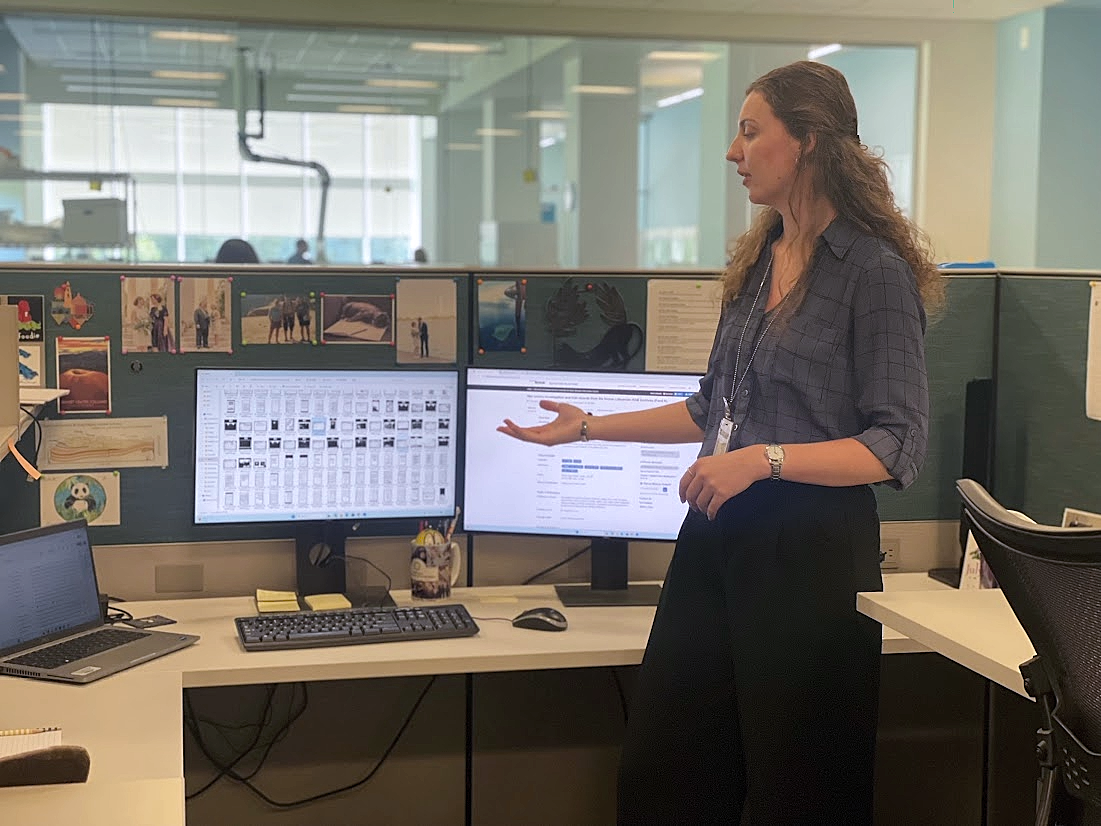 Finnigan showing the documents and photographs she is creating finding aids for.
She spends hours cross-checking inventories, documents, photos, descriptions, and creating new spreadsheets that reflect the latest information. She then hands it off to another archivist to double-check her work. It’s a cycle of verification and refinement to align the finding aids with the accurate collections. The maze of finding aids is the result of different archival processes carried out across borders, countries, and decades. “The researcher should be able to come in and find something quickly without ever having to think too much about it. The easier they can find things, the better,” says Finnigan.
A note from the past
Some mysteries are beyond languages and locations, stumping even a team of experts and bringing them together to do serious detective work. That’s exactly what happened when Finnigan noticed a small symbol on some original photos in a Lithuanian KGB (national security and intelligence agency) collection placed by the original archives. She asked archivists Julie Schweitzer, her boss, and Alla Dvorkin, her direct supervisor, but they hadn’t seen it before either. The mystery quickly spread throughout the building, ensuing a string of emails with experts weighing in, hoping to reveal the meaning of what looked like a small bean. They found that the symbol was a mark used in some European archival systems to note the poor quality of the writing or the photography.
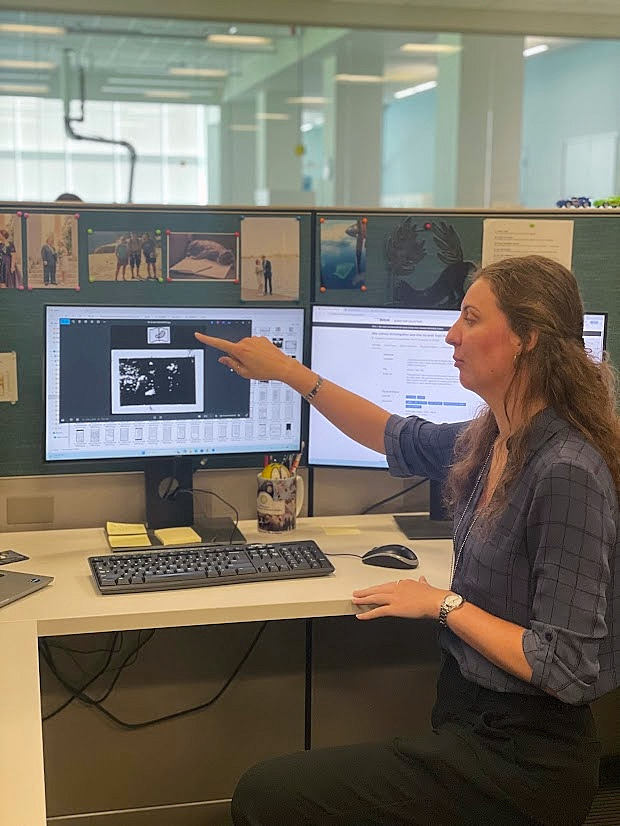
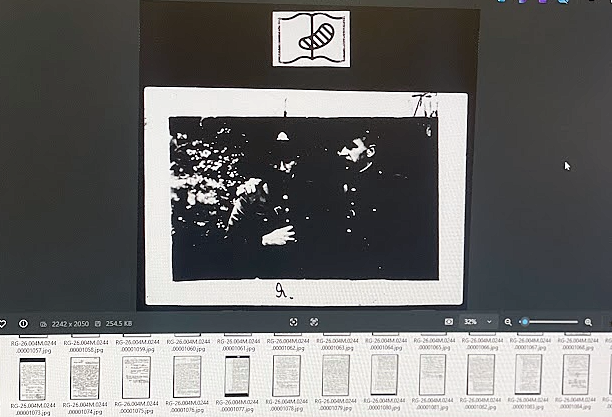
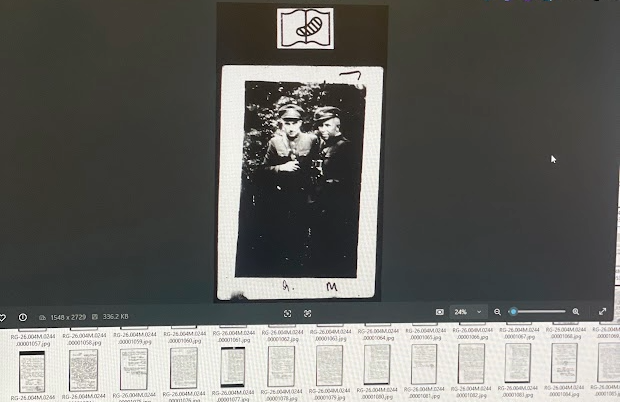
Finnigan showing the mysterious mark she came across in a set of photographs.
“People often imagine archival work as simply preserving historical materials. In reality, a surprising amount of the job involves acting as part historian, part detective, part translator, and occasionally part conspiracy theorist—until someone finds the answer,” Finnigan posted on LinkedIn. “It’s a reminder that expertise is often collective. No single person knew the answer. The solution emerged through conversations, institutional knowledge, and a network of colleagues willing to chase down an obscure question simply because it mattered.”
To preserve and share
In the last few weeks of her internship, Finnigan received additional training from Adam Fielding, a processing archivist who works primarily with personal papers. Fielding, who has been at the center for 11 years, began by showing Finnigan the Rudolph Daniel Sichel papers, an example of what a finished collection can look like once the personal papers have been digitized and preserved in archival boxes.
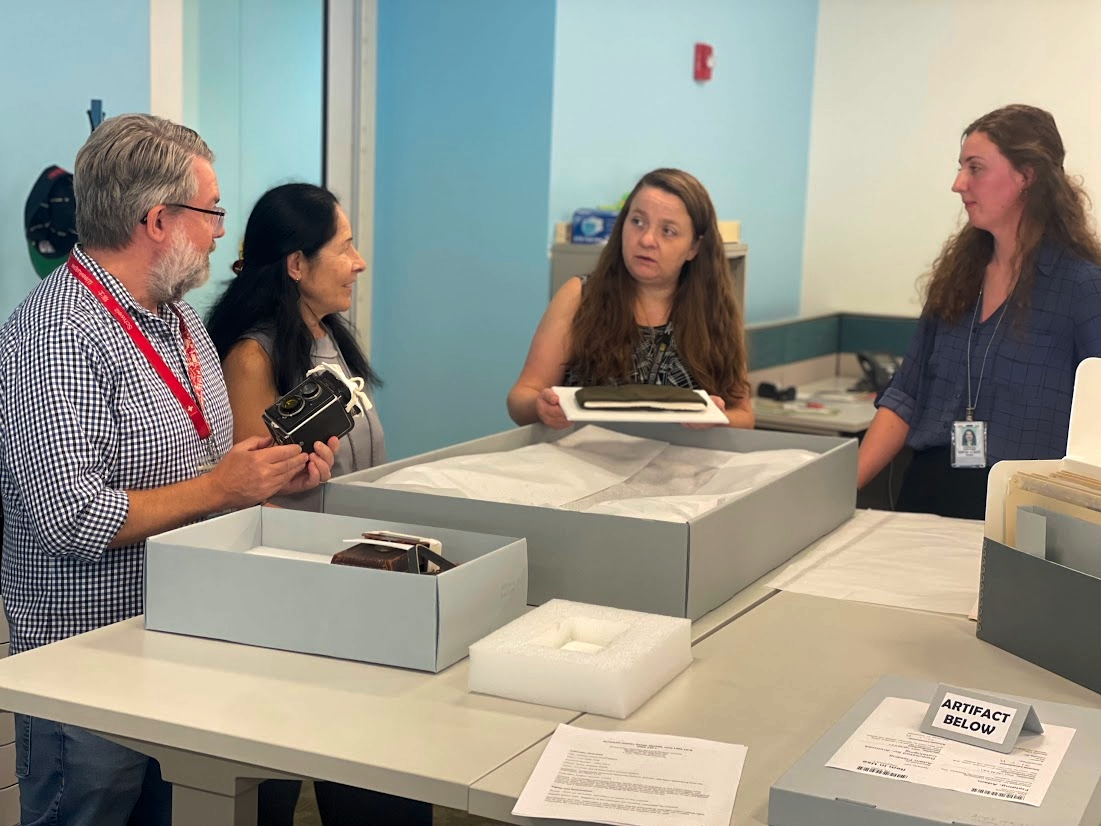
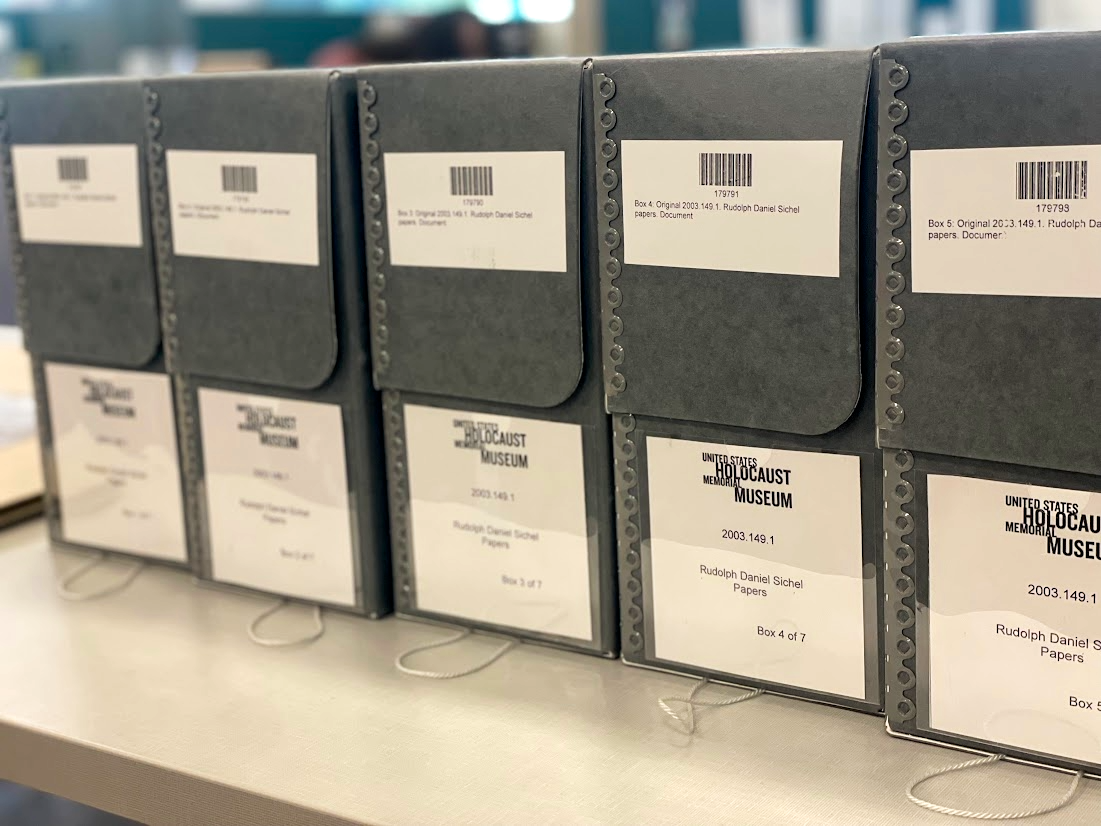
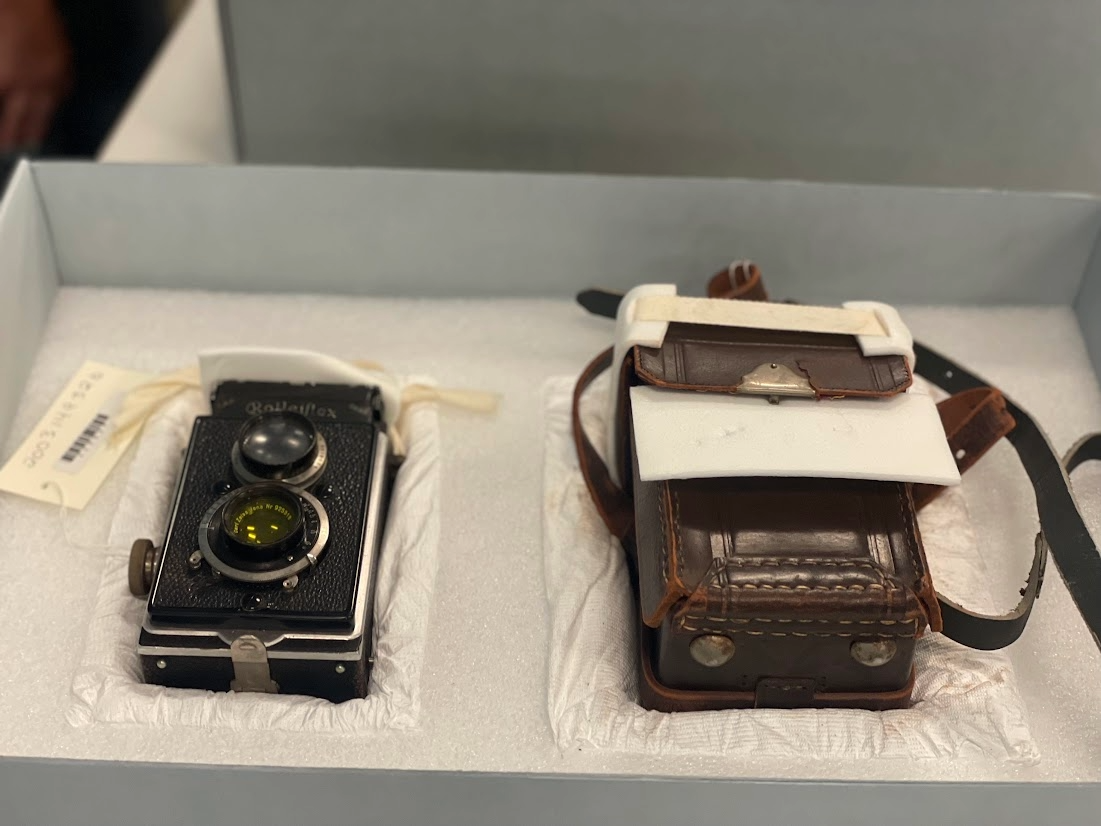
(Top) Finnigan with Fielding, Dvorkin, and Schweitzer (center), reviewing Rudolph Daniel Sichel‘s military uniform and personal camera. (Bottom) The Sichel collection archival boxes and Sichel’s camera and camera case.
The Sichel papers, donated by Rudolph’s children, consist of seven boxes with documents dating from 1903 to 1978, many of which connect Sichel to Maryland. Sichel was a “Ritchie Boy,” one of thousands of Jewish refugees who immigrated to the U.S., enlisted in the army, and trained at the Military Intelligence Training Center at Camp Ritchie near Cascade, Maryland, a little over an hour north of UMBC.
The additonal training gave Finnigan the techniques to work with non-digital items that require special care, like the folder Fielding tasked her with, full of primarily prewar family photographs related to the Kugelman family from Bedzin, Poland, dating between 1930 – 1942.
While putting these skills to use was exciting, the greater reward was seeing the impact of the team’s work. Finnigan’s interest in archival work is not only about preserving history but also making archives accessible to the public, which are two of the center’s priorities.
“There is no point in preserving all of this history if the public can’t access it. We want to preserve the history and make it easily accessible, whether through exhibitions, digital archives, or physical collections. Good archival work should essentially be invisible,” says Finnigan. This includes special handling and storage methods, like cold storage (35°F to 50°F) and cool storage (55°F to 65°F) to dramatically slow chemical decay, stop pest activity, and extend the lifespan of sensitive artifact and media collections.
“The collections at the Shapell Center are evidence of atrocities, of war crimes, of survival,” says Finnigan. “If the items are damaged, they can’t be replaced, and then that piece of history is lost.”
Learn more about internship opportunities at the United States Holocaust Memorial Museum’s archives.