UMBC researcher is helping unlock the mystery of dark energy with NASA’s Roman Telescope
On Sunday, August 30, after more than a decade of development, the Nancy Grace Roman Space Telescope successfully launched from the Kennedy Space Center in Florida. The telescope, with a field of view 100 times larger than the Hubble Space Telescope, is expected to provide an unprecedented amount of observational data that will help unravel lingering mysteries, such as the role dark energy plays in the universe’s accelerating expansion.
UMBC’s Rebekah Hounsell, an associate research scientist with the Center for Space Sciences and Technology, began working on the mission in 2015 at the University of Illinois. She has continued to work on it at multiple institutions since then, including at NASA Goddard Space Flight Center since 2020. She is co-PI and project manager of the Roman Supernova Cosmology Project Infrastructure Team (PIT), tasked with determining the best way for the telescope to collect data about cosmic phenomena called type Ia supernovae. The group is also developing tools that will turn the telescope’s data into information that scientists expect to refine—and potentially upend—our understanding of the universe. In this Q&A, Hounsell shares more about her work and why it excites her.
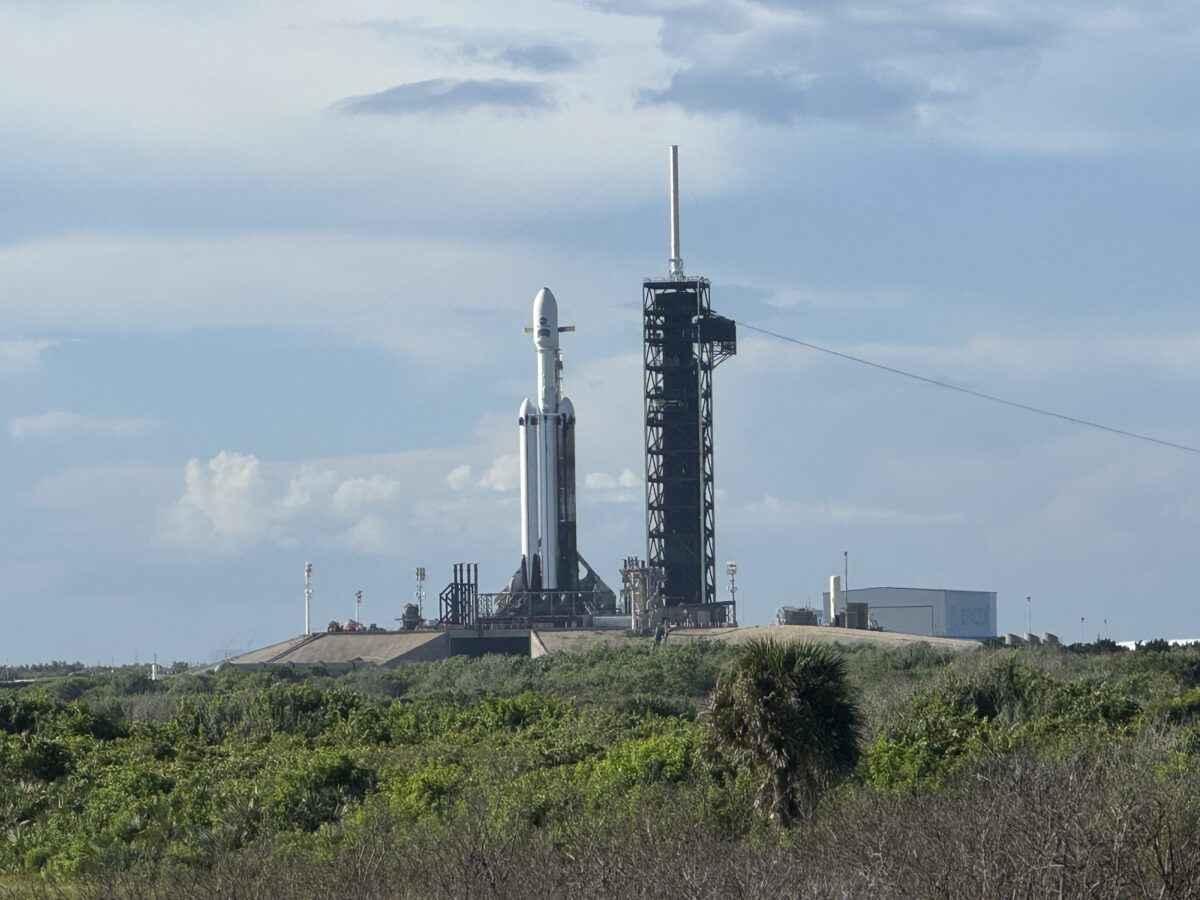 The day before the telescope’s launch, the rocket that would carry the Nancy Grace Roman Space Telescope into space was in position on the launchpad. (Photo by Rebecca Hounsell)
Q: What is your role with the Nancy Grace Roman Telescope?
A: For the last 11 years, I’ve focused on optimizing the survey design for the High Latitude Time Domain Survey, so we can get the best sample ever of type Ia supernovae. We hope those data will give us a better understanding of dark energy, which is a hot topic right now. Also, in 2024 I became co-lead and project manager of the Roman Supernova Cosmology PIT, an international group of more than 60 supernova scientists. We’re building the tools that will take researchers from pixels to detailed cosmology analysis of type Ia supernovae. These tools give the community a strong starting place from which to run their favorite cosmology modeling tools on the data and answer their own questions.
Q: How did it feel to see something you’ve worked on for so long finally go up in space?
A: It was amazing—and also anxiety-inducing. This has been my career for over a decade, and I’m expecting it to be my career for a decade more. On launch day I was sitting in the viewing area with friends and colleagues trying to stay calm, telling myself, “It’s going to be fine. It’s going to be fine.” As we got close, one of them looked at me and said, “I think I’m going to throw up,” which was exactly how I felt. Then it launched, and seeing it go up was so fast, precise, and beautiful. Seeing the rockets come back down was also amazing. Having something you’ve poured so much time into actually going up, and knowing it’s doing the work we planned, feels really special. It’s nice to know I’ve had an impact on it.
Q: What is a type Ia supernova, and why are they important to study?
 Hounsell captured this photo, of the rocket that would carry the Roman Space Telescope, from the Banana Creek viewing area at sunrise on launch day. (Photo by Rebekah Hounsell)
A: A type Ia supernova happens when a carbon-oxygen white dwarf—the dense leftover core of a star like our Sun—exceeds about 1.4 solar masses and completely destroys itself in a thermonuclear explosion. That critical mass can be reached as one star gradually pulls material off a companion star or when two white dwarfs merge. Because the explosion is triggered at a pretty consistent mass, the light released is remarkably similar from one event to the next, so astronomers call them “standardizable candles.” Because you know how bright they should intrinsically be, you can use the observed brightness, in addition to corrections to its color and light curve shape, to calculate how far away the supernova is.
In the late 1990s, samples of these objects showed that distant supernovae were fainter than expected—evidence that the expansion of the universe is accelerating, which led to the idea of dark energy. Today’s best studies use around 1,500 to 2,000 type Ia supernovae. We always thought dark energy was constant, but recent results suggest it may be evolving, and we need far more data to settle the question. Roman will find tens of thousands of type Ia supernovae, including many much farther away and in larger numbers than previously identified. With that larger sample we should be able to refine our understanding of dark energy—or discover completely new physics.
Q: Now that the telescope has launched, what are the next steps in your work?
A: Right now Roman is undergoing commissioning, where we make sure everything is working as it should with the telescope. The first images should be released to the public early next year, and all of the data will be public right away. My main focus continues to be running the infrastructure team with my colleagues so we can produce high-quality products that enable the community to do research in the years ahead, and then also using those products to do the science myself. I actually just recently received a $1.2 million grant for work using data from the telescope.
Q: What are you most looking forward to once data starts coming back from Roman?
A: I’m excited to see what the wider community does with it. The data is public as soon as it’s ready—for researchers, students, citizen scientists, anyone. I’m really excited about the possibility that a 10-year-old version of me, or a student somewhere, will look at the images, spot something weird, reach out, and end up making a real discovery. This mission is for everybody. There are already plans for citizen-science projects, building on what was done with earlier surveys like NASA’s TESS mission, and platforms like the Roman Research Nexus, operated by the Space Telescope Science Institute in Baltimore, will make the data accessible for all. Communication is going to be key so people know how to get involved.
Q: What got you into astronomy originally, and why does it still excite you?
A: I got into astronomy around age 10. I grew up in rural England, surrounded by rapeseed fields and very dark skies. As a really little kid I thought someone had put black sugar paper [British for construction paper] across the sky and poked holes in it to make the stars. My dad explained that they were giant balls of gas like the Sun, and I was fascinated. That led to learning the constellations, and I just kept going from there.
“We can imagine that this complicated array of moving things which constitutes ‘the world’ is something like a great chess game being played by the gods, and we are observers of the game. We do not know what the rules of the game are; all we are allowed to do is to watch the playing. Of course, if we watch long enough, we may eventually catch on to a few of the rules. The rules of the game are what we mean by fundamental physics.”
Richard Feynman, 1965 Nobel Prize in Physics
At university I studied classical novae, which turned out to be a natural gateway into type Ia supernovae. What still excites me is that we’re essentially watching the universe and trying to figure out its rules. We observe, make hypotheses, and then more data either supports or overturns them. Roman is going to give us a much more powerful view than we’ve had before.
I sometimes worry, though, that future generations may not get to experience that same sense of wonder I did as a kid. I think we have an ethical responsibility to think carefully about light pollution and cleaning up space debris so that future generations can look up and feel that same sense of wonder that got so many of us started.