UMBC research team discovers promising molecular target for ovarian cancer treatment
Ovarian cancer is often diagnosed after it has already spread to other parts of the body, at which point the five-year survival rate is under 30 percent. Further complicating treatment, standard therapies cause substantial harm to healthy cells alongside cancerous ones. But what if ovarian cancer treatment could more specifically target cancerous cells, causing less harm to the rest of the body? New research from Achuth Padmanabhan’s lab offers hope in the form of a potential molecular target for new cancer drugs: an enzyme called USP15, which ovarian cancer cells appear to rely on more heavily than normal cells.
Biological sciences Ph.D. student Ayokunnumi “Ayo” Ogunsanya led the work, which included experiments in cells and in mice. The results show that lowering USP15 levels causes a constellation of effects that make it a prime target for new treatments: It slows cancer-cell growth, prevents chromosomes in cancer cells from separating cleanly during division (leading to DNA damage and cell death), reduces the cells’ ability to migrate and invade other tissues, and makes them more sensitive to common chemotherapy drugs. The findings were published September 17 in Molecular Therapy Oncology.
A serendipitous discovery
Like much of science, this discovery began serendipitously. As a postdoctoral fellow at Baylor College of Medicine, Padmanabhan, Ph.D. ’11, biological sciences, was studying the protein p53, which in its normal form helps prevent tumor formation. Mutations in the gene that codes for p53 occur in nearly every case of the most common and lethal form of ovarian cancer, and are common across a wide range of cancer types.
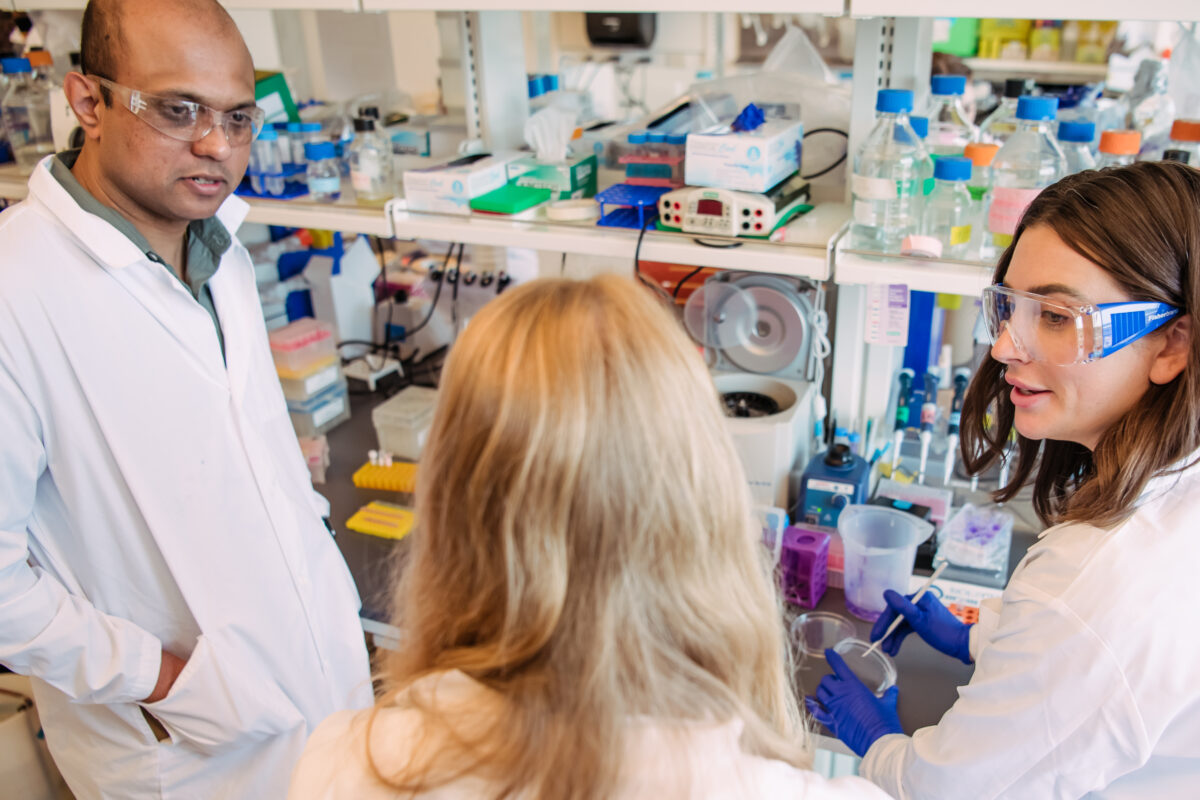 Achuth Padmanabhn, left, leads a research group at UMBC that includes several undergraduate and graduate students. (Marlayna Demond ’11/UMBC)
“Typically you would assume that a mutation would disrupt the function of a tumor suppressor,” Padmanabhan says—kind of like disabling the body’s natural brakes on cancer progression. But it’s actually worse, he explains. Two-thirds of p53 mutations in ovarian cancer convert its braking function into a stuck accelerator: Mutated p53 enhances cancer progression, and it also sticks around in the cell much longer than normal.
On further investigation, Padmanabhan found that it was the enzyme USP15 stabilizing a particular p53 mutant, therefore extending its effect on cancer progression. USP15’s function offered a clue as to why: It removes small molecular “tags” attached to proteins that label them for degradation. So when there is a lot of it around, fewer mutant proteins remain marked for destruction. When Padmanabhan returned to UMBC as a faculty member in 2019, he set out to explore what broader role USP15 might play.
“It’s rewarding to look back and see how much I’ve grown as a researcher. I hope this work contributes to developing better strategies for treating ovarian cancer.”
Ayokunnumi Ogunsanya
Ph.D. Candidate, Biological Sciences
Strengthening the story
Ogunsanya joined Padmanabhan’s lab in 2021, and she has made exploring the role of USP15 in ovarian cancer the core of her Ph.D. “I’m very excited about these findings, as they provide new insight into how USP15 contributes to ovarian cancer progression,” she says.
Importantly, reducing USP15 made the cancer cells more vulnerable to the most common ovarian cancer treatment drugs, carboplatin and paclitaxel, and doxorubicin, a particularly toxic drug used to treat a range of cancers. With less USP15 present, lower doses of these drugs might achieve the same treatment effect with less toxicity.
Yet, reaching their conclusions wasn’t always straightforward. “Some of our early findings weren’t what we anticipated, so we repeated experiments and approached the questions from multiple angles,” Ogunsanya says. “The additional experiments strengthened the story and gave us greater confidence in the findings.”
Motivating further research
Moving forward, Padmanabhan’s team wants to further reveal USP15’s basic functionality, laying the groundwork for drug development work. For example, they want to learn what controls USP15 levels in cancer cells and whether inhibiting the enzyme can also reshape a tumor’s immediate surroundings.
“Ayo is able to think through a project and see different possibilities. I’ll suggest an experiment and she’ll say, ‘I’ve already done it.’ So I told her, ‘Now you run, and I’ll follow you.’”
Achuth Padmanabhan
Assistant Professor, Biological Sciences
Even with that information, the need to figure out how to reduce USP15 levels safely in human patients will remain. The good news, Padmanabhan notes, is that molecules used to inhibit USP15 in laboratory experiments already exist and could be a starting point for developing human drugs.
“Hopefully,” Padmanabhan says, “work such as ours demonstrating the potential of USP15 as an anti-cancer therapeutic target will motivate pharmaceutical companies and other research groups to pursue the development of clinically translatable USP15 inhibitors.”