There’s something in the water
Sometimes it takes a fish for a student to envision their future. At UMBC’s Institute of Marine and Environmental Technology on Baltimore’s Inner Harbor, undergraduates handle market-size salmon, micro-inject DNA into zebrafish embryos, and troubleshoot the complex systems that keep the Aquaculture Research Center running. Immersive experiences like these have a knack for clarifying career paths in ways that expand on what students gain from on-campus labs and lectures.
“Who wants to handle the salmon?” is not something you expect to hear in an undergraduate classroom. But in MBIO361L: Sustainable Aquaculture Laboratory, handling 15-pound salmon is par for the course. Robert Tapbergen, a senior biological sciences and environmental science major, jumped at the opportunity.
Surrounded by large tanks full of fish, with machinery humming and water flowing through overhead pipes in the industrial and cavernous Aquaculture Research Center (ARC), Tapbergen transferred the heavy, slimy animal from its tank into a smaller tub. He fought to maintain his grip as the fish thrashed in response to the dramatic temperature change and brief air exposure. After lightly sedating the salmon, he and his classmates took measurements, getting soaked in the process.
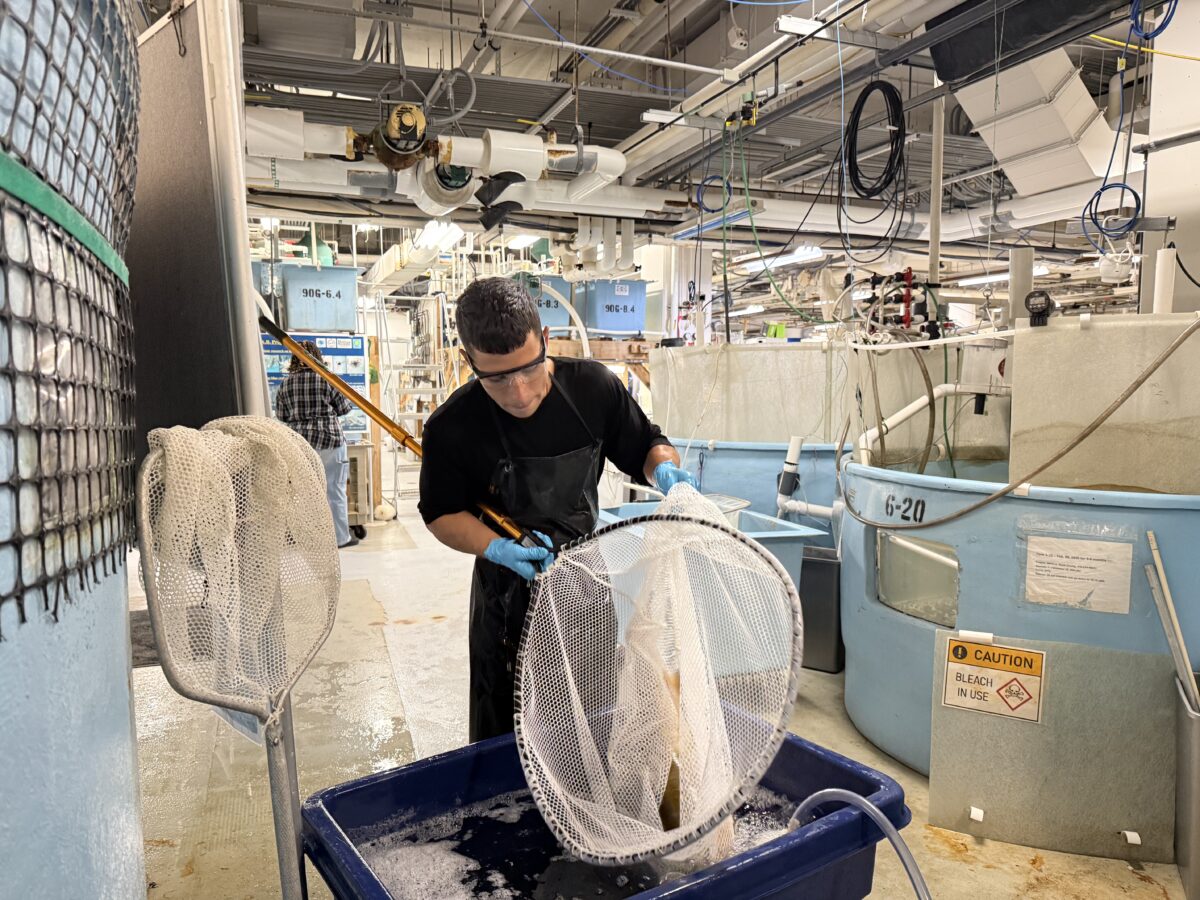 Robert Tapbergen transfers a salmon from its tank into a tub at the Aquaculture Research Center. (Courtesy of Tapbergen)
Sustainable Aquaculture Laboratory is a relatively new UMBC course offered during the summer at the Institute of Marine and Environmental Technology (IMET). IMET is internationally known for work led by UMBC’s Yonathan Zohar, professor and chair of marine biotechnology. Zohar and colleagues are tackling remaining bottlenecks in land-based aquaculture—an innovative industry developed to avoid the pitfalls of over-fishing wild populations or raising fish in open-ocean net pens. Today, land-based aquaculture may be on the cusp of revolutionizing global fish production to sustainably address increasing demand for clean protein.
Zohar’s lifetime of achievement has been recognized for its global economic impact, and he leads a consortium with academic, industry, and government representation seeking to increase the large-scale viability of land-based aquaculture. Most recently, Japanese collaborators from industry and academia agreed to work with IMET toward a large-scale, joint aquaculture research program. Other IMET researchers focus on economic powerhouse species like blue crabs, horseshoe crabs, and oysters, or less charismatic but still critical organisms like algae for applications including biofuel production.
All of this is happening a stone’s throw—or a UMBC Transit ride—from UMBC’s Catonsville campus, yet to many students, IMET feels distant. But those who decide to make the trip beyond Hilltop Circle describe courses and internships that bring innovation and application up-close and personal (including splash zones) while offering training in technical skills and the habits of mind of a scientist. The outcome for these students is frequently a fresh perspective on both research and their own futures.
That smells fishy
Matthew Stromberg, Ph.D. ’26, environmental engineering, arrived at that perspective the long way. He started college, but returned home to be closer to his family when his father passed away. After working a string of unfulfilling jobs, he eventually grew frustrated with his limited opportunities and returned to school to study environmental science at age 28. One of his community college instructors showed a video of environmental career options that included Zohar discussing aquaculture.
 Yonathan Zohar (right) co-advised Matthew Stromberg’s (left) doctoral research, which he conducted at IMET. Since graduating, Stromberg has continued as a staff researcher in Zohar’s group. (Brad Ziegler/UMBC)
“It was a real crystallizing moment for me,” Stromberg recalls. “It was like that Hitchcock shot where the camera zooms in and the background falls away, minus the dread. Everything else slid out of frame and aquaculture was the only thing left in focus.”
An avid angler as a kid, he knew right then that aquaculture was what he wanted to do long term. The technology aspect aligned with his propensity to take things apart (and sometimes put them back together), and the mission to feed the world sustainably aligned with his heart. He finished an associate’s degree, then earned dual bachelor’s degrees in civil engineering and environmental science at the University of Virginia. Eventually he joined UMBC’s environmental engineering Ph.D. program to conduct doctoral research with Zohar and be co-advised by Upal Ghosh, professor of chemical, biochemical, and environmental engineering.
Stromberg’s dissertation tackled a stubborn challenge in land-based aquaculture systems: compounds that accumulate in the fish’s fat tissue and, even in small amounts, make the flesh unpalatable. Geosmin, the same molecule that causes the quintessential post-rainstorm smell, is the primary culprit in these “off-flavor” fish. Bacteria in the biofilters that clean the water in the fish tanks produce it. The industry’s usual response—moving the fish into clean tanks and repeatedly flushing them to dilute the concentration of geosmin to undetectable levels—undoes much of the water-saving advantage that makes recirculating land-based systems attractive in the first place.
 Keiko Saito (left) and Yonathan Zohar discuss the biofilter system containing bacteria that break down toxins in fish waste. Saito teaches the summer laboratory course at IMET. (Brad Ziegler/UMBC)
To address this problem, Stromberg developed mathematical models of geosmin accumulation and tested electrochemical and physical treatment approaches to remove it without requiring extra water. His work contributed to patents, including a biosensor that’s able to tell farmers whether their fish are off-flavor in minutes rather than weeks.
Diving into the joy of research
On top of his passion for the subject matter, Stromberg loves the research process for its own sake. “There is nothing quite as satisfying as looking at some data and going, ‘I know something right now that no one else on earth knows,’” he says. After defending his Ph.D., Stromberg chose to stay on Zohar’s team to keep building the institute’s engineering side and continue working on the off-flavor issue and related technologies. He speaks of the Japanese concept of ikigai—the overlap of what one loves, what the world needs, and what one can be paid for—and of the practical goal of helping recirculating systems become a larger share of farmed fish production, easing pressure on wild populations.
Equally important to Stromberg, though, is extending the joy of research to undergraduate and even high school students. Stromberg has mentored about a dozen students so far—he keeps photos of them on his desk, and many have stayed in touch after graduating. He feels fortunate to have experienced a deep well of mentorship throughout his academic career, and now brings what he learned into his interactions with students at IMET.
 Krish Bakshi has interned with Matthew Stromberg at IMET for the past two years. (Brad Ziegler/UMBC)
Krish Bakshi, a senior biochemistry and molecular biology major, is one of those students. Bakshi first worked with Keiko Saito, assistant professor of marine biotechnology, at IMET, as a high-school intern through a Howard County Public Schools biotechnology program. He later served as a technician in the Aquaculture Research Center, and a little over two years ago he began working with Stromberg. Today he is analyzing lipid content across different salmon tissues to better understand where the off-flavor compounds concentrate.
“I’ve learned that as an undergraduate, I can still do a lot,” Bakshi says. “I was able to do real science at IMET.” The experience convinced him to continue into a Ph.D. in the same research group, most likely in environmental engineering. “It’s a really fun, varied, and interesting work environment,” he says. “I have learned so much more there than I honestly could have in a traditional lecture.”
Pescatarians welcome
 Students at IMET get to study zebrafish embryo development. (Courtesy of Robert Tabpergen)
Jenny Pham, a junior biological sciences major, ended up at IMET after noticing banners with fish on them at a tabling event in The Commons. She approached to learn more, because, she says, “I like eating fish. I like fish biology,” and signed up for a facility tour. After the tour, Pham enrolled in Marine and Environmental Biotechnology, a survey course that brings in a different IMET researcher each week. The summer lab course followed, and today she interns with Saito, helping study biofilters that remove ammonia from salmon waste while producing methane that could help power the facility. Pham says the work has helped her “home in on sustainable food production” as a career path. She is now preparing for graduate study in marine biology with a clearer sense of direction than she had before.
That sense of direction is exactly what IMET faculty hoped to foster when they began expanding undergraduate courses and research opportunities at the institute a few years ago.
“We designed these courses to give students opportunities to experience science beyond the traditional classroom and explore research fields they might not otherwise encounter,” Saito says. “By combining exposure to diverse marine biotechnology research with hands-on laboratory experiences, we want students to discover what excites them, recognize their potential, and envision career pathways they may never have imagined.”
Robert Tapbergen, who leaped at the chance to handle a salmon, has taken full advantage of IMET’s unique experiences. He describes micro-injecting DNA into zebrafish eggs so they fluoresce during development, screening oysters for parasites, culturing algae, and more as the kind of work that usually happens in a research position rather than a typical class.
 Jenny Pham conducts research at IMET with Keiko Saito. She first connected with Saito at an involvement fair on UMBC’s Catonsville campus. (Jake Saltzberg/UMBC)
Kris Sugar and Milena Cherenkov, both senior biological sciences majors, took the survey course first and then the lab course, gaining insight into their own interests in the process. Seeing the full ecosystem of the facility—from students to staff maintaining equipment and feeding animals—helped Cherenkov dial in her goals. “Getting to have hands-on experience with a variety of lab processes has helped me discover some things I enjoy and some I definitely do not want to pursue,” she says. For Sugar, exposure to algae research in the lab course led him to applying to Ph.D. programs focused on turning algae or plants into biofuels, supplements, or biodegradable materials. “You can’t grow and learn if you’re confined to only one area,” he says.
“UMBC’s marine biotechnology faculty and IMET are world leaders in the science that helps protect our oceans while producing seafood more sustainably for a growing world population,” says Zohar, who has personally mentored dozens of undergraduate and high school students in his laboratory over the years. “IMET gives students at every level the chance to dive into research that brings marine biology’s most innovative tools to bear on real-world problems.”