Four UMBC students have been named Barry Goldwater Scholars this year. The Barry Goldwater Scholarship and Excellence in Education Foundation supports talented college sophomores and juniors who aspire to become leading researchers in science, engineering, and mathematics in the U.S. The award is one of the most prestigious for undergraduates in STEM.
UMBC juniors Deeya Mistry, biological sciences, Jessica Slaughter, computer engineering, Phoenix Bryant, biological sciences, and sophomore Amir Walton-Irvin, computer engineering, are among the 454 scholars selected nationwide in 2026. They competed with nearly 1,500 students majoring in science, engineering, and mathematics who were nominated by their academic institutions for the award.
This is the third time that a record four UMBC students have received Goldwater Scholarships in the same year.
“I’m always so impressed by the caliber of students at UMBC,” says April Householder ’95, director of undergraduate research and prestigious scholarships, who works with students each year to prepare their Goldwater application materials. “And I’m excited to see what they do next, because this is also a springboard to even bigger and better opportunities.”
Personal stories propel curiosity
The road to a successful scientific career can be arduous, and each of this year’s UMBC Goldwater Scholars have tapped deep curiosity, a drive to make a difference, as well as nurturing family and school support, to take them to this prestigious milestone on their journeys.
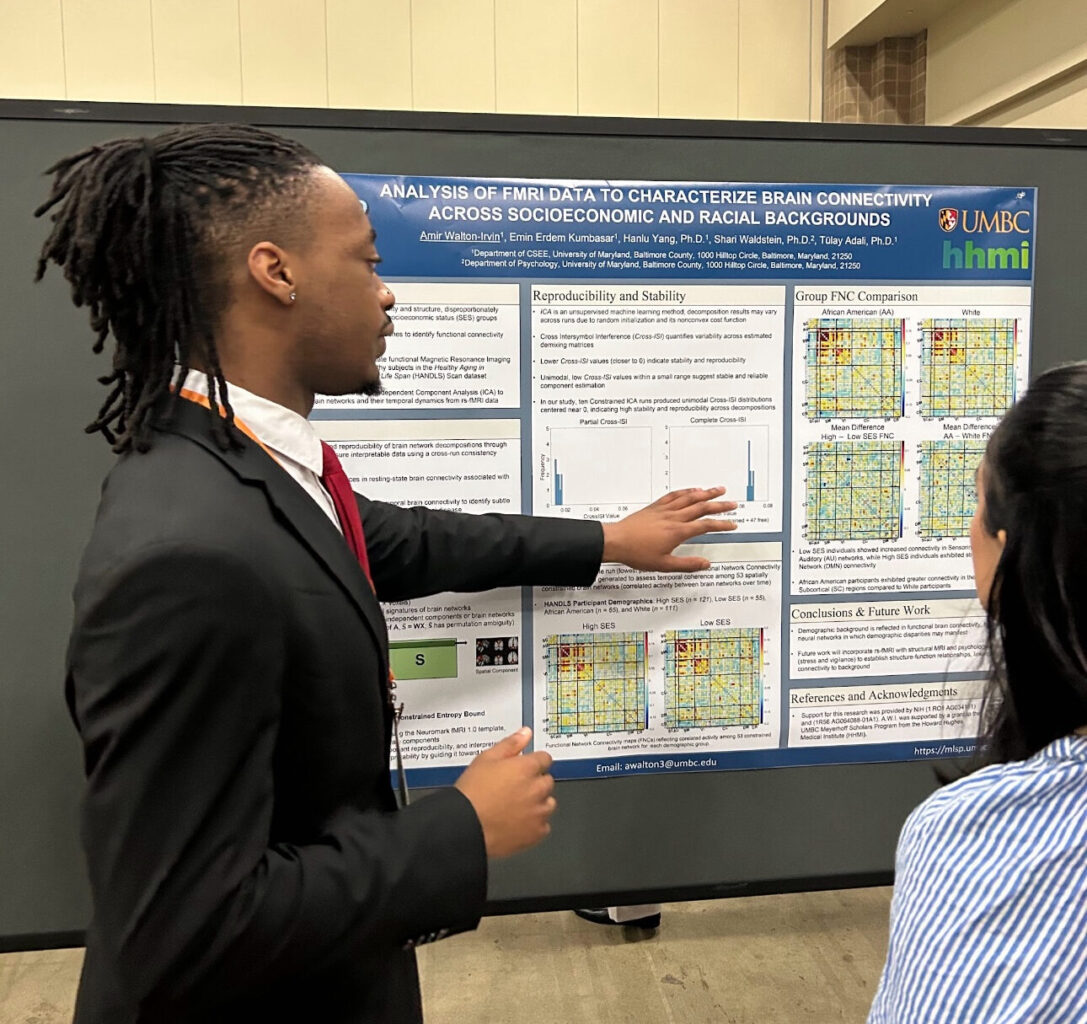 Amir Walton-Irvin presents his research at the 2025 Biomedical Research Conference for Minoritized Scientists. (Photo courtesy of Amir Walton-Irvin)
“I grew up in a household with my mom and my grandmother, who were both mathematics teachers,” Walton-Irvin says. “They both helped nurture my interest in STEM from an early age. My grandmother taught me how to solve math problems, code, and take things apart and put them back together, while my mom encouraged that curiosity by exposing me to engineering camps and science museums.”
Later, when his grandmother started showing signs of dementia, Walton-Irvin found himself facing a host of hard-to-answer questions. “She went from someone who had an answer to every question to not knowing who I was anymore. It was heartbreaking, but it also made me start asking bigger questions: Why did this happen to her, like it has to so many others before her? How does disease change brain function?” He plans to pursue a career at the intersection of machine learning and neuroscience, developing novel neuroimaging analysis methods to investigate neurological disease and health disparities.
 Jessica Slaughter working in Polina Anikeeva’s lab at MIT during a summer internship. (Photo courtesy of Jessica Slaughter)
Bryant experienced a similar personal connection to unanswered scientific questions when her dad was diagnosed with schizoaffective disorder. “I remember asking my mom: ‘Why is he like this?’ And sometimes she’d say: ‘We don’t know that yet.’ And I really wanted to know the answer,” Bryant says. She plans to enter an M.D.-Ph.D. program, and would like to study how environmental factors influence how genes are expressed and may contribute to the development of psychiatric diseases.
Mistry found herself drawn to science since grade school, working to get ever closer to that scientific frontier where new knowledge is created. “Since not everything is known yet, there’s the possibility to uncover more,” she says. “Doing scientific research is an amazing way to pursue my curiosity.” She plans to pursue an M.D.-Ph.D. with a clinical focus in emergency medicine and a Ph.D. studying the molecular makeup of individualized stroke recovery.
“While my clinical and research focuses are different from one another, I was really inspired to study this when I shadowed in the Emergency Department in downtown Baltimore,” she says. “Stroke patients usually come to the Emergency Department first, and everyone’s experience truly is different, because timing is crucial for strokes.”
Slaughter says the possibility of combining new knowledge with helping people drew her to the field of engineering, where she hopes to make a difference by improving global health, especially in disadvantaged areas where resources are limited.
Coming from a family of immigrants, Slaughter watched her grandmother travel over 5,000 miles to the U.S. for surgery, even as her health made the journey difficult. “That experience gave me a window into global healthcare disparities, especially in access to diagnostics and effective treatment, and showed me how engineering can be part of the solution,” she says. It is what drives her to develop low-cost, accessible medical devices and incorporate machine learning.
A supportive family—at home and at school
All the new scholars emphasize how much mentorship, connections, and support have helped them as they worked toward their dreams.
“One of the reasons winning this scholarship is so meaningful to me is because it was only two generations ago when women in my family did not get past a high school education,” says Mistry. She credits her parents with instilling in her a strong work ethic and the confidence to overcome challenges. “My dreams were built on the sacrifice and hard work of my parents and grandparents,” she says.
She also credits the many mentors she met at UMBC. Mistry, Slaughter, Bryant and Walton-Irvin are all part of the Meyerhoff Scholarship Program, which aims to increase diversity among future leaders in science, technology, engineering, and related fields.
“The Meyerhoff program and the COEIT community, particularly Dr. LaBerge and Dr. Marten, have been instrumental to my career,” Slaughter says.
“The advisors in the Meyerhoff program really helped me, and they’re always so supportive,” Bryant echoed.


On left, Deeya Mistry (right) with Mitsue Wiggs, associate director of the Meyerhoff program. (Photo courtesy of Deeya Mistry). On right, Jessica Slaughter (with braids) celebrates winning the limbo contest at the annual Meyerhoff Family Retreat at Centennial Park. “The Meyerhoff program isn’t just a scholarship, but also a family that celebrates every win, big or small,” she says. (Photo courtesy of Jessica Slaughter)
The students also credit their mentors in the labs where they do research on campus. Mistry is investigating the molecular mechanisms that underlie the sex differences in chronic stress susceptibility to understand why females have a higher susceptibility to chronic stress-induced psychiatric disorders such as depression and anxiety in the lab of Tara LeGates. Bryant is studying the biomechanical properties of a protein involved in chromatin regulation in the lab of Erin Green. Slaughter is applying statistical principles to develop bioinformatics applications to facilitate the analysis of dynamic, system-scale “-omics” data in the lab of Mark Marten. And Walton-Irvin is applying machine learning and signal processing methods to investigate functional brain connectivity and health disparities in the lab of Tülay Adali.
On the right path
For the four UMBC students, winning a Goldwater Scholarship is both a validation of the work they have put in so far, and a stepping stone to their next achievement.
“When I saw the email letting me know I’d been selected, I literally screamed, I was so excited,” Slaughter says. “I FaceTimed my family. I FaceTimed all my friends who helped me through this journey. I immediately sent thank you emails to all my mentors.”
Mistry messaged LeGates, her research advisor, and sprinted to her office to celebrate.
Walton-Irvin’s first response was to call his mom, as the news felt both emotional and affirming. “It meant a lot to know that the path I’m trying to build, one rooted in both personal experience and a desire to empower others, was being recognized,” he says. “Awards like this are meaningful, but I see them as part of a much larger journey of doing impactful work.”
 The Goldwater Scholars and some of their mentors strike a fun pose. Back row, from left to right, Ph.D. student Emin Erdem Kumbasar, Amir Walton-Irvin, and Professor Charles Laberge. Middle row, from left to right, Assistant Professor Tara LeGates, Deeya Mistry, Jessica Slaughter, Phoenix Bryant, and Associate Professor Erin Green; front row, April Householder. (Brad Ziegler/UMBC)
Come meet all four Goldwater Scholars at the Undergraduate Research and Creative Achievement Day on April 22 in the RAC, where they will be presenting their research alongside more than 400 other student presenters:
Deeya Mistry: “Investigation of the Circadian Rhythm on Blood Brain Barrier Permeability,” RAC 050, 9:20 – 9:35 a.m.
Phoenix Bryant: “Investigating the Function of the PHD Finger in Chromatin Regulator Set4,” RAC Arena, 10 – 11 a.m., Poster #20
Amir Walton-Irvin: “Analysis of FMRI Data to Characterize Brain Connectivity Across Socioeconomic and Racial Backgrounds,” RAC 230, 11:20 – 11:35 a.m.
Jessica Slaughter: “Open-Source Software Suite of Bioinformatic Tools for Dynamic Omics Data,” RAC Arena, 2 – 3 p.m., Poster #65