Payton Barry, a fourth-year Ph.D. candidate in biological sciences, is diving into the world of Maryland’s streams. Under Tamra Mendelson’s mentorship, he studies how introduced species of darters, a family of freshwater fish, are affecting native ones. Equal parts dedicated researcher and enthusiastic science communicator, Payton has creatively pieced together funding from organizations like The Explorers Club while sharing his work with the public through outreach events and his engaging Instagram account, @barrybiome.
Q: Why did you choose UMBC for graduate school, and how is it going?
A: I completed my undergrad at the University of Missouri and applied to UMBC specifically to work with Dr. Tamra Mendelson. I discovered her research on Twitter and thought, “This is really cool.” I sensed her great energy in our first virtual meeting, and I knew I could work with her. I moved from Missouri, and it’s been incredible ever since.
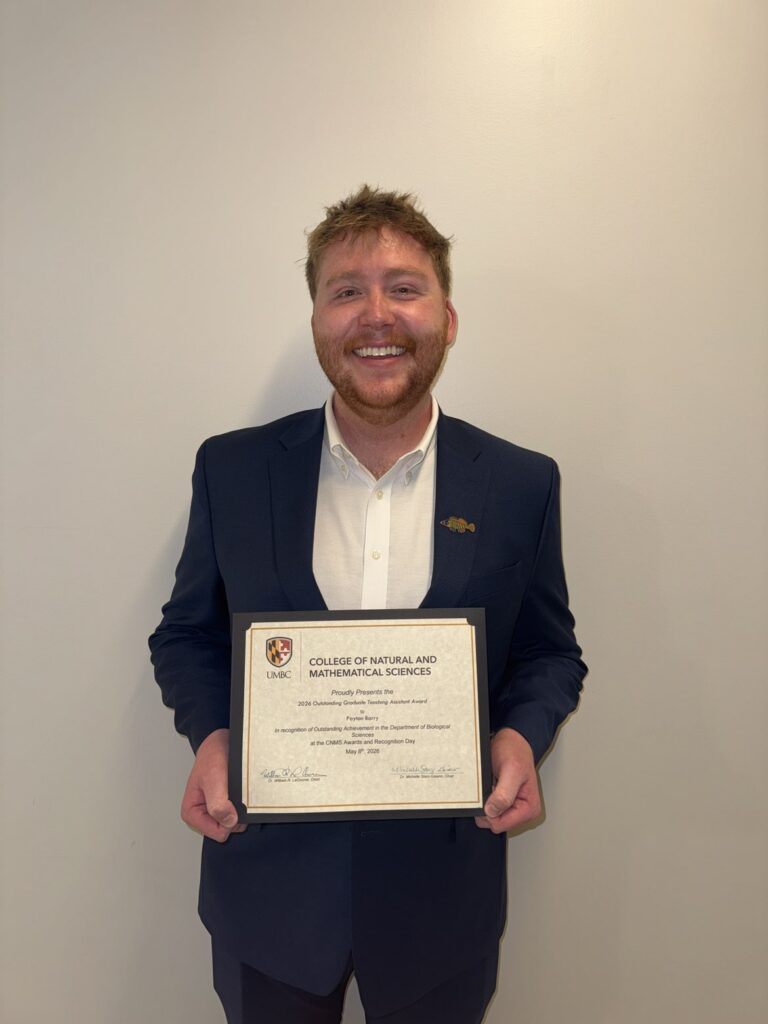
My project is pretty independent, but Tamra is always supportive. She is an awesome mentor—super approachable, really relaxed, and incredibly knowledgeable. Anything I have an issue with or a question about, she’s got an answer or knows who to direct me to. I’m one of three grad students in the lab, including Ph.D. students Georgie Puffer and Shea Buczkowski. Plenty of undergrads are involved in our work, too—sophomore James Keller has been especially helpful with my research. I was humbled to be selected as an Outstanding TA of the Year after nominations from Kevin Omland, Tamra, and Cheng-Yu Li for teaching introductory biology and evolution.
At right: Payton Barry holds the 2026 Outstanding Graduate Teaching Assistant Award presented at the CNMS Awards and Recognition Day. (Courtesy of Barry)
Q: What are the primary goals of your research, and why is this work important to you?
A: Darters are small freshwater fish common in streams. They primarily eat macroinvertebrates—little bugs—and reproduce in spring. My research evaluates how introduced darter species might affect native darter species in Maryland. We study two native species and two that were introduced in the late 1950s and 1970s, likely unintentionally by anglers using them for bait.
One of my projects focuses on habitat use. Native darters provide paternal care, with the males guarding eggs, so they need specific microhabitats to reproduce. We found a large degree of overlap between one introduced species and the native species, especially during the reproductive season—that added competition could hamper native reproduction.
We’re also studying what darters are eating, including whether introduced species prey on native eggs. We sample streams to compare how their diet matches or doesn’t with what’s available across the seasons.
This work matters because these little fish play important roles in stream ecosystems. Losing natives through competitive exclusion could affect Maryland’s biodiversity and even impact recreational fisheries.
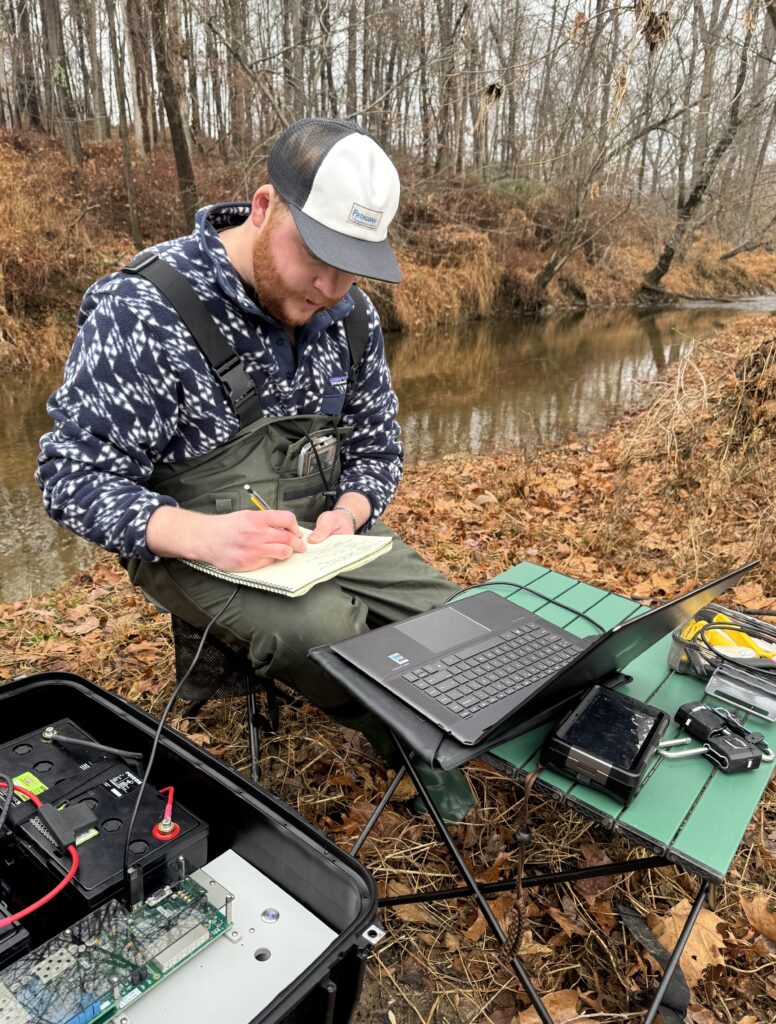
At left: Payton Barry conducts fieldwork to monitor the seasonal movement behavior of native and introduced darter species. (Courtesy of Barry)
Q: What does a day in the field look like?
A: It’s mostly me, though Dr. Mendelson joins when she can, and it’s a lot of fun. We drive about an hour to sites near Frederick, Maryland at Little Bennett Creek and the Little Monocacy River; in Montgomery County near Rock Creek; and in the Monocacy River area, plus closer sites on the Anacostia River.
First we catch the darters, and then we survey macroinvertebrates in the stream to measure food availability. We use a nonlethal technique called “gastric lavage” to wash out the fishes’ gut contents. We prep the gut samples and then send them out for genetic sequencing to identify what the fish are eating. We sampled six populations in spring, summer, and winter—when biodiversity is lowest.
Q: To support your work, you’ve sought a range of funding sources. Can you talk about that process and offer any advice?
A: With recent changes to the federal funding landscape, smaller grants from nonprofits have been crucial. I rely on racking up these small awards to support big projects. This project is funded by four or five grants combined. Our newest grant from The Explorers Club covers our genetic sequencing costs. Other support comes from the North American Native Fishes Association (NANFA), the Society for Freshwater Science, and Fly Fishers International.
I just search online for terms like “native fish research grants” or “stream fish restoration.” I tailor my applications and projects for the funders’ priorities—for example, I tied my work to the health of stocked fish populations for Fly Fishers. If you can find an organization focused on your research niche, you might have a greater chance of success, because fewer people are applying.
 Payton Barry presents on introduced freshwater fish species in the Potomac River at the Baltimore Underground Science Space Science Slam . (Courtesy of Barry)
Q: You’ve made an effort to share your research with members of the broader community. Can you describe some of that work?
A: I’m involved with the graduate student outreach group in UMBC’s biology department. For example, last fall, we hosted an event called Science on Tap at Checkerspot Brewing in Baltimore, where we invited UMBC graduate student researchers in biology and geography and environmental systems to give talks about what they do. We’ve also presented at events run by the Baltimore Underground Science Space. Plus, I run the Instagram account @barrybiome, where I post research updates and a weekly Fieldwork Friday series in collaboration with undergrads in the lab.
A lot of times researchers present only to specific audiences, which makes science less accessible. It is really fun for me to share my passion for what I do. I love getting questions about how my work relates to people. It really makes an impression when I’m able to tell them how important these little guys are and their role in the ecosystem—everybody’s got a part to play.