Beryl Fuamazeh ’26, biology, and a minor in health, wellness, and aging, is on her way to Howard University College of Medicine. After connecting with Nancy Kusmaul, professor of social work, Beryl found her research interests piqued by learning more about healthcare and aging care. While at UMBC, Beryl worked as a nursing assistant at a retirement community and volunteered for an organization that supports people with disabilities and older adults.
Beryl transferred to UMBC from the Community College of Baltimore County through the Degrees to Succeed program, and says that the support and funding she’s received from UMBC has made her education affordable and given her time to focus on her passion: healthcare and aging. Outside of school and work, she loves watching Korean dramas.
Q: Tell us about someone in the UMBC community who has inspired you.
A: Dr. Nancy Kusmaul is my research mentor, and she has been instrumental in my undergraduate research journey. The work she does to support the aging community has deeply inspired me. I have also been greatly influenced by Professor Mary Carter, an English professor here, who taught me how to better express myself through writing—a skill that was invaluable during my medical school application process. The support and guidance both faculty members have given me have truly shaped my experience at UMBC.
Q: Tell us about what you love about your academic program.
A: I’ve really enjoyed being part of the Erickson School of Aging Studies through my minor in health, wellness, and aging. Many of the classes I’ve taken have been meaningful because I can directly apply what I learn to my work as a nursing assistant in a retirement community. My biology major has also given me a strong foundation as I prepare to matriculate into medical school.
Q: What’s one thing you’d want someone to know about the support you find here?
A: Because it’s a smaller university, I’ve been able to build meaningful one-on-one relationships with professors, which has been incredibly valuable. I’ve also loved being surrounded by students who are passionate, driven, and genuinely supportive of one another, especially within the sciences. UMBC is a very supportive community.
Q: What brought you to UMBC in the first place?
A: I wanted to further my education while building meaningful relationships along the way. As someone pursuing the pre-med path, I knew it was important to be surrounded by supportive, like-minded people, and UMBC provided that for me, especially as a transfer student from the Community College of Baltimore County.
I was also drawn to the smaller campus environment, which made it easier to adapt and connect with professors and peers. Through my community college’s Degrees to Succeed partnership program, I was introduced to UMBC and the opportunities it offered, including research experiences, mentorship, and a strong academic community.
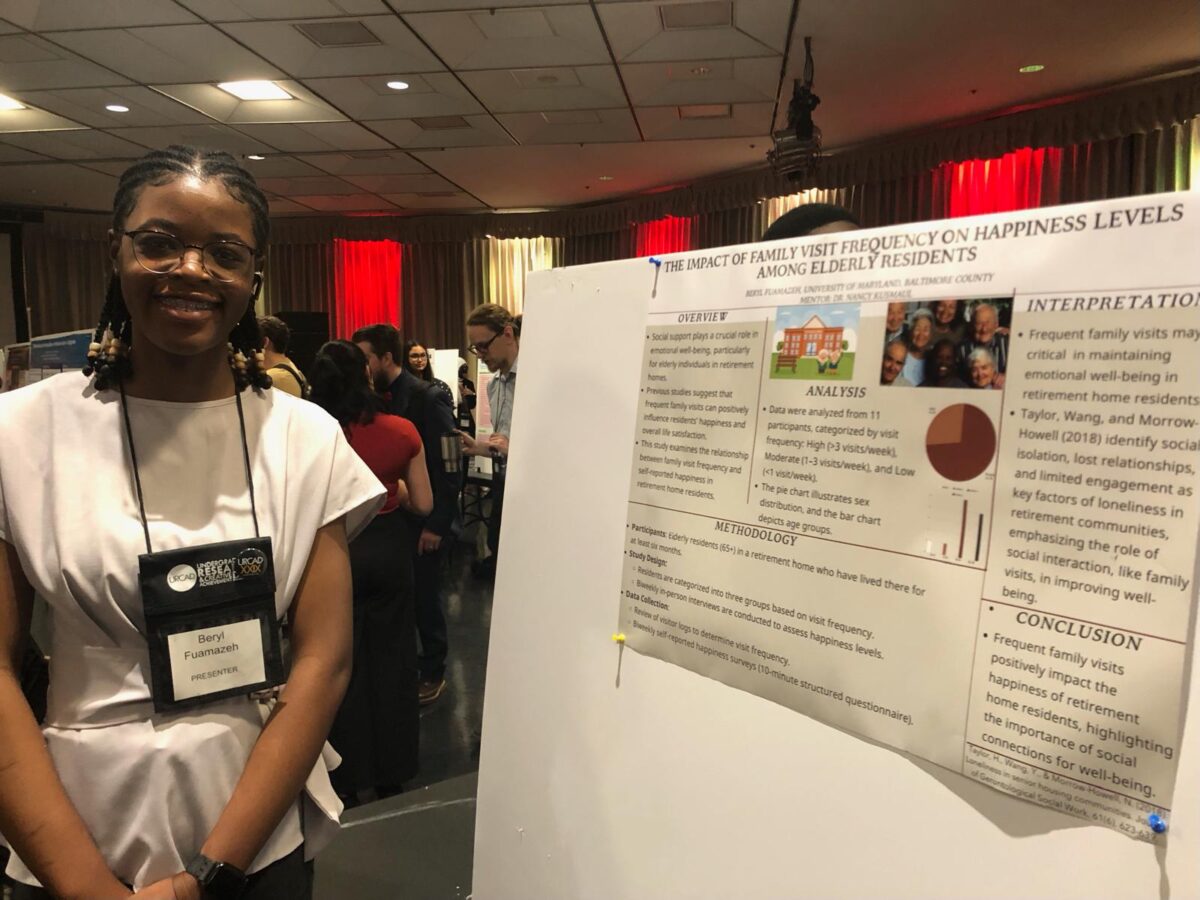
Right: Fuamazeh next to her poster at URCAD 2025.
Q: Tell us about the people who are helping you grow at UMBC.
A: Dr. Nancy Kusmaul has been incredibly instrumental in helping me grow at UMBC. She helped me kickstart my undergraduate research journey, which initially felt very daunting. All it took was reaching out to her by email, and she was immediately supportive and responsive. She took time out of her busy schedule to help me develop an individualized research study focused on aging, a topic that has become deeply meaningful to me and the communities it impacts.
Q: How have you connected with the community?
A: I have been involved in community programs, like volunteering with the Trusted Ride Program at Ascension Saint Agnes Hospital, which supports older adults and individuals with disabilities by helping them get to medical appointments safely. Experiences like this have allowed me to stay connected to the community while pursuing my interests in healthcare and aging.
Q: What would you tell others who are in your shoes about UMBC?
A: I transferred to UMBC from the Community College of Baltimore County, and through scholarships and financial support, including merit-based awards, UMBC helped ease the financial burden of pursuing higher education, which allowed me to focus more on my academics and future goals. I also felt well supported as a transfer student through the Degrees to Succeed program, even before officially transferring to UMBC. The transition felt smooth, and I always felt like there were people willing to help guide me along the way.
UMBC’s greatest strength is its people. When people meet Retrievers and hear about the passion they bring, the relationships they create, the ways they support each other, and the commitment they have to inclusive excellence, they truly get a sense of our community. That’s what “Meet a Retriever” is all about.