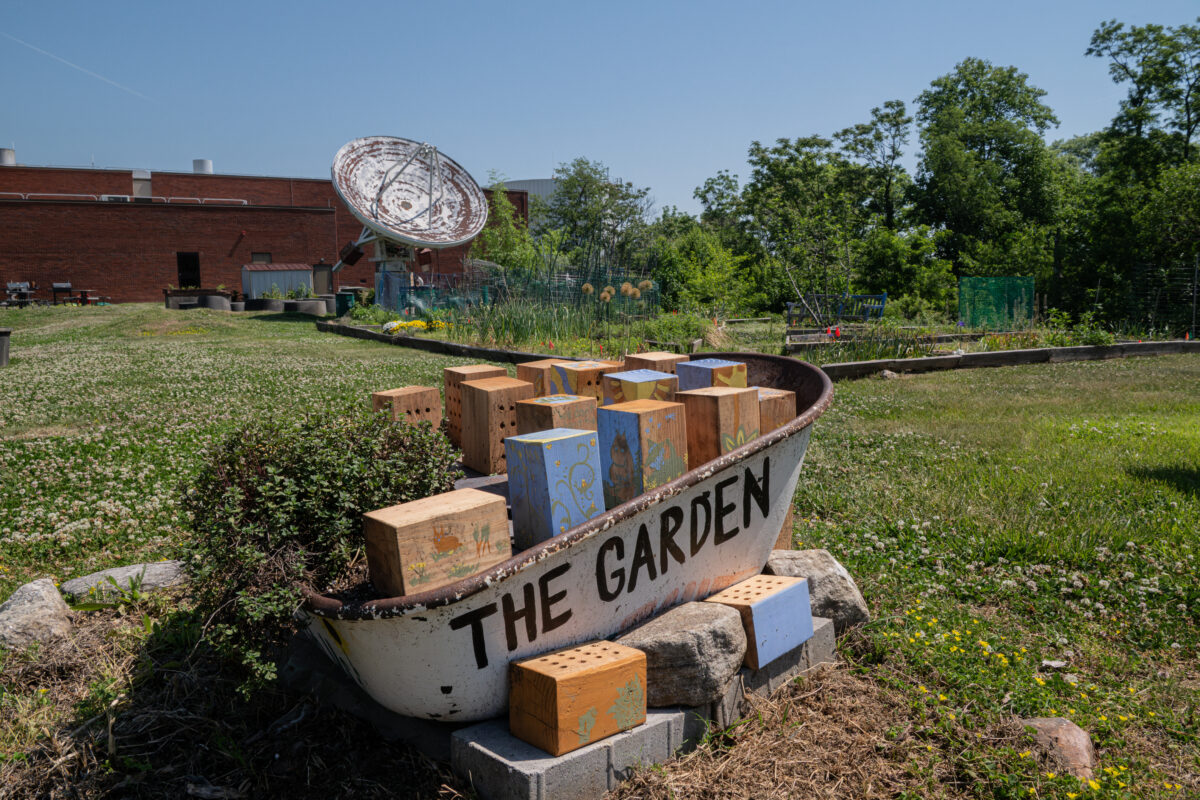
Each plant, whether a small wild buttercup or a massive oak tree, starts out as seed—packed with potential to grow well beyond its original size. By this logic, The Garden’s new Little Seed Library—co-sponsored by Retriever Essentials and the Office of Sustainability and installed by Facilities Management—is seeded with infinite potential.
Based on the now-familiar concept of Little Free Libraries that spread access to the love of reading, the Little Seed Library, down the sidewalk from UMBC Police, is set up for people to donate seeds (perhaps harvested from the adjacent garden) and those who want to put their green thumb to the test can take what they need to get started.
 Laila Kaira takes a look at what’s available in the Little Seed Library.
The idea stemmed from conversations Michael Berardi, assistant director of Retriever Essentials, was having with folks on campus about tangible ways to grow interest in the community garden while wanting to grow awareness of where our food actually comes from. “We want to help campus engage with our food in a more deep and meaningful way,” says Berardi ’19, M.P.S. ’25, who was also a co-founder of the campus-adjacent coffee shop, OCA Mocha.
Andrew Eisenhardt ’21 was one of the people talking to Berardi. He remembers: “We were hiking in the woods of Patapsco State Park brainstorming some ideas for Retriever Essentials. I had recently seen a YouTube video where a community put up seed libraries and people could go to get new seeds and donate their excess. I figured it could be cool to have something like that at UMBC.” Eisenhardt, who already graduated with a double major in geography and environmental systems and media and communication studies and is currently pursuing another bachelor’s in computer engineering, started working in The Garden during his first time at UMBC when he needed a break from doing homework and wanted to see what opportunities were on-campus to get outside and work with nature. “The Little Seed Library serves as a great starting point for community members to participate in and learn about this work,” he says. “Just get a seed, throw it in some soil and see what happens! Worst case scenario, your seed never germinates. Either way you’ll learn something about plants and you might even make some friends along the way who are trying to grow a better future.”
Jessica Graziano, who has been tending a plot in The Garden for several years, only foresees fruitful outcomes for the Little Seed Library. Eventually, in addition to seeds and instructions for planting, Graziano would like to see folks donate gardening tools and horticultural resources. Graziano, the current president of The Garden club, says her favorite thing to grow is perennials. “My current favorite is False Indigo, which I’ve had growing in my plot at The Garden for about two and a half years,” she shares. Recently recognized with a UMBC Community Impact award at SGA’s 2025 – 2026 CelebratingOrgs event, The Garden is lush with promise.
Nicole Wolf, UMBC’s sustainability coordinator, says that the Office of Sustainability has some nutrient rich ideas coming up in connection with the other organizations that help support The Garden. But in the meantime, “access to free seeds and gardening space removes the barrier of not knowing where to start, or even having to leave campus if they choose to use the community plots,” says Wolf. “We will continue to foster this culture by hosting regular ‘seed save collection’ events on our campus to keep the library stocked while teaching attendees about native plants and how to harvest ethically as we go.”