Alfred Boakye first began thinking deeply about the care and well-being of elders and their families while caring for his centenarian grandmother, Margaret Nyarko, in his home city of Tema, on the Atlantic coast of South East Ghana. She was in charge of her essential self-care routine—bathing, dressing, eating, toileting, transferring from sitting to standing, and continence—and more complex daily tasks necessary for independent living: medication management, meal preparation, transportation, and shopping. But even with her mobility, his grandmother lacked a social network.
Acting as both a devoted grandchild and a caretaker, Boakye experienced firsthand the complexities of aging. He learned to respect his grandmother’s independence while finding ways to support her where she needed help. Boakye, now a UMBC gerontology Ph.D. student in the social, cultural, and behavioral track, notes that his grandmother’s children didn’t live with her, and her grandchildren didn’t understand her aging process. As her friends and siblings passed away, her social circle shrank. “I asked her what motivated her to stay at church for hours, and she says the church supports her, brings her communion, visits her, and brings her Christmas gifts.”
After earning a bachelor’s degree in English and a master’s degree in human resources at the University of Ghana, Boakye wanted to broaden his understanding of aging and caregiving. In 2021, he moved to the United States to pursue a master’s degree in gerontology at Georgia State University (GSU), where he met his mentor and master’s thesis chair, Jennifer Craft Morgan, professor and director of the GSU Gerontology Institute.
 Boakye at his GSU master’s graduation. (l-r): Antonius Skipper, assistant professor of gerontology at GSU and Boakye’s master’s thesis committee member; Reverend Kwaku Owusu-Boachie, Boakye’s uncle; Boakye; and Craft Morgan. (Image courtesy of Boakye)
In 2023, the year his grandmother passed away and the year he completed his master’s at GSU, Boakye published his first aging-related article, “Does the Church Care? Assessment of Social Support Strategies on the Health and Wellbeing of Older Adults within the Tema Metropolitan Assembly-Ghana” in the African Journal of Ageing Studies.
Craft Morgan fostered Boakye’s interest in gerontology and encouraged him to continue his work at the doctoral level, leading him to UMBC’s gerontology doctoral program, which is an interdisciplinary program in collaboration with the University of Baltimore. “Professor Craft Morgan has held my hand from the day I started my master’s program and continues to do so today,” says Boakye. “I always feel privileged that I have her in my corner.”
Stigma of male caregivers
Boakye’s studies are also informed by his experience being the primary caregiver to his father. Before moving to the U.S., Boakye did the grocery shopping, cooking, and laundry for Stephen, his 76‑year‑old father. He became aware of the multiple obligations children have when caretaking for themselves, their families, and their parents, as well as the isolation that can happen, especially if you are a male caregiver.
At the time, Boakye saw himself as being a “helpful child,” a term associated with a Ghanaian proverb that states, “If they take care of you to grow your teeth, you take care of them to lose theirs.” The proverb is more than words—it is a way of life in Ghana, which reinforced Boakye’s caregiving role and emphasized what it takes to be a helpful child—one built on responsibility and reciprocity. But it’s easier said than done. “I had to juggle my ‘identity’ as a male caregiver in a historically patriarchal society with my caring masculinity,” says Boakye. “Caregiving is predominantly perceived as ‘women’s work’ in Ghana, and men who take on these roles are often stigmatized and labeled ‘Kojo besia,’ which translates to ‘man woman’. To avoid such labeling, I was hesitant to ask for help, despite the toll caregiving took on my physical and psychological well‑being.”
 Boakye presents his research on male caregiving to GSA leadership during their visit to UMBC in spring 2026. (Bradley Ziegler/UMBC)
Boakye presented his research and personal experience to the leadership of the Gerontological Society of America (GSA) during their visit to UMBC this spring. Thanks to the UMB Provost’s Global Scholar Program, Boakye will be traveling to Ghana this summer to engage with male caregivers—to listen to their caregiving experiences, explore what these experiences mean to them, and co‑create resources to support them. He will use this research to finish his master’s thesis in applied sociology—Boakye’s third master’s degree.
Meeting Japan’s centenarians
In 2024, Boakye joined the Global Healthy Aging in Japan study abroad program, organized by Taka Yamashita, professor of sociology, anthropology, and public health and co-director of the gerontology doctoral program. The two-week program leads students through research, community centers, and historic sites in Kanagawa Prefecture, near Tokyo. Japan is known for its cutting-edge research and policy that supports the active lives of the world’s largest aging population and the highest number of centenarians. The students visited multigenerational living communities and centers that merge theoretical research with real-world practice and outcomes.
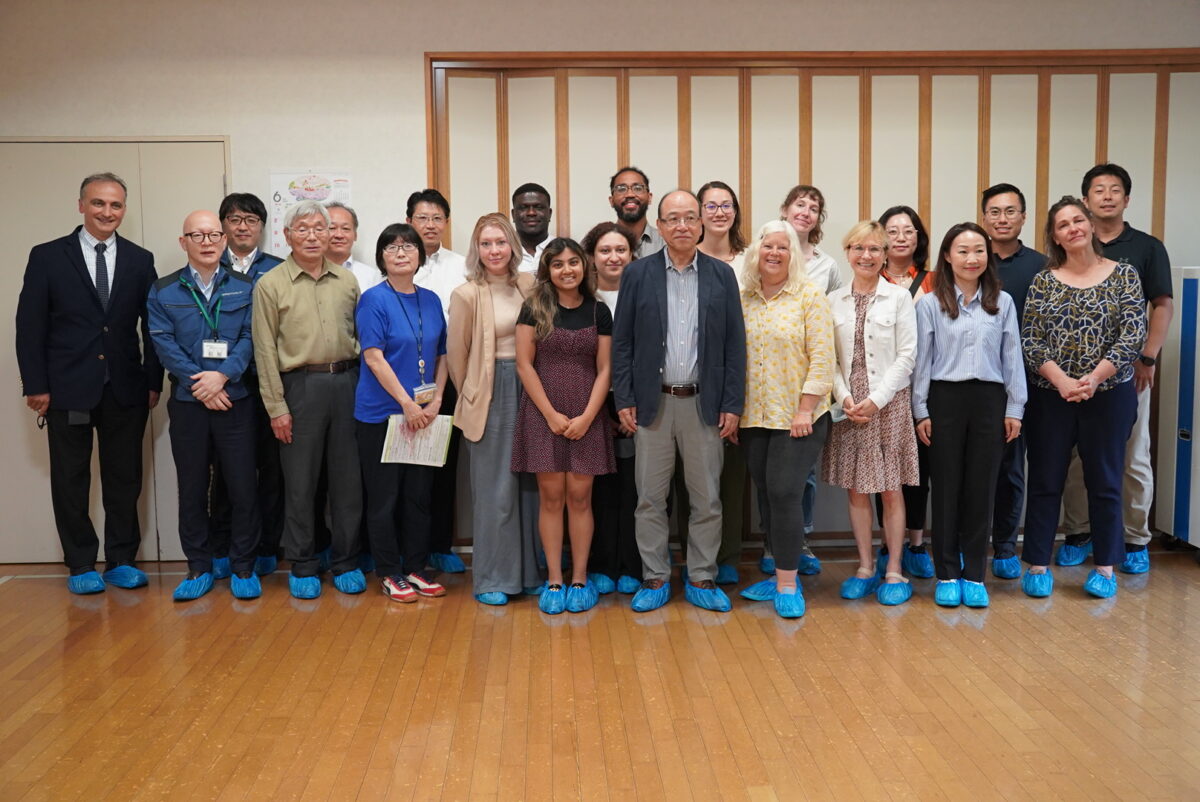 Boakye (second row, fifth from the left) at a senior center in Kanagawa Prefecture, Japan. (Image courtesy of TakaYamishita, professor of gerontology and sociology, second row, first on the right)
Boakye was not expecting that at a time when he was missing his grandmother the most, Kanagawa would make him feel like he was home in Tema. It wasn’t only that both Japan and Ghana operate on a similar collective familial care system focused on intergenerational living and inclusion, notes Boakye. It’s also the physical environment. “The buildings are close together, and people put chairs in front of their homes to talk,” says Boakye. “Older adults greet passersby, and people stop to have a conversation with them. They will tell you they are out for a little sun.”
A highlight of the trip for all the students was meeting a supercentenarian. The 110-year-old woman welcomed them and kissed each of them on the cheek. “All the students say that they were blessed to have this welcome and that she could still talk to us,” says Boakye. “It was really emotional for me. I just kept thinking of my grandmother.”
Boakye was also impressed by the Kanagawa ME-BYO approach to aging, which encourages monitoring vital signs using biomedical technologies. ME-BYO focuses on preventing and minimizing illness progression through programs that promote healthy behaviors such as a balanced diet, exercise, and social activities. “My experience in Japan has been one of the best things that has happened in my personal and academic life and in my career,” says Boakye, who wants to find a way to incorporate ME-BYO into his current and future caregiving research and practice. “This trip has equipped me with the cultural competence, literacy, sensitivity, communication, problem-solving, and critical thinking skills needed to have a real-world impact in the field of gerontology.”
Looking Ahead
With five years of longevity research, Boakye now understands that his grandmother’s experience is common for many older adults in Ghana. He discovered in the 2021 Population and Housing Census of Ghana that adults 65 years of age and older make up 4.3 percent of Ghana’s population. However, he explains, the need for person-centred and geriatric care services has not kept up with the demand.
“I feel like I am now clearly connecting the dots between my experiences in Ghana, what I saw in Japan, and what I have learned in class. I am passionate about encouraging more men to engage and support the people they love, but also seek help when they need it,” says Boakye. He plans to finish his doctoral program in fall 2027.
“It has been a pleasure to watch Alfred’s research grow during his time at UMBC,” says Nancy Kusmaul, professor at UMBC’s School of Social Work, his dissertation chair, who Boakye works with as a research assistant. “He is committed to raising the voices of paid and unpaid caregivers who provide vital services to older adults and people with disabilities in the US and abroad. I am confident that he will continue to make significant contributions to the field.”
He knows there is a long road ahead, but he is confident that he is on the right path. “I want to build culturally relevant and gender‑sensitive resources that support male caregivers, not only to improve their health and well‑being but also to amplify their voices when it matters most.” His grandmother, Margaret, continues to inspire Boakye’s work on how caregiving shapes the experiences of both the carer and the care recipient.