When Demetrie Garner moved from Maryland’s Eastern Shore to Baltimore, he found a wealth of opportunities in Baltimore, a strong spiritual practice, and a supportive network of friends and family. They became necessary anchors for recovering from opioid dependency and managing the workload of a full-time job while earning a bachelor’s, a master’s, and now a doctorate in public health from UMBC.
“My story has a lot of twists and turns. I came to Baltimore in 2018 for treatment for opioid use disorder after experiencing homelessness, incarceration, hospitalizations, and treatment programs. Recovery was a process of 26 years,” says Garner, who now works in the Baltimore City Mayor’s Office of Overdose Response. “When I came to Baltimore, I had a clean slate. I was able to go through an expungement process of criminal records, which was a list of misdemeanors that happened during my drug and alcohol addiction. My journey to UMBC began as an adult learner, at 40 years old, after a year in recovery.”
Understanding the bigger picture
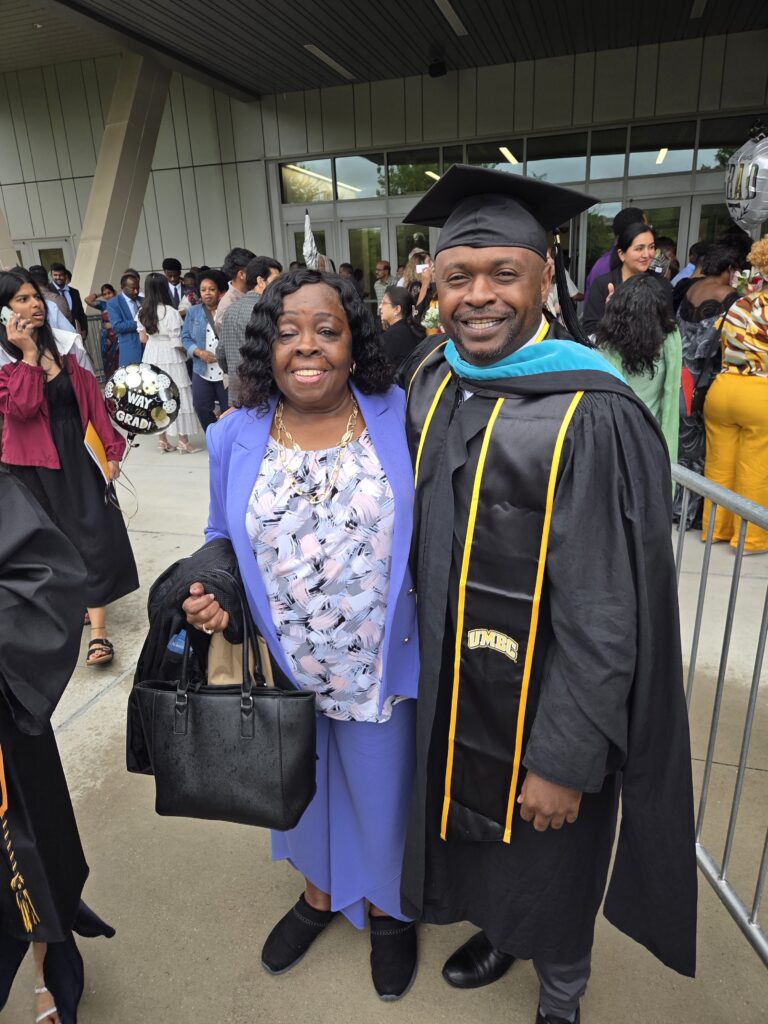 Garner with his mom, Clara Turner.
The inspiration to pursue a bachelor’s degree came from working as a recovery specialist at Franklin Square Hospital in Baltimore County, where he supported patients who had overdosed or were experiencing substance use disorders, many of whom faced significant social and economic conditions that negatively affected their health. Although he connected patients to treatment and recovery resources, he questioned why so many returned to the emergency department with the same challenges. That curiosity sparked a desire to better understand the systems, policies, and social factors driving addiction and recovery.
“I wanted to understand how healthcare is failing people in recovery,” says Garner. “I decided to go back to school. The logical step was to study public health.” Making the leap from working full-time and being a full-time student without a driver’s license posed many challenges. Thankfully, in addition to his faith, friends, and family, Garner also had a team of mentors at UMBC’s School of Public Policy that continue to support him to make his vision possible.
Garner immersed himself in public health research and learned about comorbidities, where patients are managing multiple health needs like substance dependency and mental health. He found that having multiple health needs with little to no healthcare is also exacerbated by homelessness, lack of transportation, inconsistent healthcare, or an environment not conducive to recovery. The emergency room could treat the symptoms but not the root causes.
“My undergrad journey into public health was transformative because the curriculum I was learning for the core courses in public health also exposed me to psychology and epidemiology,” says Garner. “UMBC helped me understand what was needed for me to actually serve. If I wanted to be of service, then I needed to understand not just what leads people into substance use disorder but also what drives the research.”
No limits in sight
Each learning moment inspired great curiosity. Garner sought faculty for advice and opportunities. A game-changing moment came in a research methods course with Pamela R. Bennett, professor of public policy. Bennett encouraged Garner to think beyond what was stated in the research and analyze what was in between the lines.
“I got a D in one discussion post, so I went to Dr. Bennett’s office hours. She told me to stop synthesizing information and to start thinking critically,” says Garner. “That was a game changer because I translated what she said to me into my work.”
“UMBC offered me, someone with a lived experience of homelessness and substance use disorder, a door that I would normally not have access to. College is an opportunity to discover who you are and what matters to you. Don’t be afraid to engage with professors, challenge ideas, and use your voice.Demetrie Garner ’23, public health, and M.P.P ’25
Another game-changing moment came in Lauren Hamilton Edwards‘ class. Hamilton Edwards, associate professor of public policy, told the class at the beginning of the semester that everyone had an A until they didn’t. Garner interpreted that as an incentive to do his best every day. “From the beginning, she gave me the kind of nurturing I needed,” says Garner. “Now, when I have an intern, I make sure that I’m the “Dr. Lauren Hamilton Edwards” to that intern, as she was with me.”
Additional supports like the McNair Scholars Program gave him the foundation and confidence to pursue graduate school, and his first experience presenting his research at UMBC’s Undergraduate Research and Creative Achievement Day was a humbling experience, he says.
 Garner with Baltimore City Mayor
 Brandon Scott.
Garner is thriving thanks to the support of the faculty and staff in the public policy and sociology, anthropology, and public health departments, who recognized his potential.
“Associate Professor Andrea Kalfoglou called me Dr. Garner long before I believed it myself. My faculty advisor, Katie Birger, associate teaching professor, recognized my potential early on and encouraged me to pursue the B.A./M.A. pathway,” says Garner. “Now, with Professor Nancy Miller‘s mentorship, I am on track to finish my coursework by the end of the fall semester and begin my dissertation proposal in the spring of 2027.”
“Don’t be afraid”
As Garner’s expertise in public health and policy grew, so did his career opportunities. Today, he serves as the quality assurance manager for Baltimore City’s Behavioral Health Consent Decree. His work focuses on improving outcomes for people experiencing homelessness, substance use disorders, and behavioral health crises, giving him a unique perspective on how public safety and public health intersect to advance overdose prevention and crisis response.
“I no longer see those 26 years to recovery as a period of failure. They gave me lived experience that I now use to help others entering recovery,” says Garner, who, throughout that time, drew strength from the unwavering faith of his grandmother, Hazel Parker; his sister, Shontell Cooper, and his mother, Clara Turner, who never stopped believing change was possible. He hopes his story inspires others to begin their own path to healing.
“UMBC offered me, someone with a lived experience of homelessness and substance use disorder, a door that I would normally not have access to,” says Garner. “College is an opportunity to discover who you are and what matters to you. Don’t be afraid to engage with professors, challenge ideas, and use your voice.”