If senior Kayla Nemirovsky’s passport could talk, the first thing it would likely say is, “I’m tired.” Despite having local roots, first attending Mount Hebron High School in nearby Ellicott City and then continuing her academic career 10 miles away at UMBC, Nemirovsky has always felt most at home on a plane. She has visited over 30 (!) countries with no signs of stopping her travel now. Thanks to the support and guidance she received from UMBC, she’ll be staying here to pursue a master’s in teaching.
Q: With dual degrees in math and financial economics, it’s a little surprising that one of your greatest passions in life is traveling. How did you catch the travel bug?
A: I was four, if not younger, when I took my first international trip. We traveled a lot as a family and have always had a big love of it. When I was in middle school and early high school, my grandpa took my cousin and me on three trips to Europe, which we’re very grateful for. It was a really great snapshot into a lot of places. Both of my parents are immigrants from the Soviet Union, so growing up, my dad traveled around the Soviet Union a lot with my grandpa. It’s just something that is ingrained in our family. Seeing new places, learning about cultures, trying new food, and learning about the history of places when I’m going to them—that’s what’s fun to me.
Q: With such a pull to travel and see the world, why did you decide to continue your education locally at UMBC?
A: I knew I wanted to stay local-ish and take advantage of in-state tuition. My dad [Sergey Nemirovsky ’03, computer science] went here and I worked at the UMBC summer camp in high school. I met some people who went to UMBC and they showed me around and let me know what it’s really like. But when I was accepted into the Sondheim Scholars Program, that really sealed it for me. My brother [Sam Nemirovsky ’27, mathematics] is a first-year student here, and it’s funny because we’re both math majors but doing it in entirely different ways. He’s working with applied math, and I know that’s just not for me. It was also so important for me to build study abroad into my college experience.
 Nemirovsky and friends traveling in snowy Finland.
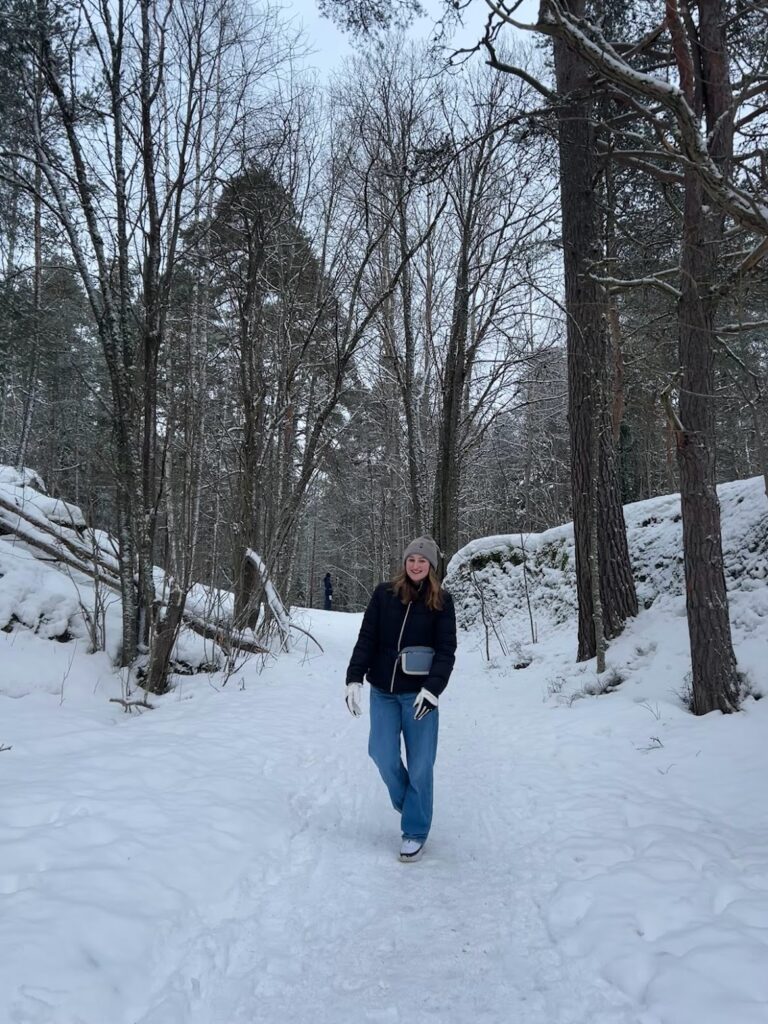 Enjoying a walk through Finland’s winter wonderland.
Q: How would you describe the Sondheim Public Affairs Scholars Program to someone who isn’t familiar with it?
A: We focus on not only policy, but also community engagement and service. Throughout all of freshman year, we’re doing community service, involved mostly in Baltimore and just getting a chance to see local communities. And then we go through our years at UMBC as a cohort. Some people graduate early, but for the most part, for us, it’s been 12 people, together. The other cool thing is it’s a very diverse group of majors so you get a lot of different perspectives and people trying to implement policy in different ways or just seeing how it comes to play, not just in government. It’s been great having that community throughout to push each other. We push each other to really exceed and make the most of our college experiences.
 Nemirovsky, left, with President Valerie Sheares Ashby and members of her Sondheim cohort.
Q: Do you have any advice for students who are unsure what they want to do?
A: Go with what you like and what you enjoy. Obviously having a job is ideal, so be a little more realistic with what you’re studying but think about how you could apply it and investigate that. And be flexible! I texted my mom a couple of times my first year thinking out loud, “What if I add this minor? What if I do this major?” And she said, “If you want to and if it makes sense, do it.”
I knew that I would love to have a job where I have the flexibility to travel but never really as a career. I had no idea what exactly I wanted to do but I always liked math, so figured maybe that route. And then I had a really good high school economics teacher [Vann Prime] who was state recognized, and I decided to go down that path and see where it takes me.
Q: So many students think it’s not possible to study abroad with their academic course load or they can’t fit it into their schedule. What would you say to them?
A: As an Education Abroad Advisor, I talk about this all day, every day. I think everybody should study abroad and there’s so many new ways to do it too, especially with the faculty-led programs that are really growing. Even in these super packed majors where you feel like you have to be here every semester, you can still travel for a short-term winter or summer faculty-led program. They’re really meeting students where they are to give them opportunities.
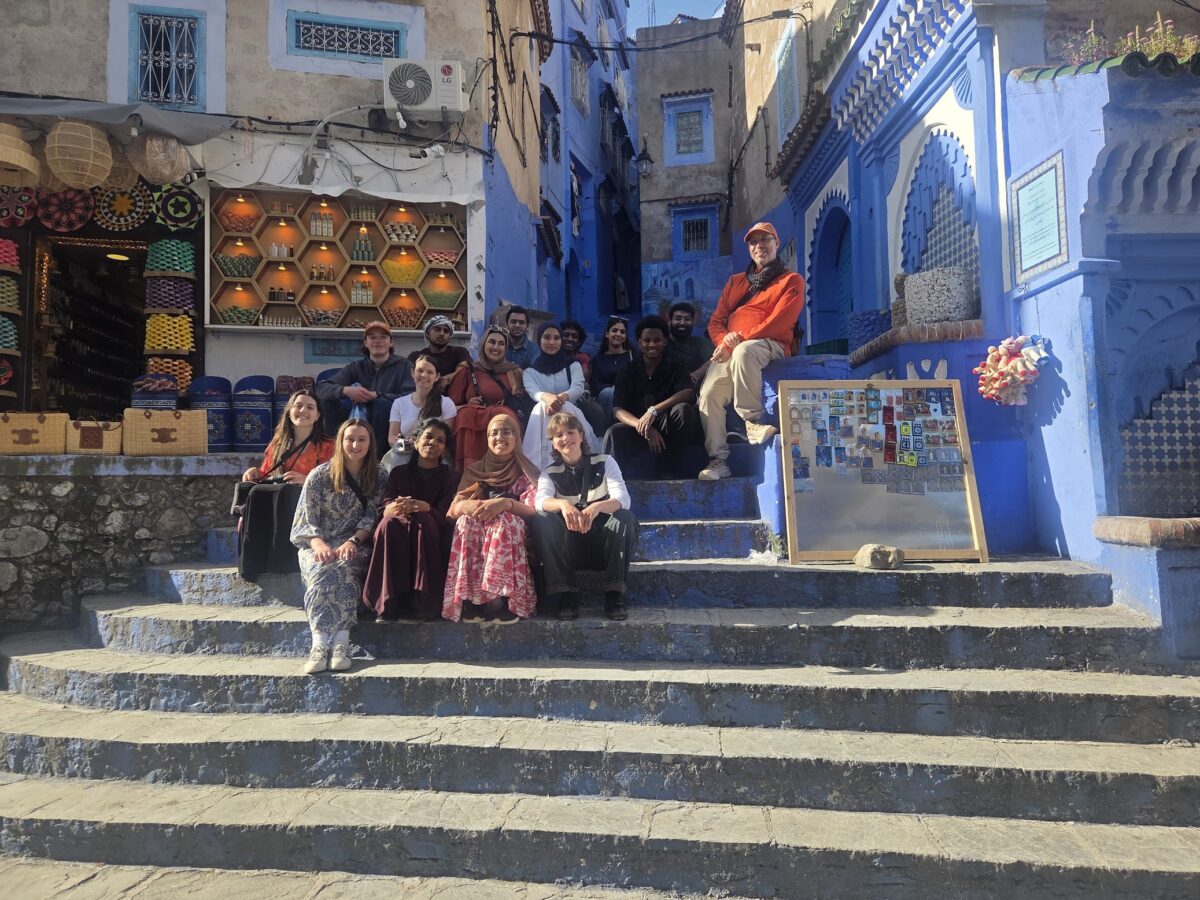 One of Nemirovsky’s many trips abroad with classmates traveling in Morocco.
Q: Have you had mentors who have influenced you throughout your academic career. What does mentorship look like and mean to you?
A: I view mentorship as something that has to be beneficial. Through the Sondheim Program, we were assigned mentors freshman year, and I originally wasn’t sure how to feel about it, and I didn’t know if we would connect in a meaningful way. But it’s been one of the things I’ve enjoyed most. Jess Cook [associate director of Sondheim] connected me to Josh Michael [’10, political science, Ph.D. ’22, public policy], who helped me get my internship at the Maryland State Department of Education and was one of my mentors. From there, this internship helped me solidify the work that I want to do in math education curriculum and policy and helped me figure out what my next steps need to be after college. The internship also helped me to expand my connections in the field and shaped my plans for senior year and beyond.
Q: Are there other ways your mentors have helped you?
A: I’m a person who needs a path. And I realized once I got to college that there’s kind of no more path, I have to make my own. That was really scary to me, so having mentors who can help me make this path…give me advice and offer suggestions, that was extremely helpful. I really believe you have to choose the people you look up to and kind of aspire to be them.