Ten minutes south of True Grits, food is also being prepared for the local community. It’s 8:30 on a Wednesday morning in the parking lot of Arbutus United Methodist Church. To the right of the church building is the Southwest Emergency Services (SWES) office, where the clanking of canned goods on metal shelves and the rustling of brown paper bags echo in the back warehouse. Legacy volunteers, a UMBC Shriver Peaceworker Fellow, and Shriver Center undergraduate student volunteers quickly stock shelves and prepare to fill grocery bags with donated goods for families in the surrounding 21227 or 21229 zip codes in need of food assistance.
Rosmery De Jesus Dinzey Santana, a senior psychology student, pops out of the dried goods room to check the first order. She writes the number three on a sticky note and sticks it to a grocery cart that gets passed around from volunteer to volunteer, until it gets all the way to the back to Joan Birmingham. She is clad in a long-sleeved flannel, baseball cap, and plastic gloves to keep somewhat warm as she moves in and out of freezers—one for chicken, one for beef, one for pastries. Birmingham, a volunteer of 20+ years, quickly spins the cart back around, pushing it down the long hallway, the wobbly wheel hitting the metal, making a ding sound like it’s announcing it’s ready to check out.
While UMBC and SWES have been in close proximity for decades, it’s relatively new that an intentional cohort of Retrievers regularly volunteers there. This shift was led by a UMBC Peaceworker Fellow, Megan Hamilton, who began working with SWES for 20 hours a week in fall 2025. The Peaceworker Fellows Program, based in UMBC’s Shriver Center, offers a master’s degree in social change leadership for returning Peace Corps Volunteers. Fellows are required to complete 20 hours a week of service with community partner non-profits, government agencies, or campus-based service-learning for the entirety of the program, says Charlotte Keniston, Ph.D. ’24, language, literacy, and culture, an alum and current director of the program. “We now have weekly undergraduate volunteers working with the legacy volunteers, UMBC staff supporting grant writing, and a team of graduate students creating a data management system for them,” Keniston says.
A call to serve
For Hamilton, the experience has been deeply fulfilling. “Community service is one of the happiest things I can do with my life,” she says. “I think in this particular time, people have lost track of the joy of service a little bit.” The Retrievers at SWES are working to bring that back.
Back at SWES on Wednesday morning, it’s getting close to 9:00 a.m., and a stream of cars fills the parking lot. Hamilton greets each client with a genuine ear-to-ear smile as they walk in the door. When Hamilton sees Birmingham, she grabs the cart, calls on the family of three, and helps them get the cart out of the narrow doorway into the parking lot. Diane Moberg, a church volunteer and SWES board member, steps into the dried goods room to help unfold grocery bags while she waits for the next financial services client to arrive.
Hamilton has a booming, happy voice and laugh. She has deep roots in Baltimore’s grassroots organizing and co-founded the Creative Alliance in 1994, a performance and art community space in the city. Her big heart has also taken her around the world in the service of others, including her Peace Corps service in Albania.
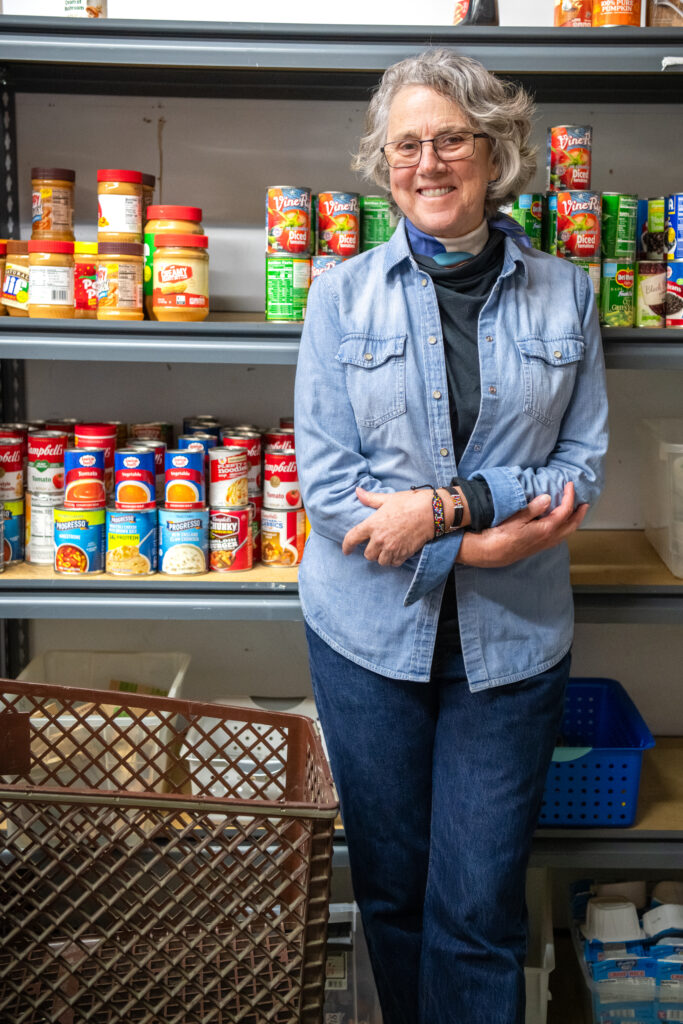 Megan Hamilton at SWES. (Brad Ziegler/UMBC)
Hamilton was beaming this morning because the Maryland Foodbank, which donates food to SWES, had just conducted a site visit and was impressed with how SWES is committed to shifting to a choice food pantry—a labor of love for Hamilton. Choice food pantries function similarly to a grocery store, where clients select the food they take, increasing agency and reducing waste.
“The loving energy catalyzed when the students meet, learn from, work with, and teach their elders is awe-inspiring,” says Hamilton. “It has meant worlds to the elders and the students, and those friendships are laying the groundwork for SWES’ long-term sustainability.
In the future, SWES is also looking to evolve its financial assistance program, where families receive partial funding to prevent evictions, utility shut-offs, and prescription costs. SWES covers part of the bill, and the family covers the rest. SWES hopes to leverage the renewed partnership with UMBC’s Peaceworkers and Shriver Center volunteers to develop a financial literacy skills program to help families become economically stable and prosperous, and pass those skills to future generations.
Powered by volunteers inspired by the community
Hamilton says part of what’s making the relationship between SWES and UMBC work so well is the physical proximity, as well as a shared commitment to service in the Baltimore area.
Dinzey Santana, the only Spanish-speaking volunteer, provides language support for Spanish-speaking families, helping to translate their needs to the rest of the team. She is quiet but fierce in her service, consistent, a master of organization, and overall just awesome, Birmingham says.
“I went to high school in Silver Springs with a lot of Latinos. Coming to UMBC, I learned so much about what is possible, and yet there is still so much that I have to learn. I want to go back and work with other Latinos to show them that it’s possible to go to college and give to your community at the same time,” says Dinzey Santana, almost at a whisper, smiling, and gliding between carts, bags, and shelves without stopping or looking—muscle memory. While she started UMBC on a pre-med track, after taking some psychology and social work classes, she was drawn to community-engaged work. Birmingham, Moberg, and Hamilton can feel her resolve. “I want students not to get frustrated if their path is unclear. Sometimes, the best path for you is not the one you set your heart on. There isn’t one path, and there is help. Everyone deserves help.”
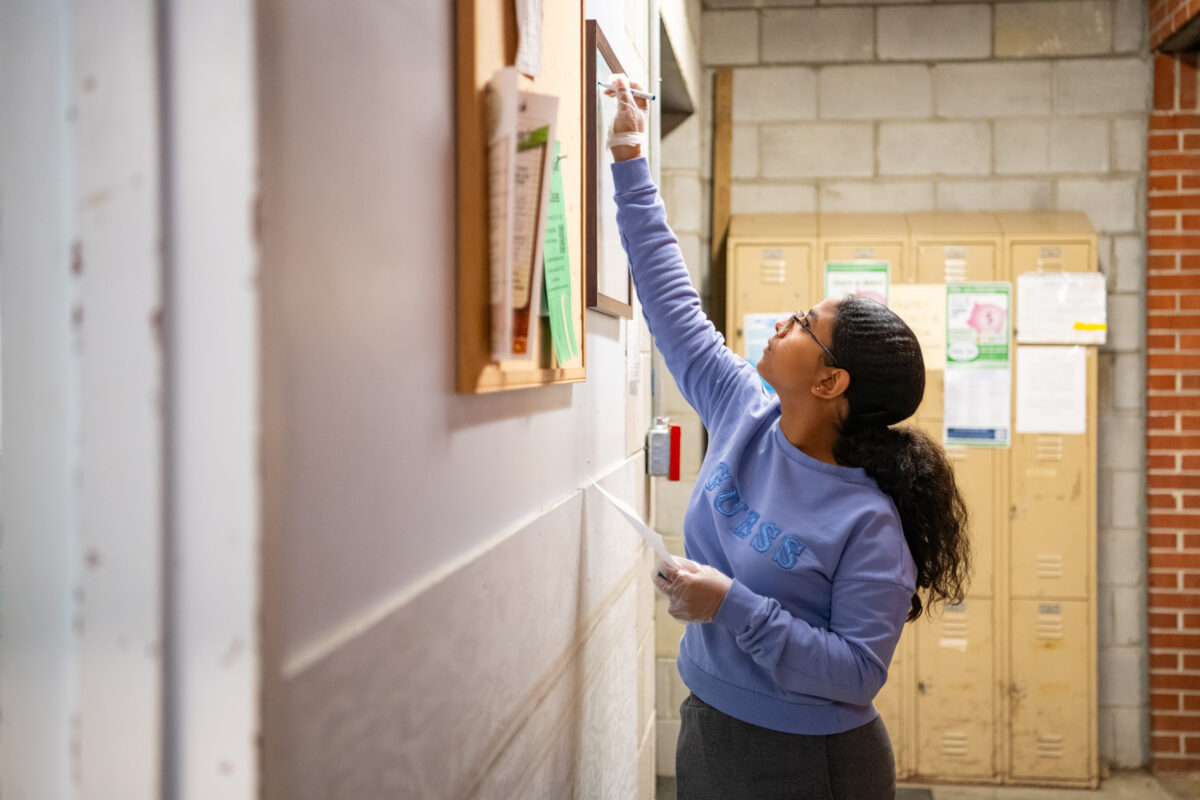 Rosemery De Jesus Dinzey Santana writes the names of the families picking up groceries. (Brad Ziegler/UMBC)
Working on a prayer
The UMBC volunteers serve alongside legacy volunteers from the community and surrounding areas who have, in some cases, been volunteering for decades. Star legacy volunteer Naomi Morris is ninety-two and has volunteered at SWES for thirty-years. Birmingham says that although SWES has seen its share of challenges, she is continually touched by the people she meets and the way they make it work.
Before becoming part of the SWES volunteer team, Birmingham worked in warehouses for 36 years, stocking and organizing shelves. “I wasn’t quite sure what I wanted to do after I retired,” she says. “I found out that [SWES] needed help through my church. I thought I would give it a try.” She started hanging clothes for their clothing donation shop for a day or two. “But I saw everything that SWES was doing, and it was unbelievable. It touched my heart. The people I have met here are just unbelievable.”
Moberg, who is a certified public accountant, joined the board and became a volunteer to support the financial assistance program. “I recognize things are really hard. Let’s face it, expenses have gone up exponentially. Gas, everything. Low to mid-range wages are not keeping pace. So, it’s really disheartening, which is why the finance mission is an extremely important one for me. “
Sometimes, when the pantry and the financial assistance dwindle, and there doesn’t seem to be an answer to how SWES will serve its community, Birmingham throws out a request to the heavens. “I learned it from my friend who volunteers with me. She just calls it out, ‘We need more of whatever it is,’ and sure enough, the next day someone walks in with what we need. Last week it was pasta, this year it was volunteers—both came in abundance, and Megan, Rosmery, and all the UMBC volunteers are now helping us legacy volunteers to keep it all going.”