After Shanika Freeman ’24 walked across the stage, she had something on her mind—basic human rights. For the past four years, Freeman’s research has focused on the reentry experiences of formerly incarcerated women in the United States and Maryland. Basic human rights—including access to healthy food, education, housing, healthcare, clothing, and job skills development—are difficult to access for people in the reentry process due to limited to no financial resources, support networks, services, and stigma.
“In Maryland, over 15,000 women are released from prison every year. Just imagine, you’ve been released, and unfortunately, you couldn’t get a transitional program or reentry program, so you are basically by yourself,” said Freeman during her individualized study major’s capstone presentation. “You go out, you kiss the ground because you know you are free, but you are only given about $50 to $100 of gate money to find transportation and all your basic needs.”
Reentry programs are not the root of these obstacles. During her research, Freeman learned that the U.S.incarceration system’s emphasis on punishments rather than rehabilitation means many women are released without workforce skills needed to meet the demands of a changing job, let alone recreate a new life. All of these factors increase recidivism rates.
“I wasn’t born to be caged up and chained up,” is a quote by Susan Burton that inspired Freeman to continue her research on successful reentry pathways. Burton is the founder of A New Way of Life Reentry Project, a non-profit organization in California that provides safe housing, pro bono legal services, advocacy, and family reunification for formerly incarcerated women. Leading with compassion inspired Freeman to seek similar approaches in her own work.
She didn’t know at the time that her search would lead her to Norway, whose incarceration system is widely recognized as one of the most humane rehabilitative institutions in the world. Their rehabilitation process emphasizes mentorship, skill-building, communal living, mirroring regular life based on the Norwegians’ belief that the only right a person loses through incarceration is liberty. As a result, Norway has one of the lowest rates of recidivism in the world. Thanks to a 2025 – 2026 Fulbright U.S. Student Program award, Freeman crossed the Atlantic to Bergen, Norway, to conduct research on the reentry experiences of Norwegian women into the community after incarceration.
Janteloven, a culture of humility
For the first time, Freeman boarded a plane, leaving the United States and Baltimore for Bergen, a city on Norway’s southwestern coast known as the city between the seven mountains. Freeman quickly found that life in Bergen is about enjoying nature. She remembers walking from her small studio apartment to the University of Bergen and seeing hikers everywhere. While cross-country skiing is the official national sport, hiking is an integral part of Bergen culture. Freeman joined the locals on both activities, and suited up with hiking boots and cross-country skis—also a first.

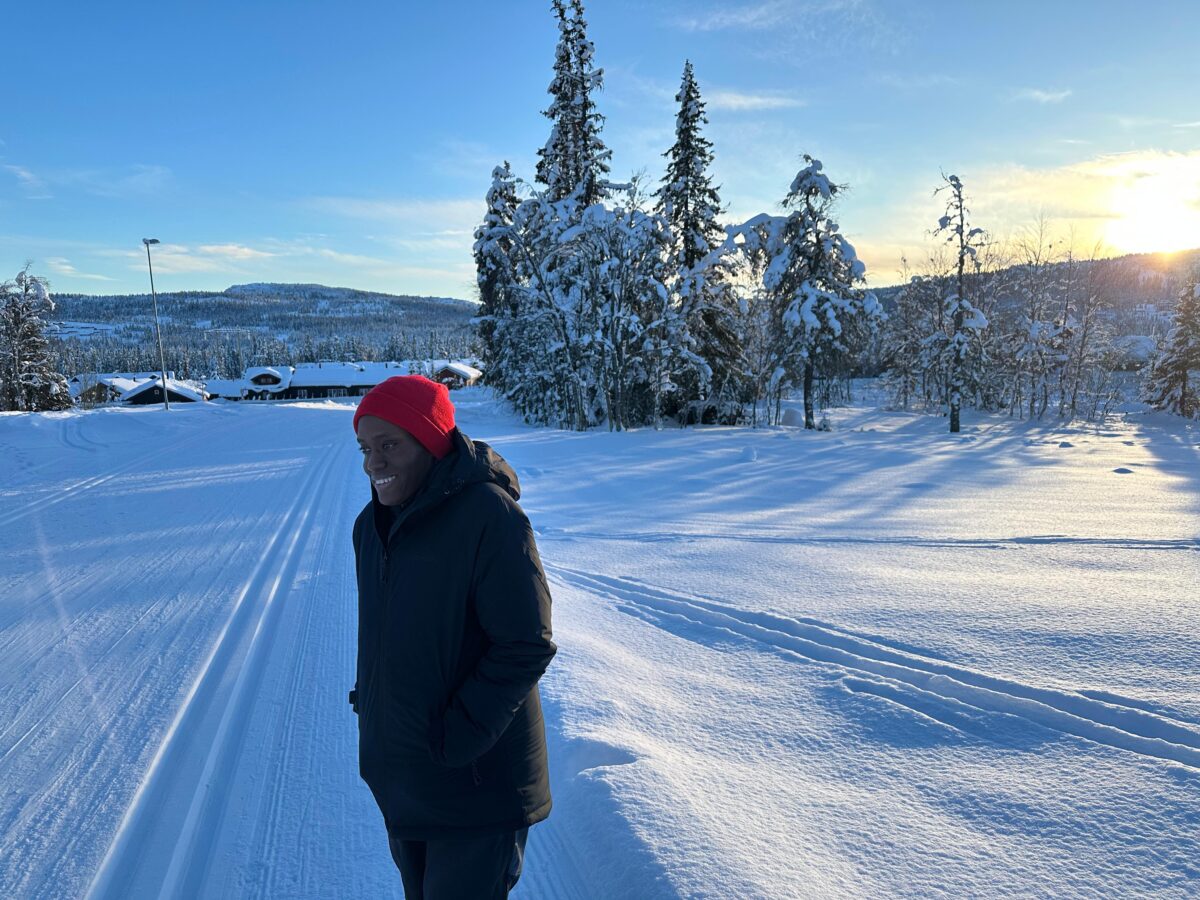 Left: Freeman cross-country skiing in Gausdal, Norway. Right: Freeman enjoys a walk in the mountains.
“I love this city. It’s not crowded. You can take a hike up a mountain any day of the week. Mount Fløyen is the closest and most popular mountain in Bergen,” said Freeman. “So many beautiful views and at the top, you can also get hot chocolate, coffee, and Norwegian waffles. It’s all really nice.” While she enjoyed the outdoors, Freeman did have some first-day jitters when it came time to join the research team.
“I was a bit hesitant when I arrived because I had just graduated with my bachelor’s, and most of my colleagues had a Ph.D. or were earning one. I was a bit worried about fitting in. But they welcomed me with open arms,” says Freeman. “Bergensere really value you and your voice, no matter what. It doesn’t matter if you have a degree or not, they really value you and make sure your voice is heard.”
This practice of equality and community above all is called Janteloven, a Scandinavian cultural, social, and literary concept that emphasizes equality, humility, and collective conformity over individual achievement. Freeman’s welcome was an example of Janteloven. This extends to architecture, clothing, and even standing in line.
“I was a bit hesitant when I arrived because I had just graduated with my bachelor’s, and most of my colleagues had a Ph.D. or were earning one. I was a bit worried about fitting in. But they welcomed me with open arms,” says Freeman. “Bergensere really value you and your voice, no matter what. It doesn’t matter if you have a degree or not, they really value you and make sure your voice is heard.Shanika Freeman ’24
Individualized Study
“From my perspective, a lot of Norwegians are sort of hard to crack because they don’t usually do small talk. Back in Baltimore, if you’re standing in line at the grocery store, you can strike up a conversation with anyone. Not here so much,” explains Freeman. “They’re not being rude. They value your time, and they value their time as well, and don’t want to inconvenience anybody. It’s a cultural norm.”
Janteloven in the prison system
Possibly because of this norm, it took time for Freeman to find participants who wanted to focus on their own story. “It’s such a sensitive subject that I researched. One of the challenges I faced was helping participants feel comfortable speaking,” said Freeman. “I talked about their feelings during incarceration and reentry. It’s a very vulnerable state to be in.” Her Fulbright research advisors stepped in and connected Freeman with a few participants and guided her to pivot from solely focusing on reentry to include the system side of the process by speaking with experts in the field of criminology and penology—the philosophy, management, and effectiveness of prison systems and rehabilitation methods.
“One of my main findings was that Norway’s successful reentry is shaped primarily by its welfare system. It is set up to help with social support, housing, education, and job support. They have something called the import model,” said Freeman, “which means that they rely on external public services like healthcare, education, and libraries that are delivered by community providers rather than the prison staff themselves.” Freeman notes that this is in stark contrast to what she found in her research on the U.S. reentry process, where these services are usually contracted out. In Norway, staff are almost always civilians from the same communities into which the residents—Norway doesn’t use the term inmate or prisoner—will be released.
Freeman found a successful example to observe at WayBack, a Norwegian nonprofit foundation that supports formerly incarcerated individuals’ return to society by coordinating services and building networks for successful reintegration. However, the process doesn’t end there. WayBack’s approach to intervention is also based on peer-to-peer mentorship, a form of rehabilitation support Freeman has rarely seen in Baltimore.
 Freeman presents her research at Bergen Global. (Image courtesy of Freeman)
“Norway’s welfare state and broader cultural belief systems, Janteloven included, reinforce the idea that the conviction and sentence to prison itself is the punishment,” Freeman explained. “So while you are inside, rehabilitation should be the main priority.”
But nothing is perfect. Another of Freeman’s findings includes the shortcomings of the Norwegian incarceration system. Freeman explained that there are prisons where women have limited gender-specific support and lack the services needed to overcome major barriers, including trauma, addiction, and mental health. “There was a recent report criticizing Trondheim Prison, a few hours from Bergen, due to human rights violations,” said Freeman, after submitting her research. “This was extremely surprising to me. They were in violation of mishandling medication, isolation, and unsanitary conditions, to name a few. So, despite all of the progress, there are still things that aren’t being addressed as quickly as others might want, but at least they are working to address it.”
Human rights in Bergen and Baltimore
After four seasons in Norway, Freeman is packing up and preparing to return home to Baltimore, leaving with a greater appreciation for Janteloven. She is hopeful that one day she will return to the city between the seven mountains either for travel or to pursue a master’s program to continue her research. In the meantime, Freeman is already working on adding a visual element to her research, as she plans to spend the summer filming a documentary on the impact of incarceration on Baltimore communities and families.
“Having both the reentering system and the criminal system perspectives made my research stronger. My main goal is to work with reentry programs or even programs inside the prison system,” says Freeman. “I want people to think about the human rights of people in the prison system. No matter what they did, just because they were inside, it doesn’t mean they don’t deserve basic human rights.”
Read more Fulbright stories and learn about UMBC’s Fulbright preparation.